How Many Riders Will Use The Crosstown (2)

In a previous article, I discussed the Eglinton-Crosstown LRT subway and the issues raised by demand projections for it.  On July 26, I met with staff from Metrolinx to explore the subject in detail, and this post summarizes our discussion.

What Network and Land Use Drove the Demand Model?

Before we can understand the numbers generated from any model, it is important to know the assumptions behind it.  Is the network a realistic view of services that will actually be in place?  What residential and work locations and densities are used to generate the travel demand flowing through the model?

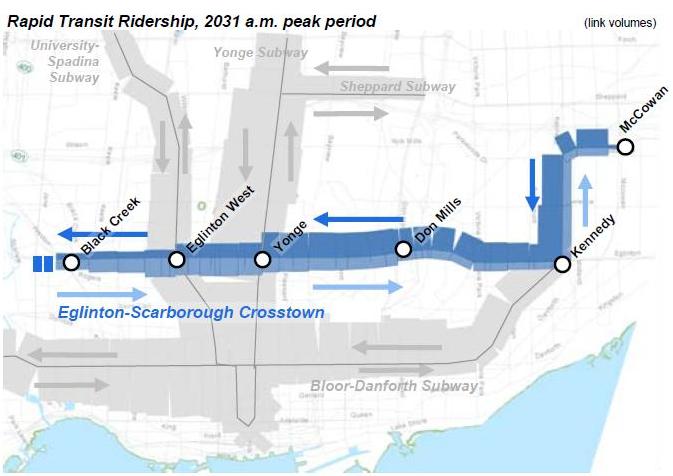
Notable by their absence from the map of passenger flows are any extension of the Sheppard subway, the proposed Richmond Hill extension of the Yonge subway and any reference to GO Transit routes or demand.

Metrolinx replied that their model includes only those routes and services for which funding is committed.  This means that only the Spadina Extension, the Eglinton line, and the GO improvements in GO’s 2020 plan are part of the model.  In effect, this takes the transportation network to roughly a 2020 state.

However, the underlying land use represents 2031 population and job projections with growth concentrated in major nodes such as Yonge-Eglinton and Scarborough Town Centre. Continue reading

How Many Riders Will Use The Crosstown?

[See also Part 2 of this discussion.]

In a previous article and its long comment thread, readers and I have discussed the question of demand for the Eglinton-Crosstown LRT subway.  After the Metrolinx board meeting in June that started all this, I asked Metrolinx for more information about their projected ridership for the underground line.  In particular, I was interested in the numbers behind not just Eglinton, but the other routes on the demand map below.

Here is Metrolinx’ reply:

Under the previous Transit City plan, most morning Scarborough RT passengers arriving at Kennedy would transfer to the Bloor-Danforth subway. However, a small number of them would transfer to the Eglinton LRT, and bus riders would also transfer to the Eglinton LRT

Under the current Toronto transit plan agreement, many morning Eglinton – Scarborough Crosstown passengers arriving at Kennedy are not expected to transfer to the Bloor-Danforth line. Instead, we expect those passengers to stay on board the Eglinton – Scarborough Crosstown and continue west along Eglinton Ave.

It is important to note that the Eglinton – Scarborough Crosstown morning morning peak hour westbound ridership leaving from Kennedy station is roughly 6,500 higher than the Transit City plan forecast. In the Transit City plan, the forecasted behaviour of these 6,500 new Eglinton-Scarborough Crosstown passengers was as follows:

  • 60% rode the Bloor-Danforth subway out of Kennedy station.
  • 40% rode parallel bus routes or used different modes

We also expect an increase of ridership at the other stations along the Bloor-Danforth Eglinton-Scarborough line, but passenger behaviour at Kennedy is the dominant factor distinguishing the two plans.

Finally, below is a comparison of the anticipated 2031 morning peak demand points for the two plans:

SRT section (southbound into Kennedy)

  • Transit City (5 in 10 plan):  10,000 pphpd
  • Eglinton-Crosstown:  11,000 pphpd

Eglinton section:

  • Transit City:  5,000 pphpd eastbound into Eglinton West
  • Eglinton-Crosstown:  12,000 pphpd westbound into Eglinton/Yonge

[Corrections to the original text provided by Metrolinx July 26, 2011]

This is the entire reply, and there is no information on the following issues:

  • What are the numbers for other lines on the demand chart both for 2011 and 2031?  In particular, to what extent does the model show growth in demand on the existing subway system?
  • What other elements of a regional network exist in the 2031 model that could alter the growth pattern and future ridership flows?  In particular, there is no Downtown Relief Line even though it is part of The Big Move, and there is no indication of what GO services might also be in place.

My ongoing complaint about regional planning, both by the TTC and by Metrolinx, is that we talk a good line about networks, but we plan lines in isolation.  It is trivially simple to produce a huge demand on a new route simply by making it the only addition to an existing network — that’s how the TTC “justified” the Sheppard subway.

Ontario is spending $8-billion keeping Rob Ford happy by burying the Eglinton line, and they desperately need to justify this investment.  A 12k demand at the peak point is just the ticket!  Where else might the extra $4b have been spent to better overall effect?  We don’t know because Metrolinx has reverted from network planning to the traditional one-at-a-time methodology it was set up to avoid.

Metrolinx needs to be much more transparent about the way it projects ridership and the underlying assumptions of its models.  What routes are in the model network?  What frequency of service operates on them?  What is the fare structure?  What is the presumed future cost or practicality of using an automobile?  Where are the capacity constraints in the road and transit neworks?  How do these factors interact to shift projected demands?

This is the heart of regional planning, and Metrolinx is utterly silent on these issues.  Instead, they prefer to show us fully built-out networks decades in the future, networks we already know will be different thanks to various short-term changes and likely funding constraints, networks we will never see in actual operation.  We see simulations of the impossible, not the practical or the likely conditions we will have to live with.

This may serve short-term political needs, but the approach evades, no ignores, the vital debate we must have about what we might (or might not) build with the limited funding that our parsimonious, if not bankrupt, governments are likely to devote to transit.

A Few Questions About Eglinton-Crosstown (Update 3)

Updated July 4, 2011 at 11:10 am:

Recently, the Toronto Star reported that Metrolinx had claimed that the travel time by underground LRT from Kennedy Station to Jane Street would be 25 minutes.  They have now confirmed that the correct figure should be 35 minutes.

Also, the full presentation given at the recent board meeting regarding the Eglinton line is now available online.  Only the station design portion had been posted originally.

Continue reading

Is the TTC Sabotaging Queen’s Quay’s Redevelopment? (Update 5)

Updated June 20 at 2:45 pm: The York Quay Neighbourhood Association issued a press release detailing a meeting between many interested parties and a representative of Mayor Ford’s office.  There is very strong support among residents and businesses on Queen’s Quay to get this project underway without it being entangled in political or bureaucratic bungling.

Continue reading

Think About Transit on Finch and Sheppard, But Not Yet

On May 30, I sat through a bizarre debate at Toronto’s Planning & Growth Management Committee.  Two motions proposed at Council were referred off to this Committee for action, one regarding Sheppard and the other for Finch.  The intent of these motions was to provoke a discussion of and request detailed information about the status of transit on the now-abandoned parts of the Transit City routes beyond the scope of the proposed subway extension project.

First up was Sheppard.  Councillor Raymond Cho, whose ward encompasses the northeastern part of Scarborough, is very disappointed that plans to improve transit to his constituents, and to the outer part of Scarborough generally, have been cancelled.  He asked that, at a minimum, consideration be given to taking the rebuilt SRT (now the Eglinton Crosstown line) further north to Sheppard as this would bring the rapid transit network across the 401 and much closer to Malvern.

Councillor Karen Stintz (also chair of the TTC) proposed that discussion of the issue be deferred “until such time as the Toronto Transit Commission’s plans for improved public transit on Sheppard Avenue are known”.

This is an odd stance to take given that there is no indication the TTC is working on any plans for improved public transit beyond the scope of the proposed Sheppard Subway to Scarborough Town Centre (STC).  Cho asked that at least a time limit for such a report be included in the motion, but this idea was not acceptable as an amendment by Stintz.

Councillor Joe Mihevc (former TTC Vice-Chair) argued that avoiding discussion now would lead to a finished product being presented for an up-or-down decision with no time for debate or public input.  He argued that people affected by the cancellation of Transit City want input into alternative plans now.  Stintz replied that Metrolinx is running a series of meetings regarding the Eglinton line, but what these have to do with service on Sheppard and Finch is hard to fathom.

Councillor Anthony Perruzza (another former TTC Commissioner) asked about the cost to the city of the cancelled Transit City projects.  Stintz went into a convoluted explanation claiming that Transit City was put together before Metrolinx existed, that it was worked out as input to The Big Move, and that since Metrolinx decided to change its plan, there was no cost to the City.  Stintz claimed that since Transit City was never funded, there could not have been any costs.

This is simply not true on a few counts.  Metrolinx was created as the Greater Toronto Transportation Authority in 2006, and changed to its current name in 2007.  At the beginning of David Miller’s second term as Mayor in December 2006, it was already known that Queen’s Park was working on a comprehensive new transit plan in anticipation of the fall election.  Whatever Toronto had on the table would likely become part of it.  Transit City was announced early in 2007, and in June 2007, Premier McGuinty announced MoveOntario2020.  Metrolinx was charged with sorting through all of the projects in a long shopping list from the GTA regions and this, eventually, became The Big Move.

The TTC, with the approval of City Council, undertook a number of Transit City studies, and carried their costs on its own books.  Once the projects were officially funded, Queen’s Park reimbursed Toronto for the costs to date.  Some projects, such as Jane and Don Mills, never reached funded status, and the sunk costs on those projects remain on the City and TTC books.

The Memorandum of Understanding between Mayor Ford and Queen’s Park explicitly states that Toronto is on the hook to repay any subsidy already paid on Transit City projects (such as preliminary engineering and Environmental Assessments)  that are no longer part of the overall plan.  This affects the Finch and Sheppard LRT projects, and probably the SRT extension.

As for Metrolinx changing its plans, it was no secret that Mayor Ford was immovable on the elimination of surface LRT from the plans, and that Queen’s Park needed to salvage the Eglinton Crosstown line by making it an LRT subway.  The decision to cut Finch and Sheppard East out of the plan was simply a way to placate Ford, to free up additional funding for Eglinton, and to get out of the way of Ford’s Sheppard Subway.  This was not a unilateral Metrolinx decision.

As the debate continued, it was clear that Stintz was being too clever for her own good by trying to treat work-to-date as not part of “Transit City”.  This is an example of the gyrations through which Mayor Ford’s team will go to warp history to fit their agenda.

Councillor Adam Vaughan grilled Stintz on the issue of tolls, a subject recently raised by Gordon Chong who is running Toronto Transit Infrastructure Limited (TTIL), a TTC subsidiary.  Stintz attempted to claim that she has no reporting relationship with Chong even though she Chairs TTIL’s parent body.  Isolated by the TTIL board on which she does not sit, Stintz claims she has no responsibility for what Chong might say.  The irony here is that Chong, as a Ford crony, really doesn’t report to Stintz who is more and more only a figurehead at the TTC where major financial decisions are concerned.

Vaughan continued with questions about funding of the Sheppard line and the amount of development needed to generate revenues that would finance its construction.  He proposed that the Chief Planner report on development sites along the corridor and the potential effect of large-scale redevelopment at densities much higher than have been contemplated as part of Transit City.  Councillor Peter Milczyn (chair of the P&GM committee and vice-chair of the TTC), punted that idea off the table by suggesting that this be done as part of the quinquennial review of the Official Plan that will get underway later this year.  Vaughan and others responded that people should know now, not in the indefinite future, the implications of Ford’s financing schemes for development in their neighbourhoods.

Councillor Ana Bailão spoke laughingly to Vaughan as if Transportation City were already a done deal when in fact neither it nor the Ford MOU has ever been to Council, unlike Transit City which required both funding approvals and Official Plan Amendments.

The entire debate took on a surreal tone with the Ford faction (who control both the committee and the TTC) weaving a fable about how discussion now would be premature, and that the new “Transportation City” plan was getting the same level of debate and consideration as “Transit City”.  In fact, it is getting almost no debate, the very issue this faction complains about every time they talk about Miller’s exclusion of the right in the Transit City planning.

The Ford team spends far too much time justifying its actions, its lack of consultation and transparency, by reference to the Miller years.  That was a weak excuse months ago, and now it’s positively laughable.  A city is not governed on resentment for a man, for a regime no longer in power, but on a coherent, believable vision for the city.

In the end, the same fate met the requests for additional reports on both Sheppard and Finch — the issues, even a request for information, are deferred until the TTC gets around to proposing something specific for each of the corridors.  We already know what the Finch report looks like complete with its confusion of a golf course for a college in the route planning.  Nothing has been presented to the TTC on the Sheppard east corridor.

“Transparency” is not a word I would use to describe transit planning in Toronto under Mayor Ford.  In time we may see what, if anything, the TTC comes up with for the two corridors.

Meanwhile, the 2012 operating budget, almost certain to bring service cuts and fare increases, is expected to surface at the June 8 TTC meeting.  The city’s huge deficit going into the budget process will make any talk of new service on Finch, Sheppard or any other corridor seem like a distant memory.

Is BRT The Chosen Way?

The Globe and Mail included a full page article by Jonathan Yazer on Victoria day on the subject of Bus Rapid Transit.  [In the interest of full disclosure, I was interviewed for but not quoted in the article.]

The online version includes one photo — a BRT operation in Seoul — but the print version includes two more — New Delhi and Soweto.

Common to all three examples is the provision of dedicated space for buses, and this echoes comments throughout the article.  The streets in question have generous proportions with the Seoul example having at least three traffic lanes in each direction, plus four lanes for the BRT (this provides space for platforms and a passing lane at stations).  The New Delhi example looks like two traffic lanes each way between stations, although the peak direction has a rather chaotic triple row of cars in it.  In Soweto, the example is on an expressway and the photo does not show a station layout.

There are really three questions any BRT advocate must address:

  • Are you prepared to take road space away from cars, or to widen the road so that non-transit capacity is maintained?  Apples-and-oranges comparisons with reserved lane LRT and mixed traffic BRT (aka BRT-lite) give the impression we can have something for nothing.  No, we would get little more than a road lane, a bit of paint, a few signs and no enforcement.  This is Toronto, and we should be honest about how traffic laws actually work here.
  • Are you building a line for local traffic, or for long-haul travel?  There is a big difference in the capacity of and the space required for a BRT line if the buses rarely have to stop.  Moreover, if you can’t provide exclusive lanes over the entire route, you must address the design where buses move into mixed traffic.  An example of such a problem who be at the Finch Hydro corridor and Keele Street if buses could not reach Finch West station without navigating through congestion on Keele.  Some parts of a route may not have room for road widening, and yet they must provide the full capacity needed for buses using the reserved-lane portions.
  • How do you expect riders to access your service?  Buses running through ravines, down expressways and along (some) hydro corridors will not be easy for passengers to reach, and this constrains the demands a line can serve.  This is not to say that such operations are a bad idea, but that they don’t answer every situation.

TTC Chair Karen Stintz remarks that “… BRT needs to be done properly, with its own right-of-ways, so that they’re convenient and effective means of moving people”.  This seems to put to rest any thoughts of making do with reserved curb lane operation.

I have a few kvetches with the article.

  • In the print edition (not online), there is a sub-title “Sayonara light-rail, au revoir subways.  Across North America, express bus corridors are leaving pricier transit options in the dust.”  This text is not supported by the article, and is a good example of poor headline writing (authors rarely get to write their own headings, except on personal blogs like this one).
  • There is a reference to the Vancouver BRT having been upgraded to “LRT”.  This repeats a statement in the TTC staff presentation on the Finch corridor.  In fact, Vancouver replaced its Richmond BRT with the Canada Line which is technologically much closer to a subway (completely grade-separated, automatic operation) than to LRT.  It’s closest cousin would be the planned Eglinton “LRT” which is a far cry from the original Transit City proposal.
  • The article does not mention the error in the TTC scheme which takes the proposed Finch line to a golf course rather than Humber College and, therefore, gets the length, cost and local impacts of the BRT proposal wrong.  I suspect that the article was completed and filed before this issue came to light.

Yazer’s article is a good overview, and it does not read as an airy endorsement of BRT in all circumstances.  I agree that BRT has its place.  Whether that place is as a replacement for Transit City is quite another matter.

We have many bus routes that will never get even this level of attention, and will do well to see the odd transit priority measure at intersections.  The war on transit will affect the bus network throughout suburban Toronto if only because making more space for transit and providing more resources to operate better service are two items far from the agenda of the Ford administration.

If Finch had not been an active part of Transit City, it wouldn’t even be considered for BRT.

The Mythical Finch West BRT (Update 2)

In what has to be a major “oops” for the TTC, a keen-eyed reader, Michael Forest, noticed that according to the map of the proposed Hydro corridor alignment for a Finch BRT, the western terminus is the Humber Valley Golf Course, about 5km east and south of Humber College.  This error occurs in both the background report and in the staff presentation.

The inability of the TTC to provide accurate maps now appears to have affected its ability to plan new routes.

It is unclear how a “Hydro” alignment would actually reach Humber College because the Hydro corridor turns southwest (past the golf course) to reach the Richview switching station.  On Finch itself, there is no parallel Hydro corridor from a point just east of Weston Road to Humber College.  How the TTC could cost such a route when none exists (unless there are many student golfers) is a mystery.

(One option might be to deploy a fleet of Swan Boats from the Golf Course via the Humber River to traverse the remaining distance to the College.)

Updated May 15 at 8:00 am:

The actual distance from Finch & Keele to Humber College as given by Google Maps is 10.9km, almost 2km more than the length cited by the TTC in its preliminary comparison of alternatives (9km).  The route is longer if via the Hydro corridor because of access between the corridor and Finch.  The distances cited by the TTC appear to be the length of a route to Humber Valley Golf Course which lies between Weston Road and Albion Road where Sheppard Avenue would be if the river valley were not in the way.

The corridor, as some have already observed in the comments, crosses Finch between Highway 400 and Weston Road, about 4km west of Keele.  Any BRT to Humber College cannot avoid centre-of-the-road construction for the 7km west of this point.

Continue reading

Eglinton-Crosstown Public Meeting (Updated)

Updated April 27, 2011 at 4:10pm: The presentation from the April 26 public meeting is now available on the Metrolinx website.

Original post from April 21:

There will be a public meeting about the Eglinton-Crosstown project on Tuesday, April 26 from 7:00 to 8:30 pm in the auditorium of St. Clement’s School, 21 St. Clement’s Avenue.

For those who don’t know the area, this is roughly a 3/4 km walk north from Eglinton Station, or you can transfer to the 97 Yonge at Davisville (indoors) or Eglinton (on-street) Stations. The service runs roughly every 15 minutes, at least on paper.

All the attendees will arrive by transit, won’t they?

This meeting is a joint presentation of several Councillors along the Eglinton line.

One can only hope that the public will actually get a chance to speak, a rare event in our fine city these days.