Line 6 Finch West Delays: January 2026 Update

This post updates a table of TTC delay stats for 6 Finch West published here about a month ago. The breakdown of delays by cause was recently refreshed by the TTC to include January 2026. I have included the December stats for comparison.

Bearing in mind that January included a full month’s operation, the number of delays declined proportionately, but the length of delays did not change much compared to December.

  • January had 386 delays compared to 350 in December with a big jump (11 to 35) in weather-related incidents.
  • The total delay minutes in January rose by about one third compared to December, again due to weather (40 minutes delay versus 1069).

Equipment problems of various kinds continue with a disconcerting preponderance of “other”.

Of concern is a doubling of the delays due to “no equipment available” indicating that Mosaic is not able to reliably field 15 of the 18 cars in the fleet for service. This has implications for future service growth other than whatever can be achieved with faster operation and, hence, shorter headways.

Operator overspeed incidents are down by half implying a growing familiarity with the line and, possibly, improvement in the speed profile enforced by the control system.

Changes to signal timings began on Finch recently, but as the TTC does not have any tracking data for the new lines 5 and 6, it will be difficult to review the ongoing benefits, and the chance for a “before” snapshot has passed.

The full table of delay counts and times for December 7, 2025 to January 31, 2026, follows the “more” break.

Continue reading

34 Eglinton East Bus: Travel Times East of Don Mills

With Line 5 Eglinton entering its second week of operation, comparison of LRT and bus speeds on the surface portion of the route is inevitable, especially among those who would prefer subways everywhere.

This article reviews the actual travel times in December 2025 and January 2026 for the bus service that was replaced by Line 5. This gives a variety of operating conditions including holidays and winter storms, and reflects stopping patterns and dwell times for the level of demand before Line 5 opened for business.

Actual bus travel times only bettered the scheduled LRT from mid-evening onward on weekdays, and were considerably longer in the PM peak. For trips to/from Kennedy Station, the LRT has an advantage of a more direct path into the station avoiding both the traffic signal at Kennedy Road and the roundabout bus route within the terminal.

The section of Eglinton where the LRT runs at the surface is uncongested during much of the day compared to other routes in the city. Some spots have slower bus travel times, but these do not persist. This is a challenge to “better” performance by the LRT unless it has some advantage over buses notably in faster speed during all operating periods, good priority at traffic signals and reliable travel times when the adjacent road is congested.

The potential for faster LRT trips through transit signal priority lies in the 2-4 minute range, an improvement of 10-20%, depending on how aggressively this is implemented. There are 14 traffic signals over the route between Ionview and the DVP, and a variety of locations with nearside, farside or no stops at these points. The Transit Signal Priority strategy should be tuned to the characteristics of each crossing.

This analysis does not include additional access time to LRT vs bus stops. This affects the surface section of Line 5 less than the underground section where both station spacing and vertical access times add to LRT journeys.

Detailed tracking data for Lines 5 and 6 are not available from the TTC although “next train” predictions are in their public data feed. This hampers analysis of the reliability and travel times of the new LRT lines.

Continue reading

Metrolinx Board Meeting: February 12, 2026

The Metrolinx Board met on February 12 with an extensive agenda, but as usual almost none of it was discussed in public. Of particular interest was an explanation of the derailment at Union Station that snarled GO Transit operations for much of the past week. Although a detailed review continues and a full report is promised, Metrolinx was unusually forthcoming with a description of the event.

The public portion of the meeting began with a “safety moment” that focused on problems with pedestrian, cyclist and auto intrusions into the Eglinton and Finch rights-of-way. This was discussed in a tone reminiscent of GO mainline rail corridors which the new LRT lines definitely are not. In the case of Finch, the right-of-way has less physical protection than on Eglinton, and no areas of open track or grass to signal that this is not part of the overall roadway.

The very nature of a surface route, regardless of technology, is that people and vehicles will cross the tracks. They have been doing it for over a century on the streetcar system, and it is odd that Metrolinx finds this an unusual behaviour. It is not clear, other than the presence of two separate P3s on these projects, why the Eglinton and Finch designs are so different. This also contributed to the switching problems on Finch because of inadequate heaters and drainage.

Reviewing the operation of Finch, Metrolinx CEO Michael Lindsay made no mention of equipment reliability, a major problem on that line compared to Eglinton. As revealed in TTC delay logs, at times there were not enough working cars to operate the scheduled service. Delays due to “mechanical problems” continue to appear in Line 6 service alerts. The logs in the City’s Open Data website do not yet include January 2026, but when they do, I will publish a review.

Speaking of Finch, Lindsay spoke of recent improvements. At Metrolinx’ urging, the P3 partner, Mosaic, took steps to improve infrastructure maintenance. The line is now into a stage of “perfection” of operations and maintenance protocols as opposed to building issues. The issue is the readiness of private sector partners to deal with climate effects, and more generally to bring their supposed expertise from other systems to Toronto. Only recently has Mosaic hired someone with expertise in cold weather operations.

Lindsay reported that all 55 switch heaters on Finch have been checked, and drainage at 40 sites is improving. Performance stats are better since the record snowstorm of January 25 with 95% availability, and TTC on time performance is 70-80% over past couple of weeks. This may sound impressive, but any stats are bound to look better as weather improved. As for OTP, TTC standards allow for erratic service as discussed here many times.

In all the celebration of Eglinton’s recent opening, Lindsay made no mention of accessibility issues with several elevators out of service including at key interchanges like Don Valley, Eglinton and Mount Dennis. Further problems include long walks to transfer between routes and less than adequate signage. Metrolinx is supposed to have design standards, but if these lines are any indication, they desperately need review. In many ways, this was the usual Metrolinx “good news” presentation which skated around problems, or presented them as past events no longer of concern.

On the subject of “lessons learned”, Lindsay claimed that private sector partners underestimated complexity, risk, and challenge of the projects, but gave no indication that Metrolinx or Infrastructure Ontario bore responsibility for assuming more expertise within the P3s than might actually have existed. There was a hint that things might have gone better. Lindsay noted that Metrolinx has changed processes, a reference to the shift to an “alliance” model where the P3 are treated as collaborators.

Lindsay hinted at problems with the Metrolinx regime and its confrontational nature saying that all parties need to remain focused on project completion, not commercial claims. They must do the right things for the good of a project even if this compromises legal or commercial strategies. Design review and acceptance must be much more efficient and less bureaucratic in all hands. When unexpected issues such as cavities in the original 1950s Eglinton Station box are encountered, a quick regulatory process to respond is needed.

Lindsay noted that there must be an early and insistent focus on systems integration — bricks and mortar are only one milestone. More important are testing, commissioning and interoperability. This should be no surprise to anyone with transit experience. Construction is a large and impressive part of a project, but without well integrated, reliable systems and vehicles, billions of dollars worth of tunnels are useless.

He remarked on another aspect of P3s that is rarely discussed: procurement must ensure that joint ventures have a collaborative relationship without their own contentious internal issues.

Better public communications on construction, cost estimates and timelines are needed.

These remarks, for those reading between the lines, are not a ringing endorsement of how Metrolinx operated on two major projects. They might have learned lessons from the experience, but the proof will show in how work now underway actually proceeds.

Continue reading

TTC Service Changes Effective February 8, 2026

Updated February 10 at 9:50am: This article was updated in stages. All pending updates are now in place with the most recent being at the end.

Changes:

  • Maps with more detail have been substituted for added clarity.
  • Maps showing bus bay allocations at stations have been added.
  • Changes to routes not affected by Line 5 opening have been added.
  • The list of current construction projects affecting routes has been added.
  • Notes about transfer connections between buses on Don Mills and Don Valley Station.
  • A detailed before-and-after spreadsheet showing operating plans, vehicle and garage assignments, etc.
  • A list of updated destination signs.
  • Construction project list.
  • Vehicle allocation tables.
  • Service budget information.

In addition to Line 5 related changes, there are also updates to:

  • 6 Finch West
  • 7/307 Bathurst
  • 21 Brimley
  • 30 High Park North
  • 31 Greenwood
  • 39 Finch East
  • 80 Queensway
  • 84 Sheppard West
  • 384 Sheppard West Night Bus
  • 101 Downsview Park
  • 106 Sentinel
  • 111 East Mall
  • 116 Morningside
  • 133 Neilson
  • 149 Etobicoke-Bloor
  • 189 Stockyards
  • 927 Highway 27 Express
  • 935 Jane Express
  • 830 Henry Kelsey–Middlefield (new school service)
  • Other routes with school trips.
  • 301/501 Queen
  • 506 Carlton
  • 507 Long Branch

These are described at the end of the article.

Continue reading

How Fast Will Line 5 Be Compared to the 32/34 Bus?

With the imminent opening of Line 5 Eglinton LRT on February 8, the TTC has repeatedly been asked “will it be faster than the bus”. They have said, yes, but with few details.

On February 3, the online schedules (GTFS format) came out for the next period including stop-by-stop travel times for Line 5. This article compares these times with the existing schedules for the 32 Eglinton West and 34 Eglinton East buses. The LRT is almost always faster except late in the evening, and then on only part of the route.

Later in the article are charts of scheduled speeds and stop spacing for the bus and LRT operations.

Continue reading

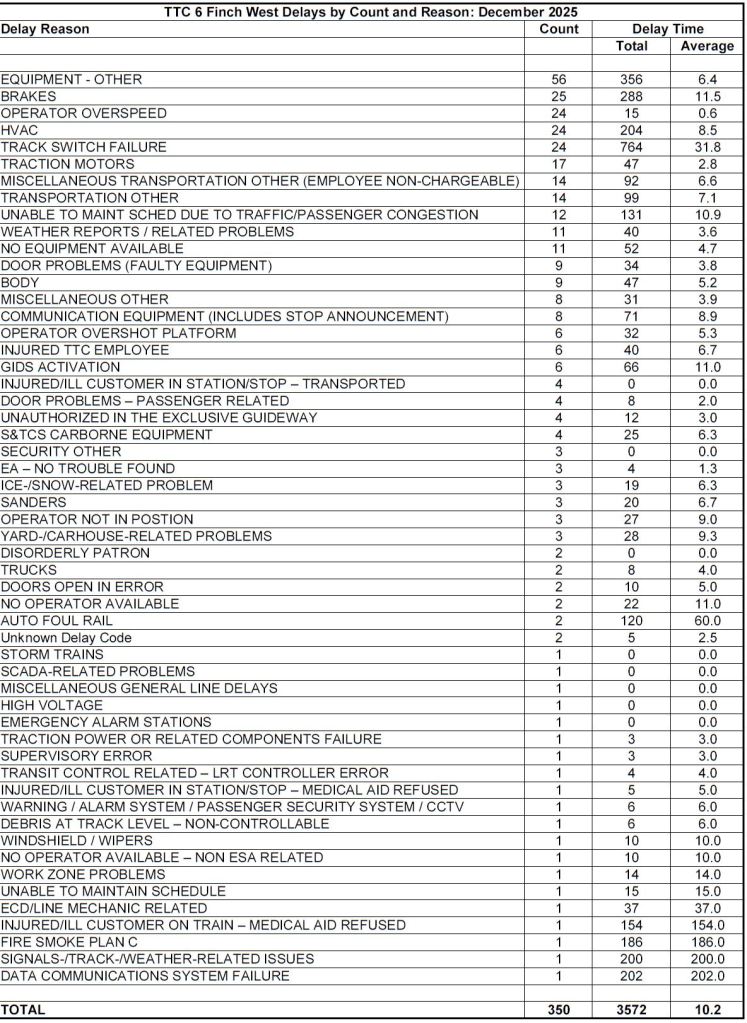
6 Finch LRT Delay Data for December 2025

The TTC has now added 6 Finch to the collection of published delay data available on the City of Toronto’s Open Data site. See:

The data are in a summary format, much less detailed than the version on which I based a recent article, but they have the advantage of being in spreadsheet format that makes general analysis easier.

In the form published by the TTC, the data include:

  • Date and time of the event
  • Location
  • Event Code
  • Minutes of delay and gap
  • Direction
  • Vehicle number
  • List of event codes

For the purpose of this article, I sorted and summarized the events by code and by the number of times it was reported. (If you want to see the full unedited list, download the file from the City’s site.)

What is immediately obvious here is that the majority of the delays are due to equipment and infrastructure failures, and that a few individual events caused extended outages. These are numbers as reported by the TTC, and do not really show the degree to which 6 Finch was effectively unavailable to riders who had to use shuttle buses instead.

Overall, in the period from December 7-31 there were 350 events.

Updated January 21, 2026 at 10:40pm:

By comparison, the streetcar network, with many longer routes in a more challenging operating environment, had only 819 events between them. Of these, 22 were infrastructure issues (with only 2 switch issues), 74 were due to equipment issues and 113 to diversions. Common incidents were due, broadly speaking, to passenger issues: 102 ill patrons, 106 unsanitary cars, and 169 security issues (most commonly “disorderly patron”).

501 Queen160509 Harbourfront23
504 King166510 Spadina75
505 Dundas124511 Bathurst59
506 Carlton115512 St. Clair69
507 Long Branch28

Will Line 5 Eglinton Open In February?

The TTC has posted an internal notice that the operators’ sign-up for work in the period starting February 8, 2026 has been delayed because of the complexity of changes happening concurrently on the bus network.

The year 2026 is in the memo giving hope that the line may actually open soon.

Thanks to Gamile Anthony King for posting this on Facebook

6 Finch West Delay Logs December 2025

The full set of delay logs for 6 Finch West found their way to me recently. The first six days were published in a previous article:

The full set is available in a PDF here. These have been condensed substantially to make browsing easier and to focus on the location, type and duration of delays and incidents.

Many of these delays are short enough that they are not reported to the public via service alerts, but there was a period from December 29-31 when no alerts for Line 6 were issued at all.

A common pattern through the month is that most of the delays are due to infrastructure or equipment failures.

  • Inoperative or non-responsive switches, especially on snow days.
  • Emergency braking caused by overspeed conditions. Some of these could be false positives, or could indicate an aggressive enforcement of speeds.
  • Emergency braking caused by passengers reopening doors. This is a common practice on streetcars, and a design that causes delays through normal passenger behaviour clearly needs a rethink.
  • Positional problems at stations caused by spin-slide braking which triggers misreporting of vehicle location.
  • Cold cars.
  • Many error codes appear on the operator consoles, and these are cleared by “remedial procedures”. There is no discussion of why these happen, and because maintenance is not handled by the TTC, there is no transparency to that part of the operation. An obvious problem is that if normal procedure is to treat error codes as spurious, they lose their meaning and importance.
  • Failed communications both of hand-held radios and of the control/signalling system.
  • No equipment available. The Line 6 fleet is 18 cars of which 15 are scheduled for peak service.
  • Inability to maintain schedule.
  • Washroom and work breaks for operators. This implies a scheduling problem which is accentuated by perennial delays on the line.

Operational issues with restrictive speeds at intersections and delays due to traffic signals are not logged as delays except for overspeed incidents. The one exception is a log entry from Christmas Day when by mid-evening the entire line was running about 49 minutes late. This is not a heavy traffic day, but the problem illustrates the mismatch between the line’s design and even the padded schedule that was implemented.

Metrolinx has been silent on the question of reliability of components that lie with its P3 partner, Mosaic, or of any work plan to address shortcomings in the vehicles, systems and infrastructure.

City Council supports changes to the traffic signal behaviour to provide aggressive transit priority, and a report on this is due early in the year. Once that comes out, we will see how much of the original design is due to foot-dragging by car-oriented planning in the Transportation Services Department who are responsible for the signals.

A detailed analysis of service such as I have provided for other TTC routes is impossible because there are no tracking data for the Line 6 vehicles. This is a problem even for the TTC who have no way to review the line’s operation, and for trip prediction apps. This is a glaring oversight that should be corrected as soon as possible to improve real-time rider information and to allow retrospective analysis of operations.

Toronto Council Debates Transit Priority

On December 16, Toronto Council debated and approved a motion by Mayor Chow regarding transit priority on 6 Finch West and more generally on the streetcar network.

1. City Council direct the City Manager, working with Metrolinx and the Chief Executive Officer, Toronto Transit Commission, to advance implementation of more aggressive, active transit signal priority at intersections along surface portions of the Line 5 Eglinton and Line 6 Finch West, subject to contractual and legal obligations, and to provide an update on progress in the first quarter of 2026. 

2. City Council direct the City Manager, working with the Chief Executive Officer, Toronto Transit Commission, to report back in the first quarter of 2026 with a plan, including costs and staffing requirements, to implement further measures that improve streetcar network speed and reliability, including signal timing adjustments, a more aggressive transit signal priority policy, deploying traffic agents at key intersections to prevent blocked streetcars, and recommendations for removing on-street parking and restricting left turns during high-peak periods on key streetcar routes. 

3. City Council direct the City Manager, working with the Chief Executive Officer, Toronto Transit Commission, to report back in the first quarter of 2026 with a plan, including costs and staffing requirements, to expedite transit signal priority activations at intersections on the surface transit network where the required technology is not currently installed.

Later in this article, I will give a synopsis of the questions and statements by various members about this motion, but to begin, here are a few key points.

  • The debate focused almost exclusively on Finch, although the motion deals with surface transit generally.
  • Some members spoke of the need to move beyond assigning blame to fixing the problems on Finch. This gracious approach avoids important “lessons learned” about how not to open a major new transit line. These cannot be ignored, nor can recognition of where problems lie among various parties.
  • From many comments by staff and councillors, it is quite clear that the slow speed of the route was known in advance of opening, indeed had been planned for years before. However, neither Council nor the TTC Board were informed of this.
  • The glacial operation has been explained away as part of a natural “bedding in” process. However, the slow speed was not foreseen by Metrolinx whose FAQ page for the project still (as of Dec 18, 2025) claims a 33-34 minute trip at an average speed of 20-21 km/hr including stops.
  • Advance publicity for the opening gave no hint of slow operations, and there is no mention of a frequent, parallel shuttle bus service to supplement the slow LRVs on the TTC’s Line 6 opening page.
  • The actual speed of cars on the line is well below the claimed limits of 60 km/hr between stops, and 25 km/hr at stops and intersections. Something else limits driving speeds, such as importation of restrictive downtown streetcar practices, but this was never mentioned in the debate. Comments by staff showed that they thought the 60/25 km/hr speeds were typical when in fact actual speeds are much lower. A slow crossing speed at intersections increases the amount of time a transit only phase would take out of traffic signal cycles.
  • There is a posted 10km/hr limit on the curve at Humber College Station which is likely permanent because the Citadis cars have troubles going around the corners which by downtown streetcar standards are quite generous. This is a design error between the curve radii and the capabilities of the cars that is likely unfixable.
  • Some members mentioned Seattle as an example of active transit priority where left turning traffic comes second, not first, and cited this as an example of how LRT could operate faster.
  • There was some confusion between automatic operation and speed limits imposed on manually operated LRVs. Routes that are completely grade separated can be driven automatically, but not a route in the middle of a street where access to the right-of-way cannot be controlled. Comparisons between systems in various cities needs to take the characteristics of each line into account.
  • On the question of nearside vs farside transit stops, the overwhelming reason for the farside design is to provide space for a nearside left turn lane. Some stops are nearside because of space constraints. In any event, farside stops depend on good signal priority to avoid the “double stop” problem so common in Toronto.
  • Reliability of the fleet and infrastructure are key responsibilities of the Metrolinx P3 partner, Mosaic. Information about failures is available in the TTC’s internal operating logs for the route, and I summarized these for Dec 7-12 in a recent article. Council was told that the TTC is cataloguing issues to work with Metrolinx and Mosaic, but was not given any details.
  • Tracking of Line 6 vehicles for service reliability and to flag locations of delay is not yet possible because the TTC does not received a tracking feed comparable to what has long been available on its routes. This also affects trip prediction apps dependent on next vehicle information.
  • On one hand, the City and TTC claim that until handover of Line 6 by Metrolinx, they could not make changes to the signal programming. However, staff revealed that a move for slower operation dates back at least to 2024, possibly to 2020, and was approved by all parties. Moreover, the handover took place well before opening day, and issues with poor signal priority would have been obvious during the TTC’s acceptance trials.
  • Thanks to action at the political level, City staff are now working on data collection for intersection operations and possible signal timing changes to place a transit phase ahead of the left turn arrow. However, the length of this phase will be determined by the speed at which LRVs cross, possibly from a standing stop. Any modelling of new timings must be done in the context of achieving the alleged 25 km/hr speed at intersections.
  • Although there has been talk in the transit community of slow operation on Line 5 testing even in the tunnels, this did not come up in debate. Any speed restrictions there will be completely the responsibility of Metrolinx.

Mayor Chow was quite clear that Line 5 Eglinton should not open until the issues found on Finch are corrected and Line 5 is updated accordingly. She noted that the City has traffic agents who can help, although this is likely more applicable to the downtown streetcar lines. Signal priority will be added on the surface transit network where it is not yet installed. Urgent work for Finch will be done soon with a report back to the TTC and Council in Q1 2026.

Chow also mentioned that the SRT busway will open in September 2026 thanks to a construction speed-up with more shifts and weekend work. This comment reveals that the original work plan for this project prioritized cost over faster completion.

The motion carried on a vote of 22-1 with only Councillor Holyday opposed. Councillors Mantas and Carroll were absent. Councillor Colle declared a conflict of interest (his son is an official at the TTC).

Continue reading

6 Finch West: Six Days of Delays

Line 6 Finch West opened for service on Sunday, December 7. Beside the basic issue of glacial train speed are questions of vehicle and infrastructure reliability. This post summarizes the delays that occurred.

This post is far more detailed than I would normally publish, but the information found its way to me, and a clear understanding of what is going on is in the public interest.

Although the TTC takes the blame for rotten operations, their shuttle buses keep service available to riders. The overwhelming cause of delay is with systems provided and maintained by Metrolinx’ P3 partner, Mosaic. It is extremely difficult to believe that these are new conditions that suddenly manifested when passengers actually rode the trains. Equipment reliability should have been proven in the acceptance process. As for switches failing to operate in cold weather, this is not exactly new technology for Toronto, and in any event Metrolinx claimed that the line had already been through cold weather testing before it opened.

A common delay is that a car’s control system will throw a fault code, but no cause was determined and the car continued in service. Some fault codes cause an emergency brake application including an overspeed condition. These happen often enough to suggest that speed restrictions with automatic stops are set far too conservatively.

Some delays arise from misalignment of cars with platforms. This could be either due to operator error, or to braking issues. Doors are not supposed to be opened with a car in the wrong place, but manual emergency mode operation is to be needed to properly reposition a car.

Some problems with maintaining schedule were reported due to operators unfamiliar with the line. This raises the question of training and the amount of experience they received before revenue operations began.

Aside from equipment failures are delays caused by “vehicle not available”. There are 18 cars in the fleet, and peak service requires 15 leaving three spare for maintenance and change offs of cars from service. It is Mosaic’s job to have those cars available. This problem grew as the week went on. Note that service improvements will be possible only by operating cars on a shorter trip time at the speed originally expected of the line. There are no extra cars to add to the service.

It would be fascinating to read and compare the logs from a few weeks before opening during the final acceptance process. How many of these problems were common then, and was the rate of failures considered “acceptable”? We will probably never know thanks to Metrolinx and TTC secrecy.

Continue reading