
The Gardiner East Conundrum: Saving Time Is Not The Only Issue

Toronto’s Public Works and Infrastructure Committee (PWIC) will consider an updated report on the Gardiner East reconstruction options at a special meeting on May 13, 2015 where this will be the only item on the agenda. (Note that additional detailed reports are linked at the bottom the main report.)

There has been much discussion of the alternative designs for the expressway section between Jarvis Street and the Don River and, broadly speaking, there are two factions in the debate.

  • For one, the primary issues are to maintain speed and capacity of the road system, and to avoid gridlock.
  • For the other, the primary issue is the redevelopment of the waterfront, and the release of lands from the shadow of the expressway structure.

Both camps seek to encourage economic growth in Toronto, but by different means and with different underlying assumptions.

A further issue, largely absent from the Gardiner debate, is the role and comparative benefits of various transit projects ranging from GO/RER/SmartTrack at the regional level, down to subway options including the Scarborough Subway Extension and the Downtown Relief Line, and local transit including the Waterfront East LRT line and a proposed Broadview Extension south across Lake Shore to Commissioners Street including a Broadview streetcar.
Continue reading

Finch West LRT Soon, Sheppard East Not So (Updated)

Updated April 28, 2015 at 8:20 am:

The decision to push construction of the Sheppard LRT out to the 2020s was taken quite recently as shown by two separate reports.

In today’s Globe & Mail, Oliver Moore reports:

According to Mr. Del Duca, the delay on Sheppard was because of the difficulty of trying to do too many big projects at once. “The plan right now is to have the procurement begin for the Sheppard East LRT after we complete the Finch West LRT,” he said.

There was no firm timeline available for the Sheppard line. If it starts on its new schedule and takes about as long as Finch to build, it should be ready some time after 2025.

This timeline is sharply at odds with the information given to a reporter in the provincial budget lock-up on Thursday. The government’s position then – given on background and not for attribution, under the rules of the lock-up – was that the Sheppard line would open about a year after Finch. Mr. Del Duca’s spokesman did not return a message Monday seeking clarification of what had changed.

On April 27, over an hour after the LRT announcement, one of my readers, seeking clarification from Metrolinx received the following email:

From: Metrolinx Customer Relations <customerrelations@metrolinx.com>
Date: April 27, 2015 at 10:43:26 AM EDT

Dear [x]

Thank you for contacting us about the status of the Sheppard East LRT.

The Sheppard East LRT is fully funded and approved. The Sheppard East LRT underpass construction at Agincourt GO Station has been completed.

Preliminary design and engineering work will be happening over the next few years. Construction is expected to begin in 2017 and be completed by 2021.

I appreciate you taking the time to contact us.

Sincerely,

[x] Customer Service Representative
GO Transit, A Division of Metrolinx

One wonders just what triggered a change so last-minute that it was not communicated to Metrolinx’ own “communications” team. The Minister claims that the delay is because there is only so much construction work that can be undertaken concurrently, but this seems to have more to do with avoiding a politically difficult decision.

A much more honest position would be to say simply that “we’re waiting for the results of various studies now underway on transit for Scarborough”, but leadership, or even a bit of common sense on anything transit-related in that part of town seems to escape the Liberals at Queen’s Park.

Original article from April 27 at 12:11 pm:

Continue reading

City of Toronto Budget Amendments 2015 (Updated)

At its meeting of March 11 and 12, 2015, City Council passed a few budget amendments affecting the Toronto Transit Commission. Some of these reflect a sense that the TTC has not been “minding the store” quite as well as it claims, and a little belt tightening is good for any organization. Others address specific concerns that, quite frankly, should have been on the TTC’s agenda before now, but were buried under the rapid transit debates.

The motions address the following topics:

  • Additional Streetcars
  • Automatic Train Control
  • Waterfront West Transit
  • TTC Staffing and Project Management

Updated March 13, 2015 at 1:50 pm with further information about proposed staffing reductions.

Continue reading

TTC 2015-2024 Capital Budget: System Expansion Projects

The TTC’s Capital Budget generates much debate over a few items, but there are many, many projects at the detailed level. Understanding those details puts the debate over transit spending, operations and expansion in a better context. This and following articles will look under the covers of the Capital Budget. I will start with the expansion projects because these have seen so much debate, but will turn to the more mundane parts of the budget that keep the wheels turning.

The projects discussed here include:

  • The Toronto York Spadina Subway Extension (TYSSE) to Vaughan Metropolitan Centre
  • The Scarborough Subway Extension (SSE)
  • Various Waterfront proposals

Neither the Downtown Relief Line (DRL) nor the Yonge extension north to Richmond Hill is included because these are not yet official projects.

Continue reading

Planning for SmartTrack

At its meeting of January 22, 2015, Toronto’s Executive Committee will consider a report (SmartTrack Work Plan 2015-2016) recommending a work plan for the study of Mayor Tory’s SmartTrack proposal together with other related transit projects. This is intended to dovetail with Metrolinx’ work on their Regional Express Rail (RER) network, and will have spillover effects on studies of both the Downtown Relief Line (DRL) and the Scarborough Subway Extension.

The most important aspect of this report is that, at long last, a study is reviewing transit options for Toronto on a network basis rather than one line at a time. Factors such as alternative land use schemes, fare structures and service levels will be considered to determine which future scenarios best support investment in transit. Rather than starting with a “solution”, the studies are intended to evaluate alternatives.

If this outlook actually survives, and the studies are not gerrymandered before they can properly evaluate all strategies, then the process will be worthwhile and set the stage for decisions on what might actually be built. The challenge will be to avoid a scenario where every pet project on the map is untouchable rather than making the best of the network as a whole. The term “best” will be open to much debate.

Continue reading

The Not So Speedy 509 Harbourfront Car

Streetcar service resumed on 509 Harbourfront on Sunday, October 12, after an absence of over two years. The Queens Quay reconstruction project started at the end of July, 2012, and was supposed to be complete in the spring of 2013. For many reasons, things didn’t quite work out that way (this has been discussed in other posts and I won’t repeat the chronology here).

Although the line re-opened for streetcar service, the operating speed was, putting it mildly, glacial thanks to a whole new set of traffic signals that gave a new meaning to the antithesis of “transit priority”. Even with relatively little demand for road traffic on Queens Quay, the vast majority of time was devoted to moving the few cars that showed up now and then, while the streetcars waited for occasional, and very brief, green windows, even at locations where the “traffic green” and “transit green” would not have produced conflicting movements. Despite over two years to plan how the signals might operate in the interim configuration for this stage of the project, the arrangement had all the earmarks of a last minute scheme with a one-size-fits-all approach to programming intersections.

This arrangement lasted until late in the first week of operation, but there is still no co-ordination between transit and signals, and there are now many more places where streetcars can be held waiting for their chance to proceed. Even with the fixes, streetcar service is slower than the bus route it replaced (which did not have to deal with anywhere near as many signals) and slower than the streetcar service operated before the reconstruction.

The TTC, City and Waterfront Toronto face an acid test in their combined commitment to transit as the primary mode of access to the waterfront — if they cannot manage at least to equal the performance of the streetcar route before construction started, what is the future for surface transit in general?

Because the final arrangement won’t be in place until Queens Quay reverts to two-way traffic in the spring of 2015, we will not know just how “intelligent” the traffic signals will be about transit. The worst outcome would be to open the finished street with a disastrous arrangement for traffic control.

In this article, I will review actual running times for 509 Harbourfront in October 2014 with both the bus replacement service and the return to streetcars, and will compare this to data from February 2010.

Continue reading

SmartTrack: That Pesky Curve in Mount Dennis (Updated)

Updated October 17, 2014 at 4:15pm:  Information from Metrolinx about the revised design for the Air Rail Link spur line from the Weston subdivision to Pearson Airport has been added.

John Tory’s SmartTrack proposal has been roundly criticized by various people, including me, on a number of counts. When one looks at the scheme, it is the technical issues — the degree to which SmartTrack will crowd out the Metrolinx RER scheme (or simply take over its function), the question of capacity at Union Station, the route along Eglinton from the Weston rail corridor to the airport. But the biggest challenge is the link from the rail corridor to Eglinton itself.

Let’s get one issue out of the way up front. Writing in the Star on October 6, Eric Miller states:

And it’s interesting to note that very little criticism deals with the basic merit of the proposal as an addition to Toronto’s transit network. The design logic to address major commuting problems is self-evident; analysis to date indicates high ridership and cost-recovery potential that is expected to be confirmed by more detailed post-election studies; and it is modelled on successful international best practice.

Criticisms have, instead, focused on the line’s “constructability” where it meets Eglinton Avenue W. and on Tory’s proposed financing scheme. As already briefly discussed, however, the constructability issue is truly a tempest in a teapot. And with respect to financing I would suggest that all three mayoral candidates and most of the popular press still have this wrong.

In fact, constructability and the technical issues are precisely what could sink this proposal. Dismissing this as a “tempest in a teapot” is a neat dodge, but it is the academic equivalent of “you’re wrong because I say so”. Many who support Tory’s campaign see criticism of SmartTrack as the work of naysayers who, like so many before us, doom Toronto to inaction.

This is tantamount to saying we cannot criticize the plan because doing so is disloyal to the city’s future. Never mind whether the plan is valid, just don’t criticize it.

Miller’s comments in his op-ed piece (linked above) also don’t line up with statements in the “Four Experts” article of October 9 where he and others talk about what SmartTrack might do. Miller is much less in agreement that SmartTrack could achieve what is claimed for it. Should we dismiss his comments as being irrelevant or counterproductive? Of course not.

This article deals with the challenge of getting from the rail corridor to a point under Eglinton Avenue West at Jane Street, the first stop on the journey west to the airport. To put all of this in context, it is vital to look at the details of both the Eglinton Crosstown LRT (including amendments) and at the Metrolinx Georgetown South project in the rail corridor.

Continue reading

Streetcars Return to Queens Quay

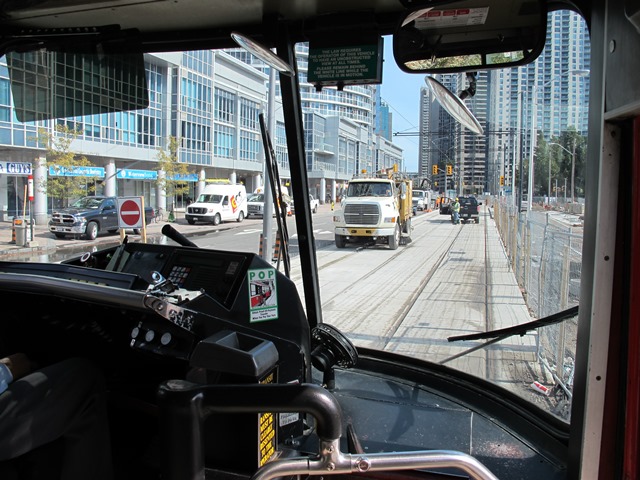
After a two-year absence, streetcar service returned to Queens Quay today with the 510 Spadina and 509 Harbourfront routes resuming their normal operation.

Construction has not yet finished — there are sidewalks still to be finished, a bit of roadwork, the construction of the new bikeway and pedestrian area on the south side, and finally the trees — but that will all be finished for spring 2015.

For those who could not make it down to the waterfront on a fine Sunday morning, and for my out of town readers, here is a sample of views along the line.

Continue reading

Getting Ready For Streetcars Returning to Queens Quay

After many delays, the Queens Quay reconstruction project will be completed to the point that streetcars can return on the Sunday of Thanksgiving weekend, October 12, 2014.

Years of utility construction, rebuilt sidewalks and a completely new trackbed for streetcars are almost over. When the project finishes in 2015, Toronto will finally see more than beautiful presentations and websites, we will see the street as the designers intended.

Updated October 8, 2014

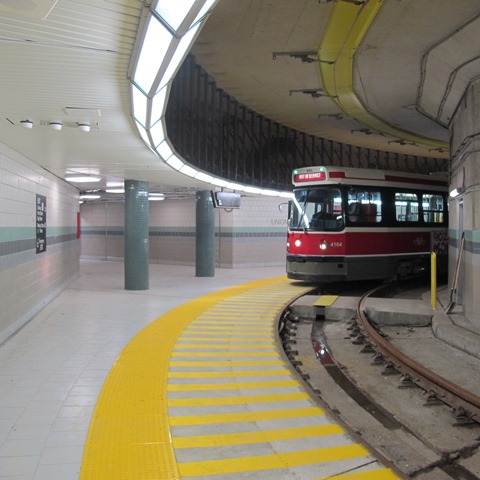
Test car 4164 ran to Union Station on October 7.

Photos from Harold McMann:

View from 4164 eastbound at Lower Simcoe and Queens Quay:

Oct 07, 2014/Toronto, ON:   TTC. EB #4164. Queens Quay at Simcoe St. First car to Union, testing track & overhead structure.

Union Station Loop:

Oct 07, 2014/Toronto, ON:   TTC.  #4164. Union Station Loop. First car to Union, testing track & overhead structure.

Photos linked from a comment by “Thomas”:

Approaching Lower Simcoe Westbound

West of Lower Simcoe

Continue reading