Metrolinx Proposes Revised Names For Crosstown Stations

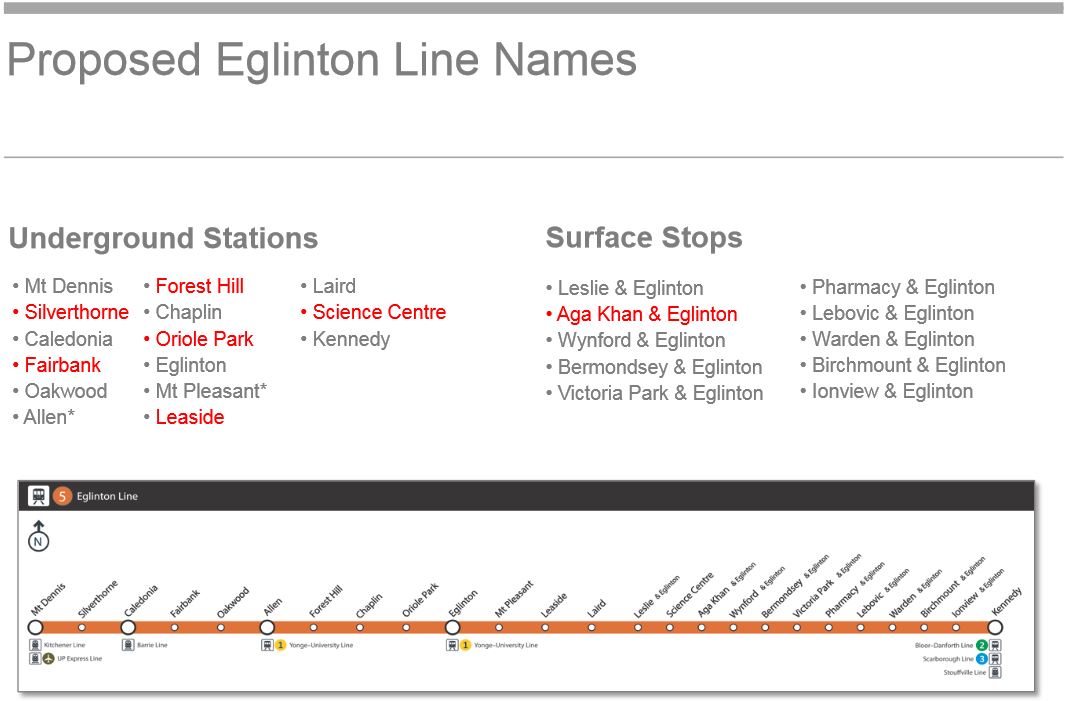
Metrolinx has proposed new names for several stations in the Eglinton corridor:

  • “Keele” to “Silverthorne”
  • “Dufferin” to “Fairbank”
  • “Bathurst” to “Forest Hill”
  • “Avenue” to “Oriole”
  • “Bayview” to “Leaside”
  • “Don Mills” to “Science Centre”
  • “Ferrand” to “Aga Khan & Eglinton”

Comments will be accepted by Metrolinx until October 7, 2015.

Updated October 2, 2015 at 9:30 am

201509_NewStationNames_ECLRT

Although the consultation affects only the stations listed in red in the list above, other changes are proposed including renaming “Eglinton West” to “Allen”.

The asterisk beside “Mt. Pleasant” is actually an error, and should be beside “Eglinton” because the proposal recommends a “change” from “Eglinton-Yonge”. Of course, the station isn’t called that yet.

Updated October 2, 2015 at 12:50 am:

The comments that have already been left on Metrolinx’ site suggest that many of their proposals are not exactly popular. I cannot help think that whoever is responsible for this report has a poor sense of Toronto (maybe another consultant who does all their work on Google Maps?), nor a sense of which neighbourhood names are actually used.

I cannot help think of the mystery surrounding stations at “St. Andrew” and “St. Patrick” that memorialized old ward/parish names that almost nobody knew fifty years ago, but which are now an inherent part of the city’s mental map of itself. Taking old names for an area may provide an historic link, but confuse people who have no idea of where these places are.

Of course we already have a precedent with Steeles West Station that has been renamed “Black Creek Pioneer Village” in reference to an attraction that is quite a distance from the station, and we almost got “University City” for Finch West.

Has anyone noticed, by the way, that this is called “Keele & Finch” in the “future” map in the report, “Leslie & Eglinton” is labelled “Sunnybrook Park” on the same map, and SmartTrack is nowhere to be found.

Finch West LRT Soon, Sheppard East Not So (Updated)

Updated April 28, 2015 at 8:20 am:

The decision to push construction of the Sheppard LRT out to the 2020s was taken quite recently as shown by two separate reports.

In today’s Globe & Mail, Oliver Moore reports:

According to Mr. Del Duca, the delay on Sheppard was because of the difficulty of trying to do too many big projects at once. “The plan right now is to have the procurement begin for the Sheppard East LRT after we complete the Finch West LRT,” he said.

There was no firm timeline available for the Sheppard line. If it starts on its new schedule and takes about as long as Finch to build, it should be ready some time after 2025.

This timeline is sharply at odds with the information given to a reporter in the provincial budget lock-up on Thursday. The government’s position then – given on background and not for attribution, under the rules of the lock-up – was that the Sheppard line would open about a year after Finch. Mr. Del Duca’s spokesman did not return a message Monday seeking clarification of what had changed.

On April 27, over an hour after the LRT announcement, one of my readers, seeking clarification from Metrolinx received the following email:

From: Metrolinx Customer Relations <customerrelations@metrolinx.com>
Date: April 27, 2015 at 10:43:26 AM EDT

Dear [x]

Thank you for contacting us about the status of the Sheppard East LRT.

The Sheppard East LRT is fully funded and approved. The Sheppard East LRT underpass construction at Agincourt GO Station has been completed.

Preliminary design and engineering work will be happening over the next few years. Construction is expected to begin in 2017 and be completed by 2021.

I appreciate you taking the time to contact us.

Sincerely,

[x] Customer Service Representative
GO Transit, A Division of Metrolinx

One wonders just what triggered a change so last-minute that it was not communicated to Metrolinx’ own “communications” team. The Minister claims that the delay is because there is only so much construction work that can be undertaken concurrently, but this seems to have more to do with avoiding a politically difficult decision.

A much more honest position would be to say simply that “we’re waiting for the results of various studies now underway on transit for Scarborough”, but leadership, or even a bit of common sense on anything transit-related in that part of town seems to escape the Liberals at Queen’s Park.

Original article from April 27 at 12:11 pm:

Continue reading

Planning for SmartTrack

At its meeting of January 22, 2015, Toronto’s Executive Committee will consider a report (SmartTrack Work Plan 2015-2016) recommending a work plan for the study of Mayor Tory’s SmartTrack proposal together with other related transit projects. This is intended to dovetail with Metrolinx’ work on their Regional Express Rail (RER) network, and will have spillover effects on studies of both the Downtown Relief Line (DRL) and the Scarborough Subway Extension.

The most important aspect of this report is that, at long last, a study is reviewing transit options for Toronto on a network basis rather than one line at a time. Factors such as alternative land use schemes, fare structures and service levels will be considered to determine which future scenarios best support investment in transit. Rather than starting with a “solution”, the studies are intended to evaluate alternatives.

If this outlook actually survives, and the studies are not gerrymandered before they can properly evaluate all strategies, then the process will be worthwhile and set the stage for decisions on what might actually be built. The challenge will be to avoid a scenario where every pet project on the map is untouchable rather than making the best of the network as a whole. The term “best” will be open to much debate.

Continue reading

SmartTrack: That Pesky Curve in Mount Dennis (Updated)

Updated October 17, 2014 at 4:15pm:  Information from Metrolinx about the revised design for the Air Rail Link spur line from the Weston subdivision to Pearson Airport has been added.

John Tory’s SmartTrack proposal has been roundly criticized by various people, including me, on a number of counts. When one looks at the scheme, it is the technical issues — the degree to which SmartTrack will crowd out the Metrolinx RER scheme (or simply take over its function), the question of capacity at Union Station, the route along Eglinton from the Weston rail corridor to the airport. But the biggest challenge is the link from the rail corridor to Eglinton itself.

Let’s get one issue out of the way up front. Writing in the Star on October 6, Eric Miller states:

And it’s interesting to note that very little criticism deals with the basic merit of the proposal as an addition to Toronto’s transit network. The design logic to address major commuting problems is self-evident; analysis to date indicates high ridership and cost-recovery potential that is expected to be confirmed by more detailed post-election studies; and it is modelled on successful international best practice.

Criticisms have, instead, focused on the line’s “constructability” where it meets Eglinton Avenue W. and on Tory’s proposed financing scheme. As already briefly discussed, however, the constructability issue is truly a tempest in a teapot. And with respect to financing I would suggest that all three mayoral candidates and most of the popular press still have this wrong.

In fact, constructability and the technical issues are precisely what could sink this proposal. Dismissing this as a “tempest in a teapot” is a neat dodge, but it is the academic equivalent of “you’re wrong because I say so”. Many who support Tory’s campaign see criticism of SmartTrack as the work of naysayers who, like so many before us, doom Toronto to inaction.

This is tantamount to saying we cannot criticize the plan because doing so is disloyal to the city’s future. Never mind whether the plan is valid, just don’t criticize it.

Miller’s comments in his op-ed piece (linked above) also don’t line up with statements in the “Four Experts” article of October 9 where he and others talk about what SmartTrack might do. Miller is much less in agreement that SmartTrack could achieve what is claimed for it. Should we dismiss his comments as being irrelevant or counterproductive? Of course not.

This article deals with the challenge of getting from the rail corridor to a point under Eglinton Avenue West at Jane Street, the first stop on the journey west to the airport. To put all of this in context, it is vital to look at the details of both the Eglinton Crosstown LRT (including amendments) and at the Metrolinx Georgetown South project in the rail corridor.

Continue reading

John Tory’s “SmartTrack”: Will That Train Ever Leave The Station?

Late in May, John Tory launched his “SmartTrack” transit line, the centrepiece of his “One Toronto” plan. Media reps gathered for a preview at the Metro Toronto Convention Centre, and the launch was handled almost entirely by Tory’s staff. All of the background papers are on the One Toronto website, and little has been added since that event.

Even then, in the early days of the campaign, there was good reason to distrust Tory’s grasp of his own proposal, let alone a willingness to engage in debate, when he made the briefest of appearances for a canned statement to give the media clips for the news broadcasts, but answered few questions.

I was modestly impressed that at least a Mayoral candidate was not just thinking at the ward level for a transit proposal, but felt the plan was rather threadbare — a single line to solve almost all of Toronto’s problems.

Wearing two hats that day – as both reporter and activist – I was scrummed by the media for comments, and the Tory campaign chose to lift one phrase out of context as an “endorsement” for SmartTrack that remains online.

Steve Munro, Toronto Transit Blogger, said, “This is very much a refocusing of what transit in Toronto should be.”

What I was talking about was the need to look at the region and at trips to points other than the corner of Bay & Front and times other than the traditional commuter peaks. As to the specifics of SmartTrack, I was rather less complimentary.

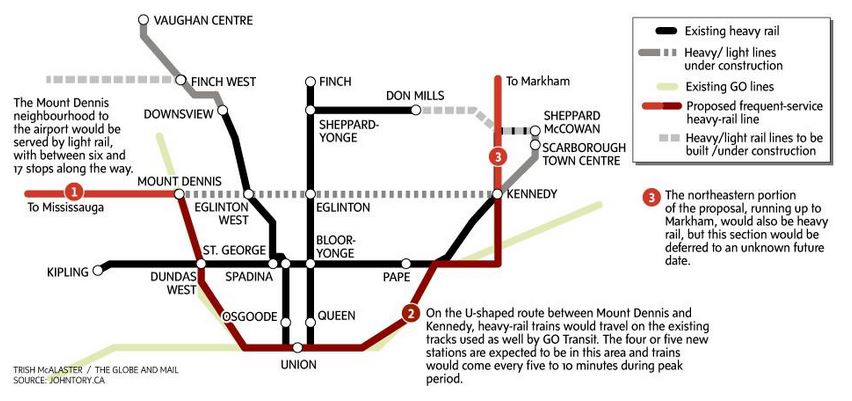
In brief, SmartTrack would see electric multiple unit (EMU) trains operating primarily on GO Transit corridors between Unionville on the Stouffville line and Mount Dennis on the Weston corridor (the Kitchener-Waterloo line). At Eglinton and Weston, the line would veer west along the former Richview Expressway lands to the Airport Corporate Centre, but not to the airport itself.

The route would charge regular TTC fares with free transfers to the existing system, and with frequent all-day service at peak levels of every 15 minutes. Over its 53km it would have 22 stations, and might, according to the campaign, carry over 200,000 passengers per day.

Continue reading

TTC Service Changes Effective May 11, 2014 (Update 4)

The May 2014 schedules will bring major changes across the system mainly in response to construction projects.  Extra running time will be provided on many routes in response to construction delays.  At some times, the current headway will be maintained, while at others the headway will be stretched.  In two cases (46 Martin Grove and 94 Wellesley), no buses are available to improve PM peak service to compensate for extra running time.

The budget for construction-related service is considerably less than what will actually be required.  Although the total hours operated will be greater than the budget for May, “regular” service will be below budget while “construction” more than compensates.  Some changes in the fleet and in service levels have been deferred until later in 2014.

2014.05.11_Service_Changes

This table is broken into four sections listing miscellaneous minor changes, construction-related changes, one route restructuring and seasonal changes.

Updated May 17, 2014:

Effective Tuesday, May 20, the diversions for the Queen & Victoria track project will be changed.

  • All westbound 501 Queen cars will divert via Church-King-York.
  • 501/502/503 shuttle bus services will terminate at Church Street.

The details are on the TTC service advisory page (scroll down to see the portion effective May 20).

Continue reading

Neptis Reviews Metrolinx: A Critique (I)

In December 2013, the Neptis Foundation published a review of the Metrolinx Big Move plan authored by Michael Schabas. This review received prominent attention in the Toronto Star and is regularly cited in their coverage of transportation issues. Some elements also appear in recent comments by Transportation Minister Glen Murray, and it is reasonable to assume that his view of Metrolinx priorities has been influenced by the Neptis paper.

Since its publication, I have resisted writing a detailed critique in part because of the sheer size of the document and my disappointment with many claims made in it, and a hope that it would quietly fade from view. Recent Ministerial musings suggest that this will not happen.

The stated goals of the report arose from four basic questions posed shortly after The Big Move was released in 2008:

  • What evidence suggests that the projects in the Big Move will double the number of transit riders and significantly reduce congestion in the region, as promised by Metrolinx?
  • Does each project offer good value for money?
  • Do all the projects add up to a substantial regional transit network or is the Big Move just an amalgam of projects put forward by diverse sponsors?
  • How do the projects in the Big Move relate to the Growth Plan for the Greater Golden Horseshoe, its land use equivalent? [Page 2]

The report itself addresses a somewhat different set of questions and notably omits the land use component.

  • Will the Big Move projects achieve the Metrolinx objective of doubling transit ridership?
  • Are these projects consistent with Metrolinx’s own “guiding principles”?
  • Are they well-designed, consistent with international best practice, and integrated with other transport infrastructure?
  • Will they support a shift of inter-regional travel onto transit?
  • Are there alternative, more effective schemes that should be considered?
  • What changes would help Metrolinx produce better results? [Page 14]

Schabas’ work is frustrating because on some points he is cogent, right on the mark.

Metrolinx has bumbled through its existence protected from significant criticism, swaddled in a cocoon of “good news” and the presumed excellence of its work. To be fair, the agency operates in a political environment where independent thought, especially in public, is rare, and years of planning can be overturned by governmental whim and the need to win votes.

That said, Metrolinx is a frustrating, secretive organization conducting much of its business in private, and tightly scripting public events. Schabas rightly exposes inconsistencies in Metrolinx work, although his own analysis and alternatives are, in places, flawed and blinkered.

Continue reading

Neptis Reviews Metrolinx: A Critique (III)

This article is the third section of my critique of the December 2013 review of the Metrolinx Big Move Plan written by Michael Schabas for the Neptis Foundation. It should be read in conjunction with Part I and Part II.

Continue reading

TTC Board Meeting: March 26, 2014

The Toronto Transit Commission Board will meet on March 26, 2014 at 1:00 pm in Council Chambers at City Hall.  The Agenda contains a number of items of interest.

  • An update on the Union Station project (Revised to add info from Metrolinx)
  • The March 2014 CEO’s report
  • Purchase of 10 additional “TR” subway trains for future demand growth
  • A report on Community Bus services
  • A proposed design for Kennedy Station’s interface to the Eglinton LRT line
  • A report on a temporary bus terminal at Islington Station

Continue reading