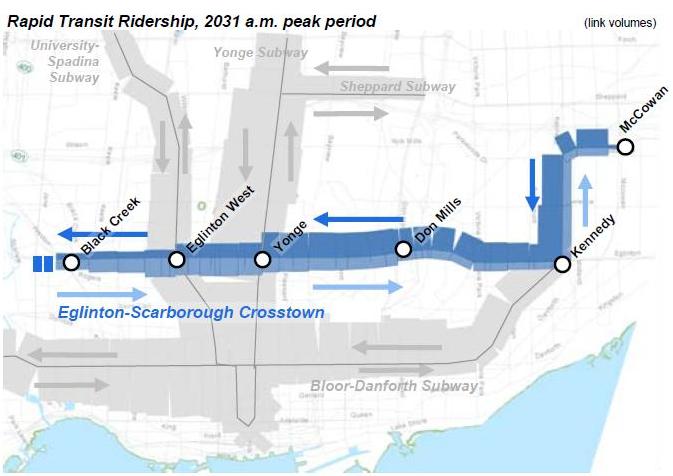
How Many Riders Will Use The Crosstown?

[See also Part 2 of this discussion.]

In a previous article and its long comment thread, readers and I have discussed the question of demand for the Eglinton-Crosstown LRT subway.  After the Metrolinx board meeting in June that started all this, I asked Metrolinx for more information about their projected ridership for the underground line.  In particular, I was interested in the numbers behind not just Eglinton, but the other routes on the demand map below.

Here is Metrolinx’ reply:

Under the previous Transit City plan, most morning Scarborough RT passengers arriving at Kennedy would transfer to the Bloor-Danforth subway. However, a small number of them would transfer to the Eglinton LRT, and bus riders would also transfer to the Eglinton LRT

Under the current Toronto transit plan agreement, many morning Eglinton – Scarborough Crosstown passengers arriving at Kennedy are not expected to transfer to the Bloor-Danforth line. Instead, we expect those passengers to stay on board the Eglinton – Scarborough Crosstown and continue west along Eglinton Ave.

It is important to note that the Eglinton – Scarborough Crosstown morning morning peak hour westbound ridership leaving from Kennedy station is roughly 6,500 higher than the Transit City plan forecast. In the Transit City plan, the forecasted behaviour of these 6,500 new Eglinton-Scarborough Crosstown passengers was as follows:

  • 60% rode the Bloor-Danforth subway out of Kennedy station.
  • 40% rode parallel bus routes or used different modes

We also expect an increase of ridership at the other stations along the Bloor-Danforth Eglinton-Scarborough line, but passenger behaviour at Kennedy is the dominant factor distinguishing the two plans.

Finally, below is a comparison of the anticipated 2031 morning peak demand points for the two plans:

SRT section (southbound into Kennedy)

  • Transit City (5 in 10 plan):  10,000 pphpd
  • Eglinton-Crosstown:  11,000 pphpd

Eglinton section:

  • Transit City:  5,000 pphpd eastbound into Eglinton West
  • Eglinton-Crosstown:  12,000 pphpd westbound into Eglinton/Yonge

[Corrections to the original text provided by Metrolinx July 26, 2011]

This is the entire reply, and there is no information on the following issues:

  • What are the numbers for other lines on the demand chart both for 2011 and 2031?  In particular, to what extent does the model show growth in demand on the existing subway system?
  • What other elements of a regional network exist in the 2031 model that could alter the growth pattern and future ridership flows?  In particular, there is no Downtown Relief Line even though it is part of The Big Move, and there is no indication of what GO services might also be in place.

My ongoing complaint about regional planning, both by the TTC and by Metrolinx, is that we talk a good line about networks, but we plan lines in isolation.  It is trivially simple to produce a huge demand on a new route simply by making it the only addition to an existing network — that’s how the TTC “justified” the Sheppard subway.

Ontario is spending $8-billion keeping Rob Ford happy by burying the Eglinton line, and they desperately need to justify this investment.  A 12k demand at the peak point is just the ticket!  Where else might the extra $4b have been spent to better overall effect?  We don’t know because Metrolinx has reverted from network planning to the traditional one-at-a-time methodology it was set up to avoid.

Metrolinx needs to be much more transparent about the way it projects ridership and the underlying assumptions of its models.  What routes are in the model network?  What frequency of service operates on them?  What is the fare structure?  What is the presumed future cost or practicality of using an automobile?  Where are the capacity constraints in the road and transit neworks?  How do these factors interact to shift projected demands?

This is the heart of regional planning, and Metrolinx is utterly silent on these issues.  Instead, they prefer to show us fully built-out networks decades in the future, networks we already know will be different thanks to various short-term changes and likely funding constraints, networks we will never see in actual operation.  We see simulations of the impossible, not the practical or the likely conditions we will have to live with.

This may serve short-term political needs, but the approach evades, no ignores, the vital debate we must have about what we might (or might not) build with the limited funding that our parsimonious, if not bankrupt, governments are likely to devote to transit.

A Few Questions About Eglinton-Crosstown (Update 3)

Updated July 4, 2011 at 11:10 am:

Recently, the Toronto Star reported that Metrolinx had claimed that the travel time by underground LRT from Kennedy Station to Jane Street would be 25 minutes.  They have now confirmed that the correct figure should be 35 minutes.

Also, the full presentation given at the recent board meeting regarding the Eglinton line is now available online.  Only the station design portion had been posted originally.

Continue reading

Eglinton-Crosstown Public Meeting (Updated)

Updated April 27, 2011 at 4:10pm: The presentation from the April 26 public meeting is now available on the Metrolinx website.

Original post from April 21:

There will be a public meeting about the Eglinton-Crosstown project on Tuesday, April 26 from 7:00 to 8:30 pm in the auditorium of St. Clement’s School, 21 St. Clement’s Avenue.

For those who don’t know the area, this is roughly a 3/4 km walk north from Eglinton Station, or you can transfer to the 97 Yonge at Davisville (indoors) or Eglinton (on-street) Stations. The service runs roughly every 15 minutes, at least on paper.

All the attendees will arrive by transit, won’t they?

This meeting is a joint presentation of several Councillors along the Eglinton line.

One can only hope that the public will actually get a chance to speak, a rare event in our fine city these days.

The Vanishing Eglinton Right-of-Way

Serious policy geeks like me spend our time delving into the more arcane reports on various agendas.  This can be tedious work, but every so often, something interesting turns up.

On the May 2, 2011, agenda for the Government Management Committee, there is an item regarding the transfer of various city properties to Build Toronto, the agency charged with making money off of surplus City lands.

Among the properties to be transferred are three strips of land along the north side of Eglinton Avenue:

  • West of Widdicombe Hill Blvd
  • East of Widdicombe Hill to Kipling
  • East from Kipling to Wincott Drive

These lands form part of the original reserve for the Richview Expressway for which plans were abandoned decades ago.  A strip of land will be kept along the south edge of these properties for road widening should an Eglinton LRT project (or similar work needing more road space) ever proceed.

Disposal of this land by the City effectively blocks any scheme for using the expressway lands for a transit line either on the surface on in a ditch.

Another block of land to be transferred lies on the northeast corner of Don Mills and Eglinton.  The report notes that this is the planned location for a bus terminal connecting with the Eglinton LRT line at Don Mills, and this would certainly be a good place for an integrated development.

Elsewhere in the list of surplus properties, one can see remnants of the Scarborough transportation corridor and the Front Street extension.  It is ironic that an administration so bent on auto transportation is giving up lands that once might have been part of an extensive highway network.

Transfer of Properties Report

Appendices including detailed property descriptions

Subway City? (Update 3)

Updated April 2, 2011 at 6:30 am: Additional details about the plan have been provided by Metrolinx.  The dialog below has been slightly edited from email exchanges, but preserves the sense of the conversation.

Q:  The Memorandum of Understanding (MOU) refers to both Black Creek and Jane as western terminals for the Eglinton line.  However, these are over 1km apart.  Where will the line actually end?  How will the line connect with the GO corridor if it ends at Black Creek?

A: The exact terminus for the Eglinton line, which is in the Mt. Dennis area, will be determined through a future additional study due to the vertical and horizontal alignment (how steep the grades can be climbing out of the tunnel and which side of the road we will be on to approach the yard) between Black Creek Drive and Jane Street. The objective is to make the connection to the GO rail corridor.

Q:  When does Metrolinx expect to have a preliminary design proposal for the section of the line east of Leaside that will now be substantially underground?

A:  We are meeting with the TTC now to discuss the timing for the preliminary plans and profiles for the underground segment.

Q:  The SRT replacement is described as ending at STC. Does this mean that McCowan will be abandoned as a station? Will the proposed right-of-way beyond McCowan to Sheppard and Malvern be protected to allow for future extension of the route? Is there any plan for an eastern yard so that trains would not all have to be based at the Black Creek yard?

A: The Scarborough LRT would follow the same route as the existing SRT and will include McCowan Station. At this time, there are no plans to close McCowan Station. We do see value in potentially re-using the McCowan yard for at least a layover site and we will need to study this further.

Q: Although the MOU states the number of stations on the Toronto projects, it does not mention this with respect to Eglinton.  The press release specifies 26 stations.  When will Metrolinx produce a station plan for the new line?

A: The exact number and location of stations for the Eglinton-Scarborough Crosstown LRT project will be finalized as part of the environmental assessment amendment process.

We expect the Eglinton project will have about 26 stations along a 25-kilometre stretch, and we’re pleased to provide this as a single-seat trip for residents from Scarborough to the Mount Dennis Area.

Since the new Eglinton project has changed from the previous concept, the working assumption now is that the station spacing across the route is approximately at 1 kilometre.

We want to make certain that residents get the best use from the Eglinton line, so we are taking more time to study the specifics of the project to determine the exact number and best locations for the stations along the Eglinton line.

The finalization of the Eglinton line and the locations of the station will be part of the preliminary engineering and Environmental Assessment, which is expected to be completed in the coming months.

Comment: The 26-station count includes not just Eglinton but also the SRT.  There were 26 stops on the Transit City version of Eglinton, not including Kennedy, and 6 more on the SRT.  The new combined route will have to go on a diet, and the roughly 1km average spacing implies that some stations will be dropped.  Throughout the Transit City debates, Metrolinx consistently wanted fewer stations on Eglinton, although at the time the underground section was shorter.

Q: Although the MOU makes reference to “LRT”, for certainty does this mean “Light Rapid Transit” as in the Flexity cars recently ordered from Bombardier, or is Metrolinx contemplating a return to ICTS Mark II technology once proposed for this route? This is an important decision as it affects the ability of the line to be extended.

A: On June 14, 2010, Metrolinx announced a $770M purchase of Light Rail vehicles from Bombardier, which included vehicles for the SRT upgrading project. We expect that we will need about 130 LRTs for the adjusted plan, but we will have to sit down with Bombardier and discuss the details. At this time, we do not plan to change from LRT to ICTS MARK II technology.

Comment: “At this time” are three little words that could do a world of damage to future LRT expansion in Toronto.  Metrolinx owes us a definitive answer in the context of their Big Move plan.

Q: The Sheppard East LRT’s costs to date are chargeable to Toronto, but one piece of work already underway is the Agincourt Station grade separation. Is this going to proceed independently of the LRT project as a GO improvement? If so, will it be built with room for a future LRT right of way if that scheme is resurrected?

A: At this time, there are no plans to change the current design for the Agincourt grade-separation. The grade separation construction work that is currently underway at the Agincourt GO Station to separate the GO tracks from Sheppard Avenue will proceed independently of the former LRT project.

It is important to note, though, that this grade separation construction work is an important safety improvement for GO commuters and drivers that use Sheppard Avenue. This grade separation is a project that has benefits to GO’s operations and traffic.

Continue reading

Metrolinx Contemplates Ford’s Subway Plan

The Metrolinx Board, not the most talkative bunch at their infrequent public meetings, took the unusual step yesterday of discussing possible major changes in their regional transportation plan.  Rob Ford’s subway plan can hardly be ignored, and Metrolinx directors need to engage in this debate lest they become irrelevant through inaction.

Both Chair Rob Prichard and President/CEO Bruce McCuaig went out of their way to speak positively about Ford’s scheme, while other directors were less inclined to accept the proposal.  In this article, I will recap the discussion and then conclude with thoughts of my own.

Continue reading

A Grand Plan: 2011 Edition

Back in the early days of this blog, I wrote a long paper about the role of transit and what a truly regional plan would look like.  To avoid extensively quoting myself, I suggest that any newcomers to this site read that as a starting point as it contains not just a list of routes, but a philosophy of how one should look at transit.

Since 2006, we have seen Transit City, MoveOntario2020 and The Big Move.  The GTA appeared well on its way to real progress in transit although problems, notably the question of local service funding, remained.

Now we have a new Mayor in Toronto, and plans that came from years of work and debate lie in pieces on the floor.  Metrolinx and Queen’s Park seem content to “plan” by carving up funding that’s already committed and redrawing their map to suit the whims of a new regime at City Hall.

The fundamental problem in this exercise is the phrase “funding that’s already committed”.  When you draw a map with a half empty pen, you make compromises, and you run out of ink leaving huge areas bereft of service.

If redraw we must, then let us do so with a view to a transit network and to a view beyond the end of next year.  What does Toronto and the GTA need?  How much will that cost?  How do we pay for it?  If we start with the premise that we cannot afford anything, we should stop wasting our time on planners, engineers and the myth that transit can actually transform travel for the next generation.

The discussion below is Toronto centric because this is a Toronto blog, and that’s where most of the GTA’s transit riders are.  All the same, the philosophy of what transit should be affects everyone, especially in those areas where so much transit growth is needed just to catch up with the population.

Some of the info here will be familiar to those who read my commentaries regularly, but I wanted to pull it all together as a starting point.  My comments are not intended as the one, definitive “solution”, but to show the need for debate on a large scale, integrating considerations from many parts of various schemes.

[While I was writing this article, the Pembina Institute published its own critique of the Ford transit plan.  I do not intend to comment on that document here because it addresses only one part of a much larger collection of transit issues.]

Continue reading

LRT vs Subway — A TTC View

Before Mayor Ford took office, the TTC briefed his transition team on the comparison between LRT and Subway options for the Sheppard and SRT projects, as well as on the status of Transit City.

This article presents a condensed version of the information.

TTC Briefing Summary

The Briefing Summary contains three tables consolidating information scattered through many pages of the briefing documents.

The first page shows the committed and spent funding for the four projects:  Sheppard East, Eglinton, Crosstown and Scarborough.  An important note here is that the lion’s share of the money is in the period from 2015 to 2020.  Queen’s Park expects to raise this via whatever “Investment Strategy” Metrolinx comes up with, but the funding machinery is not yet in place.  Only the $3.1-billion for 2010 to 2015 is “money in the bank” for Toronto.

This is the first of several potential drags on any plan to revise or accelerate transit construction.  Queen’s Park has not planned to spend most of the money until after not just one, but two coming Provincial elections.  Moreover, they have not yet engaged voters and taxpayers with a debate over the exact source of funds be they tolls, taxes or the Tooth Fairy.

To the end of September 2010, just over $129-million has been spent, although there are commitments for considerably more.  At this point, we have no idea of the “break fees” involved in closing down these contracts.

The second table consolidates the status information on the four projects.  An important point here is that the extended construction period is determined by Provincial spending priorities and the desire to shift as much as possible into the “Investment Strategy”.  The original plans for both the Finch and Scarborough lines would have seen them completed years earlier.  The constraint is financial and political, not technical.

The third table shows the cost estimates for two variants on the Scarborough line as a subway (one ending at Scarborough Town Centre, the other at Sheppard), and for a Sheppard East line running to STC.  Schematic maps for each line are linked below.

TTC Scarborough Subway

TTC Sheppard Subway

It’s worth remembering how little of Sheppard Avenue in Scarborough would actually be served by the extended Sheppard Subway.

A critical point for the SRT is that in the subway scenario, it would have to remain in operation until 2022.  The TTC was concerned about making it last to the Pan Am Games in 2015, and a 2022 date is not credible given past TTC comments on the declining reliability of that line.

The presentation materials end on a summary page that concludes that the segment from Kennedy Station to STC is the “best candidate for a subway”.  This reiterates the TTC’s long-standing anti-LRT position for the Scarborough RT by comparing only the portion of the line from STC south.  The whole purpose of an LRT conversion was to reduce the cost of reaching Malvern, but with a subway plan that will never happen.

TTC staff is expected to produce some sort of subway plan in about six weeks, probably in time for the January 2011 Commission meeting.  We will see how much is a fair presentation of options, and how much is creative writing.

The big issue for me is that if we are going to have a subway-oriented plan, then it should be a plan that serves the emerging needs of the whole city.  Just building as much as you can with the money now earmarked for Transit City will give the impression of movement, but most of this will be to the benefit of the construction industry, not transit riders.  We need to know where demands are growing to the point where some form of rapid transit is needed, what form that would take, and how much it will cost.  Otherwise, voters will have a big surprise when they see how little they get for a substantial outlay.

More New Streetcars For Toronto (Updated)

Updated on June 15 at 11:30 am:  Thanks to “nfitz” for pointing out that the base prices for both the TTC and Metrolinx cars are available in Bombardier press releases. 

Updated at 11:50 am:  A link to Transit Ottawa’s website has been added.

We gathered at an odd, odd-of-the-way spot — the GO platform at Kennedy Station — a small band of media, government aides and friends of MPPs.  In the background, SRT trains came and went from the upper level of the subway station.

The occasion?  Metrolinx and the Government of Ontario announced Cabinet approval of the extended “Big 5 in 10” project funding and the  purchase of 182 new Light Rail Vehicles for the Transit City network.  The “Big 5” announcement was no surprise — an agency like Metrolinx doesn’t publish a plan like that without knowing approval is certain.  The real news was that Ontario has embraced LRT by actually ordering vehicles.

The irony of the location, a site where we might have seen Toronto’s first LRT line three decades ago, made this event one I just had to attend even if I will have to wait almost a decade to see the new cars rolling out of Kennedy on a rebuilt, extended SRT.

This order builds on the already-approved TTC “legacy” order of 204 LRVs from Bombardier.  That contract included an option for up to 400 additional cars of which 300 were assigned to Metrolinx and the remaining 100 stayed with the TTC.  If Metrolinx wants to bump its order, it has six years to exercise the option for its remaining 118 cars.  This lies well within the timeframe of announcements for another round of LRVs for Toronto or possibly other Ontario systems, but on the timescale of transit planning, is short enough to focus attention on the question “what’s next”.

The new cars (5MB pdf) are slightly longer and wider than the “legacy” LRVs, and the Transit City lines have been designed to match the specs of an “off the shelf” vehicle rather than the more restrictive TTC streetcar system.  A comparison chart shows the major differences between the two new fleets as well as the existing CLRVs and ALRVs.

The contract price is $770-million not including taxes, spare parts and future change orders.  This $4.23-million unit cost compares favourably with the TTC’s $1.2-billion contract for 204 cars (roughly $6-million each), but the actual difference will only be in the range of 5-10% according to Metrolinx CEO Rob Prichard.  Much of the difference lies in the way the TTC and Metrolinx quote pricing and inflation (the TTC’s is an all-in price because as-spent dollars must be quoted in capital budget projections).

The TTC and Metrolinx would do well to present a price reconcilliation so that everyone can make an apples-to-apples comparison.  The last thing we need is a bunch of ill-informed Mayoral candidates presenting the difference as an example of how streetcars are too expensive in Toronto.

Updated June 15:

The base price for each set of vehicles can be found in Bombardier press releasesThe first of the new cars will run on the Sheppard East LRT scheduled to open in 2014.  The remainder of the fleet isn’t needed until 2019/20 when the Finch, Eglinton and (rebuilt/extended) SRT lines are scheduled to open.  This puts much of the order at the back end of the TTC legacy car deliveries running to 2018.  Bombardier and their workers in Thunder Bay are quite happy to see production continuing at their plant.  They have committed to 25% Canadian content, and Bombardier hopes to improve on that figure.

Metrolinx order: 182 cars for $770-million, or $4.23-million each

TTC order: 204 cars for $851-million, or  $4.17-million each

This order sets the technology pattern for other LRT projects in the GTA including Hamilton, Mississauga and Kitchener-Waterloo if any of these progresses beyond the planning stage.  Less clear, however, is the relationship with Ottawa whose LRT scheme recently got back on track with announced 1/3 funding from the federal government.  Siemens was the chosen supplier for the original Ottawa proposal, and will no doubt have a presence in any revival of that scheme.

So begins the long-overdue introduction of LRT to suburban Toronto, although much remains just lines on a plan.  There are the “Phase 2” elements of the four LRT lines, the proposed Sheppard East extension south to University of Toronto Scarborough Campus, the rest of Transit City, and who knows what beyond the 416.  The UTSC extension proposal will be on the Metrolinx Board agenda for its June 29, 2010, meeting, while the remainder awaits the “Investment Strategy” and discussions on how to fund a growing regional network.