Ooops! The initial version of this article used Line 6 in the title. I am too focused on the impending Finch opening!
The Ontario Ministry of Transportation has announced that the Line 5 Crosstown project achieved substantial completion today, December 5. The line is now transferred to the TTC for operation.
No start date has been set, and the TTC will have to conduct its own final pre-service testing just as they did on 6 Finch after the provincial hand-off. A likely date would be mid-February which corresponds to a planned schedule change far enough in the future to accommodate both Line 5 testing and the crewing process for concurrent network changes.
The opening of Line 6 on December 7 is a “mid period” change that is not part of the TTC’s regular cycle, but is likely due to a political desire to complete at least one of the lines in 2025.
According to the Ministry, service on Line 5 will ramp up:
Opening Day
Operation from 6am to 11pm
Peak service every 4’45”
Six-Month Service
Operation from 5:30am to 2:30am
Peak service every 3’30”
The TTC has not announced what type of supplementary service will operate during the six-month interim period, nor the service to be provided on a parallel 34 Eglinton bus from Kennedy to Mount Dennis Station in the long term.
The TTC has issued a press release confirming the times for start of service on December 7:
Line 6 Finch West – Toronto’s newest transit line – will officially open to customers on Sun. Dec. 7. The first westbound train will depart from Norfinch Oakdale Station at 7:33 a.m., while the first eastbound train will leave Jane & Finch Station at 7:47 a.m.
For detailed first train times at each of the 18 new Line 6 stations, customers are encouraged to visit the official TTC schedules page: https://www.ttc.ca/routes-and-schedules.
Before regular service begins, two ceremonial trains will depart from Finch West Station.
Opening day is expected to be busy, and the TTC has organized special activities to mark the occasion. Customers will have the opportunity to collect exclusive Line 6 souvenirs, including special-edition ride guides, vehicle cutouts, and limited-edition commemorative coins and buttons.
[…]
Opening day schedule
On Sun., Dec. 7, the TTC will host a celebratory opening at Finch West Station. The planned opening day schedule is below:
• 7:00 a.m. – Brief remarks from dignitaries. • 7:20 a.m. — A ceremonial first train will depart Finch West Station. This trip will be reserved for media and invited guests. • 7:27 a.m. — A second train will depart Finch West Station. Members of the public are welcome to board and join the celebration. This train will be travelling to Driftwood Station and returning to Finch West Station. It will not be picking up customers at other stops. • 7:33 a.m. — The first in-service train will depart Norfinch Oakdale Station, heading west.
Note that the schedule pages for Line 6 have not been loaded yet, but you can see the early Sunday morning service on the Finch Corridor below, and the full schedule for 6 Finch West in this pdf. The schedules should go live on the TTC’s site when they flip over to the December 7 versions on the weekend.
Original article:
This post contains a consolidated view of schedules for:
6 Finch West LRT
36 Finch West Bus
336 Finch West Night Bus
The period covered is 6 to 9am on Sundays, and these timetables show the transition from the night bus covering the entire route to the split bus/LRT operation east and west of Finch West Station during the daytime.
The information is taken from the GTFS version of the schedules for these routes published on the City’s Open Data site recently. My intent in producing this is that the new schedules will not go live on the TTC site until December 7, and many eager transit aficionados will want to know the times of service at various locations on the route in time to plan to ride early trips.
The TTC’s web page about Line 6 gives a generic start time of 7:30am for the route on Sundays, but actual times vary along the route.
In the timetables below, the LRT trips are in bold italics. Only major stops are shown to save space.
For those unfamiliar with the new line, the carhouse is located between Jane and Norfinch stations, and some trips originate there during the build-up of service.
Corrected November 29, 2025 at 2:55pm: An error in the PDF containing the schedule information has been corrected for early Sunday service westbound.
Updated November 29, 2025 at 12:15pm: Charts comparing the scheduled travel times of the 36C Finch West Bus with the planned 6 Finch West LRT have been added.
Correction November 29, 2025 at 7:45am: As some readers have noted in the comments, the times shown at Martin Grove Station eastbound on weekdays were the same as those at Humber College. This was an editing error on my part in copying columns from a larger version of the table. This has been corrected both in the snapshot and in the PDF of the full schedule.
The TTC has published the GTFS version of the schedule for 6 Finch West. This is the electronic timetable used by trip planning apps to understand how the scheduled service is supposed to behave. From these data, it is possible to construct a schedule in a human readable format as well as to calculate travel times and speeds along the line.
The full schedule for weekdays, Saturdays and Sundays is in this PDF. [Corrected Nov. 29 at 2:55pm]
As a guide to reading this, here is the early part of weekday service eastbound.
Trip id: The internal trip number assigned by the scheduling system
Departure and arrival times: These are shown for selected major stops. Some trips originate eastbound from the maintenance yard, and so they first show up at Jane-Finch.
Trip times: The difference between arrival times at Finch West Station and departure times from Humber College Station. Note that they are all 46 minute. This is not typical for TTC routes where the scheduled time varies over the course of the day. This is likely a placeholder value until the TTC finds out what the actual travel times will be.
Headways: The interval between cars at a point where all trips are present.
Because there is only one schedule design for a 46 minute trip time all day, the scheduled speeds are the same for all trips. An obvious question is whether the TTC will force cars to hold to this schedule even if it proves excessive thereby delaying riders needlessly. Conversely, if cars operate at whatever speed conditions will allow, there will likely be terminal congestion just as on streetcar routes with excessive scheduled travel and recovery times.
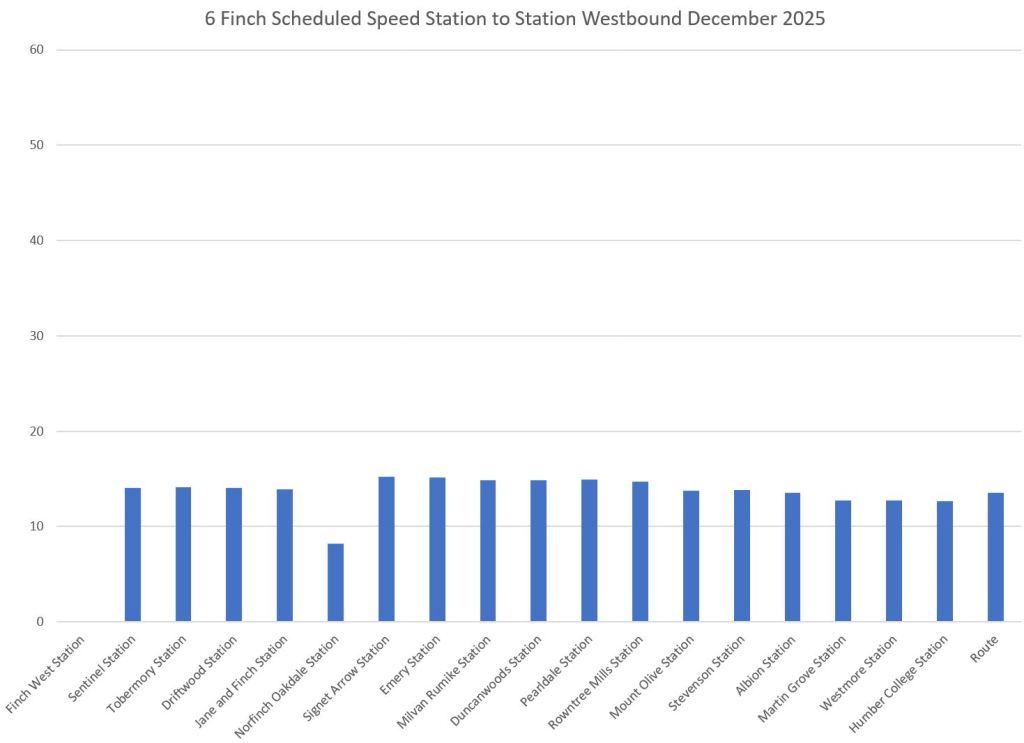
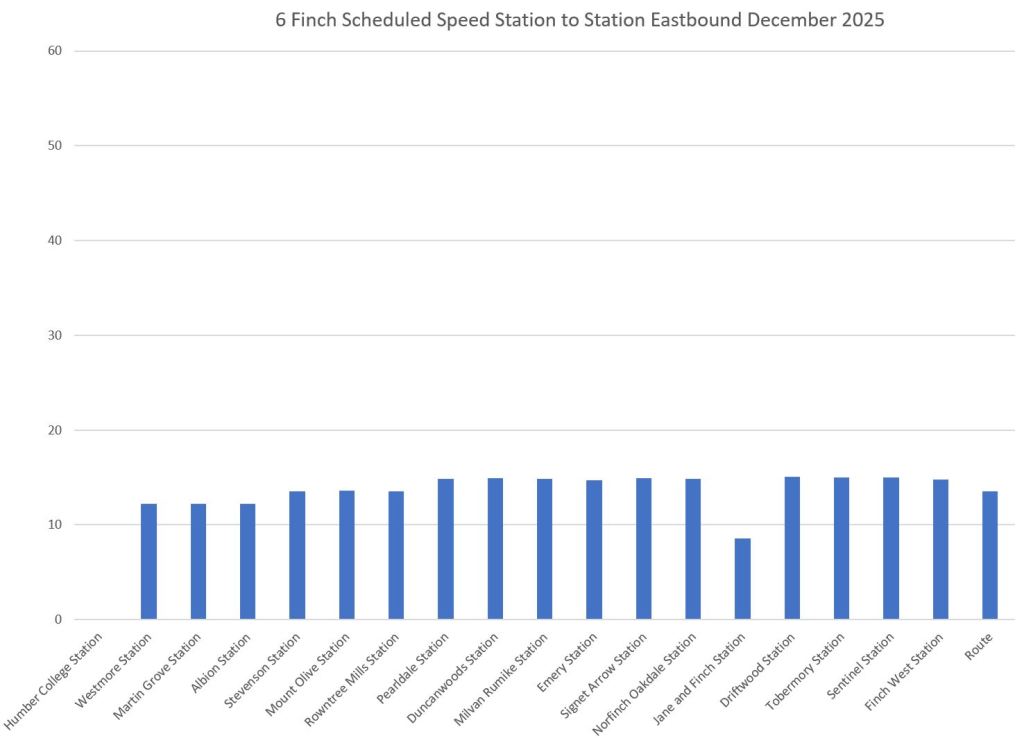
The tables in this file show the spacing between stops, the scheduled time and the speed in kilometres per hour. Speeds vary over the route, and they average 13.53 km/hr. This does not include terminal turnaround time.
There is a particularly slow section at Jane-Finch both ways implying that provision has been made for a delay on every trip. I will inquire of TTC why the slow operation (8.2 to 8.6 km/hr) applies there.
The average speed is slower than the 36 Finch bus during some periods, a rather poor showing for a rail line on its own reserved lane. In a future update, I will include more information about the stop level schedules and speeds for the 36C Finch West Bus. Here is the current scheduled service summary.
Comparative Scheduled Travel Times for 36C Finch West Bus an 6 Finch West LRT
The charts below compare the scheduled travel times between Humber College Bus terminal and Finch West Station with the planned 46-minute trip time of the LRT service. The LRT is faster than the bus notably on weekday and Saturday afternoons, but slower in the early morning and evening periods.
This post will be updated with early operating results and vehicle tracking information once they are available.
The initial service is described as a “soft opening”:
Following the recommendations of the Ottawa LRT public inquiry, Line 6 Finch West will operate under “soft opening” conditions with trains running from 6 a.m. to 10 p.m. until Spring 2026. The temporary early closing will provide the line’s maintainers, Mosaic Transit Group, with an extended maintenance window, allowing staff to become more familiar with the line and monitor it for any issues while in full revenue service.
The service level of 15 trains on a 6’30” headway implies a round trip time of 97’30”.
Fifteen fully accessible trains will operate during weekday morning and afternoon rush hours, with service every six and a half minutes. At all other times, including weekends, trains will arrive approximately every 10 to 12 minutes. [TTC media release]
By comparison, the 36C Finch West bus has an AM peak round trip time from Finch West Station to Humberwood Loop of 116 minutes, and a PM peak RTT of 138 minutes. These times include recovery time at terminals. The peak period scheduled time between Humberwood Loop and Humber College Station for buses is 8 minutes, and so for comparative purposes, 16 minutes should be deducted from the bus running times to compare with the LRT. TTC has not yet published off-peak travel times or train counts.
This adjustment reduces the AM peak round trip time for the 36C bus to 100 minutes and the PM peak time to 122 minutes, as against 97.5 minutes for the LRT. The greater saving comes when the exclusive lanes on Finch give an advantage over bus speeds, although one might have hoped for better in the AM peak. The wider headway (interval) between trains will add waiting time, and it remains to be seen if the TTC can avoid its usual bunching and gaps that plague every major route in the city.
36 Finch West bus service design effective November 16, 2025:
As more information emerges, I will update this post.
The 30-day Revenue Service Demonstration for the Finch West LRT is complete, and the TTC will take full operational control of the line no later than Monday, November 3, 2025 according to an announcement by the Ontario Ministry of Transportation. A date for revenue service will be decided by the TTC.
The next planned schedule changes for the TTC are on Sunday, November 17, and Sunday, December 22, 2025. Implementation of any changes for November 17 are already well underway internally, and it would be a stretch to see route 6 Finch enter revenue service that soon unless the TTC had already made provision for this. Service change details for November 17 are not yet public, but should start to emerge both from internal sources and from the posting of new online schedule data used by trip planning apps in early November.
The announcement notes that the Eglinton Crosstown line is currently going through its own demonstration period, but the status of that testing has likely been affected by a collision in the Mount Dennis yard as reported by the Toronto Star.
Also announced are:
November 16, 2025: Opening of Mount Dennis GO/UP Station as well as the passageway under Eglinton Avenue at Eglinton West station to reduce pedestrian crossings at the surface.
The Crosstown stations at Mount Dennis and Eglinton West will not open until revenue service begins on the line, and at that time Eglinton West will make the long-planned name change to “Cedarvale”.
The Ministry touts various changes made based on experience with the Crosstown project that were applied to the Finch project and others:
Using simpler, proven signal and power systems from other LRT projects to reduce design complexity and technical risk, making delivery, testing and commissioning smoother.
Working collaboratively with building partners to identify critical funding for testing and commissioning and ensuring claims and legal barriers do not impact this process.
Onboarding the maintenance provider earlier in the process to ensure the fleet and line are ready for service sooner.
It is not clear what “other LRT projects” might have more complex signal and power systems, but Eglinton is unique in the amount of underground running where trains will be under automatic operation. Problems with premature brake wear on the Flexity LRVs used on Eglinton were traced to incompatibility between the automatic train control system and the braking system on the cars causing them to brake too strongly. This has been corrected, but considering the years the line has been under construction and testing, it is amazing that this problem was only recently found and dealt with.
The points about working collaboratively with “partners” building the line and bringing a maintenance provider “onboard” earlier speak to basic flaws in project design and contract management. A passing reference to the Eglinton line “which began construction under the previous government in 2011” tries to fob off responsibility for issues with Metrolinx that the Ford government had years to correct.
This article will be updated as more information becomes available.
The Design Review Panel at Waterfront Toronto recently considered the proposed design for the surface portion of the Waterfront East LRT and Queens Quay reconfiguration now that it has reached the 60% level.
Updated June 6 at 4:10pm:
The presentation decks from the meeting will not be posted on Waterfront’s site, but I have set up a page on this site where those interested can access them. There is far more information about the designs in the presentation decks than I have included here.
This article focuses on aspects of the design affecting the Waterfront East LRT project (WELRT), one of several major City of Toronto priorities that is not yet funded. Toronto hopes to see money for this in the Federal government’s collection of key infrastructure projects, but nothing is certain.
How much of this design will survive the inevitable “value engineering” and reduce acres of green to boring concrete remains to be seen.
Responsibility for this project is split:
The segment from Union south to Queens Quay is a TTC project, but work on that has stopped at 30% design pending certainty about funding.
The segments on Queens Quay East, Cherry and Commissioners are split between the Port Lands Flood Protection project (funded) and the WELRT (not funded). Waterfront Toronto is responsible for design of these segments.
Two early works, shown in light blue in the map above, are the reconfiguration of the Yonge Street Slip and the extension of Queens Quay east from Small Street (where it now veers north) to Cherry Street. Readers may recall the overblown Sidewalk Labs proposal for the land around Parliament Slip and south onto Ookwemin Minising (formerly Villiers Island). This design round is far more in keeping with the style and scale of Queens Quay West’s renewal.
In its initial implementation, the WELRT will go as far as the Commissioners Street crossing of the new Don River. Tracks on Cherry will be extended south from Distillery Loop through a new portal under the rail corridor to connect with the line on Queens Quay east from Bay Street. Future expansion in various ways is possible, but how soon this might occur is anyone’s guess given the state of transit funding and the uncertainty of land development schemes. Options include:
Southern extension via Cherry to Polson Street
Eastern extension to a planned Broadview extension and thus to:
Leslie Barns via Commissioners
East Harbour Station on the Ontario Line and beyond to existing trackage on Broadview at Queen Street
This was a design presentation, and issues of constructability and eventual implementation of the WELRT are beyond its scope.
Ontario unveiled its 2025 budget on May 15. Although it speaks of “Approximately $61 billion over 10 years for public transit”, by far the lion’s share of this spending is for projects already underway in the construction and design stages.
All of this is for capital expansion and renewal, and nothing has been announced for day-to-day improvement of transit service.
GO Transit
The budget cites:
The Hamilton-Niagara through service connection at West Harbour Station which is already in service.
The proposed Bowmanville extension which has been announced before, but is only barely underway at the “early works” stage. This extension has physical alignment issues.
GO 2.0 includes “delivering all-day, two-way service to Kitchener and Milton, building new GO stations across the region and advancing planning to unlock potential new rail corridors through midtown Toronto, Etobicoke, York Region and Bolton.” There are no dates attached, and some of these have been on maps for a very long time. Notable by its absence is any mention of electrification.
A total of $850 million to refurbish GO Transit rail coaches at the Thunder Bay Alstom the North Bay ONR facility. This work is already announced. The cars may receive convenience upgrades such as “charging plug ports, cup holders and improved Wi-Fi”, but the long-term retention of these cars indicates that the operating model for GO electrification, if and when it occurs, will have a large component of locomotive-hauled trains rather than electric multiple units.
Subways
Subway projects in the budget are:
Ontario Line (under construction).
Eglinton-Crosstown Western Extension (under construction).
Yonge North to Richmond Hill (procurement underway).
Sheppard Subway Extension (planning, consultation and business case preparation underway). Notable in the map below is the absence of a line east of McCowan where there is a conflict with the City’s Eglinton East LRT project and with maintenance yard property requirements.
New subway cars for Line 2. Provincial funding for these trains has been in place for some time. What is not yet funded are trains for service expansion beyond pre-covid 2019 levels. Trains for the Yonge North and Scarborough extensions are included in those projects. The TTC is in the Request for Proposals process for new trains, but this has been skewed by provincial statements that the work should go to Alstom’s Thunder Bay plant.
Yes, they seem to have forgotten the Scarborough Subway Extension (now under construction) in the text although it is included in the map below..
East Harbour Transit Hub
The hub at East Harbour Station, near the point where the Lakeshore East GO line crosses the Don River, will eventually serve GO Transit, the Ontario Line, and the local streetcar/LRT system via the Broadview Avenue Extension and a link west via Commissioners Street.
A substantial portion of this project is funded by the City of Toronto as a remnant of John Tory’s “SmartTrack” plan.
Light Rail Projects
Hamilton LRT: This is in early states with procurement underway for Civil Works and Utilities.
Hazel McCallion (Mississauga) LRT: Construction is well underway for the initial phase of this project, and the Province is studying whether the extension into downtown Brampton should be tunneled.
Ottawa LRT: The Province is studying a potential upload of the Ottawa LRT “to help reduce costs for Ottawa taxpayers”. What implications this might have for future network operation and expansion is not clear.
Eglinton Crosstown and Finch West LRTs: “Major construction for both projects is now complete. Metrolinx continues to focus on safety and operational readiness testing, as the projects advance toward revenue service.” There is still no commitment to opening dates, and we are getting close to the three-month lead-time required for a go/no-go decision for an early fall 2025 start of service. Meanwhile, TTC has begun the process to update subway train announcements and maps to reflect the new lines.’
There is no mention of the Eglinton East or Waterfront East projects. In a recent letter, Mayor Chow asked the Federal government to contribute 1/3 to these schemes, but there is no indication of support in the Provincial budget.
The TTC work signup is now in progress for the schedule period starting March 30.
It includes a signup for the Eglinton LRT for non-revenue simulation training.
Now if only we could get Metrolinx to give a clear indication of an opening date. They did once claim that there would be a three-month pre-opening period. We will see just how long “three months” is.
Updated Feb 18, 2025 at 12:55pm:A TTC report with more extensive information about the proposal was posted today as part of the Board’s agenda for February 24. Information from that report has been merged into this article.
In the long wait for any kind of transit improvement for the eastern waterfront, the City of Toronto and TTC now plan to install reserved bus lanes on Queens Quay between Bay and Parliament Streets. A short stretch is also proposed for Front Street between Bay and Yonge Streets eastbound.
The proposal would add red lanes:
eastbound on Queens Quay from Jarvis to Parliament,
westbound on Queens Quay from Parliament to Bay, and
eastbound on Front from Bay to Yonge.
The Martin Goodman Trail (cycling) will not be affected. A new westbound right turn lane will be added on Queens Quay at Jarvis. Parking spaces will be removed on Front east of Bay Street.
Updated Feb. 18, 2025: Maps of the proposed changes to Queens Quay and to Front Street are included in the TTC report.
There is more reservation westbound on Queens Quay than eastbound, and that is the direction with the worst congestion problems. The south side offers less space for creation of a bus lane, and in some cases there might be lane narrowing to free up space for the north side.
The reserved lane westbound is generally in the curb lane, but between Sherbourne and Jarvis it will be the second from the curb. The curb lane will be dedicated to right turns given the high demand for this at Jarvis. With this change, the westbound stop at Richardson Street will be removed. The lane disappears between Cooper and Yonge Streets due to space constraints, but reappears west of Yonge in an area now used for Motorcoach loading.
On Front Street, although this is a “red lane”, the intent is for storage of up to five buses, not for speedy travel. Moreover, the bus stop will be shifted further east adding to the walking distance for riders to Union Station.
The accessible loading zone will shift west behind the bus layby. The layby area is now occupied by ten parking spaces which will be removed. This area will be shared by 114 Queens Quay, 19 Bay and 202 Cherry Beach.
For further details on the proposal, please see the TTC Report at pp 12-15.
[End of Feb. 18 update]
The area is now served, albeit infrequently, by a mix of routes that can often be snarled in traffic. The intent is to save up to five minutes travel time between Bay and Parliament. The reserved lanes will also host future improved service to developments on the eastern waterfront pending construction of the planned, but long-delayed Waterfront East LRT.
In May 2024, 114 Queens Quay replaced the southern end of 19 Bay which now terminates at Front Street. From a loop via Front, Yonge, Wellington and Bay it runs south on Bay then east on Queens Quay into the Port Lands. The 114 operates every 10 minutes in peak periods, 12-15 minutes at other times. This is the primary route serving waterfront developments.
202 Cherry Beach (summer months only) runs from the same downtown loop as the 119 and follows its route as far as Parliament where it shifts north to serve the Distillery District. The 202 then turns south via Cherry Street to a loop at Cherry Beach. In summer 2024, this route operated every 20-30 minutes with no service in the AM peak.
75 Sherbourne has a south end loop via Sherbourne, Queens Quay, Jarvis and The Esplanade. It operates every 6-8 minutes during weekday daytime, and 20 minutes or more during most other periods.
65 Parliament loops at the George Brown Campus on Queens Quay. (This loop was the former eastern terminus of 19 Bay). It operates every 8-9 minutes during peak periods, 13-15 minutes at other times. Overnight service is provided every half hour by 365 Parliament.
The service between Union Station and the waterfront on 114 Queens Quay is not on a par with other routes that have dedicated lanes, and real improvement in accessibility of the waterfront will only come with much better service and eventually the LRT link via the Bay Street tunnel. A recommendation and decision on staging of the LRT should come to Council and the TTC later in 2025, but the project is not funded.
Public consultation will be held via a survey that is active until Thursday, February 20, and via three sessions:
Tuesday, February 18, 2025, 7:00 – 8:30 p.m. This session was held via webex.
Wednesday, February 19, 2025 at the George Brown Waterfront Campus:
3 – 5 p.m. A pop-up event will occur in the main lobby.
7:00 – 8:30 p.m. An in person session in the 2nd floor main auditorium, room 237.
This page will be updated when more information is available.