TTC 2025 Operating Budget – Preliminary Review

The TTC released its 2025 budget package on January 7 including the proposed Operating Budget, the Capital Budget and Plan, and the Real Estate Investment Plan. The TTC Board will discuss this package at its meeting on January 10.

This article is a preliminary review of the Operating Budget. I will turn to other parts of the package in separate articles, and will add follow-up articles after the Board meeting.

Highlights:

  • Fares continue to be frozen at 2023 levels.
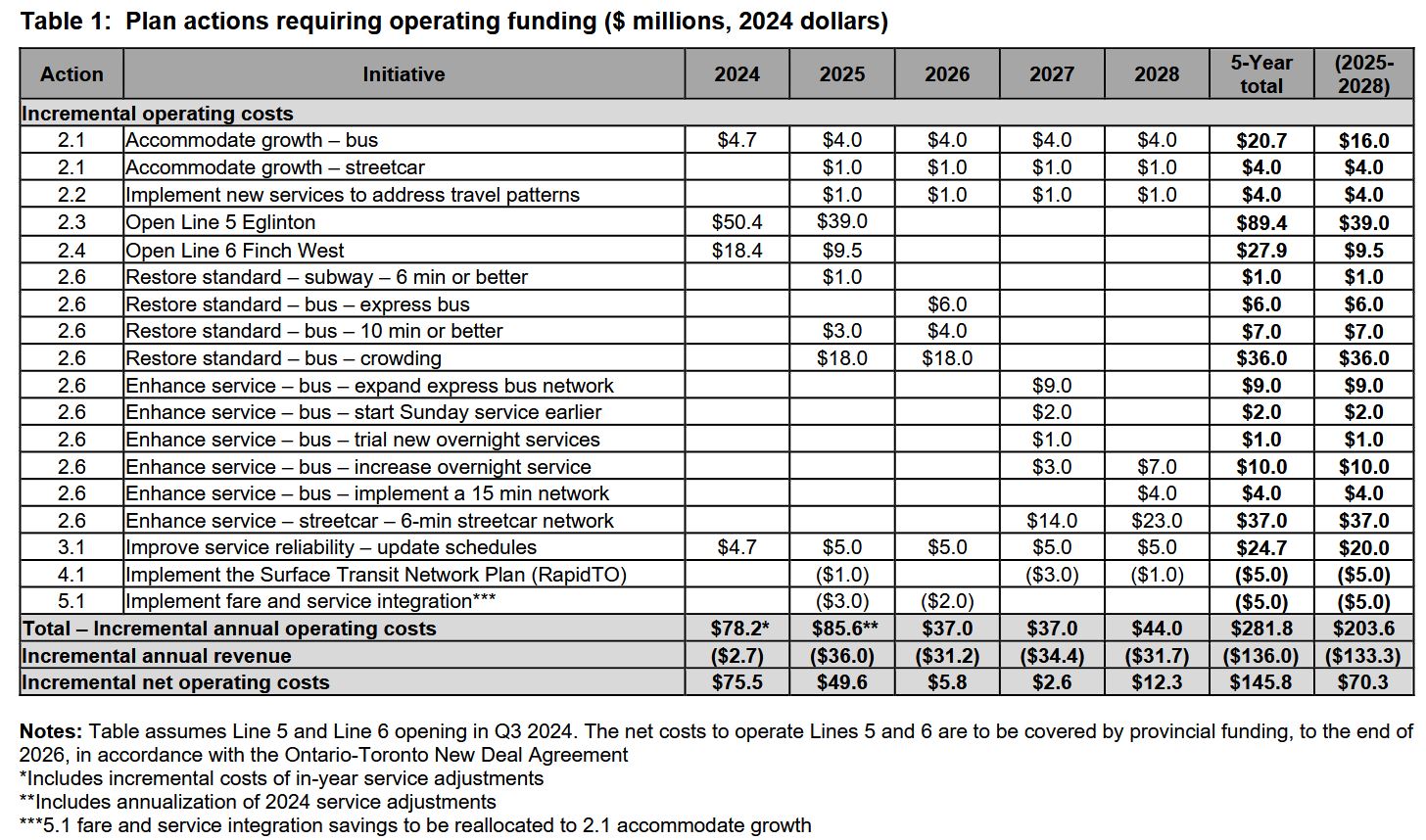
  • The total Operating Budget for 2025 is $2.819 billion of which $1.387 billion will be covered by City subsidies. This is broken down as:
    • Conventional system: $2.636 billion with a subsidy of $1.214 billion
    • Wheel-Trans: $182.6 million with a subsidy of $173.2 million
  • Service hours will be increased by 5.8%. There are some specifics in the budget, but more details are to follow.
    • 1.7% increase to account for ridership growth and new services for accessibility pending completion of the Easier Access program.
    • 2.2% increase for off-peak service.
    • 1.9% increase for opening Lines 5 and 6 together with bus network changes (tentatively planned for July and August, respectively, subject to Metrolinx confirmation of dates).
  • Specific service improvements listed in the budget include:
    • Implementation of 6 minute service or better from 7am-7pm, 7 days/week on 505 Dundas, 511 Bathurst and 512 St. Clair.
    • Return to pre-pandemic wait times on subway lines during off-peak periods.
    • Restoration of pre-2023 off-peak crowding standards. Service will be increased starting in April on nine priority routes (not listed).
  • Increase in Wheel-Trans service to handle an expected 4 million more rides in 2025.
  • Increase in capacity to recruit, train and develop the workforce.
  • A pilot program on 10 key routes to reduce bunching and gapping.
  • A pilot program to improve cleanliness in six key subway stations (Scarborough Town Centre, Kennedy, Dundas, Finch, Spadina, Lansdowne).
  • Improved maintenance and asset management for key items such as subway work cars.
  • Beginning an environmental resiliency program.
  • Expanding the fare compliance program to increase revenue.
  • Cost savings of $37.2 million from budget reviews and efficiencies.

These items are discussed in more detail in the main part of the article. Many parts of the budget are presented here only in summary with tables showing financial breakdowns. Readers interested in further details should consult the TTC’s budget report linked above.

Continue reading

Does Toronto Have a Vision For the TTC?

With a new year, and the TTC 2025 Budget coming imminently, where is our transit system headed?

Back in September 2024, as the TTC began to seek a new permanent CEO, Mayor Chow wrote to the TTC Board with her vision for the TTC’s future. The word “imagine” gives a sense of the gap between where the TTC is today, and where it should be.

Imagine a city where a commuter taps their card to enter, paying an affordable fare, and then takes a working escalator or elevator down to the subway platform. The station is clean and well-maintained, the message board is working and tells them their train is on time. People aren’t crowded shoulder to shoulder waiting to get on the train, only to be shoulder to shoulder during their ride. If while they wait they feel unsafe, there’s someone there to help them. And they can rely on high quality public WiFi or cell service to chat with a friend or send that important text to a family member.

Imagine a system with far-reaching, frequent bus service. Where riders aren’t bundled up for 20-30 minutes outdoors, waiting for bunched buses to arrive. Where transfers are easy and reliable. Where there is always room to get on board. Where people can trust their bus to get them to work and home to their families on time.

This is very high-minded stuff any transit advocate could get behind, if only we were confident that the TTC will be willing and able to deliver. This is not simply a matter of small tweaks here and there – a bit of red paint for bus lanes on a few streets – but of the need for system-wide improvement in many areas.

Reduced crowding depends on many factors including:

  • A clear understanding of where and when problems exist today, and the resources needed to correct them.
  • A policy of improving service before crowding is a problem so that transit remains attractive. Degrading standards to fit available budgets only hides problems.
  • A bus and streetcar fleet large enough to operate the necessary service together with drivers and maintenance workers to actually run them.
  • Advocacy for transit priority through lanes and signalling where practical, tempered by a recognition that conditions will never be perfect on every route.
  • Active management of service so that buses and streetcars do not run in packs.

None of this will happen without better funding, and without a fundamental change from a policy of just making do with pennies scraped together each year.

Funding comes in two flavours: operating and capital. Much focus lately is on capital for new trains, signals and buses, but this does not add to service. Replacing old worn-out buses with shiny new ones has little benefit if they sit in the garage.

A Ridership Growth Strategy

For decades, the TTC has not had a true ridership growth strategy thanks to a transit Board who thought its primary role was to keep subsidy requirements, and hence property taxes, down. This began before the pandemic crisis, although that compounded the problem. There is little transit advocacy within the TTC. Yes, there is a Five Year Service Plan, but it is a “steady as she goes” outlook. Only minor changes are projected beyond the opening of a few rapid transit lines.

What might Toronto aim to do with transit? What will this cost? How quickly can we achieve change? Strategic discussions at the TTC could lead to informed advocacy by both politicians and the riding public, but that is not what we get.

Astoundingly, the TTC Board does not have a budget committee. The Board never discusses options and goals, or “what if” scenarios. Board members or Councillors might raise individual issues, but these are not debated in an overall context. If one survives to “approval in principle”, it will be something to think about “next year” if there is room in the budget. In turn, Council does not have a clear picture of what might be possible, or what is impossible, because TTC does not provide information and options.

Whether it is called a “Budget” committee or a “Strategic Planning” committee, the need is clear, although the name will reflect the outlook. “Budget” implies a convention of bean counters looking for ways to limit costs, while “Strategic Planning” could have a forward-looking mandate to explore options. Oddly enough, billion dollar projects appear on the capital plan’s long list with little debate, but there is no comparable mechanism to create a menu of service-related proposals. A list does exist within the Five Year Service Plan, but it gets far less political attention or detailed review.

A further problem lies in prioritization of operating and capital budget needs. With less than one third of the long-term capital plan actually funded, setting priorities has far reaching consequences. The shopping list might be impressive, but what happens if, say, half of that list simply never gets funding? Everyone wants their project on the “must have” list, while nobody is content to sit on the “nice to have some day” list.

Even worse, a recent tendency inherited from Metrolinx views projects in terms of their spin-off effects. For every “X” dollars spent “Y” amount of economic activity and jobs are created. The more expensive the project, the more the spin-off “benefits”. This is Topsy-turvy accounting. Either a project is valuable as part of the transit network in its own right, or not. Spending money on anything will generate economic activity, but the question is do we really need what we are talked into buying?

On the operating side, an obvious effect is on the amount of service. Toronto learned in recent years the cost of maintenance cuts on system reliability and safety. Budget “efficiency” can have a dark side. Strangely, we never hear about the economic benefits of actual transit service, and the effects of improving or cutting it. The analysis is biased toward construction, not operations.

The populist view of transit is that fares are too high, and this attitude is compounded by nagging sense that today’s fare does not buy the same quality of service riders were accustomed to in past years. After the pandemic, we forget that TTC had a severe capacity problem in the past decade that was only “solved” by the disappearance of millions of riders. Toronto should not be aiming to get back to “the good old days”, but should address the chronic shortfall between expectations and funding.

Mayor Chow wrote:

Transit is essential. It has to work, it has to work for people. A safe, reliable and affordable transit system is how we get Toronto moving. It’s how we create a more fair and equitable city, where people can access jobs and have more time with family, no matter where they live. It’s how we help tackle congestion and meet our climate targets. In so many ways, it’s the key to unlocking our city’s full potential.

These high principles run headlong into fundamental issues:

  • The TTC metric of vehicle service hours does not reflect actual service provided to riders because it does not account for slower operation (congestion, added recovery time) and other factors (mode and vehicle changes). Getting back to pre-pandemic hours does not mean providing the same level of service. Riders want to see frequent and reliable service.
  • Recent success with federal funding for new subway trains hides two problems: there are many other much-needed capital projects, and the new funding does nothing to address day-to-day operations and maintenance.
  • Even the subway car funding will not show its full benefit for years. Service growth on both major subway lines will be constrained over the next decade by past deferrals of needed renewal projects.
  • Signal problems exist on both Line 1 (new equipment, used world-wide) and Line 2 (old, must be replaced). Management should clearly explain the sources of problems, and their plans to improve reliability in the short-to-medium term. Signal issues are only one example of the decline in infrastructure and fleet reliability that the TTC must address.
  • New eBuses may give Toronto a greener fleet, but at a substantial cost premium that adds to long-term capital requirements. The main environmental benefit of transit is to get people out of their cars, but without more service, without the money to operate more shiny new buses, service quality will discourage would-be riders.
  • Low fares are politically attractive, but absent other funding, they are a constraint on transit growth. It is ironic that fare freezes are a common political “fix”, but targeted benefits such as the “Fair Pass” program languish because they are “unaffordable”.

Toronto thinks of itself as a “transit city”, but must do more to address service as riders see it.

Continue reading

“Service” on the 320 Yonge Night Bus

A reader commented in another post that he had a very long wait this morning (Sunday, December 22, 2024) for the 320 Yonge night bus around 6am. I had a look at the tracking data on Darwin O’Connor’s TransSee website to see what was happening. What I found was not pretty, not by a long shot.

320 Yonge is one of many all-night routes that riders depend on for transportation at a difficult time of the day, but the way the TTC operates this and other 3xx routes in the Blue Night network is a testament to how badly riders are treated at off hours.

I plan a detailed review of overnight service in January, but this will give a taste of what is going on.

Here are the tracking charts showing vehicle spacing and crowding on 320 Yonge for the past four Sundays. Each line represents a bus moving north and south from Steeles at the top to Queens Quay at the bottom. The horizontal spacing shows the gap in service, and the thickness of the dot shows the crowding level. The really fat dots show a bus at 90% or more of its maximum load.

Service between 5 and 6am is scheduled to be thin, but sometimes it can totally vanish as it did northbound on December 1st and 15th, and almost completely for over an hour on the 22nd. There are wide gaps at other times on some dates. For example, a wide gap southbound from Steeles at about 2:30am travels south and echoes back and forth on the line until nearly 6am.

Remember the usual tropes to explain poor service such as traffic congestion, bike lanes and the occasional plague of frogs that are cited to explain bad service. Oh yes, we mustn’t forget how streetcars cannot run reliably in mixed traffic, but, oh dear, the last streetcar ran on Yonge Street 70 years ago.

There is only a minor sign of traffic congestion in the period from 2-3am northhbound. This is a common issue and should be provided for in the schedules. Instead, it generally creates clumps of buses than run together to Steeles and back again southbound.

This is down to bad service regulation in the off hours, something already visible for evening and weekend services in many of my previous article. Overnight bus and streetcar routes have the worst reliability in the system, but they are not important enough for the TTC to care about them.

Another factor evident in these charts is that the buses have inadequate recovery time with which to recover from any delays or simply to give operators a break. This is shown by the immediate turnaround of buses at terminals (top and bottom of charts) with very little dwell time (shown by horizontal lines indicating a stopped bus).

In the Five Year Service Plan, the TTC talks of future Night Service improvements, assuming that they are funded. Here is a table showing possible changes:

Nothing is even proposed for night service improvements until 2027, and based on typical budget cycles, that really means fall 2027, not New Year’s Day.

The problem shown in the tracking charts above is very much one of poor line management, scheduling and wasted resources. It is almost impossible to tell whether, if buses were evenly spaced, any more would actually be needed, except during that 5-6am hour when service is thin on the ground, at best.

The TTC operates under difficult circumstances, but too many problems are “own goals” all the way from service adequacy and management through infrastructure and fleet maintenance.

Biblical plagues are not responsible for poor service, although the TTC would love to have a supernatural excuse. In the new year, we will see what the TTC proposes for 2025 and whether this will really make a difference for riders.

TTC Service Changes Effective Sunday, January 5, 2025 (Updated)

The TTC will change schedules on many of its routes on January 5 in response to various factors including:

  • Restoration of holiday period cuts implemented on December 22
  • Progress in construction projects at Lawrence West and Rosedale Stations, and on Queens Quay
  • Beginning of reconstruction of Warden Station
  • Reallocation of bus bays at Kennedy Station
  • Reallocation of streetcar routes between carhouses to simplify operations
  • Setting a standard night car headway of 20 minutes (this change will complete when 310 Spadina resumes streetcar operation)
  • Implementing alternate surface routes to provide for accessibility where this is not yet available in certain stations

There is no change in subway service for this period.

Possible service improvements for 2025 will not occur until after the TTC’s 2025 budget and subsidy are approved.

Updated January 3, 2025 at 11:30pm: There will be a temporary arrangement with 511 Bathurst cars operating to Union Station and 509 Harbourfront cars operating to Spadina & Adelaide until mid-January. See the map later in this article.

Continue reading

TTC Service Changes Effective Sunday, December 22, 2024

The TTC will adjust schedules on December 22 to reflect lower demand over the holiday period. Some routes will revert to summer 2024 schedules, and extra trips for school travel will be cut. These changes will be reversed in the January 5, 2025 schedules.

Routes changing to summer schedules:

  • 38/938 Highland Creek
  • 57 Midland
  • 76 Royal York South
  • 102/902 Markham Road
  • 111 East Mall
  • 903 Kennedy-Scarborough Express
  • 905 Eglinton East Express
  • 995 York Mills Express

The 900 Airport Express will see improved service during weekday peak periods, and weekend daytime.

Service over the period will be adjusted day to day as shown below.

DateService Design
Fri. Dec. 20Regular weekday service
Sat. Dec. 21Regular Saturday service
Sun. Dec. 22Regular Sunday service with minor changes
Mon. Dec. 23Adjusted weekday service (see above)
Tue. Dec. 24Adjusted weekday service
Wed. Dec. 25Holiday service with most routes starting at 8am
Thu. Dec. 26Holiday service with 32 shopping extras between 11am and 10pm
Fri. Dec. 27Adjusted weekday service
Sat. Dec. 28Regular Saturday service with minor changes
Sun. Dec. 29Regular Sunday service with minor changes
Mon. Dec. 30Adjusted weekday service
Tue. Dec. 31New Year’s Eve service (see below)
Wed. Jan. 1Holiday service with most routes starting at 8am
Thu. Jan. 2Adjusted weekday service
Fri. Jan. 3Adjusted weekday service
Sat. Jan. 4Regular Saturday service with minor changes
Sun. Jan. 5Regular Sunday service
Mon. Jan. 6Regular weekday service including school trips

New Year’s Eve Service

Service will operate free of charge from 7pm on December 31 to 7am on January 1 courtesy of Corby’s Distillery. Late evening service on most routes will be extended to 3am January 1.

Last Train
1 Yonge-University-Spadina
North from Union to Finch2:31 am
Last train arrival at Finch3:02 am
North from Union to VMC2:27 am
Last train arrival at VMC3:10 am
South from Finch2:00 am
South from VMC1:50 am
2 Bloor-Danforth
East from Kipling 2:15 am
Last train arrival at Kipling3:08 am
East from Bloor-Yonge2:40 am
West from Bloor-Yonge2:39 am
West from Kennedy Station2:18 am
Last train arrival at Kennedy3:02 am
4 Sheppard
East from Sheppard-Yonge2:57 am
Last train arrival at Don Mills 3:05 am
West from Don Mills3:09 am
Last train arrival at Sheppard-Yonge3:17 am

There will be a total of 127 Run As Directed buses operating with ending times varying from 3:50 to 6:10am on January 1.

Contract services on 52 Lawrence West to Westwood and 68 Warden to Major Mackenzie will end at about 3am. 160 Bathurst North, 102 Markham Road and 129 McCowan North will end at their usual times.

Service Change Details

2024.12.22 Service Changes

TTC Board Meeting Dec. 3, 2024: Follow-Up

This article is a follow-up to TTC Board Meeting: December 3, 2024. The following items are covered here:

  • Accessibility Plan and Family of Services
  • Work Car Hydraulic Leak Incidents
  • Seasonal Prohibition on Lithium-Ion Battery Powered E-Bikes and E-Scooters
  • Retirement of Legacy Fare Media

See also:

Continue reading

June 1/25 the Earliest Date for Eglinton/Finch says TTC Chair (Updated)

At the TTC Board meeting on December 3, Chair Jamaal Myers proposed a motion to extend the validity of legacy fares (tickets, tokens, day passes) to June 1, 2025 for the “conventional” system, and to December 31, 2025 for WheelTrans. This was adopted by the Board.

After the meeting, in a press interview, Myers was asked “Why June 1”?

He answered that June 1 was the earliest possible opening date for Line 5 Eglinton Crosstown and Line 6 Finch. Those lines have no fare collection support for the old fare media.

This puts Metrolinx in a bind: either they announce an earlier date, something they have been loathe to do for months, or they acknowledge that we will not ride these trains until late Spring, maybe. If Doug Ford holds an election as expected, there will be no ribbon cutting for him to tout his great works.

Updated Dec. 4/24 at 6:10pm: In today’s Star, Myers qualified his statement:

TTC chair Jamaal Myers told the Star on Wednesday that the TTC is preparing to operate the Eglinton Crosstown and Finch West LRTs using an internal target date of early June next year — though he was careful to note that he does not speak for Metrolinx, the provincial agency in charge of constructing both beleaguered light-rail lines.

Myer added that the June target date was set separate from Metrolinx’s construction timeline, and was solely for the TTC’s internal preparations to take over operations once the LRT is ready.

He said TTC staff are using June 1 as a target date to train the LRT drivers and it includes a 30-day “revenue service demonstration,” which will see trains run along the full track of the LRT. The internal target dates were partly created for financial planning purposes and are not specific to the LRT.

TTC Board Meeting: December 3, 2024

The TTC Board will meet on December 3 with several items of interest on their agenda.

  • CEO’s Report and Key Performance Indicators
  • Notice of Motion: Proposed deferral of legacy fare retirement
  • Financial and Major Projects Update
  • Easier Access Program Update

In a previous article, I reviewed the report on subway work car hydraulic leaks. See:

After this agenda was published, the Federal Government announced its one third support for the purchase of 55 new Line 2 subway trains. See the Major Projects Update below for more details.

Continue reading

Actual vs Advertised Wait Times

A central part of any transit rider’s journey is the wait for a vehicle that may or may not show up when expected. Even with an app that tells you where the bus is, the news might not be good. Rather than being just around the corner, the bus might be several miles away, and heading in the wrong direction.

The only statistic the TTC publishes on service quality is an “on time” metric. This is measured only at terminals, and even there “on time” means that a bus departs within a six-minute window around the scheduled time. Performance is averaged over all time periods and routes to produce system-wide numbers, although there are occasional references to individual routes in the CEO’s Report.

Riders complain, Councillors complain, and they are fobbed off with on time stats that are meaningless to a rider’s experience.

The problem then becomes how to measure the extra time riders spend waiting for their bus, and to report this in a granular way for routes, locations and times.

This article presents a proposed method for generating an index of wait times as a ratio comparing actual times to scheduled values, and their effect on the rider experience. The data are presented hour-by-hour for major locations along a route to see how conditions change from place to place.

An important concept here is that when buses are unevenly spaced, more riders wait for the bus in the long gap and fewer benefit from buses bunched close together. The experience of those longer waits raises the ratio of the rider’s waiting experience to the theoretical scheduled value. The more erratic the service with gaps and bunching, the higher the ratio of rider wait time to scheduled time. This is compounded by comfort and delay problems from crowded buses, and is responsible for rider complaints that do not match the official TTC story.

There’s some math later to explain how the calculations are done for those who want to see how the wheels turn, so to speak.

Note that this is a work in progress for comment by readers with suggestions to fine tune the scheme.

Continue reading

The Mythology of Service Recovery – November 2024 Update

Back in September, I wrote about the gap between the TTC’s claims of service coming back to pre-pandemic levels and the actual service riders face in their daily travels. See:

I will not repeat all of the information in that post, but we are coming into budget season and the most current info should be available for debate.

When the 2025 budget comes out, we will hear much about service recovery including the obligatory photo op with the Mayor, TTC Chair and other worthies. This will be a sham because actual service today has not been restored to early 2020 levels.

The fundamental problem with TTC claims is that they measure “service” by hours for the simple reason that the primary driver of costs is the labour associated with driving vehicles. Some costs don’t actually vary with driving time, but these are generally a smaller component of the total. (For example, some costs vary with mileage, and others such as garaging are per vehicle.) For budget purposes, the variable that counts is hours.

When comparing pre- to post-pandemic service levels, one hour of vehicle operation does not necessarily provide the same amount of service as in the past. The primary reasons for this are:

  • Buses and streetcars run more slowly today than in early 2020 due to a combination of traffic congestion and operating practices (notably the pervasive slow orders on the streetcar system).
  • More recovery time is included in schedules to reduce short turning. The premise is that if there is enough padding, vehicles will rarely be late enough that they must turn back before reaching their terminals.

The combined effect is that more vehicles (and hence vehicle hours) are required to provide the same service on many routes today compared with early 2020.

I have tracked the changes in operating speed on various routes in past articles, and will return to that subject to refresh the charts in coming months.

A related problem for riders is that thanks to uneven service (gaps and bunching), the average wait for a transit vehicle can be considerably higher than the advertised headway. TTC reports “on time performance” only at terminals where service tends to be (but is not necessarily) close to schedule. The information is averaged over many routes and all hours of the day, and bears little relevance to a rider at a specific bus stop at a specific time.

I will turn to the problem of experienced vs advertised wait times in a separate article now in preparation.

The remainder of this piece updates the September charts with planned service hours by mode to the end of 2024, and a comparison of service levels by route and time of day in January 2020 versus November 2024. PDF versions of the chart sets are provided at the end.

Continue reading