The TTC’s Strategic Planning Committee met on September 4 at 10:00am in the Board Room at 1900 Yonge Street, TTC headquarters. The agenda included a presentation on the 2025 projected results and the outlook for 2026. This includes comments on the Capital Budget and Plan which I covered in a previous article.
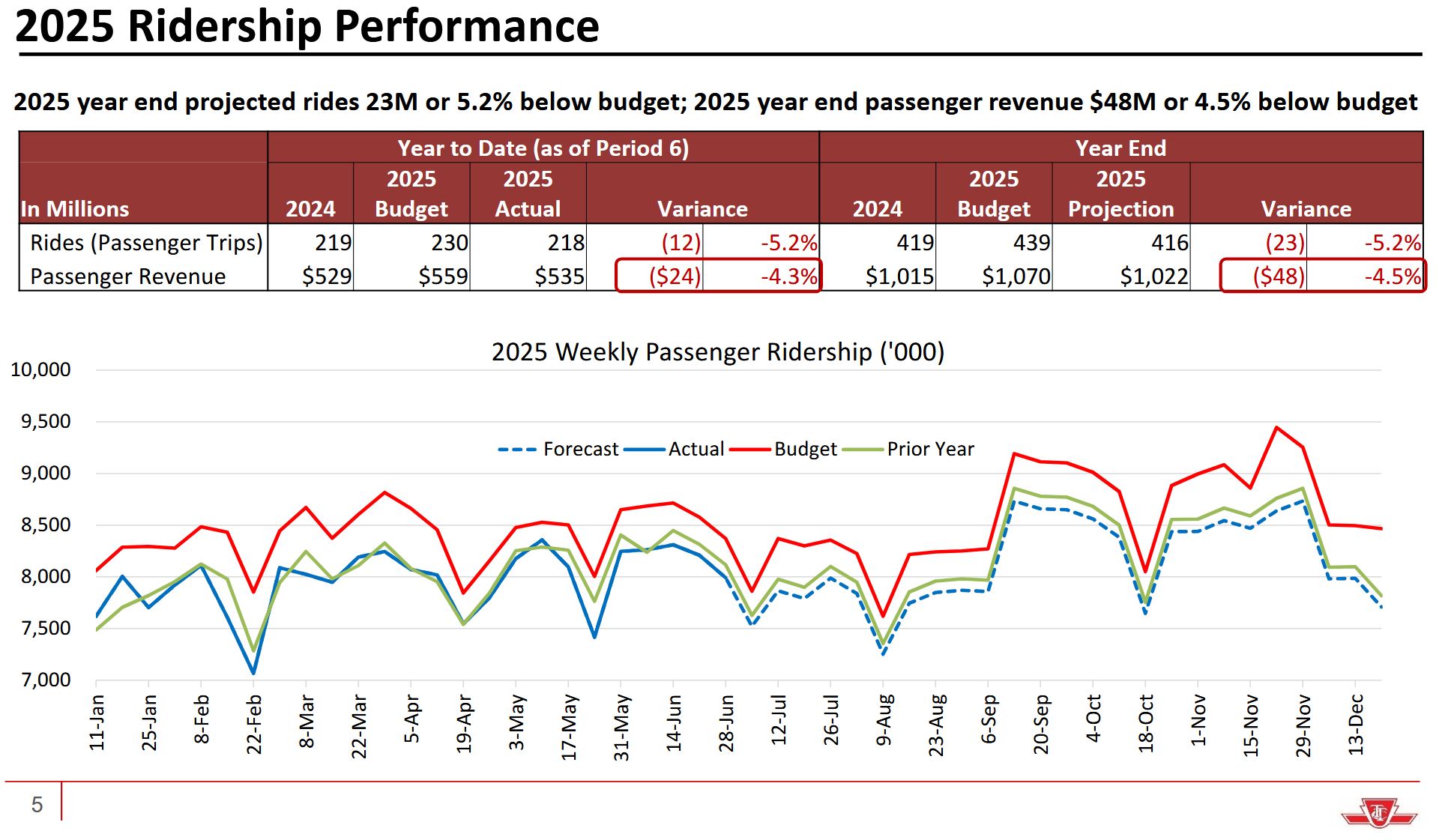
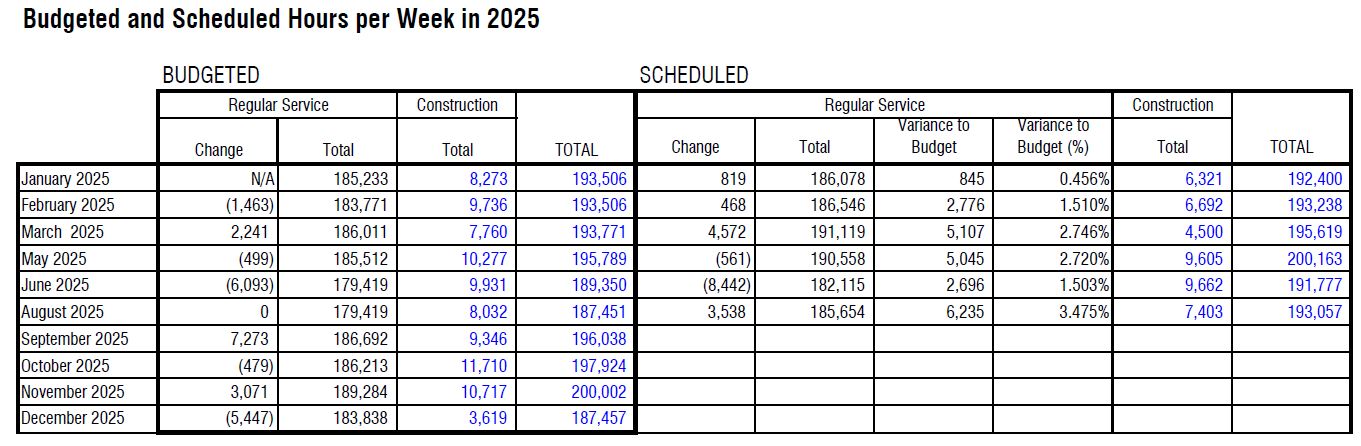
As of June 30, the TTC was running $17.7-million behind relative to budget, and this number is expected to rise to a $36.5-million shortfall for the full year.
This is due primarily to ridership coming in lower than projected partly offset by lower than budgeted expenses.
One item not mentioned in the report is that the TTC’s Operating Budget for 2025 includes a withdrawal of $51.4-million from reserves. There are several reserves for different purposes (one covers self-insured loses from accidents), and it is not clear how much headroom there is for further withdrawals once year-end results are finalized.
The City often finds “left over” money at year end from various sources, and some of this goes into reserves and/or to making the TTC budget whole. Whether this will be available in 2025 is not yet clear.
In any event, if future budgets assume substantial reserve contributions, they could exhaust the “rainy day funds”.
At its meeting of September 4, 2025, the TTC’s Strategic Planning Committee considered a report on the unfunded “state of good repair” (SOGR) projects in their capital budget and a recommendation that these be prioritized for any new funding that might become available.
Updated September 8 at 3:15 pm: A chart has been added showing the magnitude of proposed spending and the shortfall in funding over the years 2025-2039.
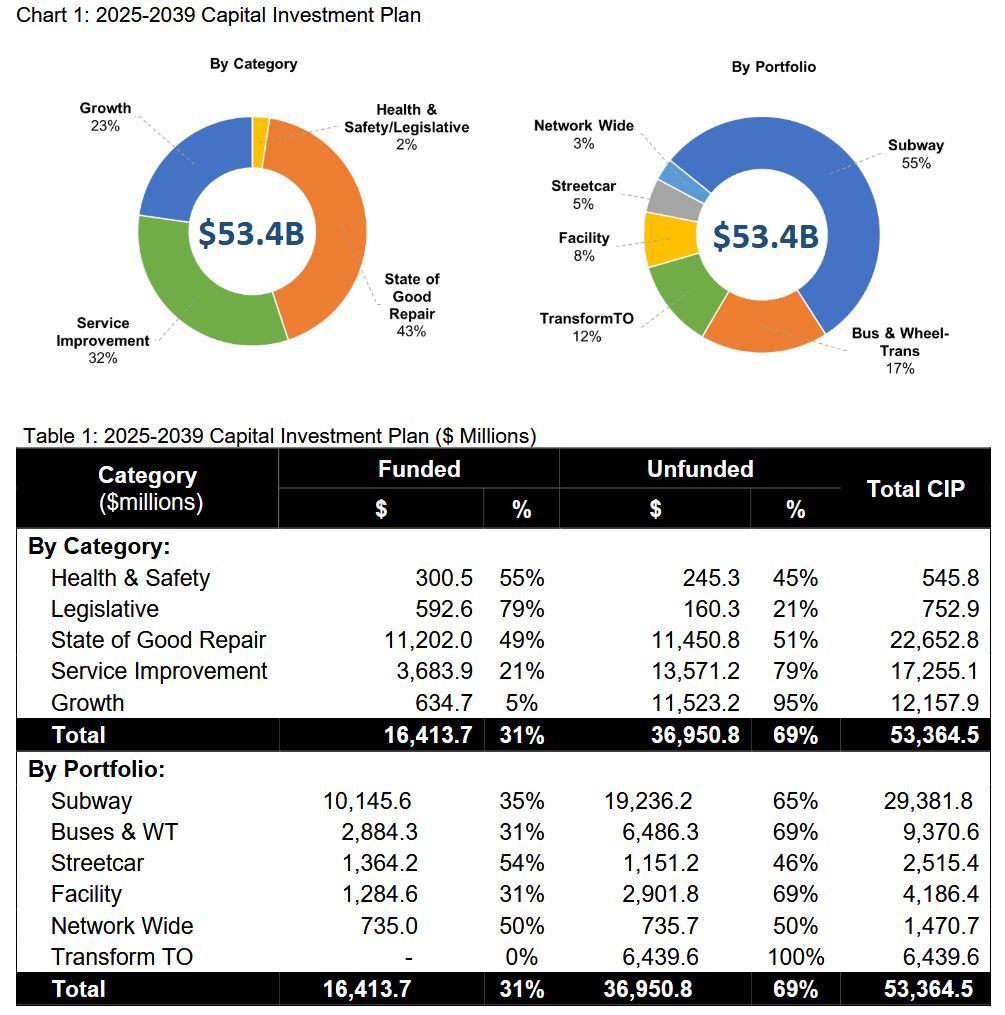
The charts and tables below summarize the 15-Year Capital Investment Plan showing the distribution of funding and spending by area. The categories are ordered by priority with mandated work, a comparatively small component, coming first, followed by State of Good Repair which accounts for roughly 40% of planned spending. Note that the Provincial projects such as the Scarborough Subway and major City projects like the Eglinton-Malvern LRT are not included here.
SOGR does not preclude spending on other work, but some major proposals could compete with basic maintenance. For example, Platform Doors and the TransformTO program together account for about 20% of the total plan ($10.5-billion). Bus “SOGR” includes not just the purchase of new buses, but also the cost of technology change for charging infrastructure. Although these should be funded from separate revenue/subsidy streams, they could elbow aside basic funding. There is not much point in such projects if the basic transit system is allowed to crumble.
Some of the language in the report is rather cataclysmic foreseeing the shutdown of parts of the system, notably the streetcar network, if SOGR work is not funded. The report is inconsistent in the language used to describe the situation:
Given the current approved funding levels, the TTC will not be able to renew tangent track assets at a rate necessary to maintain and support existing service demands in a safe and reliable fashion to meet its SOGR needs. Results of an insufficient renewal rate could include restricted speed zones/slow orders, weekend/multi-day service diversions/closures, and/or emergency service interruptions. [p. 6]
But more dire language appears later:
Even when attempting to utilize more operating resources within preventive or corrective maintenance programs, the TTC may find it necessary to plan and prioritize condemning some rail corridors in favour of renewing others, and some may be fully placed out of service, with key intersections being the most at risk. [p. 18]
Such language has appeared before going back into the previous decade. We have seen what deferred maintenance did to the Scarborough RT and to the subway network which is beset with slow zones where track is not safe to operate at full speed. Delays in funding and approval for replacement of Line 2 trains pushed out their projected lifespan, a situation relieved only by concurrent delays in the Scarborough Subway expansion. By contrast on the streetcar network, some of the worst locations have been repaired in recent years, notably the intersection at King & Church, and more replacements at key locations are planned for the near future.
One cannot help thinking there is an anti-streetcar bias at the TTC where any excuse is used to hobble the system including widespread slow orders and abdication of any sense of providing reliable service.
In past years, the TTC published a much more detailed version of the Capital Budget (aka the “Blue Books”) including maps showing the current condition of assets. These put the scope and immediacy of needs in an understandable form. The closest thing today is the map of Reduced Speed Zones, but this does not indicate the scale and timing of needed work in the near future.
The more cynical among us might wonder if the lack of detail was part of a larger effort in the Tory/Leary era to downplay the gradual decline of transit infrastructure thanks to underspending and deferred maintenance.
It is ironic that the TTC is prepared to consider shutting down part of the streetcar system when there are much more extensive areas on the subway in need of major reconstruction. With a fleet of about 260 cars of which peak service consumes barely 60%, the goal should be to increase use of vehicles they already own, not to sabre-rattle about dismantling the system.
The transit system is more than tracks, and especially on the subway many unseen or little regarded systems keep service operating and stations and tunnels safe for riders. These are all part of the SOGR program, but this emphasizes how subways are expensive infrastructure not just to build but to own as they age.
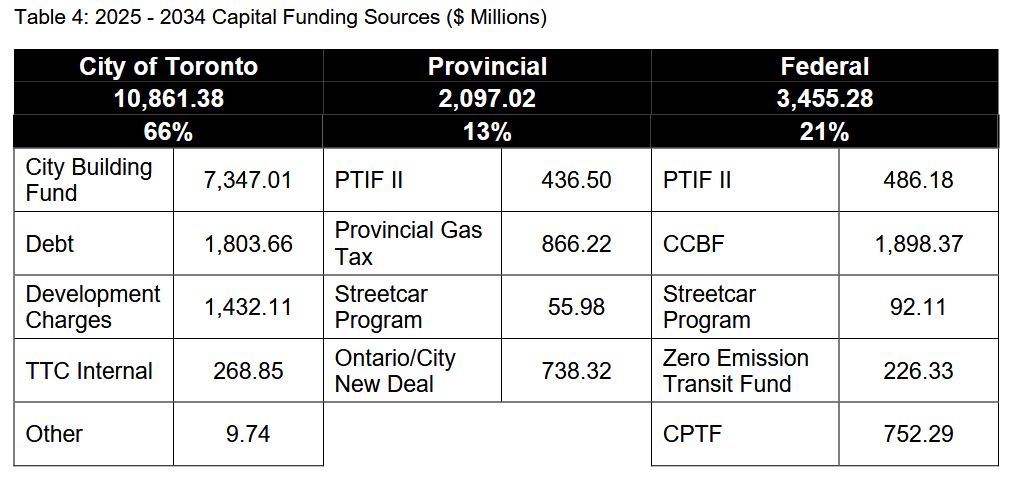
Funding comes from several sources.
The City Building Fund is financed via property tax surcharges begun under Mayors Ford and Tory.
PTIF is an old program that winds down as withdrawals are made from committed funds.
City debt is financed through general city revenues.
CCBF is the Federal program replacing the gas tax allocation.
The projection for Development Charges could be high given the state of the construction industry and the deferral/elimination of DCs on some targeted housing programs. DC funding is only available to projects that expand service, not for day-to-day SOGR.
Amounts for the Streetcar Program are for the last stage of the 60-car order now in delivery and expansion of storage and servicing facilities for some of these cars at Hillcrest. It does not address the SOGR backlog.
TTC Internal funding comes from depreciation of assets that were bought by the TTC and not funded by other governments. In effect, this is a charge on the operating budget.
The New Deal was struck by the Province and City to upload expressway reconstruction and maintenance thereby freeing up capital that would otherwise be spent by the City.
The Zero Emission Transit Fund has help pay for electrification of the bus fleet, but it is unclear whether this will continue or be rolled into the CPTF.
The CPTF is the new Federal program for transit funding across Canada.
Some of these sources will run dry when the associated commitments are fulfilled.
An ongoing political problem in Toronto is the assumption that other governments will continue with project-based funding outside of these programs. This leads to allocated funding being earmarked by the City for the project getting the most attention (e.g. the lobbying for new subway train funding) with the assumption that more money will be available for other works. In the current climate, that is a risky assumption.
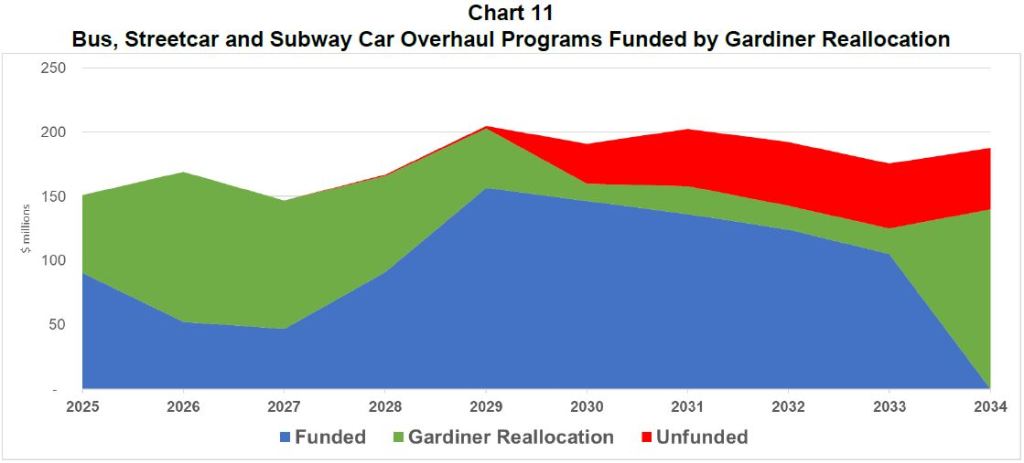
An important change in 2025 was the “New Deal” struck between the City of Toronto and Province of Ontario which had the effect of releasing capital dollars in the City’s plans for expressway renewal for use on the transit system. This money has been allocated as shown in the charts below which are from the 2025 Capital Budget.
Note that these charts show only vehicle overhaul programs, not the larger capital plan and shortfall.
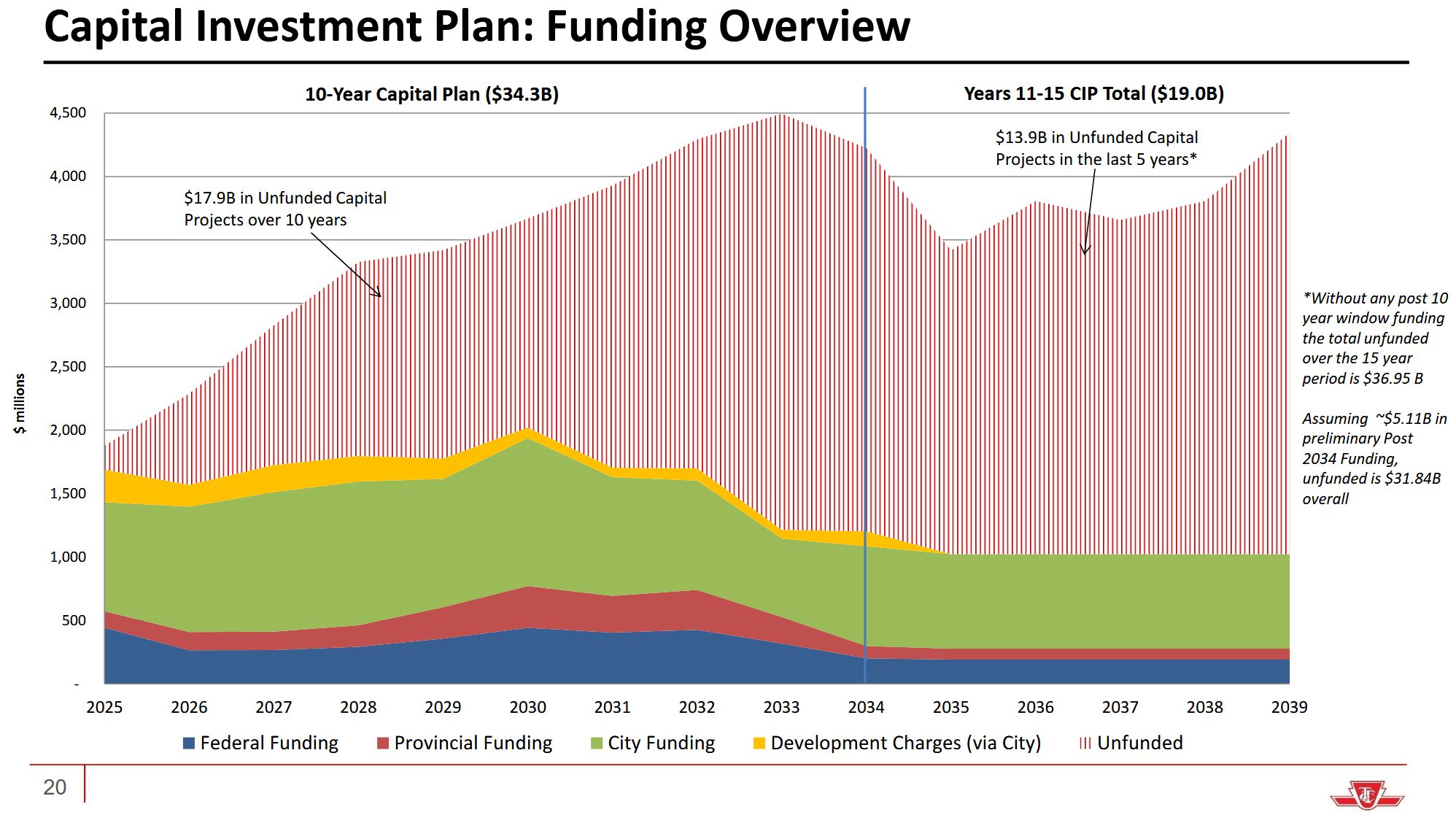
A further problem in the medium term is that the bulge in road spending would only last for the rest of the 2020s, and there is no comparable saving in the early 2030s that can be shifted to transit. The New Deal is a short term fix, not a long term solution. This leaves many projects in the “out years” of the budget with no obvious funding.
Updated September 8: Chart added
This problem is illustrated by a chart showing the proposed spending level and projected revenues, together with the wide gap in future years. Note that as things stand today, the City is the major funder of TTC Capital, but the growing mountain of unmet needs will hit in the very near future unless new money is found or spending is curtailed. That option brings its own problems if the budget lines affected are SOGR projects as we have seen in past budget cycles.
The report includes tables by major segment of the system listing the unfunded capital works. For comparison, I have included the full Capital Budget presentation slides from January 2025 to put these numbers into context. The breakdown in the September report is different from the full budget in January making comparisons tricky in places.
At the September 4 meeting of the TTC’s Strategic Planning Committee, the desire to make some system improvements at no net cost led to some Board Members musing on discontinuing unprofitable services or shifting resources from “downtown” so that Scarborough, allegedly underserved, could get more frequent buses. This came from TTC Chair Jamaal Myers who forgets at times he is in charge of the Toronto Transit Commission.
It is one thing to argue for better transit service — more frequent, more reliable, less crowded — but this should be based on facts.
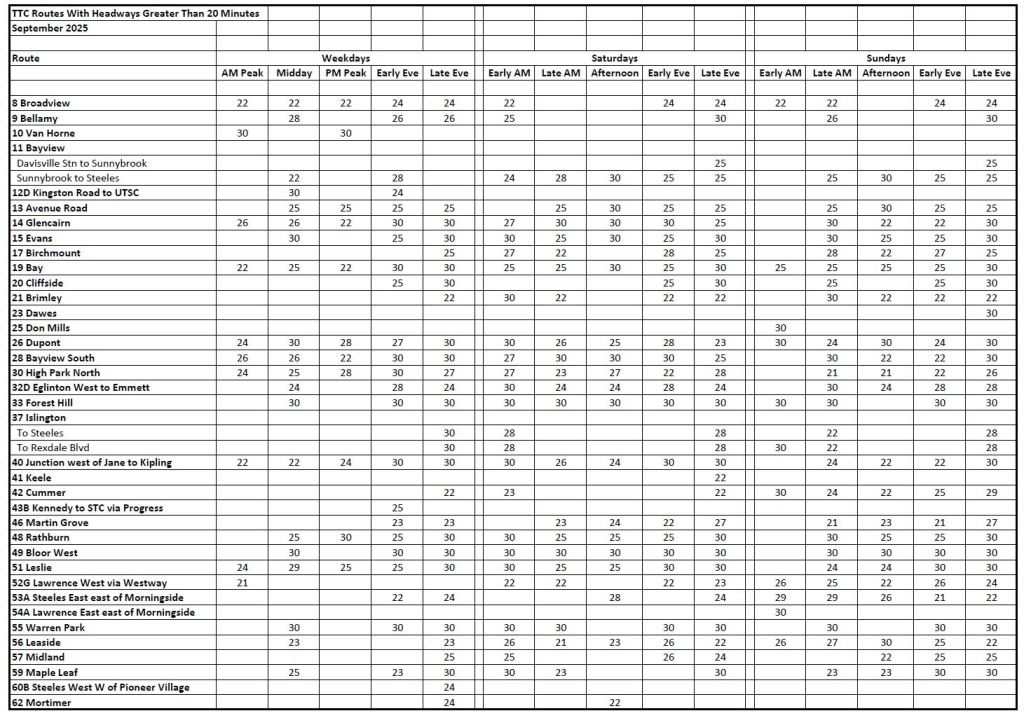
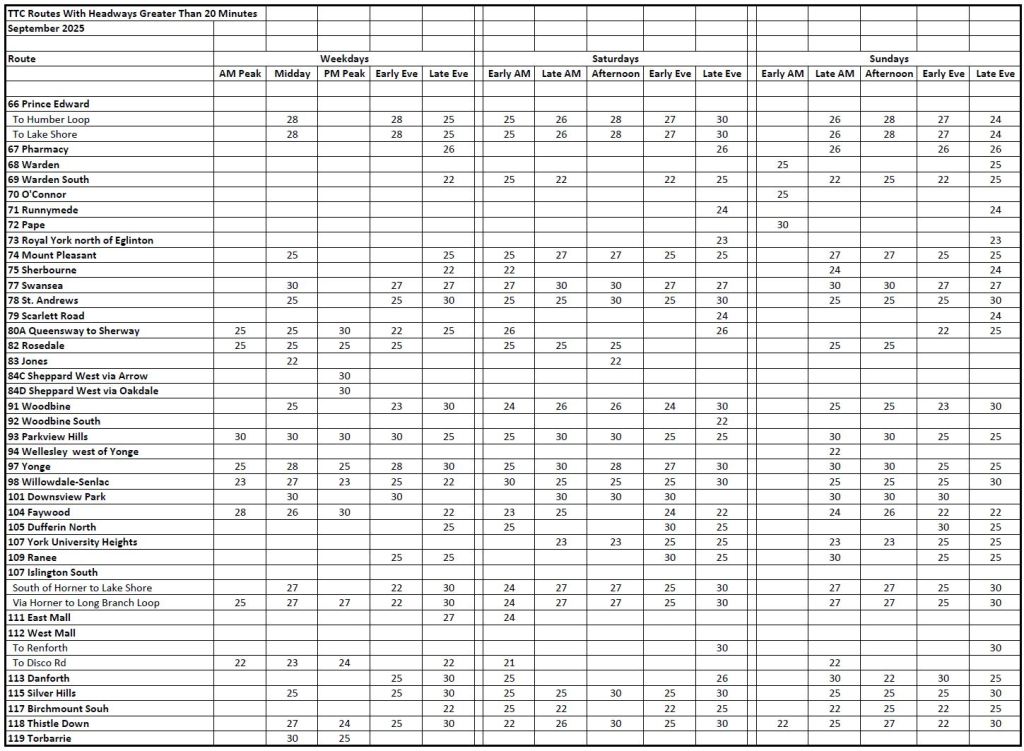
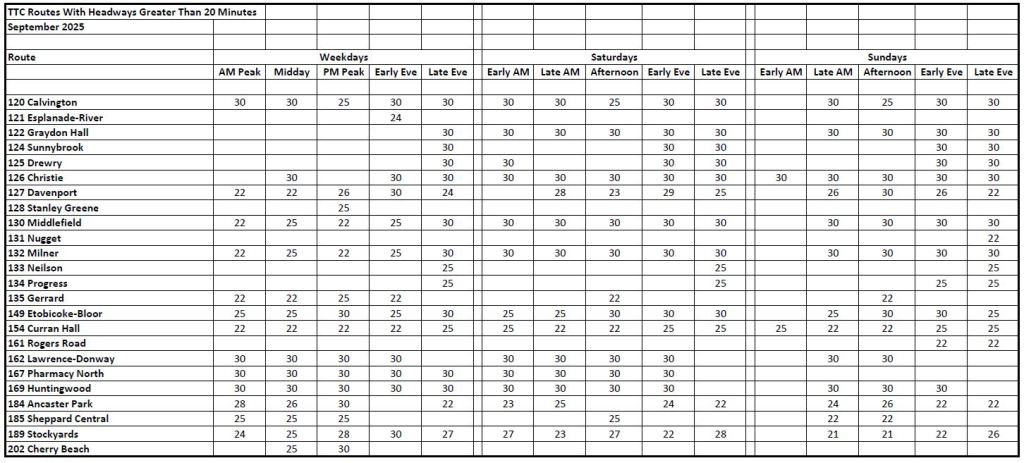
A proposal that surfaces from time to time in discussion of service standards is to improve the maximum headway on TTC routes from 30 to 20 minutes. An underlying assumption is that this will primarily affect the suburbs, but this is not the case. Many routes across the city, including the old “downtown”, have periods of infrequent service that such a change would affect.
The table below shows all routes, or route segments, operating less frequently than every 20 minutes where a policy change would demand better frequent service.
If the desire is to run more frequent service across the network, such a proposal should be balanced against the effects of any offset. For example, elimination of the 10-minute network would affect not just routes downtown but many routes in the suburbs. Is this a good policy choice, or is the real target the supposedly excess service “downtown” gets?
Pitting one part of the city against another is no way to lead an organization like the TTC, especially when the scheme is not well thought-out. There is no question that as Toronto’s network grew, the suburbs did not get their fair share of improvements. In part this was due to later development compared to the old city, and part to density, road patterns and a car-oriented philosophy. Transit has still not caught up, and needs more than a few subway lines to support stronger transit demand.
That said, the way to correct the inbalance is not to pillage the already-dense parts of the network for resources or to assume that every route in “downtown” has frequent service that can be trimmed.
On September 4, 2025, the TTC’s Strategic Planning Committee met to debate several reports. I will deal with them in a separate article, but one thread in the meeting deserves comment on its own.
The order of the agenda was changed to put an item updating the budget situation first up for debate. On a preliminary basis, the TTC faces a shortfall of $232.3-million, but the City’s budget target allows only an increase of $91-million with a parallel target of $17-million in “efficiencies”.
These amounts do not make any provision for new and enhanced services beyond plans already in the works and “investments that are demonstrating results”.
There is no mention of the fiscal sleight-of-hand that happens every year with various reserve funds where the TTC typically budgets to take money out at the start of the year, and puts money back at the end. The City often contributes to these reserves with left overs discovered in the year-end reconciliation of actual versus budgeted spending.
Much hand wringing and predictions of fiscal disaster met this report and a related one on the large shortfall in the State of Good Repair Capital Budget. More on that in my main article.
The big item, indeed the supposed primary reason for the meeting, was a report on possible 2026 implementation of six items from a proposed Ridership Growth Strategy. Many public deputants, mostly members of TTCRiders, spoke in support of various items notably the proposed capping of fares, a fare freeze, and improved service. This is precisely what one would expect from an advocacy group.
However, Chair Jamaal Myers lit into one of the speakers asking why they kept asking for things the TTC cannot afford. Those of us with long enough memories recall the tactic of harassing deputations as a classic trick from the Tory and Ford eras. It is not the role of a deputant to accept that nothing they ask for can be done, and meekly thank the Board for listening to their whispered requests.
Myers should remember his days as a community activist and know better than to berate a deputant for having the temerity to ask for better service from the City.
The debate became even more bizarre in consideration of Fare Capping and the idea that TTC should not be losing money on fare initiatives. One Board Member, Councillor Saxe, actually suggested that new riders who pay for their trip are more important than those who get additional free rides. She is woefully unaware that it is almost impossible to gain any new riders at a profit, even more so now that farebox revenue covers a much lower portion of total costs than it did before 2020.
This position does not prevent Saxe from pushing her hobby horse of free rides for groups of high school students on field trips. The premise is that this cost will build a future desire to use transit. Subsidy today, more fares, maybe, tomorrow, although the same students are likely to be unimpressed by indifferent service.
In this debate, two Board members one might think of as “progressive” went out of their way to downplay any proposals that might cost money even though they could make the transit system more attractive. Myers even toyed with the idea of service cuts downtown so that bus service could be improved in Scarborough. (I will turn to that nonsense in a separate article.)
The other members present offered little. Commissioner Jagdeo is a fiscal hawk from the Tory era, and predictably worried about how the TTC is effectively bankrupt. Commissioner Mihevc added little beyond concern for the size of the deficit in a way reminiscent of his days as a Councillor who also sat on the Budget Committee and was happy to limit TTC spending.
It is the TTC Board’s job to set policy and advocate for better transit. This might not always be possible in one go, but the Board should not start from an assumption that nothing can be done. Indeed, a spokesman for the mayor is quoted in the Star:
Mayor Olivia Chow said she “will not reduce service levels or raise fares,” adding the mayor “believes that improving service, reliability and safety is key to attracting riders back to the TTC.”
Committee Chair Alejandra Bravo strove to keep the discussion at a policy level, bouncing ideas around for strategic planning which is the purpose of her committee, while other members seemed intent on fixing the budget options today and closing off debate. How successful she will be in the long run remains to be seen given a clear desire to avoid such discussions by the Board’s Chair and others.
This was not the TTC’s finest day, and the blame must rest primarily with Chair Myers who seemed to hijack the agenda to preclude debate.
Solving the TTC’s problems will not be easy, but an attitude that nothing can be done runs counter to Council’s policy of improving use of transit. That’s not going to be cheap, and funders other than Toronto taxpayers and riders should contribute. Simply pushing discussion of what might be done off of the table is a backward move.
This report proposes implementation of six initiatives through the 2026 Budget which is now in preparation:
Fare capping (limiting the accumulated charge for trips within a month) as a replacement for monthly passes.
Year 1 of the TTC’s Wayfinding Strategy
Support growth from changing work-from-home practices
Improve service reliability
Implement outstanding proposals from the 2024 and 2025 Annual Plans
Bring service to the standards for crowding, express network routes, and the 10-minute network
There are many other possible tactics for building ridership. These are not included in the report, but the intent is to report back to the Board following budget approval in early 2026 with an updated RGS.
Updated September 1 at 10:40pm: The list of additional RGS options has been added to the end of this article.
A related issue is the question of a fare increase, the revenue it might generate and the likely reaction to such a proposal. A variety of increases from 5 to 35 cents on various fare classes are presented for discussion, but there is no recommendation.
Full disclosure: I participated in a meeting of the TTC’s Planning Advisory Group to discuss the proposed RGS along with other interested parties. There is a summary of our comments in the report [pp 6-7].
Updated September 4 at 9:00 pm: The Presentation Deck for this item is now available. I will add commentary to the article in coming days.
The Labour Day weekend sees the TTC return to fall schedules on several routes, the end of some construction diversions, and the beginning of another.
Subway Service
There is no change in subway service
Streetcar Services
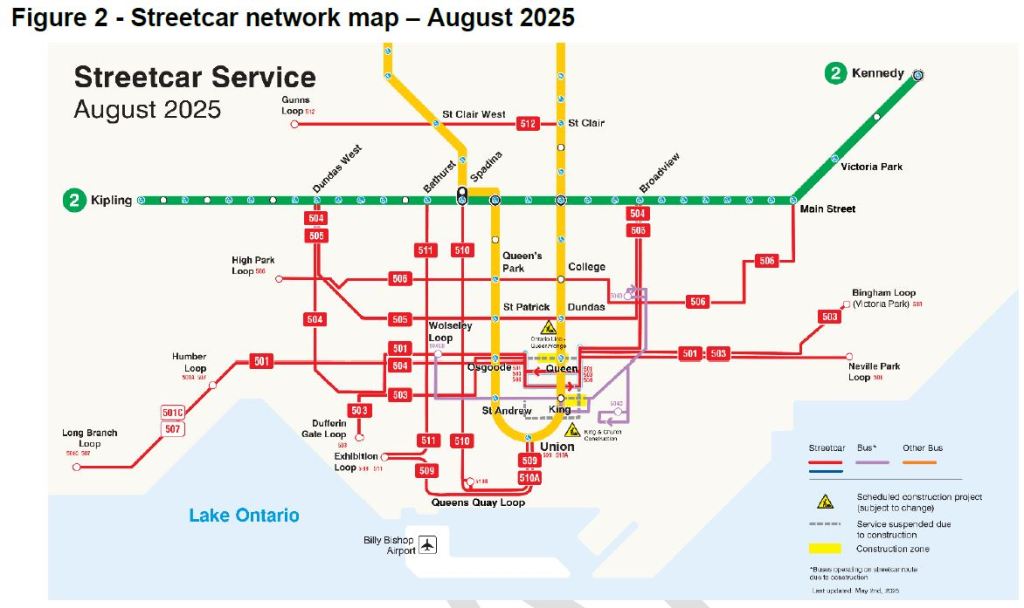
A plan to improve streetcar service to a six minute standard daytime headway begins with 512 St. Clair, and is expected to continue with 511 Bathurst and 505 Dundas at dates yet to be announced.
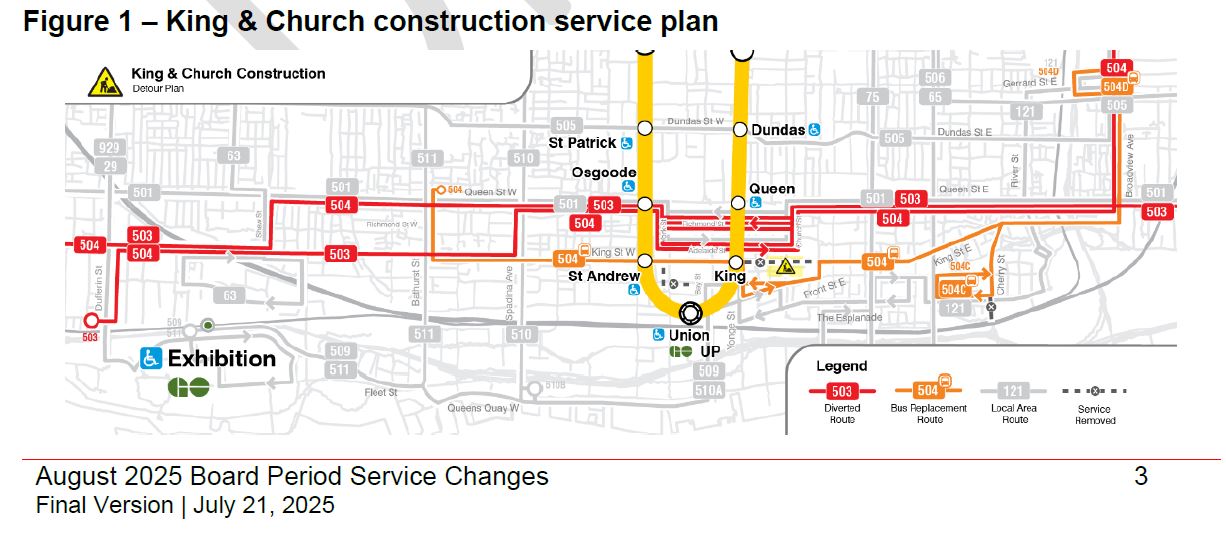
The construction work at King & Church finished recently. With the new schedules, streetcar service returns to King through downtown, but the west end of the line will divert around reconstruction of King & Dufferin until Thanksgiving weekend.
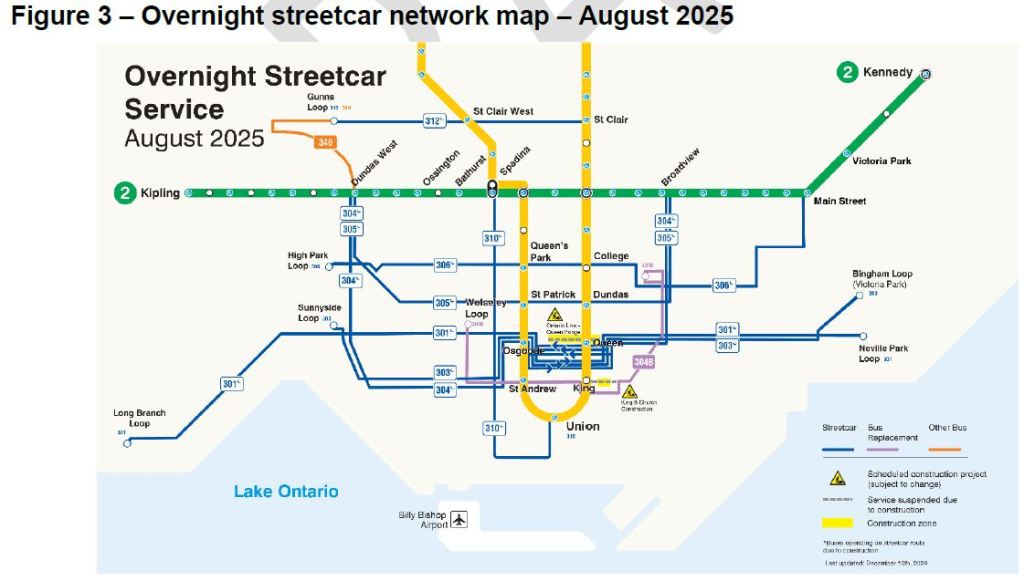
The 503 Kingston Road car will become a bus with the route shortened to Joe Shuster Way east of Dufferin. The 303 night service will be suspended. On Kingston Road the 322 Coxwell night bus will remain.
The eastern terminus of 508 Lake Shore will be shortened from Broadview Station to Distillery Loop.
Bus Services
Lawrence Station will reopen to bus service allowing restoration of regular bus services. The 52/952 Lawrence service will no longer operate via Avenue Road to Eglinton Station. Routes 124 Sunnybrook and 162 Lawrence-Donway will terminate at Lawrence Station rather than running west to Roe Loop on Avenue Road.
The south end of 325 Don Mills night bus will be extended east from Carlaw via Commissioners to Lake Shore Garage. The east end of 385 Sheppard East night bus will extended from Meadowvale Road to Rouge Hill GO Station.
Some of the seasonal services will end on Labour Day including:
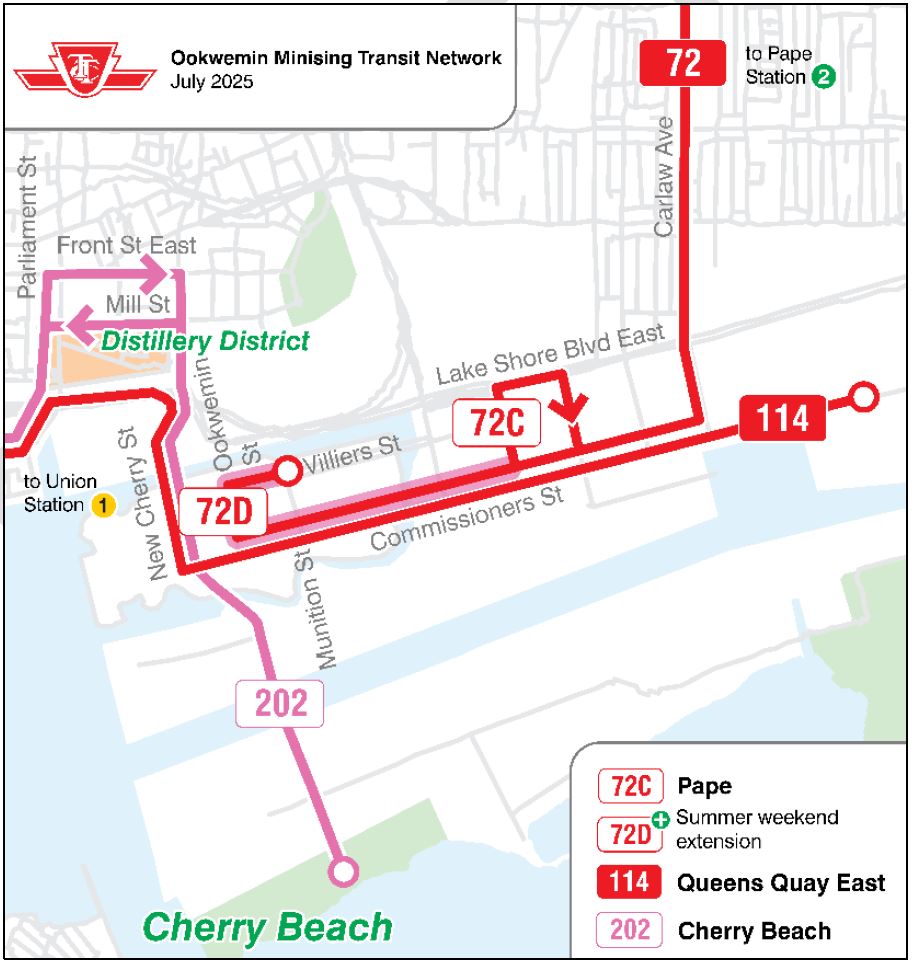
The weekend service to Biidaasige Park on 72D Pape will end, and buses will return to the 72C terminus at Commissioners and Saulter Streets.
Weekday service on 200 Toronto Zoo and 201 Bluffer’s Park will end. Weekend service continues.
Service on 203 High Park will end.
Many routes see restoration of services reduced for the summer lull in riding, although there are a few cuts scattered around the system. A large number of school trippers are also back, but these are not listed here.
The remainder of this article details various aspects of the changes and includes a link to a spreadsheet with the operating plans for all modified routes.
The list of surface route operating statistics for 2024 recently appeared on the TTC’s Planning webpage. This article consolidates data for the years 2019 (the last pre-pandemic year) to 2024.
Values included in the TTC files are:
Weekday passenger count
Weekday vehicle hours
Weekday vehicle klometres
AM peak vehicles
PM peak vehicles
Derived values included in this article:
Passengers (boardings) per vehicle hour
Vehicle kilometres per hour
Recovery rates relative to 2019
Pages for each set of stats are included in the detailed part of the article, and a PDF containing all tables is linked at the end.
In a future article, I will refresh a previously published table comparing service levels on routes in September 2025, when this information is available, with prepandemic conditions.
A basic message of both articles is that the TTC trumpets a return to former service levels, but the metric they use, vehicle hours, misrepresents the level of service provided. Buses and streetcars travel more slowly now than they did in 2019, and they have more generous recovery times at terminals. These combine to make a vehicle hour less productive in the amount of service it provides than in past years, and so 100% of former hours does not produce the same service. That is separate from other factors such as a decline in reliability, bunching and gaps which compound the less frequent scheduled service.
The problem is particularly bad on streetcar routes where a combination of factors including understaffing, budget constraints, and operating practices that slow service, lead to considerably less “recovery” to former service levels. In turn, this hurts service quality and blunts ridership recovery.
Crowding conditions are not addressed by these stats, and this is difficult to extract from TTC tracking data due to the coarse-grained nature of reported loads. TTC does not publish numeric vehicle loads, only broad light-medium-heavy loading indications. Although they report all-day ridership on each route, this is not broken down by time of day, location and direction, at least not for external consumption. TTC has crowding standards, but we do not know how well they meet them.
The number of peak vehicles is lower in 2024 than in 2019. This partly reflects limits on service growth, and partly the shift of demand into off-peak periods.
In the attempt to woo riders back onto the TTC, let alone to boost transit’s mode share for travel in line with City goals, the question of service level and quality is key. In theory, if demand actually sits below the historic level, then less service is needed to handle it. However, those who remember the condition of transit before 2020 will know that crowding was a pervasive problem and calls for better service were common. Only the March 2020 drop in demand saved the TTC from a capacity crisis.
Toronto must understand and commit the resources needed to achieve its transit goals. Just getting back to 2019 is no goal to aim at.
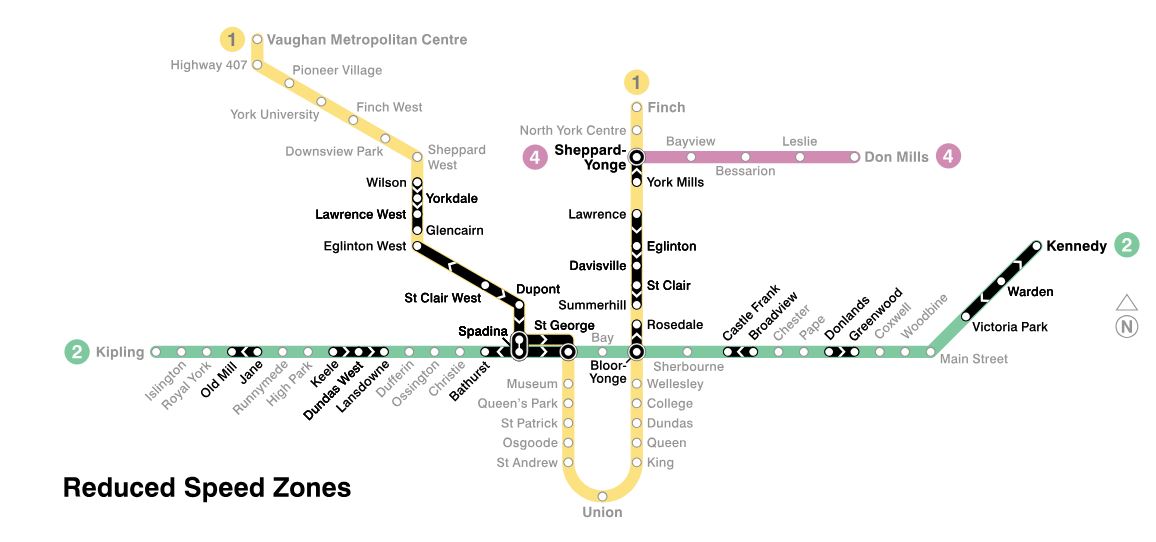
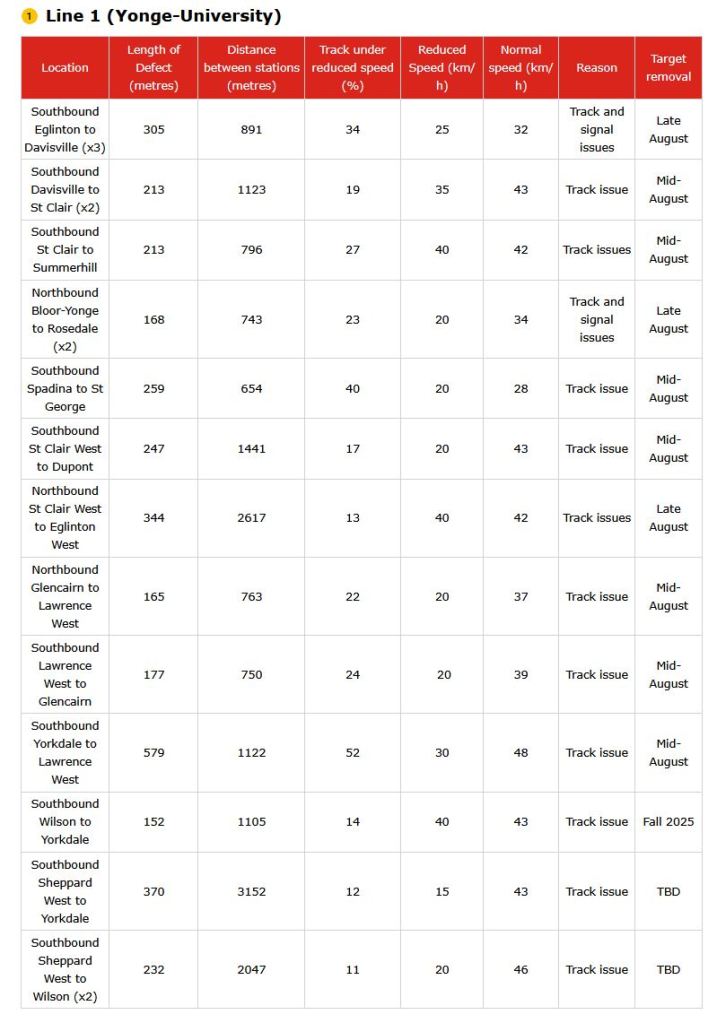
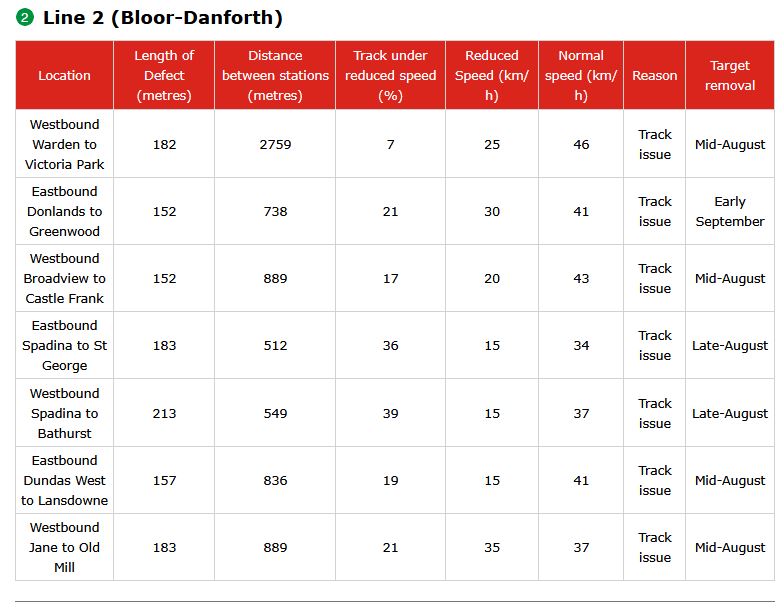
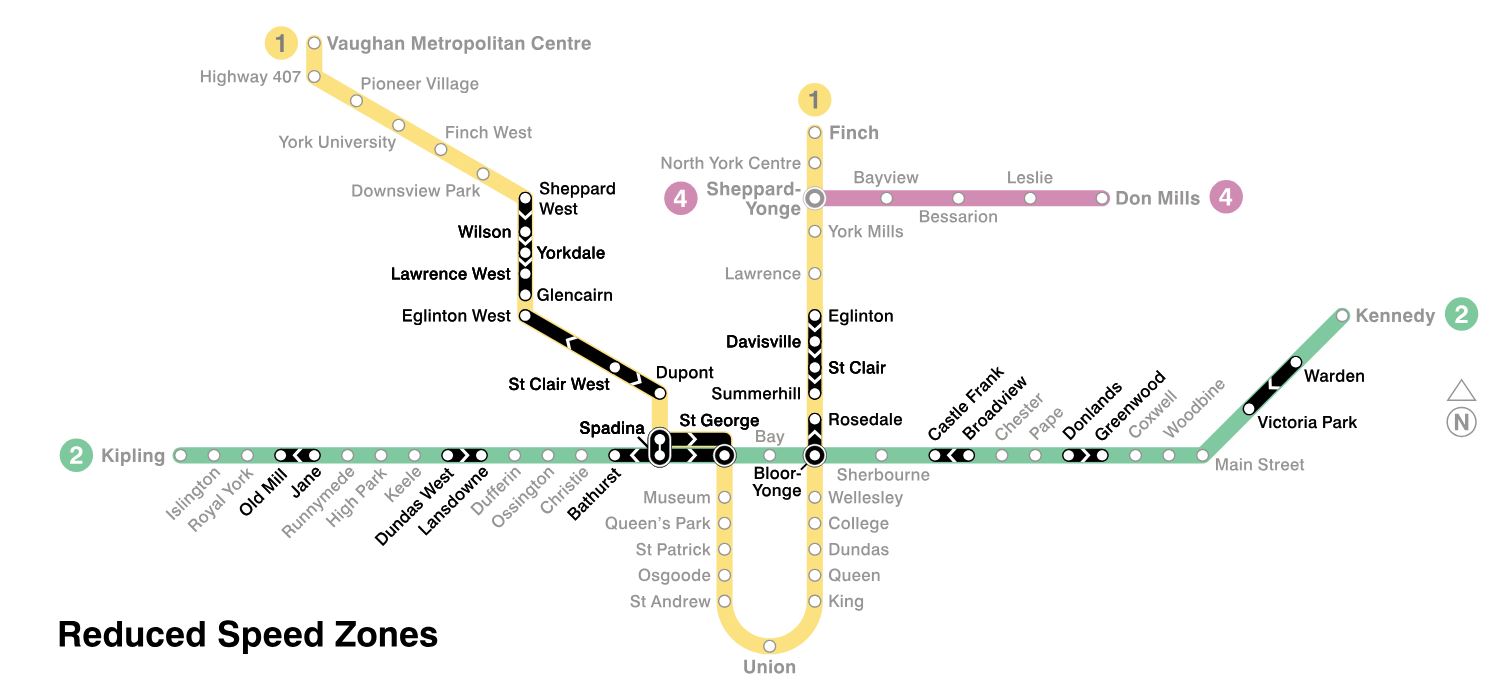
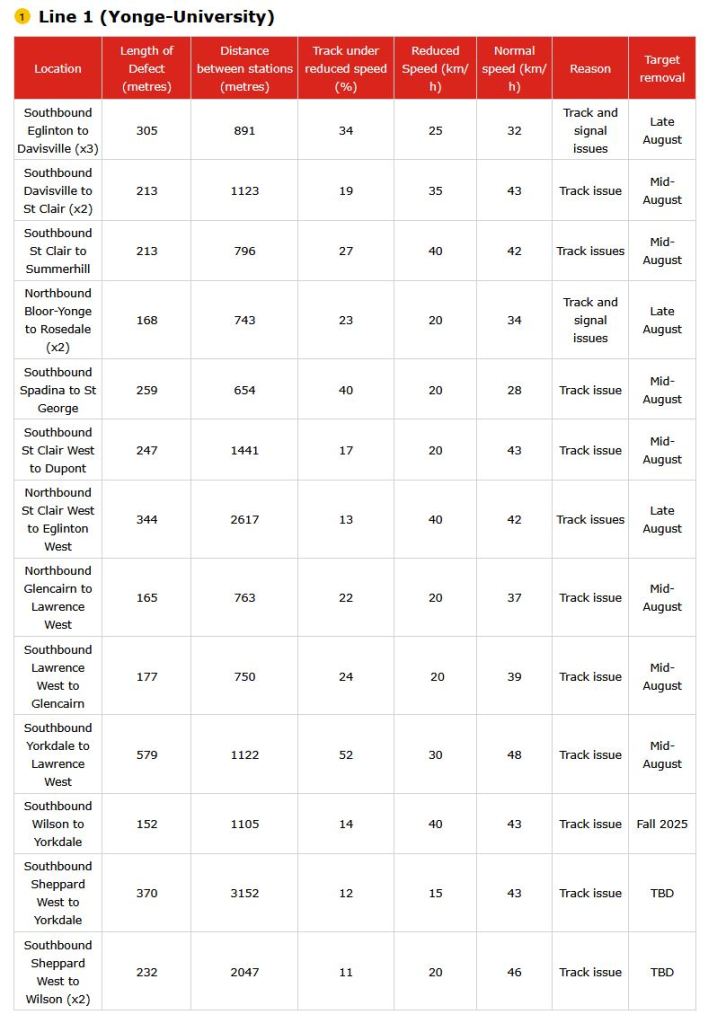
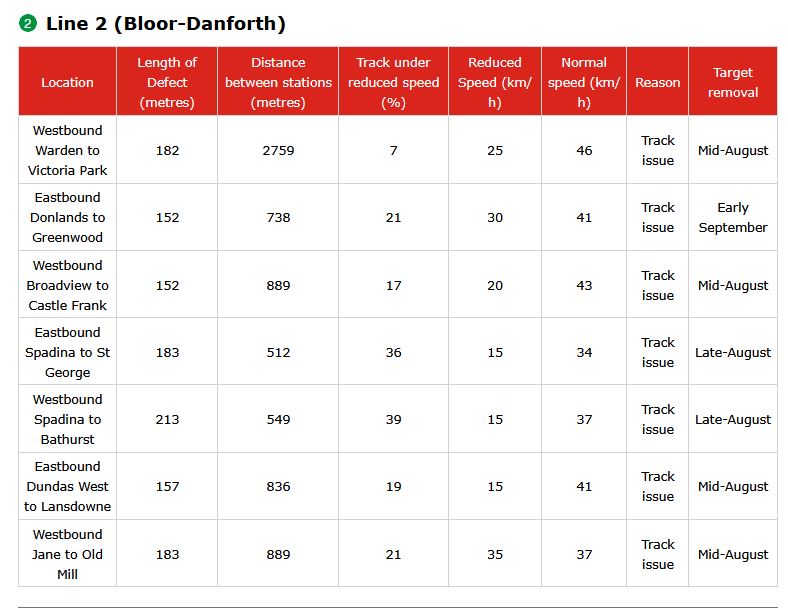
The TTC maintains a list of reduced speed zones on its website, and this constantly changing list is tracked in a previous article here showing how long some restrictions have been in place.
The format of the TTC page has been changed to include not just a map showing where the zones are, but why they were created and, in most cases, a target date for remediation.
The current map and table of repair targets, as of July 31, 2025, are shown below. Note that some of the items on the map are not included in the detail (e.g. Warden to Kennedy eastbound), and the table includes entries that are not reflected on the map (e.g. Sheppard West to Wilson). This does not speak well of the TTC’s ability to communicate consistent, accurate information.
Updated August 1, 2025 at 9:10am: The TTC has updated their page so that the map and tables are now in sync with each other.
Most of the zones listed here are scheduled for removal by early September with only a few continuing into the Fall or beyond (“TBD”). This list will bear watching for additions, and for removals of cleared sections within the expected time frame.
(The spreadsheet has been corrected to refer to Sheppard Yonge rather than Sheppard West Station for bus looping changes.)
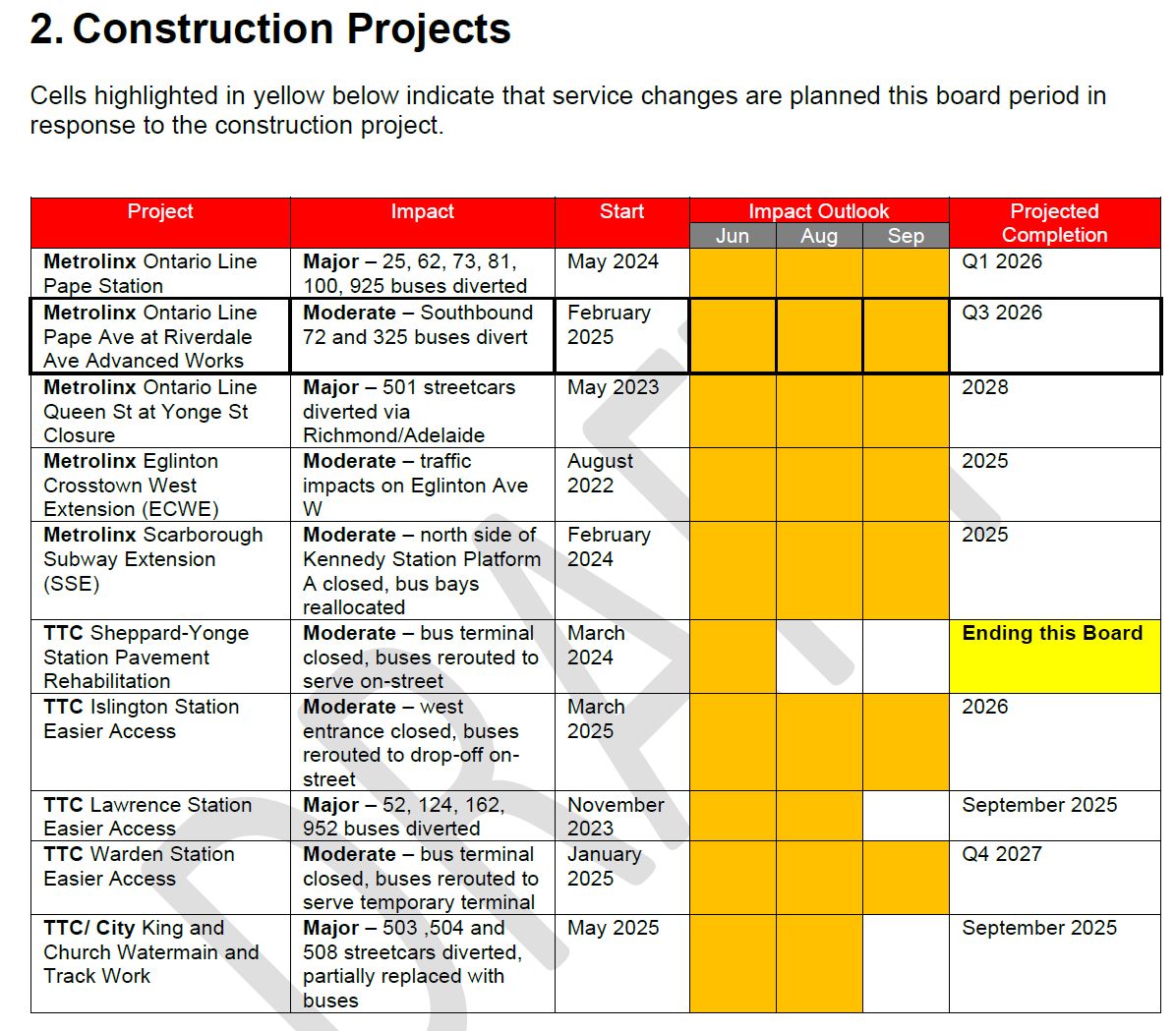
Construction Projects
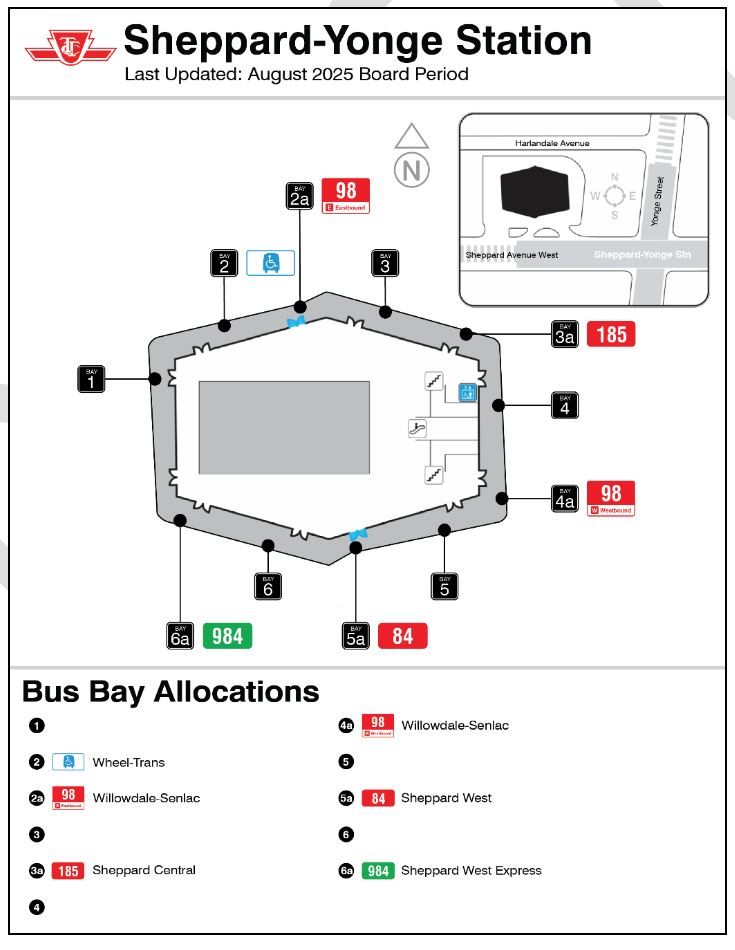
The only change in the construction project list is that paving work at Sheppard Station bus loop is complete, and buses will move back into the loop. There is no change in service on affected routes.
The bay allocation at Sheppard Station is shown below.
Temporary Service Improvements
With a surplus of operators, service will be improved to address crowding and service resiliency on many routes. These are not formal schedule changes.
504 King 20 Cliffside 32 Eglinton West 37 Islington 44 Kipling South 45 Kipling 54 Lawrence East 63 Ossington 66 Prince Edward
67 Pharmacy 68 Warden 80 Queensway 86 Scarborough 89 Weston 90 Vaughan 110 Islington South 111 East Mall 118 Thistle Down
Signs on many routes will change for standardization including:
13 Avenue Rd
30 High Park North (Branch letters removed)
75 Sherbourne
116 Morningside
203 High Park
302 Kingston Rd-McCowan Night
332 Eglinton West Night
924 Victoria Park Express
929S Dufferin (new Dufferin Station short turn for CNE service)
960 Steeles West
Routes renamed:
74 Mount Pleasant
103 Mount Pleasant North
171 Mount Dennis
Streetcar Service Changes
301 Queen Night
Two early morning trips extended west from Roncesvalles to Humber Loop to improve the transition to 501 daytime service.
504 King
Official route standardized to operate via Queen and Shaw. This has been in place since May 2025, but the schedule change will also allow trip prediction apps to “see” cars on the route they are actually using.
Bus Service Changes
22 Coxwell / 92 Woodbine South
The holiday interline at the south end of the routes will be discontinued.
72 Pape
The 72C Commissioners service will be extended on weekends except late evenings to serve Biidaasage Park. The service will operate westbound via west on Commissioners Street to north on Ookwemin Street (formerly Old Cherry Street). Eastbound service will run from Ookwemin Street east on Villiers Street, u-turn to west on Villiers Street, south on Ookwemin Street, east on Commissioners Street
100 Flemingdon Park
Weekend service revised for reliability.
102 Markham Road
Added trips on weekdays SB from Warden Station to Steeles at 4:47 and 5:13 am to reduce crowding.
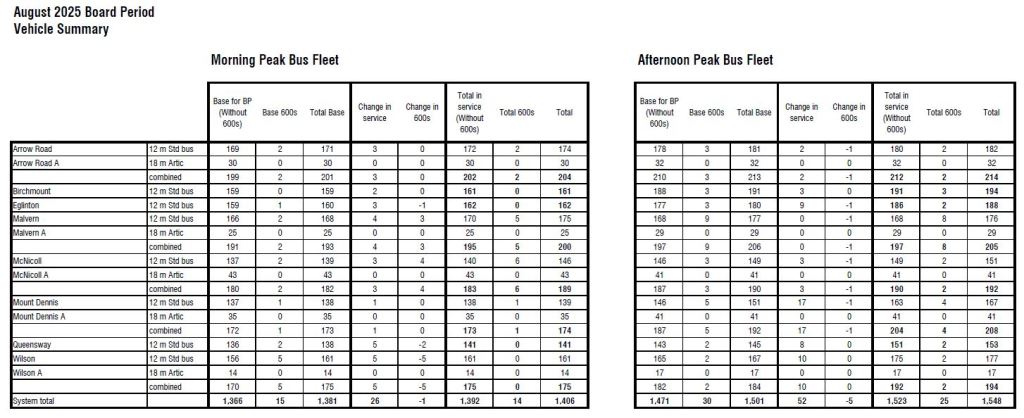
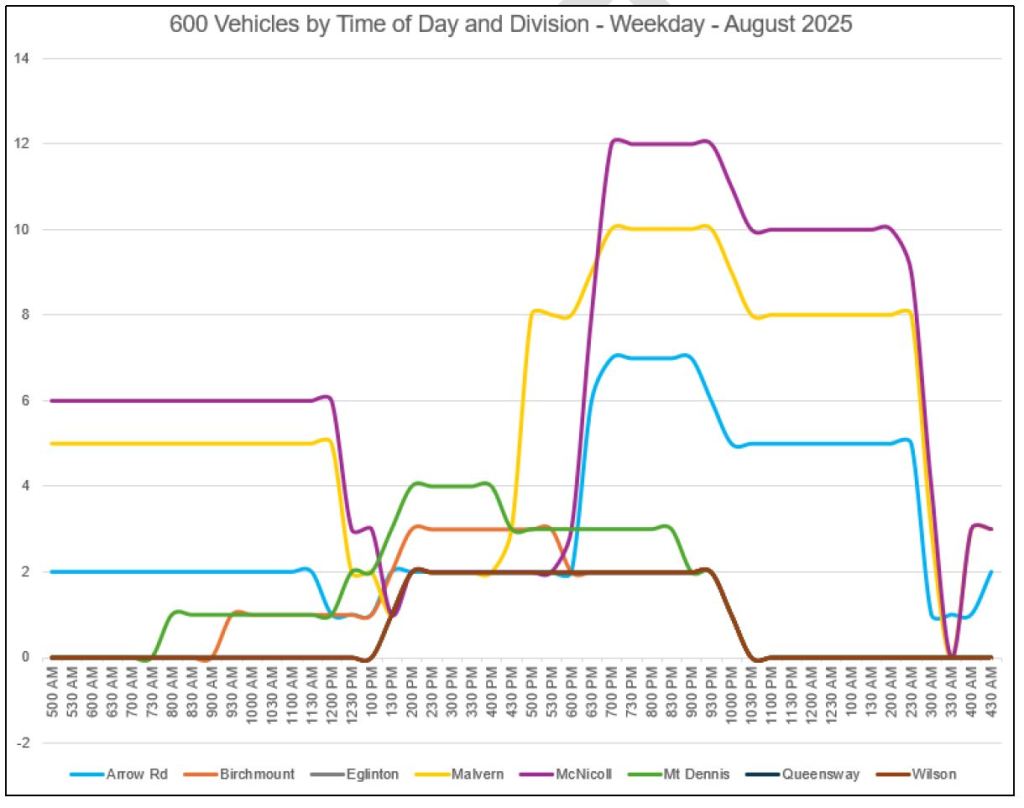
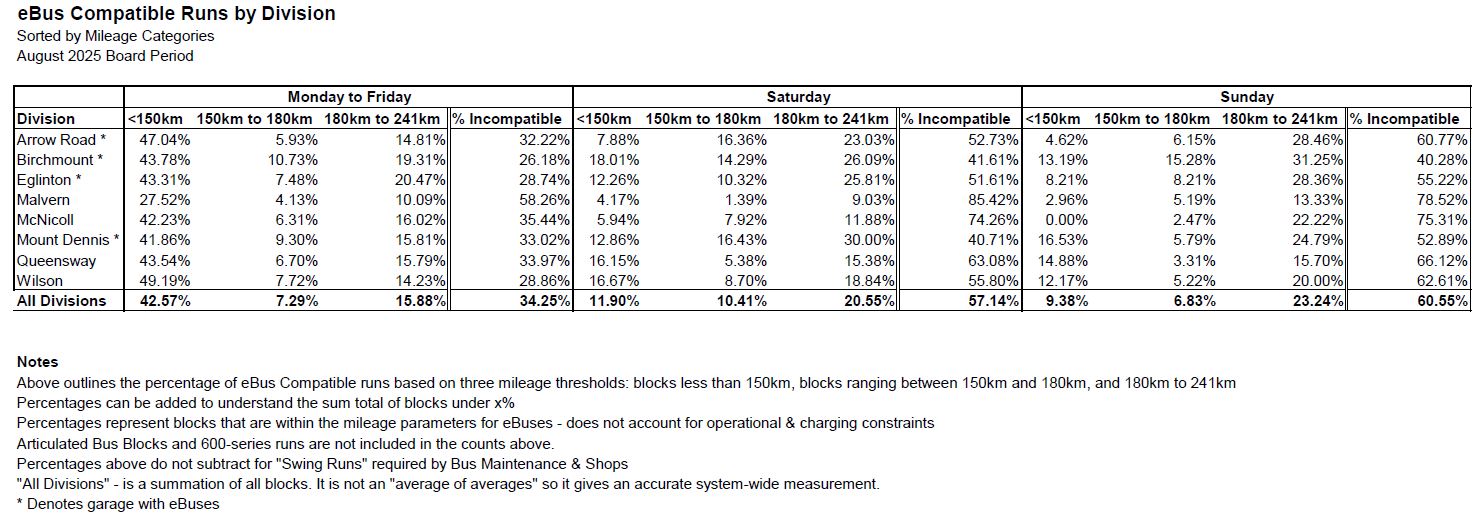
This report is covered in a separate article. Additional comments arising from the meeting have been added there. See The Troubled State of TTC Green Buses.


 Steve Munro