Ride The Dundas Bus While You Can

Track construction on Dundas Street, a long overdue project to replace decrepit rails and roadbed, has diverted the Dundas car for much of its length up to the Carlton route.

One particularly hard-hit area is Regent Park where streetcar service was removed long before road work actually started, and where streetcars will not return until late fall after completion of work on the bridge at the Don River.

In early May, at ward Councillor McConnell’s request, the TTC approved a shuttle bus to provide a clockwise loop via Broadview, Queen, River, Dundas, Parliament and Gerrard.  The problem with this scheme is that the bus runs every 15 minutes, and there is not much point in waiting for it unless you happen to be at the stop when the bus comes by.  Walking from a nearby route on Queen, Broadview, Gerrard or Parliament is generally faster and these routes, unlike the shuttle, actually go to real destinations like the subway or downtown.

The bus was implemented at a projected, unbudgeted cost of $350,000 to run through to November when the bridge will re-open and streetcars will return to Dundas between Parliament and Broadview. 

According to the staff report, this bus has carried an average of two passengers per trip and often runs empty.  The most I have ever seen is one.

Today, despite an attempt by Chair Giambrone to advocate on behalf of Councillor McConnell, the Commission had the good sense to kill off this waste of service.  The last day of operation will be Sunday, July 15. 

Analysis of Transit Route Operations

Over the next month or so, I will be posting a series of articles here about the operation of surface routes and will concentrate on lines in the King and Queen corridors.  This analysis will look at the way the line actually operates — how the vehicles move around (or not) — as opposed to the question of whether service is adequate to demand.  These topics are related by the long-standing question of why service is so bad:  congestion, number of vehicles, operational screwups, or some other factors.

This work arises from the TTC’s oft-cited claim that they can only improve transit service with exclusive lanes.  That is a self-defeating position because the TTC will never get reserved lanes on most transit routes.  Rather than figuring out how a route might be improved, the TTC claims its hands are tied.  This is not a useful stance, but it’s sadly typical of an organization whose first response to criticism is (a) you’re wrong and (b)  someone else is responsible.

I remember the initial reaction to the Transit’s Lost Decade report that I did with Gord Perks (then at TEA).  The TTC huffed and puffed and said that service had not been cut so badly and how dare we say things like that … then there was a little pause … and finally they realized that this was just the ammunition they needed to beat the drum for better funding.  Suddenly then-CGM Rick Ducharme was quoting our figures as an example of how badly the system had deteriorated.

Service on major routes was cut through the 1990s by from 25 to 40 percent, and only recently have we seen some of this restored despite ongoing ridership growth.  One major constraint is the size of bus and streetcar fleets that declined to match the lower levels of service.  This only affects peak service capabilities.  Another change has been in the operator workforce through a combination of re-sizing to current service levels and of work rules restricting the length of the work day.  (This is due both to Provincial labour standards and revisions to the collective agreement.)

Traffic congestion is a problem in many areas, and the length of the peak period has definitely grown longer over past decades.  However, is congestion the only reason service is bad, or are other factors at work?  Are there problems with regularity of service and line management?  How often is scheduled service cancelled?  How often are there major blockages (especially a problem for streetcars) as opposed to random events, delays at busy stops for overcrowded vehicles and general congestion?

How effective is the TTC’s current vehicle monitoring system, CIS (Communications & Information System), in tracking vehicles and how well is the service managed?  The TTC is seeking information for a possible “next bus” announcement system.  Will this be compromised by an attempt to recycle decades-old CIS technology?  Will it include features needed to properly manage and report on actual service and operations?

In Setember 2006, I asked the TTC for sample data from CIS in an attempt to learn how vehicles actually behaved on various routes with the hope of identifying problem areas both for congestion, where it really exists, and in line management.  CIS is incapable of reporting on vehicle loads, and its data are not fine-grained enough to allow reporting on stop service times in most cases.  Therefore, my analysis has to concentrate on vehicle movements.

Through the fall, I worked through various sample sets of data refining the process of converting it to various usable formats, and by the end of the year had a workable version.  Based on this, I have obtained CIS data for all streetcar routes plus a number of major bus routes for December 2006.  This month contains a variety of days with good and bad weather, pre-Christmas shopping and a holiday week.

The King route received the first detailed analysis, and I will present excerpts from this here over the next few weeks.  I have begun work on the Queen line (and related routes Lake Shore, Downtowner and Kingston Road) and will comment on these as well.

All of the posts will be linked via their own topic “Service Analysis”.

Please stay tuned.

A Strange View of Transit Priority

At last night’s Community Liaison Committee meeting on the West Don LRT project (aka Cherry Street streetcar), I heard a rather bizarre definition for “transit priority” that will be used to evaluate various design options:

“Transit Priority” means that transit will get at least as much green time as the through auto traffic at an intersection.

Hmmm.  Let’s compare this with what we have today.

On the Harbourfront line, the streetcar has to wait for its own green cycle which is much shorter than the green time for traffic, and is so short that it sometimes prevents more than one car from getting through on a cycle.  Clearly not a model for transit priority.

On St. Clair, the detectors don’t seem to be working everywhere, and there are left turn phases blocking the streetcars (and through traffic) even when there is nothing waiting to make the turn.  If this blockage occurs in only one direction, then one of the through road movements gets more green time than the streetcar.

On Spadina, the detectors actually work, and if there is traffic waiting in the queue only for one direction, the other one gets a green for the cars before the green for the streetcar.  If there are left turns both ways, the streetcar and other traffic get the same green time.

On a regular street in mixed traffic, everybody gets the same green time although left turns can block the movement of both through traffic and streetcars equally.

Nowhere in this list is there a model where the streetcar pre-empts the left-turning movements and is able to cross the intersection for the majority of the cycle.  Instead, the emerging standard appears to be that left turns pre-empt everything in their path.

Maybe we should call it “left turn priority” since these are the only moves that really benefit from this scheme.

“Transit priority” means “transit first”, not transit in the five seconds we grudgingly spare from everyone else.

Say “Presto!” and All Your Cares Will Vanish

Lately, with one announcement after another out of Queen’s Park (or is it Liberal Headquarters), I’m having a hard time deciding just what Rob MacIsaac’s job at the GTTA really is.

The push is on to make announcements now, to have photo ops now, to show caring Liberals fixing transit, environmental and traffic problems now!

Alas, the real world is not that simple.

The latest event was the unveiling of the Presto Smart Card out in Mississauga.  I am not going to duplicate a lot of good comments made by several writers on the thread at spacing wire, but the core of this debate lies the following issues:

  • The cost to implement Presto on the TTC is very large and has grown from $150- to $250-million in the past few years.  A detailed report was prepared by consultants for the TTC covering many of the issues.  The projected cost for the TTC implementation was actually cheaper, relatively speaking, than similar projects on other large transit systems.
  • The alleged reason for Presto is to allow seamless movement between many transit systems.  However, there are much more basic impediments to such movement notably the service quality (or lack of it) at boundaries, and the existence of multiple separate fares in each system.  Any fare integration that reduces costs to riders will require higher fares overall or improved operating subsidies.

The implementation to date between Missisauga, GO and TTC at selected locations is miniscule and has a tiny fraction of the technical requirements of a GTA-wide scheme.  A great photo op, but not nirvana.

Absolutely essential to any farecard implementation will be a unified fare structure.  Should we charge by distance?  Should we charge by time of day?  Should we treat one fare as a limited time pass eliminating the concept of a transfer per se?  Presto can make any of these possible, but we need to know what we want to accomplish and the potential effect on future and present riders.

The TTC has no pressing need to replace its fare collection system and is moving increasingly, for frequent users, to flat-price passes rather than charging for each trip.  Should we invest a fortune in a system to track details of passenger movements and calculate fares if a pass system (electronic or otherwise) will handle the majority of the transactions?

Some cities have used Smart Cards to replicate and expand byzantine fare structures already in place.  If anything, the GTTA is all about simplification and flattening of our fare structure.  Presto can help with this, but the important policy choices must come first.

This project has been around for quite some time as a technology looking for a problem and using the sham argument that fare collection technology is the answer to interregional transit.  This is total nonsense.  Better service, better fare structures and better subsidies (all of which are inextricably linked) come first.  How you collect the fare is a distant second.

After all, we already have the GTA pass, and that didn’t require any technology at all.  What it’s missing is the network and the service levels to make it widely attractive.

Queen’s Park may have scored a hit with MoveOntario, but Presto will do little to improve transit in the GTTA for years to come.

The Fiscal Realities of Ridership Growth

During the TTC board meeting on June 13, two of the fiscal conservatives on the Commission ran aground on the cost of running a successful transit system.

As I reported earlier, the TTC has an embarrassment of additional riding and will begin increasing service in September and through the fall to bring crowding within the Commission’s service standards.  More service, of course, costs more money and it is very unlikely that this will be made up from added revenues.  We are, after all, trying to give all current riders better service rather than forcing them to ride on the roof, and we are trying to attract new riders to the system within the constraints of the fleet size and available operating staff.

With Metropasses now a highly attractive fare medium, more people are buying them and more rides are taken on each pass.  This dilutes the revenue per ride as ticket, token and cash fare riders migrate to the cheaper, fixed-price pass.  Riding is going up, but revenue is not. 

Commissioners Michael Thompson and Peter Milczyn wondered openly about changing the fare structure to recover some of the additional cost including schemes such as zone fares or charging for transfers.  They should talk to their constituents in Scarborough and Etobicoke respectively.

Suburban riders take longer trips to get to work, and a transfer between routes is almost inevitable for most of them.  Downtown riders might organize themselves to stay within one route, either the subway or a streetcar line.  Charging for transfers or imposing a zone system penalizes those for whom the transit system is already less attactive — the long distance traveller — and is likely to disproportionately affect those who can least afford it.

My rationale for that statement is that long, tedious trips including transfers are likely to have a larger proportion of “captive” riders who cannot afford to trade up to an automobile as an alternative even though it would be very attractive in comfort and travel time. 

Do these Commissioners/Councillors really understand the impact of their proposals?

During the same debate, Commissioner Thompson spoke of a “crisis” facing the TTC, and indeed he planned to launch a “strategic planning” process for the system.  Yes, we need a strategic plan, but the real “crisis” is that everyone hopes that somehow the problem of transit funding will solve itself for both the capital and operating budgets.

There is no magic here.  If you want better transit, then you must spend more money.  This may come from fares or taxes or transfers from other governments, but it must come from somewhere. 

Anyone who talks about charging for transfers or imposing a zone fare system, but  never breathes the words “fare increase” is not being honest with the TTC’s riders.  The irony here is that the amount of money needed to operate better service is between $6- and $7-million on an annual basis.  This is less than one percent of the total operating budget and could be funded by a miniscule fare increase.

Any change to bring in zones or charge for transfers would be complex to implement, and unless the base fare were lowered substantially, would bring in far more revenue than is needed for the service improvements.

In another context, Toronto Council seems willing to increase the subsidy to passengers by about $13-million to operate the York University subway extension.  Why do we happily go forward with such schemes but nickel-and-dime plans for better bus and streetcar service?  The real reason, no doubt, is that York U won’t see its first passenger until at least two further terms of Council while better bus and streetcar service is something for today, for this year’s budget.

Support future spending for a dubious subway project and you are a visionary investing in the future of our city.

Support better transit for riders today and you are a wasting precious taxpayer dollars on riders who should be paying more for their service.

I look forward to seeing Commissioners Thompson and Milczyn with coffee-pot fareboxes on buses in Scarborough and streetcars in Long Branch defending the public purse from marauding, oversubsidized riders.  It will be a great photo op for their re-election literature.

TTC Plans More Service to Handle Unexpected Riders

In a report on the supplementary agenda for June 13, the TTC proposes to increase service in response to unexpected growth in riding.  This will not actually happen until November, mainly to allow hiring of new operators to catch up with requirements, and the intent is that these changes will remain into the base budget for 2008.

The 2007 service budget includes provision for increasing the weekly operation of 142,000 service hours by an additional 2,400 in the fall, but this will not be enough to handle all of the crowding.  This report proposes 1,900 more hours of service.

The improvements will come mainly in the off-peak because that is where demand is growing, and they can be implemented without any new fleet.  The list of candidate routes and time periods is not included in the report, but I will publish the information whenever it comes my way. 

Working for Better Service in San Francisco

Mike Olivier sent in a note about San Francisco’s pilot project to improve service quality on the J-Church line, the least reliable of their streetcar services.

“What’s needed for King & Queen is a comprehensive evaluation of the route, much like what San Francisco Muni is doing with the J-Church Pilot Program:”

Today, Monday, March 5, we began a new on-time performance pilot project on the J-Church light rail line. The pilot will be conducted during peak service times over a 120-day period. The J-Church study will conclude on Friday, July 13, 2007. Working together we successfully completed the 1-California pilot, which resulted in an increase in on-time performance from 81% to 88% over the three-month pilot period. I am confident that through our continued collaboration and hard work we can expand this success to the J-Church.

As part of the Transit Effectiveness Project’s (TEP) Early Action Plan, we will apply the findings from the 1-California pilot to a rail line. These projects will help us cultivate our understanding and develop our plans for improving on-time performance system wide.
Our recent on-time performance (OTP) reports reflect that the J has the lowest OTP of the rail lines. I know that working in concert, all divisions will contribute to improving the J-Church.

The pilot will include on-going analysis to compare the pilot performance to the initial data, including collecting weekly data on OTP, vehicle loads, and overall performance of operations and enforcement.
A detailed description of the pilot follows. It includes the project objective, description, and improvement strategies. Thank you for your contributions to the success of the 1-California pilot, and for your daily commitment to keep San Francisco moving.

Pilot Description

Objective: Continue to implement the Transit Effectiveness Project’s Early Action Plan by applying the findings from the 1-California to a rail line to strengthen our understanding of how to achieve improved on-time performance system wide

Project description: Multidisciplinary effort to improve the J-Church peak periods service over a 120-day period

Test route: J-Church (average weekday ridership – 18,700; beginning OTP 61.9%)

Pilot begins March 5, 2007 and will conclude July 13, 2007

For the remainder of this text, follow the link above.

The program has been extended by 60 days according to more recent updates on SFMTA’s site.  For interesting reading, have a look at the Community Advisory Committee meetings especially April 2007.  Comments from the members indicate that many of the problems we have in Toronto can also be found in San Francisco including concerns that poor service management is a culprit in service quality. 

What I find most striking about this plan is the clear commitment to make the service work.  This involves many aspects of the organization and the city, and a recognition that things actually can be improved.  It is not a catalogue of whines about what cannot be done, about how we are too busy, about how department “x” won’t co-operate.

Such an approach is long overdue at the TTC, although I fear we will need the combined pressure of politicians on the Commission and a new Chief General Manager to make it happen. 

This exercise should not be used as an excuse to tighten the funding screws in a “see, we told you, then can do better with what they have” fit of self-righteousness.  Some improvements may cost money:  making sure that there are operators and vehicles available to run all of the scheduled service all of the time means that on some days you will have more than you need, and the bean counters will not be happy. 

Keeping service well-spaced will require active intervention and, where necessary, dealing with the minority of operators who abuse the schedules for their own convenience.

Real transit priority will mean taking green time away from cars at some key intersections, and making sure that the priority signals are actually working all of the time.

None of this is particularly difficult provided there is a will to make the system and the service better.

TTC Riding Continues to Climb

The TTC monthly report of ridership and budget performance tells us that riding is up 3.8% over last year and 2% over budget.  Total riding for 2007 is now projected at 462-million.

However, much of this growth has come through increased Metropass usage, and the average fare has actually fallen by 3.6 cents as the “free” additional Metropass trips dilute the overall revenue.  As a result, there is no change in the projected total revenue for the year.

This year, we passed an important point in the evolution of fares on the TTC — over half of the adult fares are now paid by Metropass rather than by tickets, tokens or cash.  This has strong implications for ridership because the “free” extra rides a pass offers cement a rider’s choice of the TTC for their travel.  Moreover, proposals to implement any new fare system must meet the Metropass test for simplicity and cost.

The TTC plans service improvements and better loading standards for fall 2007, and details of this will probably appear soon given the lead time for implementing schedule changes.  With better service will come more riding.  Let’s hope that Council is prepared to pay for more improvements in years to come.

A TTC Business Case for Smart Cards?

The TTC has published a lengthy report on the subject of Smart Cards.  I am not going to attempt to precis the material here, but the “bottom line” is that, yes, Smart Cards will work, but are we willing to pay the price for what they will give us?

The conclusion observes:

The business case demonstrates that a smartcard system will have definite benefits for customers (convenience), decision-makers (flexibility in policy and pricing), and employees (safety and security). The analysis estimates that the cost for a TTC owned and operated smartcard system is between $250M to $260M in capital, and $11M to $12M in additional operating expenses annually. The business case analysis further shows that while the current TTC fare system does have limitations, it is simple to understand and operate, and is relatively cost efficient and reliable. From a state-of-good repair perspective, the current fare system does not need to be replaced.

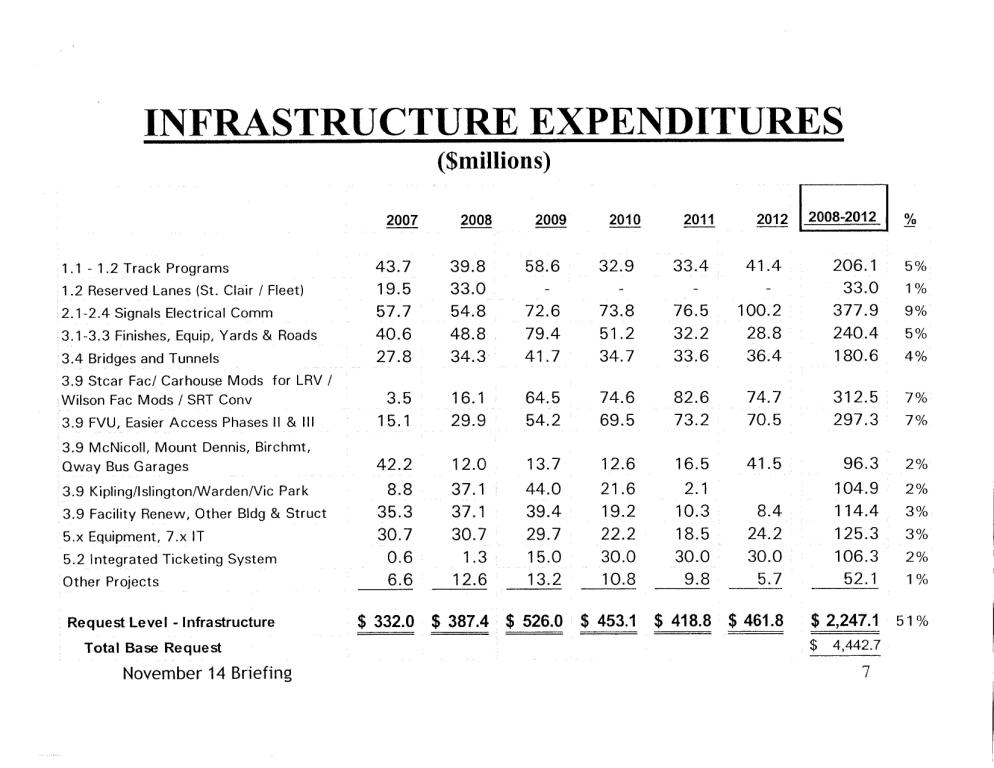
There is an interesting table in Appendix H showing the capital cost of various new Smart Card systems on large transit properties expressed per weekday boarding.  The cost cited for Toronto is cheap compared with Boston, Chicago or New York.  Whether this indicates we will do things better and at less cost, or that there is more headroom for overruns, only time will tell.  The time to implement a system on the TTC is projected at six years.

There are without question benefits that would come with Smart Cards.  However, we must decide whether they are worth the investment.  Recent comments at the TTC minimize costs with a shrug “it’s only about $40-million a year”.

As I have said so often, remember this the next time the TTC says that they cannot afford more bus service, or Council balks at the rising cost of transit subsidies.

Amazing, isn’t it, how we have money for the toys, but not for the things we really need.

How Long is it from Woodbine to Yonge?

In a separate thread here, there is an extensive discussion of whether it is faster to take the Queen car from Woodbine to Yonge, or to take a bus north plus two subway trips.  I originally quoted a running time of 20 minutes for this trip, but was subsequently convinced to up this to at least 25.

Recently, I began looking at the Queen car’s operating data for December 2006.  [For all of you who have been waiting, the grand work on King is now complete and I will be publishing a much abridged version here soon in installments.  In time I will also address the perennial Spadina vs Bathurst question.]

For the first three weeks of December, the running time from Woodbine to Yonge sits quite consistently on 25 minutes from about 7:30 am until 6:00 pm.  The spread in values ranges mainly from a low of 20 to a high of 30, although the majority of observations are within a few minutes of 25.  For trips leaving Woodbine from about 8:00 to 8:30, the running times can be extended to over 30 minutes although this tends to occur moreso on poor weather days.

A related problem is the reliability with which each scheduled car actually shows up for the peak inbound trip.  In my analysis on King, I had already discovered that several cars scheduled to pass through Parkdale during the height of the peak do not always show up, or show up late leading to erratic service just when it is most needed.  I looked for the same effect on Queen and was not surprised by what I found.

In the two hour period from 7:00 to 9:00, there should be about 25 cars westbound on Queen (I say “about” because the actual value is fractional thanks to the 4’52” headway).  As on King, some of these cars do not show up reliably or at all, at least east of Woodbine Loop, and the problem is more severe as the rush hour goes on.  Missing runs are particularly a problem starting around 8:00. 

This means that just at the point when most people want to get downtown for a start in the 8:30 to 9:00 period, the service gets reliably worse.  Because of crowding, this also means that travel times will be extended.

I have not yet had a chance to examine this in detail for the Queen route, but on King the origin of the problem is quite clear.  Some runs, especially those scheduled to enter service comparatively late, don’t always make it out of the carhouse, or if they do, they are late.  Those that are late are often short-turned, or make their trips well off-schedule.  Either way, they are missing from the time and the place when they are most needed.

The reason for this, I believe, is that these runs do not have assigned operators but use either staff from the Spare Board (operators with no assigned work who fill in for absences) or volunteers working overtime.  There is, of course, a good chance that the number of operators available for these runs will be lower on days when the weather is bad.  People who are marginally ill choose not to come in to work, and people who might take overtime prefer not to work in snowstorms.  Just when all the service is needed on the street, critical peak period cars are missing.

Intriguingly, there is very little variation through the day in running time over this section, and systemic traffic congestion does not appear to play a role in westbound trips over this segment of the route.

Often, I have discussed the question of the adequacy of service to meet demand, and the TTC routinely talks about the level of scheduled service.  The problem here is that anywhere from 20 to 40 percent of the “scheduled” service may be missing on any weekday during the morning peak westbound at Woodbine.

Congestion is a serious problem on parts of the system.  However, this is not a question of transit priority or rights-of-way, this is a question of the TTC actually operating all of the scheduled service.