Feeling Congested Part 2: Setting Priorities

The City of Toronto’s Planning Department is consulting with the public for the development of an updated Official Plan.  The plan’s transportation component falls under the rubric of “Feeling Congested” with a website devoted mainly to transit issues.  In the first round of meetings, the focus was on “what is important”, what goals should the new plan try to achieve.  In the second round, the topic is the prioritization of goals and how these might drive out different choices in a future network.

This parallels work that Metrolinx is doing on their Big Move plan, but it includes additional options for study that are city initiatives such as transit to serve the waterfront.

A survey now in progress (until June 30) seeks feedback on the evaluation criteria for transit projects, and also for the goals of the cycling plans.  Some of this makes more sense if one first reads the toolkit, but even then the presentation will leave skeptics unhappy because there is no link to the detailed study explaining how the proposed criteria have been measured for each of proposals.  (A summary chart on page 14 does not include the subcategories within each of the eight criteria that generated the total scores .)

Even with this background, an exercise asking whether the methodology is sound seems to be an odd way to survey public attitudes without a stronger discussion of the implications for a preferred network.  This is rather like discussing the colour of a magician’s hat rather than the effect this might have on the rabbit he pulls out of it (or if there’s even a rabbit at all).

Continue reading

TTC Rediscovers the Downtown Relief Line (Update 4)

Update 4 October 21, 2012 at 8:30 pm:

It’s intriguing to look back at coverage of the DRL the last time this was a major issue.  Mike Filey passed along a clipping from the Star from December 2, 1982 that makes interesting reading.  My comments are at the end in Postscript 2.

Update 3 October 20, 2012 at 3:20 pm:

A postscript has been added discussing the various demand simulations as a group rather than individually.  Charts of total demand southbound from Bloor Station as well as pedestrian activity at Bloor-Yonge are provided to consolidate information from several exhibits in the background paper.

Update 2 October 19, 2012 at 11:00 am:

This article has been reformatted to merge additional information from the background study as well as illustrations into the text.

At its meeting on October 24, 2012, the TTC will consider a report on the Downtown Rapid Transit Expansion Study.  The full background paper is also available on the TTC’s website.

A study by the City of Toronto and TTC, including consultations with Metrolinx, concludes that transit demand to the core by 2031 will grow at a rate that exceeds the capacity of all of the current and planned transit facilities.  Ridership will be 51% higher than today.  The residential population south of College from Bathurst to Parliament will grow by 83%, and employment by 28%.

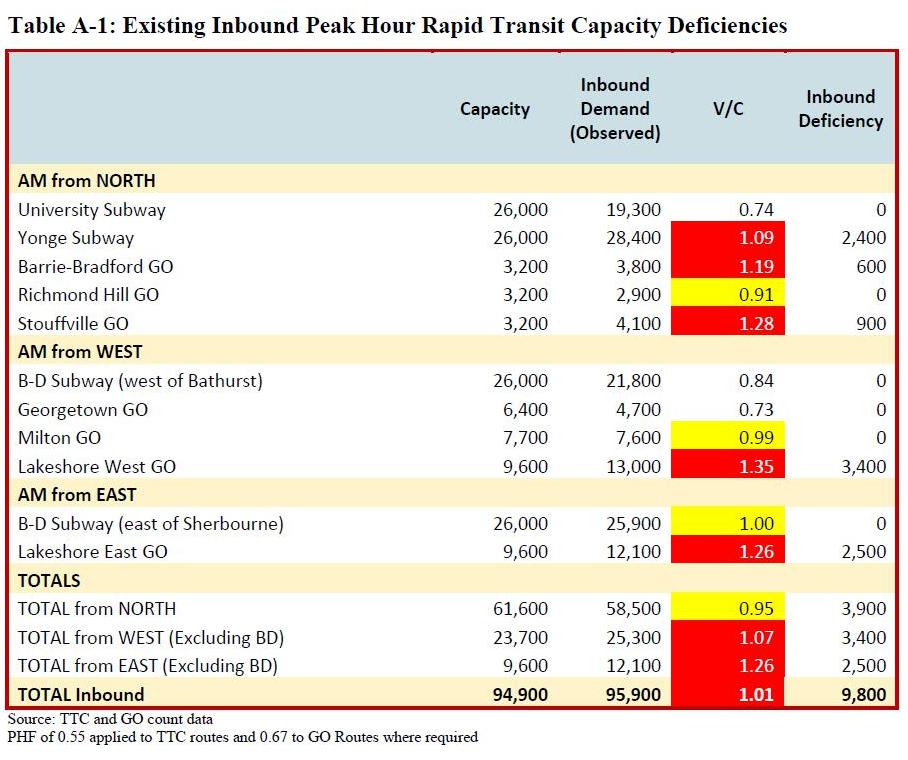
Capacity is an issue today as Table A-1 in the background paper shows.  Several corridors into downtown are already operating over their design capacity.  This is particularly the case on GO where the target is to have few standees, and there is more room for additional passengers in the design capacity than on the TTC subway services.
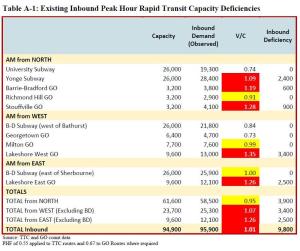
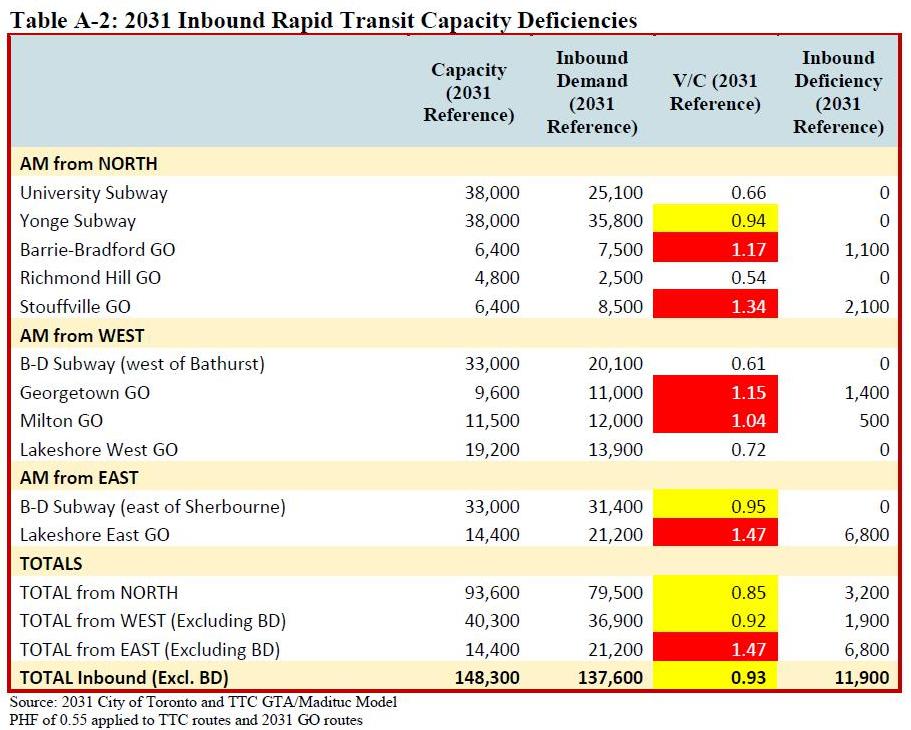
Table A-2 shows the projections for 2031.  All of the shortfalls are on GO, but the TTC lines are close to saturation.  This presumes a considerable increase in the capacity of various lines.  For example, the YUS goes from a design capacity of 26,000 to 38,000 passengers per hour (pphpd), an increase of 46% which may not actually be achievable.  Similarly, the BD line goes to 33,000 pphpd, an increase of 27%.
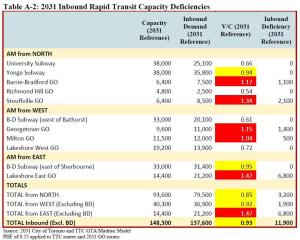
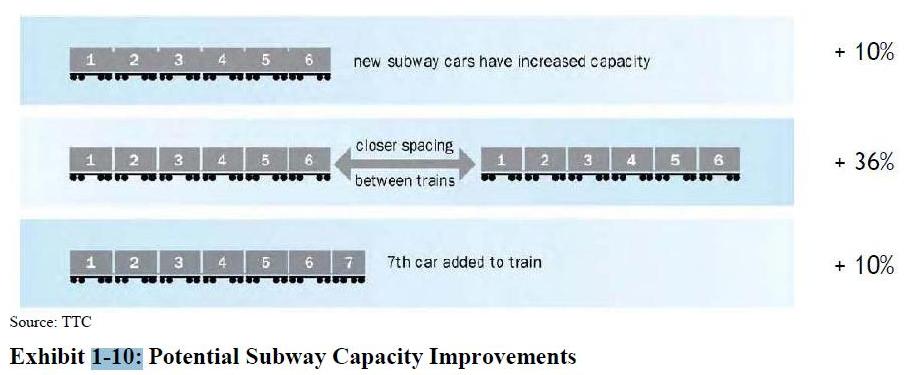
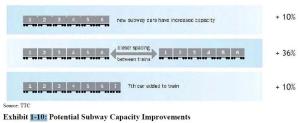
Exhibit 1-10 shows the components of projected capacity increase including 36% from running trains closer together.  As discussed at some length on this site previously, the constraints on headways arise at terminal stations.  A 36% increase in trains/hour implies a headway of about 100 seconds as compared with 140 today.  This cannot be achieved with existing terminal track geometry, not to mention the leisurely crew practices at terminals.
On the GO lines, the projected capacity on Lakeshore West doubles, and smaller increases are seen on other routes.  It is worth noting that the projected capacity of the north-south corridors to Stouffville, Richmond Hill and Barrie are nowhere near the level of service implied by The Big Move, probably because these lines are not targets for early electrification.  This contributes to the capacity shortfall in the northern sector.  Recommendation 1 of the study includes encouragement that Metrolinx review the possibility of increased capacity in those three corridors.

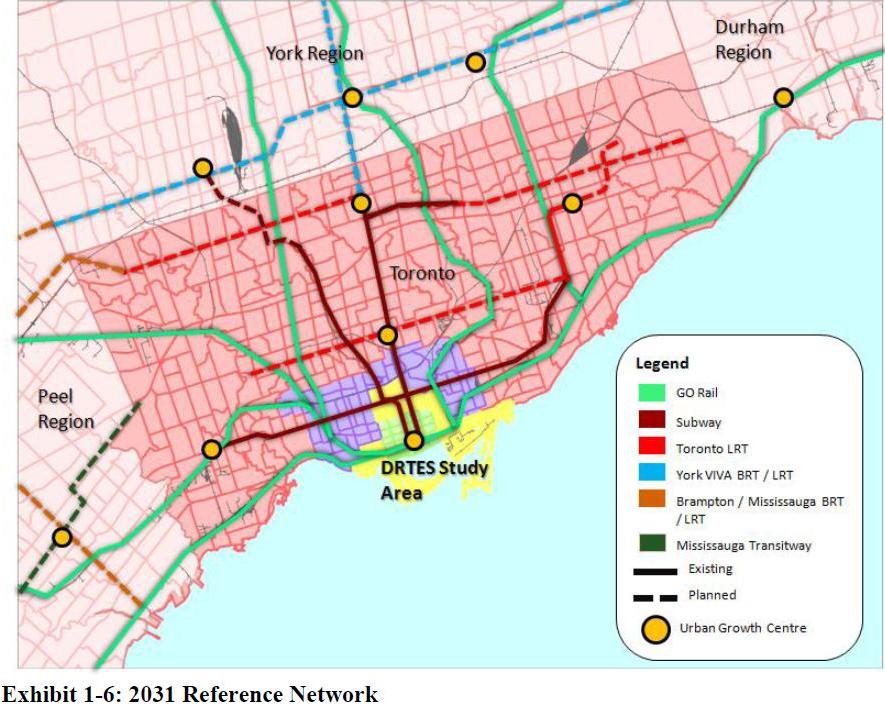
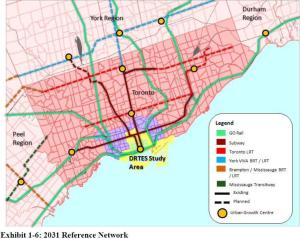
The full list of lines included in the modelled network can be found in the background study at section 1.2.1.
Continue reading

OneCity Plan Reviewed

The OneCity plan has much to recommend it even though in the details it is far from perfect.

The funding scheme requires Queen’s Park to modify the handling of assessment value changes, and they are already cool to this scheme.  Why OneCity proponents could not simply and honestly say “we need a 1.9% tax hike every year for the next four years” (not unlike the ongoing 9% increases to pay for Toronto Water infrastructure upgrades) is baffling.  A discussion about transit is needlessly diverted into debates about arcane ways of implementing a tax increase without quite calling it what it is.

On the bright side, Toronto may leave behind the technology wars and the posturing of one neighbourhood against another to get their own projects built.  Talking about transit as a city-wide good is essential to break the logjam of decades where parochialism ruled.  Couple this with a revenue stream that could actually be depended on, and the plan has a fighting chance.  Ah, there’s the rub — actually finding funding at some level of government to pay for all of this.

Rob Ford’s subway plan depended on the supposed generosity of Metrolinx to redirect committed funding to the Ford Plan (complete with some faulty arithmetic).  Similarly, the OneCity plan depends for its first big project on money already earmarked by Metrolinx to the Scarborough RT to LRT conversion.  If this goes ahead, we would have a new subway funded roughly 80% by Queen’s Park and 20% by Toronto.  Not a bad deal, but not an arrangement we are likely to see for any other line.

On the eastern waterfront, there is already $90m on the table from Waterfront Toronto (itself funded by three levels of government), and OneCity proposes to spend another @200m or so to top up this project.  Whether all $200m would be City money, or would have to wait for other partners to buy in is unclear.

Toronto must make some hard decisions about a “Plan B” if the Ottawa refuses to play while the Tories remain in power.  Even if we saw an NDP (or an NDP/Liberal) government, I wouldn’t hold my breath for money flowing to Toronto (and other Canadian cities) overnight.  A federal presence is a long term strategy, and spending plans in Toronto must be framed with that in mind.

Sitting on our hands waiting for Premier McGuinty or would-be PM Mulcair to engineer two rainbows complete with pots of gold landing in Nathan Phillips Square would be a dead wrong strategy.  Bang the drum all we might for a “one cent solution” or a “National Transit Strategy”, Toronto needs to get on with debating our transit needs whether funding is already in place or not.  Knowing what we need and want makes for a much stronger argument to pull in funding partners.

In some cases, Toronto may be best to go it alone on some of the smaller projects, or be prepared to fund at a higher level than 1/3.  If transit is important, it should not be held hostage by waiting for a funding partner who will never show up.

The briefing package for OneCity is available online.

My comments on the political aspects of OneCity are over at the Torontoist site.

To start the ball rolling on the technical review of the OneCity network, here are my thoughts on each of the proposals in the network. Throughout the discussions that will inevitably follow, it is vital that politicians, advocates, gurus of all flavours not become wedded to the fine details. Many of these lines won’t be built for decades, if ever, and we can discuss the pros and cons without becoming mired in conversations about the colour of station tiles.

Continue reading

“One City” To Serve Them All

Updated June 27 at 5:20pm:  I have written a political analysis of today’s announcement for the Torontoist website that will probably go live tomorrow morning.  A line-by-line review of the plan will go up here later the same day.

TTC Chair Karen Stintz and Vice-Chair Glen De Baeremaeker will formally announce a new plan called “One City” on June 27 at 10:30.

The plan already has coverage on the Star and Globe websites.  Maps:  Globe Star

I will comment in more detail after their press conference, but two points leap off the page at me:

  • The proposed funding scheme for the $30-billion plan presumes 1/3 shares from each of the Provincial and Federal governments.  This money is extremely unlikely to show up, especially Ottawa’s share.  From Queen’s Park, some of the funding is from presumed “commitments” to current projects such as the Scarborough RT/LRT conversion which would be replaced by a subway extension.  The rest is uncertain.
  • The “plan” is little more than a compendium of every scheme for transit within the 416 that has been floated recently in various quarters (including this blog).  What is notable is the fact that glitches in some of the existing ideas (notably the fact that the Waterfront East line ends at Parliament) are not addressed.  The whole package definitely needs some fine tuning lest it fall victim to the dreaded problem of all maps — once you draw them, it’s almost impossible to change them.

For those who keep an eye on political evolution, the brand “One City” surfaced in April 2012 in a speech made by Karen Stintz at the Economic Club of Canada.  This idea of a new, unifying transit brand appears to have been cooking for some time.

TTC Meeting Wrapup: May 1, 2012

The TTC board met on May 1.  This was a quiet affair without the political drama of the “old” Ford-stacked Commission, and I almost missed the bumbling antics of the old crew.  The agenda was on the thin side, and everything wrapped up in a few hours.

Major items included:

  • a status report on the LRT projects,
  • proposed changes to the Richmond Hill extension of the Yonge Subway,
  • the Framework Agreement with Metrolinx for implementation of the Presto farecard,
  • the Customer Satisfaction Survey, and
  • the CEO’s report.

Continue reading