Tracking the costs of Metrolinx projects with publicly available data is not an easy task. They are a secretive organization, and present ongoing costs in a way that hides the eventual total cost of construction and operations. When anyone talks about “on budget”, there is no way to verify the claim because no overall budget figure is given for any project.
Instead, what we see are the cumulative value of contracts that have been awarded as well as spending to date. The rest, assuming that there even is a “budget”, is hidden on the grounds that telling would-be bidders how much money might be on the table will only encourage them to bid to that level. This is nonsense because, except for a few huge P3s, most projects are broken into many smaller contracts and knowing that there are billions available across a project’s allocation gives no hint of how much is earmarked for each component.
The situation is even more opaque in the case of contracts that mix design and construction (a finite capital cost) with operations and maintenance (an ongoing operating cost) over an extended period. Comparison with projects elsewhere is difficult because the components are not segregated.
With the Eglinton and Finch projects now shifting from construction to operation, there is a chance to see what the split would be with the building largely complete. There will be some ongoing capital costs for project cleanup, but costs to date should largely represent the amount spent on the construction phase.
Many other projects are also in flight and there is no way to know if all of their components have been awarded and the values included in the “baseline” cost shown in financial reports.
This article consolidates the reported budgets, later renamed as “baselines”, as well as actual spending in the quarterly Metrolinx Capital Projects reports.
Some projects actually had projected in-service dates, at least in the early years, but these vanished long ago. Metrolinx promised big things once upon a time, but has been much slower to deliver, and at much greater cost than anticipated.
Today, Ontario announced that it would raise the Canadian content in 55 new Line 2 trains from roughly 25 to 50 percent. The provincial capital subsidy for this purchase will rise from $758-million to $950-million, and the increase will be matched by the federal government who are also funding this purchase. There is no change in the Toronto share.
It is not clear whether the federal contribution is net new money, or merely a reallocation within Toronto’s share of the ten-year transit funding program.
Updated January 16, 2026: According to the federal government announcement, the funding will come from an existing allocation stream and is not net new money.
This project is part of the previously announced 10-year funding commitment under the Baseline stream of the Canada Public Transit Fund (CPTF). Beginning in April 2026, the Toronto Transit Commission will receive up to $1.2 billion in CPTF funding over 10 years from 2026 to 2036.
A related question is which government(s) will be on the hook for the extra CanCon in future transit vehicles including those for the Scarborough and Richmond Hill extensions, and for added capacity to deal with expected growth. Collectively these account for a potential 57 more trains, doubling the size of the eventual order.
What the announcement did not address is a list of questions about the Toronto subway fleet overall:
When will the cars be delivered, and how much work is needed to keep the old Line 2 trains operating in the interim?
When will Metrolinx place the add-on orders to provide trains for the Line 2 Scarborough and Line 1 Richmond Hill extensions?
How will delivery of the add-on trains affect opening dates for the extensions?
Will complete replacement of Line 2 trains be delayed because new trains are needed to provide service on these extensions?
Will the extensions have enough trains to provide full service to the new terminals, or will some trains have to short-turn in peak periods?
How soon does the TTC project it will require more trains to improve capacity on Lines 1 and 2, and how will these be funded?
What is the status of funding and timing for new maintenance facilities on Lines 1 and 2 to hold and service the additional trains?
Will the Automatic Train Control (ATC) technology for Line 2 be the same as the existing system on Line 1, or will the two lines (and their fleets) be limited to use only their “own” trains?
The TTC produces a quarterly report on all its major capital projects with the intent of showing all planned work, but it does not produce a unified chart or timetable showing how everything fits together and where critical links might be in the overall plan. The TTC has a “Strategic Planning Committee”, and this is a complex piece of strategy that badly needs detailed, public review.
Ontario unveiled its 2025 budget on May 15. Although it speaks of “Approximately $61 billion over 10 years for public transit”, by far the lion’s share of this spending is for projects already underway in the construction and design stages.
All of this is for capital expansion and renewal, and nothing has been announced for day-to-day improvement of transit service.
GO Transit
The budget cites:
The Hamilton-Niagara through service connection at West Harbour Station which is already in service.
The proposed Bowmanville extension which has been announced before, but is only barely underway at the “early works” stage. This extension has physical alignment issues.
GO 2.0 includes “delivering all-day, two-way service to Kitchener and Milton, building new GO stations across the region and advancing planning to unlock potential new rail corridors through midtown Toronto, Etobicoke, York Region and Bolton.” There are no dates attached, and some of these have been on maps for a very long time. Notable by its absence is any mention of electrification.
A total of $850 million to refurbish GO Transit rail coaches at the Thunder Bay Alstom the North Bay ONR facility. This work is already announced. The cars may receive convenience upgrades such as “charging plug ports, cup holders and improved Wi-Fi”, but the long-term retention of these cars indicates that the operating model for GO electrification, if and when it occurs, will have a large component of locomotive-hauled trains rather than electric multiple units.
Subways
Subway projects in the budget are:
Ontario Line (under construction).
Eglinton-Crosstown Western Extension (under construction).
Yonge North to Richmond Hill (procurement underway).
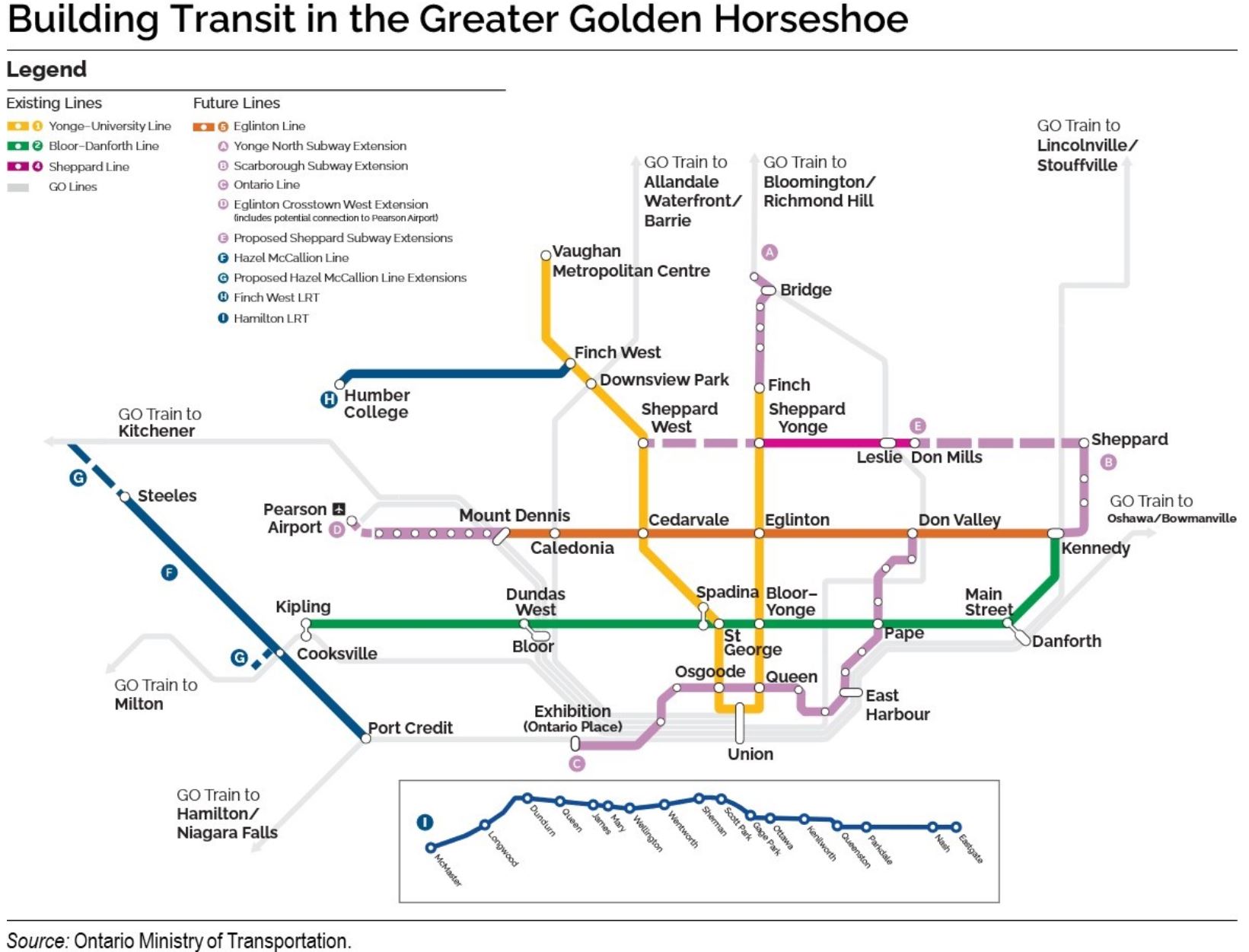
Sheppard Subway Extension (planning, consultation and business case preparation underway). Notable in the map below is the absence of a line east of McCowan where there is a conflict with the City’s Eglinton East LRT project and with maintenance yard property requirements.
New subway cars for Line 2. Provincial funding for these trains has been in place for some time. What is not yet funded are trains for service expansion beyond pre-covid 2019 levels. Trains for the Yonge North and Scarborough extensions are included in those projects. The TTC is in the Request for Proposals process for new trains, but this has been skewed by provincial statements that the work should go to Alstom’s Thunder Bay plant.
Yes, they seem to have forgotten the Scarborough Subway Extension (now under construction) in the text although it is included in the map below..
East Harbour Transit Hub
The hub at East Harbour Station, near the point where the Lakeshore East GO line crosses the Don River, will eventually serve GO Transit, the Ontario Line, and the local streetcar/LRT system via the Broadview Avenue Extension and a link west via Commissioners Street.
A substantial portion of this project is funded by the City of Toronto as a remnant of John Tory’s “SmartTrack” plan.
Light Rail Projects
Hamilton LRT: This is in early states with procurement underway for Civil Works and Utilities.
Hazel McCallion (Mississauga) LRT: Construction is well underway for the initial phase of this project, and the Province is studying whether the extension into downtown Brampton should be tunneled.
Ottawa LRT: The Province is studying a potential upload of the Ottawa LRT “to help reduce costs for Ottawa taxpayers”. What implications this might have for future network operation and expansion is not clear.
Eglinton Crosstown and Finch West LRTs: “Major construction for both projects is now complete. Metrolinx continues to focus on safety and operational readiness testing, as the projects advance toward revenue service.” There is still no commitment to opening dates, and we are getting close to the three-month lead-time required for a go/no-go decision for an early fall 2025 start of service. Meanwhile, TTC has begun the process to update subway train announcements and maps to reflect the new lines.’
There is no mention of the Eglinton East or Waterfront East projects. In a recent letter, Mayor Chow asked the Federal government to contribute 1/3 to these schemes, but there is no indication of support in the Provincial budget.
On December 9, 2024, the TTC issued Requests for Proposals for two major contracts affecting the future of Line 2 Bloor-Danforth: one for new trains, and the other for a new signalling system.
Although the documents for these RFPs total over 2,700 pages with detailed specifications for cars and signals, round one of the process is intended to establish the basic capabilities of would-be suppliers to actually handle the contract without getting into the nitty-gritty. Following rounds will get into the technical details and negotiations.
The RFP process for round one closes on January 28, 2025 (trains) and on January 27 (signals). Contract awards will occur in 2026.
Major points:
The two projects/contracts are linked because implementation of Automatic Train Control on Line 2 requires a new fleet. ATC installation can run concurrently with new train deliveries, but the benefits of ATC operation are not possible until the existing Line 2 fleet of T-1 trains is replaced.
As a separate project, the T-1s will be overhauled to keep them running into the 2030s, although they will be retired as new trains are delivered.
The new trains RFP includes provision for additional equipment including trains needed for extensions of Lines 1 and 2, and for improved service on Line 1. The timing of train deliveries for Line 2 could bump into requirements for Line 1 trains thereby delaying the Line 2 cutover to ATC. Additional trains for Line 1 also trigger the need for a new carhouse which is not yet a funded project.
Growth in capacity of Lines 1 and 2 beyond 2019 levels could be constrained by the availability of fleet and infrastructure. This has already shown up in the planned completion of the ATC cutover on Line 2 in 2035. This date conflicts with TTC projections of demand growth.
Although the RFP for new trains is theoretically open to all bidders, both the provincial and federal governments have made statements about how this will guarantee work for Thunder Bay. Bidders might well ask if any firm but Alstom actually should bother participating. Options within the RFP include future replacement of the Line 1 TR fleet which, based on a 30-year lifespan, would stretch from 2039 to 2047.
The Line 2 ATC RFP is also an open bid, and it explicitly states that if a different vendor from Line 1 (Alstom) is chosen there will be Line 1 and 2 trains with different vendors’ ATC gear. The trains will not be able to interoperate between the lines except in manual (“emergency”) mode at restricted speed.
Work cars need dual capability and the TTC intends to equip them with gear that can work with either the Line 1 or 2 system. What this might entail both for physical space on the cars, operating procedures and complexity is not discussed.
If train frequencies are improved beyond 2019 levels (less than 140 seconds), there will be capacity issues at terminals and turnbacks. The ATC RFP includes a performance requirement for faster turnarounds (as low as a 100 second headway) but it is not clear whether this is possible with existing track geometry.
The Scarborough Subway will be built with conventional block signals, and will be retrofitted with ATC in a later, as yet unfunded, project. It is not yet clear whether full service will operate during peak periods on the SSE during peak periods, and the ATC RFP provides for turnback operations in a tail track east of Kennedy Station.
Funding for future stages beyond 70 cars (55 for Line 2, plus 15 for the Scarborough and Yonge North extensions) is not guaranteed.
The July 17 Board meeting was extraordinarily long thanks to three in camera items, plus extended discussions of the CEO’s Report and of use of buses as homeless shelters during the winter.
The confidential session dealt with:
A collective bargaining update for two small groups of customer service and operations supervisor employees.
An update on advice from External Counsel. On a recorded vote, this was adopted with all Board members except Councillor Saxe in favour. As of the publication of this article (July 28), there have been no leaks about the subject of this report.
An update on the fare modernization program including the status of the Presto contract. The report was also discussed briefly in the public session later in the meeting.
The public meeting included:
The July 16 storm, flooding and hardening of infrastructure against climate change.
New subway trains and federal funding announced earlier the same day (July 17).
Prioritization of State of Good Repair projects. This item received scant attention although the report contains much interesting background on capital plans.
Safety on the TTC.
Use of shelter buses.
Transit network expansion update.
Fare Compliance Action Plan: See the updated version of my previous article on this report which includes the debate at the Board meeting.
Not discussed was the issue of hydraulic fluid leaks from subway work cars of which one quarter are still out of service. A report is supposed to be coming to the Board soon. It is not clear how much this situation is affecting the TTC’s ability to stay on top of track maintenance issues and the growing list of slow orders for track that cannot be safely operated at full speed.
The TTC is in a very difficult position for capital planning because for many years it understated the size of the capital backlog and also tended to treat related projects, or even components of the same project, as separate items. This led to low-balled estimates of total costs and, in some cases, piecemeal execution of projects. Now that we see “all in” costs, the problems facing the system are perceived more seriously, but just at a point when new money to invest in existing subways is hard to find.
Although the TTC called for proposals for a replacement of the Line 2 fleet of T1 trains, with add-on provisions for system expansion, this was cancelled in June 2023 due to lack of funding commitments from either the Provincial or Federal governments.
The report proposes three scenarios depending on when new trains and facilities would be delivered and built at total costs ranging from $8.5 to $10 billion including inflation. Very little of this has committed funding.
This is not just a question of buying new trains, but of building, or renewing, many facilities:
Greenwood Carhouse dates back to the opening of the BD subway and needs to be modernized and rebuilt to handle a new fleet.
The signal system on Line 2 dates to the 1960s and must be replaced both to maintain reliability, improve operations and provide for service growth.
Additional trains for both Lines 1 and 2 will require more storage including a major new maintenance facility for Line 1.
The funding sought by this report does not include companion upgrades that have been flagged in the overall capital plan:
Running more frequent service requires more traction power on top of state of good repair work needed for both subway lines’ power systems.
More service means more passengers, and some key stations cannot handle additional demand between the platform and street without additional circulation capacity.
Moreover, there are major projects beyond subway fleet renewal that are either partly or totally unfunded even at the City level, never mind its partners:
Ongoing replacement of the bus fleet including electrification
Any provision for service growth to improve transit coverage and encourage a shift to transit riding especially in areas where it is not competitive with auto
LRT lines in the waterfront or Eglinton East
Platform screen doors to prevent access to track level
Even if the fleet and signal renewal for Line 2 finds much-needed financial support, this is only the beginning of the TTC’s search for capital, and I have not even mentioned the need for ongoing state of good repair.
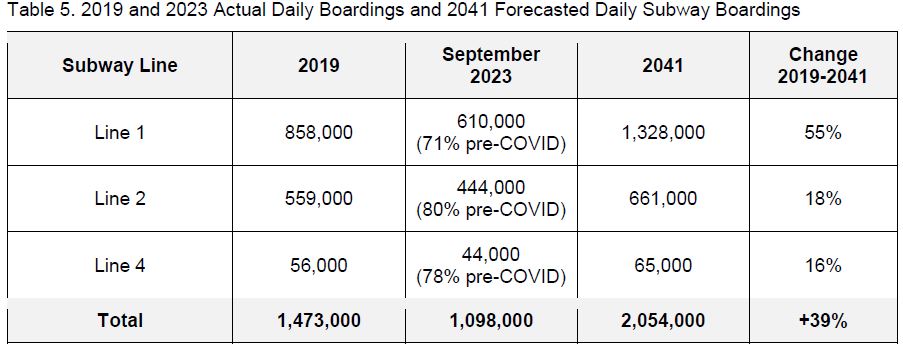
In the short term, the TTC has been “saved” from a capacity crisis by the covid pandemic and the loss of subway riding. Only a few years ago, the concern was not empty trains, but platforms full of riders who could not move. Although the subway is not back at full demand, recovery is well underway. Here are historical figures and projections for the future from the report.
2041 might sound a long way off, but in the scheme of subway fleet planning, it is fairly near given both the lead time to buy new trains and their 30-year design life. What we plan for today will affect the system for decades to come.
This forecast will be updated with results from the current Transportation Tomorrow Survey and other planning work to provide an outlook to 2051.
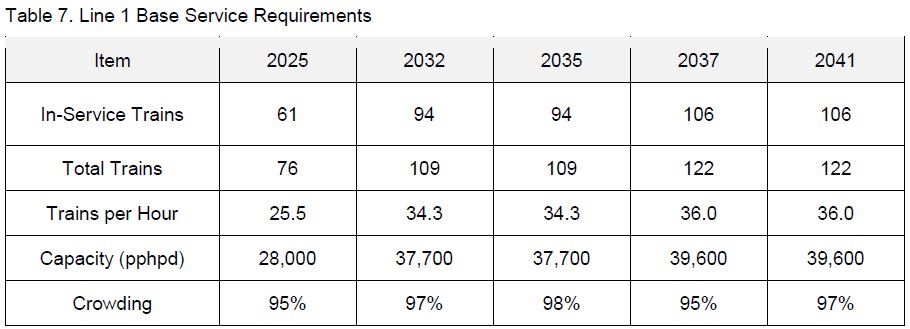
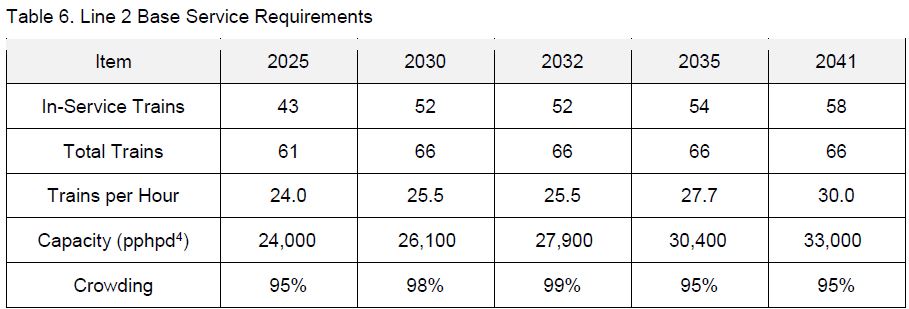
These projections translate to service requirements on the two lines. Note that this is likely based on the historical ratio of peak to all day demand. Although work-from-home may shift some riding away from peaks especially on Mondays and Fridays, this would still leave the midweek days facing crowding. It would be dangerous to make plans for lesser demand as a short-term cost saving measure.
Line 1 has already been converted to Automatic Train Control (ATC) with moving block signalling that can handle more trains/hour. Note that the projected Line 1 service is at 36 trains/hour, or every 100 seconds. This will be challenging to sustain especially at busy stations and terminals.
The current signal system on Line 2 cannot support headways below about 140 seconds, the pre-pandemic peak service level on that route. This is equivalent to 25.7 trains/hour which gets us only to the 2032 projected requirement.
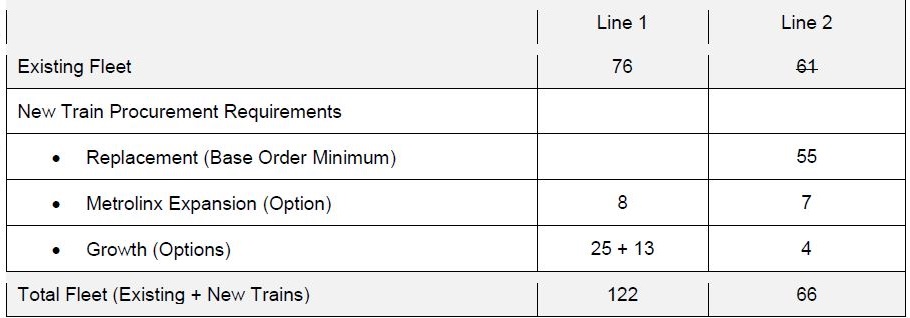
This translates into the following requirements for a larger fleet.
The 55-train replacement for Line 2 where there are now 61 trains is based on the capacity with new trains (similar to those now on Line 1) with about 10% more room than the old ones. This finally addresses the excess of T1 trains in the fleet ever since the TTC decided to run Lines 1 and 4 entirely with new “TR” trains and ATC, and relegated the T1 fleet to Line 2.
The Metrolinx options are for the Richmond Hill and Scarborough extensions. Growth trains are to permit the operation of more frequent service than the existing fleet can support.
Note that Line 4 Sheppard is not included here as it has a dedicated set of six 4-car trains that can handle projected growth on that line. Depending on the extension of Line 4, a future procurement of trains and storage facilities could be required.
In the remainder of this article, I will describe the scenarios and implications of choices the TTC, Council and its funding partners will make in the near future.
Recommendations
The report recommends that:
The TTC prioritize funding in the capital budget for:
New subway cars and related projects with a cost of $3.2 billion as the City’s share.
A 30-year state of good repair overhaul of the T1 fleet.
Risk mitigation activities for Line 2 related to fleet and signal system life extension.
Subject to confirmation of funding, the CEO issue an RFP for new trains needed on the existing Line 2 with options for extensions and demand growth on the system.
This will have effects not just for subway planning but for other TTC capital project funding and timing.
The TTC is part way through production of its 2024 Service Plan as well as a 5-Year Service Plan and Customer Experience Action Plan. In Round Two, consultation will focus on plans for service changes triggered by major construction projects. Five pop-up sessions are planned at Flemingdon Park, Union Station, Liberty Village, Finch Terminal, and Pape Station between June 29 and July 12, 2023. Details are available here.
Also available on that page is a link to a survey seeking feedback on various proposals. Please note that my site is not an official TTC conduit for feedback, although it is no secret that many at the TTC do read articles and comments here. Any specific feedback for the TTC should be submitted through their own survey.
Round Three in August-September will present draft concepts for the 5-Year Plan and Customer Experience Action Plan, and these will be refined into final drafts for Round Four in October-November.
The remainder of this article presents an overview of the survey and proposals for construction-related service changes.
There are no proposals for new routes nor of overall service levels in this round. The election of Olivia Chow as Mayor will no doubt bring a review of existing services, but that is not in the scope of this round.
An important issue left over from the 2023 Budget process and the recent service cuts is the question of Service Standards. These are described as “Board Approved”, but in fact the 2023 changes were implemented by management as part of the budget with only retroactive consent from the Board. Moreover, the actual effect of the changes was withheld from the Board and Council until well after the budget was approved.
Transparency in budgets and service planning will be an important change looking ahead to 2024. With a new Mayor I hope to see a much improved process.
At its meeting on February 28, the TTC Board will receive a report summarizing the status of most of the rapid transit plans in Toronto. This article condenses the TTC report and reorders some sections to group related items together.
Dominant among many projects are, of course, the “big four” provincial projects: Ontario Line, Scarborough Subway, Yonge North Subway, and Eglinton West LRT extension.
Project Status Overview
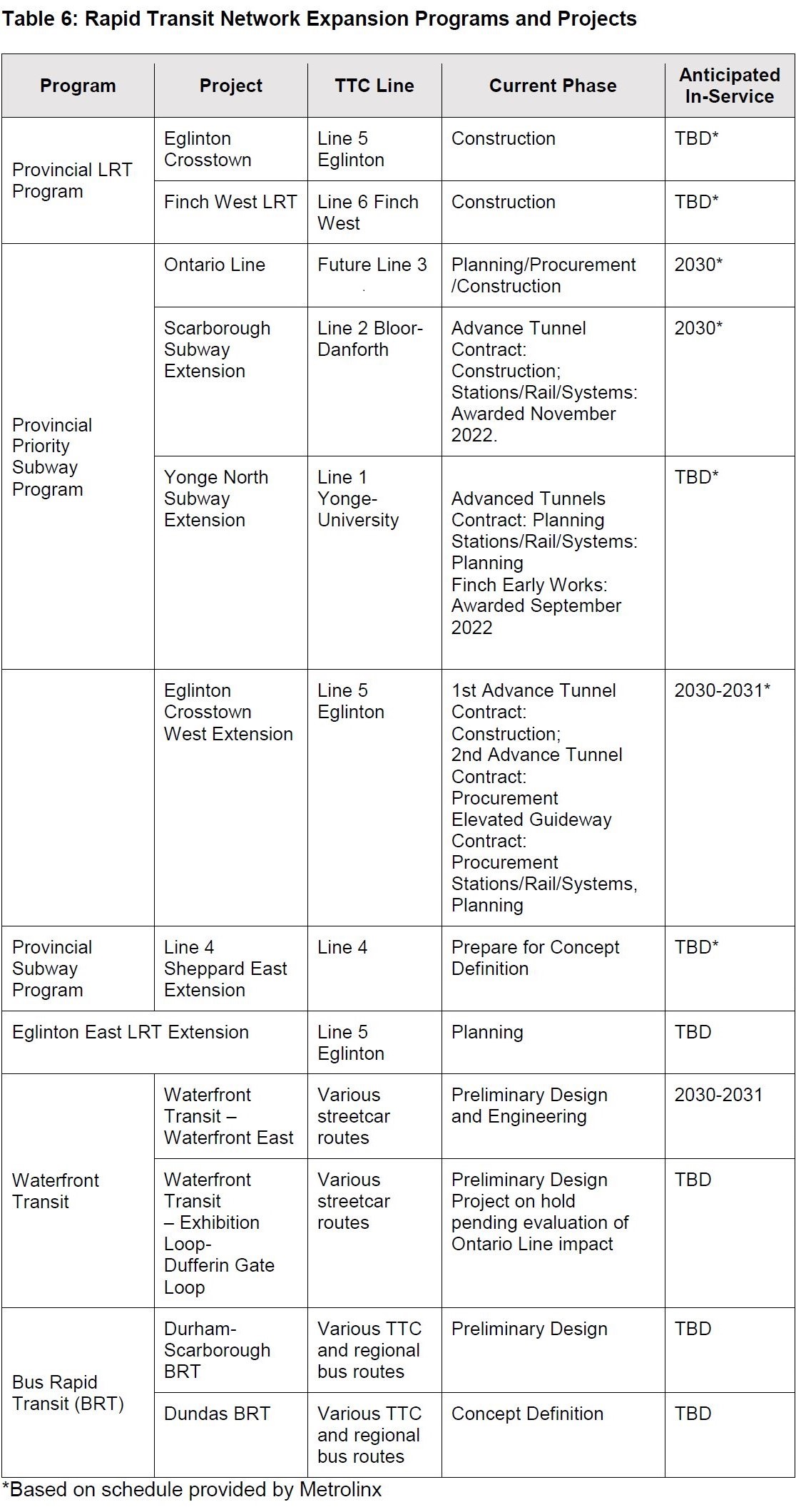
The effect of major projects elbowing everything else aside is clear in the table below. Some projects do not have in service dates because they are not funded, and the timing of that (when and if it occurs) will determine when various lines can open.
Not shown in this table are several major projects that pop up from time to time:
Bloor-Yonge Station Expansion
Waterfront West LRT from Dufferin to The Queensway
Bloor West subway extension
New Line 2 fleet and yard at Kipling (Obico yard property)
Sheppard East subway extension
Platform Edge Doors
Of these, only the Bloor-Yonge project has funding, and some are only a glimmer in various politicians’ eyes.
The Province of Ontario is not exactly transparent when it comes to reconciliation of announced project costs and actual spending, let along the changes that might occur along the way. A project, or group of projects, might be announced with a value in then-current dollars, and without necessarily including all future contract costs. There are various reasons behind this approach including:
The government does not want to tip its hand on the amount of money “on the table” to prospective bidders who might tailor their bid to the perceived level of funding.
Some contracts include future operating and maintenance costs as well as capital costs. In some case the announced cost does not include the O&M component, only the estimated capital portion.
Provincial projects are typically quoted in then-current dollars with future inflation to be added as it occurs, at least to the point where there is a contract in place which includes that provision.
This approach hides the likely as-spent costs and makes provincially run projects appear cheaper, at least in the short run.
This is fundamentally different from the way the City of Toronto tracks projects and how TTC requirements are reported. Specifically:
City project cost estimates include inflation to completion because this is factored into future funding requirements.
City projects do not bundle future operating costs with capital, but report them separately.
Note that cost estimates shown in the Infrastructure Ontario market reports do not necessarily match values shown by Metrolinx because IO shows these values on a different basis. Future operating and financing costs are no longer included in IO estimates so that a project’s value reflects only design and construction costs, a value that gives potential construction bidders a general size of the project’s scope.
Infrastructure Ontario notes on the November 2022 Market Update that we have modified the methodology used to calculate the estimated costs as presented on the chart. In May 2022, and for Market Updates prior to that, we used the Estimated Total Capital Costs. For the latest update, and going forward, the costs listed only include Design and Construction costs.
These changes were adopted after feedback from our construction industry partners found that including only design and construction costs provided them with a better sense of the scope of the project and would assist in determining if they wished to participate in the bidding process.
Email from Ian McConachie, Infrastructure Ontario, Manager, Media Relations & Communications, November 24, 2022.
This can be confusing with “bundled” projects such as the Ontario Line RSSOM contract which includes both provision/construction of vehicles and infrastructure, as well as future O&M costs. This is probably the reason, or a good chunk of it, for the very large increase in the RSSOM contract value between the initial estimate cited by IO and the contract award. However, the way these contracts are handled generally makes it impossible to know how much of the change is simply due to inflation in materials and labour costs, and how much is due to underestimates or scope changes.

 Steve Munro