Today, Ontario announced that it would raise the Canadian content in 55 new Line 2 trains from roughly 25 to 50 percent. The provincial capital subsidy for this purchase will rise from $758-million to $950-million, and the increase will be matched by the federal government who are also funding this purchase. There is no change in the Toronto share.
It is not clear whether the federal contribution is net new money, or merely a reallocation within Toronto’s share of the ten-year transit funding program.
Updated January 16, 2026: According to the federal government announcement, the funding will come from an existing allocation stream and is not net new money.
This project is part of the previously announced 10-year funding commitment under the Baseline stream of the Canada Public Transit Fund (CPTF). Beginning in April 2026, the Toronto Transit Commission will receive up to $1.2 billion in CPTF funding over 10 years from 2026 to 2036.
A related question is which government(s) will be on the hook for the extra CanCon in future transit vehicles including those for the Scarborough and Richmond Hill extensions, and for added capacity to deal with expected growth. Collectively these account for a potential 57 more trains, doubling the size of the eventual order.
What the announcement did not address is a list of questions about the Toronto subway fleet overall:
When will the cars be delivered, and how much work is needed to keep the old Line 2 trains operating in the interim?
When will Metrolinx place the add-on orders to provide trains for the Line 2 Scarborough and Line 1 Richmond Hill extensions?
How will delivery of the add-on trains affect opening dates for the extensions?
Will complete replacement of Line 2 trains be delayed because new trains are needed to provide service on these extensions?
Will the extensions have enough trains to provide full service to the new terminals, or will some trains have to short-turn in peak periods?
How soon does the TTC project it will require more trains to improve capacity on Lines 1 and 2, and how will these be funded?
What is the status of funding and timing for new maintenance facilities on Lines 1 and 2 to hold and service the additional trains?
Will the Automatic Train Control (ATC) technology for Line 2 be the same as the existing system on Line 1, or will the two lines (and their fleets) be limited to use only their “own” trains?
The TTC produces a quarterly report on all its major capital projects with the intent of showing all planned work, but it does not produce a unified chart or timetable showing how everything fits together and where critical links might be in the overall plan. The TTC has a “Strategic Planning Committee”, and this is a complex piece of strategy that badly needs detailed, public review.
The express busway linking Kennedy Station to Ellesmere Road along the former Line 3 Scarborough RT corridor will open in late September 2026 rather than in 2027 as originally planned. This was announced jointly by Mayor Chow, TTC Chair Myers and TTC CEO Lali.
The idea of repurposing the SRT corridor was approved well before the premature end of service with a derailment south of Ellesmere Station in July 2023. According to an April 2022 presentation, design work would begin in 2022, and construction to convert the corridor would begin immediately after the RT shutdown scheduled for November 2023, and the busway would open in Q4 2025.
Yes, it should be open already, but delays in funding the project, acquiring property, gaining Metrolinx approval for co-existence of a busway with their rail corridor, among other factors, pushed design completion out to mid-2024, and the target in-service date well into 2027.
A common factor in many delays was a lack of urgency, and the idea that Ontario should pay for this conversion as part of the Scarborough Subway project. Council approved its expected share of funding in February 2024, but time was lost waiting for provincial money that would never arrive. Eventually the City decided to just get on with the work.
The 100% Detailed Design of the Busway was completed in December 2024, along with the final cost estimates, which remain within the approved budget. The contract for the Busway was tendered in February 2025 and is expected to be awarded in Q2 2025 to commence the construction of the Busway.
The contract for the Busway was tendered in February 2025 and closed in April 2025. Delegated authority to award the contract was approved at the May 2025 Board meeting along with a motion to report back to the Board in July 2025 on an acceleration plan.
As the contract was awarded on June 5, 2025, and the first kick-off meeting was held with the Contractor on June 13, 2025, staff are anticipating receiving the Contractor’s baseline schedule in the first week of July. We, therefore, expect to start the discussion with the Contractor on the acceleration plan in July 2025. The Contractor will need time to line up their sub-contractors and suppliers to develop a comprehensive acceleration plan that demonstrates ways and means of achieving the acceleration goal. We anticipate finalizing the acceleration plan by end of the summer and reporting back to the Board in September/October 2025.
The contract for the Busway was tendered in February 2025. The contract for the Busway implementation was awarded in June 2025, and work commenced on July 22, 2025.
[…]
Awaiting an acceleration plan proposal from the contractor. Upon receipt of the proposal, negotiations to finalize the proposed plan will take place immediately over the following two to three weeks. A report will be provided to the Board at the October 2025 meeting.
“The contractor submitted a baseline construction schedule, and an acceleration plan to target an early revenue service is under negotiation.”
In other words, it was possible to get the busway open sooner, but that was not the original scheme nor was an acceleration plan required in the initial tender. No, it was not your imagination that this project could have run faster, it was actually planned to be long. As of a few days ago, a faster schedule was still only a possibility.
Now with political pressure, the Scarborough Bus Corridor project will speed up. However, the basic question is why was this option not on the table from day one especially after the time lost awaiting provincial funding.
Ontario unveiled its 2025 budget on May 15. Although it speaks of “Approximately $61 billion over 10 years for public transit”, by far the lion’s share of this spending is for projects already underway in the construction and design stages.
All of this is for capital expansion and renewal, and nothing has been announced for day-to-day improvement of transit service.
GO Transit
The budget cites:
The Hamilton-Niagara through service connection at West Harbour Station which is already in service.
The proposed Bowmanville extension which has been announced before, but is only barely underway at the “early works” stage. This extension has physical alignment issues.
GO 2.0 includes “delivering all-day, two-way service to Kitchener and Milton, building new GO stations across the region and advancing planning to unlock potential new rail corridors through midtown Toronto, Etobicoke, York Region and Bolton.” There are no dates attached, and some of these have been on maps for a very long time. Notable by its absence is any mention of electrification.
A total of $850 million to refurbish GO Transit rail coaches at the Thunder Bay Alstom the North Bay ONR facility. This work is already announced. The cars may receive convenience upgrades such as “charging plug ports, cup holders and improved Wi-Fi”, but the long-term retention of these cars indicates that the operating model for GO electrification, if and when it occurs, will have a large component of locomotive-hauled trains rather than electric multiple units.
Subways
Subway projects in the budget are:
Ontario Line (under construction).
Eglinton-Crosstown Western Extension (under construction).
Yonge North to Richmond Hill (procurement underway).
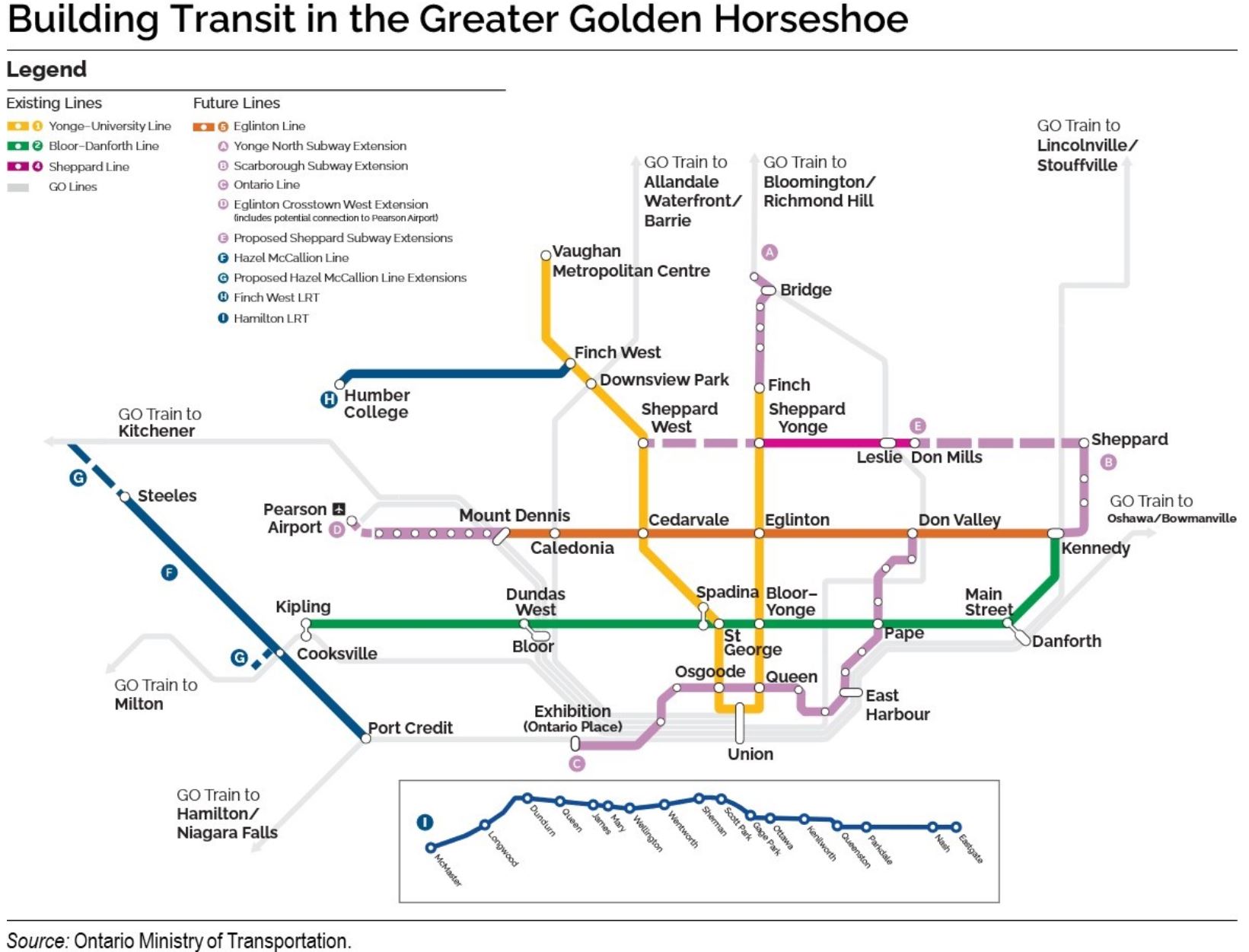
Sheppard Subway Extension (planning, consultation and business case preparation underway). Notable in the map below is the absence of a line east of McCowan where there is a conflict with the City’s Eglinton East LRT project and with maintenance yard property requirements.
New subway cars for Line 2. Provincial funding for these trains has been in place for some time. What is not yet funded are trains for service expansion beyond pre-covid 2019 levels. Trains for the Yonge North and Scarborough extensions are included in those projects. The TTC is in the Request for Proposals process for new trains, but this has been skewed by provincial statements that the work should go to Alstom’s Thunder Bay plant.
Yes, they seem to have forgotten the Scarborough Subway Extension (now under construction) in the text although it is included in the map below..
East Harbour Transit Hub
The hub at East Harbour Station, near the point where the Lakeshore East GO line crosses the Don River, will eventually serve GO Transit, the Ontario Line, and the local streetcar/LRT system via the Broadview Avenue Extension and a link west via Commissioners Street.
A substantial portion of this project is funded by the City of Toronto as a remnant of John Tory’s “SmartTrack” plan.
Light Rail Projects
Hamilton LRT: This is in early states with procurement underway for Civil Works and Utilities.
Hazel McCallion (Mississauga) LRT: Construction is well underway for the initial phase of this project, and the Province is studying whether the extension into downtown Brampton should be tunneled.
Ottawa LRT: The Province is studying a potential upload of the Ottawa LRT “to help reduce costs for Ottawa taxpayers”. What implications this might have for future network operation and expansion is not clear.
Eglinton Crosstown and Finch West LRTs: “Major construction for both projects is now complete. Metrolinx continues to focus on safety and operational readiness testing, as the projects advance toward revenue service.” There is still no commitment to opening dates, and we are getting close to the three-month lead-time required for a go/no-go decision for an early fall 2025 start of service. Meanwhile, TTC has begun the process to update subway train announcements and maps to reflect the new lines.’
There is no mention of the Eglinton East or Waterfront East projects. In a recent letter, Mayor Chow asked the Federal government to contribute 1/3 to these schemes, but there is no indication of support in the Provincial budget.
On December 9, 2024, the TTC issued Requests for Proposals for two major contracts affecting the future of Line 2 Bloor-Danforth: one for new trains, and the other for a new signalling system.
Although the documents for these RFPs total over 2,700 pages with detailed specifications for cars and signals, round one of the process is intended to establish the basic capabilities of would-be suppliers to actually handle the contract without getting into the nitty-gritty. Following rounds will get into the technical details and negotiations.
The RFP process for round one closes on January 28, 2025 (trains) and on January 27 (signals). Contract awards will occur in 2026.
Major points:
The two projects/contracts are linked because implementation of Automatic Train Control on Line 2 requires a new fleet. ATC installation can run concurrently with new train deliveries, but the benefits of ATC operation are not possible until the existing Line 2 fleet of T-1 trains is replaced.
As a separate project, the T-1s will be overhauled to keep them running into the 2030s, although they will be retired as new trains are delivered.
The new trains RFP includes provision for additional equipment including trains needed for extensions of Lines 1 and 2, and for improved service on Line 1. The timing of train deliveries for Line 2 could bump into requirements for Line 1 trains thereby delaying the Line 2 cutover to ATC. Additional trains for Line 1 also trigger the need for a new carhouse which is not yet a funded project.
Growth in capacity of Lines 1 and 2 beyond 2019 levels could be constrained by the availability of fleet and infrastructure. This has already shown up in the planned completion of the ATC cutover on Line 2 in 2035. This date conflicts with TTC projections of demand growth.
Although the RFP for new trains is theoretically open to all bidders, both the provincial and federal governments have made statements about how this will guarantee work for Thunder Bay. Bidders might well ask if any firm but Alstom actually should bother participating. Options within the RFP include future replacement of the Line 1 TR fleet which, based on a 30-year lifespan, would stretch from 2039 to 2047.
The Line 2 ATC RFP is also an open bid, and it explicitly states that if a different vendor from Line 1 (Alstom) is chosen there will be Line 1 and 2 trains with different vendors’ ATC gear. The trains will not be able to interoperate between the lines except in manual (“emergency”) mode at restricted speed.
Work cars need dual capability and the TTC intends to equip them with gear that can work with either the Line 1 or 2 system. What this might entail both for physical space on the cars, operating procedures and complexity is not discussed.
If train frequencies are improved beyond 2019 levels (less than 140 seconds), there will be capacity issues at terminals and turnbacks. The ATC RFP includes a performance requirement for faster turnarounds (as low as a 100 second headway) but it is not clear whether this is possible with existing track geometry.
The Scarborough Subway will be built with conventional block signals, and will be retrofitted with ATC in a later, as yet unfunded, project. It is not yet clear whether full service will operate during peak periods on the SSE during peak periods, and the ATC RFP provides for turnback operations in a tail track east of Kennedy Station.
Funding for future stages beyond 70 cars (55 for Line 2, plus 15 for the Scarborough and Yonge North extensions) is not guaranteed.
Back in 2017, there was a proposed renewal program for Line 2 that covered many aspects including fleet planning, extensions, future demand growth, signalling and maintenance yard requirements.
Most regular transit followers in Toronto will scratch their heads and ask “what renewal program”. The problem was that it was too rich for political blood at the time and most of it was ditched after CEO Andy Byford was replaced by Rick Leary.
A fundamental premise of the plan was that all of its components would be handled through one master schedule and common overall project management. The TTC had learned from experience on Line 1 that a piecemeal approach was fraught with conflicting timetables and specifications, not to mention the danger that each piece had to be funded separately with little appreciation for the big picture.
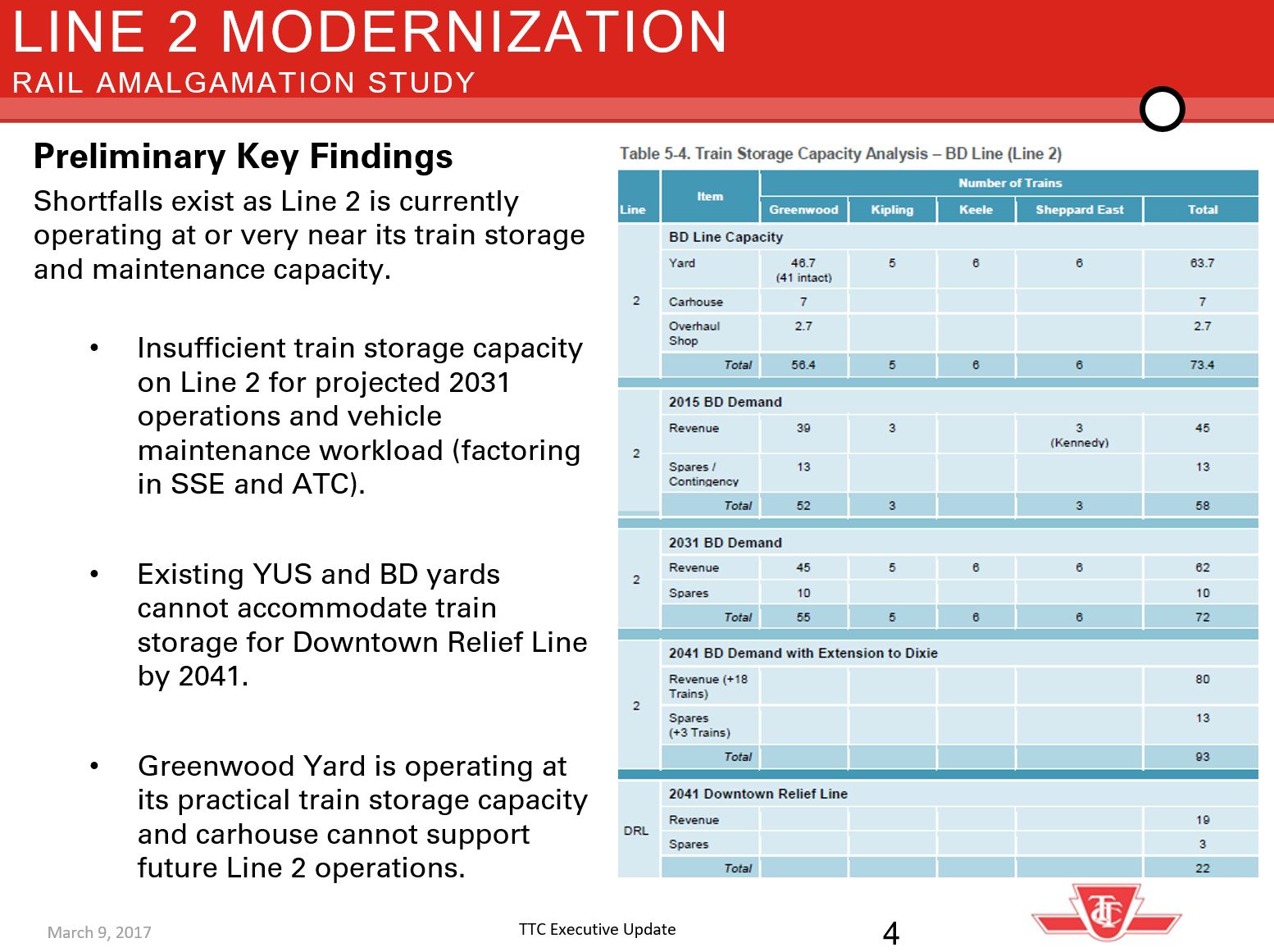
A Rail Amalgamation Study was conducted for the TTC by HDR and Gannett Fleming starting in 2015, and it was expected to finish in 2017. The intent was to review the line’s needs based on various future scenarios. For maintenance and storage facilities, it would consider:
The use of 2-car sets rather than the 6-car TR train configuration.
Possible line extensions
Expansion of the work car fleet to support expanding infrastructure
Implementation of ATC (Automatic Train Control) signalling
A preliminary report from the study showed that capacity would be a major problem. Note that in the context of this study, the Ontario Line did not yet exist, and the intent was that Greenwood Yard would host the Downtown Relief Line trains. Even without the DRL, Greenwood would not be able to handle expected growth in demand on Line 2.
The remainder of this article shows the details of the resulting plan, notably proposals for a new Line 2 fleet and expansion of the work car fleet that might have been set in motion had this scheme not been sidelined.
The TTC had a consolidated plan for Line 2 (and for the DRL), but this fell victim to budget cuts, the idea that we could “make do” rebuilding old trains and signal systems, and then the Provincial intervention with Metrolinx showing how they “knew better” how to plan and build rapid transit lines. We all know how that worked out.
The July 17 Board meeting was extraordinarily long thanks to three in camera items, plus extended discussions of the CEO’s Report and of use of buses as homeless shelters during the winter.
The confidential session dealt with:
A collective bargaining update for two small groups of customer service and operations supervisor employees.
An update on advice from External Counsel. On a recorded vote, this was adopted with all Board members except Councillor Saxe in favour. As of the publication of this article (July 28), there have been no leaks about the subject of this report.
An update on the fare modernization program including the status of the Presto contract. The report was also discussed briefly in the public session later in the meeting.
The public meeting included:
The July 16 storm, flooding and hardening of infrastructure against climate change.
New subway trains and federal funding announced earlier the same day (July 17).
Prioritization of State of Good Repair projects. This item received scant attention although the report contains much interesting background on capital plans.
Safety on the TTC.
Use of shelter buses.
Transit network expansion update.
Fare Compliance Action Plan: See the updated version of my previous article on this report which includes the debate at the Board meeting.
Not discussed was the issue of hydraulic fluid leaks from subway work cars of which one quarter are still out of service. A report is supposed to be coming to the Board soon. It is not clear how much this situation is affecting the TTC’s ability to stay on top of track maintenance issues and the growing list of slow orders for track that cannot be safely operated at full speed.
* City Council Transmittal – CC15.1 Budget Implementation Including Property Tax Rates, User Fees and Related Matters
* Financial and Major Projects Update for the Year Ended December 31, 2023
* Easier Access Phase III – Project Status Update April 2024
Approval of Public Art Concepts for the Bay, Castle Frank, Christie, Donlands and Lansdowne Stations
I have already written about the SRT report, and here will discuss only the deputations and discussion at the Board meeting.
(*) Part II will review the Asset Management Plan, and Part III will cover updates on TTC finances, Major Projects and Easier Access.
A Draft Report on the TTC’s “Innovation and Sustainability Framework” was deferred to the May Board meeting, and I will comment on that when it reappears.
Among the reports on the TTC Board agenda for April 11 is a recap of the SRT investigation. I have already written about shortcomings and contradictions in this report and will not belabour that here.
The fundamental question is whether management are being entirely transparent in their presentation. If there is someone on the Board bold enough to challenge them, here are a few key questions:
Ten days before the derailment, a high reaction rail was reported at the site, but this was logged as a low priority problem. The misalignment, reported as 1/2 inch, is on a par with the normal clearance between the LIM motor under SRT cars and the reaction rail. What repairs, if any, were made to correct this problem, and were the bolts holding the reaction rail checked for their integrity?
At the site, joins in both the reaction rail cap and the main reaction rail were at the same position. This weakens the structure because the two sections cannot reinforce each other against deflection by magnetic forces as trains pass. The sections are supposed to be staggered to prevent this type of failure. Why weren’t they, and how many other locations on the SRT shared the same problem?
How recently installed were the bolts that failed at the derailment site?
Consultant reports state that the manufacturer, Hilti, did not intend its anchors to be used in a situation where the bolts would flex under load as on the SRT. Why was this not reported to the Board in the September 2023 briefing?
New bolts on the SRT were not those supplied by Hilti, but were substituted by the TTC. The replacement bolts were longer and they used a different thread profile than the originals. Were these approved by Hilti?
What portions of the SRT were reviewed by the consultants, and did they find other defects similar to those at the derailment site?
Have all the reports, either internal or produced by consultants, about the derailment been made public? If not, why not, and when will they be made available?
TTC management claims that they did not reduce the level of maintenance on the SRT even though it was to close in fall 2023. However, the consultants point out that capital repairs (as opposed to routine inspections) were discontinued, and that only that type of work would have detected loose reaction rail bolts. How does TTC management reconcile these claims?
At the September 2023 Board meeting, TTC staff stated that the consultant’s recommendations for work to inspect and restore the SRT to safe operation would take longer then the planned remaining life of the line. How can the need to do so much work be reconciled with claims of regular inspection and repair?
Why were the consultant reports posted to the TTC’s website in November and December 2023 with no notice to the public nor to the Board?
The TTC would like to put the derailment behind them and focus on improvements going forward. However, one must ask how long the practices leading to the SRT crash were used, and whether shortfalls were the result of budgetary “efficiencies” rather than good engineering. By extension, what other parts of the TTC might be compromised, and what is needed to correct this situation.
On April 3, 2024, the advocacy group TTCriders submitted a request to the City of Toronto Auditor General for a review of TTC maintenance practices. This arose both from the July 2023 SRT derailment and other recent events on the subway including a broken switch and a flurry of slow orders.
Full disclosure: I was asked to review a draft of the TTCriders letter and suggested minor edits, but am not a party to their request.
Both in the staff presentation at the TTC’s September 26, 2023 Board Meeting and in comments responding to TTCriders, the TTC has been quite clear that it regards the root cause of the SRT derailment to be loose mounting bolts for the reaction rail. This does not tell the full story, especially in light of consultant reports that were published well after the September 26 meeting.
The published version of the Network Rail report is dated August 23. The Hatch report is Sept 28. Gannett-Fleming’s is Oct 12. Systra’s is Nov 30. For an extensive review of these, see my previous article:
A common thread in the consultant reports was that inspection and maintenance practices were inadequate, staff were not trained in the potential danger of defects that they discovered, and many staff were juniors who had not fully qualified as track inspectors. At the time, this was treated as a problem limited to the SRT. Recent events suggest that poor practices extend beyond to the rail network generally, and this is a more pervasive problem than originally reported.
The staff presentation in September was part of a larger review of the SRT replacement service, and the report title gives no hint that the derailment is part of this. Elsewhere in the same agenda, the CEO’s report celebrates the “Farewell to the SRT” event but makes no mention of the derailment reviews.
In the TTC’s review of these reports, presented in the April 11 Board meeting agenda, these suppositions are countered, although not entirely convincingly. It is fair to assume that most people will not be familiar with the detailed reports and will take the TTC’s rebuttal at face value. [The April 11 report is discussed later in this article.]
TTC spokesperson Stuart Green said CEO Rick Leary ordered the external reports the night of the derailment to get answers on what happened while including links to the reports posted on the TTC website. He also said the matter was discussed at the Sept. 26 TTC board meeting.
“TTCriders was represented at this same meeting so presumably they heard the same information and are fully aware what the root cause was,” he wrote.
Certainly TTCriders and anyone else attending the September 26 meeting or playing the video later “heard the same information”. The problem lies in being “fully aware” of the root cause which was not the loose bolts, but the failure to detect and correct the problem, and more generally the state of inspection work and staff training. A related problem identified by the consultants was that previous repairs at the derailment site had created a weakness in the reaction rail which, combined with loose bolts, made the failure causing the derailment more likely.
The September presentation noted the difficulty of inspecting the reaction rail supports which required hands-and-knees posture to peer under the track in all manner of weather and lighting conditions. In practice, this level of inspection was rare because it was so difficult. Oddly enough, the Vancouver SkyTrain system uses a separate test, striking the support bolts with a tool, and listening for a dull “thud” instead of a clear “ping”. The “thud” indicates a loose bolt requiring closer inspection.
A common indication that there were problems is scuffing of the reaction rail. This was noted at several locations on the line. One does not have to peer under the track to see this early indicator of a developing problem. However, scuffing could also result from minor clearance problems with specific cars and this would not necessarily be interpreted as a location warranting detailed reaction rail review, especially if the marks had been seen repeatedly.
The most damning item is in the TTC’s own Maximo defect tracking system as reported by an inspection team two weeks before the derailment (July 9, 2023). The item highlighted below shows the reaction rail was “raised 1/2 inch on the approach end”. This was a defect serious enough to be visible without the usual difficulty of inspecting under the reaction rail. A related oddity is a two-week gap in reporting of any further problems leading up to the derailment.
In summarizing the investigation at the September meeting, TTC staff stated that the “immediate cause” of the derailment was the failed anchor bolts. Further, the consultants had recommended that if the SRT were to resume operation through November, then all of the newer bolts installed from 2016 onward should be tested and retrofitted as necessary. This work would have required “time well beyond the planned closure date”, and so the line remained closed. (See meeting recording.)
The estimated scope of this work implies a pervasive problem that was either undetected or whose potential severity was not understood, or worse ignored.
An important distinction here is that the term “immediate cause” has morphed into “root cause”. No matter the frequency of track inspections, the loose bolt problems would not be detected because they were not visible.
A further concern is the manner in which consultant reports were quietly posted on the TTC’s website with no announcement in November and December 2023. My coverage of them was the first that some TTC Board members I have spoken with knew about them.
The documents are posted under the Projects page for the future of Line 3 SRT replacement service, hardly a location one would look for technical info on the derailment. Three of the reports were posted in mid November and one in December. It is easy to verify that they were not there earlier by looking at Internet archives for the page on October 2 and December 7, 2023. The first three reports went up almost two months after the Board meeting, not “a few weeks” as expected. However, there was no media release about them nor were they brought to the Board’s attention.
At the September meeting, Councillor Matlow asked whether there could have been a reduction in maintenance or negligence due to the anticipated shutdown of the line. The Gannett-Fleming consultant replied that there were multiple possible causes for the bolts coming loose, but did not address the frequency of inspections.
Staff and consultants reiterated that inspections for problems of loose bolts were very difficult and they would generally not be spotted. It would not matter how often a walking inspection passed potentially defective reaction rail mounts because these were not visible. Indeed, there was an inspection on the morning of the derailment that found no issues.
The Network Rail consultant mentioned marks on the reaction rail surface in passing, but then talked about the impossibility of seeing bolt problems because they are under the reaction rail, and movement was seen only with a train passing. He also said that issues were being reported and fixed, but this is contradicted by the Maximo logs which show a reaction rail lifted 1/2 inch at the site two weeks before the derailment (see above).
One major problem with the Maximo records is that there is no explicit log of repairs made in response to problem reports. Moreover, the consultants noted that almost all issues were logged with a relatively low priority for repairs. I attempted to FOI the repair work orders. However, the TTC advised that the only record was that a defect report was closed, and that there was no information on the actual repair work. If true, this makes post-incident review of the nature of repairs, if any, impossible.
In September, Matlow asks whether there was an increase in maintenance on the aging system. Staff replied about the 2016 plan to replace the anchors which was well-intentioned, but as we know from the reports there were design and installation issues that eventually caused the failure.
Councillor Holyday pursued the anchor design issue. The replies mentioned that there were other locations with scuff marks but mostly from different causes. There was no mention of a problem, flagged by consultants, of repairs that created a weak spot due to cuts in both layers of the reaction rail at various points including the derailment site.
Matlow asked CEO Leary about how the TTC will prevent another accident, and Leary talked briefly about changes already underway and lessons learned. He then mentioned a planned November report, but this was the unfunded capital projects report, not a more detailed SRT report.
Leary pivoted to the Line 2 trains and signal system, and funding problems that could lead to shutdowns. He explicitly mentioned avoiding having old vehicles in service in the future. This ignored his original support for rebuilding Line 2 trains for a 40-year lifespan, and of keeping conventional signals because ATC would have been incompatible with these trains. Now he has changed his position.


 Steve Munro