The Sheppard LRT Report (Part III)

Many background presentations informed the Expert Panel’s review of options for the Sheppard corridor.  This article is the first of two summarizing and commenting on this information.

There are six groups of documents:

  • Professor Eric Miller’s comments
  • Metrolinx presentations and reports
  • TTC presentations and reports
  • Toronto Transit Infrsatructure Ltd. (TTIL) presentations and reports
  • City of Toronto presentations and reports
  • Third Party reports

TTIL is the TTC subsidiary through which Dr. Chong’s pro-subway work reported.  Given the amount of material, I will deal with reports from TTIL, the City and Third Parties in the fourth and final article in this series.

Continue reading

Sheppard East Vote Delayed to March 22, 2012

Council did not finish its debate by 8pm on March 21, and a motion to extend time failed, barely, on a vote of 28-15 (a 2/3 majority was needed because this would be a procedural change).

The pro-subway forces are running the clock, but they are simply wasting everyone’s time.  On a simple majority basis, the LRT option will pass.

Come back at 9:30 am on March 22.

The Sheppard LRT Report (Part II)

In the previous article, I reviewed the three main options under study for Sheppard East as well as the comments of the City Planning and Finance departments on various related issues.

In this article, I turn to the Expert Panel’s evaluation of the options, their scoring system, and the question of bias in the process.

The analysis and scoring begins on page 39 of the Expert Panel Report.  The panel chose three broad areas for analysis, and subdivided each of these into three subcategories.

  • Funding & Economic Development
  • Transit Service
  • Sustainability and Social Impact

In each of the 9 subcategories, the highest possible score is 5 points for an overall raw total of 45.  However, the weights assigned to each group are different with Funding & Economic Development getting a weight of 3x, Transit Service 2x, and Sustainability and Social Impact 1.5x. Once the weights are applied, the total potential score is 95 points.  These values are normalized up to a “perfect” score of 100.

Table 15 on page 41 summarizes these scores.  In order that readers can see how the weights affect the outcome, I have recast these data to show the buildup of the weighted scores to a 100-scale. Continue reading

The Sheppard LRT Report (Part I)

On Wednesday, March 21, Toronto Council will consider a report recommending that the Sheppard rapid transit line be built as an LRT from Don Mills Station east, initially, to Morningside.  This is the same scheme that was on the table in the Metrolinx 5-in-10 plan, and approval of this recommendation will more or less put Transit City back on track where it was before the election of Mayor Ford.

There is a main report and many background documents, including an alternative subway proposal, what might be called the “Chong Dissent” from the otherwise pro-LRT conclusions of the panel.  This article provides a summary of material from many sources.  For the definitive word, please refer to the originals as I am not going to attempt to cover every detail here.

As a general observation, the materials present a review of the situation in considerably more detail than we see for many transit planning decisions, notably those surrounding recent budget debates.  With luck, and with a less transit-hostile TTC board, we might see the same level of interest turned to basic questions like “where’s my bus and why can’t I get on when it shows up”.

The pro-subway folks claim that the report is biased, that it is hogwash, and advance their own dissent purporting to show the superiority of a subway option.  The misinformation and factual errors in this dissent are disconcerting, putting it mildly, considering that billions in provincial spending and the future development of our transit network might have depended on such twaddle.  I will turn to this in detail later in a future article.

Continue reading

Union Station / King Station Update

Union Station

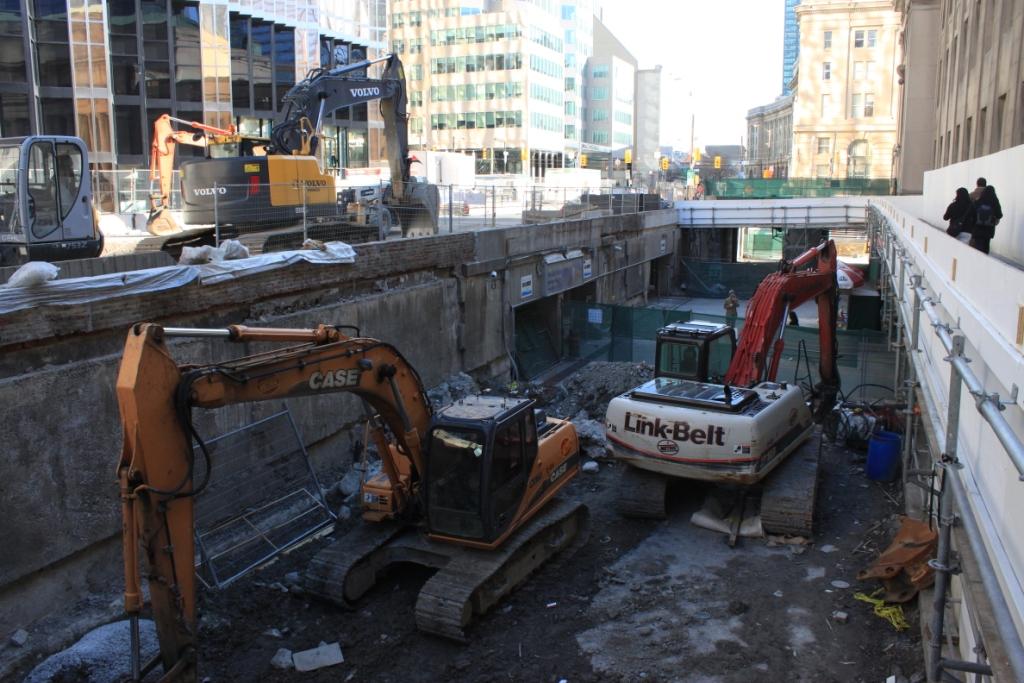
Work at Union Station has progressed to the point where the existing link between the railway and subway stations is affected by construction.

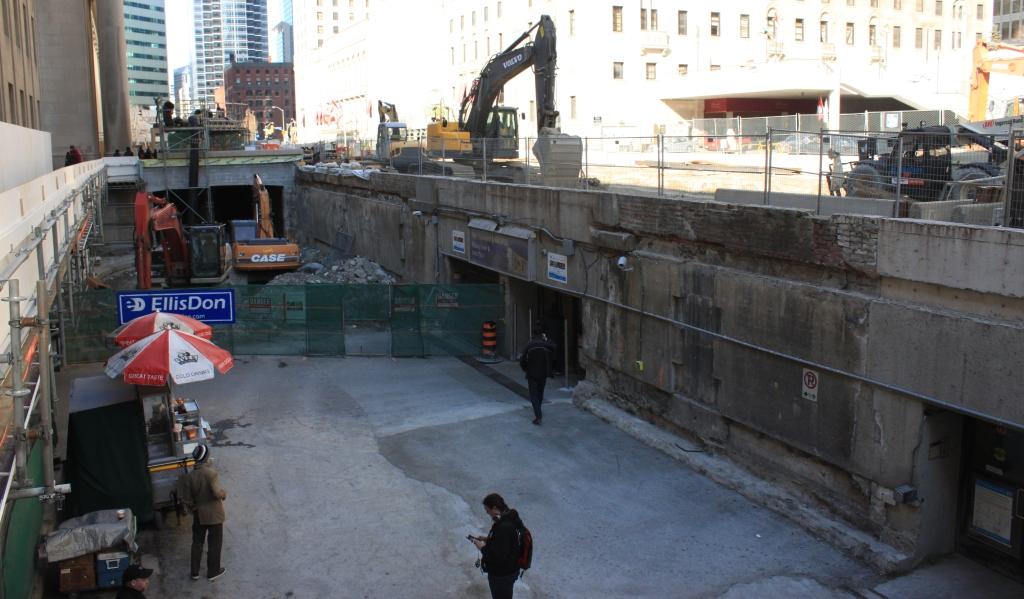
The westernmost door leading onto the moat outside of the GO Bay Street Concourse from the subway has been closed, and space in the subway west mezzanine formerly occupied by rather tired shops has been walled off.  There is a narrow passage from the fare barrier to the westernmost stairway down to the subway platform.  (The escalator to the same space was out of service today, March 11, for repairs, but it should be back in operation for Monday, March 12.)

Of the two stairways leading from the south side of Front Street down to the subway, the western one is now closed.

These arrangements will allow for construction of the western part of the new fare control area under Front Street.

IMG_2797c

The moat looking west.  The hot dog vendor is still doing business surrounded by construction, but the westmost exit from the subway mezzanine is fenced off.

IMG_2798c

The moat looking east.

IMG_2801c

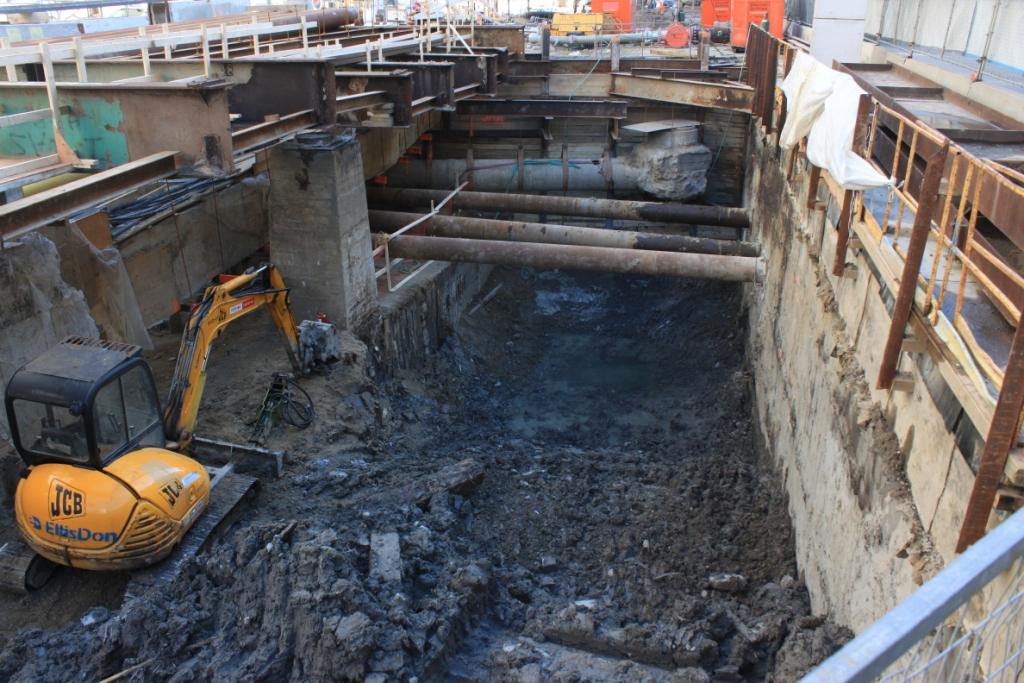
The excavation directly in front of the main doors of Union Railway Station. The large concrete box on the left side of the photo is the subway station, and the deep trench will be the space for the new northbound-to-Yonge platform.

King Station and Crossover

On the weekend of March 23 to 26 starting at midnight on Friday the TTC will close the Yonge subway between Bloor and Union for the first stage of installation of the new crossover at King Station.  Preliminary work is already underway, and there is a slow order through this area.  If past experiences at College and St. Clair are any indication, we can expect two more shutdowns in coming months.

Activation of the three new crossovers will not occur until the signal system replacement project finishes in a few years.  The original crossovers at these locations were never electrified and there is no provision in the existing signal system to manage them.

Also, the power feeds on either side of the crossovers are not set up to allow isolation of the crossover territory as a terminal.  When Bloor crossover was done many years ago, new section gaps were added at the south end of the station and midway north to Rosedale so that power could be maintained on both sides of a crossover even if there were a shutdown further north or south of Bloor.  Changes to the power feeds will be done concurrently with the signal work.

TTC Meeting Review February 29, 2012

The February 29th meeting of the Toronto Transit Commission was one of the shortest in my long memory of these events.  The agenda was trivial with an utter absence of meaty issues for debate, and the real action would follow in press scrums.

Accessible Transit Services Plan: 2011 Status Report

This generally upbeat report was approved without debate.

Notable by its absence is any mention of the operating budget challenges faced thanks to cutbacks in funding by the City of Toronto.  Recently, the Commission diverted $5-million intended to support regular bus service quality into the Wheel Trans budget.  For the long term, Council must address the fact that cutbacks to the Wheel Trans subsidy have much more severe effects, proportionately, than cuts to the regular system.

The TTC may be improving its accessibility, slowly, but basic questions about whether the service is adequate to meet demand receive little public debate.  This is not just a question of Wheel Trans for those who cannot use the conventional system, but of recognition that mobility affects many who are ambulatory, but whose neighbourhoods and destinations may not be well served by surface routes.

What’s In A Name?  Stations on the Spadina Extension in Vaughan

The Commission adopted “Highway 407” and “Vaughan Metropolitan Centre” as the names for the two stations north of Steeles on the Spadina subway extension on a 5-2 vote.

For some time, staff and some Commissioners have pressed for the simpler “Vaughan Centre”, but the City of Vaughan Council prefers the longer (and somewhat more pretentious) name.  Sadly, the opposition to the long version came from Commissioners whose credibility leaves much to be desired, although their comments might in other circumstances be cogent.

Norm Kelly mentioned the “conceit” of former cities within Metropolitan Toronto which created “town centres” such as in Scarborough, Kelly’s home turf.  This is deeply ironic considering that it is the failure of Scarborough Town Centre to attract employment that is part of the argument against the Sheppard Subway extension which Kelly supports.  Frank Di Giorgio worried that everyone will make a case for special consideration on station names.  Di Giorgio, it should be remembered, is the advocate for total obedience to Mayoral fiats by city staff, and if Rob Ford had a position on station names, it would take precedence over everything.

Meanwhile Maria Augimeri had hopes her “Black Creek” would get equal consideration when it comes to formally naming “Steeles West” station.

After the meeting, a group of my colleages agreed that one of my local stations, Chester, should be renamed as “Riverdale Metropolitan Centre”, although I might add the word “Organic” in deference to the neighbourhood.

It is unclear how the TTC will handle placing the long version of “VMC Station” on its maps and other signage.

St. Clair at Keele/Weston

Commissioner Palacio asked for a report on improving traffic conditions at the St. Clair and Keele intersection where, because of the rail underpass just to the east, traffic is constrained to a single lane by the streetcar right-of-way.

Restructuring the Commission

In a scrum after the meeting, Chair Karen Stintz announced that she had reached a compromise for the proposed change in the makeup of the TTC.  A report coming to Council on March 5 (whose origin lies in the machinations of the Ford camp to enhance control of all agencies by the Mayor) recommends a nine-member Commission (as at present) with five citizen members and four Councillors.  The Chair and Vice-Chair would be a Councillor and Citizen member respectively.

The new proposal would see an 11-member Commission with six Councillors.

After the firing of Gary Webster by Ford’s Gang of Five, many Councillors have talked about restructuring the Commission to be more representative of Council as soon as possible, including at the March 5 meeting.  Stintz feels that she has the votes for the compromise arrangement, and that a major shuffle of the Commission would not occur until June when the citizen appointments are confirmed by Council.

The next move is up to Council itself on March 5.

Subways and only Subways

While the TTC was meeting, across on the other side of City Hall Mayor Ford was hosting a bevy of developers for a luncheon discussion of subway funding.  After the TTC meeting completed, there was a scrum outside of the Mayor’s office (with Chair Stintz nowhere in sight) in which the Mayor and his circle claimed that there was broad support in the development industry for subways.  When pressed about funding, Mayor Ford didn’t want to get into the details beyond pointing to the Chong report, but claimed that the development community was totally onside.  Onside maybe, but the developers all slipped out the side door and avoided the media lest they have to go on record supporting or, worse, opposing the Mayor.

Of course developers love subways because they offer an opportunity to squeeze higher densities out of the city than they would get otherwise.  We have been down this path before with the Sheppard Subway.  However, don’t ask the developers to pay for subways, certainly not through development levies that would make their brand new condos uncompetitive with buildings downtown, the really hot part of the condo market.

See Robyn Doolittle and Royson James in the Star (the photo suggests Ford is less than engaged in the event), and Elizabeth Church and Kelly Grant in the Globe.

The strangest part of the whole scheme is that funding the subway depends on new revenue sources many of which Ford is on record as hating, and one (the vehicle registration tax) which he killed early in his term as a swipe at Toronto’s alleged appetite for higher revenues rather than reduced expenses.  Even the normally supportive Toronto Sun cannot believe what their hero is up to.

All of this leads up to a March 15 21 special Council meeting where the “expert panel” convened to look at Sheppard options will report that LRT is the preferred option.  Will Mayor Ford have a credible financing scheme in place, or will this be more smoke and mirrors, more claims that the money is there without any commitment to actually raising the levies needed to build the project?

Sheppard Panel To Recommend LRT, Not Subway

Various media outlets have reported that the Expert Panel struck by Toronto City Council to review options for the Sheppard East line will recommend the original Transit City LRT plan, not a subway extension.

To the amazement of many, Mayor Rob Ford appears to be trying for a compromise, but given his history, that word probably has a different meaning for the Mayor and his circle than for the rest of us.  The essential problem is to decide whether the subway will end somewhere west of Scarborough Town Centre (Don Mills?  Victoria Park?) or if the “compromise” plan would presume getting to STC some day.  If that’s the “compromise”, them building an LRT to meet the subway would come under fire as a waste of money, and we would be back, essentially, to Ford’s all-subway plan for Sheppard.

Meanwhile, TTC Chair Karen Stintz and Councillor Josh Matlow held a packed meeting in North Toronto to explain and advocate for the LRT option endorsed by Council.  Although there is good support for LRT, an uphill battle remains to counter the Ford camp’s pro-subway spin.

City Council will meet in March 15, 2012 to consider the panel’s report which, if the agenda process runs true to form, should be available in advance of the meeting.

The Secret Sheppard Subway Report

On February 15, 2012, the Star’s Royson James wrote about a TTC report prepared in March 2011 for Mayor Rob Ford on the Sheppard Subway.  The article included a photo of the report’s summary.

Royson James graciously provided me with a copy of the document, and it is available here for those who want to see the whole thing.  I suspect that it is only part of an even larger report because this material only covers one big question: why are the assumptions from the Network 2011 study done back in 1986 no longer valid?  There is no discussion of construction costs, project financing, or any comparison of alternative schemes.

2011.03 Transit Technology Summary and Background

2011.03 Transit Technology Table

Note:  These files were prepared by scanning the copy I received, which itself was a previous generation copy including a lot of marginalia.  The text was imported into and formatted as a new Word document with approximately the same layout (and typography) as the original.  This allowed it to be “printed” in PDF format (the files linked above) rather than a much larger set of images of the scanned sheets.

The report contains a few rather intriguing comments that won’t sound new to regular readers of this site, but which raise questions about the planning assumptions underneath decades of work by the TTC, City Planning and other agencies.

Planners and politicians make grand statements about how policies, official plans and zoning will focus development in locations and patterns of their choice.  In practice, this does not actually happen because the best intentions are inevitably diluted by political reality.  Developers build where there is a real market, not where a plan tells them they should build.  Jobs move around in complete ignorance of city, regional and provincial goals.  Do you own some land that doesn’t fit the plan?  Just sit on it until a friendly government comes to power and get a brand new, as-of-right zoning upgrade.

The idea that transit will shape development is demonstrably false because so many parts of the city with subway stations have not, in fact, developed at all.  This may be due to neighbourhood pressure, or to a policy of preserving the “old” parts of the city because that character has a value greater than massive redevelopment.  A neighbourhood may simply not be ready for development, or may have the wrong character.

This is particularly striking for residential development where local amenities and the “feel” of a neighbourhood are more important than with an industrial/commercial/office development.  People may work in office towers surrounded by pedestrian-hostile roads and parking, but they want to go home to something friendlier.

Because the market for commercial real estate and the jobs it brings has shifted to the 905, much of the development in nodes originally intended for employment has been residential.  This completely changes the transit demand pattern.  Instead of many commuters travelling “in” to a few nodes, we have residential areas that spawn outward trips all over the GTAH.  Subway plans presumed the concentrated trip making that nodes full of employees would create, and these have not materialized.

We are now seeing this pattern even in downtown Toronto with the growth of the condo market.  Many residents live and work downtown, but a considerable number are “reverse commutes” out to the 905, trips for which both the local and regional systems are very badly equipped.

The idea of “downtown North York” or “downtown Scarborough” has simply not materialized in the form expected three decades ago.  Actual employment levels at these two centres are about 1/3 (North York) or 1/5 (Scarborough) of the 1986 projections.  This should be a lesson for today’s planners and politicians who think they can forecast and direct future growth patterns with the aid of a few maps and regulations.

The employment growth projected back in 1986 for “Metropolitan Toronto” (now the City of Toronto) was a rise from 1.23-million to 1.9m.  In fact, employment grew only to 1.30m by 2011 with the lion’s share of the jobs going instead to the 905.  With the absence of strong nodes for new jobs, there was little chance of improving the modal split to whatever commercial development did occur.  Combining lower than predicted growth and a failure to achieve the projected transit modal split leaves us with demand projections that are completely meaningless.

Far too often, there is a political imperative to make the future look better than it might be, or at least to do a proper sensitivity analysis, a “what if” scenario for conditions that don’t match what we would like to see.  Any subway financing scheme that depends on future ridership must answer basic questions:  will those riders actually arrive, and will land development occur in a manner that will generate trips the subway will serve?

We have already seen development in the Sheppard corridor, but it is unclear whether this attracts buyers because it is near the 401 and DVP (and thus to a wide set of GTA destinations), or because it is near the subway.  That development is generating many car trips because, for most destinations, auto travel is the only real option.  The market share for transit at the North York and Scarborough centres is barely half what was projected in 1986, and the compound effect of much lower employment means that transit demand to these centres is a trivial fraction of what Network 2011 was intended to serve.

One item caught my eye in the section of “Public’s travel patterns and behaviour”.  Not only were the employment and mode share values used to model demand considerably above what actually happened, assumptions were  made about the way the Sheppard subway would get its passengers.  Regional and local bus services would be gerrymandered to force riders onto the Sheppard line (at least in the model), but riders actually preferred to go to Finch Station where there was a chance of getting a comfortable spot on a train.

Another assumption in the demand model was that the cost of driving would rise substantially both through higher gas prices and the cost of parking.  Neither of these materialized, although based on typical motoring behaviour, without a very  good network of transit alternatives, the pricing of auto trips does not discourage much travel.

This begs a vital question for all regional planning — can we trust the models?  What assumptions went into the model for our new transit  network, and have these been tested against actual patterns of development and of the regional economy?

The projected demands on new transit lines made back in 1986 were substantially higher than today’s expectations:

  • The Sheppard subway was expected to have 15,400 peak riders by 2011, but the actual number on the existing line is 4,500.  The projected peak demand for the full line in 2011 is now 6-10,000.
  • The Eglinton subway was expected to have 17,600 peak riders by 2011, but the LRT projection is now reduced to 5,200 (based on having the central section underground).
  • The Downtown Relief line was projected to have 11,700 peak riders by 2011, and the demand projection today is 12,000.  This is no surprise given that the DRL would serve a demand that actually existed 25 years ago, rather than a notional demand in a regional plan.

In previous articles, I have discussed the matter of the TTC’s Capital Budget and the mounting cost of simply keeping the subway system running.  Nothing lasts forever, and many systems are wearing out.  We are now on the third major generation of vehicles, there are problems everywhere with station finishes and equipment, water penetration and damage is an ongoing headache, and the signal system must be completely replaced.  Contrary to statements by some subway advocates, subways do not last for 100 years without major investments in rehabilitation.

Back in 1986, the TTC had not yet reached the point where the subway had started to wear out.  The oldest line (Yonge from Eglinton to Union) was only 32 years old, and much of its first generation equipment was still functional.  The TTC now knows that the subway system has an ongoing cost of $230m operating (routine maintenance) and $275m capital (major systems replacement) every year.  Looked at another way, simply maintaining the subway system consumes about 1/6 of the annual operating budget, and a substantial slice of the non-expansion related capital budget.

There is a large backlog of needed capital repairs with a shortfall of $2.3-billion in the 10-year capital budget thanks to provincial cutbacks in capital funding.  Building more subway lines will only add to this set of maintenance costs a few decades in the future.

Finally, we have a bit of creative history writing.  Why, the TTC asks, was LRT not embraced as an option back in 1986?  They claim that at the time it was a poorly understood mode with only limited use, particularly in North America.  What we now think of as “modern” LRT had not yet evolved.  This statement ignores the LRT renaissance in Europe and suggests that despite new LRT systems in North America (notably Edmonton’s and Calgary’s), it was too soon for the TTC to embrace the mode.

I will not dwell on the fact that the Scarborough ICTS system was brand new, and the idea that an “intermediate capacity” system between buses and subways already might exist was simply not in accord with provincial policy.

In fact, the TTC’s love for LRT is a very recent phenomenon.  When the Ridership Growth Strategy was first proposed in 2003 for “short term” service improvements, TTC subway planners were terrified that their pet projects had fallen off of the map.  The RGS was hastily amended to include a commitment to the Spadina and Sheppard extensions, and this move has been cited ever since as “proof” that the TTC supports the Sheppard line.  It would be another four years before the Transit City scheme was launched.

LRT was well-established around the world before the Transit City plan was announced, but it took a major rethink of Toronto’s transit network at the political level, combined with the economic constraints against subway building, for LRT to get the consideration it deserved.  Transit City was not perfect, but it got Toronto thinking about what might be built.

This report is a year old, and its existence shows that the pro-subway forces in Toronto, notably in the Mayor’s office, did not want an informed, public discussion of subway plans to occur.  Observations about the changing growth patterns in Toronto raise important questions about the future role of transit, indeed of the ability of transit to serve the region as we have actually built it.  Far too much effort is concentrated on the subway-vs-LRT battle in a few corridors when the real challenge lies “out there” in the growing and very car-oriented 905.

Metrolinx and the Toronto Council LRT Decision

At its February 16, 2012 meeting, the Metrolinx Board received a presentation and report on the status of projects in Toronto arising out of the Council action taken on February 8.  The report does not add much to information already reported, but it consolidates various documents in one convenient location.

The map of the 5-in-10 plan (the version of Transit City agreed to by Toronto Council in 2009 and disavowed by Mayor Ford) appears in both documents.  This map includes:

  • The Eglinton line from Jane to Kennedy with an underground section from Keele station to Laird station.  In the press scrum following the meeting, I asked about the possibility of redesign of the section through Mount Dennis (Weston Road) and near Don Mills and the DVP.  Metrolinx confirmed that details of these areas are still being worked out.  (See below)
  • The SRT rebuilt as LRT from Kennedy Station to Sheppard.
  • The Sheppard LRT from Don Mills Station to Morningside including a new carhouse at Conlins Road.
  • The Finch West LRT from Finch West Station to Humber College.

A note I received from Rick Ciccarelli (long active in transit affairs in Weston) gave further information from a public meeting on February 15 in Weston:

In speaking with Jack Collins [Metrolinx Vice-President, Rapid Transit Implementation] last night at Councillor di Giorgio’s Kodak Town Hall, he said underground [is] still in play and indicated the loading and unloading of trains at the start and end of service will be a problem for at-grade, and he also expects an interconnecting GO/TTC station to work better. He is not sure if it will go underground past this station. They are also looking at a bridge across Black Creek Drive to service the yards, plus bus connections for both TTC and regional service. The Kodak building could become a bus terminal. He said there are multiple issues to sort through before the design can be finalized including whether they are designing for 3 car LRT or full subway vehicles, and the relationship with the GO rail corridor track expansion project and the new station.

Collins confirmed at the Metrolinx meeting that the purchase of the Kodak site was concluded at about the beginning of February.  The remark about possibly designing the carhouse for full subway vehicles dates, I suspect, from a period when the actual technology to be used for the line had not been settled by Council.  Changing to full subway requires far more extensive design modifications than simply at the carhouse.

During the Board’s discussion, the question arose of interference in Council’s decision by the Ford brothers and their “Save Our Subways” scheme.  CEO and President Bruce McCuaig replied that Queen’s Park has indicated that they will listen to Council.  Chair Rob Prichard said that Metrolinx’ job was to be respectful of the Council process, and that it was not for Metrolinx to take sides with individual Councillors, but to wait for Council’s decision-making process to complete.

Director Lee Parsons asked what risk there might be that the Council debate will not be resolved by the end of March.  McCuaig replied that Metrolinx needs “certainty and clarity” from Council.  Prichard said that the “end game” is an agreement with the City, a binding agreement, and that McCuaig and his staff would move forward to a full master agreement as quickly as possible.  In the press scrum, Prichard hopes that Council will take a position endorsing a new master agreement, and referred to comments by individual members as “noise on the side”.

Director Douglas Turnbull worried that the longer the LRT versus subway debate continues — a false one he believed because LRT is the only reasonable option — that a window of opportunity for transit expansion may be lost.

Director Peter Smith noted that both Metrolinx and Infrastructure Ontario are strong supporters of arrangements where the entire provision of a line would be outsourced.  Bruce McCuaig replied that the province is committed to AFP (alternative financing and procurement) models, but various types of “package” may be appropriate.  Smith wondered whether the TTC was in any position to dictate an alternative arrangement for a facility that was not their own, and thought that the public did not understand the situation well (blaming the media for this state of affairs).

On the status of penalties for cancelled projects, Rob Prichard stated that Metrolinx would provide the City’s “expert panel” reviewing options for Sheppard with information about these and the effect of various possible options on which sunk costs could be reinstated as part of active projects.  Jack Collins said that Metrolinx has now broken down the costs per project and that the amount of sunk (unrecoverable) costs will go down as original route designs come back into the plan.  There will be some loss from the work done on tunnel design for the eastern section of Eglinton, although to whose cost this might be is an interesting point considering that Council never requested the change.

The vehicle delivery schedule must be revisited now that Finch and possibly Sheppard are  back in the mix.  Delivery dates can now move back to something close to the original contract based on the 5-in-10 plan.

Director Joe Halstead asked what differences there were between the Council motion of February 8 and the Transit City 5-in-10 plan.  Collins replied that the big issue is the status of Sheppard East although this also would have an effect on the SRT/LRT project.  If there is no Sheppard LRT and carhouse, then extension of the SRT beyond McCowan Station is unlikely.  Rob Prichard noted that the sequencing of projects may be changed depending on what is planned for Sheppard to accommodate constraints on the cash flow acceptable to Queen’s Park.

During the press scrum, the Star’s Tess Kalinowski asked at what point is Council’s position considered to have “coalesced”.  Bruce McCuaig replied that there are two points:

  • What position will Council take after the report of the Expert Panel on Sheppard?
  • How much power will they delegate to staff to negotiate the Master Agreement with Metrolinx, and will the agreement have to come back to Council for ratification?

McCuaig noted that a lot of work on the language of an agreement already existed from previous work on the 5-in-10 plan.

I asked about press reports that the Presto implementation in Toronto might be held hostage now that the Ford MoU which purported to commit Toronto to Presto was of no force.  Bruce McCuaig replied that work on Presto is still moving forward, and that implementation of the fare card is linked to other funding agreements including the streetcar purchase and the provincial gas tax share.  Metrolinx expects that an agreement for Presto implementation will go to the TTC Commission at its March 2012 meeting.

[I will report on other issues from the Metrolinx meeting as an update to my “preview” article.]

The LRT Vote: A Long Day at Council (I)

Wednesday, February 8, 2012 brought the debate on the future of LRT in Toronto to the floor of Council for a Special Meeting.  After a year waiting for Mayor Ford to get his act together on the transit file, to bring his Memorandum of Understanding (MoU) with Queen’s Park to Council for debate, to bring a credible plan for financing the Sheppard Subway extensions into public view, Council had enough.

TTC Chair Karen Stintz, the last person the progressive wing of Council would have expected, filed a petition with the City Clerk on February 6 for the meeting with the support of 23 of her colleagues.  Two days later, Council would be in open revolt against the Mayor.  The public gallery filled quickly, with overflow viewing by video in the rotunda of City Hall, and the Press Gallery had more reporters and camera crews than I have seen at Council in years.  They stayed all day — this was not a story to cover in an hour or so.

Stepping back from the political drama, this was an astounding day for me as a lifelong advocate for Light Rail Transit.  Here was Toronto Council spending an entire day debating transit planning, technology and funding with a level of detailed knowledge of the issues advocates could only have dreamed of years ago.  At stake was not just $8.4-billion of provincial money, but the future direction of transit development.

The results are reported elsewhere.  This article presents the flavour of the questions and speeches that filled the day together with a strong sense that LRT, forty years after the Streetcars for Toronto Committee’s victory, will finally have a fair chance in Toronto.  I have included details of the questions asked by most Councillors in the interest of showing the range of the debate and the growing understanding, or lack of it, by various members of the details of the issues.

Mayor Ford is not known as a gracious loser, and long before the votes were actually counted, it was clear which way the issue would turn.  The lowest point of the day came just after lunch when the Mayor’s team attempted to sabotage the meeting by breaking quorum.  Council cannot meet without a majority of members present (23), and the Mayor’s folks actually seemed to think that by staying away, they could halt the meeting.

This shows the desperation of the anti-LRT side, and puts Ford’s later comment that Council’s vote was “irrelevant” in a different light.  So relevant was that vote that he attempted to ensure it never took place.  He failed.

Continue reading