When I first wrote about this project and its effects, Metrolinx advised that they would not be releasing information about the site selection until late 2022, roughly the same point where a contract for construction would be awarded and long after any design changes would be possible.
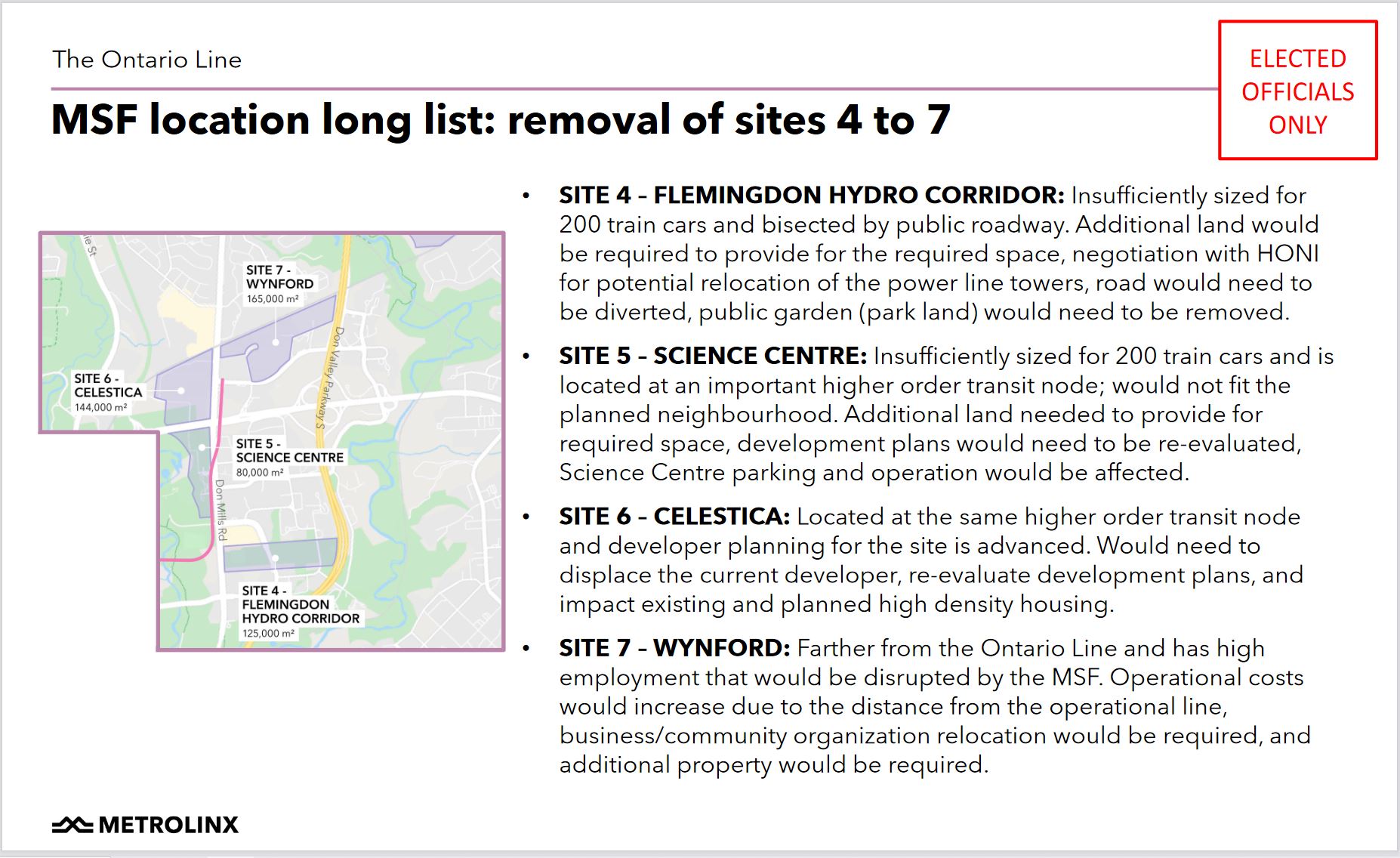
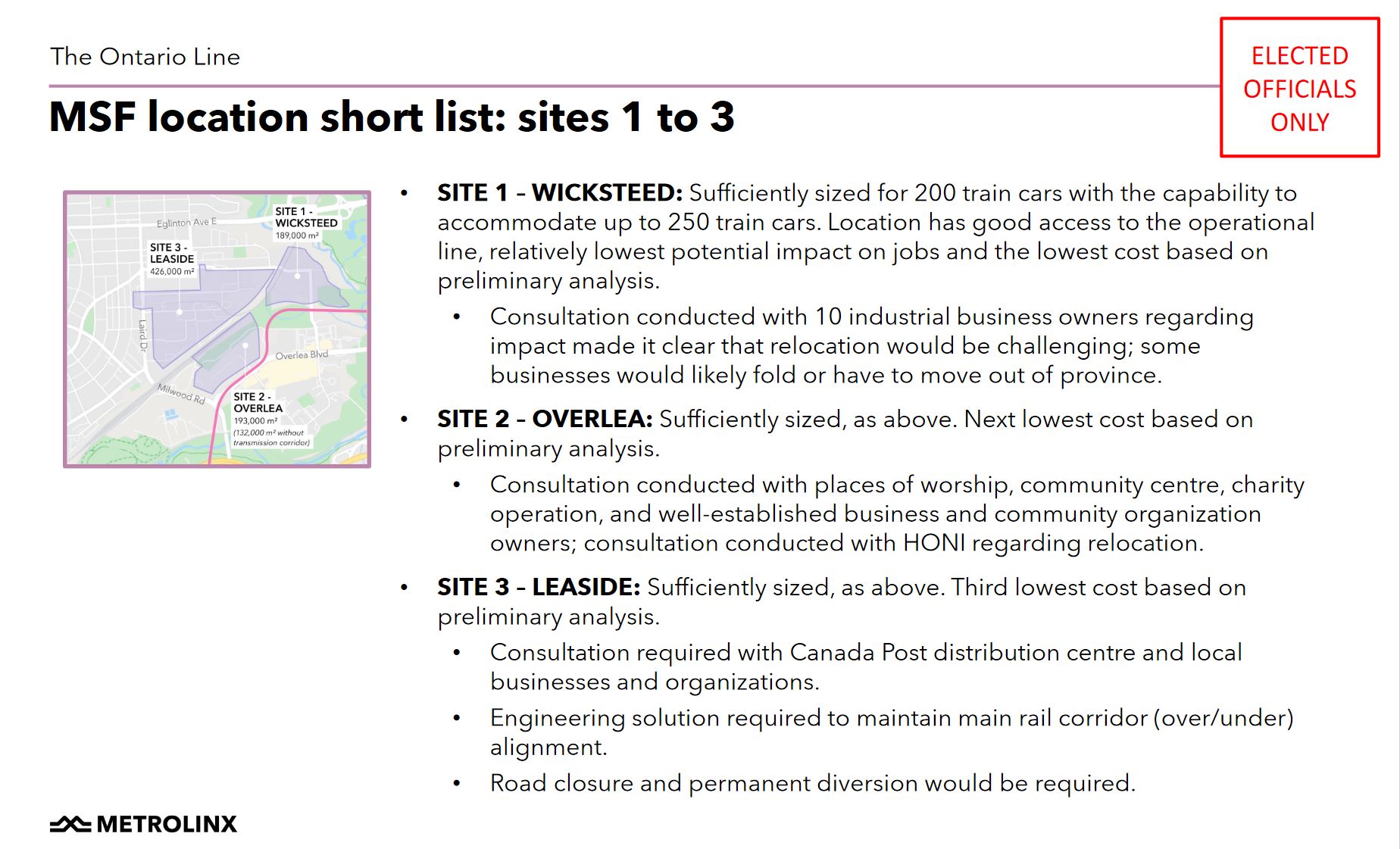
This position changed quite recently, and the presentation deck for a public meeting on April 15 includes maps of the proposed sites. The original version included the legend “Elected Officials Only” is part of these illustrations and shows how this deck was closely held until quite recently. A revised version posted during the meeting has some differences in the deck.
Although sites downtown and west to the Exhibition were considered, none of them was large enough to accommodate the MSF and yard.
A common thread through this process is that all of the facilities will be at one location as opposed to building storage at various points along the route. That approach would take advantage of train automation to allow remote dispatching of trains to and from service, but it has not been included in the design.
Most of the sites are clustered around the Ontario Line corridor with a few exceptions well away from the line. These are described in the maps below.
The slides describing the removal of various sites from consideration were in the originally posted version of the deck, but they do not appear in the version now online and shown at the meeting.
Four sites in various parts of Flemingdon Park were rejected either because they are too small, they are too far from the main line, or because major development is already planned on the site.
In the original Relief Line Subway plan, trains would have been stored and serviced at Greenwood Yard. This yard is too small for the projected Ontario Line fleet, an intriguing claim considering the relative demand and capacity on Line 2 (now served mainly from Greenwood) and the future Ontario Line.
This leaves three sites on either side of the CP rail corridor through Leaside. Each of these sites has its challenges.
Metrolinx settled on using parts of site 1 (the southern part of the Wicksteed block), and site 2 (the northern part of the Overlea block).
In the previous article comments thread, a reader suggested placing the storage yard in Site 3 (the northeastern portion of the Leaside block). This requires an underpass at the CPR. It is not clear whether Metrolinx considered a hybrid Site 1-3 scheme that would not require the entire Leaside block, only enough room for the storage yard now planned for the northern portion of Site 2.
In the public meeting, Metrolinx stressed that they would be talking to affected businesses about support for relocation. The surprise expressed at this plan by members of the community suggests that consultation is comparatively recent although planning has been underway for some time.
The affected properties are shown in the map below.
The Islamic Society of Toronto plans to the move the Masjid Darussalam mosque from 4 Thorncliffe Park Drive to 20 Overlea Boulevard according to Metrolinx.
Metrolinx said that they are “keenly aware” of impacts to businesses and importance of Iqbal Foods (located in 2 Thorncliffe Park Drive) in the community. They are dedicated to work with all of the business owners to relocate “within the neighbourhood”. How much financial help will be involved remains to be seen. CEO Phil Verster said that it is “100% our intent” that these businesses are not lost to the local community.
Metrolinx received many complaints about timing of their announcement and holding the meeting during Ramadan in an area with a large Muslim population. They plan to hold more consultations after the holy month concludes in mid-May.
The overall project timeline for the North Section of the Ontario Line is summarized in the chart below.
The map of the northern segment of the Ontario Line published by Metrolinx in their October 2020 blog article has been added for reference. Scroll down to the end of the article.
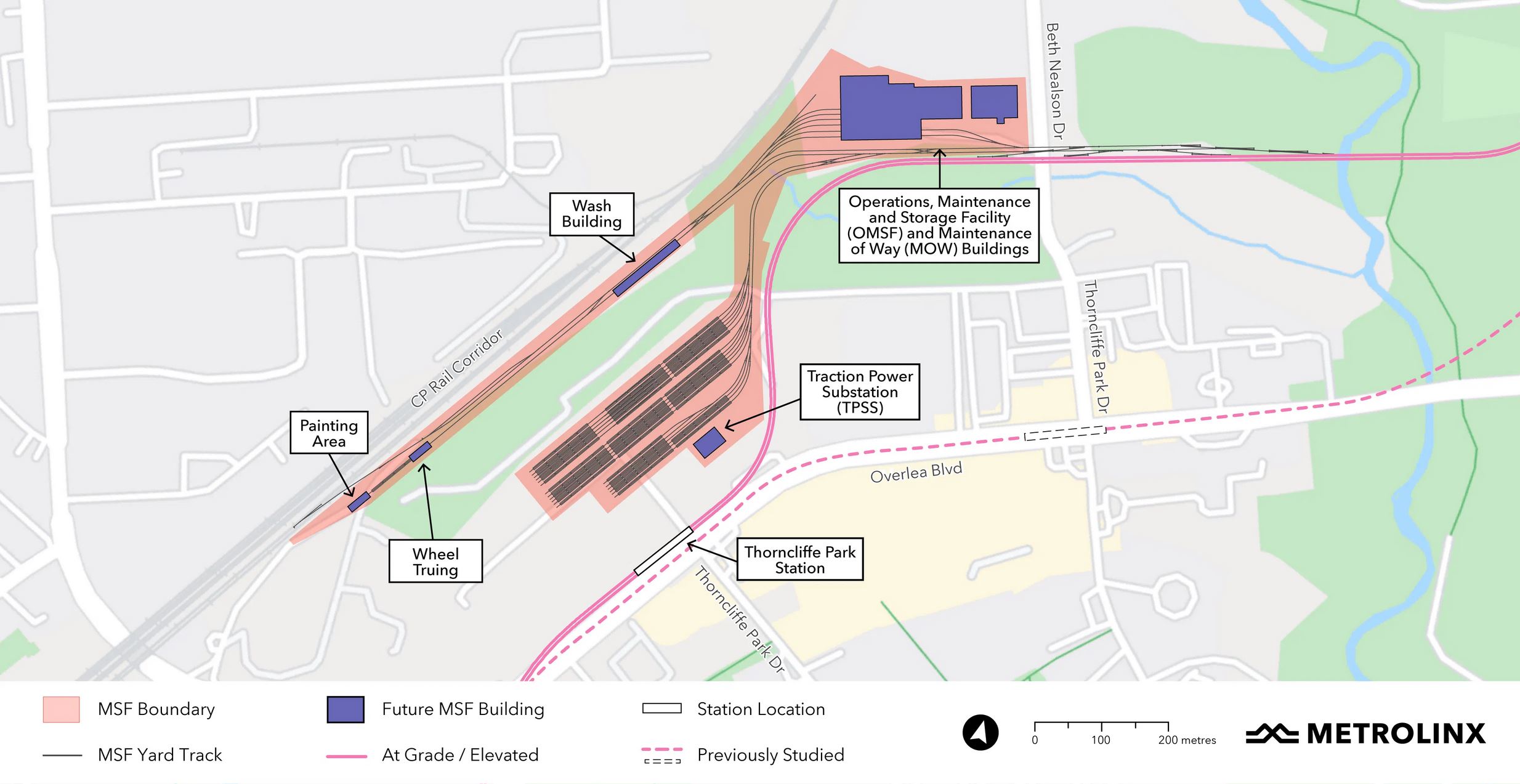
Metrolinx has unveiled a plan for the Ontario Line’s Maintenance and Storage Facility north of Thorncliffe Park. Because of the local terrain, green space and the Hydro corridor (not shown on the map below), this is split into three distinct sections:
The main buildings are west of Beth Nealson Drive north of the Don River.
Some servicing areas are in a long spur parallel to the CPR corridor. This will also be the location of a delivery track where vehicles will arrive from the manufacturer.
The storage yard will be in an area now occupied by various shops and offices as well as a mosque.
Here is a satellite view from Google Maps rotated to match the orientation of the map above.
Source: Google Maps
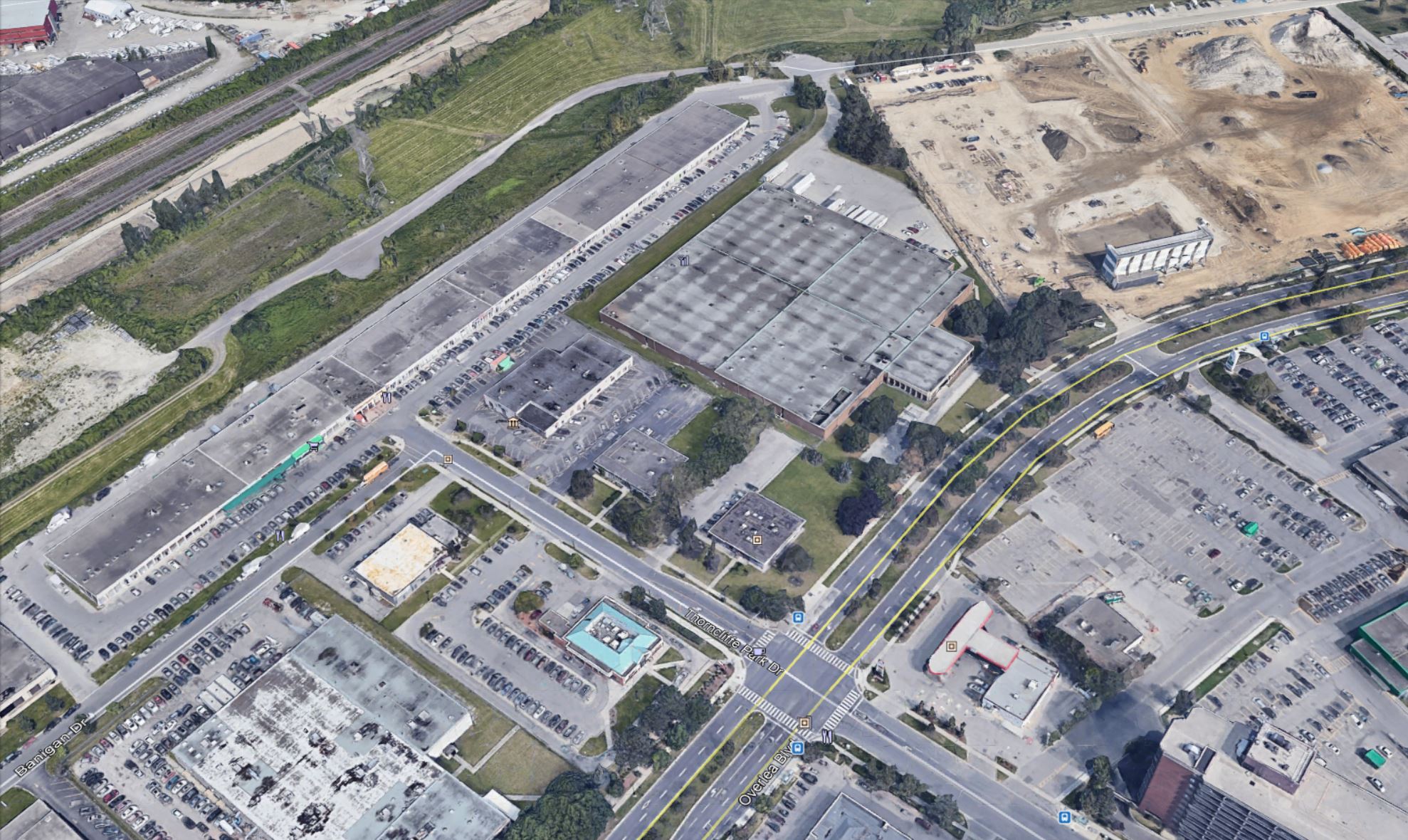
The area to be occupied by the yard at the north end of Thorncliffe Park Drive West is shown below. This was taken before the Costco building went up on the vacant land in the upper right of the photo. The Ontario line will run north from Overlea Boulevard along the west edge of this property.
The area for the main buildings on Beth Nealson Drive is shown below as it currently exists.
Source: Google Earth
According to the Metrolinx Blog article on this plan, the site was chosen from a list of nine. Metrolinx has not published the other locations that were considered.
The work we did to identify the best site for the MSF and yard will be pulled together as part of the Environmental Impact Assessment Report that will be available in 2022.
We can let you know we looked at land near the western terminus at Exhibition all the way to the east and to the northern end of the alignment. A list of nine sites were brought forward for more detailed analysis, some of which were ruled out because they weren’t big enough or they affected too many businesses and jobs.
The site in the southeast portion of the Leaside Business Park was selected because our studies showed that it keeps impacts to the local community to a minimum while meeting all of the needs for the project:
• it is already zoned for industrial use;
• it is close to the main line, making it quick and easy for trains to go in and out of service;
• it is large enough to meet future needs;
• it minimizes community impacts;
• has less individual job impacts.
Email from Metrolinx Media Relations, April 9, 2021
While the northern portion that will house the main buildings might only displace a self-storage farm, the southern portion where the yard will be located sits on top of buildings that are an integral part of the Thorncliffe Park community. What the reaction will be might be gauged at an online meeting to be held on April 15, 2021 at 6:30 pm.
Updated April 12, 2021 at 9:30 pm:
When Metrolinx announced their revised route through Thorncliffe Park in October 2020, they touted the fact that this would avoid disruption of buildings such as the Macedonian Orthodox Cathedral. The map of the revised route is below.
Note the area labelled “MSF Study Area”. This is the location, in the updated plan, for the Operation and Maintenance building. The area at the north end of Thorncliffe Park Drive West is not touched by the line and there would be no reason for anyone to raise flags about the businesses and institutions already there.
The yard which is now part of the complex is completely new, and there was no advance indication that this would be part of the design.
On a related note, one of the comments below from Simon Hirst suggests that an alternate location might be the land on the other side of the CPR corridor now occupied by a gravel and cement company. This is visible as a white patch directly above the “MSF Study Area” in the Metrolinx map above (where “north” is to the right, and “west” is up), and in the view below which is a closer view of the same area in the usual geographic orientation.
Source: Google Maps
If that area were to be used, a connection tunnel would have to go under the CPR to link with the Ontario Line whose main shops and offices would be where the brown-roofed buildings labelled “Toronto Moving and Storage” are in the upper right of the photo.
Because Metrolinx has not published its list of alternative sites, we do not know whether this option was considered but rejected for some reason.
Metrolinx does not plan to publish its alternative site analysis until Fall 2022 with the Environmental Project Report, but they also intend to let the contract the includes construction of the MSF and yard at roughly the same time precluding major changes in design.
Infrastructure Ontario issues quarterly updates about the projects it is managing for P3 procurement, and I have been tracking the transportation items on this site. Their April 2021 Market Update came out on April 8, but I have been waiting for clarification of some issues before posting here.
Here is a spreadsheet tracking changes in project status since these updates began.
Items highlighted in yellow have changed since the last update.
Note that this report only covers the procurement portions of Metrolinx projects that are undertaken through Infrastructure Ontario. Contracts that are in construction, or are directly tendered and managed through Metrolinx outside of the P3 model, do not appear here.
Ontario Line, Line 1 North Extension (Richmond Hill Subway), Line 4 Sheppard East Subway
There are no changes to these projects in this update.
Line 2 East Extension (Scarborough Subway)
As previously announced, the tunneling contract gets underway this spring. The contract for the remainder of the project (stations etc.) enters the Request for Qualifications (RFQ) stage this spring/summer, but contract execution is not expected until spring 2023.
Note that vehicles for the extension will be procured as part of a TTC order for fleet expansion and renewal that does not show up in the IO updates.
Line 5 Eglinton West Extension
As previously announced, the tunneling contract gets underway this spring. There is no date yet for the remainder of the project to enter the RFQ stage.
GO Expansion Projects
Metrolinx came up with a new term for procurement, the “alliance” model where more responsibility for the project is shifted back onto Metrolinx as owner rather than expecting bidders to take on a substantial project risk. This showed up in the Union Station platform expansion project early in 2020.
In this round of updates, things appear to have gone a step further. Three projects (Lake Shore East and West Corridors, and the Milton Corridor) are reduced in dollar value. I asked Infrastructure Ontario about this, and they replied:
Since the previous Market Update (Dec 2020), there have been some changes in scope of work for these projects. Items which have been descoped may be carried out by Metrolinx in the future under separate, traditionally-procured contracts. The intent is to better manage risks and costs with respect to the GO Expansion program.
As these projects remain in procurement, we will provide further updates this spring/summer.
Email from Ian McConachie, IO Media Relations, April 9, 2021
Specific changes by corridor:
Corridor
Change (per Infrastructure Ontario)
Previous Cost
Updated Cost
Lakeshore West
Descoping of Exhibition Station in-corridor enhancement works and track improvements, Clarkson Station and Bronte Station in-corridor enhancement works.
$500M-$1B
$200-500M
Lakeshore East-Central
Descoping of Scarboro Golf Club Works and 2.5km of grading (previously part of LSE-E) and deferral of Highland Creek Expansion
$200-499M
$100-200M
Milton
Descoping of Station Operations West Facility and replacing the pedestrian tunnel with a pedestrian bridge.
$100-199M
< $100M
The project formerly called “Milton Corridor” is now called “Milton Station”.
A separate project line, Lakeshore East-West Corridor, dropped off of the IO Update in mid-2020. The project was transferred to Metrolinx for delivery as a non-P3 contract.
The comment about “better manage risks and costs” is telling here, and it implies that the P3 model has not worked out as favourably as hoped for all of Metrolinx’ work. In some cases it is simpler and cheaper to just go out and buy/build something yourself than to set up elaborate machinery for others to do this for you.
Notably the $10B GO “ON-Corr” project which entails a complete restructuring of GO including future operation, maintenance and electrification has not changed status in a year. With GO’s ridership uncertain in the near term, projecting just what Metrolinx might ask a P3 to undertake, let alone contracting for it, is like peering into a very cloudy crystal ball.
This article is a follow-up to Ontario Line Design Changes Again including material from a new Metrolinx blog post.
As previously reported, Metrolinx has changed the track configuration between Corktown and Gerrard Stations on the Ontario Line so that both OL tracks are on the same side (north/west) of the rail corridor rather than straddling the four-track GO corridor.
When the Ontario Line was announced with much fanfare, a great deal was made by Metrolinx of the across-the-platform transfer connections possible at both Exhibition and East Harbour Stations with the GO Lakeshore corridor. The explicit benefit was to offload of GO/TTC transfer traffic from Union Station.
This design fell off the table (quietly) last year at Exhibition Station, but until quite recently, it was still advanced as the rationale for the OL’s configuration in this segment.
Now it too has disappeared and both OL tracks will be on the same side of the corridor. This actually makes life easier for Metrolinx designers including:
only one shared centre platform rather than two would be needed at stations, and only one set of vertical accesses (stairs, escalators, elevators);
electrification of GO will be relatively isolated from that for the OL which will run on a different voltage and probably a different height of overhead above the rails;
only one bridge rather than two will be required to carry the OL across the Don River;
only one tunnel portal will be required at Gerrard rather than two;
no tunnels under the rail corridor will be required to shift the eastbound OL first to the south side at East Harbour and then back to the north side at Gerrard;
there is room at East Harbour for platforms for all four GO tracks, not just the two outer ones, permitting this to be an express and local station as befits its location at a major development node.
Considering that Metrolinx is all about building projects more efficiently, one has to wonder why they didn’t pursue this configuration from the outset unless that cross-platform transfer was a holy grail untouchable until now.
The change is promoted as the result of listening to the community where more than a little opposition to the OL came from its intrusiveness and potential effect on buildings and open spaces. Until quite recently, Metrolinx defended their original design against all criticism.
Their tune has changed:
Re-positioning Ontario Line tracks at East Harbour means all Lakeshore East and Stouffville GO train services can stop at the station – something that wasn’t possible with the previous design. With a shared concourse providing easy access to all of the rail services that will serve East Harbour, more customers will be able to transfer between more trains, and travel to more places.
Customers who will be boarding the stations at Queen and De Grassi and at Gerrard and Carlaw will also see more benefits because, no matter what entrance they use, they’ll arrive at a centre platform that serves trains in both directions. They won’t have to worry about getting to platform level just to realize their train is on the other side of the rail corridor, accessed through a different station building. This will create a simpler, more accessible experience for everyone who uses the station.
[…]
But the improvements to the track positioning means teams can cut down on the amount of station buildings needed as well, which means even fewer impacts to the parks that have been developed around the active rail corridor over the years.
The line now occupies slightly less space than before, although the diagrams above are not engineering drawings showing the exact scope of work before and after the redesign.
Metrolinx is still silent on the need for or absence of crash walls between the GO rails, the Ontario Line and nearby buildings. These would add to the total width of the corridor.
Metrolinx would do well to show more detail for their new plan all the way from the Don River to the portal(s) at Gerrard.
Another round of community consultation is planned in coming weeks.
This post is a departure from my usual reportage and takes us into the realm of “what would you do” advocacy.
The ongoing debate about Metrolinx’ proposed above ground route for the Ontario Line between East Harbour and Gerrard Stations turns on two issues:
The effect of a six-track wide shared GO+OL corridor on the neighbourhoods through which it will pass.
Whether the Ontario Line could be tunnelled.
The debate was recently clouded by a proposed shift in the OL’s alignment. Originally, the line would straddle the GO corridor in order to provide “across the platform” transfers with the outer two GO tracks at East Harbour. Metrolinx is now contemplating shifting both OL tracks to the north/west side of the corridor. This has several advantages as I discussed in a recent article, but it leaves the OL above ground.
The original configuration is shown below in a map from Metrolinx’ site. Note that North is at the right.
Putting the line underground on this alignment is very difficult because of constraints on the grade change between East Harbour and the (misnamed) Leslieville Station. Any descent is constrained by the cross-streets let alone the vertical difference between an East Harbour Station on the rail embankment and a Leslieville Station at Queen.
A neighbourhood group (The Lakeshore East Community Advisory Committee, aka LSE CAC) posed the question to me: is there a way to put the line underground? On the Metrolinx alignment, the simple answer is “no”, but that brings us to the question: why that alignment?
The original Relief Line would have crossed under the Don River on the line of Eastern Avenue with a station at Broadview as shown in the diagram below. The link with GO at East Harbour would not be as simple or direct as in the Metrolinx proposals where the OL and GO tracks and platforms are adjacent.
Metrolinx seeks to offload GO traffic from Union Station and sees transfers to the OL at East Harbour and Exhibition as a solution. However, changes to the planned layout at both stations have stripped the simple across-the-platform transfer for peak directions from their designs.
At Exhibition, only the westbound service would connect with the south side of the terminal station platform. Inbound (eastbound) GO riders would have to access the OL via an underpass. At East Harbour, if the alignment shifts to the north side of the station, the westbound GO track would be adjacent to the eastbound OL track, and there would be no direct link to the eastbound GO platform.
Metrolinx now describes the connections as more convenient rather than direct, but the attraction of a simple transfer to shift traffic has disappeared.
An alternative scheme, which I developed before Metrolinx plan to shift the OL to the west/north side of the rail corridor, uses the proposed eastbound tunnel under the rail corridor as its starting point. Instead of carrying just the eastbound track, it would house both directions, and they would cross the Don River on a dual track bridge south of GO’s trackage where a single eastbound bridge was proposed by Metrolinx.
A shared platform at East Harbour would be oriented to be as far west as possible and only one OL train length (not the full size of a GO platform). The east end of the platform (and hence the point where a descent underground could begin) is dictated by the proposed Broadview extension which would pass under East Harbour Station.
From that point, the line would turn east and descend through what is now largely vacant land and a laneway behind a heritage buildings on Eastern Avenue.
East of Booth Avenue, the line would swing north and join the original Relief Line alignment east of Logan.
The illustration below was prepared by the LSE CAC based on my proposal.
Courtesy of “Save Jimmy Simpson” / Paul Young
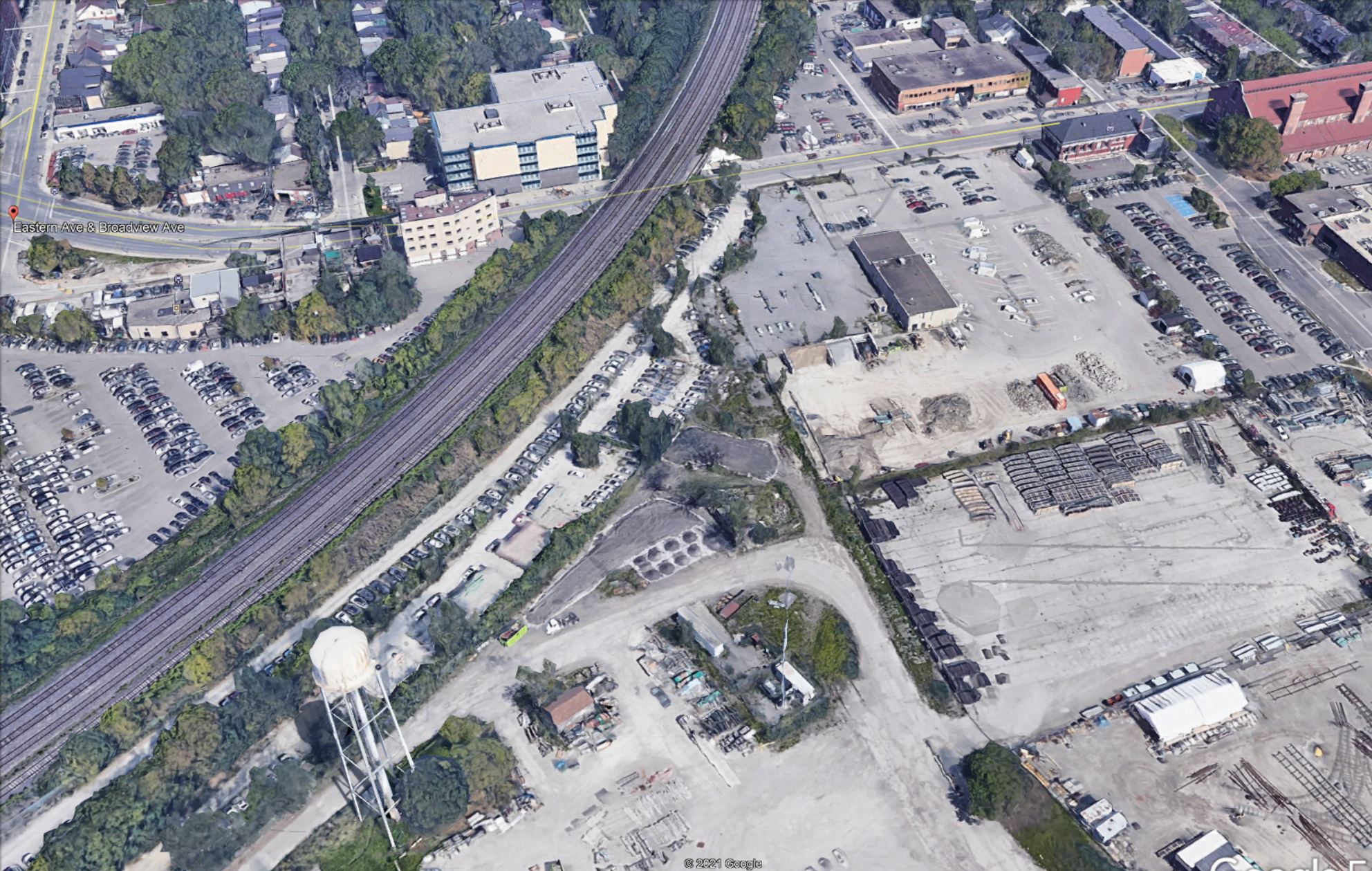
Here is the west end of this area. For reference, the Broadview Extension will cross just west (left) of the water tower (which is to be retained as a landmark in the new development here).
Source: Google Earth
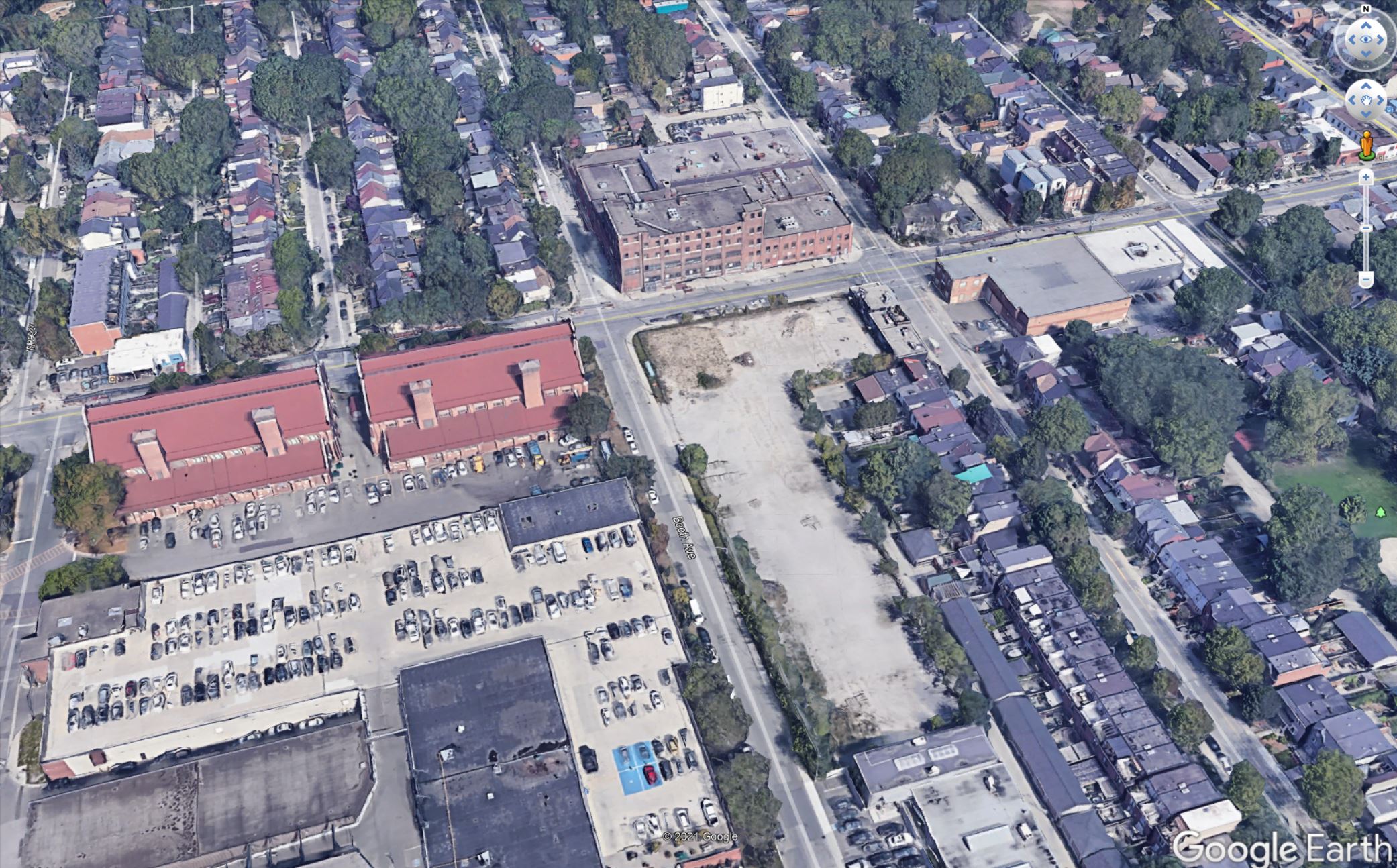
Here is the east end of the area. Note that the vacant lot on the south-east corner at Booth and Eastern in this photo is now occupied by a self-storage building that would have to be removed.
Source: Google Earth
I have no illusions that this would be an easy alignment, but it has advantages over attempting to fit the Metrolinx route under ground:
The transition from above grade to underground would occur in largely vacant land and before the line must cross a major street (Eastern), preferably west of Booth so that this street would remain open.
The Leslieville Station is far enough from East Harbour that it does not constrain the vertical alignment in the same manner as the station would at Queen & Degrassi.
Potential issues include:
The City has plans for this land in the East Harbour development and they would have to be revised to accommodate the ramp and portal structure for the Ontario Line.
The OL structure would be close to the surface continuing its descent to Carlaw. This could affect utilities where the alignment crosses Booth, Eastern and Logan, as well as some properties along the curve between Eastern and Carlaw.
It is self-evident that an underground route from East Harbour to Gerrard will be more expensive than the Metrolinx proposal along the rail corridor.
Very bluntly, I could be more sympathetic to this issue if Metrolinx were not already pursuing underground options in Scarborough and on Eglinton West at great expense for blatantly political reasons.
Updated March 27, 2021: The reference to third rail power pickup for the Ontario Line was incorrect and has been changed. According to the December 2020 Preliminary Design Business Case the line will use 1500V DC overhead power supply.
As originally announced, the Ontario Line was intended to run along the GO Lake Shore East corridor between the Don River and Gerrard Street with the new rapid transit tracks straddling the GO transit line as shown in the map below.
Discussions with the Riverside and Leslieville neighbourhood have been fraught with concerns about the combined effect of the two new Ontario Line tracks, the stations, the expanded four-track GO corridor and the infrastructure needed for electrification. This has been the subject of previous articles and I will not rehash the issues here.
At a community meeting on March 25, 2021, an unexpected piece of news was revealed not by Metrolinx staff, but by City Councillor Paula Fletcher: Metrolinx has changed the design so that the Ontario Line tracks will run on the west side of the GO corridor.
I asked Metrolinx for their comment, and here is their reply:
As part of our planning, we have been exploring alternatives that will allow us to incorporate some of the feedback from the community. The updated plans are not yet final so it is too early to provide details or images.
One thing we are looking at is shifting both Ontario Line tracks to the west side in the corridor, rather than on either side of the GO tracks.
Once finalized, we will be sharing the updated plans related to the configuration with the community in the coming weeks at a public consultation.
We are still conducting environmental assessments for the area, which include a Joint Corridor Early Works Report and an Environmental Impact Assessment Report for the whole line.
Email from Metrolinx Media Relations, March 26, 2021
This has many implications including the total space needed for the six-track corridor, the placement of electrification infrastructure, the effect of stations on their neighbourhoods, and transfer provisions at the key East Harbour Station.
From a construction point of view there are benefits to keeping the OL tracks together:
There is no longer any need to tunnel under the rail corridor so that the eastbound track can reach its position south-east of East Harbour Station, nor to tunnel again for the tracks to rejoin at Gerrard before heading up Pape.
Only a single shared bridge over the Don River will be needed.
The two directions of the OL can share a centre platform rather than requiring dedicated platforms, including access elements like escalators and elevators.
Structures for GO can be better separated from those for the OL which will now lie beside the GO tracks, not astride them.
Construction of the OL should have less effect on the adjacent GO operations.
The possible downsides or side-effects include:
The consolidated eastbound and westbound platforms and station structures are now all on one side of the GO corridor possibly affecting areas and buildings that were previously outside of the construction area.
The minimum clearances for GO electrification will have a greater effect on the east side of the corridor because the eastbound OL track will no longer provide some of the separation needed from nearby buildings and vegetation.
The claimed benefit of across-the-platform transfer between GO and OL services at East Harbour is now reduced. All transfers will have to go down to a concourse level to switch between trains.
At the March 25 Metrolinx Board meeting, management presented an overview of the Ontario Line and the benefits of above ground construction. This alignment change was not mentioned at all. Notable by its absence was any reference to the convenience of across-the-platform transfers, a major selling point for the OL as a potential way to offload demand from Union Station.
When originally announced, the Ontario Line would provide across-the-platform transfers with GO at both East Harbour and Exhibition Stations to redirect some GO traffic to the OL and offload Union Station. At Exhibition, this design has already proved to be impractical and the OL station will be entirely north of the rail corridor. We appear to be on the verge of seeing a comparable change at East Harbour. This was a major selling point for the OL design.
As I discussed in a previous article, aspects of that presentation put a better spin on Metrolinx plans than might actually be deserved. With the change in the track layout, a further issue pops up: the proximity of buildings or vegetation to the electrified GO trackage.
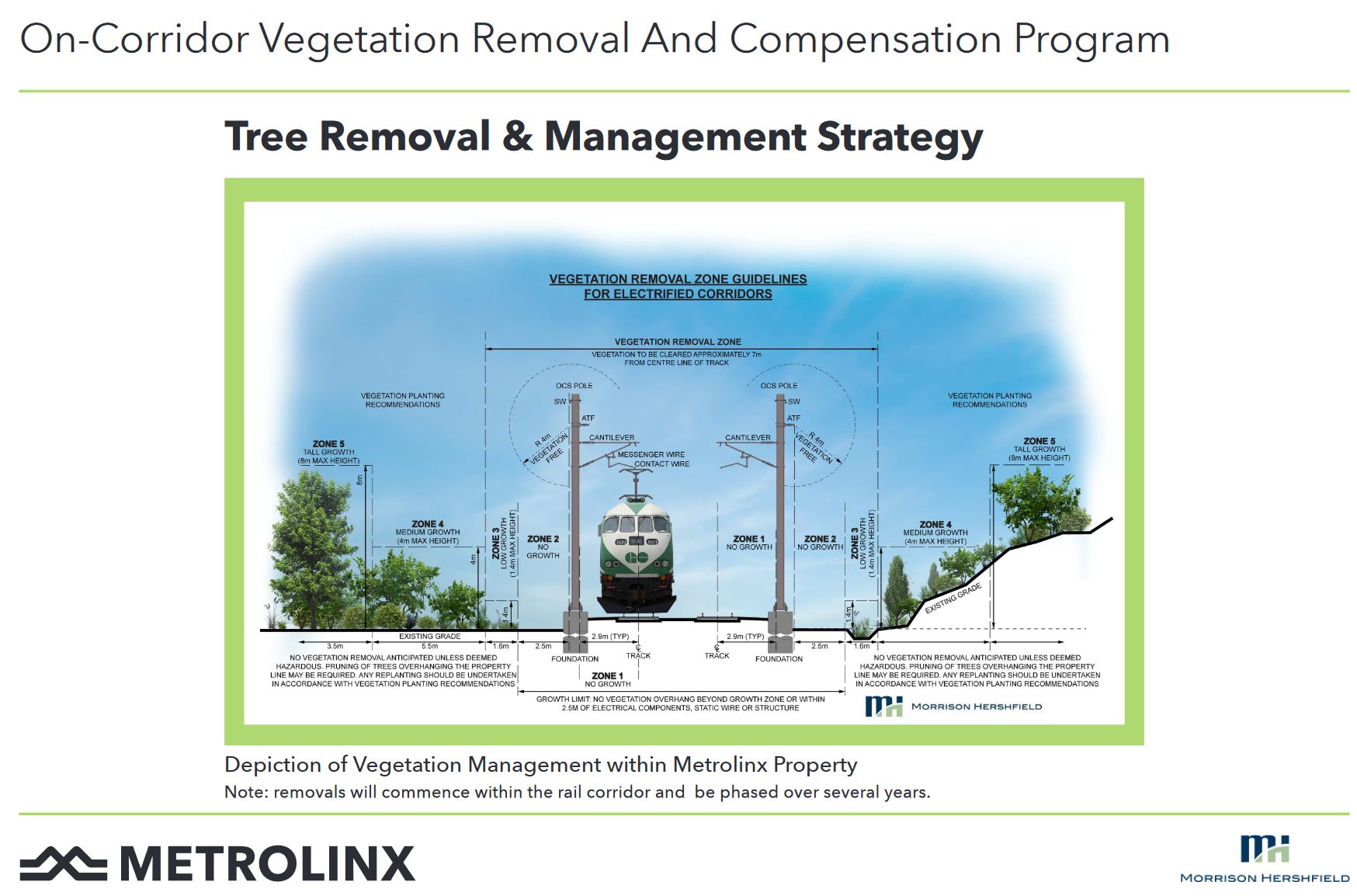
Here is a diagram showing the minimum clearances from adjacent vegetation (mainly trees) on an electrified GO corridor:
In a context where buildings are nearby, the diagram changes a bit, but the basics are similar.
These drawings show a two-track GO corridor, but Lake Shore East will have four tracks, plus the Ontario line tracks. If this view looked northeast, the OL tracks would be on the left side, probably to the left of the pole holding the overhead system.
In that configuration, the “no vegetation” zone to the left (west/north) would be occupied by the OL itself which should have much less restrictive requirements for nearby growth because it uses overhead power at a much lower voltage than GO trains. However, on the right (east/south), the outermost GO track is now at the edge of the corridor and clearance requirements for electrification apply. [Corrected March 28/21 to reflect overhead rather than third rail power supply.]
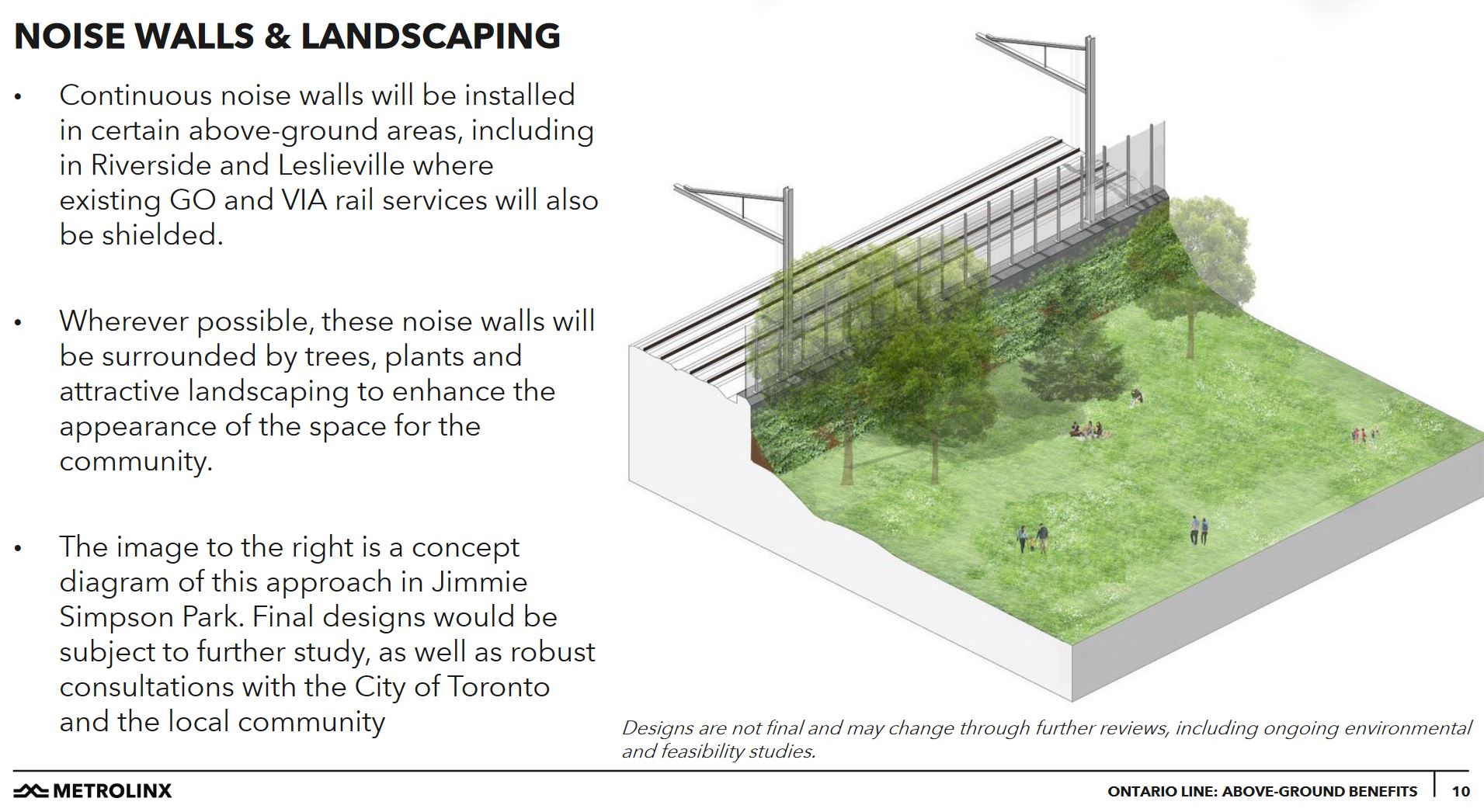
An illustration of a park on the line must be seen in this light. This shows a mature tree immediately beside the sound wall and the overhead support poles. As shown, it is within the clear zone required for electrification.
In the management presentation, Metrolinx claimed that the Ontario Line will actually make the neighbourhood quieter, although they did not explicitly say “quieter than today”. This is something of a stretch because there will still be more GO trains, and many of them (thanks to the Bowmanville extension of GO service) may well be diesel.
This is an example of a fundamental problem with Metrolinx planning for this corridor: they conduct separate studies and community sessions for the Ontario Line and for the GO Expansion and Electrification program rather than producing a consolidated plan showing the effect of all three changes planned over the coming decade.
A further exaggeration, intended to show how all of this work has a beneficial end even though it might affect the community, lies in claims of environmental and congestion benefits of the project (regardless of its alignment).
All of the new transit riders on the Ontario Line are assumed to represent avoided auto trips complete with their congestion and pollution. There is no guarantee that fewer auto trips will be taken in the future due to a backlog of demand for road space, and due to population growth.
A common remark Metrolinx has made about The Big Move regional plan is that it will at best keep things from getting worse. In areas where there is already heavy traffic and congestion, it is not realistic to assume that the day the OL opens, roads will suddenly empty of cars. This is a bogus position, and Metrolinx should know better.
The original Ontario Line scheme was sold on its benefits for GO interchange and because it was claimed to fit within existing Metrolinx lands, more or less. Gradually these claims are coming unglued, although many of the underlying issues were clear the day the line was announced.
Postscript: An Alternate Alignment from the Don River to Carlaw
In my previous article, I alluded to a possible alignment that would splice the Ontario Line into the Relief Line’s alignment running up Carlaw from Eastern. From East Harbour, the OL would have travelled east parallel to Eastern Avenue and descended below grade, then veer north to hook into the Relief Line route at about Logan Avenue.
This scheme depended on the Ontario Line being entirely on the south/east side of the rail corridor at East Harbour rather than astride it (as in the original OL plan) or on the north/west side as in the revised plan.
With the proposed shift of the Ontario Line to be entirely on the north/west side of the rail corridor, this scheme is no longer feasible.
The Metrolinx Board meeting on March 25, 2021, brought two contrasting views of “good” rapid transit projects to the fore exposing inconsistencies in the “official story” about building above or below ground.
On the Capital Projects front, many works ranging from LRT lines to GO upgrades are on the surface although, of course, the central portion of the Eglinton line is underground. Progress on the surface LRT lines is swift thanks to the avoidance of underground work and complex tunnel structures.
But at the end of the presentation, the “big news” is that prime bidders for both the Scarborough Subway and Eglinton West LRT tunnels have been selected and negotiations are underway on contract details. Some early works such as construction of the tunnel boring launch site at Sheppard/McCowan Station will begin in April.
The long history of debates about Scarborough’s transit network do not bear repeating. Suffice it to say that the underground option is oft touted as the only way to provide good transit, albeit at substantial cost.
According to a Metrolinx Blog article, the line will be tunneled in one bore from Sheppard south and west to Kennedy Station rather than in two separate bores meeting at Lawrence East. This simplifies some of the construction staging and eliminates the potential for major upheaval for Scarborough General Hospital at Lawrence & McCowan. The line will be a single bore 10.7m diameter tunnel according to the Board presentation by Matt Clark.
On Eglinton West, despite the availability of land for a surface LRT right-of-way and demand projections well within the capacity of surface operations, the line will be buried from the Humber River westward as dictated by Premier Doug Ford in his transit plan.
In both cases there will be fewer stations that would have existed with surface LRT options, and on Eglinton ridership projections are lower as a result. (Scarborough is a more complex case because one subway has been substituted for two, if not three LRT lines in a network.) Access time between surface and subway routes – a key item Metrolinx always mentions about its surface alignments – is not mentioned when they enthuse about coming tunnel construction.
At its February 10, 2021 meeting, the TTC Board receive a long report entitled Transit Network Expansion.
The raison-d’être for the report is to obtain the authorization to increase staffing by 34 positions that would be funded by Metrolinx, but would be part of the TTC’s stucture. Many aspects of projects underway by Metrolinx depend on TTC input and acceptance because they affect lines the TTC will operate and, at least partly, maintain. A new Transit Expansion Assurance Department within Engineering & Construction. The authorization include provision for temporary expansion beyond 34 should this be required.
This move is intriguing because it implies Metrolinx has accepted that it cannot build new lines completely on their own without TTC input, especially when they will operate as part of the TTC network.
The report also requests authorization for:
[…] the Chief Executive Officer, in consultation with the City Manager, City of Toronto where applicable, to negotiate a Master Agreement and/or other applicable Agreements with the Province and/or any other relevant provincial agency for the purposes of the planning, procurement, construction, operations, and maintenance of the Subway Program, in accordance with Board and City Council direction, and to report back to the Board on the results of such negotiations. [pp. 2-3]
There is a great deal more involved in building and operating transit projects than holding a press conference with little more than a nice map. Now comes the hard part of actually doing the work. Whether Metrolinx will negotiate in good faith remains to be seen, but the TTC and Toronto appear to be less willing to hide Metrolinx’ faults in light of the Presto screwups.
Another recommendation has a hint that all is not well with consultations, as that should be any surprise to those who deal regularly with Metrolinx.
Request Metrolinx to conduct meaningful engagement with the TTC’s Advisory Committee on Accessible Transit (ACAT) as part of the Project Specific Output Specification (PSOS) review and design review for all projects within the provincial programs. [p. 3]
The operative word here is “meaningful”. ACAT has already complained of difficulties with Metrolinx including such basics as poorly designed elevators on the Eglinton Crosstown line that cannot be “fixed” because they have already been ordered.
Right from the outset, the TTC claims to have a significant role, a very different situation from the days when Metrolinx claimed it would be easy for them to take over the subway system.
The TTC continues to play a key role in the planning, technical review, and implementation of all major transit expansion projects in Toronto and the region. These include the Toronto Light Rail Transit Program and the provincial priority subway projects, referred to collectively as the “Subways Program”: the Ontario Line; the Scarborough Subway Extension; the Yonge North Subway Extension; and the Eglinton Crosstown West Extension. [p. 1]
In support of the staffing request, the report goes into great detail on many projects:
Two projects are not listed among the group above, but there is a description buried in the section on Bloor-Yonge expansion.
Overall subway system capacity and service expansion
Any discussion of the Line 2 renewal project
There is no discussion at all about renewal and expansion of surface service. This is just as important as new lines, but it is not seen as “expansion” with the political interest and funding that brings. Yes, this is a “rapid transit” report, but the core network of subway lines dies without the surface feeder routes, and many trips do not lie conveniently along rapid transit corridors.
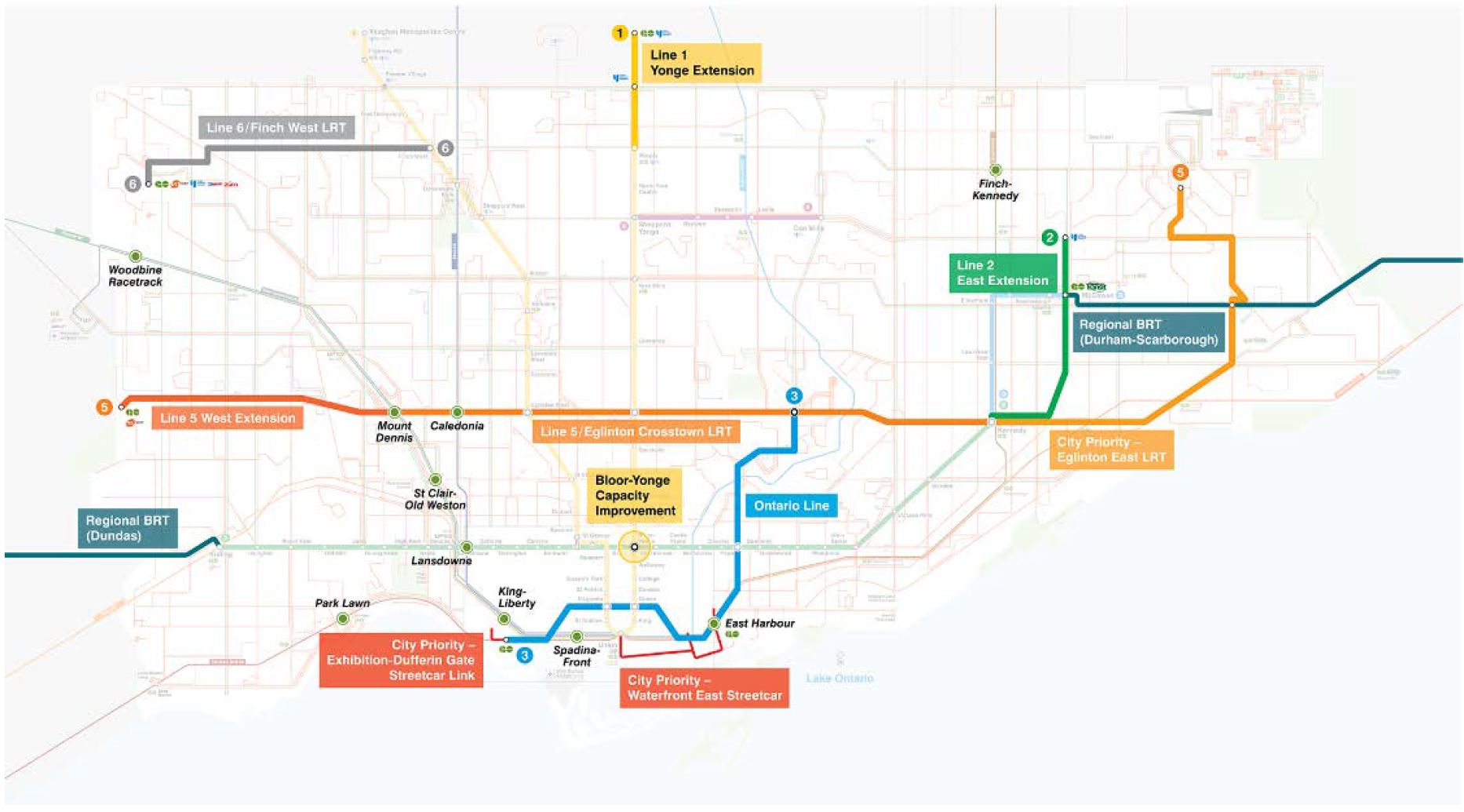
The map below shows the location of most of the projects, but there are some odd inclusions and omissions.
The RapidTO bus corridors are not included.
City-funded GO stations at St. Clair/Old Weston, Lansdowne, King/Liberty, East Harbour and Finch/Kennedy are shown.
GO funded stations at Woodbine Racetrack, Mount Dennis, Caledonia and Park Lawn are shown.
The planned improvement at between TTC’s Dundas West and GO’s Bloor station is not shown, nor is any potential link between Main and Danforth stations.
SmartTrack stations are shown, but there is no discussion of how GO or ST service would fit into the overall network.
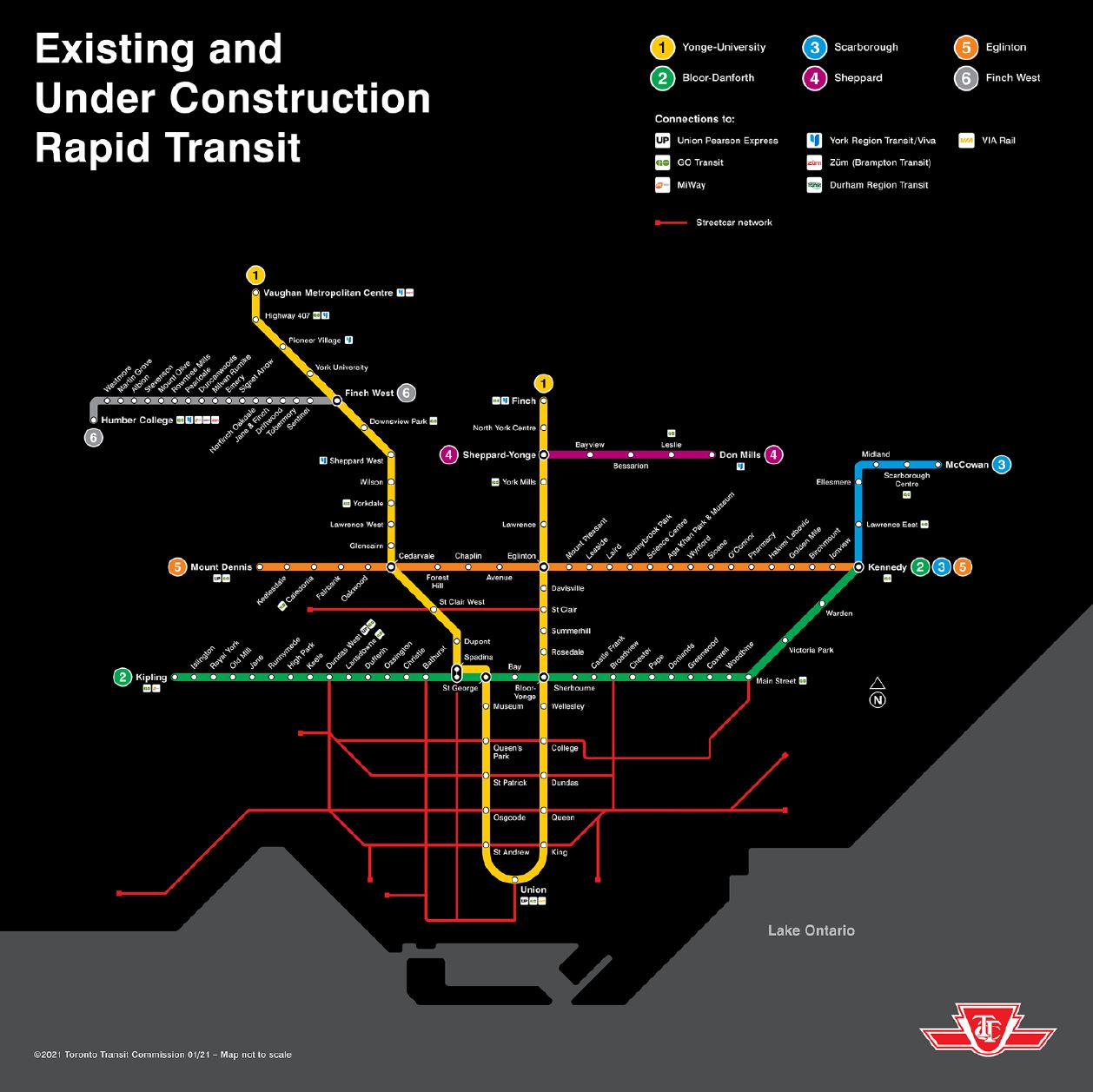
The following two maps have attracted a lot of attention, although they do not tell the full story. Much as I am a streetcar/LRT advocate, the presence of the entire streetcar network here is misleading, especially in the absence of the RapidTO proposals. Some of the streetcar lines run in reserved lanes, although thanks to overly generous scheduling some of them are no faster than the mixed-traffic operations they replaced (notably St. Clair). However, most of these routes rank equivalently to the bus network in terms of transit priority. If we are going to show the streetcar lines, why not the 10-minute network of key bus route?
The map is also distorted by having different and uneven scales in both directions. The size of downtown is exaggerated while other areas are compressed.
For example, the distance from Queen to Bloor is, in reality, half that of Bloor to Eglinton and one quarter of Eglinton to Finch. It is also one quarter of the distance from Yonge west to Jane or east to Victoria Park. For comparison, the TTC System Map is to scale, and it shows the city in its actual rectangular form.
This map gives an impression of coverage, but masks the size of the gaps between routes as one moves away from the core. Bus riders know all about those gaps.
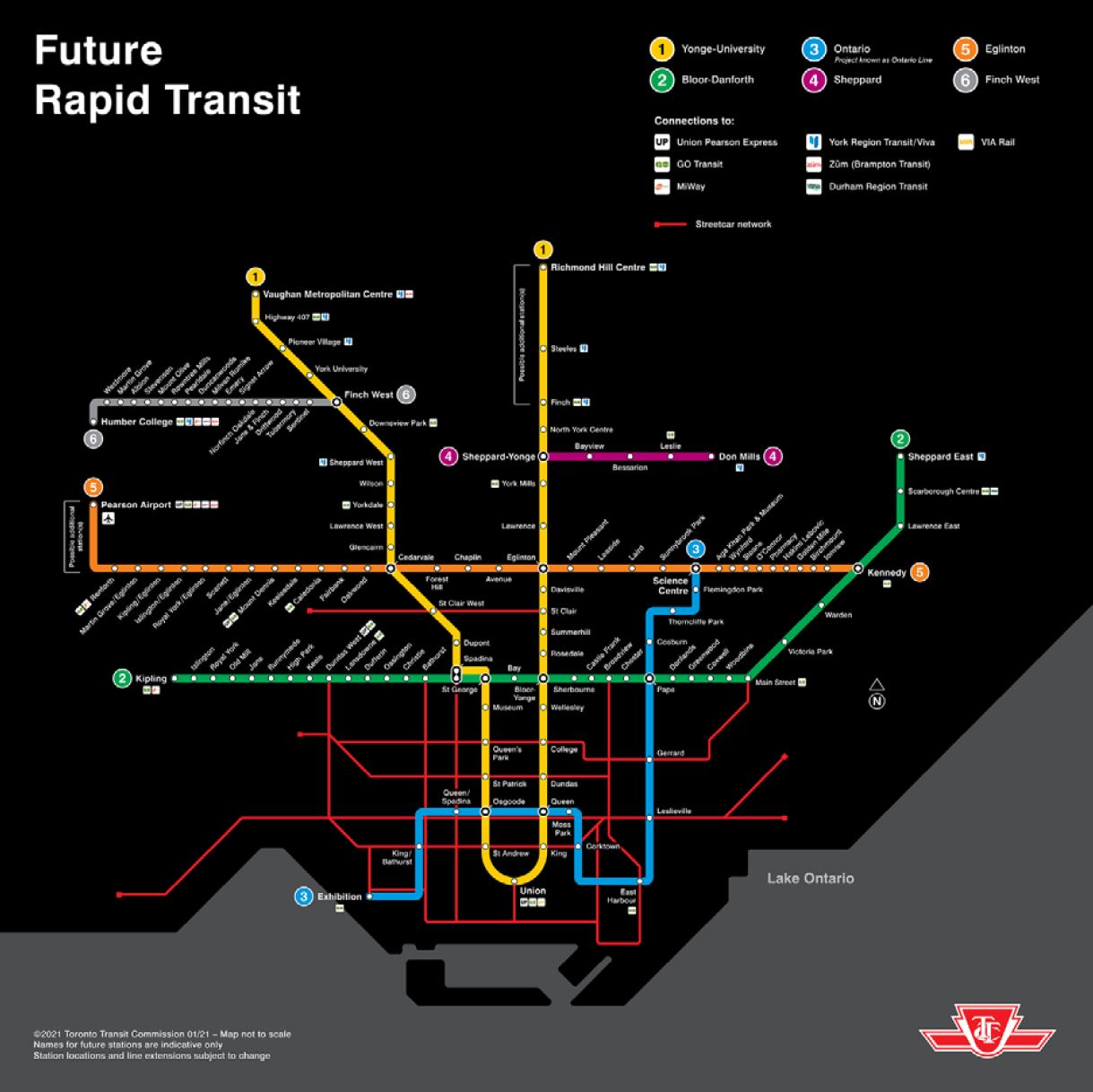
By 2031, the network is hoped to look something like this. No BRT proposals are shown, but we do see the waterfront extensions west to Dufferin, and east to Broadview (East Harbour). Also missing are the GO corridors which, by 2031, should have frequent service and (maybe) attractive fares. They are (or should be) as much a part of “Future Rapid Transit” as the TTC routes.
This map is trying to do too much and too little at the same time. It also reveals a quite selective view of “regional” transit.
I am not trying to argue for a map that shows every detail, but it should exist (a) in scale and (b) in formats with overlays showing major parts of the network and how they relate to the overall plan. When people concentrate on the pretty coloured lines, they tend to forget the other equally important parts of the network.
Metrolinx has launched another round of consultation for various projects that make up the GO Transit Expansion Plan. Information on these is scattered through various pages on their site.
There is an interactive map of locations where changes are proposed, although it can be tedious to navigate because the default map does not have street names. (You can change this by selecting a different base map from the options in the upper right of the display.)
This map shows roughly the location of the Ontario Line corridor, but gives no detail about extra space, although the map is not to be taken as definitive. Nothing is shown of potential stations for the OL, and there is no information at all in the map for the several proposed SmartTrack stations.
This means that the scope of the project review and the combined effect GO Expansion will have with other projects is not known. Moreover, it would be foolish to approve a project based on a spec that did not include two major additions that are somewhere in the Metrolinx pipeline.
Stations, be they for the Ontario Line or for GO/SmartTrack require platforms and circulation elements (stairs, elevators, roads) but there is no hint of the space these will take.