The TTC Board met on October 6, 2025. Many items on the agenda were confidential in whole or in part, and the meeting immediately recessed into private session. Four hours later, the public session resumed.
Extended private sessions have been a “feature” of recent Board meetings, and this is a major inconvenience for people who have taken the trouble to travel to City Hall for deputations, or remained available online. In years long past, the Board scheduled an in camera session before the public session so that, usually, the public part started on time. They should reconsider this practice, or at a minimum advertise a long, planned private session in the agenda so that public attendees can plan accordingly.
Items of interested included:
The CEO’s monthly report including an updated format for bus fleet and route performance metrics
The Peer Review of asset management by the International Association of Public Transport (UITP)
In the Major Projects Update on the TTC Board’s September 2025 agenda, there is a troubling reference under three subway maintenance projects in progress.
Rogers 5G Implementation
“The schedule may be impacted because of workcar and resource availability, which prioritizes state-of-good-repair activities. The TTC will co-ordinate with internal departments to prioritize Rogers work (where possible) so that workcars are available and assigned.” [p. 19]
Line 2 Capacity Expansion Program
“The unavailability of the TTC Operations workforce and workcars is a concern and is impacting the successful delivery of Line 2 Traction Power portfolio projects.” [p. 22]
Line 1 Capacity Expansion Program
“Negative reinforcing cables VMC to Sheppard West: Construction has slowed down due to the unavailability of the TTC Operations workforce and workcars … [p. 25]
“The unavailability of the TTC Operations workforce and workcars is a concern and is impacting the successful delivery of Line 1 Traction Power portfolio projects.” [p. 26]
Reading this, I could not help thinking back to the proposal for renewal and expansion of the TTC’s fleet in the latter years of Andy Byford’s term as CEO. Until 2019, the TTC published its Capital Plan in detail in two large binders commonly referred to as “the blue books”. This practice stopped in 2020, and it was not replaced by an electronic equivalent.
From the 2018 budget, I compiled a list of planned work car purchases. Also, I requested from the TTC a list of new vehicles since 2017. The table below merges this information.
Note 1: At the beginning of the work car plan, TTC owned two tie tampers, RT-21 and RT-41. Descriptions in the detailed plan speak of acquiring two additional units similar to RT-41. However, all that appears to have happened is that one unit, RT-21, was replaced. These units are essential to dealing with track problems that lead to slow orders.
Readers will recall the major interruption to subway service in 2024 thanks to an hydraulic oil spill from a work car. This incident triggered a review of maintenance practices revealing problems with the quality and frequency of inspection, and of the general state of the fleet. One issue is the age and condition of some cars which are not always fit for service.
From the table above, it is clear that many planned work car purchases in the 2018 plan have gone forward, but some have not. I asked the TTC about pending acquisitions, but received a generic answer.
The TTC Subway Workcar fleet undergoes a continuous program of growth, replacement, and overhauls, with another 10 vehicles targeted for overhaul/upgrade, or replacement between 2026 and 2032. The usual caveats around timing being dependent on the ability to procure would apply once they are put to tender. [TTC Media Relations email Septmber 8, 2025]
As the subway system grows and ages, the maintenance workload will go up, and with it the need for both specialized staff and work cars. The Major Projects report shows that the TTC is falling behind on both counts.
This is an aspect of “State of Good Repair” that is generally hidden from public view, but is key to maintaining reliability of the infrastructure and the revenue service it supports.
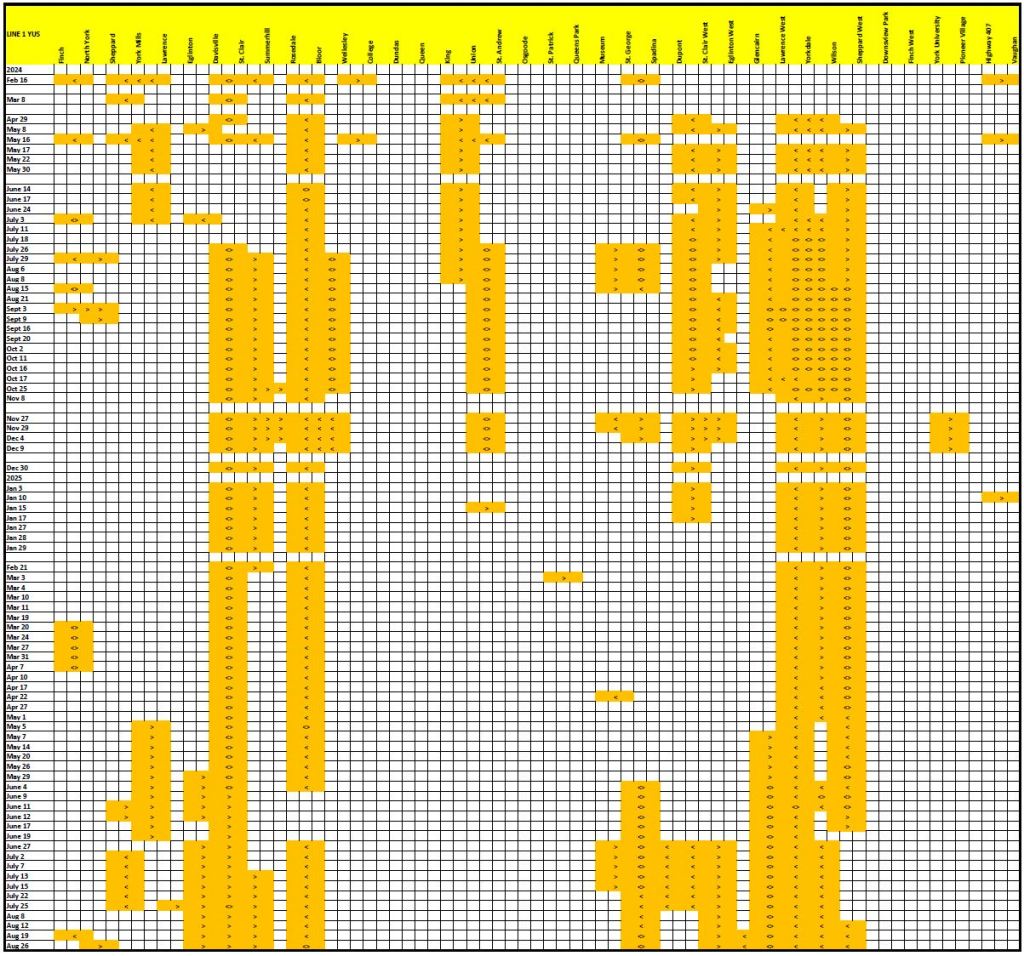
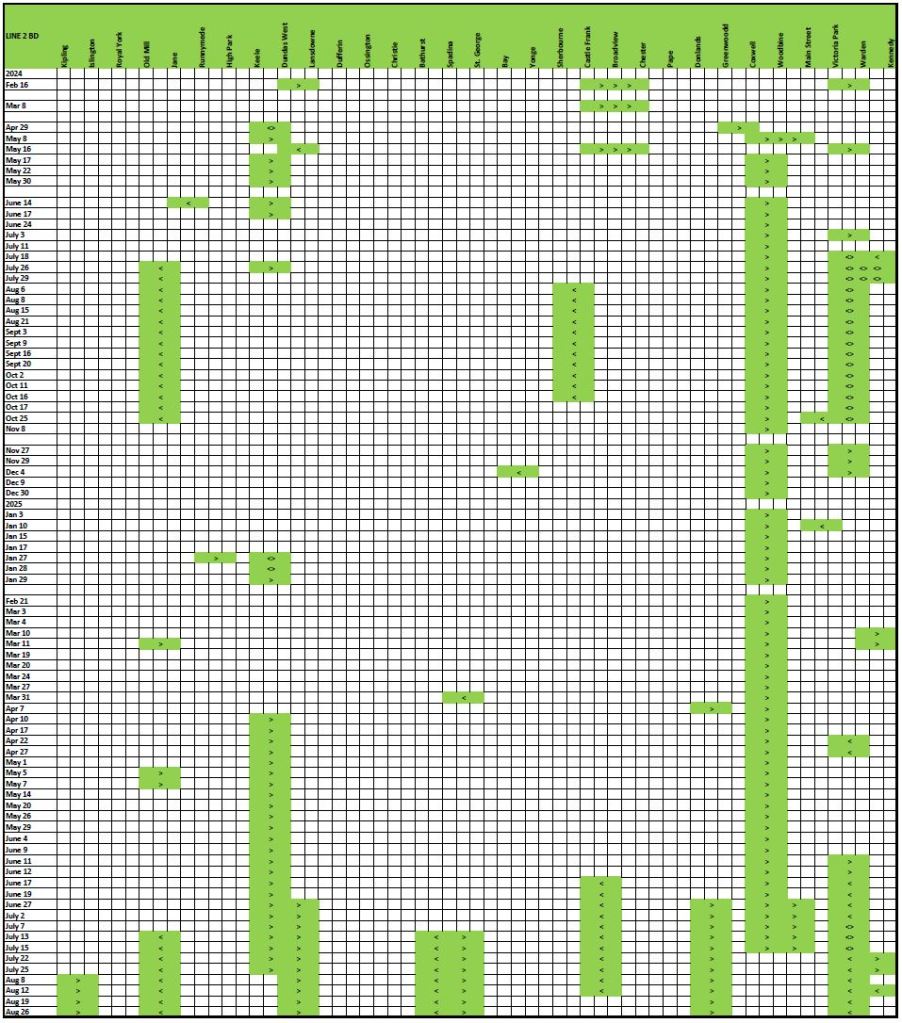
In previous articles, I have tracked the evolution of subway segments where Reduced Speed Zones (RSZs) are in place since February 2024. Recent comments in other articles suggest that readers have not been following this.
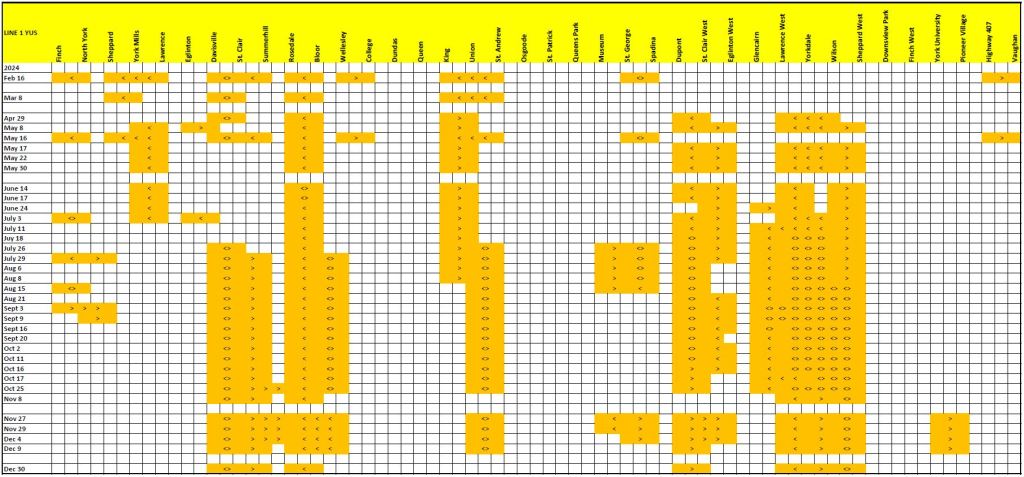
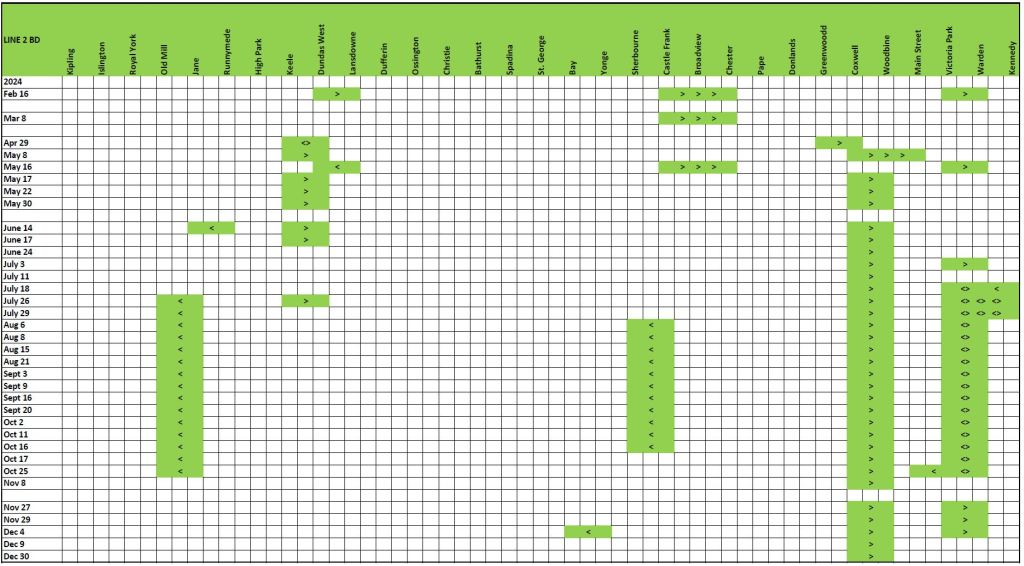
Here are updated charts showing areas where speeds are or have been restricted on Lines 1 and 2.
The charts on the left are for 2024, while those on the right show 2025 with a gap at the top where I did not check for about a month. The longevity of the RSZs can be clearly seen in the length of more or less continuous coloured vertical bars notably on Line 1 between Eglinton and Bloor, and north from Eglinton West to Sheppard West.
The coloured areas show where RSZs were located, and the arrows show the direction with “<>” meaning “both ways”.
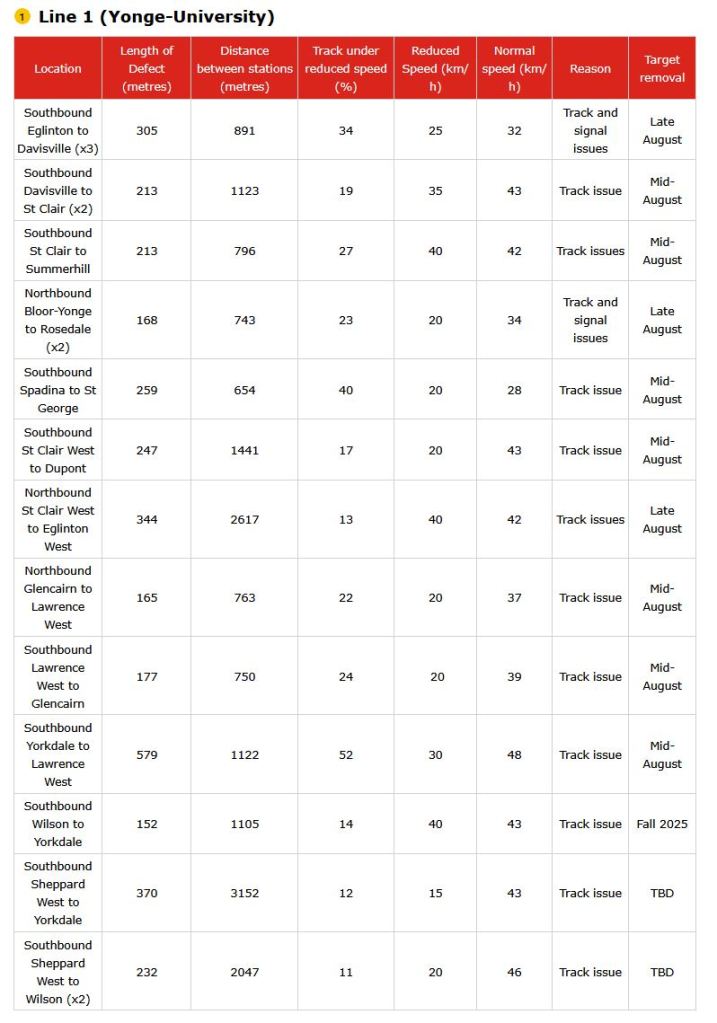
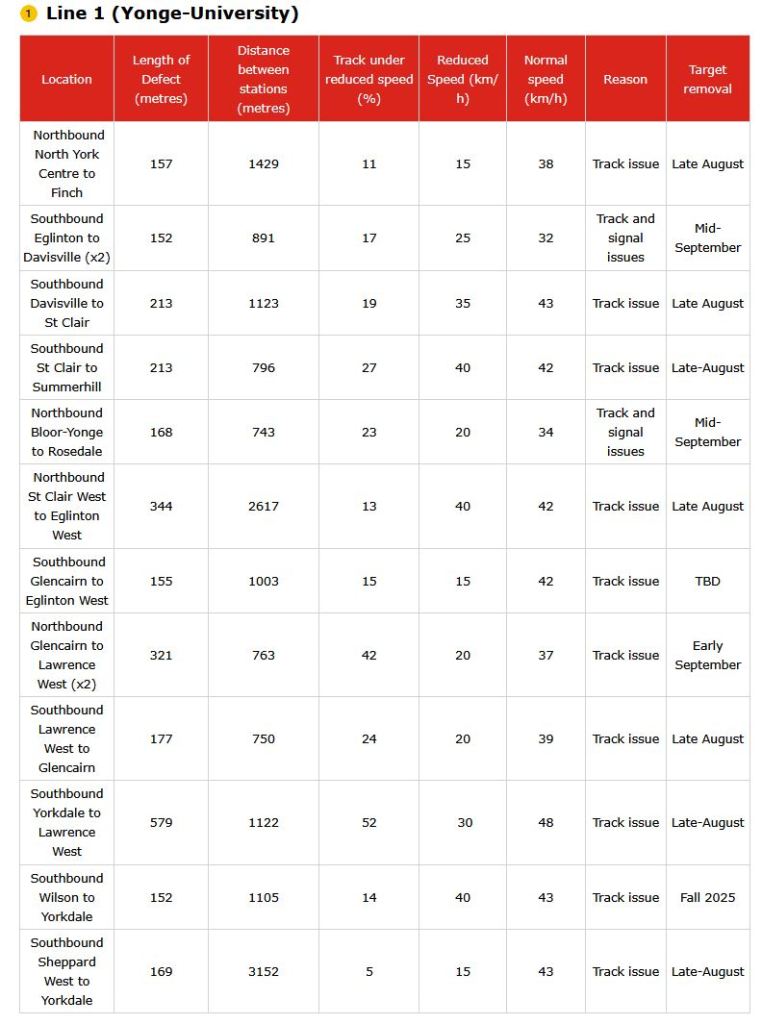
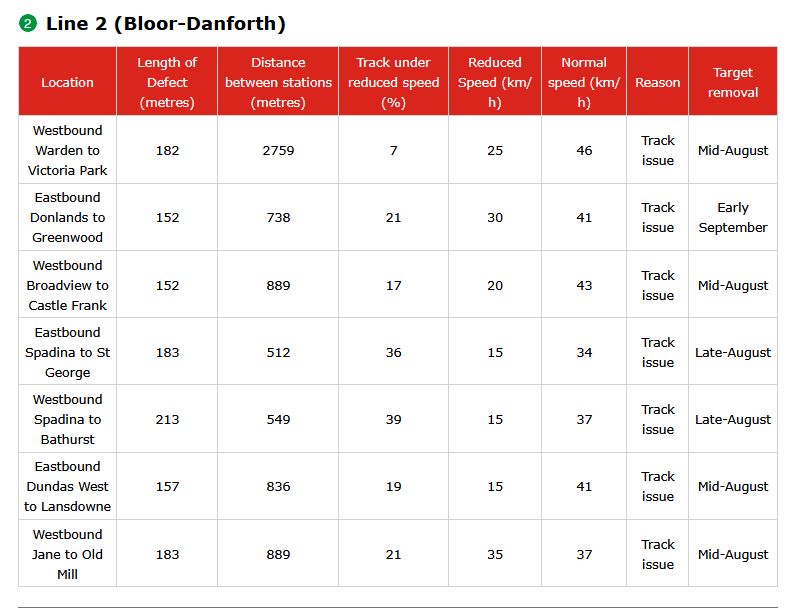
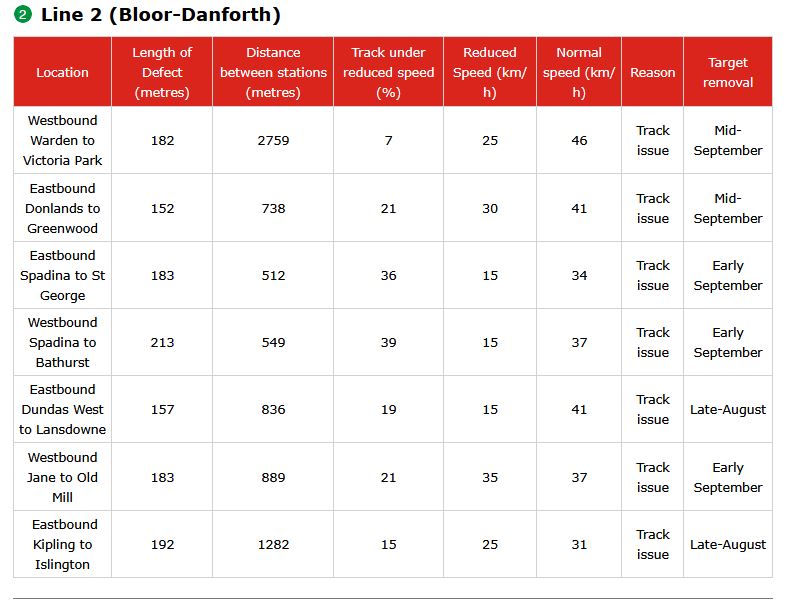
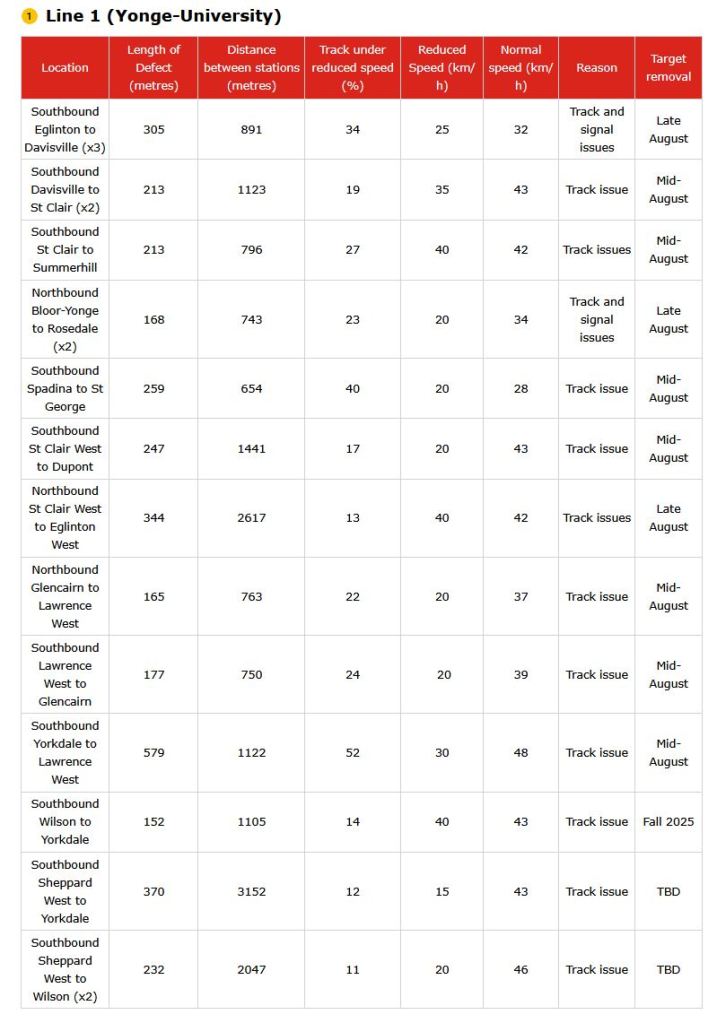
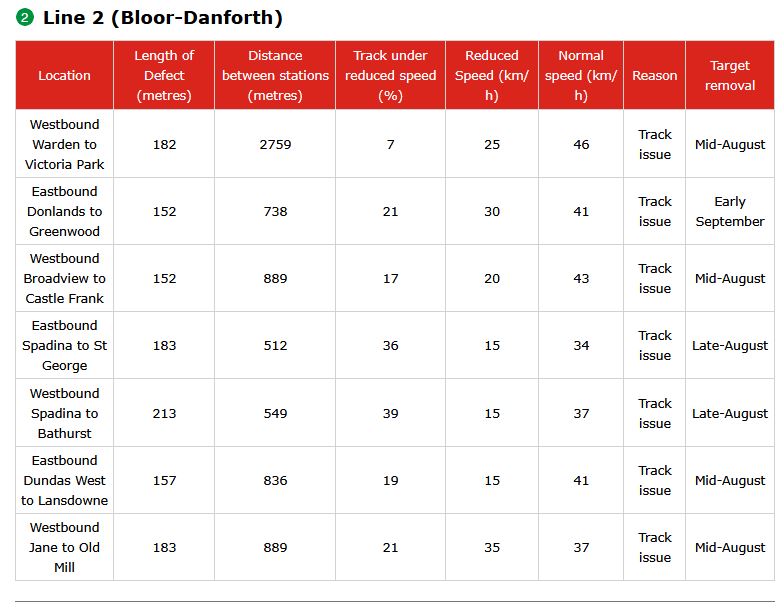
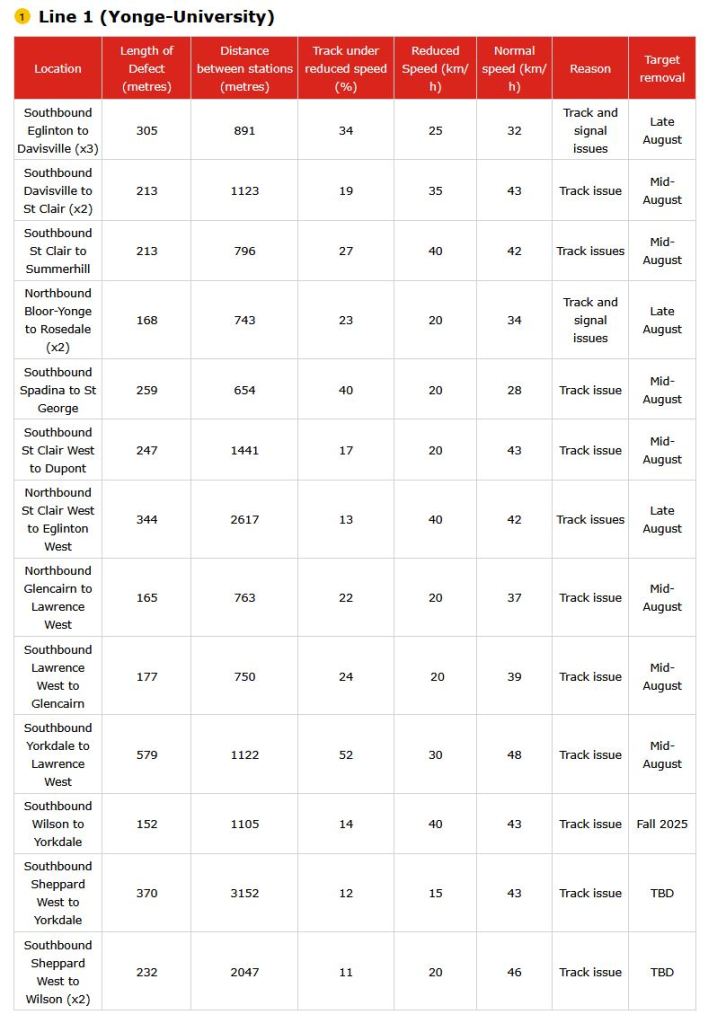
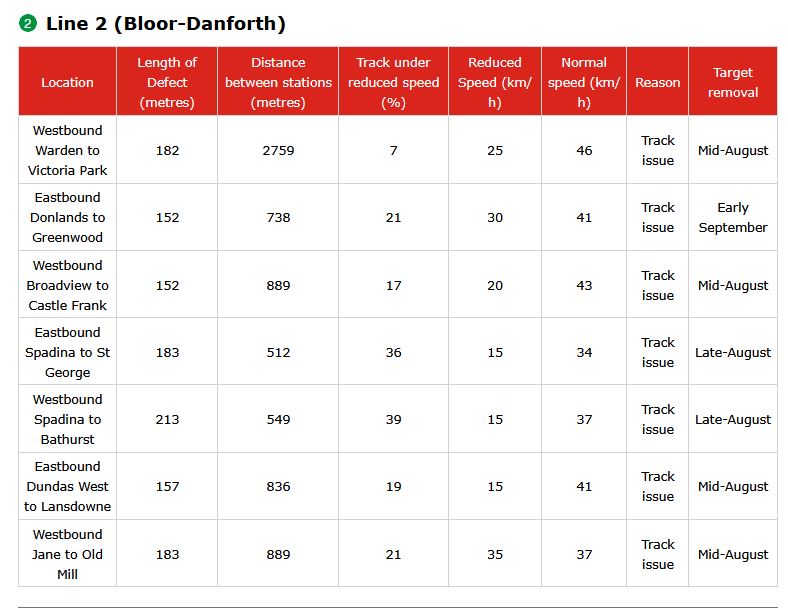
Tables with location details and expected times to repair taken from the TTC’s site are below. Note that in previous versions, many of these sites were expected to be repaired in August, but the target dates have been adjusted.
At the request of a reader, here are the Line 1 and 2 charts condensed onto a single page for each line so that the year-to-year continuity of problem areas is more obvious.
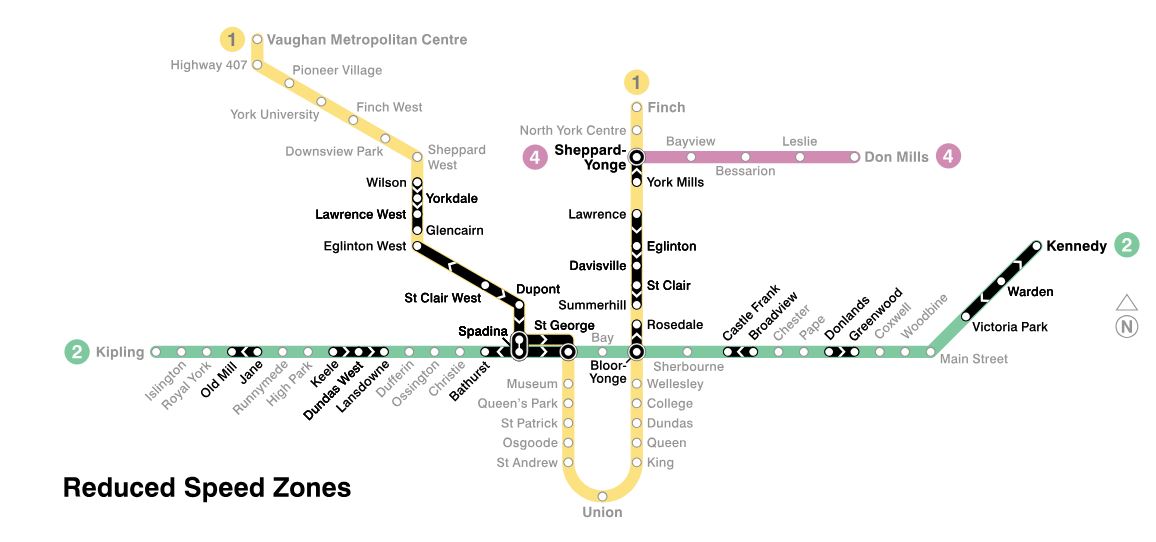
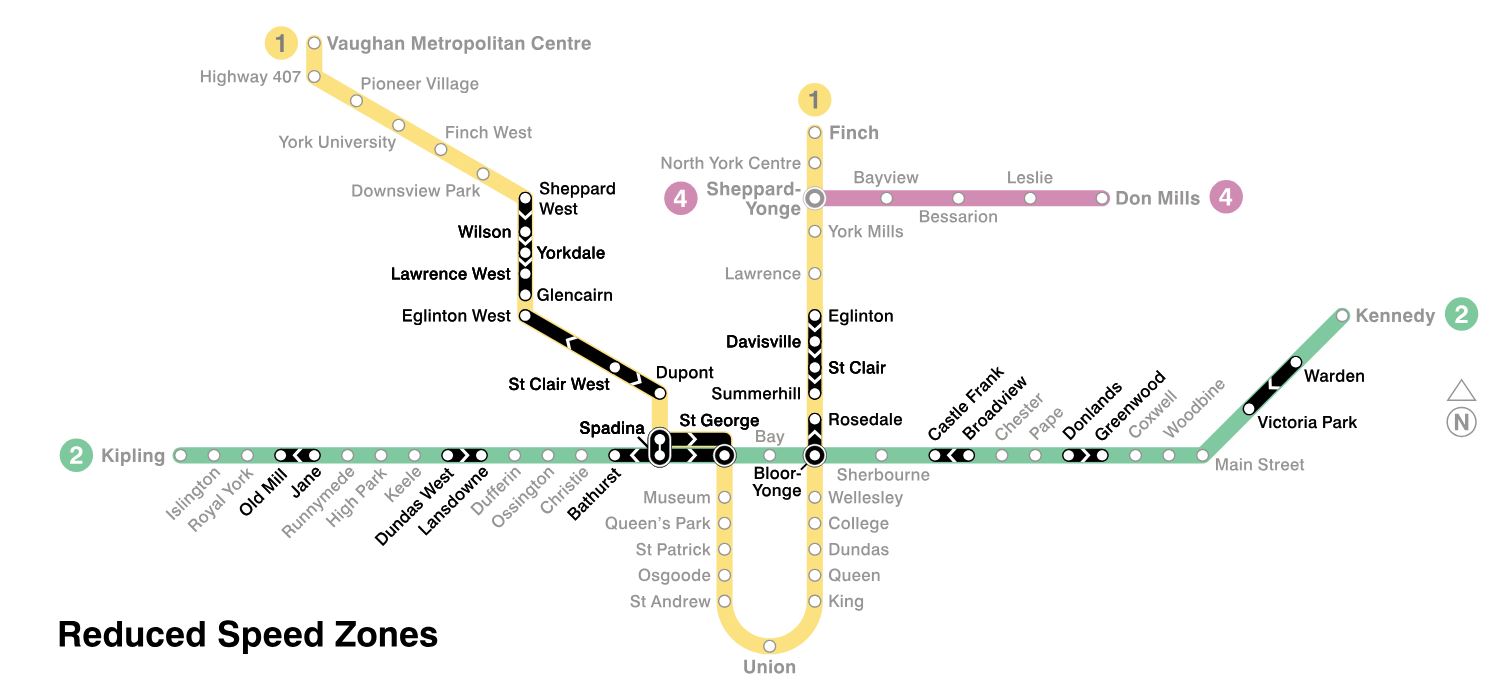
Recently, the TTC added tables to its page mapping all reduced speed zones indicating the nature of each problem and the anticipated time to repair. Many of the dates were in August, and we’re well into that month already. Given past history, this seemed optimistic.
The table has now been revised with a number of dates pushed into September. A few items have vanished, but there are new entries too.
August 1 VersionAugust 19 VersionAugust 1 VersionAugust 19 Version
Despite the premise of an open, competitive bid among potential carbuilders for new subway trains, various politicians have openly argued that the work should go to the historical provider, the Alstom (formerly Bombardier) plant in Thunder Bay.
On August 15, all three funding governments, Canada, Ontario and Toronto announced that a sole-source contract will be awarded to Alstom Transport Canada. This is intended to support Canadian jobs and an existing manufacturing facility. All bidders have been notified that the former bid process has been cancelled.
To ensure that Alstom delivers state-of-the-art trains at a fair market price, maximizes the creation of Canadian jobs, and benefits Toronto, Alstom must:
• deliver a product that is compliant with the TTC’s original requirements; • maximize Canadian content and create Canadian jobs; • have its pricing subject to an independent third-party market price assessment.
It is expected that negotiations will occur over the next few months with a report back to the TTC Board on the status of negotiations by the end of the year.
The proposed contract would provide 70 new trains
55 trains to replace the existing Line 2 fleet
15 trains for the North Yonge and Scarborough extensions
There is also provision for future train orders that would support expansion of service on both Lines 1 and 2. The 55 trains are sufficient to operate Line 2 at the capacity supported by its existing signal system, but more trains would be needed to exploit the capabilities of CBTC (Computer Based Train Control) which will be installed in coming years. Similarly, the existing Line 1 fleet will support the pre-CBTC service level of 140 seconds (25.7 trains/hour), but more trains are needed to go beyond that level. There is no funding for the additional trains in current budgets, nor for the added maintenance facilities a larger fleet will require.
The award of additional trains to Alstom is dependent on their performance on the 70-train order.
The new release states:
The TTC is working diligently to ensure the aging Line 2 fleet operates safely and reliably until new trains arrive.
Originally, the TTC had planned to replace the Line 2 trains by 2026, but that scheme was shelved by former CEO Rick Leary who claimed the trains could be life-extended to 2040. That solved a budget pressure for funding, including the proposed new maintenance yard at Kipling, but created a potential crisis in subway reliability and fleet availability.
The TTC has more than 55 of the current T-1 stock used on Line 2 due to changes over the years in the scope of automatic train control implementation on Line 1. These would, if all trains were working, have allowed the Scarborough extension to open using the existing fleet, but only barely. The delay in the Scarborough project bought the TTC time to procure new trains.
The challenge now is to keep the T-1 fleet operating reliably until new cars arrive. TTC management reported at a Board meeting earlier this year that some cars are being used as a source of spare parts. There are obvious limits to how far this practice can go, and if carried too far will limit the TTC’s ability to restore full pre-pandemic service on Line 2.
The TTC maintains a list of reduced speed zones on its website, and this constantly changing list is tracked in a previous article here showing how long some restrictions have been in place.
The format of the TTC page has been changed to include not just a map showing where the zones are, but why they were created and, in most cases, a target date for remediation.
The current map and table of repair targets, as of July 31, 2025, are shown below. Note that some of the items on the map are not included in the detail (e.g. Warden to Kennedy eastbound), and the table includes entries that are not reflected on the map (e.g. Sheppard West to Wilson). This does not speak well of the TTC’s ability to communicate consistent, accurate information.
Updated August 1, 2025 at 9:10am: The TTC has updated their page so that the map and tables are now in sync with each other.
Most of the zones listed here are scheduled for removal by early September with only a few continuing into the Fall or beyond (“TBD”). This list will bear watching for additions, and for removals of cleared sections within the expected time frame.
Since February 2024, I have tracked the TTC’s posted list of Reduced Speed Zones (RSZs) on subway lines 1 (YUS) and 2 (BD). A pattern has emerged that some RSZs are very long-lasting, others are brief, and some come-and-go.
Former Interim CEO Greg Percy claimed that we should expect about a dozen of these at any time, but the current total as of July 13, 2025, sits at 27.
If these zones came and went in short order as problems were discovered, one might tolerate a period of travel delay. My own recent experiences with glacial trips from Vaughan to St. George makes me thankful that I don’t take this route every day, but regular riders there have my sympathy.
Current reporting makes actual tracking of track defects difficult, and there is no sense of the underlying problems or limitations on performing repairs. Transparency demands that more information is provided for the status of RSZs, specifically:
Location
Date first reported
Defect issue(s)
Planned repairs
Projected date to completion
Actual date slow order is lifted
Whether this will speed repairs depends on available resources (capital, work equipment, crews) and conflict with other works along the subway lines, but at a minimum riders deserve to know when they can expect relief from slow orders. The TTC Board and Council deserve to know how deep-seated the outstanding problems might be, where they originated, and what will be required to fix them.
Approve addition of PEDs requirements, including operational and technical system requirements to the TTC Design Manual and Master Specifications for implementation at future new stations.
Direct staff to include funding based on estimates for the implementation of a pilot installation at TMU Station (Dundas) as part of the 2026 budget submission.
Approve ongoing planning work, including prioritizing stations for implementation of appropriate technologies based on specific needs and drivers of each station.
At the meeting, there was an attempt to refer the report to staff for further study:
Motion to Refer Item moved by Fenton Jagdeo (Lost)
Refer the report back to staff for further analysis to compliment [sic] the platform edge door study that includes:
Other technology, infrastructure, or passenger management solutions at stations that could improve operational efficiency, customer experience, and safety.
Prioritization of stations that would most benefit from platform edge doors and those that could realize safety, operational, and customer experience improvements utilizing other solutions.
Capital budget costs of (non platform edge door) station enhancement investments that could be implemented in 2026 to improve safety, operations, and customer experience.
Expanded business cases that include metrics for potential operational cost savings, service reliability improvements, and customer delay time savings that could be realized with platform edge doors at the highest priority stations.
A jurisdictional review of alternate platform edge door funding models that leverage non-fare (advertising) revenues.
There was also a motion to refer the report to the Strategic Planning Committee for further discussion:
Motion to Amend Item (Additional) moved by Councillor Dianne Saxe (Carried)
The TTC Board requests that staff provide the Strategic Planning Committee with class 5 estimates of the costs and benefits to the TTC of technically feasible options to detect or discourage track-level intrusions at subway and LRT stations, including those being installed by Metrolinx on new stations in Toronto.
The Feasibility Report by AECOM is a long document, but the core of it lies in the first 90 pages covering many aspects of potential implementations and designs. One significant conflict between this report and the management recommendations lies in the choice of stations for a trial installation. Although management recommends Dundas/TMU, a busy downtown station, the Feasibility Report recommends lightly used stations where problems can be worked out without a major upset to service and riders.
It is further highly recommended that TTC implement a number of PED installation pilot projects at different stations representing the typical condition for each type of design solution. Representative stations are proposed based on low ridership numbers to minimize impact to the subway system and ridership inconvenience associated with performance of the work and the anticipated learning curve. Potential stations include North York Centre, Lawrence, Glencairn and Old Mill. This variety of stations will allow contractors to familiarize themselves with all station groups and structural solutions. [p. 19]
The project is estimated to take over 20 years to complete system-wide at a substantial cost:
The total capital cost for the implementation of the PEDs system for Lines 1, 2 and 4 is estimated at $4.1 billion, with average costs of $44 million to $55 million for two platforms of a station based on the preliminary (Class 5) cost estimate, which includes a cost escalation to the midpoint of construction projected in 2036. The estimated cost was also included in the 2025-2039 Capital Investment Plan and remains unfunded. Subject to the approval of the recommendations of this report and available funding room available, $44 million will be included in the 2026-2035 Capital Budget and Plan submission for the implementation of a pilot installation at TMU Station (Dundas) for Board consideration. The preliminary cost estimate does not include the ATC interface. This will be further reviewed and discussed with the Line 1 ATC supplier as the PEDs project progresses and an implementation strategy is developed. [Management Report, p. 2]
Note that the study lists many other aspects of the project for which costs are not included. I will turn to these in the detailed part of this article.
The PED project is not funded in the Capital Plan and would have a significant effect on annual spending, especially if there is political pressure for a compressed timeline.
The study reviewed four different implementations:
Full-height doors with a roughly 300mm ventillation space at the top.
Partial height doors.
Intrusion detection systems (IDS)
“Rope” barriers.
Based on a scoring system full-height doors were favoured because they are the only proven system that completely prevents track level access. However, this is only one component of the evaluation and the differences overall are small, except for “rope” systems due to a “less-proven” ranking.
The costs for full- and half-height doors are substantial thanks to the station modifications needed for their installation many of which are common to both schemes.
Adapted from Board Report, Table 1, pp. 6-7
An important issue in such a review is to determine just what reason lies behind the desire to install PEDs. The commonly cited issue is suicides, and yet the TTC has a greater problem with people walking at track level. Other problems include fires caused by debris blown onto track level, and the potential contact between passengers on the platform and trains. Various implementations address each of these to a greater or lesser extent.
If the intent is to make track level access difficult and deter the majority of intrusions, then walls of some height are required. Sensors can detect unwanted intrusion, but they will not prevent it, and could be prone to false positives.
The operative word in “IDS” is “detection”. Such a system can detect entry into the guideway, but not prevent it. This will be used on the underground portions of the soon-to-open Lines 5 and 6 in Toronto, and we will see how well it works, especially in distinguishing between real intrusions and false positives that would halt service.
Installing PEDs is not simply a matter of erecting a wall along the platform. There are issues of structural integrity of platforms, relocation of services in the under-platform area, station and tunnel ventilation, power supply and control systems, and emergency operation of the doors. Most of these are common to half and full-height implementations, although the effect on ventilation is less for half-height doors.
The implementation of PEDs at existing stations will require extensive planning, with the majority of the work taking place at track level during non-operating hours and will need to be implemented alongside ongoing State of Good Repair (SOGR) work in subway tunnels and stations. Implementation of the PED system as part of major works, such as Bloor-Yonge Capacity Improvements (BYCI) will minimize operational and customer disruptions while addressing cost and schedule efficiency.
Extensive subway station closures and station bypasses will be necessary to effectively complete track-related work for the PED system and to minimize the challenges. Partial and full closures of subway lines and stations were used in Paris, Hong Kong, Singapore, Copenhagen, and Seoul’s Metros to successfully retrofit the PED system in existing stations. [Management report pp 1-2]
The TTC has never undertaken an “extensive” closure of a station, let alone a line, beyond weekend maintenance shutdowns. This has substantial implications at busy stations near major destinations or with extensive surface feeder services.
The Business Case (also by AECOM) presents the advantages and disadvantages of PEDs.
The Business Case is a troubling document because it purports to show the monetary value of the project, albeit over an extended period. I am not convinced that this is an appropriate way to address the issue. The majority of the savings comes from fatality incidents which contribute to many of the factors below, notably to the imputed value of lost lives. Some of these savings are not direct dollar spending (such as emergency response costs), and cannot be recouped as an offset to the capital cost.
Arguing the preservation of life as a “business case” begs the question of whether fiscal hawks would agree to the project if there were not a good “return on investment”. Conversely, a 20-year implementation plan has little sense of urgency. The question, then, is how quickly the project could actually unroll, at what cost, and a what disruption both to ongoing subway operations and the overall capital plans for the TTC.
The footnote above refers to anticipated longer dwell times at stations as the control systems for both the platform doors and trains agree with each other about opening and closing while trains are stopped.
There is some irony to the proposal of Dundas/TMU Station as a trial installation. At the previous TTC Board meeting, the University made a proposal to set up a research effort with the TTC based on their business startup model. The idea was that there were potential developments that could be marketed to the world. One of the focus areas was to be intrusion detection, although such systems have existed for decades in various forms. In December 1985, SkyTrain in Vancouver opened with an Intrusion Detection System, although a replacement technology is now under consideration. IDS is not a new concept, and whether TMU can bring some enhancement that does not already exist in the market remains to be seen.
At this point, management asks the Board for approval to continue study of a potential PED rollout. This would include evaluation of appropriate technologies for different types of stations. and make budget provision for a trial implementation at Dundas/TMU. Any installation work is still a few years away, and a full rollout further still. An obvious question is whether an interim Intrusion Detection System is worthwhile, or even sufficient for the less heavily-used stations.
The challenge is to define the system’s goal and the level of protection needed to achieve this. Will problems simply migrate from stations with full segregation between platforms and trains to others with lesser or no detection or barrier? What proportion of the system must be converted to achieve a significant reduction in unwanted events? How long would it take to achieve this?
The remainder of this article delves into the technical review of PEDs and what their implementation on the TTC network would entail.
The TTC continues to issue notices of Restricted Speed Zones (RSZ) for the subway system. Some appear and disappear in short order, while others are extremely long-lived. I have been tracking the status of these since early 2024, and the charts below show where and when the zones were in place.
Some areas have had RSZs in place continuously for over a year. The TTC has not given any indication of when these will be repaired, although the list has thinned out over the past year.
The departing interim CEO has claimed that 12 RSZs will be a normal situation. This might be credible if problem areas appeared and disappeared quickly, but this is only the case for some of the zones listed here.
A related problem is that some of these areas have been in bad shape for an extended period thanks to deferred maintenance and the complexity of repairs. TTC management has mused about extended shutdowns to attack these problems, but without any specifics, and especially regarding replacement services.
Where the symbols “>” or “<” are used, the RSZ is only in one direction. Where “<>” is used, the zone applies both ways. The charts are broken by year with 2024 on the top, 2025 below. The dates correspond to my visits to the website.