
Crowding at Bloor Yonge Station

I received the following note from James McArthur:

I  was just curious to hear your take on the need to significantly expand the capacity of Bloor/Yonge Stn. particularly because of the bottlenecks in the mezzanine and stair/escalator areas (these are really bad even outside rush hour).

I saw that Adam Giambrone mentioned renovating the lower level (for aethetic reasons I gather), but has any consideration been given to this problem?  How can you solve it w/o spending hundred’s of millions?ill the TTC even try?   Can the system carry more riders if they don’t?

Steve:  Years ago, the TTC had a plan for expanding the capacity of Bloor Yonge that was breathtaking in its scope.  Fortunately, the only part they actually built was the widened platforms on the upper level and the removal of the central pillars.  The whole scheme involved moving the Yonge line tracks further apart and adding a centre platform.  Vertical access was a real problem, not to mention construction at the north end where the station is physically inside of the Bay.

The scheme also involved new platforms outside of the existing tracks on the Bloor level.  Access between all of the platforms was complex, and construction issues, were very, very difficult.  The station sits in an old stream bed and much work would have to be done by hand in a pressurized environment. 

Oh yes — the station would close for at least six months.  Trains would run through without stopping and bus shuttles would take people from Rosedale to Wellesley.

Adding capacity to the Bloor line’s platform is very difficult because the station is inside of the Bay building including some of the structural columns that hold it up.  This is a major issue in any move to increase capacity on the Yonge line through resignalling.  If the Bloor line cannot take passengers away as fast as the Yonge line delivers them, then congestion will be worse than it is today.

Headways, as we have discussed here before, are constrained on the Bloor line by turnaround times at terminals.  Even if we had more platforms, escalators and stairways, we would not be able to have more trains.

The real issue with Bloor-Yonge is the number of people coming through it who could be taken to the core via an alternate route be that GO Transit or a “downtown relief line” of some flavour.  It may be cheaper and provide better service in a network sense to look at new capacity into the core rather than trying to pack more people through the Bloor-Yonge interchange.
See The Ghost Subway Station! [Updated]

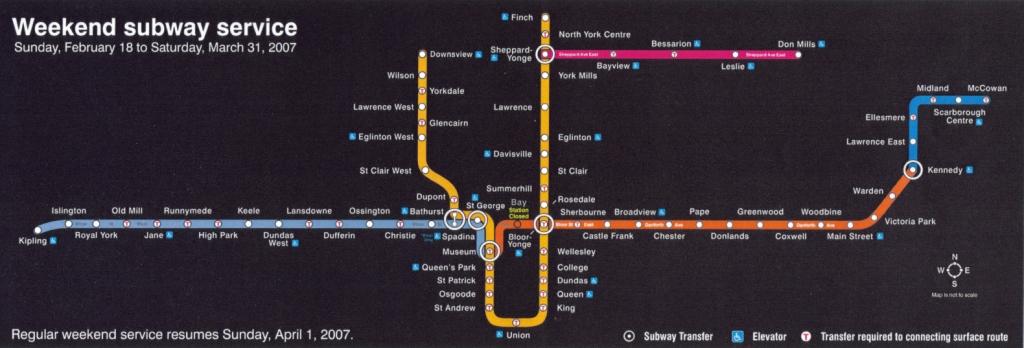
Trips through the little-used legs of the Wye between Bay, St. George and Museum Stations will be standard operation for six weekends from February 24 to March 31, 2007.  Thank to Tim Bryant for pointing out the change in the planned start date.  The TTC page on this event is here:

www.toronto.ca/ttc/bloor_danforth_weekend_tunnel_construction.htm

This unusual operation is required to permit work on the tunnel west of Upper Bay Station where the Bloor line passes under the Park Plaza Hotel.  This can only be achieved by closing the line for a few days at a time.  Conveniently, the wye is in just the right location to permit a subway “diversion”, not the sort of thing you see every day. Continue reading

The Queen Street Subway Debate

I have been truly astounded that the post on the new streetcar plan has turned into a pitched battle between the pro and anti LRT/subway forces on this blog.  Frankly I am getting a little tired of it because, after all, this is my blog and I happen to believe that LRT is going to rule the day.

This will happen for three reasons:

  • We cannot afford a subway network,
  • We do not need a subway network, and
  • We must not put off transit improvement in the vain hope that someday the tooth fairy will give us the money to build one.

All of the pro and anti subway comments have been edited into this separate thread and I am closing the debate on this issue.  Several comments that were sitting in moderation are included here.

If you want to talk about the streetcar plan, fine, I will continue adding to that thread and commenting on it.  If you want to tell me how the manifest destiny of downtown Toronto is to have a network of new subway lines, please start your own blog. Continue reading

GTTA On the Web?

One of my correspondents, Tom B., wrote:

Does Mr. MacIssac have an email address?  You should email your posting to him!

The Great and Powerful Greater Toronto Transit Authority does not seem to have a web presence yet.  Type in GTTA to Google, and you will get the Guernsey Table Tennis Association.  It shows just how important this agency is when the Government of Ontario can’t be bothered to ensure it has a web presence from day 1.  Other than a few press releases, the agency might as well not exist.  Pay no attention to that man behind the curtain!

Meanwhile, the domain gtta.ca is owned by someone in Quebec (although the registration mistakenly has “ON” for a Quebec postal code), and the technical contact is an outfit called “ID Theft Protection” in the Cayman Islands.

The amateurs at Queen’s Park might want to think about protecting domain names before they create agencies.

I trust that someone at the GTTA owns a computer and is already monitoring this website.

Last Chance for the GTTA?

On Friday, January 26, the Canadian Urban Institute presented a panel discussion entitled The GTA’s New Transportation Authority:  Last Chance to Get It Right?  Events like this tend to have a lot of talking heads rambling on to a room full of their professional cohorts, but I attended on the off chance the collection of speakers and the political dynamics would provoke some interest.  The session certainly provoked a standing room only crowd, unusual, I heard, for CUI events. Continue reading

Walk Left, Stand Right

One of my regular correspondents, David Crawford, passed on this post on the torontoist blog about the disappearing escalator signs.

Click here.

David comments:

For a group of people who can’t find time to put up clear and current signage (lots of examples on your site) I find it amazing they can find time and man-power to remove signs that seem, to me anyway, as being very useful.  They have them in London where the escalators are very orderly,  they do not have them in Montreal, where it’s chaotic –  draw your own conclusions!)

From my point of view, the most walking that happens on escalators is at times when they are not running at all.  This has not been as bad of late as the months I documented earlier in 2006, but it still happens far too often.

As for claims that an escalator cannot be restarted without an extensive technical check, here’s a counter example.  A few days ago, at Broadview Station, the oft-stopped escalator was restarted by someone who just arrived on the scene, inserted a key to start it, and then wandered off again.  So much for a complex inspection, just another of those wonderful TTC excuses for not providing good service.

Service For January 2007

January 2007 does not bring much in service changes beyond the return of streetcars to St. Clair west of the Spadina Subway.  Buses will continue to run east to Yonge Street until, it is hoped, the middle of February.

The RT will continue to operate with buses on Sundays to allow testing of the new RT signal system.  As a regular user of this line, I am looking forward to it actually working on those cold mid-winter days (which surely will be here eventually) when the old system regularly froze up.

There are several minor changes in running times and a few added trips here and there, but nothing major in improved service.  Current expectations are that we won’t see anything significant until the fall when sufficient operators, buses, and budget headroom will, in theory, be available.

Meanwhile, the list of services that should be improved or operated, but are not due to funding and other constraints, continues to grow. Continue reading