Metrolinx Speaks With A New Voice

For the past few months, Metrolinx has been rather quiet as Queen’s Park worked through the legislation abolishing the old board and merging GO Transit into Metrolinx.  How is “Metrolinx 2” going to work?  What are its priorities?  The transitional board has been meeting informally, and signs of change have been obvious in recent announcements such as the GO Electrification Study.

On June 9 and 10, the new President and CEO of Metrolinx, J. Robert S. Prichard, more commonly known simply as “Rob”, gave similar speeches to the Greater Toronto Marketing Alliance and the Building Industry and Land Development Association.  These are available from the Presentations page on the Metrolinx site in both text and Powerpoint versions.  (Both are saved as PDFs.)

Much of the content is in the “rah rah, we’re a new agency with a new mandate” cheerleading vein, but some points are worth noting.

Metrolinx has a mandate to actually do things, and do them quickly.  In times past, this took on an aggressive, negative tone attacking NIMBYism and suggesting that anyone perceived to get in the way would be pushed aside.  Today, the need for action remains, but it is presented as a widely supported, long overdue program to reverse the damage of lost decades of underinvestment in transit infrastructure.

Prichard cites priorities he has received from Premier McGuinty, and the focus is on results, not on process. 

  • Get it done.  Residents … are tired of announcements.
  • Improve the quality, reliability and availability of GO Transit.
  • Develop an investment strategy to fund programs beyond the initial $10-billion already allocated.

That list implies things were not happening under the old Metrolinx, and we’ve heard rumblings about unco-operative, foot-dragging politicians.  More about them later.

Yes, we are all tired of announcements, and it’s refreshing to know that not only will money be pledged, it will actually be spent.  (Earth to Ottawa: Are you listening?)  I have shelves full of plans, but I can’t actually visit the sites or ride the lines because they remain only on paper.  In a few cases, this is a blessing in disguise. Continue reading

A Few Questions About the Scarborough RT Extension

Updated 11:25 am:  Information about maximum gradients added as well as a comment about costing of the underground alignment north of Sheppard.

Last week, the TTC and City conducted an open house for the Scarborough RT extension project.  As regular readers here know, I have long advocated that the RT technology be changed from ICTS to LRT, but there is little sign of a move in that direction in the materials on view at the open house.  A single panel (page 32 in the presentation) says that the technology is yet to be determined, but the design clearly is based on an RT implementation.

This is rather odd considering that a rethink of the RT/LRT debate has been floating around since last fall when Metrolinx produced its report comparing the benefits and costs of various alternatives for the RT extension.  If a real comparison were underway, we would see two designs that reflect the requirements specific to each technology and exploiting the advantages of each.  Moreover, the keep/replace decision would be part of the larger context of the future of the existing RT and its place in the context of Transit City.

Back in 2006, after a study of the RT’s future, the TTC adopted a policy of retaining the ICTS technology.  The context for that decision was very different from today:

  • Neither Transit City nor the Metrolinx Regional Plan had been formulated, much less announced, and a “Scarborough LRT” would have been a free-standing new LRT just as the RT is a self-contained implementation of ICTS.
  • “Rapid Transit” plans consisted of a network of higher-order bus routes plus modest subway expansion.
  • The decision was taken in the context of replacing the existing line, not of extending it to Malvern and, possibly, beyond.

In less than a decade, the RT will truly be a technology orphan, an ICTS line surrounded by a network of LRT lines.  However, the 2006 policy decision has yet to be revisited.

The TTC, echoing a tactic used decades earlier, has created a scenario that demands complete grade separation of the RT extension by claiming an 10,000 per peak hour demand for the line.  However, this only applies to the section between Scarborough Town Centre and Kennedy, not to the whole line.  Demand north of Sheppard is projected to be only 2,500 by 2031.  (During the original LRT scheme’s debates in the 1980s, TTC claimed that an elevated LRT would be needed through STC to avoid isolating property south of an LRT right-of-way.  The LRT proposal took the hit of what was then considered an intrusive elevated structure thus paving the way for ICTS.)

The design shown at the open house was clearly prepared for an ICTS implementation.  All of the illustrations show trains that look suspiciously like Mark II ICTS, and the route is integrated only with the existing RT, not with Transit City for vehicle maintenance.

Several questions remain unanswered:

  • If this were an LRT line, why does it need a separate maintenance yard?  At most, the line would need a storage yard, but heavy maintenance could be performed at the proposed carhouse for the Sheppard LRT.  What is the additional cost of supporting a technology for one line?  The FAQ talks about possible savings from a consolidated LRT maintenance facility, but the design shows a carhouse that would only be needed for ICTS.
  • The RT extension passes under Sheppard with no connection to the LRT line.  As an ICTS route, this is logical, but not as LRT.
  • Demand north of Sheppard, by comparison to other Transit City routes, is well within the capability of LRT, but there is no provision for a “short turn” service at the Sheppard Station, nor of a transition to at-grade operation in anticipation of extending service beyond Malvern.
  • Structures appear to be sized for ICTS, not LRT, both in the underground section and at stations.  What is the effect on cost for LRT?
  • Although it is impossible to know from the presentation, what is the maximum gradient on the line and is this appropriate for the Transit City LRT vehicle specification?  This question is answered in a comment below left by Karl Junkin.  The answer is “yes” the proposed alignment is within Transit City vehicle specs.
  • What would be the price of ICTS and LRT options?  We already know that vehicles for each technology cost roughly the same (about $5-million each), but the LRT cars are much larger.  What other differences would there be in an LRT implementation?
  • The evaluation of alignments north of Sheppard includes a footnote that cost comparisons are based on an at-grade alignment through the old rail corridor, not underground as the plans now show.  What is the extra cost of going underground, and would this be needed for an LRT line running with less frequent service?

Difficult though this may be, the TTC needs to address the technology issue for the entire RT line and do this in the larger Transit City context.  Many design issues hinge on the technology choice notably the reconfiguration of Kennedy Station.  If this will be a junction of three LRT lines (Eglinton, Scarborough-Malvern and “RT”), the layout will be very different from that with ICTS technology on the RT.

The short-sighted 2006 policy decision to retain ICTS must be reviewed.  Too often, I hear rumours and comments suggesting that support for ICTS is dwindling among transit professionals in Toronto, but none of this surfaces in public debate.  We need that debate now.

A Long Day At City Hall

Tuesday, June 2 was a long day for members of Toronto Council’s Executive Committee.  Many transportation issues were on the agenda including Union Station Revitalization, Western Waterfront Master Plan, Queen’s Quay redesign, and the Gardiner Expressway replacement EA.

As if that wasn’t enough, an open house for the Scarborough RT extension took me out for a ride on the Milner bus.

This transit blogging is harder than my pre-retirement work! Continue reading

Weston Corridor Update

Metrolinx has now released Part 2 of the Draft Environmental Report for the Georgetown South Service Expansion Project, and will hold a series of Open Houses over the next few weeks.

I will add more details to this post once I have a chance to digest several hundred pages of online information.

Updated 6:15 pm:

Mark Dowling sent along a note about a rather bizarre statement in the Metrolinx document:

Are Metrolinx trying to pull a fast one?  Section 5.1.7 Page 204 (page 216 of the PDF):

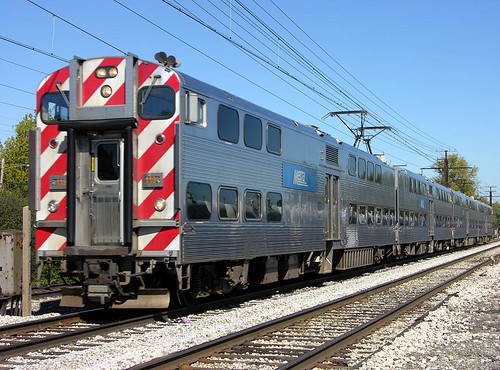
“At present there are no electric double-deck commuter cars that can legally operate on North America railway lines.”

What would they call these then? Or has this fleet been retired by METRA since 02?

In any case, nobody said they had to be EMUs, did they? (Although EMU would have its advantages, obviously).

It’s this sort of thing that makes one wonder about the accuracy of so much else Metrolinx produces, or of the (possibly unintentional) bias in their studies.

Union Station Revitalization Update

Disclaimer:  Although I am the Vice-Chair of Toronto’s Union Station Revitalization Public Advisory Group, this article represents my own opinions, not necessarily those of USRPAG who have not had a chance to discuss this matter since the release of the report linked below.

On June 2, Toronto’s Executive Committee will consider a staff report recommending that the Union Station Revitalization project proceed at a total cost of $640-million.  This project is dependent on funding approvals from Queen’s Park and Ottawa which are expected to materialize over the coming months. Continue reading

Second Exits, Second Entrances

In response to modern fire safety codes, the TTC has an ongoing program to add secondary exits at many subway stations.  Note that these must be completely separate paths out of the station.  Two stairways leading to a common mezzanine count as one exit because a fire in the common area could block access to the surface from platform level.

As an example, the new exits at Broadview take a path up to the bus and streetcar loop that is not connected to the original path up to the main entrance.

Planning for most of the new exits had assumed that they would be “exit only” facilities as this makes them cheaper to build.  However, access to stations is improved if these exits can also be entrances.  To that end, changes are proposed for five stations.

  • College Station’s original proposed second exit was at Granby Street, one south of Carlton, east of Yonge.  The primary entrance for the station is constrained by existing buildings and cannot be made accessible with elevators.  Therefore, the second exit will be converted to a full entrance including elevators.  An alternative scheme involving connection to College Park is also under study.
  • Museum Station’s original proposal would have surfaced in Queen’s Park, but there is now a proposal for a connection to a new UofT Faculty of Law campus on the northwest corner of Queen’s Park.
  • Dundas Station will have an automatic entrance connection to the new Ryerson University development.
  • Dundas West Station has a rather odd history.  There has been a design for a full connection to GO Transit at this location for years, but for some reason, the TTC had scaled this back to an exit only arrangement.  Given the service GO (and the Air Rail Link) will run in this corridor, it deserves a proper subway connection.  The project is now in Metrolinx’ hands.
  • Wellesley Station will get a new entrance at Dundonald Street (one north of Wellesley).  The population density here is high enough to support two entrances, and this configuration will avoid passengers having to walk through a laneway to reach Wellesley’s main entrance from Dundonald Street and areas to the north.

Frankly, I can’t see why the TTC wouldn’t design second entrances (not just exits) right from the outset, and I hope that this will be the standard from now on.

Electrifying News for GO Transit

According to today’s Star, Metrolinx will today announce the commencement of a study of electrification.  Although this had been planned sometime in the future, the dates were vague depending on which report one read.  Indeed, GO seemed to be leaning more to continued diesel operation with a mix of local and express trains rather than using inherently faster electric trains for all services.

This is a great victory for the Clean Train Coalition who will release “The Better Move”, a response to Metrolinx’ Regional Plan, “The Big Move”, at a press conference on Wednesday (May 27).

The West Toronto Chapter of the Professional Engineers of Ontario plans to set up a subcommittee to study the electrification issue, and will hold a meeting on the evening of May 27.  Mike Sullivan from the Weston Community Coalition will be speaking.  The meeting is open to the public, but pre-registration is required.  For information, please see the PEO Chapter’s flyer.

SRT Extension Open House

The City of Toronto and the TTC will hold an open house for the proposed extension of the SRT:

  • Tuesday, June 2, 2009
  • 6:30 to 9:00 pm
  • Sts. Peter & Paul Banquet Hall, 231 Milner Avenue

This open house is described as part of the preliminary planning for an EA for this project.  One important outstanding issue is the question of vehicle technology, and this is far from settled.  For example, the current proposal included in the meeting notice (not yet available on the City’s website) shows a new yard east of Bellamy and Progress.  This yard would not be required if the line is built as LRT because it would share the proposed carhouse for the Sheppard East line.

Also, the station connection at Sheppard will be affected if both routes are LRT because a track connection for carhouse moves will be needed.

Whether these issues are addressed in the presentation materials on June 2 remains to be seen.

Another GO Transit Grade Separation Project (Updated)

Updated May 14:  The display panels from the April 22 open house are available on GO Transit’s website.

Original post from April 15:

Construction is already underway for the grade separation project at the West Toronto diamond, and the residents are mightly upset about the noise from pile driving.  This project will continue disrupting the neighbourhood until late this year.

GO Transit has announced a public meeting on April 22, 2009 that will kick off another project in the same area, this time to remove the diamond where the Newmarket Subdivision (Barrie GO line) crosses the CPR North Toronto Subdivision.

(Thanks to Vic Gedris for passing along a copy of the notice.)

Goodbye Metrolinx, Hello Metrolinx

Earlier today I learned that Bill 163, the act to amalgamate GO Transit with Metrolinx and dump the politicians from the new Board, is expected to pass third reading imminently with proclamation shortly thereafter.

This means that the planned Board meeting on May 15 will be the new, wet behind the ears, but ever so non-political board.  Whether they will choose to meet in public much less discuss anything of consequence remains to be seen.  The date is still on the Metrolinx events calendar, but a week is a long time in politics.