Weston Corridor GO/UPRL Approved, But With Conditions (Update 4)

Updated October 7 at 8:00 am:

Toronto Councillor Michael Thompson, who could not possibly be labelled part of Council’s left wing or a Miller loyalist, has written to George Smitherman, Minister of Energy and Infrastructure, urging that he pursue electrification immediately.  Many of the arguments in this letter echo those of critics of the Minister of the Environment’s approval of diesel operations in the Weston Corridor.

This places Smitherman, a possible mayoral candidate in Toronto, in an intriguing position.  Does he take a Queen’s Park view and parrot the standard line “clean diesels now, but electric maybe, someday”, or look to the election campaign and move to support Toronto Council’s view of the issue?  Thompson himself could be a mayoral candidate.

Updated October 6 at 10:35 am:

Interviews with Keith Brooks of the Clean Train Coalition are available online from CBC (select the item “Diesel Not Good Enough”) and from AM640 (select the item “Keith Brooks — October 5th”).

Updated October 6 at 10:10 am:

John Gerretsen, the Minister of the Environment, seems unable to stay “on message” when discussing electrification with the media.  On CBC and in the Globe, the Minister is quoted as saying that electrification is “too expensive”, and yet in a letter to Keith Brooks of the Clean Train Coalition, the Minister states:

“Many requests were made to require Metrolinx to electrify the Georgetown South Corridor. Metrolinx has committed to conducting a study to look at the best technology for the entire GO Transit rail network of the future, which is required before electrification of the corridor can be considered. I have reminded Metrolinx of its commitment to further study the possibility of electrification for the entire GO Transit rail line, which includes the Georgetown South Corridor. If the study results in information or recommendations that could have positive impacts on the environment, I expect Metrolinx to implement the recommendations as expeditiously as possible.”

Either electrification is too expensive, and should not be considered now, or it will magically become acceptable following the study.

If the Minister is making soothing statements to community groups, why doesn’t he make the same statements to the media?  Possibly because the “too expensive” excuse wouldn’t wash if there’s a study whose outcome may show that electrification is cheaper and better?

Updated October 6 at 6:55 am:

Brodie Fenlon at The Globe covers this story including comments from several of the community and government folks involved in this issue.

Tess Kalinowski at The Star has a short piece, and The CBC reports on the issue.  CBC radio coverage notes that John gerretsen, the Minister of the Environment says the approval will allow the diesel connection to the airport to open by 2015.  This is clearly in aid of the Pan Am Games bid, and an unanswered question is “what happens if we don’t get the bid”.  Has this project approval been railroaded [sorry about that] to sustain Toronto’s bid credibility?

The Minister is also quoted by the Star and CBC as saying that electrification is too expensive.  Does this prejudge the outcome of the very electrification study Metrolinx is about to undertake?  Why study a technology we have already rejected?  Are we seeing the real face of Queen’s Park’s “public consultation” here?

Original post: 

This evening, Ontario’s Ministry of the Environment announced that the Georgetown South GO project has been approved, but with conditions required to ensure that it meets claims for environmental improvements and mitigation, if needed, for any harmful effects.

The press release and detailed announcement of terms are available online.

In brief, the Minister requires that GO Transit and the Union-Pearson Rail Link abide by several conditions.  It is noteworthy that the UPRL is explicitly included because through much of the discussions, it has been treated as an off-limits deal between the federal and/or provincial governments and a private company, SNC-Lavalin, who would implement and operate the service. Continue reading
Will the RT become LRT? (Update 3)

Updated October 2 at 11:15 pm:

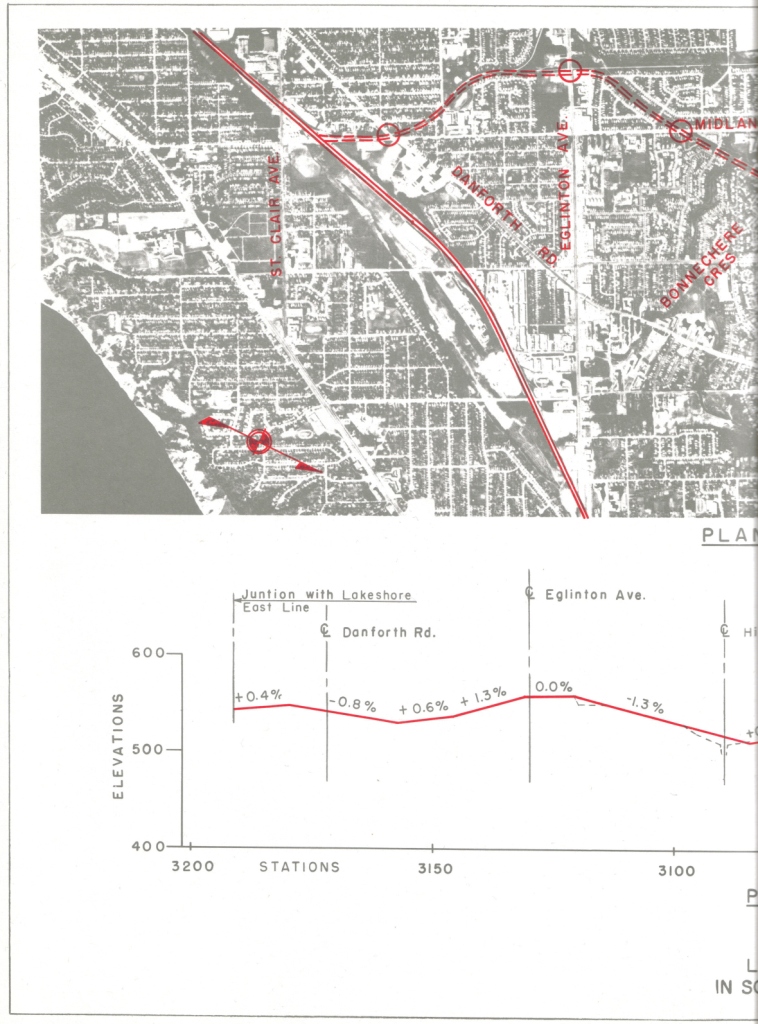
In the comments thread, a question has come up about the originally proposed alignment of the SLRT.  This dates back to the Metropolitan Toronto Transportation Plan Review (MTTPR) and a study of alternatives to the Scarborough Expressway.  One of these was an LRT line starting at roughly Queen & McCaul running east to the CNR Kingston Sub at Degrassi St., then northeast via the CN to Morningside Avenue.  A branch would run north from Scarborough Junction following mainly existing and abandoned rail corridors to the Scarborough Town Centre.

That branch eventually became the SRT, but was moved to follow the Uxbridge Subdivision because the old right-of-way used in the first proposal was very narrow.  As you will see from the maps, this is not the very wide Hydro corridor that crosses the SRT line, but a much tighter route.

To orient yourself, the Uxbridge Subdivision runs just below the top edge of these maps which have north to the right.

South Part
North Part

Updated September 30 at 4:50 pm:

Item SC 28.30, which requests the TTC and Metrolinx to report in November 2009 on an LRT implementation for the SRT, was passed today by Council.

Item SC28.20 was ruled out of order and withdrawn.

Updated September 30 at 12:45 pm:

This morning, in discussion of another Transit City matter on the Council Agenda, Councillor Thompson asked TTC Chief General Manager Gary Webster about the status of the Scarborough project.  Among other things, Webster replied that:

  • TTC now feels that LRT is the appropriate technology for the route and is working with Metrolinx to define the technology and scope for the Transit City projects generally.
  • The funding announced by Queen’s Park is not sufficient to carry the SRT north from Sheppard to Malvern.

The debate will continue this afternoon, but I suspect the items listed in my original post below will not be dealt with until tomorrow given their place on the agenda.

Original post:

Toronto Council’s agenda today, September 30, includes items of interest regarding the Scarborough RT (SRT) line.

Continue reading

Metrolinx Loves its Secrecy (Updated)

Updated September 30 at 4:30 pm:

This afternoon I received a note from the Project Director of the Electrification Study, Karen Pitre.  She concurs that the confidentiality agreement goes beyond what is necessary, and is preparing a revised version.

I hope to be free to report on the dialog at the workshop.

Original post:

Today, I received the agenda for an upcoming “stakeholders’ workshop” regarding the GO electrification study.  In the same email, there was a gentle reminder that I must sign a Conflict of Interest and Confidentiality Agreement to participate.  Continue reading

Metrolinx Fudges Clean Train Info

As I reported here recently, Toronto’s Medical Officer of Health, Dr. David McKeown, criticized the Metrolinx plans for substantial increased diesel train operation in the Weston corridor.

Subsequently, the MOH issued a revised critique in response to updated information from Metrolinx.  In this, he retracted three claims made in his original letter:

  • Unacceptable lukemia risks are no longer predicted.
  • Although local concentrations of some contaminants are predicted to rise, the MOH no longer feels that Metrolinx is underestimating the local outcomes.
  • Similarly, acute health risks are predicted to rise, but the increase is not underestimated my Metrolinx.

However, the MOH goes on to say:

Notwithstanding the above, I remain concerned about the air quality impacts and increased health risks predicted for the immediately adjacent communities as a result of the proposed diesel expansion.

In the “Information Clarification” Metrolinx has described potential air quality and health impact mitigation measures, including improvements to locomotive stock. While these mitigation measures would reduce emissions, it is not clear what level of reduction will be achieved in local ambient air concentrations of the respiratory irritants for which increased risk is predicted.

On its home page, Metrolinx lists the three bullets above, but without the qualification.  Metrolinx goes on to claim that the MOH’s revised opinion includes:

As an alternative to electrification, other mitigation measures proposed by Metrolinx may, subject to demonstration, be acceptable.

In fact, Dr. McKeown’s letter actually says:

In its additional information Metrolinx also indicates that it is exploring alternatives to diesel train technology, including electrification. In my view, electrification is the option that most clearly addresses the air quality and health impacts predicted from the proposed project for populations adjacent to the line by ensuring that any emissions (due to electrical power generation) are regional in nature. Whether other measures proposed as part of a comprehensive mitigation strategy could reduce the predicted air quality and health impacts to an acceptable level remains to be demonstrated.

Metrolinx not only misrepresented the MOH’s position, but blanketed the Weston Corridor with flyer reiterating the claims made on their website.

Today, as part of the Clean Train Coalition‘s protest march, Dr. McKeown took the unusual step of attending a public rally.  At that rally, he said:

What we know about air pollution in Toronto is that any proposal now should pass a very stringent test before it goes forward. This proposal has not passed that test in my view. The study, conducted by Metrolinx itself, indicates clearly that there will be impacts on air quality as well as health risks for those that live close to the line.

Additional information on the rally can be found at the Star’s website.

Metrolinx really needs to stop spinning this issue.  They have created an electrification study, an advisory committee to recommend terms of reference for that study, and are about to have a “stakeholder consultation” where folks like me can contribute their input to the advisory committee.  Electrification of the Lakeshore corridor is already part of the Premier’s announced plans for GO Transit.

Why is Metrolinx trying so desperately to win a battle between the community and the Minister of the Environment?

More Follies With Station Signage

The Cumberland Street entrance of Bay Station re-opened recently at long last.  Construction had been delayed by unexpected conflicting structures when the old entrance was demolished.

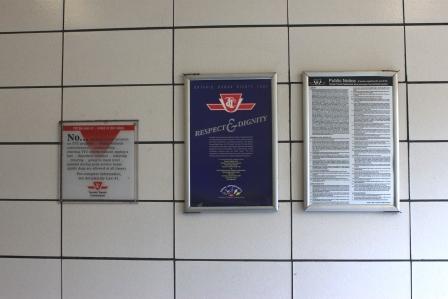
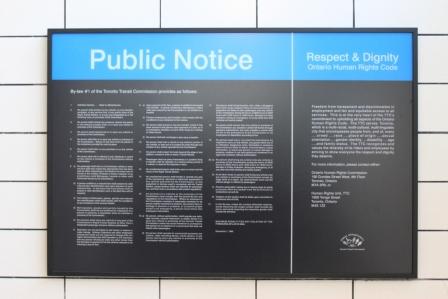
It’s a nice entrance, as TTC buildings go, but something very odd shows up in the decor.  At the bottom of the entrance stairway, we find not a beautiful mural, not an historic account of Yorkville, not even ad advertising frame, but a copy of TTC Bylaw No. 1 at very large scale.  This is no cardboard throwaway, but a metal sign built to last the ages.

IMG_0358C

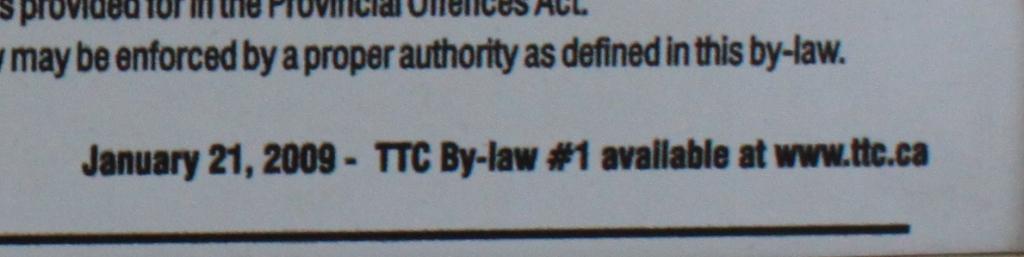
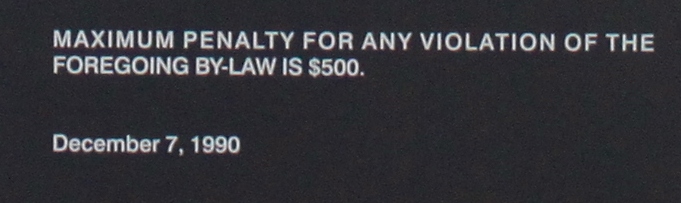
There’s only one tiny problem:  the date.

IMG_0358C2

In fact, the TTC Bylaw was updated in 2009 as we can see by visiting the Bellair Street entrance.

IMG_0362C

Here, we have the same info as on the Cumberland panel (the Human Rights statement and the Bylaw), plus a “here’s the bylaw stuff you really need” sign.  However, this is the new bylaw from January 2009.

IMG_0363C

I have been advised that the Cumberland panel will be replaced.  Why did this happen in the first place?  What is so important about the bylaw that it deserves pride of place on a wall that could have held a decoration appropriate to the neighbourhood?  Why was a sign installed with text that was replaced 8 months earlier by a new and substantially revised bylaw?

There is a move afoot to set up a website where people can report signage foul-ups.  It may be hosted here, or maybe elsewhere.  Once this is in place, I will publish the details.

Landmarks Vanish! Tourists Mystified!! (Update 2)

Updated September 22 at 9:50 pm:  According to this evening’s Global news, the TTC will pull the offending maps tonight from all stations.  Now may be your last chance to photograph your favourite blunder.  Mind you, considering how fast the TTC is at taking down out-of-date notices, I suspect the “bad” maps will be around for awhile.

It will also be intriguing to see if, when the new maps are installed, they actually do update all of them in every station.  I found four of elderly vintage without looking very hard yesterday.

Meanwhile, the Star managed to publish an annotated version of the St. Andrew map which shows City Hall where Osgoode Hall actually is, and the CN Tower at the corner of John and Front, north of the rail corridor.  I suppose a paper with its offices in the 905 can’t be expected to know much about downtown Toronto any more.

Finally, I strongly urge that the TTC circulate the new maps for comment to ward Councillors’ offices who might actually know where things are in their respective neighbourhoods.  Even better, as some have suggested in the comments here, put them online so that the vastly better-informed transit amateurs can help out with the project.

Continue reading

The Discovery of a Transit Agenda

The Toronto Board of Trade recently issued a press release calling for a permanent national transit funding strategy.  Included in the release is a list of Ottawa’s spending promises in the GTA, although notable by its absence is comparable information for Provincial or Municipal shares in these projects.

As regular readers here will know, I have my doubts about the viability of a national funding scheme specifically because of this unpredictability and the inevitable three-way fights that arise over funding and eligibility.  If Ottawa is to be part of transit funding, I agree that this needs to be on a permanent basis and with a formula that transit agencies can rely upon to plan their long-range budgets.  Project-based funding is at the whim of day-to-day policy and politics.

Later this month, the Board of Trade has a session about Vancouver’s Transit Revolution and the wonders that innovative financing can bring.  For a more jaundiced view of the Vancouver situation, visit Stephen Rees’ blog.

Meanwhile, the Canadian Urban Institute will present Designing Transit Cities on November 19-20, 2009.  This will include a free public session in City Council Chamber on the evening of November 19, and a number of paid-entry sessions on November 20.

This program is co-sponsored by the City of Toronto, the Toronto Society of Architects, the Cities Centre at UofT, the TTC and Metrolinx.

Oddly, these “Canadian” organizations have assembled guest speakers all from the United States.  What does this say about their perception of Canadian planning?

There is supposed to be a separate website at www.transitcities.org, but it leads right back to the main CUI page with no additional info.

With two major organizations publicising the importance of transit to urban areas, I can’t help wondering how their programs, not to mention those of would-be mayoral candidates, would differ from and improve on transit plans already in place.

Weston Community Coalition Slams Metrolinx Corridor Study

The Weston Community Coalition today released an extensive critique of the recently completed Metrolinx study of the Georgetown South corridor.  This document, a letter to the Minister of the Environment, urges the Minister to reject the Metrolinx study, demand a full review and require that the project be designed and operated as an electrified service from the outset.

I will not repeat the WCC’s arguments in detail here, but they include documentation of a long history of misleading and contradictory statements by project proponents, serious concerns about emissions, noise and vibration studies, and an overall sense that the process of public consultation has been window dressing around an already-decided outcome.

In the interests of full disclosure, please note that I have worked with the WCC in preparation of this and other materials, and helped to review and edit this critique.  While there are individual comments with which I may disagree, the overall document is quite good.

This is not, as so often has been claimed, a case of NIMBYs standing in the way of progress, but of government agencies bent on ignoring the effects of their work and thwarting the spirit of “environmental” assessments.

The decision now rests with Queen’s Park.  Will they bravely move into a future of electrified commuter rail on GO Transit, or will they obfuscate issues and avoid real debate?  What record does this government want to have in the history books?

Sometimes Repairs Take Longer Than Expected

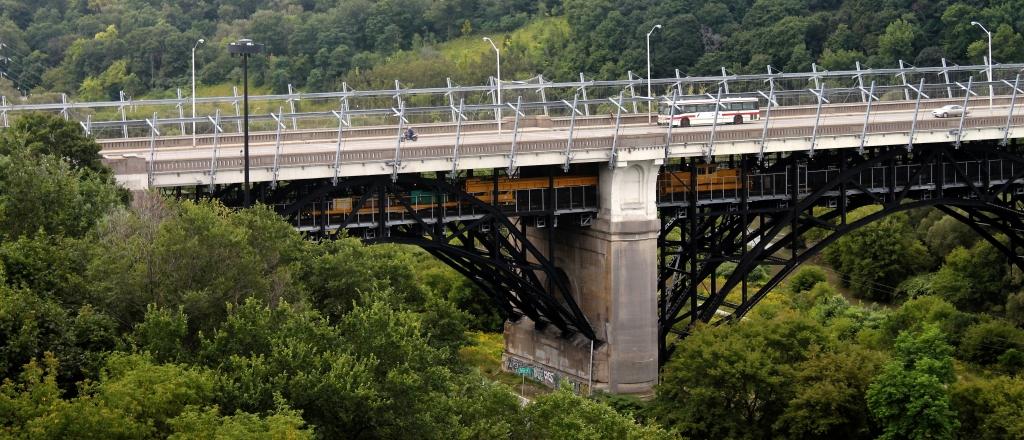
This morning, I was happily working away when what should I hear, but the familiar blast of the horn on the work train that maintains the Prince Edward Viaduct.  One small problem.  It’s 9:50 am and the subway should be running by now.

Was there a service interruption notice?  No.

Memo to Brad Ross at the TTC:  We keep hearing about the new staff and all the wonderful things that will happen with notices regarding service.  When?

IMG_0037E1V3CC

Transit City Bus Plan: Surface Routes Matter (Update 2)

Updated August 28, 2008 at 8:15 pm:

At its meeting on August 26, the TTC adopted the Transit City Bus Plan with a few amendments:

  • There will be a 6-month communication and consultation period  regarding the proposed plan.
  • Staff will report back on criteria for inclusion of routes in the plan so that these can become part of the formal Service Standards policy.
  • Staff will report back on headway-based rather than schedule-based management of routes with frequent service including those in the Plan.

As I was out of town for this meeting, my comments were submitted as a written deputation.

Updated August 23, 2008 at 8:45 am:

I have added information at the end of this article about streetcar and bus route headways illustrating some of the issues raised here.

Original article:

Today, the TTC published its Transit City Bus Plan, the next step in an ongoing attempt to focus attention on the transit system overall, not just the subway projects.

I would like to report wild enthusiasm about this plan, but we will have to drop the “wild” part, and think of enthusiasm tempered by disappointment.  The TTC is headed in the right direction, but with compromises.  In a constrained economy, compromises are necessary, but so are the bolder strokes giving politicians and the public at least the option of moving faster should they wish to.  That was the whole concept of the Ridership Growth Strategy (RGS) to which the bus plan is a successor.

The report linked above contains both an Executive Summary and a detailed set of proposals.  I will skip over the summary and comment on the main report. Continue reading