In the first part of this article, I looked at the origins of Transit City. Here, I will turn to that plan’s various components and to other transit schemes that have some or all of their funding in place. Continue reading
A Grand Plan
Transit City Revisited (Part I)
Transit City and transit in general are much in the political news thanks to one mayoral candidate’s declaration that there would be a moratorium on additional routes among other changes at the TTC. Christopher Hume’s column in the Star gives an overview of the landscape.
In the midst of TTC problems from lousy customer relations to service reliability, from Enbridge cutting into the subway tunnel to a maladroit handling of the recent fare increase, everyone needs to step back a moment and divorce the TTC from the politicians.
Transit City has many good points, and they need to be reinforced, not simply tossed aside as part of the anti-Miller rhetoric brewing in some campaign offices and newspapers. Transit City isn’t perfect, but the map may as well be cut into stone tablets rather than being a living document to hear some of its supporters. Such inflexibility undermines the plan itself.
There’s an odd parallel to Metrolinx’ Big Move plan. Metrolinx claims that their plan is a work in progress, but just try to criticize it, try to suggest changes, and their professed love of public input evaporates. Transit City isn’t quite as bad, and we are at least having some public feedback through the Transit Project Assessments. However, some fundamental changes are needed.
Before I talk about the plan, it’s useful to see where it came from. Continue reading
Put Transit City On Ice: Rocco Rossi (Updated)
At the Empire Club today, Mayoral candidate Rocco Rossi proposed that all of Transit City, except for the Sheppard East line, be put on hold pending a financial review.
Rossi may not be familiar with local issues, but he should at least know that Queen’s Park (and, for Sheppard, Ottawa) is paying for these lines, not the City of Toronto.
There are issues with Transit City about which I will write in coming days, but stopping the projects is hardly the correct approach. It smacks of simplistic anti-Miller campaigning — whatever David Miller did must be wrong and so we’ll stop, or at least slow down, the plan.
I will be generous and assume that the candidate may be badly advised, but this is the second gaffe of Rossi’s platform (the first is the proposal to sell Toronto Hydro), and I can’t help thinking he’s headed for an electoral graveyard.
Updated 11:30 pm: I am advised that Rossi is aware of funding from other levels of government, but is concerned about future operating costs. He might start by looking at the extension to Vaughan which is expected to increase net TTC operating costs after any incremental fare revenue by well over $10-million annually when it opens. The projected riding north of Steeles Avenue is lower than on the Eglinton LRT.
A Post Mortem for St. Clair’s Construction
The January TTC agenda includes a report about the lessons learned from the St. Clair construction project and their implications for work on Transit City.
While it is refreshing to see anything the TTC does held up to the cold light of review, I can’t help feeling that the tone avoids the question of why this project ran out of control for so long. The covering report states:
TTC considers the St. Clair Streetcar experience as an important stepping stone in the evolution of LRT in Toronto which began with the Spadina LRT, then Harbourfront LRT to the St. Clair project. This invaluable experience is an important guide in the delivery of the Transit City program.
That’s not saying much. Toronto has now built three pseudo-LRT lines over two decades. The first, Harbourfront, is due for a major redesign with the reconstruction of Queen’s Quay. That line also features a connection at Union that was woefully inadequate for the demands placed on it, despite claims to the contrary by TTC engineers.
The Spadina LRT, a scheme that took 25 years from proposal to implementation, was a bit better, but like Harbourfront, still suffered from traffic signal timings that favoured road over transit operations. This has still not been fully addressed even though the line opened in 1997.
Much was expected for St. Clair, a chance to “get it right”, but this project was plagued by:
- conflicting and changing demands for the use of road space
- a design process that produced detailed plans too late for proper public review (they appeared while the work was already out to tender), and that inevitably led to construction periods spanning winter months
- a construction process involving multiple agencies and contractors with nobody in overall control
St. Clair did not “get it right”. Now that the line is open to Lansdowne, we can see just how appallingly the TTC manages service on a route where there is no excuse for chronic bunching, wide gaps and short turns. This comes just as the TTC attempts to gain credibility for Transit City as an improvement in suburban transit services. St. Clair is not a shining example. Continue reading
Will Broadview Station Ever Be Finished? (Updated)
Update: As of January 15, 2010, the signs around the closed stairway have been updated to give an opening date of “May 2010”. The signs pointing to these exits are still uncovered and lit, causing people to head for them only to discover that they are closed.
Original post from January 6: Continue reading
When Things Go Wrong (1) (Updated)
CBC Radio 1 will be looking at the issue of TTC customer service starting on Monday, January 11, and I will be on Metro Morning dark and early sometime before 6 am.
Updated January 11: The Metro Morning interview is now available online.
The chats with story producers got me thinking about the TTC’s eAlert system as well as other sources of information. Knowing we won’t possibly cover all the details in a short interview, and that other aspects of the discussion will certainly come from readers here, I have started this thread.
A long-standing complaint about TTC service is that nobody knows what is going on. At the best of times, one might peer into the mists on Queen Street and hope that somewhere there is a streetcar, or listen down the subway tunnels for the familiar rumble of a train. Far too often, the TTC is not at its best, and the lack of information can drive people into a fury, one that may be visited on hapless TTC staff who are no better off than the rest of us.
The TTC’s website can be hit-or-miss depending on whether it is being updated regularly. For example, the 501 Queen car’s route description was not changed back from the Shaw/Parliament split until quite recently (thanks to feedback from a reader on this site). However, the 512 St. Clair route description gives no hint of the split streetcar/bus operation.
Diversions pose a special challenge because some are implemented thanks to emergencies such as fires or major collisions, but the most annoying are those implemented locally by the route management team, and not reflected on the website or on notices at bus and car stops. The 41 Keele (local) service is diverting around construction at St. Clair southbound, but it took a few weeks for this to show up online, but only in the route description. The schedule page and map still show the route running via St. Clair, and you can look up times for a stop that in fact has no service. The info is on the “Diversions” page, but there is no alert on the route’s own page to indicate that readers should also consult the diversion information.
The subway, the main target of this article, has additional information sources for would-be riders, although all of these can be quite frustrating.
If you are at platform level, and your station has a working video screen (dead screens are becoming common), and you’re standing close enough to read it, and Transit Control considers a delay to be serious enough to put up a notice, then you have a fighting chance of discovering that something is amiss. There may even be PA announcements, but they tend to occur only for very long-running delays. (As I write this, there is no subway service east of Victoria Park, and info about this comes over the speaker systems regularly. It also appears on the “Service Advisories” on the TTC website.)
If you are anywhere else, and you have cell/internet signal, you may get information from various sources:
- The TTC’s eAlert service (via email)
- The TTC’s Facebook page (via SMS)
- Twitter feeds, some from TTC sources, available via the TTCUpdates community page (not a TTC site)
I get both the eAlerts and the Facebook updates, and compiled a log of information from both sources. My apologies to those who don’t like “busy” displays as there is a lot of info consolidated in one place. Continue reading
Streetcars for Toronto: 1952 (Updated)
Updated January 8 at 7:30 pm: Links have been added at the end of this article to Transit Toronto’s site.
Back in 1952, the TTC was about to open its first subway line and was contemplating the future of the streetcar system. Options included rehabilitation of its Peter Witt car fleet as well as the acquisition of more PCC cars.
By that time, new PCCs would be expensive as the market for them had more or less disappeared thanks to the onslaught of bus conversions in North America. However, many used fleets, some quite new, were on the market and Toronto was quick to snap them up.
A fascinating report to the transit commission dated June 3, 1952, was written by W.E.P. Duncan, Operations Manager, and it recommends among other things the acquisition of used streetcars from Cleveland and Birmingham.
This report is also interesting for what it tells us of demands on various major routes and the number of streetcars assigned to each line. The Bloor route, carrying 9,000 per peak hour/direction, would require 174 cars. Today’s network requires 192 cars in total, of which 38 are ALRVs. Demands have changed quite a lot.
The report includes strong language about the retention of streetcars, not a common approach in the 50’s.
There is obvious justification for the abandonment of streetcars in smaller communities but the policy of the abandonment of the use of this form of transportation in the larger communities is decidedly open to question. In fact it is hardly too much to say that the results which have occurred in a good many of these larger cities leaves open to serious question the wisdom of the decisions made.
It may be not wholly accurate to attribute the transit situation in most large American cities to the abandonment of the streetcars. Nevertheless the position in which these utilities have now found themselves is a far from happy one. Fares have steadily and substantially increased, the quality of the service given, on the whole, has not been maintained, and the fare increases have not brought a satisfactory financial result. Short-haul riding, which is the lifeblood of practically all transit properties, has dropped to a minimum and the Companies are left with the unprofitable long hauls. Deterioration of service has also lessened the public demand for public passenger transportation. The result is that the gross revenues of the properties considered, if they have increased to any substantial degree, have not increased anything like the ratio of the fare increases, and in most cases have barely served to keep pace with the rising cost of labour and material. It is difficult to see any future for most large American properties unless public financial aid comes to their support.
These facts being as they are, Toronto should consider carefully whether policies which have brought these unfortunate results are policies which should be copied in this city. Unquestionably a large part of the responsibility for the plight in which these companies find themselves is due to the fact that the labour cost on small vehicles is too high to make service self-sustaining at practically any conceivable fare.
Why then did these properties adopt this policy? It is not unfair to suggest that this policy was adopted in large part by public pressure upon management exerted by the very articulate group of citizens who own and use motor cars and who claim street cars interfere with the movement of free-wheel vehicles and who assert that the modern generation has no use for vehicles operating on fixed tracks but insists on “riding on rubber”. If there is any truth in the above suggestion it is an extraordinary abdication of responsibility by those in charge of transit interests. They have tailored their service in accordance with the demands of their bitter competitors rather than in accordance with the needs of their patrons.
Two important points made here still apply today.
First, the importance of the short-haul rider. These are the cheapest to serve. In the flat-fare environment of the 50’s, they would also yield the greatest revenue per passenger and were most sensitive to quality of service. We know this today — people love the ability to jump on a vehicle for a short trip provided that they don’t have to wait very long for it. If they can walk faster, they do, but deeply resent the poor service.
Second, is the attitude that motorists should not be catered to as fellow users of the road. Transit should not adjust to accommodate them, but should address them as rivals. In today’s context, this churns up the “war on the car” rhetoric, and the days when transit could demand precedence are long gone. All the same, transit gives up too easily too often because politicians talk a good line about priority measures but go to great lengths to avoid hurting motorists.
The plan set out in the report set the stage for the eventual elimination of streetcars by 1980 on the assumption that the major routes would be replaced by at least one of the Bloor or Queen subways, even though the latter would be initially operated with streetcars. This leads directly to the suburban rapid transit plan of 1969, described in the previous article.
Updated January 8:
For an excellent article on the many sets of second-hand streetcars acquired by the TTC, please see Transit Toronto’s site. The two photos linked below are also on that site.
Photo of a train of two ex-Cleveland cars westbound on Bloor entering the transferway at Bloor Station (where, until recently, Bloor street widened out for the streetcar station removed after the BD subway opened in 1966). A train of ex-Lousiville cars passes eastbound. The westbound train is a Danforth Tripper headed for Bedford Loop (now St. George Station and the OISE building).
Photo of a train of two ex-Louisville, ex-Cleveland cars on Bloor Street at Bedford from Transit Toronto. These cars were ordered by Louisville, but the city abandoned its streetcar system before they were delivered. Cleveland bought them, but later in the throes of abandonment itself, resold them to the TTC who acquired almost-new cars at a very attractive price.
Once Upon A Time in Scarborough
Over the years, I’ve taken a lot of flak about LRT proposals for Toronto. Some folks imply that I am personally responsible for leading one or more generations of politicians astray, and that LRT is an invention of my very own with which, like the Pied Piper, I have lured the city away from its true destiny, a network of subways and expressways.
That is an exaggeration, but there are times I wonder at the powers claimed for me, and wish I had taken up a career as a paid lobbyist.
In fact, there was a time when the TTC was considering a suburban LRT network of its own, one that bears some resemblance to plans we are still discussing today, four decades later.
To set the stage, here is an article from the Globe and Mail of September 18, 1969 about the new life Toronto’s streetcars would find in Scarborough. Included with the article was a photo of a train of PCCs on Bloor Street at High Park, and a map of the proposed network.
The TTC’s hopes for streetcars on their own right-of-way are a bit optimistic, and it’s intriguing how the ranges seen as appropriate for various modes have all drifted down over the years. All the same, it was clear that the TTC had an LRT network in mind and was looking eventually for new cars for that suburban network. It didn’t happen, of course, because Queen’s Park intervened with its ill-fated high-tech transit scheme.
A few things on the map are worth noting. North York and Scarborough Town Centres are still “proposed” as is the Zoo. There is a proposed Eglinton subway from roughly Black Creek to Don Mills, and the proposed Queen Street subway turns north to link with the Eglinton line and serve Thorncliffe Park. The network includes links to the airport from both the Eglinton and Finch routes.
I didn’t invent this plan, and Streetcars for Toronto was still three years in the future. Somehow, the TTC and Toronto lost their way, and what might have been the start of a suburban transit network, years before the development we now live with, simply never happened.
Still Waiting for Airport Rapid Transit
Wandering through my files, I ran across a clipping from the Toronto Sun dated November 28, 1990. (Note to the Sun folks — if you want to holler about copyright, I will cut this down to quotations.)
Pearson LRT link still up in the air
By Ian Harvey
A rapid transit link to Pearson International Airport may take until the next century to get off the ground.
The province and federal government have jointly commissioned a $400,000 study into transit links but Ontario Minister of Transport Ed Philip says no timetable or priorities have been established.
One of the options being considered is to relocate the CN Rail track which currently runs past the airport. That is being proposed as more efficient than running spurs off the line, which also carries the Georgetown GO Train and some VIA trains.
But moving the line would be expensive and could involve problems getting rights-of-way.
A more ambitious plan calls for a TTC Light Rail line to the airport from Eglinton Ave. and Hwy. 427.
However, that plan depends on construction of a $1.2-billion line from Spadina to Hwy. 427 along Eglinton Ave. W. from the Spadina subway line.
TTC general manager Al Leach said the Eglinton LRT line might not be completed by the end of the decade because it is competing with eight other projects for funding.
“There is no time frame” for the airport link, said Philip. “We expect draft proposals by the spring. I’m not going to set any timetable until I see the report.”
[“LRT” in this article refers to the RT technology in Scarborough.]
Those with good memories will know that late 1990 saw the beginning of the Bob Rae NDP government at Queen’s Park, and their approach to transit was to build as much as possible, whether we needed it or not, as a job stimulation scheme. The fact that subways have a very long lead time — when mainly planners and engineers make all the money — shows up in the fact that so little was actually built. Mike Harris could easily cancel projects that barely had a shovel in the ground.
Now it’s 2010, and current plans will get the airport link to an Eglinton line by 2020.
Don’t pack your bags yet.
History of the Dundas West GO Connection
From time to time in the Georgetown South Corridor debate, the issue of a direct connection between Dundas West subway station and the GO platforms at Bloor station surfaces. Oddly enough, although a connection at this point for the Airport link would be quite useful, the usual “design” mooted is for a walking transfer via Bloor Street. This is bad enough for TTC-to-GO connections, but for Airport passengers with luggage, it’s a joke.
Since the late 1980’s, the TTC and GO have contemplated a direct link at this location, and provision for this was included in the property deal between the City of Toronto, the TTC and what became in time the Crossways Development. Nothing ever came of this in part because service on the Weston corridor was peak-only, and the cost was considered excessive for the potential use it would see. This situation is no longer true because there will be all-day service at least to Georgetown plus the Airport link, however it is implemented.
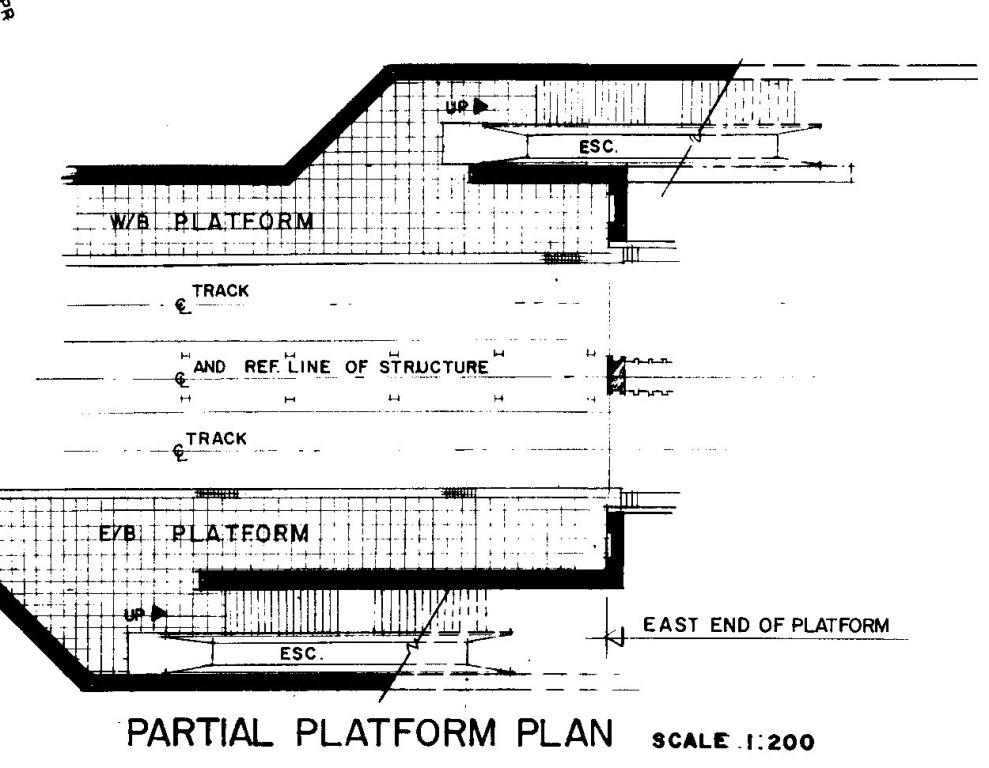
A preliminary design for the connection was done by TTC in April 1987. This design would require some revision today both to provide full accessibility (elevators) and to fit with the planned new platform arrangements at Bloor station on the rail corridor. In the interests of informed discussion, I have scanned the 1990 report on the history of this connection as well as the 1987 plan.
The report has been reformatted slightly, but the text is unchanged. The drawing has been split apart from four separate images on one large page for ease of viewing online.
TTC GO Connection Report
Key Plan of Stations
Subway Platform East End
Control Area of Connection
Section View of New Connection
 Steve Munro