The SRT As It Might Have Been

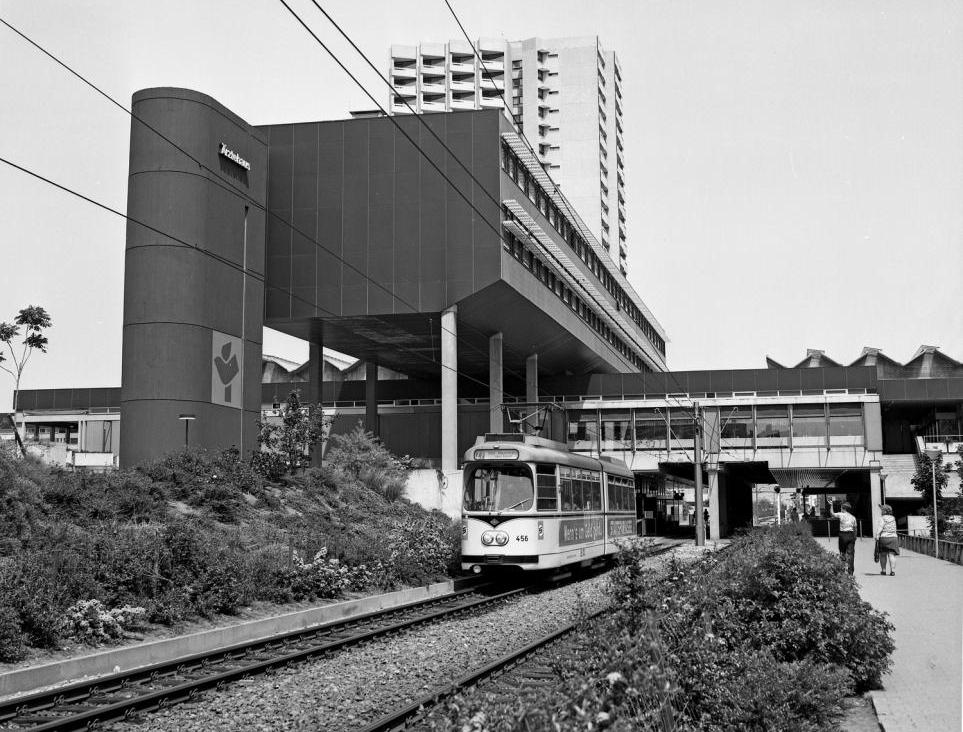
John F. Bromley sent me a photo of a new LRT line running through a commercial development.

Look familiar?  Can you say Scarborough Town Centre?

The photo is from June 1972.  The cars were the first in Europe to be air conditioned.

This shows the kind of thing done with LRT in Europe even before the TTC reversed its anti-streetcar policy, about the time Queen’s Park decided that we needed an “intermediate capacity” system midway between buses and subways, and before the TTC collaborated with Queen’s Park in destroying an LRT plan that could have been built 40 years ago.

How Clean Is My Station?

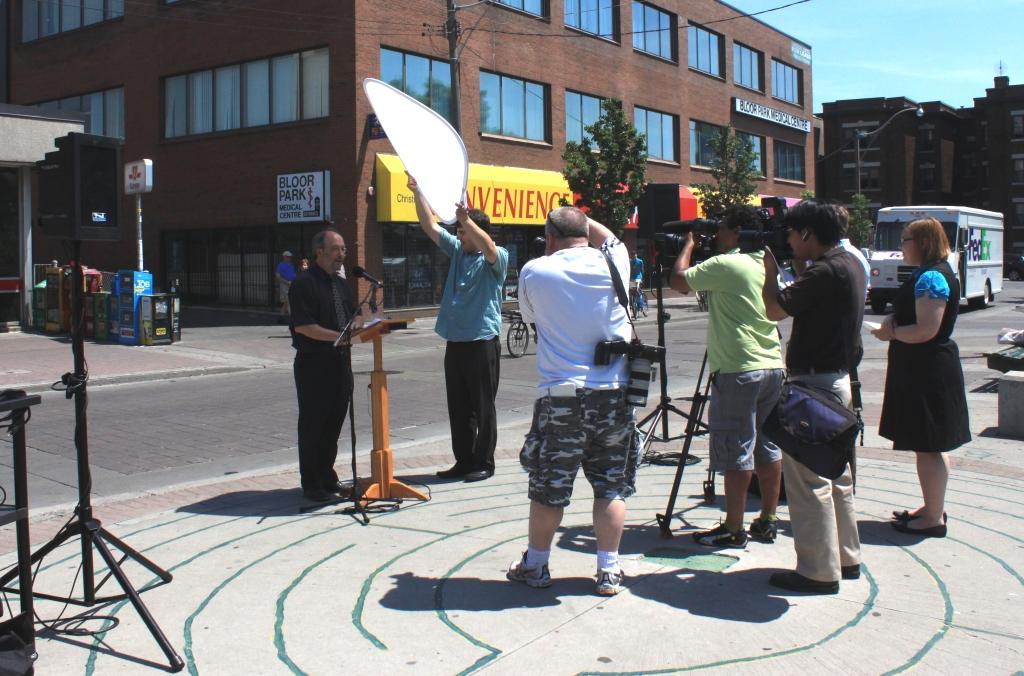
On May 27, TTC Vice-Chair Joe Mihevc staged a most unusual press conference at Christie Station.  The purpose?  To announce a new website, ttcpassengeraudit.com, where riders can report issues about the subway stations they use.

On July 17, 2010, volunteers who sign up for a specific station will audit their sites and post responses via an online form (available only in hard copy as I write this).  Topics to be reviewed include lighting, cleanliness, maintenance, way-finding, the station exterior and surroundings, safety and quality of ride (not strictly speaking a “station” related issue).

The need for customer-based reporting is an admission of failure in “official channels” to get things done.  Customers report lots of things to the TTC today, and some are even addressed, but many languish for months with no apparent action.  The TTC maintains web pages with information about escalator and elevator maintenance, as well as construction projects, but these cover the large, planned works, not day-to-day housekeeping.

Some issues, such as the long-standing closure of the “new” entrance to Broadview Station, are not listed on the TTC site at all.  (As a passing update, some work appears to be taking place, but very slowly, and the notices now claim the entrance will reopen by June 30, 2010.)  Riders should be able to get up-to-date information about the status of such projects online without counting on transit activists or Councillors to chase TTC staff.

The TTC hires an outside agency to audit its stations to give an unbiased view of what is happening.  Although there are goals for improvement, the index for the system as a whole inches up very slowly.  TTC claims that it is hamstrung by the availability of staff and things would be so much better if only there was a greater subsidy.  Whether the staff they have is properly managed and monitored is not discussed, at least not publicly.
The press conference was unusual in that it had no TTC official presence, and it was conducted, at least initially, outside of the station.  It was very hot, and Mihevc’s assistant Anthony Schein held a reflector to act as a parasol.

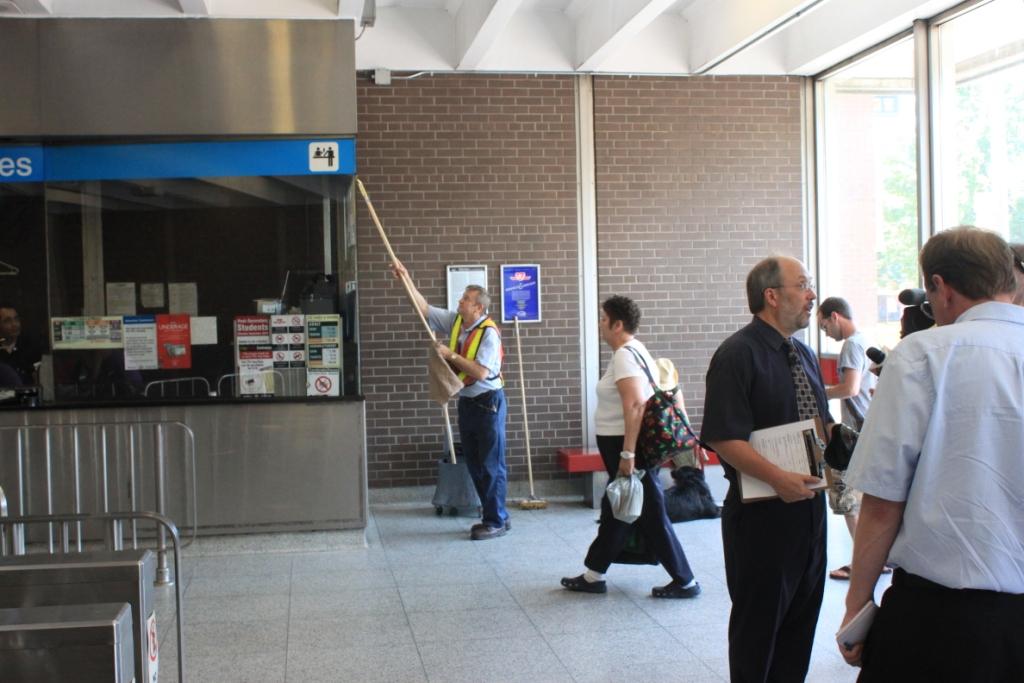
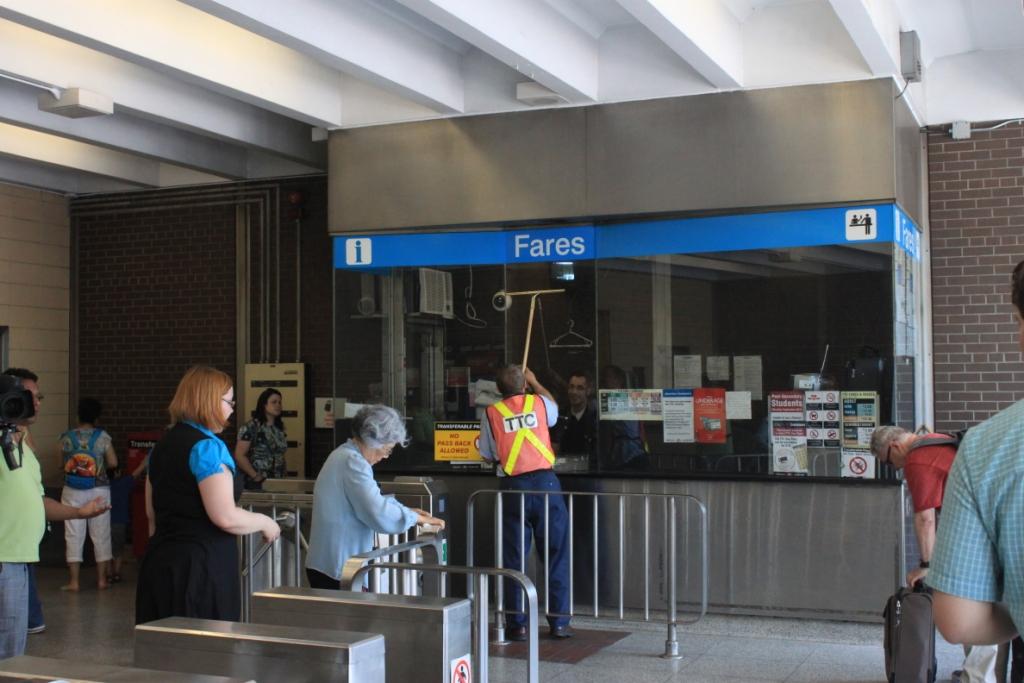
Later, we all moved inside, and things took quite an amazing turn.  Strangely enough, the TTC had two workers on hand cleaning the station.  I had seen one sweeping the platform when I arrived, but upstairs there was another.  As Joe spoke, the cleaner was washing the glass of the Collector’s booth.  I have been riding the subway since it opened, and I have never seen this activity.  Maybe I just don’t frequent the right stations.
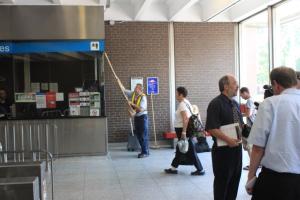
Note also that the signs in the booth window are all lined up.  If you look closely, you will see that only one of them is hand-written.

Meanwhile, elsewhere in the station, we have:
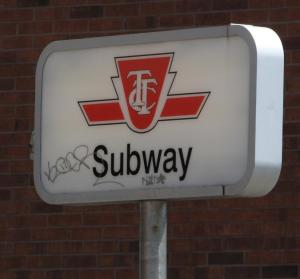
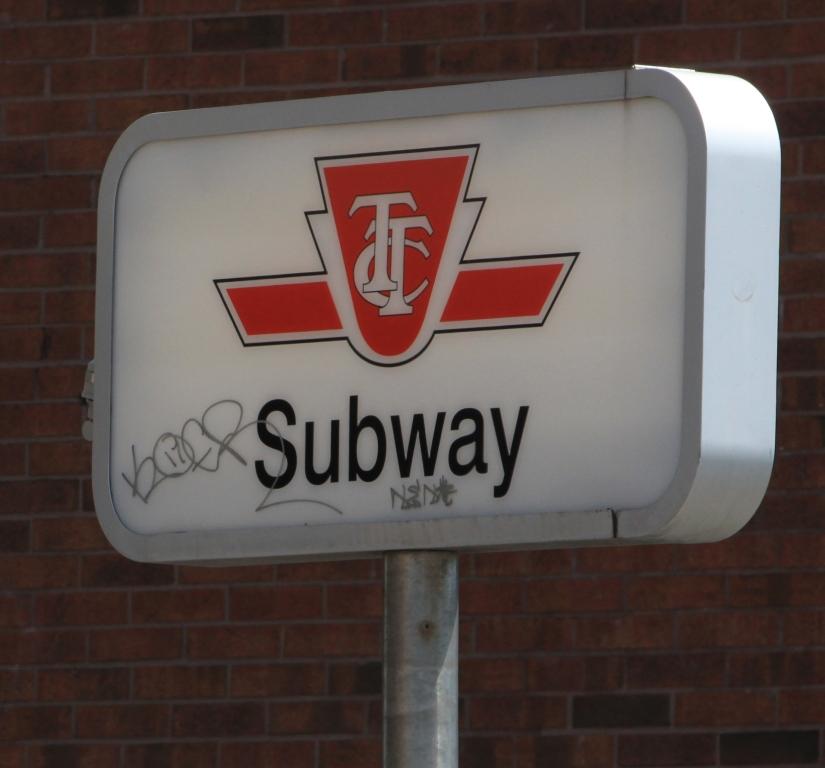
The entrance sign bearing a tag, and …
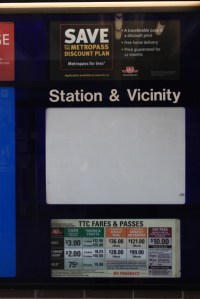
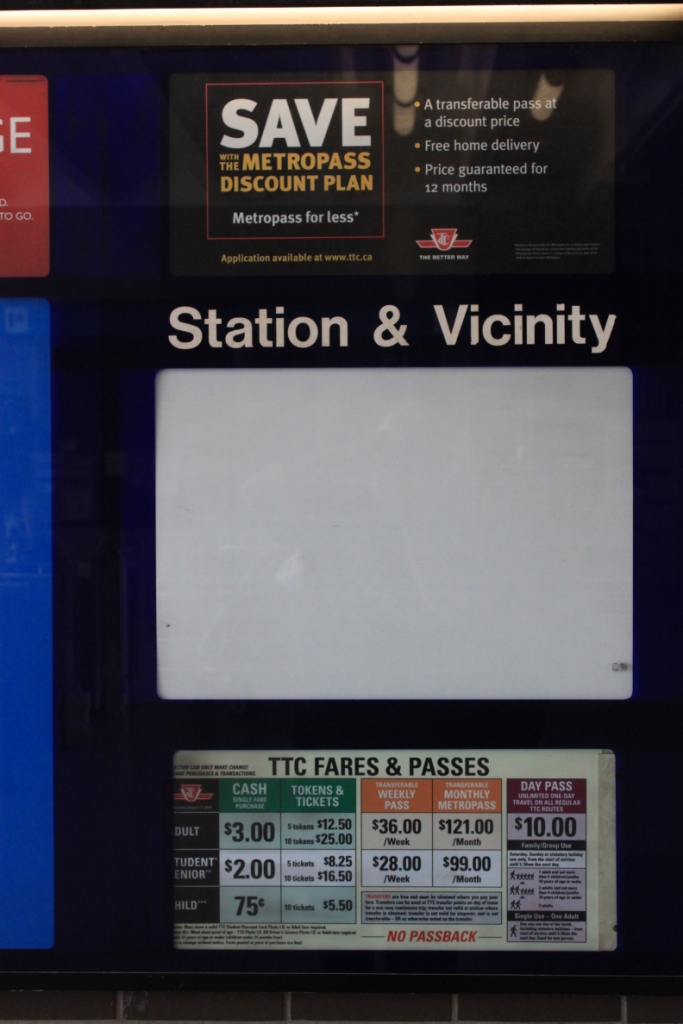
The long-missing vicinity map.  After the debacle of new and wildly inaccurate maps last September, maps that vanished in the blink of an eye once the problem was reported, the TTC assured us that new maps would be in place by November.  It is now May.

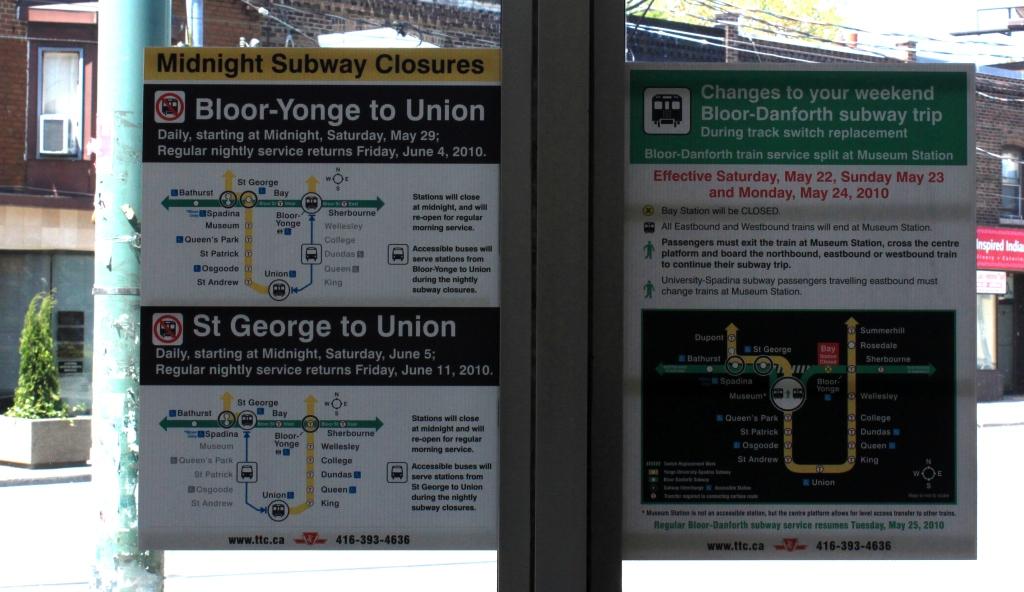
On the subject of removing and installing signs, the TTC has outdone itself in recent days.  An ongoing problem is that old signs are never taken down, they just fall down, eventually, after being vandalized, shredded, or just slowly crumbling off of the wall.  Last weekend, there was a subway diversion at St. George, and posters announced the temporary routing.  Starting this weekend, there are nightly shutdowns of parts of the Yonge-University line.  Signs for the new diversion were installed days after the St. George diversion ended, but the old signs remain in place.

At Broadview, main level, they are side by side.  At the mezzanine level, the St. George notice occupies pride of place at the foot of the main stairway in front of the newsstand, while the YUS notices are tucked away in corners.

Why is it not possible to take down out-of-date notices, especially when the space could be better used for current information?  How long will these two signs languish at my station?  Will we give a prize for the station with the most out-dated signs or maps?

For many years, I have urged the TTC to adopt a simple tactic I saw decades ago in Boston where all notices have a “stale date” and text at the bottom saying “Remove after xxx”.  Station cleaning staff take down old signs as part of normal housekeeping.  Somehow, this simple process is beyond the abilities of the best transit system in the known universe.

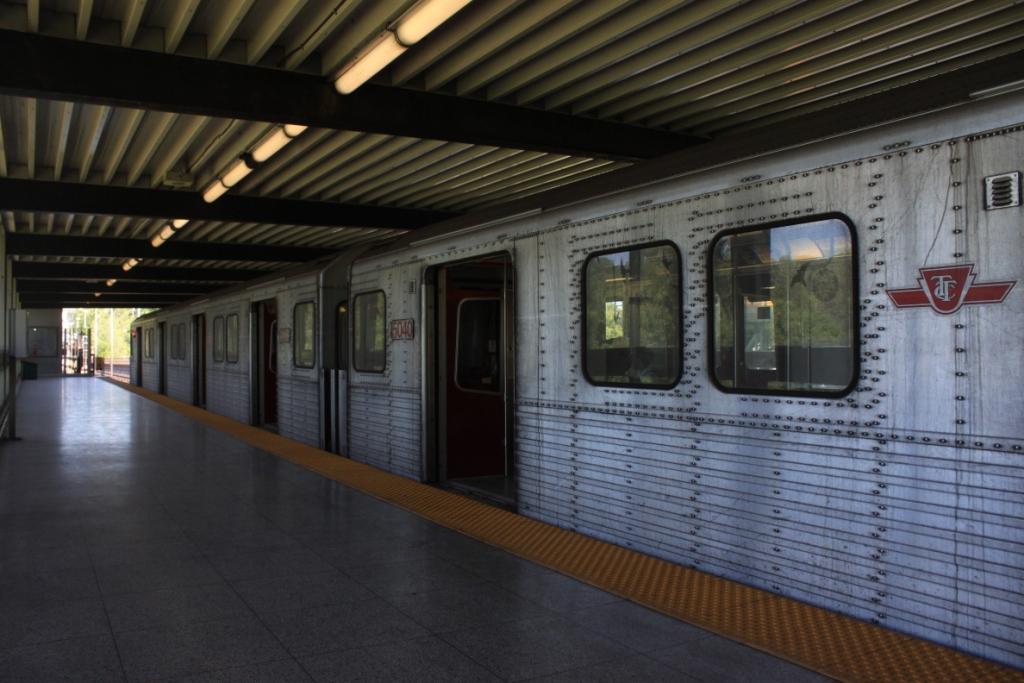
Riding over to Christie Station, I was on a train that was not just dirty, the exterior was black.  The fleet number on one car was covered with a tag, and many people had “finger painted” in the dirt on the windows.  Indeed, I started to notice how few cars did not have such “inscriptions”, and was astounded a day later to see a train that was almost gleaming, the only freshly-washed train I have seen in months.  The problem seems to exist mainly on the Bloor-Danforth line.

This train is fairly typical of BD-line equipment.  Dirt streaks run down from the roof, and although it’s not immediately obvious, the windows are coated with dust.  Our stations may be spotless, but from inside the trains, it’s like looking through a fog.
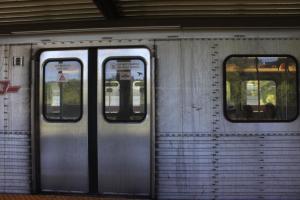
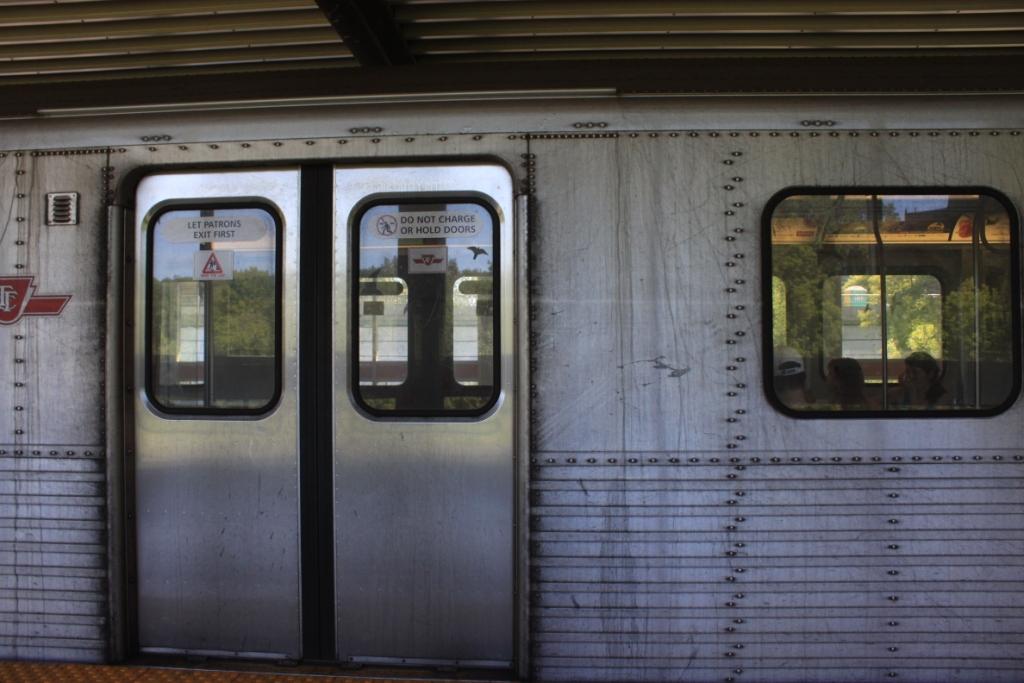
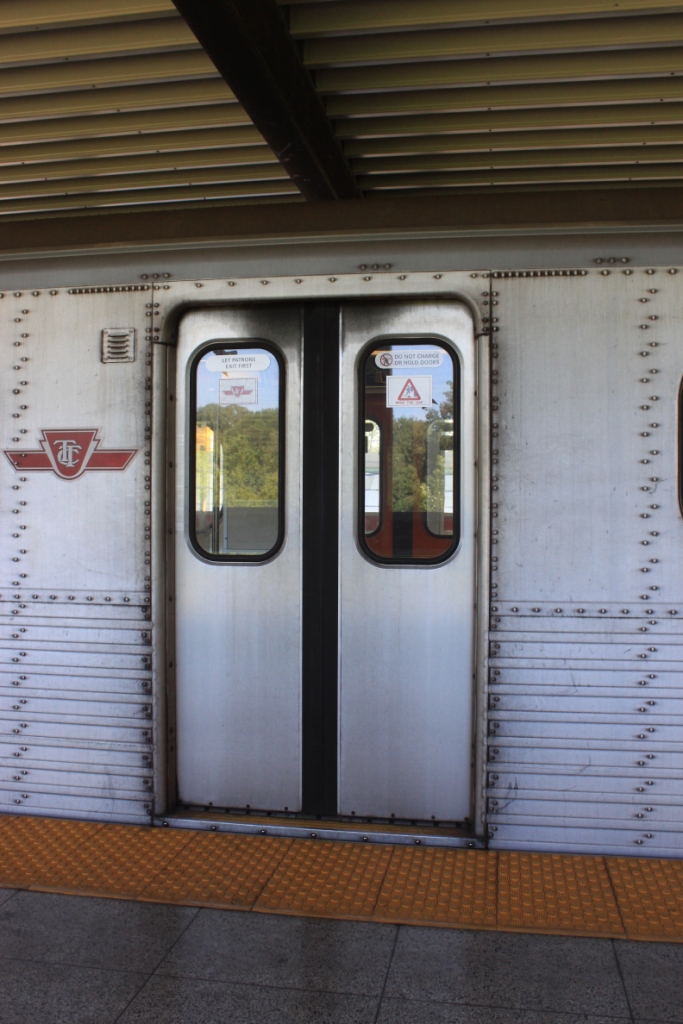
This car has beautiful clean, shiny doors.  That’s the colour the whole thing is supposed to be.  Maybe not mirror-bright, but a decent silver, not a shoddy imitation of pewter.
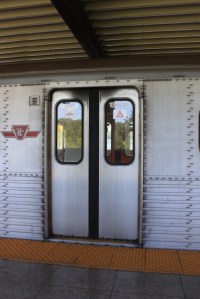
This shows a common problem with doors on cars that are somewhat cleaner than average.  There is an area at the top of the doors that simply doesn’t get scrubbed clean.

[Technical note:  These photos were taken in Old Mill Station using daylight that came in through the north window on a cloudless late afternoon.  You can see the exterior lighting condition in each of these photos, one way or another.]

Joe Mihevc wants riders to have a sense of ownership in their system.  At times, riding the TTC is like living in a run-down apartment building where I want the place to look nice, to be proud to bring friends, but the landlord has excuses for not doing anything.  There is even  plaque in the lobby congratulating him for the condition of his building.

When the TTC starts to care about its system again, when it stops using the “we need more money” excuse as a blanket response to every criticism, riders might really feel they are part of the TTC.

Metrolinx Board Wrapup for May 2010

The Metrolinx Board met on Wednesday, May 19 for an unusually long public session.  Rather than post separate articles, herewith a compendium report.  The major topics are:

  • The Board Speaks!
  • The Managing Director Reports
  • We Have A Vision, We Just Don’t Know What It Is Yet
  • Achieving 5 in 10, or Transit City Rescheduled
  • GO Rail Service Expansion Benefits Cases
  • A Question of Advocacy

The Board Speaks!

Probably the most astounding thing about this meeting, the first anniversary of the “new” Metrolinx, is that the Board members finally found their voices.  I was beginning to wonder if they were ever going to show some indication of earning their keep and actually asking hard questions of staff in public.  We’re not quite there yet, but at least the discussion gave an indication that the Board is thinking about its role.

As regular readers will know, I believe that organizations such as Metrolinx should be publicly accountable through an electoral process and through direct access to one’s representatives.  Boards that answer to nobody but the government which appointed them, and entertain no criticism from the public, can leave much to be desired.

To be fair to Metrolinx, even when it had a political board, much of the “public participation” was managed to achieve concensus with, more or less, what Metrolinx planned to do anyhow.  That other well-known transit board, the TTC, is elected, but has succumbed to the disease of being cheerleaders for the organization right-or-wrong.

Metrolinx has not had to actually do much (as opposed to GO Transit which was simply merged into its new “parent”), and we have yet to see how the Board and the Government will react if Metrolinx badly fouls up any of its projects.

Continue reading

The Board of Trade Discovers Transit Funding

After years of howling that taxes in Toronto are too high, that no business would dream of locating here, that the Toronto economy is going down the tubes because politicians are not generous enough with their handouts, the business community has discovered transit funding as a major issue.

The Toronto Board of Trade published The Move Ahead:  Funding “The Big Move”, a document arguing that lack of infrastructure investment, specifically in transit, is a serious impediment to economic vitality in the Greater Toronto Area.  The Board’s report is based on a June 2008 Metrolinx report, but adds observations about the mechanics, implications and practicality of various revenue-generating measures, as well as examples of their use in other cities.

Continue reading

Transit City: Half a Loaf? (Update 4)

Today, May 17, 2010, Metrolinx CEO Rob Prichard addressed the Toronto Board of Trade with an overview of plans for Transit City projects.  The presentation slides are available on the Metrolinx website.

The final transcript version of the accompanying speech is also available online.

Updated May 18 at 6:20pm : An updated version of the Metrolinx plan is now online.  This includes more information about the staging and cash flows for each of the five projects, and confirmation that Metrolinx will be ordering 182 LRVs for the four Transit City lines.

Queen’s Park announced the Ontario Budget in March 2010 including a $4-billion cut to the short-term funding for the “Big 5” Metrolinx projects — VIVA BRT, Sheppard East LRT, Eglinton LRT, Finch West LRT, and Scarborough RT to LRT conversion and extension.  This triggered a vigorous debate between Provincial and Municipal politicians about the real effect of the cut and the true extent of Provincial commitment to transit funding.

The primary concern at Queen’s Park is constraining the growth of the Provincial debt.  In the short term, the Metrolinx projects were seen as easy to shift into future years, beyond the point where debt would be a problem.  However, in political circles, deferral can mean outright cancellation especially if the government changes or another portfolio takes precedence for spending.

Only half of Transit City has any funding commitment to date, and now half of that commitment is in question.  Where does this leave the plan and, more generally, the growth of a robust transit network in the GTA?

Continue reading

Transit Village

Recent reports (here in the Star) show this week’s version of Transit City according to Queen’s Park.  Needless to say, this does not sit well with the folks at City Hall (Mayor Miller’s letter and comparison table).

Metrolinx claims that the City agreed with the proposed changes, but as David Miller makes quite clear in the letter linked above, this is not the case.  However, it appears that Metrolinx is getting mixed messages, one from the politicians and another from TTC staff.

This scheme is presented as the scaled down, what-we-will-do-now plan, and the construction timelines now reach out 10 years.  Although this is claimed to simply be building in ten years what was originally proposed for eight, this is actually a considerable cutback in the scope of the first phase of Transit City.  There is no indication of when, if ever, more of the plan will be built.

After the surgery, here’s what is left on the map:

  • Sheppard:  Cut back from Meadowvale to Conlins Road (the carhouse site), a relatively small change.
  • Scarborough RT:  Reconstruction is deferred until after the Pan Am Games (sumemr 2015).  Phase 1, as planned by the TTC, will proceed ending at Sheppard, but Phase 2 north to Malvern has no definite construction date.
  • Finch:  Cut back to run from Finch West Station at Keele to Humber College.
    • The section east of Yonge, an invention of Metrolinx in the 2009 funding announcement, deservedly fell off the plan. TTC never took this segment seriously.
    • West from Yonge was part of Metrolinx regional vision for cross-city travel, a vision that is much shorter than a few years ago.
  • Eglinton:  Once touted as a high speed regional link cross the city, this line will now end at Jane.  Although the option of an airport link is in “phase 2”, I suspect that the real agenda, long advocated by some at Metrolinx, may be to bring the Mississauga busway east via the Richview expressway corridor.  This would ensure that Eglinton could never provide the direct, cross-city regional link to the airport so trumpeted by Metrolinx, and would avoid threatening the premium fare air rail link with reasonably priced competition.

The real problem here is that funding “announcements” no longer have any meaning. There is no guarantee anything will be built, or whether the announced scope will actually match the as-built project.

The remants of Transit City, even if they are built, leave anomalies in the network.

  • Finch West is an isolated route with its own carhouse to support one line only slightly longer than than SRT.  Who knows when or if the Jane line (another user of the Finch carhouse) will ever connect Finch to the rest of the network?  I fear that Finch may never actually be started.
  • Sheppard does not include a potential extension south to UTSC.  This connection was openly discussed by folks at Metrolinx and the TTC as a way of serving the games site and giving the Sheppard line a substantial eastern destination.  However, it has disappeared from the plan even though it would be sensible and a worthwhile addition to TC.
  • On the SRT, riders must make do with current technology, although life (by way of second-hand Vancouver cars) might be breathed into it.  As you freeze on platforms for the next several winters, send cards of thanks to Queen’s Park.
  • Meanwhile, Malvern Town Centre gets no service at all.  This is quite a come-down from its original role as a major terminus.

The SRT Project

In related news, the TTC decided today to include the underground connection from the SRT to the Sheppard line (price premium $65m) as an alternative design in the project’s EA to placate the local community.  TTC did a poor job of presenting the surface LRT option and making it seem far worse (noise, vibration, sleepless nights) than is likely.  It fell to Vice-chair Joe Mihevc to champion TTC track technology, but the damage had been done.

I could not help comparing the warmth of reception and sensitivty to this neighbourhood’s concerns with the shabby treatment given to the Weston and Mt. Dennis deputations about the Eglinton line’s configuration at Black Creek and Weston Road.

One remaining uncertainty is the modification needed on the Sheppard LRT to provide for eventual construction of an underground connection to the SRT extension.

The TTC also discussed the mechanics of replacement bus service during the SRT reconstruction.  Staff claim this will require 70 buses/hour.  This shuttle and its service level trigger the need for a temporary terminal at Kennedy.  Nobody seems to have realized that if the SRT closes after Sheppard opens, some demand now funnelled to the SRT from north of 401 can be taken west to Don Mills via the Sheppard line.

Other Transit City Routes

No funding has been announced and no dates settled for the remaining Transit City routes:

  • Don Mills:  This route is tied up with discussions about a possible Downtown Relief Subway.  Where the money will come from to pay for any of this is unknown.
  • Jane, Scarborough-Malvern and Waterfront West are completely in limbo awaiting word on their position in the overall Metrolinx priority list.

There is no word on how Queen’s Park would fund the rest of The Big Move including these remaining Transit City lines, the second phases of the funded projects, or additional regional services.

The Lost Network

What we have lost with these cuts is the network view of transit.  Fragments of lines, only what we can squeeze out of the budget, will leave us with a disjointed network failing many of the original hopes and aims of Transit City.

Many other projects, part of the Metrolinx regional plan, are nowhere to be seen.

Unless sustained, substantial funding comes into play, we will be back to endless debates on one line at a time.

Dalton McGuinty could have been the transit Premier, but his focus has moved to other areas.  Transit City is only a shadow of the original scheme, and ongoing funding for TTC operations and maintenance are well below the level needed to run this large transit system.

Transit takes a long view, the determination to hold out through long economic and political cycles. How many more decades must we wait for real commitment to transit at Queen’s Park?

Queen’s Park Commits to Transit City, Sort Of

Queen’s Park has announced that it will build the four previously funded Transit City lines (Sheppard East, Finch West, Eglinton and the SRT rebuild/extension) as well as the VIVA busway, but over a longer time than planned.

Tess Kalinowski writes about this in today’s Star.

The construction start dates will be adjusted:

  • Sheppard and VIVA are already underway and will continue.
  • Eglinton will not start until 2012 rather than the originally planned 2010
  • Finch West will not start until 2013 rather than 2010
  • The SRT will continue operating until after the Pan Am Games in 2015 at which point it will close for reconstruction.  Second-hand Mark I ICTS cars will be purchased from Vancouver to supplement the existing fleet in the interim.

Also rumoured is a Metrolinx announcement regarding purchase of cars for these lines from Bombardier.

All of the details will come out at the Metrolinx Board meeting on May 19, 2010.

The City of Toronto has proposed that it would finance the projects starting on the original schedule as this would be cheaper than other capital expenses it would have to undertake (a larger bus fleet and a new garage) to handle system growth pending opening of the Transit City lines.  One might argue that they should just “get by” if this would only be a short-term pressure, but if Queen’s Park’s new promise falls through (there might be a different party in power by the time in came to actually pay up), the TTC would be seriously behind in providing capacity.

Rob Prichard of Metrolinx argues that the financial goal is to minimize provincial debt, and starting the projects early would add to the debt regardless of who pays the interest costs in the short term.  This is really the nub of the debate.  Queen’s Park seeks to minimize its book debt, and must deal with accounting standards that no longer allow governments to hide debt through leases or third-party financing.  Oddly enough, this also affects some privatization schemes because, ultimately, the government is still on the hook to pay for the lines.

There are much larger questions in play here.

Metrolinx “Big Move” plan includes over 50 projects, and we have no idea of how Queen’s Park will pay for them, much less operate the network once it is built.  If the first five projects are stretched over the next decade, when will work begin on the others?  Will any new revenues (tolls, taxes, the Tooth Fairy) be used to fund additional projects, or will they backfill the original five?

Metrolinx’ mandate for a financial plan was explicitly set up to keep funding issues off the radar until after the 2011 provincial election, but that idea (a triumph of politics over good planning) fell apart when the 2010 budget cut funding for transit.

On top of this, there is no word on a provincial role in funding operating costs of local transit systems.  In a best-case scenario, this might show up in the 2011 budget as a pre-election goodie, but Toronto and the TTC will go into their own budget cycle (which is largely complete by the time Queen’s Park announces its own plans) facing a TTC operating subsidy of about half a billion dollars.  Mayoral candidates have a lot to be worried about, and they won’t solve the problem by counting the pencils.

Attention 905: Transit Cuts Hurt You Too

Yesterday evening, a full crowd at Toronto Council Chamber chanted the words “Save Transit City”, the mantra-de-jour of the Public Transit Coalition.  This was a rousing meeting, a rally to spur people to get out and develop support in their communities, and it ended with a surprise visit from David Miller to send everyone out in high spirits.

Some media and political reaction was quite predictable and treated this as an event to be ignored by all right-thinking folks and especially by Queen’s Park.  MPP Glen Murray was there to put a goverment spin on the situation by claiming that all of the projects are still going ahead, and we’re only having a short delay while the treasury recovers from recent unpleasant circumstances.

Would that it were so easy.  Already, word is leaking out of Metrolinx that some Transit City routes are on the chopping block.  Not deferred.  Cancelled.  The Scarborough RT will never reach Malvern because it won’t be rebuilt, merely re-equipped with aging second-hand cars from Vancouver.  Eglinton may never reach the airport.  Jane?  Don Mills?  In your dreams.

This may play well to 905 voters and to the press who pander to an us-vs-them viewpoint of relations with the City and especially with the Miller regime.  However, it’s time for the folks “out there” to wake up and see what funding deferrals mean for them.

The Metrolinx Big Move contains roughly $50-billion worth of projects spread over a 25-year period.  I doubt that this estimate (leaving aside inflation, changes in interest rates, or capacity limits of the construction industry) is any more valid than the oft-criticized estimates for TTC projects.  Somehow we are to believe that Metrolinx has a much more accurate crystal ball than the TTC, but I have my doubts.  They certainly do not have a track record to prove it.

Queen’s Park hoped that Ottawa would come in for 1/3, but that clearly isn’t happening with a Harper government, and I wouldn’t hold my breath waiting for Iggy, if he ever gets to the corner office, to be any more helpful.  We’re not the only city wanting federal handouts.

That means Ontario has to find $2-billion a year in new money, and likely another $1-billion to handle future operating costs once the lines are up and running.  So far, they had announced $11-billion and change, but that would not cover anywhere near all of the 50-plus projects in The Big Move.

Remember that The Big Move has 15 Top Priority projects (see page 60 in The Big Move):

  • Express rail on the GO Lakeshore corridor (frequent, electrified all-day service)
  • Rapid transit from Eastgate Mall to McMaster University in Hamilton
  • Rapid transit on Dundas Street in Halton and Peel
  • 403 Transitway from Mississauga City Centre to Renforth
  • Hurontario rapid transit from Port Credit to Brampton
  • Brampton’s Queen Street Acceleride
  • Rail link from Union Station to Pearson Airport
  • VIVA Highway 7 and Yonge Street projects
  • Spadina Subway to Vaughan Corporate Centre
  • Yonge Subway capacity improvements and Richmond Hill extension
  • Eglinton rapid transit from Pearson to Scarborough Centre
  • Finch/Sheppard rapid transit from Pearson to Meadowvale
  • Upgrade and extention of the Scarborough RT
  • Rapid transit on Highway 2 in Durham
  • Improvements of existing GO services and extension to Bowmanville

A few of these projects are funded and in progress, but many are not.  How will their timetables be affected by pushing back the “Top 5” projects?  How long will people in the 905 have to wait for their transit services?

Debates about funding sources seem to focus on commutes into Toronto, but many of the “Top 15” projects have nothing to do with downtown-oriented travel.

Queen’s Park and Metrolinx were also big on “alternative procurement” involving private sector capital, construction and possibly operations.  Strangely, the delay in the early projects is all put down to provincial spending constraints, and there’s no word of the bucketloads of capital supposedly available elsewhere.

Queen’s Park has a lot of explaining to do, and they need to set out a clear roadmap for transit development.

Meanwhile, out in the 905, voters need to wake up.  Queen and Bay may be a long way from where they live, and a Toronto rally may seem of little consequence.  That bus, that LRT, that subway you were hoping to see soon is still a long way off and it’s not headed your way.

Public Transit Coalition / Save Transit City Rally

The Public Transit Coalition, a recently formed umbrella group for supporters of Public Transit, will hold a rally at City Hall in Council Chambers on Wednesday, April 21 at 6:00 pm.

Additional related information is on the TTCriders website.

Facebook groups have been created for “Friends of” the various Transit City lines.