
How Does The City Grow?

The October 22 meeting of Toronto’s Planning & Growth Management Committee saw the launch of the 2013 edition of a report tracking residential and commercial development patterns in the city.

How Does The City Grow Website

If anyone needs proof that downtown is the focus of development in Toronto, they need only look at the numbers in this report.

Development in the Greater Toronto Area is strong, but Toronto itself is taking a larger proportion of the total.  Across the GTA, dwelling unit completions have been on a long decline since a peak in 2002 while completions within Toronto have grown.  Toronto’s proportion of the total rises as a result with over 40% now located inside the City.

Grows13Fig1

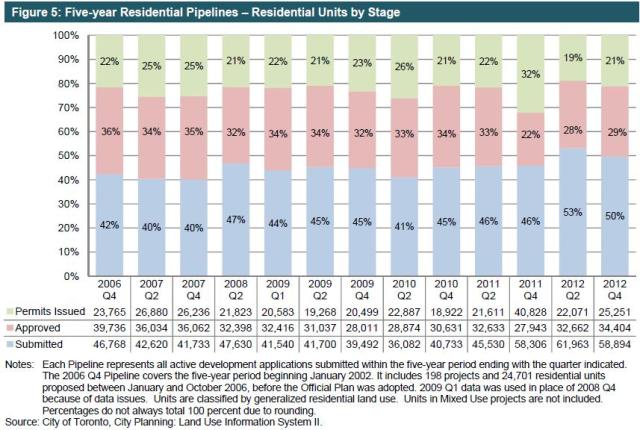
City Planning tracks development applications within a five-year “pipeline” which allows for the long lead times between initial applications, approval, construction and occupancy of buildings.  This smooths out year-over-year variations, but also flags a turndown in future growth if the early stages of that pipeline start to dry up.  There is little sign of this happening up to the 2012 data, although the proportion of applications relative to the total rose slightly.
Grows13Fig5

The overwhelming type of new residential development is in the apartment form (this includes condo and rental projects).  This is not surprising considering that there is almost no vacant land in the city suitable for low-rise development on the scale we see in greenfield subdivisions outside of Toronto.

Grows13Fig4

New development is not evenly distributed across the city, but is concentrated in a few locations, notably downtown.

Grows13Tab3

During the five-year period 2008-2012, 41% of the proposed residential units were downtown.  This shows very strong market demand to live close to the core, but a related number is the 39% of proposed non-residential floorspace (GFA in the chart above) that is downtown.  Downtown commercial development in Toronto is, today, 25% of all such development in Canada.

Although City Planning puts a brave face on things, Table 3 also reveals the comparative failure of the “Centres” as planning mechanisms to focus development.  Only 8.7% of all residential and 3.5% of non-residential proposals are in the four centres: Etobicoke, North York, Scarborough and Yonge/Eglinton.  Scarborough Centre has almost no development planned at all.

The data presentation caused some confusion at the P&GM meeting when North York Councillor Filion compared the “38%” number for his centre with the numbers for downtown.  He was gently reminded that this was 38% of the 8.7% for all of the centres combined.

Where data consolidation does mask important details is in The Avenues, those major streets that are targets for future development, and in the “Other” category.

Almost one quarter of residential proposals are sited on The Avenues (the brown stripes in Map 1 below), but this is not broken down by city region.  Some areas have a great deal of development proposed and already built (many of the early projects in the 2008-2012 pipeline are already substantially completed), while other areas have nothing.  Are The Avenues actually directing development or simply endorsing what would happen naturally?

Grows13Map1

Almost 40% of non-residential development lies in “Other” areas many of which are designated employment zones.

The actual development patterns are clear in the overview maps (for full size versions of all illustrations here, please download the source document from the City’s website linked above).

Grows13Map2

Grows13Map5

The growth of downtown residential population is not tracked in this report, but a few comments at recent meetings give some indication of what is happening.  Cllr. Vaughan spoke of the development pressures in the Entertainment District where the population has gone up 125% in the past four years.  At a recent briefing on the Gardiner Expressway, Deputy City Manager John Livey noted that the population of Planning District 1 (downtown from roughly Dundas to Lake Ontario) has tripled between 2006 and 2011.  With the developments in the pipeline, this pattern will continue.

Non-residential space translates to jobs, and this puts great pressure on the transportation network.  Some of these jobs will be taken by people who will walk, cycle or take surface transit to work, but many commuters will come from further afield via the subway and GO Transit.  The idea that downtown “has enough subways”, to quote Mayor Ford, would be dubious with the existing level of demand, but seen in the context of future development the statement shows foolhardy disregard for investment in city infrastructure.

There will be growth in the suburbs, but not at the scale of the core area.  Moreover, it is unclear that simply designating an area for growth will actually produce the desired effect without considerable incentives.  Motions by Cllrs. Vaughan and Nunziata approved by the Committee speak to opposite sides of the same issue:

The Planning and Growth Management Committee:

1. Directed the Chief Planner and Executive Director, City Planning to report on how to create a policy framework to cap growth in areas of hyper intensification and re-direct development in a strategic way to other parts of the city.

2. Requested the Chief Planner and Executive Director, City Planning in consultation with the General Manager of Economic Development and Culture, to report back to the Planning and Growth Management Committee on the methods the City of Toronto could employ to stimulate economic development in areas currently underused or vacant.

In the case of downtown, there are areas where developments, many proposed at substantially above the zoned density for the land, are skewing the property market and straining services for current and future residents.  In other parts of the city, notably Weston which is among the lowest income areas in Canada, there is plenty of land to develop, but no activity.  How much power does the City actually have (or wish to exercise) in shaping its future growth?

Major transit lines are planned or under construction, but it will be a decade before we see their effect.  Meanwhile, large areas now served by subway lines see little development.  How much of this is nimby-ism throttling growth and how much is simply market forces building where there is both a market and a profit?

The disconnect between actual and proposed development, and the goals and dreams of the City Councillors and their neighbourhoods is quite striking.  Without significant intervention by Council, a move that would be ideologically distasteful to many and certainly would be subject to legal challenges, controlling development, especially that which can occur “as of right”, will be very difficult.  Should the transit system be built to serve what is there today and what we know will develop, or will Council persist in planning based on dreams that do not match market realities?
The Transit Investment Panel: Hard Truths

After Metrolinx produced its report on revenue sources that might fund their regional plan, The Big Move, the whole thing was turned over to a newly created panel by Queen’s Park to review the options.

This panel now has its own website, and has issued the first of three discussion papers on the “Hard Truths” about transit in the GTHA.

One of the most damning statements about the depths to which Toronto has fallen appears in the Introduction:

Toronto used to be considered a transit system leader and all levels of government made bold investments to earn that reputation. We are reaping the benefits of those investments to this day, as a city, region, province, and country.

The Toronto region now ranks as the worst performer in Canada in moving people to and from work and is near the bottom of global rankings.

That’s what happens to a city that rests on a decades-old reputation for its transit network.  Toronto was spared some of the worst effects of hollowed-out downtowns thanks to postwar immigration and a robust local economy, but this masked deeper problems with the lack of investment in mobility around the city and region.  The central city, the one in all the tourist posters, prospered while gradually the suburbs strangled in traffic.

Debates about transit plans and funding are mired in misconceptions about what can and should be done, and the Hard Truths paper is intended to reset the discussion.  Whether the panel will be successful in their aim given the highly polarized political context remains to be seen.

These are hard truths, but until we accept them, we will not be able to have a mature discussion. Decisions will not be based on reason and evidence, but will be one-off decisions aimed at short term political gain.

The six truths are:

  • Subways are not the only good form of transit.
  • Transit does not automatically drive development.
  • The cost of building transit is not the main expense.
  • Transit riders are not the only beneficiaries of new infrastructure.
  • Transit expansion in the region is not at a standstill.
  • We can’t pay for the region-wide transit we need by cutting waste in government alone.

Continue reading

Moving People Downtown: The Gardiner East Is Only The Beginning

On October 16, 2013, the second public meeting in the Gardiner East Environmental Assessment presented additional information and refinement of the options for dealing with the expressway’s segment between the Don River and Jarvis Street.

The purpose of the meeting was to report on the options that would receive further analysis in the next step of the EA and to provide comparative information about costs and benefits of the various schemes.  Broadly, there are four families of options:

  • Maintain the existing expressway with necessary repairs to make it sound for several decades’ more service.
  • Replace the expressway on a new structure either above or below ground.
  • Improve the existing expressway by selective reconstruction to open up space under the road deck.
  • Remove the expressway and create an at-grade boulevard.

Some options have been dropped from further study:

  • An underground alignment 1km long transitioning to/from existing elevated structured at the Don and at Jarvis.
  • An elevated alignment over the rail corridor.
  • A surface alignment on a berm abutting the south side of the rail corridor.

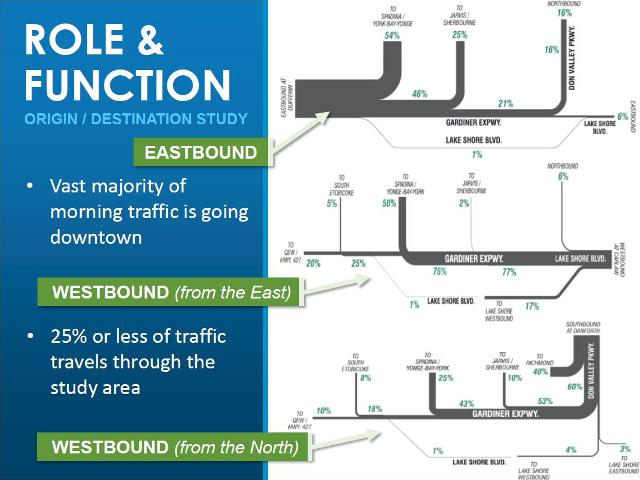
For any tunnel option, an important consideration is that most of the traffic arriving from the DVP and Lake Shore East is bound for the core area rather than as through trips to the western side of Toronto and beyond.  Therefore, access ramps are essential to any option that is not at grade so that traffic can actually get to downtown.  (By contrast, the “Big Dig” in Boston provided a link between the north and south sides of the core area on a route where 80% of the travel is through traffic and does not create demand for local ramp structures.)

The study claims that 80% of inbound trips have downtown destinations and this argues against a tunnel from which access would be difficult.  However, consider the origin-destination charts on page 15 of the presentation:

GE2P15

Of the traffic arriving from the DVP:

  • 40% leaves at Richmond Street
  • 7% exits to Lake Shore
  • 53% continues onto the Gardiner East, subdivided as
    • 10% exits at Jarvis/Sherbourne
    • 25% exits at Spadina/York/Bay
    • 18% travels beyond downtown.

If we were contemplating a tunnel across all of downtown, the argument about ramps and O-D patterns would be valid, but in this case, from the point of view of such a tunnel, most traffic is “through” traffic.  Only 10% of traffic that would enter a tunnel westbound at the Don leaves at Jarvis, and even this would be served if an off-ramp were incorporated in the transition from tunnel to elevated.  Similar arguments apply to the other O-D maps above.

The real problems with a tunnel are its cost and the barrier effect created by ramps linking the tunnel to the elevated structures at the Don and at Jarvis Street.

The schemes involving the rail corridor have both been dropped because they cannot be fitted into the space available.  In the case of an elevated, there is no room for the support structures needed (not to mention access ramps), and in the case of the berm, the area is reserved for future expansion of rail operations.

A far more important issue hinted at by the presentation but not explored in detail is the wider context of transportation into the core area.

Continue reading

Once Upon a Time in Scarborough

Mike Filey passed along to me a clipping from the Toronto Star of June 29, 1977.

A high-speed streetcar line providing service between the Scarborough Town Centre and the Bloor-Danforth subway has been approved by Metro Council.

The $108.7-million line … was approved on a 23-8 vote.

Streetcars on a separate right-of-way should make the trip in about 15 minutes.

The cost of this route was to be shared 75-25 between Queen’s Park and Toronto.

It is no secret that this line was not built, nor was the planned extension to what is now Malvern Centre.  Instead, Queen’s Park, always happy to meddle in Toronto’s transit planning, strong-armed Toronto and the TTC into changing to the technology we now have on the RT at a cost, by the time the line was finished, of about $240m.  The hope for low-cost transit expansion was dashed by a technology that was almost as expensive as a subway.

The network that might have sprung from this to serve Scarborough and other suburbs never materialized.  Instead, we have endured 36 years of arguments about where we can afford to put our next subway lines, one at a time.

Premier Bill Davis may have said that the city is for people, not for cars, but he did bugger all to advance that position by making Toronto a showcase for a failed transit technology rather than a burgeoning network that grew along with and shaped its suburbs.

Scarborough LRT Study, April 1977, Excerpts

Will Scarborough Get Its Subway? (Updated: Probably)

Updated October 9, 2013 at 1:20am:

Toronto Council, by a vote of 24-20, has approved proceeding with the Scarborough Subway project including a three-stage property tax increase totalling 1.6% to finance the City of Toronto’s share of the budget.

There is little new to add at this point on the technical issues all of which were covered on this site before.

My personal reaction is disappointment, but more strongly, disgust at the behaviour of some Councillors and a few City Officials.  The outright hatred and slander against “downtowners” and their motives in “pushing” LRT does not bode well for cordial relations on Council, not to mention sowing equivalent feelings among the electorate.  There are arguments to be made for the subway option (many of them have appeared here in the comment threads), but this should be done in a civil manner relatively free of distortion.

Instead, we got warped versions of the truth about both the subway and LRT options, and not a few outright lies.  TTC CEO Andy Byford, one who trotted out the “100 year subway” myth was forced to backtrack on two counts by questions at Council.  He admitted that the tunnels last for 100 years, but much of what is in them does not.  Meanwhile, he talked about LRT lasting 50 years, not the 30 year figure that has been bandied around of late.  The obvious issue is that a tunnel may very well last 100 years, but if you don’t have to build one in the first place, and can save the expense, what does it matter?

We will have to wait a decade to see whether the suddenly much rosier projections of demand for a rapid transit line in Scarborough come from the same well-cooked land-use and population assumptions that brought us the vastly overstated estimates for the Sheppard Subway (and for growth at Scarborough Town Centre).

In any event, the vote is taken, and barring a discovery of a major extra cost for the City appearing during detailed design, the decision is as final as we can expect to see from this Council and the provincial government.

How the rest of the LRT network will fare really depends on the 2014 municipal and provincial elections.  Mayor Ford has already declared that subways on Sheppard and Finch are goals for his next term.

The half-hearted advocacy for LRT from Metrolinx and Queen’s Park plays a big part in this situation, but I never thought their hearts were in it going right back to the early days of Metrolinx when I was persona non grata for asking their newly-minted Chair if they would consider this mode as an option in their grand plan.

How many more ridings will the Liberals feel the need to buy off with a subway promise?

The original article from October 4 follows the break.

Continue reading

Scarborough Subway (via SRT) Feasibility Study (Update 7)

Updated October 2, 2013 at 12:30 pm:

Metrolinx has released a transcript of a press conference held earlier today regarding their letter to the City Manager about the Scarborough subway.

In related news, Metrolinx advises (through a separate email) that they are “approximately 3 months away from making [a] formal recommendation on Sheppard and Finch” LRT lines, and the possible acceleration of these projects.

Also, regarding Eglinton-Yonge Station, they “hope to have a final concept that Metrolinx, City and TTC agree on in the coming weeks and will present in the public session of the Metrolinx December Board meeting”.

Updated October 2, 2013 at 10:30 am:

Metrolinx has sent a letter to Toronto’s City Manager regarding the proposed Scarborough subway.  Unlike some pronouncements from Queen’s Park, this takes a more conciliatory tone for discussions between Ontario and the City of Toronto.  Notable points include:

  • Metrolinx continues to believe that LRT “would provide an effective rapid transit solution to the transportation challenges in this area” within the available funding, but bows to the desire by all three levels of government to build a subway.
  • Metrolinx is not dictating that a specific route be chosen, but wants a proper alternatives analysis as part of the Environmental Assessment.  This contradicts earlier statements by the government implying that only one route was to be funded.  It also implies that the shorter “Transit Project Assessment” process (which does not include the potentially embarrassing need to review alternatives) will not be used.
  • The Province is sticking with a figure of $1.48-billion in available funding, from which must be deducted the $85m in sunk costs for the Scarborough LRT project and unspecified costs of scaling down the LRT car order from Bombardier.
  • Although the $320m reserved for the Kennedy Station reconstruction with both the Eglinton and Scarborough LRT lines may not all be required, additional costs are expected at the Yonge-Eglinton interchange beyond the current project budget.  Savings from Kennedy may be redirected to Yonge-Eglinton.  If there is anything left of the $320m between the two projects, then it could be directed to the Scarborough subway.
  • The Scarborough subway will be entirely a City/TTC project contrary to previous schemes for the LRT that would have seen provincial ownership and a PPP arrangement similar to that proposed for the Eglinton line.  This begs a question regarding the accounting for the provincial funding contribution: if you don’t own the line, you can’t book the asset as an offset to the money spent on it.  Does this mark a shift away from the creative accounting used to justify taking Toronto’s transit projects away from the TTC in the first place?
  • Provincial funding will begin to flow in the 2018/19 fiscal year implying that no serious construction will be underway until then.  The City and/or Federal government will have to front end the project with funding for the EA and preliminary engineering.  All risk for project cost overruns will be to the City’s account.
  • Infrastructure Ontario remains available to participate in this project, but this is no longer a requirement of the Province for funding.  The decision on whether to use IO or to proceed with a conventional procurement (as on the Spadina extension) is up to the City of Toronto.

Not included in the letter, but reported through Twitter by John Michael McGrath, is a comment from Metrolinx that they are reviewing the timing of the Sheppard and Finch LRT projects.

This letter provides a more balanced response to Scarborough subway issue than some recent statements by Ontario Transportation Minister Glen Murray, and it is good to see Metrolinx acting as a reasonable broker rather than simply as a rubber stamp for ministerial musings.  The next major step will be Council’s discussion of the matter at the October 8-9 meeting.

Continue reading

Metrolinx Benefits Case Analysis for the Richmond Hill Subway

Metrolinx has published a study of the proposed subway extension to Richmond Hill updating a Benefits Case Analysis done in 2009.  The new report is dated May 2013, but it has only recently been publicly released.

Background information in the study gives an indication of the demand challenges facing the transit network in coming decades.  The study itself shows many of the shortcomings of Metrolinx analyses in the selective use of information and limited scope of alternatives comparison.

The study looks at four options for the Richmond Hill line:

  • A Base Case assuming substantial additions to existing subway capacity, leaving things as they are with buses serving the existing terminal at Finch Station.
  • Option 1: Full subway extension to Richmond Hill Centre close to the existing GO station.
  • Option 2: A two-stop subway extension to Steeles with buses serving the area beyond.
  • Option 2A: A Steeles subway extension accompanied by improved GO service on the Richmond Hill corridor.

Notable by its absence is an option of both a full subway line to Richmond Hill and improved GO service or any analysis of how demand would divide between the two routes.

The study notes that the Metrolinx Board, in response to earlier analyses, requested additional information:

  • Possible adjustments in project scope, timing or phasing;
  • Consideration of the extent to which improved service levels on the parallel GO Richmond Hill rail corridor off-loads some of the demand on the Yonge Street subway; and
  • The cost impacts of the various options on the subway yards strategy, Yonge-Bloor subway station improvements, and a future Downtown Relief Line to bypass the Yonge-Bloor congestion pinch point.  [Par. 1.12, page 3]

The 2013 report does not address these requests because it does not include any option where both the subway and improved GO service operate to Richmond Hill.  Although parallel studies (such as the TTC’s own subway yards needs analysis) do look at some aspects of the third point above, this information is not integrated into the analysis, nor is there any review of configurations that could avoid some of the cost of increased subway capacity.  This should follow in the Metrolinx study now underway of the Relief Line and associated alternatives, but that sort of network-based review is years overdue.

Continue reading

Cycling as a Transit Alternative

A conversation has broken out in the thread originally dedicated to the Scarborough Subway regarding the ability of cycling to reduce demand on the subway if a bike lane were implemented on Bloor-Danforth.

I have moved all of the comments related to this topic here to separate them from discussions of the subway extension.

Transit Technology Choices: A Quote Worth Repeating

Updated September 6, 2013 at 11:10 am:  There is an excellent article by Stephen Wickens on his blog recounting the sorry history of Queen’s Park’s imposition of the ICTS technology on the Scarborough route.

It is worth noting that the ICTS cars cost over $2-million each 30 years ago, an outrageous sum.  The price to Vancouver was much lower, well below $1m each, and the TTC order was used to funnel money from Queen’s Park to offset the development costs of the new technology.  This is what passed for a “transit strategy” in the Davis government.

Updated September 5, 2013 at 11:00 am: My comments about Transportation Minister Glen Murray’s Scarborough subway announcement yesterday are now online at the Torontoist.

The original post follows below.

Continue reading

Where Will the Scarborough Subway Go?

The Toronto Star reports that Queen’s Park is contemplating an alternative route to Toronto’s proposed Scarborough subway extension via Eglinton and McCowan to Sheppard East.

The key paragraphs in the article are:

“In the next couple of weeks we should have an announcement on what the routing will be, what the design will be and what the cost will be,” he told reporters on the way into a cabinet meeting Wednesday.

Queen’s Park wants to have the subway run on a similar route to the light rail transit plan to “maximize the impact of this line and get it connected to as many people (as possible),” said [Transportation Minister] Murray.

Murray seeks to find out how much could be built with the $1.4b already committed to a subway project.  Using an existing corridor could reduce the cost compared to the McCowan alignment.

This raises questions debated in other threads here of how the subway would be extended via the existing SRT alignment including the configuration of Kennedy Station and whether a route from Ellesmere Station eastward would be elevated or underground.

Recycling some or all of the existing corridor will require a period of shutdown for the RT with parallel bus service, an issue that weighed heavily against the LRT scheme in recent debates.  Will the promise of a subway quell objections to this shutdown?

Murray will meet with Lisa Raitt, the federal Minister of Transport, to discuss funding, but he is already throwing cold water on hopes for assistance from Ottawa for a  “416” project.  Even if the feds bring money to the table, the next questions will be whether the original McCowan scheme or an SRT alignment for the subway are the best use of available cash, and how either subway would fit into a larger network.

The debate comes back to Toronto Council in October preceded by Murray’s announcement likely in mid-September.  Backers of the subway like TTC Chair Karen Stintz and recently-elected MPP “Subway Champion” Mitzie Hunter have stressed that their support for a Sheppard LRT was for a different line in different circumstances.  A Scarborough subway, wherever it goes, will leave large parts of eastern Toronto far from rapid transit.

The LRT debate is not over.  Will Stintz and Hunter become “LRT champions” for other parts of the network?