Playing Fast and Loose With SmartTrack (Updated)

In a previous article, I wrote at length about the City of Toronto’s reports on the status of SmartTrack to be discussed at the October 20, 2015 meeting of the Executive Committee.

Two related items also deserve comment.

First up is an article in the Star by Tess Kalinowski in which she reveals that Metrolinx CEO, Bruce McCuaig, wrote to City Manager, Peter Wallace on October 6, over a week before the reports were posted on the Executive Committee Agenda. His letter said quite clearly that SmartTrack would only be an incremental upgrade of GO service, not a separate operation running on GO’s trackage.

“Metrolinx and the province believe that the (city report) should reflect the scenario where SmartTrack is an incremental increase in RER (regional express rail) service, rather than an independent and parallel service that co-exists with RER,” he wrote.

“The risk of creating unmet expectations is too great,” said McCuaig.

The letter also suggests the city stop referring to SmartTrack as a “surface subway” since federal rail regulations would prohibit TTC-style subway trains from operating on GO tracks.

The full text of the letter is not yet online, and it is notably absent from the Executive Committee agenda.

Updated October 19, 2015 at 11:45 am:

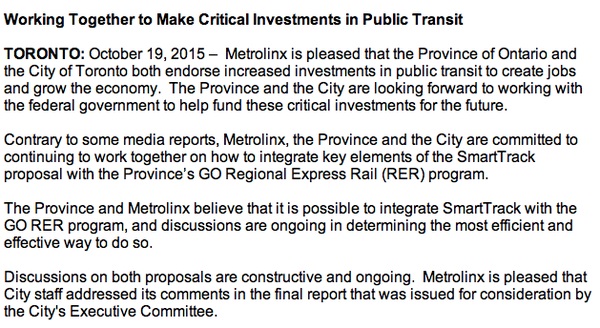
Metrolinx has issued a statement pledging its continued support for “key elements” of SmartTrack, whatever that means.

MetrolinxStatement_20151019

Second is the appearance of an “advocacy group” called FAST (Friends and Allies of SmartTrack) which appeared to spring out of nowhere earlier this week. This is no ordinary citizens’ group plotting in someone’s kitchen how to get some new transit line built, but a well-financed group with close ties to Mayor Tory. Their website reproduces the Tory campaign colours and links to SmartTrack material from that era.

Continue reading

SmartTrack Update: Many Reports, Many Unanswered Questions (Updated)

Updated October 21, 2015 at 9:30 am:

The Executive Committee spent a few hours discussing this report. As the morning wore on, it was clear that Mayor Tory was becoming unhappy with questions about his scheme. By the end of the debate when he spoke, he said:

I think a number of the questions raised by members of council today are perfectly legitimate questions which I’m sure our staff have taken note of and if they weren’t already being asked and answered, those questions, they will now be.  I just hope and I sense a generally positive sort of sense around here but I hope that we don’t get into being either sort of Douglas or Debbie Downer about these things. [Adapted from a quotation in the Toronto Sun]

Tory went on to say that he had “a mandate” from voters to build SmartTrack in a manner distressingly reminiscent of Rob Ford’s “mandate” to tear up Transit City. The problem with both claims is that voters did not elect Tory or Ford for those specific purposes, but in a reaction against the previous administrations, particularly in Tory’s case. Moreover, that “mandate” does not mean that the platform necessarily made sense as proposed, only that it was an attraction to voters that a candidate had concrete ambitions. We have already seen Tory backtrack on his claims that Toronto did not need more bus service (responding to Olivia Chow’s half-hearted support for transit), and there is no reason for SmartTrack to be treated as a divine plan on stone tablets.

As answers from staff to various questions made abundantly clear, there is a lot of work to do between now and first quarter 2016 when all of the details are supposed to return to Council. Staff went out of their way to avoid giving any indication of the way preliminary work might be headed lest they be drawn into a debate about “conclusions” before the supporting studies are in place.

The Executive Committee made a few amendments to the report’s recommendations:

1.  Requested the City Manager to forward the report (October 15, 2015) from the City Manager for information to the Toronto Transit Commission, the Ministry of Transportation, Metrolinx, the City of Mississauga and York Region.

2.  Requested the Chief Planner and Executive Director, City Planning to report to the Planning and Growth Management Committee on the results of the public consultations arising from the Preliminary Assessments of the Smart Track Stations, as set out in Appendix 2 to the report (October 15, 2015) from the City Manager, particularly with respect to the development potential of new stations.

3.  Requested the City Manager to work with Toronto Transit Commission, Metrolinx, and GO Transit, to develop a One Map Strategy where by major intersections and/routes of these transit operators are shown on future hard copy and electronic local and regional transit maps, once SmartTrack routes and stations are established.

The first recommendation is the original staff proposal simply to transmit the update report to other agencies. The second arose from a concern by Councillor Shiner, chair of the Planning & Growth Management Committee, that implications of and potential for redevelopment around SmartTrack stations be understood as soon as possible. During debate, he spoke about the success of development a long the Sheppard line, an ironic stance considering how strongly he had opposed development around Bayview Station when it was at the design stage.

The third recommendation arose from Councillor Pasternak, who never tires of advocating the “North York Relief Line” (otherwise known as the Sheppard West extension to Downsview). His desire is that maps show all of the projects that are in the pipeline during studies, not just the one that happens to be the subject of debate.

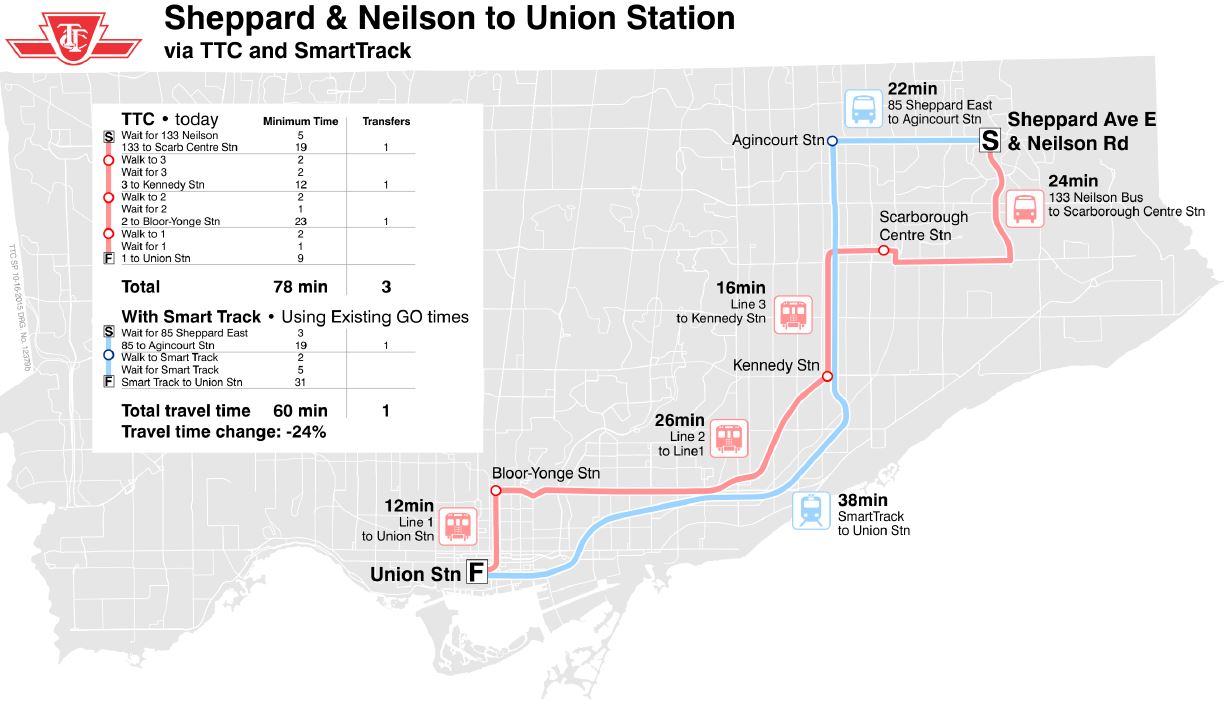
A notable absence in the staff presentation was any reference to the Scarborough Subway Extension as an alternative route for travel to downtown. That presentation covered substantially the same information as the background reports, but it included a few new charts about comparative travel times with SmartTrack in place.

STvsTTC_TravelTimes1

The important difference between this map [at p23] and the Tory SmartTracker website (which shows comparative travel times) is that the TTC includes the access and wait times for SmartTrack in its calculations. This reduces the proportionate saving over a trip. Another issue, of course, is that many riders do not work at Union Station, and taking SmartTrack there would be an out-of-the-way trip. This is not to downplay what SmartTrack might do, but to point out that if ST is to be part of a “network”, then advocacy for it must look at how it benefits all of the trips originating in some part of the city (say northeast Scarborough), not just those that conveniently lie on its route. This will be an issue in comparative ridership projections for ST and the Scarborough Subway Extension because those who are bound for midtown will almost certainly have a shorter trip simply by taking the subway rather than ST.

The original article follows below:

Continue reading

The Vanishing Relevance of SmartTrack

The Metrolinx Board received a presentation today from their Chief Planning Officer, Leslie Woo, about the Yonge Relief Network Study. One item in this report raised eyebrows – the projection that GO RER and SmartTrack services would divert only 4,200 passengers during the peak AM hour from the Yonge corridor.

In the discussion, it was clear that service in the SmartTrack corridor would be every 15 minutes. Four trains per hour is hardly an inducement to change routes although at least if SmartTrack operates with TTC fares, it could still be atttractive.

However, I wondered just what that 15 minute headway meant, and so I wrote to Leslie Woo for clarification:

When you talk about 15 minute headways, does this mean an RER train every 15′ and an ST train every 15′ for a combined 7’30” headway, or is this 15′ for the combined service with a wider (e.g. 30′) headway on each one?

Her reply:

15 mins – combined.

Keep in mind that where Kitchener/Milton/and Barrie corridors converge we are already at less than 15 min headway in the peak.

This is a fascinating statement. SmartTrack is, among other things, intended to add stations along the GO corridors so that a more finely-grain service can be provided in Scarborough and at some locations along the Weston corridor such as Liberty Village. However, if the combined express GO and local ST services will only run every 15′, this implies a wider headway on ST, possibly every over train or 30′. With only a pair of tracks on the Stouffville corridor, and likely only a pair dedicated to GO+ST on the Kitchener corridor, it is impossible for express GO trains to pass local ST trains, and this limits how many trains per hour, in total, can possibly operate there.

During the press scrum, Metrolinx CEO Bruce McCuaig was asked about the equipment to be used, and he said that both GO and ST services would run with GO trains. It would appear that the only difference will be where they stop. Of course we already have this type of arrangement on the Lake Shore corridor, and didn’t need an election campaign to get it.

When candidate John Tory pitched SmartTrack, it was to be a “surface subway” using, mainly, existing GO rights-of-way but operating with quasi-subway service level, speed and station spacing. There were claims made for 200k/day in ridership, and the whole project was pitched as if it was the one line to solve every problem. Ask about the weather? SmartTrack will fix it. Out of a job? SmartTrack will speed you more quickly to job locations you never dreamed of. Why don’t we have more buses? Buses are a waste of money and what you really need is a shiny new fast train.

The problem with these claims is that they depended on SmartTrack actually being “like a subway” with frequent service, something it is quite clear that it will not be, at least not as Metrolinx sees things. The challenge here is that unless there is a very substantial investment in infrastructure by Metrolinx beyond what is planned for GO/RER, the network cannot handle the very frequent service contemplated for SmartTrack and this limits the effect it will have region-wide.

Even if SmartTrack did operate more frequently (a situation that was modelled by Metrolinx), it doesn’t attract much more ridership away from the critical Yonge corridor. The basic fact is that the west end of SmartTrack (wherever it might actually go) is so far from Yonge Street that it addresses a completely different market. Even the eastern branch on the Stouffville corridor is a fair distance from Yonge and, if anything, would bleed demand from the Scarborough Subway rather than the Yonge line.

A vital but missing piece of information in the presentation is the count of likely riders on various routes in the modelled networks. This report tells us how many riders are diverted from Yonge, but not how many riders would be on the other corridors and, therefore, the value of and need for more service in them. This information should come out in a technical background paper expected in July 2015.

Although the Metrolinx discussion did not get into SmartTrack costs, there are fundamental questions to be answered:

  • What are the comparative costs and benefits of serving the Eglinton West corridor with the proposed SmartTrack tunnel or with the planned westward extension of the Eglinton Crosstown LRT? (This should be answered later in the SmartTrack study of that corridor.)
  • Will SmartTrack share GO’s corridor through Union Station, or will it split off into its own tunnel downtown? Would the more frequent service a tunnel implies actually be able to co-exist with GO operations when the line rejoined the GO corridors?
  • What is the actual, likely cost of SmartTrack? For election purposes, this was estimated simply by taking the average costs of a few European “surface subways” or “overground” lines as London calls them, and scaling this to the length of the SmartTrack route. Originally, it was claimed that there would be no tunnels, but the campaign quickly learned that their research was faulty on that score. The cost is important because Toronto has volunteered to pay 1/3 of the total, whatever that might be.
  • Why should Toronto taxes be used to pay for a service which had among its objectives improvement of access to commercial properties in Markham and Mississauga?
  • Can a local service that operates considerably less frequently than a subway route be expected to generate much development as associated tax revenue?

As things now stand, SmartTrack has all the appearance of a line on the map that fades gradually under the harsh light of actual planning, operational constraints, and the degree to which Ontario is prepared to build infrastructure to enable it.

Yonge Relief Network Study: June 2015 Update

At its board meeting on June 25, 2015, Metrolinx will consider an update on the study of capacity relief for the Yonge Street Corridor in Toronto.

The report states that projected demand on the Yonge line can be handled for the next 15 years:

1.a. Significant relief to the Yonge Subway will be achieved with currently committed transit improvements underway including:

i. TTC’s automatic train control and new subway trains;

ii. The Toronto-York Spadina Subway Extension; and

iii. GO Regional Express Rail

1.b. Based on [the] above, more rapid transit service and capacity that is currently funded and being implemented will meet the future 15 year demand, assuming current forecasts on the growth rate of downtown employment and the implementation of TTC automatic train control on the Yonge Subway.

Continued work is recommended:

2. Direct the Metrolinx CEO to work with the City of Toronto City Manager and the TTC CEO to develop an integrated approach to advance the Relief Line project planning and development, incorporating further business case analysis and the findings of the Yonge Relief Network Study to:

  • further assess the extension north to Sheppard Avenue East to identify a preferred project concept,
  • inform the planning underway by the City of Toronto and TTC to identify stations and an alignment for the Relief Line from Danforth to the Downtown area
  • continue to engage the public in this work as it develops

3. Direct staff to work in consultation with York Region, City of Toronto and the TTC to advance the project development of the Yonge North Subway Extension to 15% preliminary design and engineering.

The emergence of a variation on the Relief Line that would operate north to Sheppard is quite a change from days when even getting discussion of a line north of Eglinton was a challenge. The context for this emerges by looking at the alternatives for “relief” that were considered and how they performed.

The next report to the Metrolinx Board will be in Spring 2016. The challenge will be to keep planning for a Relief Line “on track” in the face of the excitement and political pressures for GO RER, SmartTrack and a Richmond Hill Subway.

Continue reading

Joint Metrolinx, City and TTC Consultation on Transit Studies (Updated June 21, 2015)

Updated June 21, 2015 at 12:45 am: SmartTrack alignment option 1C which was included in the presentation deck, but not in the individual illustrations on the project website, has been added to the consolidated set.

Updated June 12, 2015 at 6:30 am: Details of SmartTrack and Relief Line alignment options added.

The City of Toronto, Metrolinx and the TTC will conduct a series of eight meetings at locations around Toronto over coming weeks to present current information on studies now in progress regarding GO’s Regional Express Rail (RER) plan, SmartTrack, the Scarborough Subway Extension (SSE) and the Relief Line (aka “DRL”). Some of these meetings will focus on specific projects (noted below), while others are general overviews.

  • Sat. June 13 9:30am: Burnhamthorpe Collegiate Institute, 500 The East Mall
  • Mon. June 15 6:30 pm: Estonian House, 958 Broadview Avenue (Relief Line)
  • Wed. June 17 6:30 pm: Spring Garden Church, 112 Spring Garden Avenue
  • Thurs. June 18 6:30 pm: Archbishop Romero Catholic SS, 99 Humber Boulevard South (SmartTrack)
  • Sat. June 20 9:30 am: Hyatt Regency Hotel, 370 King Street West
  • Mon. June 22 6:30 pm: Winston Churchill Collegiate Institute, 2239 Lawrence Avenue East
  • Wed. June 24 6:30 pm: Scarborough Civic Centre, 150 Borough Drive (SSE)
  • Thurs. June 25 6:30pm: Riverdale Collegiate Institute, 1094 Gerrard Street East (Relief Line)

Consultation in Mississauga, Peel, Markham and York Region will occur in September according to the City’s press release.

Recommendations will be presented by TTC and City staff to the TTC Board and Council in Fall 2015 on SmartTrack, the SSE and the Relief Line.

Update June 12:

SmartTrack

The presentation boards and alignment options for the western leg of SmartTrack are now available online. For convenience, I have collected the illustrations in one file [PDF 2MB].

Broadly the study is considering three alignment groups for the link between Mount Dennis and the Mississauga Airport Corporate Centre:

  • A direct connection via Eglinton from the Kitchener rail corridor
  • A separate heavy rail corridor via Eglinton from Mount Dennis
  • A direct connection south from the Kitchener rail corridor through the airport

The “base case” for the study is the already-approved second phase of the Crosstown LRT.

The options include:

  • 1: Direct links with the SmartTrack alignment:
    • 1A: Swinging east of the KW rail corridor south of Eglinton, and then turning west to make a direct connection with the Crosstown line.
    • 1B: Turning west from the KW rail corridor south of Eglinton. This is the original SmartTrack proposal.
    • 1C: Continuing north of Eglinton, and then veering back south through a vaguely defined area west of Weston Road [illustration added June 21]
  • 3A: A separate line west from Mount Dennis.
  • 2: Links north via the rail corridor and then south into the airport lands:
    • 2A: To a point beyond the UPX airport spur, then south through the airport. The “Airport” station would be a connection to the UPX at Airport Road.
    • 2B: The same alignment as 2A at the north end, but following Dixon Road and Carlingview south to 427/401.
    • 2C: To a point east of the UPX spur with a station at the east side of the airport, then south via Carlingview as in 2B.

Some alignments require tight turns and tunneling will be needed for all of them contrary to the original claims that SmartTrack would be a “surface subway”. This will also force the issue of electrification without which a tunnel alignment is impossible, but Metrolinx plans now claim that the first electric operations will not begin until 2023.

The option 2 alignments will face technical challenges including curve radii depending on the exact details of the alignment and the equipment chosen for the route.

Headways for all option 1 and 2 alignments will be constrained by the need to share trackage with the UPX operation.

Relief Line

Four corridor options are under consideration. At its northern end, the corridor would start at either Broadview or Pape Station, and through the core area, the line would follow either Queen or King/Wellington. I have collected the four maps together in one file for convenience.

Detailed discussions of the pros and cons of these options are on the respective pages of the project site. The Pape alignment has clear advantages over Broadview, and a Wellington alignment through the core has advantages over King or Queen.

The Gardiner, SmartTrack and the Scarborough Subway

Three major projects face approvals at Toronto Council and Queen’s Park in coming months.

  • Should we replace the Gardiner Expressway with an at-grade boulevard between Jarvis and the Don River?
  • Should “SmartTrack”, John Tory’s signature campaign plank, form a U-shaped line from Markham to Pearson Airport providing both regional and local service in parallel with GO Transit?
  • Should the Bloor-Danforth subway be extended through Scarborough in place of the once-proposed LRT network, via which route and at what cost?

None of these is a simple problem, and they are linked by a combination of forces: polarized political views of what Toronto’s future transportation network should look like, very substantial present and future capital and operating costs, and competing claims of transportation planning models regarding the behaviour of a new network.

On the political front, Mayor Tory is playing for a trifecta against considerable odds. Winning on all three would cement his influence at Council, but it is far from clear that he will win on any of them. Council is split on the expressway options, SmartTrack has already sprouted an alternative western alignment, and the Scarborough Subway fights for its life with alternative route proposals and the threat of demand canibalized by the Mayor’s own SmartTrack plans.

Continue reading

Planning for SmartTrack

At its meeting of January 22, 2015, Toronto’s Executive Committee will consider a report (SmartTrack Work Plan 2015-2016) recommending a work plan for the study of Mayor Tory’s SmartTrack proposal together with other related transit projects. This is intended to dovetail with Metrolinx’ work on their Regional Express Rail (RER) network, and will have spillover effects on studies of both the Downtown Relief Line (DRL) and the Scarborough Subway Extension.

The most important aspect of this report is that, at long last, a study is reviewing transit options for Toronto on a network basis rather than one line at a time. Factors such as alternative land use schemes, fare structures and service levels will be considered to determine which future scenarios best support investment in transit. Rather than starting with a “solution”, the studies are intended to evaluate alternatives.

If this outlook actually survives, and the studies are not gerrymandered before they can properly evaluate all strategies, then the process will be worthwhile and set the stage for decisions on what might actually be built. The challenge will be to avoid a scenario where every pet project on the map is untouchable rather than making the best of the network as a whole. The term “best” will be open to much debate.

Continue reading

The Dubious Planning Behind SmartTrack (Part III)

In the first part of this series, I discussed The New Geography of Office Location, 2011, and then in the second part, its successor A Region in Transition, 2013. Now, I will turn to The Business Case for the Regional Relief Line, October 2013. All three papers were produced by SRRA (Strategic Regional Research Associates).

Only a 17 page summary version of the Relief Line report is available online, compared to the full versions of the first two. Considering the clear influence this series of reports has had on transit policy and the recent election campaign, the idea that

Detailed research is available to Investment Partners of SRRA [Page 1]

leaves a big hole in the range for public comment and review. I hope that Metrolinx will rectify this situation as part of whatever studies might take place.

My thanks to those of you who slogged through the first two articles.

Continue reading

The Dubious Planning Behind SmartTrack (Part II)

In the first article of this series, I examined a 2011 report about the shifting location of office development in the GTHA. Here I will turn to a follow-up report, A Region in Transition, from January 2013.

These reports provided the underpinning for the SmartTrack campaign proposal from Mayor John Tory. It is important that we understand just where this scheme came from and what it was  intended to accomplish by authors who, in some cases, lent their support to the Tory campaign and the SmartTrack brand.

Continue reading

The Dubious Planning Behind SmartTrack (Part I)

As I reported in a previous article, Mayor Tory has launched a study process for his SmartTrack scheme via Toronto’s Executive Committee.

One intriguing, if not surprising, admission to come out of this process was for Tory to admit that SmartTrack “was not his idea” and was simply a repackaging and rebranding of the provincial RER (Regional Express Rail) scheme. However, during the campaign, SmartTrack was regularly described as something that experts had studied, a solid proposal, not simply a line on a napkin.

The origins of a “Big U” looping from Markham through downtown and out to the northwest predates Tory’s campaign and can be found in three papers:

If we are to understand the claims made for SmartTrack, we need to understand its origins, and the degree to which campaign rhetoric and fantasy may have diverged from the earlier detailed planning. Also, of course, there is a basic question of whether the studies had the same goals for rapid transit network design as those that should inform the planning process in Toronto and the GTHA beyond.

This article reviews the 2011 paper on the changing location of office space in the GTA.

Continue reading