New Premier, New Policies? (Updated)

Updated February 2, 2013 at 12:30 am:  The costing for Next Wave projects has been corrected to reflect that spending for local projects and roads is included in the total of $34-billion rather than as an additional cost on top of that number.

The Ontario Liberal Party has a new leader, and soon the province will have a new Premier.  Although I am not a Liberal supporter, I am extremely pleased by Kathleen Wynne’s rise to head our provincial government.  She represents the progressive wing of the party, and a fresh outlook after the increasingly frustrating reign of Dalton McGuinty.  A change of focus is already evident with social services, education labour relations, job creation and transportation infrastructure getting prominent mention.

Transportation is not first on the list, but it is vital to the GTHA.  Mobility has many benefits for business and for individuals.  Transportation infrastructure, especially transit, has far too often been treated as a cost to be avoided, to be offloaded, to be deferred while we strangle in congestion.  That congestion isn’t just on roads, plugged highways and arterials, but on the very transit systems we keep telling drivers can be our way out of the mess of 21st century gridlock.

The scope of what we need is enormous.  Within Toronto, we are accustomed to annual ridership figures now over half a billion, although this is well below half of all the journeys in the city.  Elsewhere in the greater Toronto area, transit does well to carry 10% of all travel.  The GTHA requires much, much more investment in transit infrastructure and in service to attract a larger share of the market.  Making transit a credible alternative to the automobile will not be easy, and reaching a target of 1/3 of work trips by transit in 2031 requires far more than a few trains and buses.

“More of the same” is not an option for a new government, especially one with a tenuous minority in the legislature.  Transportation problems are too big and have been set aside for another day for far too long.

Later this year, we will see the long-awaited Metrolinx “Investment Strategy”, a document that should have been published at least two years ago.  The necessary background information has been available for some time, but nobody at Queen’s Park wanted to talk about new “revenue tools”.  This lack of political fortitude and leadership, coupled with project funding delays and scope changes, cost the GTHA more lost time and compounded the deficit in transit building.

Fortunately Ontario now has a Premier-designate who is willing to talk about raising the money necessary to improve transit.  The challenge will be to actually go from talk to implementation and the creation of a funded transit plan.

We are at an important time in the political and economic cycle for the debate and real progress to begin.  Too many big announcements came just at high points when the economy boomed, only to lose the momentum to a downturn, retrenchment, and a shift of focus away from transit expansion, let alone changes in government. This pattern stretches back to the early 1970s and the Davis government’s aim to build cities for people with transit rather than with cars.

We are having the difficult, “mature” conversation about new taxes (whatever we might call them) when times are tougher.  Building transit funds into the base of government spending rather than as good-time baubles will be a major change, if it happens.

Continue reading

Metrolinx and the Auditor General (Updated)

Updated December 14, 2012 at 1:40pm:

Additional information regarding Presto and Metrolinx’ response to the Auditor General’s report has been added at the end of that section in this article.

Original post from December 13:

The Auditor General of Ontario released his Annual Report on December 12, 2012, and it includes a section on Metrolinx.  For those of us who have wrestled with the secrecy of Metrolinx, some of the information and recommendations in this report are a breath of fresh air.

Metrolinx’ overall reaction to the report is much of the same boilerplate about the wonderful job they are doing and how important they are to the region.  In some cases, Metrolinx dodges the questions raised by the Auditor in a way familiar to anyone who has ever attended one of their press conferences.

The report should be read in the context of March 31, 2012, the end of the period to which the audit applies.

Continue reading

Metrolinx Meeting Wrapup — December 2012

The Metrolinx Board met on December 5, 2012.  Most of its business was conducted in private, an unfortunate habit of this provincial agency, but some items emerged on the public agenda.

I have already reported on the “Next Wave” of transit projects and the amendments proposed for The Big Move regional plan.  In other news …

Continue reading

Metrolinx Updates The Big Move, Announces Priorities for Phase 2 Projects (Updated)

Updated December 6, 2012 at 11:20 am:

A warmed over version of the Board of Trade presentation was given to the Metrolinx Board by President & CEO Bruce McCuaig at the Board meeting on December 5.  There were a few clarifications of note:

  • The list of “Next Wave” projects will not be nailed down until the February 2013 Board meeting following a round of public consultation.
  • That consultation will also include a review of the proposed amendments to The Big Move and yet another round of talks about potential revenue tools.  The meetings will probably take place in January at 12 public round tables, as well as a 36-member “Residents’ Reference Panel” doing “deep dives” into the issues at weekend sessions.  This process will report back to the Board in spring 2013.  (There is no info about how the 36 “residents” will be selected for the panel.)
  • It is likely that construction of the Downtown Relief and Yonge Extension subway projects would take place concurrently with Yonge to Steeles opening at roughly the same time as the DRL from Downtown to Danforth.  “Phase 2” of each project would follow.  At this time there is no commitment to going north of Danforth or to any specific route either through downtown or through the east end of Toronto.  This will be the subject of an Environmental Assessment for the project.
  • The goal of TBM was described by McCuaig as having 75% of GTAH residents within 2km of rapid transit at their origin or destination.  That “or” is an important distinction I don’t remember hearing before.  It’s child’s play to have lots of people close to rapid transit at one end of their trip — anyone who works in major centres within Toronto or lives along a subway, LRT, BRT or GO line will qualify.  The more difficult target is to have such access at both ends of the trip because “convenience” is meaningless if only one end is well-served.
  • In an apparent contradiction to the implied 1/3 local funding described in the Star’s article about Mississauga having second thoughts on the LRT project, McCuaig said that we cannot look at traditional federal/provincial/municipal financing models.  Presumably the Investment Strategy will address this problem.

The actual timing of the Next Wave projects varies depending on which document one reads or how one parses the announcements.

  • In the Next Wave handout (linked later in this article), this is described as a 15-year, $34-billion project.
  • The spend rate implied by another part of the same handout is only $1.2b/year, and this translates to a 28+ year timeframe.
  • Metrolinx, in an email responding to this article and my concerns about the status of projects such as the Eglinton LRT to the Airport, said that there would be a “Third Wave” in 2025.
  • At the press briefing following the Board meeting, McCuaig confirmed that for the “15 year plan”, year zero has been reset to 2012.  This implies that TBM’s original 15 year timeframe is now stretched to roughly 20.  Moreover, McCuaig hinted that projects started within the next 15 years may not finish by then.
  • Despite all of the delays, the year 2031 is still the target for completing all of The Big Move.

In previous discussions of the Investment Strategy, Metrolinx has included an allowance for operating the new facilities as they come into service.  This is missing from the $34b of the Next Wave, but will have to be incorporated into the IS discussions.  Moreover operating costs are ongoing while capital are one-time.

In all of this discussion it was amusing to listen to Metrolinx talk about revenue tools, code for the very things some politicians in Toronto find utterly unacceptable preferring to imagine that pools of private capital are available at little or no cost.

The presentation materials from the Board meeting are not yet online, but the hard copy version comes under the unhappy title of “The Big Move In Action”.  Deleting only one space would give a good description of the treatment of project schedules for Transit City by Queen’s Park.  The presentation ends with a page titled “Keep the wheels moving” and a picture of a stone wheel and hammer.  Ontario makes a lot of claims for its triumphs in transportation technology, and I can’t help wondering if this is an early product of the Ontario Transportation Development Corporation.

I mention this because Metrolinx appears to have embraced a new, quaint graphic style for their Big Move and Union Pearson Express websites.

Continue reading

TTC Rediscovers the Downtown Relief Line (Update 4)

Update 4 October 21, 2012 at 8:30 pm:

It’s intriguing to look back at coverage of the DRL the last time this was a major issue.  Mike Filey passed along a clipping from the Star from December 2, 1982 that makes interesting reading.  My comments are at the end in Postscript 2.

Update 3 October 20, 2012 at 3:20 pm:

A postscript has been added discussing the various demand simulations as a group rather than individually.  Charts of total demand southbound from Bloor Station as well as pedestrian activity at Bloor-Yonge are provided to consolidate information from several exhibits in the background paper.

Update 2 October 19, 2012 at 11:00 am:

This article has been reformatted to merge additional information from the background study as well as illustrations into the text.

At its meeting on October 24, 2012, the TTC will consider a report on the Downtown Rapid Transit Expansion Study.  The full background paper is also available on the TTC’s website.

A study by the City of Toronto and TTC, including consultations with Metrolinx, concludes that transit demand to the core by 2031 will grow at a rate that exceeds the capacity of all of the current and planned transit facilities.  Ridership will be 51% higher than today.  The residential population south of College from Bathurst to Parliament will grow by 83%, and employment by 28%.

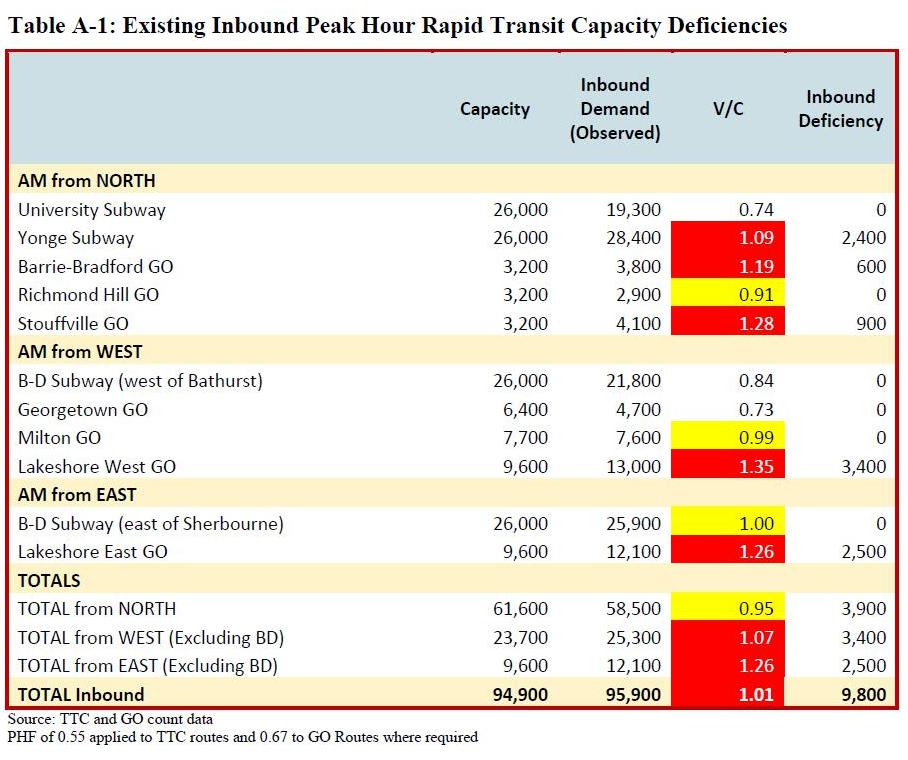
Capacity is an issue today as Table A-1 in the background paper shows.  Several corridors into downtown are already operating over their design capacity.  This is particularly the case on GO where the target is to have few standees, and there is more room for additional passengers in the design capacity than on the TTC subway services.

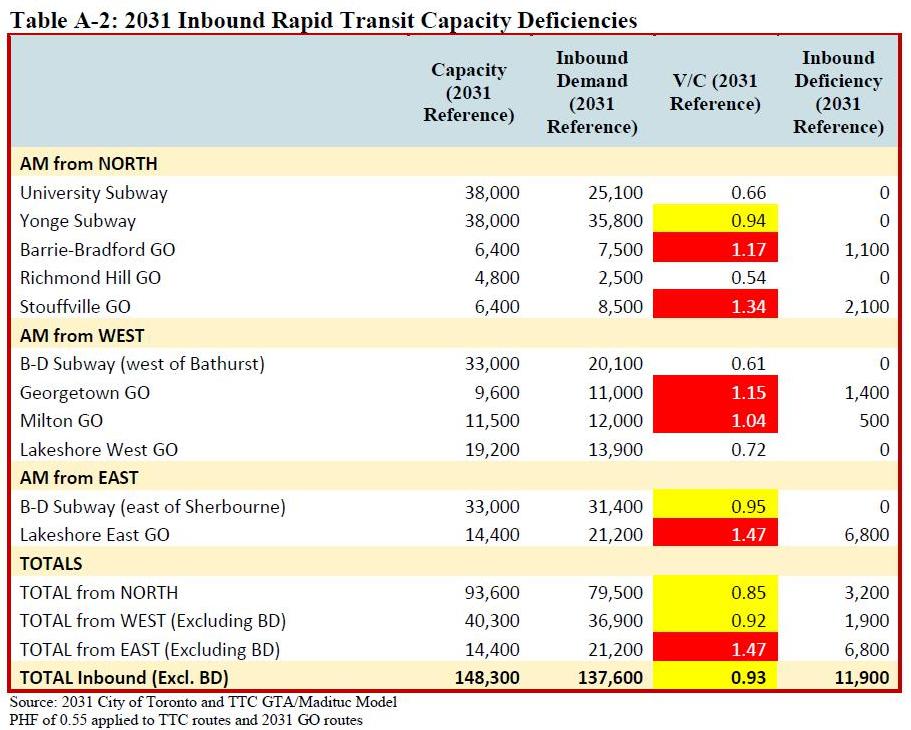
Table A-2 shows the projections for 2031.  All of the shortfalls are on GO, but the TTC lines are close to saturation.  This presumes a considerable increase in the capacity of various lines.  For example, the YUS goes from a design capacity of 26,000 to 38,000 passengers per hour (pphpd), an increase of 46% which may not actually be achievable.  Similarly, the BD line goes to 33,000 pphpd, an increase of 27%.

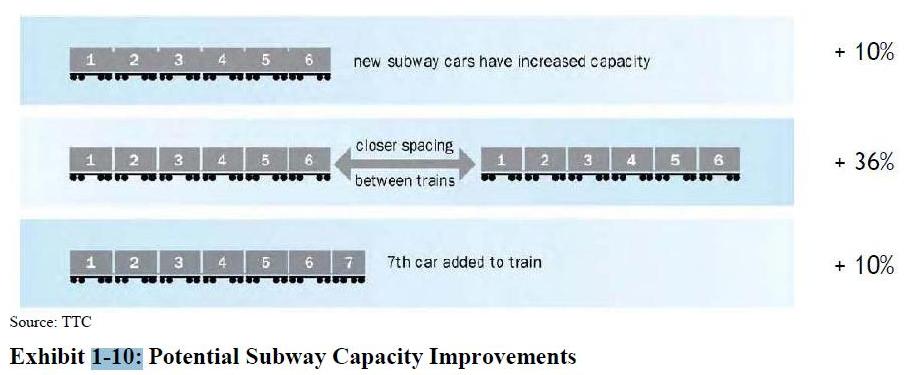
Exhibit 1-10 shows the components of projected capacity increase including 36% from running trains closer together.  As discussed at some length on this site previously, the constraints on headways arise at terminal stations.  A 36% increase in trains/hour implies a headway of about 100 seconds as compared with 140 today.  This cannot be achieved with existing terminal track geometry, not to mention the leisurely crew practices at terminals.

On the GO lines, the projected capacity on Lakeshore West doubles, and smaller increases are seen on other routes.  It is worth noting that the projected capacity of the north-south corridors to Stouffville, Richmond Hill and Barrie are nowhere near the level of service implied by The Big Move, probably because these lines are not targets for early electrification.  This contributes to the capacity shortfall in the northern sector.  Recommendation 1 of the study includes encouragement that Metrolinx review the possibility of increased capacity in those three corridors.

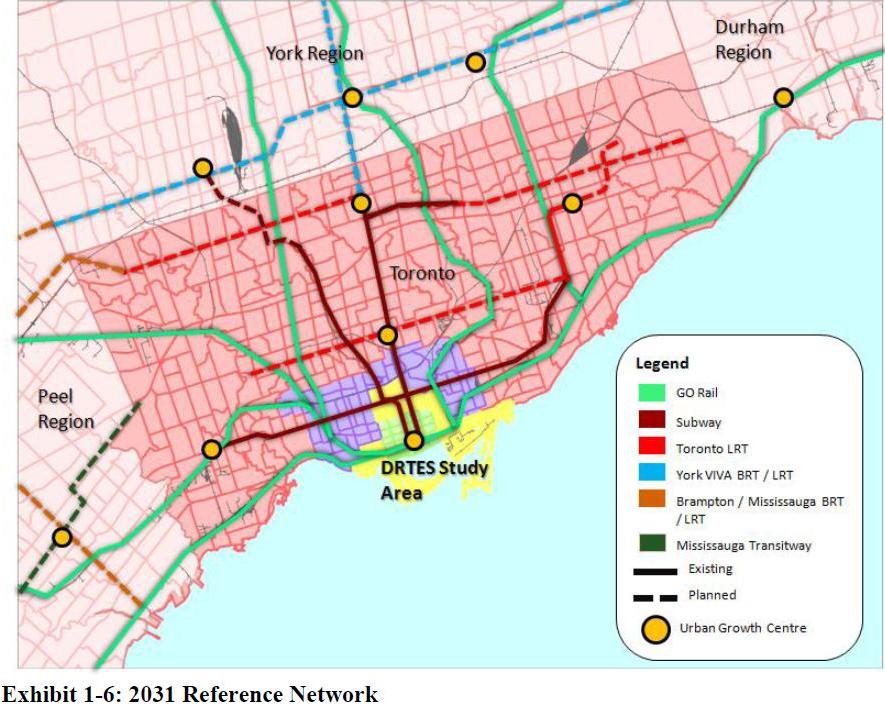
The full list of lines included in the modelled network can be found in the background study at section 1.2.1.

Continue reading

Toronto Contemplates Transit Funding / Reviews Transit Plans (Updated)

Updated October 9, 2012 at 5:30 pm

Toronto’s Executive Committee considered a report on transit funding mechanisms today.  In the following report, I have included only the most interesting or important of comments to give the flavour of the debate.

The proceedings were rather odd in that a presentation, cued up for City Staff, was never heard, but a “private citizen” managed to give a half-hour long deputation thanks to many friendly questions from Committee members.  That “citizen” was Dr. Gordon Chong, former head of Toronto Transit Infrastructure Limited, an all-but-bankrupt subsidiary of the TTC used to conduct a study of the Sheppard East subway extension for Mayor Ford.

Chong liberally drew on his transit experience including years as head of the Greater Toronto Services Board, a provincial agency predating Metrolinx.  Throughout his deputation, the highly misleading map of four cities’ subway system was projected to emphasize how little Toronto has done.  (That map purports to show how little Toronto has in comparison with London, New York and Madrid while ignoring the fact that these were much larger cities, much sooner.)

A “glaring omission” from the collection of transit plans in the staff report, Chong said, was his own Sheppard report and the information produced by KPMG about tax increment financing (TIF).  Chong clearly implied that the report was biased, but missed the fact that the Council motion directed the inclusion of “approved” plans for review, something Chong’s most emphatically was not.  As for TIF, it is mentioned, but rejected as a funding mechanism as staff argue that such revenue is needed for general support of city services and should not be earmarked just for transit capital projects.

Councillor Michael Thompson pursued the scheme of a Scarborough subway with a BD extension that would loop back along Sheppard to close the loop at Don Mills Station.  Chong replied that if Toronto could deal with the “money issue”, then there is no reason we can’t have the best in transit.  Thompson observed that a casino might bring in $75-100m annually and could fund transit projects.  The oddity here is that both treat any new money as a bonanza to be used for the best possible transit (where they want it) when fiscal conservatives might be expected to argue for careful husbanding of whatever loot might come their way.  There is also the small problem that the municipal share of projected revenue for a Toronto casino is probably an order of magnitude lower than the Councillor’s claim.

Various Councillors mused about a regional agency to dispense transit dollars and decide which projects should be built.  An underlying assumption was that, of course, the network of suburban Toronto subways would rank high on the list, and nobody seemed to contemplate that a 905-dominated agency might have other more pressing needs or think that the investment in all those subways was of dubious value.

Chong had only veiled contempt for the “expert panel” who reviewed his report and recommended, instead, for the LRT option on Sheppard.  He strongly supports subway construction presuming the money is available, supported by the best possible feeder bus network.  Councillor Norm Kelly asked whether the LRT plan was “an aberration”, and Chong replied that all previous TTC Chief General Managers had supported subways.  Although he invoked the name of David Gunn, he neglected to mention that Gunn boycotted the opening ceremonies of the Sheppard line.

Next the Committee turned to questions of staff. Continue reading

The Fate of OneCity (Updated)

Several postmortems have appeared on blogs about the supposed death of OneCity and what might follow:

Updated July 19, 2012 at 7:00 am:

Updated July 16, 2012 at 11:15am:

My own take on OneCity’s fate together with the original article detailing proposals for dealing with transit planning follow the break.

Continue reading

The Missing Half of OneCity

Last week brought the excitement of the OneCity network announcement, followed by mildly supportive words from Queen’s Park and its agency Metrolinx, followed in turn by rather stronger provincial denunciation of a City that can’t make up its mind on transit.  Queen’s Park can hardly talk about consistency given their happiness to leap into bed with Rob Ford’s subway plan until Council gently reminded their provincial cousins that the Mayor had not bothered to ask for Council’s approval.  Meanwhile, delivery dates for provincial “commitments” drift off into the 2020s with the flimsiest of excuses about the limitations of an overheated construction market.  This is the same provincial government who talks about the power and capabilities of international companies just itching to work in the Toronto market.

All this kvetching detracts from two major issues.  First, once we get past the obvious conflicts created by proposals for the Scarborough Subway and the Scarborough/Etobicoke express services taking over the GO/ARL corridors, the rest of OneCity doesn’t step on any provincial toes.  As with so many of the debates here (and on other transit blogs), it’s the “I’m 100% right and you are 100% wrong” outlook that gets in the way of intelligent conversation.  There may be a role for the Scarborough Subway, although I am less certain about the proposed services taking on GO corridors.  At least we should get more information about the options and effects, not to mention defensible costs and demand projections (something neither the TTC/Toronto nor Metrolinx have been strong on in either Transit City or The Big Move).

Second, and at least as important, is the complete absence of money for improved service and maintenance, including a huge capital backlog on the TTC for vehicles and facilities.  The Ford era saw “savings” through cuts in presumed future growth.  A bus order for system growth was cancelled, and a new garage dropped from the plans.  The size of our future streetcar fleet was trimmed about 10%.  Who knows how many cars we really need given the strangulation of streetcar routes for service by the TTC.  Service growth in general was artificially depressed by changing loading standards to fit more people on each  vehicle.

These were all one-time fixes, fudges that got Toronto through two budget cycles while meeting the meddlesome demands of an administration for whom transit was just too much fat waiting to be cut.

The sad part is that thanks to two years of see-no-evil budgeting, nobody really knows what the true backlog in operations and maintenance might be, or what it will cost to put things aright.  Even if OneCity gets some sort of approval and funding, its projects won’t see a rider for years, and in some cases decades.  Should people who cannot get on the King streetcar or Finch West bus have to wait a decade for someone to address their problems?

OneCity is a plan for enhancing transit on major routes, but it’s only half of a network plan.  Most Torontonians will still ride on ordinary bus and streetcar routes for part or all of their journeys, and they are just as deserving of good service as those who will have new subway and LRT lines.  Indeed, even those who will, someday, see a new faster route should not have to wait for its construction.  “Coming in 2021” is cold comfort to someone waiting for a bus in February 2012.

If Council refers OneCity to staff for a report on costs and first-cut details of projects, we will learn more about the options for rapid transit in Toronto.  A long-overdue, informed conversation may actually happen rather than endless posturing for one neighbourhood or another.  But it will only be half a conversation.

Toronto needs to know what it will take to bring better service before we can build our rapid transit dreams, and what might come to many corners of our city that will never see a subway, LRT or BRT line.  What is our goal for these neighbourhoods?  What does “good service” mean to this newly enlightened Council?  How much will it cost?

These questions are just as important for transit’s future as contemplating the route of a new subway or the mechanics of a tax increase.  Council needs to ask them loudly and strongly as part of an integrated review of Toronto’s transit network.

Meanwhile, down the road at Metrolinx, a little humility might be in order.  This is an agency which, until fairly recently, did not even acknowledge the importance of local transit as part of the regional system, and still boasted about its high farebox recovery thanks to cherry-picking the most cost-effective services.  The provincial “investment strategy” must sustain not just the simplest, cheapest lines on the GO Transit map, but a wide range of services across the region including those provided by local carriers.

Is Toronto, is Ontario, serious about transit being a real alternative, about providing a “car-free” option to a much wider market of riders, or do they both simply prefer to hold press conferences with pretty maps?

The maps are nice, and the accompanying studies will fill yet more space in my library (or storage on my hard drive), but it’s the space and time in between that’s most important.  Riders will wait a very long time for some of these brave new transit lines to appear, and they deserve better than a walk to a crowded, infrequent bus route or a drive to a parking lot that fills before 7am in the meantime.

Toronto Council should demand that the TTC look not just at shiny new lines for the indefinite future, but that it address its real requirements today.  If the “new TTC” gets bogged down planning for the 2020s while transit continues to wither from overcrowding and underfunding through the 2010s, they are not doing their job.

Metrolinx Board Meeting, June 2012

The Metrolinx Board met on June 21 with a full agenda.  As is unfortunately the case with this quasi-public board, the fatter the agenda, the less time is spent on actual discussion of the material in it, at least in public.  Presentations were rushed, and there were few questions from the Board to staff.  Many issues on the public agenda have counterparts in the private session where, one might hope, there is more robust debate.

[This article has been in the hopper a bit longer than I had hoped while I chased some details from Metrolinx.] Continue reading

Where Should We Put the “Downtown Relief” Line?

The Downtown Relief Line has been in the news a lot lately, what with dreams of vast new revenues to pay for transit expansion and, at long last, a recognition that more people want to travel downtown than we have transit capacity to handle.

Back in the 1980s, the Network 2011 plan included a line from Union Station to Don Mills and Eglinton by way of the rail corridor, Eastern Avenue, Pape, a bridge across the Don Valley, and Don Mills Road.  This scheme was turned down in favour of the Sheppard Subway as part of a misguided idea that if we simply stopped building new lines into downtown, growth would stop.  In fact, GO Transit did a fine job of providing extra capacity, and more recently the new downtown condos have raised short commutes by streetcar, cycling and foot to levels nobody expected thirty years ago.

The Yonge subway filled up, for a time,but the pressure fell off thanks to the 1990s recession and the general drop in transit use.  That’s no longer the case, and suddenly everyone wants to “do something” about transit capacity downtown.  The TTC, shamefully, downplayed anything beyond its own mad scheme to stuff thousands more riders onto the Yonge line, a project requiring major changes in signalling, reconstruction of Bloor-Yonge station (and possibly others) for extra capacity, a much larger subway fleet (and yards to hold it) and possibly even the addition of platform doors at all stations.

Council asked the TTC to look at a DRL, and there is even supposed to be a study.  However, its web page is the only sign that anything is going on.

Meanwhile, every would-be transit planner in town is busy drawing maps, to the point where a credible plan can be found simply by dropping a piece of spaghetti on a map of the city and declaring this a route.  (Post-graduate degrees are available to those who can determine the ideal height from which to drop the pasta and cooking time needed to produce the best results.)  What’s missing in a lot of this discussion is a view of how a DRL might fit into a wider network, not to mention a few basics about how a new rapid transit line will, or will not, fit in some of the proposed alignments.

One of the better proposals is on Phil Orr’s DRL Now site.  It’s not perfect (no proposal is, including those I have floated from time to time), but at least this is a place to start with sufficient detail to understand what is going on.  Drawing a swoosh across a map is easy (politicians do it all the time), but designing something that might actually work is a lot harder.

A major challenge with some versions of this line is that proponents try to do too much.  Playing “connect the dots” with a transit route has its limitations, and trying to hit too many of them causes the line to wander out of its way.  This ties back to a fundamental question:  what is a DRL supposed to do?

If we believe some of the simpler plans (notably one in last week’s Star proposed by Councillor Pasternak), the DRL’s sole function is to get people from the Danforth subway to Union Station.  This is far too simplistic and guarantees the line will not be well used except as a peak period relief valve.

Other schemes take the route south of the rail corridor to serve the Port Lands and eastern waterfront.  Aside from the problems of building such a line in landfill beside Lake Ontario, the route would not provide the fine-grained transit access possible with a surface LRT, and would vastly overservice an area whose expected demand is lower than the existing Sheppard subway.  Connection to Union Station from the south would also be a big challenge.

From time to time, I am asked “what would you do”, but to start that discussion, a few first principles:

  • A”DRL” should not exist solely to relieve the Yonge line’s peak traffic problem, but should provide new links within the transit network giving rapid transit to areas of the city that do not have it today.  Indeed, the regional function within the network may well be as important as the “relief” function at Bloor-Yonge.
  • Any proposed route through downtown must respect the actual built form of the streets and buildings.  Diagonal routes through built-up areas should be avoided as they are difficult if not impossible to build.
  • Stations must be located where it is physically possible to build them.  Some routes use rail corridors without considering how either a surface or underground station might fit or be built.
  • A “DRL” is not the complete solution to capacity problems on the subway.  These problems originate north of Steeles Avenue, and a major role in trimming peak demand falls to GO Transit which has several north-south routes that could drain traffic otherwise headed for the Yonge line.

The proposed route on DRL Now (click on “Interactive Map” under the “Station Information” pulldown) includes four phases:

  • Don Mills and Eglinton to City Place
  • City Place to Dundas West
  • Don Mills from Eglinton to Sheppard
  • Dundas West to Pearson Airport

I have concerns with a few details of this plan, but the basics are good.  Another view of the route is available via Google Maps.  This has the advantage of showing the detailed alignment rather than a “route map” graphic.

Continue reading