
The Big U and the little u

The Transit Investment Strategy Advisory Panel has ventured off its supposed path of looking at ways to fund transit growth in the GTHA to at least one proposal for a change to the Metrolinx Big Move plan.  This showed up at recent open houses in a handout that is not yet available online.
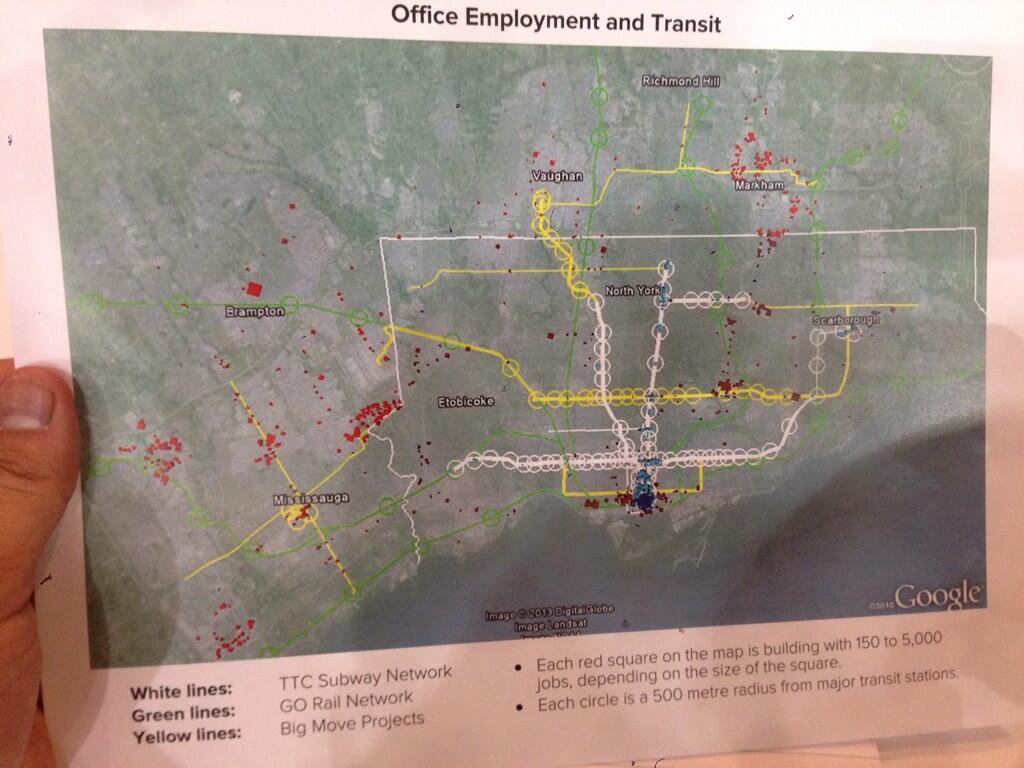
InvPanelOfficeEmpAndTransit

[The image above was posted on Twitter by Rishi L (@CdnEnginerd).  Click for full size version.]

The purpose of this map is to show how office employment is not sited along existing or proposed rapid transit lines.  With this as a jumping off point, the Panel suggests there is a need for a “Big U”, a much enhanced GO Transit route from Meadowvale, through Union Station and then north via the Uxbridge Subdivision (Stouffville line) to Markham.

A related factoid (one of those handy bits of information whose presence is supposed to silence critics) is that employment concentrations generate far more transit usage than residential ones.  It is certainly true that it is much easier to serve a place like downtown Toronto with a transit network that acts like a big funnel, but this does not eliminate the need to serve the residential ends of those trips.

Toronto’s Bloor-Danforth subway and GO’s commuter lines, for example, spend much of their time running through comparatively low-density neighbourhoods, collecting passengers as walk-ins, park-and-rides, and transfers from the surface transit network.  Every time a new transit route is proposed, we hear how it will only be viable if stations are surrounded by huge condo developments.  This is utter nonsense because any transit route has a catchment area.  The problem is to ensure that transit, sidewalks and bike lanes serve that area and deliver riders to a network that will take them where they want to go.

What is missing from the chart above is any indication of where the people who work in those centres actually live.  Looking at the Meadowvale end of the line, how many people come from the area that would be served by the GO corridor and a feeder network to it?  There is a lot of territory north, west and south of Meadowvale for which a rapid transit line to the east will do absolutely nothing.  Similarly, many who work in Markham live west, north and east of the employment centres.  Indeed, most of the red dots on that map are well west of the rail corridor.

Much as I sympathize with the Panel’s desire to get people talking about how parts of any network proposal might actually serve the region, I fear that we are seeing a classic example of someone who got out their crayons and drew a map.  The job will quickly change from discussing the philosophy of transit planning (and, don’t forget, funding) to defending the specifics of a proposal.

That is precisely why I have been so restrained about getting out my own crayons except in special circumstances.  The recent Don Mills Subway discussion needed a line on a map to illustrate how the “downtown” focus needed to change.  Well over half of the debate this triggered became a matter of dueling proposals between “my” line and “your” line that added little to the real issue — the need to see what such a line could connect and serve beyond simply diverting trips away from Bloor-Yonge Station.

People would even argue that there wasn’t “enough” development in some locations to justify such a route ignoring what is there today, what is in the pipeline for tomorrow and what could occur with planning and political encouragement.  Meanwhile, we build a subway to land that was recently the middle of nowhere, and propose one through miles of low density residential development as a vote-buyer claiming that only with a subway will Scarborough reap the development it “deserves”.

There is one big problem with the “Big U” — it diverts attention from the “little u” otherwise known as the “Downtown Relief Line”.  It doesn’t help one bit that the version of the “little u” shown on the map is the Pape-Queen-Roncesvalles alignment, one that is guaranteed to be very expensive and fails to recognize shifting development patterns (ironically, one of the goals of the “Big U”).  It ignores the southerly shift of population and jobs, avoids the available Weston rail corridor where we are spending a fortune to intensify transit infrastructure for a Toonerville Trolley to the airport, and it stops at the Bloor-Danforth subway missing the opportunity to reach further north to be more than a “downtown” line.

“Alternatives analysis” is a fine art in many projects, but the real art for many agencies is to ensure that what you always wanted to build is the “preferred” choice.  This is often guaranteed by setting up straw man comparisons so that the one you want shines out as the best of breed.  Such may be the situation with the DRL where, on darker days, I suspect that the whole idea is to paint as grim a picture as possible so that it will never be built.  Remember that the TTC for decades claimed we didn’t need a DRL, that they could stuff everyone into an upgraded Yonge-University line.  Expanding YUS capacity on a heroic scale was their “preferred alternative”.

With the Big and little U’s, we risk being trapped into specifics of route designs that looked good on a napkin in a bar, but which need much more thorough discussion as to purpose and specifics.  They are good as starting points for discussion, but are most definitely not the final answer in their respective fields.  Moreover, they are not alternatives to each other, a point that is often lost as the political imperative says “build in the suburbs, not downtown”.

The Big Move and the Investment Strategy that supports it have one gaping hole.  Very little attention is paid to the role of or funding for the feeder network to a regional system.  Moreover, the plethora of lines on the map hides the fact that many of them will not have the most frequent service on the planet.  Not all “rapid transit” lines are created equal.  As a recent Metrolinx report noted, the growth in “rapid transit” recently has mainly been in “BRT Light” for which the infrastructure requirements are minimal along with the service levels.  Crowing about progress in bringing transit to the millions ignores the question of how attractive that transit will be and how people will connect from the trunk routes, such as they may be, to their homes, work and other destinations.

This will be an important issue for network design on both the Big and little U’s.  One would serve rail corridors and be totally dependent on local service to deliver riders from homes and to employment locations.  The other would serve established and growing neighbourhoods and would enjoy an existing, well-developed set of local transit services as feeders.  These are not trivial differences, but they show the problems that will arise if the study does not look beyond the edges of station platforms.

This is the real debate the Transit Panel should engage — does The Big Move really serve the market it claims to address?  How useful will it be in attracting trips out of cars and onto transit?  Can developers and owners of residential and employment properties expect a real improvement in travel to and from their developments, or will their value be strangled by poor access?  Underlying all this is the basic question of whether we are spending all of those billions in the “right” place and what benefit each component of the proposed network will achieve.  That speaks directly to the concept of spending wisely, not just for the sake of generating construction jobs and photo ops for the next generation of politicians.

Returning to the “little u”, there will be a motion before Council from Councillor Josh Matlow, seconded by Cllr. John Parker (also a member of the TTC Board), to accelerate work on the EA for a “Relief Subway Line”.  Moreover, it asks that Council confirm such a route as “Toronto’s next subway expansion priority”.  It will be intriguing to see how this motion fares amid the current circus at City Hall, the recent battle over the Scarborough Subway and a faction claiming that downtown “has enough subways” already.

If this proceeds, it will be vital that it not be hamstrung with narrow terms of reference that filter out options before they are even discussed.  A major shortcoming of the new “Transit Project Assessment” protocol is that there is no consideration of alternatives because the decision that something is a “good project” is already assumed.  Debating alternatives just gums up the works in what is supposed to be an expedited process, but actually winds up as an exercise in selling an already-determined choice.  This is precisely the criticism many had of Transit City that compounded the process with less than stellar detailed planning and “sales”.  (Moreover, once a project is approved, it can be amended beyond all recognition, even though the original design was the one that “justified” the project in the first place.)

There is no point in doing a study if the underlying desire at the political and staff level is to sell a “Big U” as a replacement for the “Relief” line, whatever we call it.  The terms of reference must ensure that all options are reviewed, including cross-jurisdictional issues such as repurposing the Weston corridor’s UPX trackage for rapid transit.  We must not prejudge the outcome by requiring one continuous line to serve both legs of the U/u, especially considering that in some variants both western legs run in the same corridor.

Will Toronto Council, Metrolinx and Queen’s Park embrace the need for a full study of these routes without prejudice toward any preconceived doodlings on maps?

Metrolinx Benefits Case Analysis for the Richmond Hill Subway

Metrolinx has published a study of the proposed subway extension to Richmond Hill updating a Benefits Case Analysis done in 2009.  The new report is dated May 2013, but it has only recently been publicly released.

Background information in the study gives an indication of the demand challenges facing the transit network in coming decades.  The study itself shows many of the shortcomings of Metrolinx analyses in the selective use of information and limited scope of alternatives comparison.

The study looks at four options for the Richmond Hill line:

  • A Base Case assuming substantial additions to existing subway capacity, leaving things as they are with buses serving the existing terminal at Finch Station.
  • Option 1: Full subway extension to Richmond Hill Centre close to the existing GO station.
  • Option 2: A two-stop subway extension to Steeles with buses serving the area beyond.
  • Option 2A: A Steeles subway extension accompanied by improved GO service on the Richmond Hill corridor.

Notable by its absence is an option of both a full subway line to Richmond Hill and improved GO service or any analysis of how demand would divide between the two routes.

The study notes that the Metrolinx Board, in response to earlier analyses, requested additional information:

  • Possible adjustments in project scope, timing or phasing;
  • Consideration of the extent to which improved service levels on the parallel GO Richmond Hill rail corridor off-loads some of the demand on the Yonge Street subway; and
  • The cost impacts of the various options on the subway yards strategy, Yonge-Bloor subway station improvements, and a future Downtown Relief Line to bypass the Yonge-Bloor congestion pinch point.  [Par. 1.12, page 3]

The 2013 report does not address these requests because it does not include any option where both the subway and improved GO service operate to Richmond Hill.  Although parallel studies (such as the TTC’s own subway yards needs analysis) do look at some aspects of the third point above, this information is not integrated into the analysis, nor is there any review of configurations that could avoid some of the cost of increased subway capacity.  This should follow in the Metrolinx study now underway of the Relief Line and associated alternatives, but that sort of network-based review is years overdue.

Continue reading

Another DRL Proposal or Just Another Gerrymander? (Update 2)

Updated August 2, 2013 at 6:00am:

André Sorensen has written a commentary in today’s Star expanding on his proposed use of the rail corridor for express airport service and a quasi Downtown Relief line.  I’m with him on a more intelligent use of the rail corridor, especially to the northwest of downtown, but not with the premise that this could replace the proposed subway from Don Mills & Eglinton to the core.

Continue reading

Metrolinx Board Meeting of June 27, 2013

The Metrolinx Board met on June 27 with a full agenda.

There is a great deal of duplication between various reports, and I have consolidated information to keep like items together.  Some reports are omitted entirely from this article either because the important info is included elsewhere, or because they simply rehash status updates with no real news.  Metrolinx has a love for “good news” to the point that each manager stuffs their presentations with information that is already well known, or which parallels other presentations.

Among the more important items in these reports are the following:

  • Metrolinx is now conducting various studies all of which bear on the problem of north-south capacity into downtown Toronto.  This involves the (Downtown) Relief Line, the north-south GO corridors and the Richmond Hill subway expansion.  A related study involves fare and service integration across the GTHA.  It is refreshing to see Metrolinx taking a network approach to planning, rather than looking at projects in isolation, and recognizing that some of their own, existing routes can be part of an overall approach to solving this capacity problem.
  • The Metrolinx Five-Year Strategy includes dates for the beginning of service on various projects including the LRT replacement for the Scarborough RT.  Previous versions of these dates cited “by 2020”, and Metrolinx has indicated a desire for as short a construction/shutdown period of under three years.  However, the new strategy paper talks of an “in service date” of 2020.  Metrolinx is aiming for a three year shutdown at most, but the SRT might continue operating beyond the originally planned September 2015 date, possibly for one additional year.  This could lead to an earlier reopening than 2020.  (Correspondence from Metrolinx on this issue is included later in the article.)

Continue reading

Sabre Rattling in Halton?

Earlier this week, Tess Kalinowski reported in The Star that Halton Region, a fast-growing region west of Toronto, would simply stop approving new developments without more provincial support for transit and other services.  Chair Gary Carr wants to see funding for transit – including two-way, all-day GO rail service – not to mention schools, roads and public health.

Halton’s population of half a million is planned to grow by 50% in the coming two decades as new residents pour into the Greater Toronto region, but the infrastructure to support them does not exist.  This problem is shared by other municipalities either because they face growth of their own, or because they lie between newer neighbourhoods and downtown and absorb increases in travel through older parts of the GTHA.

Metrolinx had originally slated all-day service for Halton on the Kitchener and Milton GO lines in the first 15 years of its 25-year Big Move transportation plan. But the plan’s updated version pushes the GO expansion to the list of projects in a 16- to 25-year window.

Besides more GO trains to Milton and Georgetown, Carr said the region wants Metrolinx to reinstate plans for another GO station on Trafalgar Rd. and it wants the Lakeshore West GO line electrified so it can deliver 15-minute express service.

Municipalities in the 905 now have (or are planned for) populations and the transportation demands they will create that exceed the capacity of road-oriented development.  Even if transit in the 905 (and commuting capacity for 905-to-416 travel) were much better, the land use patterns work against effective transit service.  This is not just a question of dispersed work and home locations, but of neighbourhood designs generally where stops to run errands as part of larger trips demand the use of a car.  These problems will not be wished away with better bus routes or all-day GO service.

Halton, like many regions, is reacting to proposed new region-wide “revenue tools” with the question “what’s in it for us”, but this is a natural result of the “Big Gap” between the original promise of Metrolinx (and of provincial plans for managing GTHA growth) and what is actually happening on the ground.

Various plans exist for the expansion of GO Transit service, and these have changed from time to time leaving some confusion about what, exactly, will be provided and when service expansions will occur.

Continue reading

The Metrolinx “Big Conversation”: What are The People Saying?

Through early 2013, Metrolinx conducted roundtables across the GTHA to sound out interested citizens on the transportation plan, “The Big Move”, and on possible ways that this might be funded.  A summary report consolidating the input from each area makes interesting reading.

“Consistent, top-line themes” are identified right at the outset:

Participants across the region feel frustrated with the level of congestion they face on highways, roads and public transit. They feel the negative impact of gridlock on family life, work obligations and health. The inadequacy of existing public transit systems is a common concern for participants. GTHA participants agree that across the region – along its busiest routes – our roads, highways, subways, trains and buses are straining to meet demand.

The need for reliable and frequent service was heard consistently across the GTHA. Participants are looking for leadership among transit providers to collaborate and deliver improved levels of service that is better integrated across the region. Participants look forward to system improvements that will allow them to more easily coordinate their schedules, enjoy a wider range of transit options with less uncertainty and stress, and travel more efficiently and cost-effectively from A to B. [page 3]

A few points leap out here:

  • “Public transit” is a generic problem, not a “GO” or “TTC” or “HSR” issue, and there is no call for a few “magic bullet” solutions.
  • Frequency and reliability rank highly, and would-be riders want to see better co-ordination and service delivery.
  • Efficient and cost-effective travel are important.

A subtle but important linking factor here is that delivering on these issues requires a network approach, and high quality operations are at least as important as building new infrastructure. Continue reading

Metrolinx Reveals Preferred Revenue Tools, But Says Little About Investment

On April 2, 2013, Metrolinx released a list of the preferred “revenue tools” in its forthcoming “Investment Strategy”.

Public consultation until today featured a longer list, and several of the options fell off of the table thanks to public and political feedback.  The complete list and a detailed analysis of each option can be found in a 225-page report “Big Move Implementation Economics Revenue Tool Profiles” produced by AECOM and KPMG in March 2013.

At a press conference, Metrolinx CEO Bruce McCuaig emphasized that the duty of his organization is to make recommendations, to offer advice, but that the final choice on tools and the amount of revenue to be sought will be up to the politicians at Queen’s Park.  This neatly shifts the focus of detailed questions, but avoids the question of just how much detail will be included in those recommendations.

A handout we are sure to see during the next round of consultations outlines the general philosophy and gives details of what might be achieved with each short-listed tool.

InvToolsShortlistP1c InvToolsShortlistP2c

The most important statement here is that

An Investment Strategy is about more than just raising revenues for transportation; it’s about implementing mechanisms that grow a more livable, prosperous and sustainable region.

To this I would add that a “strategy” also includes important components such as the staging of projects and discussions about the speed (or lack thereof) with which the full Big Move network is implemented.  Today and in the past weeks leading up to the announcement, we have heard a lot about new revenues, but little about how they should be “invested”.

Continue reading

What Should Be In The Metrolinx Investment Strategy?

With much talk about “new revenue tools” and debates over the least objectionable way to extract $2-billion or more from taxpayers in southern Ontario, the actual purpose of the Metrolinx “Investment Strategy” has faded into the background.  Somehow the act of collecting all that money has become more important than figuring out what, exactly, we are going to do with it.

But, you say, don’t we have the Quick Wins?  The Big Seven?  The Second Wave?  Shovels are in the ground and all we need is the will to spend!

Things are not quite that simple.

What we do not have is a clear sense of what we will achieve and when we will achieve it.  In 2008 Metrolinx produced The Big Move, our regional transportation plan with two very broad objectives — a 15 and a 25 year plan.  Demand projections, including a vision of what traffic and transit might look like, only considered the fully-built 25-year plan, something we already know will not be finished (if ever) within the projected time span.

Some projects received a “Benefits Case Analysis”, but these studies considered each line in isolation rather than looking at what subsets of the whole plan would contribute to the network.  Indeed, the biggest “benefit” of many lines would be the money spent to build them, not their contribution to transit overall.  This would follow the tradition of transit projects in the GTHA as economic and job stimulus packages first, with transportation improvements as an afterthought.

An “Investment Strategy” is not simply a matter of figuring out where new revenues might be found, but of recommending the best way to use them, to “invest” in the future of the region. Continue reading

Metrolinx Meeting Preview: February 14, 2013 (Update 2)

The Metrolinx Board meets on February 14 with an agenda that, as usual, features a rather long private session followed by a shorter public one.  There will be brief updates on GO Transit and the PRESTO farecard project, a Customer Service Committee update, and one substantive item – updates to the regional plan, The Big Move, and feedback from the public consultation sessions now in progress.

Updated February 15, 2013 at 9:10 am:  Notes from discussions at and after the Board meeting have been added to this article.

Update 2 at 12:45 pm:  The date for Board approval of the Investment Strategy has been clarified.

Continue reading

Metrolinx Math

In a recent comment, a reader questioned the disparity between the $34-billion cost of the Metrolinx “Next Wave” projects and the sum of the individual projects listed on the website.  These projects are:

Brampton-Queen BRT     $  600 million
Dundas BRT                600
Durham BRT                500
GO Expansion            4,900
GO Lakeshore Express    1,700
GO KW Electrification     900
Hamilton RT             1,000
Hurontario LRT          1,600
Downtown Relief Line    7,400
Yonge North Subway      3,400
Total                 $22,600 million

A big chunk of the difference between these two numbers can be explained by a factor which is new in the “Next Wave”, a provision of 25% of whatever funding is available for local transit, regional highways and other smaller projects.  This would eat up $8.5b out of the total leaving $25.5b for the next wave of “Big Move” projects.

I wrote to Metrolinx asking for an explanation of the remaining $2.9b, and this is their response.

Transforming the transportation network in the Greater Toronto and Hamilton Area is similar to any renovation project, and $50 billion was a planning number that was developed in 2008 for the Regional Transportation Plan, also known as The Big Move. As we move through assessments and delivery, we will have harder numbers, so that figure will change.

However, prior to the assessments and delivery, we’ve built a contingency into the $34 billion cost of the Next Wave projects, which accounts for a difference in numbers.

It should be noted that more than $16 billion from all three levels of government has been allocated to the “first wave” of projects drawn from The Big Moves list of top priorities. This is the largest financial commitment to transit expansion in Canadian history. [Email from Metrolinx February 5, 2013]

I will take at face value the statement that the $2.9b is “contingency”, but note that this was not mentioned in any of the presentation materials nor on the website.  To me it looks more like an “oops”.

This is not simply a question of catching Metrolinx out on an incomplete or inaccurate presentation.  We are now engaged in a debate about regional transportation and funding, and it is vital that this take place in a fully informed context.  An amount of $2b/year is commonly used as a reference point for the amount of funding that must be delivered by any new revenue tools.  This was in the original “Big Move” budget of $50b delivered over 25 years, and shows up most recently in the City of Toronto’s “Feeling Congested” outreach program.

That original number was in 2008$ and it included some provision for future operating costs.  However, it did not include inflation, nor did it include the recently added provision for local transit and road projects which would take 25% off the top of any new revenue stream.

The $50b was supposed to finance 52 separate projects listed in The Big Move, but between the “first wave” and “next wave” list, many still remain outside of funding plans.

If the Investment Strategy report expected from Metrolinx late this spring is to have any relevance to the discussion, it must include current estimates of capital and operating costs to be funded from new revenues, and must provide for inflation.  Either the capital provisions must be escalated to future dollars, or the future revenue from new tools must be discounted to present day.  We cannot discuss our long-term funding needs with a mixture of dollar values spanning decades.

Public transit projects have a long history of coming in over budget for various reasons.  Some of this is bad planning and some is scope creep, although it could be argued that these are often related.  There is always the issue of unexpected circumstances, not to mention the treatment of large public transit projects as an opportunity for every nearby utility to have their plant upgraded at the project’s expense.  Past funding for Metrolinx projects has always been announced as $x-billion plus inflation so that a $16b or $34b “commitment” may actually be much larger in as-spent dollars.

A further wrinkle is the use of private sector financing, construction and operation through “AFP” (Alternate Finance and Procurement), a methodology now in favour both in Ottawa and at Queen’s Park.  In this scheme, part of the capital cost of a project is assumed by a private partner, and this can reduce the capital outlay required during construction by the public sector.  However, that money has to be paid someday, and the payments show up on the operating budgets through mechanisms such as leases and revenue guarantees.  That will be a future call on the new revenue streams, and it must be built into the long range Investment Strategy.

Finally, some transit costs have been borne through non-Metrolinx budgets including various transfers to municipalities (now mainly the gas tax, although the infrastructure fund may be revived in a future budget) and a clawback to GO transit via a tithe to help pay for its capital program ($20m from Toronto this year).  All of these funding streams need to be sorted out and presented in one place so that a rational view of what is needed going forward is available for everyone to see.

Metrolinx should take greater care with its announcements and fiscal plans so that its credibility is not undermined by simple questions about arithmetic, and so that the funding they seek will actually match the funding they will need.