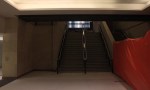
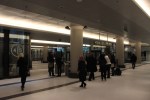
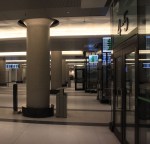
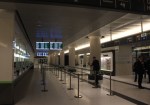
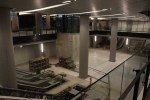
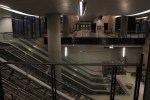
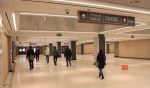
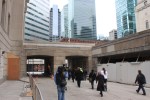
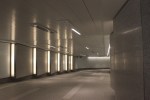
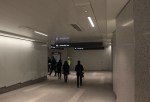
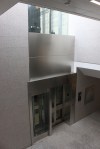
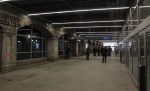
Union Station York Concourse Opens April 27, 2015

The new GO Transit York Concourse at Union Station will open for business on Monday, April 27. After years of construction and an ever-changing maze pf construction hoarding, the new concourse will show off what the Union Station Revitalization project is all about.

Anyone who travels through Union Station knows the old, crowded GO Transit area under the East Wing of the station. Passengers rushing for trains jostle with queues in the fast food court and the ticket area. The York Concourse opens up space under the West Wing that formerly housed baggage services and parking, an area that for most users of the station simply didn’t exist because much of it was off limits to the public.

The new concourse will add about 50% to the available passenger space and will open up circulation between the waiting areas and the tracks above, not to mention adding new ways to get into and out of the station.

Union_EN-1000x800_201504

This map looks north with the existing Bay concourse at the right hand end of the station. On either side of Bay Street are the old freight teamways which are now pedestrian paths under the rail corridor and access to tracks above.

In the middle of the station is the Via concourse which is not affected by this work. To the west (left) is the new York Concourse.

Both the Bay and York concourses will remain open until after the Pan Am Games this summer, and the Bay Concourse will then close for a renovation to match the new York Concourse with a target reopening date early in 2017. Concurrent work will include completion of the new lower level shopping concourse in two stages (under Via in 2016, and under the Bay Concourse in 2017), as well as heritage restoration of the Great Hall and the East Wing of the building.

The goal is to have three times the space GO Transit has today to serve at least twice the passenger volume.

Also opening will be new accesses to the station and tracks including the first phase of the NorthWest PATH link across Front Street (eventually to extend north to Wellington Street) and the York East Teamway providing another set of stairs up to track level and access to the station itself.

The photo gallery below is from a media tour on April 24, 2015.

GO Transit RER/Electrification Plans Announced

The details of GO Transit’s service improvements and electrification leading to the rollout of the “RER” (Regional Express Rail) network were announced today by Minister of Transportation Steven Del Duca.

The plans will please some and disappoint others, but there is little to surprise anyone familiar with the details of GO Transit’s network and the constraints of the rail lines around the GTHA.

RER rollout by line

RER rollout details

If there are “winners and losers” in this announcement, the benefits clearly fall (a) on lines that are completely under Metrolinx ownership and control and (b) on lines that do not already have full service, that is to say, there is room for growth.

Electrification is planned for most corridors by 2022-2024 starting with the Kitchener and Stouffville routes in 2022-23, followed by Barrie and the Lakeshore in 2023-24. The announcement is silent on the UPX service on the Kitchener line and whether the inner portion of the corridor will be electrified as a first step for UPX before 2022. (I have a query out to Metrolinx on this topic.) These dates have implications for rolling stock plans including purchase of whatever new technology — electric locomotives or EMUs — will be used for electric services, and, by implication the eventual fate of the existing fleet.

The scope of electrification will be:

  • Kitchener line: Bramalea to Union
  • Stouffville line: Unionville to Union
  • Lakeshore East: Full corridor
  • Lakeshore West: Burlington to Union
  • Barrie: Full corridor

There are no plans to electrify either the Milton or Richmond Hill lines, nor to substantially improve service on them. In Milton’s case, this is a direct result of the line’s status as the CPR mainline. On Richmond Hill, significant flood protection works are needed in the Don Valley as well as a grade separation at Doncaster. Plans could change in coming years, but Queen’s Park has clearly decided where to concentrate its spending for the next decade – on the lines where improved service and electrification are comparatively easy to implement.

The limits of electrification correspond, for the most part, to the territory where all-day 15-minute service will be provided. This will be the core of the “RER” network with less frequent, diesel-hauled trains providing service running through to the non-electrified portions.

One important aspect of the line-by-line chart of service improvements is that there will be substantially more trips (most in the offpeak) before electrification is completed. This allows GO to “show the flag” as an all-day provider and build into a role as a regional rapid transit service, not just a collection of peak period commuter lines. This will also give local transit a chance to build up to improved GO service over time rather than a “big bang” with all of the changes awaiting electrification.

Over the five years 2015-2020, the Kitchener corridor will see the greatest increase in number of trains, although many of these will not actually run through all the way to Kitchener. The service build-up will finish in 2017.

The Barrie line will receive weekend service in 2016-17 with weekday off-peak service following in 2017-18. The Stouffville line also gets weekday service in 2017-18, while weekend service follows in 2018-19.

Minor off-peak improvements are planned for both Lakeshore corridors in 2018-19.

Peak service improvements relative to today vary depending on the corridor:

  • Lakeshore East: 4 more trains by 2018-19 on a base of 45 (9%)
  • Lakeshore West: 6 more trains by 2019-20 on a base of 47 (13%)
  • Stouffville: 4 more trains by 2018-19 on a base of 12 (33%)
  • Kitchener: 6 more trains by 2019-20 on a base of 15 (40%)
  • Milton: 6 more trains by 2019-20 on a base of 18 (33%)
  • Barrie: 2 more trains in 2019-20 on a base of 14 (14%)
  • Richmond Hill: 4 more trains by 2018-19 on a base of 8 (50%)
  • Total: 32 more trains by 2019-20 on a base of 159 (20%)

Other than making trains longer (where this has not already occurred), that’s the limitation of peak period growth for the next five years on GO Transit. This has important implications for projections of greater transit commuting along the GO corridors, and especially for the shoulder areas within Toronto itself that lie along GO routes, but also face capacity and travel time issues with the local transit system. Unlocking gridlock may be the goal, but the rate of service growth could not be described as “aggressive” especially against the background growth in population and jobs.

This will, or at least should, lead to renewed discussion both of rapid transit capacity within Toronto, and on how GO Transit will address growth beyond 2020. Where should new capacity be provided? What are the realistic upper bounds for various options? How will Toronto deal with demand for expanded suburban subway service to handle growth in the 905?

It is quite clear from the electrification dates that an electric SmartTrack is not going to start running soon, and with frequent all-day service to Bramalea, Aurora and Unionville using diesel-hauled trains operating well before electrification is completed, one might wonder just where SmartTrack as a separate “local” service will fit in.

Beyond these questions lie the more complex issues of travel that is not bound for Toronto’s core. “Gridlock” is commonly cited as the rational for transit spending, and yet this spending does little to improve travel anywhere beyond existing corridors to central Toronto. Demand in the GTHA is not conveniently focused on a few points, not even on Pearson Airport which is a major centre, and single-route improvements do not address the diverse travel patterns of GTHA commuters.

Ontario will spend billions on transit in the coming decade, and sticker-shock has already set in with the huge amount of infrastructure needed. Even this is only a start and the work to truly address travel requirements of the coming decades is only just starting.

The Dubious Economics of the Union Pearson Express

In today’s Toronto Star, Tess Kalinowski writes about recently released Metrolinx reports concerning the Union Pearson Express (UPX).

The items of interest are down at the bottom of the Reports & Information page and they include ridership forecasts from December 2011 and May 2013. The latter report was cited as background to the Auditor General’s 2012 Report on Metrolinx [beginning on p. 6 of the pdf].

Given that the projection is almost two years old, one might be tempted to say “maybe things have improved”, but that’s a tad hard to believe in the absence of any newer studies from Metrolinx.

There are great hopes, and even greater hype, for the UPX, and getting some basic information on the table is certainly worthwhile. Continue reading

Metrolinx Board Meeting Wrapup: March 3, 2015

The Metrolinx Board met on March 3 for its quarterly gathering. Although there were important issues on the agenda, the debate was as superficial as usual, and the message that “everything is just great” permeated the proceedings.

Things got off to a slow start. The meeting room is relentlessly beige, overlit and unadorned. Windows there are, but when we entered, they were already partly screened and the view, such as it is, simply looks across to rooms and the roof opposite. Not long into proceedings, a further set of screens blocking this view descended lest we be distracted from the worthies sitting at the board table. We might as well have been in the set of an existential play wondering if there actually was a world outside, not a fine, downtown historic building.

The first order of business was a goodbye to retiring director Nicholas Mutton, a genteel fellow who has headed up the Customer Service Committee. Sadly his reports are always pushed to the back of the agenda and are rushed for time, and his presentations rarely get beyond reading a few pages of a short PowerPoint.

Then we had a brief report from Bruce McCuaig, the Metrolinx President & CEO, reiterating events of note since the last board meeting in December. One might forgive the poor directors for being out of touch with recent news given that they meet so rarely and have so little to say. Surely they stay informed on Metrolinx activities and don’t need a recap beyond the most unusual events.

In the remainder of this article, I will discuss:

  • Back-Charging Toronto for Metrolinx Work
  • The Regional Express Rail (RER) Update
  • The Regional Fare Integration Study
  • The Study of the Pearson Airport Area

Continue reading

CPR Obico Yard: A chance for TTC Expansion?

According to the Globe and Mail, the CPR plans to redevelop surplus lands in many cities. Among the land that is up for grabs is the Obico Yard near Kipling Station in Etobicoke.

Why does the TTC need more yard capacity?

For starters, they have more trains than will fit within existing yards and the problem will only get worse with the construction of any new lines such as the Scarborough extension or the Downtown Relief Line. The yard at Keele Station has been pressed back into service to hold the overflow from Greenwood Yard that was triggered, in turn, by the T1 car fleet at Wilson Yard being pushed out by the new TR fleet.

The Scarborough project includes budget room for a new yard, but exactly where the TTC would put this in Scarborough is a bit of a mystery.

A west end yard on the BD line would allow service to be split between both ends of the line, and it would free up space at Greenwood. The property is already a railway yard, and it sits in the middle of an industrial area.

Toronto talks a lot about preserving industrial lands, but if this property turns into a new subdivision, this will be a major failure by the TTC (or GO Transit) to grab an ideal spot for expanded system capacity.

Planning for SmartTrack

At its meeting of January 22, 2015, Toronto’s Executive Committee will consider a report (SmartTrack Work Plan 2015-2016) recommending a work plan for the study of Mayor Tory’s SmartTrack proposal together with other related transit projects. This is intended to dovetail with Metrolinx’ work on their Regional Express Rail (RER) network, and will have spillover effects on studies of both the Downtown Relief Line (DRL) and the Scarborough Subway Extension.

The most important aspect of this report is that, at long last, a study is reviewing transit options for Toronto on a network basis rather than one line at a time. Factors such as alternative land use schemes, fare structures and service levels will be considered to determine which future scenarios best support investment in transit. Rather than starting with a “solution”, the studies are intended to evaluate alternatives.

If this outlook actually survives, and the studies are not gerrymandered before they can properly evaluate all strategies, then the process will be worthwhile and set the stage for decisions on what might actually be built. The challenge will be to avoid a scenario where every pet project on the map is untouchable rather than making the best of the network as a whole. The term “best” will be open to much debate.

Continue reading

GO Transit Pilots Cut Rate Fare For Short Trips

Today, Metrolinx announced that GO Transit will offer a pilot low-cost fare on its Lake Shore line between Exhibition, Union and Danforth Stations. For $60, riders can buy a monthly sticker that would be added to their Metropass much as the Premium Express stickers for TTC services are today.

This is a substantial discount from the $181.60 that it would cost for the 20 days’ commuting trips based on the fares effective February 1, 2015. ($5.09 for each of rides 1-35, and $0.69 for rides 36-40.) The scheme began with a call for cheaper fares between Liberty Village and downtown Toronto, given that Exhibition Station is at the south end of the neighbourhood. Not to be outdone, east end Councillors jumped on the bandwagon, and Danforth Station was added to the request. GO’s announcement responds to these two “squeaky wheels”, but falls short on a number of other points.

  • Having a Metropass is a pre-requisite to using the lower GO fare. Depending on a rider’s travel pattern, a Metropass may be more expensive than pay-as-you-play token purchases.
  • The further one lives from Exhibition Station, the less attractive a walk to GO will be, especially during off-peak periods when finding space on the King car would be less of an issue.
  • One advantage touted for the scheme is offloading subway demand. In fact, this requires passengers to walk from Main Station to the GO Danforth Station, roughly a seven minute journey from the subway platform, plus the wait time added by the transfer connection. Ironically, many of the peak trains stopping at Danforth will also serve Kennedy Station which would be a much simpler transfer point for many east end riders, but the cheaper fare will not be available there.
  • The fare from Danforth to Union is the same as the fare from Scarborough, Eglinton, Kennedy, Weston, Etobicoke North, Oriole, Old Cummer and York University Stations. It is higher than the fare from Bloor, Long Branch, Mimico and Kipling. However, the cheaper “integrated” fare is offered only to those riders who have the least potential time saving by switching from TTC to GO for their commute trips.

Many peak period trains now run express and skip Danforth and Exhibition Stations. As of January 16, 2015, service is provided only by Lakeshore corridor trains (all Stouffville trains run express).

  • Danforth to Union
    • AM Peak: 6:36, 7:01, 7:16, 7:55, 8:27, 8:55.
  • Union to Danforth
    • PM Peak: 15:43, 16:30, 17:05, 17:20, 17:35, 18:18
  • Exhibition to Union
    • AM Peak: 6:27, 7:00, 7:37, 7:58, 8:24, 8:56, 9:04
  • Union to Exhibition
    • PM Peak: 15:43, 16:13, 16:43, 17:10, 17:43, 18:13

The schedules will change effective February 2:

  • Stouffville line trains will stop inbound at Danforth at: 6:15, 7:36, 7:48, 8:20, 8:46, 9:46
  • Stouffville line trains will stop outbound at Danforth leaving Union at 16:18, 16:48, 18:00

Some counter-peak Lakeshore trips that now run express will stop at Danforth. Details are on the GO website.

No additional trains will stop at Exhibition Station.

At the press conference announcing this pilot project, Metrolinx President & CEO Bruce McCuaig spoke of how this would be a “revenue neutral” undertaking. No additional trains will be operated. Whatever handful of commuters who now pay the full GO fare from Exhibition or Danforth to Union will get a big discount, but any new riders are found money for GO Transit. Whether this would be the case if the arrangement were extended throughout GO’s inner fare zones is another matter.

This is supposed to be a one-year pilot, and riders who originate in, say, Scarborough might reasonably ask why they have been left out in the cold even though there are many GO stations including those in the future SmartTrack corridor. How this pilot will establish much about the actual market for an integrated TTC/GO fare is a mystery, but the announcement provided yet another photo op for the politicians.

As of 1:45 pm on January 16, I await a formal response from Metrolinx to a query about the scope of the pilot and the absence from it of many potential stations.

The Mythology of GO Transit “Fare By Distance” Pricing

At its recent meeting, the Metrolinx Board approved a GO Transit fare increase taking effect February 1, 2015.

A separate, but important topic, and one noticeably absent from the meeting agenda, is the question of regional fare integration. Another related matter is the relative roles of GO as a regional operator and the TTC as a local one to accommodate demand to the core area. The hybrid SmartTrack proposal is a bit of both — a GO Transit corridor running with station spacings more like a subway in spots, but at TTC fares.

The problem has always been that GO simply does not regard itself, or at least not until quite recently, as having a role as part of a unified network. Critically, the fare structure is rigged against short distance trips, and this has been getting progressively worse for a decade.

Continue reading