A Slightly Less Grand Plan

Ontario’s Finance Minister, Dwight Duncan, yesterday announced that the province will run a half-billion dollar deficit thanks to the international financial upheavals and declining economic outlook.  In this context, I spent the day at a Metrolinx “stakeholders’ meeting” where we discussed details of the Draft Regional Transportation Plan and Investment Strategy.  The whole discussion has a surreal air because nobody is quite sure where the billions to pay for this plan will come from.

There is reasonable agreement about the need for better transit, but much suspicion of whether this plan will join its predecessors on library shelves.

In the informal post-meeting chats, I was asked what I would do if the promissed $11.6-billion MoveOntario money didn’t materialize, if we had to cut back the scope of the “top priority” projects to fit a tighter budget.  This is too big an issue for a short chat, and it deserves a post of its own.

Any budgetary cutback discussion must first consider whether to make the “death of 1000 cuts” or to look hard at big ticket items.  If you need to defer or cut spending, there is more money to be found in large projects than small ones, but we may skip reviews of smaller items that really don’t belong at the top of the pile.

A major problem lies in the dearth of information Metrolinx has published about the detailed performance projections and roles of each component in the plan.  We have demand forecasts only for year 2031 where the combined effect of future job and population growth interact with a completed network.  The published data show only peak point counts, not the demands for each network link.  There is no way to understand which links are cost-effective, and there is no data for intermediate states (such as after the “first 15” are built) to show whether they are an appropriate use of whatever resources might be available.

Metrolinx must publish this information as soon as possible.  Meaningful discussions of cutbacks are impossible without it.

This brings me to the “Business Case Analyses” that are in progress already for some of these lines.  These analyses are proceeding in the old, worn-out style of looking at each project individually rather than collections of projects for their combined effect on the network.  From the 2031 projections, we can see that the regional express rail lines and other new major elements have a big impact on demand on the existing network.  Notably, the forecast overload of the subway system doesn’t materialize because there are other high-capacity lines where the demand can flow.

Meanwhile, the TTC’s report on the north Yonge extension to Richmond Hill raises an old, hare-brained scheme to add a third platform at Bloor-Yonge station for increased capacity.  I won’t go into a detailed discussion here beyond saying that this is horrendously complex and expensive, but at least the TTC finally recognizes that subway capacity involves more than new signalling and more trains. 

The real question, however, is whether the money would be better spent on alternate services to divert riding with new options for travel to the core area.  Should some projects — the Richmond Hill regional express and/or the east leg of the Downtown Relief subway — be moved up as alternatives or as key pre-requisites?  That’s the kind of comparative analysis Metrolinx and the TTC are not doing, but should.

Next we come to project phasing.  Do we really need a line all the way to Richmond Hill?  Is there a shorter “phase I” that will have significant benefits without the cost of the full line?  Analysis on an all-or-nothing basis doesn’t give us staging options.

We need to be open about “the untouchables”, the projects with political clout that soak up billions of dollars because someone wants to see them built.  There is no point in talking about fiscal restraint if billions in proposed spending can’t be reviewed.  A related question is how that “top 15” list came into existence in the first place. 

Some time ago, the Metrolinx Board approved this grab-bag as likely top candidates that should be analyzed in more detail.  However, that analysis isn’t even started for many of them, and there is every possibility that the analyses may show that some projects don’t pull their weight, at least in the short term.  I may be splitting hairs, but that “top 15” has gone from candidates for early study to the definitive list of first projects without benefit of formal approval.  If we are to have a spending review, we must stop assuming that this list has the force of detailed review and blessing.

Oddly, it’s almost an afterthought in the Draft RTP — Metrolinx doesn’t even include a map showing the network with only these lines completed.

The subway to Vaughan is a special case.  There is supposed to be a trust fund holding the funding from Queen’s Park, Ottawa, York Region and Toronto.  Is this money really sitting in a bank somewhere?  Does the provincial share come out of the $11.6-billion MoveOntario pot?  Can we step back and ask questions about why this line is so important?  For starters, someone has to reconcile demand projections in York Region’s own EA that would make the Sheppard subway look busy with the impetus to build this line.  Metrolinx does not break out the section north of Steeles as a separate project, and the published demand for the line gives only the peak point value (likely just north of Downsview Station).

The TTC is already studying alternatives to the SRT including LRT conversion of the existing line.  The original recommendation to keep Skytrain technology only made sense for a line that remained at its existing length or had a short extension.  The further north it goes (Markham is a mooted destination), the less practical and more expensive Skytrain is relative to LRT.  Keeping the RT was a bad recommendation skewed by a desire to preserve Bombardier’s showcase technology, and we cannot afford to avoid this debate.

On the Sheppard/Finch corridor, current thinking is headed toward an eastward extension of the Finch LRT to Don Mills (where it would connect to the Don Mills line) and a westward extension of the subway to Downsview.  These may be viable projects in the long term, but we have to consider them separately from the original Transit City proposals.  Indeed, the Don Mills LRT isn’t even in the “top 15”, and there isn’t much point building the Finch line east of Yonge until it has something to connect with.

At Finch Station, there are big problems with the bus terminal and with the design of a future LRT interchange.  What happens if the subway extension gets underway and much of the bus operation shifts north?

On Eglinton, a line whose projected peak ridership is similar to both of the subway extensions, but whose extent provides rapid transit service to a far larger area, we are faced with an expensive central tunneled section that cannot be avoided.  Indeed, the size of this project requires that it be started sooner rather than later so that its benefits as a key part of the overall network can be available.

In the Don Mills corridor, should the DRL end at Danforth or continue north to Eglinton with a major transit hub linking the Eglinton and Don Mills LRT lines to the DRL subway?  This won’t be part of the “top 15” list, but the Don Mills Transit City study would make a lot more sense if the TTC stopped trying to shoehorn an LRT right-of-way into Pape or Broadview.  That scheme (and related alignments) are holdovers from the days when this was a BRT study, and this nonsense has to stop.

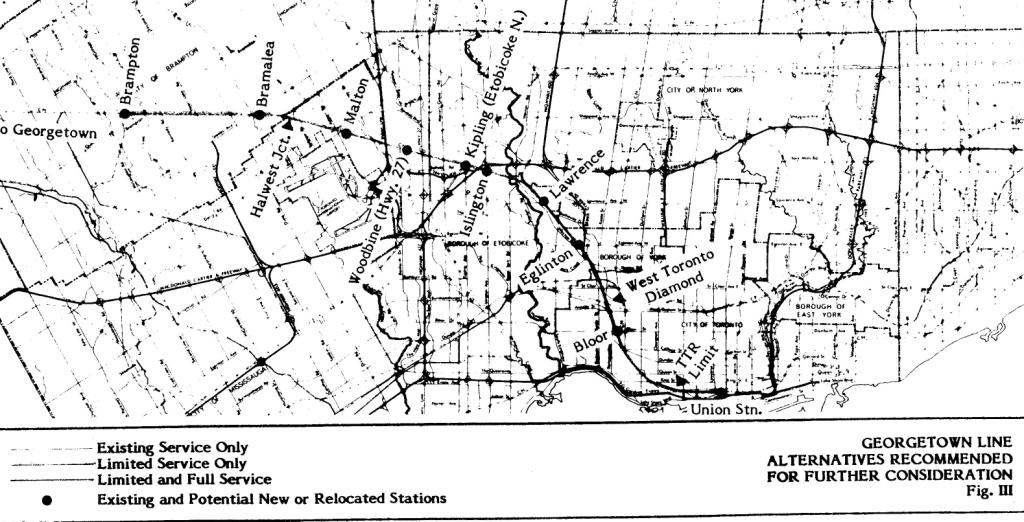
On the Weston/Brampton rail corridor, why do we persist with the fantasy of the Toronto Air Rail Link (TARL, formerly called “Blue 22”) that will chew up track space for a premium fare service on the same route as a proposed regional express service to Brampton?  How much does the private sector-proponent of the line hope to make from this service?  Can they be bought off?  Is it cheaper to not build Blue 22 and devote the resources to upgrading GO in the same corridor?

What are the possibilities for the CPR North Toronto Subdivision?  What options do we have for cross-region service via this corridor especially as an alternative way for riders from the north-east to get into the city without using the RT/subway network?  Negotiating with CPR won’t be easy, but doing nothing may condemn us to building rapid transit capacity elsewhere we might not actually require.

If there is a common thread in all of this, it’s a simple message:  Metrolinx started off designing a network, and they must not lose sight of the network view of any solutions.  Look at revisions to the plan as a whole, look at where the benefits are greatest in the short term so that we spend what money is available on projects that will show real improvements for transit.

Toronto has decades of making wrong, expensive choices, and transit suffers a well-deserved reputation as an “also ran” thanks to those decisions.  Provincial belt-tightening is just the opportunity we need to focus on what really works, on what we really need.

The Psychology of Free Parking

Over the past week, since the TTC proposed, then approved, the elimination of free parking for Metropass holders, I have been amazed by the volume of comments on this blog, other sites and in feedback in the mainstream media on this subject.

Parking is something dear to the hearts of motorists, and taking away free parking seems to be on a par with kidnapping a firstborn child.

Several people commenting on my site have claimed that getting rid of free parking at TTC or at GO lots will drive people (sorry about that) into commuting all the way downtown even if they have to pay for parking. There is a long comment by Andrew currently at the end of the thread comparing the costs and time required for various types of trip (all car, part transit, paid and unpaid parking). The viewpoint embedded in his calculations mirrors that of many who write about the need for free parking. Continue reading

Commuter Parking for Metropass Users (Update 1)

Update 1, August 27, 10:00 pm:

After a lengthy debate regarding the fairness of charging for parking and various alternatives, the Commission voted 5-3 this evening to implement the staff recommendations.

Original post:

Today, the TTC will consider a proposal to eliminate free parking for Metropass users at its lots.  When I first heard of this, my reaction was supportive because, as a non-driver, I don’t benefit from whatever subsidy the parking lots represent.  Some media comments have placed this subsidy as high as $7 per user per day, an unconscionable amount of subsidy that would be intolerable if “parking” were a proposed new route.

However, looking closely at the figures reveals a different story.

The TTC loses $3.6-million annually on parking operations on a total budget of $6.3-million.  In other words, the cost recovery is about 43 percent.  Things don’t look too good yet.

However, there are 14,000 parking spaces and this means that the loss per space is about $250 per year, or about $1 per weekday.  This is nowhere near the figure cited above, and is much more in line with a reasonable incentive to use transit. 

By analogy to bus and streetcar routes, the subsidies vary from route to route, but the network is most important.  At $1/space/day, this subsidy is higher than the average for many bus routes, but not completely off the map.

Conversely, if the TTC were able to fill its lots even with a parking charge of $2 or more, they would make far more than is needed to offset the operating cost.  Bluntly, the TTC’s numbers don’t add up.

Lest you think that I am an advocate for commuter parking, that’s quite another matter.  Parking lots have many undesirable characteristics including the poisoning of land for community use — buildings generating lots of pedestrian activity and a sense of neighbourhood.  New parking lots have property and construction costs, and if structures are involved, those costs will be substantial.

Even existing lots can represent lost opportunities.  When the outer stations on the Bloor-Danforth line were built, land was cheap and a lot of it was already in the public sector.  Parking was an obvious land use.  Only now, 40 years after the lines opened, are we starting to see development at some locations that should have appeared years ago if the common myths about subway stations creating development could be believed.  In effect, the TTC strangled development right where it would be most desirable by dedicating so much land for parking.

As an aside, I should note that some lots such as Finch are on land that cannot be developed, and this at least puts the Hydro corridor to some use.  However, there is a limit to how far east and west from Finch Station parking can be built, and sites like this are an exception in the system overall.

On GO Transit, the lots at stations are full by 7 am, and massive parking expansion is really not in the cards.  GO has more stations in industrial areas where high density residential development is less likely, but the problem remains that there’s a limit to how much land the transit system can dedicate to parking.

The real problem is that feeder services to GO and TTC stations leave a lot to be desired especially as demand on both systems grows, bidirectional travel becomes common, and frequent all-day GO service is finally getting serious discussion in transit plans.

As for the existing TTC lots, my position is this:  if they can be redeveloped both to liberate the capital value of the land and to provide more transit riders while converting sterile transit terminals to community centres, so be it.  In those odd cases like the Hydro corridor where redevelopment is not practical, let people park, but recognize that there are limits to this and that parking is not a panacea for attracting riders to transit. 

As always, good service is the key.

The Downtown Relief Line Gets On The Map

In what has to be record time for a transit proposal to get from a blog discussion to publicly debated policy, the Downtown Relief Line (DRL) is now barely a decade away.

Yesterday, Sean Marshall’s post at spacing generated a blizzard of comments, and today, the National Post reports comments by Adam Giambrone and Rob MacIsaac.  Giambrone will start looking at the line in 2018.  That is far too late, and the TTC needs to start looking at it today if it’s going to be open, as he suggests, by 2020.

A few comments raised my eyebrows, however:

As the city core becomes more dense, passengers are choking the Bloor-Yonge and St. George transfer points, as well as the King and Queen streetcars. The Bloor-Danforth line will soon be congested, too, Mr. Giambrone said.

Rob MacIsaac said:

“There’s so much demand that you’re exceeding what a streetcar line can carry. I had a discussion with [former TTC general manager] David Gunn once and he said, ‘Don’t build a subway until you can jump from the top of one streetcar to the next,’ which is probably a circumstance that you’re getting close to on Queen Street.”

I don’t know who has the idea that streetcar service on King and Queen are anywhere near capacity, and the only streetcars someone can jump roofs on are in Russell and Roncesvalles Carhouses.  Service on both streets has operated at twice the current capacity, and there’s lots of room for more streetcars if only the TTC had a large enough fleet.

What’s fascinating to me is that, finally, it is acceptable to talk about adding transit capacity into the core of the city.  For years the focus has been on the suburbs going  back to the deal-with-the-devil struck by then Councillor Jack Layton and Mayor Lastman.  Layton supported suburban subway expansion as a means of diverting intensification from downtown.  The DRL fell off the map because it did not fit with the goal of strangling core area development to benefit the suburbs. 

We all know how successful this was.  A good chunk of the office and commercial space in North York Centre is empty, while downtown fills up with condos and resurgent office development.

As for the DRL, the original proposal was simply for a line from Flemingdon/Thorncliffe to downtown.  Subway fitted with existing technology in the area, and nobody was taking LRT seriously as a “light subway”.  We have more options today including a through connection to a line in the Weston Subdivision (as described in the Post article) up to at least Dundas West Station.  It doesn’t take a genius to see how this fits into Transit City and a service to the airport.

Very frequent service can operate on the southerly parts of the Don Mills and Weston lines where they are completely on their own right-of-way, with less frequent trains continuing up Don Mills in the street median, up Jane and out Eglinton West.

When we look at the possibilities of both an Eglinton and a “DRL” built with LRT, but spanning almost the complete range of LRT implementations from street median up to near-subway, we see the real possibilities of this mode for our growing transit network.

(And yes, Hamish, the Waterfront West service can hop onto the same corridor at Queen and Dufferin.)

While we’re at it, as I mentioned in a previous comment, we must keep sight of the role for regional services on existing and future GO lines.  One source of subway overloading is long-haul riders for whom GO service (if any) is too infrequent.  Better GO service with a fare structure integrated with the TTC will give riders a fast, alternative way into downtown, at a much lower cost than expanding subways everywhere.

Queen’s Park, Metrolinx & the TTC (Updated)

Late last week must have been slow for real news when both the Star and Globe devoted considerable space to musings at the Pink Palace about a Metrolinx TTC takeover. Furious backpedalling all ’round with denials from Metrolinx’ Rob MacIsacc and cries of “hands off” from Mayor Miller.

Lurking under this sort of scheme are claims that just don’t hold up to scrutiny.

First up is the oft-heard desire for “seamless integration” of transit. Boiled down to its essentials, this means I should be able to ride from anywhere to anywhere for one fare with convenient integrated service wherever a change of route or mode is needed.

Riding on the back of this is a scheme for fare-by-distance charging and smart cards. While this may keep the technology companies and those who value appearance over substance as transit policy, this is totally the wrong end of the “solution”.

If the desire were to give everyone an integrated fare between the TTC and the 905 systems, we could do it tomorrow either with the GTA pass or some area-specific version. The big problems are how to divide up the revenue, what to charge and whether there will actually be any service in the 905 with which a 416 rider can seamlessly connect.

These are organizational and financial issues. As long as each transit system is expected to keep its own books, raise its own revenue, and account for every penny (perish the thought we might needlessly run one more bus than necessary), the rules of the game create agencies that defend their revenue turf.

As long as we maintain artificial distinctions between who gets to pick up riders on which street (again partly a turf war), we will have duplicate services.

As long as we starve transit agencies for funds, the clear goal is not to improve service but to minimize costs. This is totally contrary to any claims that our public goal is to get more people riding transit.

You don’t need a quarter-billion’s worth of high technology to fix these problems which, indeed, will still remain if we don’t fix the underlying way in which revenue is allocated to operators. If the fare barrier at Steeles Avenue is eliminated, somebody is going to have to pick up the difference — the TTC and its riders, York Region or Queen’s Park. Nobody wants that debate, but we can sidestep it so long as we focus on Presto! rather than on how it will be used.

It’s ironic that many cross-border services are now operated by TTC on contract to other agencies and the only “impediment” is the fare at Steeles Avenue. Maybe York Region would opt to pay the TTC more to carry its customers. Maybe a special subsidy could be arranged just as it is for Oakville passengers connecting with GO Transit. Why is it okay to have a special fare arrangement for GO Transit feeder services, but not for 905-to-TTC riders?

The “seamless barrier” is one of those transit myths that get dragged out regularly to avoid discussing the real issues. The line between the 416 and 905 could disappear tomorrow if only someone wanted to pay for it and co-ordinate the overlapping services where they exist.

This brings me to that shining example of Ontario’s contribution to transit, the GO system. Remember that GO is not paid for entirely by Queen’s Park, but levies a tithe against the municipalities. Only last week, a tripartite agreement with Ottawa was finally settled when Toronto agreed to pony up its share of a GO Transit funding request.

Metrolinx has been churning out discussion papers (green ones to solicit comment now, white ones to set policy soon) like sausages, and they hope this will lead to a Regional Transit Plan by “Spring 2008”. Whether they mean March 21 or June 22, I am not sure, but even the later date is very optimistic. Moreover, it is troubling because we recently learned that the RTP is also to stand in for the first two steps of the already shortened Environmental Assessment process.

We risk having a regional plan rammed through with little opportunity for comment or intelligent debate that could commit us to a complex and explicitly laid-out network long before we have a chance to consider how it will all fit together. Moreover, there is no mandatory ongoing review and process for change of the plan making “getting it right” at the outset all the more critical.

While Queen’s Park muses about a TTC takeover, they should look closer to home first. GO Transit has been in the commuter rail business for decades, with small forrays into buses, but with the focus on peak period, downtown oriented services. It does not matter what the agency name might be, there is a need for long-distance capacity around the GTA that does not stop at every lamppost. Riders in Oshawa don’t want a tour of Pickering, Scarborough, North York and Etobicoke on their way to Mississauga where they might arrive just in time to go back again.

GO’s service reliability raises questions about its ability to take on a larger role. Riders are cranky about crowding and unexpected changes in schedules, and there is even an online petition demanding a fare rebate when service runs late.

GO, however, has been at least as constrained for funding as the TTC and thinks only of its core services. Expansion comes in small jumps because they have no firm commitment from any level of government to do more.

I might believe that a Provincial agency could do a passable job with the TTC if the current one were actually looking beyond a narrow mandate as a commuter service. Imagine the example Queen’s Park could show of what their bounty could bring to transit. So far, what we have is unimpressive as a replacement for the TTC.

This is not to say that the TTC couldn’t use some housecleaning. However, any “new broom” had better know what it’s doing, not just come in to sell off the furniture and declare huge but ephemeral savings.

One particularly troubling aspect to some comments in this debate is the political slant. Adam Giambrone is out-and-out NDP, and David Miller certainly is not a Tory. Toronto Council is, if not in the grip of the left wing, at least not quite as right-wing as it was in the Lastman days.

What’s the solution? Take them over? Well we tried that with amalgamation, and after a few years of flailing around, look what we have: a moderately left Council with a moderately left Mayor. The voters have spoken.

If anyone has designs on the TTC or on GTAH transit in general, let the decisions be made for legitimate reasons of management, finance, operations and community involvement, not because some politician wants to score points for a coming election. We have seen decades of Provincial interference in transit both in funding and in technology choices that had much more to do with so-called economic development and pandering to voters than with production of useful transit infrastructure.

Message to Dalton McGuinty: Leave the TTC alone. Let Metrolinx continue with its planning, and don’t force the issue of a final plan so quickly and so permanently that we regret everything and start over in ten years.

Recognize that building and running more transit, getting a bigger share of the travel market, is going to cost a lot of money, and some of that will come from the public purse. Keep your chequebook handy.

Don’t substitute the illusion of action — organization and re-organization — for the real needs of transit systems throughout the GTAH.

GO Transit’s 15-Cent Solution

Sean Marshall wrote in with the following comment in another thread. I’m putting it in its own post so that replies can be kept in the appropriate area.

… at GO Transit, they’re planning to increase fares again by the flat $0.15 rate. Of course, this is a disproportionate fare increase for those who make shorter trips (say within the 416 or from, for example, Georgetown to Brampton) yet almost insignificant for someone coming in from Barrie. And GO also has to fix the problems with its fare structure, where, for example, a bus trip from Square One to York U is the same price as from Bramalea to York U, about half the distance.

Anyway, my sense is that GO will always take the easiest route (requiring the least thought) to fix a “problem”. Service crowded? Tack on more cars. Issues with parking? Build more spaces. Crowding at platforms? Remove the escalators. Raise fare revenue? Make it a flat fare increase so we don’t have to work out what the new fares should really be.

This is not the first time GO has done this, and I can’t help worrying just a bit in anticipation of a smart card system that can do everything but make passengers’ breakfast, lunch and dinner, but might wind up supporting a fare structure more appropriate for conductors and ticket agents. Will GO continue to penalize short-haul riders with disproportionate fare increases?

Union Station Revitalization

On Wednesday, November 14, the City of Toronto will host an open house at Union Station to display plans for the station from 12:30 to 6:30 pm.  Further information on the Union Station project is available on the City’s website.

Please note that although I am a member of the Union Station Revitalization Public Advisory Group for this project, the following comments reflect my personal opinion, not that of the USRPAG.

Today, the National Post reported GO Transit’s Gary McNeil as saying that GO should buy the station to take it out of the hands of “dithering politicians”.  McNeil, along with others who mused recently about taking over the TTC, should stick to running their own businesses before they weigh in on City matters.

Union Station’s future was mired for years in a failed scheme to have it managed on a long-term contract by a private company, and there was good reason to believe both that the selection process for a private partner and the financial situation for the City were less than ideal.  Much time was wasted in this exercise.

Although the detailed report is not yet public, some indication of the short-term spending requirements has already appeared in the Budget Analyst’s notes for the City’s Capital Budget.  Some Council members will groan about the high cost of owning this heritage station, and McNeil’s proposal that GO would happily take the building on will have an eager audience.  They should think twice. 

GO has been starved for funding for well over a decade, and the last thing it needs is the expense of bringing an aging and poorly-maintained station up to first class condition.  Moreover, GO’s operations will soon fall under the GTTA which may have its own spending priorities.

Meanwhile, some members of Council mused recently about shops and markets in Union Station.  This is a nice idea, but why couldn’t they wait for the staff report on the station to come out? 

A fish market at Union, if nothing else, will lend a distinct aroma to Gary McNeil’s trains.  For those long winter nights when trains languish miles from Union Station, McNeil might add a self-serve grill to the GO concourse so hungry passengers can eat their catch-of-the-day while it’s still fresh.

Union Station needs a lot of work to handle the expected growth in demand over the coming decades.  Many agencies need to work together with each other, with the politicians and with the public to make Union Station the great hub it can be for downtown’s transportation systems.

Those who take off in their own directions wanting only to read their name in the National Post as often as possible do nothing to aid this vital project.

Getting On GO Transit

At the GTTA Board meeting yesterday (see previous post for additional information on this), GO Transit presented an overview of its plans for additional parking on the network.  I won’t go into the fine details here, but broadly this contained two important directions:

  • GO is moving toward parking structures, possibly in conjuction with development of its parking lot properties, as an alternative to continued outward expansion of the lots.
  • The target growth rate is from 1,500 to 2,000 spaces per year.

GO currenly operates 48,500 parking spaces, and the park-and-ride sector now account for 67% of ridership.  Other modal shares are kiss-and-ride (15%), walking (9%), local transit (8%) and cycling (.5% to 1%).

In the long run, parking is not sustainable at its current modal share.  Assuming a 20-year growth rate in the middle of GO’s cited range (1,750), this would give 35,000 more spaces.  However, GO expects its riding to double over the next 20 years, and external factors such as a stepp rise in oil prices could accelerate this.  Clearly, parking will handle a lower, even if still important, proportion of total ridership.  A further problem is that a route such as Lakeshore with plans for large increases in capacity through electrification and extension is not necessarily where the additional parking capacity can be easily located.  Rapid growth in ridership may outstrip parking growth on this line.

This puts a considerable additional demand on local transit service to the GO stations both in quantity and in hours of service.  This will be a challenge for local transit operators and, by extension for the GTTA.

As the GTTA contemplates the future role of transit, it must adapt from provision of downtown-oriented, peak Monday to Friday communting service (including the local transit component) to service that makes travel by transit within and among the regions easy.  After all, much of the GTA gridlock comes not from commuters to downtown, but from travel between the regions including phenomena such as the lunch-hour traffic jams.

This is one of several cases the GTTA must not adopt a “more of the same” approach to transit.

When Will Dalton Discover Hot Air?

One of the more bizarre election stories appeared in the Globe and Mail today — Dalton McGuinty is advancing the idea of hydrogen-fuelled GO Trains.

Regular readers here will know that my opinion of hydrogen as a transit fuel is thinly-veiled contempt on the best of days, and I am astounded to see McGuinty wandering down this technological dead end.

Fuel cells and hydrogen power have their uses, but they run into difficulties even at the scale of a city bus, let alone a railway car.  If this were used for GO equipment, it would be at best for self-propelled cars running on minor lines that did not warrant full, locomotive-hauled trains.  This is a niche market, not a mainstream replacement for existing equipment. Continue reading

Who’s In Charge at Kipling Station?

[Since the Star has hotlinked my site from their article, it might be nice if there was actually some content here for any visitors to read.  Hence this piece.]

Today, Queen’s Park announced that GO Transit would fund the construction of a regional terminal at Kipling Station for joint use by GO and Mississauga Transit.  Amusingly, this project was not part of MoveOntario, but, like many other bits and pieces, was overlooked in the rush to put together Dalton McGuinty’s transit plan.

Oddly, nobody from the City or TTC was at the announcement even though the new terminal will sit on their land.  The TTC design for a new Kipling Station came out late last year, and it’s hardly news.  All we were waiting for was funding, and that arrived today.  However, Queen’s Park seems only concerned with the regional part of the project and it remains to be seen how the City/TTC portion, which includes redevelopment of some lands at Islington, will fit into everything. Continue reading