Past studies of electrification together with information on the technology’s use in other cities and countries is now available on the Metrolinx website.
I will comment on this information once I have a chance to digest all of it.

Past studies of electrification together with information on the technology’s use in other cities and countries is now available on the Metrolinx website.
I will comment on this information once I have a chance to digest all of it.
Robert Wightman rode the GO service to and from Niagara Falls today (July 1), and sends the following comments.
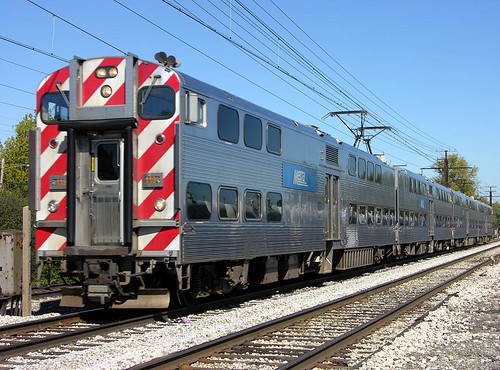
I rode the second GO train to Niagara today — 650 passengers. The third train ran with 270. GO is running ten car trains so that they do not need to make and break train sets but they are only using the eight cars closest to the locomotive because St. Catharines appears to only have an eight car platform while Niagara only has a five car platform; they stop the train twice.
GO has put in proper platforms including handicap mini platform at St. Catharines and Niagara. There is room to lengthen the Niagara platform but there is some construction going on there. It appears that they are putting in a wayside power connection at Niagara, probably for VIA.
GO has not done a Mickey Mouse job at these two stations as they have put in new platform lighting and a proper and permanent mini platform. It appears as if GO wants to make this a permanent run. They were running a buy-one-get-one-free promotion today so you could buy a one way ticket and use it as a return ticket. Toronto to Niagara and return cost $15.90 instead of $35.80 on VIA.
GO pulled out all the stops as they had a GO crew and a CN crew in the engine because GO crews are not current on the Grimsby Sub. They also had two CSA’s (Customer Service Agents or door operators,) and two or three Special Constables to make sure everything ran smoothly. They did not check tickets in either direction on my two trains.
I was surprised at the number of people who got on both ways at St. Catharines. Considering the amount of money that GO has put into platforms and lighting at these two stations, I bet that they will start running two trains in from Niagara in the morning and out in the afternoon sometime this fall. The trains are in the new Lakeshore West timetable and will run on Saturdays, Sundays and Holidays until Oct. 12. It would not cost them any new equipment but they would probably need to put in a yard at Niagara to store the trains overnight.
Number 98 the 17:25 Amtrak/VIA train to Toronto was 1h45 minutes late as US homeland security decided to check what every one on the train was exporting from the US. It was probably a not so subtle hint to keep your vacation money in the US. This caused a 1h05 delay to the GO train into Niagara at 18:15 as it had to wait for the Amtrack train to clear Canadian Border Security Agency check. Amtrak/VIA did not pull into the second track even though one Niagara person who was apparently instrumental in setting up the GO excursion train said they were supposed to as part of the contingency set up for this scenario. The VIA agent said the Customs people had refused in the past to check trains on this track as they thought that it was dangerous to cross track one to get to track two even if the passengers had to do it.
I was pleasantly surprised to see how many people were riding the train. Once GO gets its operation down pat to the point where they can run three man crews this should be a money maker as well as a boon to tourism in Niagara and Toronto. Perhaps they could consider doing this for Stratford to improve tourism there as well as getting nameless transit commentators to their hotel before they go to the theatre.
Running this type of service has a low cost to GO as the equipment is sitting around all weekend doing nothing so they do not need a large passenger volume to cover their costs. With eight cars to carry 650 passengers the train was not crowded but it still carried enough to cover its marginal costs.
It was educational to compare the GO and the VIA Amtrak service as they loaded at Niagara. The VIA Amtrak trains loaded about 25 people through one narrow door for about 7 minutes. GO loaded close to 500 passenger through 10 double width doors, including a number of bicycles, in about two minutes and these were mainly people who do not ride any train normally. VIA and Amtrak should scrap their existing equipment and replace it with something like the Bombardier bi-levels that can load and unload so much faster with their low level double width doors.
If the US security folks want to see people spending money south of the border, they should be happy to see all sorts of US goodies in travellers’ arms going back across the border to Canada. Of course how much of that stuff was actually made in the USA and how much elsewhere is another problem. Conflicts in operations like this need to be worked out.
It’s good to hear that the train did well on its first day although the effect of full fares needs to be seen.
As for cultural events, it’s still a pain in the butt to get to Niagara-on-the-Lake. Stratford, for me, is a weekday jaunt. The city would love to see GO run service there regularly and has proposed the largely vacant yard at Stratford as a GO facility, but it’s quite a jaunt west of Kitchener.
The problem on that line is that the arrival time of the morning train is now just late enough that catching a matinee isn’t a sure thing. I doubt GO will be running midday trains that far from Toronto any day soon.
Updated 10:15 am, June 27: Metrolinx has decided to release GO’s electrification studies without a formal Freedom of Information request. They will be available online sometime in the next two weeks once they are converted to a suitable format.
Updated 12:30 am, June 23: A list of existing commuter rail operations including those with electrified operation has been added at the end in response to a bogus claim in a Metrolinx FAQ.
Updated 9:50 am, June 23: Another Caltrain newsletter shows the benefits of electrification and the benefits of EMU operation.
Much of the debate on the Weston corridor study, formally known as the Georgetown South Service Expansion (GSSE) Environmental Assessment, focuses on noise, vibration and pollution effects from the substantial addition to train traffic in the corridor. One major option, electrification, was not included in the EA on the premise that this conversion will, possibly, be done sometime in the future, but not now.
Responding to public pressure, Metrolinx will launch a detailed study of system-wide electrification for GO. The first step will be to strike a consultative committee of various interested members of the public to advise on the terms of reference for the study. The committee should be appointed by the Metrolinx Board in July 2009. Once the terms are nailed down, the study itself is expected to take until the end of 2010.
Alas, this is far enough in the future that it will have little outcome on what is actually built in the short term. Also, by looking at the full network, and having cited very high figures for a complete conversion, I can’t help wondering if Metrolinx hopes to derail support for a movement to electrify “now”.
Unfortunately for Metrolinx, GO has already studied electrification of the Lake Shore corridor first in 1992, then an update in 2001, and, I understand, another update in mid-2008. Do we really need another study for this most important of GO corridors? Can we estimate, broadly, the cost of converting the Georgetown corridor based on the Lake Shore study?
Metrolinx was asked to release the Lake Shore studies, but in a splendid example of contempt for the public, they require a Freedom of Information request to release documents we all know to exist in the first place. As of June 26, the requirement for an FOI request was dropped, and Metrolinx will post all of the GO studies online within the next two weeks once they have been formatted for that medium.
The FAQ for the electrification study (linked above) states:
Q. Hasn’t a study already been done?
A. Yes. A smaller study was done for the Lakeshore West line only.
Well, no, actually the April 2001 update covers Oshawa to Hamilton. Moreover, this may not be the entire system, but it is certainly the heart of GO’s network and information here gives order-of-magnitude values that can be used when looking at other lines. Continue reading
Updated June 27 at 10:10 am: The study of noise impacts is now available on the Metrolinx Site. I will review this and other reports in a future post.
Updated June 23 at 9:45 am: The detailed studies of air quality and health impacts are now available on the Metrolinx site. I have not had a chance to read through them yet, and will probably not be commenting on them for a few days.
On June 15, the Toronto Board of Health (an agency that operates independently of City Council but on which some members are Councillors) considered a report from the Medical Officer of Health concerning the impact on air quality of the proposed service expansion in the Weston rail corridor. The recommendations in this report were amended by the Board (see item 24.4 in the decisions of the Board).
The MOH had been asked by both the Board and by the Parks and Environment Committee of Council to review the potential health impacts associated with diesel fumes from the proposed increase in diesel train traffic in the corridor. Noise issues were not addressed by the MOH’s report although they are mentioned in the Metrolinx Part II document for the Environmental Assessment now in progress.
The full Part II document is available online. A much reduced version of the information is available via the consultation portal, but I don’t recommend it.
Many people from communities along the corridor appeared at the Board to make verbal presentations. A common theme in their submissions was that the large increase in diesel traffic in the corridor will have an adverse health impact on those who live, work and go to school nearby, especially children who are more sensitive to pollution effects. In particular, there was a concern that overall air pollution may be contributing to the rising rate of asthma among children, and that the levels expected in the rail corridor, although mostly within “standards” may disproportionately affect families living in the corridor.
Speakers asked that the Board strengthen the recommendations of the MOH which they did by inserting:
The Board of Health … requested Metrolinx to electrify the Georgetown South Service Expansion and the Union-Pearson Rail Link prior to implementing expanded service (Clause 3.a of the decision).
This decision does not bind Metrolinx, but indicates that the BOH considers this to be the preferred way of dealing with the corridor. Continue reading
Tuesday, June 2 was a long day for members of Toronto Council’s Executive Committee. Many transportation issues were on the agenda including Union Station Revitalization, Western Waterfront Master Plan, Queen’s Quay redesign, and the Gardiner Expressway replacement EA.
As if that wasn’t enough, an open house for the Scarborough RT extension took me out for a ride on the Milner bus.
This transit blogging is harder than my pre-retirement work! Continue reading
Metrolinx has now released Part 2 of the Draft Environmental Report for the Georgetown South Service Expansion Project, and will hold a series of Open Houses over the next few weeks.
I will add more details to this post once I have a chance to digest several hundred pages of online information.
Updated 6:15 pm:
Mark Dowling sent along a note about a rather bizarre statement in the Metrolinx document:
Are Metrolinx trying to pull a fast one? Section 5.1.7 Page 204 (page 216 of the PDF):
“At present there are no electric double-deck commuter cars that can legally operate on North America railway lines.”
What would they call these then? Or has this fleet been retired by METRA since 02?
- http://en.wikipedia.org/wiki/File:Metra_Electric_train.jpg
- Link to the photo used in the Wikipedia article
In any case, nobody said they had to be EMUs, did they? (Although EMU would have its advantages, obviously).
It’s this sort of thing that makes one wonder about the accuracy of so much else Metrolinx produces, or of the (possibly unintentional) bias in their studies.
Disclaimer: Although I am the Vice-Chair of Toronto’s Union Station Revitalization Public Advisory Group, this article represents my own opinions, not necessarily those of USRPAG who have not had a chance to discuss this matter since the release of the report linked below.
On June 2, Toronto’s Executive Committee will consider a staff report recommending that the Union Station Revitalization project proceed at a total cost of $640-million. This project is dependent on funding approvals from Queen’s Park and Ottawa which are expected to materialize over the coming months. Continue reading
According to today’s Star, Metrolinx will today announce the commencement of a study of electrification. Although this had been planned sometime in the future, the dates were vague depending on which report one read. Indeed, GO seemed to be leaning more to continued diesel operation with a mix of local and express trains rather than using inherently faster electric trains for all services.
This is a great victory for the Clean Train Coalition who will release “The Better Move”, a response to Metrolinx’ Regional Plan, “The Big Move”, at a press conference on Wednesday (May 27).
The West Toronto Chapter of the Professional Engineers of Ontario plans to set up a subcommittee to study the electrification issue, and will hold a meeting on the evening of May 27. Mike Sullivan from the Weston Community Coalition will be speaking. The meeting is open to the public, but pre-registration is required. For information, please see the PEO Chapter’s flyer.
Updated May 14: The display panels from the April 22 open house are available on GO Transit’s website.
Original post from April 15:
Construction is already underway for the grade separation project at the West Toronto diamond, and the residents are mightly upset about the noise from pile driving. This project will continue disrupting the neighbourhood until late this year.
GO Transit has announced a public meeting on April 22, 2009 that will kick off another project in the same area, this time to remove the diamond where the Newmarket Subdivision (Barrie GO line) crosses the CPR North Toronto Subdivision.
(Thanks to Vic Gedris for passing along a copy of the notice.)
For a good part of today, April 18, a conversation has flown back and forth via email between me, Karl Junkin of TRAC, Mike Sullivan and Rick Ciccarelli of the Weston Coalition, and Robert Wightman (a frequent contributor to comments here and a member of the original Streetcars for Toronto Committee). I will not attempt to précis all of the threads, but thought it worthwhile to bring the discussion out into a broader context in this blog.
The problem, in brief, is to ensure that the electrification of the Weston/Georgetown corridor happens sooner rather than later and that the number of diesel trains operated on that corridor is kept to a minimum as service builds up to projected levels.
We had quite a discussion about dual mode locomotives with the major points pro and con boiling down to:
The idea lurking behind this is to maximize the amount of electric operation in the Weston corridor at least as far as the airport in keeping with the desire of communities along the corridor to minimize diesel operation, noise and fumes.
Various links of interest:
Railway Age article (quoted on another site).
Bombardier specification sheets for existing New Jersey and on-order Montreal equipment.
Specification sheets for GO’s current equipment (here and here, similar content).
Recently, I threw a new variation into the discussion by suggesting that there could be two separate fleets of locomotives. Purely electric locomotives would be used to hall the service on the all-day section of the Lakeshore and Georgetown lines, and diesels would be used for peak period express trips running on the extended routes.
This arrangement would mean that all off-peak service would be electric, and diesel operations would remain only for peak extensions and for lines that had not been converted for electric operation.
There are downsides to this, notably that more infrastructure would be needed to get to the point where electric service could start, but it would achieve much of the goal of reduced diesel operation in the major corridors without requiring electrification to the end of service territory. It would also eliminate the need for dual mode locomotives — whether this is a “benefit” depends a lot on where you stand on this type of operation.
Finally, all of this assumes that “Blue 22” would be electrified from day 1. This seems highly unlikely given current arrangements with the proponent, SNC Lavalin, who are not even providing new equipment for their service. Whether the proposed structures for the airport access tracks can even accommodate future electrification is unknown, and I would not be surprised to hear how we couldn’t possibly force SNC Lavalin to include this in the initial build.
Metrolinx is showing its usual colours on this whole issue saying that the project to get new service on the Weston corridor is far to important to delay, and that electrification is something for the future. They are not making a lot of friends along the line on this count as well as on other structural issues involving neighbourhood impacts. I will explore those in a separate post.