Ontario’s 2025 Budget and Transit

Ontario unveiled its 2025 budget on May 15. Although it speaks of “Approximately $61 billion over 10 years for public transit”, by far the lion’s share of this spending is for projects already underway in the construction and design stages.

All of this is for capital expansion and renewal, and nothing has been announced for day-to-day improvement of transit service.

GO Transit

The budget cites:

  • The Hamilton-Niagara through service connection at West Harbour Station which is already in service.
  • The proposed Bowmanville extension which has been announced before, but is only barely underway at the “early works” stage. This extension has physical alignment issues.
  • GO 2.0 includes “delivering all-day, two-way service to Kitchener and Milton, building new GO stations across the region and advancing planning to unlock potential new rail corridors through midtown Toronto, Etobicoke, York Region and Bolton.” There are no dates attached, and some of these have been on maps for a very long time. Notable by its absence is any mention of electrification.
  • A total of $850 million to refurbish GO Transit rail coaches at the Thunder Bay Alstom the North Bay ONR facility. This work is already announced. The cars may receive convenience upgrades such as “charging plug ports, cup holders and improved Wi-Fi”, but the long-term retention of these cars indicates that the operating model for GO electrification, if and when it occurs, will have a large component of locomotive-hauled trains rather than electric multiple units.

Subways

Subway projects in the budget are:

  • Ontario Line (under construction).
  • Eglinton-Crosstown Western Extension (under construction).
  • Yonge North to Richmond Hill (procurement underway).
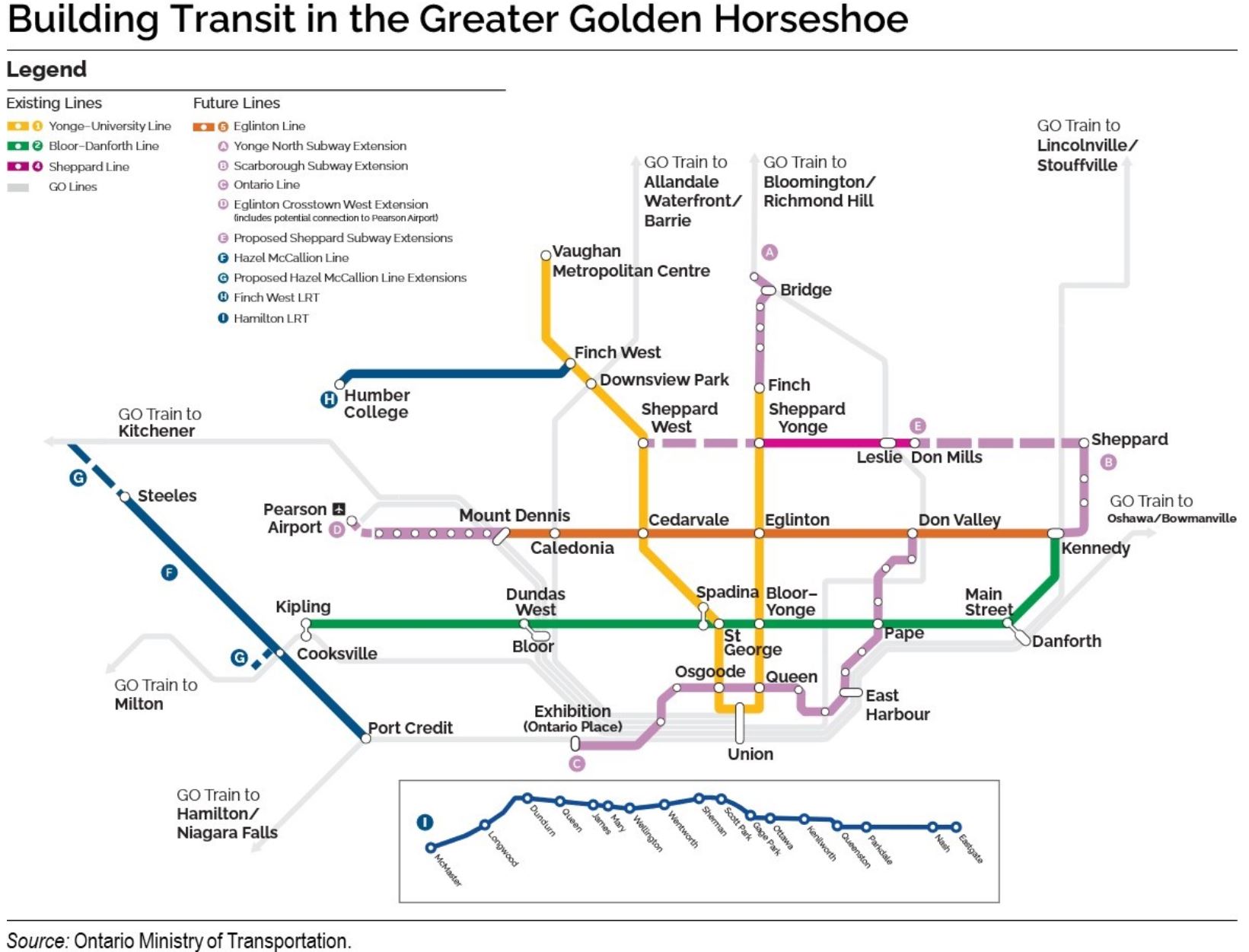
  • Sheppard Subway Extension (planning, consultation and business case preparation underway). Notable in the map below is the absence of a line east of McCowan where there is a conflict with the City’s Eglinton East LRT project and with maintenance yard property requirements.
  • New subway cars for Line 2. Provincial funding for these trains has been in place for some time. What is not yet funded are trains for service expansion beyond pre-covid 2019 levels. Trains for the Yonge North and Scarborough extensions are included in those projects. The TTC is in the Request for Proposals process for new trains, but this has been skewed by provincial statements that the work should go to Alstom’s Thunder Bay plant.

Yes, they seem to have forgotten the Scarborough Subway Extension (now under construction) in the text although it is included in the map below..

East Harbour Transit Hub

The hub at East Harbour Station, near the point where the Lakeshore East GO line crosses the Don River, will eventually serve GO Transit, the Ontario Line, and the local streetcar/LRT system via the Broadview Avenue Extension and a link west via Commissioners Street.

A substantial portion of this project is funded by the City of Toronto as a remnant of John Tory’s “SmartTrack” plan.

Light Rail Projects

  • Hamilton LRT: This is in early states with procurement underway for Civil Works and Utilities.
  • Hazel McCallion (Mississauga) LRT: Construction is well underway for the initial phase of this project, and the Province is studying whether the extension into downtown Brampton should be tunneled.
  • Ottawa LRT: The Province is studying a potential upload of the Ottawa LRT “to help reduce costs for Ottawa taxpayers”. What implications this might have for future network operation and expansion is not clear.
  • Eglinton Crosstown and Finch West LRTs: “Major construction for both projects is now complete. Metrolinx continues to focus on safety and operational readiness testing, as the projects advance toward revenue service.” There is still no commitment to opening dates, and we are getting close to the three-month lead-time required for a go/no-go decision for an early fall 2025 start of service. Meanwhile, TTC has begun the process to update subway train announcements and maps to reflect the new lines.’
  • There is no mention of the Eglinton East or Waterfront East projects. In a recent letter, Mayor Chow asked the Federal government to contribute 1/3 to these schemes, but there is no indication of support in the Provincial budget.
John Tory’s Dwindling Legacy

In a report to City Council’s meeting on December 17, we learn that the cost of the five remaining “SmartTrack” GO stations has risen above previous estimates. See:

This is not the first time a cost problem arose, and back in March 2023, the City faced a similar problem: See:

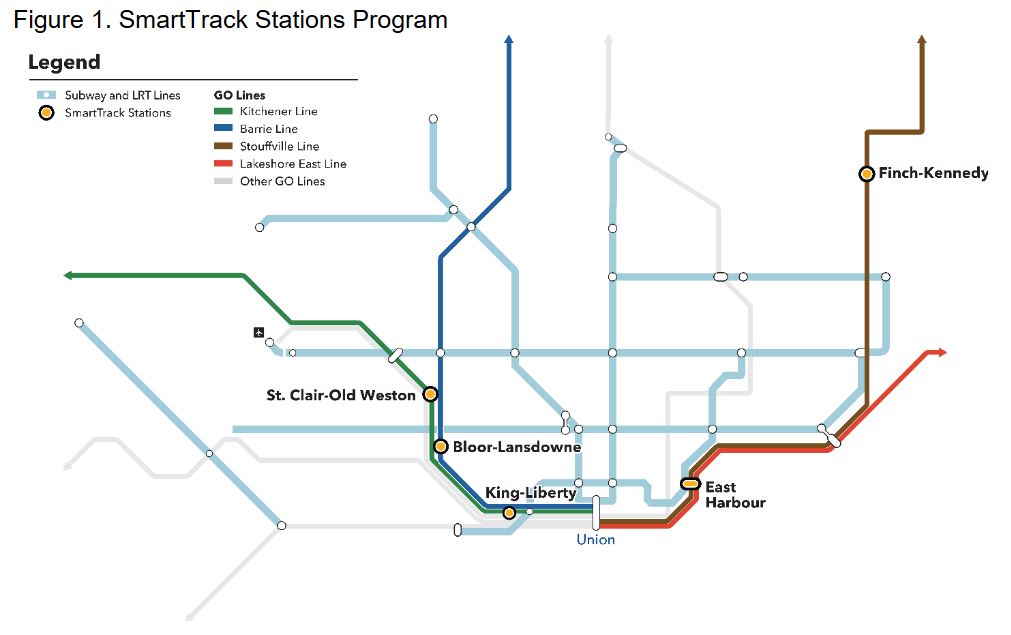
Here is a map showing the five stations that remain in Toronto’s SmartTrack program.

The cost and funding shares are shown below.

DateTorontoOntarioCanadaTotal
Original$0.878B$0.585B$1.463B
June 2023$0.878B$0.226B$0.585B$1.689B

The Province has now discovered that the five stations cannot be built within the available funding, and the City Manager recommends that that three of the five be retained as City priorities: East Harbour, Bloor-Lansdowne and St. Clair-Old Weston. The rational behind the choice is:

  • East Harbour will be a major hub linking GO Transit, the Ontario Line and future surface transit including the proposed Broadview-Commissioners link to the Port Lands.
  • St. Clair-Old Weston will be serve an important node in the City’s planned revitalization and urbanization of that area.
  • Bloor-Lansdowne does not have such a strategic significance, but it is already under construction and is likely a less-expensive station compared to others like East Harbour and Liberty Village.

For the remaining two stations at Liberty Village and Finch East, the report recommends that Council:

[…] request that the Province identify a funding solution, including exploring funding opportunities with the Government of Canada, to deliver the Finch-Kennedy and King-Liberty stations at no further cost to the City. [City report at p. 4]

We do not know cost estimates for individual stations as these are in a confidential appendix thanks to Metrolinx’ desire for secrecy. As of June 2023, the cost for five stations averaged $338 million, and is obviously higher now. Taking available funding and dividing by three, instead of five, yields a cost of $563 million. These are surface stations, not underground, although some of them involve work beyond the station structures proper. For details, refer to the technical backgrounder.

The report gives no indication of Metrolinx’ position on this scheme and whether they would simply drop the two stations, or proceed on their own with stations that originally were expected to be “free” contributions to GO’s capital program by the City.

A related problem is that from the Federal point of view, it does not matter whether their money pays for a new GO station, subway trains, or any other project. It all counts against Toronto’s “share”. This has bedeviled transit schemes in the past. Council always has its “priorities” and assumes that everything that comes along will get at least a 1/3 share from the Feds. This is not necessarily a valid assumption given competing Federal priorities, not to mention a possible change of government. If the Feds won’t come to the table, the Province may also hold back on funding as they did with the new subway car purchase making their contribution contingent on a Federal commitment.

If the Feds do kick in whatever extra is needed, what other Toronto projects will go unfunded because our share was burned up on SmartTrack?

Continue reading

Greenwashing the TTC

The TTC seeks feedback on its Innovation and Sustainability Strategy. As I write this, the announcement has been posted on X/Twitter, but not on the main TTC page. Instead, it is well hidden, like so much on the TTC site, among many items on the “Riding the TTC” page under “Green Initiatives”. There is a link from the survey’s introductory page, but this is only available when launching the survey, not afterward. Within the Green Initiatives page is a link to the TTC’s 2024-2028 Draft Innovation and Sustainability Strategy, a 50-page document that puts the survey in a wider context, but which most readers are unlikely to access, let alone read.

The survey contains three sections addressing various aspects of a TTC strategy:

  • An “innovation pipeline”
  • Prioritizing climate actions
  • A culture of innovation and sustainability

Reading through the Draft Strategy, the overwhelming impression is of the creation of a bureaucracy within the TTC, not to mention a pervasive presence of an Innovation and Sustainability czar. Much of their work would focus on internal changes, only some of which actually address climate effects. This is not to say that innovation per se is a bad thing, but it is not defined. Moreover, it has been bundled with schemes to green the TTC that are really a separate project.

Continue reading

The Ever-Fading SmartTrack

John Tory might be gone as Mayor, but SmartTrack clings on like grim death even in his absence. A report before an upcoming meeting of Toronto’s Executive Committee shows that the total cost of the five remaining stations is estimated by Metrolinx at $1.697 billion, yes that’s with a “b”, or $234 million higher than the City’s $1.463 billion budget for this work.

Federal funding of $585 million has already been committed, but the remaining $1.112 billion is on the City’s dime. The City’s share will come from “development charges, tax increment financing and the City Building Fund” [CBF] according to the report. The CBF is an extra levy on the City Property Tax (recently extended to compensate for increased borrowing costs) that will help to pay for one of John Tory’s legacies.

Metrolinx seeks full reimbursement for this amount, but the City in March directed “the City Manager to negotiate with the Province of Ontario for the Province to commit to paying all amounts above the original Program Budget”. Negotiations are ongoing and a supplementary report will follow at an unspecified date.

The station locations are shown below, and they include a key station a East Harbour that will be the interchange between GO Transit, the Ontario Line and a possible future Broadview Avenue streetcar extension into the Port Lands. Why the City is paying for a major regional interchange is something of a mystery, but even worse is the fact that we now face a per-station cost of about $340 million for surface rail stations. The exact numbers are shrouded in the usual Metrolinx secrecy.

This is a sad story where too much political capital has been expended for anyone to ask just why we are building these stations, and especially why the SmartTrack moniker survives. With all of the hand-wringing over City budgets, the survival of at least some of these stations as City-funded projects should be reconsidered.

SmartTrack: The Brand That Will Not Die

On Tuesday, March 21, 2023, Toronto’s Executive Committee will consider an update on the so-called Smart-Track Stations project.

Reports:

For comparisons with the previous, February 2021 update on the station designs, please see:

Updated March 17, 2023 at 7:15 pm: The Early Works list for East Harbour Station has been corrected. In the original version of the article that section was copied as a template from another station’s entry, but not changed to reflect the East Harbour site.

This project is the remnant of a scheme first proposed by mayoral candidate John Tory in May 2014 to overlay a frequent surface rapid transit service from Unionville to Pearson Airport using primarily GO Transit corridors.

The proposed route included a bizarre idea of running a mainline railway corridor along Eglinton Avenue West in lands originally reserved for the Richview Expressway, and later intended for the Eglinton Crosstown LRT line. SmartTrack itself descended from an idea to run a similar route whose western leg would use the GO Milton corridor rather than Eglinton Avenue. Both of these foresaw frequent service with the dual benefit of providing more capacity into the core and making office/industrial areas that were choked by gridlock on roads more accessible by transit.

Both ideas were deeply flawed, and the issues with SmartTrack are covered in detail in many other reviews. In fairly short order, pieces started to fall off of the proposal, but it remained a scheme to add stops to GO within the City of Toronto and use GO at least in part for urban rapid transit.

One fairly early casualty was the notion of a separate SmartTrack service. This was replaced by the idea that at least some GO trains would serve new stops, although the number of such trains was always hard to nail down as Metrolinx service plans changed. Getting a strait answer out of them proved almost impossible, and the best we can get today is a 15 minute service on all corridors with more if demand justifies this.

This is considerably poorer service than was envisioned in the SmartTrack hype and in the way it was presented to Council. Indeed, ST was seen to be so competitive in the Scarborough corridor that the Scarborough Subway Extension was shifted east to avoid the competition.

That is a far cry from SmartTrack’s original promise, but the brand lived on because it was Mayor Tory’s plan. Dropping the name would be suicidal for City and TTC planners, even though Tory suffered from an acute case of “the emperor’s new clothes”. Metrolinx simply humoured the Mayor by using his name for their new stops.

We have reached the point where only four of the original 22 stops on the ST line remain: Finch-Kennedy, East Harbour, King-Liberty and St. Clair-Old Weston. A station on the Barrie line, not the original ST corridor although the format of the map below disguises this, was added.

All five of the station projects are running later than the originally proposed opening dates. Details are given in each station’s section.

A sixth station was proposed at Front-Spadina, but there is no sign of it yet even though the City’s contribution to the station dates back to a $60 million payment toward GO expansion costs in 2017-2019. (See Revised Ontario-Toronto Agreement in Principle at page 9.)

Toronto’s SmartTrack Station costs are, under that agreement, deemed to be the City’s contribution to GO Transit Growth Capital for 2017-18 to 2024-25.

The anticipated cost of the five stations was $1.463 billion, a Metrolinx estimate, but costs have now risen by $234 million to a total of $1.697 billion. Of this, $585 million would come from the Government of Canada. Although the station-by-station breakdown is in a confidential attachment to the report, this means the average cost per station would be $339 million, a value that was once considered rich for an underground subway station.

Toronto is prepared to spend a lot of money for a handful of stations that might only see 4 trains/hour each way.

The report recommends that Council ask Metrolinx to pause the contract award for Bloor-Lansdowne station pending a guarantee from Queen’s Park that Ontario will pick up cost overrun. This is only one of many transit projects that faces problems with rising costs, not to mention projects under other portfolios.

City staff are seeking City Council direction to request the Province to pay all cost increases over the existing Program Budget of $1.463 billion to deliver the Program, which as of the date of this report is anticipated to be $234 million, as further detailed in Table 1 of Confidential Attachment 1.

A decision on the future of the Program is required urgently as the Design-Build (DB) procurement for the Bloor-Lansdowne Station contract is set to be awarded in early April. With a DB procurement, the City, through Metrolinx, would be committing to proceed to detailed design and construction. As such, there may be no opportunity for the City to reconsider or “off-ramp” its commitment to the station’s delivery once the contract is awarded. Metrolinx has secured an extension to the bid validity date with the proponent until April 5, 2023. Prior to making this commitment, City staff are seeking City Council’s direction to confirm to Metrolinx that the City will not proceed with the delivery of the Bloor-Lansdowne Station until the Province has committed the additional funding required to deliver the Program as set out above.

SmartTrack Stations Update pp 7-8.

What Should Stay? What Should Go?

City has sunk costs in design (listed in the confidential appendix), and contracts have been awarded for all but the Bloor-Lansdowne Station. It is very unlikely that Council would consider dropping any stations except for Bloor-Lansdowne, but should ask itself the question of whether proceeding with all of the stations actually makes sense. Metrolinx is unlikely to let them off the hook.

Meanwhile, conversion of the SRT corridor as a bus roadway is not yet funded because the City wants Metrolinx to pay for it. At $59 million this is small change and yet it will have a considerable benefit for both riders and for the TTC. If the work begins as soon after the SRT shutdown as possible, the bus roadway could be operational by Winter 2025, according to the TTC.

From the TTC Website:

In the event the city is unable to secure the outstanding $59M for the SRT busway, will the project run along Kennedy, Ellesmere and Midland until the SSE is completed? 

If the City is unable to secure funding from the province, it would ultimately have to find an alternate source if it wished to build the busway. The transit priority measures that will be implemented on Kennedy, Ellesmere, and Midland are planned to be designed as long-term solutions regardless of the busway construction; they could have legacy use for customers even beyond SSE is completed. 

This is an example of how funding for projects is discussed in isolation without looking at tradeoffs that might be possible or necessary. What we do not know is how much dropping Bloor-Lansdowne from the overall plan will save in total, only that there is a $234 million overrun for the five stations.

We are in an interregnum between Mayors, and there is no sense of whether any of the would-be candidates see SmartTrack spending as an issue to revisit.

Continue reading

Toronto’s Board of Trade Contemplates Transportation

Prologue: When I started to write this story, John Tory was still Mayor of Toronto and the dynamics of City-Province relations assumed he was in charge. The context for these discussions was soon to change.

The Toronto Region Board of Trade holds a yearly “transportation summit”, and on February 8, 2023, this focused on the Greater Toronto Area’s transit, plans for the future, and the aftermath of the covid pandemic.

The TRBoT is no wild-eyed radical institution. The regional economy and businesses are at the heart of causes it advocates.

Both in the introductory remarks and in comments by speakers sprinkled through the day, the economic effect of traffic congestion was a mantra. This sets the framework for the importance of both transit and road projects, depending on who is speaking. The latest factoid describing Toronto’s problems is that we have the third worst congestion in North America and the seventh worst in the world.

CBC: Toronto ranks 3rd most congested city in North America. Here are the city’s worst traffic spots

A problem with this hand-wringing is that there is little acknowledgement that some particularly bad locations are related to major infrastructure projects such as the Gardiner Expressway rebuild and various rapid transit lines. Moreover, goods movement has severe problems in areas that historically have poor transit and show little chance of seeing any in the near future. No single project will solve the problem of many-to-many trips patterns that now depend almost totally on roads and private vehicles.

Continue reading

Tracking Metrolinx Project Costs

The Province of Ontario is not exactly transparent when it comes to reconciliation of announced project costs and actual spending, let along the changes that might occur along the way. A project, or group of projects, might be announced with a value in then-current dollars, and without necessarily including all future contract costs. There are various reasons behind this approach including:

  • The government does not want to tip its hand on the amount of money “on the table” to prospective bidders who might tailor their bid to the perceived level of funding.
  • Some contracts include future operating and maintenance costs as well as capital costs. In some case the announced cost does not include the O&M component, only the estimated capital portion.
  • Provincial projects are typically quoted in then-current dollars with future inflation to be added as it occurs, at least to the point where there is a contract in place which includes that provision.

This approach hides the likely as-spent costs and makes provincially run projects appear cheaper, at least in the short run.

This is fundamentally different from the way the City of Toronto tracks projects and how TTC requirements are reported. Specifically:

  • City project cost estimates include inflation to completion because this is factored into future funding requirements.
  • City projects do not bundle future operating costs with capital, but report them separately.

Note that cost estimates shown in the Infrastructure Ontario market reports do not necessarily match values shown by Metrolinx because IO shows these values on a different basis. Future operating and financing costs are no longer included in IO estimates so that a project’s value reflects only design and construction costs, a value that gives potential construction bidders a general size of the project’s scope.

Infrastructure Ontario notes on the November 2022 Market Update that we have modified the methodology used to calculate the estimated costs as presented on the chart. In May 2022, and for Market Updates prior to that, we used the Estimated Total Capital Costs. For the latest update, and going forward, the costs listed only include Design and Construction costs.

These changes were adopted after feedback from our construction industry partners found that including only design and construction costs provided them with a better sense of the scope of the project and would assist in determining if they wished to participate in the bidding process.

Email from Ian McConachie, Infrastructure Ontario, Manager, Media Relations & Communications, November 24, 2022.

This can be confusing with “bundled” projects such as the Ontario Line RSSOM contract which includes both provision/construction of vehicles and infrastructure, as well as future O&M costs. This is probably the reason, or a good chunk of it, for the very large increase in the RSSOM contract value between the initial estimate cited by IO and the contract award. However, the way these contracts are handled generally makes it impossible to know how much of the change is simply due to inflation in materials and labour costs, and how much is due to underestimates or scope changes.

Continue reading

Metrolinx! The Musical!

Updated July 15, 2022 with monthly Metrolinx ridership recovery stats.

Metrolinx Board meetings are rather quiet affairs devoid of controversy, not to mention substance. They are pro-forma efforts at public meetings by an organization that does everything it can in private.

The breakdown of the agenda tells the tale. Contrast this with the openness demanded by legislation in municipal proceedings.

This is not new. In the pre-covid era, I would attend the meetings along with a dwindling band of reporters from the City Hall or Queen’s Park press galleries who eventually decided that it was not worth wasting their time unless there was some burning issue where an interview ambush might yield a juicy quote.

For two years, the Board meetings have been online with all of the technical foul-ups we have come to love through Zoom and its relatives. This month, in a grand return, the Board met in person. It was almost like the lights coming back to Broadway.

Metrolinx just loves to tell everyone how wonderful they are, how everything is going so swimmingly well. This time they even had celebratory video.

The meeting video is available for those who just must watch, although as a show it should have died on the out-of-town tryouts.

There are two common themes:

  • The overwhelming emphasis is on marketing and communications with as much “good news” as possible.
  • There is no discussion of policy. Anything substantive, if the Board discussed it at all, was handled in committee or in a private Board session.

I could not help thinking of how “In here life is beautiful” in Cabaret, or “Everything is beautiful at the ballet” in A Chorus Line. Alas, Metrolinx has not (yet) recruited the likes of Kander & Ebb, or Michael Bennett & Marvin Hamlisch to its burgeoning communications team.

Considering the years of debate over regional fare integration and the number of virtual trees felled for reports on the subject, Metrolinx is skipping over the complexities by simply offering a free transfer between GO and 905 area transit systems. Toronto/TTC? No.

It is hard to understand why we have excruciating debates about things like zone boundaries, time-based transfers or differing classes of service when the main agency, GO/Metrolinx, simply gives free transfers and deeper discounts to encourage ridership. If a municipal system tried this, they would be pilloried for wasting precious tax dollars on people who are not motorists.

The debate on all fare schemes is whether the marginal revenue is worth the complexity and the cost of administration, although the latter is much simpler with fare cards rather than conductors and paper transfers.

The related context is that we learn in the Annual Report for 2021-22 that the operating subsidy for GO Transit doubled to almost $1-billion thanks to the combined effect of lost ridership and continued, albeit reduced, scale of operation during the pandemic.

Operating expenses have declined little, despite service cuts, through the pandemic era.

The operating subsidy, however, has grown because of lost fare and other revenues.

The degree of belt-tightening at Metrolinx will be an interesting contrast to what might be forced on municipal agencies as special pandemic financial supports wind down.

There was no public discussion of how this situation can be sustained in coming years depending on the rate of ridership recovery.

The report on community relations was particularly galling because it pitched Metrolinx’ work as listening to communities as a positive contribution to projects. In fact, Metrolinx’ common strategy is to bull through their proposals and then “involve” the community in making the best of a bad situation with things like design competitions for decoration of new, unwanted structures. Even the canard about parks getting bigger thanks to Metrolinx continues to ignore (a) the relatively small amount of land involved, and (b) the much more extensive effect of the associated project on a neighbourhood.

The Board laps this up as if staff are doing such a wonderful job.

Updated: There was some discrepancy between ridership recovery numbers presented in reports and verbally at the meeting. Here are the definitive monthly numbers from Metrolinx.

MonthGO TransitUP Express
January ’2211.8%16.1%
February ’2220.3%22.6%
March ’2232.4%33.3%
April ’2233.5%41.0%
May ’2239.4%47.3%
June ’2249.5%59.5%
Continue reading

Ontario Line Environmental Assessment Open Houses: Part III – South Section

This article continues a series reviewing the open house sessions conducted online by Metrolinx for the Ontario Line in February and March 2022.

The material here is condensed from recordings of the two meetings about the section from Gerrard to Exhibition Station. The questions and answers have been grouped to bring related topics together, mainly on a geographic basis. This is not an exhaustive Q&A as the topics depend on the interests of those participating.

Statements are not attributed to any specific person (if you really want to know who said what, listen to the recordings), but if anyone feels I have misrepresented their position, please let me know through the comments.

The sections prefaced with “Comment:” are my remarks.

Continue reading

Infrastructure Ontario January 2022 Update

Infrastructure Ontario has issued its quarterly update of projects that are in the planning and procurement stages. This affects several parts of the Ontario government, but my focus here is on transit projects.

The spreadsheet linked below tracks the past and current updates to show how the projects have evolved. There are two sections: one for active projects and one for projects with no currently reported info (typically for projects that are now in construction or completed, or that have been withdrawn).

Where a cell is coloured yellow, there is a change from the October 2021 report. Several cells are coloured light yellow. There is new text, but the only real change is to say “Jan-Mar” instead of “Winter”, and similarly for other seasons. This eliminates a point of confusion in past reports.

The substantial changes in this round are:

  • The Ontario Line North Civil, Tunnels and Stations contract dates have slipped by one quarter, and the contract type has changed from DBF (Design, Build, Finance) to TBD (To Be Determined). This covers the OL infrastructure work from East Harbour to Science Centre Station.
  • The Yonge North subway extension has been split into two projects: one for the tunnel and the other for the stations, rail and systems. The projected dates for the tunnel contract are unchanged, but for the stations project they are TBD.
  • A new line has been added for the Eglinton West LRT tunnel between Jane and Mount Dennis.
  • All of the GO expansion projects have slipped into 2022 for contract execution, but with dates early in the year. This implies an imminent flurry of announcements just in time for the coming election. These projects are running a few years behind their originally planned dates.
  • The contract type for the GO OnCorr project which includes future operation and maintenance of the system has changed from DBOM (Design, Build, Operate, Maintain) to “Progressive DBOM” which appears to provide earlier design input from prospective builders as well as a better (from the bidders’ point of view) allocation of risk between Metrolinx and the P3.
  • The Milton GO Station project has not been updated since October 2021. It is possible that this work is paused pending a resolution of issues between Metrolinx and CPR about all-day operation on this line.