
In a report to City Council’s meeting on December 17, we learn that the cost of the five remaining “SmartTrack” GO stations has risen above previous estimates. See:
This is not the first time a cost problem arose, and back in March 2023, the City faced a similar problem: See:
Here is a map showing the five stations that remain in Toronto’s SmartTrack program.

The cost and funding shares are shown below.
| Date | Toronto | Ontario | Canada | Total |
|---|---|---|---|---|
| Original | $0.878B | $0.585B | $1.463B | |
| June 2023 | $0.878B | $0.226B | $0.585B | $1.689B |
The Province has now discovered that the five stations cannot be built within the available funding, and the City Manager recommends that that three of the five be retained as City priorities: East Harbour, Bloor-Lansdowne and St. Clair-Old Weston. The rational behind the choice is:
- East Harbour will be a major hub linking GO Transit, the Ontario Line and future surface transit including the proposed Broadview-Commissioners link to the Port Lands.
- St. Clair-Old Weston will be serve an important node in the City’s planned revitalization and urbanization of that area.
- Bloor-Lansdowne does not have such a strategic significance, but it is already under construction and is likely a less-expensive station compared to others like East Harbour and Liberty Village.
For the remaining two stations at Liberty Village and Finch East, the report recommends that Council:
[…] request that the Province identify a funding solution, including exploring funding opportunities with the Government of Canada, to deliver the Finch-Kennedy and King-Liberty stations at no further cost to the City. [City report at p. 4]
We do not know cost estimates for individual stations as these are in a confidential appendix thanks to Metrolinx’ desire for secrecy. As of June 2023, the cost for five stations averaged $338 million, and is obviously higher now. Taking available funding and dividing by three, instead of five, yields a cost of $563 million. These are surface stations, not underground, although some of them involve work beyond the station structures proper. For details, refer to the technical backgrounder.
The report gives no indication of Metrolinx’ position on this scheme and whether they would simply drop the two stations, or proceed on their own with stations that originally were expected to be “free” contributions to GO’s capital program by the City.
A related problem is that from the Federal point of view, it does not matter whether their money pays for a new GO station, subway trains, or any other project. It all counts against Toronto’s “share”. This has bedeviled transit schemes in the past. Council always has its “priorities” and assumes that everything that comes along will get at least a 1/3 share from the Feds. This is not necessarily a valid assumption given competing Federal priorities, not to mention a possible change of government. If the Feds won’t come to the table, the Province may also hold back on funding as they did with the new subway car purchase making their contribution contingent on a Federal commitment.
If the Feds do kick in whatever extra is needed, what other Toronto projects will go unfunded because our share was burned up on SmartTrack?
SmartTrack’s History
John Tory announced SmartTrack as his solution for Toronto’s transportation problems in his 2014 mayoral campaign. Yes. A decade ago.
There were many head-scratching features including the use of GO corridors for a “surface rail subway”, but most importantly the western leg from Mt. Dennis to the Matheson/Airport Corporate Centre was, to be kind, impractical.
That leg would require a difficult link from the Weston GO corridor to Eglinton Avenue, and would plunk mainline railway trains onto a major street. That would have been a much more substantial incursion than the proposed Eglinton West LRT.
Worth noting here is that a consultant behind the SmartTrack proposal “surveyed” the line from his office in London, England, using out of date Google Street View images. The same consultant is at least partly responsible for Doug Ford’s subway plans including the Ontario Line.
SmartTrack would run from Unionville to a Corporate Centre. This was not its first incarnation, and it is derived from a scheme intended to improve commuting access to those terminals and increase property values. Some areas in the GTA already suffered from problems attracting employees because of poor transit service, and in theory, SmartTrack would deliver the young, urban King Street dwellers to suburban office parks.
Looked at from the reverse perspective, SmartTrack, with frequent service and TTC-level fares, would form an alternative to what was then called the Relief Line. One tiny problem was that it would also poach riders from the proposed Scarborough Subway which had to be shifted east so that demand models would assign trips to it. That’s why the subway runs east of Scarborough Centre rather than further west.
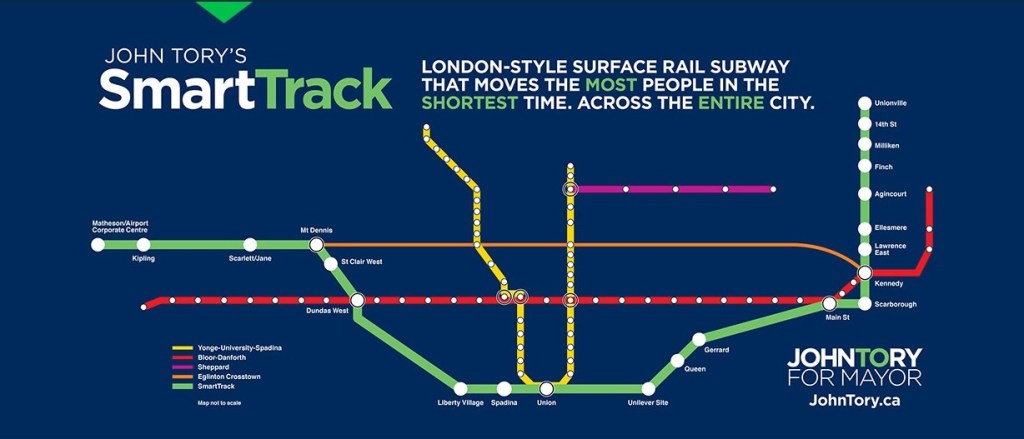
Metrolinx did not take this plan seriously at first, but played ball with Mayor Tory to avoid a public spat. Pieces began to fall off of the map as technical challenges became apparent, but SmartTrack did its job of giving Tory a veneer of credibility on the transit portfolio.
When Metrolinx announced its GO expansion plans with frequent all-day service on the Weston and Stouffville corridors, it was obvious that there would be no “SmartTrack” branded trains. There was lots of shilly-shallying to keep the concept alive by treating local trains as “SmartTrack” and express trains as “GO Transit”, but conflicting service plans presented at Council and at Metrolinx showed that the claimed SmartTrack service level would never be possible.
What was to be a separate service dropped back to City funding of five stations, a move that the Province would deem as a municipal contribution to the GO Capital Program. Now there are only three.
If costs have gone up on SmartTrack, they must also be rising on other projects, notably the massive GO infrastructure and service expansion. How many of Metrolinx’ projects will lose hoped-for elements in coming years? How much promised “congestion relief” will remain only lines scribbled on a napkin or on an election poster?
The Future of Transit Funding
We are now at a point where “SmartTrack” will contribute stations to two important future nodes, plus a notional link from the Barrie line to the Line 2 subway, albeit with a long walking transfer at Lansdowne Station. The same GO corridor already has a subway link at Downsview.
John Tory’s legacy was a collection of half-baked transit proposals and many delays including the deferred replacement of trains and automatic train control (ATC) on Line 2. Former CEO Rick Leary was responsible for these delays, but I have little doubt he was serving the Mayor’s agenda to reduce transit costs and leave headroom for Tory’s pet projects.
The TTC has just issued Requests for Proposals for these, and I will write about them in a separate article. We will not see the benefit of new trains and signals for a decade or more. The TTC has some headroom to improve service on Line 2 with the existing fleet and the constraints of the elderly signal system, but not much. While we agonized over how to pay for subway cars, Toronto was more than happy to spend on Tory’s vanity project.
SmartTrack might be something of a transit joke, but it is symptomatic of how Toronto’s transit plans were skewed to serve political interests and egos.


I hope whoever wrote the play “The Master Plan” about Sidewalk Labs and Waterfront Toronto, write a play about SmartTrack. It will be be super funny but the downside will the very long Tory monologues.
LikeLike
It’s not Just that GO stations are usually terrible rail-to-anything connections. It’s not just that they are eye-wateringly expensive.
It’s that they manage to be both. And late.
GO: schedule, cost, quality – pick zero.
LikeLike
Just depressing.
LikeLike
There’s a quite costly and at this point less-wise bike project of the Rail Path Extension coming in at $150M, that Council seems keen on, though it’s with $100M of borrowed funds, and a federal contribution. While the corridor is a valuable asset, and highest best use may have been for transit as per 1985 plan, and there are a lot of bridges to be built to bring this nice facility south from College to south of Queen, it’s wiser to wait for a recession tho there’s enough impetus to consider halving the project to just get the Trail across Lansdowne. Maybe. It’d be maybe $40,000 to paint the bike symbols on Dundas St. from Lansdowne to Shaw St. which would feed in to the core, but even that is controversial as roads are for cars under the carservatives.
And maybe we should call this all Smart Trick? Except the jokes are on the taxpayers.. of all levels.
LikeLike
The Smart Track beg for station in Spadina. How can you skip such a busy vibrant area that left out from any subway station!!!
Steve: The proposed station at Spadina would only have served trains on the Barrie line because of the geometry of various corridors leading to Union. That station fell off the plan fairly early.
LikeLike
The city has millions to spend on adding bike lanes and then remove them.
But not stations? That’s ridiculous!!!
Steve: Bike lanes cost a small fraction of the cost of one station. And the city would not remove them without pressure from Doug Ford.
LikeLike
I also think uploading transit to the Ont gov back when the liberals were in power was one of many poor decisions. The gov back then was so corrupted that everyone knew something like LRT and the like would be a problem. Mike Colle, who is now dep mayor was MPP who chaired this idea of uploading. His son Josh, was on the TTC board at the time and was directly involved. I don’t know how they got away with that. Not pointing at one party here. They just happened to be in.
LikeLike
SmartTrack was so dishonest it isn’t funny. Building an overground rapid transit network by simply rebranding a portion of the GO regional rail was never going to work. GO has a hard enough time, especially on tracks it shares with freight operators. Chow’s plan, which was centered on more bus service was more economical and could have provided service fairly quickly. Not as sexy as rail, but a good short-term fix until other modes could be built.
Steve: And after he was elected, Tory suddenly “discovered” that the TTC needed more buses, and so funded 100 more. But did he provide funding to operate them? No. The announcement was all that mattered.
LikeLike
It is ‘interesting’ that this discussion of “SmartTrack” has arisen at a time when I have heard from several sources that John Tory is planning to run for Mayor again in 2026. (Yes, I also find it hard to see this working out but …)
Steve: If so, I hope that Olivia Chow hits him hard with the mess he left so much of the City in. Gloves off.
LikeLike
Smart track was just ploy by Tory to get elected. Metrolinx is a joke 3 l r t lines will never open.
LikeLike
SmartTrack was an attempt to counter former Mayor Rob Ford and Councillor Doug Ford attack on public transit. The Ford brothers tried to cancel Transit City, which they mostly succeeded.
LikeLike
But with the finch Kennedy station funding on hold, will the finch east grade separation still go ahead?
Steve: It’s part of the same project I believe, so I doubt it unless Metrolinx decides to fund it separately.
LikeLike
A small point of info from Alex’s comment – the City will NOT be removing bike lanes on University, Yonge and Bloor unless compelled to by the Ford’s Bill 212, which is strong-arming the CIty/cyclists, and using bike lanes as a distraction about fast-tracking Highway 413 without an EA and other parts of process. And the thing about the Ford attack on these bike lanes which is quite grating, that nearly nobody is picking up on, is that these facilities are all atop subway lines, which is a logical place to do something different than a mere carterial or highway. Carservative misrule again, though at times all parties are ‘carservatives’ – and votorists are everywhere.
LikeLiked by 1 person
Is there any exploration from the city on reducing the cost of the 5 GO stations to bring all of them back into the existing budget? I honestly fail to see how a few concrete slab platforms with one overhead bridge costs half a billion each unless there is significant gold plating going into them.
Steve: These are Metrolinx stations, and the province is responsible for the design. Some of them are fairly complex, notably East Harbour and Liberty Village. The “station” costs include utility relocations and road works. It’s not just a case of dropping a few concrete slabs onto existing open space. However, thanks to the secrecy around everything Metrolinx does, we do not know the cost breakdowns site by site, nor the components of each station project.
LikeLiked by 1 person
How can grade separation not occur at Finch. A GO line with that frequency depends on it. Key grade separations are occurring along the route whether stations or not. How much can the Finch station cost once the grade separation occurs. Also lot of anti-Tory stuff here. He got ball rolling with smart track. It shrunk cause of Ontario , Scar extension and Eg west extension. Who cares what it is called.
Steve: Smart Track was dead on arrival when announced because it was impractical, especially the west end which would have been physically impossible to build and operate as conceived. It was an election ploy that took root in city planning for years. The legacy is that Toronto is paying for several major GO stations that should have been on the Provincial tab.
LikeLike