Ontario’s 2025 Budget and Transit

Ontario unveiled its 2025 budget on May 15. Although it speaks of “Approximately $61 billion over 10 years for public transit”, by far the lion’s share of this spending is for projects already underway in the construction and design stages.

All of this is for capital expansion and renewal, and nothing has been announced for day-to-day improvement of transit service.

GO Transit

The budget cites:

  • The Hamilton-Niagara through service connection at West Harbour Station which is already in service.
  • The proposed Bowmanville extension which has been announced before, but is only barely underway at the “early works” stage. This extension has physical alignment issues.
  • GO 2.0 includes “delivering all-day, two-way service to Kitchener and Milton, building new GO stations across the region and advancing planning to unlock potential new rail corridors through midtown Toronto, Etobicoke, York Region and Bolton.” There are no dates attached, and some of these have been on maps for a very long time. Notable by its absence is any mention of electrification.
  • A total of $850 million to refurbish GO Transit rail coaches at the Thunder Bay Alstom the North Bay ONR facility. This work is already announced. The cars may receive convenience upgrades such as “charging plug ports, cup holders and improved Wi-Fi”, but the long-term retention of these cars indicates that the operating model for GO electrification, if and when it occurs, will have a large component of locomotive-hauled trains rather than electric multiple units.

Subways

Subway projects in the budget are:

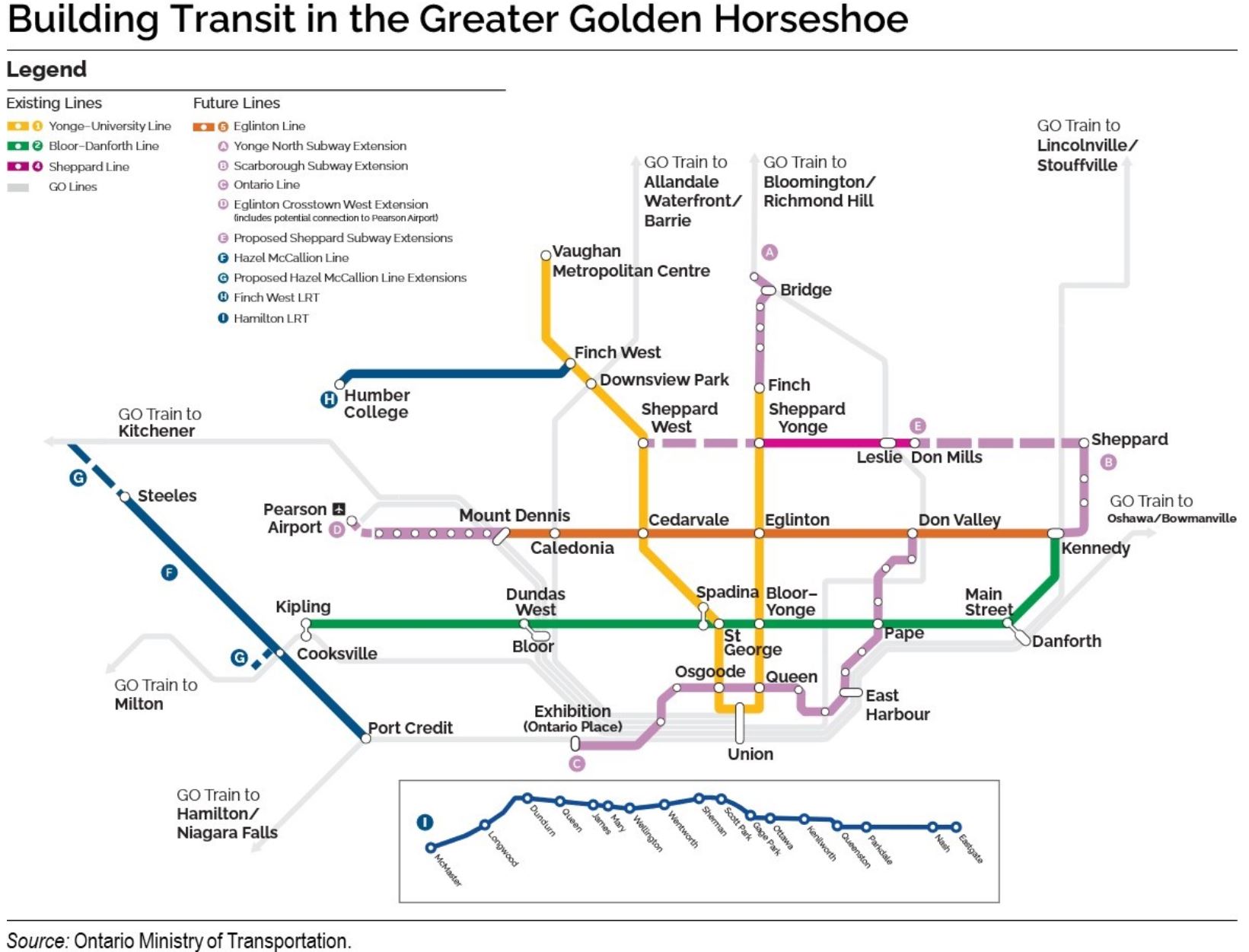
  • Ontario Line (under construction).
  • Eglinton-Crosstown Western Extension (under construction).
  • Yonge North to Richmond Hill (procurement underway).
  • Sheppard Subway Extension (planning, consultation and business case preparation underway). Notable in the map below is the absence of a line east of McCowan where there is a conflict with the City’s Eglinton East LRT project and with maintenance yard property requirements.
  • New subway cars for Line 2. Provincial funding for these trains has been in place for some time. What is not yet funded are trains for service expansion beyond pre-covid 2019 levels. Trains for the Yonge North and Scarborough extensions are included in those projects. The TTC is in the Request for Proposals process for new trains, but this has been skewed by provincial statements that the work should go to Alstom’s Thunder Bay plant.

Yes, they seem to have forgotten the Scarborough Subway Extension (now under construction) in the text although it is included in the map below..

East Harbour Transit Hub

The hub at East Harbour Station, near the point where the Lakeshore East GO line crosses the Don River, will eventually serve GO Transit, the Ontario Line, and the local streetcar/LRT system via the Broadview Avenue Extension and a link west via Commissioners Street.

A substantial portion of this project is funded by the City of Toronto as a remnant of John Tory’s “SmartTrack” plan.

Light Rail Projects

  • Hamilton LRT: This is in early states with procurement underway for Civil Works and Utilities.
  • Hazel McCallion (Mississauga) LRT: Construction is well underway for the initial phase of this project, and the Province is studying whether the extension into downtown Brampton should be tunneled.
  • Ottawa LRT: The Province is studying a potential upload of the Ottawa LRT “to help reduce costs for Ottawa taxpayers”. What implications this might have for future network operation and expansion is not clear.
  • Eglinton Crosstown and Finch West LRTs: “Major construction for both projects is now complete. Metrolinx continues to focus on safety and operational readiness testing, as the projects advance toward revenue service.” There is still no commitment to opening dates, and we are getting close to the three-month lead-time required for a go/no-go decision for an early fall 2025 start of service. Meanwhile, TTC has begun the process to update subway train announcements and maps to reflect the new lines.’
  • There is no mention of the Eglinton East or Waterfront East projects. In a recent letter, Mayor Chow asked the Federal government to contribute 1/3 to these schemes, but there is no indication of support in the Provincial budget.

Grading Toronto Region’s Transit Systems (Updated)

The Toronto Region Board of Trade recently published a review of municipal transit systems against an overall set of targets. Intriguingly, this document goes by two names:

  • Needs Improvement: Toronto Region Transit Report Cards is the title cited on the main announcement page for this report.
  • Needs Improvement: Getting to World-Class Transit is the actual title on page 1 of the report itself.

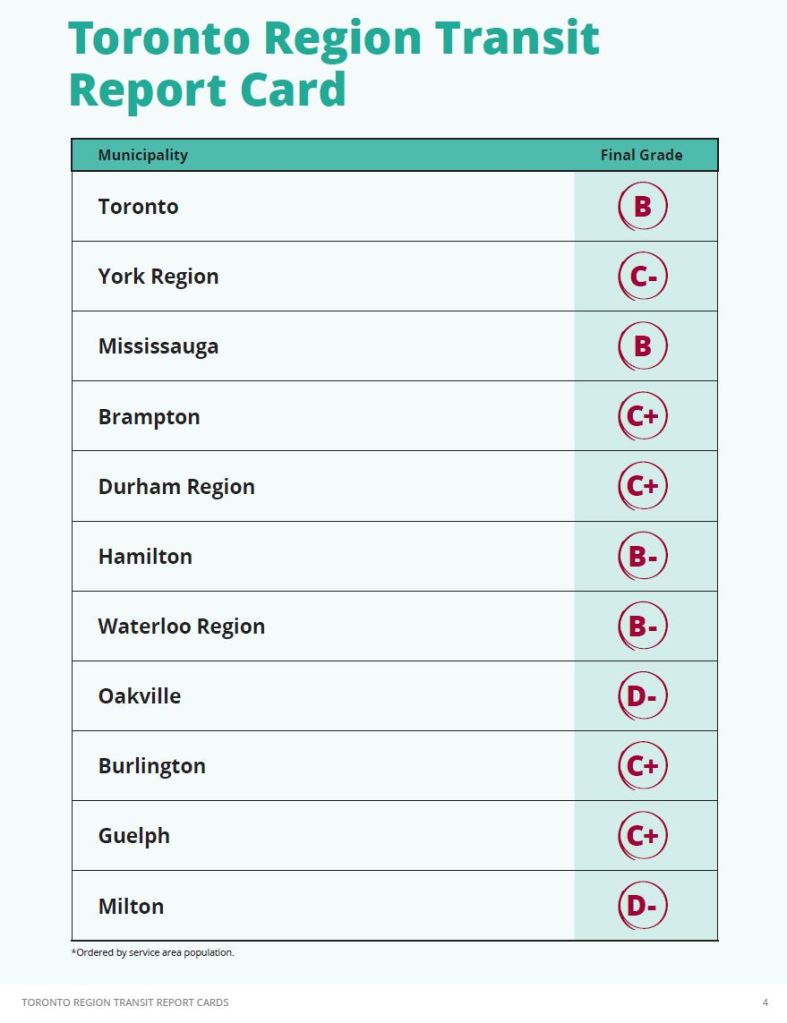
To little surprise, the most mature among the municipal systems received the highest grades: Toronto, Mississauga, Hamilton and Waterloo Region. The challenge with any grading system, assuming that it is uniformly applied, is the structure and goals used in any evaluation.

Updated July 12 at 11:10pm: Comments by Darwin O’Connor of TransSee.ca regarding reliability metrics are now reflected in the text of this article.

Updated July 10, 2023 at 3:00 pm: The City of Guelph had their grade upped from a D+ in the original rankings to a C+ based on service reliability which is quite high on that system. This raises a few key questions:

  • Was the “reliability” metric cited by Guelph the same as the one used by the Board of Trade for other systems? Just what does Guelph’s claimed reliability score of 88% mean?
    • (Updated) Darwin O’Connor, who calculated the reliability metrics for the Board of Trade Report, advises that he also provided the Guelph score and used the same methodology as for other cities where tracking data were available.
  • Reliability counts for 35% of the total mark. Was Guelph scored zero on this simply because the Board of Trade didn’t have service tracking data for them?
  • Reliability data are also listed as “Not Available” for Oakville and Milton. Considering that neither of them has a 15 minute service area, awarding them substantial marks for being “on time” with what they do run would be boost that might not be fairly earned.
    • (Updated) O’Connor replies: “TransSee is unable to provide reliability data for Oakville because their API doesn’t have a method to get all vehicle locations at once. I also didn’t have tracking data for Milton because my data source is unofficial. I expect if it was included they would get a better mark like Guelph did.”

If anything, this gaffe reveals sloppiness in the Board’s methodology and the typical problem of looking only at the high level summary without poking “under the covers” to verify the results. The Board of Trade should try harder for accuracy and completeness on their next transit outing.

See also Global News coverage of this change.

The Board regards the ability to move workers, students and residents as an important economic goal, and the absence of good transit as a drag on the region’s economy.

“Improving transit is critical to addressing our reputation as North America’s third-most congested city – a key barrier to the economic competitiveness of our region,” said Jan De Silva, President & CEO of the Toronto Region Board of Trade. “These report cards highlight where we’re falling short and, as a result, what we can look to as we seek to provide a world class transit network that will better-connect workers to jobs, students to school, and residents to their lives.”

TRBOT Media Release, July 5, 2023

There is a fundamental difference between a mere evaluation of our transit systems versus each other, and one that would qualify systems as “world class”. That term sets a much higher threshold, and there is no sense that the Board of Trade took this into account when constructing its grading system.

Updated July 10, 2023 at 3pm: The chart below is the revised version showing Guelph with a C+ grade.

“Getting to an A” is the premise behind the review, but much less clear is whether that “A” will actually bring the type of transit network and service to be truly competitive, to be “world class”.

The Board acknowledges the limitations of its review and notes that some conditions “are the result of a historical lack of investment and operational resources”. That is a delicate way of saying that transit has not been a priority at the political and social level. As population and travel growth shift the emphasis toward transit, “… suburban cities now find themselves pressured to stand up an urban-quality transit system that helps residents move within and throughout the region …”.

Key findings include:

  • The combination of network coverage (where there are routes close to people and destinations) and service is poor in most of the region.
  • Service reliability is particularly bad in Toronto with only 58% of trips meeting an “on time” standard.

Another important factor is that a line on a map does not guarantee good service, or service at the time and to the destination a rider might require. GO Transit, a system notably absent from the Board’s analysis, looks good on a map, but not quite so good on the timetable.

For an organization like the Board of Trade, this is a rare recognition that transit is more than a handful of high profile construction projects. A dominant car-oriented culture led directly to the congestion that bedevils the region. Cars enable travel throughout the region, but a corresponding web of transit service never developed. Our collective focus on big ticket projects to support commuting traffic primarily to Toronto’s core left other travel to lower-quality bus service, if that.

In all the hoopla about billions in “transit investment” we forget that over a decade ago the Metrolinx regional plan clearly showed that their proposed network would at best keep congestion from worsening, but would not relieve the underlying problem.

In this article, I will review the scoring system and the goals it seeks to achieve, what the Board considers worthy of an “A” grade. Are we aiming high, or is our definition of “world class” merely good enough to remove some of the more embarrassing gaps in our region’s transit network?

For those wanting the answer up front, no, I believe that the Board, and by extension the political voices they represent, are aiming low. Either they would give everyone an “A” grade for middling improvements, or they would be forced to admit that “world class” is out of reach.

The target for “frequent” transit service is not exactly high. If we were evaluating a road network on a similar basis, we would be happy with two lane roads on a roughly 1.6km grid. That would be a square from roughly Bloor to Dundas, and from Yonge to a bit west of Spadina. The roads would only require capacity for 200 people/hour each way equivalent to four full buses on a 15 minute headway. Some roads would close every evening and all weekend.

That is hardly a “World Class” transit service. The target coverage and service level befit a rural area with cows and sheep grazing by the roadside, not an urban transit system. This target understates the true shortfall in transit as a viable travel alternative.

Continue reading

The Ottawa LRT Report (Part V)

This is the fifth part of my review of the Final Report of the Commission of Inquiry into the Ottawa LRT fiasco. This article covers the trial operation of the line up to the transition to revenue service and draws from chapter 12 of the Inquiry Report.

Some of the quotations here are extensive as I want there to be no doubt that the voice is that of the Inquiry Commissioner, not my paraphrase.

See also:

Continue reading

The Ottawa LRT Report (Part III)

This is the third part of my review of the Final Report of the Commission of Inquiry into the Ottawa LRT fiasco. This article covers mainly the vehicle and control system manufacturing, and corresponds to chapter 9 of the Inquiry Report.

See also:

Part IV will deal with the construction of the line, and Part V will deal with the transition to revenue service.

The entire process is a textbook example of what happens when “on time, on budget”, coupled with an unproven design, forces abandonment of well-established best practices for manufacturing and testing. Moreover, the lack of integration and communication across the project puts the lie to the idea that a private sector consortium will automatically be run like a well-oiled machine rather than a clanking contraption on the edge of collapse.

Updated Dec. 12/22 at 5:30 pm: The discussion of signalling systems used on various lines has been corrected to cite Bombardier’s Cityflo 650 system as the one used on Line 5 Eglinton.

Continue reading

The Ottawa LRT Report Part II

This is a continuation of my review of the Final Report of the Commission of Inquiry into the Ottawa LRT fiasco. This article picks up from the point where the contract is awarded to the successful P3 bidder, Rideau Transit Group, and reviews the contract and project structure.

See also: The Ottawa LRT Report Part I which contains introductory material and the story up to the contract award. In Part III I will turn to construction problems and testing before revenue service began, and Part IV will cover from that point to the present.

Contractual Agreement

On December 19, 2012, Rideau Transit Group (RTG) achieved the best score on their submission although, as I noted in the previous article, this was primarily on financial factors as the technical scores of the three bids were close to each other. Ottawa still clung to the 2010 budget estimate, and the project was approved at $2.13 billion. However, the P3 arrangement removed much of the City’s control over the project.

The actual structure of the project involved several entities, some of which were actually the same companies acting in different guises. This divided the project into subcontracts although ultimate responsibility rested at the top with RTG.

The Project Agreement accounted for the fact that, as is typical with this type of model, RTG would flow the bulk of its contractual obligations under the agreement down to subcontractors. […] The Project Agreement required RTG to ensure that its subcontractors complete the subcontracted scope of the OLRT1 project in the same manner and to the same extent as RTG is required to under the terms of the
Project Agreement.

Accordingly, the obligations for the works required by the Project Agreement were set out in RTG’s subcontracts with OLRT-C [the construction arm of the P3] and RTM [the mainenance arm], respectively. Under the subcontract with OLRT-C, OLRT-C took on the obligation to complete the design and construction as required under the Project Agreement as well as the risk and associated payments if the obligations were not met. Similarly, the subcontract with RTM flowed down RTG’s obligations to maintain the OLRT1 project as required under the Project Agreement, and RTM took on the risk and associated payments if the obligations were not met.

This structure allows RTG to be a small entity made up of only a handful of executives and support staff who would administer and oversee its contracts with its subcontractors. Any reporting from the subcontractors up to the City and back went through RTG. [p 148]

In this arrangement, management of the groups responsible for the work flows through the topmost level, RTG. In theory, this provides a single point of contact and responsibility, but it also creates a potential choke point in the City’s ability to manage work done on its behalf.

“Under the Project Agreement, RTG was responsible for the construction and maintenance of the OLRT, and the City would be the operator of the system. The Project Agreement, which was based on Infrastructure Ontario’s P3 template, gave the City limited control over the construction process or the subsequent maintenance of the system. Therefore, the City’s ability to direct the project was generally limited to enforcing specific financial remedies under the Project Agreement. In essence, the City was in a position where it had to rely on RTG to fulfill its contractual obligations and could only attempt to ensure compliance by withholding funds or otherwise enforcing contractual remedies.” [p 9]

Systems integration is an important part of any large technical project. One cannot simply buy components from various sources, plug them all in and expect them to work. With the management of suppliers happening a few levels removed from the City, an assumption is needed that this integration is actually happening. In fact, it was not, or at least not at a level needed to guarantee success.

“RTG’s project plan required the various engineering systems that went into the OLRT1 to be carefully integrated. However, the subcontractors operated in silos. These decentralized arrangements made it essential that the parties integrate their efforts and engage in near-constant communication. They failed to do so, OLRT-C [the construction arm of the P3] did not effectively coordinate their efforts, and the project suffered due to this lack of coordination.” [p 9]

On top of these issues, the vendors argued that the specifications were too “prescriptive” about how things should be achieved, as opposed to describing a system performance requirement and leaving it to the P3 to figure out how that should be met. This affected, in particular, the vehicle design.

An obvious question is why this was not addressed during the pre-award stage of commercially confidential discussions, or if the City and their consultants (who presumably were responsible for the specification) refused to change it.

“Regardless of the details of the project specifications required in the Project Agreement, by signing the Project Agreement, RTG agreed to be “responsible for the complete design, Construction, testing and commissioning and Maintenance of the complete Systems required for the safe and efficient operation of the LRT.” That is, RTG signed the Project Agreement with “eyes wide open.” [p 151]”

The contract contained provisions for various types of default including:

  • Failure to Maintain Schedule: The City could issue a notice to RTG which triggered a requirement for a plan to get the project back on time and achieve a Revenue Service Availability (RSA) date no later than mid-May 2019. Failure to deliver a plan would be deemed a default and entitle the City to terminate the contract.
  • Delays to Revenue Service Availability: Many preconditions determined whether RSA had been achieved including Substantial Completion of civil works, testing and safety requirements, and training of City staff for system operation. The RSA date was May 24, 2018, and five days after certification, RTG was entitled to a $200 million payment. If this date was not met, the agreement included provisions for rescheduling and a penalty payment (liquidated damages), but in any event if the date went beyond May 2019, this would be considered as a default.
  • The contract between RTG and OLRT-C also contained provisions for penalties up to about $145 million for delay damages.

Various types of events were provided for where RTG would be entitled to a schedule change and financial compensation. Typically these were external events including Acts of God, interference by other agencies or governments, labour actions, civil unrest, contamination of work sites, and archeological finds. Even if the event was beyond RTG’s control, they were required to reduce or eliminate its impact to the degree possible.

Despite this fairly exhaustive list, the agreement did not provide for any relief related to geotechnical risk. This was assumed completely by RTG with only the following exemption:

“The only partial exception to this is that the Project Agreement did create a Relief Event “with respect to Tunnel Work only” for “bursting or overflowing of water tanks, apparatus or pipes if such events are not attributable to the actions or omissions of Project Co [RTG] or any Project Co Parties and are not properly inferable, readily apparent or readily discoverable from the Background Information.” [p 159]

RTG, in effect, lost their bet on geotechnical risk thanks to a large sinkhole on Rideau Street. This event is covered later in the report.

Although the contract included a worst-case option that the P3 would be declared in default and the entire project would revert back to the City, this is obviously not a path to be followed except in the most dire circumstances. There is a strong incentive for the P3 to hit the mark on schedules, or at least claim that this will occur, and for the City to use financial threats to ensure projects stay on time. However, this creates an antagonistic relationship if anything goes substantially wrong on the project.

However, with the Mayor’s political credibility hanging on delivering a project “on time, on budget”, the likelihood that the P3 would be forced into default was minuscule. This created a situation where the project would “succeed” no matter what.

Continue reading

The Ottawa LRT Report Part I

The Ottawa LRT project opened for service in September 2019. It was riddled with problems years before through the procurement, construction and commissioning. After several failures, including two derailments, the Ontario government created a Commission of Inquiry under the Honourable Justice William Hourigan to investigate how this came to be.

This article is not an exhaustive review of the findings. Interested readers can browse the full report on the inquiry’s website. The Executive Summary gives a good overview, but many of the details are in the full report which is organized into “deep dives” into various aspects of the project’s history.

There are many lessons to be learned for other agencies and projects, and there is no reason to believe that the issues are unique to Ottawa’s first LRT line.

Where I quote directly from the report, this is shown clearly in quoted blocks. I have used the Executive Summary as a starting point, but have also woven in material from the detailed chapters to give additional background. Any conclusions or interpretations are my own.

This article reviews the report up to the point where the contract is awarded to a P3, Rideau Transit Group, to build and maintain the system. Part II will pick up the story from that point onward.

I have included part of the “Conclusions” section here for the benefit of readers who do not want to read through the full articles, much less the report.

Continue reading

Tracking Metrolinx Project Costs

The Province of Ontario is not exactly transparent when it comes to reconciliation of announced project costs and actual spending, let along the changes that might occur along the way. A project, or group of projects, might be announced with a value in then-current dollars, and without necessarily including all future contract costs. There are various reasons behind this approach including:

  • The government does not want to tip its hand on the amount of money “on the table” to prospective bidders who might tailor their bid to the perceived level of funding.
  • Some contracts include future operating and maintenance costs as well as capital costs. In some case the announced cost does not include the O&M component, only the estimated capital portion.
  • Provincial projects are typically quoted in then-current dollars with future inflation to be added as it occurs, at least to the point where there is a contract in place which includes that provision.

This approach hides the likely as-spent costs and makes provincially run projects appear cheaper, at least in the short run.

This is fundamentally different from the way the City of Toronto tracks projects and how TTC requirements are reported. Specifically:

  • City project cost estimates include inflation to completion because this is factored into future funding requirements.
  • City projects do not bundle future operating costs with capital, but report them separately.

Note that cost estimates shown in the Infrastructure Ontario market reports do not necessarily match values shown by Metrolinx because IO shows these values on a different basis. Future operating and financing costs are no longer included in IO estimates so that a project’s value reflects only design and construction costs, a value that gives potential construction bidders a general size of the project’s scope.

Infrastructure Ontario notes on the November 2022 Market Update that we have modified the methodology used to calculate the estimated costs as presented on the chart. In May 2022, and for Market Updates prior to that, we used the Estimated Total Capital Costs. For the latest update, and going forward, the costs listed only include Design and Construction costs.

These changes were adopted after feedback from our construction industry partners found that including only design and construction costs provided them with a better sense of the scope of the project and would assist in determining if they wished to participate in the bidding process.

Email from Ian McConachie, Infrastructure Ontario, Manager, Media Relations & Communications, November 24, 2022.

This can be confusing with “bundled” projects such as the Ontario Line RSSOM contract which includes both provision/construction of vehicles and infrastructure, as well as future O&M costs. This is probably the reason, or a good chunk of it, for the very large increase in the RSSOM contract value between the initial estimate cited by IO and the contract award. However, the way these contracts are handled generally makes it impossible to know how much of the change is simply due to inflation in materials and labour costs, and how much is due to underestimates or scope changes.

Continue reading

Contemplating the Network Effect

In a recent Metrolinx Blog article (Phil Verster explains the network effect and how it will create new transit possibilities for generations of customers), the CEO discusses how the presence of a frequent, well-connected network of transit will change the way people move around the Toronto area.

This is little surprise to those who long advocated for a view of transit that addresses not just core area commuter traffic, but the wider need for travel around the region without using a private vehicle. GO Transit was conceived as an alternative to highway building in the 1960s, but expansion beyond relief for core-bound highway traffic is minimal. One need only look at traffic on Highway 401 (among others) to see the scale of travel markets that have not been addressed by transit in the past half-century.

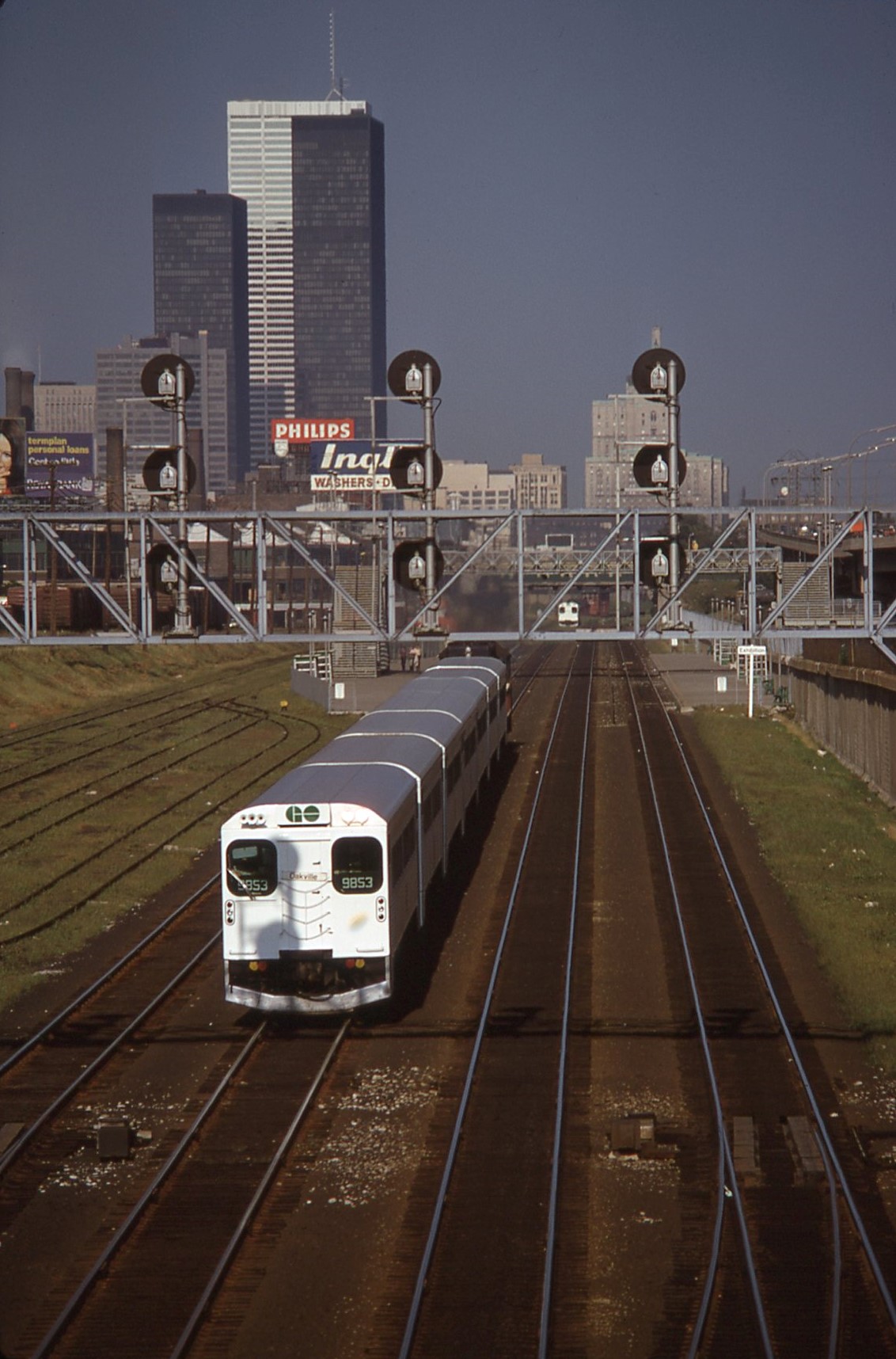
Looking east to GO Exhibition Station from Dufferin Street, August 1972

Verster’s focus is the GO Expansion program. Important though that is, GO is hobbled by the geography of Toronto’s historical, radial railway network. There is only one cross-city line within Toronto (CPR) and one crossing the southern part of York Region (CNR). Both of these are busy freight routes where insertion of passenger services would be challenging, assuming that the railways even agreed to such a scheme, and their locations do not coincide with major population and job centres.

The railway network was created primarily to serve freight, and the early industrial districts of the region lie along rail corridors. The node at Union served not just passenger traffic, but also as an interchange with the harbour. That was very much the case until trucks took over much of the shipping market and highways became the focus for development. GO Transit inherited railway corridors whose locations fit a century-old industrial pattern. Modal interchange shifted to rail and truck terminals in the suburbs, and railways shifted much more to a line-haul role with trucks handling local distribution.

GO’s first half-century was a comparatively easy one taking the low-hanging fruit of existing rail corridors, building massive parking facilities along these lines, and basking in the arrival of thousands of commuters. That model does not work any more because the web of travel demands is much more complex than the legacy railway network. Parking garages are expensive and they occupy valuable real estate at stations.

Parking lots are a quick and relatively cheap way to address the “last mile problem” of linking stations to their customers, and GO is one of the largest operators of parking facilities in North America. As of April 2019, GO transit had 85,055 parking spaces while the rail network carried 219,000 daily boardings (the equivalent of 109,500 round trips). That is almost four parking spaces for every five commuters. (I have ignored the GO bus network here because it is much less dependent on park-and-ride demand.)

That model simply does not scale up, nor does it provide a “network effect” because it is highly dependent on personal vehicles. The system is capacity-constrained by would-be riders’ ability to get to the trains.

Continue reading

Billions Promised for Toronto Transit

May 11, 2021, brought a shower of money, or at least promises of money, onto plans for rapid transit in Toronto. The federal government announced a total of $10.7 billion to fund a 40 per cent share in the Ontario, Scarborough, Yonge North and Eglinton West projects.

May 12 brought another, albeit smaller, promise of $180 million each from the federal and provincial governments to fund expansion of the streetcar fleet on which Toronto already planned to spend $208 million.

On May 13, a funding announcement for the Hamilton LRT line is expected. This is a project the province had tried to kill.

Combined with their recently announced national transit funding program, the federal Liberals are making a real splash in the transit pond, at least for big-ticket capital projects.

Before we all head out for a socially distanced beer or champagne celebration, there are important caveats.

Why 40 Per Cent Isn’t Necessarily 40 Per Cent

When the federal government agrees to fund a project, the dollar value is (or more accurately will be) “as spent” dollars without any provision for inflation. If Queen’s Park says that the Ontario Line is going to cost $10.9 billion, that’s what the 40 per cent is calculated on. Add-ons or inflation will be entirely on Ontario’s dime, unless a future federal government takes pity.

The last time a subway project ran out of money due to a hard cap on the “commitment” was with the Sheppard Subway’s terminus at Don Mills. Ironically, it was a conservative provincial Premier, Mike Harris, who capped spending on that project, and Toronto did not have enough money to continue east to Victoria Park, much less beyond to Scarborough Town Centre.

Cost overruns on the Vaughan subway extension were shared by Toronto and York Region.

The announced costs for the four Ontario key projects in Toronto are:

  • Ontario Line: $10.9 billion
  • Yonge North: $5.6 billion
  • Scarborough: $5.5 billion
  • Eglinton West: $4.7 billion
  • Total: $26.8 billion

“The federal government is contributing 40% of each project, up to a total of $10.4 billion” according to Infrastructure Canada’s announcement. This could give leeway for allocations to move between projects, but sets a total on the group.

This puts all four projects in a box, and will make adding costs to them very difficult because there will be no matching federal dollars. The dubious nature of the spending, notably on the Eglinton West underground alignment, appears to be of little concern to the feds who do not want to be seen as interfering in local decisions.

That stance takes an odd turn when we see that there are conditions on this support, although I suspect that many are window dressing.

The federal government understands that every taxpayer dollar invested in public transit must have multiple benefits including creating good jobs, building more equitable and inclusive communities, and tackling climate change. That is why the federal government’s funding is dependent on satisfying conditions including demonstrating how the investments will drive down emissions and build resilience, substantive environmental reviews, ensuring affordable housing along the line, incorporating accessibility, mitigating local concerns, maximizing benefits for communities including through Community Benefit Agreements, and meeting employment thresholds for underrepresented communities including Black, Indigenous and people of colour, and women.

Just what is meant by “substantive environmental reviews” and “mitigating local concerns” is anyone’s guess especially in light of Canada’s rejection [22 MB PDF] of a requested environmental review of the Ontario Line. In brief, the feds hold that there are provincial and municipal processes in place to address concerns, and moreover that there are few areas of federal jurisdiction touched by the Ontario Line.

Metrolinx projects already provide accessibility and include Community Benefit Agreements. These “requirements” simply reinforce what they are already doing.

The Ontario Line is under fire in at least two locations, Riverside and Thorncliffe Park, because of intrusions on the community. In Riverside, the debate is over underground vs at grade construction, as well as the proposed alignment, and Metrolinx’ possible misrepresentation of the combined GO Transit and Ontario Line corridor from the Don River to Gerrard. In Thorncliffe Park, the proposed maintenance yard requires the expropriation of a group of offices and shops that form a community centre. A Mosque is also affected, although it plans to move to another building nearby.

Changing the design in either of these areas will almost certainly raise costs, and the project cap will be used to counter any such proposals. Oddly enough, this was not an issue on Eglinton West which is going undergound at a cost of nearly $2 billion so that the good people of Etobicoke do not have to see streetcars in their neighbourhood. That decision is now baked into the project cost, and Metrolinx is on the verge of awarding the tunneling contract.

The planned alignment of the Yonge North extension under the Royal Orchard neighbourhood is also under fire, although Metrolinx claims that the line will be so deep it will have no effect on the residential community above. That is an intriguing claim given that the tunnel portal is in the GO rail corridor and the trains will not leap instantly from deep underground to the surface.

The Scarborough decision has long been a fait accompli, but the current announcement commits the feds to a 40 per cent share of the expanded project.

More Streetcars for Toronto

In 2020, the TTC proposed that the streetcar fleet be expanded by 60 cars, and the City signed on to fund 13 of these. The remaining 47 are now funded by contributions from the other governments, a move that will keep Thunder Bay happy with a vehicle order to keep the now-Alstom (formerly Bombardier) plant going. Some work will also go to the Alstom plant in La Pocatière, Québec.

The subway extensions will also need new cars, but unlike the streetcar fleet, there is no open contract to simply be extended. It will be interesting to see how additional cars for Line 1 and a new fleet for Line 2 will be tendered, and what political machinations will bear on the vendor selection.

The expanded streetcar fleet will not all fit in existing facilities at Leslie, Russell and Roncesvalles. The TTC plans to renovate Harvey shops at Hillcrest as a small carhouse serving (at least) the 512 St. Clair route. The existing streetcar maintenance facilities at Hillcrest were designed in the 1920s for standard sized streetcars and could only host a few Flexitys at a time during the early testing and acceptance period.

Now that the full order for more cars has funding, the Hillcrest renovations can proceed.

Left at the Altar

Important projects which might benefit from federal funding are still sitting in limbo including:

  • Eglinton East LRT to UTSC and Malvern
  • Waterfront East LRT to Broadview
  • Line 2 Bloor-Danforth Automatic Train Control and fleet renewal
  • New Line 2 maintenance facility west of Kipling Station (Obico yard property)

There is a separate federal program to fund transit, but that is already partly earmarked for electrification of the bus fleet and garage upgrades. How much will be left for other projects remains to be seen.

With all of this new money for Toronto transit, the TTC needs to update its Capital Plan to reflect the current status of project funding and the remaining budget shortfall. We might have billions worth of promises, and even a few celebratory bottles to drink, but there is a long way to go thanks to decades of deferred investment.