Travel Times on Bathurst/Dufferin Part III: 511 Bathurst

This is the third part of a series showing details of travel times in the Bathurst and Dufferin corridors.

For introductory remarks and a discussion of general issues, please refer to Part I.

The main part of this article contains the charts for the streetcar service on 511 Bathurst. Note that data for any bus extras has been omitted from these charts to ensure a presentation of streetcar-only speeds. Data from October 2024 and July 2025 are shown here to be outside of the period when the line was rerouted around construction at Fleet and Bathurst with buses operating a south-end shuttle service.

Continue reading

Travel Times on Bathurst/Dufferin Part II: 29/929 Dufferin

This is the second part of a series showing details of travel times in the Bathurst and Dufferin corridor.

For introductory remarks and a discussion of general issues, please refer to Part I.

The main part of this article contains the charts for the local and express bus services on Dufferin Street in June 2025.

Although the focus of recent debates about transit priority for Dufferin was from Eglinton south, data here show that there are issues with extended running times, particularly in the afternoon, over the full route with northbound trips taking the lion’s share of the delay. Express trips are faster than local trips, but by varying amounts over the route. The least benefit is on the southern portion of the route where red lanes will be installed, and where staying in those lanes could prevent express buses from leap-frogging the locals.

There are some areas where traffic slows in advance of an intersection, but more common is a general slowing down of bus speeds over the route representing overall traffic speed and longer stop service times when the route is busy.

Data shown here are from June 2025 with both the local 29 and express 929 services plotted together for comparison. In many times and locations their speeds are comparable, while in others the express buses have higher speeds than the locals.

The main article contains all of the charts including PDFs with all day sets.

Continue reading

Travel Speed and Time on Bathurst/Dufferin Part I: 7 Bathurst

In recent discussions of the Bathurst and Dufferin transit priority schemes, a major issue is the degree to which various parts of the routes contribute to slower operation by time-of-day and direction. In this article and two to follow, I will review the actual behaviour of these routes to provide both a basis for discussion of expanding the priority schemes, and as a “before” reference for comparison after they are implemented.

Reviews by time-of-day are useful not just to spot peak period issues, but also as a reference for what might be achieved. At the beginning and end of service hours on most routes, there is no traffic congestion and lighter passenger demand reduces stop service time. Bettering travel times from those periods would be challenging.

Travel times are affected by many factors including:

  • Interference from other traffic on the road, and the degree of congestion for traffic generally.
  • Absence of signal priority and “priority” signals that do not adequately reflect actual operating conditions.
  • Stop service time including both the penalty for stopping, starting and rejoining the traffic flow; and passenger boarding times which depend on the volume of riders and crowding conditions.
  • The proportion of riders with large objects such as bicycles, baby carriages, shopping carts, luggage, scooters and wheelchairs. This affects not just boarding times, but also the ability of passengers to move within vehicles, particularly buses.
  • Slow driving speeds induced by a desire to avoid running early when scheduled times exceed what is actually needed.
  • Posted speed limits.
  • Weather conditions.

Express services have fewer stops and therefore lose less time on that account, but this is only one of many possible factors.

A further consideration is that for the transit vehicle, we generally talk about point-to-point times, but for a rider, “travel” includes access time to and from stops at their origin and destination. Removing stops might speed up buses, but at the cost of longer access time. This is a balancing act depending on local geography, the location of signalized intersections and major trip generators.

Travel Times and Ridership

The relationship between travel times and demand is not exact, and depends on various factors:

  • A substantial reduction in a long trip is more noticeable than a small reduction.
  • For short trips, an improvement in scheduled service and reliability will improve wait times possibly by more than the saving for in-vehicle time. This is compounded by riders experiencing wait time as longer than in vehicle travel time.
  • Comfort is important for longer trips where standing in a packed bus is no fun. For short trips the inability to board is a disincentive to ride. Speed is only one measure of attractiveness.
  • If service is changed, or stops are removed, in parallel with the reduction in travel time, it is not clear which factor influenced ridership the most.

The origin and quantity of any new riders can vary and will depend greatly on both the latent demand and the perceived improvement for travellers. Would-be riders who now drive require a substantial inducement to change modes especially if their trip would involve multiple routes of which only one was improved. Some riders may shift from nearby routes as happened with the King Street corridor, but this is very specific to local routes and riding patterns, and it does not represent net new transit users.

Any analysis is complicated by the events of 2020-25 and a major shift in overall travel including the stronger recovery of off-peak as compared to peak period demand. If transit priority only yields its greatest benefit in the peak, a large part of the travel market sees little change.

The TTC projects substantial ridership increases on Jane, Dufferin and Bathurst through the proposed transit priority schemes, and this implies both a major improvement in perceived service quality and a latent demand for better transit. However, they do not explain how they reach this conclusion nor the methodology behind their claims, nor the amount of extra service, if any, that will be fielded in anticipation of growth.

Looking at the Whole Route

The Council debate concerned only the section of 7 Bathurst and 29/929 Dufferin south of Eglinton, and of 511 Bathurst from Bloor to Fleet. An inordinate amount of time was spent on a short section of Bathurst south of Dupont. For both corridors, much work was done by local Councillors, their communities and Transportation Services to fine tune the design. This should have occurred earlier in the process.

The larger question, however, is not just the installation of transit priority over a portion of these corridors, but the routes overall and the service they provide. The TTC loves to point to external factors like traffic congestion as their rationale for irregular service, but they do not manage the service they already have as I have shown in numerous articles. Moreover, the standard on which they base reports of “reliability” is very generous for routes that only run every 10 minutes allowing a deviation between 5 and 15 minutes in vehicle spacing.

If one were to say “make it tighter”, I expect the first response would be “oh, we cannot possibly do that” even though the same standards set a tighter deviation for more frequent routes. If it is possible to manage to a six minute window on a 6 minute service, it should be possible to manage to this on a 10 minute service. TTC Service Standards excuse poor service rather than demanding excellence.

The main part of this article presents speed profiles showing details over 7 Bathurst by hour. Within these, one can see locations where transit vehicles have slow operation over extended distances, notably on approaches to intersections. These are key sites for any focus on speeding up transit service.

As a reference, the travel times over each segment, broken down by hour, are also included to show the variation over the day, and the degree of variation (standard deviation of values).

There are many charts, but only a sampling is included inline here. PDFs with full day sets are linked for those who are interested.

I will cover 29/929 Dufferin and 511 Bathurst Streetcar in Parts II and III.

Continue reading

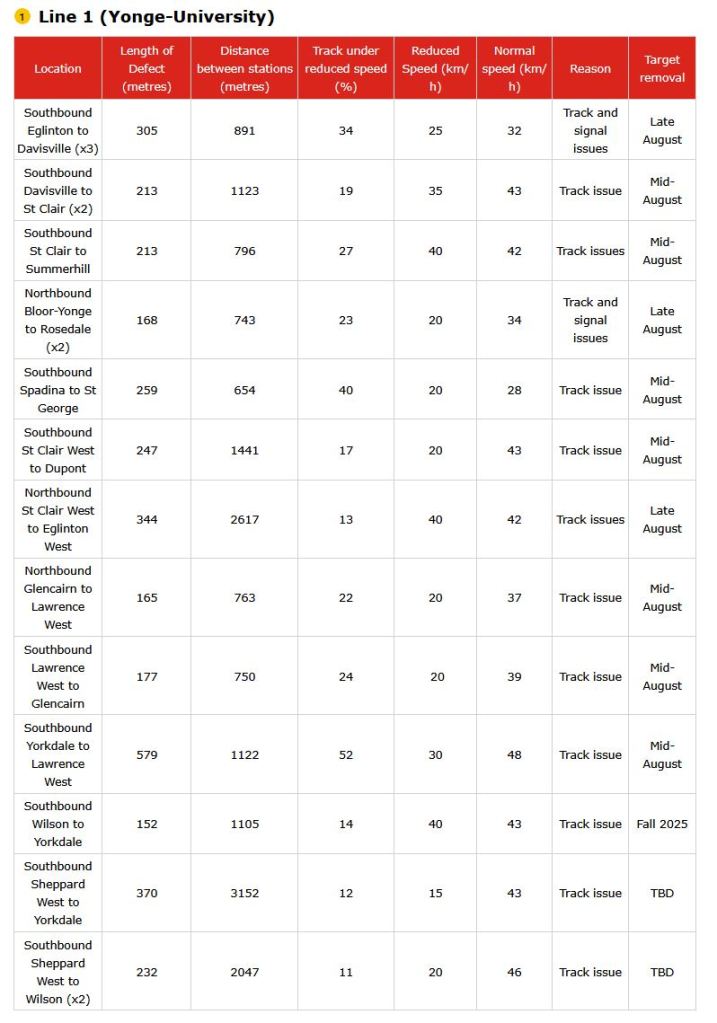
TTC Updates Reduced Speed Zone Info

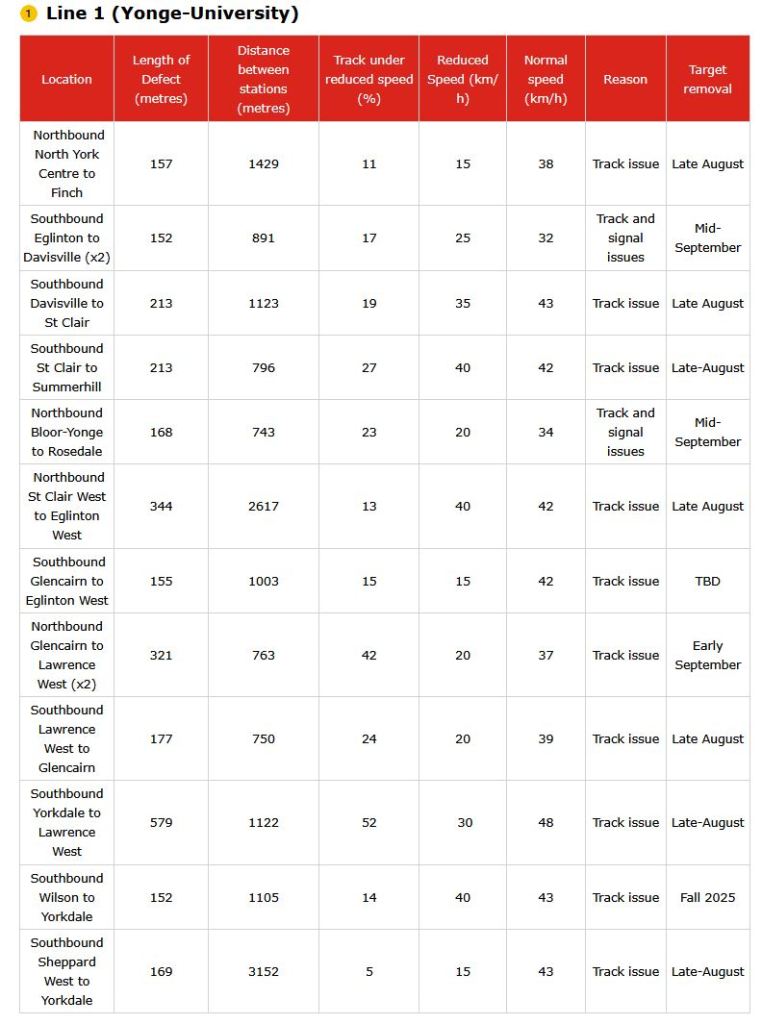
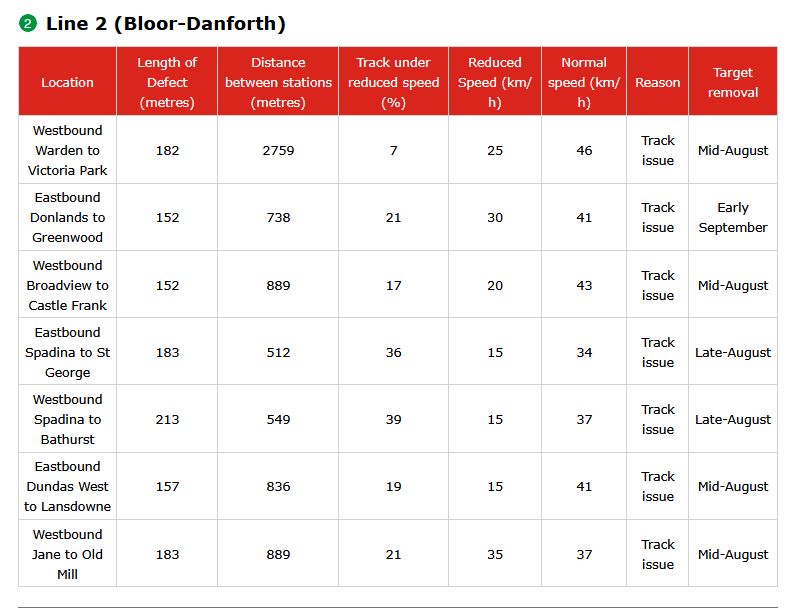
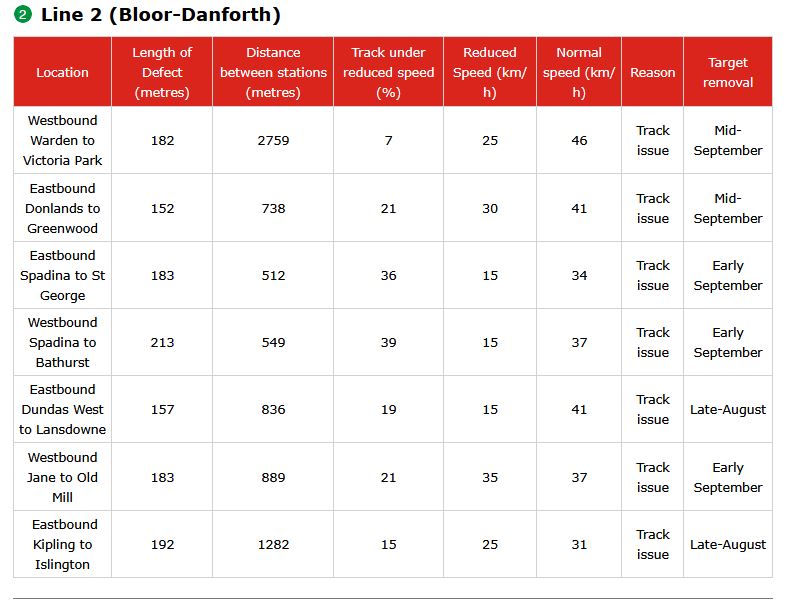
The TTC maintains a list of reduced speed zones on its website, and this constantly changing list is tracked in a previous article here showing how long some restrictions have been in place.

The format of the TTC page has been changed to include not just a map showing where the zones are, but why they were created and, in most cases, a target date for remediation.

The current map and table of repair targets, as of July 31, 2025, are shown below. Note that some of the items on the map are not included in the detail (e.g. Warden to Kennedy eastbound), and the table includes entries that are not reflected on the map (e.g. Sheppard West to Wilson). This does not speak well of the TTC’s ability to communicate consistent, accurate information.

Updated August 1, 2025 at 9:10am: The TTC has updated their page so that the map and tables are now in sync with each other.

Most of the zones listed here are scheduled for removal by early September with only a few continuing into the Fall or beyond (“TBD”). This list will bear watching for additions, and for removals of cleared sections within the expected time frame.

Original July 31 versions:

Revised versions:

TTC Service Changes Effective July 27, 2025

The TTC will make a few service changes effective July 27, 2025 as well as a number of route name and signage modifications.

The changes including before and after service designs are in the spreadsheet linked below.

(The spreadsheet has been corrected to refer to Sheppard Yonge rather than Sheppard West Station for bus looping changes.)

Construction Projects

The only change in the construction project list is that paving work at Sheppard Station bus loop is complete, and buses will move back into the loop. There is no change in service on affected routes.

The bay allocation at Sheppard Station is shown below.

Temporary Service Improvements

With a surplus of operators, service will be improved to address crowding and service resiliency on many routes. These are not formal schedule changes.

504 King
20 Cliffside
32 Eglinton West
37 Islington
44 Kipling South
45 Kipling
54 Lawrence East
63 Ossington
66 Prince Edward

67 Pharmacy
68 Warden
80 Queensway
86 Scarborough
89 Weston
90 Vaughan
110 Islington South
111 East Mall
118 Thistle Down

119 Torbarrie
123 Sherway
124 Sunnybrook
125 Drewry
126 Christie
161 Rogers Rd
929 Dufferin Express
960 Steeles West Express
996 Wilson Express

Destination Sign Changes

Signs on many routes will change for standardization including:

  • 13 Avenue Rd
  • 30 High Park North (Branch letters removed)
  • 75 Sherbourne
  • 116 Morningside
  • 203 High Park
  • 302 Kingston Rd-McCowan Night
  • 332 Eglinton West Night
  • 924 Victoria Park Express
  • 929S Dufferin (new Dufferin Station short turn for CNE service)
  • 960 Steeles West

Routes renamed:

  • 74 Mount Pleasant
  • 103 Mount Pleasant North
  • 171 Mount Dennis

Streetcar Service Changes

301 Queen Night

Two early morning trips extended west from Roncesvalles to Humber Loop to improve the transition to 501 daytime service.

504 King

Official route standardized to operate via Queen and Shaw. This has been in place since May 2025, but the schedule change will also allow trip prediction apps to “see” cars on the route they are actually using.

Bus Service Changes

22 Coxwell / 92 Woodbine South

The holiday interline at the south end of the routes will be discontinued.

72 Pape

The 72C Commissioners service will be extended on weekends except late evenings to serve Biidaasage Park. The service will operate westbound via west on Commissioners Street to north on Ookwemin Street (formerly Old Cherry Street). Eastbound service will run from Ookwemin Street east on Villiers Street, u-turn to west on Villiers Street, south on Ookwemin Street, east on Commissioners Street

100 Flemingdon Park

Weekend service revised for reliability.

102 Markham Road

Added trips on weekdays SB from Warden Station to Steeles at 4:47 and 5:13 am to reduce crowding.

Streetcar Vehicle Allocations

Streetcar Route Maps

Bus Vehicle Allocations

eBus Compatible Runs By Garage

Budget and Scheduled Service Hours

TTC Board Meeting: July 17, 2025

The TTC Board met on July 17, 2025. Among the items on the agenda were:

Continue reading

The Troubled State of TTC Green Buses

Updated July 21, 2025 at 11:20am:

Despite the extensive catalogue of issues with the Green Bus program, the TTC Board wasted no time in adopting the report without debate on an enthusiastic motion by Commissioner/Councillor Saxe. There was a sense that they could not wait to get this item off of the table.

However it is likely to come up again at the Strategic Planning Committee in discussions of future service improvements and the resulting fleet size, and the City Auditor’s review of the program will land on Saxe’s Audit & Risk Management Committee agenda sometime in 2026.

In the meantime, the TTC needs honest reporting of the performance of its growing eBus fleet as more buses arrive. In the short term, they can paper over range issues by using these vehicles on blocks of work that do not tax their capacity (buses that are only in service for part of the day, and on less stressful routes). The disparity between charging capacity and fleet size discussed in the report will also affect availability, and “performance” metrics should include not just how far a bus can travel, and how reliable it is from failure, but also whether it is even available for service.

Meanwhile, major systems elsewhere in North America continue to hedge their bets on eBuses with parallel orders of hybrids as Toronto is now doing.

Vancouver has the advantage of an existing trolley bus network which allows them to design around in motion charging. See Coming soon: the first of Metro Vancouver’s next-generation trolley buses.

Original Article

At its meeting on July 17, the TTC Board will receive an update on its Green Bus (eBus) program.

This is a long report, and some key information is buried down in the appendices. It reveals, among other things, that:

  • Delivery of the battery-powered eBuses is running late. This is an industry-wide supply chain problem.
  • The TTC plans to buy 200 more hybrid buses as an interim step to allow retirement of their oldest vehicles.
  • The reliability of the eBuses is below the originally hoped-for “long range” capacity and they are only achieving about 250km per charge. That is with a new battery, and the value is expected to drop as batteries age.
  • Much of the TTC’s currently scheduled service cannot be operated with standard range eBuses, and planned change-offs will be needed to cover the span of service typical on TTC. This will add to mileage and operator hours.
  • Charging operations at garages are constrained by a shortage of installed charge points compounded by limitations of electrical capacity.
  • The problem of shorter range and limits on charging fundamentally change how garages operate for diesel/hybrid buses where refuelling is quick and is performed as part of routine servicing as buses come out of service.
  • The need to shuffle buses between charge points and storage locations will add to staffing requirements at garages.
  • eBuses cannot replace hybrids on a 1:1 basis because of the charging constraints.
  • There is a possibility that the TTC will have to store new buses unused because of charging limitations.
  • The policy decision to deploy eBuses at all garages simultaneously requires that maintenance equipment, staffing and training must be provided everywhere at once rather than a garage by garage transition, and that concurrent support for hybrids must also exist at all sites.
  • On route charging (using charge points at key locations to permit buses to “top up” their charge) was considered early in the project, but was rejected for various reasons including a desire to be up and running quickly to secure special eBus subsidies. It is now treated as a possible option, but with implementation five years away.
  • The comparative performance of hybrids and eBuses in the CEO’s monthly Metrics Report artificially understates the hybrid numbers and makes the eBuses appear to perform closer to hybrid buses than is actually the case.
  • The TTC does not address garage capacity issues and, indeed, speaks of shifting the need for a 10th garage off by over a decade through a “garage enhancement” project. This scheme echoes other past budget juggling to shift major infrastructure requirements and their funding needs off of the current planning calendar.
  • The report contains no discussion of the implications of technical limitations for the future of bus service especially in the context of any desire to drive up ridership with significant service improvements.

Overall, the report describes a project that has finally addressed the technical realities of eBuses, something that has been glossed over for years. Some aspects of eBus migration, notably charging capacity, time and garage management issues, are presented almost as new discoveries even though they are not new to the industry. Whether this is wilful ignorance or downplaying of problems on a high-profile project, the effect is the same. As with a few other major Toronto projects, the TTC is saved from some pitfalls because schedule extensions give them more time to deal with issues that should have been foreseen.

The project began in 2017 when, shamefully, the TTC Board under then Chair Josh Colle, allowed reps from BYD to pitch their wares in the guise of a “deputation”. This was “facilitated”, to use City Hall speak, by then TTC Board member Minnan-Wong with behind the scenes support from then-Mayor Tory. The video is still available on YouTube. The original hype from BYD, who hoped for a large untendered contract, is falling away, but the implications for the future of TTC bus service are only now coming out in the open.

See also: Is A TTC Bus Technology Gerrymander In The Works? [Sept. 5, 2017]

(Those of us with long memories will recall the combined efforts of TTC management, MTO “innovative technology” staff, the gas industry and Ontario Bus Industries to replace the TTC’s trolleybus system with “clean” natural gas buses on a sole-source contract. We have been here before.)

As the 60-bus pilot project wore on, BYD was only able to supply half of the 20 buses originally allocated to them. Proterra, now out of business, got 25 and New Flyer got the other 25. At the point I write this article (July 13 at 3:00 pm, none of the BYD buses is reporting a position on the vehicle tracking system. (14 of 25 Flyers, and 8 of 25 Proterras are active.)

New Flyer is supplying eBuses to the TTC, and of the fleet numbers 6000-6203, the highest number reporting its location is 6141. Fewer than half of the delivered buses is reporting a location. Nova Bus deliveries on a 136 bus order are slower, and only 6 buses are reporting locations. (See Appendix E later in this article for information on delivery progress.)

An important issue when considering reliability stats is that a bus that never runs never fails, and so does not contribute to MDBF (Mean Distance Before Failure) stats. These buses do, however, count as part of the TTC’s active fleet and inflate its apparent size including chest-beating claims to the number of eBuses Toronto has. Having them and operating them are two different issues.

When there are only a few trial vehicles in the fleet, how well they work has little effect on service, especially through the pandemic era when service was not running at 100% of former levels. The situation is much different as recovery to full service, notably on the bus network, is in sight, and both City Council and some TTC Board members talk of an aggressive increase in transit service to wean motorists out of cars and accommodate population growth.

The TTC has already reached the point where it must keep elderly vehicles in service to compensate for performance issues with the new fleet, and this situation will compound as more eBuses arrive. There is even a question of where to store all of these buses if they cannot be actively, reliably used. The planned order for hybrids does not simply buy time while supply chain issues are worked out and battery technology improves. It is an admission that the electric fleet plan is not working out and that service at current levels is threatened. Major service expansion is simply not possible.

On the financial side, migration to eBuses is not cheap, and the project is funded only to about 37%. An important discussion nobody at the City or TTC seems willing to address is whether it is better to lower emissions by converting the fleet and all facilities to electric operation, or if buying and operating more buses to get riders out of their cars and improve mobility in the city should take precedence. Capital projects are seductive because they are often funded with “other people’s money”, but even the special eBus subsidies only go so far.

It is both ironic and sad that the electric streetcar system has many surplus vehicles thanks to service cuts, but also from a shortage of operators. The TTC plans to move to a six-minute service on three routes in Fall 2025, but may have to bus one line (503 Kingston Road) for want of streetcar drivers.

Peak streetcar service in July 2025 is 170 cars (on Saturday afternoons, not during the weekday peaks!), but the fleet will soon number 262 cars when the last of the new Flexitys arrives. 50 of the 60 new streetcars, 4603-4662, are actively reporting locations, and the highest of these, 4655, shows how close to complete the deliveries are.

In the rest of this article, I will explore issues with the eBus project and plans in more detail, but the last Appendix deserves to be here, “above the fold”.

A review commissioned by the TTC Board from Deloitte in 2023 flagged issues with “project management improvement in the areas of schedule, cost, scope, reporting, risks and issues, governance, and interdependencies management”. Of the 37 recommendations, 18 are closed and 19 are in progress.

An APTA (American Public Transit Association) peer review is planned to begin in September 2025, and the City’s Auditor General plans to review the eBus program.

It is quite clear reading through the report that the TTC eBus project is in trouble both because of external factors (industry conditions) and because the implications of the technology were not fully understood or appreciated. Moreover, the transition will require far more than buying some new buses and plugging them in. The TTC loves to claim that is a leader in the field, but this is likely only true in comparison with smaller systems that do not have the capacity. Within the industry, TTC is not at the front of the pack.

Continue reading

114 Queens Quay East and Its Red Lanes

On June 4, 2025, new reserved bus lanes were installed on Queens Quay westbound from Sherbourne to Bay, and eastbound from Jarvis to Sherbourne. The TTC projected travel time savings of up to 5 minutes, and more reliable service for riders using routes on this roadway including 114 Queens Quay East, 75 Sherbourne, 65 Parliament and 202 Cherry Beach.

Now that the June 2025 tracking data are available, this article reviews the actual change, if any, in travel times and headway consistency. For historic context, the data presented here go back to May 2024 when the 114 Queens Quay East route was split off from the south end of 19 Bay.

Here is a map showing the affected routes and location of the new red lanes.

Source: TTC

Over the period before red lane implementation, the 114 Queens Quay East service suffered from schedule problems with an unrealistic high scheduled speed. This was reduced in October 2024, and then raised again recently in anticipation of red lane benefits. The current scheduled speed is not as high as the original design in May 2024. Service frequency has also been changed from time to time mainly in response to seasonal fluctuation, but in some cases to “stretch” buses over a longer running time. (Details later in the article.)

The original eastern terminus was an around-the-block loop via Logan, Lake Shore and Carlaw to Commissioners. This was changed to Lake Shore Garage (the Wheel-Trans garage on Commissioners west of Leslie) to provide a better, off-street location.

Service until the October 2024 schedule change was extremely erratic, especially in the PM peak, as buses could not maintain the original running times. Since October, there has been little change at most times of the day including in June 2025 after red lane implementation.

There is a very strong day-of-the-week effect in the PM peak for westbound travel times on Queens Quay with midweek days being the worst. In June, the worst of the peaks are down from April levels, but that month was unusually bad. There is not yet enough accumulated data to establish whether there will be a permanent “shaving” of peak travel times through the red lane area.

There is an analogy here to the King Street project where the travel times under normal circumstances changed little, but the peaks on days when there was a disruption or special event were shaved off improving overall reliability.

Any analysis of the benefits of the red lanes must be careful not to cherry pick “good” and “bad” days for comparisons.

The data here provides mainly a “before” view of service on 114 Queens Quay East. I will update these charts in the Fall when full traffic conditions have resumed.

Continue reading

Tracking Reduced Speed Zones

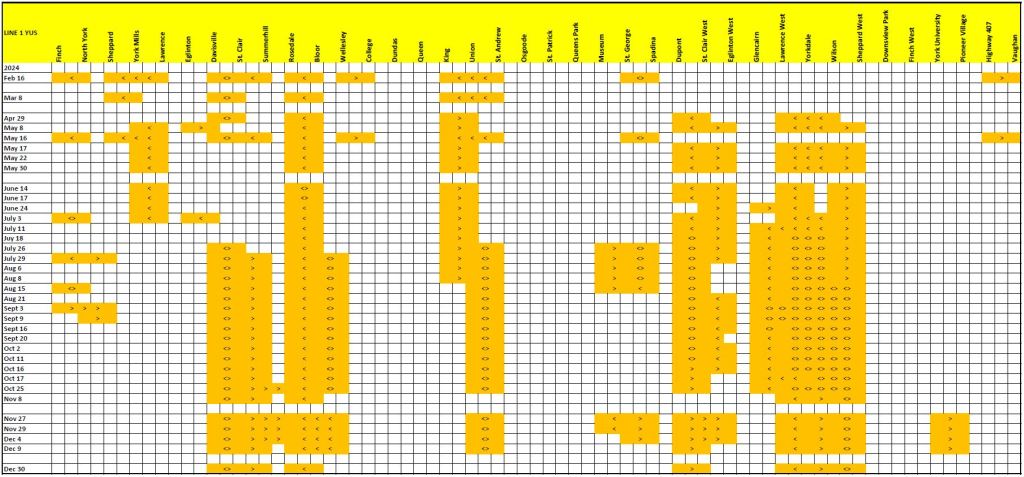
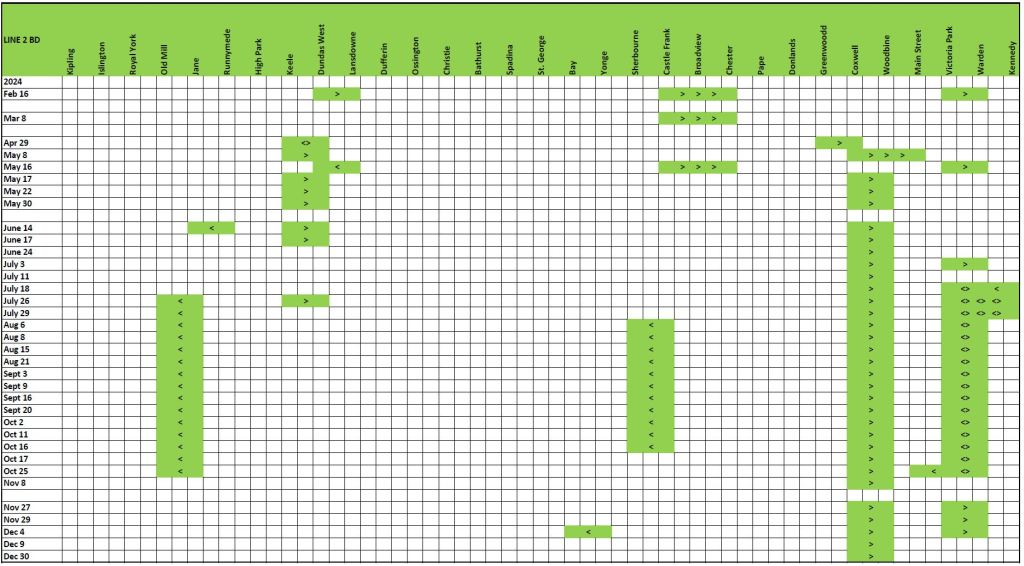
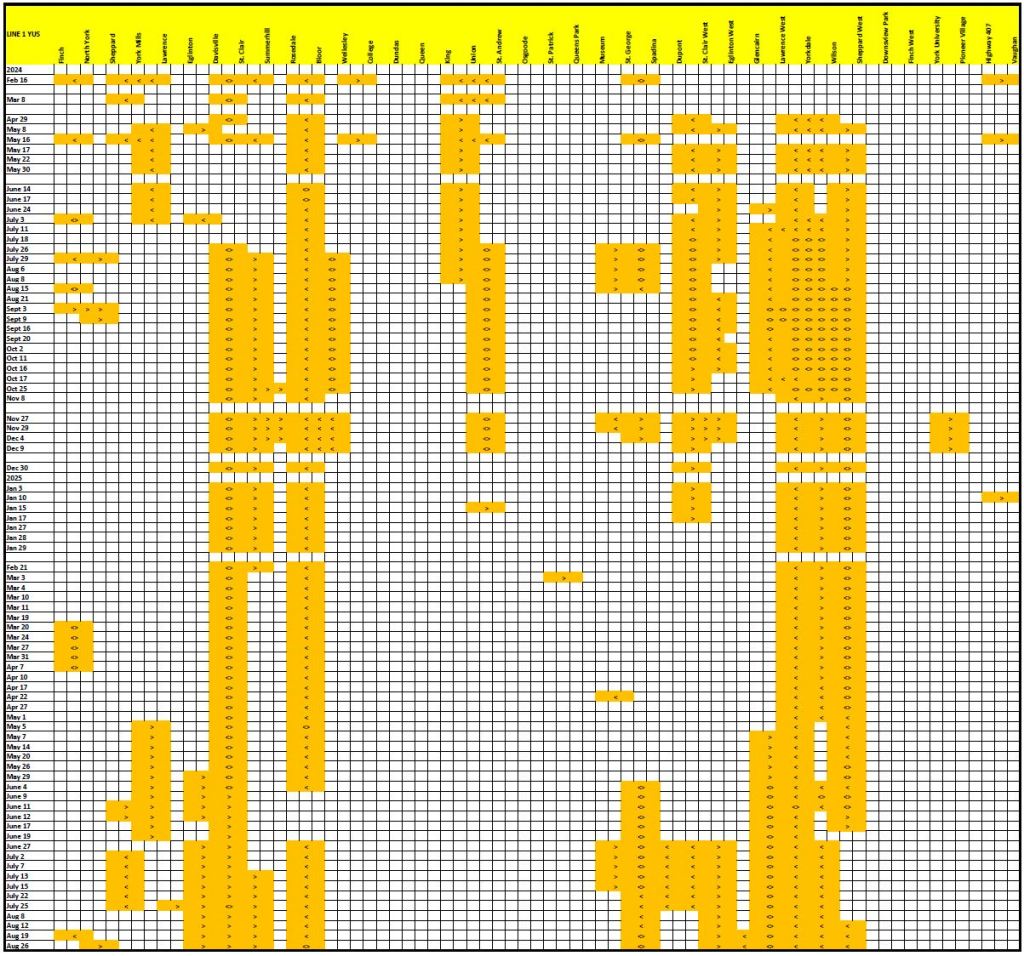
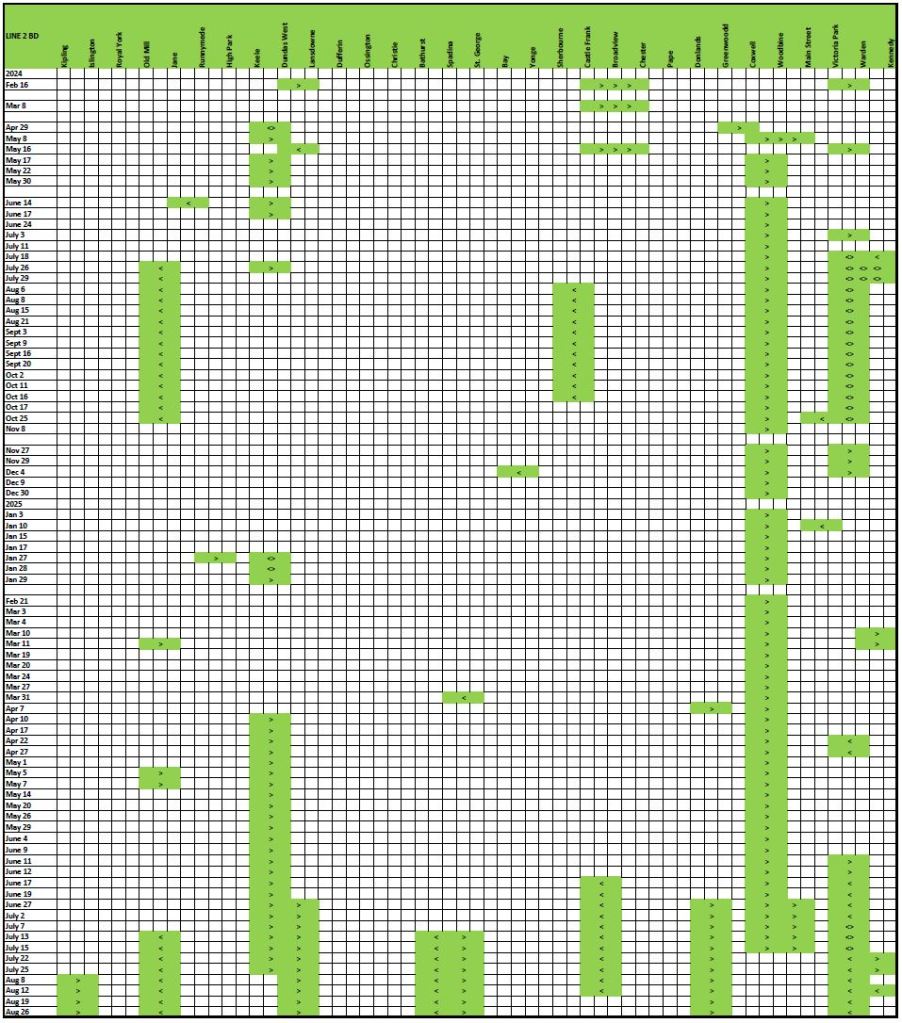
Since February 2024, I have tracked the TTC’s posted list of Reduced Speed Zones (RSZs) on subway lines 1 (YUS) and 2 (BD). A pattern has emerged that some RSZs are very long-lasting, others are brief, and some come-and-go.

Former Interim CEO Greg Percy claimed that we should expect about a dozen of these at any time, but the current total as of July 13, 2025, sits at 27.

Source: TTC Site July 13, 2025

If these zones came and went in short order as problems were discovered, one might tolerate a period of travel delay. My own recent experiences with glacial trips from Vaughan to St. George makes me thankful that I don’t take this route every day, but regular riders there have my sympathy.

Current reporting makes actual tracking of track defects difficult, and there is no sense of the underlying problems or limitations on performing repairs. Transparency demands that more information is provided for the status of RSZs, specifically:

  • Location
  • Date first reported
  • Defect issue(s)
  • Planned repairs
  • Projected date to completion
  • Actual date slow order is lifted

Whether this will speed repairs depends on available resources (capital, work equipment, crews) and conflict with other works along the subway lines, but at a minimum riders deserve to know when they can expect relief from slow orders. The TTC Board and Council deserve to know how deep-seated the outstanding problems might be, where they originated, and what will be required to fix them.

Continue reading

TTC Strategic Planning Committee: July 10, 2025

Introduction

On January 10, 2025 as part of the budget process, the TTC Board approved:

  1. Establish a Strategic Planning Committee to assist the TTC Board in managing strategic planning and priorities, including through a Ridership Growth Strategy and other existing strategic documents, and direct the Director, Commission Services to report back to the February 24, 2025 TTC Board meeting on a proposed structure and meeting schedule after canvassing Commissioners’ interest in committee membership;
  2. Amend the 2025 Schedule of Meetings to add a Special Meeting of the Board in September 2025 to consider recommendations from the Strategic Planning Committee, receive an update on the 2026 Budget, and discuss budget priorities informing the development of the 2026 TTC Operating Budget; 2026-2035 Capital Budget and Plan and 15-Year Capital Investment Plan and Real Estate Investment Plan Update;
  3. Direct the Director, Commission Services to include a Special Meeting to consider recommendations from the Strategic Planning Committee, receive an update on the next year’s budget, and discuss budget priorities informing the development of the next year’s budgets in future year’s recommended annual schedule of Board and Committee meetings for the Board’s approval, in
    accordance with Section 20 of the By-law to Govern Board Proceedings;
  4. TTC Staff conduct public consultations and develop a Ridership Growth Strategy 2.0, building upon the Ridership Growth Strategy 2018-2022 and report back to the Board in July 2025;
  5. TTC staff develop a hiring strategy on the basis of the approved Ridership Growth Strategy 2.0 and report back to the Board by October 2025; and TTC staff use the approved Ridership Growth Strategy 2.0 and associated hiring strategy to inform the 2026 TTC Budget process.

I began writing this article before the meeting took place as background based on the then-posted materials. After attending the meeting, I found that it was more productive than I had expected thanks in part to two presentations that were not in the original published agenda.

TTC Chair Jamaal Myers praised Councillor/Commissioner Alejandra Bravo who chairs the Strategic Planning Committee for the work she did in producing a focused agenda that made for a useful meeting. Past attempts by the Board to engage in general policy debates have been rare.

There was much more meat on the presentations than we have seen in a long while at the TTC. Heavy going in places, and some hard truths about the options available. This type of briefing is long overdue, and will provide the foundation for informed discussions at the TTC Board and eventually at Council.

The actual establishment of a committee contemplated in point 11 did not actually occur until the Board meeting of April 16, 2025, and the first meeting only now happened, six months after the original motion. It is not clear how much influence the committee will have on the 2026 budget process considering the length of delay.

Although the next meeting date is currently shown as October 25, 2025, Chair Bravo indicated that she does plan to schedule one in time to feed into the budget.

As for consultations on a Ridership Growth Strategy, these have not yet begun, and the TTC is now only in the first round of its Annual Plan consultations. By extension, any service improvements flowing from a new RGS including hiring required to staff buses and streetcars do not yet exist. How much would be done in the 2026 budget remains to be seen.

The delay in the committee’s initiation places the Board in a familiar position. Actual discussion of policy options is pushed off, if it occurs at all, so late in the year that the next budget is “more of the same” because there was no time to consider alternatives. Options for significant growth are never presented to Council because the TTC Board never discusses what might be done.

“Value for Money”

Almost at the end of the meeting, Chair Bravo made a comment about advising the budget process. She posed two questions about funding:

  • Is it the best value for money?
  • Does it create the most value for transit users?

This slipped by quickly, but a vital issue here is that these are not the same question, but two separate issues depending on what one assumes as the role of transit. Best value for money for whom? For taxpayers asked to subsidize transit? For riders awaiting a bus that never comes?

That distinction lies at the heart of every transit funding debate I have heard, but the actual question is never asked, and “value for whom” rarely starts with riders. This can be an important change in budget planning and in advocacy for financial support from the City and Province.

On The Agenda

There are three items on the July 10 agenda:

Continue reading