The construction work on Broadview north of Danforth has not run particularly quickly with a few intervals where nothing happened at all for over a week. This appeared to be not the TTC’s problem, but rather the contractor, Sanscon, who simply did not have anyone working on site at times.
As of November 16, they have only now reached the point of excavating the north end of Broadview Station Loop. Both track and concrete are incomplete, albeit progressing, on Broadview and at the loop entrance. Broadview Avenue cannot reopen until this track work has finished and the pavement is restored.
The reopening of the station for bus service is now expected in December (exact date unspecified).
The schedules for “normal” operation at Broadview Station are already in place, but service will operate in an interim configuration pending completion of work at the station.
8 Broadview will operate from Broadview & O’Connor Mortimer to Warden Station. It will no longer interline with 62 Mortimer. [Corrected 6:35 pm, November 16]
62 Mortimer will operate from Broadview & Mortimer to Main Station. It will no longer interline with 8 Broadview.
87 Cosburn will continue operating to Pape Station via Mortimer and Pape.
72 Pape will no longer provide replacement service for Broadview Avenue, but this will be taken over by a 504/505 shuttle. 72A Pape will no longer be interlined with 100 Flemingdon Park.
100 Flemingdon Park will operate from Pape Station independently of 72A Pape.
The 504/505 Broadview shuttle will operate from Castle Frank Station to King & Parliament via Bloor, Danforth, Broadview, Queen and King, and it will use on-street stops at Broadview & Danforth.
304 King Night Bus will operate from Castle Frank Station east to Broadview and then over the 504 King daytime route to Dundas West Station.
322 Coxwell Night Bus will divert to Pape Station.
When Broadview Station Loop reopens, routes 8, 62, 87, 100, 504/505, 304 and 322 will resume their normal routes to that loop.
The TTC has not yet published information about on street stops for the temporary western terminals of 8 Broadview and 62 Mortimer.
Here are two views of construction work at the north end of Broadview Station on November 16.
Looking SW from Erindale to BroadviewLooking S into Broadview Station from Erindale
Streetcar operation to Broadview Station will resume in mid-February 2024 following sewer rehab work by Toronto Water.
Although there was no regular TTC Board meeting in October, a CEO’s Report was issued for that month. It contains two separate sets of charts about ridership, one more recent than the other.
In the CEO’s commentary, data for the week ending October 13 are cited:
For the week ending October 13, excluding Thanksgiving Monday, the TTC’s average weekday boardings stand at 82 per cent of pre-COVID levels, or 2.55 million boardings. Weekend ridership continues to exceed weekday demand, being 96 per cent for this week. Bus boardings are leading recovery, at 96 per cent of pre- OVID levels, while streetcar boardings sit at 65 per cent and subway at 73 per cent. Wheel-Trans ridership is at 75 per cent of pre-COVID levels.
October 2023 CEO’s Report p 5
The chart of ridership only goes to the end of August, and reports an expected seasonal decline for that period. Fare revenue follows the same pattern.
October 2023 CEO’s Report p 10October 2023 CEO’s Report p13
The chart of boardings runs to early October, and shows September’s jump in demand.
CEO’s Report October 2023 p 25
Crowding levels continue to rise, although stats are reported only for the bus network. An important issue about this chart is that it reports all-day values. There are many routes with uneven demand by direction, and with more lightly-loaded trips at some times of the day or week. Even at the pre-covid demand of January 2020, only 27% of trips reported more than 70% of capacity. However, depending on where and when they are concentrated, they can have a disproportionate effect on the perceived crowding level. An empty bus at 10pm on Sunday evening is of little use to someone who cannot board a packed weekday bus on a busy route in the peak period.
CEO’s Report October 2023 p 26
There are two issues that might skew some of the quoted statistics.
First, with the conversion of the SRT from rapid transit to bus, an additional set of “boardings” is created. Boardings for the subway network are treated as a single event with no extra count for transfers between lines. With the SRT replaced by the 903 Scarborough Express bus, former SRT trips create an extra boarding for that leg of their journey. This will change again on November 19 when many bus routes formerly ending at STC will be extended to Kennedy Station, and that leg will no longer count as a separate boarding.
Second, boardings are counted based on the mode actually operating on a route. If buses replace streetcars, the riders count toward the bus total, not the streetcar total.
In January 2020 (pre-covid), the streetcar route service was provided by:
501 Queen: Streetcars from Neville to Long Branch, except for 6 bus trippers in each of the peak periods.
502/503 Downtowner/Kingston Road: Buses on a combined 503 route.
504 King: Streetcars
505 Dundas: Buses
506 Carlton: Streetcars except for 8 bus trippers in the AM peak.
508 Lake Shore: Streetcars
509 Harbourfront: Streetcars
510 Spadina: Streetcars
511 Bathurst: Streetcars
512 St. Clair: Streetcars
Over the past years, various construction projects, notably on Queen, have caused bus substitutions and diversions accompanied by declining reliability and challenges for riders in how to get from “A” to “B”. Comments like “I’ve given up on the TTC” are not uncommon, and yet for a large part of the city served by buses, demand is strong.
By October 2023, 503 Kingston Road and 505 Dundas had reverted to streetcar operation, 512 St. Clair operated with buses, and the bus trippers on 501 Queen and 506 Carlton had been removed.
Construction on Broadview causes the east end of 504 King to be replaced by buses, and 505 Dundas streetcars divert to Woodbine Loop. This is expected to end in February 2024. A partial or complete return date for 512 St. Clair service is not yet certain.
It is not clear when the TTC speaks of streetcar ridership recovery whether this refers to the network of streetcar routes regardless of the mode actually operating, or if only riders who are actually on streetcars are counted. I have a query in with TTC to clarify this.
Update: The TTC has confirmed that total riding on the streetcar network is agnostic about the vehicles actually used on these routes.
The TTC’s Planning page does include a chart of streetcar route boardings from 2019 to 2022, but does not reflect the substantial growth in system riding overall in 2023. Note also that these are annual totals that will not reflect current daily demand because of growth through the recovery years.
2023 figures, when they are published, will be affected by the number of construction projects that disrupted streetcar service and the constant wandering paths of some substitute services.
The TTC plans many service changes for November 19 of which the largest group relates to the Line 3 replacement bus service. Other groups of changes include the restoration of service at Broadview Station, the return of streetcar service to Long Branch, and the closure of Lawrence Station bus loop for accessibility retrofits.
Notable by its absence is any change in subway service.
Although the list of routes affected is substantial, there is little change in the total number of vehicles in service. Bus service during the AM peak gains 3 vehicles, and in the PM peak loses 10. Streetcars gain 8 due to the restoration of 507 Long Branch service. This is only a rebalancing of resources across the system.
Much of the additional service operated in 2023 was due to construction projects, while the basic service level on the system did not change much until late in the year. We have yet to see budget proposals for the 2024 service levels.
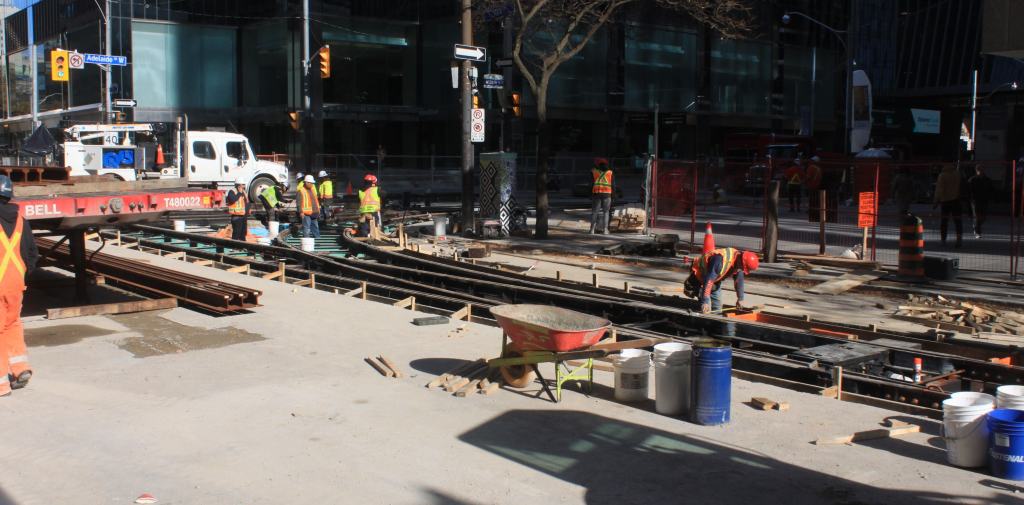
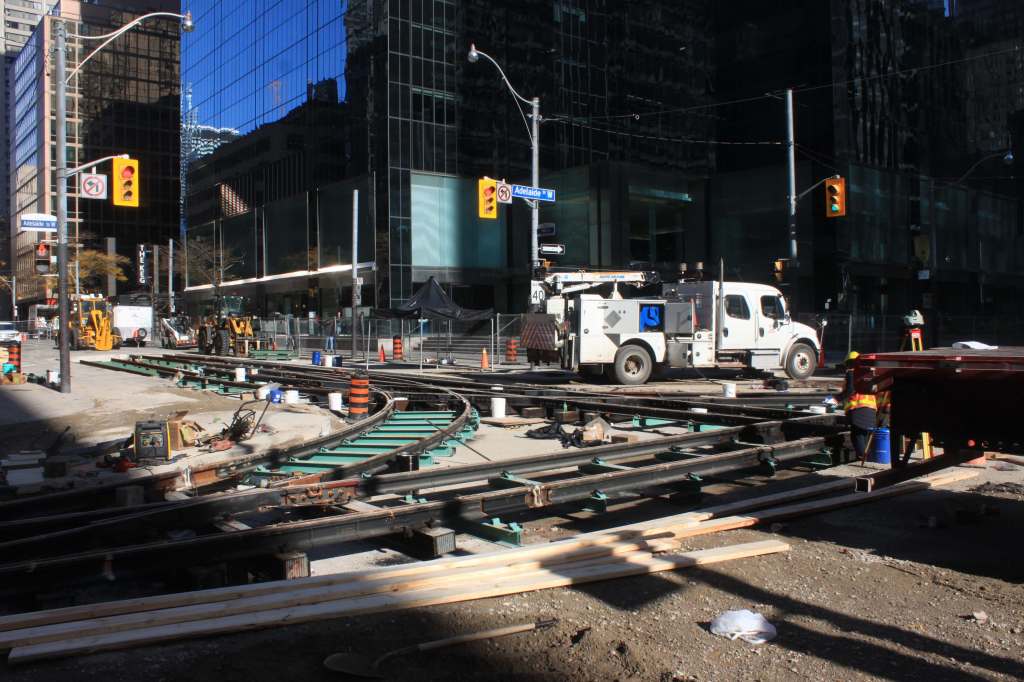
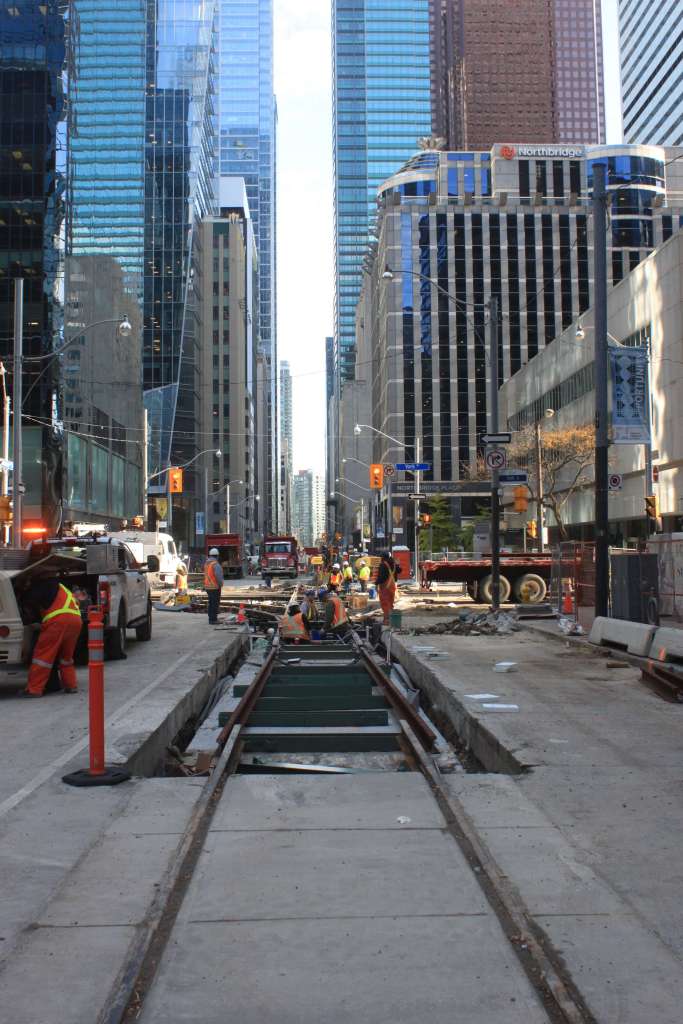
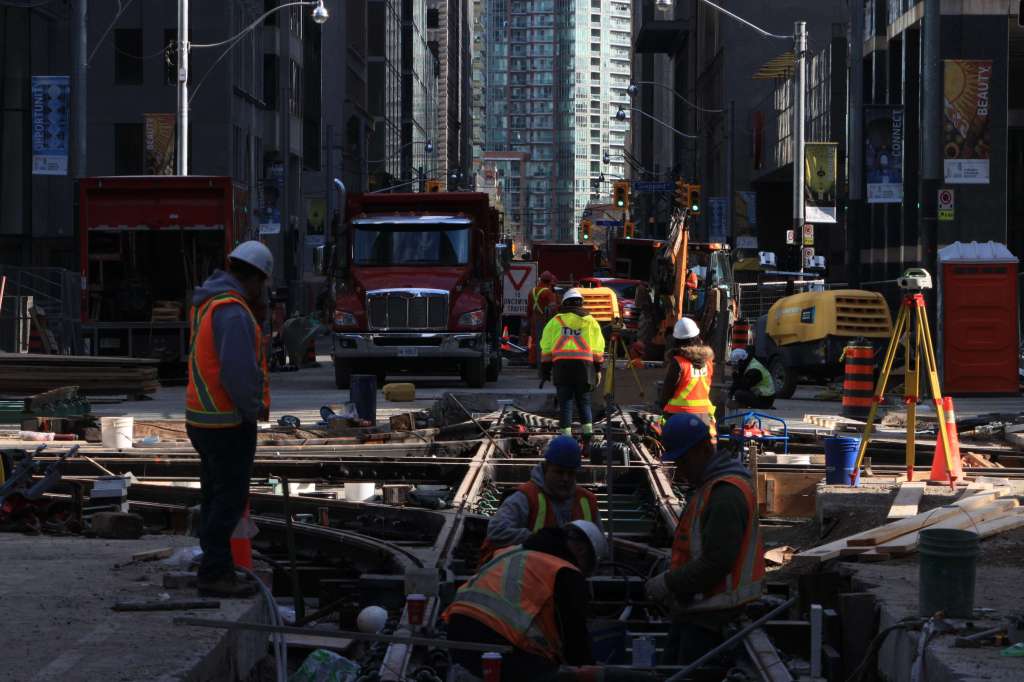
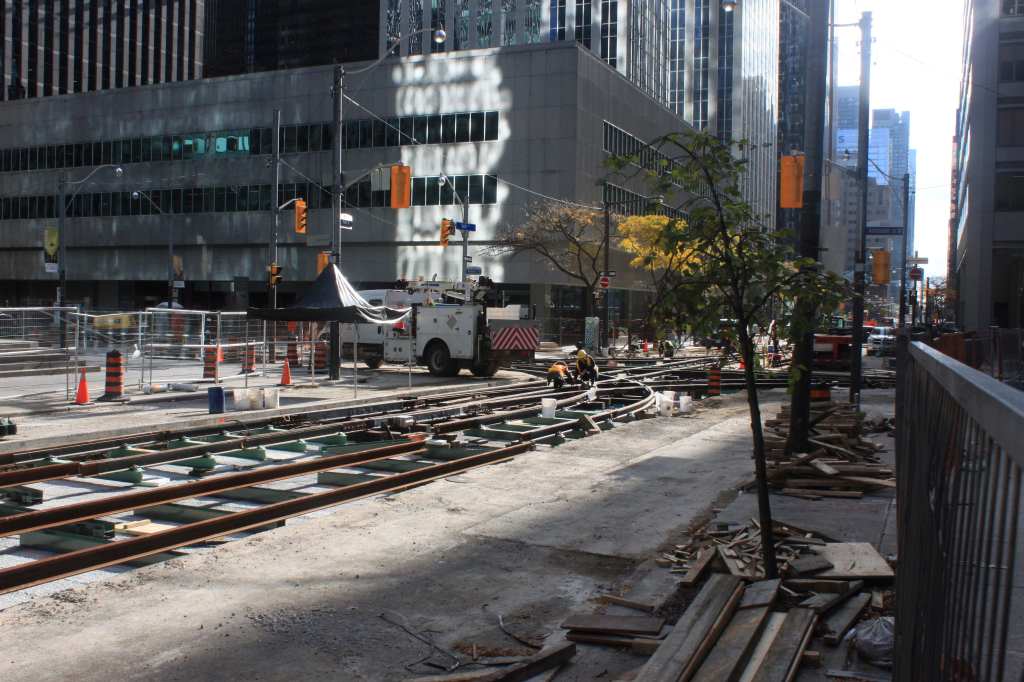
The intersection of Adelaide & York is taking shape with special work installation for the 501 Queen Ontario Line diversion.
Curves have been installed:
South to east for the 501 diversion.
North to east.
East to north.
Of these three, the north to east is net new compared with the track layout half a century ago as shown by a map drawn by John F. Bromley and hosted on the Transit Toronto website.
Here are my photos of the work in progress on November 10, 2023. (Yes, dear readers, I made a point of visiting when the sun was aligned with the downtown office canyons.)
Looking NE from YorkLooking NE across AdelaideLooking E on AdelaideLooking E on AdelaideLooking SE from York
Still to come is the installation of tangent track southbound from Queen to Adelaide, and the provision of an east to south curve at York and Queen. York Street will become two-way from Queen to Adelaide after its long era of one-way northbound operation implemented when the Gardiner Expressway opened.
Updated January 14, 2024: The TTC has implemented auto-forwarding of URLs that point to the azureedge site to cdn.ttc.ca. Links to azureedge should now work properly. However, links to reports created on the old TTC site will fail because the URLs have completely changed and auto-forwarding is not possible.
Across various sites including this one, the City of Toronto, and the TTC’s own site, there are many links to reports on the TTC site.
The last time the TTC reorganized its site, the URL for all reports changed to a complex string that began with:
ttc-cdn.azureedge.net/
This has now changed to
cdn.ttc.ca/
If you click a link and it fails on a “server not found” error for “azureedge.net”, you will have to manually change the URL to the correct server name. (Do this carefully so as not to disturb the rest of the very long URL for reports on the site.)
At least the remainder of the URL still works. The last time the TTC revised its site, complete file names changed and finding reports required tracking down their revised locations. This also broke all of the results from search engines.
The TTC appears to have updated links within its own site, but not within files such as Board reports that refer to each other. This is a recent change. Reports within the September 26, 2023 Board meeting agenda include links to the old server name and these fail.
Why this was implemented without an auto-redirect from the old name to the new one is a mystery. This is yet another example of a change that makes the TTC’s site less useable. This is not just a question for a blogger like me who routinely links TTC reports, but for all agencies including the TTC and City who embed links to TTC reports in their documents.
I have sent a query to the TTC asking if this problem will be fixed, and will update this article when I hear back.
This is the final article in a series reviewing the effects of diversions around various construction and road repair project downtown during the month of October 2023, and especially the period from October 18 to 25.
In the third installment, I look at the effect of the route changes and congestion on the quality of service on affected major routes: 501 Queen, 503 Kingston Road and 504 King.
Service was badly disrupted not just downtown, but on other parts of these routes which already suffered from erratic headways (the interval between vehicles) in “normal” TTC operations. A major problem with TTC service quality reporting is that it does not consider the fine-grained detail, and yet that is the level at which riders experience the system.
“Congestion” is something the City talks about in the abstract, but does not really address especially in acknowledging that some roads are full.
There are many detailed charts in this article, more than I would usually publish. They show how the view of data changes as one moves down from broad averages to specifics, and how seriously unreliable service was on routes affected by the sinkhole diversion even without that extra layer of problems.
Equally importantly, these charts show that problems are not occasional, but a chronic feature of TTC operations.
Data here goes only to the end of October, although the effects of the diversion carried over into early November. Even after service returned to “normal”, regular congestion effects remained on parts of King Street showing the underlying issue that was compounded by the diversion and its delays. I will turn to that in early December when I have all of November’s data.
From October 19 until early November, there was a major disruption of transit service downtown due to concurrent construction activities and the complete absence of transit priority or traffic management.
A sinkhole of King east of Jarvis blocked all streetcar service from the afternoon of Wednesday, October 18 to Tuesday, October 24. From October 25 onward, streetcars diverted only weekdays until 7pm.
Construction on Adelaide Street for the Ontario Line 501 Queen eastbound diversion track continued including the relocation of several underground chambers. This work closed York Street northbound at Adelaide.
Construction on Queen Street at Yonge for the Ontario Line closed that street from James to Victoria.
This event showed what can happen when a transit service and the streets it runs on are nearing the point of gridlock, and are pushed over the edge by loss of capacity. It also showed, quite starkly, how Toronto’s talk of managing congestion is much more talk than action.
This is a vital lesson in planning for future diversions and special events.
An important issue here is that some of the congestion problems pre-dated the sinkhole. Moreover, congestion did not occur in the same time at all locations, and some of it did not correspond to traditional ideas of peak periods.
The volume of turning movements overloaded the capacity of the intersections to handle transit, road and pedestrian traffic. A detailed list appears later in the article.
Streetcars and buses stop to serve passengers at many intersections, a fact of life for transit vehicles which behave differently from other traffic. Often two traffic signal phases would be consumed per vehicle: one for it to pull up to the stop, and one for it to make the turn. This limited the throughput of some intersections to fewer cars/hour than the combined scheduled service of the routes.
The electric switch southbound at King and Church was unreliable, and operators had to manually throw it so 501 Queen cars could go straight south to Wellington while other cars turned west on King. On its own, this would be an annoyance, but it compounded other delays.
Only 501 Queen ran on its scheduled route looping south on Church to Wellington, then west to York, north to King and east to Church. During some periods, the congestion was so great that the 501 Queen service was redirected from the Don Bridge westward via King to Distillery Loop. Off-route operation plays havoc with trip prediction apps adding to riders’ woes in finding when and where the service they needed would be.
In this article, I review the vehicle tracking data and travel times over the route from Queen and Parliament, west to Church, south to King and west to Peter (east of Spadina) using the 503 Kingston Road car as the primary subject. This was the only route that travelled the full length of the area during the diversion. Some cars did short turn, but most operated west to Charlotte Loop (King, Spadina, Adelaide, Charlotte) and they give a good representation of travel times experienced by all routes.
In the third and final part of this series, I will review the effect the delays downtown had on service of the three streetcar routes. This type of event has effects far from where it occurs, and these are not always acknowledged. A related problem is the inherent irregularity of TTC service even without a major diversion and congestion added to the mix.
After the break, there are a lot of charts for people who like that sort of thing, but there is also a summary for those who want the highlights.
Sunday, October 29 saw streetcars return west of Sunnyside Loop after a long absence during many construction projects. Service operates as far as Humber Loop on route 501, but with rush hour 508 Lake Shore trippers to Long Branch. The 507 Long Branch car will return on Sunday, November 19 at the next schedule change running between Humber and Long Branch Loops. Late evening service will run through with 501 Long Branch cars.
Here is a gallery of photos taken on November 3 and 5 of the restored operation.
While it is heartwarming to see streetcars back on a right-of-way that dates to the 1950s, the operation is hampered by the TTC’s fetish for caution with stop-and-proceed rules at all facing point switches (four between Queen & Roncesvalles and Sunnyside Loop, and even at the Humber Loop tail track), and at all intersecting roads. The concept of “transit priority” is diluted almost to vanishing.
Humber Loop looking W at the tail track entranceHumber Loop looking W with Queen cars and the 66 Prince Edward busLooking E on the approach to the Humber River bridgeLooking NW at The Queensway and EllisLooking SW at The Queensway and EllisLooking E across Ellis on The QueenswayEastbound car on The Queensway at Grenadier PondWestbound car on The Queensway at Grenadier PondLooking W from Parkside Drive on The QueenswayLooking E from Parkside Drive on The Queensway
Work on the Waterfront East LRT crept forward with the approval by Toronto’s Executive Committee of funding to continue design work, and of a tentative project plan. This must be endorsed by Council at its meeting of November 8-10, 2023.
Updated: Shortly after this article was published, the City of Toronto replied to questions I had posed about their report. The replies are integrated with the text of the article.
A combination of several factors push the completion date of this project, assuming that it receives full funding from provincial and/or federal sources, out into the 2030s. There is a danger that a so-called transit first community will actually see much of its redevelopment occur before adequate transit is in place to support it. Conversely, absent the transit service, some planned projects may simply sit as empty lots because they are not viable without it.
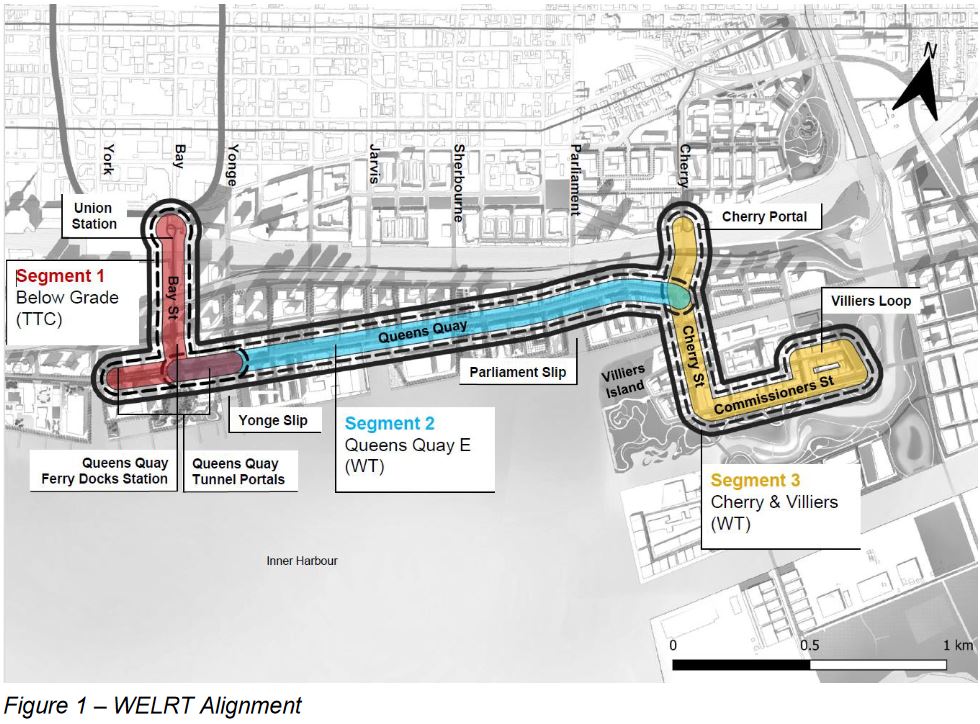
Segment 1 (red) contains the Bay Street tunnel and the portals at Queens Quay where streetcars will surface. The existing west portal will be renovated and the new east portal added. Plans for decorative canopies have been dropped from the plan as a cost saving measure. This segment is under the TTC’s control for design and construction.
Segment 2 (blue) consists of the surface running on Queens Quay East to a revised intersection at Cherry Street which is realigned to the west. This segment primarily involved the reconfiguration of Queens Quay East similar to what already exists on Queens Quay West. (For details please refer to previous articles.)
Segment 3 (yellow) includes the southerly extension of trackage from Distillery Loop under the GO corridor, along a realigned Cherry Street, and east on Commissioners St to Villiers Loop (which is actually an around-the-block terminus, not an off street loop).
There are impediments to the work on segments 1 and 3 that dictate the timing of various works. The many delays in actually launching the WELRT project put other works in the same area in conflict that might otherwise be avoided notably the Ontario Line and the Gardiner/DVP realignment. The Bay Street tunnel has become more complex due to updated fire codes and the need to serve many more passengers than the Union Station Loop does today. Still outstanding is the redesign and expansion of Queens Quay Station and a link to the Island Ferry Docks which has been dropped from the project, as of the last update in April 2023.
The recommendations approved by Executive Committee are that:
Council approve the alignment shown in the report.
Council approve advancing design for the entire project, except segment 1 (underground), to 60%.
Council approve
completion of environmental approvals,
undertaking of a traffic management plan to address interfacing the WELRT an other projects’ construction, and
design and coordination of the scope for the WELRT at the Cherry Lake Shore realignment, the Inner Harbour Tunnel at Jarvis, and the Hydro One relocation project at Cherry Portal.
Council authorize an increase to the Transit Expansion Division’s Capital plan of $63.6 million in 2024-2026.
Council direct the Executive Director of the Transit Expansion Division to report back at some point, unspecified, in 2024 with an update.
The estimated cost of the full project is $2.57 billion over a ten-year period assuming that full funding comes in Q1 2024, and the design work proposed in this report starts immediately. Any delay is a notable concern in an era when construction material and labour costs are rising quickly. It is not clear whether the figure cited is in current 2023 dollars, or includes inflation to the point the money is actually spent. I await clarification on this from the City.
Updated: The City of Toronto advises that:
The City is using as-spent dollars with future escalation included to the anticipated year of the expenditure. The cost estimate relies upon timely funding to meet the implementation schedule which is used as the basis for these inflation numbers.
Email from City of Toronto Media Relations, Nov. 2/23
The reason that the underground segment is excluded from approved design in recommendation 2 above is that this segment is proposed to be executed with a design-build contract where the detailed design will be undertaken by a contractor who is familiar with work in an underground environment.
Updated: This also keeps the design cost off of the City’s expenses for the moment. The City of Toronto advises that:
As noted in the staff report, staff are not recommending advancing the design of Segment 1 to 60% due to the City’s current financial pressures.
Email from City of Toronto Media Relations, Nov. 2/23
The project is subdivided into three parts:
Union Station Loop, $932 million.
Remainder of project except Cherry North, $1.3 billion. Includes East and West portals on Queens Quay, Queens Quay Station, Yonge Slip infill, Queens Quay East track from Bay to Cherry, Cherry Street south, Commissioners Street and Villiers Loop.
Cherry North connection to Distillery District, $337 million, to be completed as a separate future phase.
The scope of work planned at Queens Quay Station is unclear because at the last update, much of this work had been dropped (platform expansion, link to adjacent building, link to ferry docks). I have asked the City for clarification of this.
Updated: The City of Toronto advises that:
The current scope for Queens Quay Ferry Docks Station is related to the station access upgrades (upgrade of the west entrance to improve accessibility) and it is part of the Segment 1 scope.
Email from City of Toronto Media Relations, Nov. 2/23
For the benefit of latecomers to the Waterfront East project, I have included a history at the end of the article. The idea goes back at least to the 2003 Central Waterfront Plan, and has languished without strong political support ever since the Ford era when all focus shifted to subways.
The greatest challenge was and remains that waterfront transit is not “important enough” to many on Council and lacked key leadership from the Mayor’s office through the John Tory era. Under Mayor Chow, it will compete with many other projects for priority and funding both for transit and in the wider context of City projects.
Three decades after the Central Waterfront Plan and a 2011 target opening date, we might still not have good service to our “transit first” neighbourhood by 2032.








 Steve Munro