
Today’s Star has an article by this title, except there’s no question mark. The question of property development on TTC lands comes up from time to time with an unfortunate feeling that a “gold rush” is just around the corner. The TTC could do everything we want if only it would develop its surplus property. Continue reading
Author: Steve
Always A Car In Sight (2)
Not long ago, I wrote about the changing level of service on the streetcar system over the past 50 years in Always A Car In Sight. Just to recap, my intentions were threefold:
- Show how much service was actually operated and how many people a network of streetcar lines could carry. If this could be done in mixed traffic, then it certainly could be achieved with some form of reserved right-of-way.
- Document the changing service levels especially since 1980 first as the TTC saw the heavy streetcar routes as an easy place to save money, and later where service levels threaten the attractiveness of transit service.
- Demonstrate why the Bloor-Danforth subway is so different from current and recent subway schemes by virtue of the very heavy, established ridership in the corridor the Bloor line serves.
This produced a number of comments as you can see in the post, but a few other points have come up here and in other threads. Continue reading
Greetings for 2007
Here we are on New Year’s Day, although as I write this the effects of a wonderful dinner and bubbly wine (not the genuine article, but bubbly all the same) are limiting my ability to write long complex posts.
I just wanted to wish all of my readers the best for 2007 with the hope that those of you who are in a position to improve transit in Toronto and the GTA will actually do so. Let’s not wind up a year from now staring at the same problems and wondering how the TTC and the City are ever going to solve them.
Transit can be better if only we will give it the political and financial priority it deserves.
New Streetcars Sooner, Not Later? (Updated)
[This item has been updated to correct some typos, and to add a concluding paragraph that I forgot to put in before publishing it.]
Yesterday’s Toronto Sun reported that a proposal for 100 of the CLRVs to be refurbished by Bombardier’s Thunder Bay plant is on hold. Some history is needed to put this in context.
For quite some time, the TTC has looked at new or refurbished streetcars. New cars always seemed to have an astronomical price tag, but refurbishing was neither cheap nor a long-term option.
Any price quoted for a new streetcar, commonly $3- to $5-million per vehicle, provoked sticker shock. Oddly, nobody ever mentioned the size of the vehicles in this discussion. Given the TTC’s long anti-streetcar history (now mellowed to grudgingly accept that there is a place for LRT), the suspicious among us might think that this was a deliberate strategy to make streetcars look prohibitively expensive.
Current talk is for a $3-million car that will be larger even than an ALRV or subway car, and that’s not a bad price for a vehicle of that size (more about service impacts later). If we can actually get new cars for that price, the comparison against a $1-million CLRV retrofit doesn’t look so bad (almost twice the car and at least double the lifespan for about three times the money). Continue reading
David Soknacki’s Valediction
In today’s Globe and Mail, Jeff Gray brings us farewell musings by the former City Budget Chief, ex-Councillor David Soknacki. It starts off with comments about the TTC’s unwillingness to market itself, but goes on to meatier issues of property development, splitting up the TTC and private sector involvement.
First off, a few comments about marketing. Many have written about the TTC’s lacklustre graphics and the fact that such hits as the subway station buttons and the Warm Soupy Butt subway map were not exactly a TTC invention. But pace my friends over at spacing, we are not going to solve the TTC’s problems with a trinkets for the tourists.
What the buttons and the TTC’s heavyhanded response to the anagram map show us is an organization that has no sense of humour, and certainly little pride in the system. Paranoia about copyright infringement takes priority over a celebration of a hilarious adaptation of the subway map. We see a hypersensitive organization that knows the days of sparkling clean stations and vehicles, of good service marvelled at by other cities, are decades in the past.
So what would our former Budget Chief do about this? Continue reading
Always A Car In Sight
That, believe it or not, used to be the TTC’s slogan years ago when transit service was a far more important part of the life of Toronto than it is today. Three love affairs have brought us to where we are now:
- The automobile
- The subway which moves huge numbers of people provided they’re going where one was built
- Tax cuts and changes in public spending priorities
From time to time, people ask me both about how service has declined and about the practical limits on streetcar service. I am not going to pretend that the answer to our problems is to build streetcar lines running in mixed traffic everywhere. For one thing, there’s a lot more of that “mixed traffic” than there used to be. But it’s interesting to see what streetcars were doing even well into the “modern” automotive era. Continue reading
A Wakeup Call for Chairman Adam
Ed Drass has an excellent column in Metro for Thursday, December 21 (here) in which he describes a recent visit with Adam Giambrone, TTC Chair, to Finch Station. The site is a catalog of what many TTC stations look like and the lacklustre attitude the organization takes to passenger information and convenience.
Like so many TTC stations, Finch seems as if under a permanent state of construction. Ceiling slats are missing everywhere. Temporary and handwritten signs adorn walls, windows and collector booths. Wooden hoarding closes off a major portion of a corridor heading to the buses, but there are no signs describing what is going on.
I have a blunt message for Chairman Adam: This state of affairs has nothing to do with traffic congestion. It has little to do with whether or not additional funds come from Queen’s Park or Ottawa. It is an indictment of sloppy project management and an inability to see beyond the limits of each job to how it affects the passengers’ experience.
That’s the sort of message we send to customers. It doesn’t take a complicated traffic study or an EA or millions of dollars worth of consultants to fix this. Even Howard Moscoe’s proposed “Station Managers” would be ineffective if they are little more than glorified greeters with no power to change a well-entrenched corporate culture.
It’s astounding that we have a system paying millions for an automated stop announcement system, but they can’t put up and properly maintain signs telling people what’s going on in a construction zone, or take down signs announcing service diversions that finished months ago.
I’ve seen occasional annoncements about subway service problems running along the bottom of the subway advertising monitors. Great if you’re on the platform near a sign. Useless otherwise.
Maybe if we figured out a way to build a multi-million-dollar automated station signage project, the TTC might be interested, but only if Ottawa would pay for it. Meanwhile, let’s get out those magic markers and practice really neat printing.
Going, Going, Gone
I received the following note from a reader here, and this prompted me to dive into the archives.
Hi Steve,
Do you know if the old TTC tokens have been redesigned since the 1950s? I have a token that looks completely different from any of the tokens currently in use (with the TTC coat of arms etc; not the bimetallic ones). It simply says “Toronto Transit Commission” around the edge and the word “Subway” across the middle. Could this be a very old token or is it a fake?
Thanks,
Arthur
This is an older type of token. The illustration below (click to open the larger version) contains three token holders of various vintages in the form that tokens were then sold. There are both the 6/$1 and 5/$1 version dating from the late 1960s, as well as a single token holder that was a complimentary “first day cover” for the Bloor-Danforth subway. Note that this last one is a brass token, the format used for single-token sales.
If you look at the regular tokens, you will see that they match the one you have.

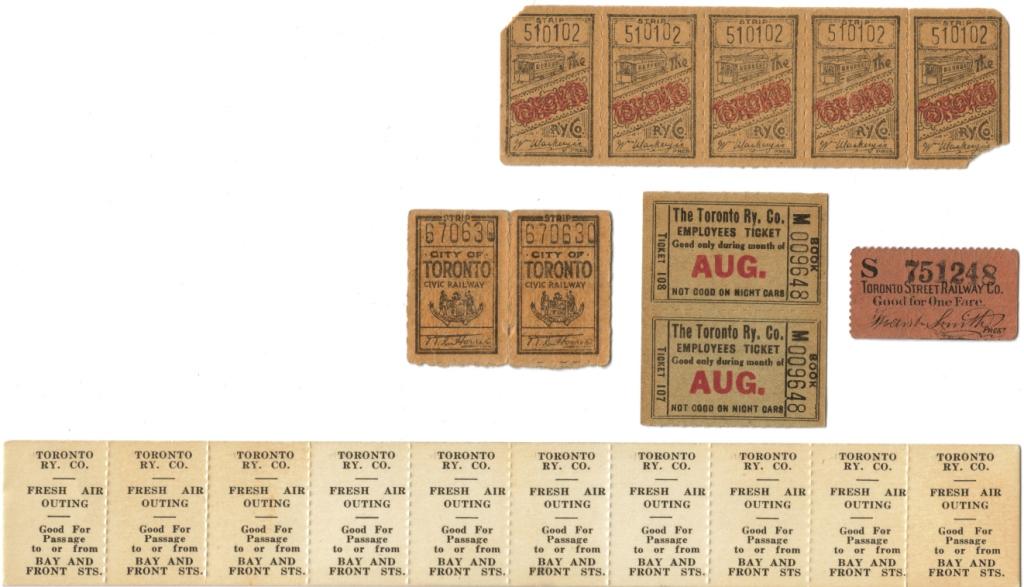
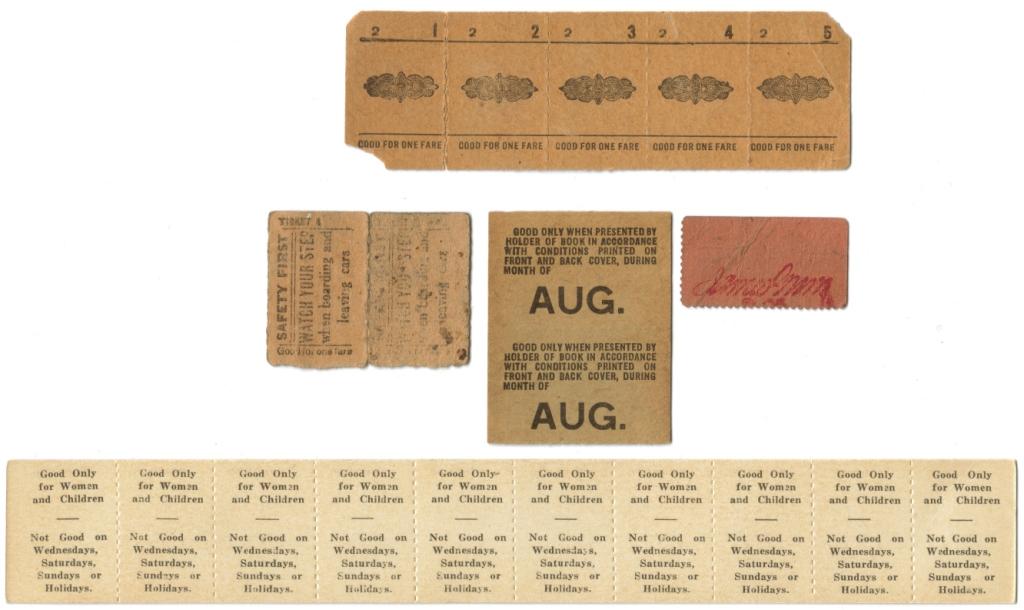
Why stop at 1966, I thought. Let’s go back a bit further. The next pair of images are front and back scans of some pre-TTC fare media.
The red ticket is from the Toronto Street Railway. The TSR was replaced by the Toronto Railway Company in 1891, and by 1911 when the TRC refused to extend its network, the city set up its own company, the Toronto Civic Railway. These two, plus other bits and pieces, merged into the TTC in 1921.
The TRC tickets are interesting for a number of reasons. First is the little picture of the electric trolley car. The TRC was granted its franchise with the express purpose of electrifying the street railway, and so an electric car was central to their purpose. Next, you will see that there were special tickets for employees that had restrictions on time of use. Finally, there is the strip of Ferry Service tickets good only for women and children travelling to the docks (note that the service did not yet cross south of the railway corridor, and the destination is Bay and Front).
The Subway Diversion Map
For those of you who collect variants on the subway map, here is the version that was published as part of the report to the Commission last week.
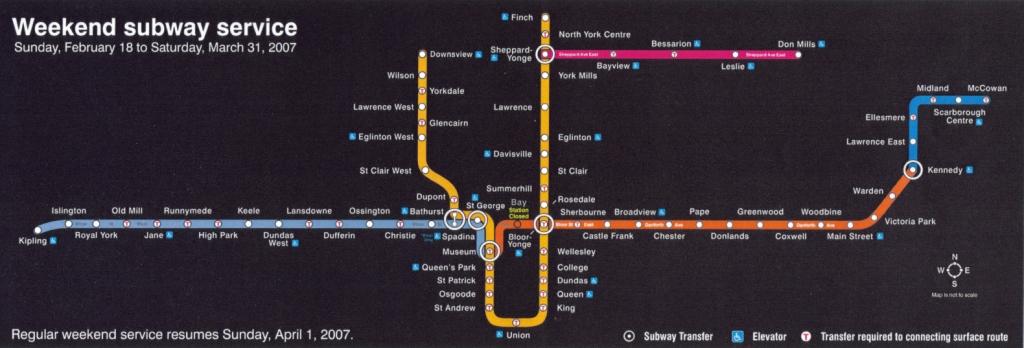
Many people seem to come to this page innocently looking for the real subway map. It can be found on the TTC’s website.
Service For January 2007
January 2007 does not bring much in service changes beyond the return of streetcars to St. Clair west of the Spadina Subway. Buses will continue to run east to Yonge Street until, it is hoped, the middle of February.
The RT will continue to operate with buses on Sundays to allow testing of the new RT signal system. As a regular user of this line, I am looking forward to it actually working on those cold mid-winter days (which surely will be here eventually) when the old system regularly froze up.
There are several minor changes in running times and a few added trips here and there, but nothing major in improved service. Current expectations are that we won’t see anything significant until the fall when sufficient operators, buses, and budget headroom will, in theory, be available.
Meanwhile, the list of services that should be improved or operated, but are not due to funding and other constraints, continues to grow. Continue reading
 Steve Munro