Waterfront East LRT: Will This Ship Ever Sail? (Updated)

Updated September 4, 2012:

The full set of Waterfront Toronto reports and the City Manager’s recommendations arising from them are now available in the Executive Committee Agenda for September 10.

I will not attempt to summarize all of the material in these, but a few critical points deserve mention.

  • Although the revitalization of the mouth of the Don River is a central theme in this entire project, and illustrations showing the effect abound in the reports and publicity, in fact this work has been relegated beyond the 30-year timeframe of the financial projections.  The river mouth changes are in “phase 4” which is beyond the 30-year line.
  • Similarly, transit improvements to the area beyond the level of bus service, possibly but not necessarily as BRT with dedicated rights-of-way, are pushed off to phase 3 and beyond.  Transit is now described as “demand led” rather than the “transit first” policy around which much of the East Bayfront and Port Lands were being planned.
  • The connection to Cherry Street under the rail corridor is not even costed in the report and lies off in the vague future.

The fundamental problem for Waterfront Toronto and for the City is that the economics of a self-financing project simply do not work.  In the City Manager’s report, some shuffling of components allows the scheme to show a “profit” in the short term, the first decade, by the expedient of delaying or dropping expenditures to future years.

The City Manager’s Report shows the evolution of the costing model.  The first cut (page 4) used conservative assumptions and produced a net cost of $189.2m for the first 30 years.  This was reworked (page 5) with more generous assumptions to achieve a positive cash flow in the first decade, and a reduced net cost of $118m over 30 years.  Note that the tables are clearly titled “phases 1 and 2” and therefore omit costs associated with the river mouth and with the upgrade of transit services to LRT.

As someone who has been involved in many of the public discussions of these plans, I am deeply disappointed on three counts:

  • The shift of “phase 3” beyond the 30-year line was not made clear by Waterfront Toronto in its recent public meetings.  This verges on dishonesty from an organization previously well-known for plain dealing with the public.
  • The idea that Toronto would pre-build a good network of transit lines into the waterfront districts has been abandoned, and we are back to the standard TTC approach of running a bus, now and then, once a few people start to complain about service.
  • The myth that private sector development will somehow relieve the City (or other levels of government) from funding the Port Lands revitalization is exposed for what it is.  If Toronto wants to reinvigorate this huge tract of land, it will have to invest money in the process.  This issue — how to actually pay for the waterfront and what staging strategies could be taken — is completely absent.  Council is asked to approve the proposed scheme without knowing what alternatives might be available or what financing strategies would be needed to achieve them.

Building new neighbourhoods of this scale requires major investment in infrastructure and in the operating cost of providing services.  If Toronto is not prepared to pay these costs, then the Port Lands will sit empty for a long time.  Someone may propose they be rescued with a special project such as an Olympic Games or a World’s Fair.  That’s wishful thinking, and simply playing the slots at a race track may prove a better investment.  We cannot make the future of the waterfront dependent on the world’s desire to let us put on a big party.

The original article from August 12 follows the break …

Continue reading

How Network Structure Matters — The Birth of the Grid in Toronto

Robert Wightman left an interesting comment that begins by linking to Jarrett Walker’s piece on Portland’s 30th anniversary of their grid-based transit network.

Toronto’s grid is almost a half-century old.  With it we avoided having the 60’s growth turn into the rambling sort of suburban transit system found so often in the 905.  Here is Robert’s comment:

Jarrett Walker has an interesting article on his web site about the 30th anniversary of the grid in Portland. Next September is the 50th anniversary of the TTC’s implementation of the suburban grid system in the then OUTER REACHES OF Toronto. Before that date if you wanted to go from Lawrence and Warden TO DON MILLS  AND LAWRENCE you took a bus (Pharmacy IIRC) to Luttrell Loop, the Bloor car to Pape and the Don Mills Bus to Lawrence. After that date is was a straight 10 to 12 minute ride instead of a 90 minutes sightseeing tour of Scarborough, Toronto, Leaside and North York.

I will bet that are not many at the TTC who realize what a monumental effect that decision had on the growth of transit usage in Toronto, especially the suburbs. This anniversary should not be forgotten and the people who were responsible should be honoured, probably posthumously unfortunately. The foresight and courage of these people to take a major risk and change all the suburban bus routes to form a cross city grid is a major factor in the TTC’s current success.

I have PDF files of the early 1963 and late ’63 ride guides and the difference in coverage is amazing. What is also noticeable IIRC is that the Sheppard bus ran from Dufferin to Warden or Kennedy, the Finch bus from Dufferin to Leslie or Don Mills. Most of the outer 416 was still farmland.

Maybe Steve could start a new thread on this topic and anyone who has any relevant information could add to it. The TTC should also play up this anniversary as it was a major game changer in Toronto and the planning should be remembered.

The grid is, of course, absolute poison to those who believe a transit system’s job is to take them from their front door radially to the subway system.  Even with our grid, the network is still very subway-centric looking at service quality for anyone who wants to travel around the suburbs.

Service Changes Effective October 7, 2012

On Sunday, October 7, the TTC will improve service on many routes.  This is a continuation of the upgrades across the system made possible by Council’s allowing the TTC to spend unexpectedly high fare revenue on more service.

2012.10.07 Service Changes

This round of improvements begs an intriguing question.  These are improvements not driven by some Miller era ideology about improving transit service in the hope that more people will ride, but by the fact that ridership growth has pushed demand on many routes beyond the reduced service standards enacted by the Ford/Stintz administration.

A fundamental issue about cities with robust transit demand is that eventually you have to run more service.  We may make nips and tucks around the edges, but those pesky passengers just keep showing up at stops.

Will Council recognize this fact in the 2013 budget and allow the transit subsidy to grow, or will they cave in to the Ford ideology that no increase is the only acceptable policy?

Looking at the projected changes in average loads for many routes, it won’t take much more riding to bring them above the threshold for another service improvement.  This is not a one-time effect, and the TTC needs to produce a plan showing how it will deal with the growing demand on all of its network.

With the October schedules, the services on Queen will be back on their normal route except for the 502 Downtowner which will be extended from McCaul to Bathurst until mid-November pending completion of water main and track construction on McCaul.  The Spadina streetcar returns between Bloor and King in November, and to Queen’s Quay just before Christmas.

Service Changes Effective September 2, 2012 (Updated)

September 2012 will bring the restoration of “winter” service levels on routes across the system as well as many service improvements.  Most of these occur in the off-peak period thanks to constraints on the size of the fleet and of the operator workforce.

The bus fleet is constrained in the peak period by the many construction projects now underway.  These require either bus/streetcar substitutions, or additional vehicles on bus routes to deal with congestion.  Some of these will end as the fall progresses.

Updated August 26, 2012:

A fare policy experiment will begin on the 38 Highland Creek bus on September 1 and will run through until April 27, 2013.  Riders with GO fare media will be allowed to ride free between Rouge Hill GO Station and University of Toronto Scarborough Campus.

Summer Services

Seasonal services will end after Labour Day on the following routes:

  • 101 Downsview Park weekday service
  • 29 Dufferin to Princes Gates (the limited service that would remain will not operate to the CNE due to a construction diversion)
  • 30 Lambton service to High Park
  • 72B Pape service to Cherry Beach weekday daytimes and weekend evenings
  • 86 Scarborough to the Zoo (extended hours weekday evenings, weekend route extension)
  • 85 Sheppard East to the Zoo (extended hours weekends)

Rapid Transit Changes

The Yonge-University-Spadina subway will see improved midday service, and the transition between the AM peak and midday will be smoothed.

Running times on the Scarborough RT will be extended and headways will be widened.  This change is intended “to better reflect actual operation”.  How it will affect the SRT’s ability to actually operate all of its scheduled service (the target now is to operate at least 80% of planned trips) is a matter for conjecture.

Waterfront Changes

Service on 511 Bathurst will be cut from the summer levels, but will remain above the normal winter schedules to compensate for the construction on Queen’s Quay and on Spadina.

Service on the 509 Harbourfront bus will be cut slightly from summer levels.  However, all 509 buses will now operate to Exhibition and this will recover the time now wasted by many of them laying over in Spadina Loop.  Service west of Spadina will be greatly improved.

The 6 Bay bus will be restructured to provide somewhat improved service to the eastern waterfront and the new George Brown College campus.  In August, the Dundas branch of the route was extended south to Queen’s Quay.  Beginning in September, a new 6C Union to Queen’s Quay service will be added.

The combined service south of Front will see considerable improvement:

  • AM peak from 6’30” to 2’27”
  • Weekday midday from 12’00” to 6’40”
  • PM peak from 10’20” to 3’20”
  • Weekend afternoons from 15’00” to 7’30”

The 75 Sherbourne bus will also see improved service for the George Brown campus:

  • AM peak from 9’00” to 7’30”
  • Weekday midday from 12’00” to 9’00”
  • PM Peak from 10’00” to 8’30”
  • Saturday afternoon from 20’00” to 11’00”

Construction Route Changes

Dufferin street trackage will be rebuilt north from Dufferin Loop to Queen (skipping over the intersection at King) beginning in September.  The 29D Princes Gates service will divert to operate southbound via the “old” Dufferin routing of Peel and Gladstone to Queen, then east to Shaw, south to King, west to Mowat, south to Liberty, east to Fraser and north to King.  The northbound buses will follow the route via Shaw and Gladstone back to the regular route.

The temporary service arrangements for the routes operating on Queen Street will remain in effect with streetcars diverting between Broadview and Coxwell via Gerrard.

2012.09.02 Service Changes

Zero Percent Is Not Acceptable

Recent press coverage of the opening salvos in Toronto’s 2013 budget process tell us that the Budget Chief, Mike Del Grande, is trying for another year in which he, the Mayor and the City Manager dictate a zero percent increase in city funding to all agencies.  This is not playing well with some members of Council according to The Star, and with some luck this will extend to boards of agencies like the TTC.

The dynamics of Council have changed since the 2012 budget launch a year ago when the Mayor and City Manager issued a zero-percent edict and drove through cuts to many city services while claiming a massive, if fictional, deficit threatened the city’s integrity.  Trying for a repeat performance may play well as part of the already-in-progress 2014 election campaign, but such an attempt runs counter to the will of many on Council.  This is a delicate time for management at the City and its agencies like the TTC, and the leadership for a different world view must come from Council and the agency Boards.

This will not be as easy as holding a press conference to announce a $30-billion plan for a fairytale network of rapid transit lines that would be paid for through as-yet unknown future taxes and contributions from other governments.  This is the real world where the City and its agencies must raise real money from existing revenue streams today, must make decisions that will affect real service levels today, must be prepared to fight for policies that will deliver results today, not decades in the future.

The Operating Budget in Brief

The Operating Budget covers the day-to-day cost of running and maintaining the transit system.  Major repairs, new vehicles and infrastructure come out of the Capital Budget (about which more later).  Generally speaking, expenses and funding cannot be moved between the two budgets.

2012 Budget (Revised)        Operating     Wheel-Trans
                               ($m)          ($m)
Farebox & Other Revenues      1,069.9           5.3
Expenses                      1,444.0         100.2
Subsidy                         374.1          94.9

2012 Projected

Farebox & Other Revenues      1,076.6           5.3
Expenses                      1,447.4         101.4
Subsidy Required                370.8          96.1
Subsidy Available               374.1          94.9
"Surplus"                         3.3        (  1.2)

Source: CEO's Report for April 2012 (Published June 2012)

The projected figures are always different from the budget for various reasons.  The most common is that expenses never work out exactly as expected due to actual conditions including unexpected changes in major cost centres such as fuel and vehicle repairs.  Some details are in the CEO’s report (see compendium of links at the end of the article).  Revenue is affected by ridership, but can also be hurt or helped by fluctuations in advertising and rent revenues.  While these are small numbers in the larger budget scheme, all of the political debates about transit funding revolve around such small amounts and discuss service cuts or adds in millions of dollars.  A bad year for ad revenue coupled with a Council unwilling to backstop the loss with subsidies translates to worse service for riders.

The 2012 budgets were amended twice.  In June 2012, Council approved increasing the regular expense budget by $2.1m to provide additional service beginning this fall with funding to come from increased revenues.  Earlier, when the Commission was still dominated by Ford-friendly appointees, an attempt by Council to fund $5m in added service was thwarted by the Commission who diverted the funding to Wheel-Trans.

Continue reading

TTC To Order Artic Buses from Nova Bus

NOW magazine’s Ben Spurr reports that the TTC will award a contract to Nova Bus for 153 articulated buses.  The award is already shown on the TTC’s website with a date of August 2, and this will be confirmed by the Commission at its meeting on September 27.

Plans to buy artics have been in the works for a while at TTC, but this is a particularly large order, roughly the equivalent of two years’ of past bus purchases.  NOW lists many routes where these might run (the topic has been discussed in past reports to the Commission), and there are no surprises.

The critical point in any rollout will be the degree to which service capacity is actually increased.  For decades, riders on Bathurst and Queen streetcars have put up with wider headways (which are compounded by delays and short-turns) from the use of articulated streetcars.  The TTC bases service levels on the alleged demand and capacity of the route.  Demand that gives up and walks, cycles or drives isn’t counted.  Vehicles that never show up because of short turns, or which appear in a parade and run little-used, are of no benefit to riders but count toward the scheduled capacity.  TTC service standards were changed thanks to the Ford administration’s penny-pinching to stuff more people on routes that provide frequent service, and there is no sign this decision will be reversed.

With luck, by the time the new buses arrive, a more enlightened transit funding policy will be in place at Council, but until then, riders on major routes shouldn’t count on any improvement.

CLRVs Visit Boston

Back in 1980, the Urban Transportation Development Corporation (UTDC) had suffered the demise of their planned magnetic levitation train system in Toronto, and the “Intermediate Capacity Transit System” (ICTS) we know as the Scarborough RT had not yet been foisted on Toronto.

During a brief period when the only viable UTDC product was its new light rail vehicle, the CLRV, they shopped the design around to various systems.  The only taker they ever got was San Jose, California, for a small order.  Three CLRVs found their way to Boston for a demonstration, and I was lucky enough to catch them out on the Riverside line in May 1980.

A train of 4027 and 4029 prepares to leave Riverside Yard (the outer terminal of the line which includes a large parking lot and the carhouse/shops for the route.  A train led by Boeing car 3400 sits beside the CLRVs.  The overhead in Boston at this point was set up for operation by cars with either trolley poles (the remaining PCC fleet) or pantographs (the Boeing cars).

The CLRV train pulls out of the yard.

… and onto the main line.

The Riverside Line was build on an abandoned railway corridor, the Highland Branch, and opened in 1959.  A new connection into the existing central subway (a streetcar subway dating from 1897) was built to bring cars through downtown.

Here the CLRVs pass outbound through Reservoir Yard.  The larger part of this yard and an old carhouse are out of shot to the left, and they serve the Cleveland Circle line which terminates there.  Work cars in the yard include a PCC converted for use as a line car, and several “Type 3” passenger cars adapted as snow plows, essential equipment for a network with so much private right-of-way.

Outbound at Newton Centre station.

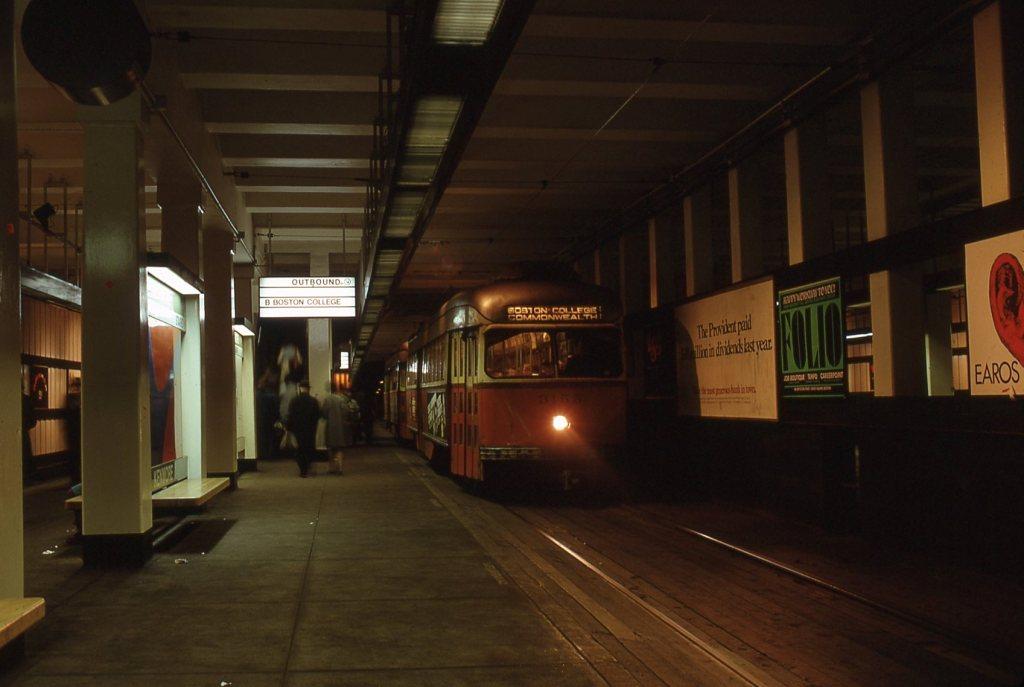
The shot below is from May 1972 at Kenmore Station which opened in 1932.  Readers with eagle eyes and long memories will recognize this shot which I loaned to the UTDC for inclusion in a brochure advocating the wonders of LRT which, at the time, the Ontario Government was actually pushing as a product, if not as a “solution” for Toronto.  It didn’t last long, and they went back to their old lies about how there was nothing to fill the gap, the missing link, between buses and subways — hence the need for an “intermediate” capacity system.

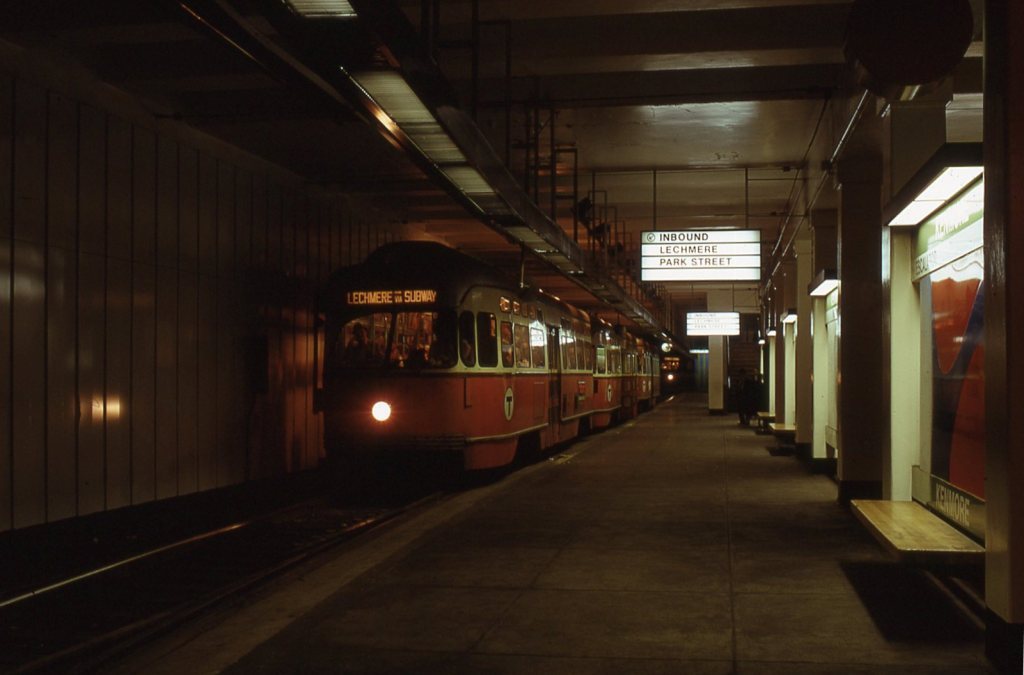
Kenmore Station is a busy place and has separate platforms for routes which diverge here.  Boston cars have doors on both sides so that they can serve island platforms like this.  Needless to say, the CLRVs served only stations with right-side platforms.  (The sign in the front window says “All stops except Kenmore” because the Riverside trains used the outside tracks at this station.)  Yes, that’s a three-car train of PCCs sitting at the platform.

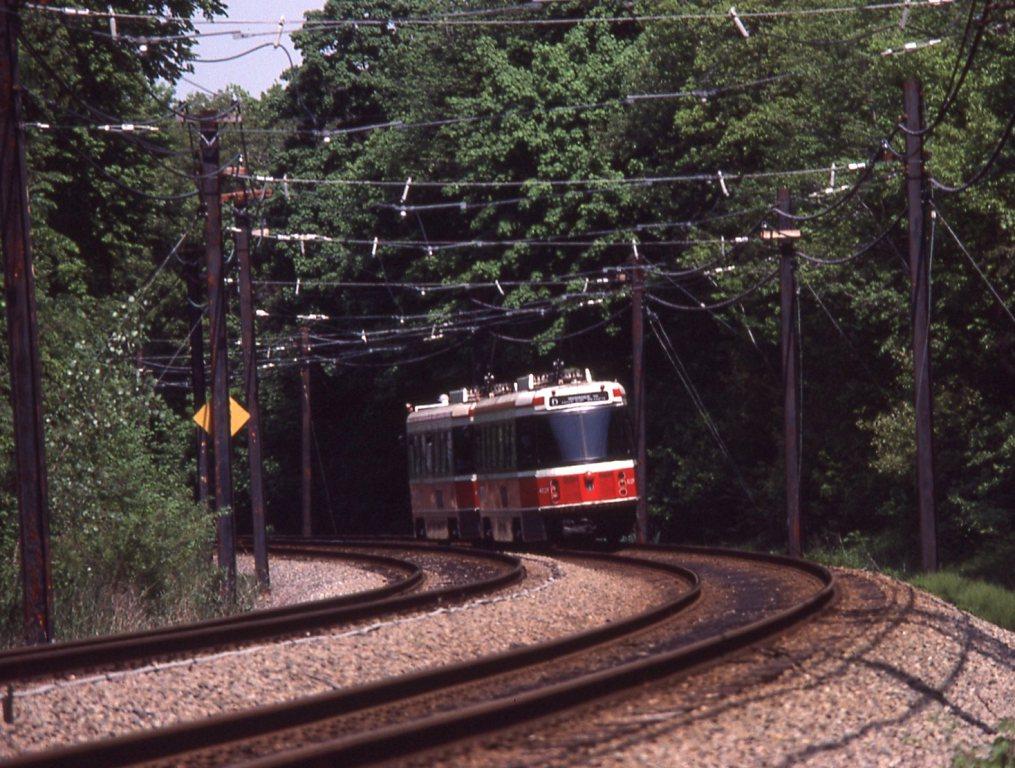
Finally, a look outward towards Riverside terminal (off to the left behind the trees in the distance)  in October 1968.  The small building on the right is an abandoned railway station.  This line could have been a model for the Scarborough RT, an implementation of “LRT” at the high end of what this technology can accomplish with almost complete grade separation, rapid transit station spacing, and speedy operation.  (Although the CLRVs are capable of 70mph operation — itself a design excess by the UTDC — they were limited to 50mph operation on the Highland Branch.)

By the time the SRT and its expensive ICTS opened at a cost more than double the original estimate for LRT, the Riverside line had been operating for 25 years.

Looking Back: Services to the CNE

With all the recent talk about Ontario Place, and with Exhibition season almost upon us, I thought this would be a good excuse for photos of streetcar services to the Ex.  Decades ago, the CNE raised much bigger crowds and there was a time it really was a showcase, an “exhibition”.  I remember when the “Better Living Centre” was brand new, and its intent was to give fairgoers a look at all that was new and exciting in household goods.  The Internet didn’t exist yet, and the phenomenon of the shopping mall full of goods manufactured anywhere but here was in its infancy.

The TTC ran many streetcar services into the Ex over the years, and parades of cars would leave the grounds following the evening fireworks.  (Transit Toronto has a short history of the CNE services on its website.)

The photos here have been chosen not just for the fact that cars might be operating on Exhibition routes, but also for interesting details about what is, or is not, still in the city today. Continue reading

How Can Transit Serve a Revived Ontario Place?

Today a Ministerial Advisory Committee headed by former Ontario PC leader John Tory released its analysis and recommendations for the future of Ontario Place.

For those readers who are not familiar with Toronto, Ontario Place is a park opened in 1971 with then-futuristic architecture on the shore of Lake Ontario west of downtown Toronto and immediately south of the Canadian National Exhibition grounds (now known as Exhibition Place).  Over the years, its attractiveness faded and much of the site was recently closed pending a review of its future.

Access to the site has always been a problem because the transit loops are at the north side of Exhibition Place over 600m from the entrance bridge to Ontario Place, provided that events within Exhibition Place itself do not block off a straight route south.  The recent Indy car races and the annual CNE itself are two good examples.

Forty years ago, the Ontario Government toyed with a magnetic levitation train under development by Krauss Maffei.  A trial installation of a one-way loop around the grounds was proposed, but all that was ever built was a few foundation slabs and pylons for the elevated guideway.  This project ran out of steam when the German government, a partner with KM, withdrew its funding.  Technical problems also arose, and a simplified version of the technology appeared roughly a decade later as the Scarborough RT replacing the originally proposed LRT line in that corridor.

Many years later, the Waterfront West LRT proposal included a route turning south (and underground) from current point of entry to Exhibition place, under Princes Boulevard (the main east west street in the park), and emerging into the land now occupied by the Ontario Place parking lot.  This scheme was strongly opposed by Ontario Place management who preferred to cater to motorists coming to their site rather than transit riders.

Within Transit City, there is also a Waterfront West LRT.  Its alignment through Exhibition place included various options differing mainly in whether the route followed the north or south side of the park.  Because the WWLRT was seen as an “express” route to southern Etobicoke (a dubious claim at the best of times), a southern route was seen as taking passengers “out of their way”.  Sadly, there has been no recent examination of transit to Exhibition Place as opposed to through it.

The Advisory Panel’s report includes a short section on transit to Ontario Place on pages 45 to 47.  This includes:

ONTARIO PLACE IS UNDERSERVED BY PUBLIC TRANSIT.  TTC streetcars and the GO Train do not go to Ontario Place. Streetcars go as far as Exhibition Place, and the commuter GO Train service provides access at the GO Exhibition station that is adjacent to the streetcar loop. The only mode of public transportation that goes directly to Ontario Place is the Dufferin Street bus — but this is only in the summer season.

Well, no, the Dufferin bus does not GO to Ontario Place per se, only to a loop along Princes Blvd provided that it is physically possible to operate buses on this route.  This service is infrequent presuming that it is not short-turned.  (Some of the Dufferin buses did run south to Ontario place in 2011, but this operation was dropped for 2012 because Ontario Place closed.)

The Advisory Panel recommends that parking for Ontario Place be provided in either a parking structure (under of above ground) or by Exhibition Place which has a vast amount of parking most of the year long.

Among the options proposed by the Panel are:

WE SEE A NUMBER OF OPTIONS TO IMPROVE THE ACCESS REQUIRED to generate the crowds Ontario Place needs to attract:

First extend Dufferin Street further south to provide direct bus access to the area and extend the streetcar loop from Exhibition Place.

Second, create more north south pedestrian and cycling paths.

Finally, bicycle storage and rental locations must grow — to encourage riders to bring their own bicycles, and to link to the growing network of bicycle rentals.

Notable by its absence is any mention of the implications improved north-south access through Exhibition Place will have for events that now take over the entire park.

This brings us to a recommendation:

RECOMMENDATION 18

Working with the PRIVATE SECTOR and PROVINCIAL and MUNICIPAL PARTNERS, Ontario Place should explore NEW PUBLIC TRANSIT OPPORTUNITIES to better access the western lakeshore area. [Caps are in the original text]

It is unclear what exactly is meant by a private sector role in “new public transit opportunities”.  The fundamental point in any transit scheme is that only with very high, sustained demand is there any hope for profitability and hence attractiveness of any scheme to the private sector.

Possibly Queen’s Park hopes to recycle the bits of infrastructure dating back to the Mag-Lev scheme, or hopes for someone to propose a monorail loop around the grounds as an alternative to extending the streetcar/LRT trackage.  This would impose a needless transfer for riders trying to reach any development on the south side of Exhibition Place.

Finally, Metrolinx has its own scheme to bring the “Don Mills / Downtown Relief Line” west from a proposed GO terminal at Bathurst Street into Exhibition Place.  If that’s a goal, and it will happen quickly (not very likely), then this will compete with other proposals that would be termed “short term”.

As with the eastern waterfront, planning for transit to the western waterfront has been a slipshod affair between the TTC, the City, Waterfront Toronto and Metrolinx.  If we are serious about redeveloping Ontario Place and the lands along Lake Shore Blvd., we must include good transit as an essential part of any plan.

Updated July 28:  The Globe & Mail weighs in with an article (the print version includes a large map).