More Metrolinx New Math (Updated)

Updated June 8, 2013 at 12:05pm:

Metrolinx has issued a correction via Twitter (where this discussion started) clarifying that, yes, it is person-years of employment, not jobs, that they are creating, and acknowledging that the graphics and tweets using them were “shortened”.

Anne Marie Aikins ‏@femwriter

… Report explains “person yrs of construction & LT employment” pg 30. Graphs/tweets shortened. Good reminder. Thx

[Anne Marie Aikins is a Media Relations Manager at Metrolinx]

That’s putting it mildly.  Someone did a calculation to figure out how many ACCs would be needed to hold all those people, and so clearly did not understand how the numbers should be used.  Someone put that chart in the Metrolinx report.  The report survived Board scrutiny without anyone, including their members from the banking sector, spotting the problem.

Ooops.

The original post from June 7 follows below.

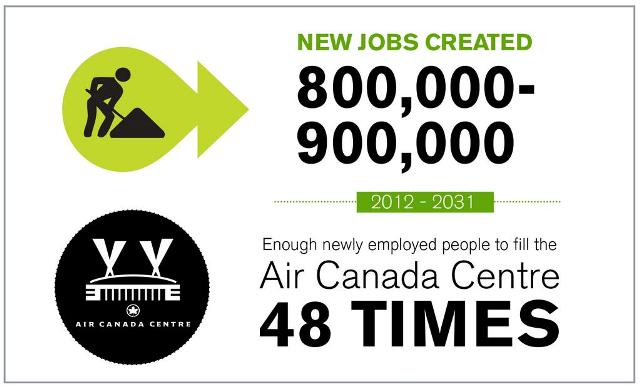
Metrolinx recently published a graphic purporting to show the employment effect of the Next Wave’s spending over twenty years.

MetrolinxNextWaveJobsWeb

These numbers are a complete fabrication and show how an organization more concerned with puffery than with accuracy can screw up basic arithmetic.

The statement here is that “enough newly employed people” would fill the ACC 48 times.  The official capacity of the ACC is 19,800, and so we’re talking about 950,400 newly employed people.  That’s roughly 1/3 of the entire population of Toronto.

The problem here is the confusion between employees and employee-years.  Metrolinx plans to raise $2b annually for twenty years.  Let’s assume that it will all be spent on job creation, not on getting more work from an existing pool of labour, nor on purchasing offshore technology such as rolling stock, control systems and managerial expertise.  We’re talking about design, engineering and construction, not the cheapest of professions and trades, and a reasonable average fully-burdened (including benefits) cost per job would be at least $80k.  (Governments have paid vastly more per new job on things like auto plants.)

The math is straightforward:  $2b/year divided by $80k gives 25,000.  If the entire amount goes to net new hires, then that’s 25k.  Do this every year for 20 years, and you produce 500k person-years of employment, but not 500k new hires.

There will be some multiplier effects in that an employed person has money to spend and that will find its way into the local economy.  How many new jobs will result is another matter.

We can look at this from the reverse angle: if there is $40b on the table, and it has to be shared among 800k new hires, then each of them will receive $50k.

In this, I have assumed that even the 25% of revenue dedicated to municipal projects creates jobs on the same basis as for the 75% allocated to the Next Wave.

Metrolinx has similar math challenges on commuting times when they routinely confuse avoided future congestion with actual savings.  Moreover, the claimed “saving” only occurs if the entire Big Move is built, something that appears vanishingly likely.  Because Metrolinx only ever discusses their fully-built scheme, we have no idea of how much “saving” will accrue for intermediate stages of the network, nor of the variation in benefits across the region.  This most basic of business analyses is totally missing, at least in any published Metrolinx papers.

Metrolinx really needs some remedial work on economic analysis and basic arithmetic.  Think about it: does it really take 1/3 of Toronto’s population to build a transit network? I have to repeat: the Metrolinx claim is not for job-years, but for newly employed people, nearly one million of them. That’s a basic reasonableness check anyone should be able to spot. How did such a claim even get out the door?

Howling errors like these job creation numbers undermine credibility not just of an incompetent agency but of the government who looks foolish for making claims they cannot possibly deliver.


What Does Subway Construction Cost?

An interesting article on the site Pedestrian Observations was recently linked on Twitter by Taras Grescoe (@grescoe), the author of Straphanger.  In Comparative Subway Construction Costs, Alon Levy attempts to bring together projects worldwide, adjust for currencies, inflation and other factors to derive comparable US$ values for subway construction.  The numbers are interesting in light of complaints about overpriced construction in Toronto.

The underlying problem, of course, is that no two projects are the same.  Varying proportions of underground construction, different soil/rock/water conditions, variations in station numbers/size/depth, not to mention rolling stock procurement and yard/maintenance facilities all affect the total cost and hence the cost/km.  Stir in political differences and the ease or difficulty with which projects are approved, and the number of variables is quite high.

All that said, Toronto’s costs are not wildly out of line.  This is not to say that they may not be excessive, but the cause could be our extended design and approval process and a preference for deep bore tunneling that drives up construction costs compared to shallower cut-and-cover.

The argument for LRT has always turned on the availability of a surface option where it is practical.  Whether we choose to exercise this in every possible case is another matter.

There are cases where underground construction is the only practical way to build a line, but that should not condemn Toronto to building only subways without looking at alternatives.

TTC’s Five Year Plan Reviewed

TTC CEO Andy Byford was hired by former chief Gary Webster to modernize management practices and provide focus to an organization that had lost its way.  Thanks to Webster’s ousting at the hands of the subway-loving, LRT-hating Mayor Ford, Byford unexpectedly found himself top dog.  After a year in Toronto, Byford released his five year corporate plan on May 29, 2013.

Those of use who follow the TTC closely have heard a lot about this plan as a centrepiece for the future of our transit system.  Byford’s talks at meetings around the city, most recently a Town Hall presented by Councillor Josh Matlow on the eve of the plan’s release, raised expectations for a major document, a fundamental shift in how the TTC would operate.  If this were a summer movie release, Byford’s appearances would be the equivalent of ever more tantalizing trailers and “sneak peeks” at what would come.

The plan’s release was something of an anti-climax — a press release via web and email, no additional information, no political feedback to indicate support.  The TTC board discussed the plan in its private session at their May 24 meeting, but made no public comment.  Internally, the plan was launched at staff meetings that will continue over coming weeks to reach throughout the 12,000-strong company.

Media attention is, to be generous, muted with the story completely submerged under the Ford follies at City Hall and the Metrolinx Investment Strategy.

Continue reading

TTC Meeting May 24, 2013 (Update 3)

The agenda for the TTC meeting on May 24 contains a few items of interest, but also a troubling sign that matters of public interest are being debated behind closed doors.

Items included in this preview:

Updated May 23 at 12:10 am:

Links to the TTC construction pages for the York Street, Ossington Avenue and Kingston Road reconstruction projects have been added.

A reference to a statement about the New Streetcar Implementation Plan attributed to Andy Byford at the April Commission meeting has been corrected to reflect that it was made by Chris Upfold, Chief Customer Officer, who was standing in for Byford at that meeting.  TTC’s Brad Ross has confirmed that this plan will be presented in the public session of the June Commission meeting.

Updated May 23 at 9:15 pm:

The Kingston Road construction project info has been updated to reflect the early replacement of streetcars by buses effective June 3.

Updated May 25 at 1:30 pm:

This article has been updated to reflect events at the Commission meeting.

Continue reading

Five Years, Seven Goals: Where Will The TTC Be In 2018

TTC CEO Andy Byford addressed the Empire Club on May 13, 2013 setting out a strong argument for political and financial support for the transit system (full text at the Torontoist site).  After last week’s debacle at Council where almost nobody took any sense of responsibility for the future of transit beyond their own doorsteps, arguing for the TTC is a hard battle.

On one hand, we have an intensely local debate at the ward, if not the neighbourhood level, with the worst of petulant “I-want-a-subway-too” politics.

On the other, the region and the province are preoccupied with funding a large-scale plan that happens to have a spin-off for local transit, but one that will only give Toronto a fraction of what it costs to run and maintain the TTC today, let alone make substantive improvements.

In some ways, the TTC has been its own worst enemy managing on one hand to alienate potential supporters with poor community relations, unreliable budgeting and declining service quality, but on the other managing to attract riders and be more financially “efficient” in spite of itself.  When political support for better funding and service is needed, the “success story” is that the TTC has managed to cram more riders into fewer buses and streetcars.

This is not a sustainable approach to transit.  Growth – which has come disproportionately in off-peak periods when there is still some capacity in parts of the system – cannot continue on this basis.

Byford will formally launch a Five Year Plan for the TTC in the week of May 27, 2013, but his speech gives a broad outline of his goals.  Are they enough, or is there too much concentration on the decor while the house rots around us?

Continue reading

Spadina Reconstruction News (Updated May 15, 2013)

Updated May 15, 2013 at 1:30 pm:

TTC CEO Andy Byford spoke at a meeting of the York Quay Neighbourhood Association yesterday evening and the status of transit service to Queens Quay was a major topic.  There appears to be some confusion among and within agencies about the date when service will return to Queens Quay on the 510 as a through route and as a streetcar.

The TTC Service Planning memo for the schedule period beginning June 23 says that the current operation is expected to last until the end of that period (late July).  However, Waterfront Toronto and Andy Byford himself speak of November or even December dates.  The TTC website has given June 2013 as a date for service resumption for quite some time, although this is to be corrected, presuming someone knows what the information should be.

Part of the confusion may arise from the fact that streetcar service will be suspended for reconstruction of the intersections at King and at Dundas and this will require bus replacement on the route.  Those buses will be able to run through to Queen’s Quay replacing the shuttle and so there will be “through” service, just not with streetcars.

I have asked the TTC for definitive information on the date for resumption of streetcar service to Queens Quay.

The Service Planning  memo also notes that a planned shutdown for reconstruction of the platform at Spadina Station Loop has been deferred to 2014.  One can only hope that this will include changes to allow two LFLRVs to serve the platform simultaneously for unloading and loading.

Continue reading

Irresponsible Madness at City Hall (Update 2)

Updated May 10, 2013 at 8:45 am:

A consolidated list of Council actions has been added to show the net effect of many overlapping motions and amendments.

Updated May 9, 2013 at 11:00 pm:

After an extremely long debate and complex voting process, the primary outcome of Council’s actions was:

  • “That City Council support the extension of the Bloor Danforth Subway Line from Kennedy Station to the Scarborough Town Centre and north to Sheppard Avenue.”
  • “That City Council request that the North York Relief Line (unfinished subway construction between Sheppard Avenue and Allen Road, and Yonge Street and Sheppard Avenue) be recognized as a substantive project priority for Phase 2 Metrolinx funding.”
  • That consideration of various other projects such as the Bloor West subway extension be referred to the Chief Planner for analysis and incorporation in the review of the Official Plan now in progress
  • That Council not support any of the proposed “revenue tools” to fund transit expansion or operations, but that if Queen’s Park chooses to implement some, Toronto wants its cut subject to a number of conditions.

The full minutes, for those with the heart to wade through them, are on the City’s website.

From a procedural viewpoint, Council merely offered “support” or a “request” for new subway lines, but did not actually ask that the Scarborough LRT be recast as a subway project.  Speaker Nunziata ruled that Council was not technically reopening the matter of its agreement with Queen’s Park, and therefore only a simple majority of votes was needed for motions regarding changes to the proposed network to pass.

Before the voting even began, Transportation Minister Glen Murray had told the Queen’s Park press gallery that the province was building the already agreed-to network and would not entertain a change to subway technology for the SRT replacement.  This did not deter Council from asking for the change anyhow, no doubt hoping that political winds at the Pink Palace will bring a change in policy.

This on the same day Transportation Minister Glen Murray emphasized that the province will not be giving Toronto a new subway extension in exchange for a deal on revenue streams to build transit. “I want to be very clear so no one misunderstands me: We have 15 projects, we’re not revisiting those projects, we’re continuing to build those projects,” he said. [The Globe And Mail, May 9, 2013]

Over half of the voting time, and a great deal of debate, was wasted on the question of which revenue tools, if any, Council would support.  The staff report recommended a few, but rejected most.  Rather than completely replacing this recommendation with a set of motions to adopt or reject each tool, Council wound up with a rat’s nest of overlapping and contradictory motions proposing new lists, and with some Councillors proposing amendments to others’ motions.  The effect at times was to create double and triple negatives in the effect of some votes rather than simply taking each tool/tax/fee in turn and voting up or down on whether Council supported it.

In the end, Council rejected all of them, a process that could have taken a lot less time with only a modicum of procedural leadership.

Toronto now faces a provincial government that will almost certainly ignore its requests and, in the short term, will proceed with the agreed plan (which Council did not attempt to revoke).

For their parts, Metrolinx and the TTC owe everyone a much more detailed statement of the cost implications of the LRT and subway options to inform any decision to take one or the other path.  Whether we will actually get this, given the vested interests in the fog of misinformation hanging over Council’s debate and Metrolinx planning, is another question.

Update 2 – Decisions taken by Council:

In this section, I have attempted to collect related motions together so that the overall intent of Council (assuming such a thing exists) is clear.  Where an action is included in quotation marks, this is a direct quote from the Council motion.

Council did not explicitly name Sales Taxes or Development Charges in the list of revenue tools it supported.  This has been construed by some Councillors as a backhanded endorsement by omission.  However, a separate motion recommending a 1% province-wide sales tax dedicated to transportation programs throughout Ontario was defeated by a vote of 28:16.

Although Council does not support a parking levy, if one is imposed then:

  • “City Council request the Provincial government to consider no charge for small scale commercial parking and differentiated charges for paid commercial parking lots and other large scale free commercial parking.”

Council indicated general support for regional transit expansion and for dedicated revenues to fund The Big Move’s capital and operating costs.  Any new taxes or fees implemented should follow certain principles:

  • “All project selections be based on a cost/benefit analysis that emphasizes improving transportation capacity, relief from congestion, and is linked to appropriate land-use planning.”
  • Operation of transit expansions should be fully costed.
  • New GTHA fees should be dedicated to GTHA transportation, they should imposed at the same level across the region and they should not “create a disincentive to economic growth in Toronto”.
  • The mix of fees should balance between effects on residents and businesses.  They should take account of affordability for those of low incomes with tax credits to be considered to offset the cost for this group.
  • New revenues should not be used to fund the existing $8.4b provincial commitment to the “phase one” Big Move projects.
  • GO Transit capital and operating costs should be carried by the province separately from new revenues.  This position conflicts with the presence of GO expansion projects in The Big Move.

Council’s support for new fees is conditional on a 25% share of the revenue for incremental funding (ie: net new money) of municipal transit expansion with priorities to be set municipally.  A regional property tax was explicitly rejected because this revenue stream is required to fund local requirements.

Separately, Council asked that Queen’s Park agree to fund 1/2 of transit operating costs, state of good repair programs and rolling stock in Toronto.

Council asked that the Federal government contribute to The Big Move with “equitable and increased” funding.  The Feds were also asked to implement a regional income tax reduction to offset the cost of new taxes to the GTHA.  Yes, you read that correctly.  Council wants the Feds to, in effect, pay for the cost of transit expansion through a tax cut in the GTHA that would be clawed back through new provincial revenues.

Council asked that Metrolinx work with provincial and federal agencies to implement projects through public private partnerships (PPPs) to minimize costs.  Of course, there is no guarantee that this will actually deliver better, cheaper projects over their lifetime, but this is part of current financial orthodoxy.  In a separate motion, Council also asked that Metrolinx issue an international Request for Proposals (RFP) for future subway construction in Toronto.  This is actually already Metrolinx’ practice.

Council asked that capital maintenance costs for any projects built and owned by Metrolinx be borne by that agency.  By implication, municipalities should not be responsible for funding repairs to infrastructure that they do not own.  This could be tricky depending on the wording of operating agreements between Metrolinx and municipalities.

Council asked that all Metrolinx and TTC projects “be aligned with City Building goals including appropriate transit oriented development on Metrolinx properties” and that both agencies “undertake Community Benefit Agreements for all transit lines and local projects funded through new revenue tools”.

Council requested reports from the City Manager on:

  • a revised governance structure for Metrolinx,
  • principles for allocation of the 25% municipal share of new revenues,
  • the “opportunity” to use the municipal share to finance 50% of existing GTHA transit operations.

Council referred the following additional transit lines to the Chief Planner:

  • a Sheppard LRT spur to the Zoo,
  • a Finch West subway from the Spadina subway to Humber College,
  • the Downtown Relief Line,
  • the Sheppard Subway Line from Don Mills Station to Scarborough Town Centre,
  • extension of the Bloor-Danforth Subway Line to the East Mall and Sherway Gardens Mall.

Council also decided that it should:

“not proceed with the proposed Yonge North Subway Extension until improvements have first been made to increase capacity on the existing Yonge University line by an amount at least equal to the increased ridership generated by the Yonge North Subway Extension.”

This is oddly worded because both the Richmond Hill extension and any project to relieve capacity downtown are Metrolinx projects within The Big Move, not Toronto projects.  This appears to be a drafting error, and the motion should have read that Council does not support building the extension until there is capacity to absorb the new riding.

Notwithstanding the report request to the City Manager, Council also made several requests to Queen’s Park related to Metrolinx:

  • “The governance and decision-making processes of Metrolinx must be changed to ensure Toronto has an appropriate degree of control over the use of new transit-related revenue tools applied in Toronto.”
  • “Mechanisms are put in place to insure the accountability of Metrolinx, including the appointment of the Mayor or his designate to the Board of Metrolinx.”
  • That the board revert to its original format with political representation from the regional municipalities on an “equitable basis” between Toronto and the other regions, and that the chair be appointed by the province.  All decisions on the spending of new revenues would be controlled by this board.

Continue reading

A Few Delicate Questions About The Scarborough Subway (Updated)

Updated May 7, 2013 at 9:30 am:  The TTC has confirmed that the January 2013 cost estimate for the Scarborough LRT includes a $500m provision for a carhouse and yard.  As previously discussed in this article, the yard is not required for the LRT option because the Scarborough and Sheppard East lines will share space at Conlins Road Carhouse.

The City Manager’s Report on “Revenue Tools” to fund transit expansion may, or may not, find its way onto Toronto Council’s agenda on May 7/8 depending on the success of political manoeuvres to bring the item onto the agenda.  Executive Committee chose to defer the item to its May 28, 2013, meeting at which point the issue will be moot as Metrolinx will already have issued its recommendations to Queen’s Park.

In the run-up to a forced Council debate, it is not enough for some, including TTC Chair Karen Stintz, to simply appeal to a sense of democracy – six members of Executive should not be able to block debate by 45 members of Council on an important matter.  This became a chance to dust off the “One City” plan and pull together a Scarborough coalition by advancing the cause of a Scarborough Subway – an extension of the Danforth line east and north from Kennedy Station to Sheppard and McCowan.

No sooner was this scheme back on the table, but other would-be players began to mutter about their own pet projects.  That “extra half billion” the subway option in Scarborough may cost on paper could attract billions of add-ons, almost like the worst of pork-filled appropriations in the US Congress.  What might fall off of the table to pay for the Scarborough subway plus any other extras needed to bring reluctant Councillors onside is unknown.  Queen’s Park has been quite clear that there is no additional funding from that quarter, and so and extra must come from Toronto.

Queen’s Park can, of course, ignore whatever Council may try to add as conditions on approval of revenue tools, but if these undo the agreement to build LRT lines signed barely a year ago, this is no trivial discussion.  Regional planning will take a back seat to political aspirations just as it has for the past four decades, and momentum for actual construction rather than endless debate and delay will be lost.

The whole concept that the subway option is “affordable” turns on the premise that it is only slightly more expensive than the LRT, and brings benefits the LRT option cannot.  Some claims made for the subway option are, at best, misinformed, and at worst outright deceptions.  Unfortunately, the public agencies charged with providing accurate information are staying silent lest they be drawn into yet another political debate that could wreck professional careers.

Here are a few questions that should be asked and answered.

Continue reading