Streetcars Return to Queens Quay

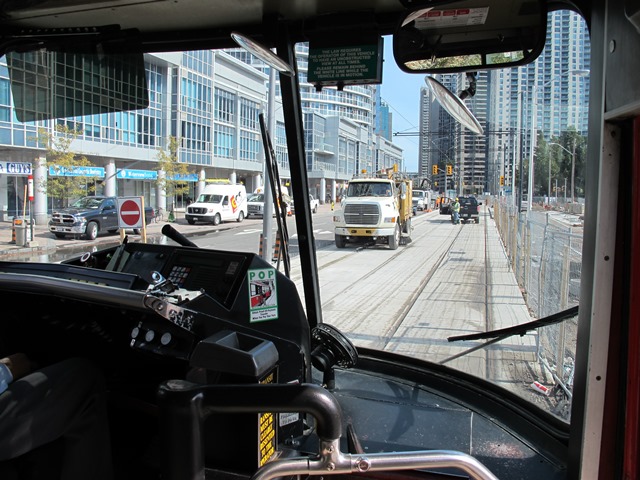
After a two-year absence, streetcar service returned to Queens Quay today with the 510 Spadina and 509 Harbourfront routes resuming their normal operation.

Construction has not yet finished — there are sidewalks still to be finished, a bit of roadwork, the construction of the new bikeway and pedestrian area on the south side, and finally the trees — but that will all be finished for spring 2015.

For those who could not make it down to the waterfront on a fine Sunday morning, and for my out of town readers, here is a sample of views along the line.

Continue reading

Who Subsidizes The TTC? (Updated)

Updated October 11, 2014 at 12:45 pm:

This article and accompanying charts have been updated to include data from 2010-2013. (A further update was added on October 13 to show the breakdown of declining reserve funds.)

We hear a lot from every government about how much money they shovel out the door to support transit in Toronto, but it is useful to look at just how much they are spending, where it goes, and most importantly whether there are ongoing increases in funding levels.

Continue reading

Getting Ready For Streetcars Returning to Queens Quay

After many delays, the Queens Quay reconstruction project will be completed to the point that streetcars can return on the Sunday of Thanksgiving weekend, October 12, 2014.

Years of utility construction, rebuilt sidewalks and a completely new trackbed for streetcars are almost over. When the project finishes in 2015, Toronto will finally see more than beautiful presentations and websites, we will see the street as the designers intended.

Updated October 8, 2014

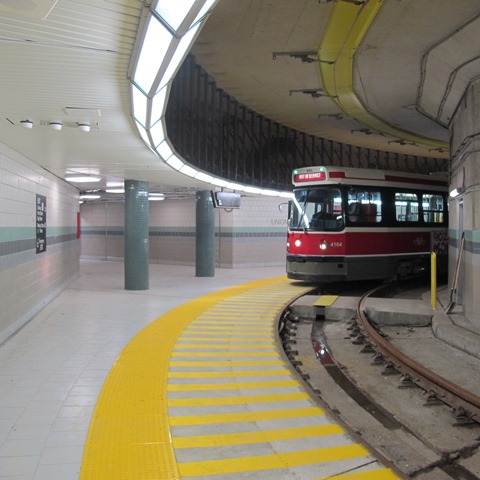
Test car 4164 ran to Union Station on October 7.

Photos from Harold McMann:

View from 4164 eastbound at Lower Simcoe and Queens Quay:

Oct 07, 2014/Toronto, ON:   TTC. EB #4164. Queens Quay at Simcoe St. First car to Union, testing track & overhead structure.

Union Station Loop:

Oct 07, 2014/Toronto, ON:   TTC.  #4164. Union Station Loop. First car to Union, testing track & overhead structure.

Photos linked from a comment by “Thomas”:

Approaching Lower Simcoe Westbound

West of Lower Simcoe

Continue reading

Measuring and Reporting on Service Quality

On September 30, 2014, the TTC’s Bloor-Danforth subway suffered a shutdown from just before 8:00 am until about 3:00 pm on the segment between Ossington and Keele Stations. The problem, as reported elsewhere, was that Metrolinx construction at Bloor Station on the Georgetown corridor had punctured the subway tunnel. While the weather was dry, this was not much of a problem because, fortunately, the intruding beam did not foul the path of trains. However, rain washed mud into the tunnel to the point where the line was no longer operable.

In the wake of the shutdown, there were many complaints about chaotic arrangements for alternate service, although any time a line carrying over 20k passengers per hour closes, that’s going to be a huge challenge. The point of this article is not to talk about that incident, but to something that showed up the next day.

20140930Stats

According to the TTC’s internal measure of service quality, the BD line managed a 92% rating for “punctual service”. This is lower than the target of 97%, but that it is anywhere near this high shows just how meaningless the measurement really is.

The basic problem lies in what is being measured and reported. Actual headways at various points on the line and various times of day are compared to a target of the scheduled headway plus 3 minutes. This may look simple and meaningful, but the scheme is laden with misleading results:

  • On the subway during peak periods, service is “punctual” even if it is operating only every 5’20”, or less than half the scheduled level. Off-peak service, depending on the time and day, could have trains almost 8 minutes apart without hurting the score.
  • There is no measurement of the actual number of trips operated versus the scheduled level (in effect, capacity provided versus capacity advertised). Complete absence of service has little effect because there is only one “gap” (albeit a very large one) after which normal service resumes.
  • There is no weighting based on the number of riders affected, period of service or location. A “punctual” trip at 1 am with a nearly empty train at Wilson Station counts the same as a train at Bloor-Yonge in the middle of the rush hour. There are more off-peak trips than peak trips, and so their “punctuality” dominates the score.

An added wrinkle is that the TTC only includes in its measurements periods of operation when the headway is unchanged. With the service being so often off-schedule, it would be difficult to say just what the value of “scheduled headway plus 3” actually is at specific points along the route during transitional periods.

All the same, we have a measurement that has been used for years in Toronto and it gives a superficially wonderful score. Sadly, the formula is such that falling below 90% would require a catastrophic event, and some silt in the tunnel does not qualify.

Continue reading

King & Sumach: Connecting to Cherry Street (Update 10: September 21, 2014)

Last year, the TTC built new track on Cherry from Eastern Avenue south to the rail corridor that, eventually, will host a new streetcar service in spring 2016. Why so long you ask? The south end of the line sits in the Pan Am Games’ Athletes’ Village and won’t be ready for service for two years even though most of the track will already be in place. The opening will co-incide with the period when purchasers of condos (originally used as athletes’ quarters) will start moving into the neighbourhood.

New photos will be added to the end of this article as the project progresses.

Continue reading

How Can the TTC Run More Service?

In a previous article, I wrote about the crisis in system capacity across all modes – buses, streetcars and subways – and the danger that Toronto may face years without meaningful improvement in transit capacity.

This is a campaign issue, but one that is embraced only by one major candidate, Olivia Chow, and even then, not very well.

Full disclosure: Early in the campaign, I was approached by the Chow team to advise on what became her better bus service plank, but I certainly didn’t write it for reasons that will soon be obvious.

Her transit plan includes support for LRT lines, GO electrification and the first stage of a Downtown Relief subway line. It also includes this commitment regarding bus service:

A better transit plan starts investing now, with buses. Because 60% of TTC rides involve a bus and as the TTC says, the only way to expand transit now is with buses. So Olivia will invest to boost bus service right away, investing $15 million a year.

When we stack a paltry $15m up against the billions in rapid transit plans, it looks rather puny and gives the impression we are trying to get more service on the cheap. How can small change by transit budget standards stack up against the massive spending schemes of rapid transit networks?

Where did the number come from? Back when the Ford/Stintz crew started to dismantle the Miller-era service standards, the anticipated saving was only about $14m/year. However, reversing the cuts is not quite as simple.

When you cut transit service, you can reduce costs simply by letting old buses wear out and not replacing them, by reducing the operator workforce through attrition, and by cutting plans for a new bus garage (needed for a bigger fleet) out of the capital budget. That’s precisely what happened.

To undo the damage, we need more buses, more garage space and more operators. Some, but by no means all, of the cost will come out of the $15m, but there is much more involved.

McNicoll Garage has a pricetag of $181-million (of which only about $80m has been funded as of 2014), and it is required simply to handle growth in the bus fleet with no provision for better service standards. Yet another garage will be required to support better service, although in the short term one garage will do for both purposes. Also, by 2020, some bus services will have been replaced by rapid transit lines, but we don’t really know how much because the future of various schemes is uncertain.

(Some of the chaos in fleet planning dates from the cancellation of Transit City, and still more from shortsighted cutbacks of the last few years.)

New buses cost about $700k apiece. With current peak service at around 1,500 buses (not including those used for construction service), a 10% bump in fleet capacity means 150 new vehicles at a cost of $105-million.

At the very least, in the next few years, the TTC would face the following capital costs over and above what is already committed:

  • $100m to fully fund McNicoll Garage
  • $105m to purchase 150 buses

Moreover, the McNicoll project must be accelerated for completion before 2019, the current schedule. The idea that Toronto would see no additional peak service for five years is a disgusting testament to the ill-informed folly of the Ford/Stintz era.

Continue reading

John Tory’s “SmartTrack”: Will That Train Ever Leave The Station?

Late in May, John Tory launched his “SmartTrack” transit line, the centrepiece of his “One Toronto” plan. Media reps gathered for a preview at the Metro Toronto Convention Centre, and the launch was handled almost entirely by Tory’s staff. All of the background papers are on the One Toronto website, and little has been added since that event.

Even then, in the early days of the campaign, there was good reason to distrust Tory’s grasp of his own proposal, let alone a willingness to engage in debate, when he made the briefest of appearances for a canned statement to give the media clips for the news broadcasts, but answered few questions.

I was modestly impressed that at least a Mayoral candidate was not just thinking at the ward level for a transit proposal, but felt the plan was rather threadbare — a single line to solve almost all of Toronto’s problems.

Wearing two hats that day – as both reporter and activist – I was scrummed by the media for comments, and the Tory campaign chose to lift one phrase out of context as an “endorsement” for SmartTrack that remains online.

Steve Munro, Toronto Transit Blogger, said, “This is very much a refocusing of what transit in Toronto should be.”

What I was talking about was the need to look at the region and at trips to points other than the corner of Bay & Front and times other than the traditional commuter peaks. As to the specifics of SmartTrack, I was rather less complimentary.

In brief, SmartTrack would see electric multiple unit (EMU) trains operating primarily on GO Transit corridors between Unionville on the Stouffville line and Mount Dennis on the Weston corridor (the Kitchener-Waterloo line). At Eglinton and Weston, the line would veer west along the former Richview Expressway lands to the Airport Corporate Centre, but not to the airport itself.

The route would charge regular TTC fares with free transfers to the existing system, and with frequent all-day service at peak levels of every 15 minutes. Over its 53km it would have 22 stations, and might, according to the campaign, carry over 200,000 passengers per day.

Continue reading