
Two new lines on Toronto’s transit map suddenly sprang back to life this week with announced funding for the Waterfront East route by the City, Province and Federal governments. Days later, both Mayor Chow and her competitor, Councillor Bradford, came out with competing support for the Eglinton East LRT, now rebranded by Chow as the Scarborough East Rapid Transit, or “SERT”. “LRT” has become a dirty word thanks to the botched implementation on Finch, and a less than steller launch on Eglinton.
I will leave discussion of the details of SERT for another post once there is a better sense of just what technology and infrastructure options are actually on the table.
It’s important to remember that whoever is Mayor after the 2026 elections, there’s a good chance they will not be in office to see SERT, whatever it might be, open for service.
Meanwhile, long-suffering Scarborough transit riders will have only buses to ferry them around. The same can be said for other parts of the city waiting for transit improvements, and large parts of Toronto will never see anything more than a few RapidTO red lanes.
This raises two fundamental issues about TTC service:
- How much service should there be on TTC routes, and
- How much can crowding and convenience issues be addressed with existing services?
TTC Service Standards set out crowding levels for various types of vehicle, service and periods of operation.
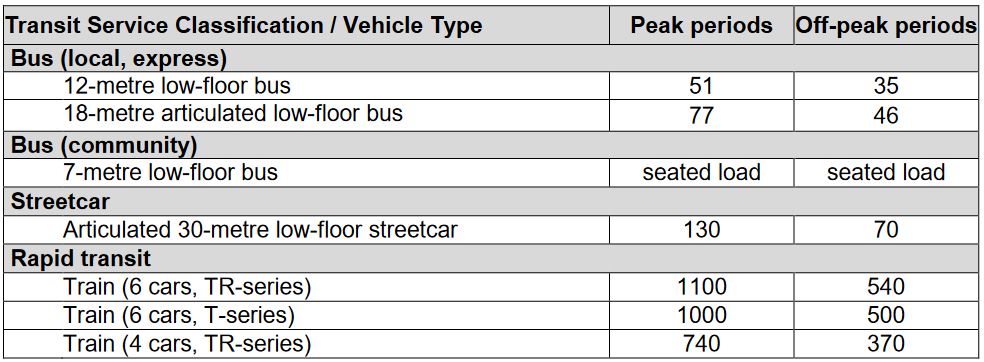
Although the TTC reports that overall ridership has not returned to 2019 levels, they also acknowledge that some routes are crowded beyond the standards. They do not list specifics of routes and time periods, and so it is hard to know the scope of the problem or the affected locations.
This situation is not corrected thanks to budget limitations. The TTC owns buses and streetcars, but they cannot afford to run all of them.
From a rider’s point of view there is more to service quality than the number of buses on the road. These vehicles should also show up reliably so that loads are evenly distributed between them, and wait times are predictable. TTC loves to blame all problems on traffic congestion, but a fundamental issue is that service does not run on even spacing, and little is done to improve this. One difficulty is the acceptance in standards of being off schedule up to 5 minutes, and this only applies leaving a terminus. This allows buses to run together on frequent routes and still be “on time” while giving poorer service than advertised.
Back in the early days of debates on a Scarborough LRT or subway replacement for the former Line 3 SRT, important research from UofT showed that in the off-peak period, the majority of trips in Scarborough stay in Scarborough. A transit network designed to get people downtown does not necessarily address local travel unless it happens to lie along well-used commuter routes. Such a network can also miss travel patterns to and from major suburban work and academic locations both inside Toronto and in the 905 beyond. Off-peak service is important, but it must be more than a line on the map representing a bus that will appear sometime, maybe.
Later in this article, I will detail service frequency on routes across Toronto. In some quarters it is common to say “Scarborough gets the dregs”, but in fact the problem of infrequent and irregular service extends well beyond Scarborough borders. If there is to be advocacy for better transit, this will be more productive with all affected neighbourhoods.
The view ahead to the 2027 budget is not hopeful. Increased spending on service falls in various categories:
- Inflationary and cost-of-living effects
- Service added to address growth
- Service hours added to address congestion
- Service added to promote growth
The budget focus is on the first three, and growth for its own sake gets little attention. The TTC might produce a ridership growth strategy, but it will not affect the 2027 budget.
There has been no discussion of the level of service possible with existing infrastructure and fleet, as opposed to changes that would require more vehicles and, possibly, more garage space. Any added service will, of course, require more operators to drive it and that drives up the budget and subsidy requirement.
TTC planning in recent years focused on making changes within existing financial resources, and the funding shortfall to improve service overall is never presented for public debate. Meanwhile, the politicians do not want to talk about anything that would increase operating costs and lead inevitably to proposals for new revenues including fares and subsidies.
Better service both in quantity and quality is key to the TTC’s growth. Drawing lines on maps keeps the announcement machinery turning and fuels endless social media debates, but it does nothing for service today.
Any politician or advocate claiming to serve their community needs to address service and how it can be improved to serve everyone now, not just in the decade to come.
The Infrequent Service Network
TTC has a network of routes with 10 minute or better service at all times, and some streetcar routes are now scheduled every 6 minutes or better during daytime hours. There is also a network of express buses overlaid on the basic local service.
What we don’t hear much about are the infrequent routes.
When Service Standards are discussed, one topic that comes up is whether the maximum allowed headway should be reduced from 30 to, say, 20 or 15 minutes. The question, however, is whether the resources to do this could be better spent on improved service where there already are riders by tightening the crowding standards to allow fewer riders per vehicle.
Where is the greater improvement in attractiveness? Which change would gain more riders and at what cost?
The table below lists all surface routes sorted in descending order by AM peak headway. A pdf containing the full set follows. Note that frequent and infrequent routes are scattered all over Toronto.
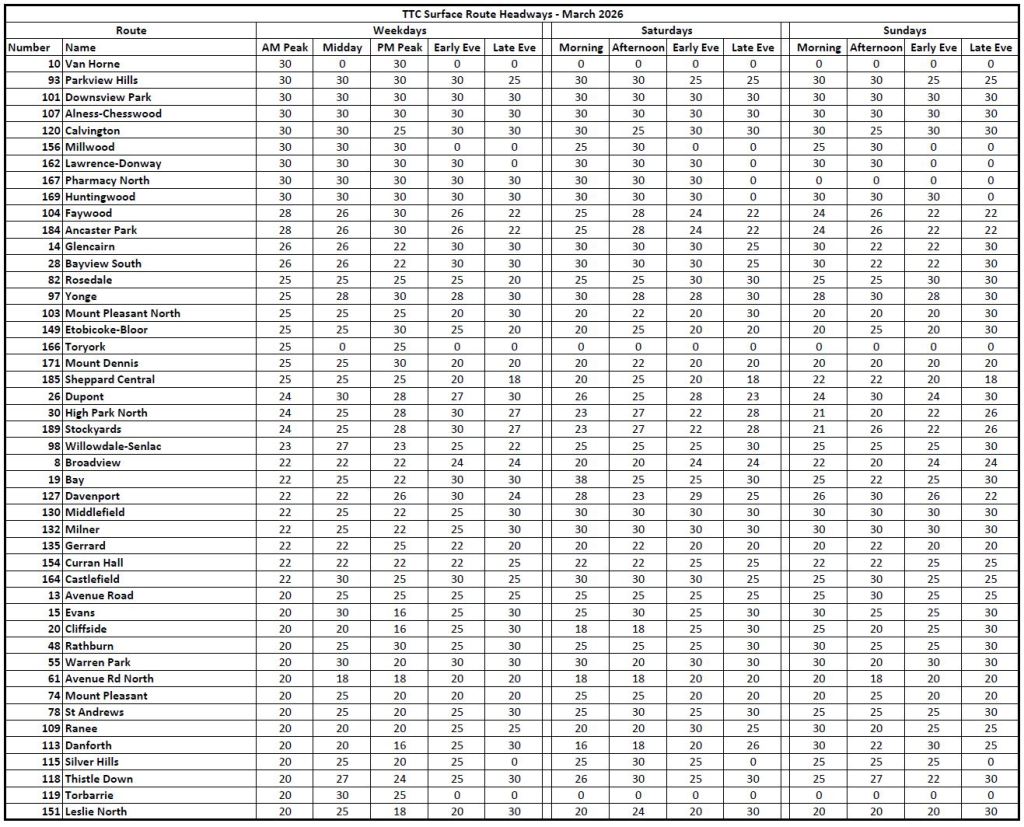
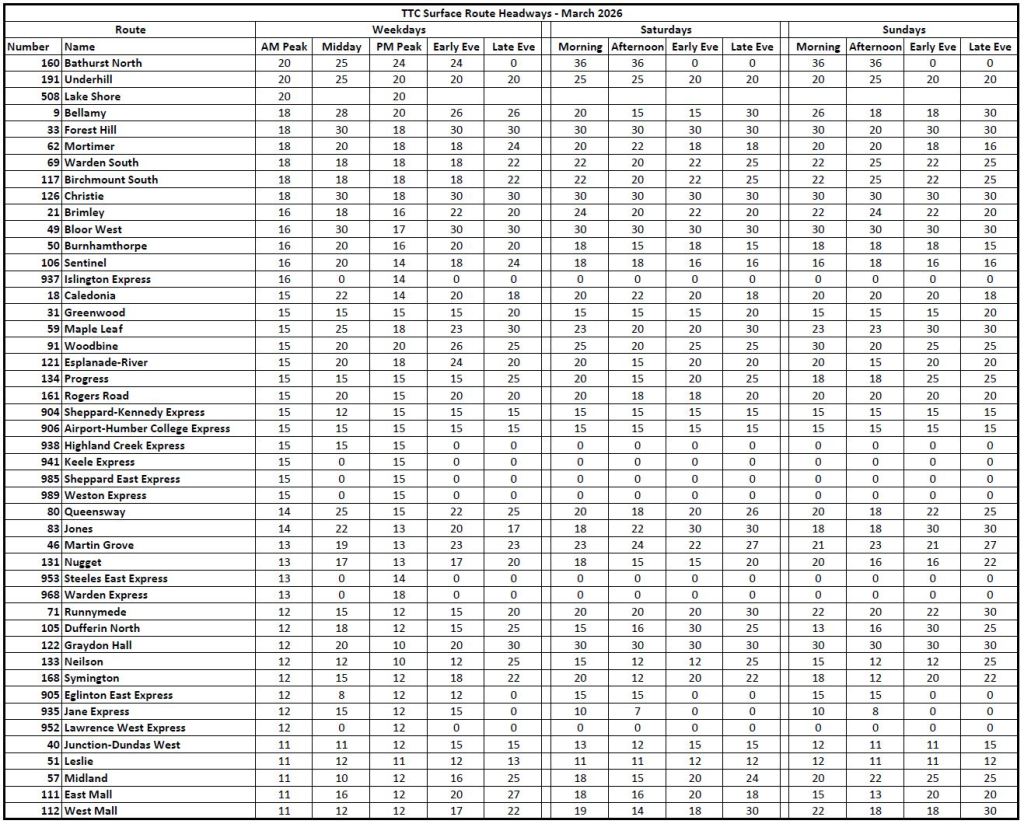
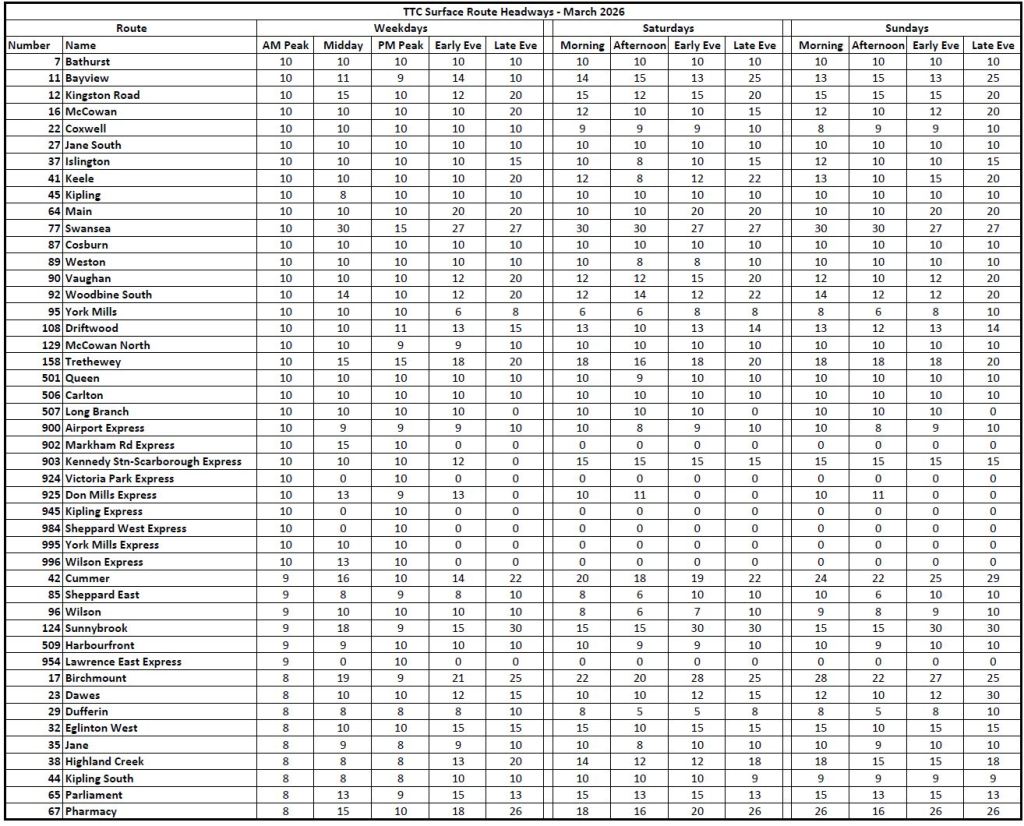
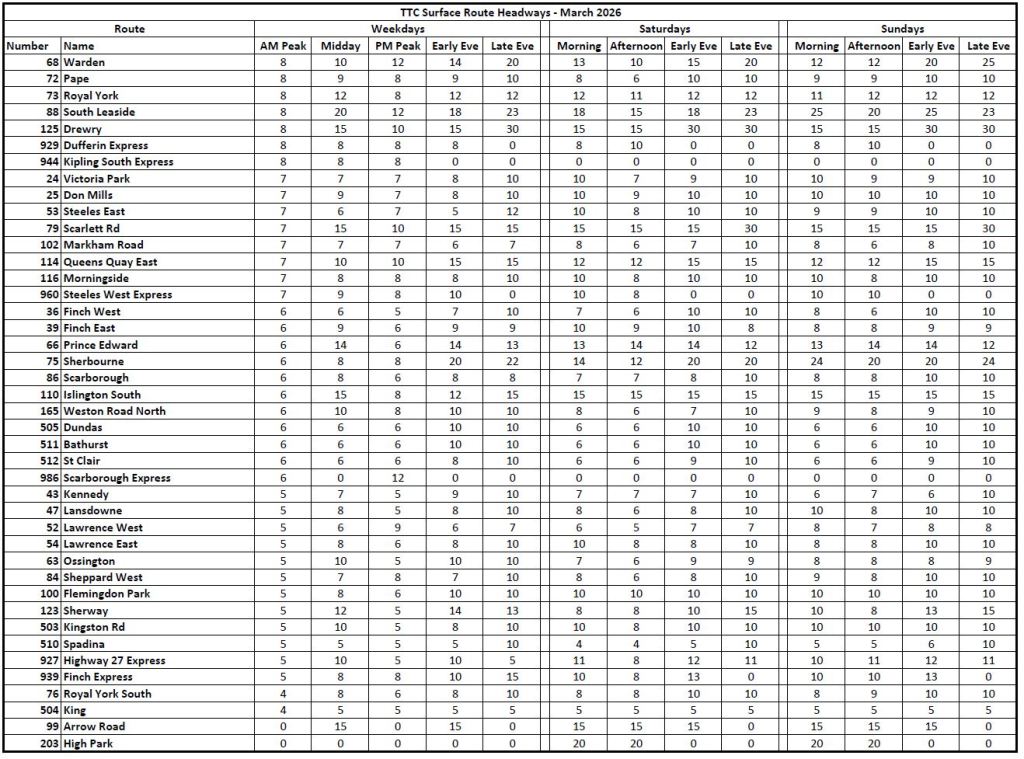
Source: Adapted from TTC Service Summary March 15 to May 2, 2026 pp3-4
 Steve Munro
At the risk of sounding overly picky, the tables do not in fact list all surface routes. 94 Wellesley is missing.
I went looking specifically for that route to see how it was listed, because its two segments have very different headways. Castle Frank-Wellesley Station runs on ten-minute headways; but west of Wellesley Station the headways are 20 minutes.
It wouldn’t surprise me if the TTC blithely claim the 94 runs every ten minutes, ignoring the fact that at least two-thirds of the overall route gets only half as much service.
I wonder whether any routes actually in the table are falsely described in that way. And of course whether any others are just missing.
Steve: Sorry. My error in copying the table from the TTC’s document into a spreadsheet so that I could sort it. I will update this later today. Both 60 Steeles West and 94 Wellesley were missed.
And, yes, the TTC does claim a 10 minute headway on Wellesley all day every day.
LikeLike
NO! I used to advocate for the EELRT but after seeing how they manage Eglinton (surface section) and the disaster on Finch West, and the slowest streetcar system in the world, I hope they don’t bring this to the EE corridor… The current 905 and 986 in bus lanes (and I’m sure the local 86, 116) can fly past an LRT with the way the TTC operates them. Slow pace, too many surface stops, long dwell times at stations, uneven waits and not full signal priority…no thank you. Save that money and use it for something else that will not slow down the riders in Scarborough. People care more about getting places fast rather than taking a fancy new train that is much slower. I don’t trust the city to get this right…
LikeLike
A couple of comments.
First, overcrowding can be a factor in short peaks, like shift changes or school times. My recent experience with taking a 114 Queens Quay East bus from Union to the docklands around 9:25 AM was crush-loading and leaving passengers behind at the two Bay St stops (Union and Queens Quay). Almost all the passengers got off either at Jarvis or Dockside (Sherbourne). This was mostly a George Brown College load.
The TTC runs various school trippers, however when there are hundreds of students wanting to go somewhere, a two or three low-floor buses won’t really manage. Okay, the curmudgeons might say “the ‘children’ students won’t pay fares anyway, so too bad for them”, however other riders won’t be able to get on either.
Second, simple headway metrics as given in this article are only partially meaningful. Some of the long-headway routes may formerly have been branches of a mainline route that were spun off (the TTC has been rather enthusiastic about this lately). Whether the standalone ends of these spun-off branch routes really have demand for more frequent service can be debatable.
On the other hand, a route like 110 Islington South has frequent service….but only if you are travelling no further south than Judson (south of Evans). From here, buses alternately head straight down to Lake Shore and Islington, or they head west along Horner to Long Branch loop. Neither of these branches really manages 10 minute headways.
And in a further twist, the “via Horner” routing itself has a rush hour branch, so during morning and evening peaks they run alternately via Thirtieth and Lakeshore, or Brown’s Line. The individual branches have headways of more than 20 minutes.
This is not to disparage branches.
For example, I think the TTC could really use a 114B branch that runs to Parliament and Lake Shore to handle the heavy school/office traffic on Queens Quay. However, that only helps if they drop the overall headway by keeping at least the same number of buses. The round trip time of the 114B branch should be not much more than half the round trip to the Wheel Trans garage. While riders going beyond Parliament might get a bit less service, they wouldn’t have to cram on buses (and have the driver yell that they must move back to the yellow line or get off).
Of course the “cost efficient” TTC way would be to keep the same headways, save a bus, and leave docklands with worse service.
Steve: I used the TTC’s simple version of the headway table primarily to illustrate that wide and short headways are common everywhere. A table showing all of the branches would have been major work, and for the purpose of the article this one will have to do. Anyone who wants the gory details can refer to the full schedule summary.
Some partisan advocates would have us believe that nothing east of Victoria Park has decent service while the routes serving other areas are unduly generous. This is BS. There’s good and bad service everywhere and that’s before we even talk about reliability.
That said there is a general issue that bus service is ignored in all the announcements of rapid transit expansion even though nothing new will actually open for years and all most riders will ever see is buses.
But more service costs money while announcements cost nothing at least in the short term. Your tax dollars etc etc etc.
LikeLike
Well, clearly, to be modern it will be a maglev monorail. “Light Rail” being so earlier-this-year.
Steve: Don’t forget the gondola crowd. Monorails are so dated.
LikeLike