
This article is a follow-up to my previous reviews of items on the March 31 Strategic Planning Committee agenda:
- TTC Financial Planning & Subsidy Streams
- TTC Ridership Growth Strategy 2026-2028
- Ridership or Budget: What Should Drive TTC Strategy?
Also included are comments on the Fare Alignment and Seamless Transit Act, 2026 introduced in the Ontario Legislature on March 30.
Long Term Financial Plan
The meeting began with discussion of the Long Term Financial Plan. There was little concrete beyond the recognition that the TTC has a large revenue hole to fill. Although management will eventually bring back a discussion of various scenarios, this will not happen until 2027, nor will there be any interim update on their work. This effectively punts any serious policy debate into the 2028 budget year, not an auspicious start to a discussion of future strategy.
The management recommendation to receive the report for information was amended on a motion by Commissioner Mihevc:
Request TTC staff to include in the Phase 1 work, ideas and opportunities for public and intergovernmental advocacy informed by Canadian and global best practices.
“Phase 1” is the initial jurisdictional review of funding tools available to and used by other transit systems including implementation possibilities and barriers in Toronto.
Ridership Growth Strategy
The Committee turned to the Ridership Growth Strategy, and opinions about what exactly this should accomplish were quite varied.
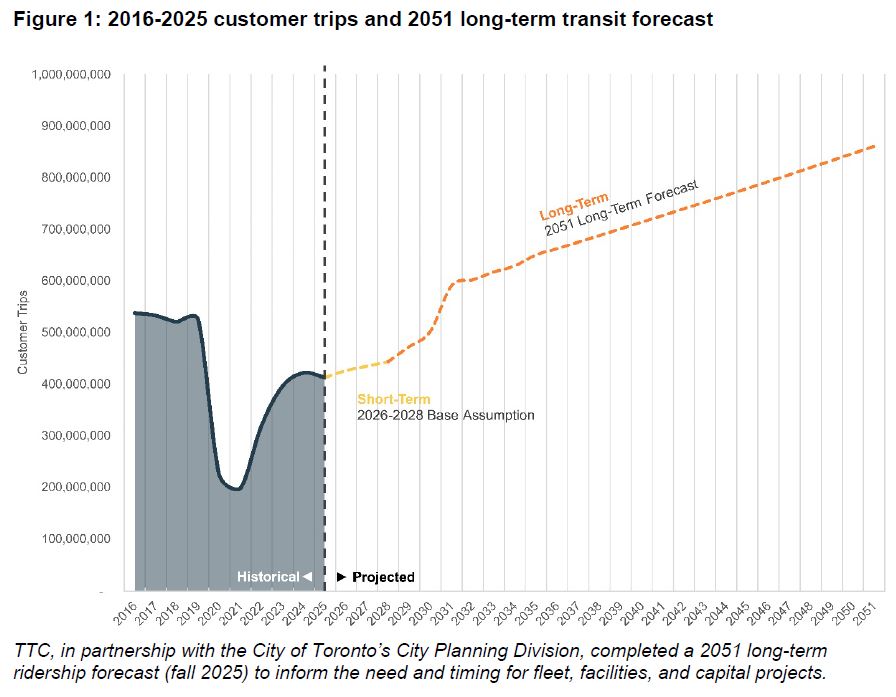
Although management’s projections for growth beyond 2028 are quite aggressive, there was no indication of where these new riders will come from, nor of why there would be sustained growth over such a long period.
The burst in demand in the early 2030s is assumed to come from opening new rapid transit lines, but beyond that is a projected growth of about 10-million new rides per year starting from a base of 600-million, well above current demand. Indeed, if this growth is the result of “business as usual”, one must ask what additional a Ridership Growth Strategy might achieve. Conversely, the idea that this many new riders will come to the TTC implies a large investment in service capacity.
The implications will no doubt come out in the updated Financial Plan, but it is odd that the RGS report did not address this.
Moreover, the impression stated by some Committee Members and by management is that the system has surplus capacity, and attracting riders to use this is a low-cost way to improve demand. This flatly contradicts claims in the RGS that some services are overcrowded and running below TTC standards.
Completely absent from the debate was any mention of service quality from the point of view of reliability and management. The focus was on transit priority measures in the best TTC tradition of blaming outside factors for most of their problems. This is particularly odd considering that a recent Internal Audit report recognized the need for better reporting on service quality from the rider’s point of view.
The presentation notes the cost of congestion and uses the Jane bus as an example. The slide below implies that the cost of serving the Jane corridor went up between 2019 and 2024, but that is not entirely what happened. Instead of adding buses to counter congestion, the TTC cut service during many weekday periods.
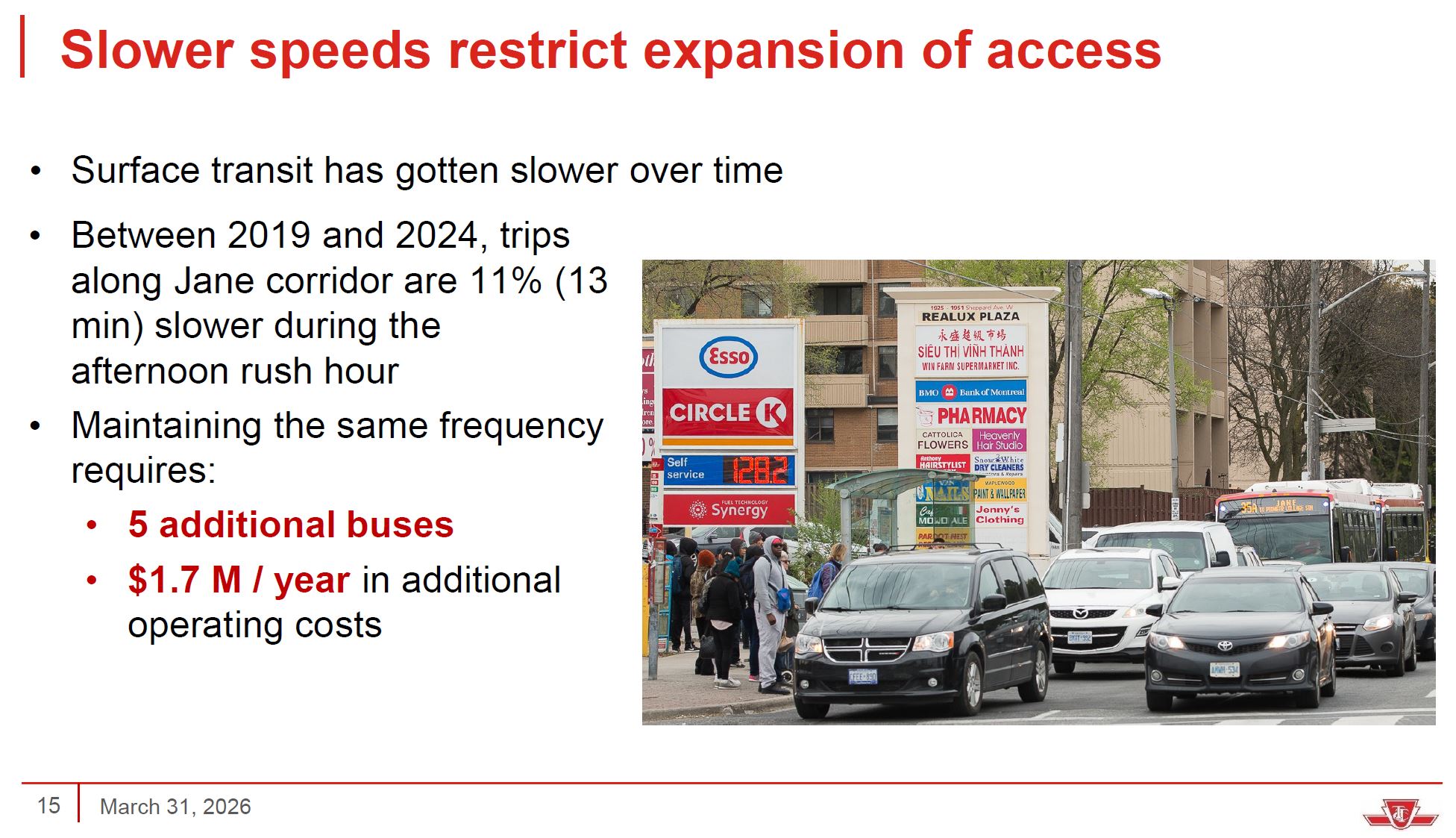
Here is a comparison of 35/935 Jane service between Jane and Pioneer Village stations before and after the pandemic in the fall schedules. Note that the decline in speed is in all periods. Any move to improve speeds cannot just address the peak period.
| Period | Headway 2019 | Headway 2024 | Vehicles 2019 | Vehicles 2024 | Speed 2019 | Speed 2024 |
|---|---|---|---|---|---|---|
| Local Service | ||||||
| AM Peak | 4’20” | 6’00” | 24 | 23 | 17.9 | 16.8 |
| Midday | 7’00” | 7’30” | 15 | 19 | 18.6 | 16.8 |
| PM Peak | 5’00” | 6’00” | 26 | 29 | 15.8 | 13.0 |
| Evening | 8’45” | 7’30” | 11 | 17 | 20.4 | 18.7 |
| Saturday Afternoon | 10’00” | 7’00” | 14 | 22 | 18.6 | 15.6 |
| Sunday Afternoon | 10’00” | 8’00” | 10 | 18 | 19.8 | 17.2 |
| Express Service | ||||||
| AM Peak | 7’30” | 12’00” | 12 | 10 | 21.9 | 19.0 |
| Midday | 9’30” | 15’00” | 9 | 8 | 23.2 | 19.6 |
| PM Peak | 9’40” | 12’00” | 11 | 13 | 18.1 | 14.6 |
| Evening | 9’00” | 15’00” | 9 | 7 | 25.1 | 20.4 |
| Saturday Afternoon | 9’00” | 7’00” | 10 | 18 | 22.1 | 18.3 |
| Sunday Afternoon | 8’30” | 8’00” | 10 | 14 | 23.5 | 20.6 |
Another aspect of the discussion was fare policy. A deputant raised the issue that although fare capping will come into force in September 2026, one group of riders, Post-Secondary students, will not benefit from this. The reason is that there is no single-fare for these students, only a monthly pass. The price of that pass was not adjusted as part of the fare capping scheme even though the cap will apply to seniors and youth.
For a moment, thanks to Vice-Chair Mihevc, it appeared that the Committee might veer into the whole “so how would you pay for this” response, but Mihevc seemed to have second thoughts. This is an oversight that was not caught in the original decision, and the TTC should rectify this if not for 2026, then early in 2027.
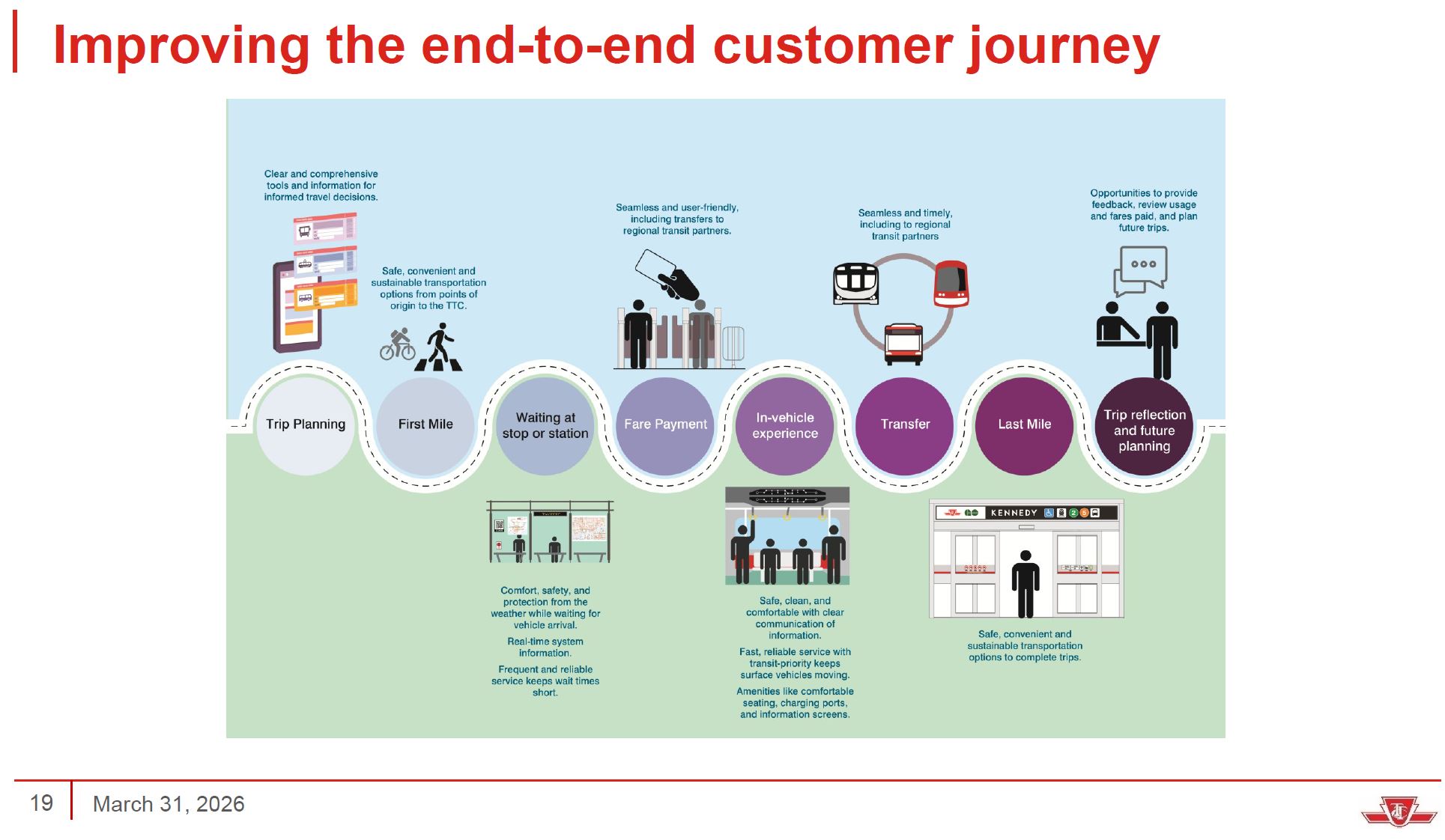
An important chart in the management presentation showed the many components of a transit trip and factors affecting them. Congestion is a common point of discussion, but it is only part of a larger experience including trip planning, first and last mile access at stops, and the dubious joys of waiting for service both for the first bus or streetcar, but also at transfer points. Irregular service adds unpredictability to each of these and works against trips requiring transfers, a fundamental part of TTC’s system design.
Motions
Four sets of amendments were proposed by Members.
Commissioner Jagdeo moved that the Committee:
Direct staff to prioritize ridership growth initiatives that leverage existing resources and service when developing the 2027 budget.
This motion could be interpreted various ways, but Jagdeo’s remarks and his history as a fiscal hawk on the Board make clear just what is meant. “Existing resources and service” means making the most out of existing budgets without touching overall service levels. Another approach might be to ask what growth is possible within existing physical resources (mainly fleet), but that was not Jagdeo’s intent. The Committee approved this, and we should not look forward to much service improvement in 2027. Mayoral candidates might have other ideas, but implementation will almost certainly wait until late 2027 or early 2028.
Commissioner Mihevc moved that the Committee:
Send the report back to staff for further work and consideration, such work and consideration to include:
- stakeholder consultation and expert input into its plan;
- an articulation of a ridership growth vision and a high level statement on what the TTC is seeking to address in terms of increasing mobility in Toronto;
- an analysis of the mobility context modal share review and new trends in employment, leisure and development pressures;
- a review of the opportunities that exist in this context that can increase modal share and ridership growth, including new fare products, review of TTC service standards, new ideas that trend towards higher gain with lower costs; and
- possible cost and strategies to fund a Ridership Growth Strategy, such strategies to be developed in consultation with the City.
Request staff to report back to the TTC by Q1 2027 with specific options and recommendations for the Board’s consideration.
This motion is intriguing in par because it implies a report on RGS options before the Long Term Financial Plan actually comes back to the Board.
An important point here is the need for consultation beyond the TTC itself. The Board needs to hear more than an echo-chamber recital of management’s point of view. This would also parallel management plans to review the Service Standards, another process needed pubic input.
Commission Chair Myers moved:
As part of the City-TTC MOU outlining roles and responsibilities, include an overview of the roles of partners required for the execution of ridership growth initiatives, along with their respective accountabilities.
Direct TTC staff to work with the City of Toronto to establish city-wide long-term mode share objectives, that includes all modes along with transit ridership growth targets.
Commissioner Bravo moved:
Direct TTC staff to develop a long-term strategy document that integrates the Ridership Growth Strategy, Long-Term Financial Plan, and other relevant strategic and policy documents that will serve as the integrating and guiding framework for transit capital, service, and policy directions.
This motion addresses a problem that multi-year plans on various aspects of TTC policy have grown over the years, and there are overlapping effects, not to mention the “too many cooks” problem of multiple authors. Reports “A”, “B” and “C” from earlier years might include “approved” policies that conflict with updated thinking and political context at the Board and Council level.
All of the motions passed.
Provincial Policy Direction
There was no discussion at all of Provincial legislation tabled on March 30 which could have significant effects on the TTC’s ability to set fare and service policy. The “One Fare” scheme does not simply mean that your Presto card will work anywhere, but that the Province will set an overall fare structure and some aspects of service.
The Fare Alignment and Seamless Transit Act, 2026 provides that for “prescribed transit systems”
The Minister may make regulations establishing a fare structure for prescribed transit systems, including,
(a) setting fare prices; (b) defining fare categories, types and eligibility requirements; (c) establishing fare discount policies; (d) establishing transfer policies for travel between a prescribed transit system and any other passenger transportation systems.
[…]
The Minister may prescribe geographic zones for the purposes of this section and may designate prescribed transit systems in relation to each zone.
All fares collected by any prescribed transit system that is designated in relation to a geographic zone […] shall be apportioned among the systems designated in relation to that geographic zone in accordance with the regulations.
Every prescribed transit system that is designated in relation to a geographic zone shall pay the amounts required to be provided by it in accordance with the apportionment rules set out in the regulations.
This allows the Province to create zones within which revenue sharing will be required. It is not yet clear whether this is a move to pillage TTC fare revenue for the benefit of other agencies.
The Act provides for service integration and standards on key cross-border routes.
The Minister may make regulations,
(a) designating new and existing routes as priority routes, which may cross municipal boundaries; (b) prescribing service standards for priority routes, including,
(i) establishing time periods during which the service standards must be met, (ii) establishing the frequency of services to be provided on the priority route, which may specify the frequency of service at different stops on the priority route;
(c) prescribing requirements for service integration between different prescribed transit systems on priority routes, including requiring services be provided by a prescribed transit system outside of its primary service area.
It is not clear whether service standards would be considered a maximum or minimum, nor is there any discussion about operating subsidies to fund increases beyond existing levels.
The Act provides for integration of services for the disabled including “a unified trip booking system approved by the Minister” as well as avoidance of transfers between local systems within a yet-to-be-prescribed distance of municipal boundaries. This would, for example, extend the Wheel-Trans service territory beyond the Toronto boundary.
 Steve Munro