
Work on this article began before the March 30 announcement of tripartite funding for various housing and transit projects. Comments about this have been incorporated here.
At its meeting of March 31, the TTC’s Strategic Planning Committee will consider two reports relating to the financial future of both the Operating and Capital budgets.
The report on a long-term plan is less than its title might suggest in that it merely launches a process to develop a plan, but does not propose anything concrete. Some members of the TTC Board have wanted to see a long-term plan and options for years, but nothing usually comes of this beyond rehashing information we already know from the annual budget cycle. City Council cannot formulate capital and operating budget plans without a clear indication of the needs and trends at its most expensive agency.
A related problem is that conflicting indications come from the Council and the Mayor about spending priorities, and some TTC plans are closely linked to Provincial projects such as the North Yonge subway extension. Major committed projects have already claimed much of the announced Federal funding, and substantial additions will require net new funding.
That, in turn, requires the TTC and Council to think carefully about priorities rather than asking for money project-to-project on the assumption that money will always be available. In the context of high Provincial debt and considerable spending on transit, plus a refocus of Federal priorities and an attempt to decrease spending, Toronto is unlikely to receive everything it wants.
Short-Term Planning
Short-term planning placed the TTC in a very difficult position.
The short-term balancing of the TTC’s financial pressures would not have been achieved without a substantial City subsidy in recent years, including the Ontario-Toronto New Deal providing three-years of operating funding support, and project specific capital grant funding from the provincial and federal
governments.For instance, the injection of $5.1 billion in the 2025-2034 Capital Plan, which was predominantly city funding, reduced the TTC’s state-of-good-repair backlog by $3.9 billion, or nearly 50%. However, fleet plan changes, asset condition assessments and cost estimate increases have increased the SOGR backlog in the 2026-2035 Capital Plan to a projected $6.1 billion at the end of the 10-year planning window. Funding for new trains, buses and streetcars by other orders of government addressed immediate fleet needs, and the operating support through COVID, have kept the system going. While these efforts had significant impact in the immediate term, the TTC still has a long-term financial problem due to a fiscal framework that has not evolved at the same pace as the scale, complexity, and expectations of a world class transit system.
This cycle of finding immediate term solutions to the budgetary pressures of the organization is one repeated annually. With each successive year the balancing act produces increasingly limited opportunities to find new efficiencies and revenue generation opportunities. The TTC’s aging assets continue to drive state-of good repair investment needs to maintain existing levels of service, while struggling to fund capacity enhancements to keep up with growth. [Long Term Plan, p. 1]
As things stand, the projections for Operating and Capital Budgets assume very modest growth in demand, at least in the short term, but there is a long list of projects, mostly unfunded on the Capital side both for Stage of Good Repair (SOGR) and to accommodate projected demand growth. Rapid transit extensions now underway only include provision for fleets at the level needed to serve current demand, but not the extra trains to increase capacity nor the maintenance facilities to house the expanded fleets. Drawing lines on maps requires not just tunnel construction, but consideration for how the network will operate and what effect extensions and new lines will have on the existing network’s operations.
With all the focus on a few rapid transit projects, there is the much larger issue of subway and surface fleet renewal, not to mention infrastructure work. Any plan to increase service and ridership substantially places an additional load on the Capital budget not to mention the Operating budget to actually deliver new service.
Fare Revenue Will Not Pay For Capital
Fare revenue from ridership growth did not pay for expansion even when the cost recovery rate was 70%. Now that it is below 50%, the effect of additional service is even more acute. We cannot talk about system expansion and moving more people with transit if we are not prepared to pay for it.
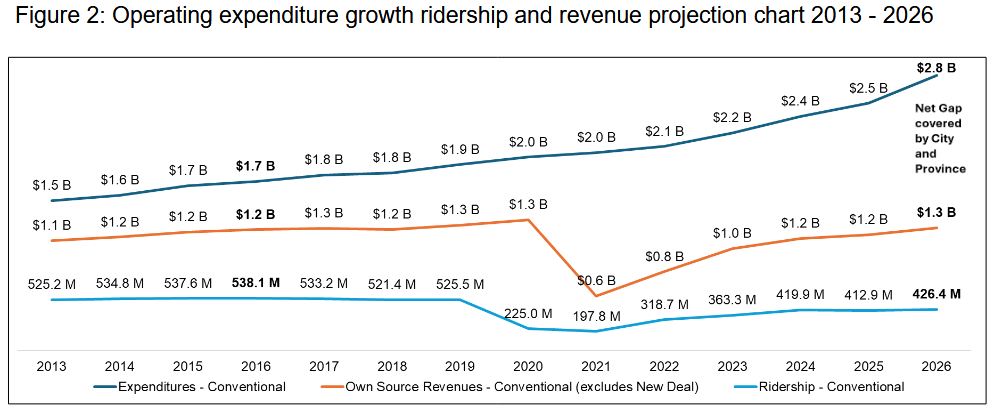
Transit funding in other cities comes from a variety of sources as detailed in the jurisdictional review. Toronto’s problem is that actually levying most of these requires cooperation from senior governments, notably Ontario where new taxes or fees of any kind are not welcome. In at least the medium term, Toronto will have to make do with existing funding schemes while hoping/lobbying for increases.
Options For Ridership Growth
The other side of this dilemma is that Toronto has never been presented with options beyond modest business as usual transit service. We do not know what growth and service quality we might aim for because annual budgets only scrape by to keep the system running.
While ridership growth is essential to long-term sustainability, on it own it is insufficient to close the structural fiscal gap without complementary changes to funding, fare policy and cost structures. As a result, other options and strategies must be identified. Recognizing this, at the January 23, 2026 meeting, the City of Toronto’s Budget Committee directed City staff to work with the TTC to develop a multi-year operating budget that both supports ridership growth and addresses the underlying financial pressures.
Growing ridership and increasing the mode share of public transit trips will require additional levels of investment in both service and capital beyond what is currently projected and may demand consideration of other sources of revenue and/or fundamental changes in policy with respect to how transit is prioritized within the City. [p. 3]
The report proposes that various scenarios be developed for levels of future growth and service. This will inform future budgets, but not immediately. A four-phase program is proposed:
- Jurisdictional review of major transit systems: See the attachment linked above.
- Scenario development and long-term analysis
- Balancing strategies including cost containment, fare policy including enforcement, funding, and capital priorities
- Recommendations and implementation roadmap
There is no discussion of the range of options that might be considered, nor is there a proposed date to report back. Obviously major change will not occur overnight, but short-term plans should explore what can be achieved within existing resources (fleet, infrastructure) and at what cost to get more out of resources the TTC already owns. Further out, no rapid transit growth will come online until the early 1930s, but the surface system should not be ignored waiting for new trains to roll into Scarborough, Richmond Hill and Thorncliffe Park.
In parallel there is the TransformTO plan which has a very aggressive target for shifting travel away from cars. It includes a massive increase in transit service that will not be achieved overnight even assuming Council approves this and funding is available. The TTC Board and Council need to make hard decisions about the scope of transit expansion, and not just a few rapid transit lines, they are prepared to undertake.
Once again, Middle-East war has exposed economy to rising fuel prices. What this will do to economic growth and transit demand remains to be seen. Toronto is at least in the position of owning a large, if not entirely adequate, transit network serving a goodly chunk of demand. However, this is historically focused on downtown-oriented trips, with considerably less support for the more numerous trips between suburban areas.
Ontario bears some responsibility here too because for decades GO Transit’s downtown focus worked against better use for inter-regional trips, and support for local and regional bus service has not encouraged large-scale growth. Calls for us to “do something” to relieve the high cost of fuel, such as free transit, ignore the fact that transit simply is not present, or is too small-scale, to support a major shift of auto to transit travel. Moreover, this only addresses the cost of driving where transit is an option, not the much wider question of the wider economic effect of higher fuel costs.
The March 30 Announcement
The Federal, Provincial and Toronto governments announced funding for various transit projects, as well as tax relief for some new housing.
The first important point about this is that it affects only the TTC Capital budget, but provides no new support for transit operations. Moreover, none of this announcement addresses the TTC’s unfunded capital backlog. Note that Waterfront East is not part of the TTC capital plan.
The Federal contribution to several transit projects has been confirmed, but this is not “new money”, only the formalization of previous announcements. These projects are: Ontario Line, Eglinton Crosstown West Extension, Scarborough Subway Extension, Yonge North Subway Extension and Hamilton LRT. These are Metrolinx, not TTC, projects.
In the name of stimulating housing, municipal Development Charges will be reduced with the gap made up by transfers from other governments. This benefits housing prices, but has no effect on transit to the extent that TTC plans include a provision (albeit declining) for DC revenue as a capital funding source. The only change is which pocket the money comes from, tempered by the hope that replacement DC funding will match what might otherwise have been expected.
The Waterfront East transit line will be funded at $3-billion with one third coming from each level of government. Any overruns will be the City’s responsibility. Now that funding is announced, the next stage of design can get underway. Waterfront Toronto expects to reveal staging plans for construction soon to Council and to community stakeholders.
Capital Subsidies
Provincial
Historically, Ontario participated with Toronto on capital projects with a share of the total cost. This changed with the Metrolinx takeover of major projects like the Relief/Ontario Line and various extensions which will be 100% funded by the Province. It is not yet clear which agency/government will “own” delivery of the Waterfront East line which, until now, has been a joint effort of the City, TTC and Waterfront Toronto.
Ontario provides a share of gas tax revenue to Toronto ($178-million in FY 2024-2025). The City divides this roughly equally between Operating and Capital subsidies to TTC. Note that because of the indirect flow it shows up as a part of “City” subsidies but is actually provincial money. This distinction is clear in the TTC’s annual financial statements.
Federal
The recent Federal Budget announced that a program originally planned to distribute $30-billion over ten years across Canada would be reduced to $25-billion. This is achieved by consolidation of funding for existing programs and shifting some funds earmarked for transit to a new, more general a new Build Communities Strong Fund for infrastructure.
Toronto’s share of the Baseline stream is $116.4-million, or $1.16-billion over 10 years. Allocations under the other streams are not cited in the TTC’s report, but it is clear they will be project-based, not an automatic annual transfer.
| Program | Scope | |
|---|---|---|
| Baseline Funding Stream | Stable 10-year funding agreement toward routine growth and rehabilitation, state-of-good-repair. Maximum Federal contribution of 40% of eligible costs for capital projects. Distributed based on ridership (70%) and population (30%). | Original: $5B over 10 years, $500M annually Revised: No change. |
| Metro-Region Agreement Stream | Geared to regions with complex transit systems. Funding to support diverse projects, including major transit expansion priorities outlined in an Integrated Regional Plan. Up to 10-Year Agreements with local government/transit agency partnerships within a Metropolitan Area and supported by Province. | Original: $20B over 10 years, $2B annually Revised: Same. Subject to review by HICC on distribution. |
| Targeted Funding Stream | Targeted intake process based on Federal priorities. Includes rural and remote transit, active transportation, zero-emission transit. | Original: $5B over 10 years, $500M annually Revised: Consolidated with Metro-Region Stream |
| Total | Original: $30B over 10 years, $3B annually Revised: $25B over 10 years, $2.5 B annually |
Approved TTC projects under the Baseline stream already exceed the $1.16-billion allocation. It is not clear whether this overage will be taken from other potential entitlements. For example, the eBus and Charge Points projects could come out of “zero-emission transit”.
| Project | Total ($M) | Federal ($M) |
|---|---|---|
| 55 Line 2 Trains | $2,678 | $950.9 |
| 200 Hybrid Buses | $403 | $161.2 |
| 105 Wheel-Trans Buses | $35 | $14 |
| 50 eBuses (*) | $104 | $45 |
| 227 Charge Points (*) | $308.5 | $133 |
| Total | $3,529 | $1,304 |
Note that most projects in the March 30 announcement are Provincial, not Municipal. There remains a very long list of unfunded projects for State of Good Repair (notably vehicles and infrastructure) and provisions for system growth.
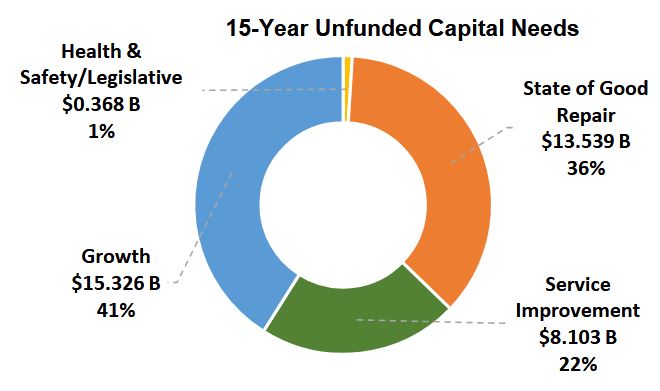
The TTC, as input to the Fall 2026 Federal Budget, has urged the government to:
- Restore at minimum the CPTF to a $30 billion 10-year program, reversing the $5 billion cut through Budget 2025.
- Ensure the long-term predictable funding program is sustained by adding the new 10th year of the program (2037) in the financial framework.
- Index the CPTF annually for inflation, recognizing market factors and the impacts of inflation on diminishing the purchasing power of the fund. [Intergovernmental Update p. 4]
A major challenge in any long-term planning remains the consistency of government intentions especially if there is a major shift in policy after an election.
For a detailed review of the TTC Capital Plan and funding backlog, see:
Operating Subsidies
Provincial
As noted above, roughly half of the annual gas tax subsidy to Toronto is allocated to transit operations. While this is helpful, it is less than $100-million out of a total budget of $3-billion.
There is special funding under the “New Deal” between Toronto and Ontario, but this expires early in 2028. Expected payments are $148-million and $98-million in 2027 and 2028 respectively. If the agreement is not renewed or replaced with a new revenue stream, the City will face hard decisions about future projects and the scope of transit service.
Federal
The Federal government provides no operating subsidy to the TTC.
 Steve Munro