
The City of Toronto has released its detailed mobility plan for the coming FIFA World Cup matches in June-July.
The document is over 100 pages long, although some of that is background on the city’s existing transportation infrastructure. In this article, I will primarily review the transit component and leave other topics to interested readers.
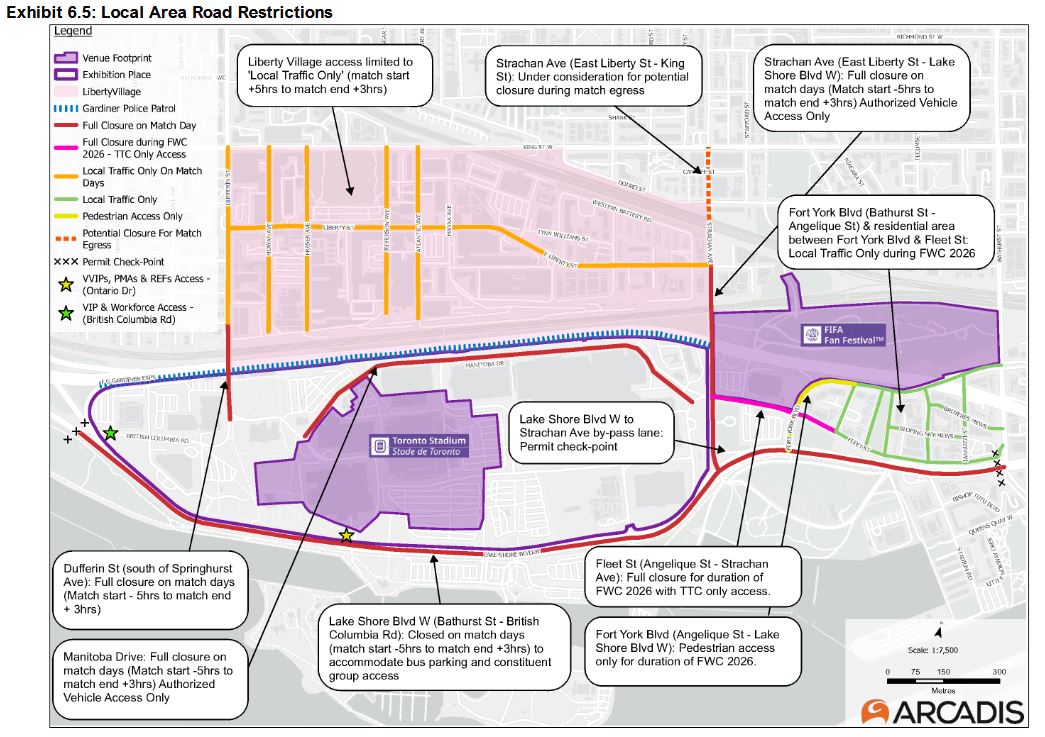
The World Cup matches will occur on June 12, 17, 20, 23, 26 and July 2. The June 12 and 26 games kick off at 3:00pm, June 20 at 4:00pm and the other at 7:00pm. From 5 hours before to 3 hours after each game there will be extensive constraints on the area around Exhibition Place, and transit will be the primary mode of access.
Road Restrictions
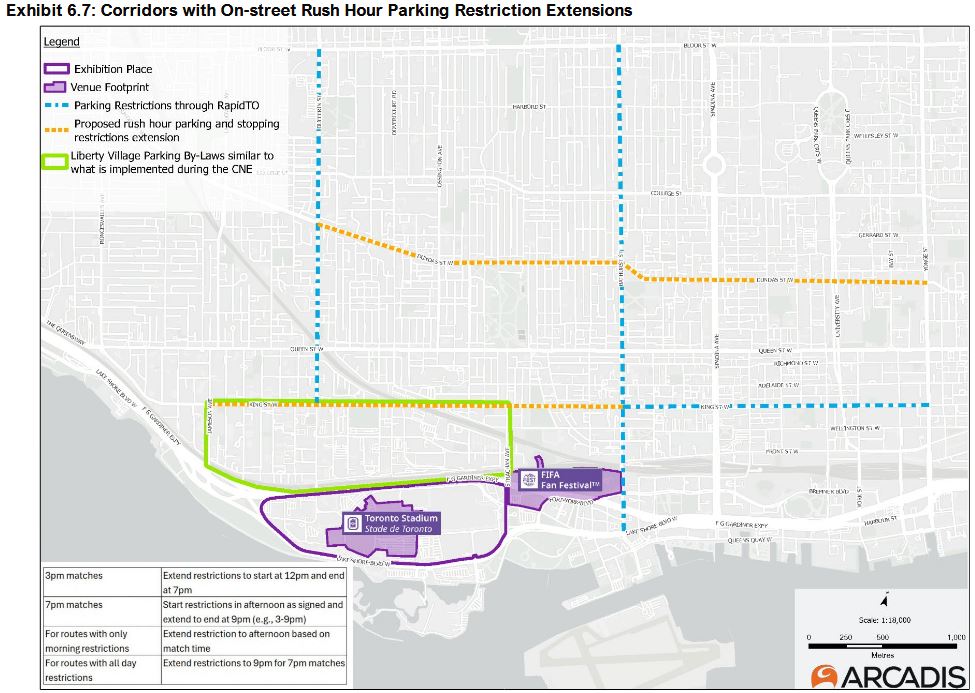
Parking on some arterials that now only exists during peak periods will be extended to improve road capacity.
Transit Access
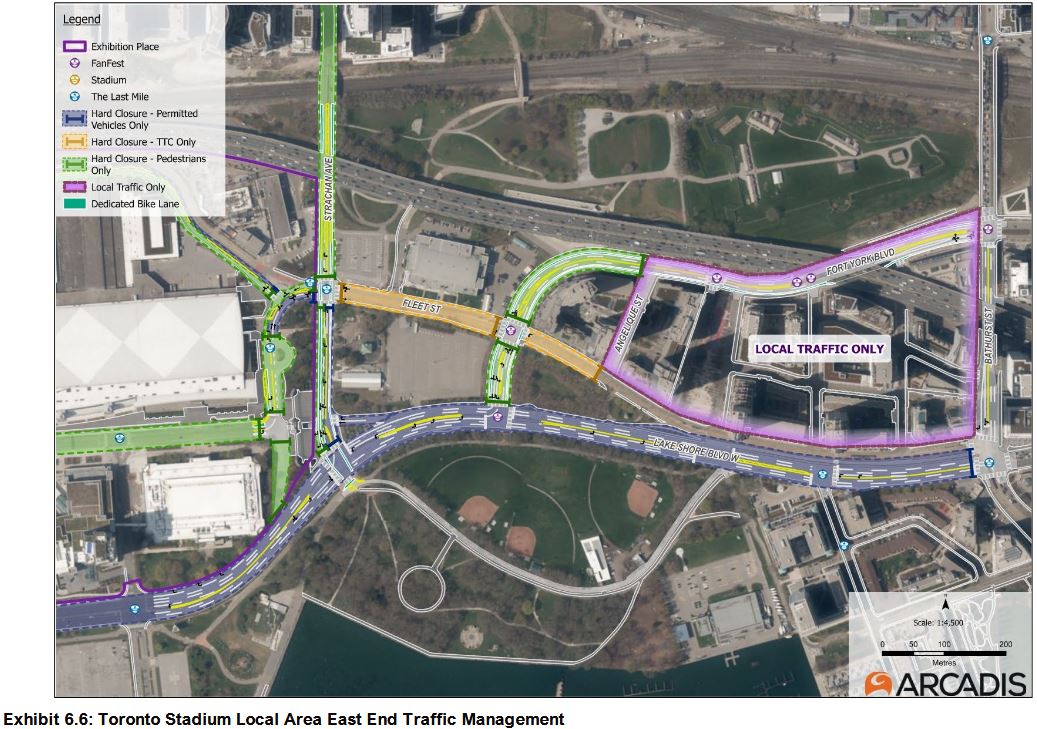
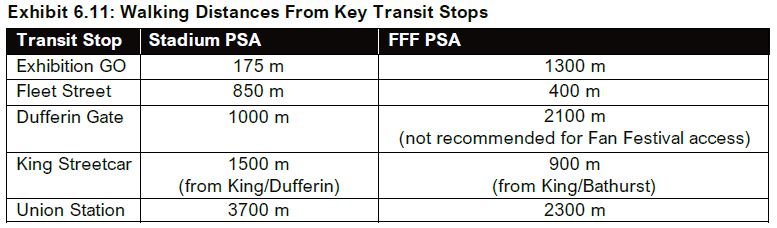
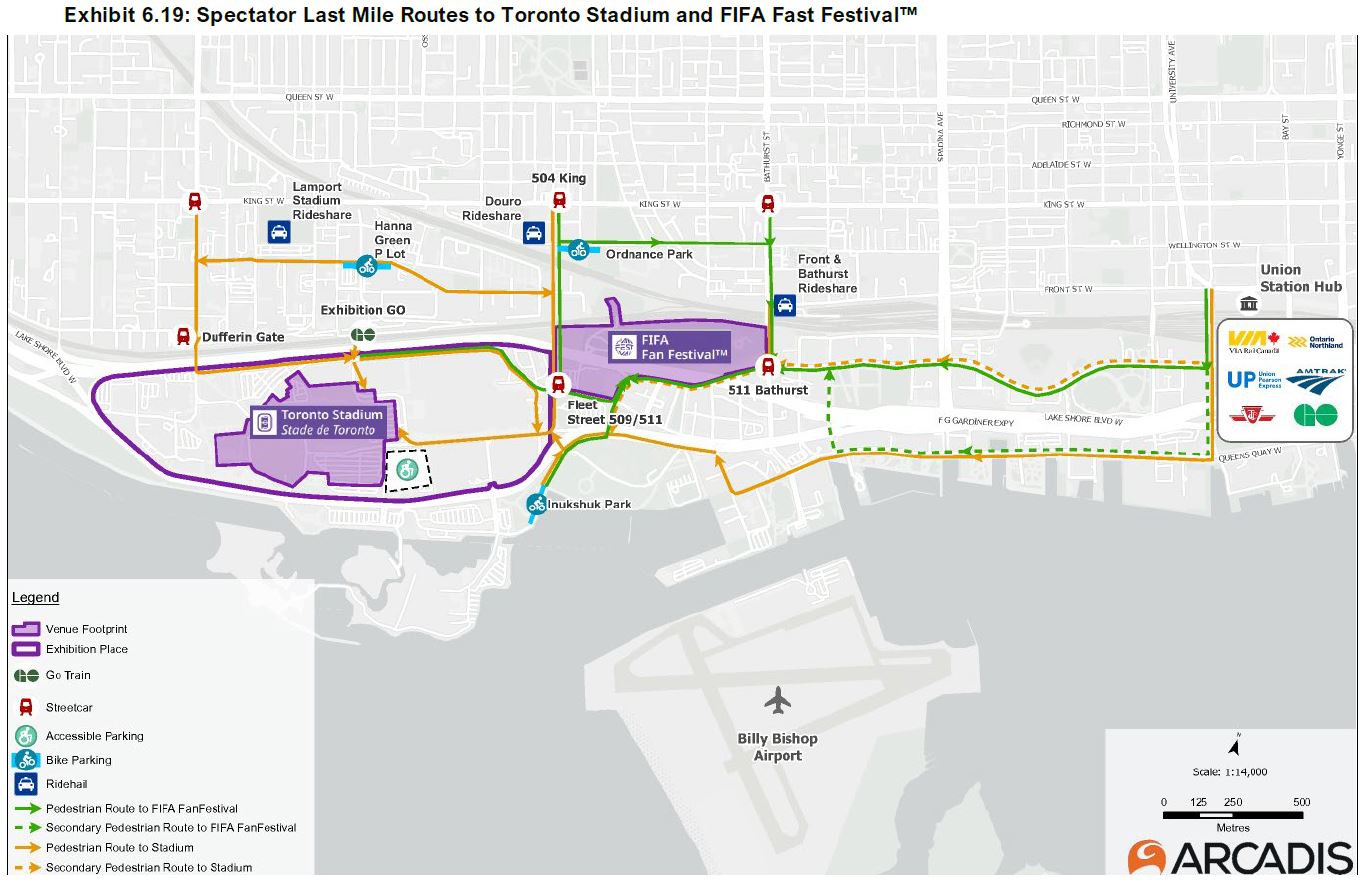
The area east of Exhibition Place will serve as a transit hub on Fleet Street plus the Fan Fest area at Fort York and The Bentway (under the Gardiner Expressway). The primary access for 509 Harbourfront and 511 Bathurst streetcars will be on Fleet between Strachan and Fort York Boulevard (orange in the map below). Exhibition Loop will be used only by riders requiring deployment of an access ramp.
The projected mode shares both to the stadium and to the Fan Fest area are:
- Transit (TTC+GO): 70%
- Active Transportation: 13%
- Taxi/Rideshare: 10%
- Auto (self driven): 7%
The GO Transit share is expected to be lower for the FanFest area because it is further from Exhibition GO station.
The plan is inconsistent about the number of attendees to be served. This will affect the total transit demand and the need for extra service on game days.
| Stadium | Fan Fest Area | |
|---|---|---|
| Capacity | 45,000 | 20,000 |
| Planned attendance | 36,000 | 25,000 |
Transit service is expected to accommodate arrivals and departures with the following profiles:
Arrivals
- 3 hours before: 20%
- 2 hours before: 50%
- 1 hour before: 30%
Departures
- 1 hour after: 70%
- 2 hours after: 25%
- 3 hours after: 5%
With an expanded stadium, the Fan Fest and limitations on parking, transit will carry far more people than it does today especially during the after event surge.
TTC service will be provided on various routes taking advantage of reserved lanes.
- 29/929 Dufferin bus service to Dufferin Loop
- 509 Harbourfront streetcar service from Union Station to Exhibition Loop
- 511 Bathurst express streetcar service from Bathurst Station to Exhibition Loop. Buses will run in parallel for local trips.
504 King will have extra service with riders expected to walk south to the stadium or Fan Fest. 504 cars will not use Dufferin Loop to maximize capacity for the 29/929 Dufferin bus.
The scheduled streetcar services will be improved beyond what is normally provided. Additional service will operate on game days. The values below are from the Mobility Plan and have not yet been confirmed by the TTC.
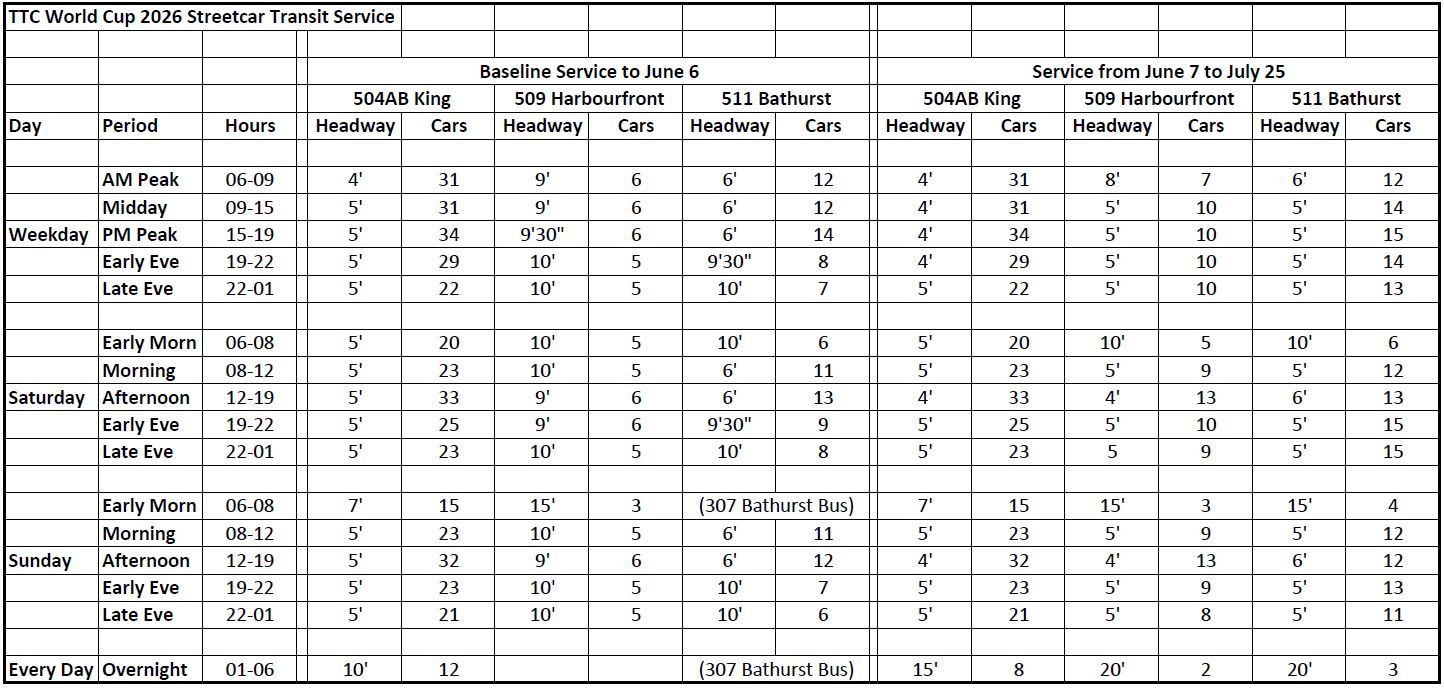
Specific service levels for 29/929 Dufferin are not shown beyond saying that there will be “enhanced” service plus match day express shuttles.
GO Transit will operate a 15 minute service on the Lake Shore corridor with extra trains possibly down to a 10 minute headway before and after matches. Their service is constrained by infrastructure including train spacing on the corridor and the combined service through Union Station. GO passengers arriving from other corridors face either a transfer to/from Lake Shore trains, a long walk from Union to Exhibition Place, or the limited capacity of the Harbourfront streetcar link notably the small loop and loading area at Union.
Taxis, Ride Share and Cycling
Access by taxis, ride sharing and cycling will, like all other traffic, not be allowed within the stadium or Fan Fest restricted zones. Three taxi/ride share drop off and pick up points will be created at Lamport Stadium, south of King at Strachan & Douro, and at Front & Bathurst.
Bike parking, including Bike Share terminals, will be at the Hanna & Liberty Green P lot, Ordnance Park east of Strachan, and at Inukshuk Park on the waterfront.
One challenge for cyclists is that there are areas with potential conflicts between large volumes of pedestrians and cyclists. “Walk your bike” will be the expected behaviour.
In the map below, a streetcar symbol is shown at Dufferin Gate, but the 504 streetcars will not actually go there, only the 29/929 Dufferin bus services.
Fare Payment
Fare payment will be via the PRESTO system at the standard rates including the GO/TTC integration. However, a limited time regional pass might be available.
A proposed new Regional Tourism Transit Pass pilot, subject to successful technology testing in early 2026, will provide visitors with an integrated and convenient means of payment across multiple transit systems while travelling throughout the GTHA. The PRESTO-enabled pass will offer unlimited travel on GO Transit, UP Express, and the TTC for 3-or 5-day periods. Modeled on established programs in global cities such as Paris and London, the initiative is intended to enhance the visitor experience, reduce transportation barriers, and support broader regional exploration. [p. 63]
The Rest of Downtown
Not mentioned in detail in the plan will be the effect of added travel demand and road closures both on traffic conditions and transit service in the central city. Past experience has shown that traffic control during events and in response to construction tends to focus on the immediate area, but locations further afield can be badly affected.
Not only does this snarl traffic, but transit service passing through affected areas deteriorates or vanishes affecting riders far from the event. Personally, I will completely avoid affected areas on game days, but many people do not have this flexibility.
Toronto talks a good line about transit priority, but does not always deploy the resources needed to provide it and to enforce restrictions on motorists’ behaviour. The FIFA games will be a major test in telling motorists that they are not in command of streets.
 Steve Munro