
The TTC’s Strategic Planning Committee will meet on March 31, 2026 at 9:30am in the boardroom at TTC headquarters, 1900 Yonge Street. There are three items on the agenda. Two of them deal with financial plans, and I will turn to them in a separate article. The third is an updated Ridership Growth Strategy, although it is really a rehash of current plans with little attention to actually achieving growth.
Previous iterations of the RGS, especially the original in 2003, were built on the premise of showing what actions to gain riders might be possible and at what cost. This is repeated in the current report, but with no new initiatives beyond those already in the TTC’s Five Year Plan.
The report begins by noting that ridership growth has stagnated and sits at a level well below pre-pandemic figures. Travel declined generally in Toronto from 2024 to 2025, and the change (-3.1%) lies in the middle of the range of declines seen by TTC in various periods. The report notes:
The shift in ridership and customer boarding patterns suggests that the surface network is serving fewer long-distance bus riders, discretionary trips, and shift workers at manufacturing and warehousing areas, as well as work commutes to businesses in the educational services, administrative and support, real estate and rental and leasing, and retail trade sectors.
Overall, the decline in surface boardings is system-wide and not tied to particular corridors, though outer parts of the city are most affected with boarding losses strongest in suburban and outer urban areas.
[…] the most significant opportunity for ridership growth comes not from creating new travel where it no longer exists, but from ensuring the TTC is the most attractive, reliable and competitive option for the trips people are still making. [Report at pp 1-2]
| Comparison to 2019 | |
| Ridership | 80% to 83% |
| Revenue | 92% |
| Expenses | 137% |
| Cost Recovery | Down from 65-70% to 46% |
| Ridership decline since February 2025 | |
| Midday and evening | 4% to 6% |
| Peak periods | 1% |
| Weekends | 4% to 7% |
| Toronto Travel by All Modes | |
| Q4 2024 | 6.6 million trips |
| Q4 2025 | 6.4 million trips |
The decline in offpeak travel is troubling because this segment showed stronger growth while the peak period recovery was hampered by changes in work and commuter patterns.
The perception of transit as an option is declining, but this is a refreshing, if not welcome, view of customer satisfaction stats. In past reports, TTC tended to pump every increase in values, no matter how small, without considering the overall trend as context.
Customer satisfaction declined in 2025 and is lower among priority groups: Gen Z, shift workers, women and customers with low income. Customers generally feel safe on the TTC, with 89% of customers reporting they feel safe on vehicles and 77% at stops, though there is room to improve. [p. 3]
The TTC recognizes the need to be more attractive to existing and would-be riders, but the challenge is how this could be achieved.
By improving speed, safety, affordability and making the experience seamless, the TTC can divert trips from other modes, most notably private vehicles and rideshare, and increase its overall mode share while retaining our existing customers. In a constrained travel market, growth depends on being the better choice: making transit the mode people prefer when they do need to travel and capturing a larger share of trips across all segments. [pp 3-4]
“Affordable, Fast, Safe and Seamless” are the plan’s four focus areas. Unfortunately, the detailed descriptions leave key questions unanswered.
- What is “affordable”? The report notes that riders care more about speed than “minor” fare changes, but what are the implications for fare and revenue growth? Are fares frozen forever or will they start to rise to cover part of transit’s growing cost?
- “Speed is not a luxury feature, it is a core performance requirement. Makes Transit Competitive with Driving. Travel time is the top factor in mode choice.” These statements imply an attempt to compete with auto speeds using transit, but this is simply not possible especially when access and waiting times, not just in-vehicle travel, are considered.
- The Safety bullet concentrates on perceived and actual safety and security for passengers, a factor that depends not just on the TTC but a wider group of social agencies and policies to address a variety of economic and mental health issues.
- The Seamless bullet talks about access to trip planning information, a positive experience on vehicles and in stations, and “confidence that they can predict and complete their trip”. This is not just a question of a better website or new ways to access information, but that transit operations reliably provide the advertised service. The Plan is utterly silent on the need for better service management and standards.
Ridership History and Projection
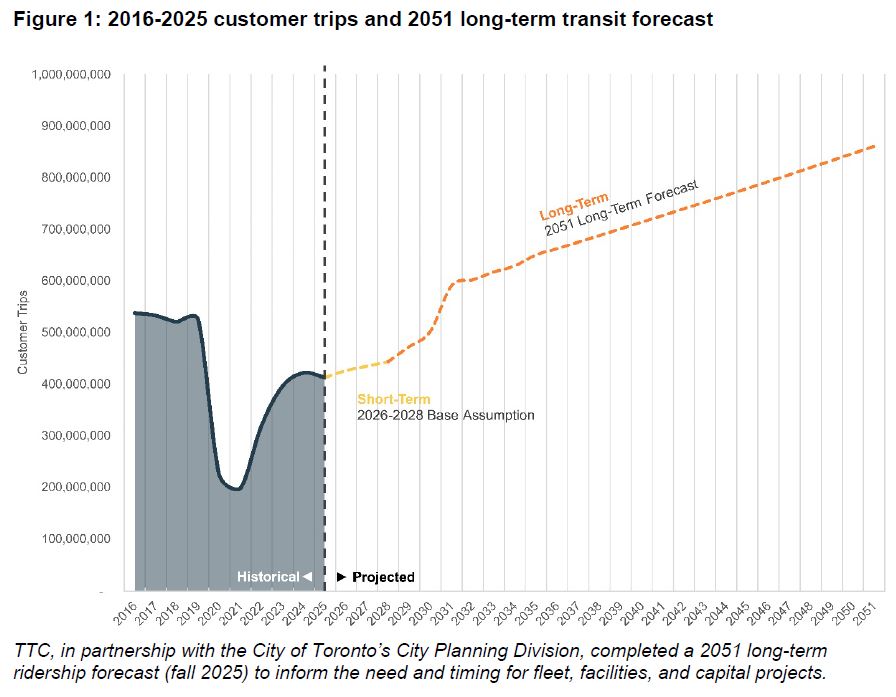
Together with City Planning, the TTC presents a chart showing ridership over the past decade and projections out to 2051.
In the prepandemic period, ridership had already plateaued by 2016 and began a show decline. At the time this was ascribed basically to the system being “full” and all of its spare capacity, especially off-peak where growth had been stronger, being used up or tuned out of the service.
Next comes the huge drop in the early 2020s followed by recovery, but not to the 2016 level.
Short term modest growth is projected out to 2028, followed by a strong upturn especially post 2030 where the effect of new and extended subways comes into play, and then strong sustained growth out to 2051.
However, the post-2030 growth is not explained as to where it will come from, what parts of the network will be most affected and the type of trip this growth represents. The 2051 value doubles current ridership, but it is not clear what will bring so much additional demand to transit.
The City’s TransformTO plan (not yet fully endorsed by Council) contemplated doubling transit ridership by 2050 in its original form, although this was shifted back ten years to 2040 by Council’s embrace of a more aggressive target for a Net Zero city. That forecast line looks much more like the wishful thinking of TransformTO than a considered opinion on the likelihood of such growth over the period.
Because the current report only takes us out to 2028, there is no discussion of the fleet, infrastructure and staffing implications of such growth, nor of the financial implications. Moreover, this growth rate is not reflected in the financial reports on the same Strategic Planning agenda.
The Short Term Plan
The plan for 2026 is modest and includes only a few provisions directly related to service quality. The basic problem is that each year’s budget looks only at what can be afforded, not what might be done. Planning ahead has too often been left to “next year’s budget”, but seems to be forgotten when that opportunity comes around.
Table 1: 2026 Key Ridership Growth Strategy initiatives
- Freeze fares and introduce fare capping, set at 47 trips for all TTC customers
- Deploy Neighbourhood Community Officers on the subway network
- Pilot new and emerging technologies to enhance safety and reliability, such as: LIDAR for track intrusion detection, AI for suicide prevention, bus collision avoidance technology
- Implement station exit numbering at six stations
- Improve real-time information by piloting digital signage at 72 stops
- Expand 5G wireless service across the subway network to improve digital access to real‑time TTC information and alerts
- Introduce E-Ticket Convention Passes and launch Machine Readable Transfers on streetcars
- Reinvest LRT network efficiencies in service improvements
- RapidTO: Complete feasibility studies for Finch Avenue East and Lawrence Avenue East
- Install or update transit signal priority at 50 locations, and install regulatory transit priority measures at up to 15 locations
- Construct four queue jump lanes
- Make 150 stops accessible
- Pilot Real-Time ASL/LSQ Video Assistance
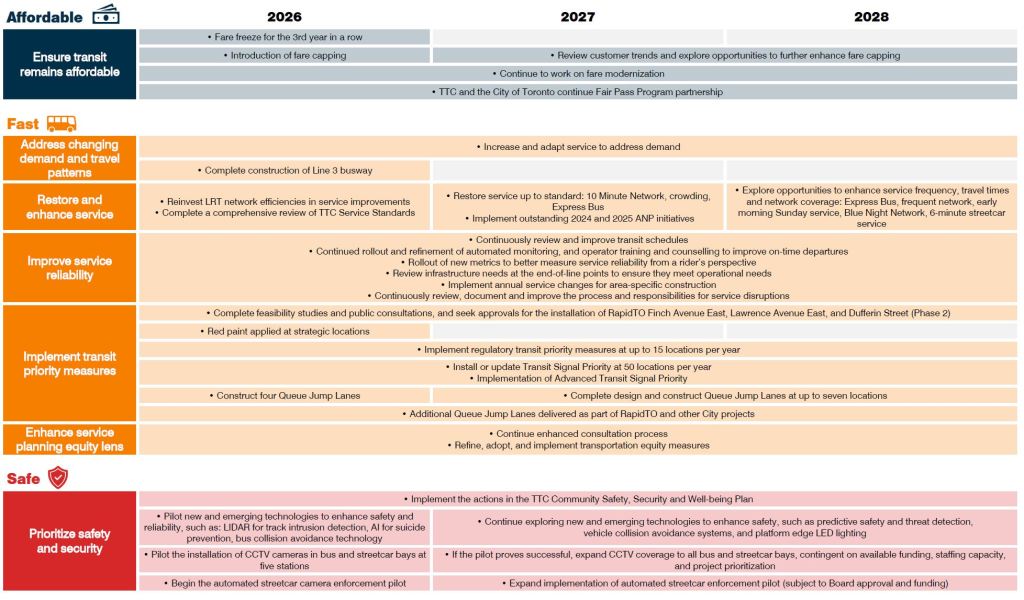
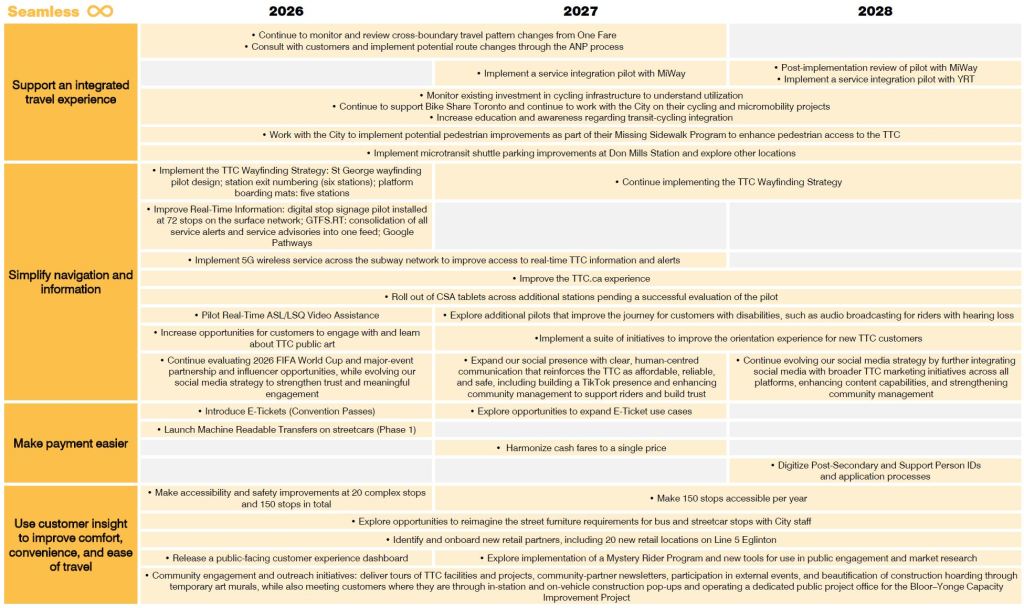
Consolidated 2026-2028 Action Plan
The next three years include some provision for service growth and, notably, include a recognition that some services are already not running at the TTC’s crowding standard. The specifics are not listed, but should be along with future tracking to ensure these are corrected. Nothing here addresses a shift to an aggressive growth rate shown in Figure 1 above because this lies beyond 2028. However, planning and policy decisions are required now to either embrace this level of growth or to consciously aim lower.
Note that there are far more items in this table than are shown in the estimated cost of improvements beyond a business as usual level. These improvements are shown in the next section.
Proposed Service-Related Improvements
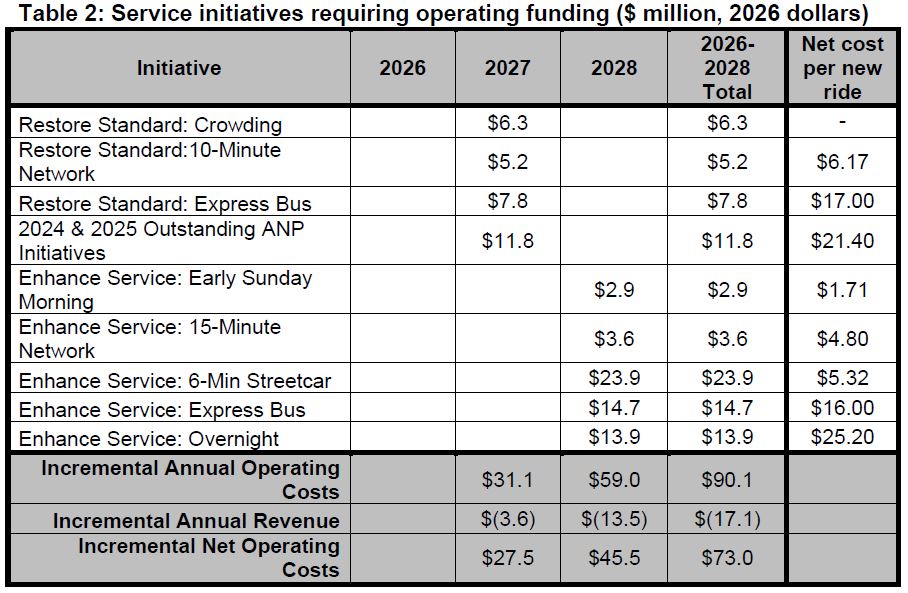
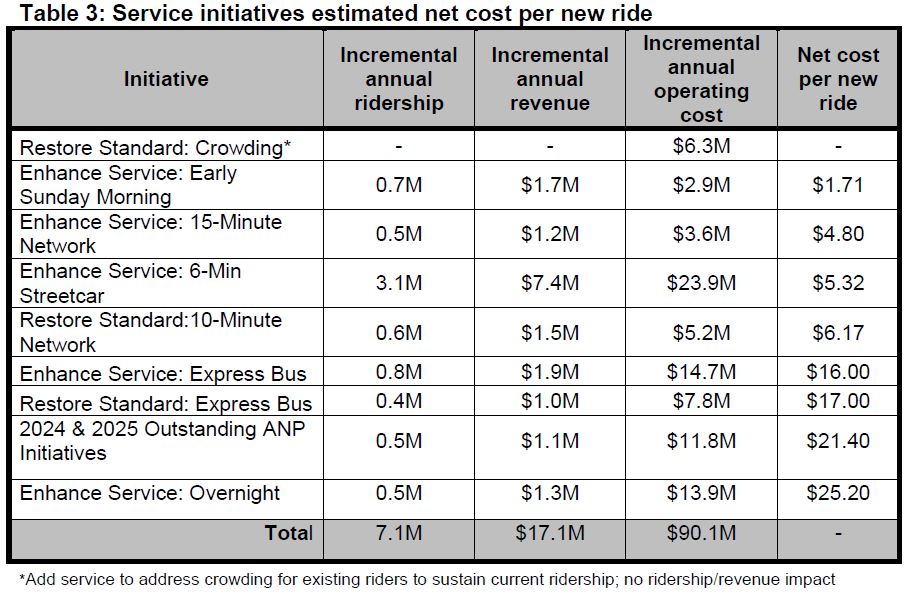
The anticipated effect, depending on how much service is improved, is growth to 451 million rides by 2028, 7 million or 1.6% over the “business as usual” value of 444 million. The cost of the changes above current budget is $90.1-million annually partly offset by $17.1-million in new revenue. The tables below show the proposed rollout by budget year, and also by net cost/rider. It is not hard to guess which of these would be cut to fit available funding.
Discussion of these options would be aided by an actual description of what is proposed for each item to put the cost and benefit in context.
Also, because there is no discussion of longer term growth requirements, options and costs, we do not know what other plans and priorities might dislodge some of these. For example, is better local daytime service more important than more express buses or night service? Which of these also has a social benefit component, such as night service, that justifies the investment?
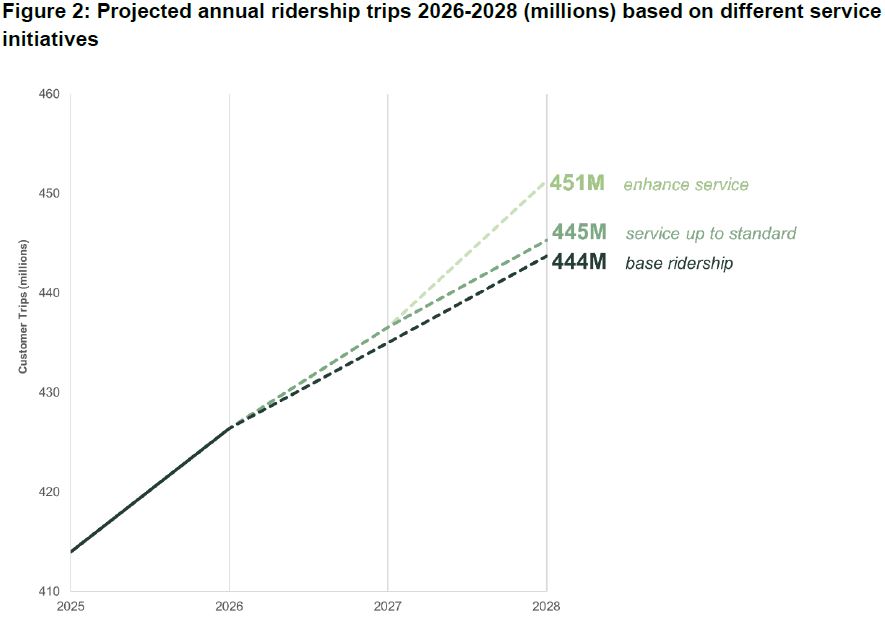
Travel patterns have shifted, customer expectations have not. Ridership growth will not occur by default. It requires deliberate, sustained investment in the fundamentals that make transit the mode of choice. [p. 7]
The plan observes the need for ongoing investment, but gives no indication of the components nor their magnitude to achieve a strong growth rate beyond 2028. The strategy will be presented to the April 16 Board Meeting, but it is unclear whether it will contain any more than what is shown in this report.
In particular, there is no discussion of scaling the projected growth and investment to lower targets and what this would imply. Is the sustained growth to over 800-million rides actually possible? Is that growth the result of real planning work supported by anticipated population and job growth, or is it a notional value to satisfy the TransformTO goals? Is the actual target 2050 or 2040? Will Council and other governments invest at the level to make this happen, and how will this be funded in an environment where every promised dollar is already over-subscribed by high priority projects?
Capital Shortfalls
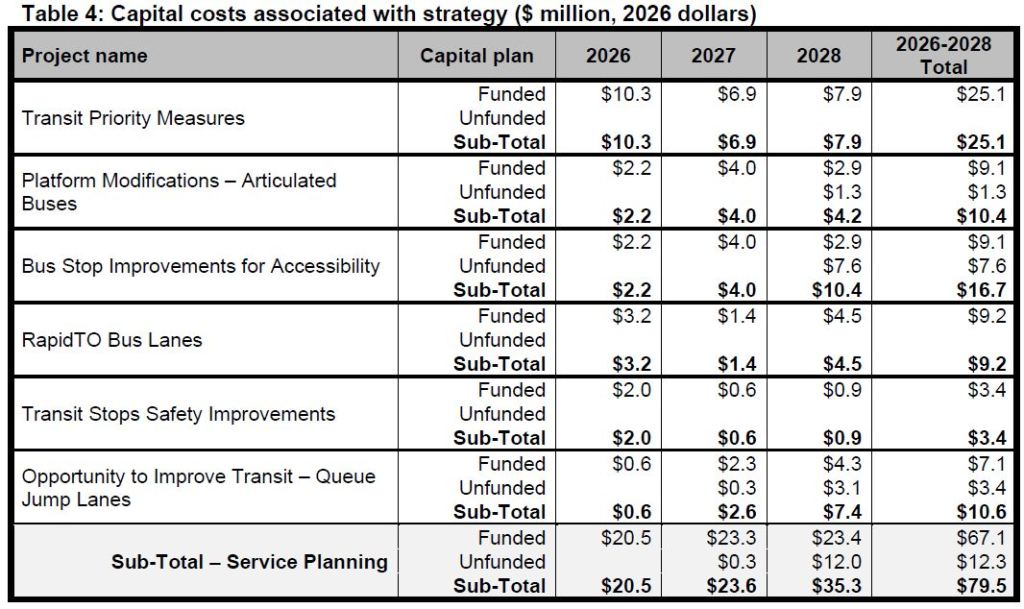
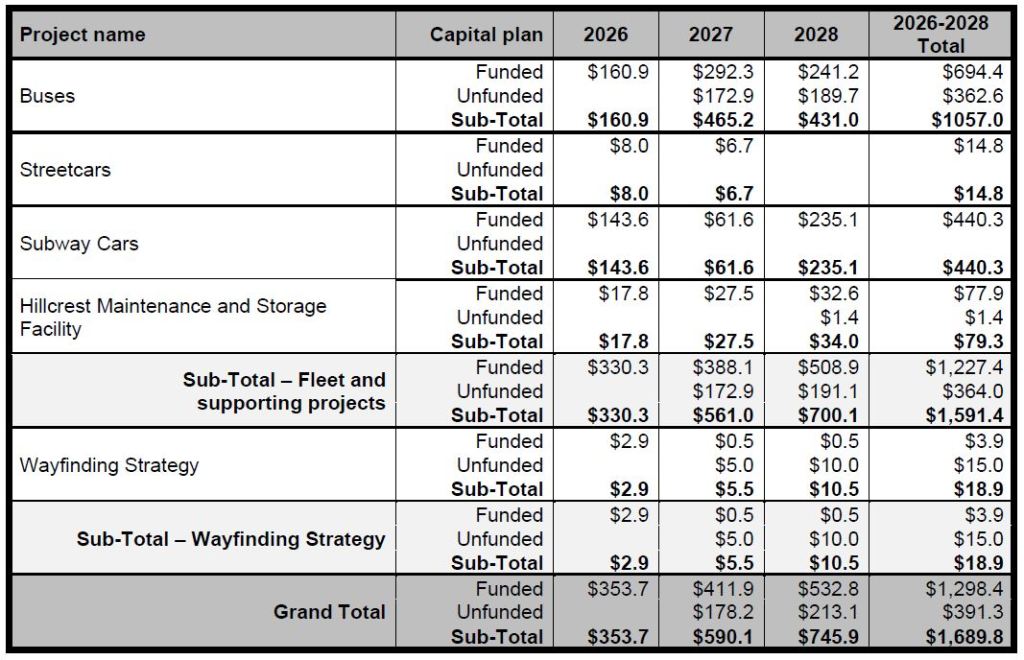
The report lists various capital projects and their funding status for 2026-2028. Roughly two-thirds of the total is for new buses. Most of these are replacements for existing aging vehicles with only a small provision for service growth. Another quarter is for subway cars, partly for overhauls and partly the early costs of replacements for the Line 2 fleet.
The streetcar cost shown here, $94.1-million, are the tag end of the fleet expansion and carhouse renewal/conversion to accommodate the new cars.
Note that there are many other lines in the Capital Plan and a huge shortfall in funding. There is no capital projection for the aggressive growth projected out to 2050 nor any discussion of whether spending on growth will be overwhelmed by other plans.


Hands down, the two biggest factors in dropping passenger numbers are the negative effects of allowing the system to become a roaming homeless shelter, and turning a blind eye to anti-social and criminal behaviour.
Next would be terrible route management and unpredictability.
I feel like the TTC could probably skim by with the abysmal service. But when you force people to deal with your horrible service plus some homeless guy ranting and raving at everyone, accompanied by his shopping cart full of empty bags. wearing no shoes and having not showered since December. Well, that is just to much for most people on a Monday morning.
And when you’re asked to provide proof of payment only to watch them ticket and kick off passengers who have something to lose. but they ignore the guy smoking crack at the back of the car, or the one sleeping across 3 seats. Well….. people get a bit sick of it. We pay to ride this service. As such, the minimum we expect is to feel safe and get to where we want to go, more or less on time. Compassion for a minority can’t come at the expense of the comfort and safety of the majority. People with the means to will just find alternatives to the TTC. And soon you will be left with just passengers who have no alternative.
Steve: One of the issues with the fare inspectors is that they have no powers beyond that function. It’s ridiculous that they can issue tickets for vastly more than an illegally parked car would receive, but can’t deal with the homeless, drug users and others. That said, if we expand their powers (and with appropriate training) it is possible that fare inspection might take a back seat and the fiscal hawks would gripe about lost revenue. They don’t seem to consider the revenue effects of unsavoury environments and behaviour.
LikeLike
We need to talk about the inability for the TTC to finish projects that should be finished…that 5G, bus stop accessibility, queue jump lanes are still on this list is ridiculous…
We need a project to finish projects…finish quick, close them off, fire or rehome everyone that was working on them and reduce the number of projects in flight…it’s nuts…
One of the things that makes people hate the TTC is they keep promising stuff but do it at the most glacial pace possible…it makes riding the service a daily reminder that nobody seems to have any urgency behind their on street service, or their project delivery…
LikeLike
The TTC and the City have allowed the streetcar network to become a shambles. This is the backbone of downtown core east/west transit and the speed restrictions across the whole network are tanking ridership.
The crown jewel of the SC system, 504 King crawls along, stopping at every single light, every intersection and every 200metres because we insist on having stops at every corner, all despite King being a so called transit priority corridor. It’s shouldn’t take 23 minutes to travel 2km (Fact, I timed it yesterday Parliament to John). When it’s quicker to walk, you know transit has failed.
Toronto’s streetcar network should be the envy of other cities but instead it’s a laughing stock.
Steve: For the record the average stop spacing from Parliament to John is just under 300m. The closest spacings are Sumach to Sackville (needed because of poor transfer provisions at Sumach), and Yonge to Bay (I don’t think you could reasonably eliminate a stop at Bay). The Bay to Simcoe spacing is already over standard because of the elimination of the stop at York, also the stop at Trinity (east of Parliament) was removed a few years ago. There are problems with a lack of useful TSP at signals where there are no stops, notably at George and York Streets, and of course the complete absence of TSP at other locations which have farside stops and encounter the double-stop problem.
Re travel on March 26: You can look at the travel times on TransSee. For trips from Parliament to John, there is one trip above 20 minutes just after 5pm. Times generally range from 11-15 minutes with a scheduled time of about 13.5, but there is a lot of variation, the very thing the King transit priority scheme was intended to eliminate. The long trip was car 4469 and it was held for several minutes at University Avenue.
LikeLike
Couldn’t agree more about TTC taking FAR too long to finish projects. Examples:
1. The amazingly slow speed of reinstalling station ‘wall and ceiling panels’ at St Andrew, Queens Park etc. This has been going on since well before covid.
2. Exterior signage at subways stations. They had a project a decade ago to install standard exterior signage at subway station entrances. They did all stations on King but could not do the entrances on north-side @ Yonge due to building renos and ‘electric power issues’. There are still no proper standard signs to King Subway entrances there.
3. They gave up on the Downtown Express Routes years ago, there are still stops saying they will arrive. (George north of King being for the 141 being an example.)
On why riders have deserted the system – though being exposed to unruly homeless people is not pleasant, I suspect the main cause is the poor management of schedules. In fact, if more ‘regular people’ rode the TTC there would be more ‘eyes on the street’ and it would feel safer!
Steve: A big problem with negative experiences is that they don’t have to occur on every trip, just often enough to seem likely. A simple example would be a trip interruption serious enough to be very annoying. If it happens one trip in ten, that’s once a week for someone who just uses the system for daily commutes. Service “quality” at 90% sounds good but effectively means one incident a week, more for frequent users.
The same applies to uncomfortable social encounters which could be with homeless people, but there are other types who make the environment feel unsafe. It doesn’t have to occur all the time, just enough to be a common impression that it’s likely.
I think there is too much back-patting for achieving “high” rates of performance whatever is being measured. It’s that other 10% that undermines things, and on some parts of the system it’s way higher.
LikeLike
King has also now become the defacto route to travel through the core for Toronto Fire, EMS, and Police for any emergency calls. With Adelaide plugged up, Queen blocked, and Front Street a mess, it’s the only way they can move around, so anytime an emergency vehicle is around it all grinds to a halt. It doesn’t help that for medical emergencies they dispatch both fire and EMS, and use three vehicles to respond, all of which come by one minute apart from each other. Throw in there all these delivery and rideshare vehicles for anything and everything now parked along King between Bay and York and it’s back to the way it used to be.
LikeLike
The streetcar track work on Queen @ the Don has finished and the 503 bus (and other routes) are back to normal. BUT, according to the TTC website announcement, the info on routes etc will not be updated until May 3. More than four weeks away. Seems an amazingly long time to offer accurate information to ‘customers’ …
Steve: Yes. TTC generally does not update the gtfs scheds on open data that drive trip prediction apps. It is a major gap, and their deal with TransitApp to second guess locations does no address the wider realm of info sources riders use.
LikeLike