
The last of the TTC’s 60-car add-on streetcar order arrived in Toronto recently, and entered service on December 16, 2025. This brings the streetcar fleet to 264 vehicles.
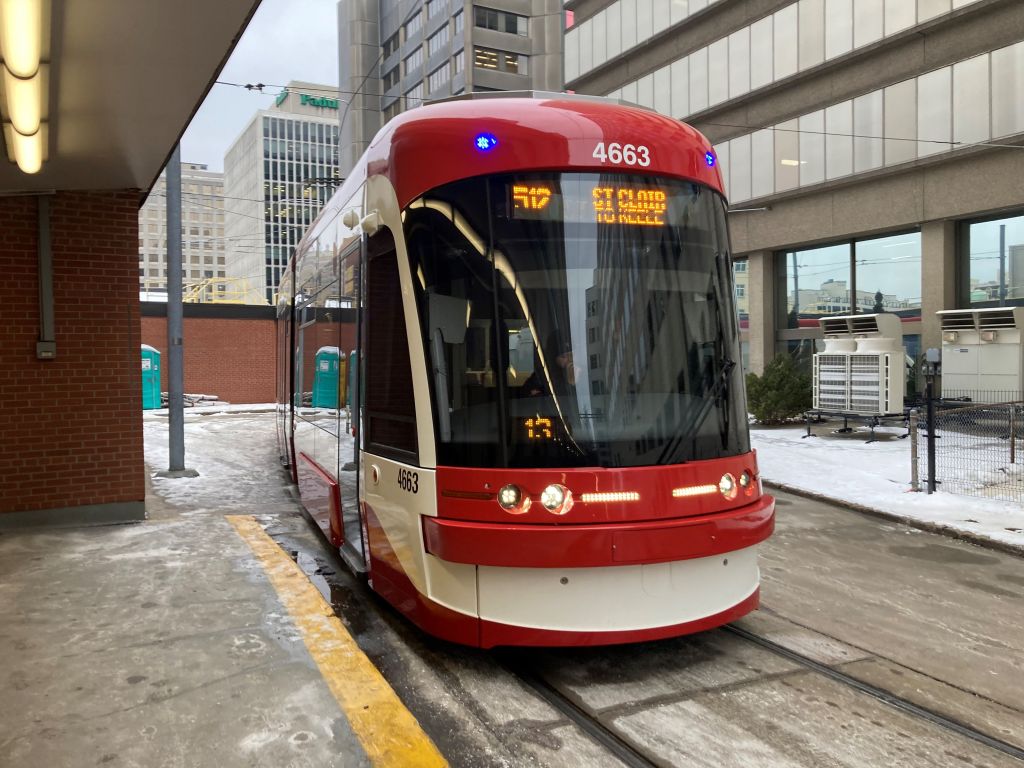
With so many streetcars, the real shame is that the service is so poor on many routes through a combination of 10-minute headways and erratic operation, not to mention the effect of never-ending diversions, construction projects and bus replacements.
The TTC began a shift to a 6-minute headway standard with 512 St. Clair earlier in 2025, and this was followed by 505 Dundas and 511 Bathurst in mid-November.
Due to construction at Queen & Broadview, the 503 Kingston Road car is operating with buses, and will continue to do so at least until April 2026. There are moves afoot within the TTC to kill off the all-day operation of the 503 downtown, but one of its biggest challenges comes from irregular service on the 503 itself, and the total absence of headway blending where the 503 joins the 501 Queen car westbound at Kingston Road and Queen. Pairs of 503 buses are a common sight today, and 503/501 pairs were common when streetcars plied both routes.
The TTC simply does not take seriously the effect of unreliable service on ridership.
As we see a move to a new 6-minute standard, the question is just how far the 264-car fleet will stretch. The table below shows all of the streetcar routes with headways and PM peak car requirements. Toronto has not seen every streetcar route active at the same time for a very long time thanks to equipment shortages during the later days of the CLRV fleet, and the omnipresent construction projects that always managed to keep a route running with buses. One might think that the TTC overextended its route closures simply to save on streetcar operations.
In fact, a big shortage lies in operating staff and in budget headroom to field more cars on a scheduled basis.
If all streetcar routes were operating with streetcars today, the TTC would need 172 cars for service. A 20% provision for spares would raise this to 206 leaving a substantial pool of cars on the sidelines.
The right-most column below shows the current peak requirements scaled up for routes that now run on headways above six minutes. For example, getting 501 Queen down from a 9-minute to a 6-minute service would require 14 more cars. The total for an all-streetcar operation would be 215 cars, plus 43 spares for a total of 258, only slightly below the fleet size.
Until we see details of the 2026 budget, we will not know if any more routes will join the 6-minute network in the coming year.
| Route | Headway | Peak Cars | Cars Required for 6-Minute Network |
|---|---|---|---|
| 501 Queen | 9’00” | 28 | 42 |
| 503 Kingston Road to York (April 25) | 10’00” | 12 | 20 |
| 504 King (April 25) | 5’00” | 27 | 27 |
| 505 Dundas | 6’00” | 25 | 25 |
| 506 Carlton (Sept 25) | 10’00” | 19 | 32 |
| 507 Long Branch | 10’00” | 8 | 13 |
| 508 Lake Shore | Trippers | 5 | 5 |
| 509 Harbourfront | 9’00” | 6 | 9 |
| 510 Spadina | 5’00” | 14 | 14 |
| 511 Bathurst | 6’00” | 14 | 14 |
| 512 St. Clair | 6’00” | 14 | 14 |
| Total | 172 | 215 |
The 60 new cars were intended both to handle growth and to provide for the Waterfront East line that is still only a faint hope for better transit there. An update on this project is expected at Council early in the new year, but a projected opening date lies in the 2030s.
The TTC is also short carhouse space. Thanks to the arrival of all 60 cars well before planned work completes to expand storage and maintenance capacity at Russell and Hillcrest. Part of the main shops will be converted as a streetcar barn serving 512 St. Clair and possibly 511 Bathurst. Several Blue Night streetcar routes operate with improved headways simply to reduce overnight storage demands on the carhouses.
The streetcar system always pulls up the rear in reliability stats, and recovery of pre-pandemic demand is not as strong on that part of the network as elsewhere. This is due in part to a shift in travel and work patterns in the area streetcars serve, but one cannot help wondering how much the erratic service deters riders from returning.
An ironic side-effect of a move to 6-minute service is that this makes “on time” an easier target, but with bunching as a daily event. The reason is that TTC vehicles can be up to 5 minute late and still count as “on time”. On a 6 minute headway, this easily leads to pairs of “on time” vehicles every 12 minutes. The real condition of service is hidden by a too-easily attained “target”.
The bus network also has fleet utilization issues, but these are a mixture of scheduled service levels, vehicle reliability, budgeted headroom for growth and the use of “Run As Directed” buses. The “RADs” are a relic of the Leary era that were routinely cited as a catch-all alternative to addressing specific problems. The vehicles were not well-used and their numbers dwindled as the pool of spare operators moved to other duties, notably on Lines 5 and 6. I will turn to the bus fleet in a future article.
For 2026, streetcar routes face many challenges:
- Provision of enough budget to allow improved utilization of the streetcar fleet.
- Service management that actually brings evenly spaced streetcars on dependable headways.
- Addressing the validity of operating practices that hamper streetcar speeds everywhere, rather than just at locations with problems such as badly worn track. This includes sorting out constraints that really do relate to “safety” as opposed to using that as a catch-all excuse for padded schedules.
- Addressing track switch controller issues that have plagued the streetcar network for decades.
- Providing real transit signal priority for streetcars including at locations where diversions and short turns see streetcars fight through traffic attempting turns with no signal assistance at all.
- An end to construction diversions scheduled for longer periods than actually needed to complete road, water, track and overhead repairs or upgrades.
- Getting City projects that are supposed to be co-ordinated with streetcar track and overhead repairs to actually start and end when they are planned.
 Steve Munro
Wait, did I hear you correctly? They’re thinking of cutting back the 503 to, what? Between Bingham and Woodbine?
That’s… not good.
Steve: The likely move would be to return to the old 502/503/22 configuration with streetcars coming downtown only weekday daytime. Probably 502 would not return and 503 would be the surviving route.
LikeLike
I have given up on the 504. Maybe one day when all the rerouting ends I may return.
LikeLike
As usual, the TTC’s study on the subject is stupid to begin with. When stupid people are put in charge of things they do stupid things.
The route runs every 10 minutes and they noted that the downtown and Queen portions met their arbitrary performance criteria. Okay it seems they learned how to count.
But then they reverted to their base state and complained about the failures on Kingston Road. So they cancel the service because of this and then what? Bring back the 22B to run every 10 minutes? Knowing these geniuses they’d probably bring back the 22B and then cut the 503 back to Woodbine loop for a cost savings of net zero!
Pairs? Three, four, and even five is common enough. I’ve seen some “theories” online saying the source of the problem is bus getting stuck behind streetcar but as far as I can tell bunching occurs whether there are streetcars around or not and also at all times of the day.
They could also cut into their money-wasting padded schedules to get breathing room.
Steve: I deliberately left out adjustments for that and for improvements from better TSP and aggressive deployment of traffic agents. They are obvious choices.
LikeLike
As a keen enthusiast of the 503 streetcar, I am depressed seeing so many streetcars sitting every day idle at the Connaught barns on Queen East. Yes it seems the powers that be and geniuses who brought us the huge monster streetcars just want to do away with thus long time route. Instead the line is choked with buses. Surely they use far more drivers than the streetcars. Why on earth did they buy so many streetcars if they’re not going to get used.? Ridiculous.
I also feel, with no data to back me up, that track repairs have increased immensely since the heavier cars started running. That’s also part of the problem contributing to constant diversions.
Steve: The number of repairs has not grown much beyond catching up on a covid-era backlog (King Church was at least four years overdue). What has changed is linking track work with water and sewer work that never starts on time and takes onger than expected. A shutdown that should last six to eight weeks drags on for months. That said, there are old pipes that need replacing, but much better co-ordination is needed between timing of city and TTC projects. Of course the Ontario Line construction isn’t helping much either.
LikeLike
I take the 503 daily and can unfortunately confirm what you’re describing — chronic bunching, long gaps, and severe overcrowding are the norm, especially with the 501 on detour. For riders, this is now the most direct downtown option.
From your experience, what’s the most effective way to bring these operational issues to the TTC’s attention so they’re addressed during the construction period rather than used to justify cutting the route?
Steve: This is very hard to say. The TTC Board has a few members who are sensitive to this, but manages to BS their way through discussions of service management. They seem to be aware that just putting a supervisor with a clipboard out on the line isn’t enough, but until they move away from “on time” to headway based management they can always use the excuse that buses and streetcars are late thanks to traffic and sit on their hands.
I’m hopeful that the recent attention to Finch and the clear need to make it better will spill over to the streetcar system downtown too. It’s only now that we have the political will at the Mayor’s office to do more than superficial changes and demand results riders can see quickly.
LikeLike
Thank you, Steve, as always! And Season’s Greetings!
LikeLike
Thanks you Steve for his continued advocacy and for consistently surfacing the hard, uncomfortable truths (loved the 2 Steve’s podcast appearance).
Steve: You’re very welcome! I have added a link to it for readers.
Reading about the challenges on the 503, especially when reflecting on the repeated reconstruction cycles at KQQR, Bathurst and Front, Church, Dufferin and now Queen and Broadview, brings back a familiar frustration. Time and again, Toronto undertakes massive, disruptive intersection overhauls, yet continues to install single-point switches. The result is predictable: deeper operational fragility, more slow orders, and more stop-and-go service at exactly the locations where reliability matters most.
Has the TTC ever provided a clear, public justification for continuing to invest in this outdated technology, knowing its long-term service impacts? Instead of digging the hole deeper with every rebuild, why is there no serious effort to at least start digging sideways toward more resilient infrastructure?
The question of why Toronto continues to rely on single-point switch technology should be directed to:
If the TTC board knew which way was up, should have these reviews with each infrastructure teams (Bus, Streetcar, Subway, and Stations) at least once a year to keep the TTC honest.
Intersection after intersection is rebuilt at enormous cost, with profound consequences for service quality. If Toronto genuinely wants to move beyond excessive running time padding, chronic slow orders, and initiatives like the Leary RAD becoming permanent crutches, then addressing foundational infrastructure choices seems like a logical place to start.
If the TTC can walk and chew gum at the same time, the path forward is not mysterious: modernized intersection design, stop spacing where appropriate, aggressive transit priority signals, and meaningful CAD/AVL-driven line management. Without that, we will keep spending billions to lock in mediocrity.
LikeLiked by 1 person
In 2024, Melbourne had done a study that showed that Toronto had the “slowest” trams, not Melbourne. Maybe Toronto should repeat the study AFTER the FIFA games to see if Toronto is still the “slowest” tram network in world.
LikeLike
While the 503 has been using replacement buses I’ve sometimes have occasion to use them to travel from downtown to the east end in the afternoon rush hour. Every time they’ve been prone to bunching, not with themselves but with the 504 and 501 streetcars. The Flexity operations are so slow that the 503 buses easily catch up to them and then get stuck behind them.
What was the historical reason for the different peak vs off-peak route structure on Kingston Road west of Vic Park that, until recently, has always been the case? The one-seat ride is nice if you’re going to/from downtown, but the tradeoff is that service on Kingston Road is no longer insulated from downtown disruptions and is prone to the same bunching and unreliability off-peak as in the peak.
Steve: Historically there were four streetcar routes:
The Coxwell and Kingston-Road Coxwell cars became the 22 Coxwell bus when the Danforth subway opened in 1966.
The Kingston Road car, later renamed “Downtowner” and extended from McCaul Loop to Bathurst Station, became the 502 when routes were numbered with the arrival of the CLRVs. The Kingston Road Tripper became the 503, and the “Tripper” name was dropped.
For a time both the 502 and 503 operated, but as headways widened, it made more sense to have only one, and the 503 won out because there was more demand for service to King Street. It ran weekday daytime and peak periods, and the Coxwell bus took over nights and weekends as before.
The idea of running the 503 all day came about in part from the desire for more service on King and Queen Streets East. The western end of the 503 has changed regularly depending on various construction projects. In fact the extension further west from York increased demand on the 503 because King Street was underserved on the west side of downtown.
LikeLike
Let’s not leave out Betty Hasserjian who is the (acting?) Chief Safety Officer, whose desk I’m sure has crossed paths with the useless customer-facing safety (slow down) initiatives.
If it were up to me I would throw all three of them out of the nearest airlock for poor performance and gross incompetence.
LikeLike
This can happen with or without the presence of streetcars. I was literally on a bus last week that caught up to the 503 ahead of it despite my bus being caught out behind two streetcars before turning off at Parliament. The op took full advantage of the long clear stretch of Queen to catch up to the rear bumper of the one ahead before the halfway point of the route.
LikeLike
Hi Steve
I want to thank you again for all of the work that you do. I hope that you, and yours, have a very Merry Christmas and a Happy New Year!
Steve: You’re very welcome, and seasons greetings back to you too!
LikeLike
The TTC simply does not take seriously the effect of unreliable service on ridership. Very important words, Steve. It’s why so many have tried to seek alternatives. Lack of reliability means missing planes, work, concerts or more. Alternatives are required. I guess that’s the new way.
Happy Holidaze!! Nancy
>
LikeLike
Today there seemed to be huge number of 503 buses on King – many in bunches – as we walked from Sherbourne to Spadina. As Operator costs are, I think, a very large part of the cost of running a vehicle, is it really cheaper to run (more) bus replacements when they could, I assume run (fewer) streetcars. From your tables they have streetcars ‘coming out their ears’.
Steve: The chaotic bus operation on the 503 has been quite amazing to watch, and it demonstrates the folly of the claim that “flexible” buses can provide so much better service. There are two reasons for bus replacement. One is to provide service on Queen from Broadview to Parliament while streetcars divert to Dundas for water main and track work. The other is that they don’t have enough streetcar operators to run full service. A likely third is that there are moves within the TTC to kill of the 503 car as an all-day operation.
LikeLike