
From the moment Line 6 opened in a magisterial whoosh of grandeur, well, maybe not exactly a whoosh, the issue of its glacial operating speed has fuelled many debates in social media.
One comparison that is always made is between the “LRT” and subway speeds. Yes, the LRT has closer stops, it has to deal with traffic signals, errant motorists and pedestrians, but it gives a new meaning to “glacial”. The downtown streetcar lines are in the same ballpark, and some of them best the brand new “LRT”.
There are many factors at work which I will leave for another day. This post is intended to provide info on the scheduled travel speeds of the two major subway lines and the new 6 Finch West.
The data are taken from the GTFS version of schedules used by trip planning apps. They do not match the actual speeds, but give a sense of what the TTC expects these to be, in general, for trains running “on time”. (The GTFS data includes times and spacing for every stop from which the scheduled speed can be calculated easily.)
In the charts for Lines 1 and 2 (Yonge-University and Bloor-Danforth), data are shown for both the AM and PM peaks. For Line 6 Finch, only one set of data is shown because the TTC has used a generic all-day schedule for the initial service.
The vertical scale is set at 60 km/hr for all charts. The average values for each set of data are at the right end of each chart labelled “Route”.
It is self-evident that subway speeds will be higher for many reasons including stop spacing and the fact that trains both accelerate to and run at higher speeds. However, the LRT speeds are embarrassingly slow. Riding the line even on a trip that makes its scheduled time, the car crawls across the route.
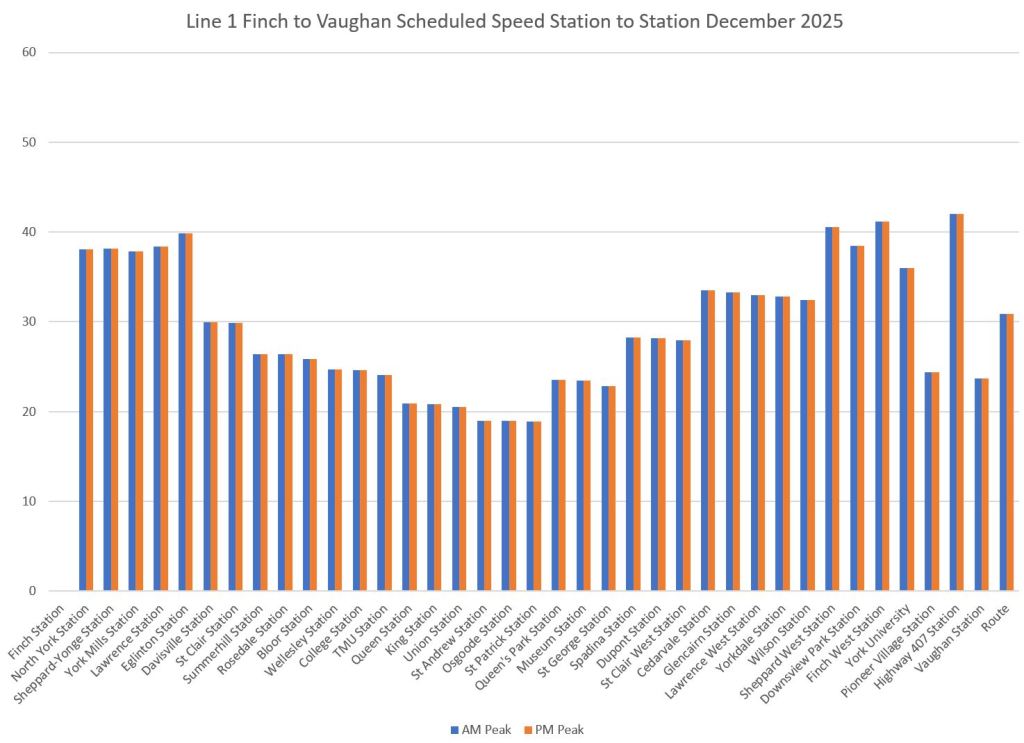
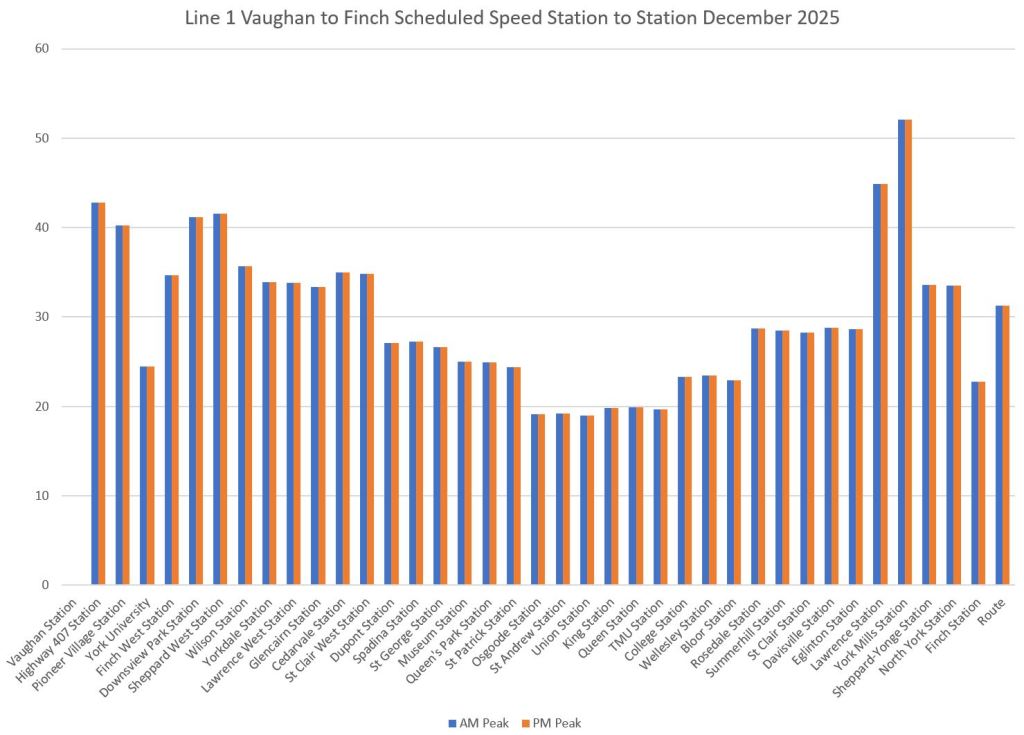
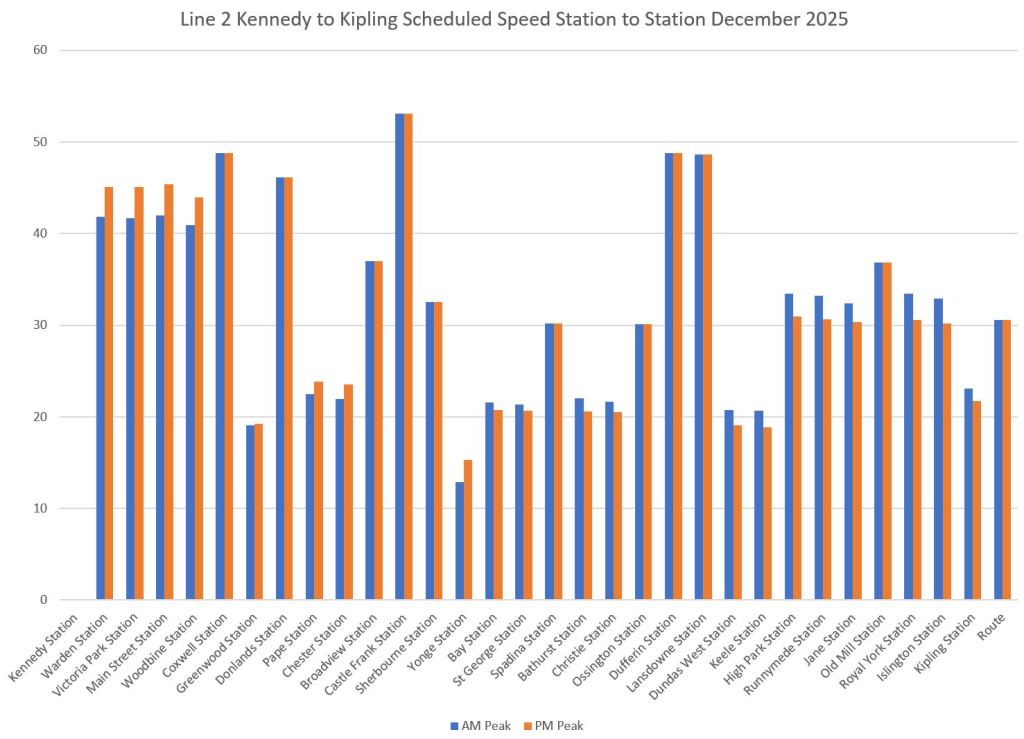
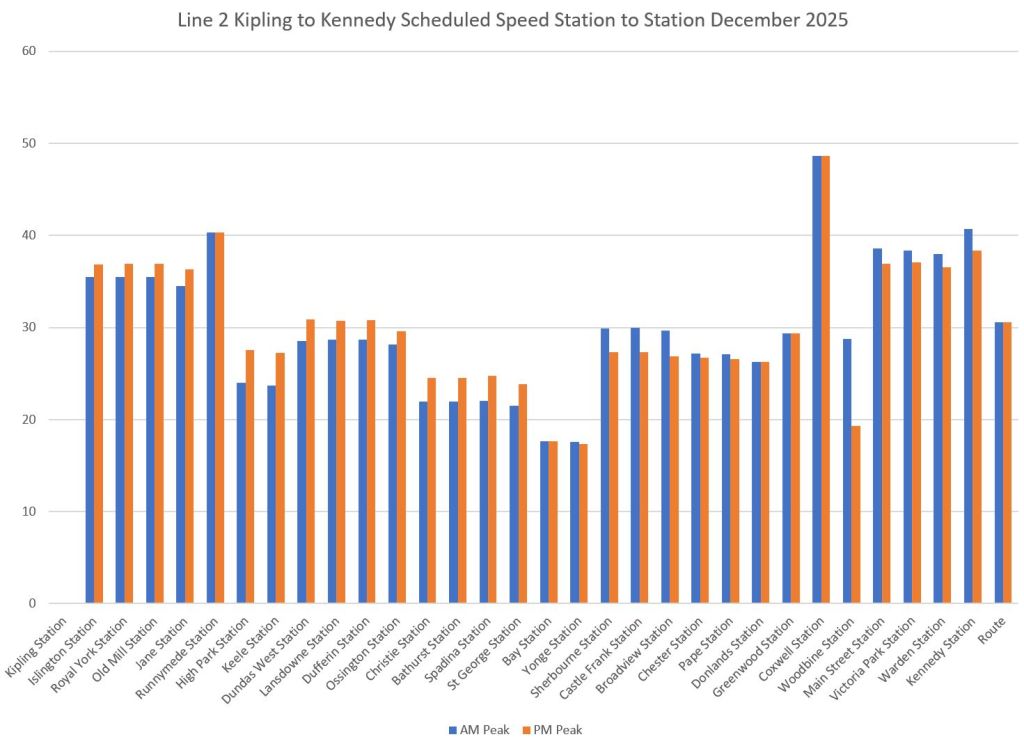
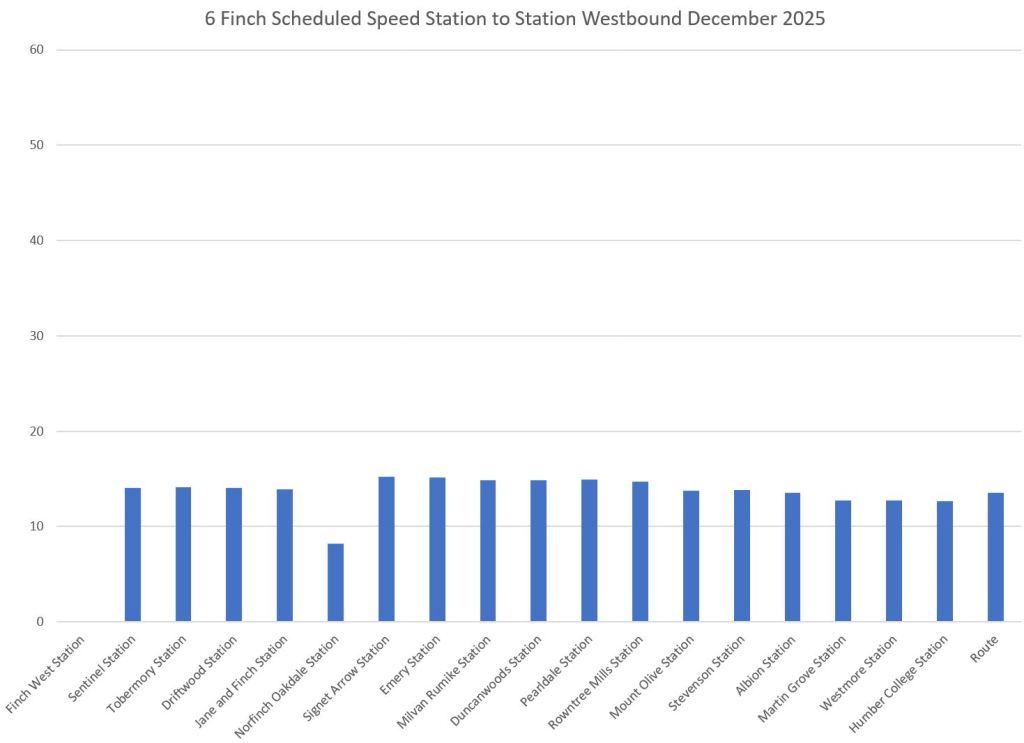
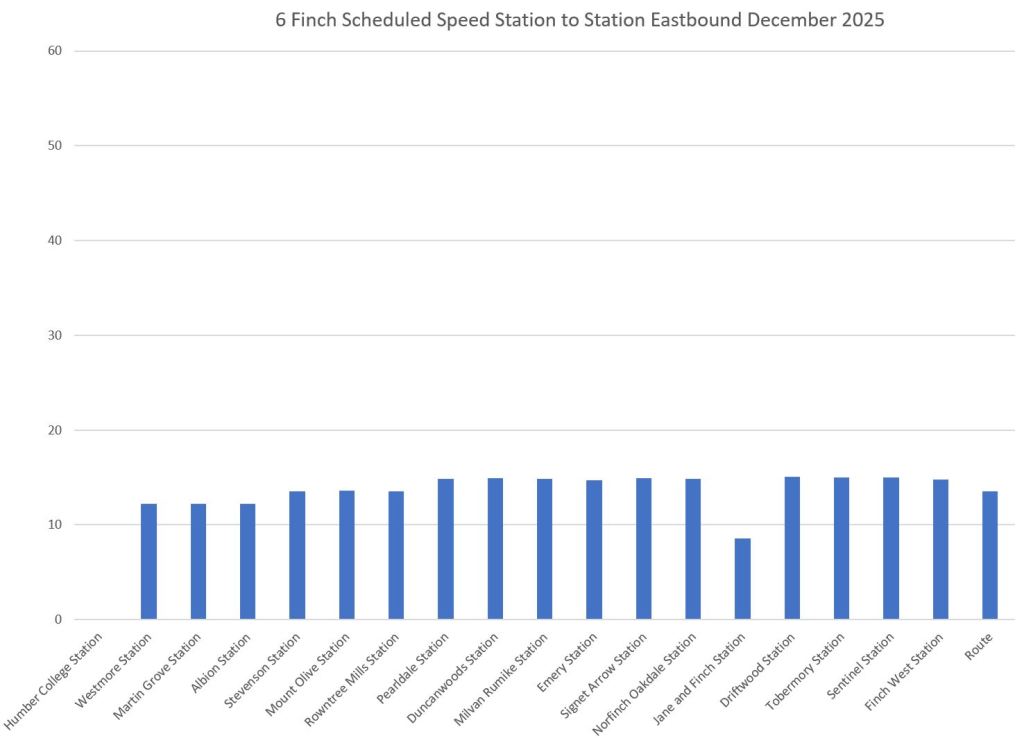
As a matter of comparison, the 512 St. Clair car is only slightly slower than 6 Finch and at times faster. The 507 Long Branch running on Lake Shore Boulevard in Etobicoke is consistently faster than 6 Finch.



 Steve Munro
No worries. They’ve shifted the LRT’s transmission to ‘drive’, but not found the accelerator pedal yet.
Steve: Hmmm. Hand controls. No wonder they can’t find the pedal.
LikeLike
Amazing. Is this what was expected? They could have just used buses and not torn up the road for so many years!
Steve: This is not what was promised, and several bad decisions by many people had a hand in making this so.
LikeLike
Oh but you’re forgetting the good old TTC motto! If we operate everything in slow motion then the system will be 100% safe. Bonus points for reducing maintenance requirements.
The people running the TTC are morons to put it kindly. It was quite obvious when you published the schedule that these people are stupid.
Make me TTC dictator for a day and I will jettison the useless dead weight overnight and as a non-professional I will bring back common sense which they lack.
Steve: You will have to get in line behind me.
LikeLike
And for you idiots at the TTC reading this, I bet you’re already writing out your boilerplate reports blaming traffic congestion for your failures!
Word to the wise, it’s not traffic that’s forcing your employees to drive 10 km/h in a 60 km/h zone. It’s your stupid training and your stupid rules.
LikeLiked by 1 person
Steve, Is the TTC using their usual subway start-up procedure of maximum speed is Series for the first month, and then increased to full Parallel? Sorry, I’m using old terminology, since that’s what I was familiar with.
Steve: Don’t forget that the TTC has already been operating test runs for a month and so we’re past the stage of cautious operation, or should be.
When the Vaughan extension opened, they ran pre-revenue service for a month, and opened at full speed.
Something else is going on here.
LikeLike
Thanks for this. How do the actual Finch times compare to the promised / contracted / specification times?
Tried to submit a comment directly but a WordPress login message came up and I don’t think I have a WordPress account.
Steve: I don’t know what the contracted times are because those documents are confidential. Metrolinx has talked of times as short at 30 minutes, and their FAQ about the route still claims 33-34 minutes.
Re WP Login: There are some strange things happening in the WP comment system when replying to an email version of a post from an iPhone. I don’t know if that’s your configuration, but WP has been wrestling with this for some time.
LikeLike
Hi Steve, I believe there is an error in the line 2 charts, as the data doesn’t quite make sense.
Line 1 Westbound, somehow the speed to Castle Frank is >50km/h but the eastbound speed to Broadview (i.e. the same stretch) is around 30km/h.
Other speeds on the westbound chart also don’t make sense given their location. Somehow the speed from Sherbourne to Yonge is lower than the speed from Yonge to Bay. Anecdotally, since the latter is mostly acceleration, crossings, and braking due to its short distance, we know that high speed average isn’t true, so I think each of the values may be shifted left by one?
Steve: The speeds are calculated directly from the info in the GTFS files which may be incorrect. The distances between Broadview and Castle Frank are about .88 km both ways, but the scheduled travel time EB is about 2 minutes while WB it’s only 1 minute. That causes the spike in the calculated scheduled speed on the chart. The drop in the Sherbourne to Yonge segment is clearly an error in the GTFS data because the travel time is 4 minutes (!).
Over the full line, the totals are the same both ways so everything evens out. I doubt that anyone has really looked at those given that nothing depends on the individual station-to-station values.
LikeLike
It’s interesting to compare the Finch West project to the light rail lines in Sydney, which suffer from the same excessive slowness. From reading and viewing videos of the lines**, it feels there is the same issue of schedule padding and overly-cautious engineering and operational practices (in Sydney’s case, the existence of a former tram line along the same route allowed direct comparisons of how much slower the modern light rail was), over and above lack of signal priority.
Sydney Morning Herald article and video
**if watching videos, the issues are more obvious viewing the Randwick end of L2, rather than the city centre where (arguably) high density of pedestrian traffic requires caution.
Cautious operational practices strike me as bad news — the result generates public discontent, but of a kind that doesn’t easily drive careful re-evaluation (in the opaque web of engineering consultancies) of decisions that excessively sacrifice line speed. For example, are we going to get a straight answer as to how the segment near Humber College ended up limited to 10 km/h? Is it a temporary slow zone, or a botched design for the alignment? It is certainly not a signal priority issue, as that section is grade-separated. (A minor impact relative to the line length, but it makes a very obnoxious impression.)
I have no idea if it’s accurate, but certain Reddit commenters claimed that (in Sydney’s case) consultants applied railway-like practice to a light rail alignment, which results in extremely conservative assumptions about stopping distance and a requirement to crawl slowly in locations where the alignment could interact with pedestrians/traffic (i.e. almost everywhere). It would be more usual to engineer a streetcar / tram / LRV for fast acceleration/braking like a conventional street vehicle.
Steve: The curve at Humber College is considerably gentler than those typically found our downtown streetcar system that our Flexitys handle with no problem. The issue appears to be a poor choice of vehicle which shudders going through the curves even at low speed. There is some vibration and squeal on even gentler curves on the surface portion of the route east of Humber College. Ottawa has problems with the same cars with some curves on their system. I suspect that this will be a permanent condition and also a location for accelerated rail wear.
As for incompetent consultants, this problem is not confined to Australia.
LikeLike
I worry that the TTC/City will implement TPS and not caution drivers to be super careful when approaching intersections. Because people are creatures of habit. And they are so used to getting an advanced green, they may very well jump the gun. Run a red and turn into the path of a LRT.
I was also super disappointed to see how slowly the doors close on these new trains. Clearly this was the TTC’s doing.
LikeLike
If the city implements REAL transit signal priority, it should be done at the same time using transit traffic signals.
Not just the vertical white bar, but the diagonal white bar (left or right), horizontal white bar(stop), and white triangle (prepare to stop). Signal that are used in other jurisdictions (like Québec or Europe) WITHOUT verbal signage.
Currently, the transit signals can be confused with the regular traffic signals. Especially, if one can’t read English.
LikeLike
I agree with the alternative signal types, Calgary uses it, even for buses. Not sure if Waterloo uses it for ION, but they seem to have implemented good signal priority regardless (driver error of cars notwithstanding).
Steve: Yes, Waterloo uses alternative signals.
But if someone can’t read English (or French for that matter), they shouldn’t be driving. It’s part of the G1 test, being able to read signs, even if they’re not a good idea in general (i.e. to have text signs the way we do in Canada).
LikeLike
On opening day I spoke to one of the TTC line supervisors about the speed of the trams on the line. He hinted that while the TTC had operational control of some facets, the tram speed was imposed on them by an outside source. Further it was implied that source was Alstom. This implies divided operational control of this system – not good. How accurate this is I do not know. And with the usual transparency of Metrolinx I doubt we will ever know. But the obvious correction is to make the TTC resposible for all operation and maintenace and let the 3P consortium just pay the maintenance bills.
From some of the above comments I begin to wonder if the original track geometry was designed around the planned Bombardier vehicles. Then Metrolinx was worried about vehicle delivery and switched to Alstom units to meet deadlines! And of course the right hand did not tell the left hand that changes to track geometry, so the Alstom units could run properly, was required. Or perhaps Alstom claimed their units could run on the existing track geometry and have sold us lemons?
Either way, I think this is another glitch that can be blamed on the 3P contracting process.
The one bright side of the “slowness” is that the City has finally gotten of their butts about transit signal priority. Hopefully this fixes the running time on line 6 and the joke is on us if the whole “slowness” is a TTC plan to persuade the city to prioritize transit priority!
LikeLike
I don’t really understand the politicians on this one. The whole point of having a “soft opening” is that you have one “get out of jail free” card. If anything goes wrong, you can blame anything and everything on the fact that it’s a soft opening and claim that you’ll improve things later as you figure things out. Instead, they seem to be taking it on the chin for no reason. Especially when the fix for frequency/speed and other problems simply involves telling LRT drivers to drive faster and more recklessly instead of whatever milquetoast Vision Zero driving that they’re doing now. It’s not like the slow speeds have prevented the line 5 trains from running people over either.
LikeLike
Since Line 6 opened I’ve seen many comments about Waterloo’s ION and the effectiveness of its signal priority, which prompted me to do a before and after check. I pulled a 2014 schedule of the old ION bus off the Internet Archive and compared the southbound times against the current LRT schedule.
The northern, mostly off-street section (north of uptown Waterloo) is much faster now than it used to be… the whole section is 15 minutes now, compared to 20-22 minutes on the previous bus (25 minutes in the PM peak). This part of the route is more direct now and most of it basically runs like a mini train separated from traffic.
The central on-street section (south to Borden/Ottawa) is essentially unchanged… 15 minutes now, vs. 14-16 minutes previously. This suggests either that the bus had transit priority too and it was equally effective, or that the transit priority didn’t speed up service, it just helped prevent the more complicated signal phasing from slowing down LRVs.
The southern section (as far as the terminal at Fairway), a combination of different types of running, actually takes longer now… 13 minutes now, vs. 8-9 minutes previously. Some of this is because the bus route was direct, whereas the LRT goes out of the way so it can make another two stops en route. Good if you’re close to those two stops, bad if you’ve taken a bus to the terminal and are continuing north into the city.
LikeLike
This shouldn’t even be a consideration. If they’re on the road they presumably know the rules. Let people learn the hard way by wrecking their vehicle and increasing their insurance rates. Treating people with kids gloves is what digs you this hole because people know there aren’t any consequences for them being idiots.
LikeLike
I think some context needs to be provided for the ION LRT’s signal priority. I will preface this with the fact that I have yet to ride it, but I drive around the Region for work quite a bit and can’t help with stare with admiration at those Flexitys while I (quite rightly) give way.
Depending on the section, TSP looks different. On King Street between Allen and Central Station, the LRT is centre running along a busy street, so here it’s a green wave. Each light will either change to green quickly or extend the green time to let the LRVs (and neighbouring cars) fly along. Funny enough, this is also the location for most of the cars driving into LRVs.
Certain intersections will simply turn all traffic to red and the ION’s light will flash then turn solid white (examples include Fredrick/Queen, Allen, and the final 2 intersections approaching Conestoga station). Others will employ full crossing arms, bells, and flashing lights prior to the white signal (such as Waterloo Public Square/Willis Way, Block Line, and Northfield stations – all 3 feature a separated ROW, rather than a centre running median).
Occasionally the system will hiccup, such as when a LRV arrives at a red that had just turned or if it arrives too far into an advance cycle for another LRV.
On the topic of speed, most straight track in a ROW will have a top speed of around 50km/h; side of street running closer to 35km/h, and hard turns (similar to the corner under Finch/Hwy 27) are between 10-20km/h, depending on the location. The route of the ION LRT has many, many more curves and turns than the Finch LRT, but with more robust TSP. There’s no reason that a route like Finch with 90% straight track, once it has full TSP, can’t be speeding along around 50km/h between stops.
If the folks at Metrolinx and the TTC are reading this and thinking what to take away from ION:
– TSP will not break car traffic patterns. Even the busiest locations for traffic, like Erb/Bridgeport across from the old Seagram’s building clears within a traffic signal cycle, despite how aggressive the TSP is in that location (full intersection crossing arms, 45 degree approach from the dedicated ROW, total intersection shutdown for 60 seconds). Drivers will groan but they’ll survive.
– Giving the LRT a jump in before left turning vehicles is such an easy win and very easy to program for. Same with extending the green signal for an approaching LRV.
– If you are particularly worried about cars driving into the path of the LRT, it unfortunately is a fact of life due to the human condition. That said, a priority location like around the Highway 400 off-ramps and the Norfinch and Arrow Road intersections could benefit from that extra protection without the noise bothering nearby residents.
– If you haven’t gone to see and ride the ION LRT yet, go for it. It’s not a perfect system, but it’s functional and familiar in an Ontario context.
LikeLike
Steve: From the moment Line 6 opened in a magisterial whoosh of grandeur, well, maybe not exactly a whoosh, the issue of its glacial operating speed has fuelled many debates in social media. One comparison that is always made is between the “LRT” and subway speeds.
What are you talking about? I have read so many news articles, watched or listened to countless news reports, read hundreds of comments and social media posts – all of them state that the new LRT/streetcars are very slow compared to the buses that they are meant to replace. Nobody is comparing on street LRT/streetcar speeds to subways except you but it appears that you are trying to make the new LRT/streetcars look less bad by saying that they are slower than subways when in fact they are much slower than even the buses they are supposed to replace.
Steve: My subway vs LRT speed post was intended as background info for a debate running in social media talking about comparative speeds without any details. It was too long to post as an X or BlueSky thread. I am not trying to make the new line “less bad” and indeed am disgusted with how it is operating compared to claims made for it by Metrolinx at the outset of the project. What is clear is that both Metrolinx and TTC were prepared to accept worse-than-bus operations and hoped to get away with it under the guise of a “soft opening”. And both of them hid the truth right up to opening day.
LikeLike
Dear Steve. The Finch line is a super slow streetcar line sold to residents and business owners under false pretenses by labelling it as LRT and “rapid” transit. You have made every excuse under the sun to justify the slow streetcar speeds. You know full well that buses in the toughest of conditions (construction, mixed traffic, closer stops, no signal priority, old vehicles) beat streetcars every time in the easiest of conditions (no construction, own reserved lanes, farther stops, signal priority, new vehicles). For the legacy streetcars, you justify the super slow speeds because the track infrastructure is old but even brand new streetcar lines are equally slow. You also say that the new Finch streetcars are slow because the stops are close but the old 36 bus route is much faster even though that its stops are even closer together and there are more of them as a result. You complain that the new streetcars are slow because they have no signal priority but nor do buses and yet the buses are much faster. The most damning of all is the fact that the streetcars have their own exclusive lanes and yet the buses in mixed traffic are much faster. We need to rethink future “LRT” lines as BRT is much cheaper and faster while subways are more expensive but the fastest. I hope that Waterfront East and West “LRT” lines are replaced with BRT.
Steve: You really do love to attribute arguments to me that I didn’t make, or to distort what I said.
I agree that the line was sold under false pretenses especially as we now know that quite some time ago Metrolinx had abandoned their original speed targets, but didn’t tell anyone. I do not justify slow streetcar speeds including the glacial movements across intersections approaching stops, excessive dwell times at terminals and stops, and slow orders because the cars cannot safely go around curves at speeds ordinary streetcars in Toronto could handle. An important part of TSP missing in Toronto is a “call on” indication telling an operator that TSP is anticipating their arrival. This allows a vehicle to approach a signal confident that it won’t change in front of them.
Curb lane buses generally beat streetcars on reserved lanes because the buses are not subject to (a) unreasonable delays waiting for green signals and (b) TTC operating practices that dictate slow operation through intersections.
I have never argued that stops are too close together on Finch, and more generally argue against stop removals because their benefit is oversold. It’s a management hobbyhorse that ignores the need for riders to access transit, and gives management the sense of accomplishing “something”. When these changes are bundled with red lanes, the benefit if any of stop removals is counted as part of the red lane benefit. The TTC did this on Eglinton East, and even announced the launch of the RapidTO program at a stop they removed, but then had to restore due to local demand.
The track infrastructure on Finch is brand new, and is in good shape on most of the streetcar system. There are locations that badly need work, and they justfiy slow orders, but the real problem was that they were allowed to decay in the first place. The TTC’s general slow order on special work comes from their use of switch electronics that were always a problem, and imposing system wide rules where slow orders at problem locations is what’s needed. Imagine if the entire subway was under a slow order because of some bad track near Wilson Yard.
An important point about signal priority is that when Finch cars miss a cycle, they then start very slowly at their next green rather than gliding through the intersection on a green that was held in anticipation of their arrival. This is related to the slow operating speeds generally because whatever green time extension has been included, it times out before cars reach the point they can use it. If the streetcars ran at bus speeds this would not be an issue. Also, the buses generally have nearside stops and only have to stop once per intersection, not twice. They don’t need the same TSP because their stop design is different.
The exclusive lane is useless when operating practices prevent cars from utilizing it. You want BRT? Well, the buses in a centre reserved lane would have many of the same problems except they would not be driving at an artificially low speed. It’s not the choice of technology, it’s the hopelessly incompetent implementation.
LikeLike