
The TTC Board met on July 17, 2025. Among the items on the agenda were:
- CEO’s Report
- Green Bus Program Update
- This report is covered in a separate article. Additional comments arising from the meeting have been added there. See The Troubled State of TTC Green Buses.
- SRT Busway Update
- Addressing Service Delays on the TTC
- TTC Corporate Plan 2024-2028: Mid-Year 2025 Progress Update
- This is a long report, and I will address it in a separate article.
- Report on the Unauthorized Release of Confidential Information from a 2023 Closed Toronto Transit Commission Board Meeting
CEO’s Report
This CEO’s Report was the handoff from Interim CEO Greg Percy to Mandeep Lali who assumed the role in early July. There is little sense of Lali’s potential effect on the organization beyond his desire “to make the TTC the safest, cleanest, and most reliable transit system possible”.
Cleanliness is a matter of effort, and past experience makes look of the system a warning for the more general malaise of deferred or reduced maintenance. Safety embraces both passenger and staff security, as well as the integrity of system infrastructure. Again, that is an area where deferred maintenance has shown its effect.
Reliability is, or at least should be, a primary goal of the TTC. This has been compromised by resource issues, laissez-faire management, and an attitude that with construction and congestion, little can be done. Without a recognition that part of the problem is a question of internal culture, it will be hard to see major improvements.
On Queens Quay East, new bus lanes have been implemented. The benefit does not appear to be as great as hoped based on recent tracking data, but the real test will come with the return of fall/winter traffic volumes. See 114 Queens Quay East and Its Red Lanes.
Gapping and Bunching Pilot
Previous monthly CEO reports and management comments at Board meetings gave the impression that a project to attempt regulation of headways would be underway in June on eleven routes. This was the basis for my recent articles about service behaviour on those routes. (See Does TTC Mid-Point Route Management Work? (Part I) (Part II)
As reported at the July 17 meeting, this is only getting started in earnest on two routes, 7 Bathurst and 512 St. Clair. TTC feels that more staff are required to make this work, although this begs the question: do they actually have a meaningful target? The Bathurst Bus fared better than the St. Clair streetcar, but many factors could affect the numbers. Moreover, there is the basic issue of the validity of the metrics.

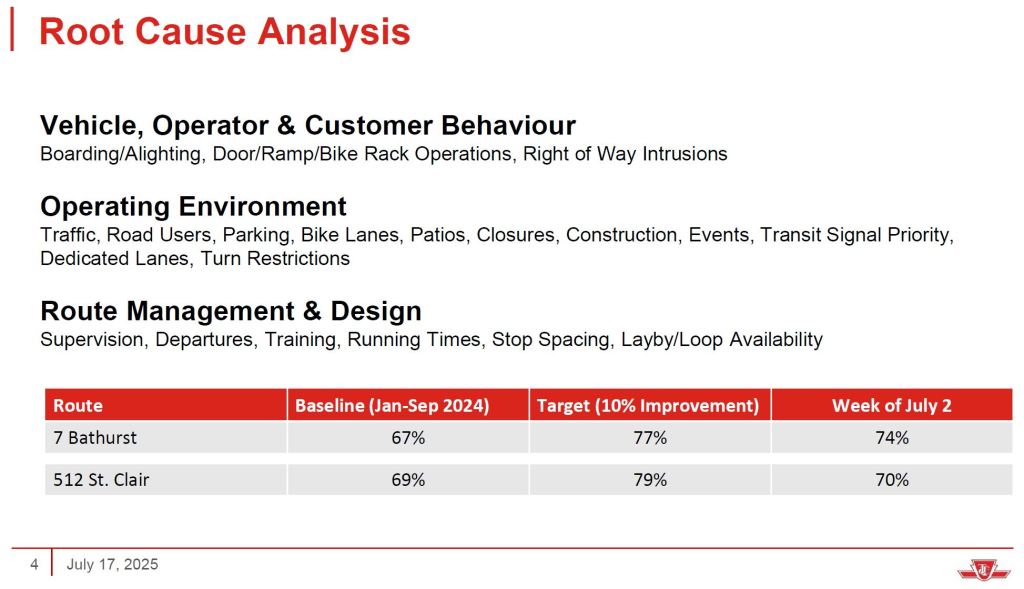
Two problems remain:
- Although there are service standards for terminal departures, they are schedule based. The headway standard which would be applied mid-route depends only on the spacing between buses. These two standards can work against each other if spacing service will cause it to violate the “on time” standard.
- Both standards have a wide margin for error both in the range of times that are considered within the standard, and with the target that considerably less than 100% of trips all day actually meet the standard. Moreover, results are stated on an all day basis allowing good and bad service intervals to be mixed.
There is no indication in the results cited above of where the measurements were taken, and if at multiple locations whether stats were different by location, direction and time of day. In my own analyses, it was clear than on most routes, the AM peak period sees a moderate dispersion in headways values, but this deteriorates as the day goes on. Although in some cases, there are demonstrable problems with schedules (inadequate time to make trips), there are more cases where terminal recovery time for vehicles is usually quite adequate. Regular riders cite the number of vehicles they see parked at terminals awaiting their departure times. Whether these occur “on time” and regularly spaced is quite another matter.
The next steps planned by the TTC are:
- July 2025: Implement corrective action items directly under TTC control
- Meet with City of Toronto to review findings and potential mitigation measures that require partnership
- August 2025: Review results
- Meet with local councillors and BIA to discuss and gain support for CoT/TTC mitigation measures
- Implement mitigation measures
- September 2025: Review results
- Refine measures
- Measure against customer experience and satisfaction
- October 2025: Expand efforts to a further two routes
- Report back to the Board
In other words, a pilot that was supposed to include 11 routes now has only 2, and a further 2 will be added in October. Most riders’ buses will arrive sooner.
SRT Busway Update
At its June 5 meeting, the TTC Board directed that:
staff to work with the City Manager, the General Manager, Transportation Services, and the Executive Director, Transit Expansion Division, to expedite all required land acquisitions and permits to accelerate
construction of the SRT Busway and report back in July on the acceleration plan.
The TTC has since worked with City departments to accelerate reviews and permit approvals, and has streamlined internal procedures to dedicate design resources and participate in on site to expedite problem resolution.
What is clear in this report is that a known high priority project was not given resources to be achieved as quickly as possible either by the City or TTC. What is not known is how mush of this is due to staff shortages and procedural delays that more generally affect this type of work.
Any acceleration plan must also be discussed with and approved by the contractor, and that need raises questions about the urgency built into the job specification and tender process. Management will report back to the Board in early Fall with an update. The target for completion is the end of 2026.
How many other TTC projects suffer from similar project management issues?
Addressing Service Delays on the TTC
This report arose from a motion at the January 2025 Board meeting requesting an update on various issues related to service delays and how they are handled.
A peer review of subway and streetcar asset maintenance commissioned from the International Union of Public Transport (UITP). This includes a review of Automatic Train Control (ATC) to identify root causes of failures. This work is underway and there will be a preliminary report to the Board later in 2025.
Audits of Public Address systems to verify announcement intelligibility. Although most tests show clarity, there are some defects in wayside transmission units and onboard systems. Upgrades to in-station systems is now complete. Human factors issues such as consistency of volume on announcements and clarity of the text are also being addressed according to the report.
Video screens at station entrances and on platforms display information about disruptions, although there is a limited amount of “real estate” on screens when multiple problems occur concurrently. The station entry screens show only TTC information, while the platform screens share a narrow band for notices with advertising and weather information. This is an example of the tradeoffs when a functional part of the system is paid for by a third party and is not fully available to the TTC, except in major emergencies. There was also a limitation on the number of platform screens, although more have appeared recently.
Incident info is broadcast via @ttcnotices on X/Twitter. In a recent change, notices are updated regularly both to give riders a sense that they are attended to and to keep them in their recent feeds. The information is echoed on BlueSky by a bot that is not part of TTC services. This means that info posted by other TTC X accounts is not echoed. Information is also pushed via the Live Alerts section on the TTC’s site, and via eMail to subscribing riders. There is an internal goal of three minutes between an event and a public notice.
A review of other systems’ procedures showed that some major systems delay issuing alerts for at least 10 minutes. This may prevent clutter from notices for short-lived delays, but at the expense of leaving riders wondering what is going on. During complex surface events such as parade diversions, the TTC tends to depend on generic notices issued in advance rather than on regular updates.
A significant challenge of long standing is that many notices have been paper-based, and they require a long lead time to produce and install. The report speaks of these and electronic notices as an aid for the hard-of-hearing, but the need is much more general to overcome problems with timeliness and widespread access to information by all riders during disruptions. Various techniques and procedures are being implemented to make information available, but a significant problem remains that these depend on station staff who may not be well-informed, sufficiently numerous to provide coverage or familiar with details of problems that are not in their immediate area.
At the meeting, a representative from TTCRiders demonstrated a map-based display of subway delays that consolidates data from several TTC pages. (See ttcmap.ca) Although this demonstrates what can be done by scraping data from websites, it is limited to parsing notices that are in a recognizable location and format. If the TTC intends to make this widely available to application developers, they need to create a standard repository for all notices that can be read by any app. Complex notices such as for construction projects could exist there as a “stub”with the URL of a page containing more details.
The TTC site suffers from fragmentation and the production of content by multiple authors in multiple places causing inconsistencies and incorrect information. The TTC is looking at consolidation of responsibility for notices, but this will depend both on a better web structure and on the timely provision of accurate information to the communications team.
Shuttle bus operations for subway delays are under review jointly by TTC management and by ATU local 113 so that “frontline expertise informs the design of practical, workforce-supported solutions that improve response time, service continuity, and customer experience during emergencies”. Discussions are also underway with the City on traffic and signal priority for shuttle buses including pre-authorization of pro-transit measures.
A challenge here will be that some aspects of traffic management can only realistically be implemented “on the ground” with police and traffic wardens as we have seen with downtown congestion management. Staging resources for this is comparatively easy for pre-planned events, but not for major emergencies.
“Surface transit redundancy” is a phrase implying that it is possible to provide alternate paths for riders via the surface system. There are many limits to this including both the limited capacity of parallel routes and the inherent delays in providing extra service on them. This section of the report veers into a discussion of red lanes on surface routes, although their purpose and extent are very different from areas needed for subway relief.
Intrusions at track level occur for various reasons, and these have driven discussions of the need for platform doors. However, that is a long term project, and the TTC is considering various alternatives for monitoring such activities. Line 5 Crosstown includes laser-based sensors in the underground stations and tunnels, and the TTC will review their performance for possible implementation on the subway.
Integrity Commissioner’s Report on Unauthorized Release of Confidential Information
On October 27, 2023, there was a special Board meeting to discuss a confidential matter about former CEO Rick Leary. As later reported in the Toronto Star:
The public agenda included no further details, but according to three sources with knowledge of the session, the legal advice related to allegations against Leary that he had bullied and intimidated employees. The Star has not reviewed the details of the claims.
Leary was not remove from his post at that meeting, and various rumours described in that article concerned the precise action taken and who was behind them. It is no secret that Leary was not well liked by many within the TTC and concerns about a poisoned workplace surfaced as part of the headhunting exercise that would find his replacement. Leary resigned from his position on June 20, 2024 following receipt by the Board of additional advice from external legal counsel.
The Integrity Commissioner was asked to review the release of information to the media by person or persons unknown from the October 2023 meeting, and his report was before the Board at the July 2025 meeting.
The Commissioner found that in spite of extensive queries he was unable to identify the source of the leaked confidential report, and recommended that no action be taken on that account. However, he emphasized the importance of keeping such material truly confidential, and this would extend to practices such as Councillors or Commissioners sharing information with staff and use of personal email to transmit confidential documents.
Various types of confidential reports reach members of the TTC Board including negotiating positions, property purchases, senior HR matters and contract tendering. Release of information can disrupt many types of business, but in this case the context was political given the change in TTC Board makeup in the post-John Tory era.
Leary’s name was never mentioned in the public discussion of the report, but the Integrity Commissioner did indicate, when asked, that the affected individual had suffered unspecified harm from the leak.
The Board accepted the Integrity Commissioner’s recommendation that Chair Jamaal Myers not be penalized for whatever role he might have had in this event, but the Board also moved:
That the TTC Board request that TTC staff develop a proposal for Board consideration on when confidential information can be shared, and with whom, and best practices to be followed with respect to sharing confidential information.
The issue of leaks was uncomfortably obvious during the discussions when the Toronto Star posted an article about a letter from federal Housing and Infrastructure Minister Gregor Robertson to Mayor Chow about proposals to procure new subway cars from the plant in Thunder Bay.
Fixing the leaks is important, but so is addressing the environment that led to Leary’s departure. With a new CEO now in place, the situation at TTC will not magically return to “normal” overnight, and the ancien regime’s legacy will take some time to expunge. An important step will be for the Board to acknowledge that legacy and work diligently to return the TTC to a healthy, productive workplace.
 Steve Munro
Steve, the last two paragraphs of this post look like they are written by you, rather than part of the TTC Board motion that starts the block quote.
Steve: Fixed. Thanks for the catch.
Regarding the gapping and bunching pilot, was there any indication of what “Small gains realized but not sustainable” meant? Or what “actionable items” might be?
Steve: Although the pilot is supposed to address mid route bunching, they didn’t try very hard and concentrated on terminals. As the detailed stats show, headways are often erratic at or near terminals and degrade from there on. Small scale interventions don’t work.
I am not convinced that on street supervision bus needed everywhere. It’s a crappy job with little shelter, but the alternative is that central monitoring has to be well staffed and with a clear idea of what they’re supposed to achieve.
This project thus far does not seem like a serious response to the issues.
LikeLike
I have been stating all along that the Finch West streetcar line will open before the Eglinton streetcar line and that the Scarborough subway will open before the SRT busway.
Steve: Who knows, you might be right on Finch, but the SRT busway is a much simpler project and should open in late 2026. The Scarborough subway on the other hand is in 203x where “x” is an unknown.
LikeLike
The last section of the post is a quote in italics.
But are the last two paragraphs of the post part of the quote? Sounds more like one Mr Munro’s thoughts.
Steve: Yes this was an editing error and has been fixed. Thanks.
LikeLike
Here’s a perfect example. If one viewed ttc.ca this weekend, the subway status under current service showed the green dot for “normal service” on lines 1, 2, and 4 despite line 1 being closed from St. Andrew to Lawrence West. One had to click through on a closure notice to see that “normal service” was not in fact running.
One cannot suffer harm to reputation and good name when they do not exist.
LikeLike
The CEO’s Report notes” “The TTC is also working on a pilot to develop automatic camera enforcement technology for motorists who pass open doors, which will capture the incident and license plate information. Testing is scheduled to begin late next year.”
As the TTC (or the City) had been lobbying to be allowed to use cameras for years and the Province made it possible well over a year ago this is really a VERY leisurely schedule!!
LikeLiked by 1 person
Steve, day-of managing and supervision of bunching and gapping can be accomplished but requires buy-in from senior management in acknowledging that they are not only interested in having Supervisors put out the fires, but rather the goal is to prevent the fire from starting. There will always be the unknowns that creep in during day-of operations but front-line and control centre supervisors can easily become discouraged and disconnected from iniatives of this type when the suggestions and solutions identified and proposed fall on deaf ears. If we keep short-turning the same runs on the same routes, whether a result of construction, inadequate road infrastructure, improper running times, insufficient recovery times or unrealistic interlining and from sheet-to-sheet the agency fails to make the needed changes, you’ll “lose the locker room”, as the saying goes.
LikeLike
TTC is probably the dirtiest transportation company in the Western World.
1. Food and drinks should not be allowed
2. Dirty feet on seats
3. Plastic seat cover would be a better option
Lack of proper scheduled departure. (3 – 4 trains follow each other, then 40 minutes nothing)
No or very few arrival information in bus stops and streetcar stations
Drivers are well trained and professional
LikeLike
I agree 100%, Canada is a dirty third world country now. Hopefully, Prime Minister Carney will fix this but it will take decades to undo the damage done by Trudeau.
Steve: Not to mention the damage done by Doug Ford, John Tory, Mike Harris, Stephen Harper. They would sell their grandmothers to give tax breaks and sweetheart contracts to their friends.
LikeLike
The TTC is nowhere near the dirtiest public transport system in the western world. That statement is far beyond over reach.
A more nuanced statement is that the TTC could be cleaner, and appear cleaner, through better upkeep, in a host of ways, but I would highlight the idea of daily seat cleaning (spot cleaning for stains); similar to the streetcars during Covid, a post morning rush clean for any vehicle remaining in service, all-day, run out of the subway station/terminal point; and more frequent painting of light-coloured ceilings in stations.
LikeLiked by 1 person
The TTC is not the dirtiest public transit network. The small “c”-conservatives keep cutting the TTC operational budget to “save money”, resulting in less cleaning being done.
Want a “cleaner” system? Return the operating budget to a level that we can make it cleaner to your eyes.
LikeLike
The gapping/bunching project is sounding like a failure before it gets out the door…stand by my thoughts that a technical solution is needed, and route management should mainly be managed by software which can integrate more information than can be reasonably done by a human, and likely already exists on a shelf somewhere…
I also strongly believe that the TTC should be much more transparent about *why* it makes operational decisions in realtime…a standard realtime report on all non-standard actions and why they occurred would help identify bad management practices…it’s not enough to know a short turn occurred, but why it occurred…why did the bus leave early (even if it was the operator who decided to leave early)…some of these reasons are valid, others less so…
Steve: I am not enamoured of the idea that software can handle the system overall for a few reasons. First, as any IT person knows, the “specs” from the client rarely match the real world. The computer does what it’s told with less than ideal results. TTC really does not know what it is aiming at in terms of service design and standards. Then there are the common, frequent interventions for diversions. Will the software be able to adapt on the fly? We have seen the experience with NextBus and other apps where everything works fine until there is a screw up, and then the app is useless. Even TransitApp, which attempts to adjust to route changes (not always successfully) can’t really make predictions. This is a decades old problem.
If the goal is “on time performance” but with a wide latitude of what is “on time”, the software will sit back and let a route fall apart because it’s still within spec. If the goal is headway management, there is both the issue of leniency as well as the need to modify contract rules which are based on “on time”. Indeed some of the tighter rules in the Local 113 contract date from a period when management was trying to get as much unpaid time out of ops as possible and they were always getting in late. That was “fixed” with a strong monetary penalty for this practice. Of course that leads to short turns whose whole purpose is to get an operator to their shift break point on time, and to padded schedules so the short turns are not required. The stats look good. Give that Rick Leary another gold star! But riders deal with slower service that is caused not by “congestion”, but by a wrong-headed approach to line scheduling and management.
LikeLike