
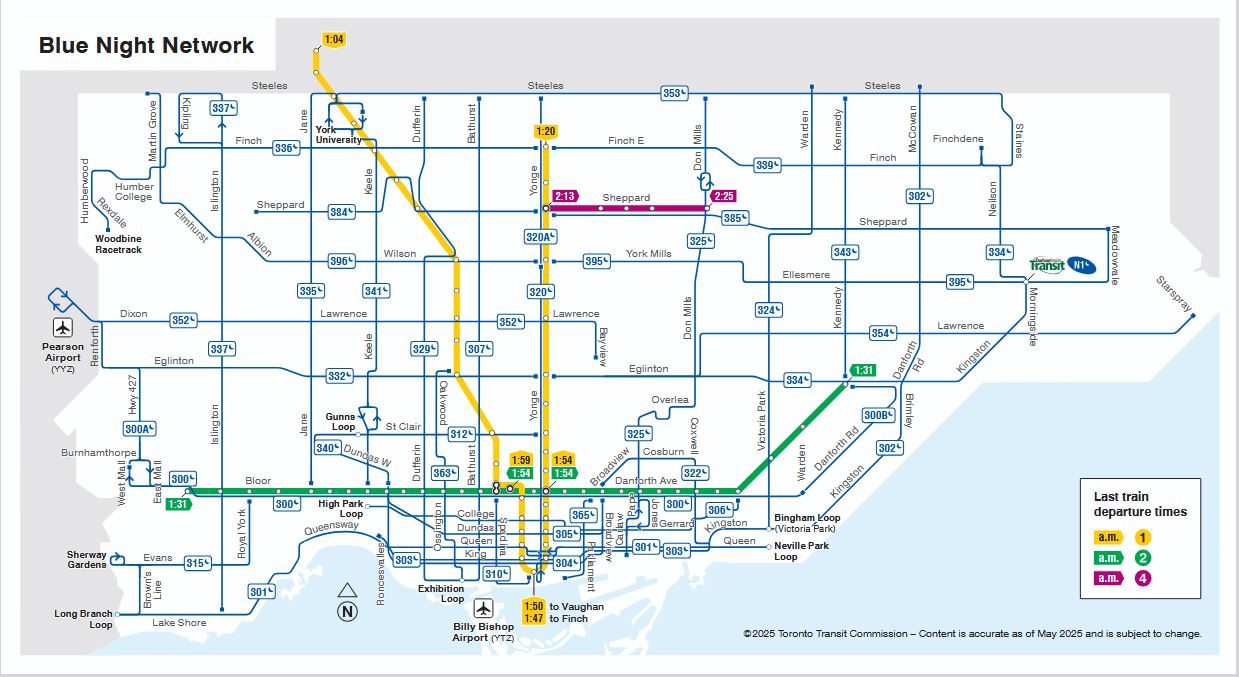
This article begins a series to review the TTC’s overnight services, aka the Blue Night network. Most of these are bus routes, but a few of the older lines still operate with streetcars.
Included in this article are:
- 307 Bathurst
- 329 Dufferin
- 332 Eglinton West
- 335 Jane
- 336 Finch West
- 341 Keele
- 352 Lawrence West
Other routes will follow in future installments.
It’s worth reviewing the TTC Service Standards regarding their Blue Night network.
Purpose of night service:
The overnight network is designed so 95% of the population and employment is within a 1,250 metre walk (15 minutes) of transit service. Consequently, overnight services may be provided on different routes than the base network in order to meet these requirements. Where possible, however, overnight routes will follow daytime routing and be identified in a manner consistent with the daytime route. The overnight network is an important part of the TTC’s commitment to maximizing the mobility of people in the City of Toronto and meeting all of their diverse travel needs.
- Hours of service: 1:30am to 6:00am (8:00am Sunday)
- % of population and employment served: 95%
- Within walking distance: 1250 metres
- Within walking time: 15 minutes
- Minimum service frequency: 30 minutes
- Headway performance: Service is considered to be on time if it is no more than 1 minute early and no more than 5 minutes late. TTC’s goal is to have 60% of all trips meet the on-time performance standard.
The one minute early standard was informally dropped in early 2025 and on time performance is now measured by TTC against a -0/+5 scale. That applies to on-time departure at terminals, but not to headways. The standard allows a swing of headways between 25-35 minutes for a half-hourly service as shown below. The service is “on time”, but unreliable, especially when the compounding effect of the swings is considered at transfer points.
Moreover, the “standard” need only be achieved 60% of the time, and then only at terminals. Almost half of the service is held to no standard at all.
| Trip | Scheduled Time / Headway | Actual Time / Headway |
|---|---|---|
| 1 | 2:00 | 2:00 |
| 2 | 2:30 / 30m | 2:35 / 35m |
| 3 | 3:00 / 30m | 3:00 / 25m |
| 4 | 3:30 / 30m | 3:35 / 35m |
| 5 | 4:00 / 30m | 4:00 / 25m |
The TTC does not have any planned meets in its night network, and these would require scheduled, protected departure times enroute, not the current catch-as-catch-can arrangement. On a half-hourly base and with long routes, the gaps between buses can vary a lot, and riders cannot count on their arrival. This is a common annoyance on the daytime network, but on the night routes where a missed bus can make a large difference in trip time, this should be unacceptable.
Most night services operate every 30 minutes, although there are exceptions on both the bus and streetcar networks. That service level is provided generally from 2am onward to about 4am, later on some routes depending on when demand begins to build up for the morning. There is also some overlap of daytime and night time route number usage, although the TTC has been sorting out its schedules for consistency in past months.
Some routes do achieve a narrow band of headways around 30 minutes for terminal departures, although this band widens along the route just as it does with daytime service. However, some routes have erratic headways even near their terminals, but the standards are lax enough that these still can count as mostly “on time” in reports of service quality.
For all that the night services are supposed to be for shift workers and the night economy, reliability leaves much to be desired because, like so much TTC service, the time a vehicle will arrive is unpredictable. The situation varies from route to route as the sample in this article will show. Some routes are not too bad, but still leave riders vulnerable to missed trips and connections. Others are a real mess with 307 Bathurst taking the prize here. (There are likely competitors for that title, but I have not worked through every route yet. Be patient, gentle reader.)
May is an ideal month usually free of major storms, hot or cold, and conditions are about as good as one can expect. Service in February will not be as good as the examples shown here.
The TTC’s common bugbear/excuse for erratic service, traffic congestion, does not apply to these night services. Uneven headways are caused by lack of line management, the absence of a policy to maintain on time performance along routes, and in a minority of cases by schedules that are too tight to allow for terminal recovery time.
Through this series, I will review the quality of night service provided on the TTC system. This will take a while, and the articles will appear as time permits in between other topics.
Note: This is a long article with a lot of charts. I don’t expect most people to read every word or review every route. For some, this might validate their own experience. For others, it will show the variations across the network. Happy reading.
Blue Night Network Map
Reading The Charts
One problem in looking at night service is that there are far fewer trips in a month, week or day than for the regular, frequent daytime services. Most routes run every 30 minutes and the 3xx night routes only operate for a few hours between the end of regular service and the build-up of the next day’s morning peak.
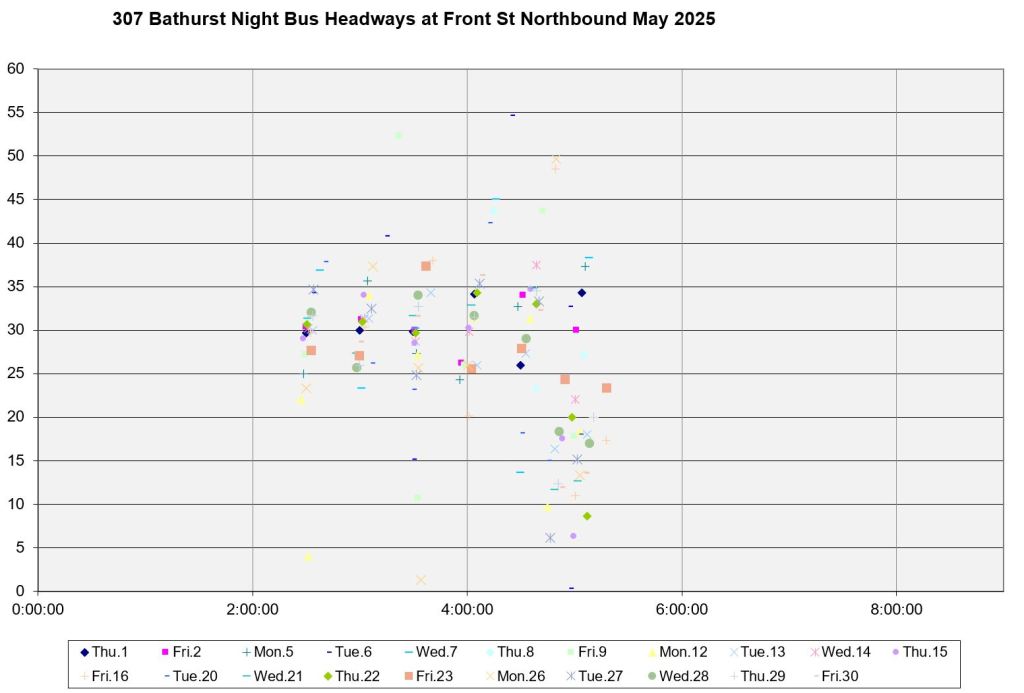
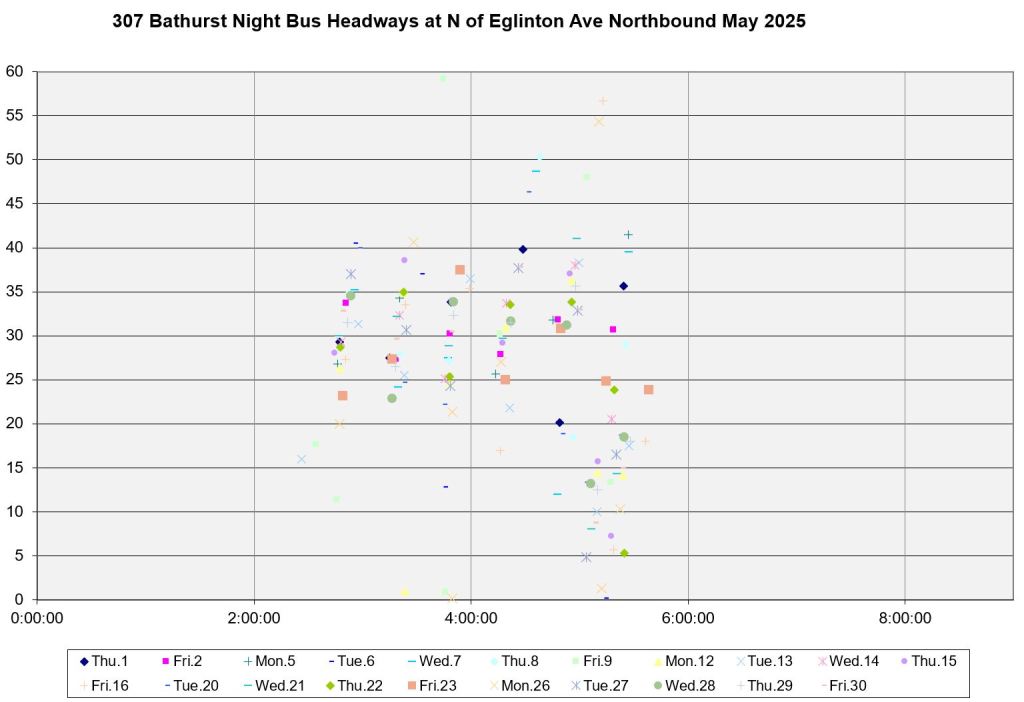
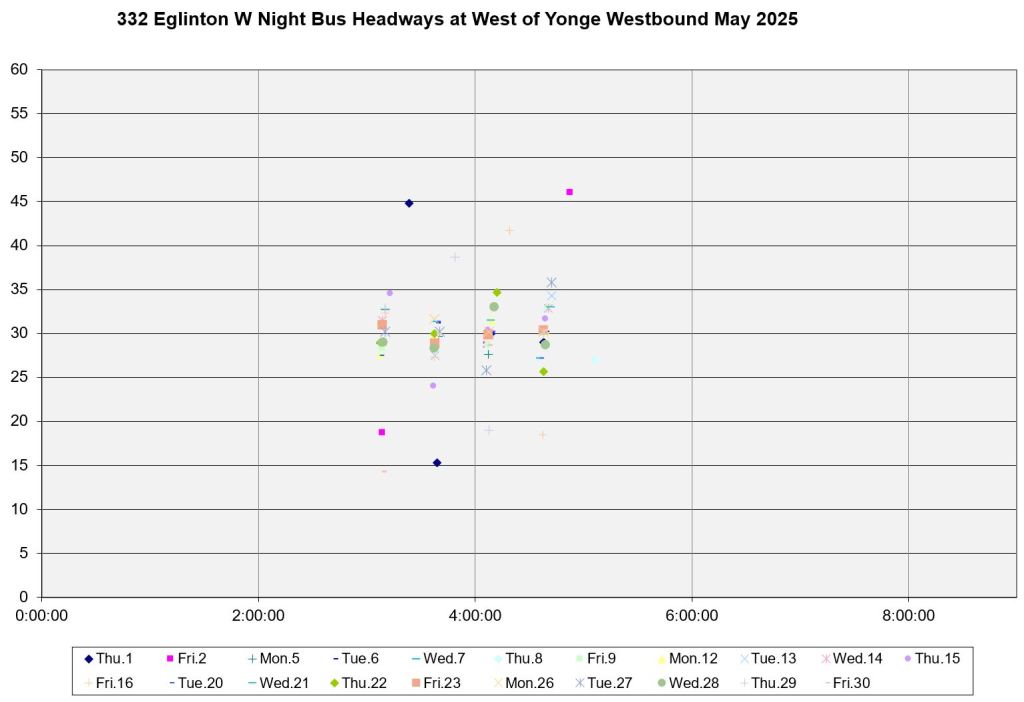
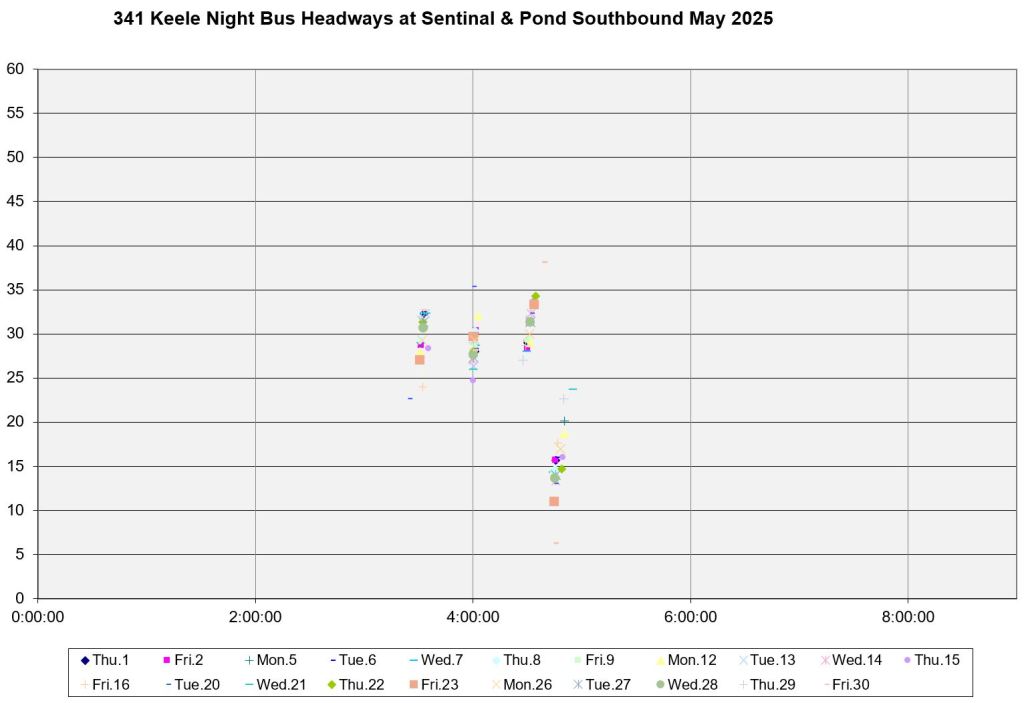
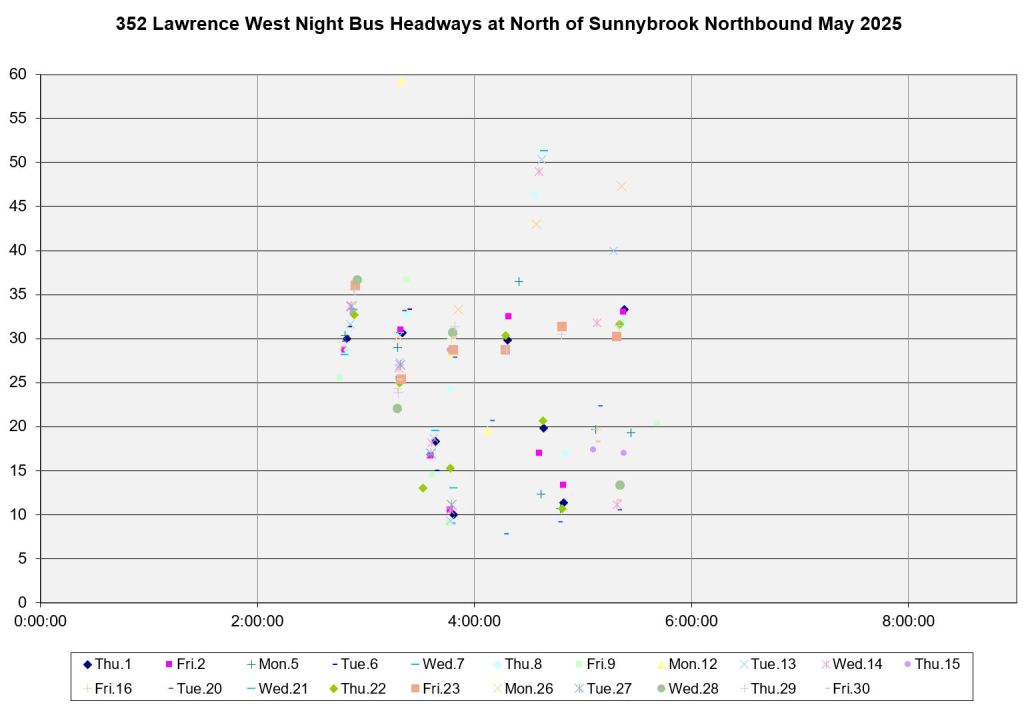
There were 21 weekdays in May, and that gives us somewhat more data. I have presented this in two ways: as a scatter chart showing time and headway, and in a quartile chart showing the distribution of values within each hour. Here are samples:
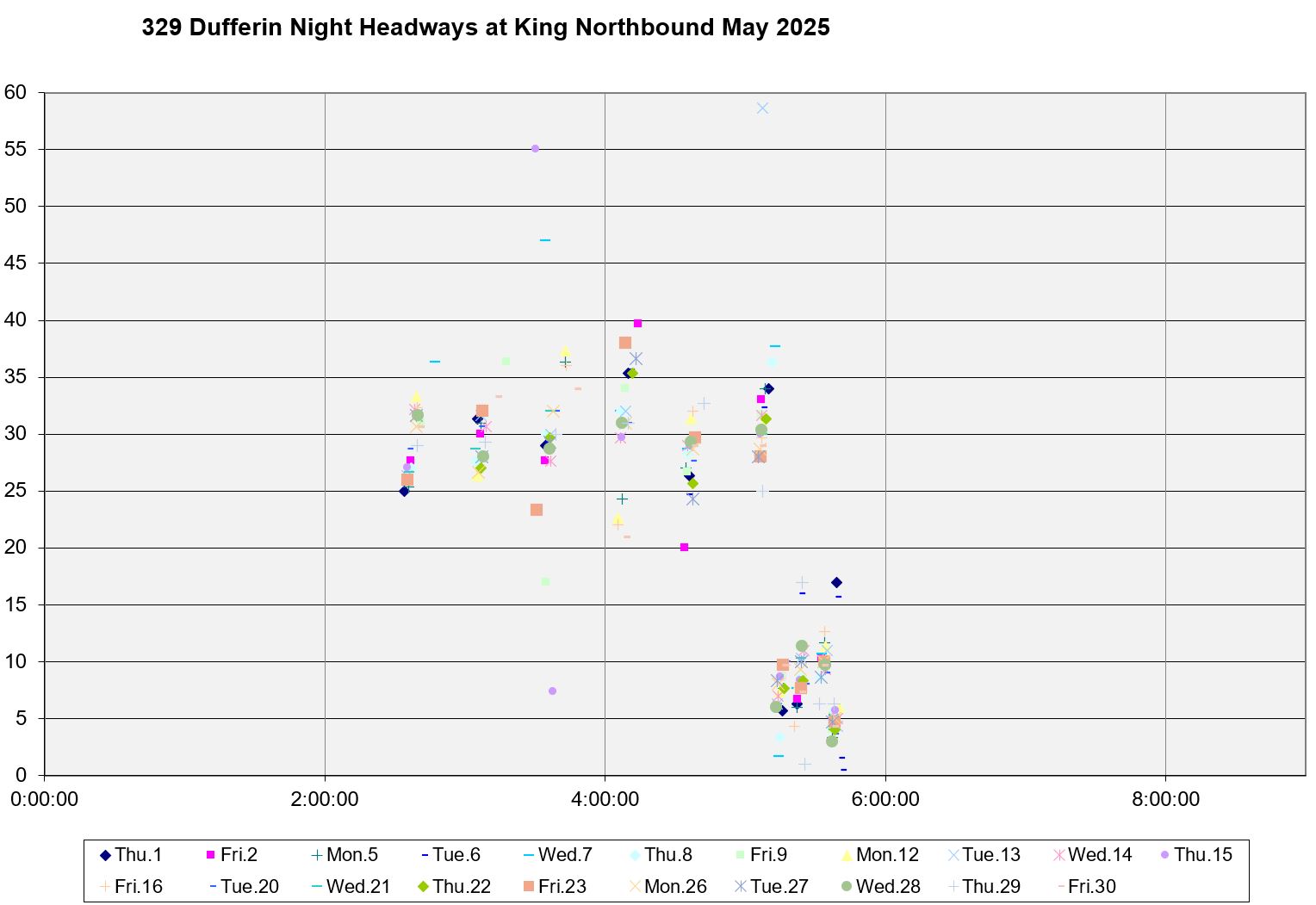
Scatter chart of headways
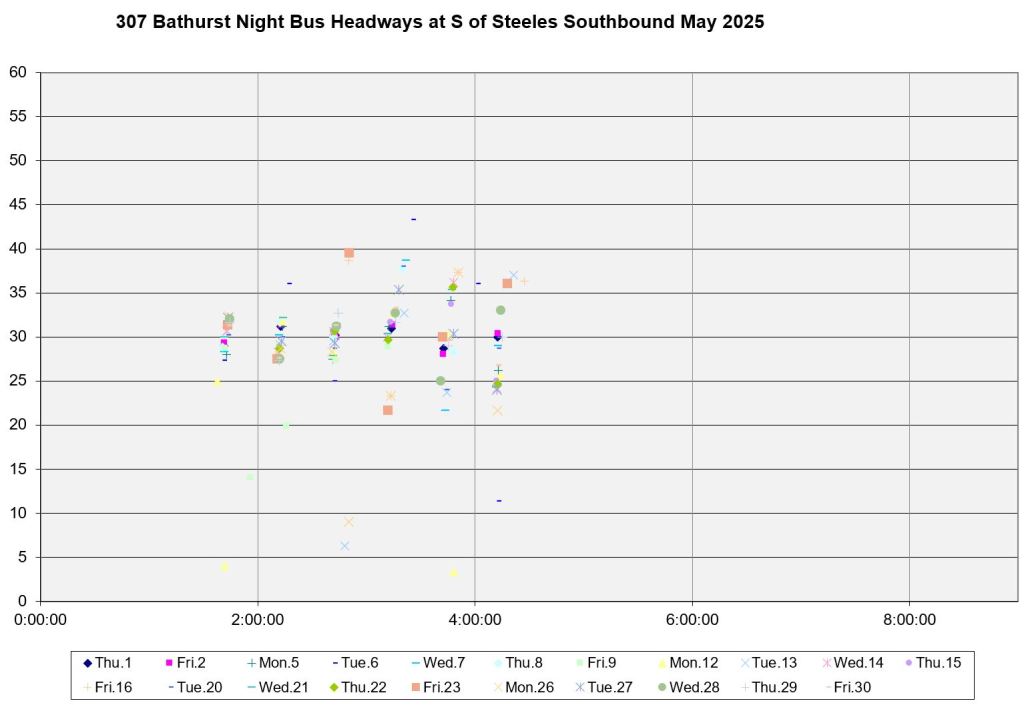
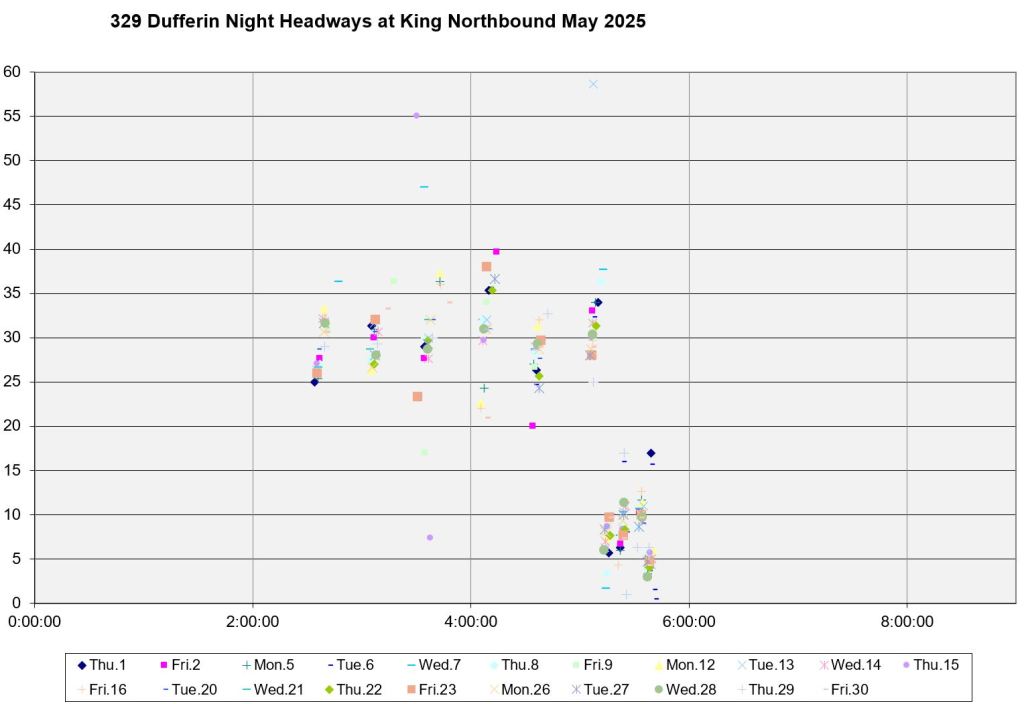
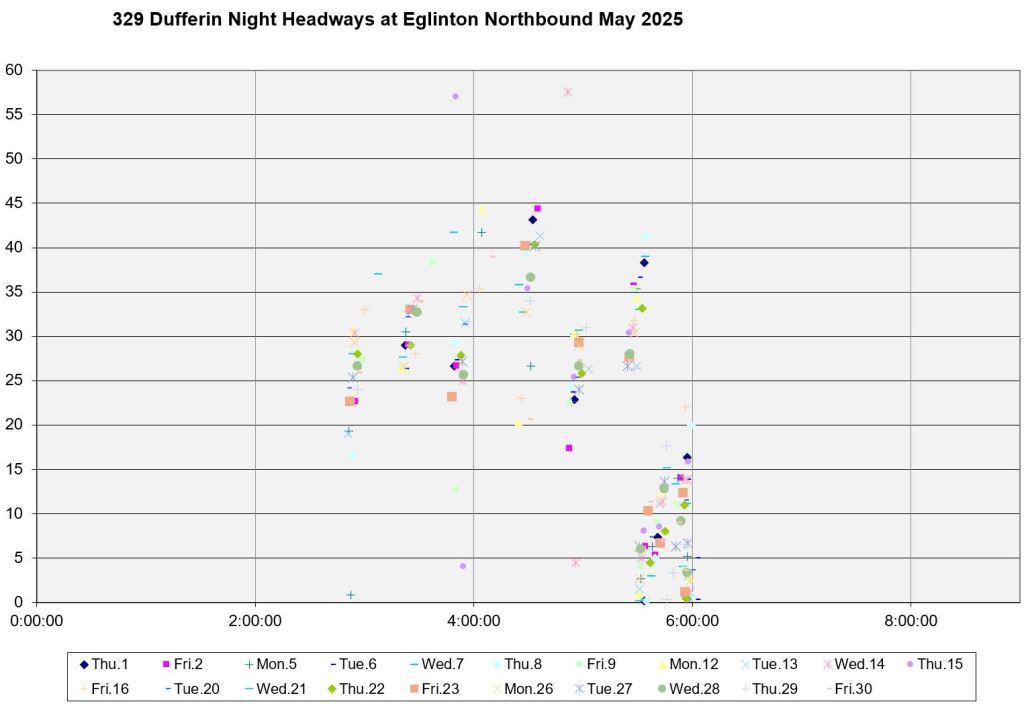
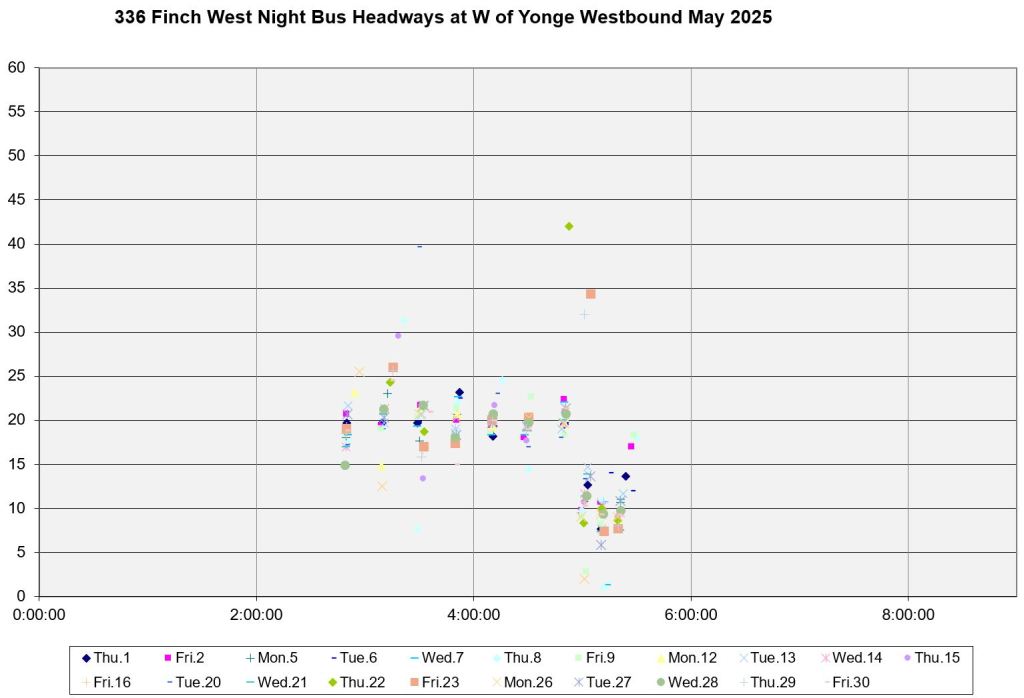
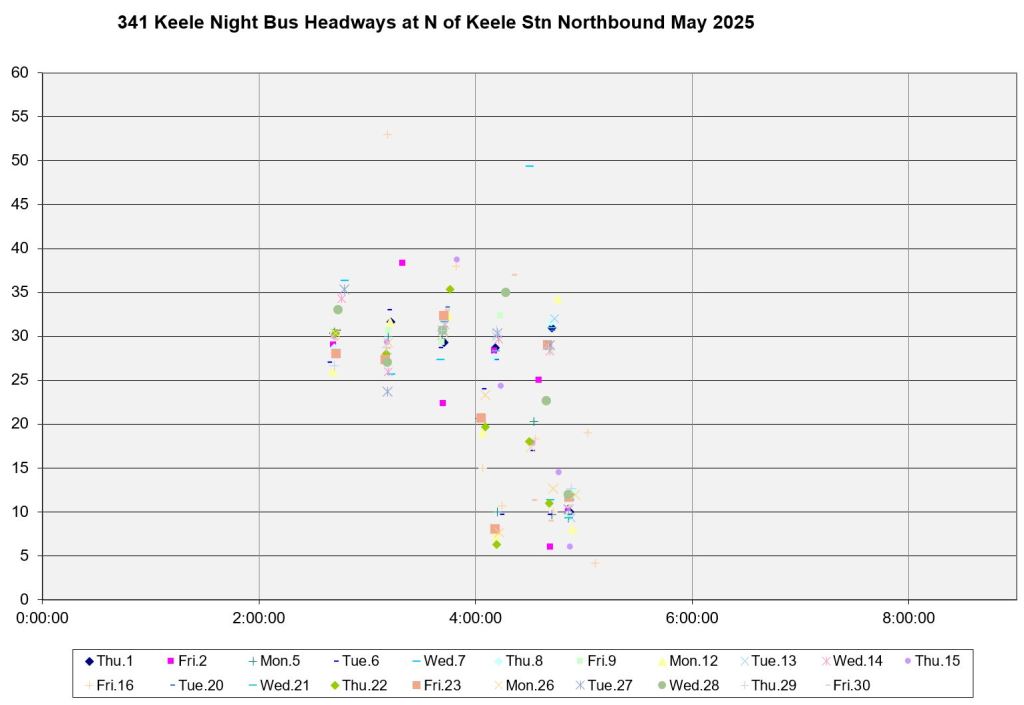
This chart shows data for all weekdays on the 329 Dufferin night bus northbound at King. Each dot is one bus, and their shape and colour shows which day. The points are grouped in vertical bands at roughly the same time corresponding to the scheduled half-hour service. Note that these bands lean slightly to the right showing the effect of later arrivals on headways. Notionally buses come every 30 minutes, but most arrive over a span of over 10 minutes with some outliers beyond. The cluster of points around 5:30am corresponds to early morning service that operates with the 329 route number.
Quartiles
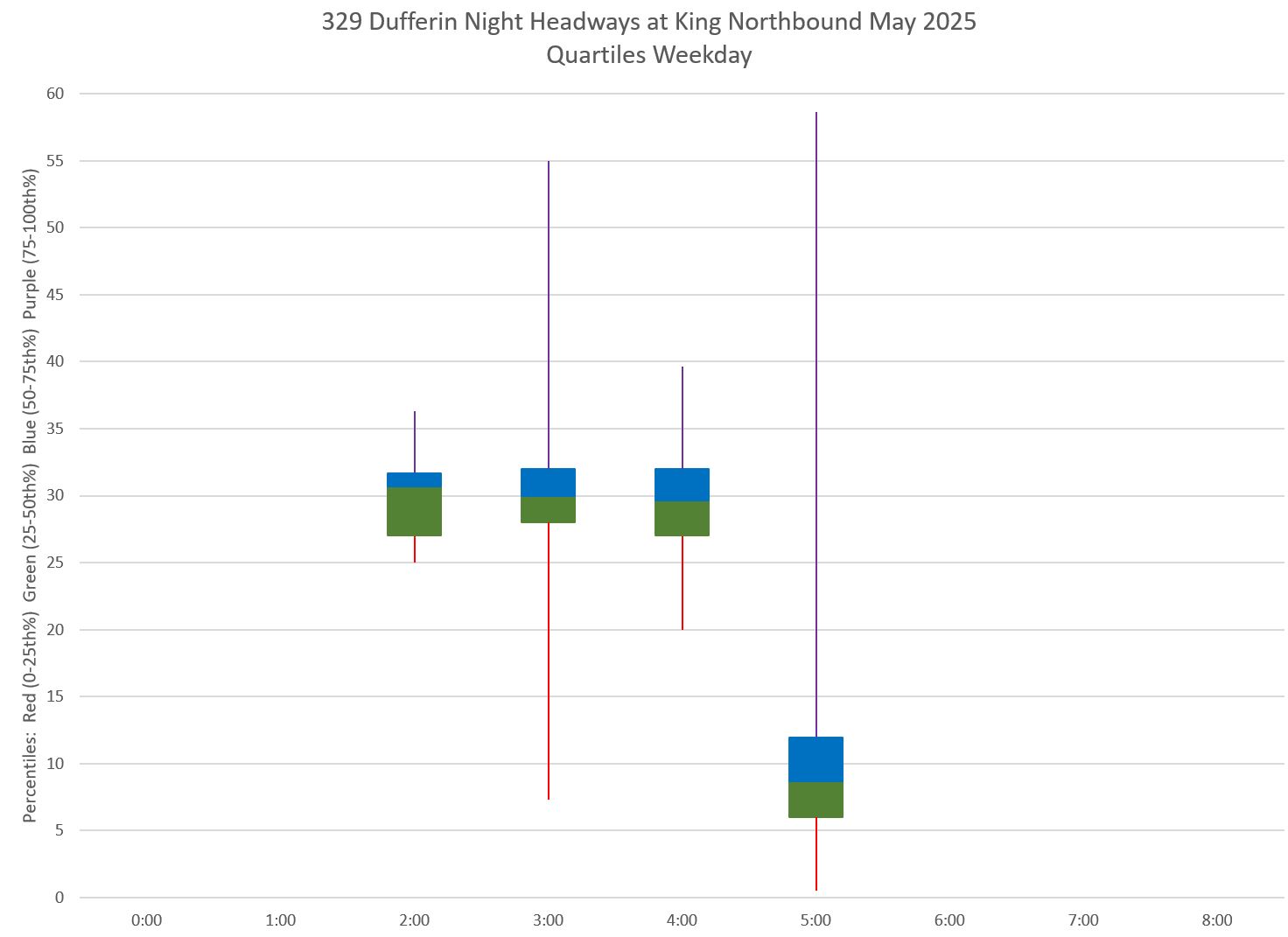
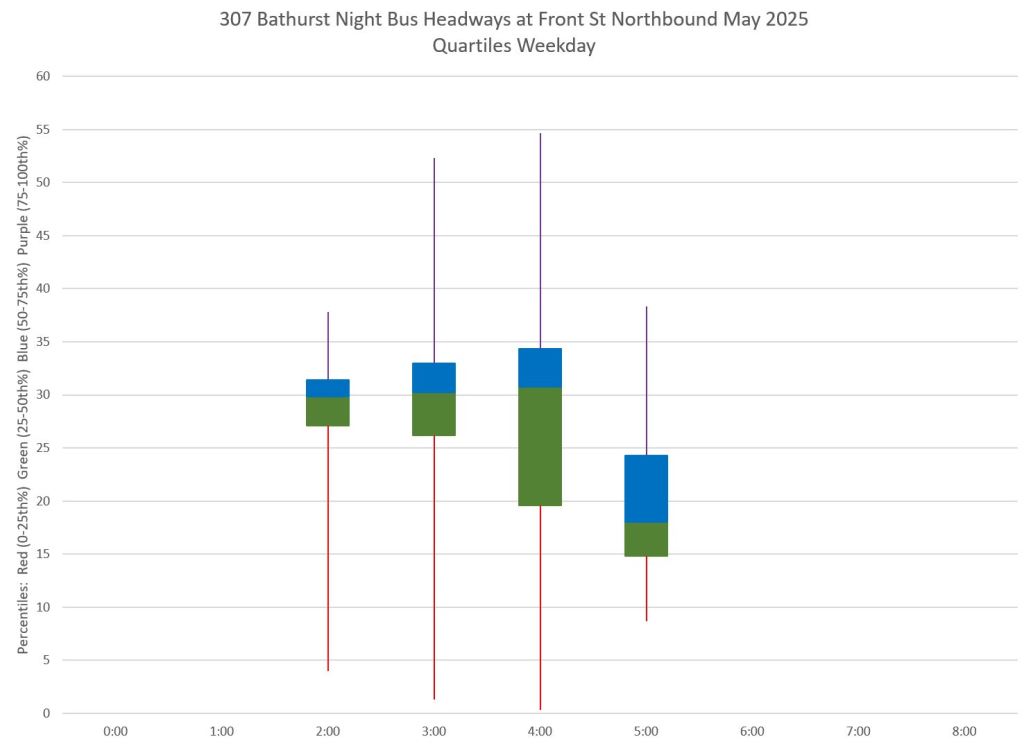
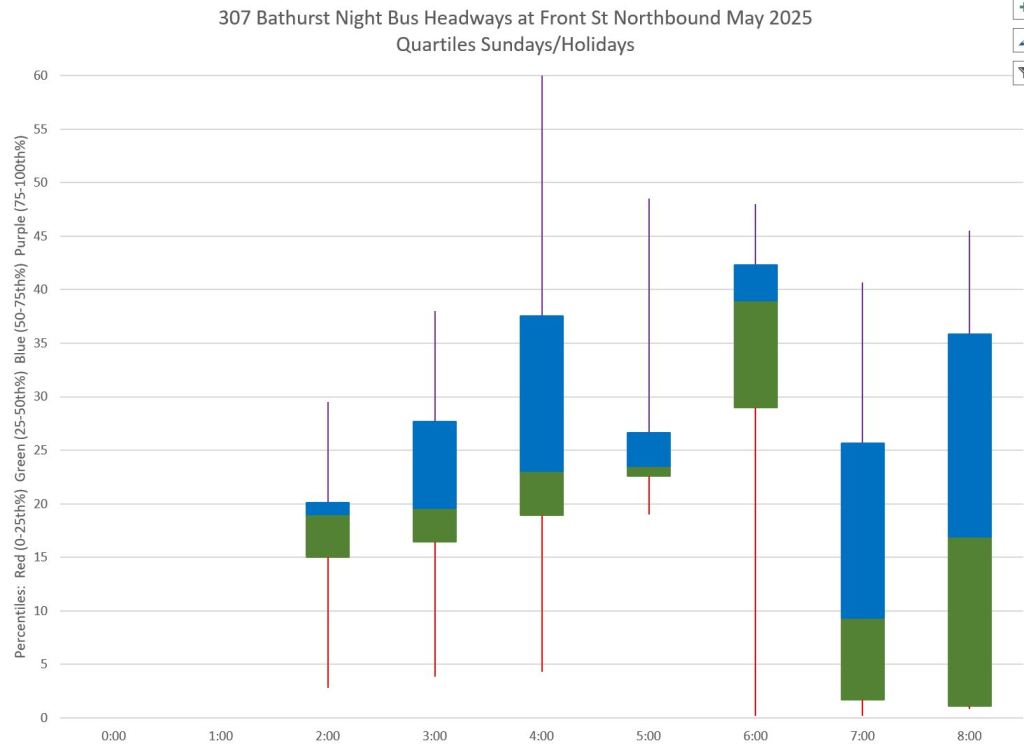
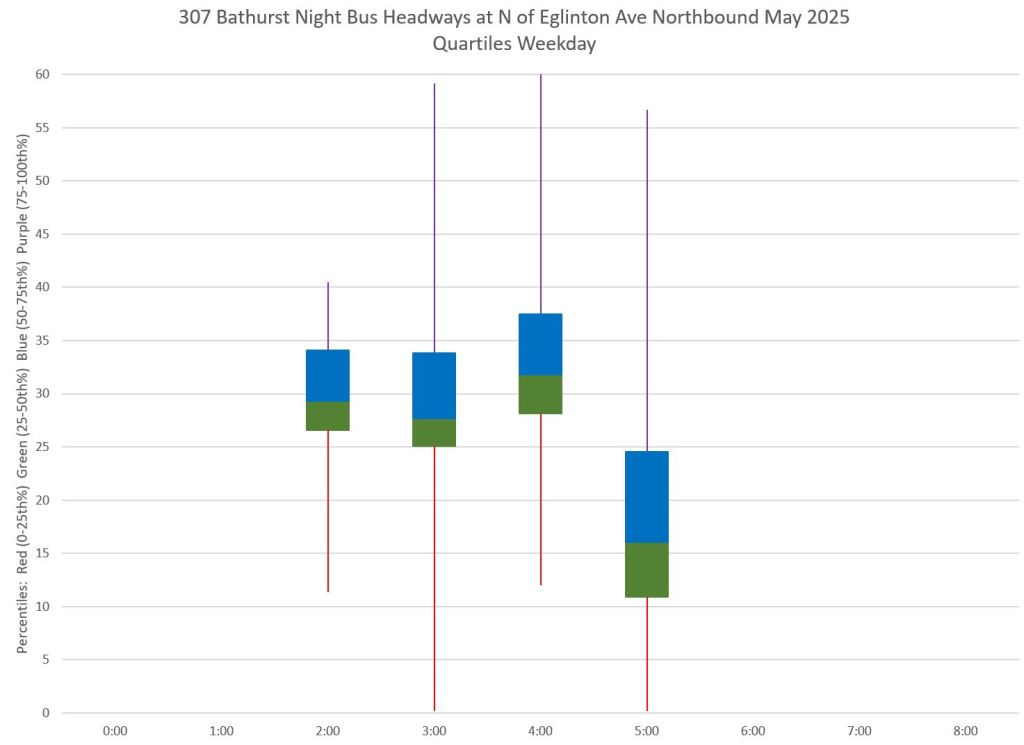
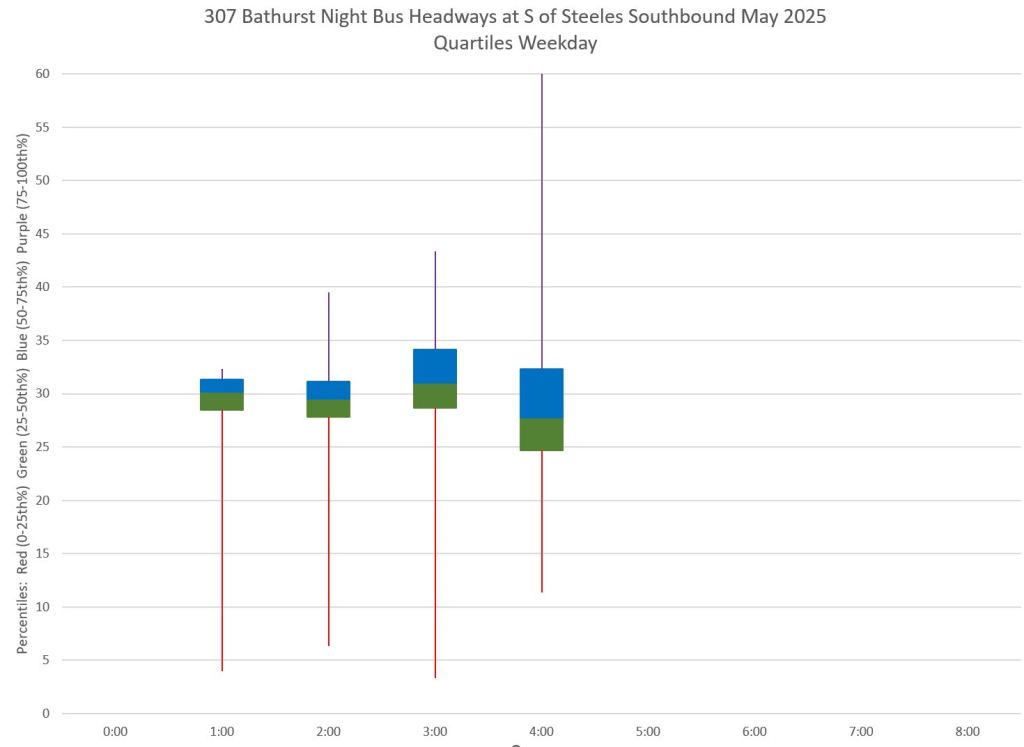
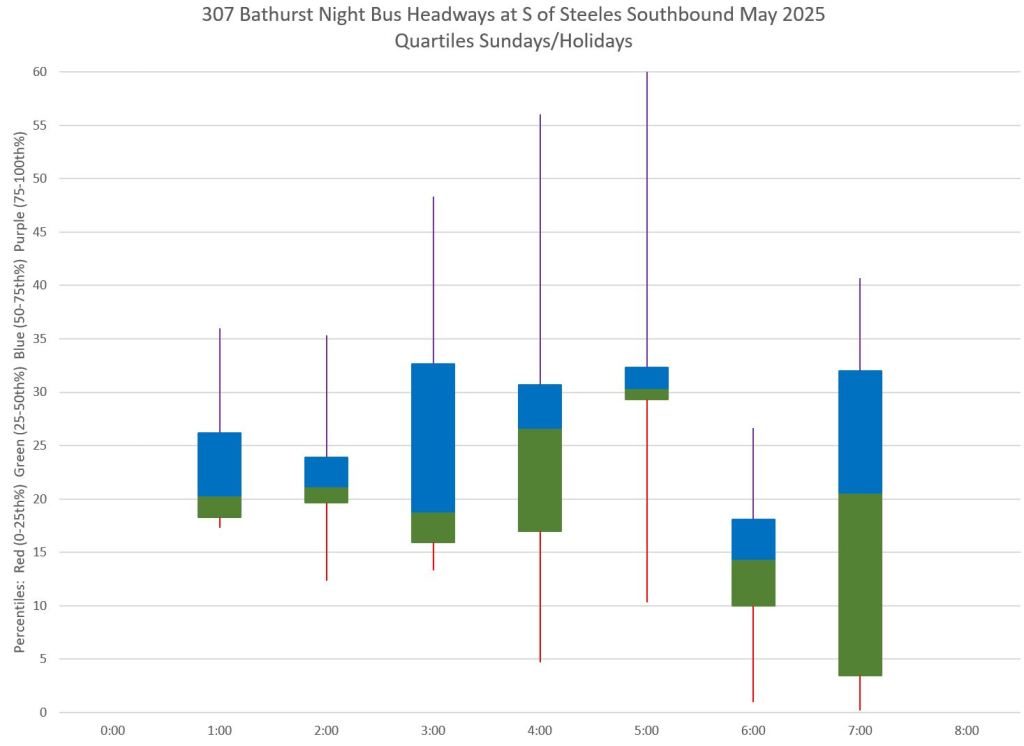
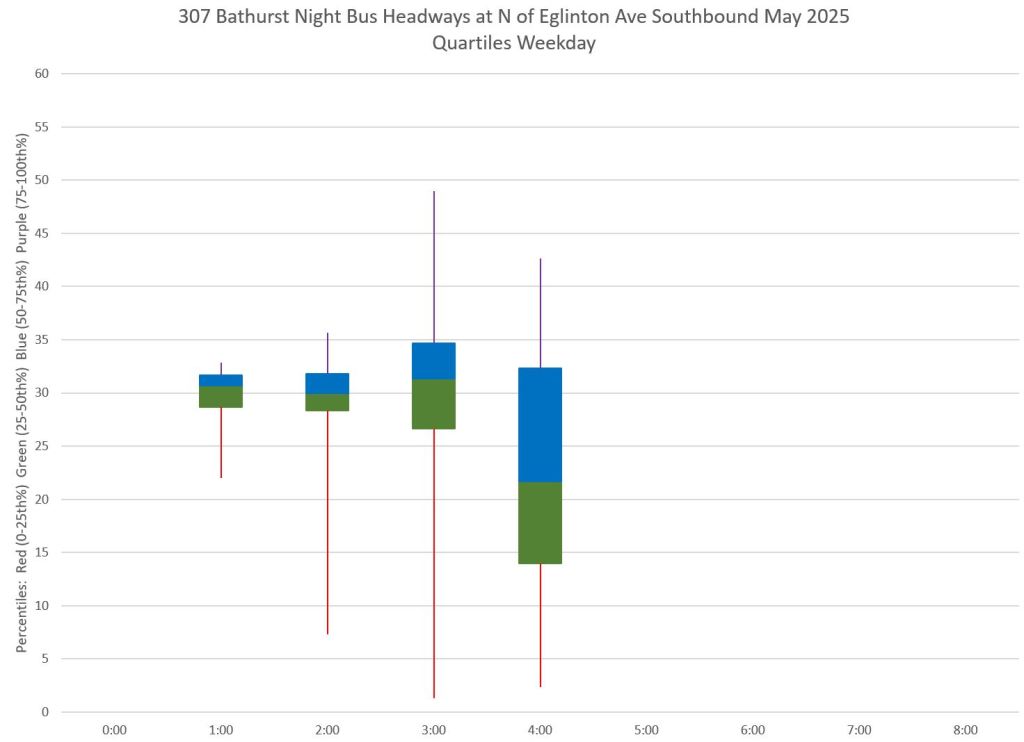
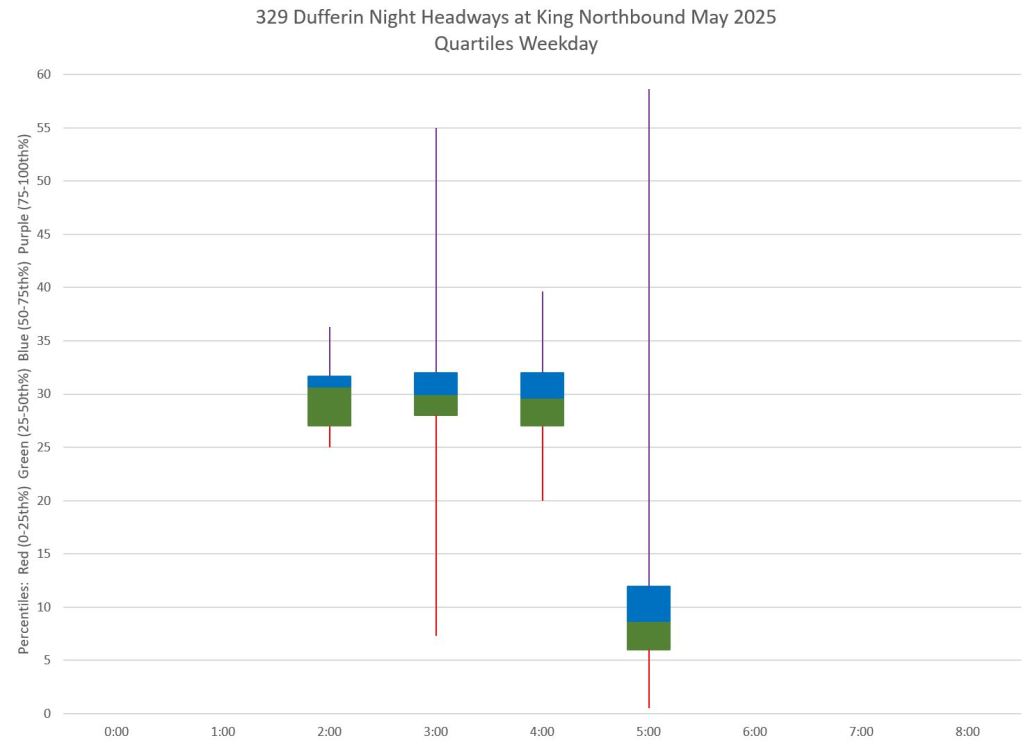
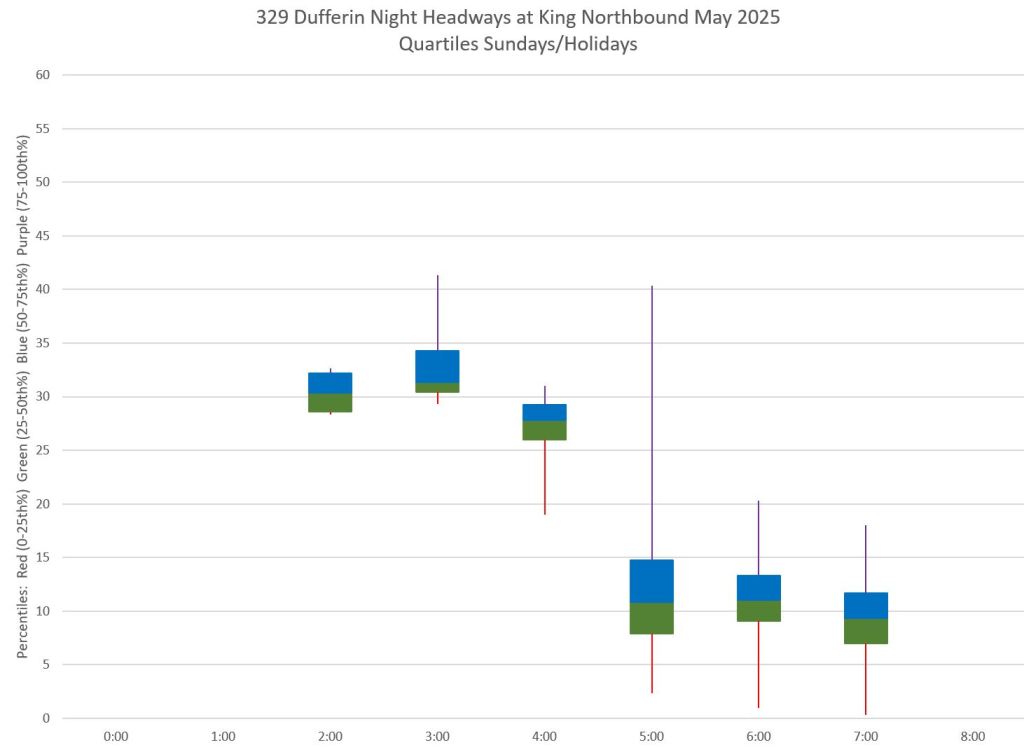
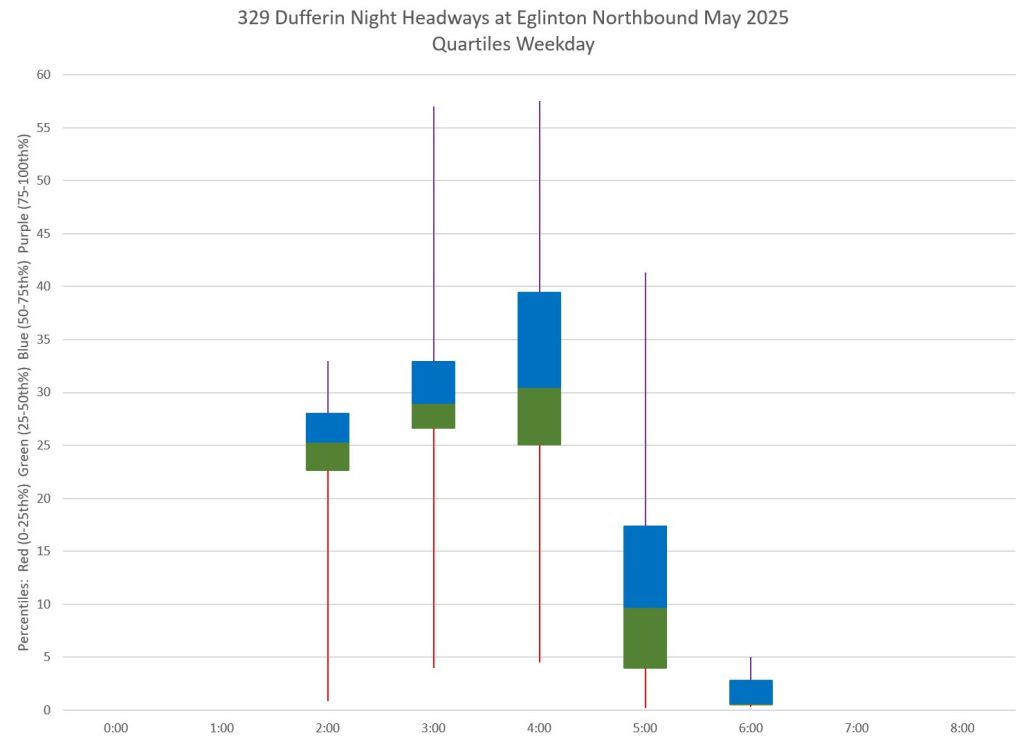
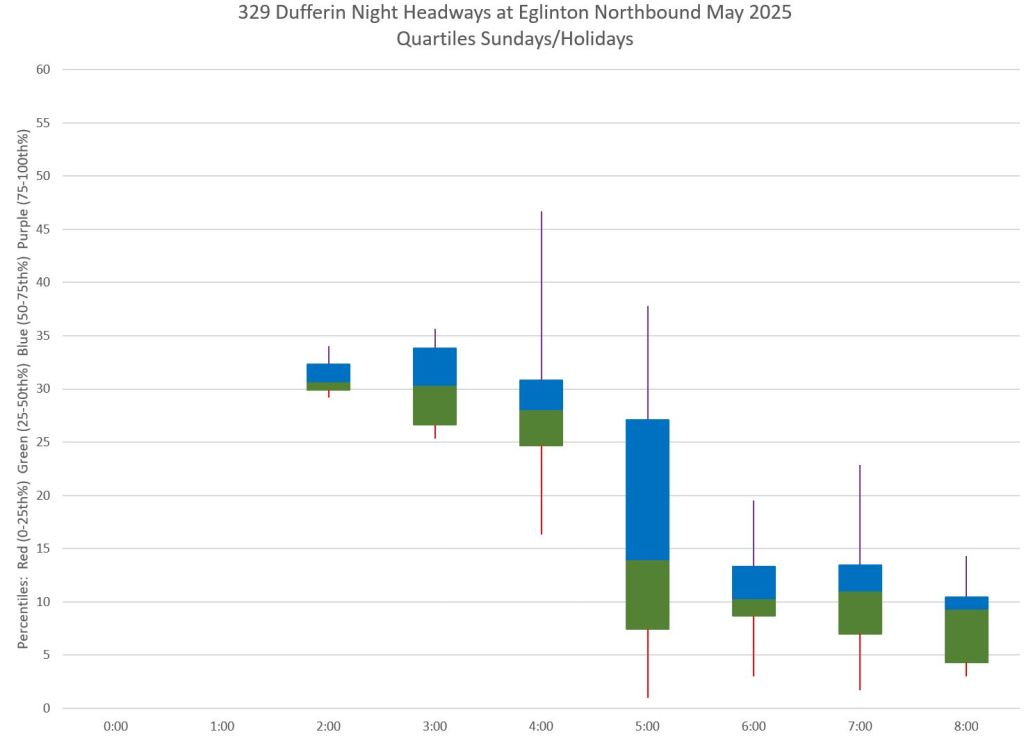
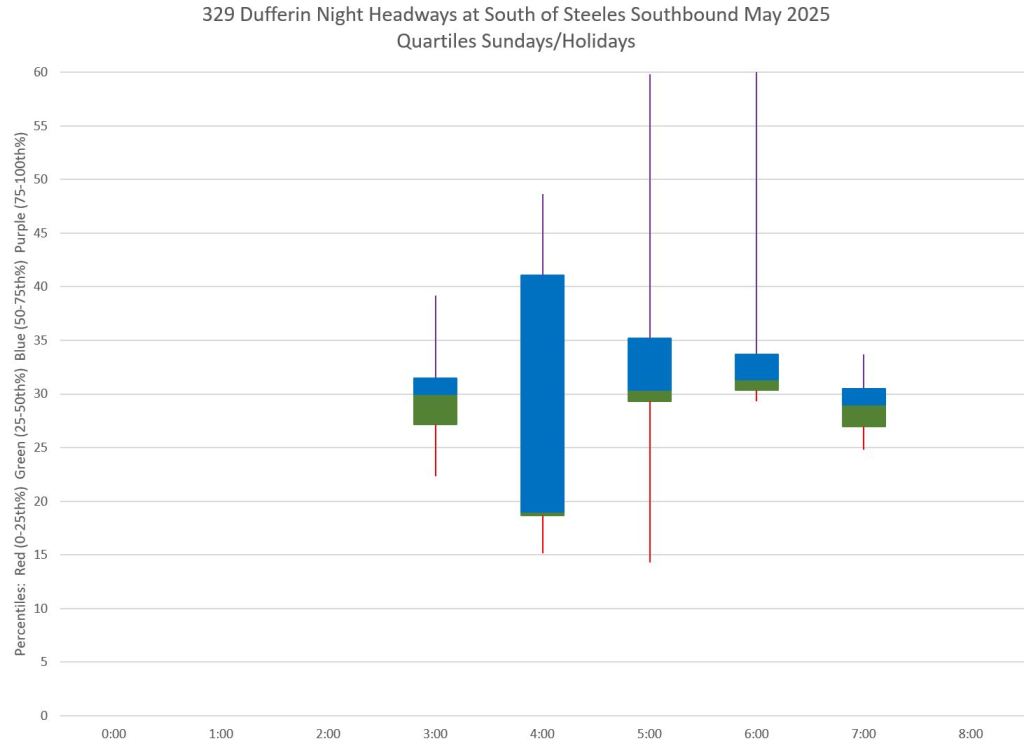
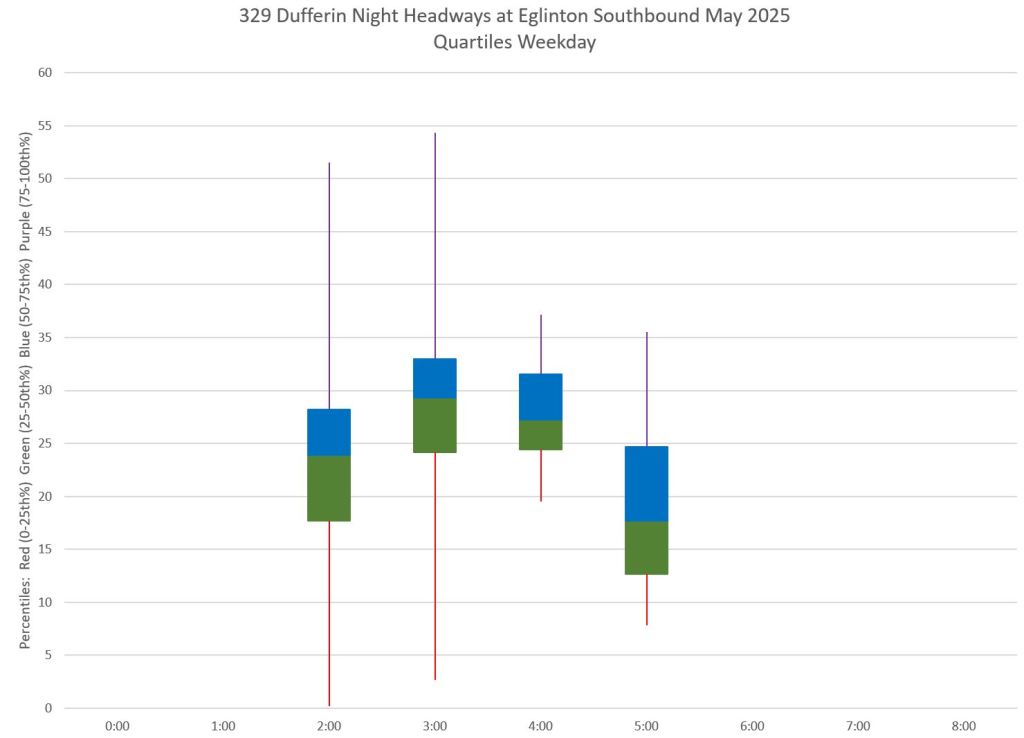
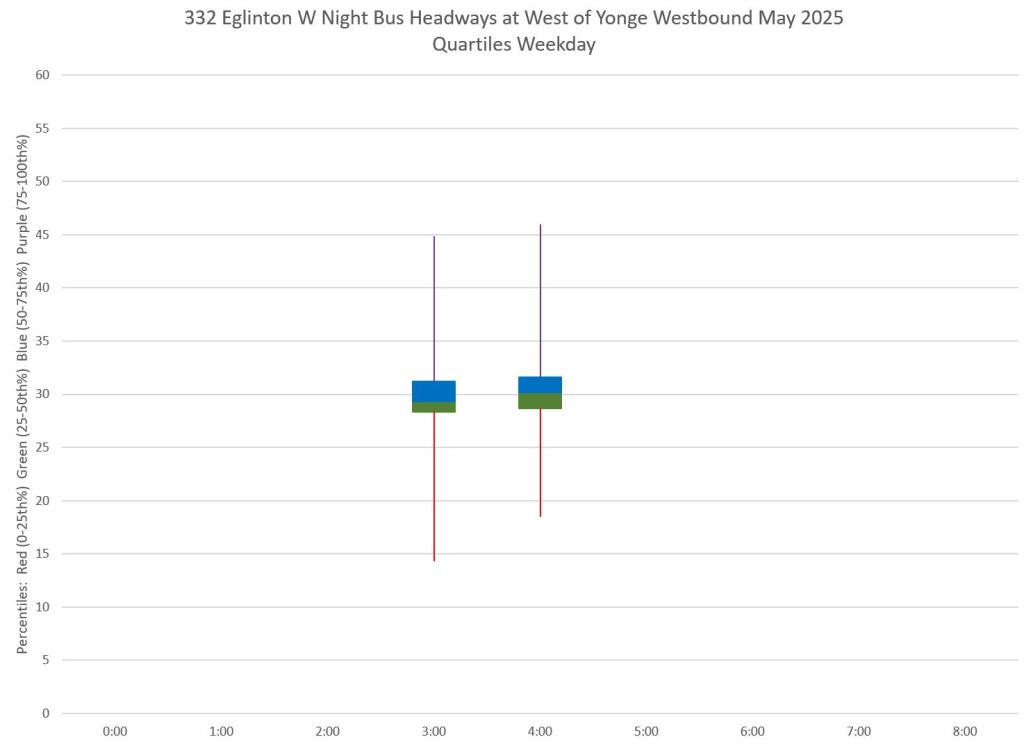
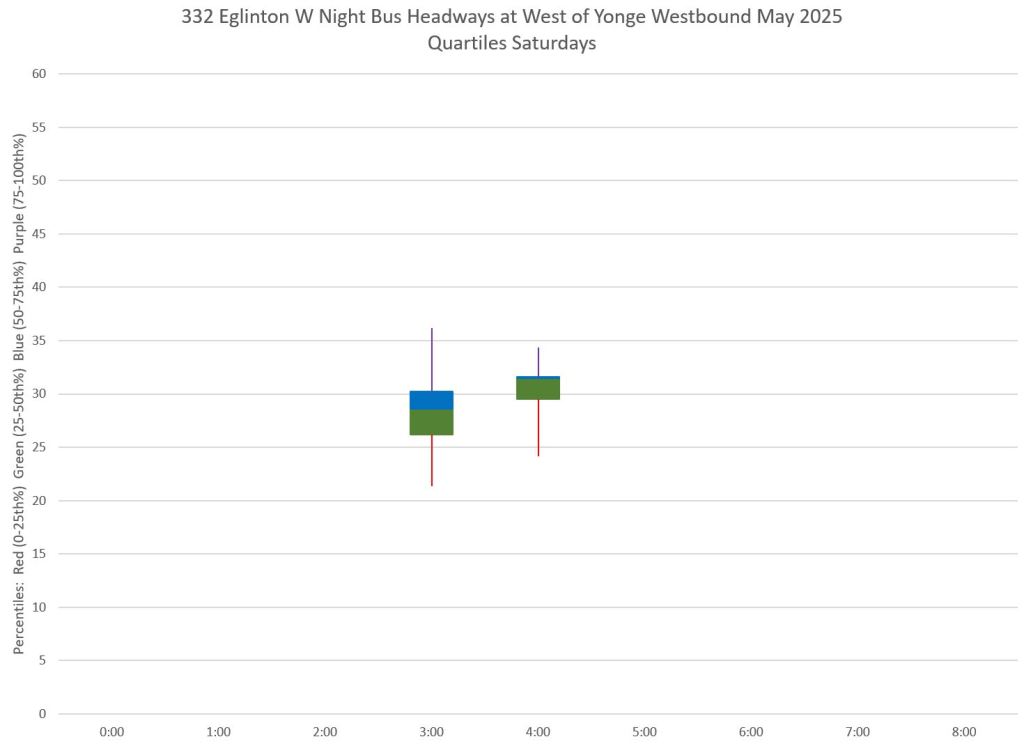
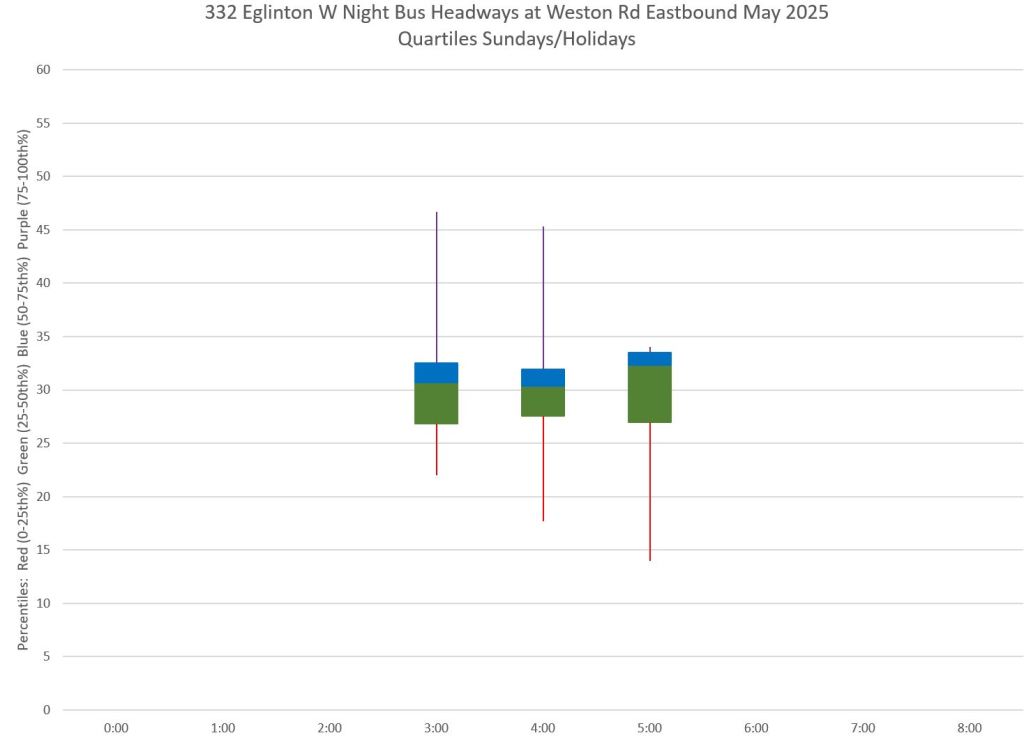
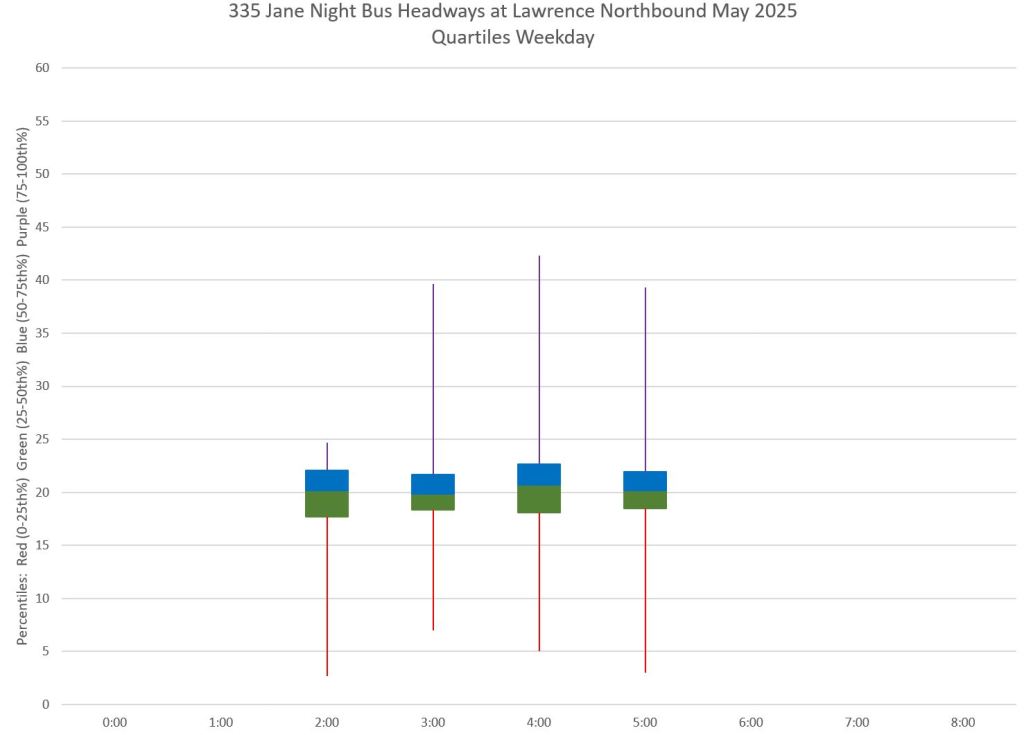
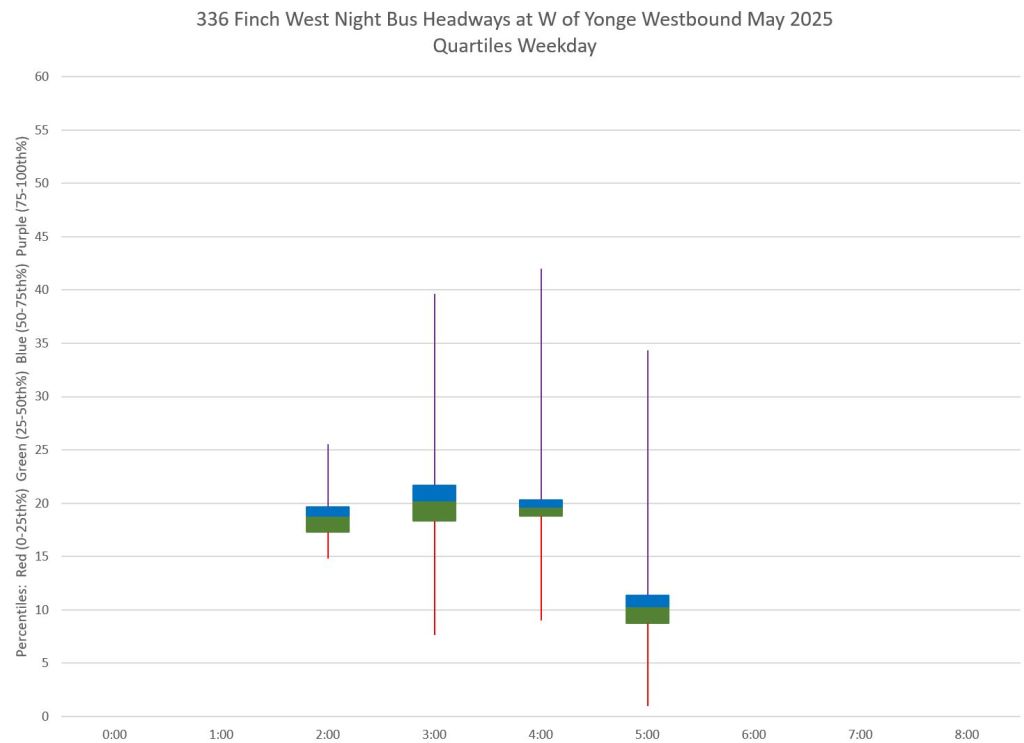
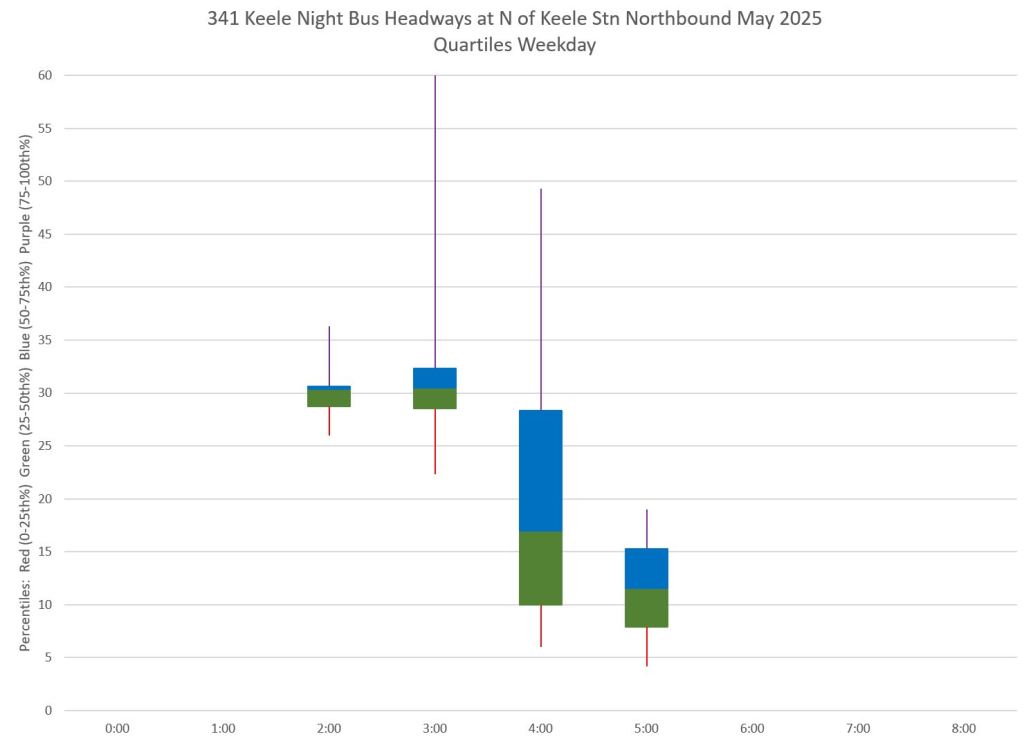
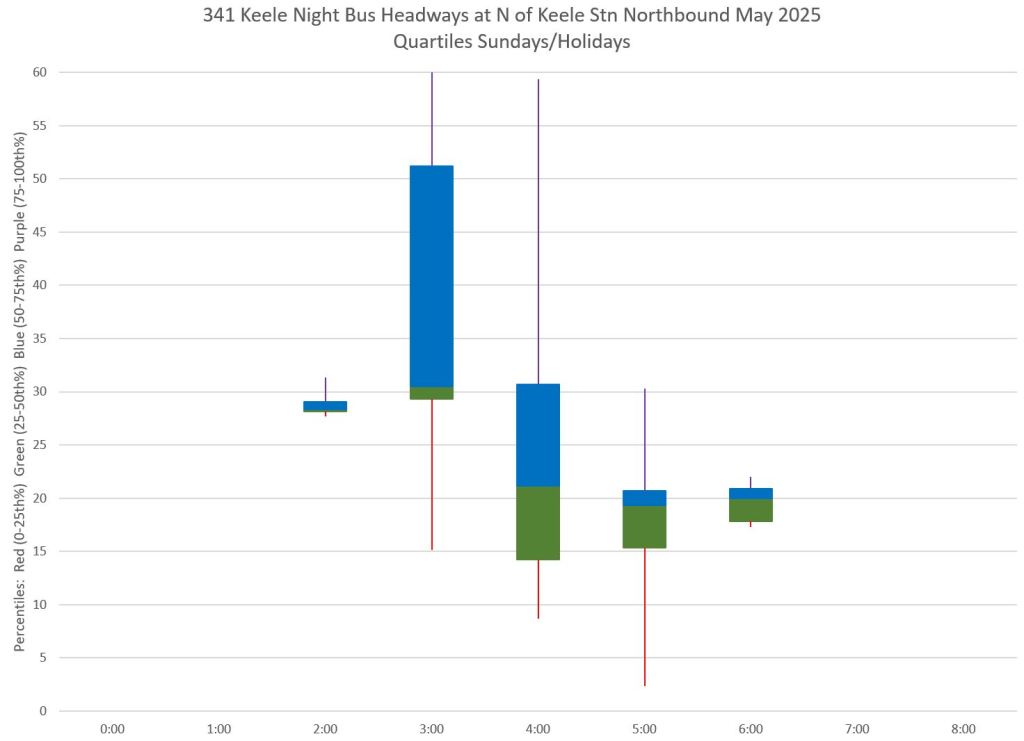
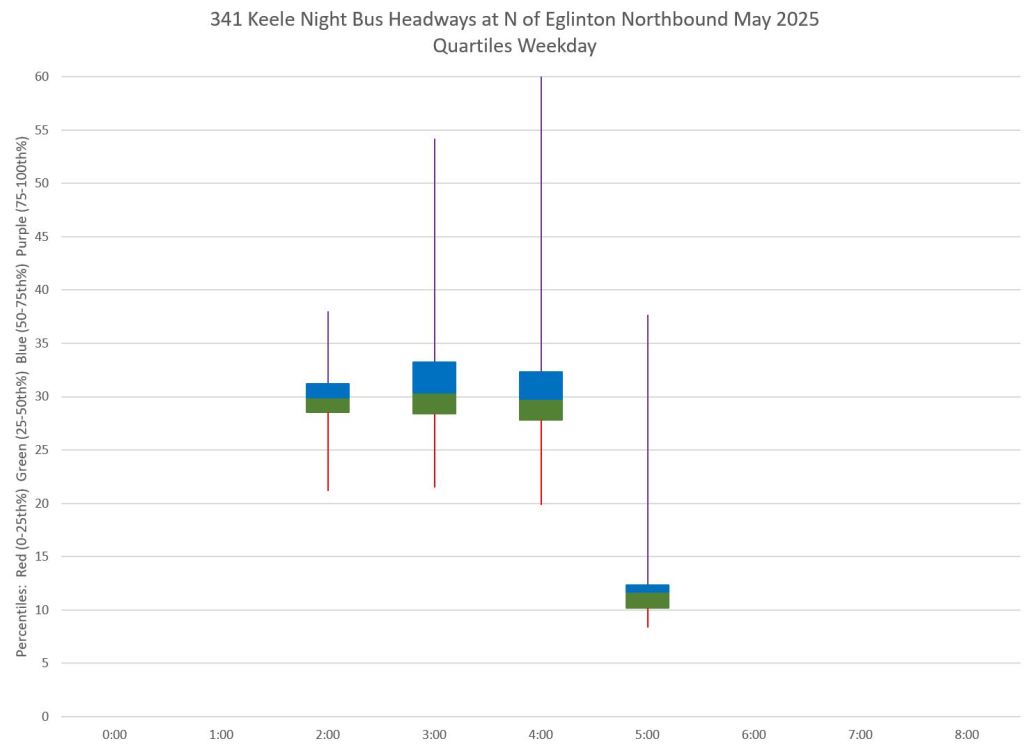
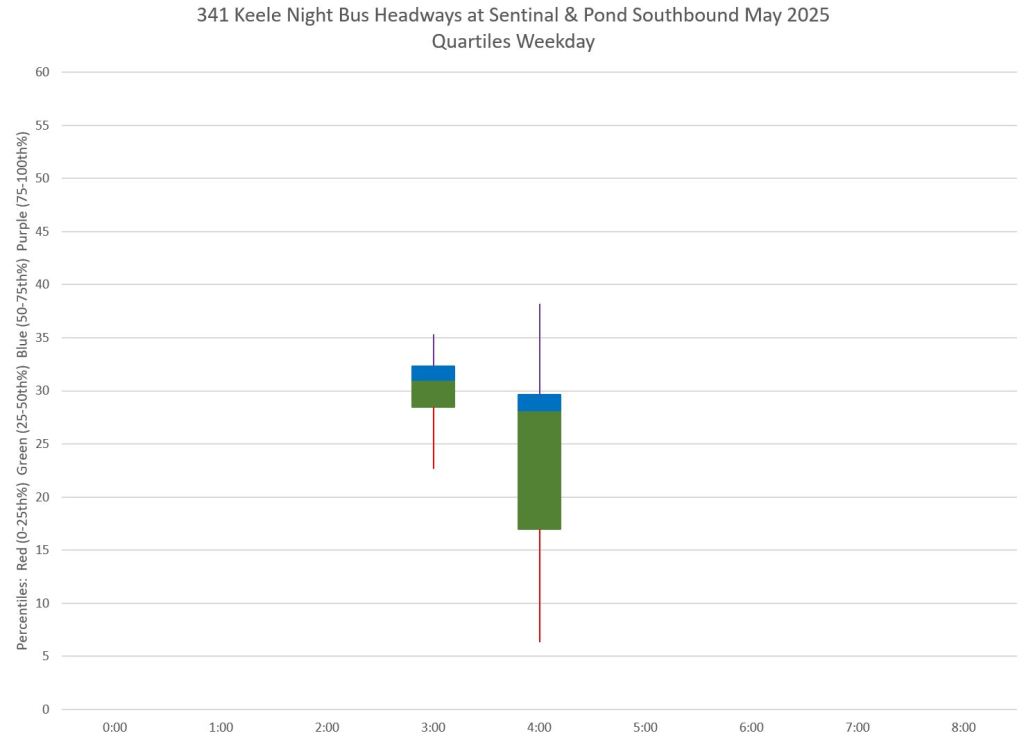
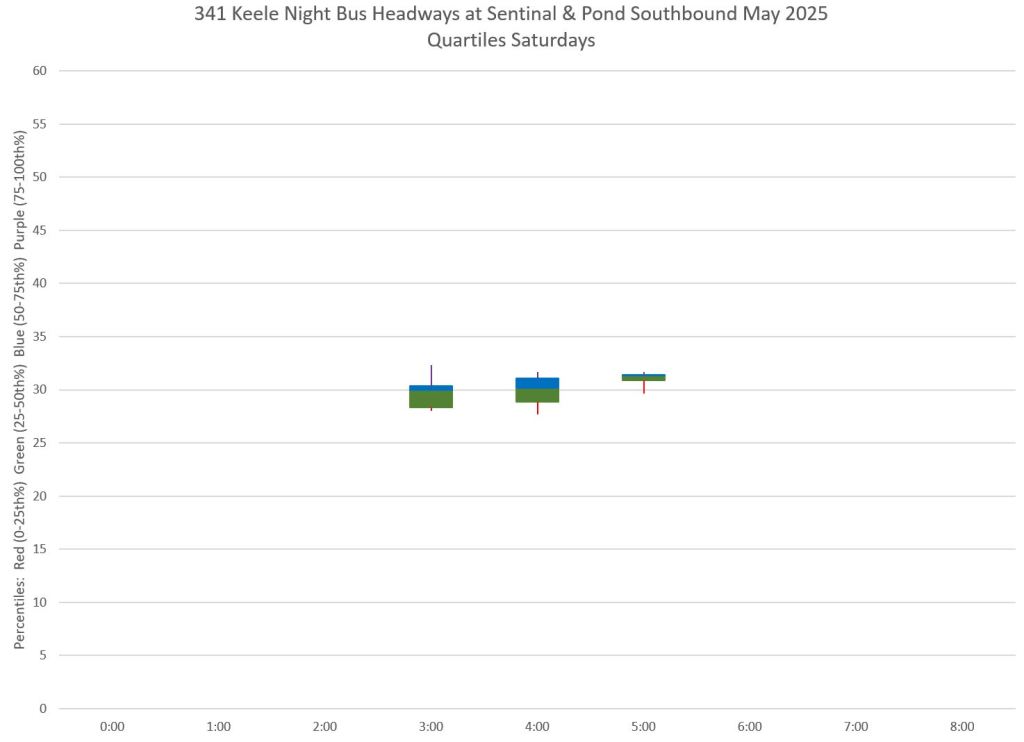
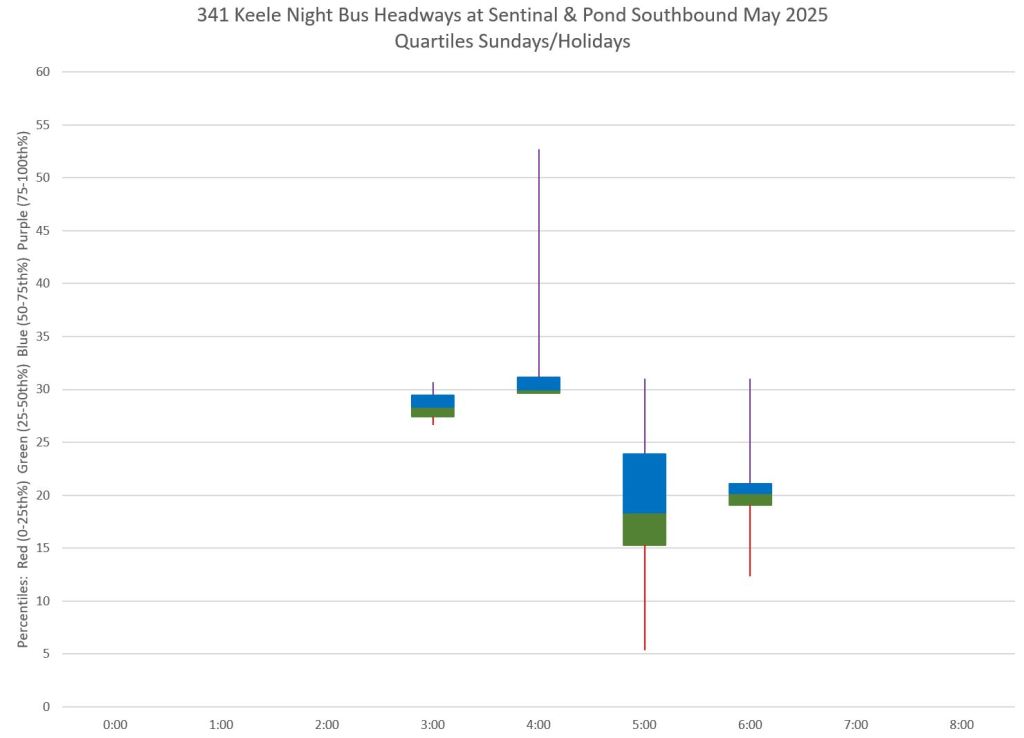
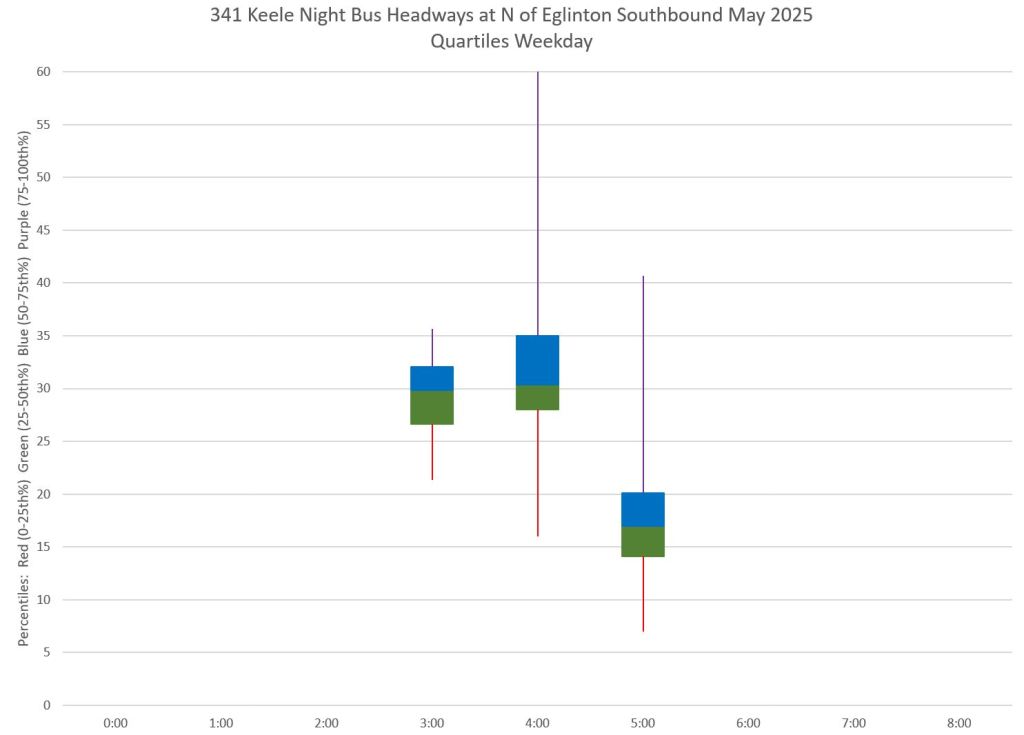
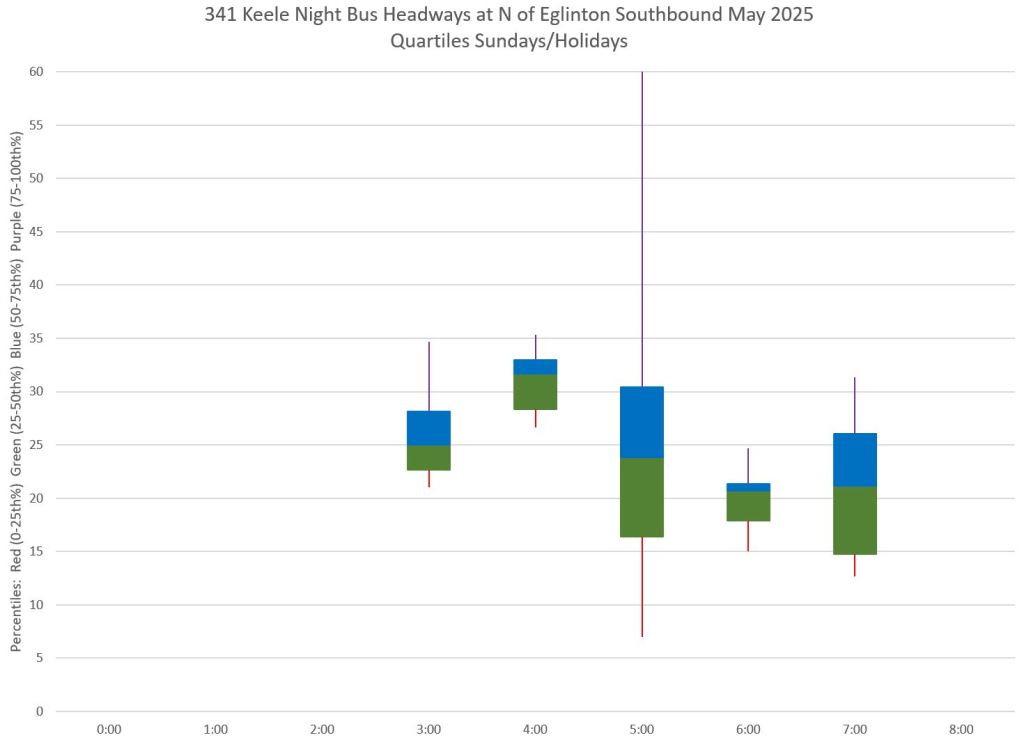
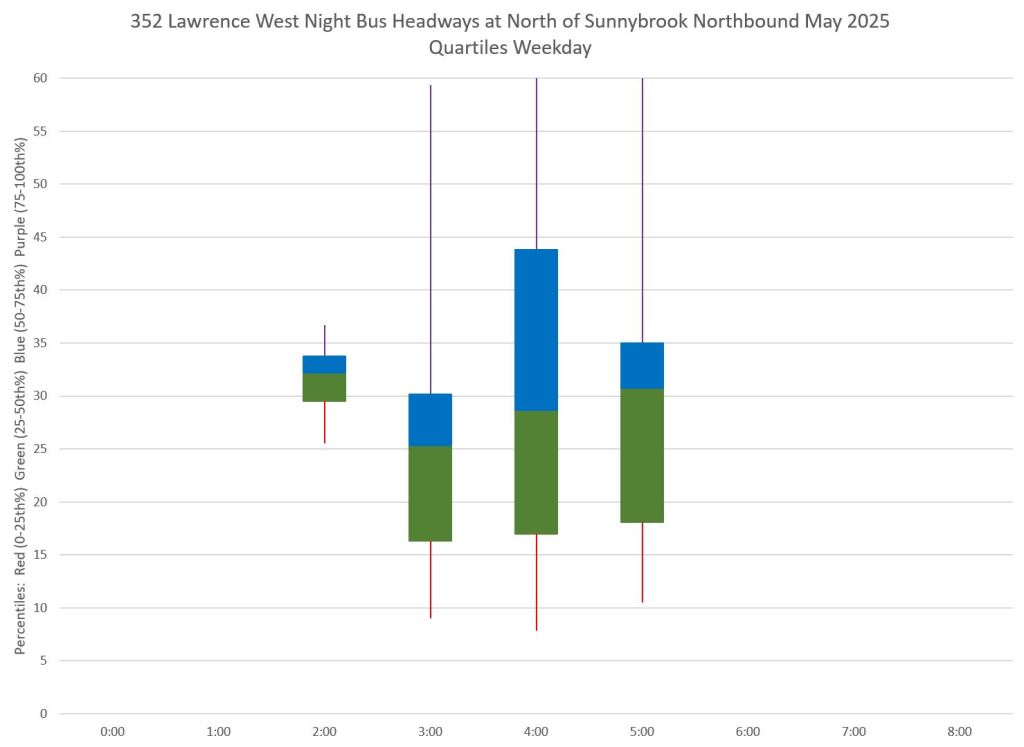
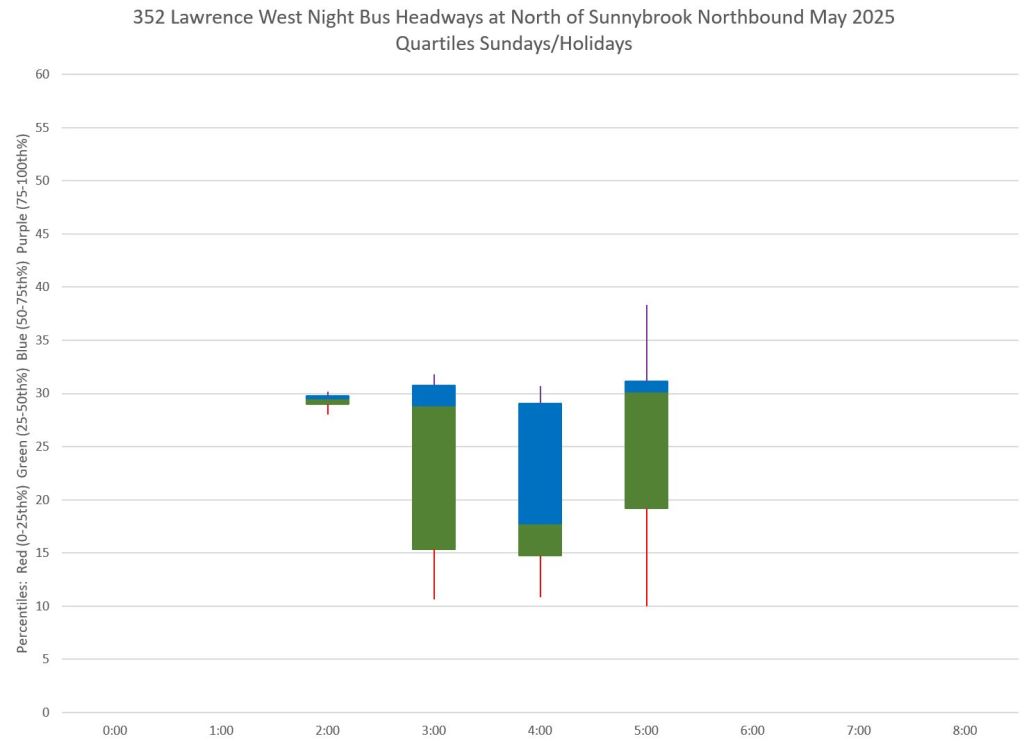
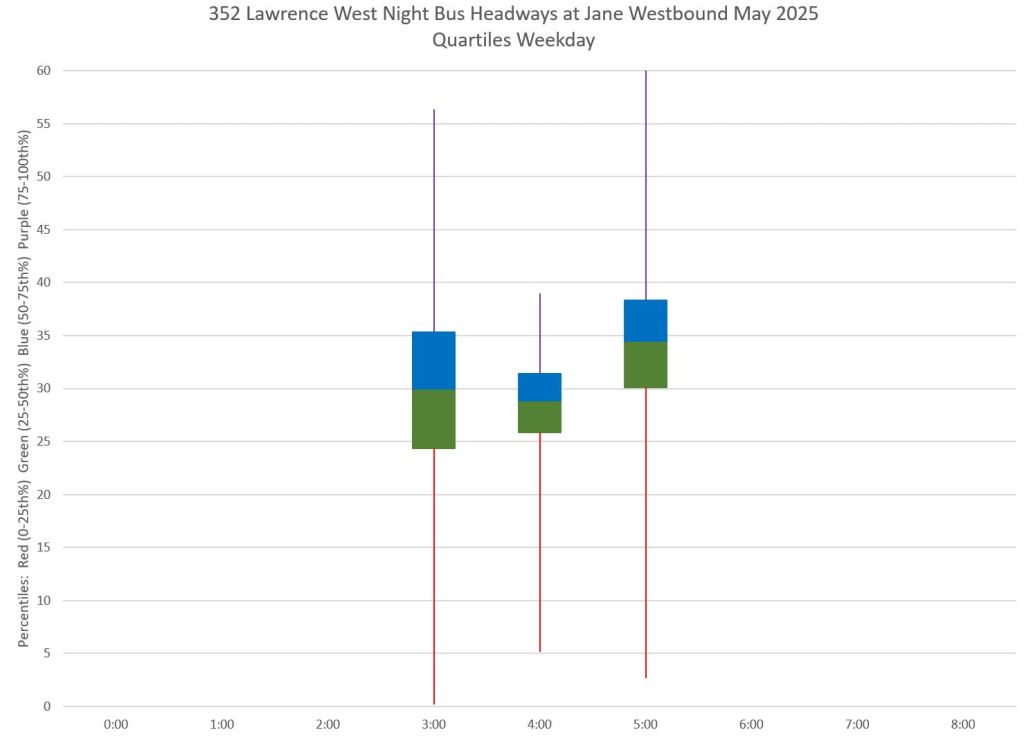
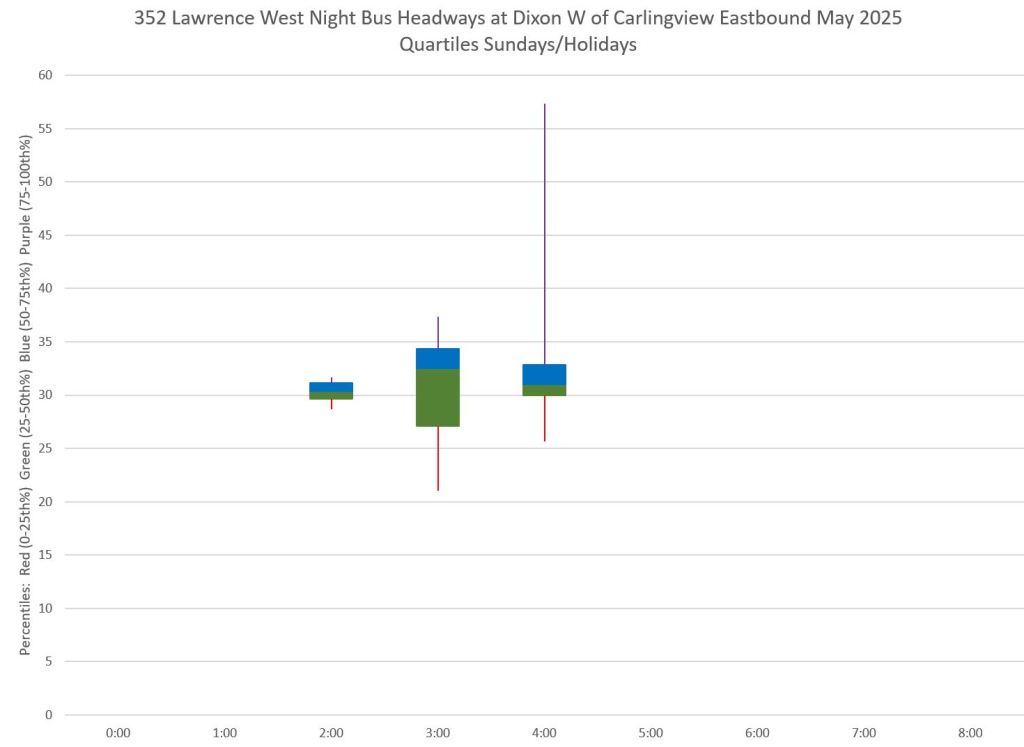
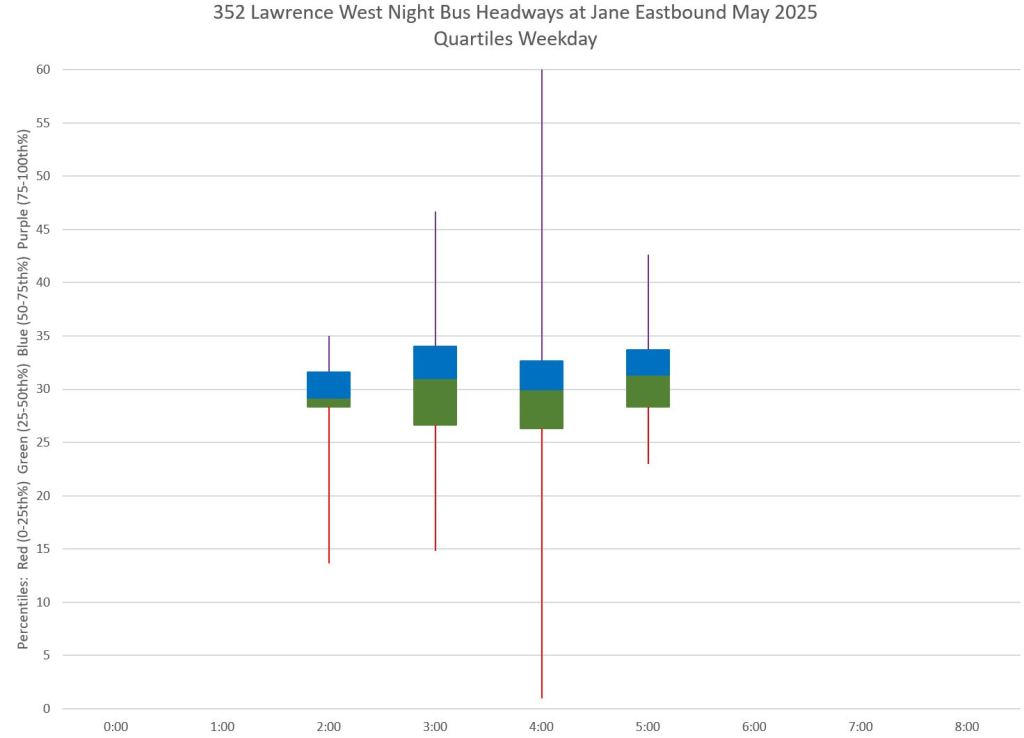
The chart below summarizes the data shown above into hourly quartiles. For service to be reliable, ideally the entire distance from the bottom of the first quartile (red) to the top of the fourth (mauve) should be short, and definitely the central green and blue box (second and third quartiles) should be compact.
In this chart the central boxes span less than 10 minutes, indicating that half of the service is close to the 30 minute target. However, some of the “tails” for the outer quartiles reach far from the median (the green/blue boundary) showing that the other half of the service is well outside of the advertised frequency.
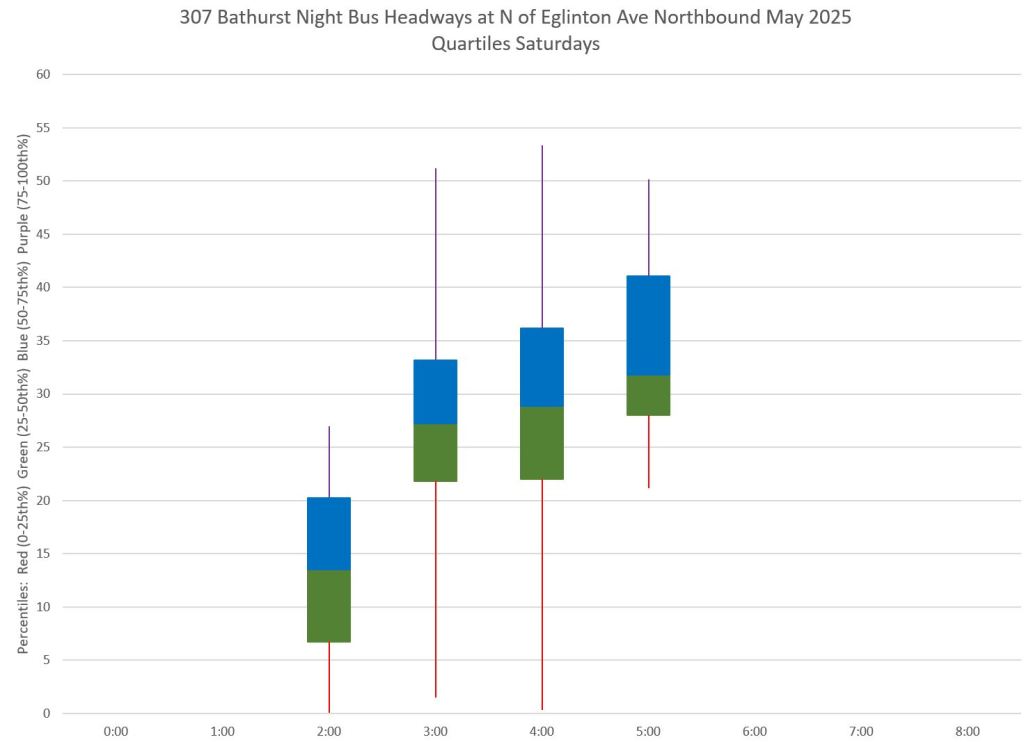
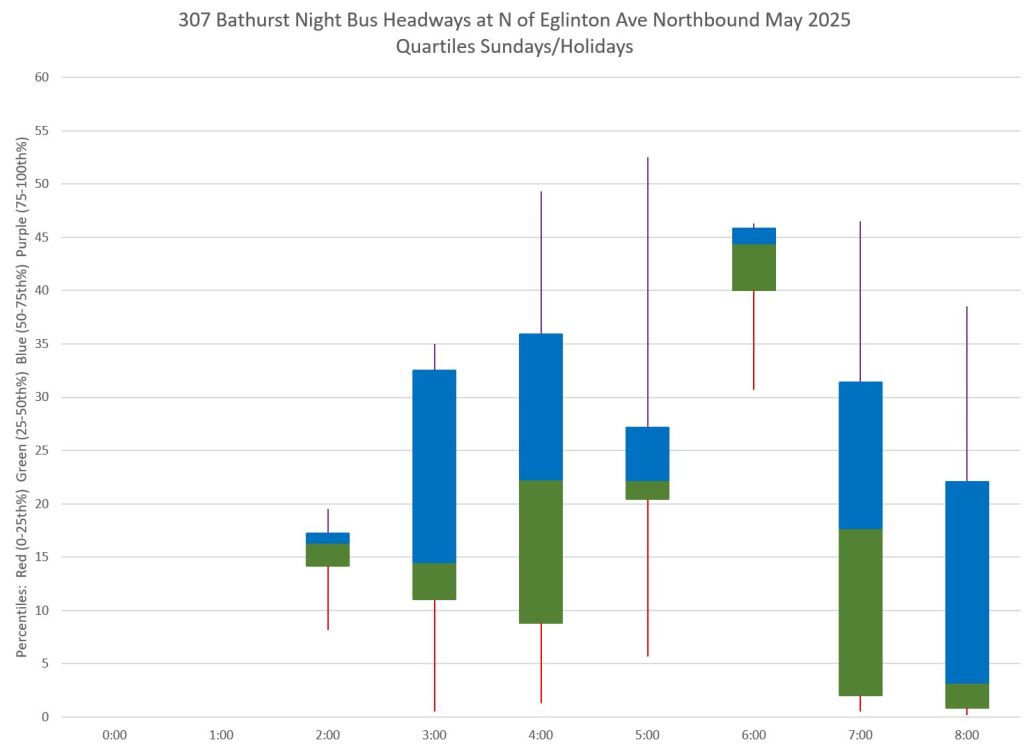
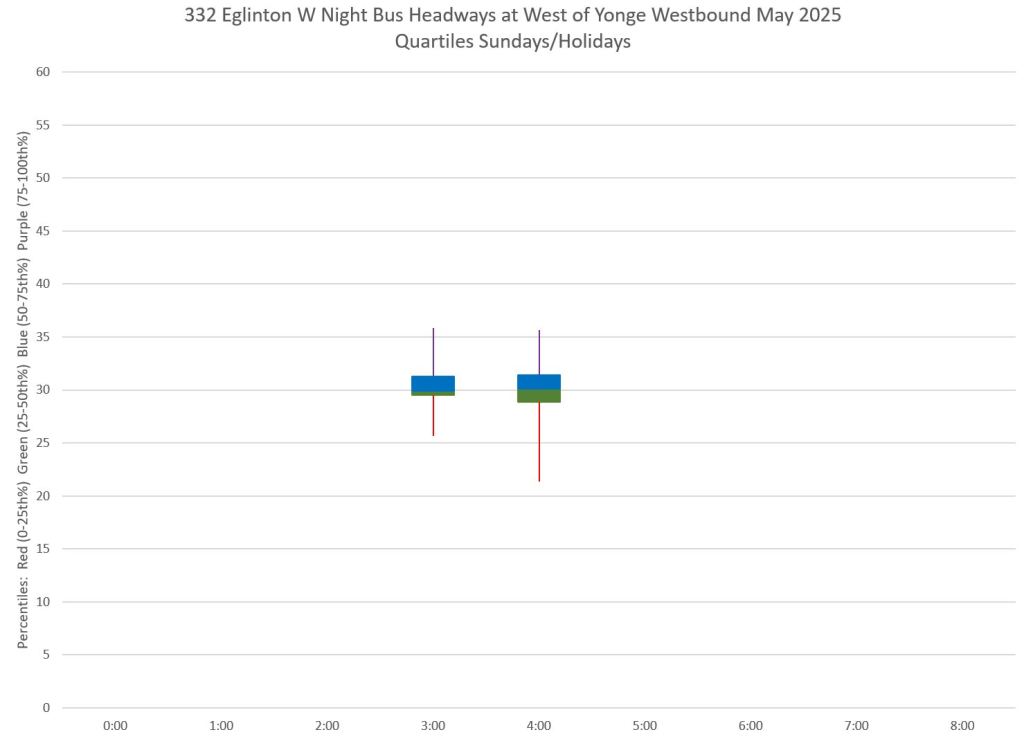
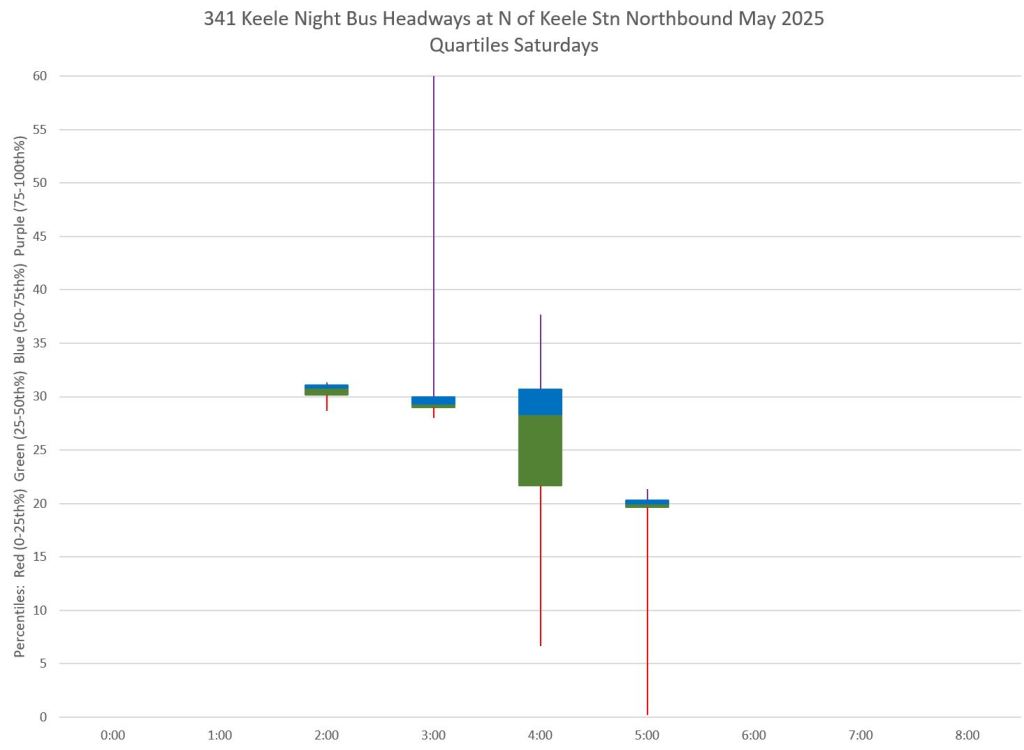
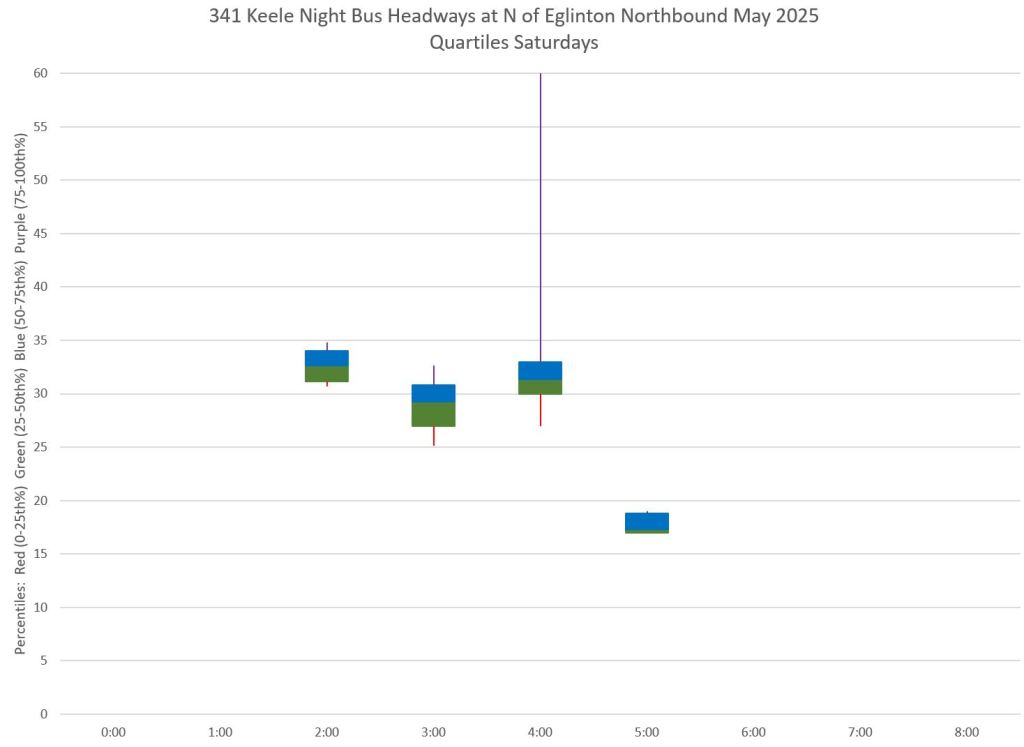
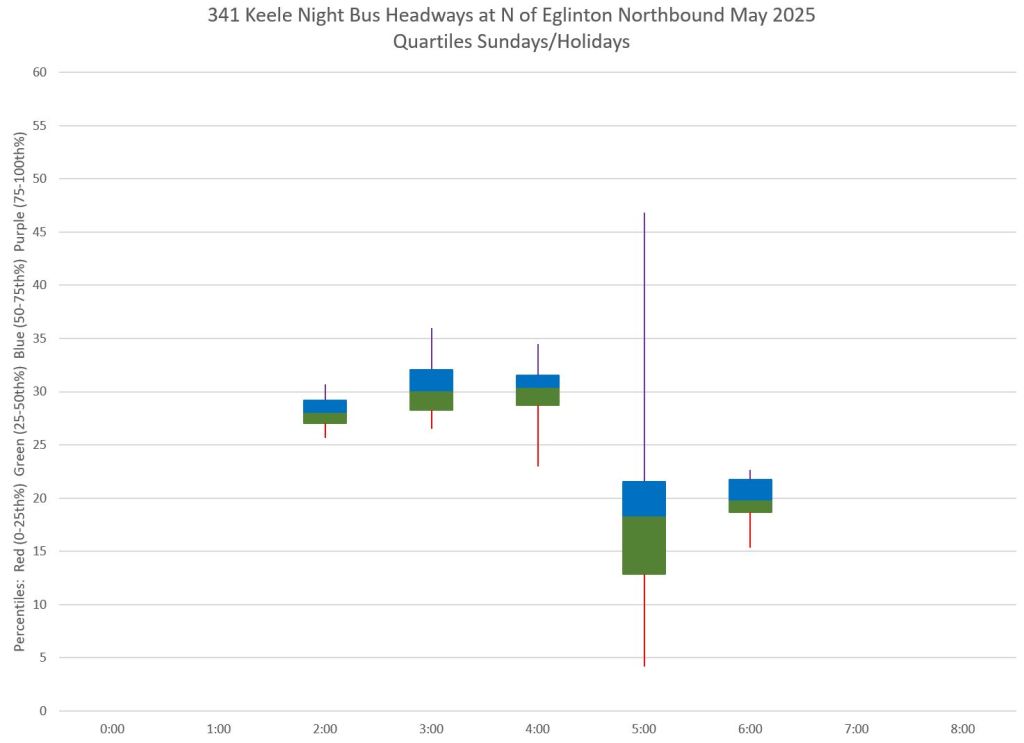
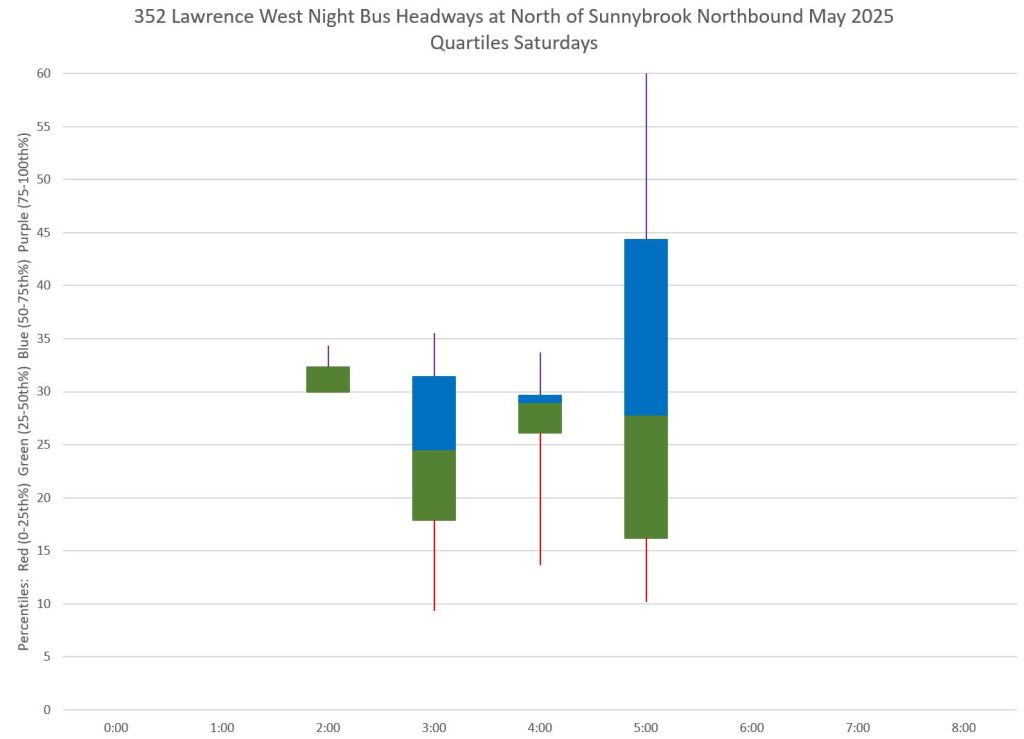
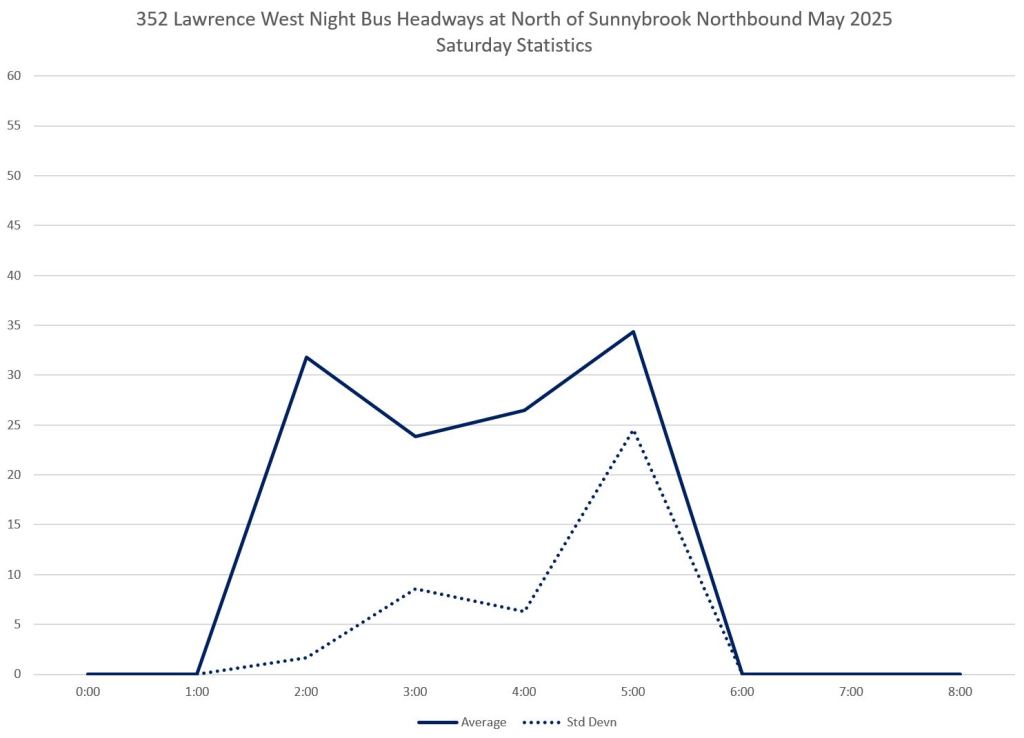
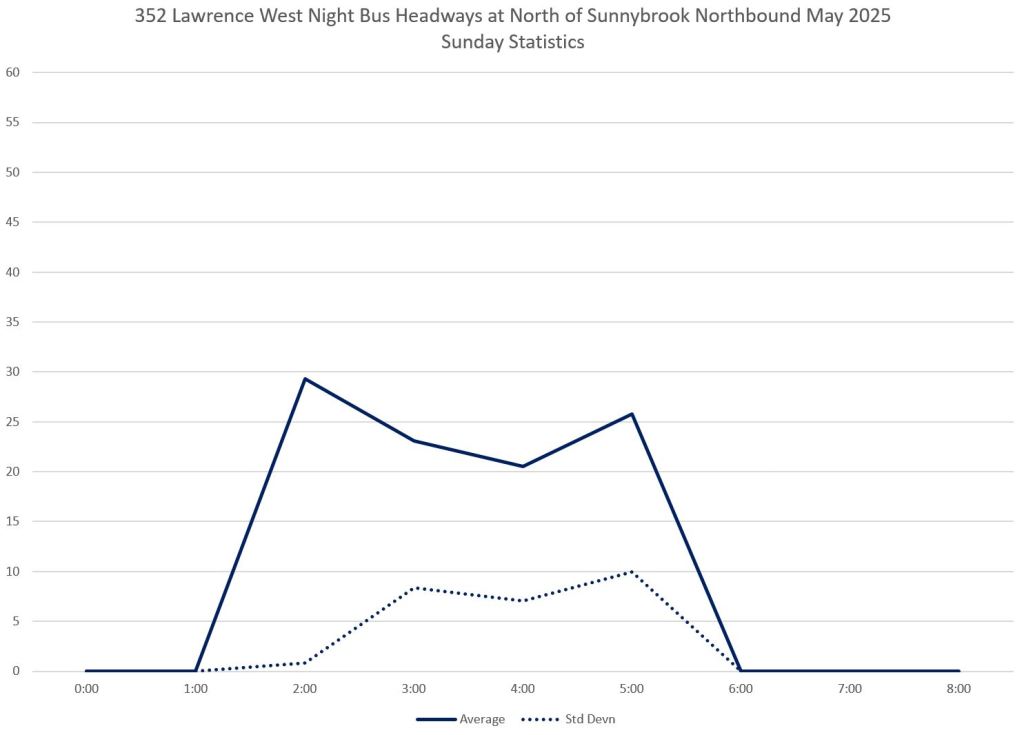
In May, there are five Saturdays and five Sundays/Holidays, and so for a specific hour there might be only 10 headways in a sample (half hourly, 5 days). For the first hour, there will be only 5 trips with headway data because this analysis does not attempt to measure the gap between the last regular “day” bus and the first “night” bus. On a half hour headway, this means there will be only one measured gap in the first hour (e.g. a bus at 2:15 and at 2:45).
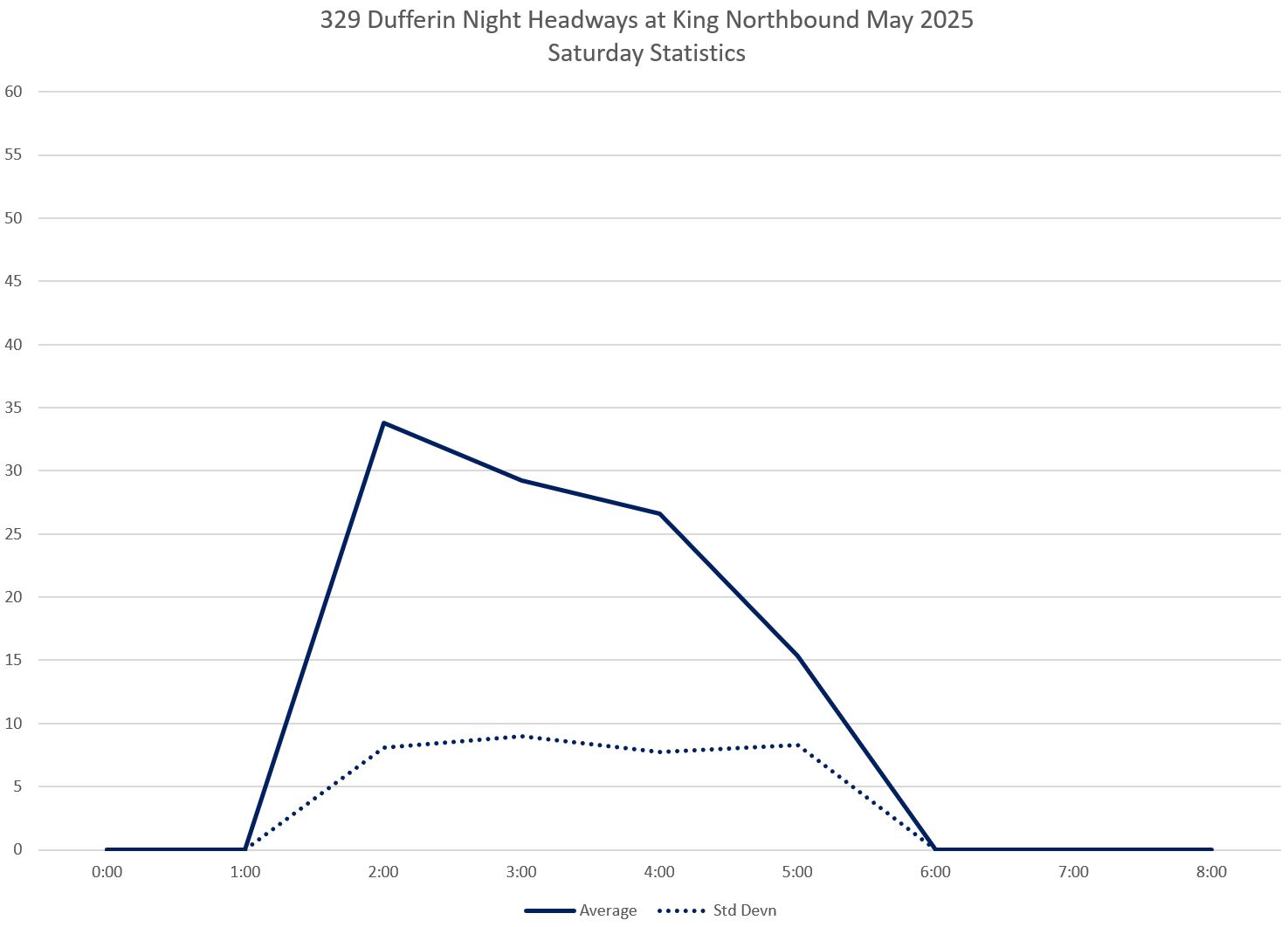
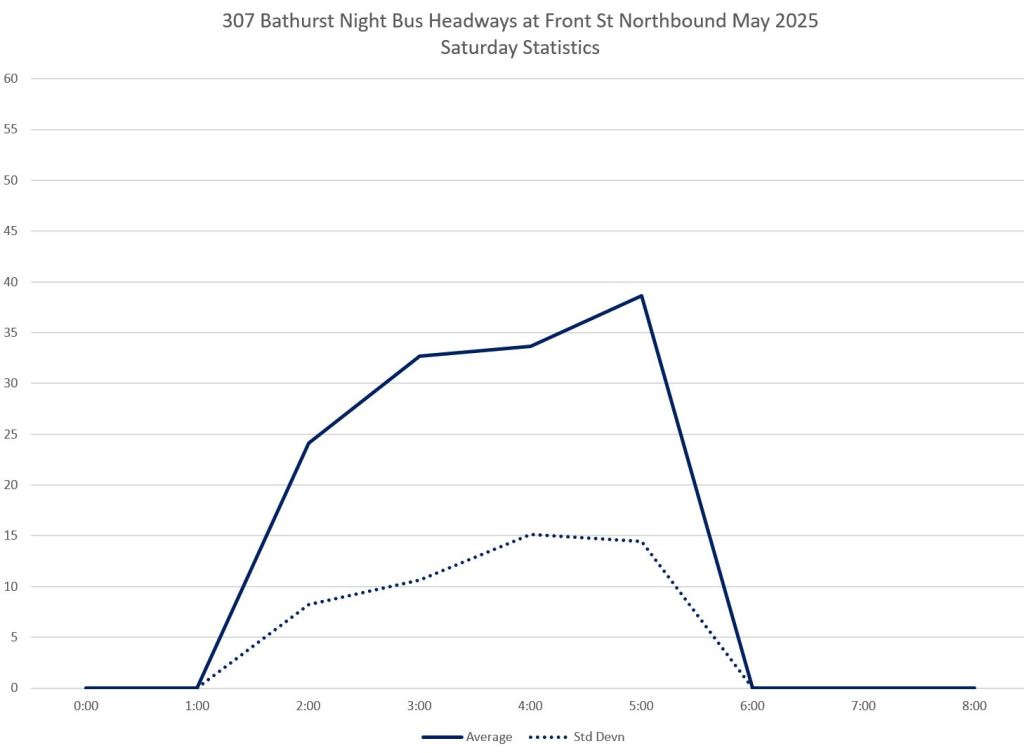
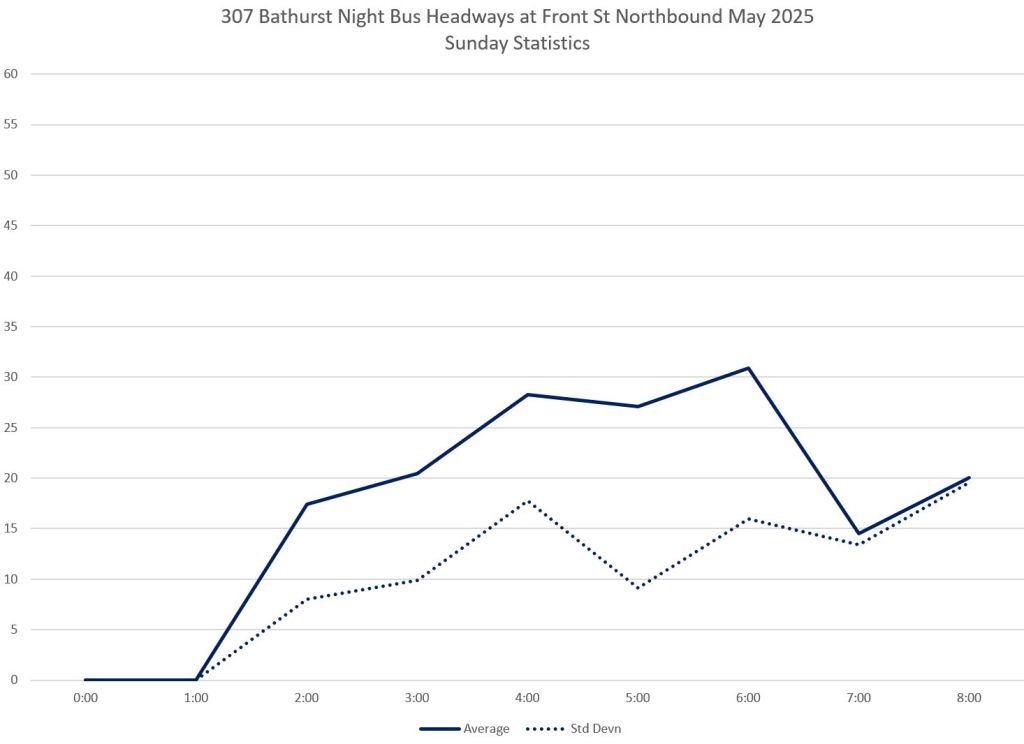
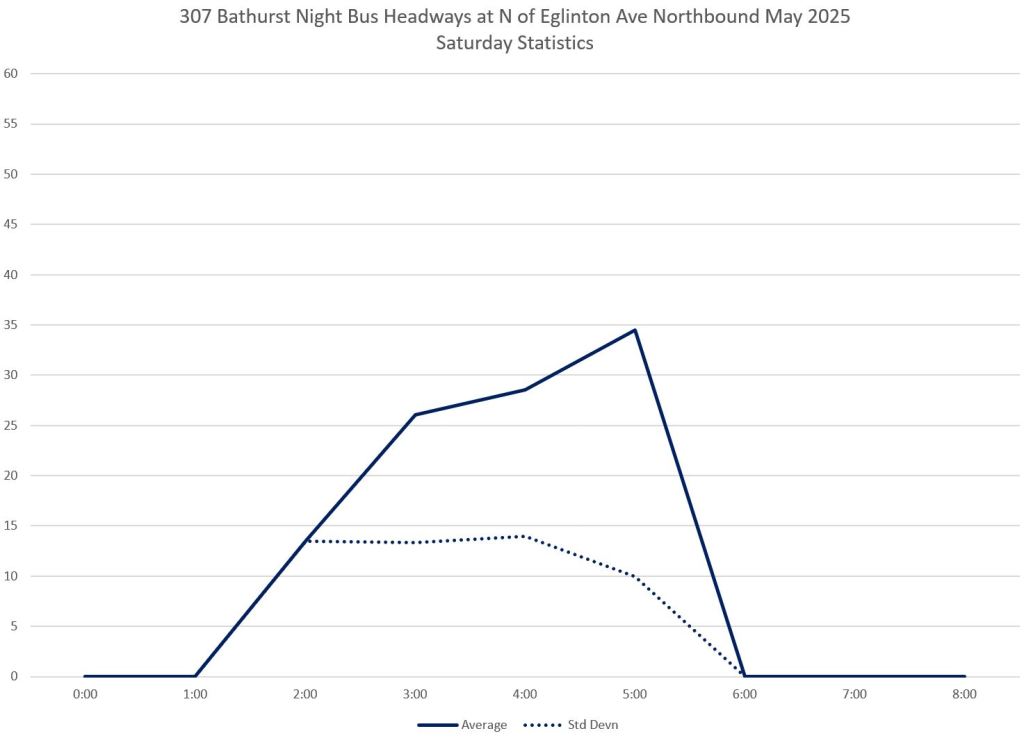
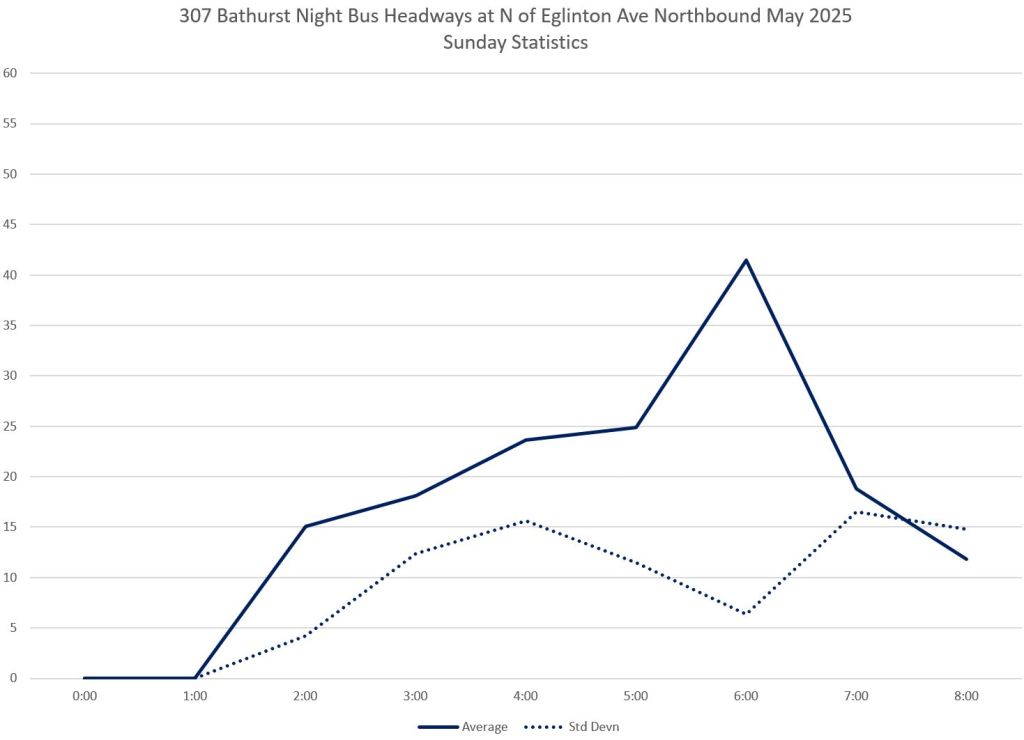
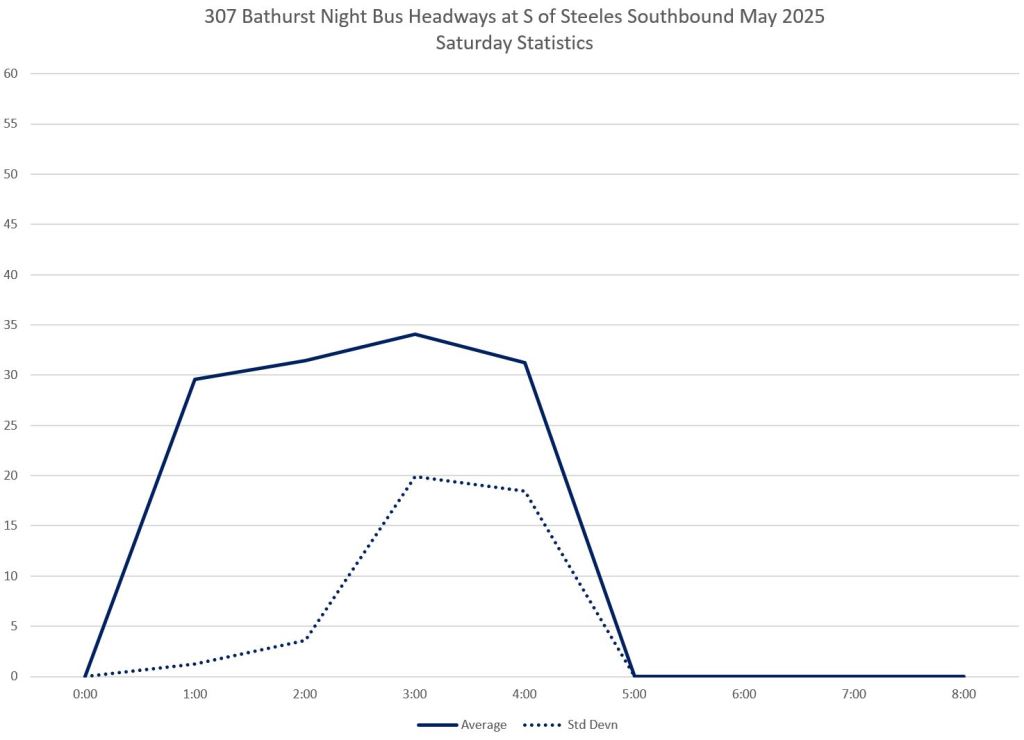
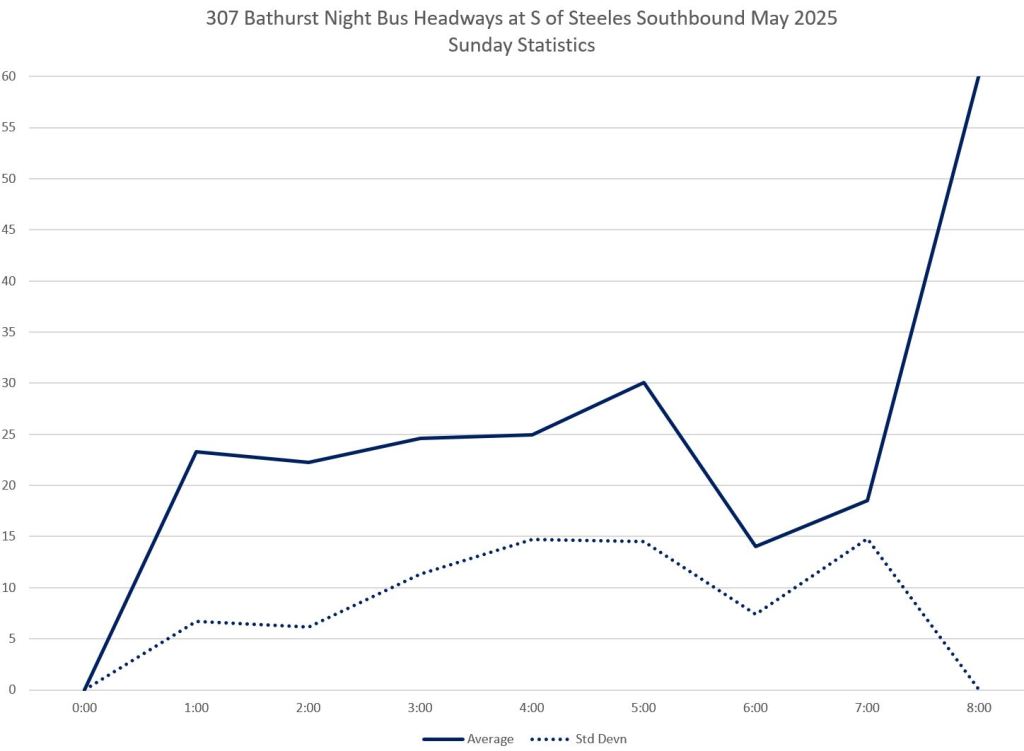
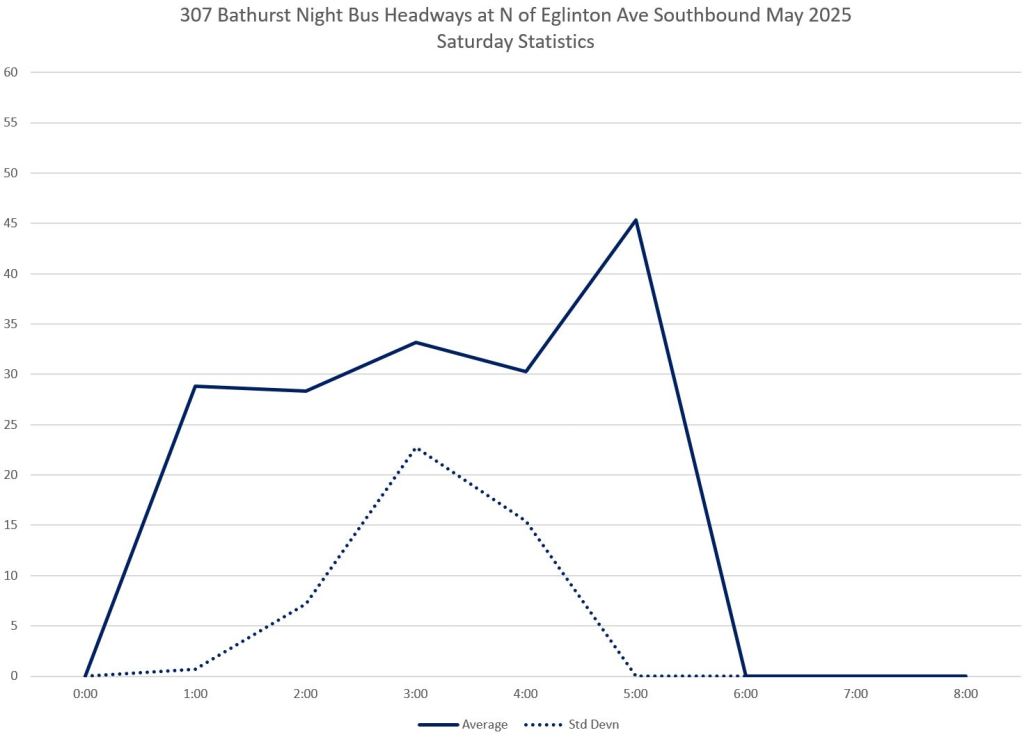
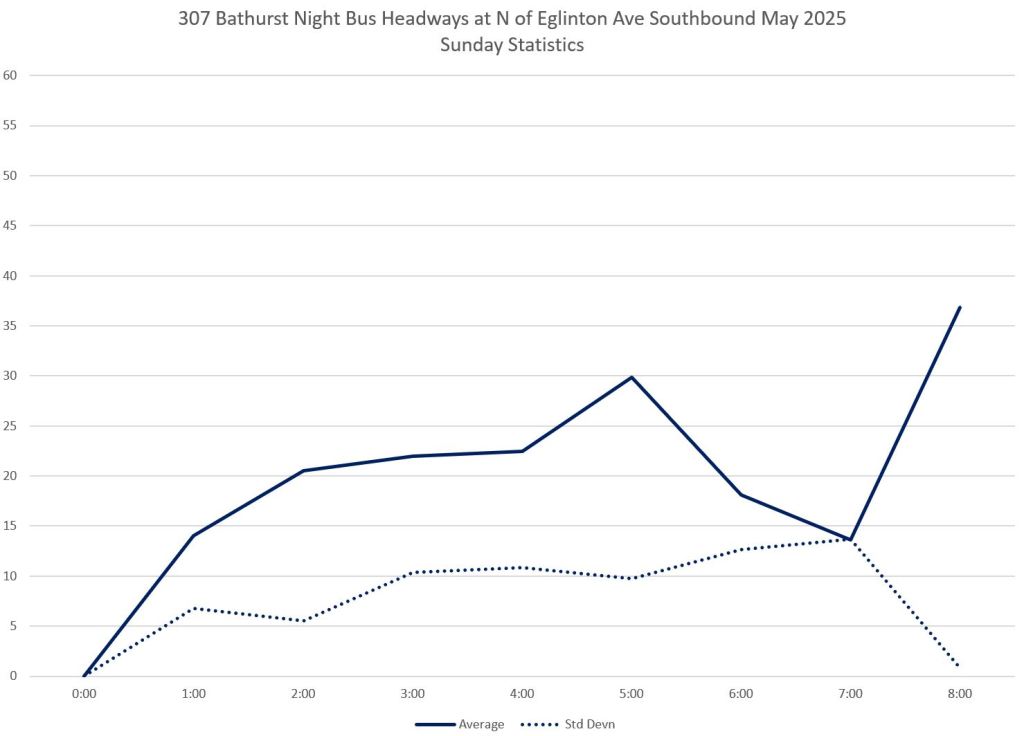
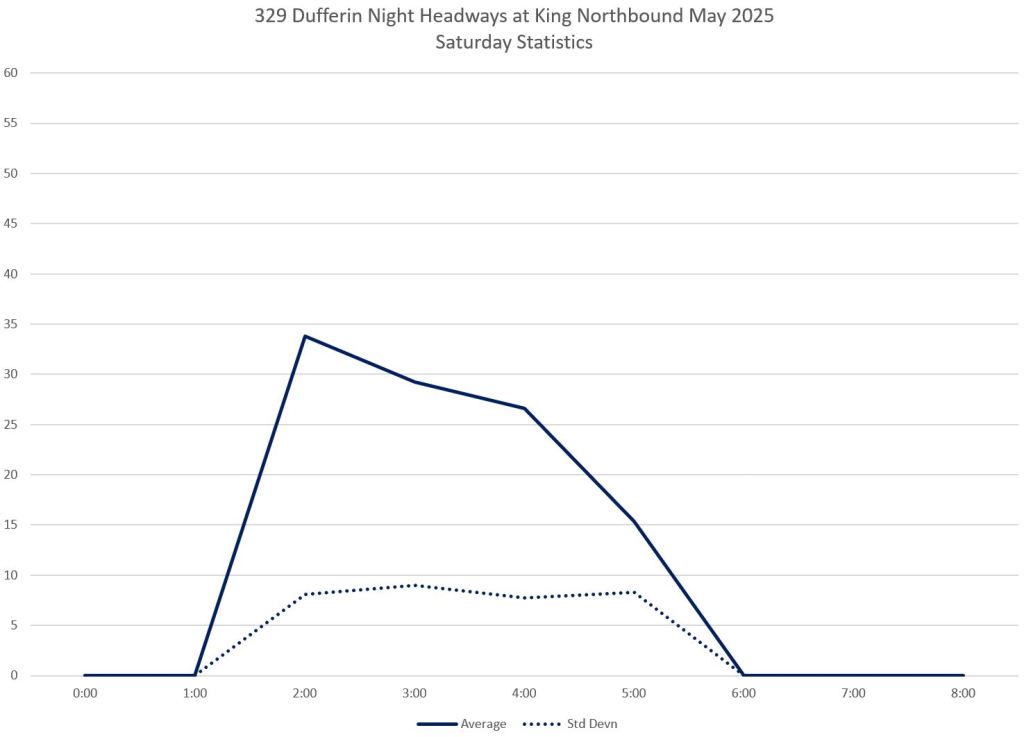
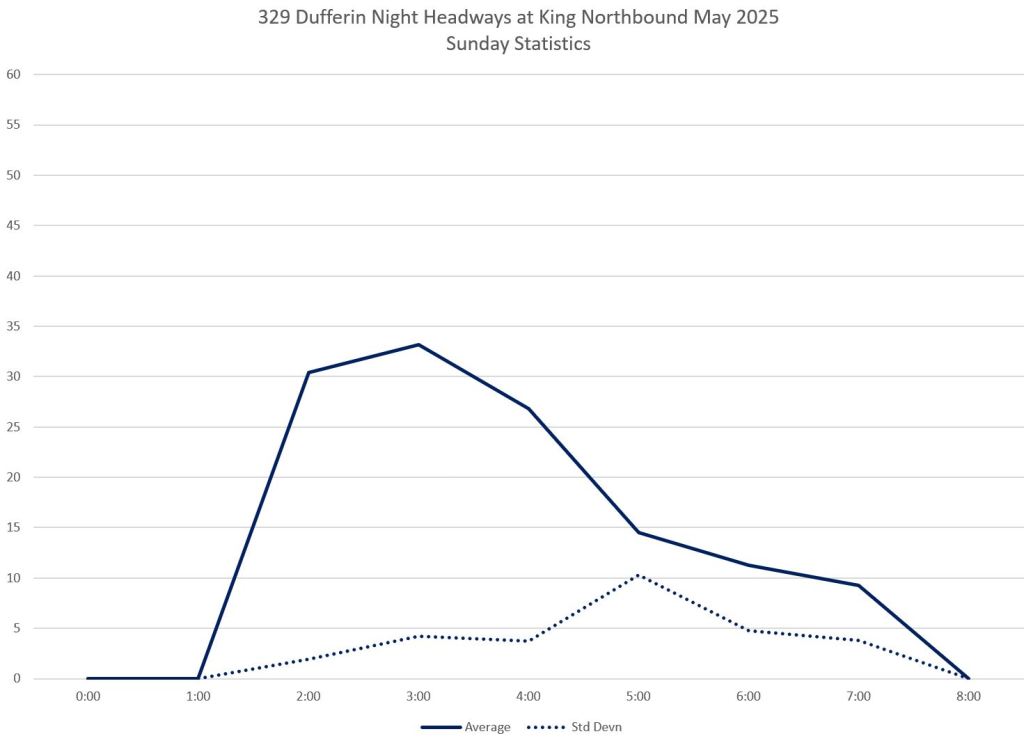
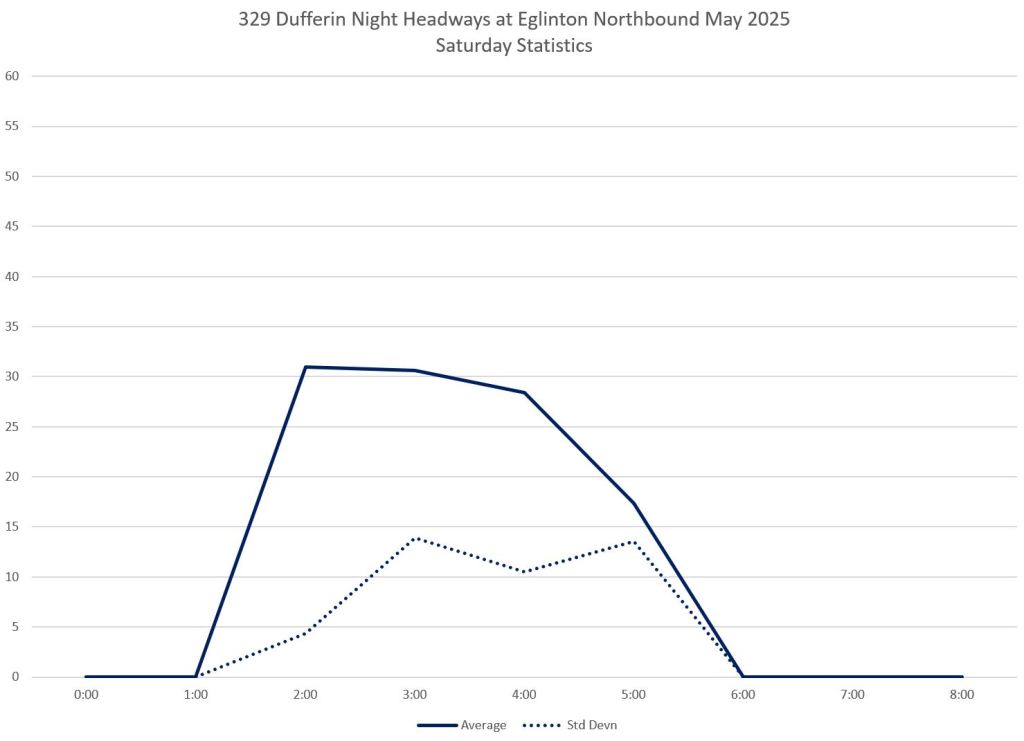
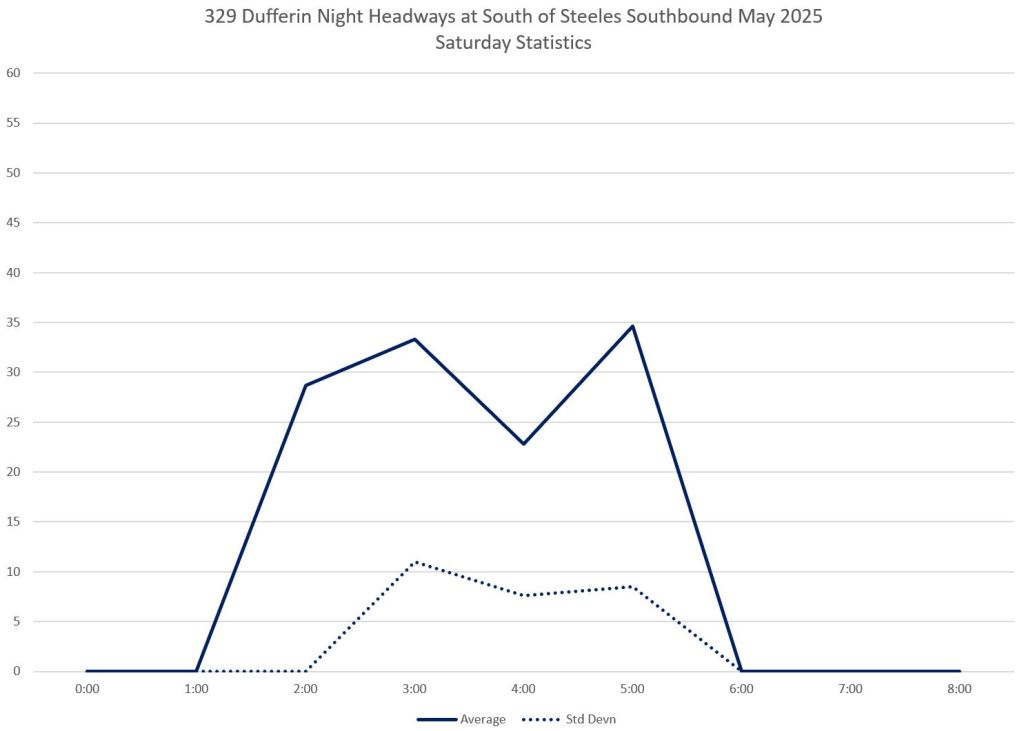
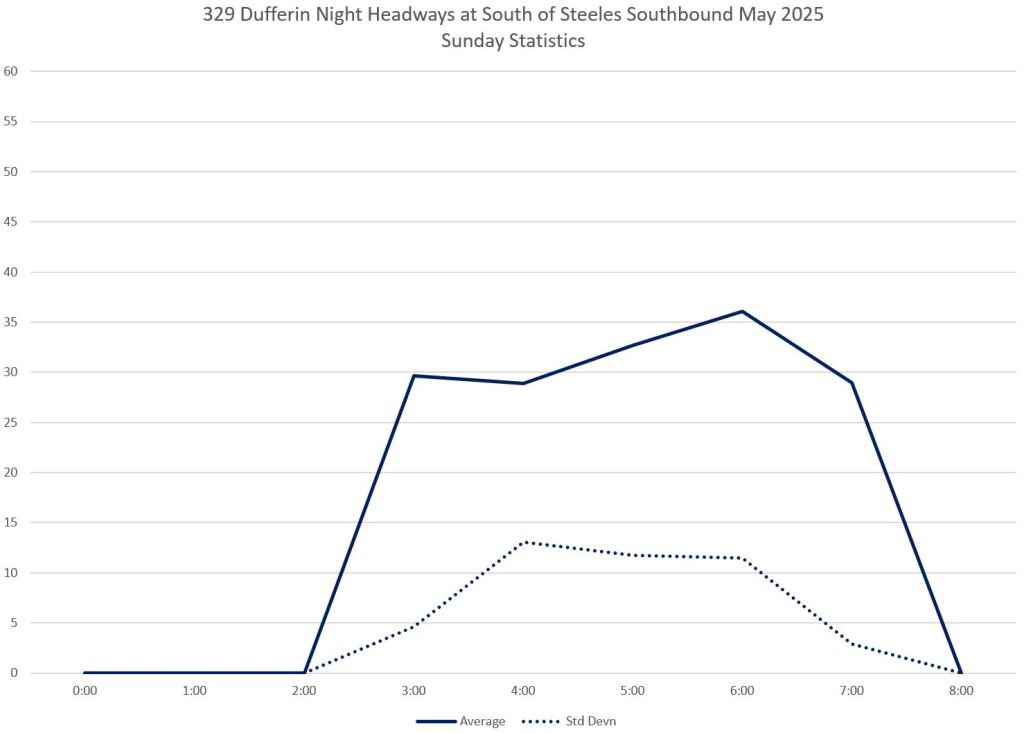
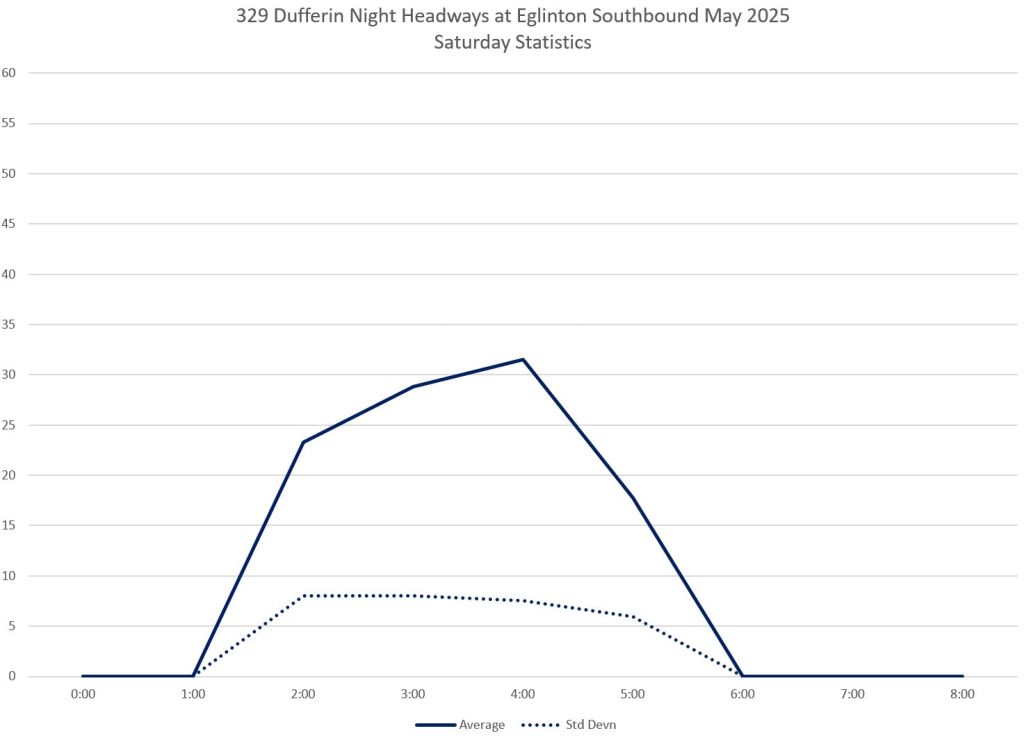
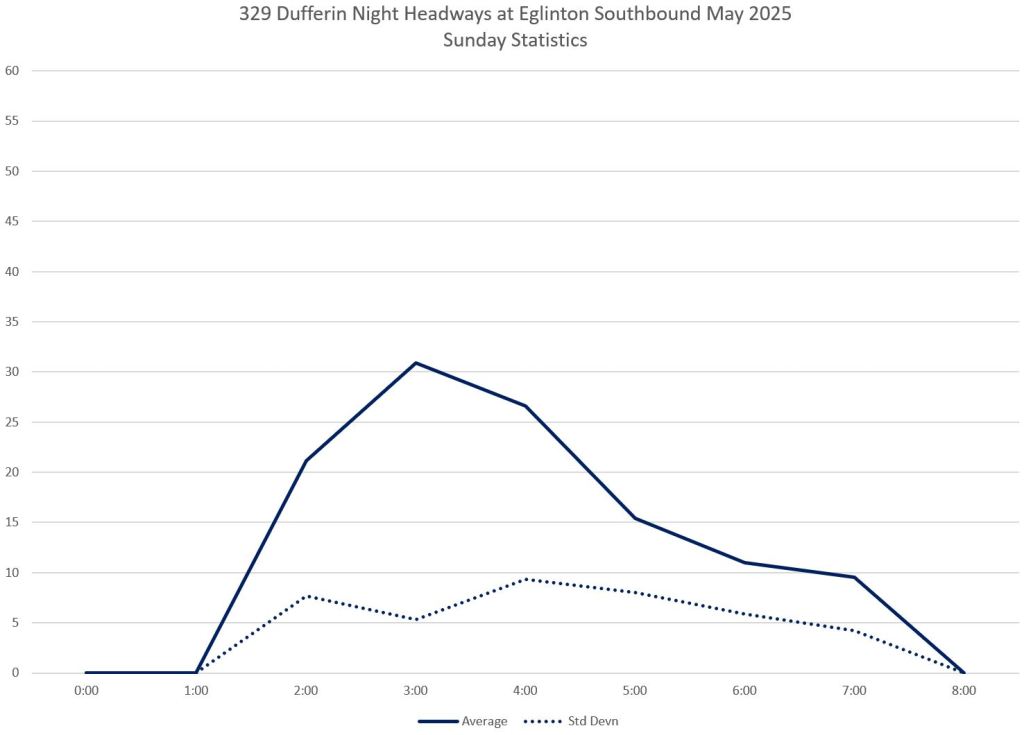
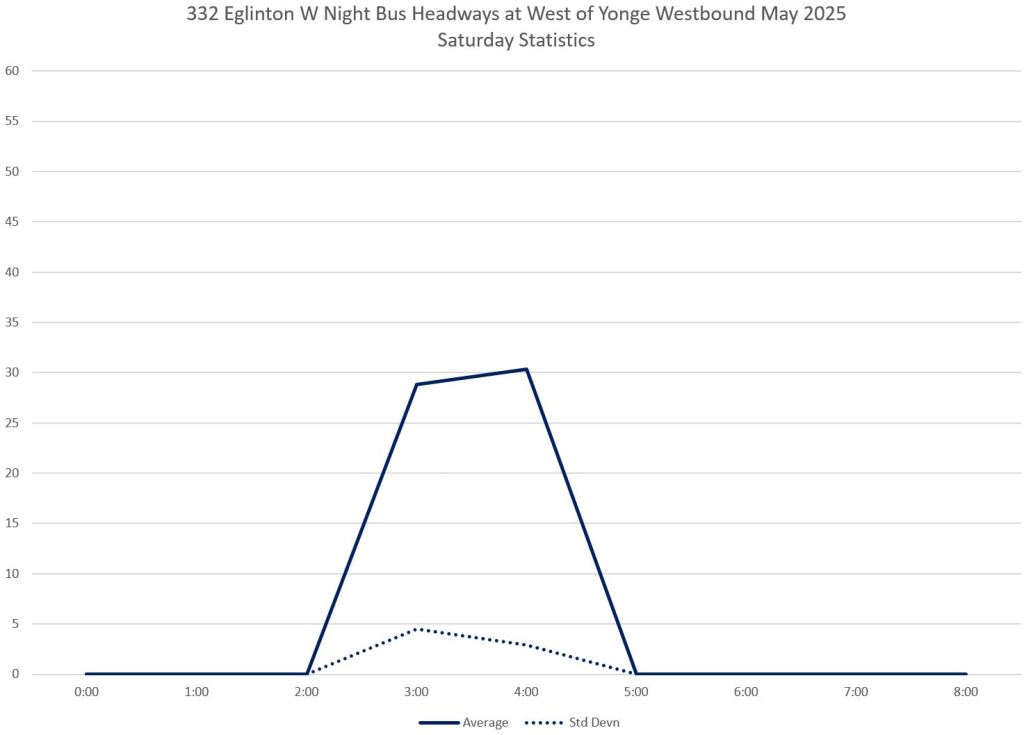
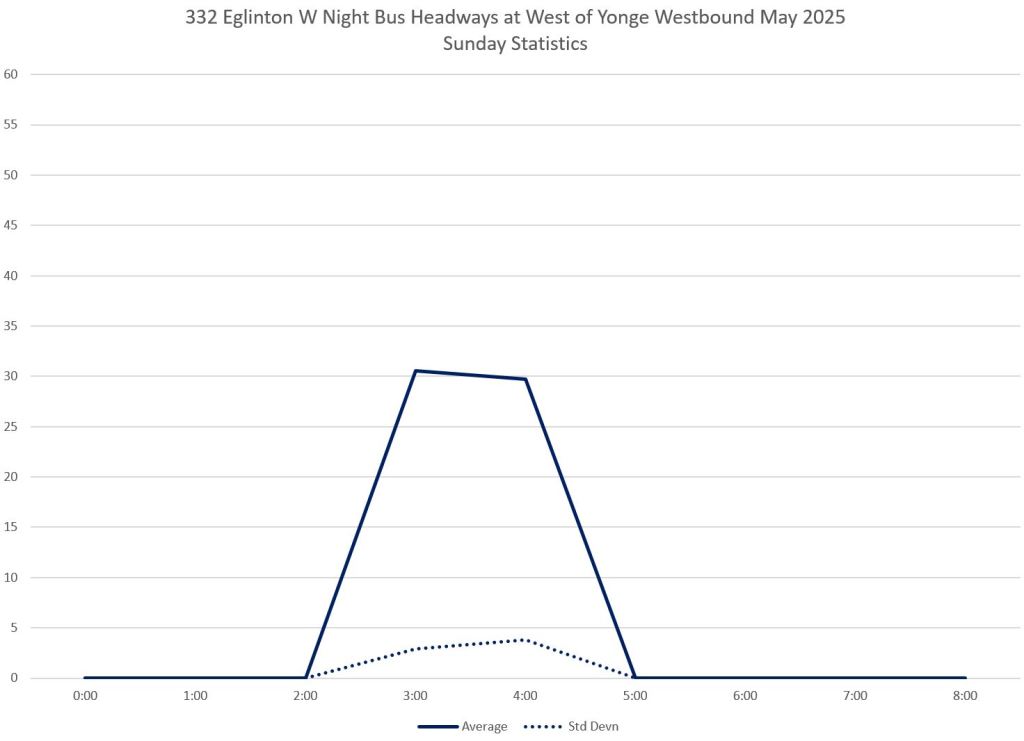
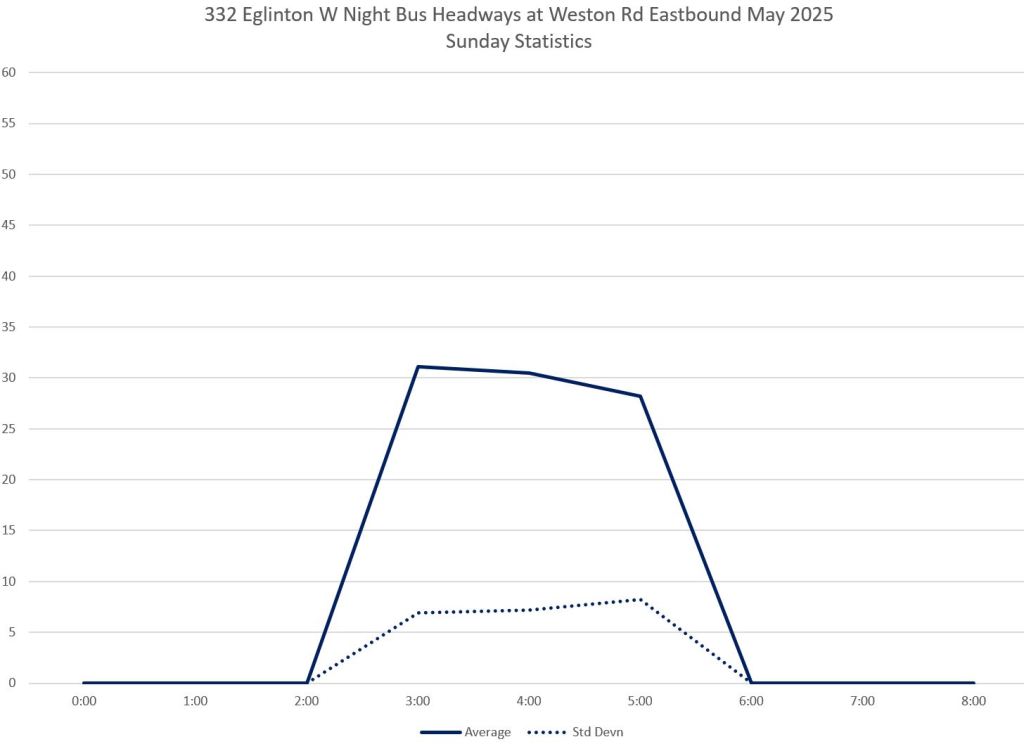
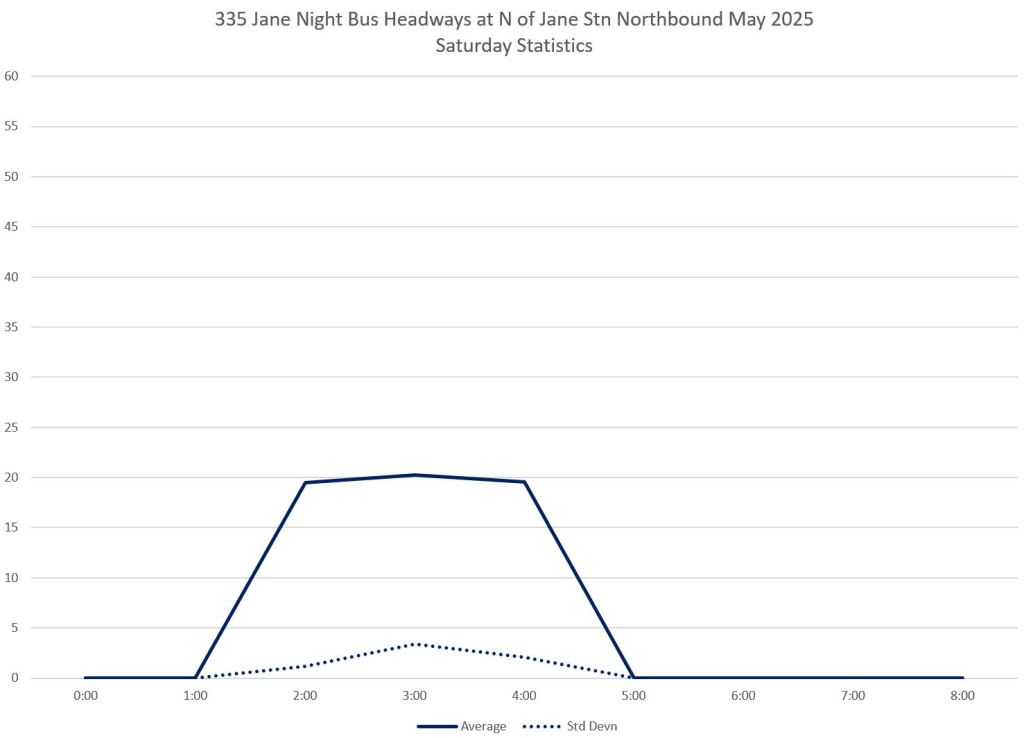
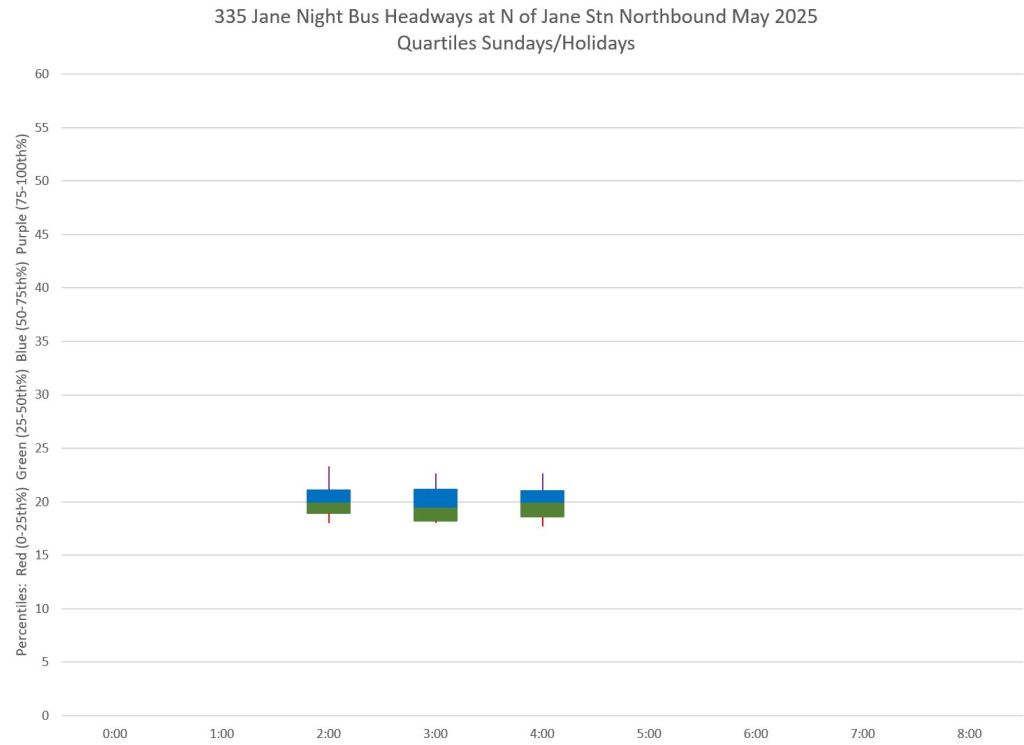
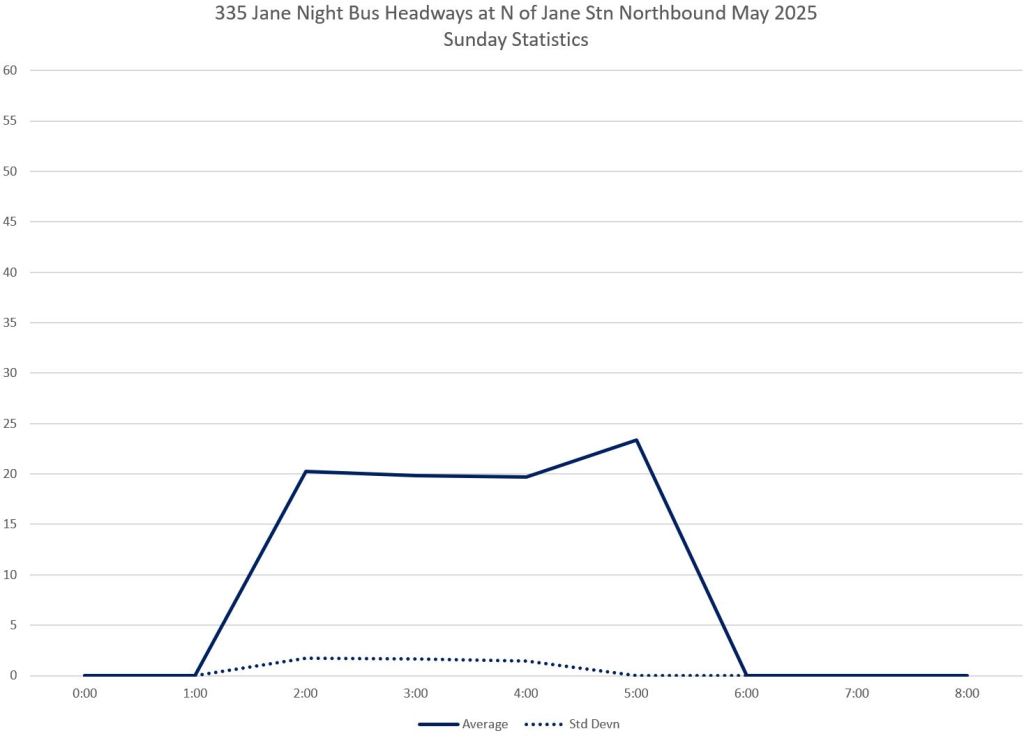
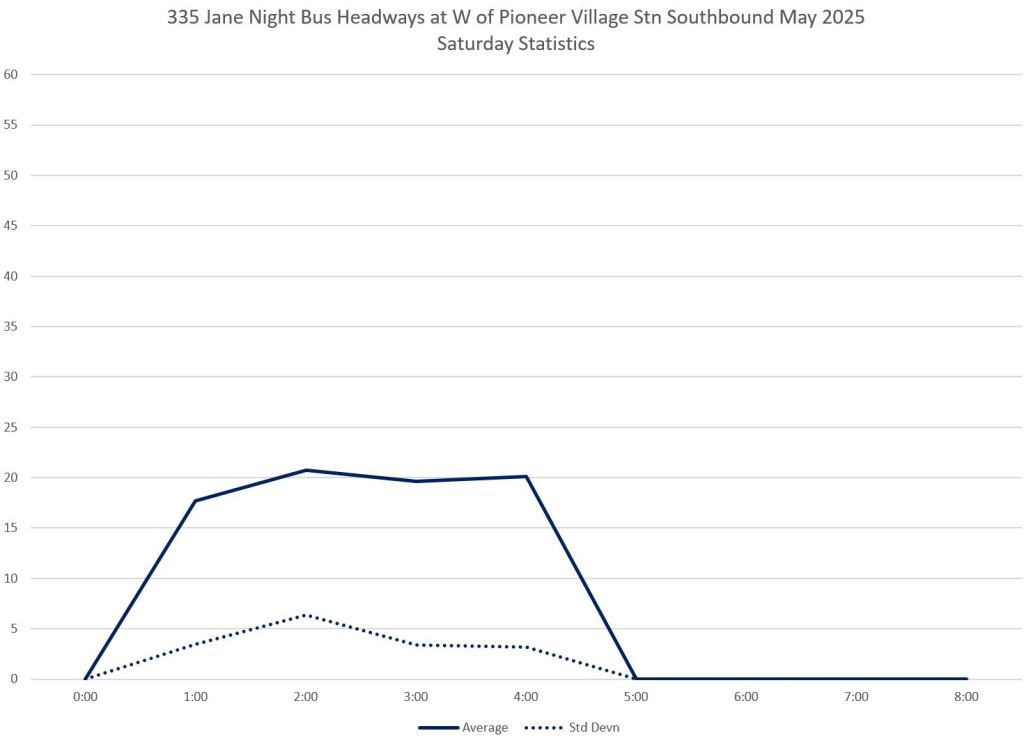
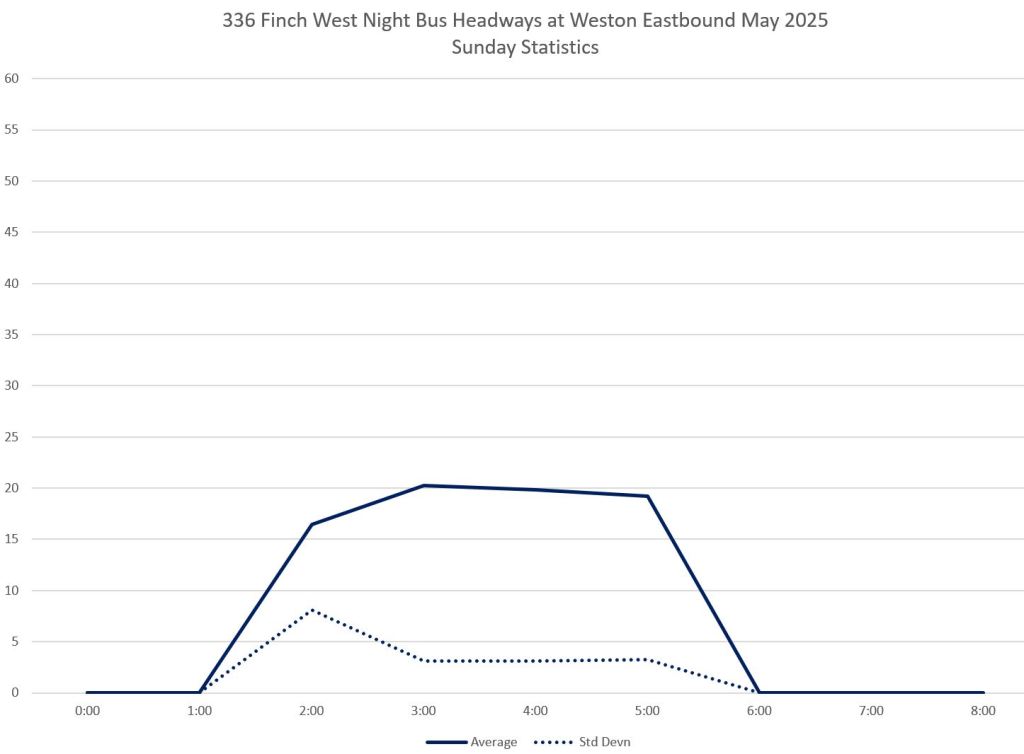
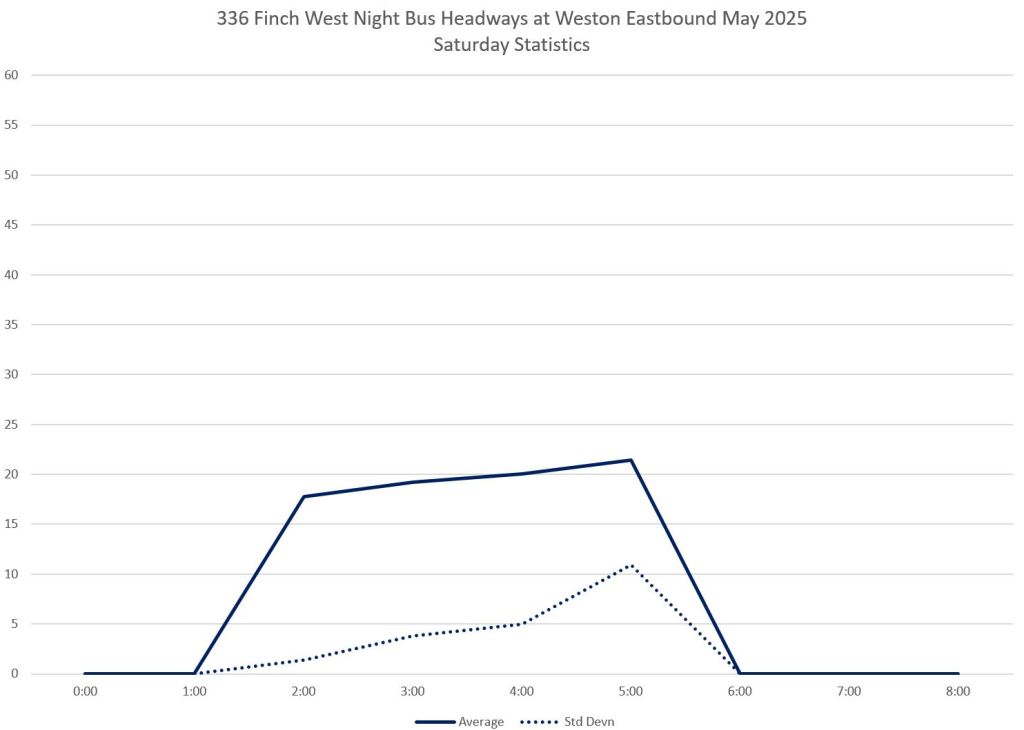
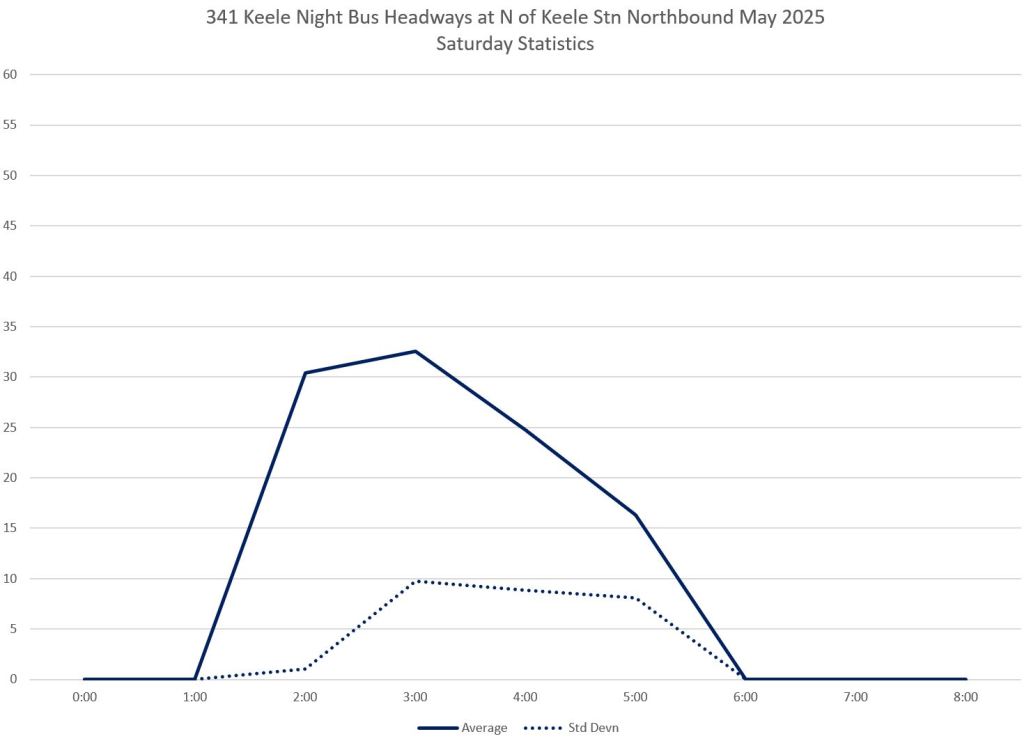
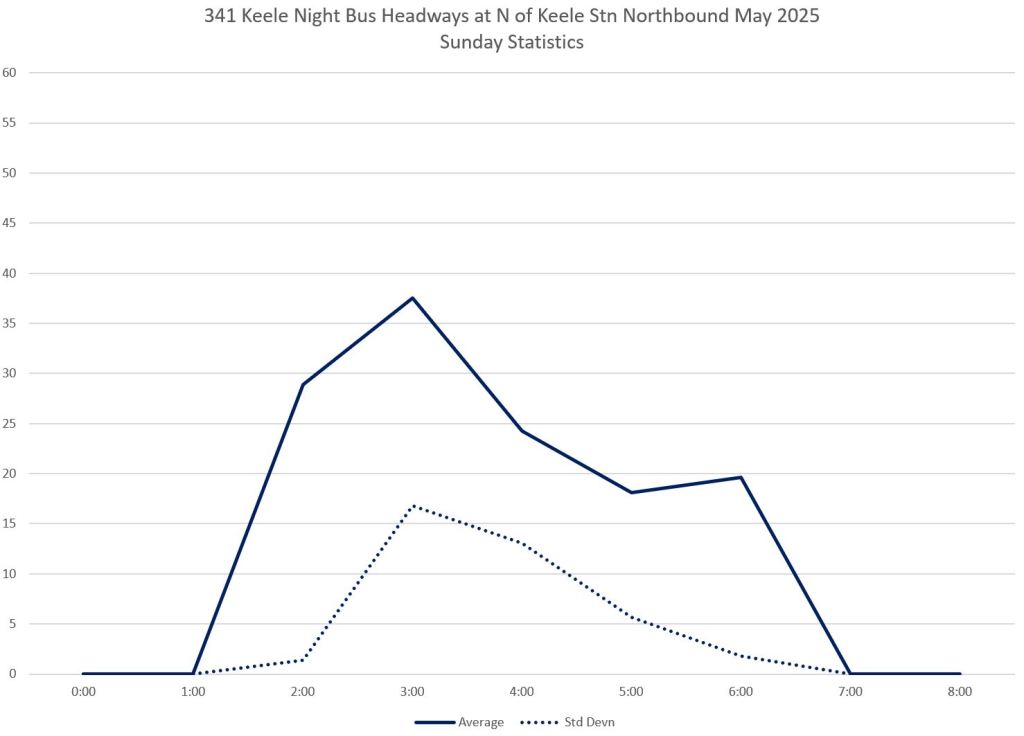
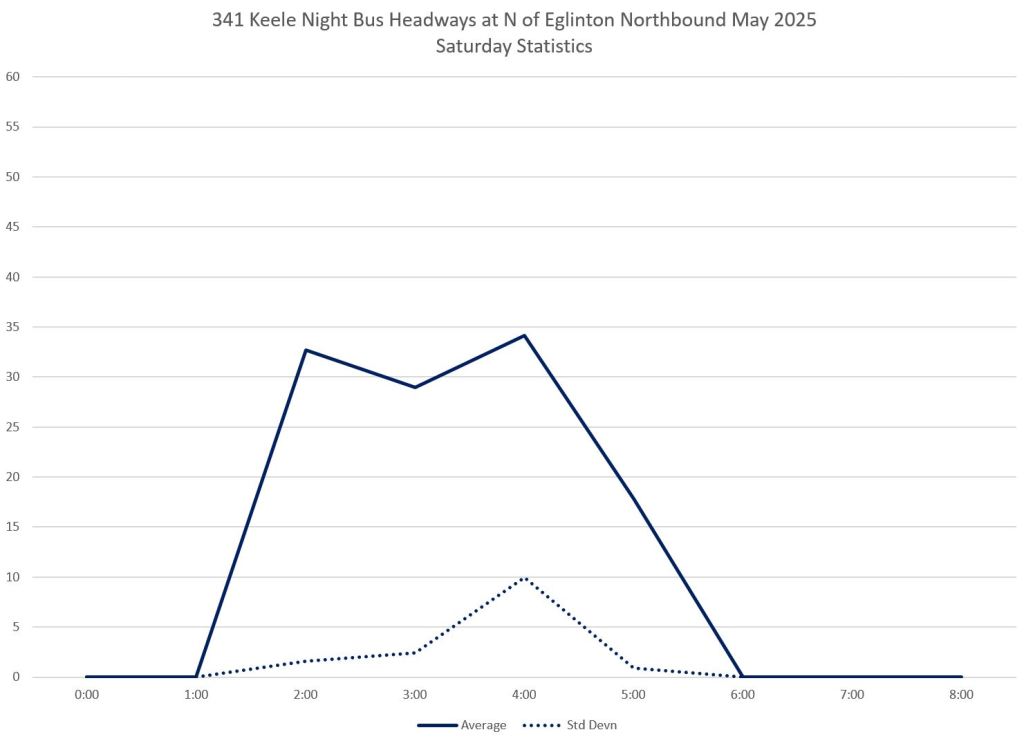
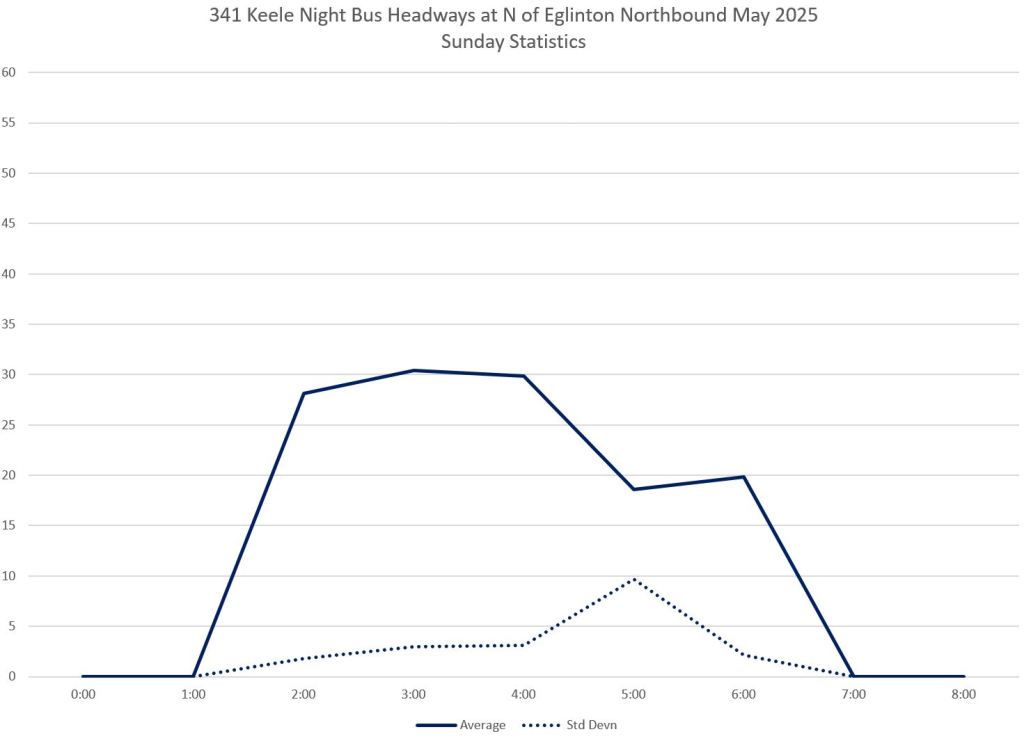
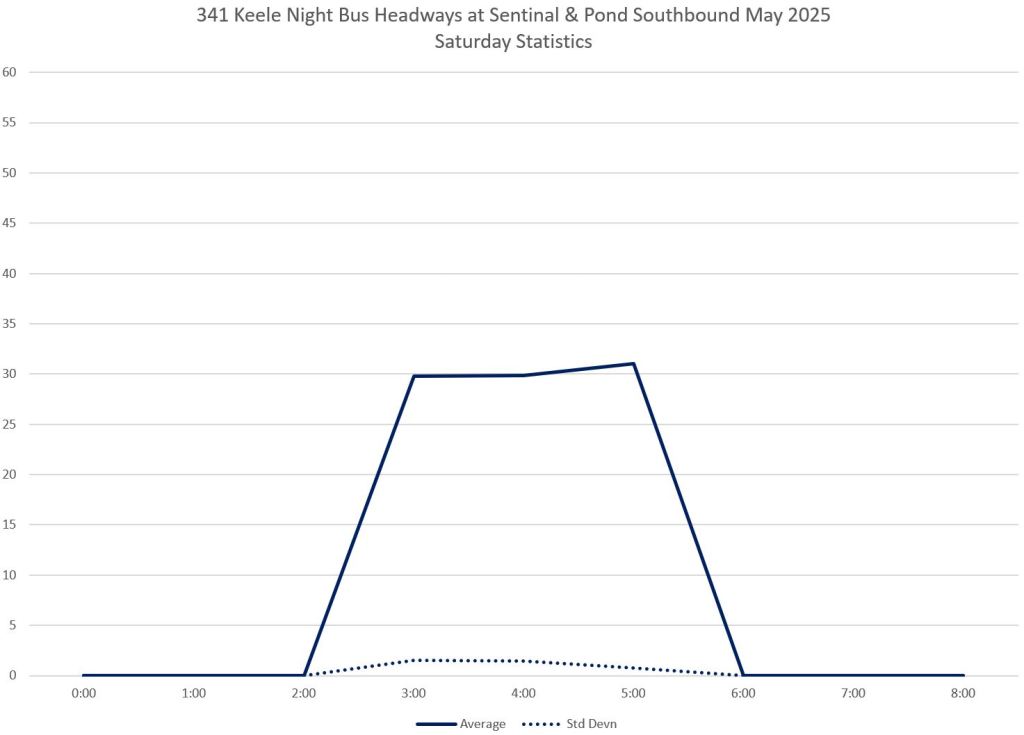
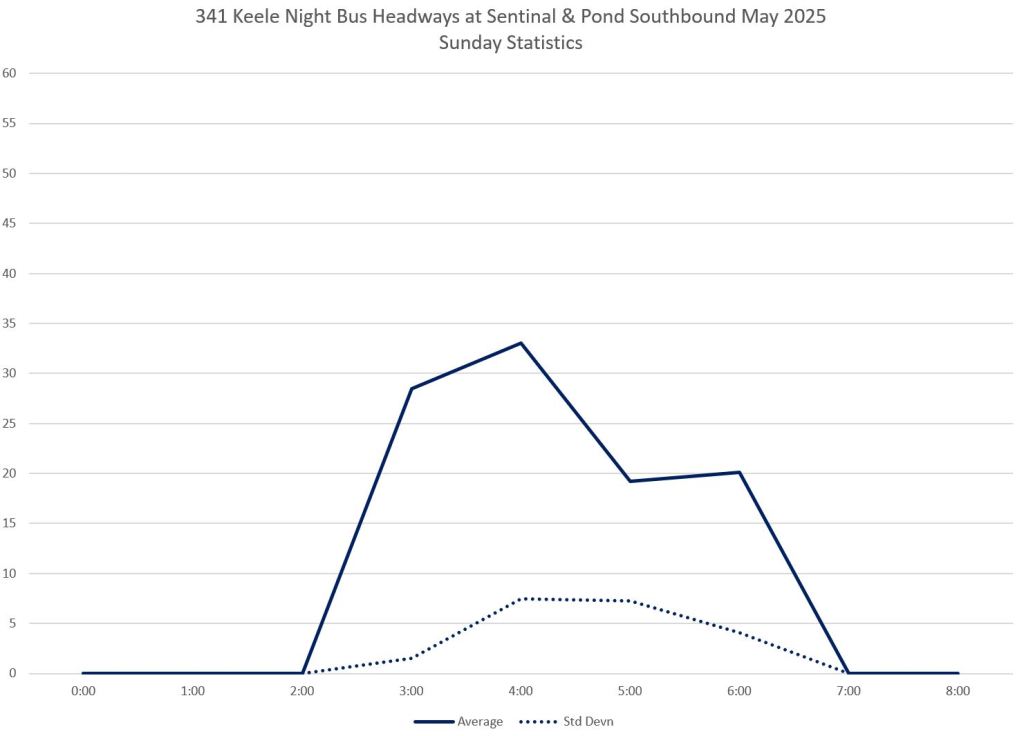
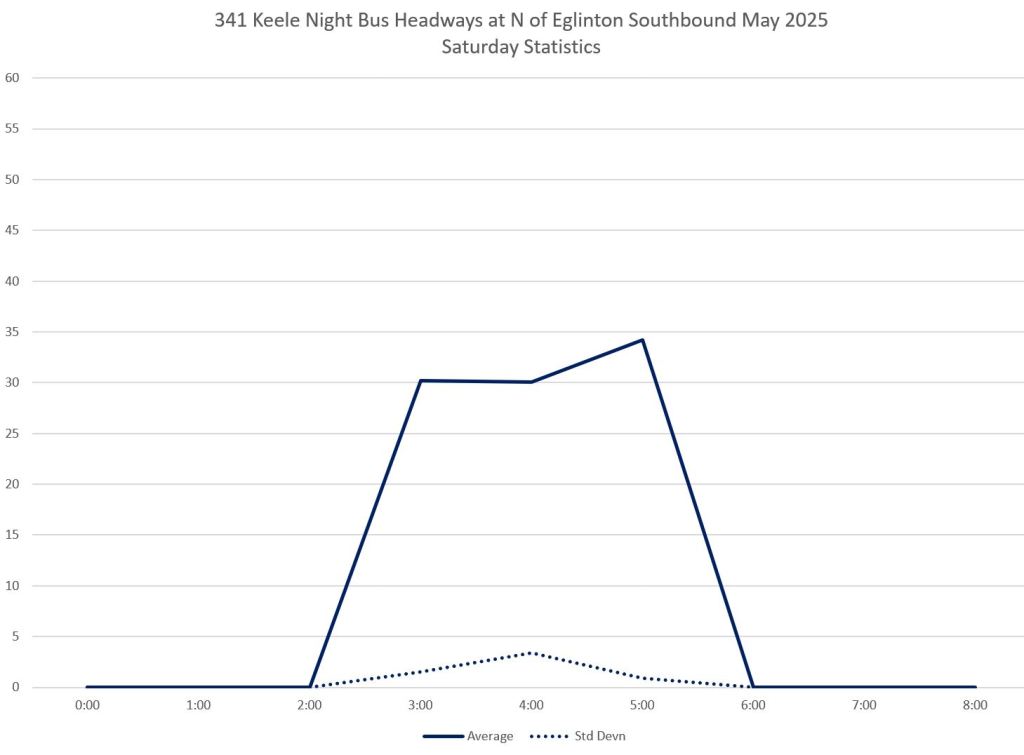
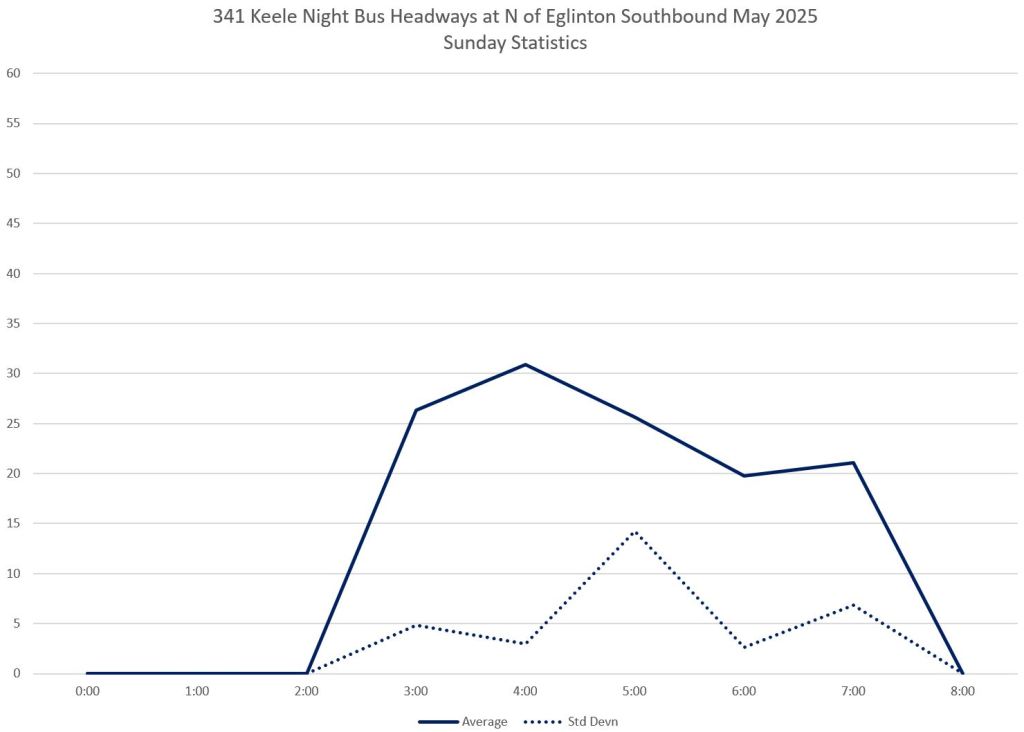
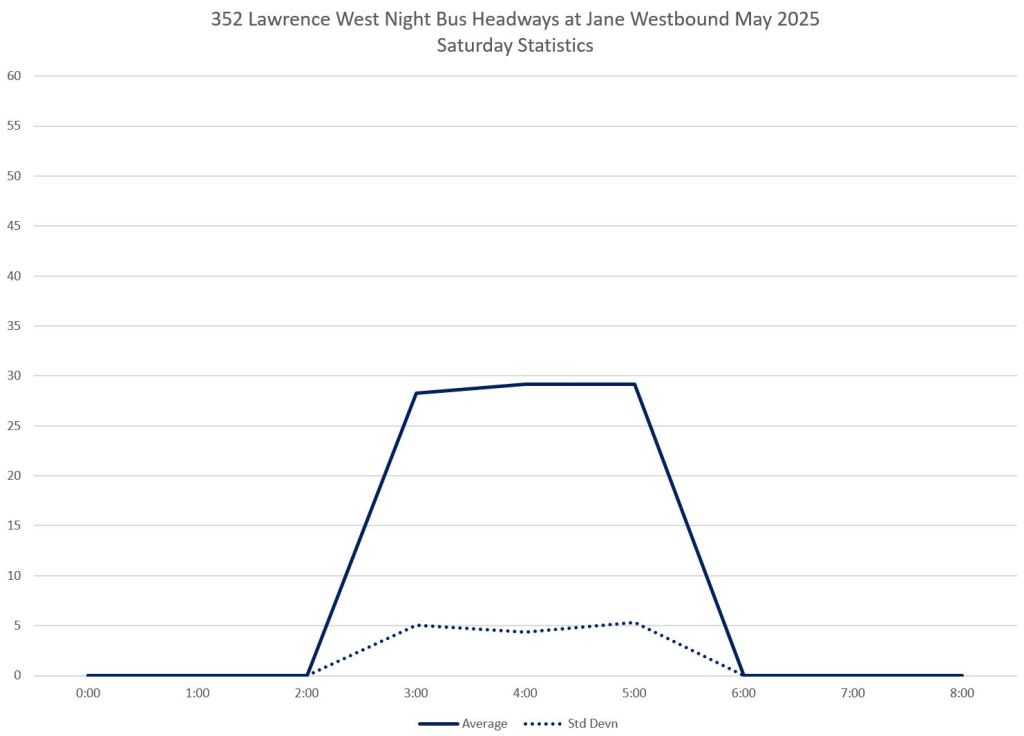
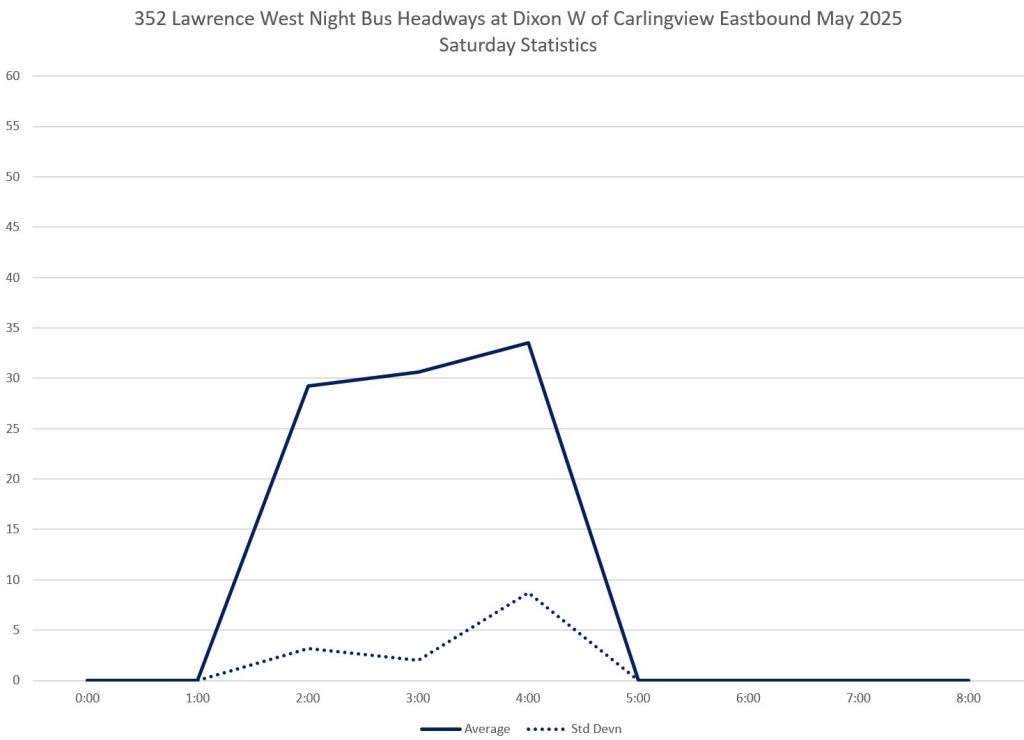
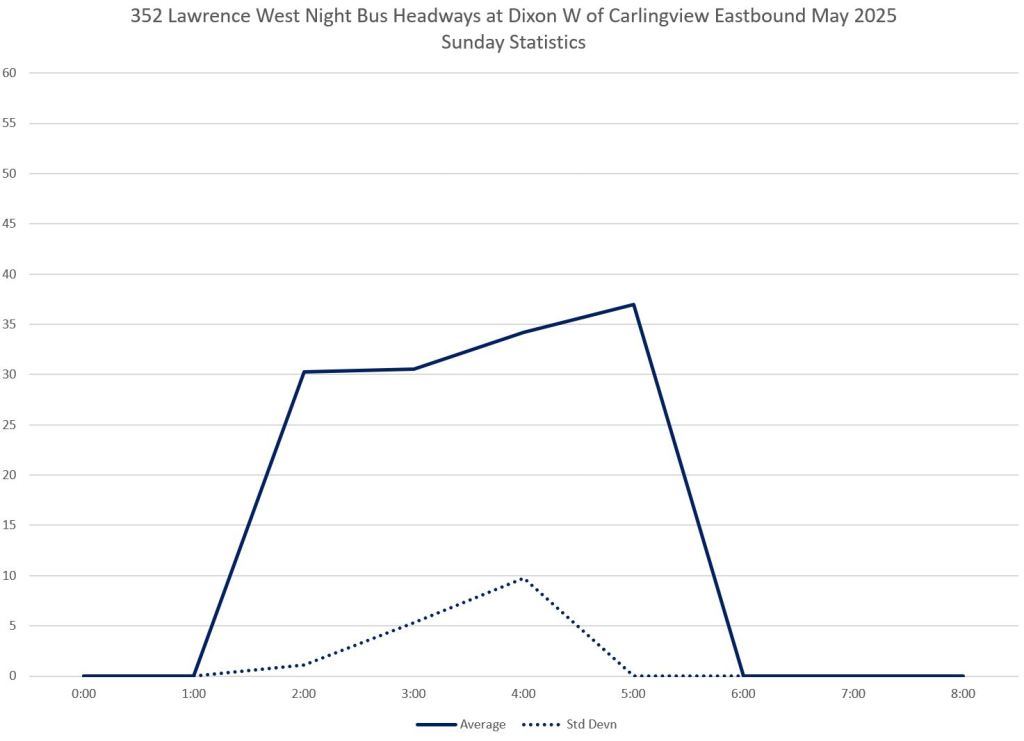
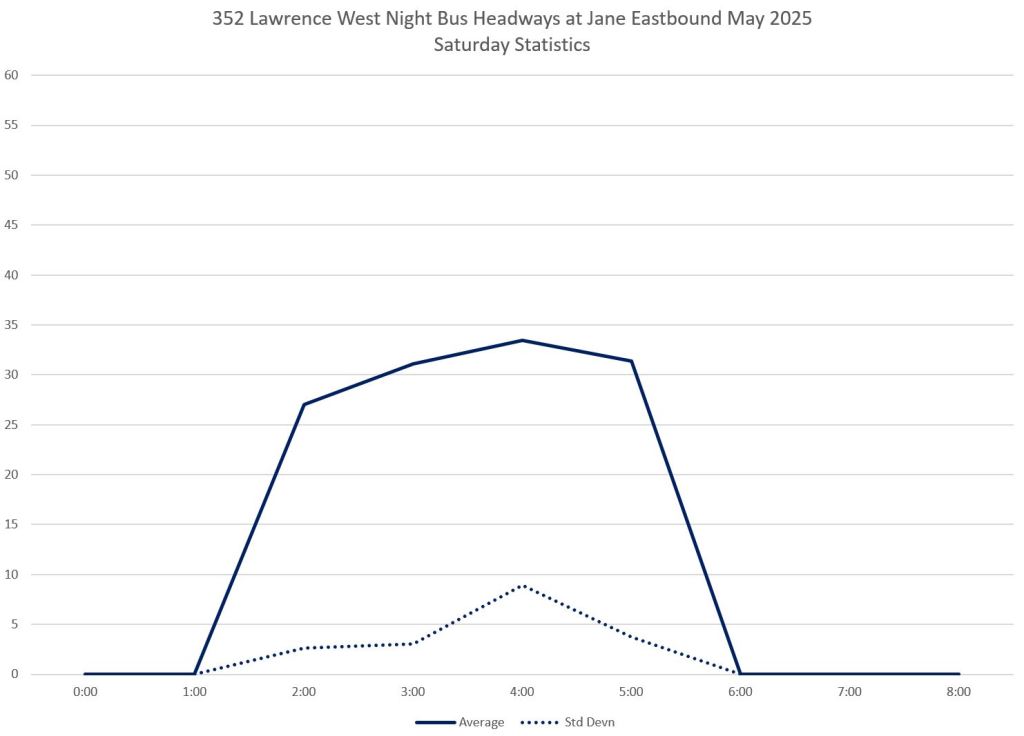
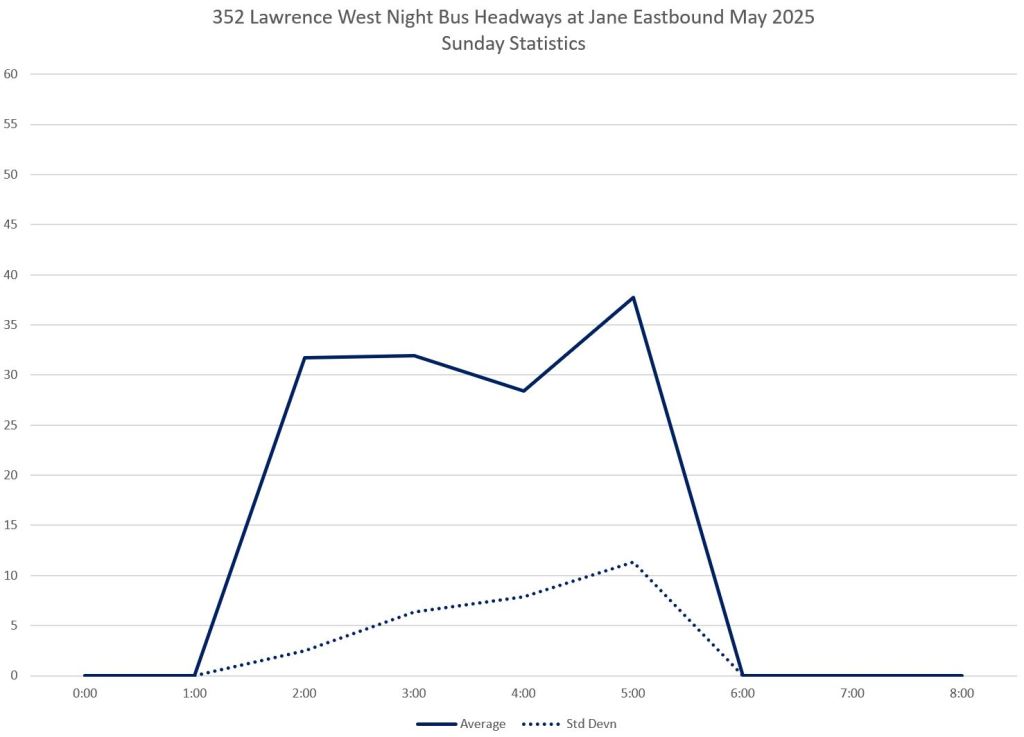
This makes the stats a little dodgy, but they give the overall sense of what is happening. For these days, I show both the quartiles, as above, but in place of the scatter chart which would have few points, there is a simple plot of the average headway and standard deviation of values. This is a measure of the dispersion of the data points, and the smaller, the better.
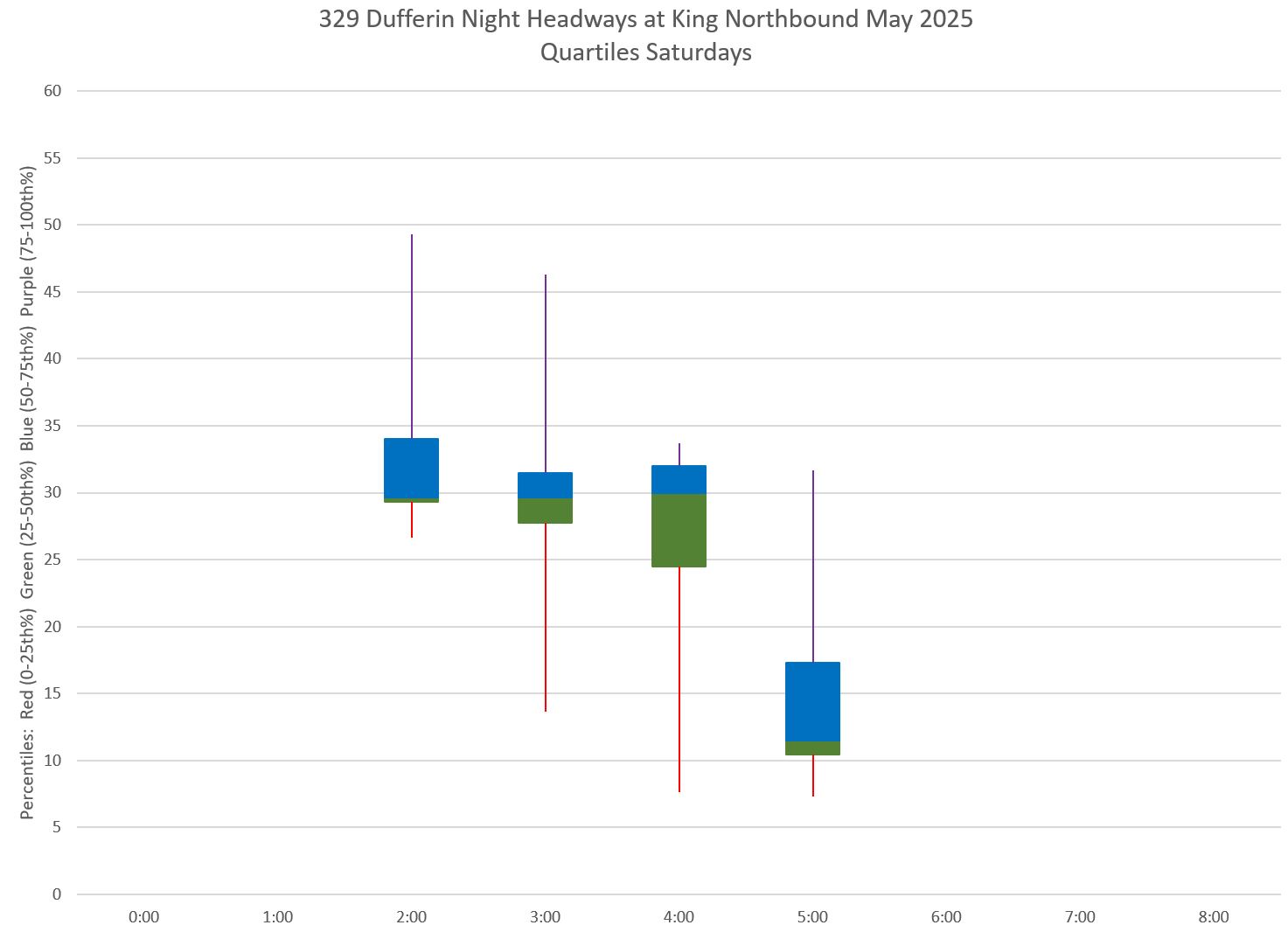
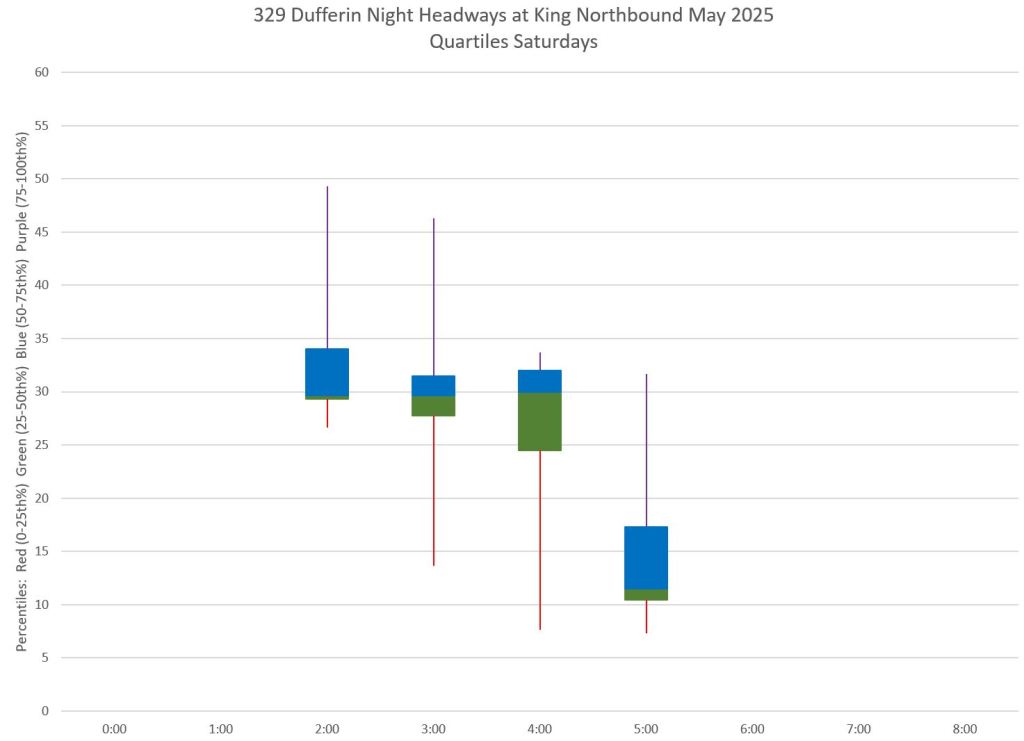
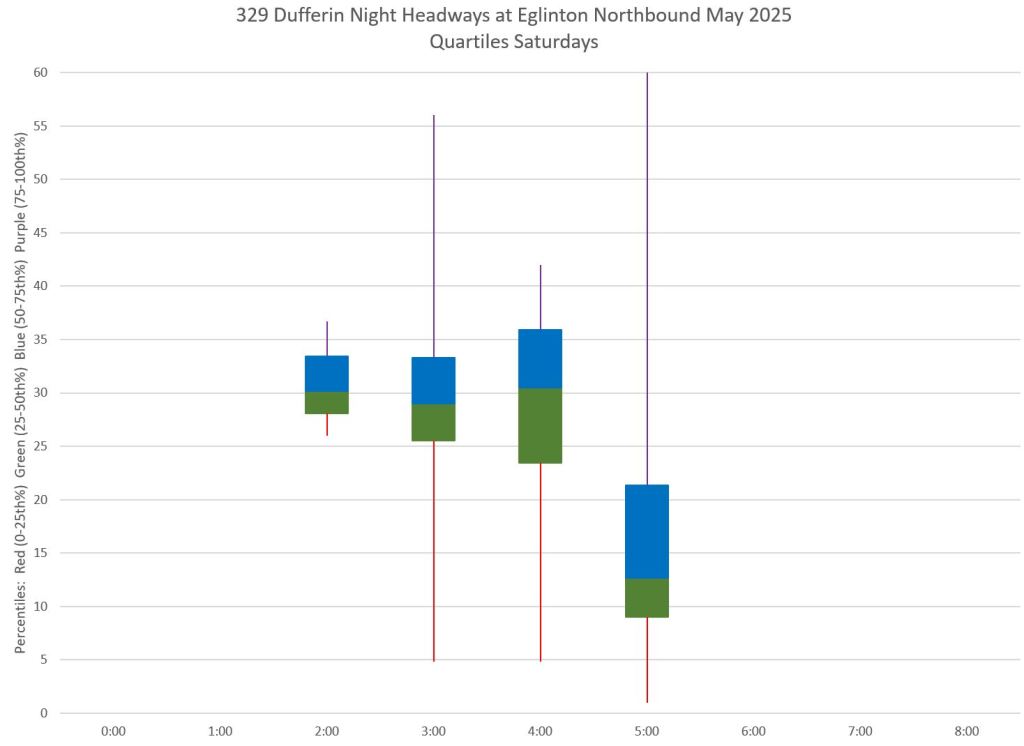
First, here is the quartile plot for Saturdays at the same location, King & Dufferin northbound.
Averages and Standard Deviations
The stats corresponding to this are shown below, and the standard deviation sits at about 8 minutes. This reflects the spread in data values and the length of the “tails” in the quartile chart. Some readers have a preference for one format over the other, and so I have provided both.
The SD line (dotted) gives a quick read on the level of uneven headways, and it should be only a few minutes for most service to stay within a band five minutes wide. In most cases shown here, the SD values are much higher.
307 Bathurst Night Bus
The 307 Bathurst Night Bus operates from the eastern gate of Exhibition Place to Bathurst and Steeles combining the daytime 7 bus and 512 streetcar routes. Scheduled service is half-hourly.
Northbound at Front Street
The screenline used here for the origin of northbound service is at Front Street so that measurements will be unaffected by the route buses take between Exhibition Loop and Bathurst Street during road construction at Bathurst/Fleet/Lake Shore. This is not strictly at the terminal, but close enough to be representative.
Weekdays
Departures northbound from Front show a wide variation in headways from a few minutes to nearly an hour. From 2 to 4am, half of the departures (the green and blue boxes) lie within a range of about 8 minutes, but the other half have a very wide range.
Weekends
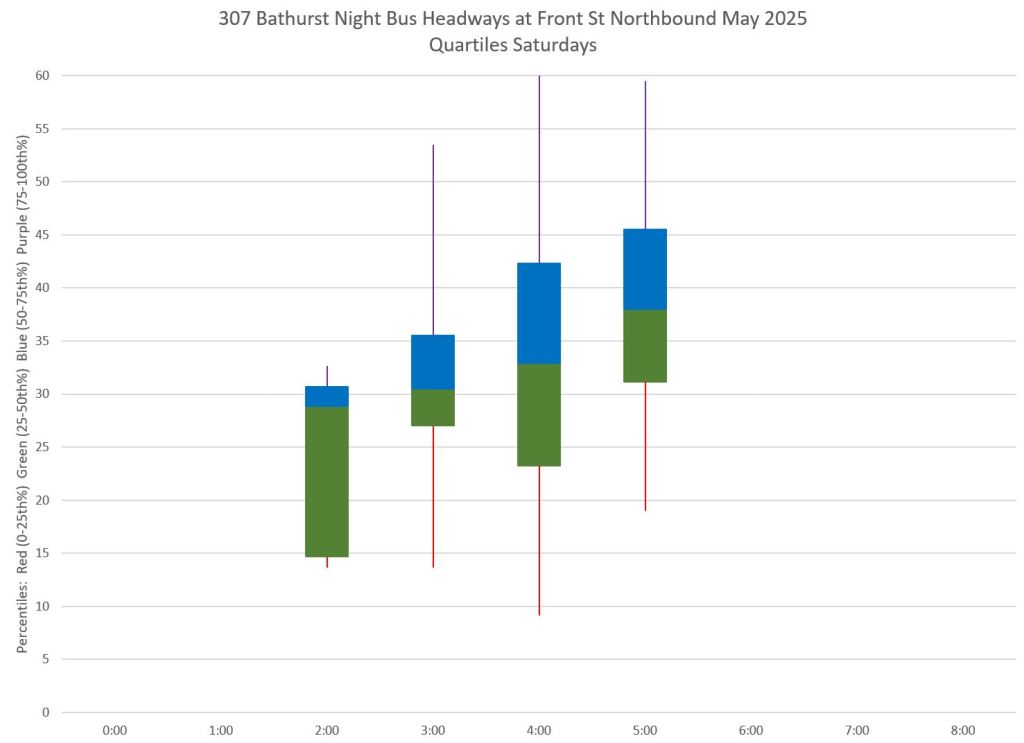
The situation on weekends is worse than on weekdays with a wider range of central quartiles during many periods. This is reflected in the statistics which show a high standard deviation of headways. The average might be close to the scheduled value (i.e. all trips operate), but the gap between buses varies widely.
Northbound at Eglinton
By the time the service reaches Eglinton northbound, the headway values are more widely distributed than at Front Street.
Weekdays
Weekends
Southbound South of Steeles
The screenline for these measurements is just south of the on-street loop at the north end of the route.
Weekdays
Weekday departures from Steeles southbound show a compact range of headways in the middle quartiles, but there are still cases of very closely spaced buses.
Weekends
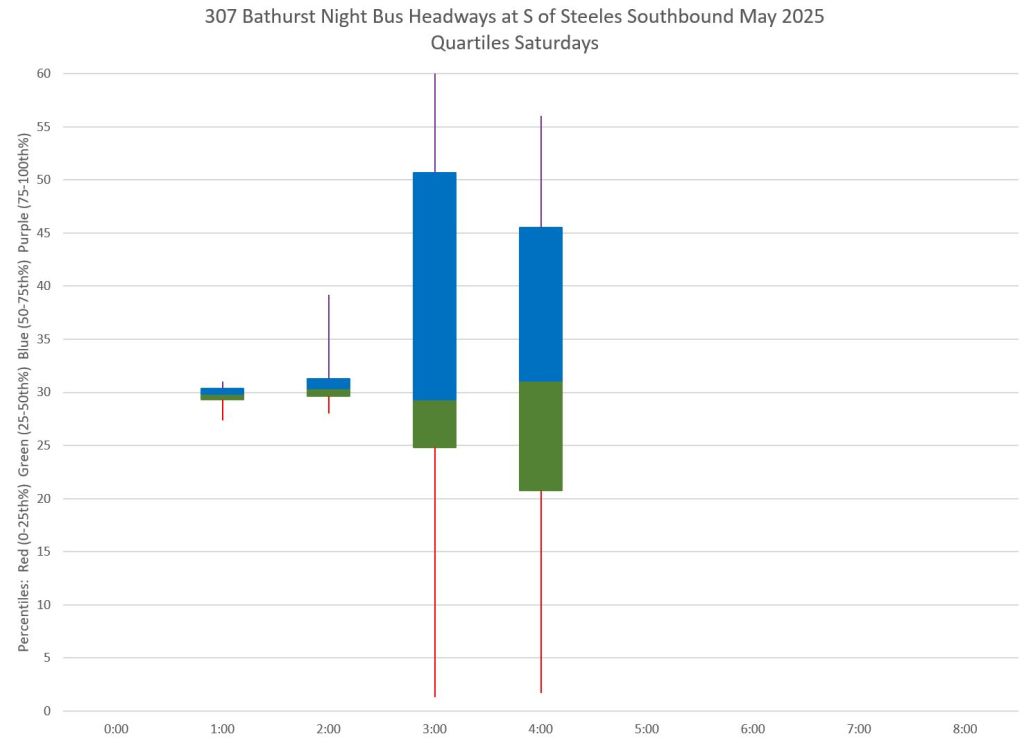
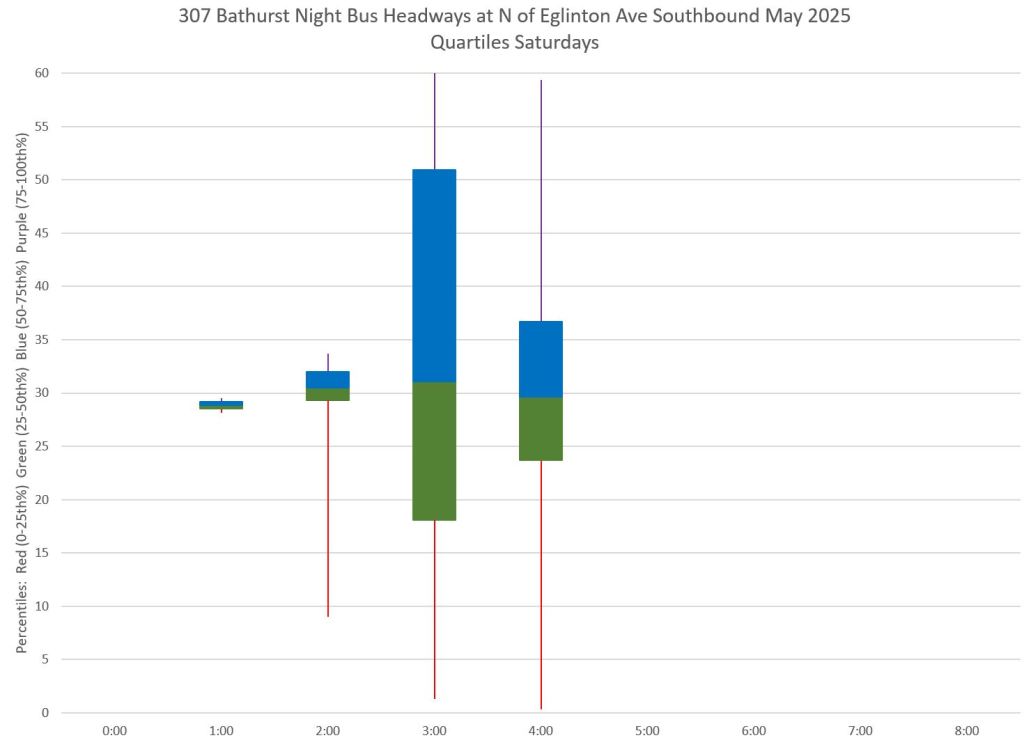
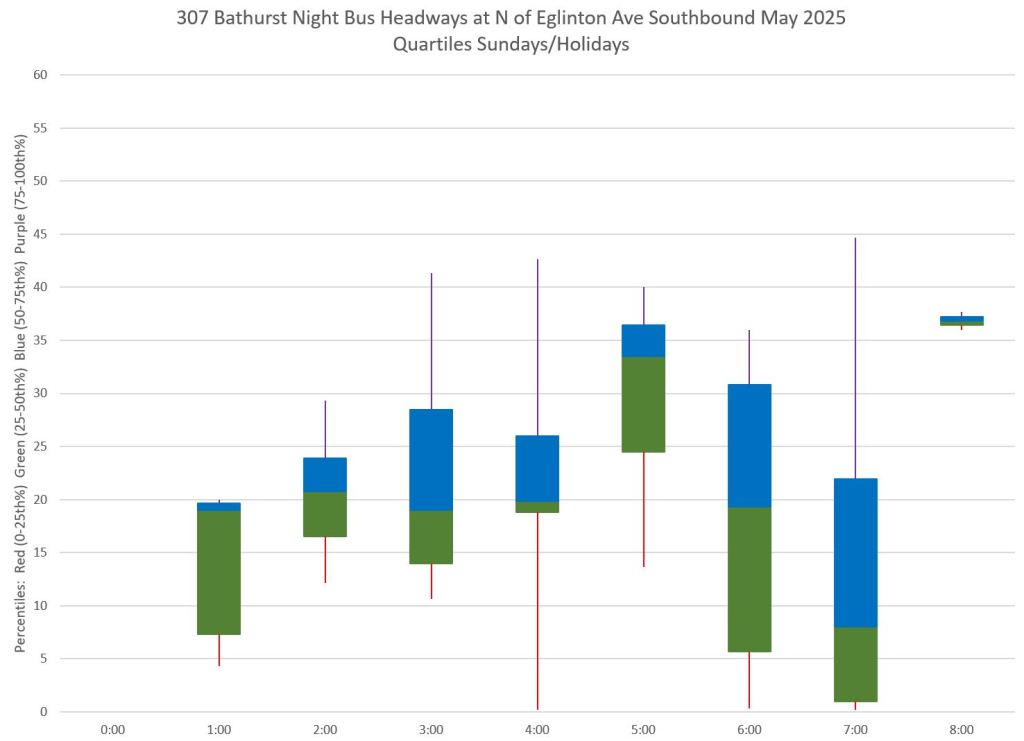
The weekend service southbound from Steeles is reasonably well behaved in the early hours on Saturdays, but becomes much more disorganized in the period from 3-5am. Sundays also show a wide range of headways departing from the northern terminal.
Southbound at Eglinton
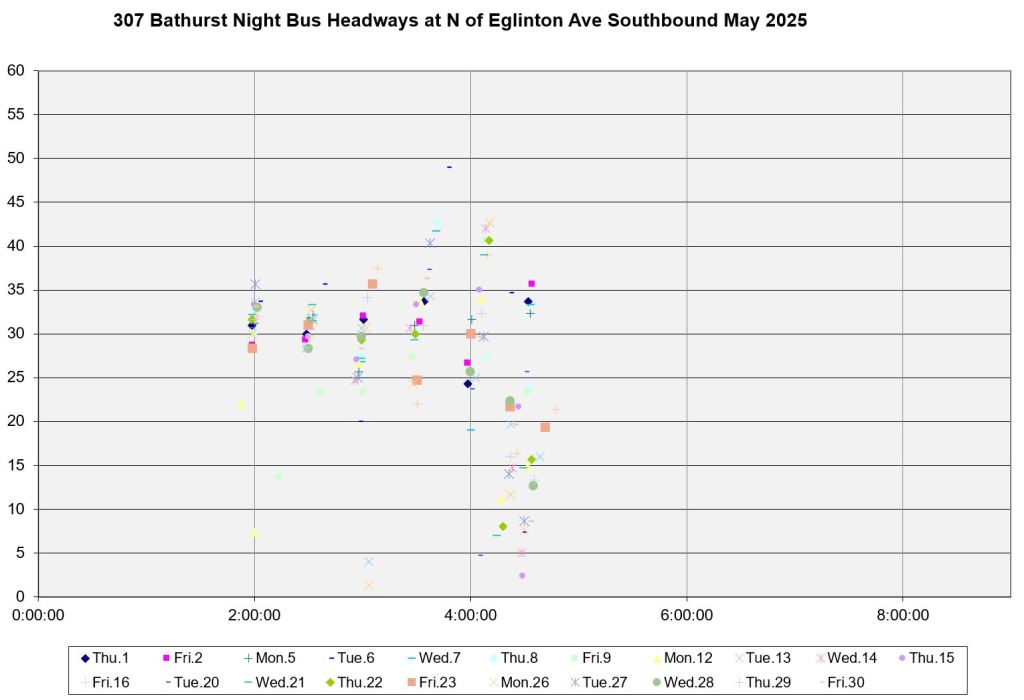
The pattern at Steeles is echoed further south at Eglinton with a wide range of headway values.
Weekdays
Weekends
329 Dufferin Night Bus
The 329 Dufferin Night Bus route is an amalgamation of much of the daytime 29 Dufferin, 104 Faywood and 105 Dufferin North routes. It runs from Dufferin Loop in the south to Steeles Avenue in the north. Scheduled service is half-hourly.
Northbound at King
Weekdays
Weekday headways at King lie in a band about 10 minutes for much of the overnight service, although there are a few outliers that show up in extended “tails” for the 3-4am data. This corresponds to a delay on May 10 that caused two buses to bunch together making for a gap followed by two buses running close together.
The drop in headways after 5am corresponds to the start of daytime service.
Weekends
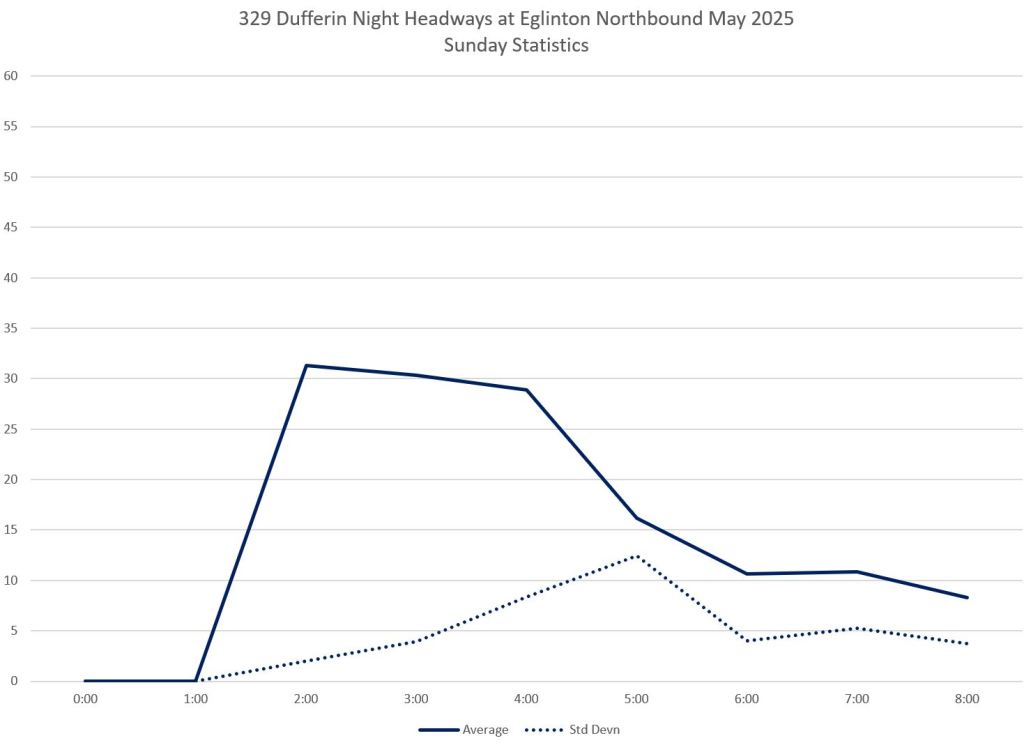
On Saturdays, the central quartiles show that half of the service ran within a band of 4-8 minute headways, but the tails reveal longer and shorter gaps. The situation on Sundays was better. This is reflected in the SD values for Sundays compared to Saturdays.
Eglinton Northbound
By the time service reaches Eglinton northbound, the headways are more widely scattered than they were at King Street. This is nominally a half-hourly service, but riders can wait much longer for a bus to appear.
Weekdays
Weekends
Saturdays are only slightly better than weekdays, with a further small improvement on Sundays.
Steeles Southbound
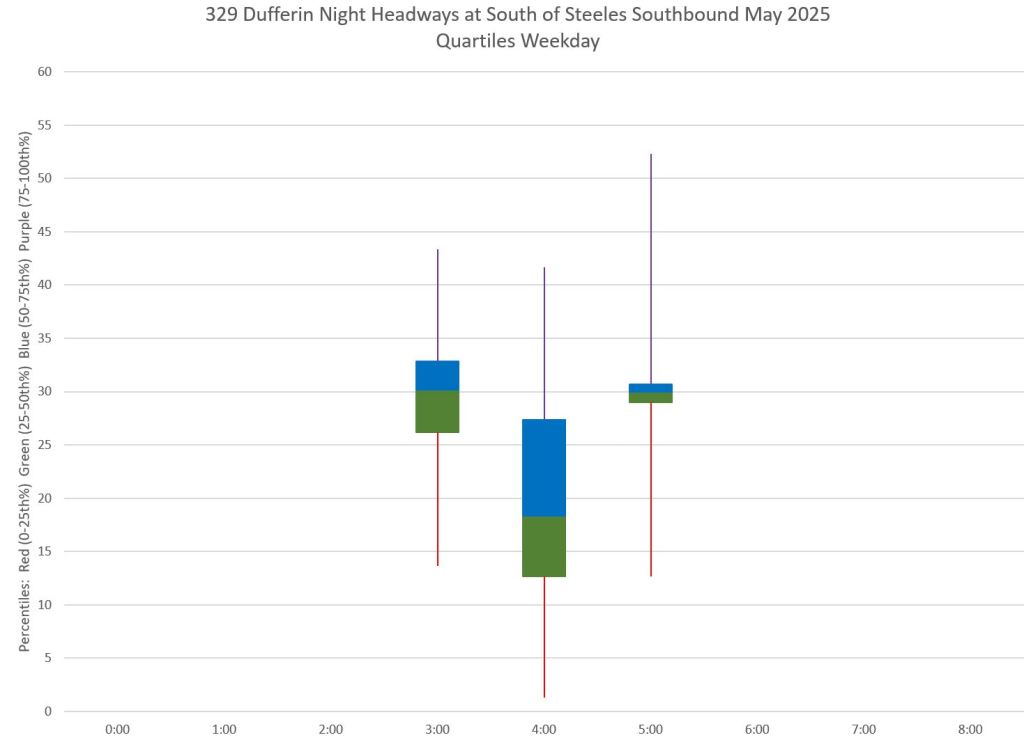
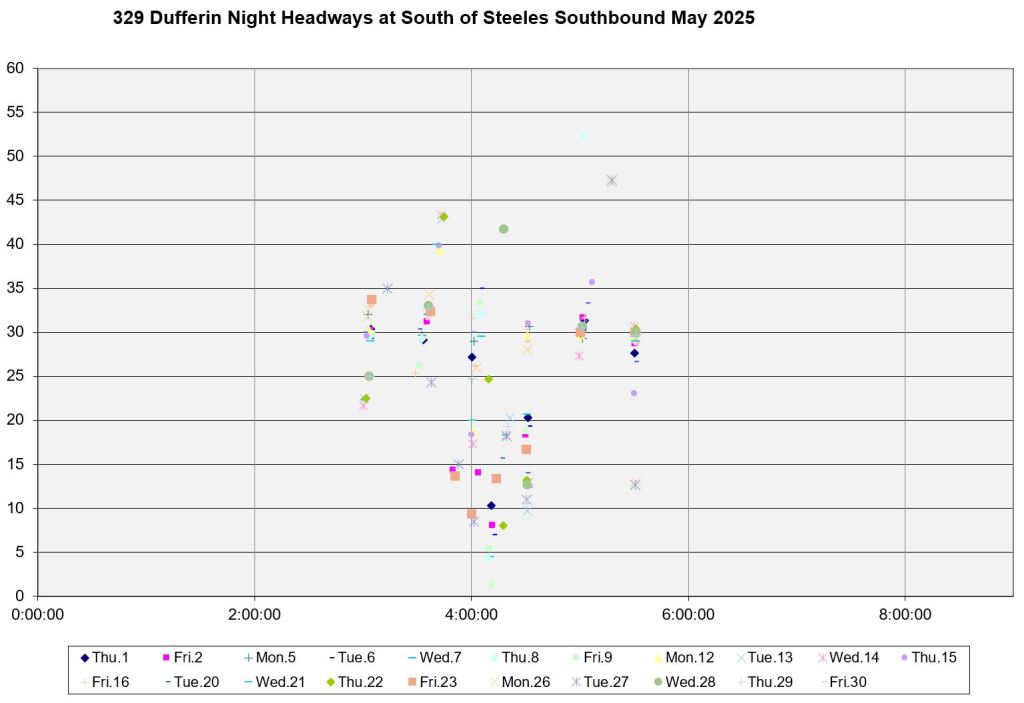
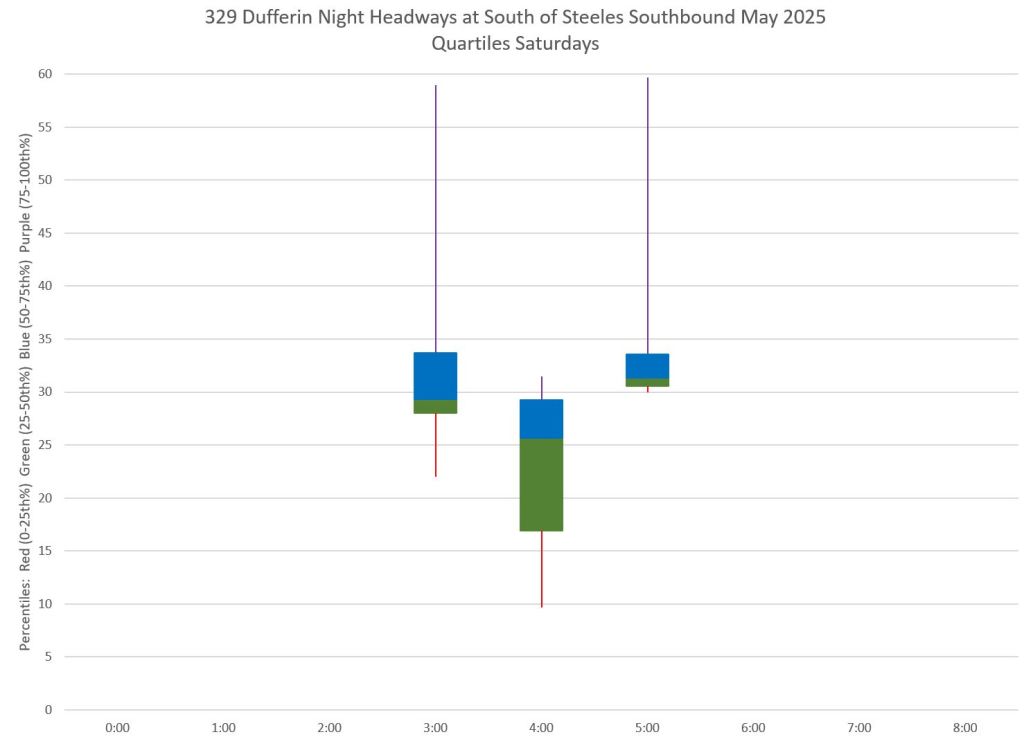
The service southbound from Steeles looks odd with more frequent service around 4am than at other times. This is caused by scheduling where a few new buses enter service replacing others. All four cross the screenline used in these charts producing the shorter apparent headways in the data. Note that in the Eglinton southbound data in the next section, this problem does not exist because only the “new” runs survive and the “old” ones have returned to the garage.
All that said, there are headways well over the scheduled half hour service here.
Weekdays
Weekends
Eglinton Southbound
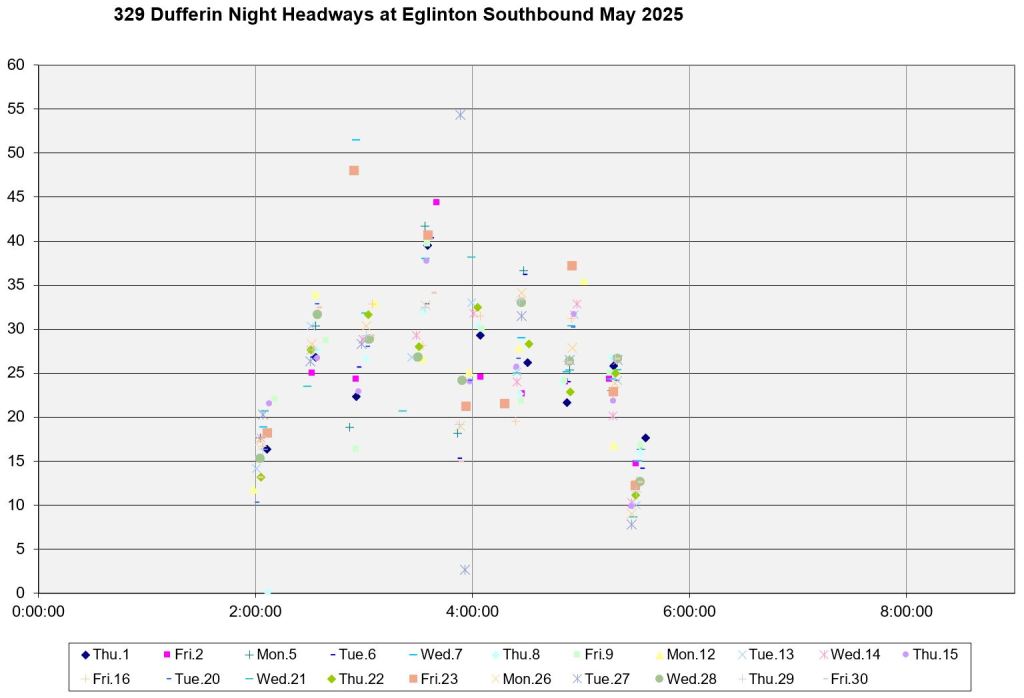
At Eglinton southbound the very short headways at Steeles caused by garage trips have vanished, but the service still is spread over a wide range.
Weekdays
Weekends
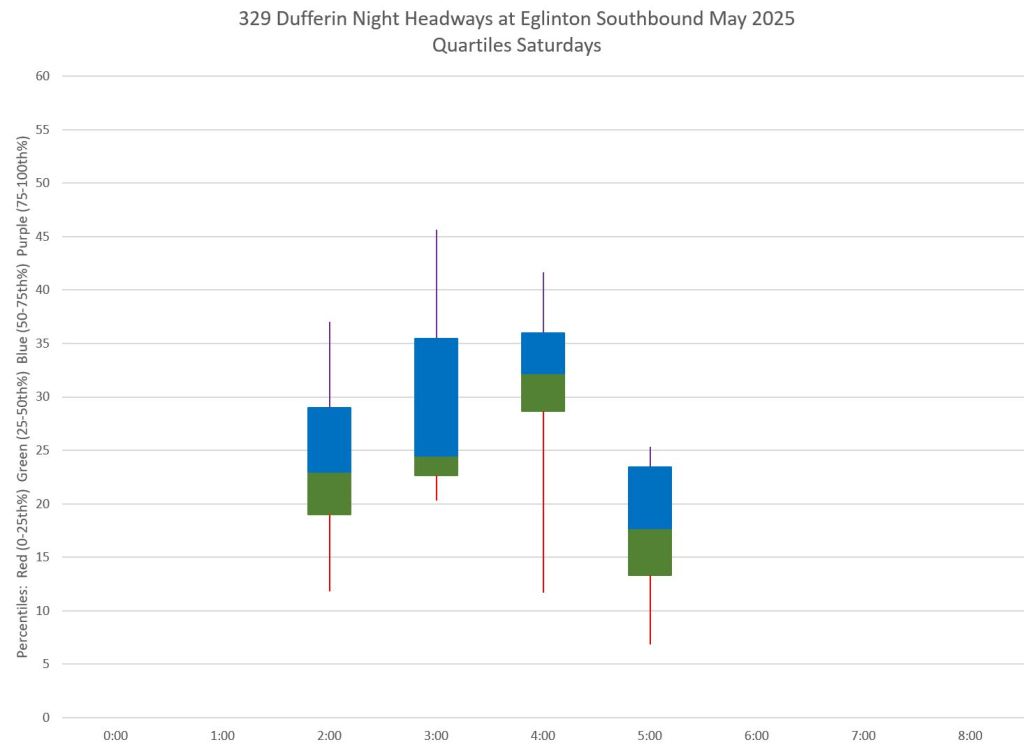
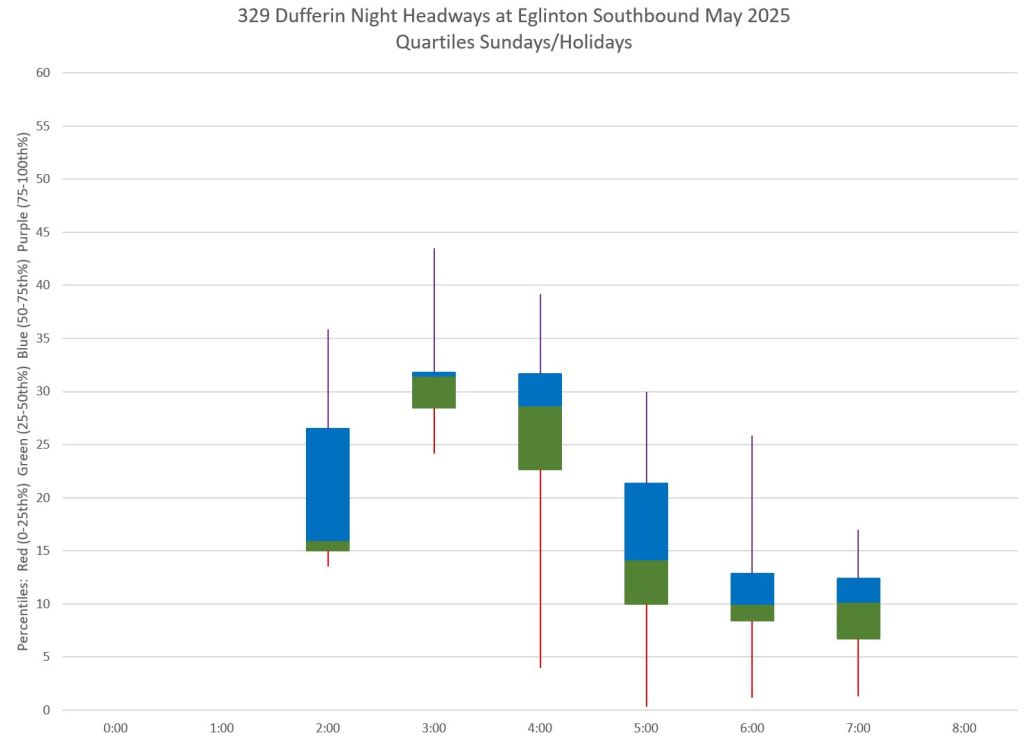
332 Eglinton West Night Bus
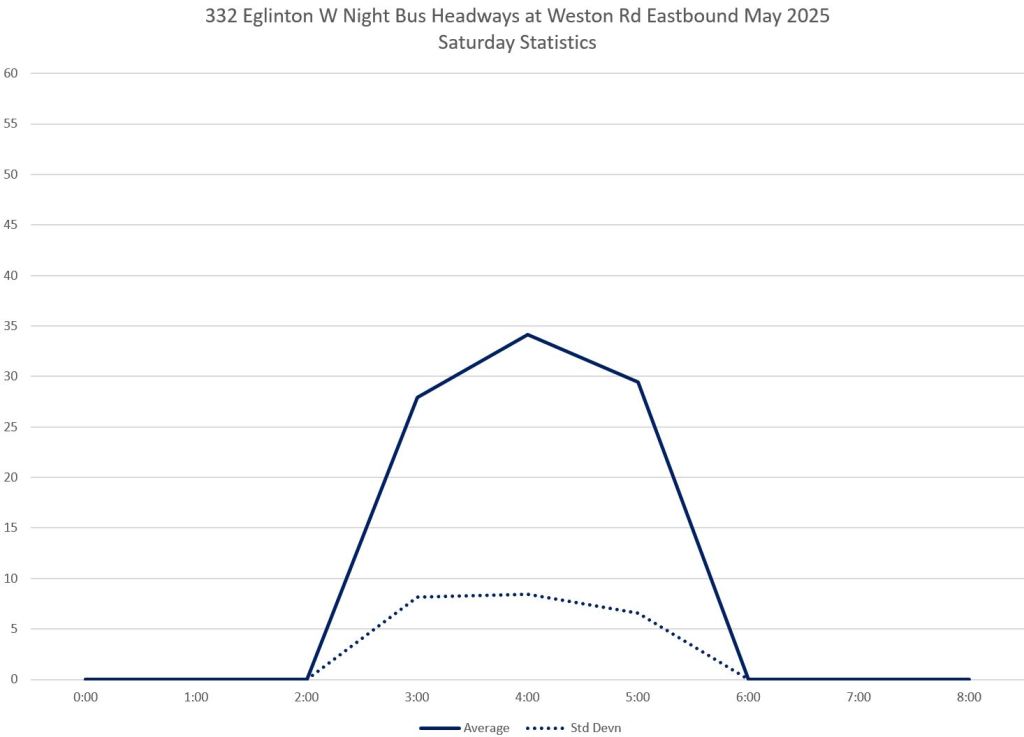
The 332 Eglinton West Night Bus is similar to the 32 Eglinton West daytime route except at its western end where service turns north at Renforth (rather than serving Renforth Station) and west on Dixon to Pearson Airport.
Yonge Westbound
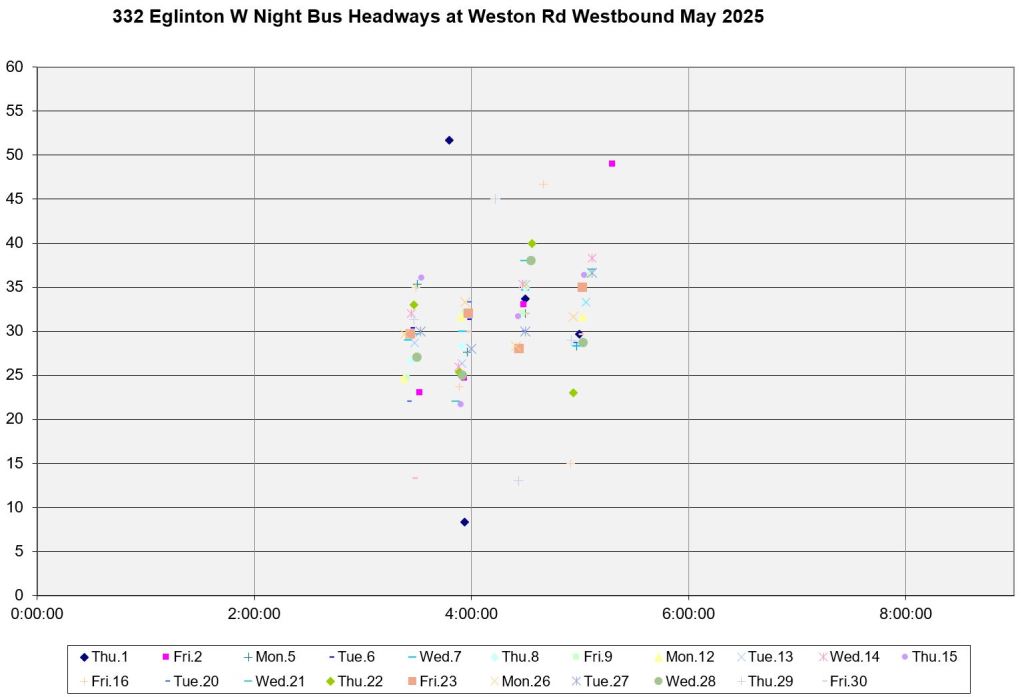
Service leaving Yonge westbound on weekdays and weekends is generally clustered in a narrow range of headways. There are a few exceptions with headways of 15 or 45 minutes caused by some buses running off-schedule. In particular there are a few days where the service remains badly off schedule through the night (May 1 and 2, the dark blue and pink dots in the weekday headway charts below). These days are presented in detail at the end of the article.
Weekdays
Weekends
Weston Road Westbound
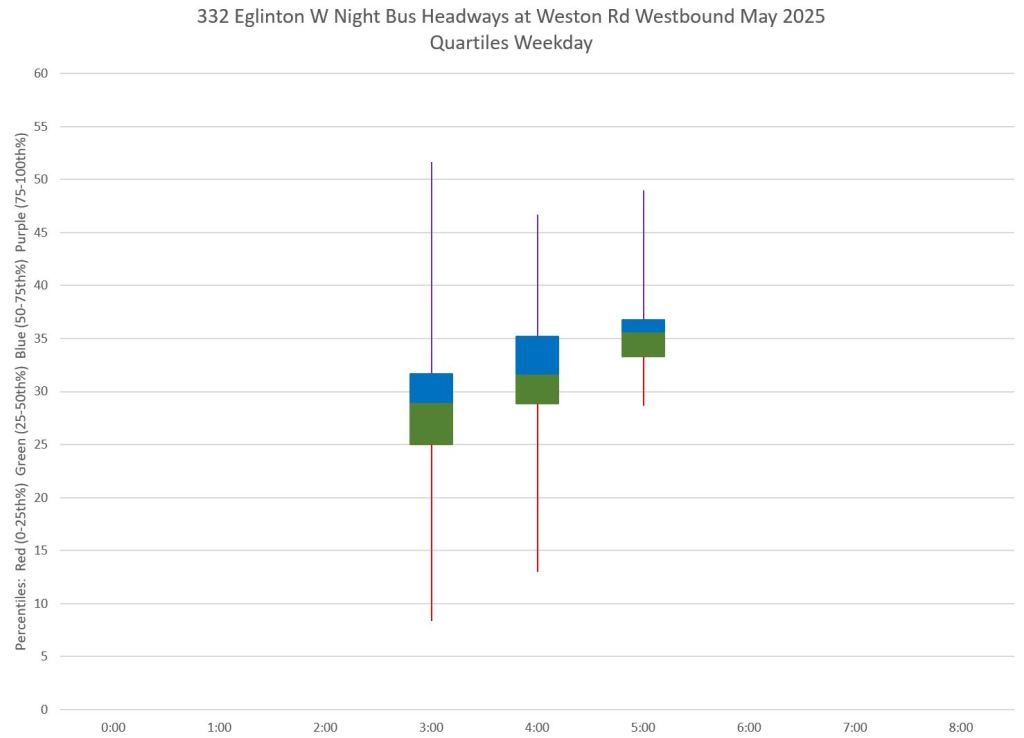
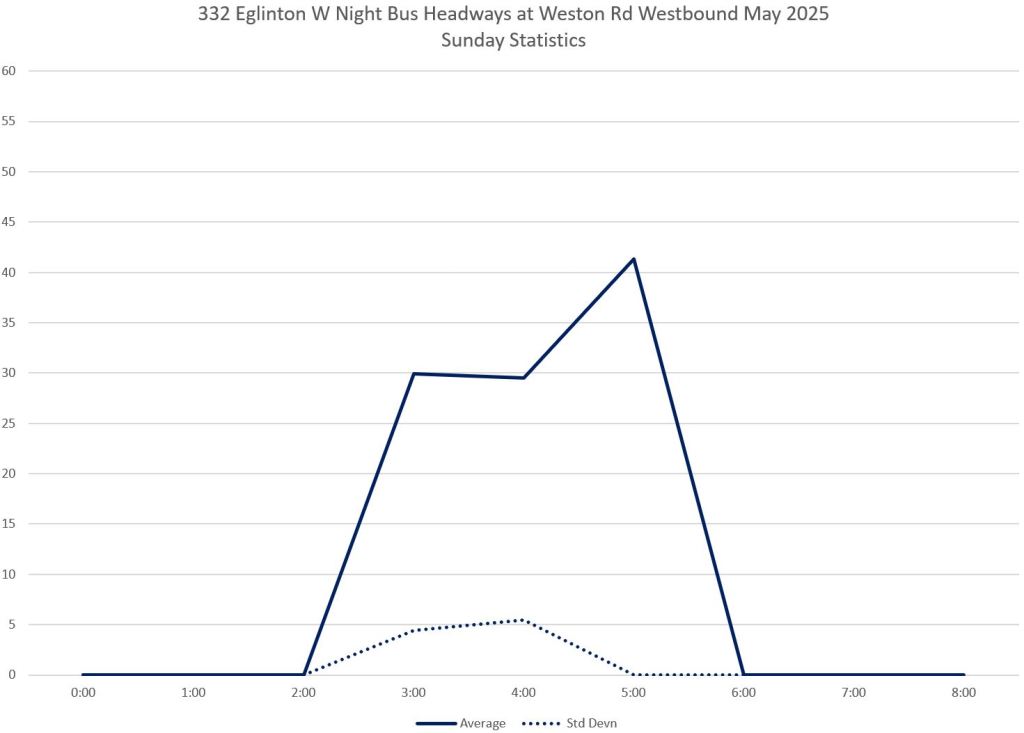
By the time the service reaches Weston Road, the range of headways has expanded with most lying between 20 and 40 minutes on weekdays. The outliers at 15 and 45 minutes at Yonge have widened here to 10 and 50 minutes.
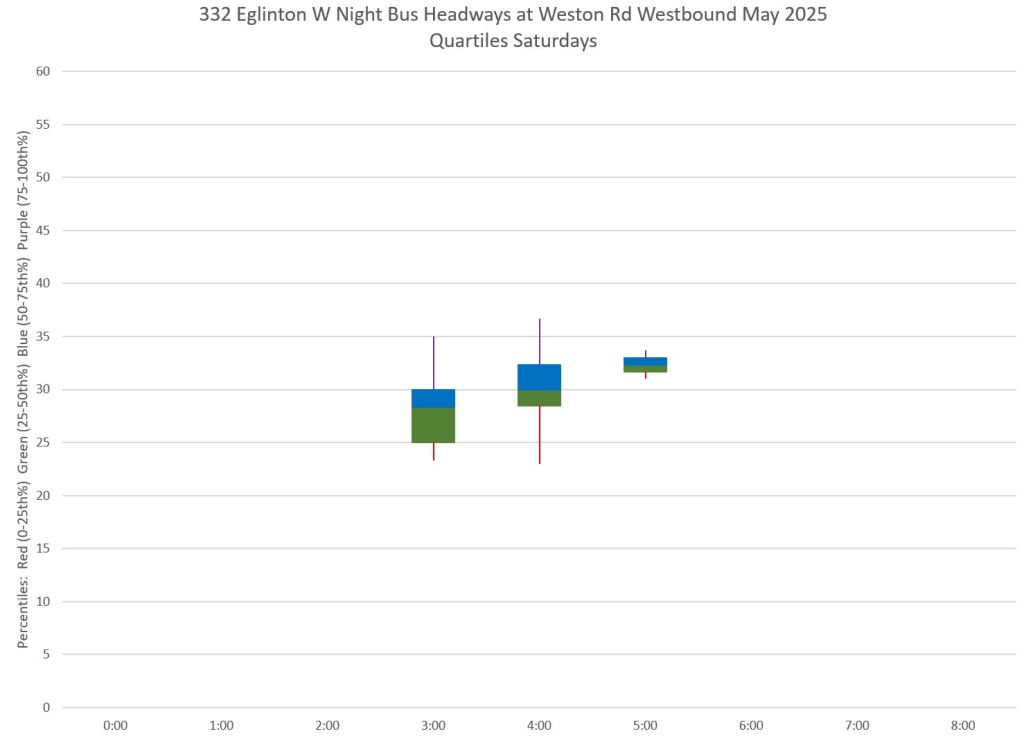
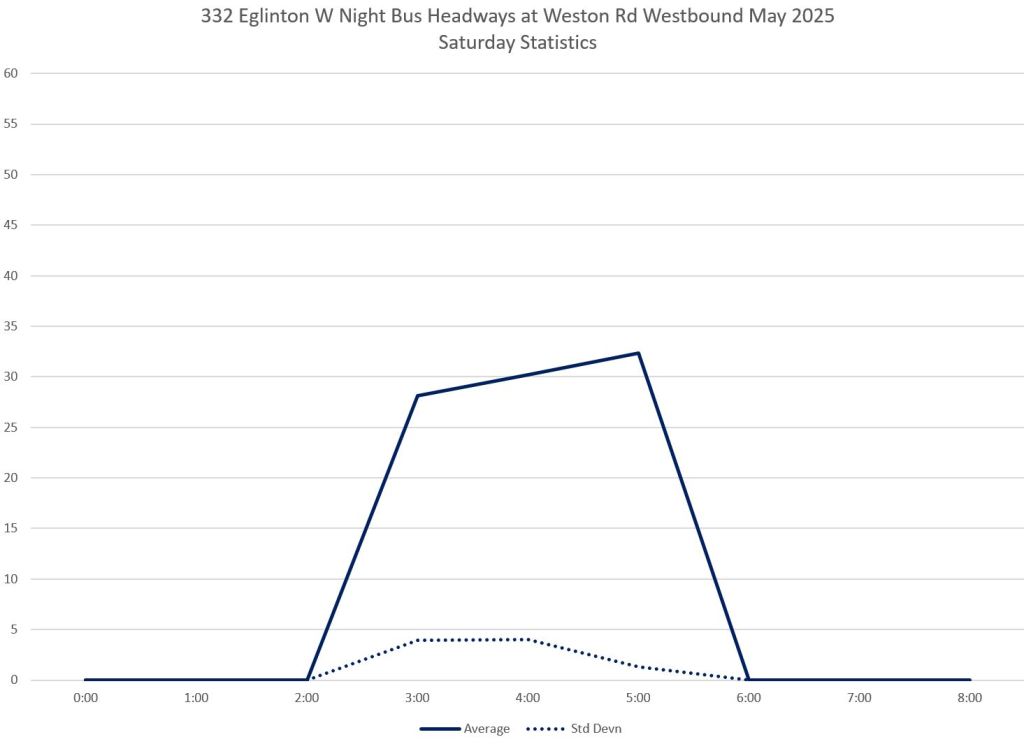
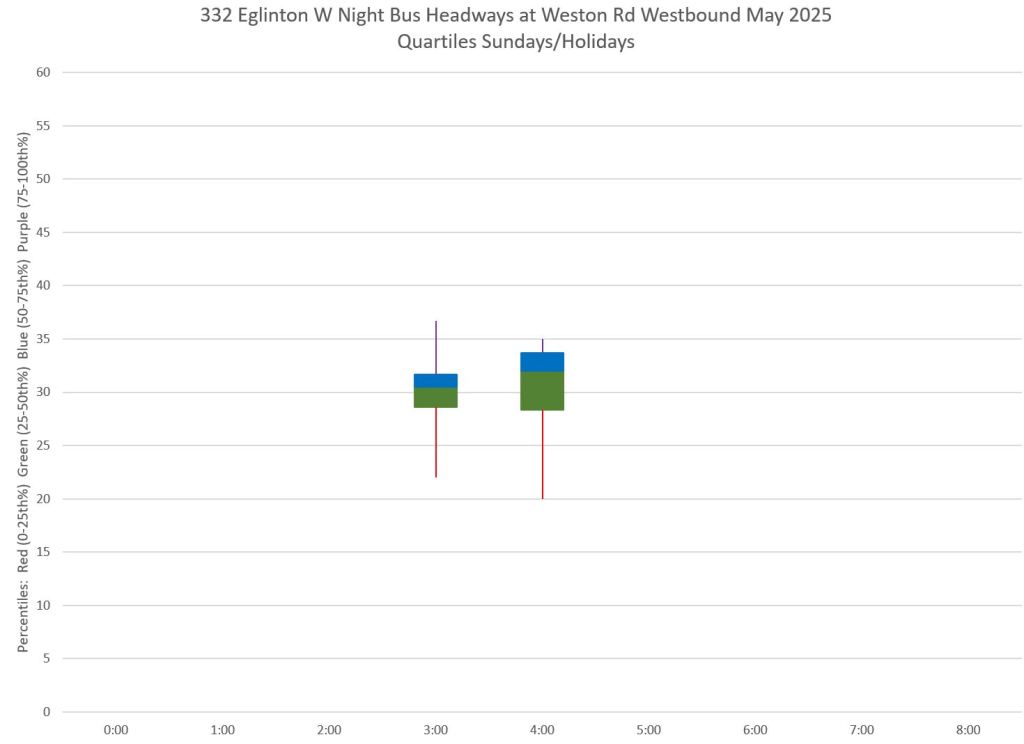
The spread is considerably less on weekends.
Weekdays
Weekends
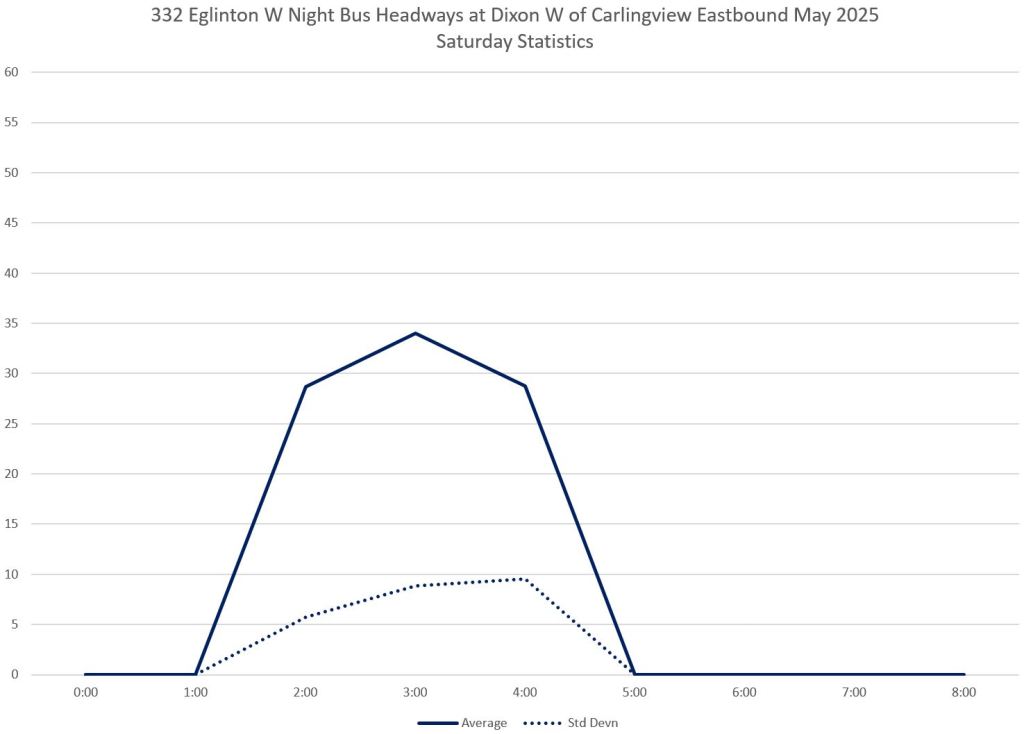
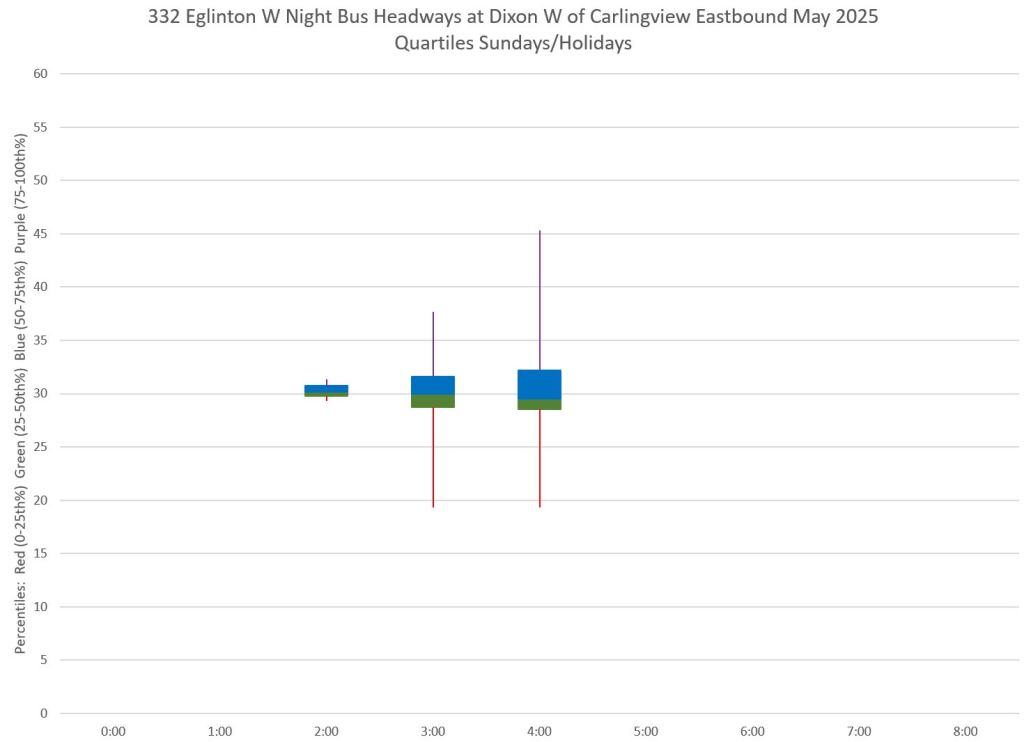
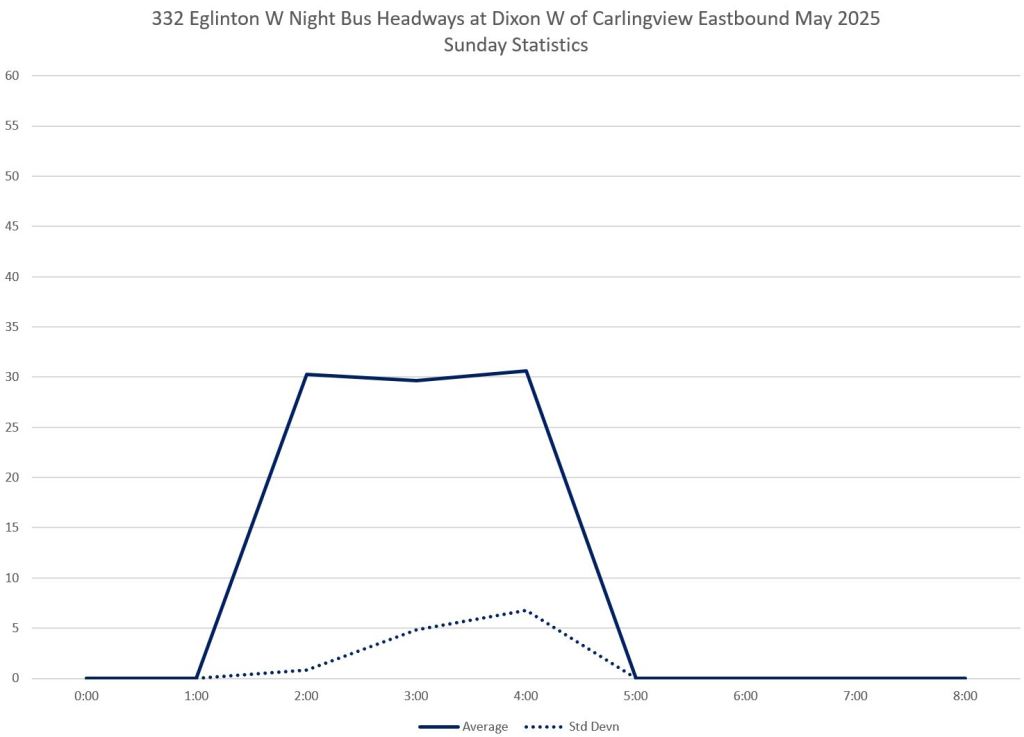
Airport Eastbound
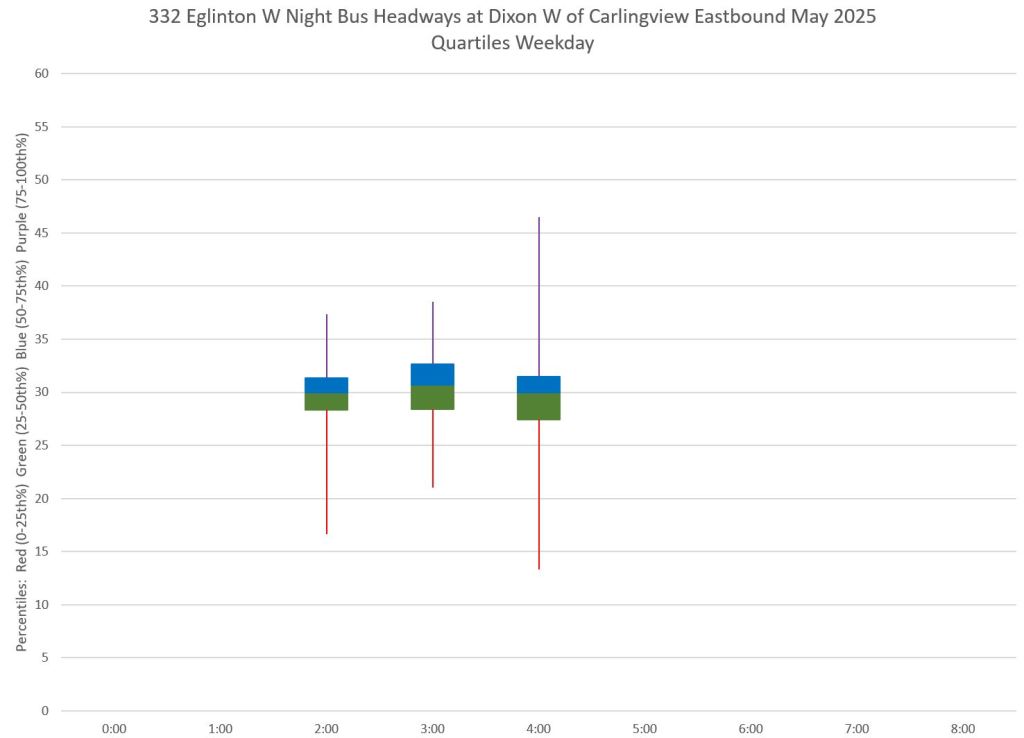
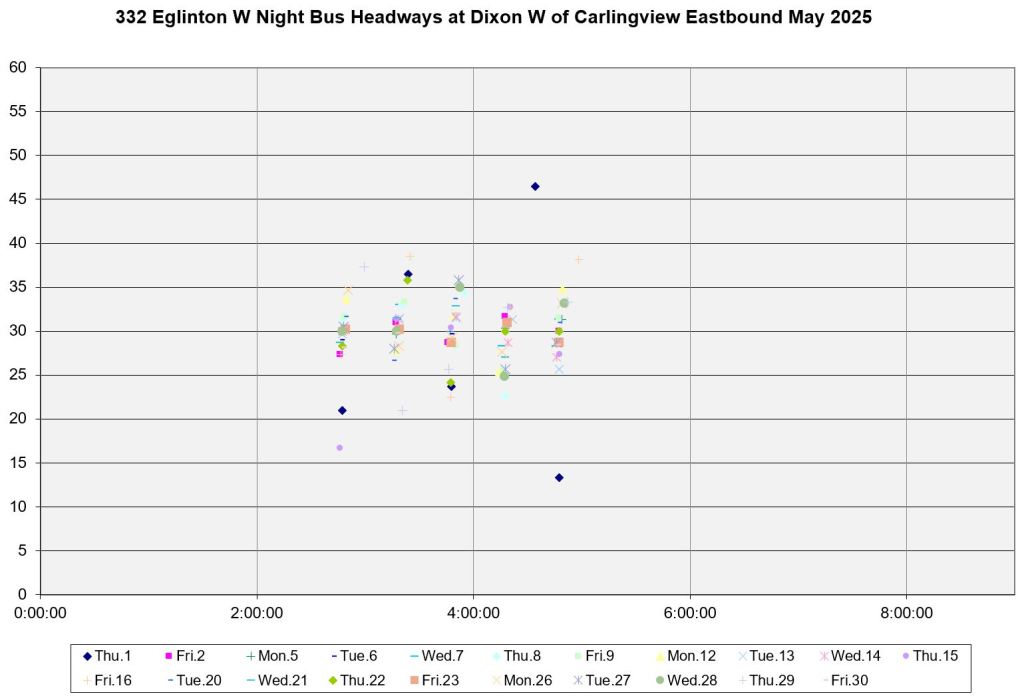
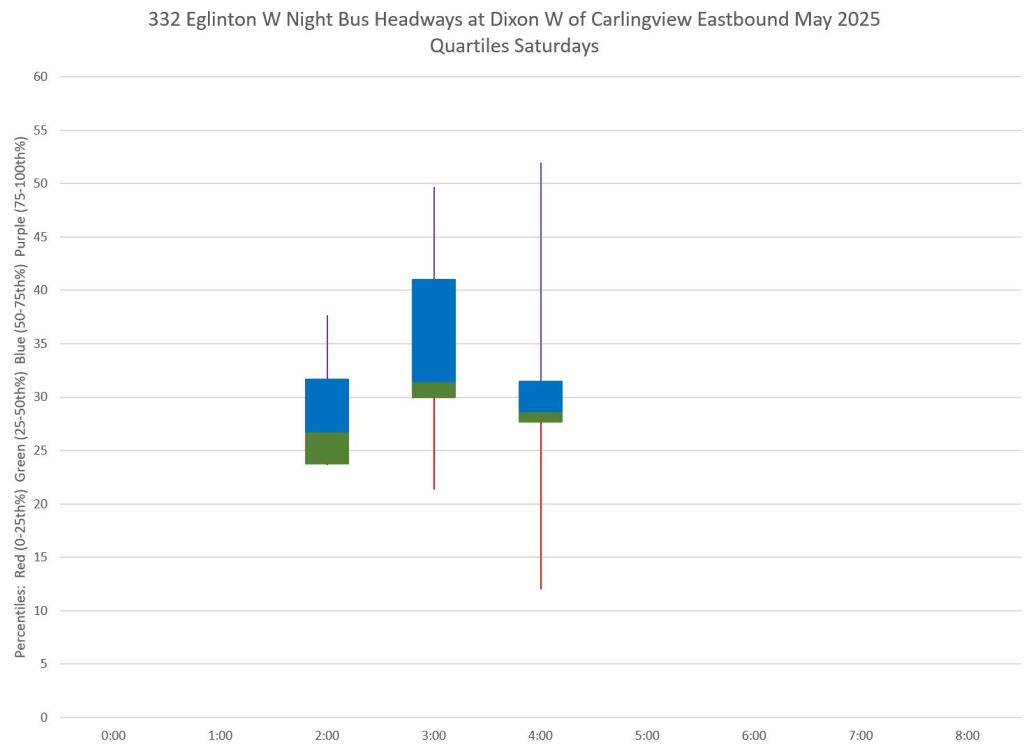
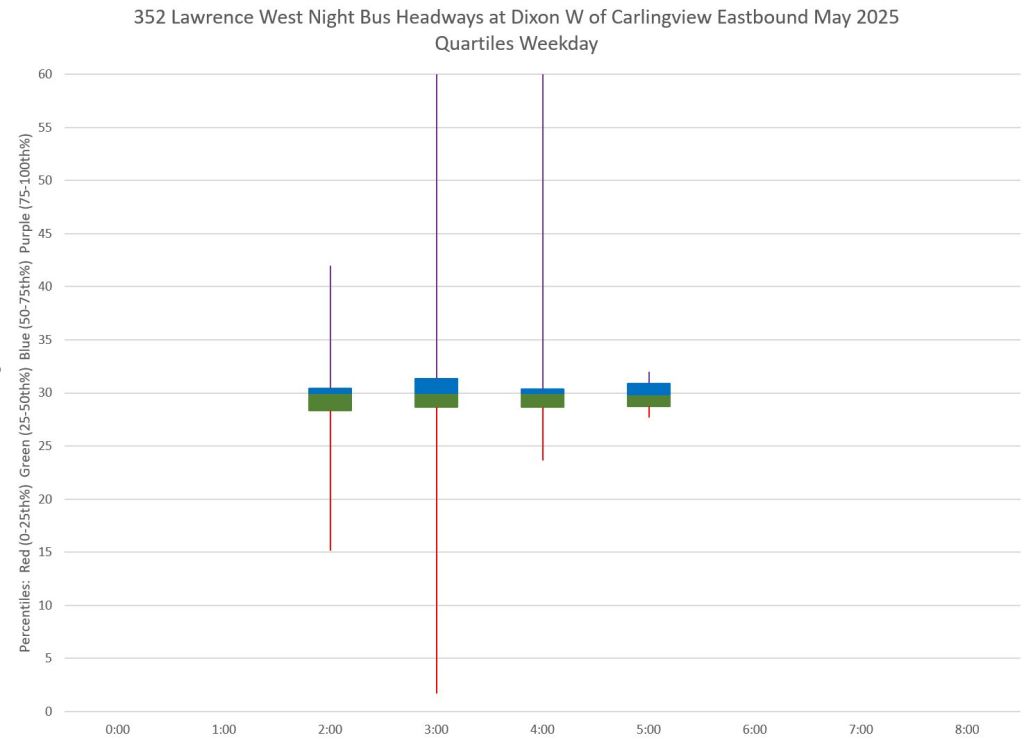
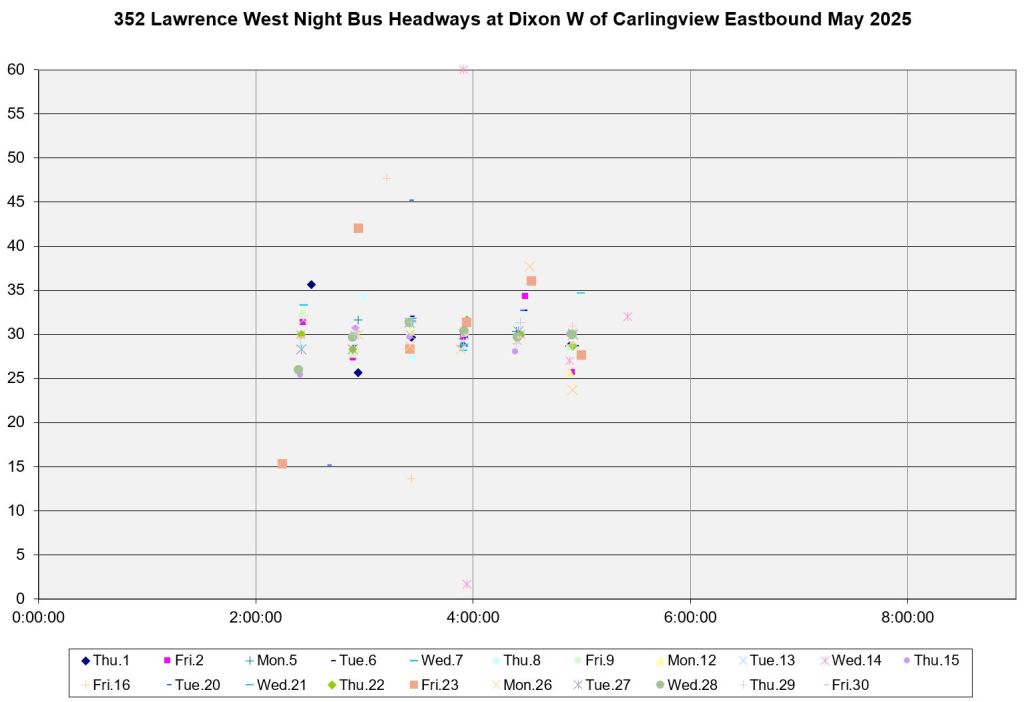
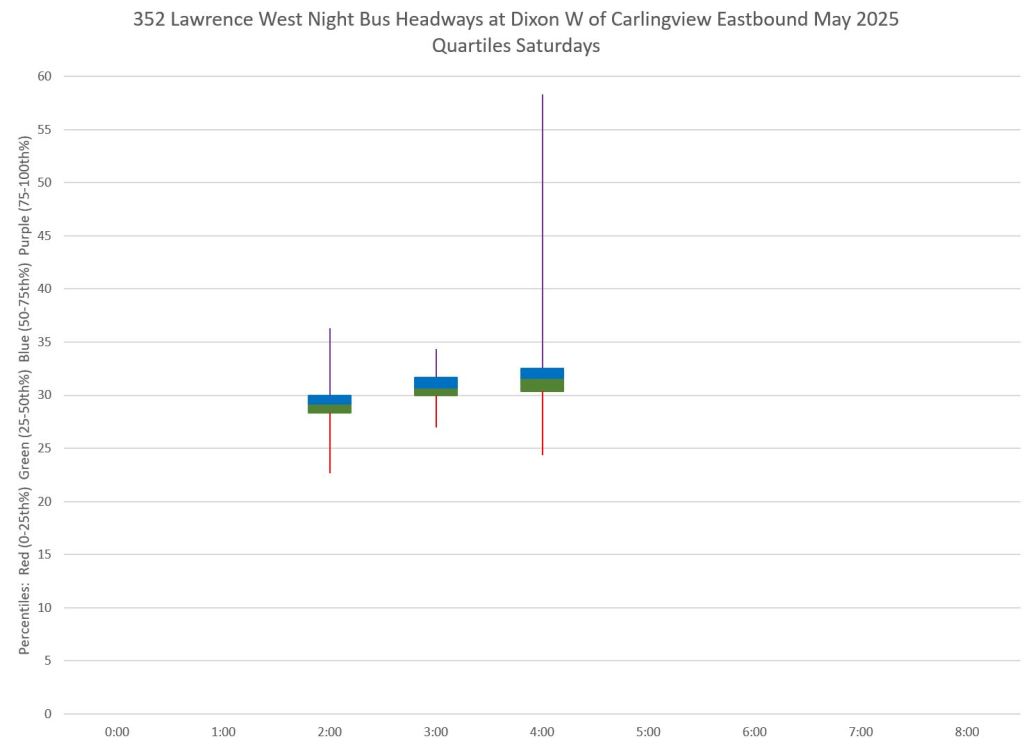
The screenline used here for Airport services is on Dixon Road just west of Carlingview. This avoids problems with headway measurement as buses loop through and lay over in the airport area.
The pattern is similar to the one at Yonge Street with many headways clustered around 30 minutes, but a outliers ranging from 15 to 50 minutes.
Weekdays
Weekends
Weston Road Eastbound
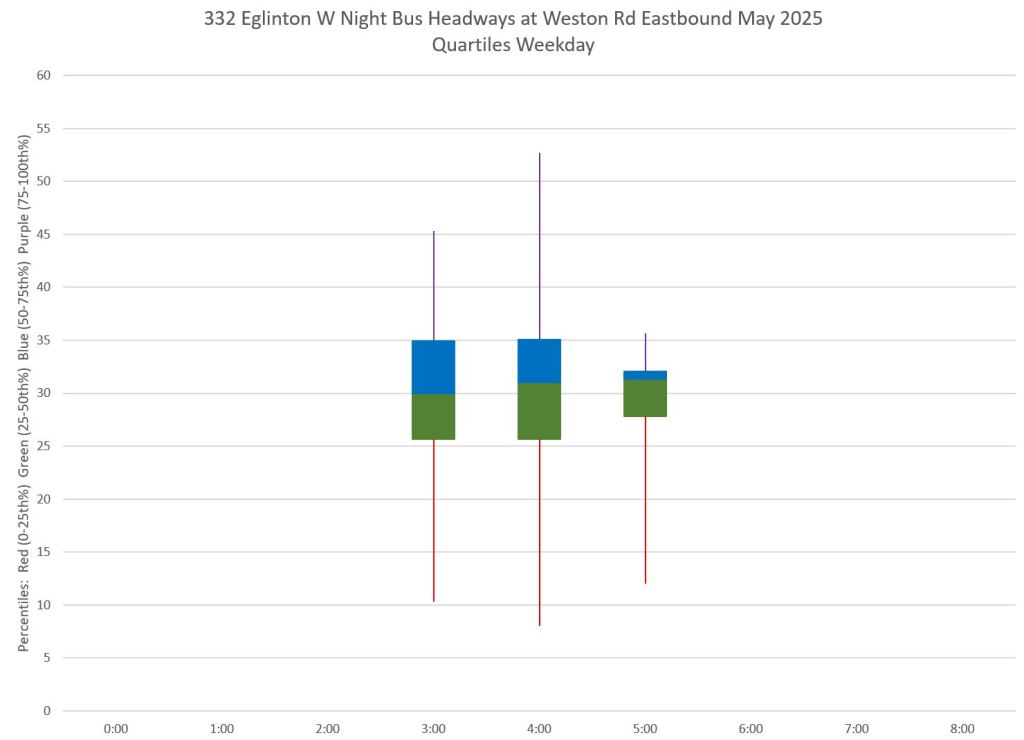
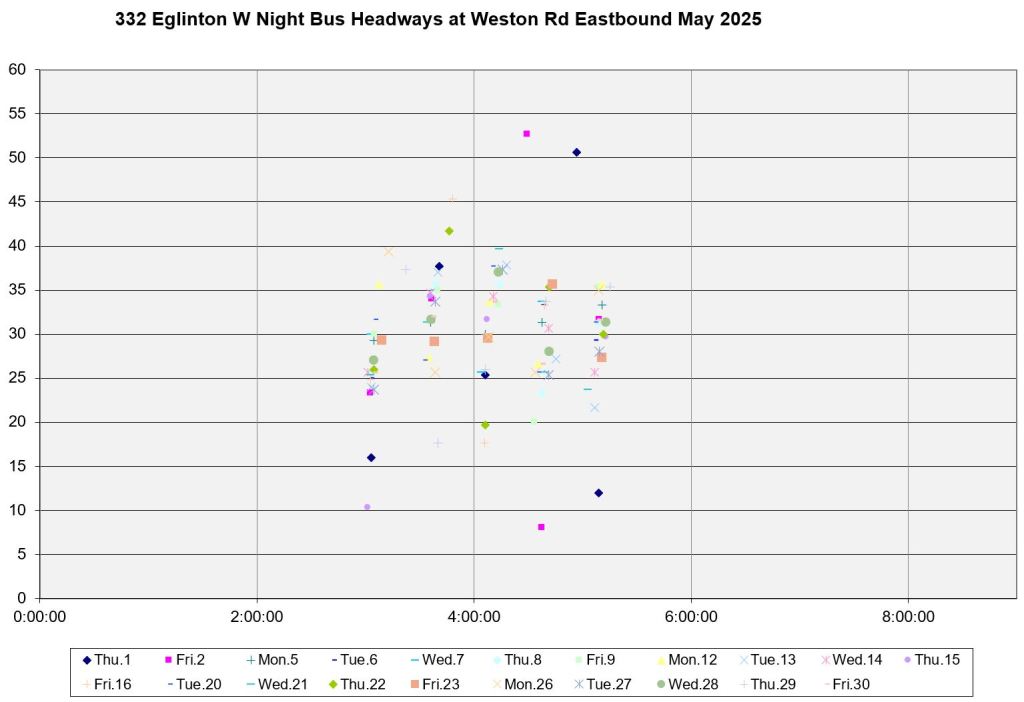
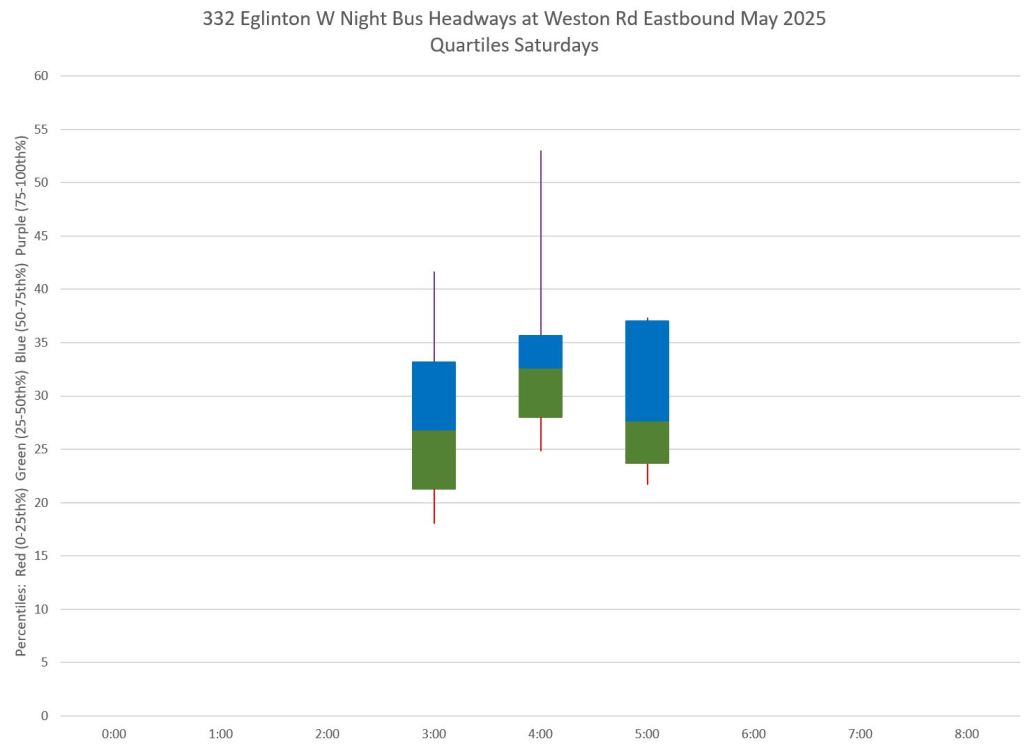
When the service reaches Weston Road eastbound the headways are even more scattered than they were east of the airport (above).
Weekdays
Weekends
335 Jane Night Bus
The 335 Jane Night Bus follows the same route as 35 Jane except that the northern terminus is a loop into York University rather than at the subway station.
Jane Station Northbound
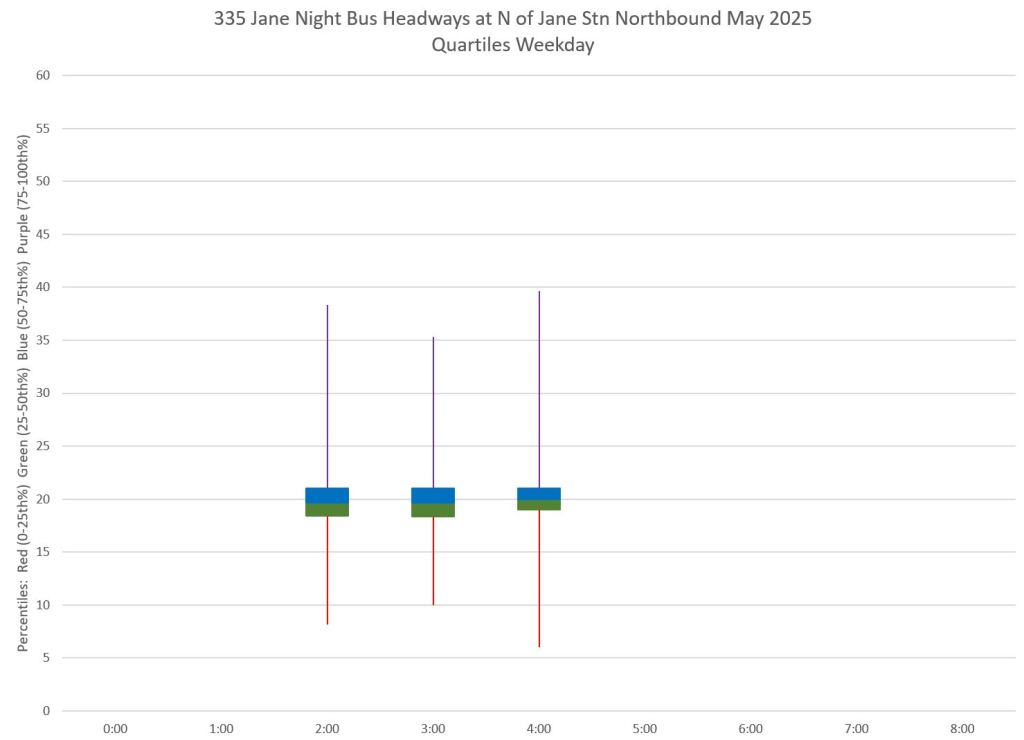
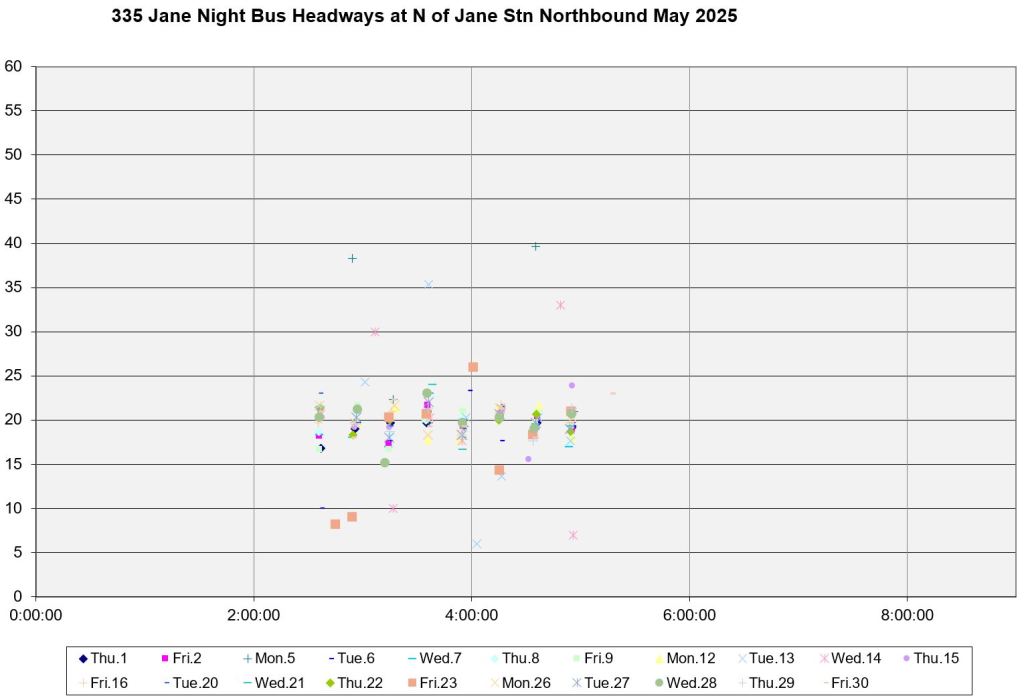
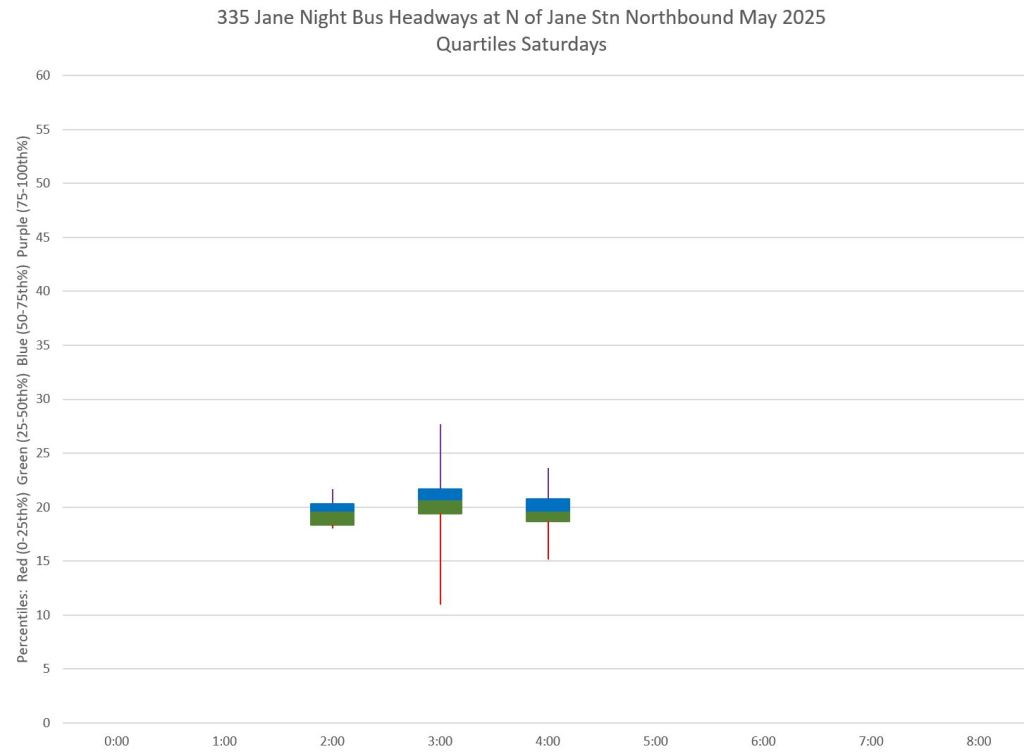
Service leaving Jane Station northbound is, with some exceptions, clustered around the 20 minute scheduled headway.
Weekdays
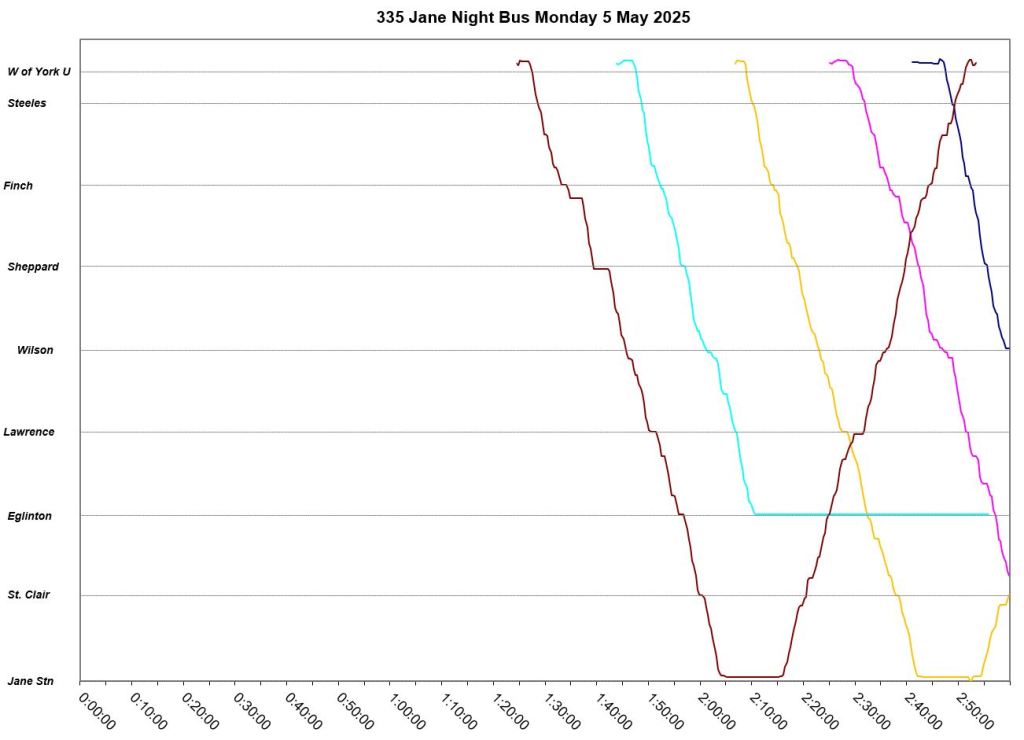
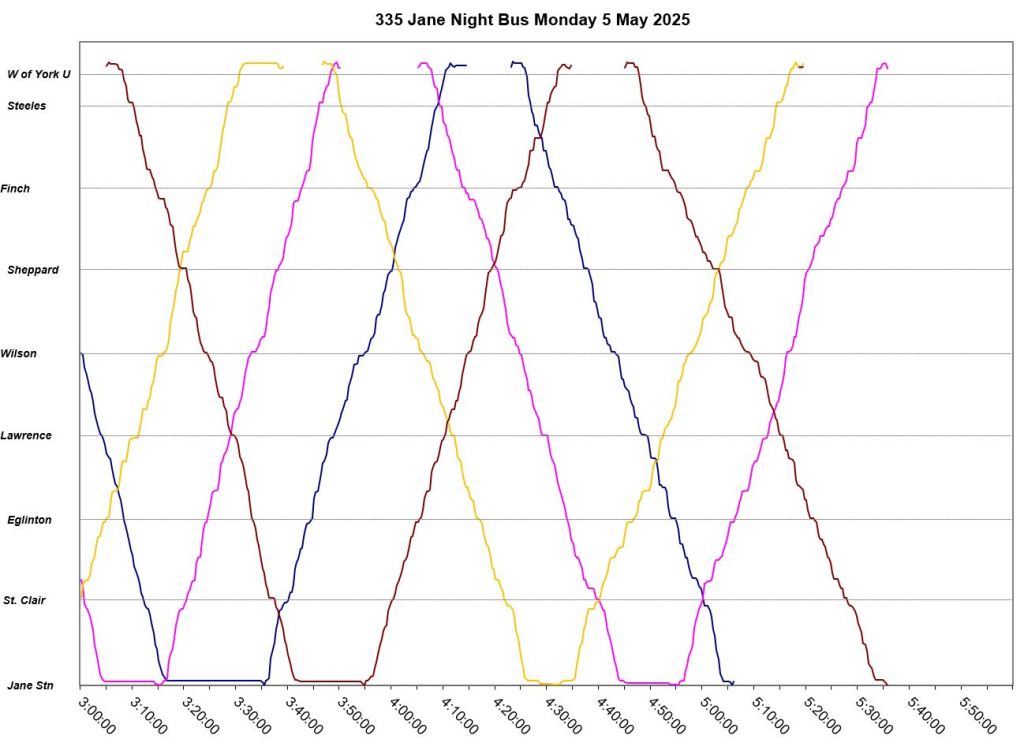
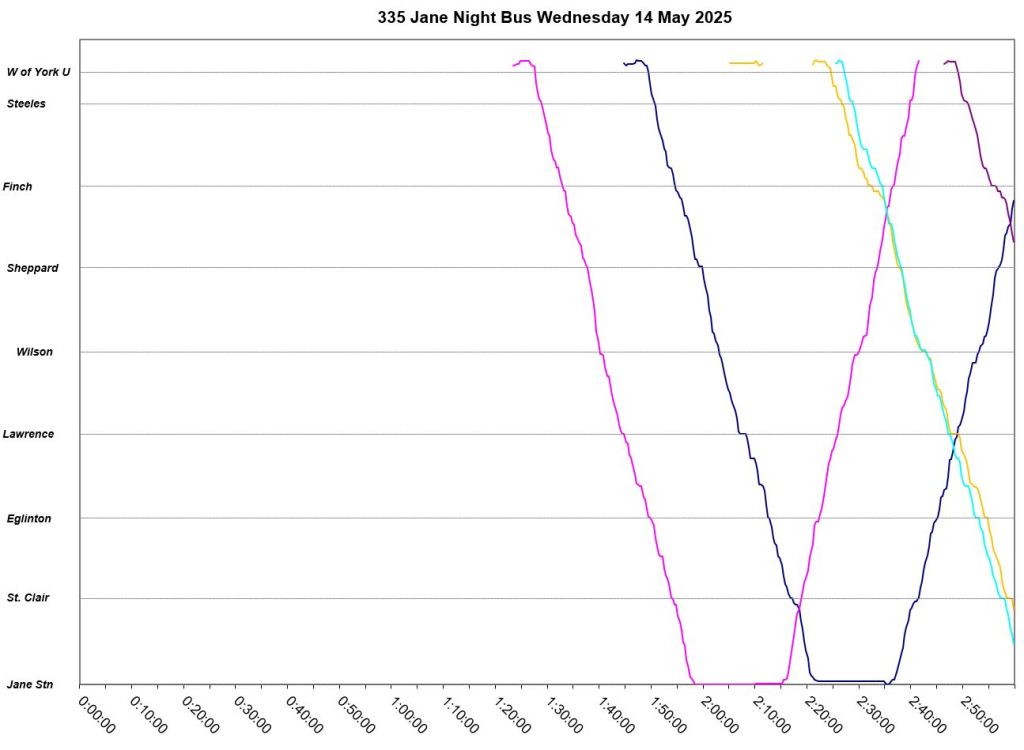
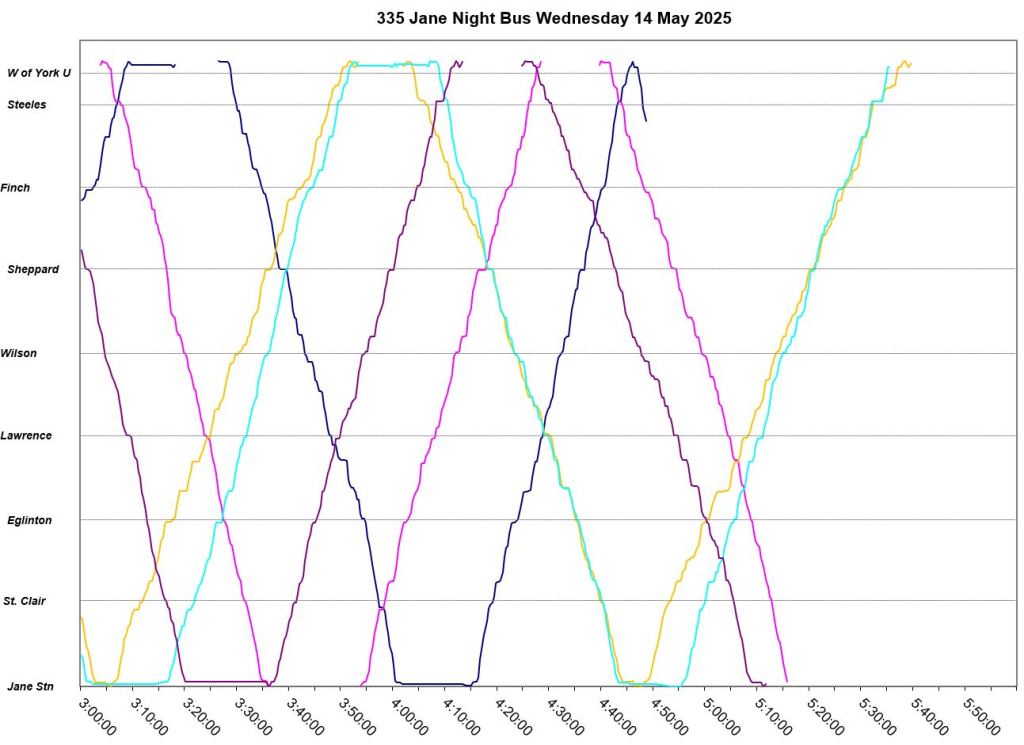
On May 5, one bus was missing for most of the night leading to double headways. On May 14, two buses ran as a pair for the entire service period. (Detailed service charts are at the end of the article.)
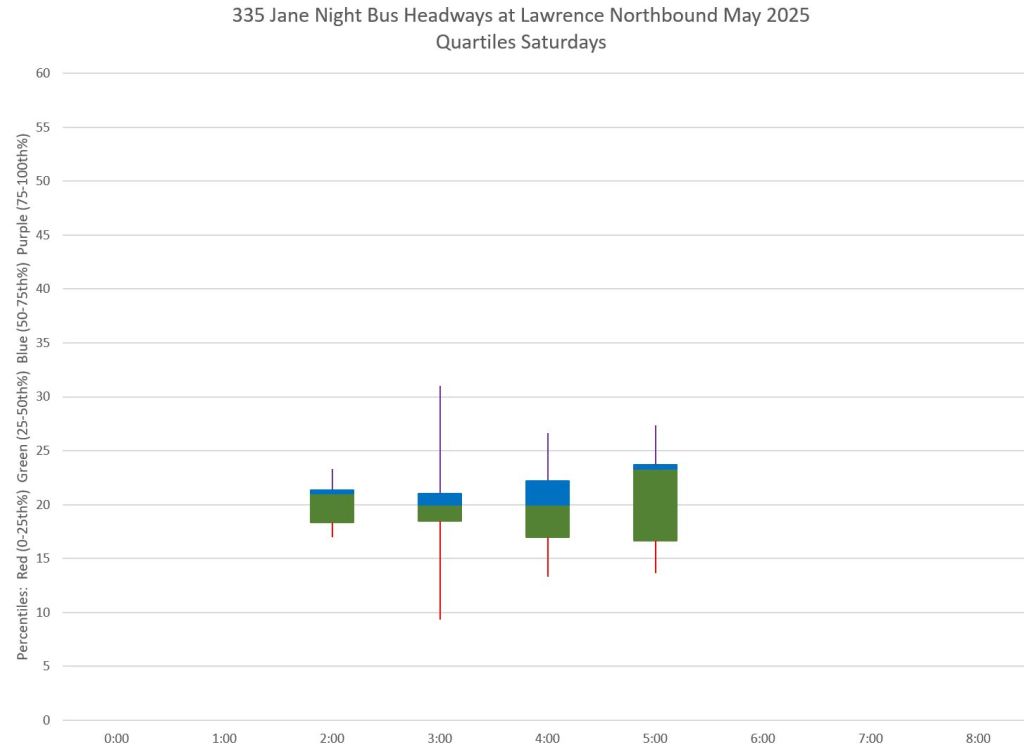
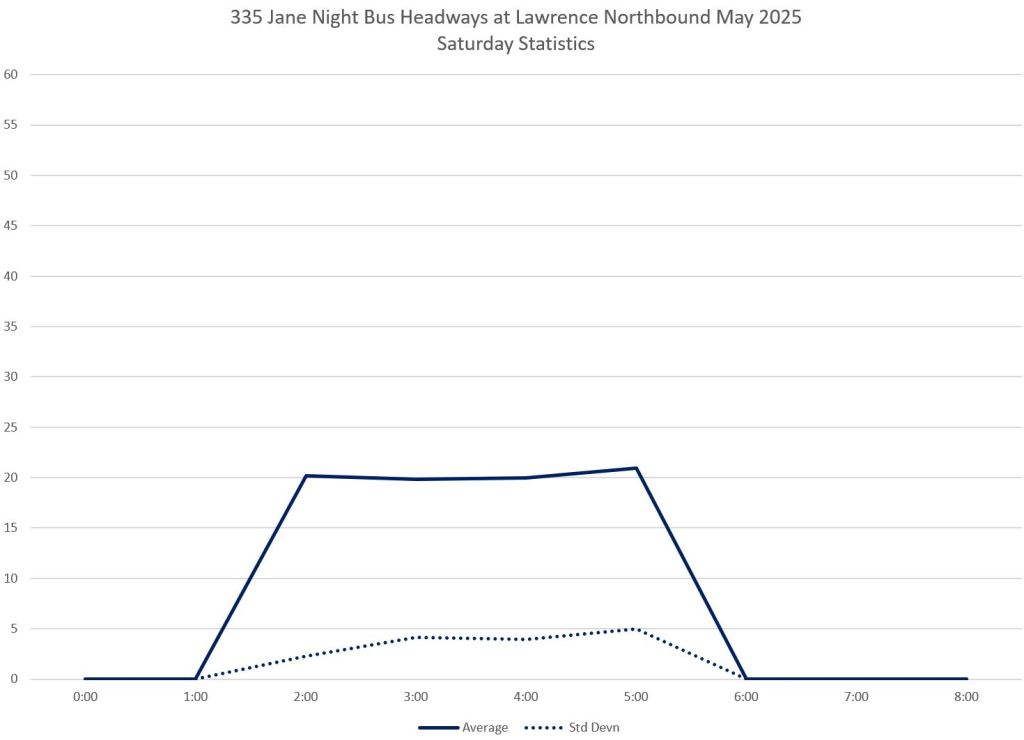
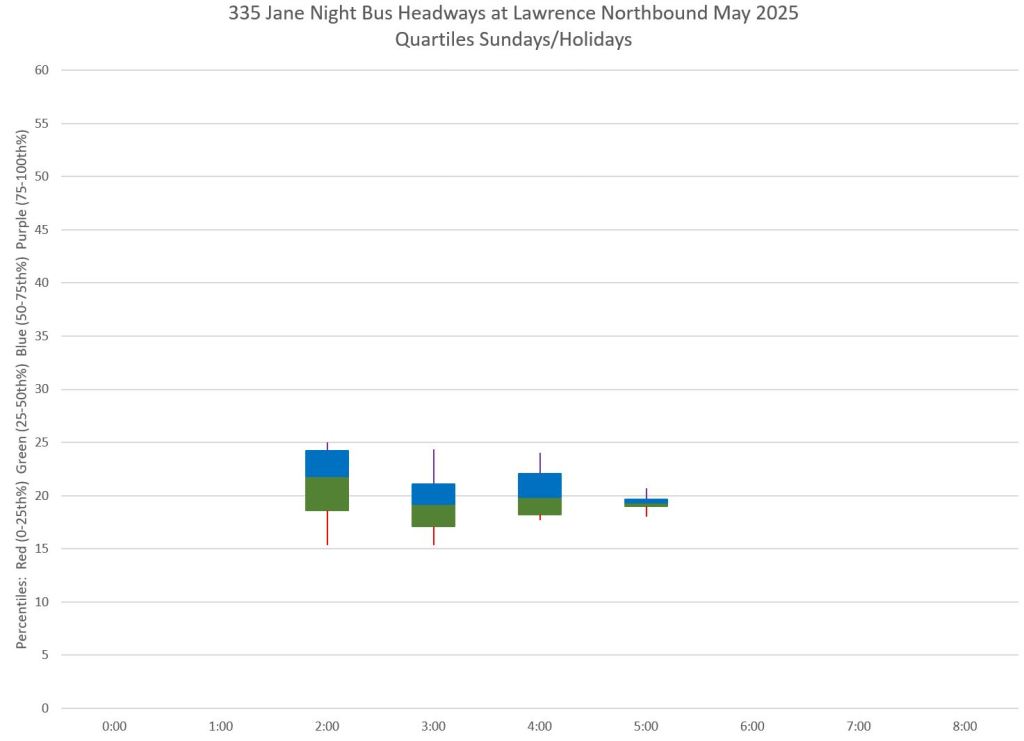
Weekends
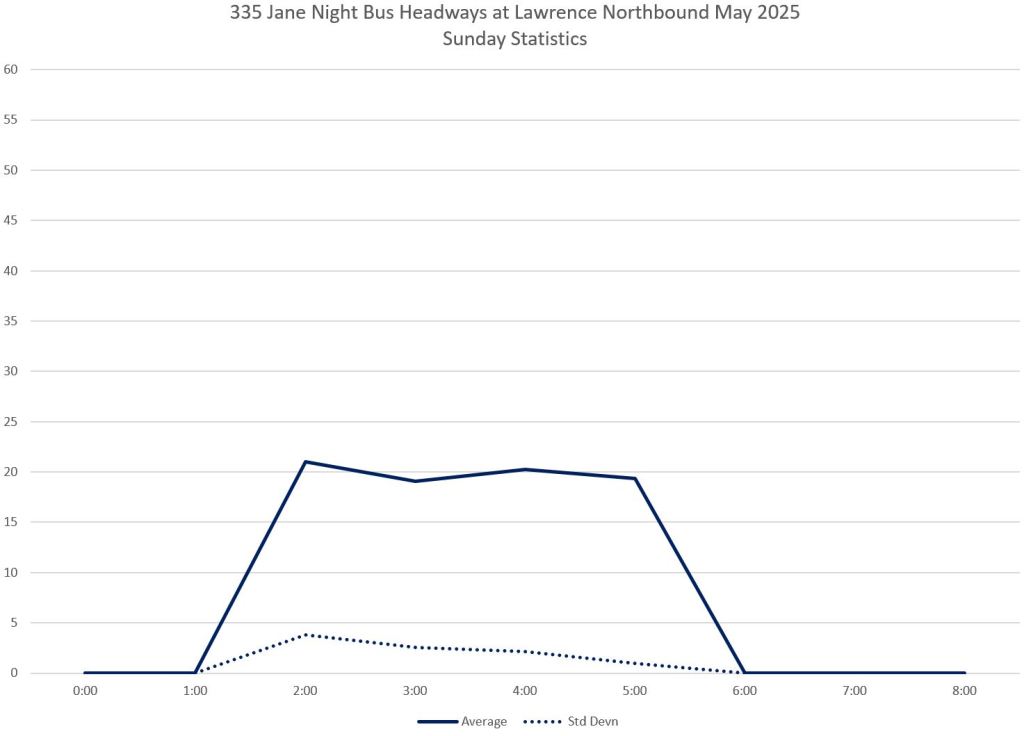
Lawrence Northbound
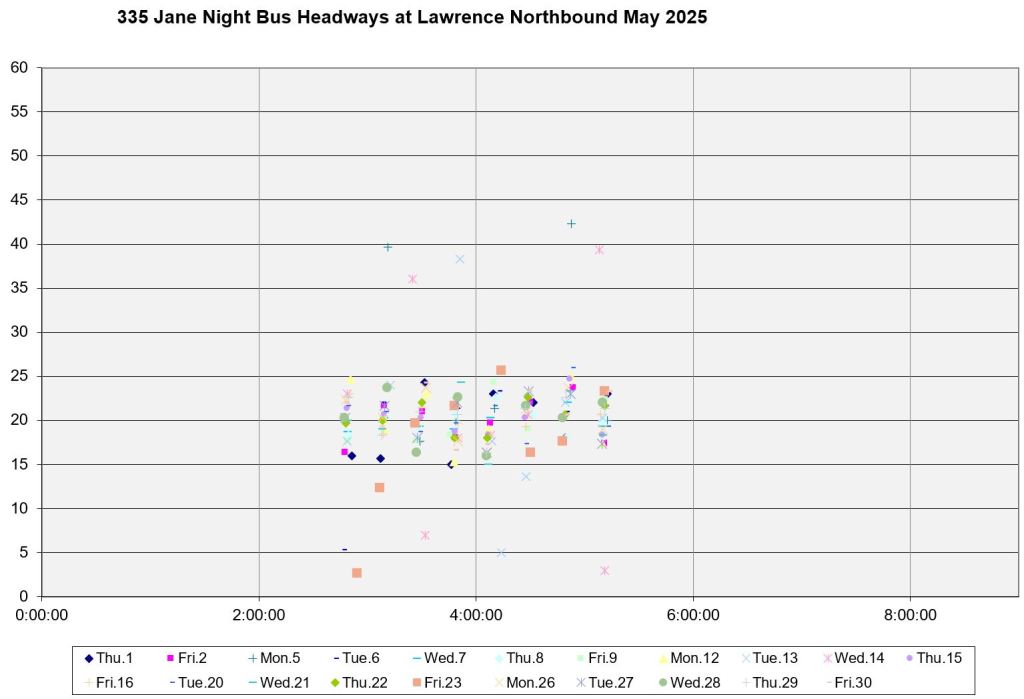
Weekdays
At Lawrence northbound, most headways lie in a band from 15-25 minutes with some outliers under 5 and over 30 minutes.
Weekends
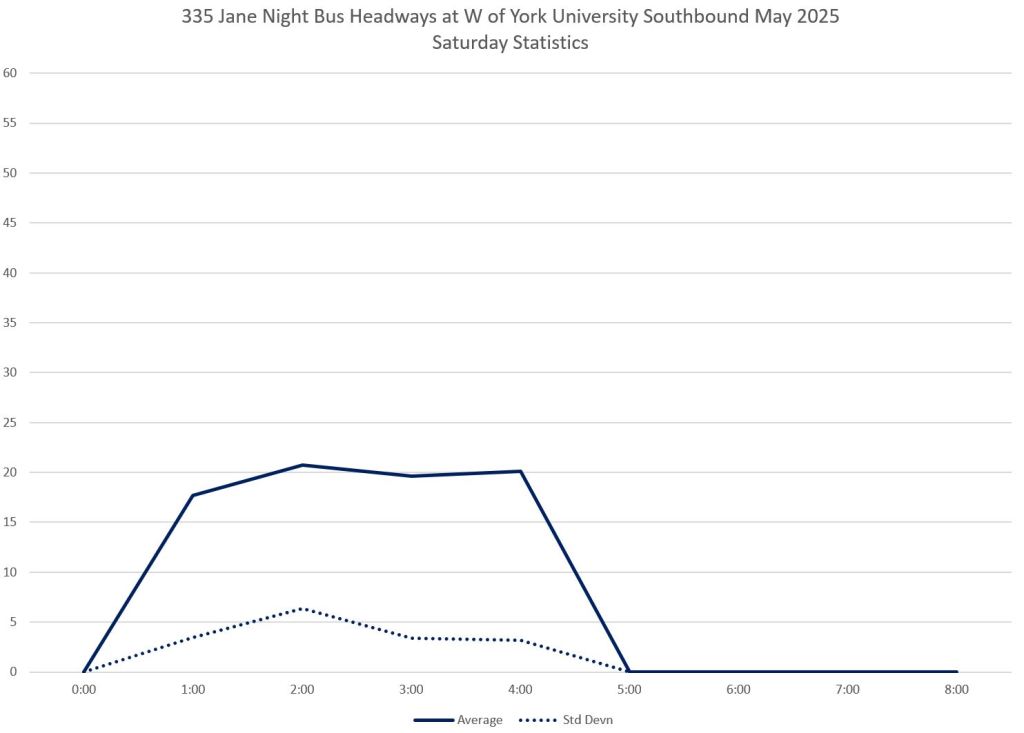
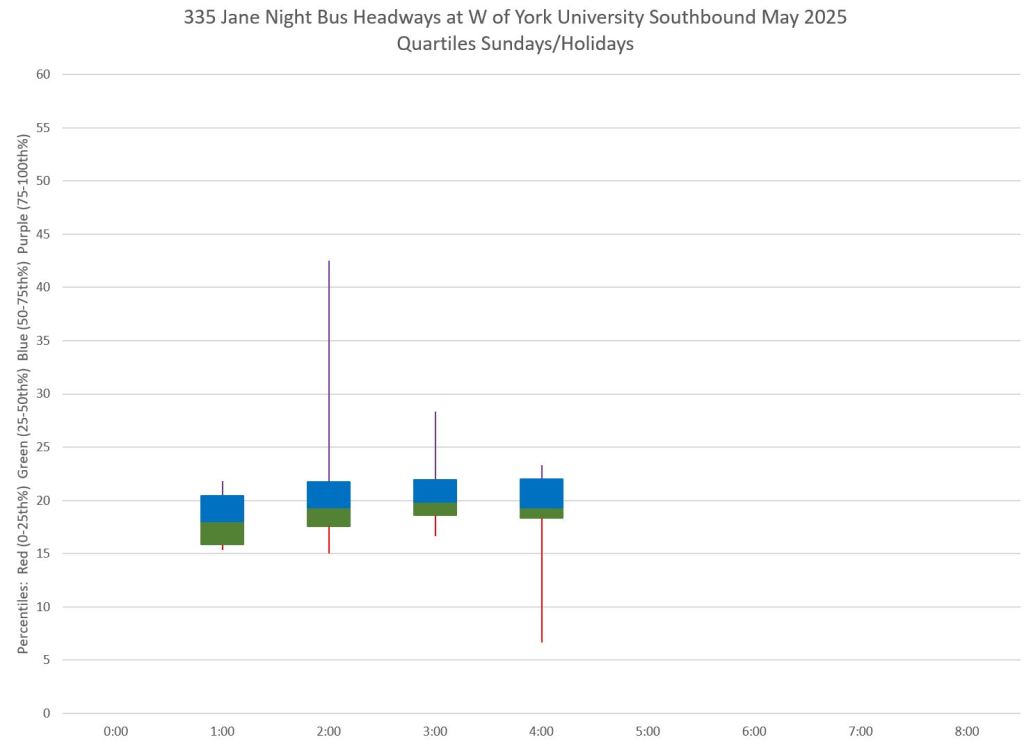
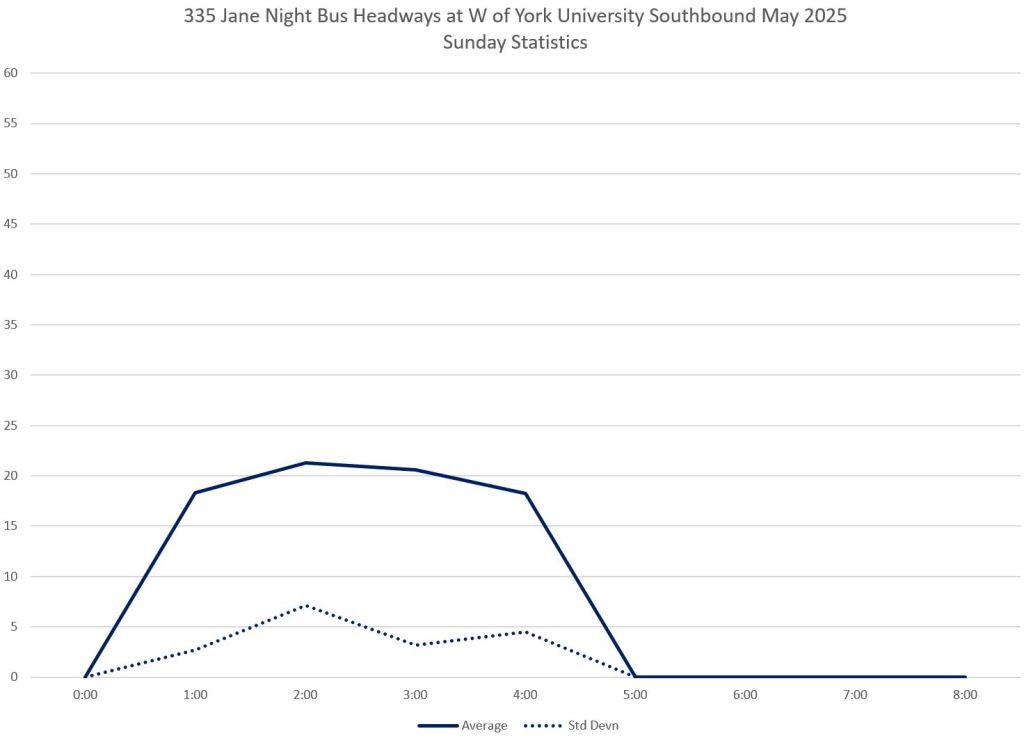
West of York University Southbound
The screenline for these measurements is on Steeles Avenue west of the exit from York University to avoid any confusion with looping and layover positions within the campus.
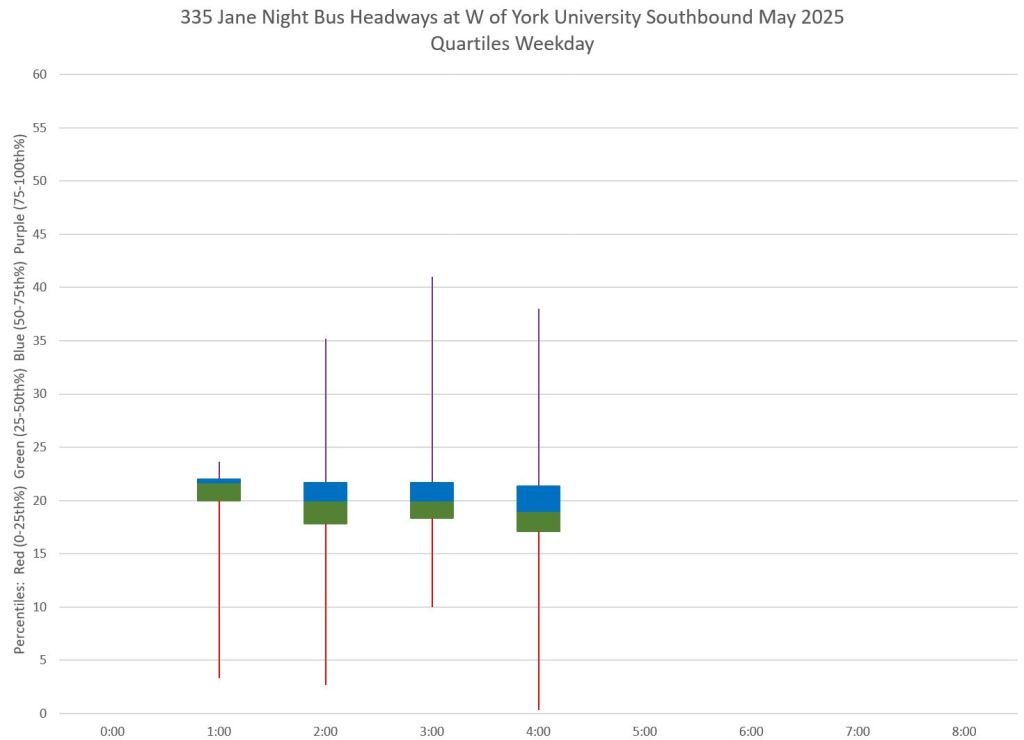
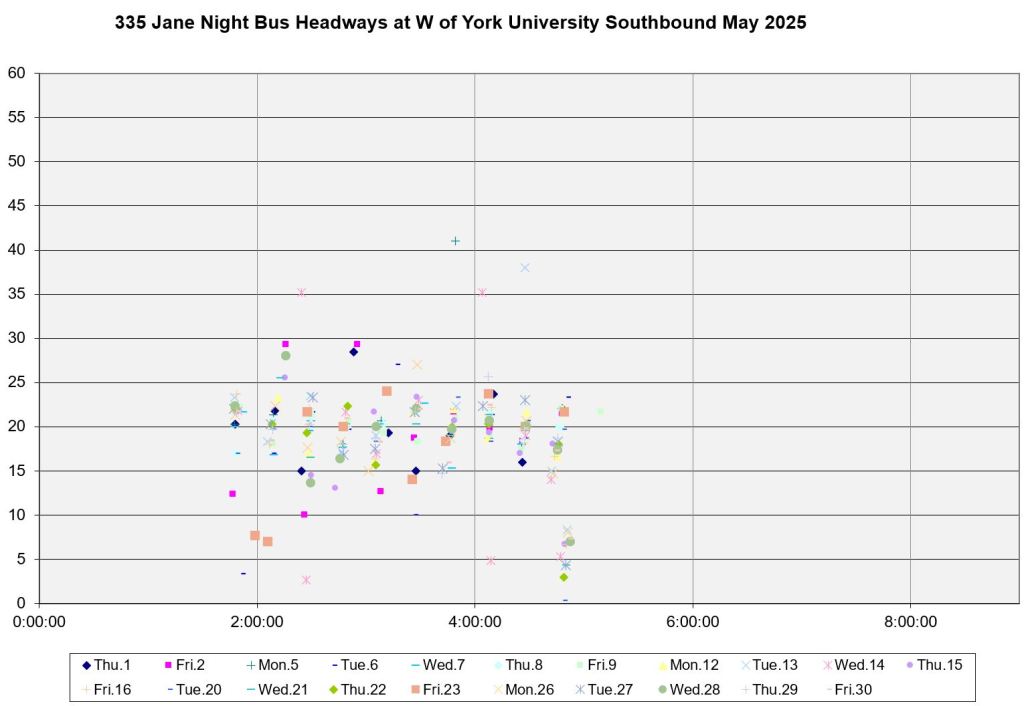
Weekdays
Headways southbound from York University keep an average around the 20 minute scheduled line, but with individual values from 10-30 minutes, and some outliers beyond that range.
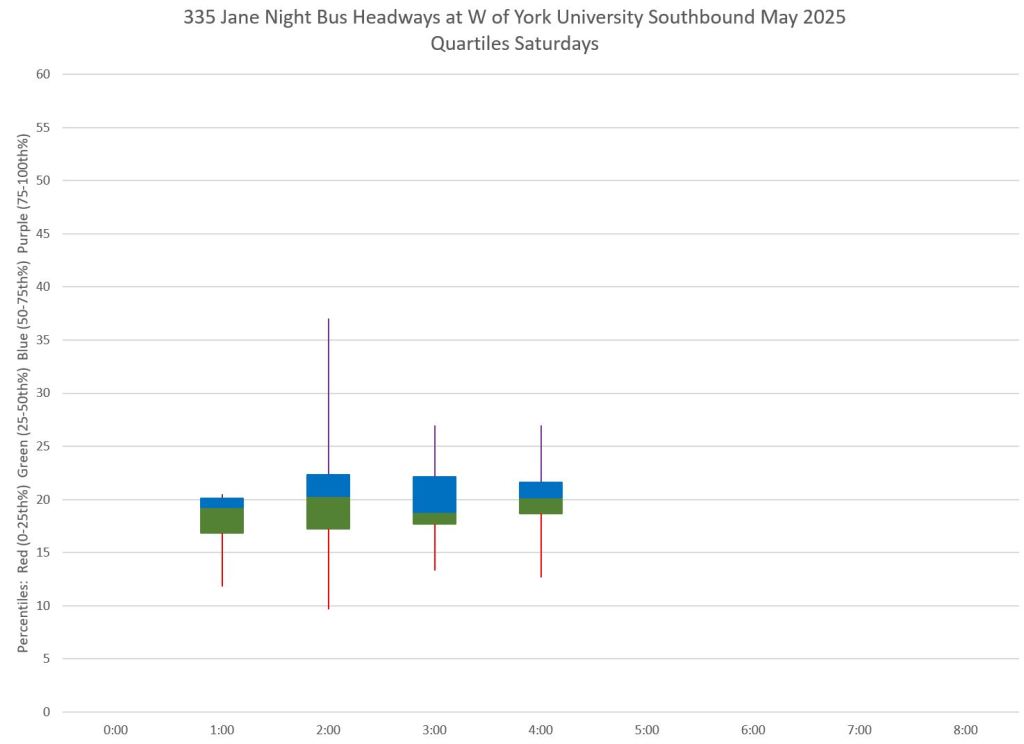
Weekends
Weekend headways are less scattered than on weekdays, although there is a wide range of values in the 2-3am period.
Lawrence Southbound
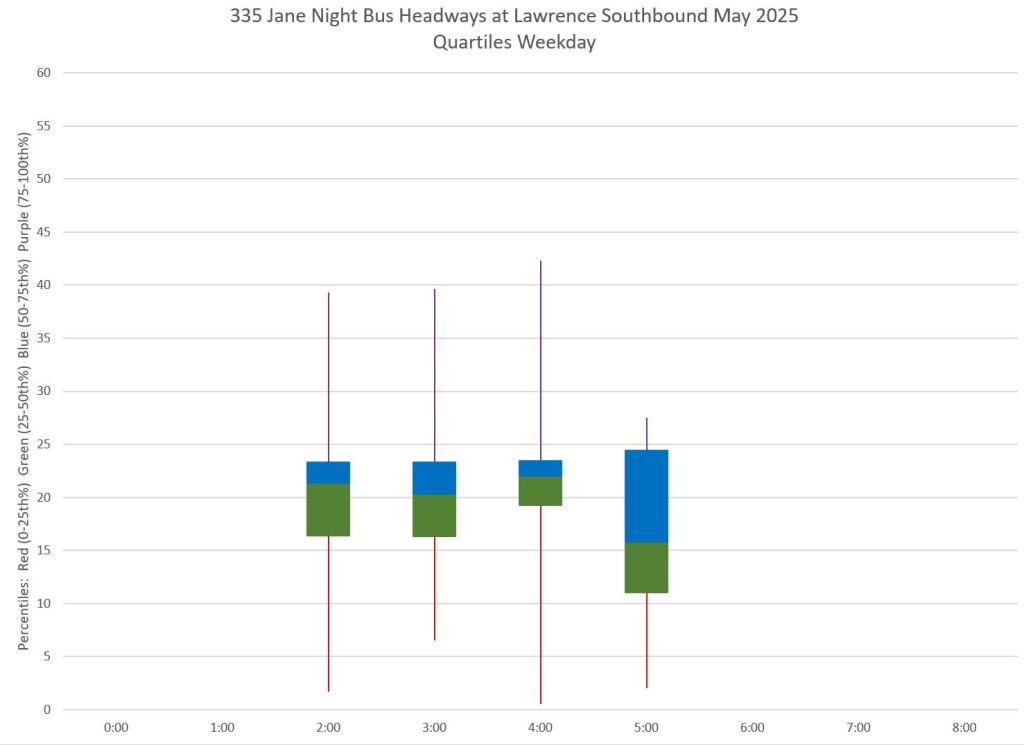
Weekdays
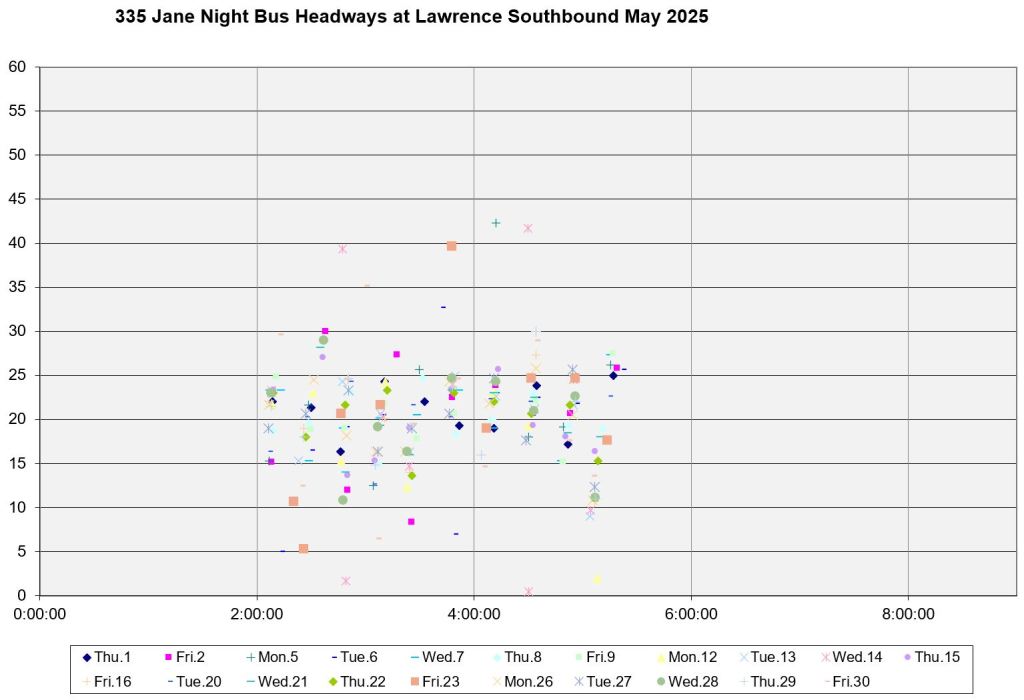
Headways southbound at Lawrence show a similar pattern to those leaving York University, but with an even wider spread of values.
Weekends
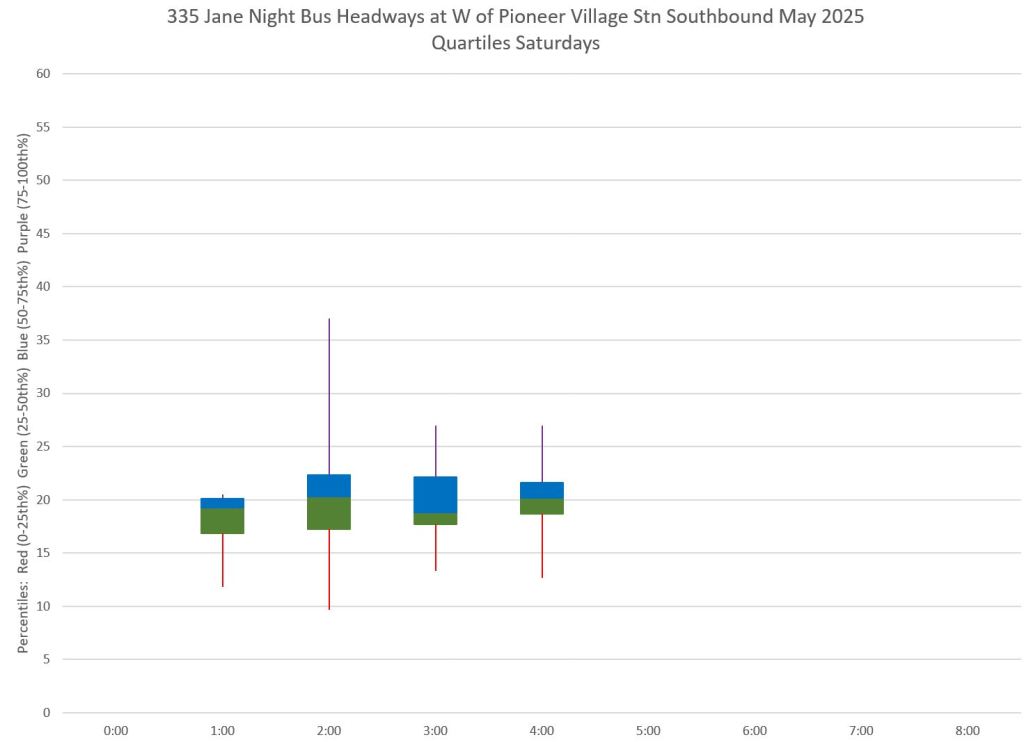
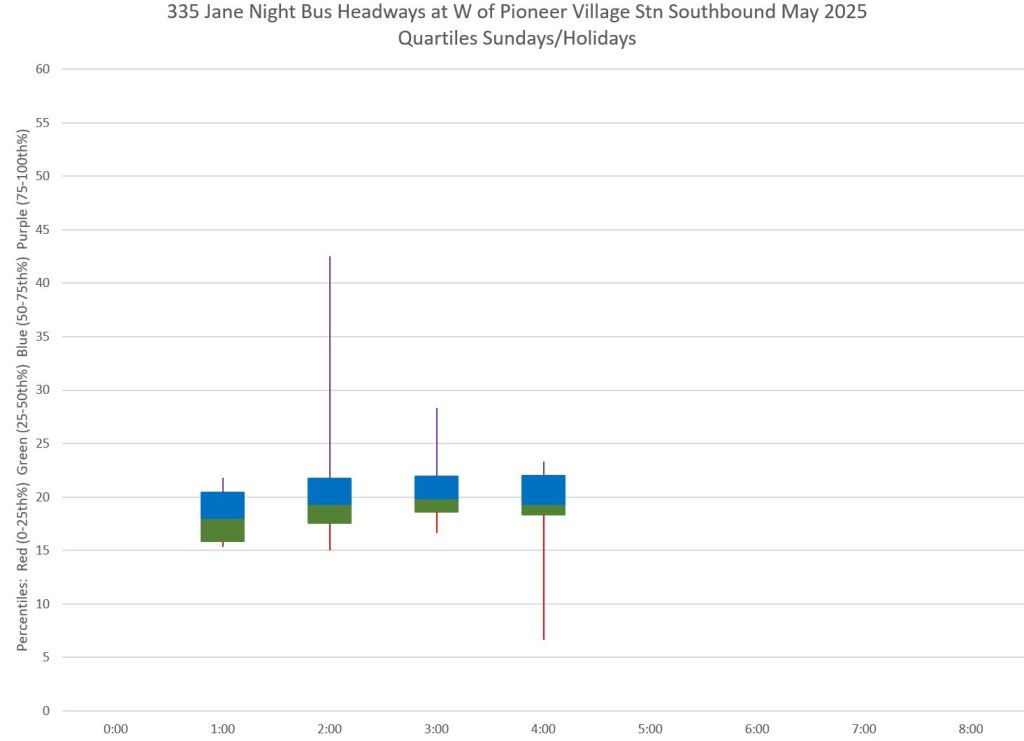
Weekend service is somewhat better than weekdays.
336 Finch West Night Bus
The 336 Finch West Night Bus operates from Finch and Yonge similar to the 36 Finch West daytime route. However, the west end of the 336 is modified and extended beyond Humberwood Loop south and east to Woodbine Racetrack where daytime service is provided by the 37A Islington/Rexdale branch.
The scheduled service is every 20 minutes until the transition to daytime schedules.
Yonge Westbound
Weekdays
Headways at Yonge westbound are clustered around 20 minutes except for the 3:10am scheduled departure where many days show longer headways.
Weekends
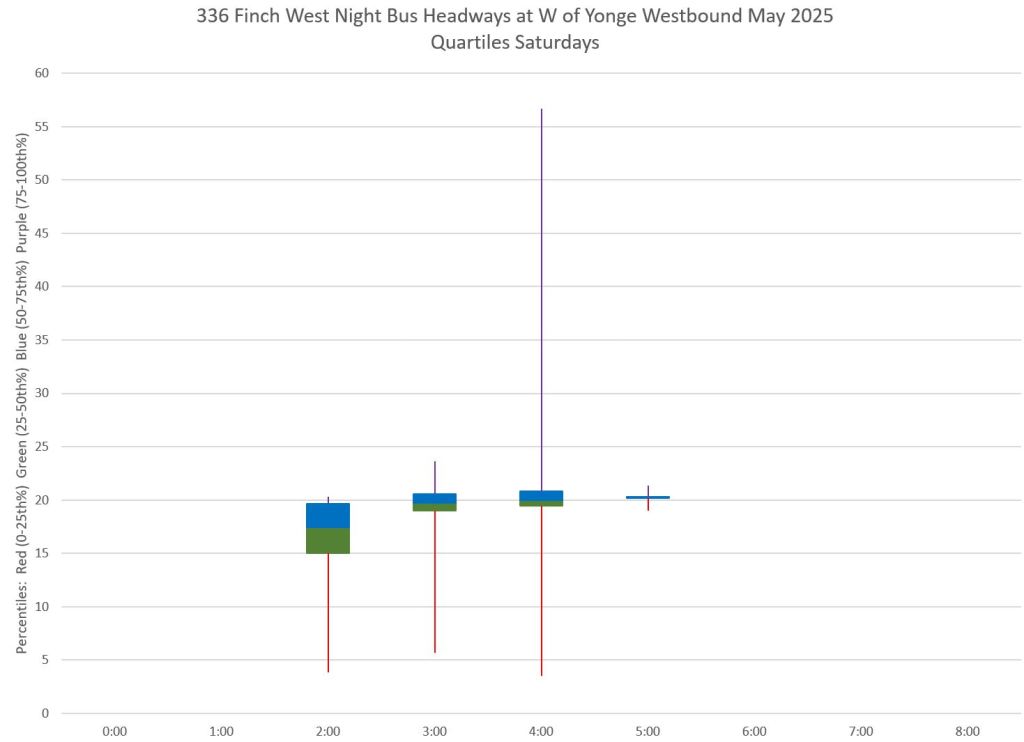
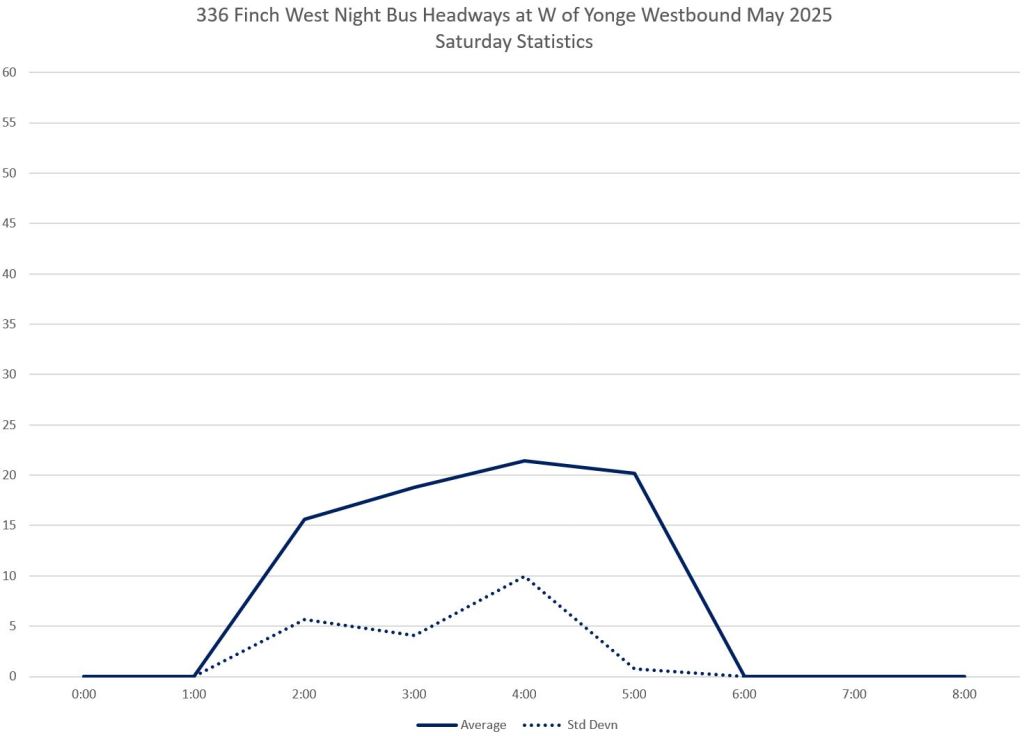
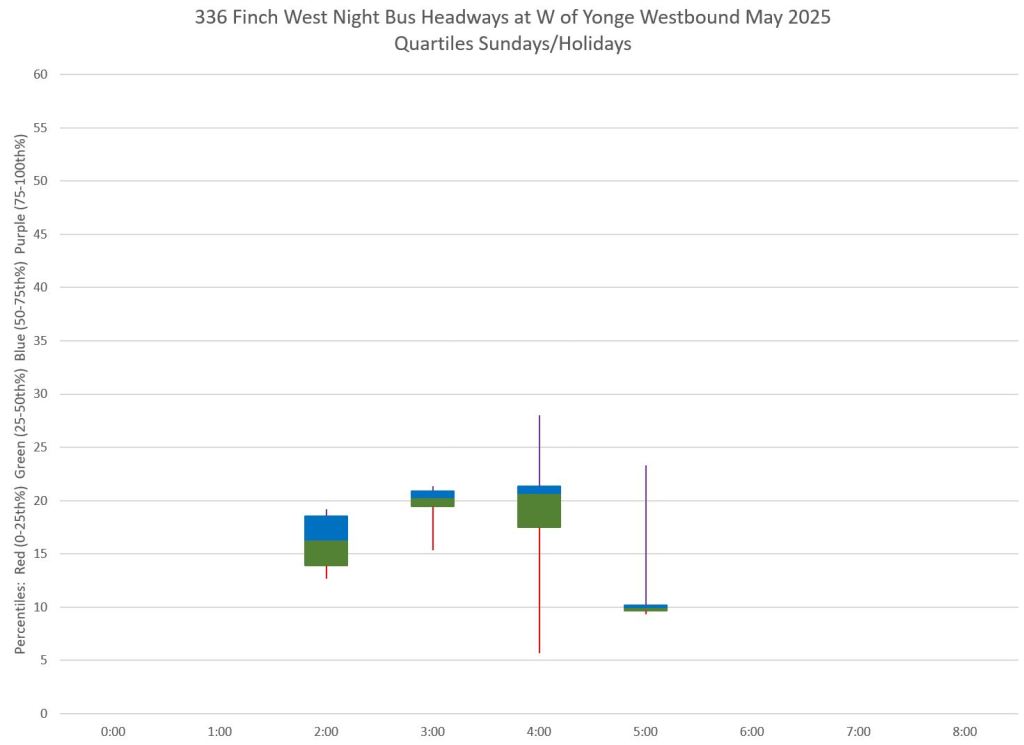
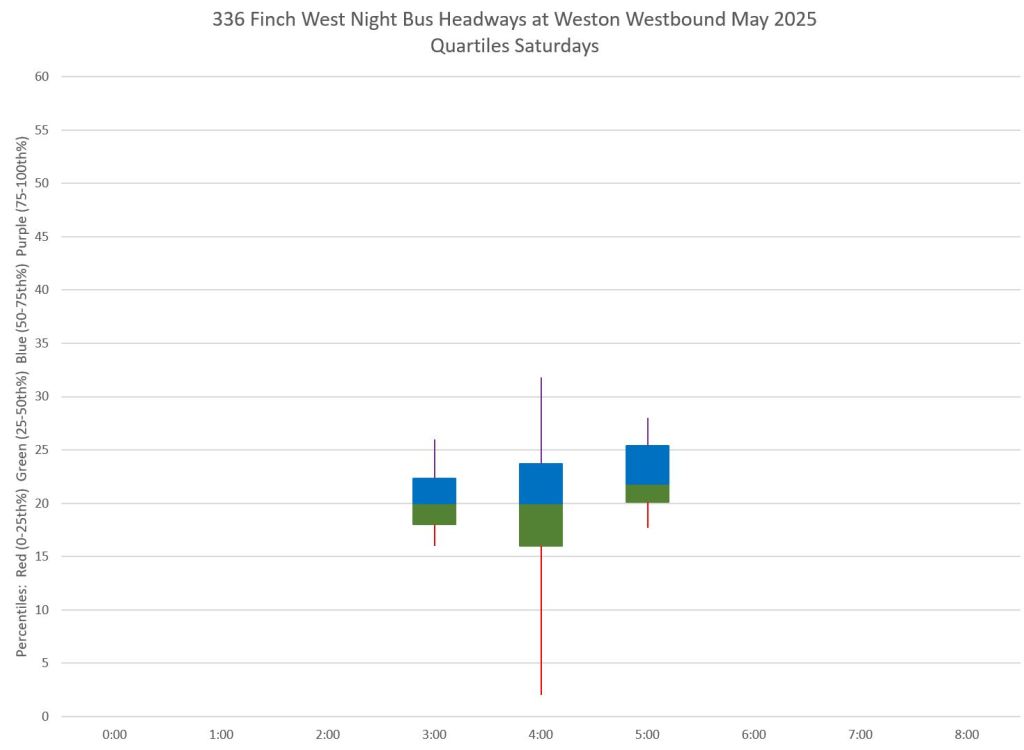
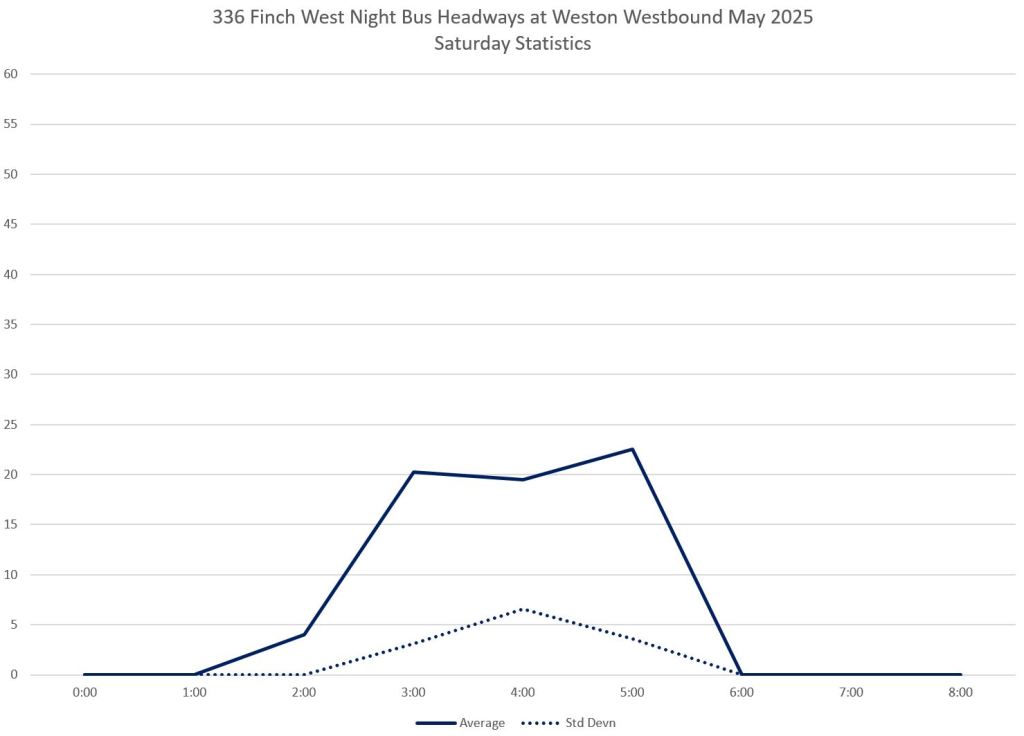
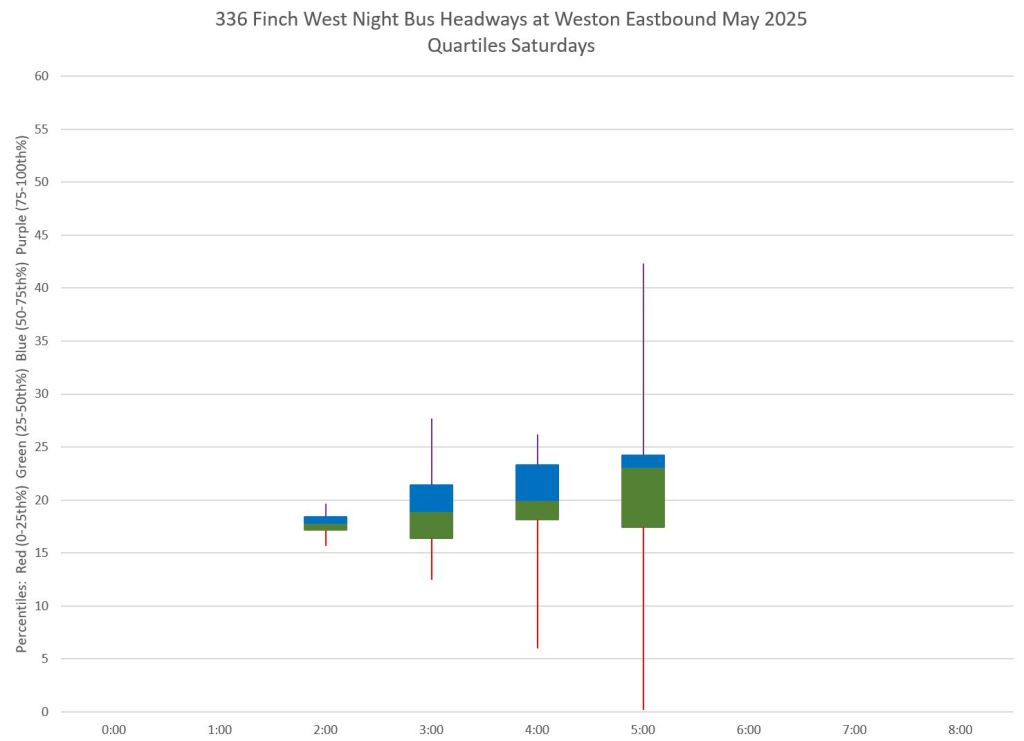
Saturday headways are generally close to 20 minutes, but the service on May 31 included several bunched trips causing the “tails” on the quartile chart to show very high and low values for the outer quartiles. This is an example of the problem of presenting data with few data points where one day’s data can make a big difference in the chart.
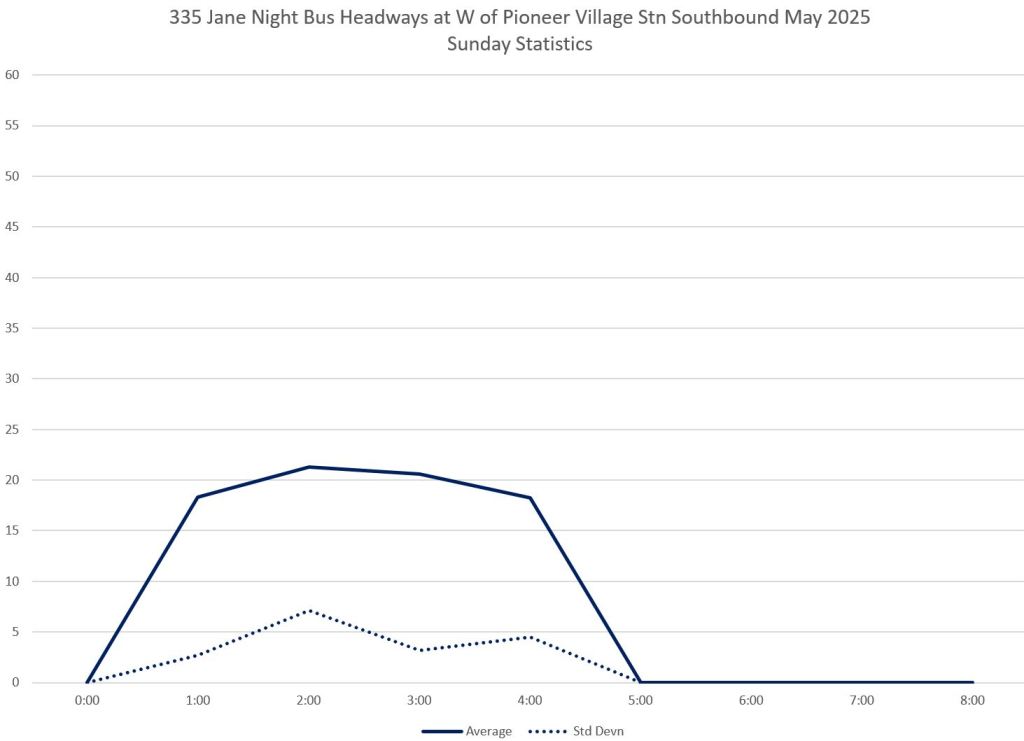
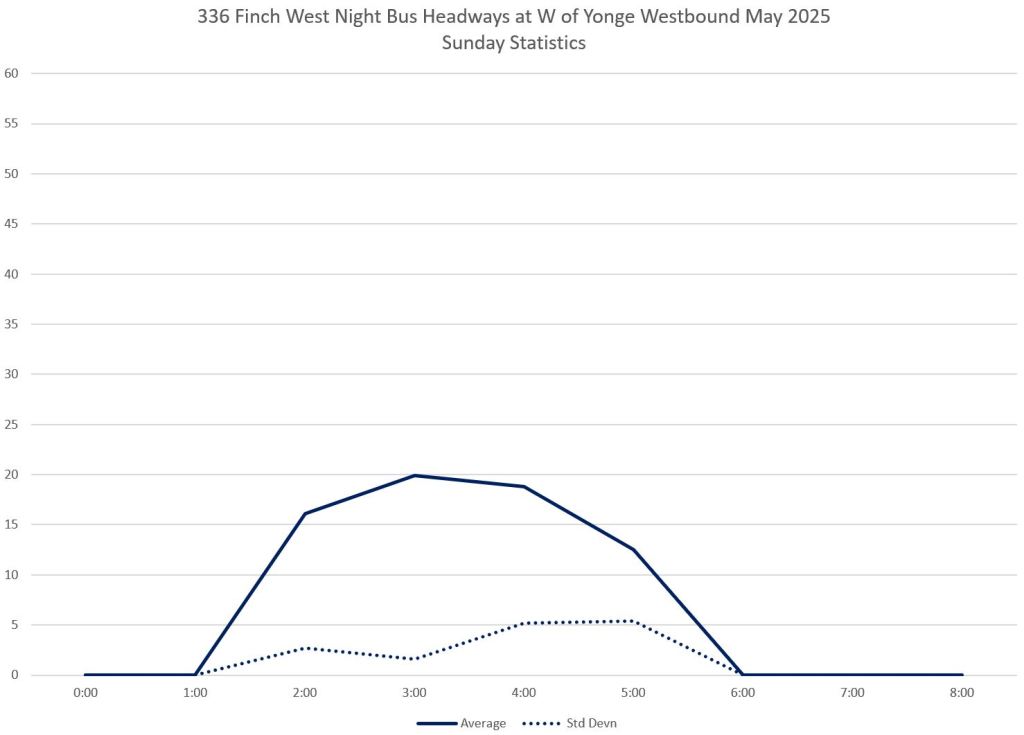
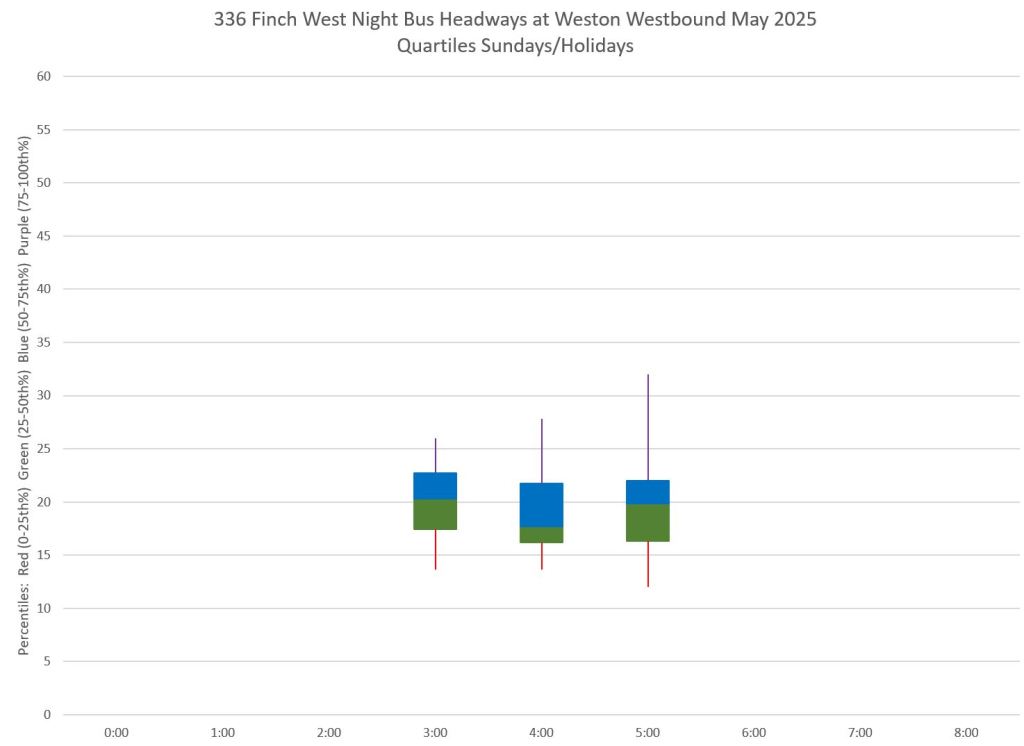
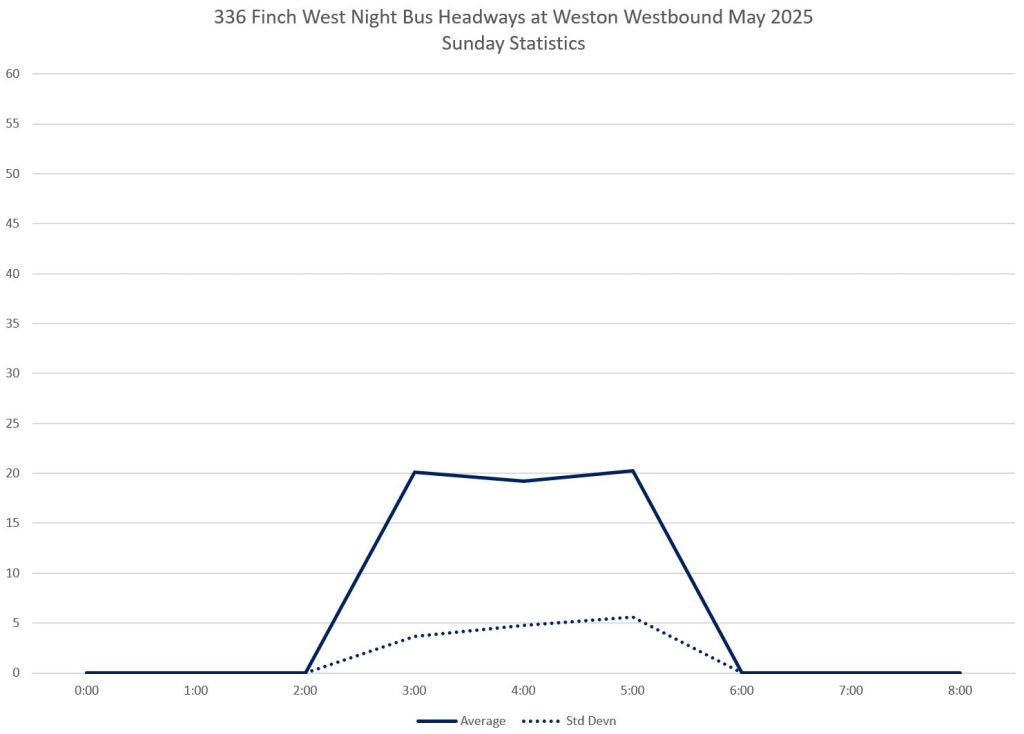
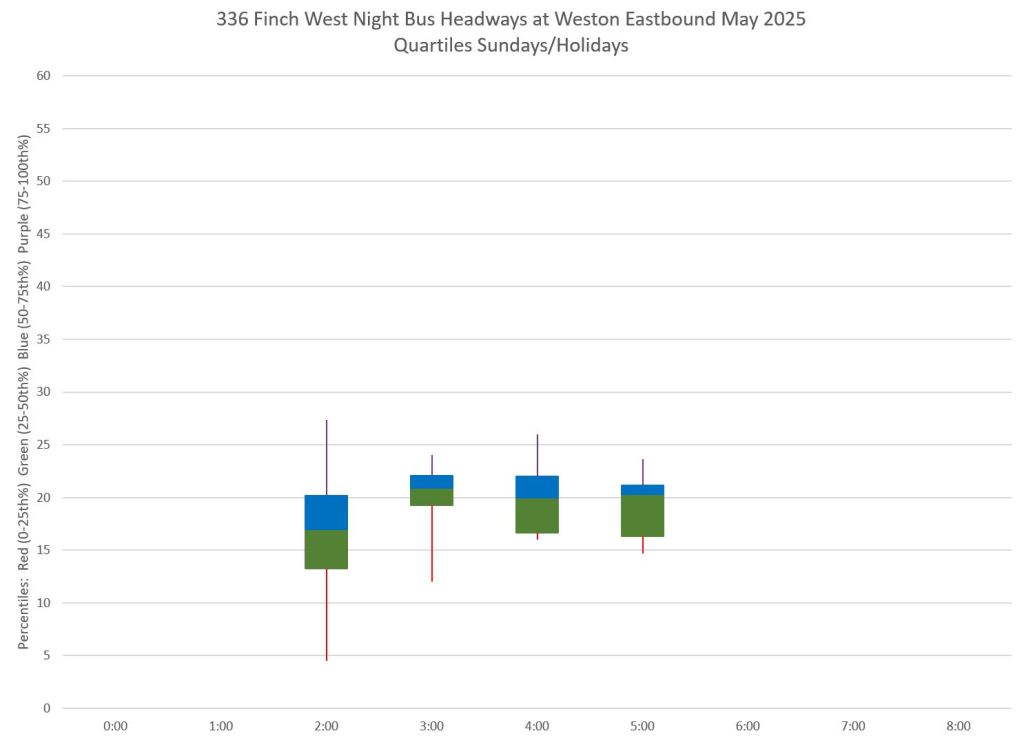
Sunday service was better behaved as shown by the more compact range of the quartiles and the lower standard deviation values.
Weston Road Westbound
Weekdays
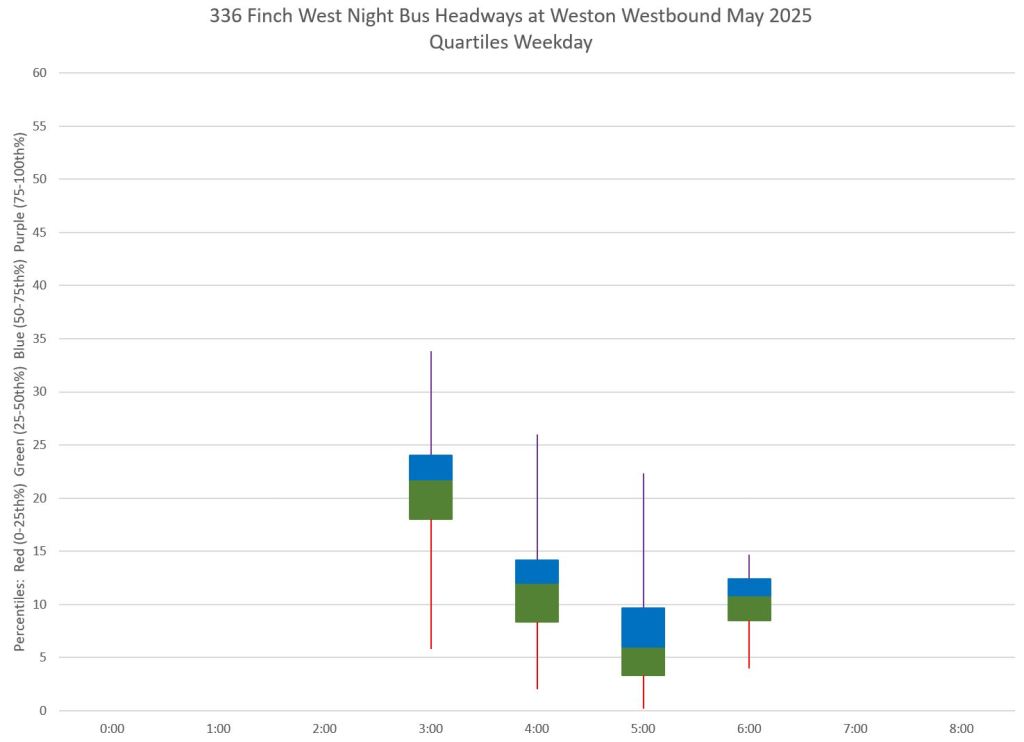
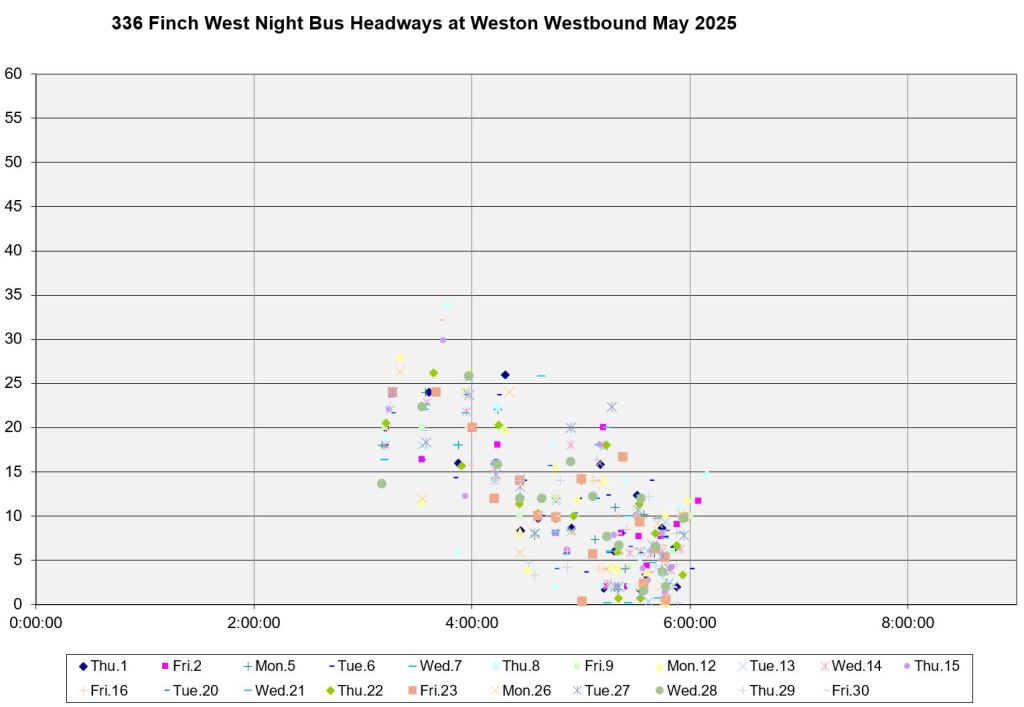
By the time service reaches Weston Road westbound, headways settle down to a band between 15-25 minutes until the build-up of daytime service begins.
Weekends
Woodbine Racetrack Eastbound
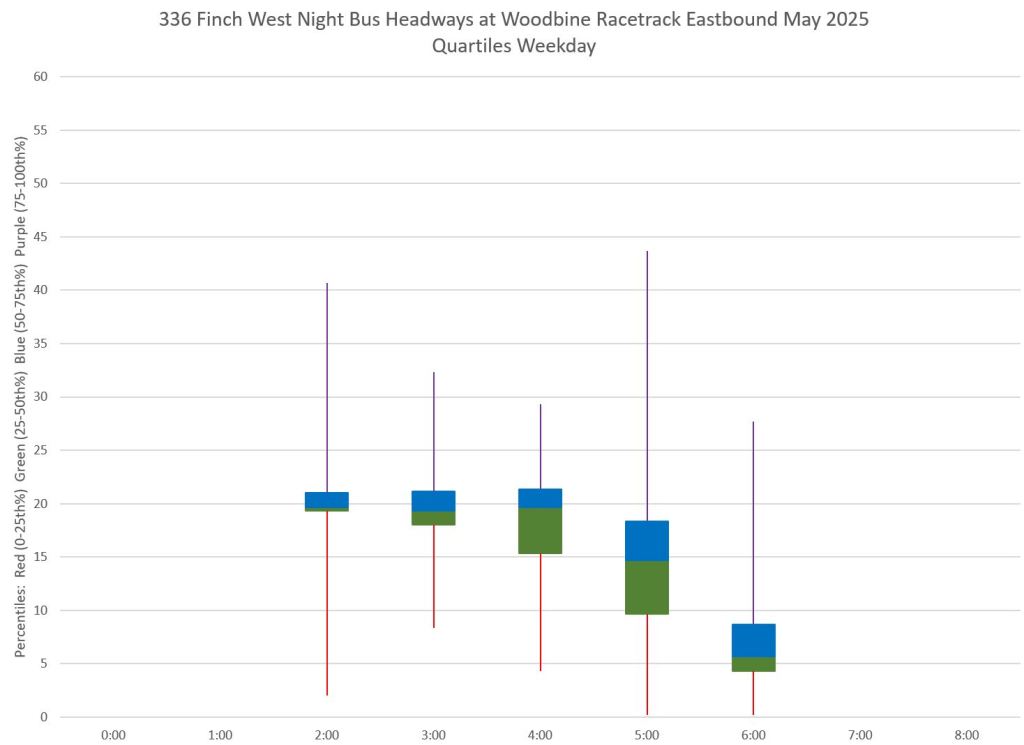
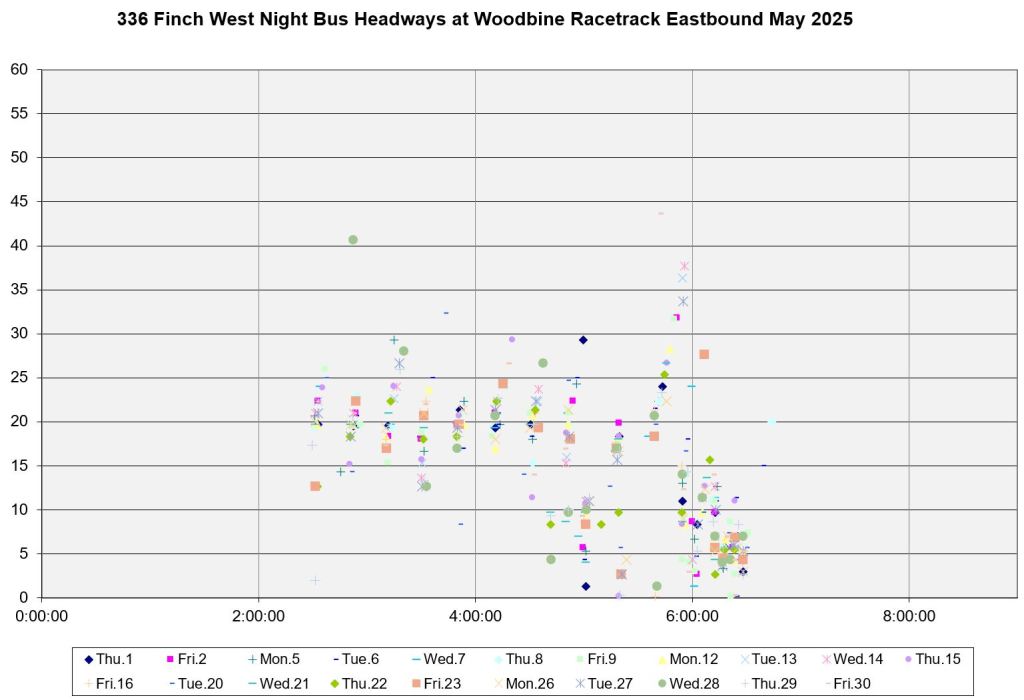
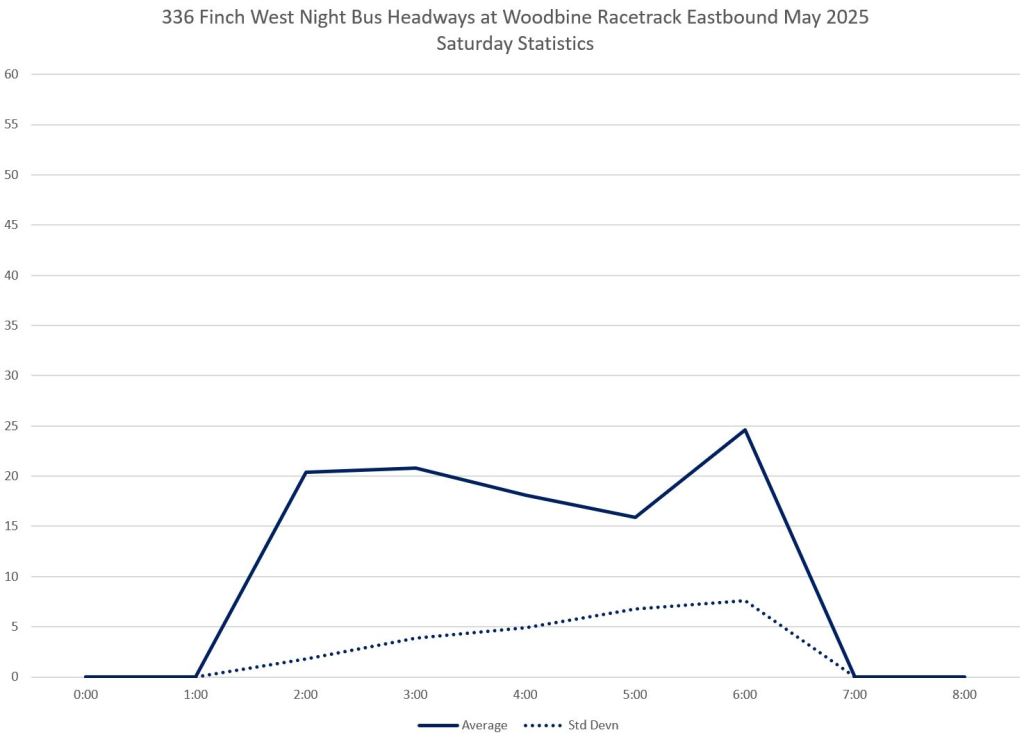
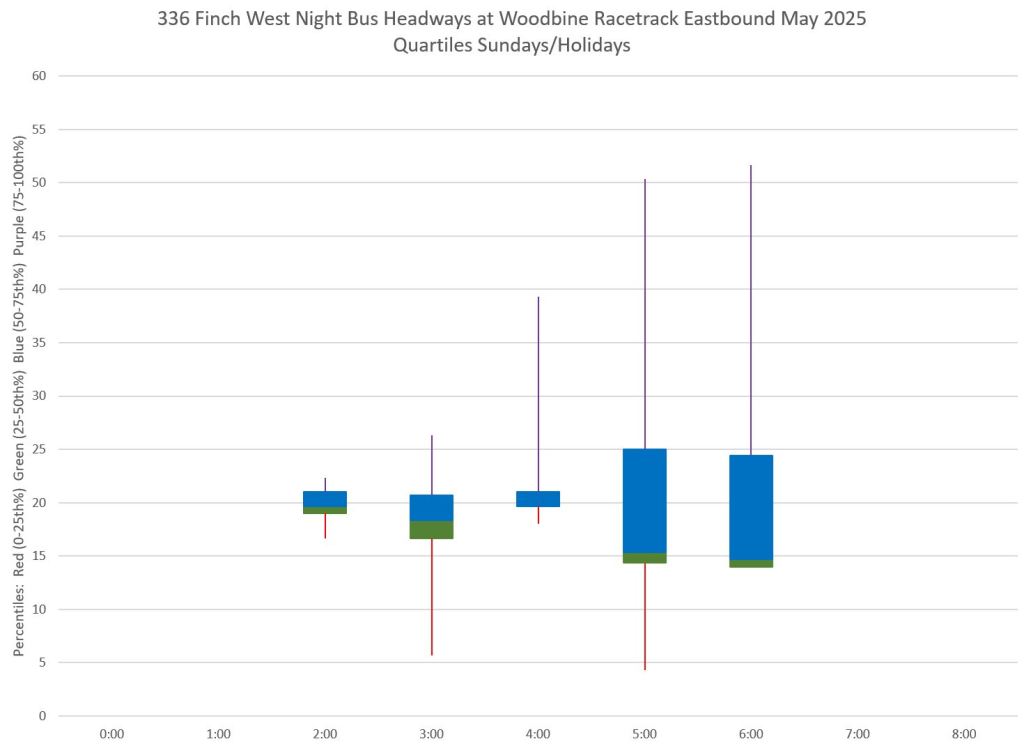
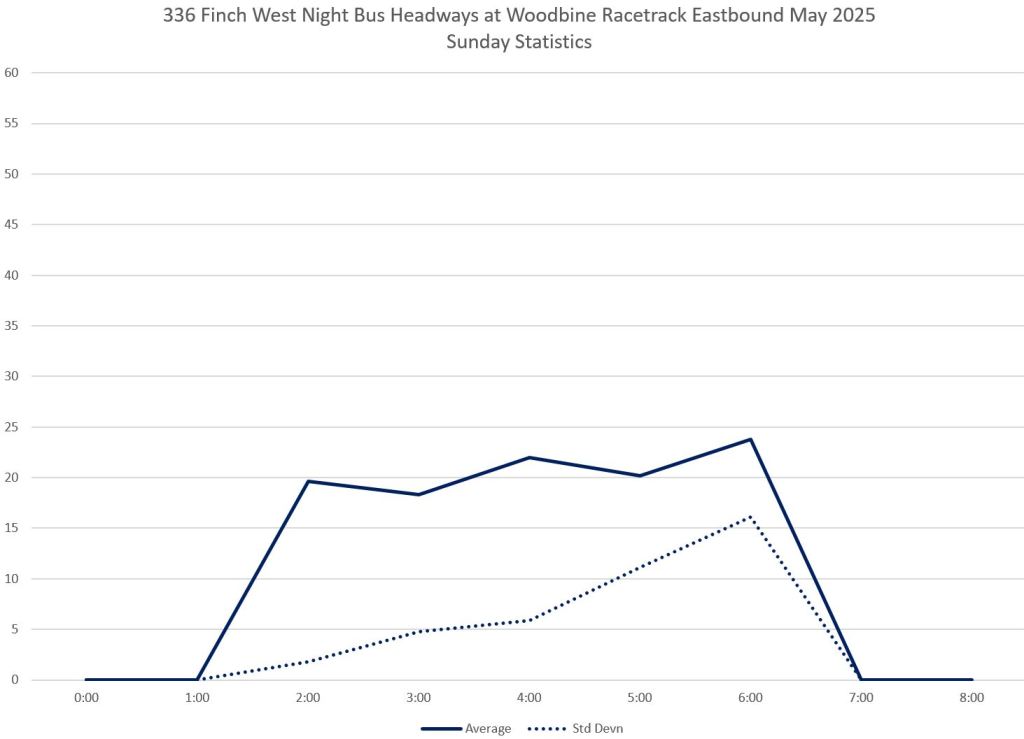
Most trips leaving Woodbine Racetrack range from 15-30 minute headways on a 20 minute schedule.
Weekdays
Weekends
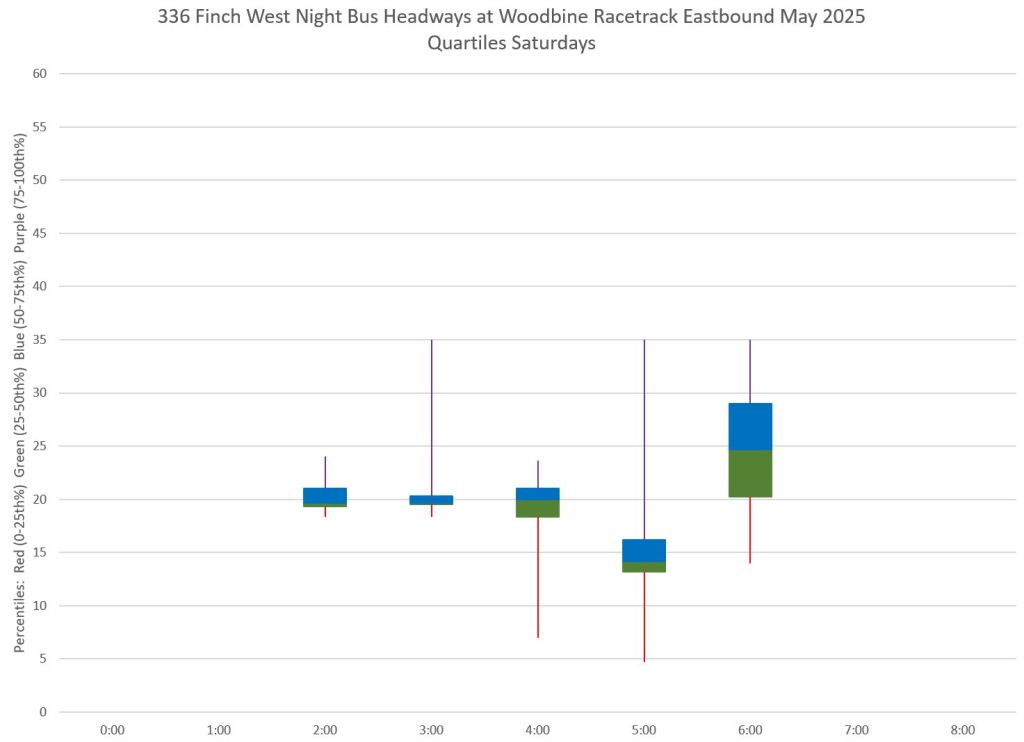
Weekend departures from Woodbine Racetrack are more tightly clustered around the 20 minute schedule than the weekday service.
Weston Road Eastbound
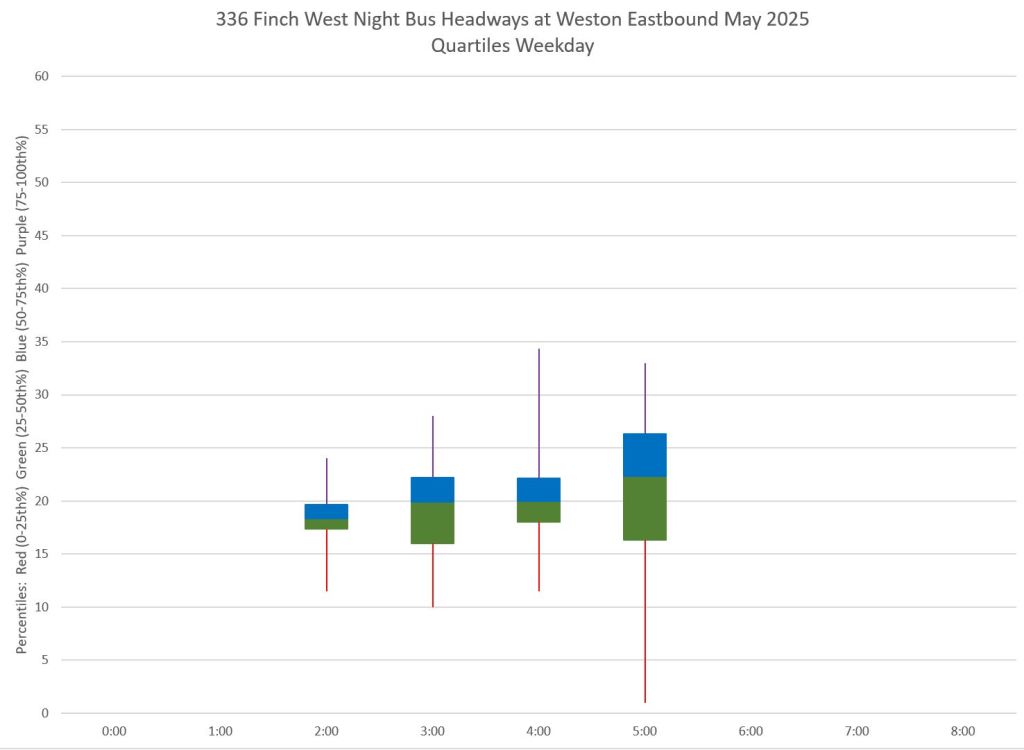
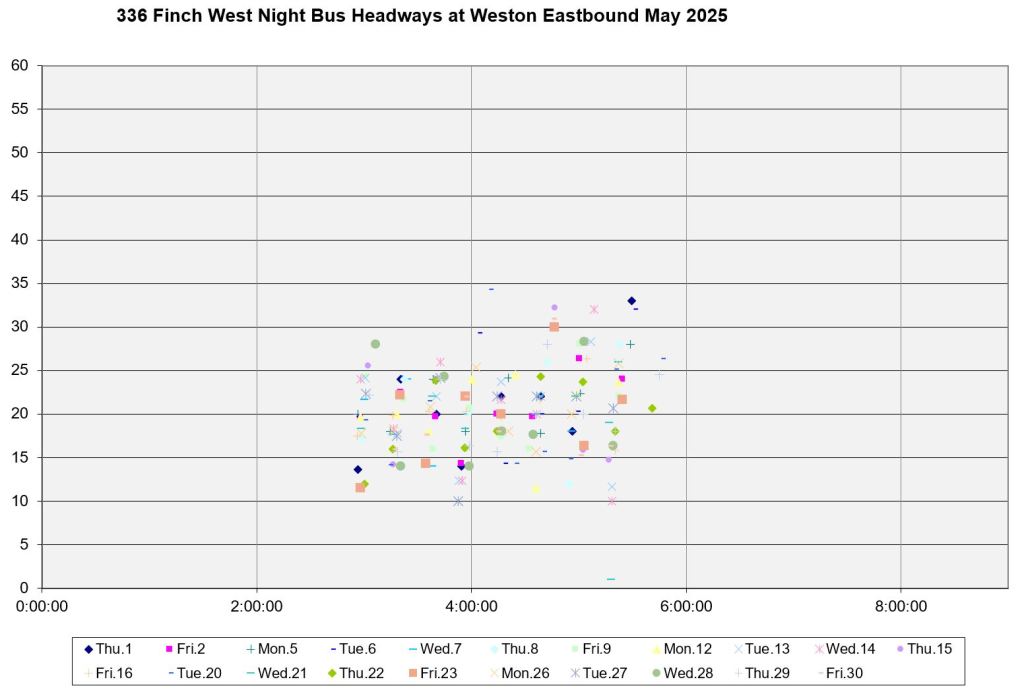
Headways at Weston Road eastbound mostly lie in a band from 15-25 minutes.
Weekdays
Weekends
341 Keele Night Bus
The 341 Keele Night Bus follows the same route as 41 Keele except that the north end loop is within York University rather than at Pioneer Village Station.
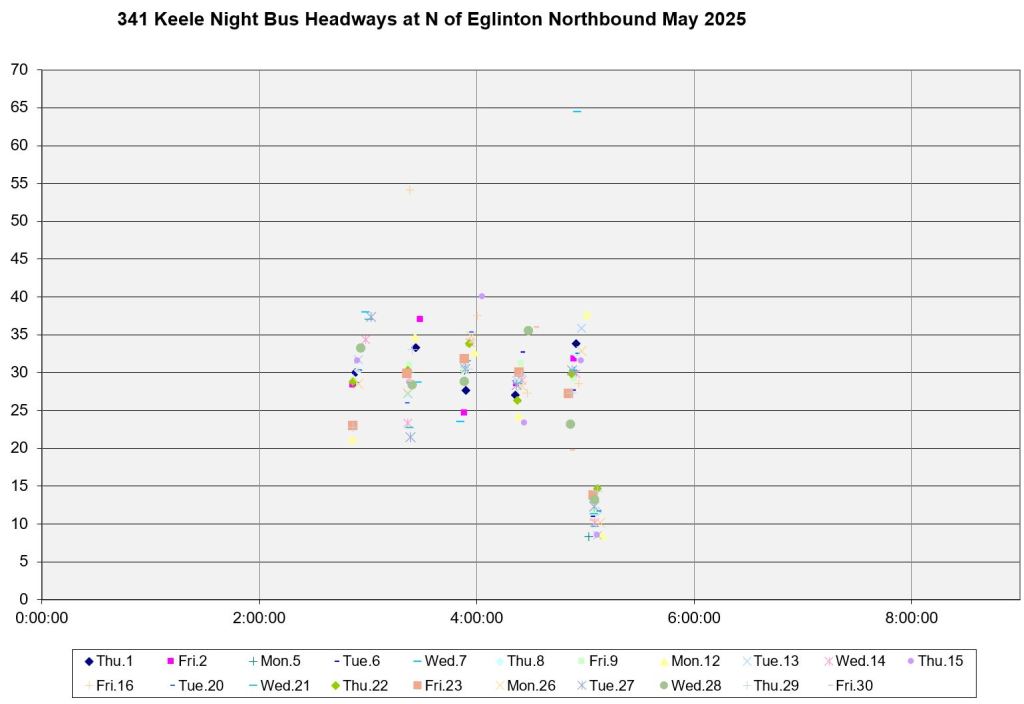
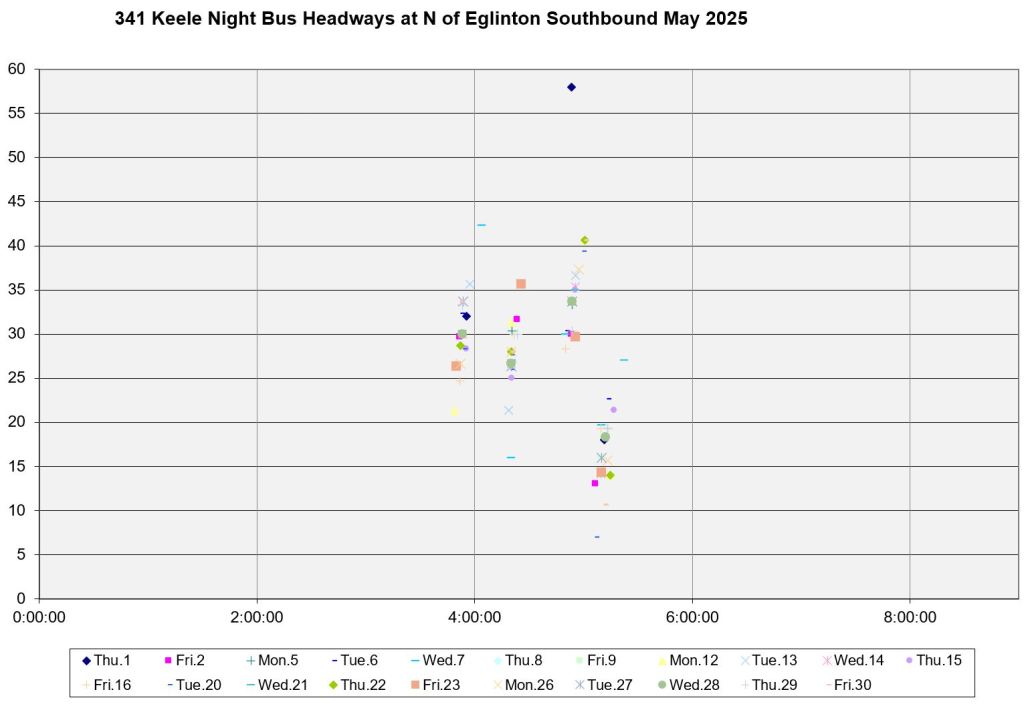
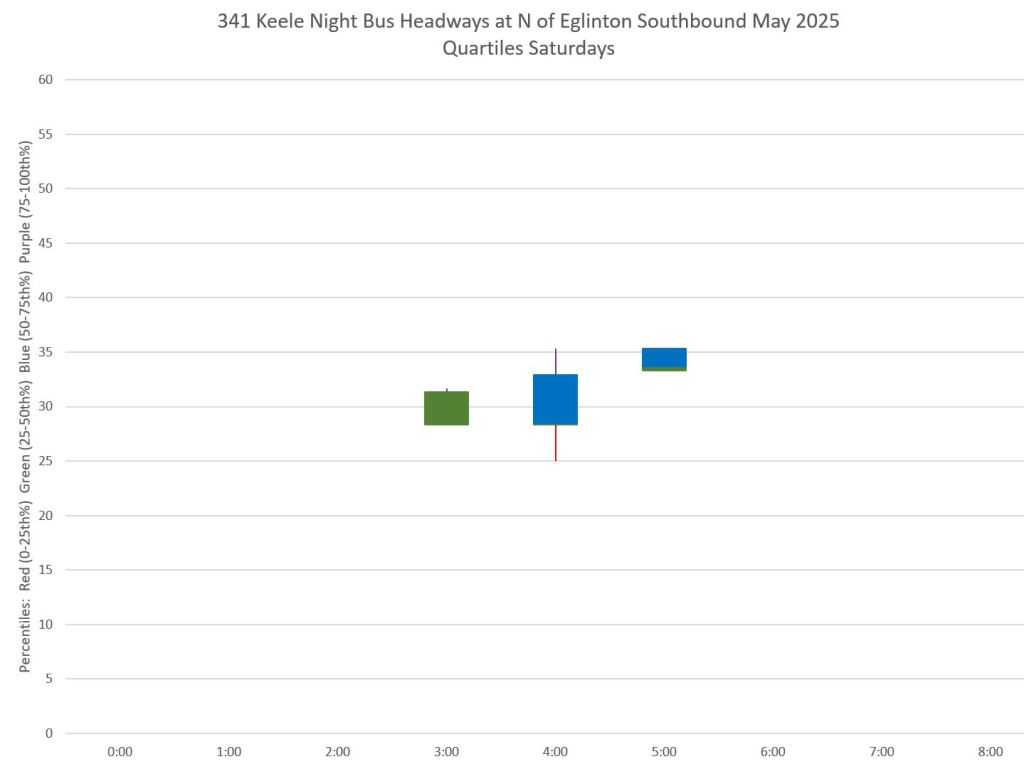
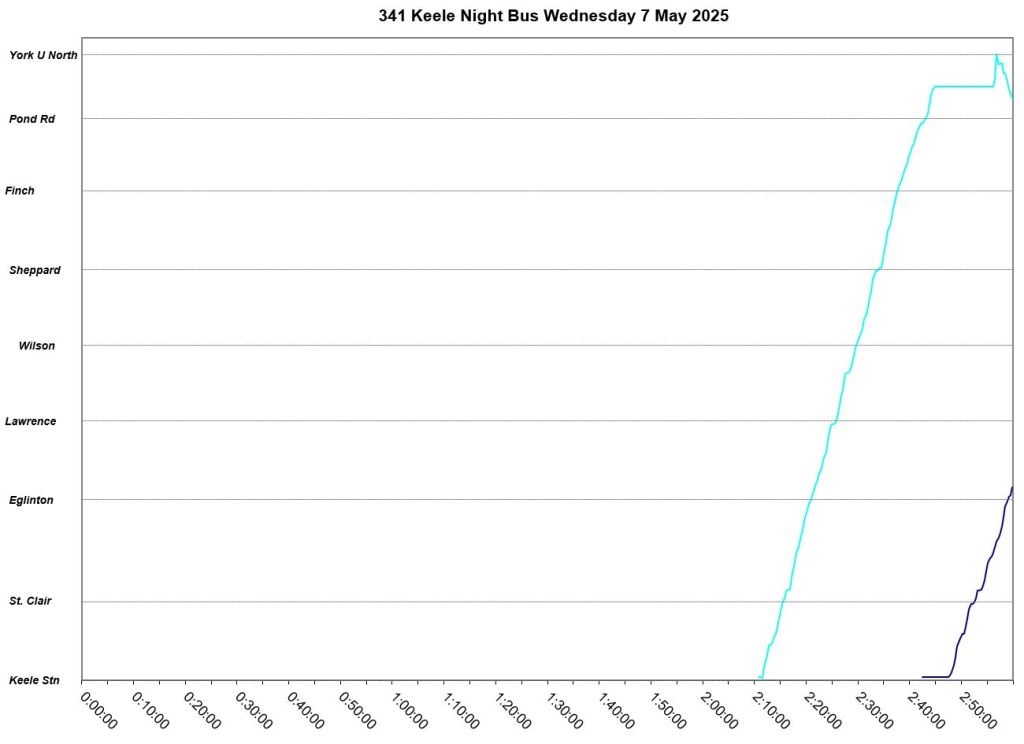
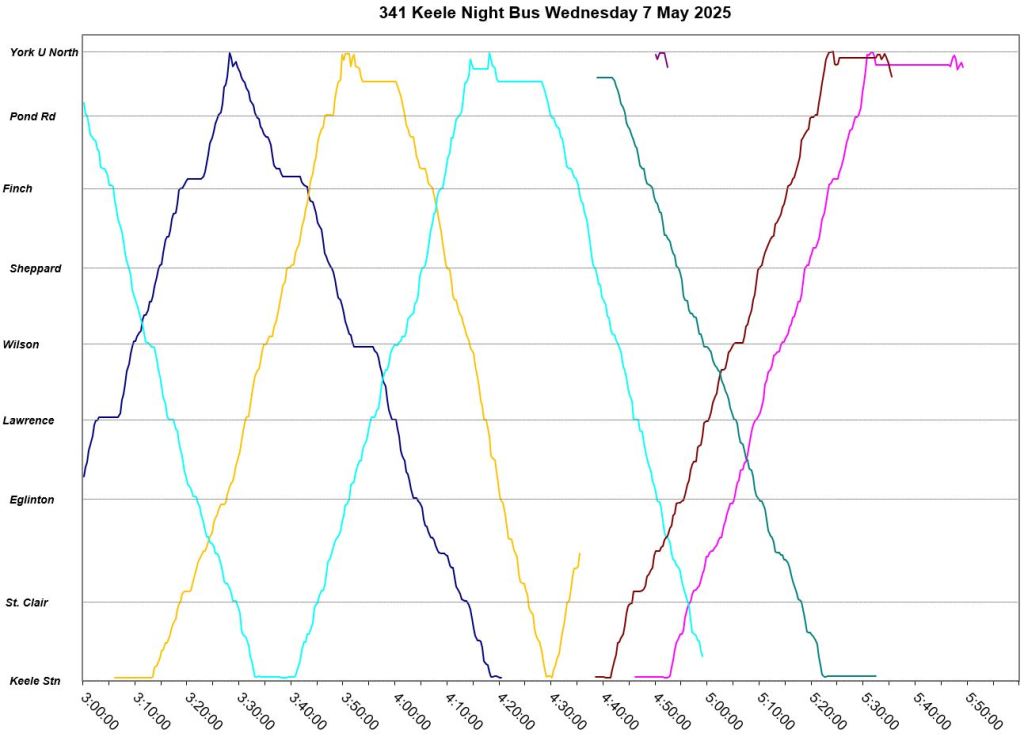
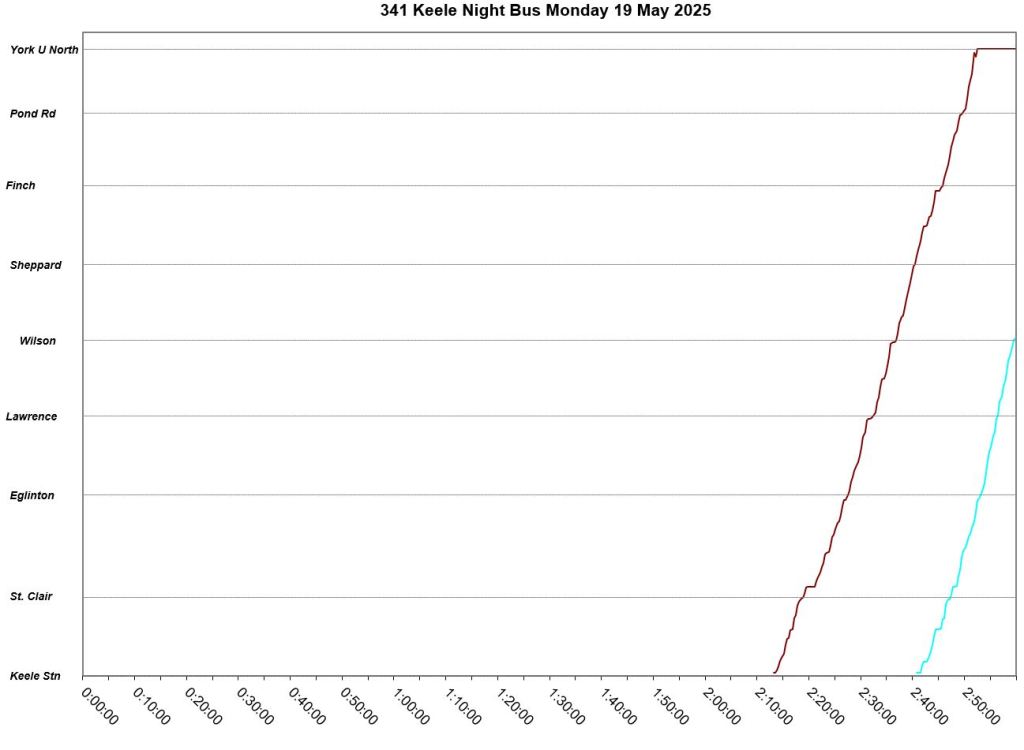
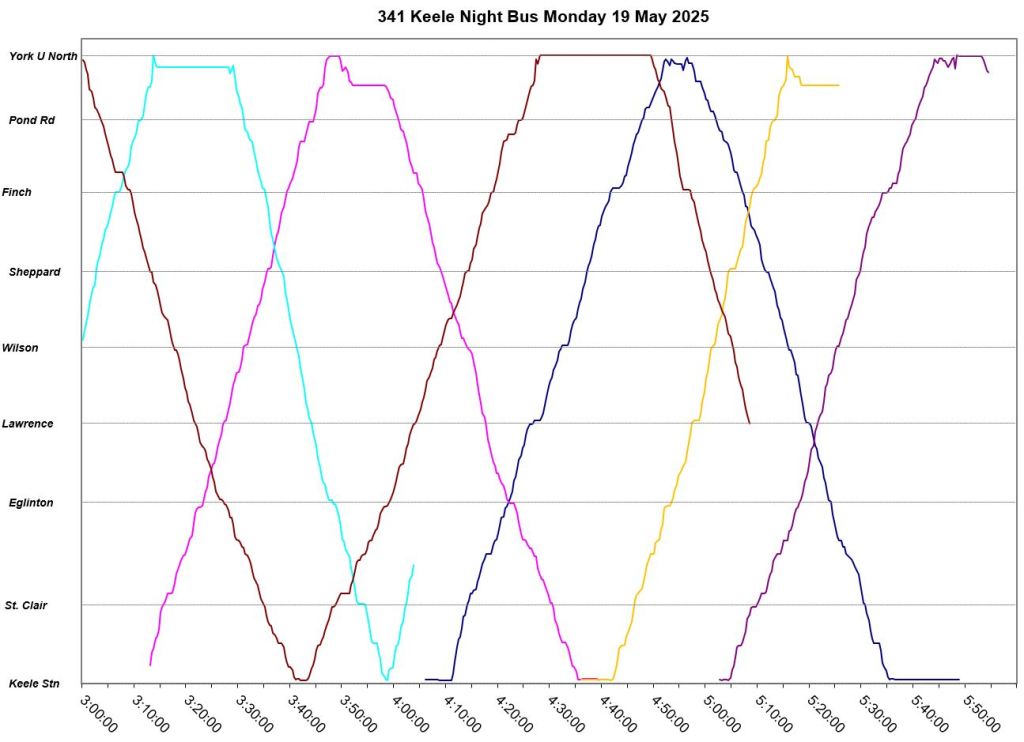
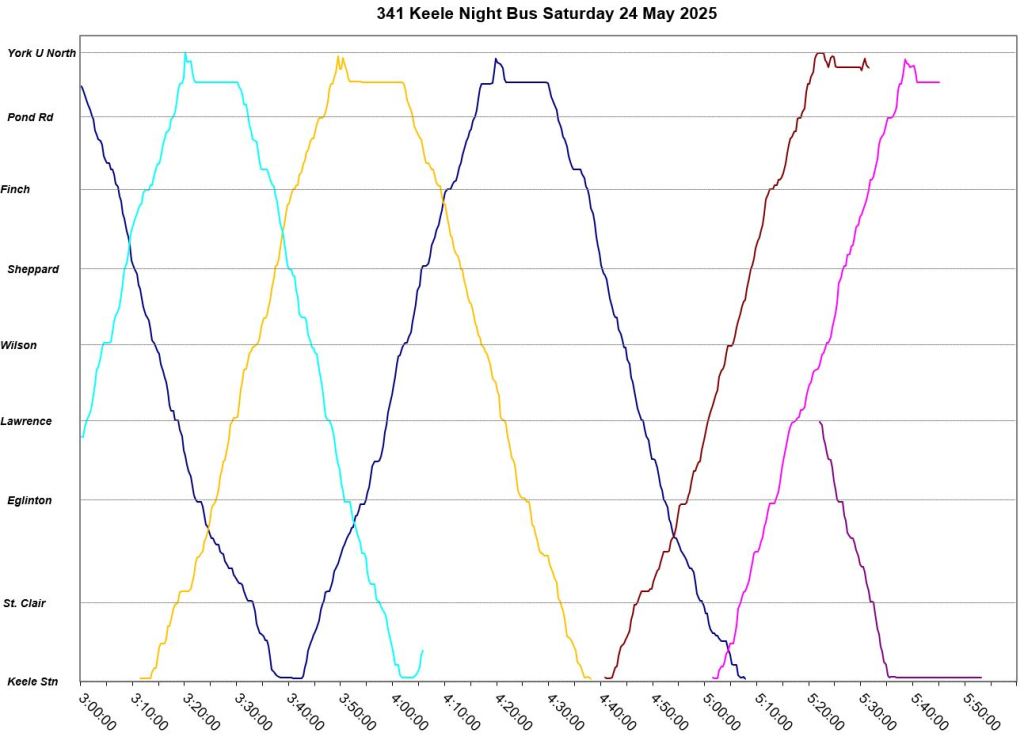
The 341 shows shorter than scheduled headways at some locations due to the transition between “night” buses and daytime buses operating on the night route’s number from 4am onward. This transition is not always seamless with daytime buses entering service out of step with the night bus headways, or missing early trips creating gaps. Sample service charts for various days are at the end of the article.
Keele Station Northbound
Weekdays
Weekends
Eglinton Northbound
Weekdays
Weekends
York University Southbound
Weekdays
Weekends
Eglinton Southbound
Weekdays
Weekends
352 Lawrence Night Bus
The 352 Lawrence Night Bus operates from Sunnybrook Hospital to Pearson Airport. It is an amalgamation of 124 Sunnybrook and 52 Lawrence with a slightly different route from Lawrence to Dixon Road via Royal York rather than Scarlett Road.
Sunnybrook Hospital Westbound
Headways in the tracking data for buses from Sunnybrook Hospital are erratic because there is a period before 4am where night and daytime buses co-exist making service appear better than it really is. Conversely, some daytime buses do not appear as “active” until later in their trips leading to very wide headways in the charts. Although this might be dismissed as “an operational problem” in that well-worn TTC phrase, this behaviour is reflected in transit trip arrival apps that do not “know” a bus is there.
Weekdays
Weekends
Jane Westbound
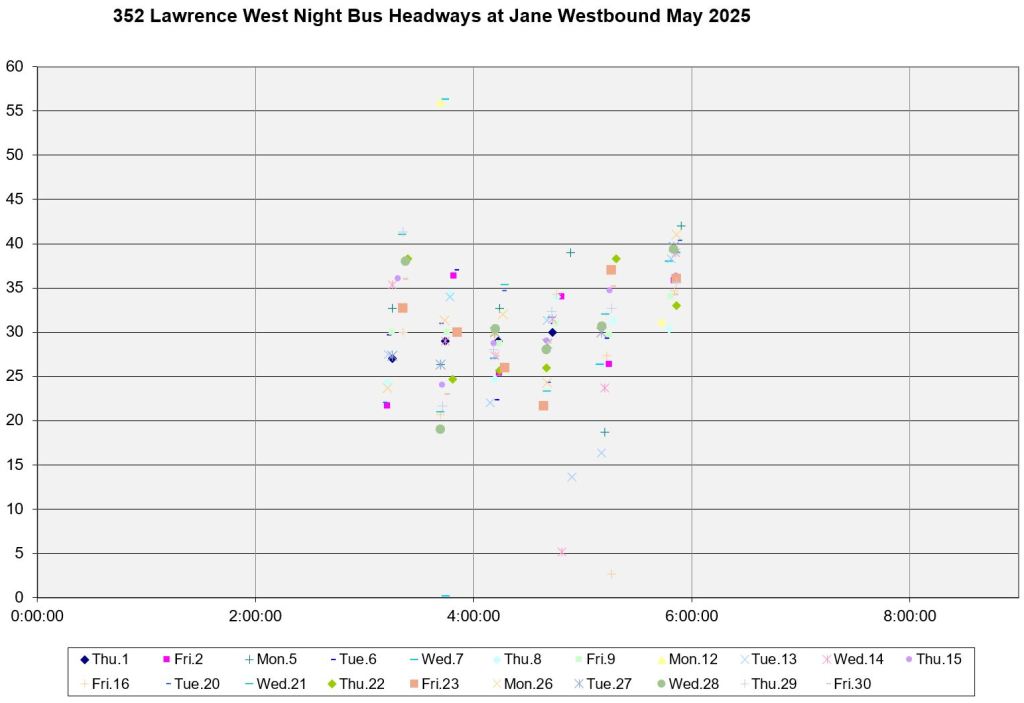
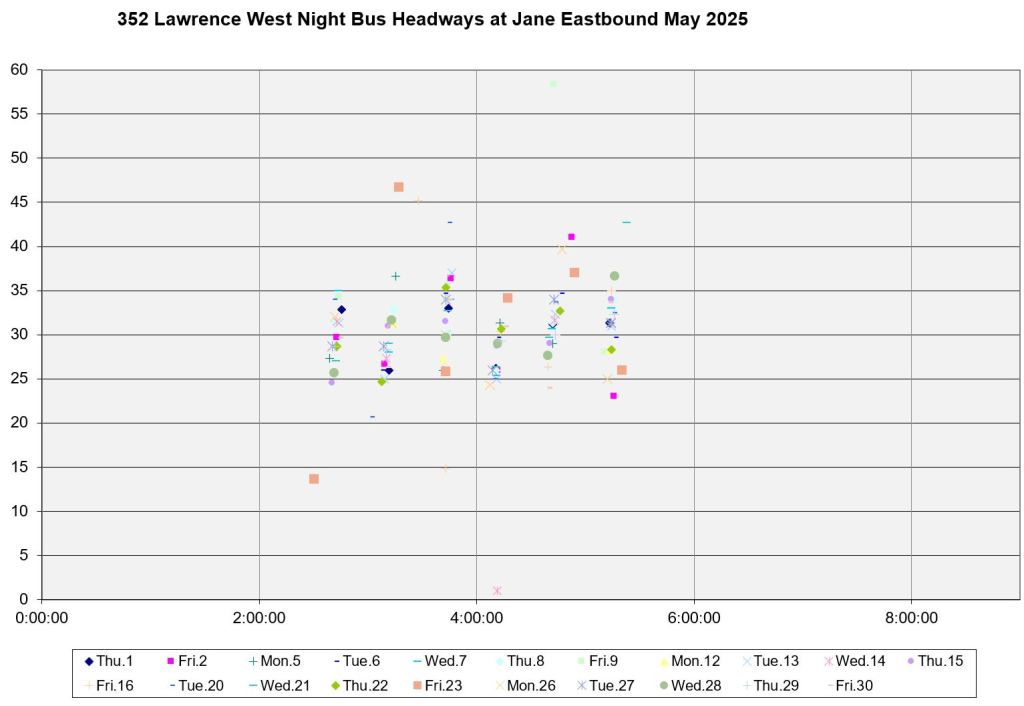
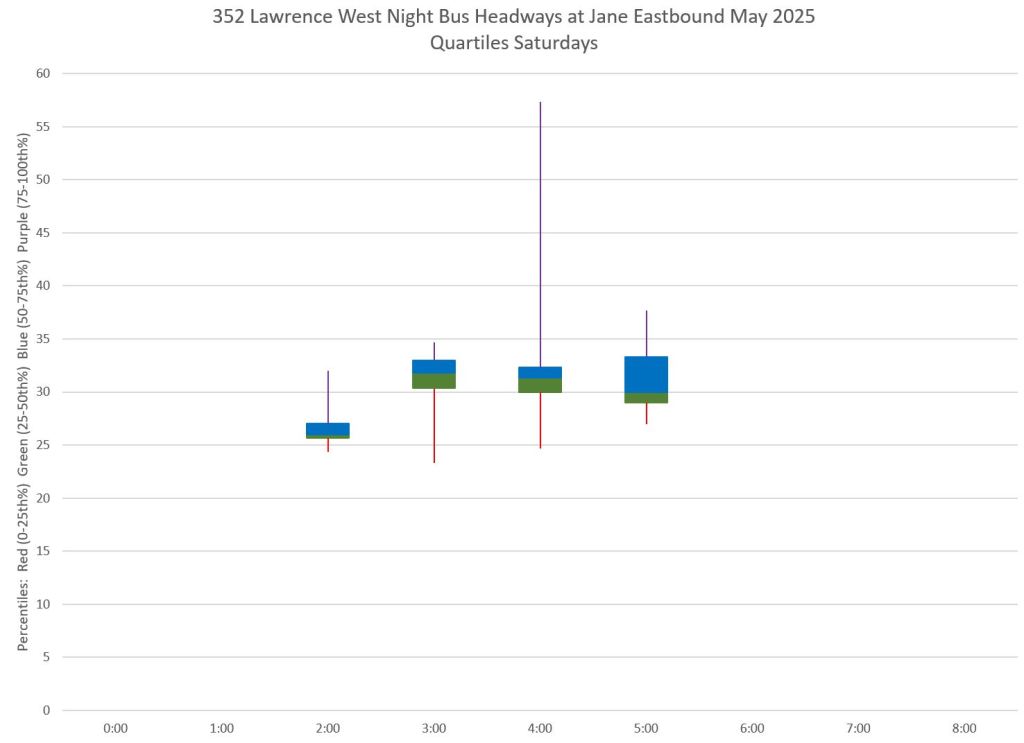
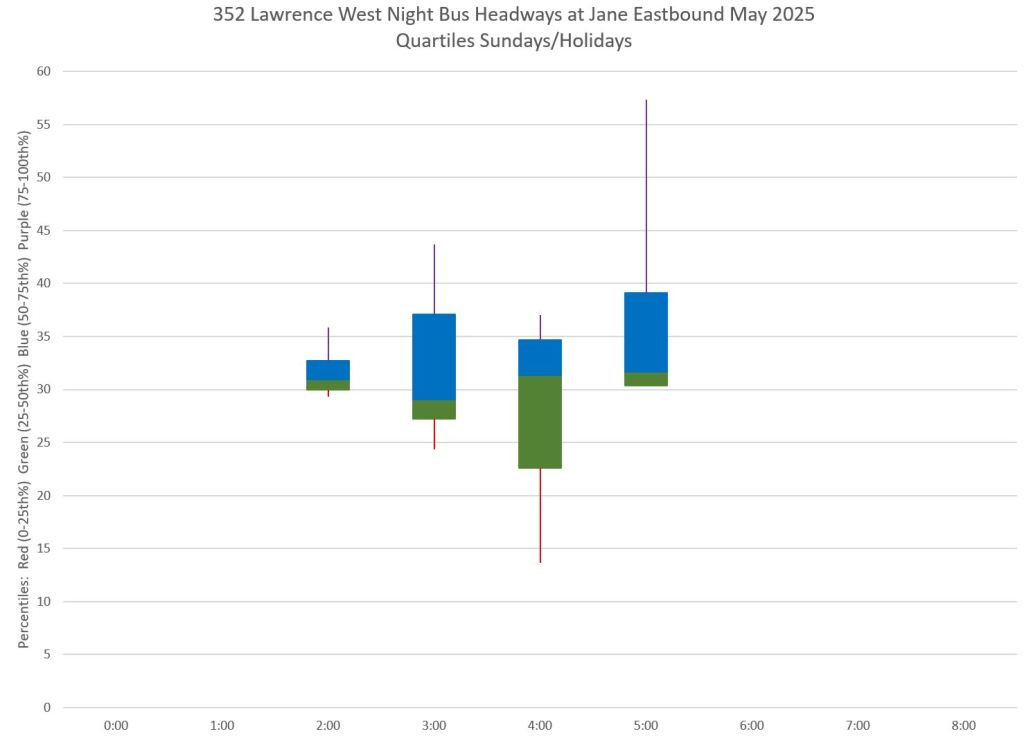
At Jane Street westbound, the headways range from 20-40 minutes on what is supposed to be a half-hourly service. However, the double reporting of night and daytime buses has vanished .
Weekdays
Weekends
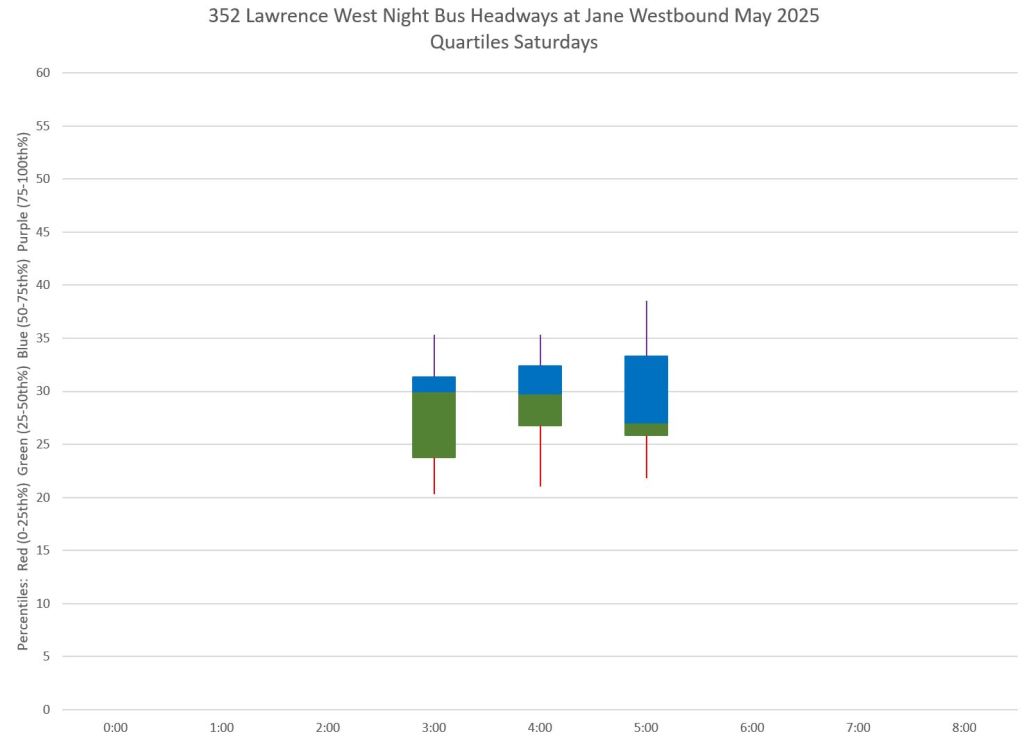
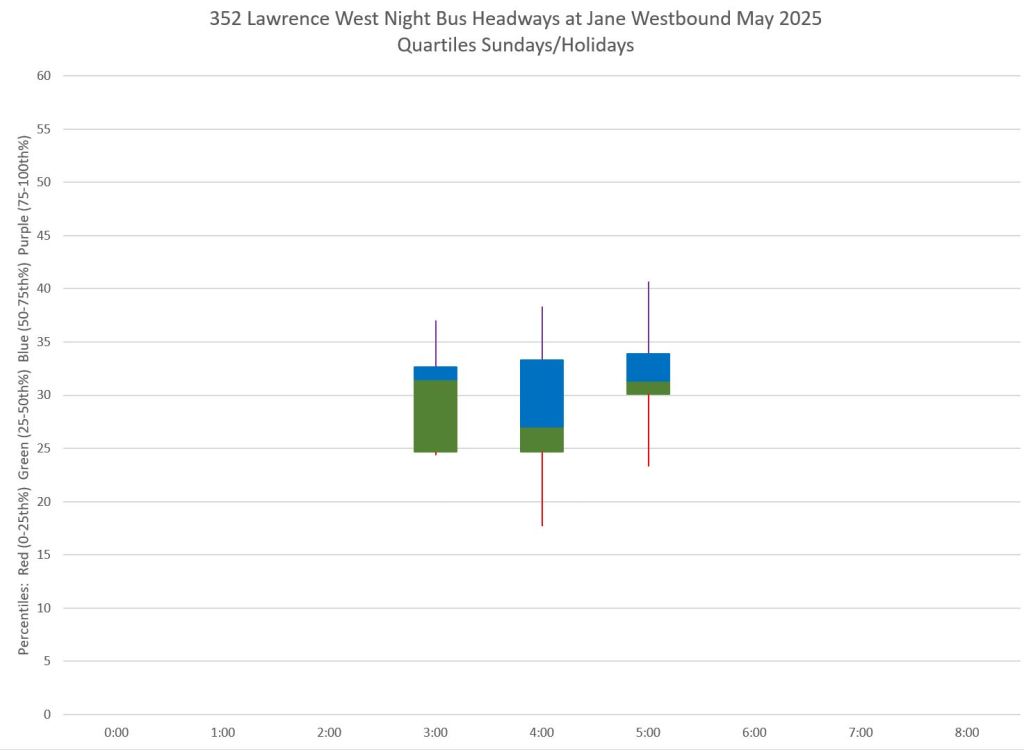
Weekend headways are spread over a narrower range than for weekdays.
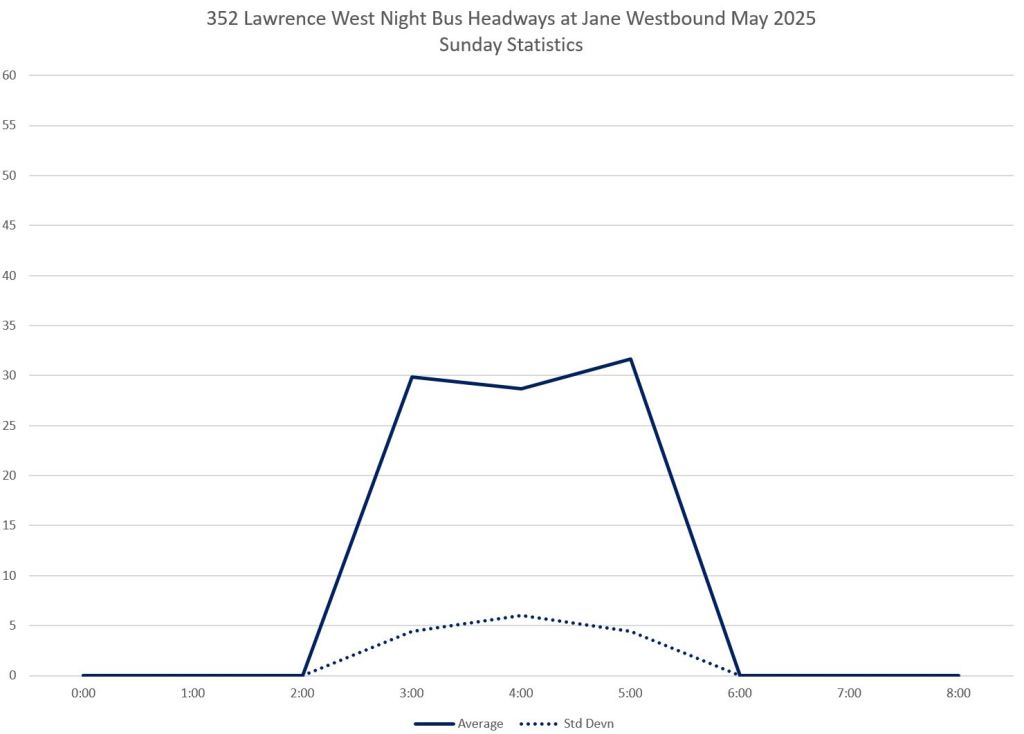
Airport Eastbound
Weekdays
The middle quartiles are tightly grouped around the scheduled 30 minute headway, but a few outliers pull the outer quartiles to 0 and 60 minutes in the 3am period. This was caused by a bus taking an extended layover at the airport and running as a pair with its follower on the eastbound trip on May 14.
Weekends
Jane Eastbound
Weekdays
Weekends
307 Bathurst Service Charts
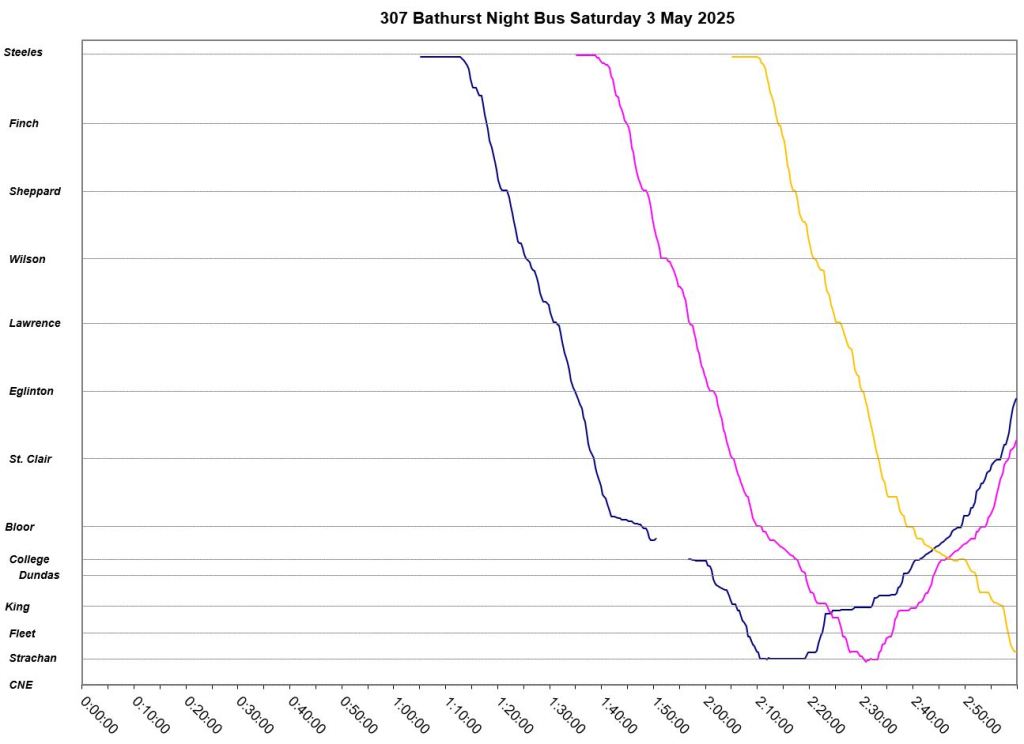
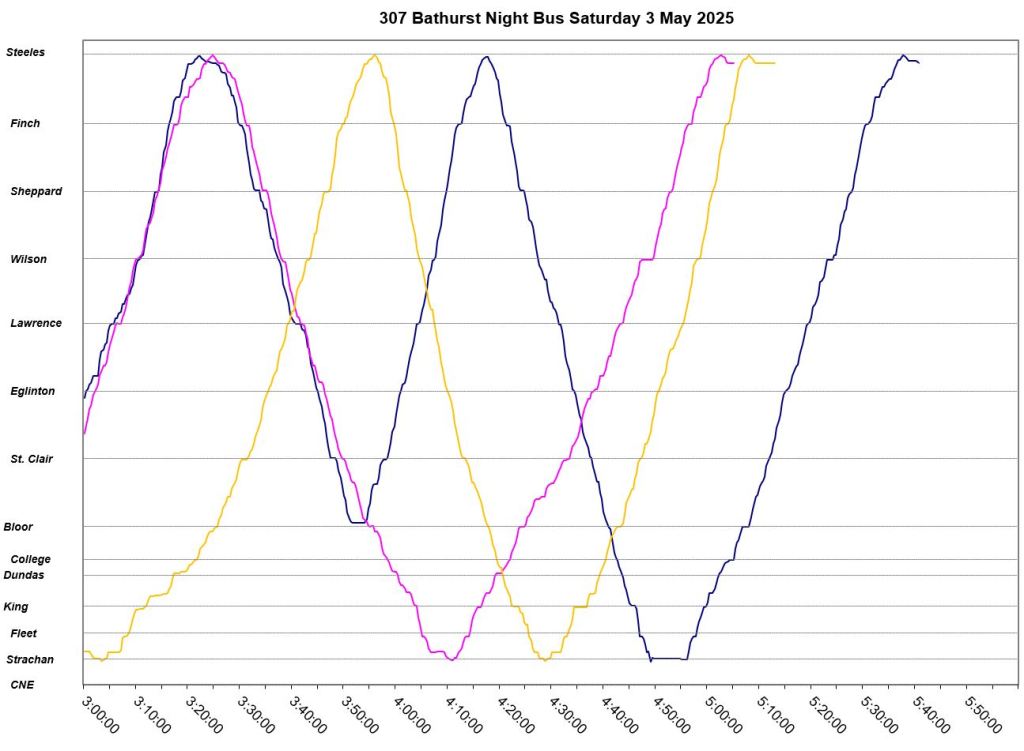
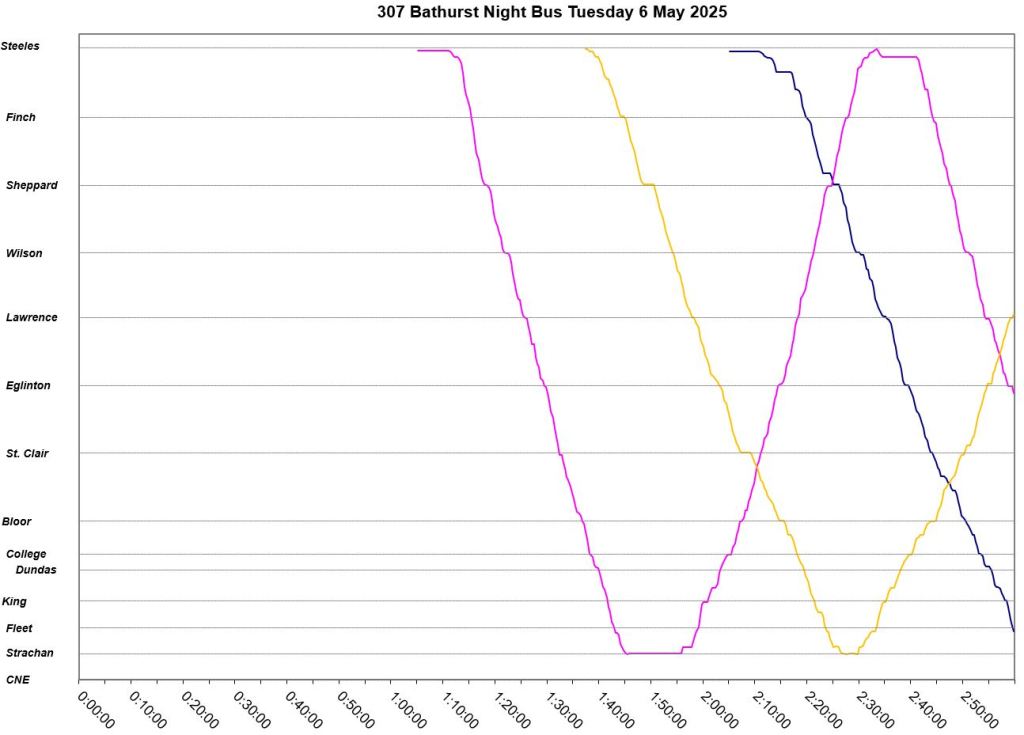
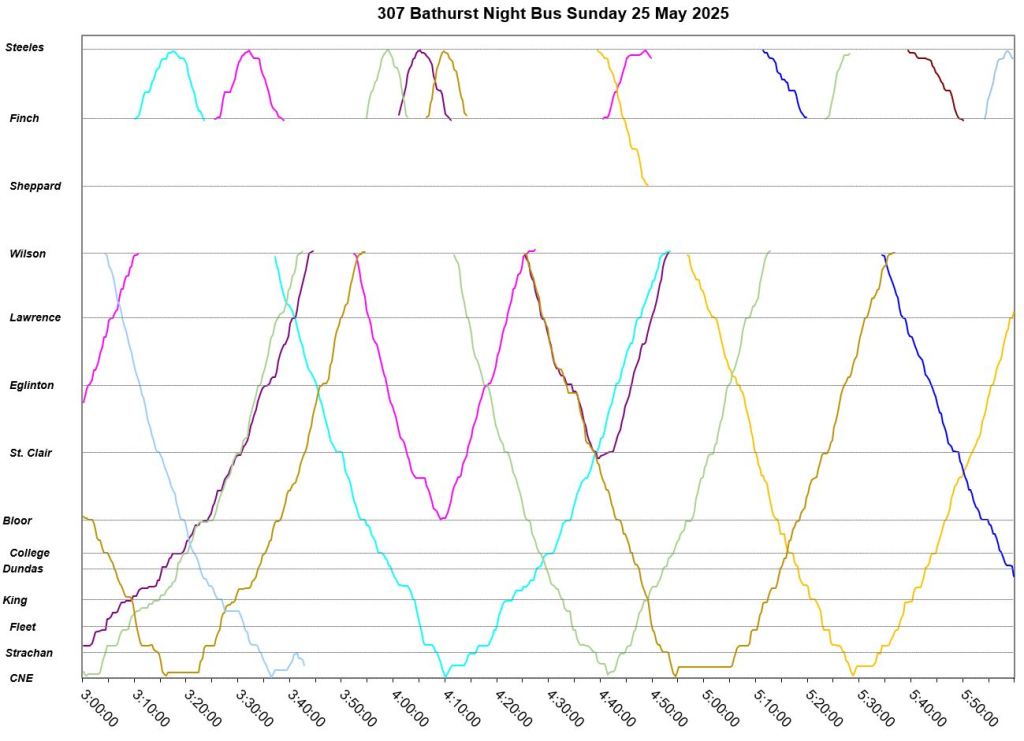
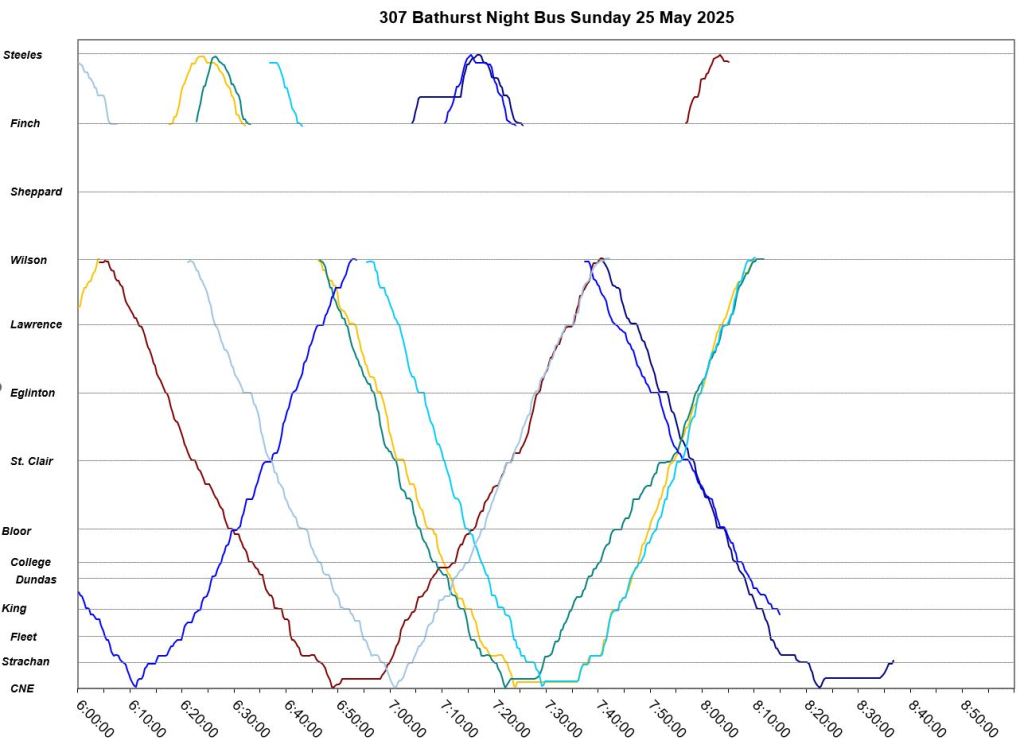
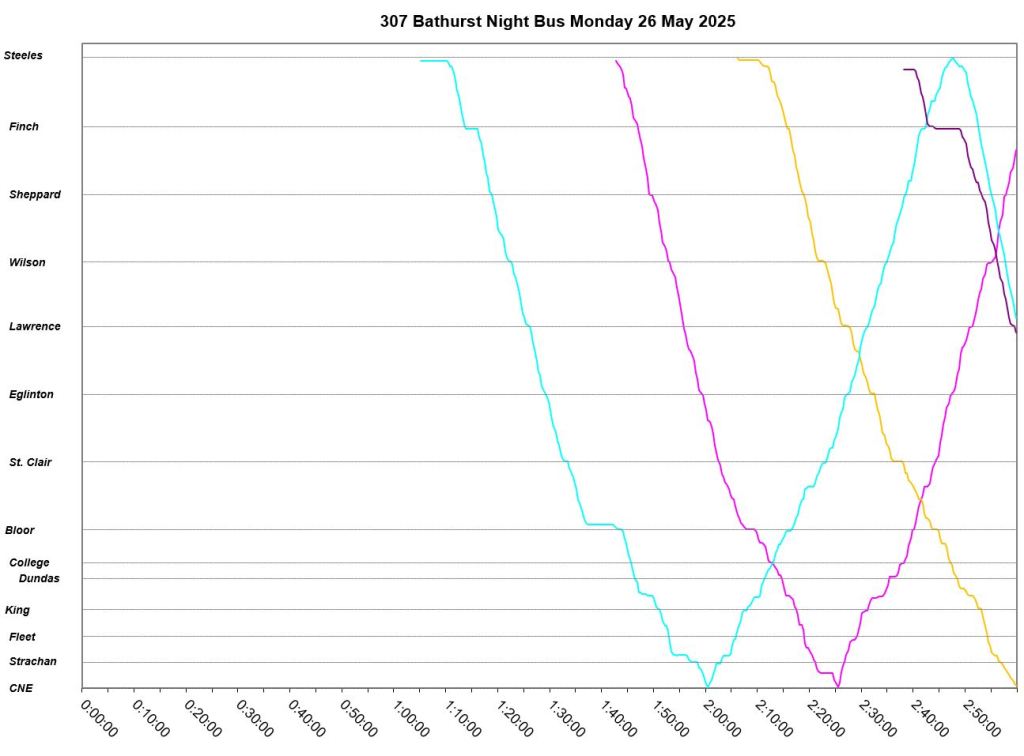
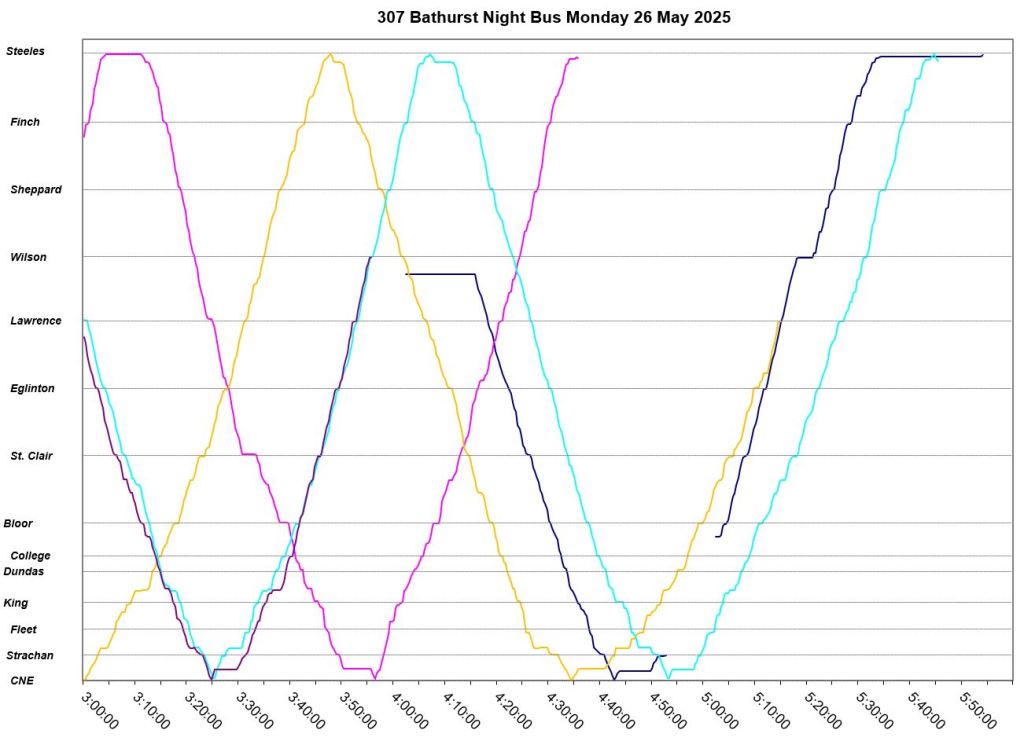
A common factor in the charts here is that buses do not get much recovery time at terminals and this compounds any disruption in regular service.
Saturday, May 3, 2025
Two buses run as a pair for much of a round trip with one of them (dark blue) short-turning southbound at Bathurst Station to restore its proper place. There is a delay northbound at King at about 2:20am which created this pair
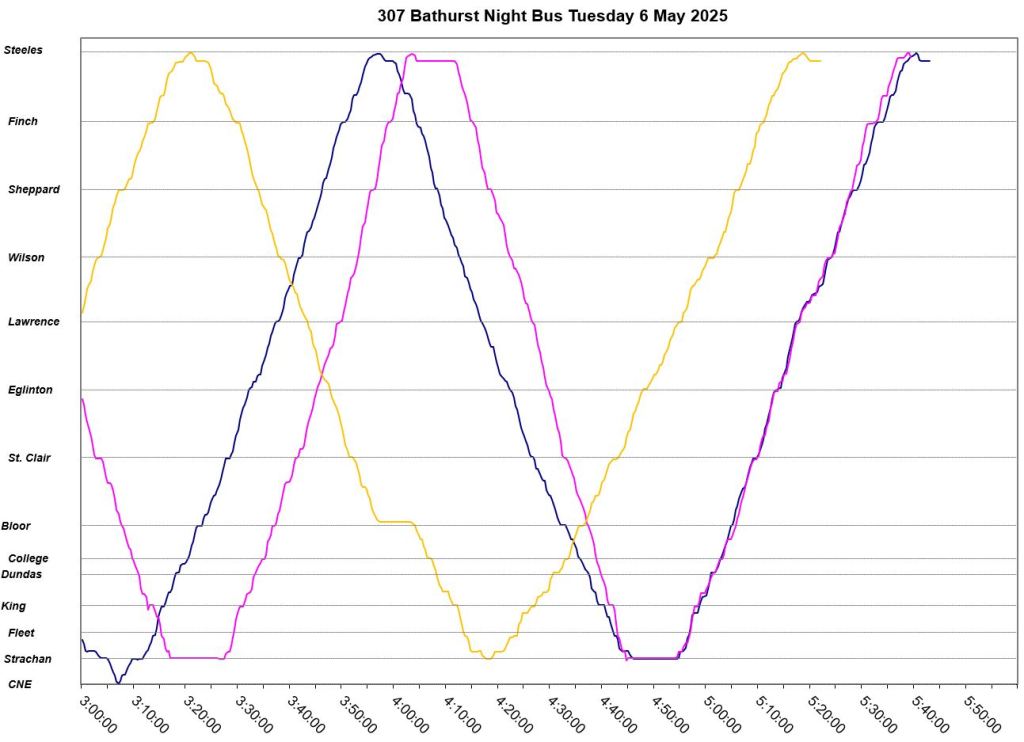
Tuesday, May 6, 2025
One bus (dark blue) runs late and gradually falls back to run as a pair with its follower (pink).
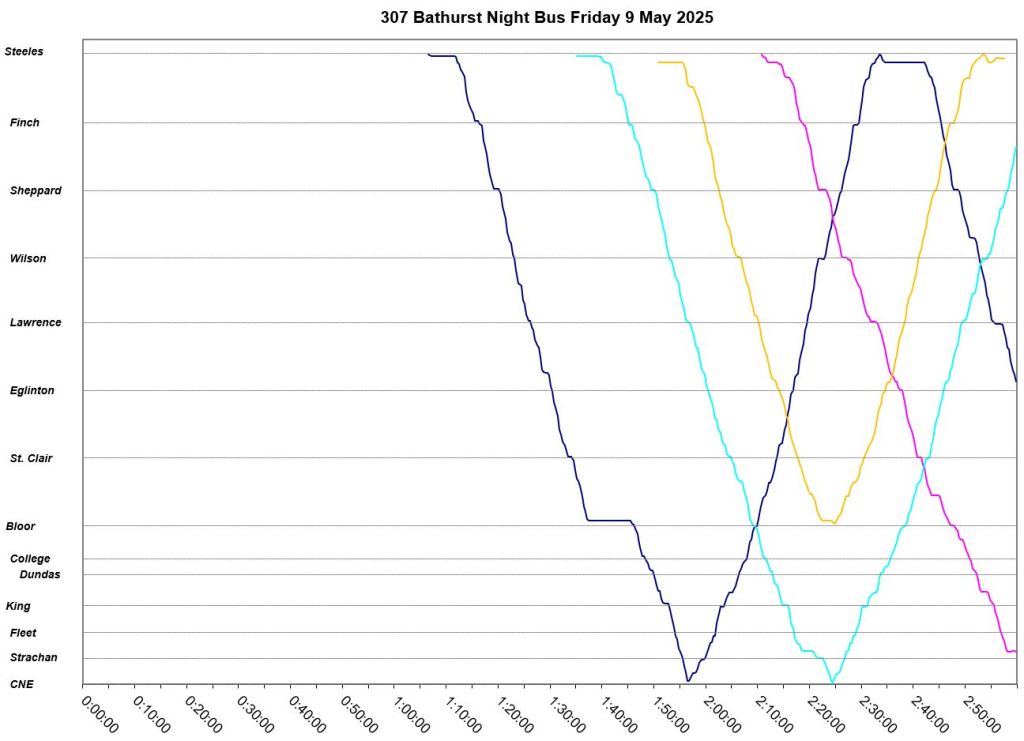
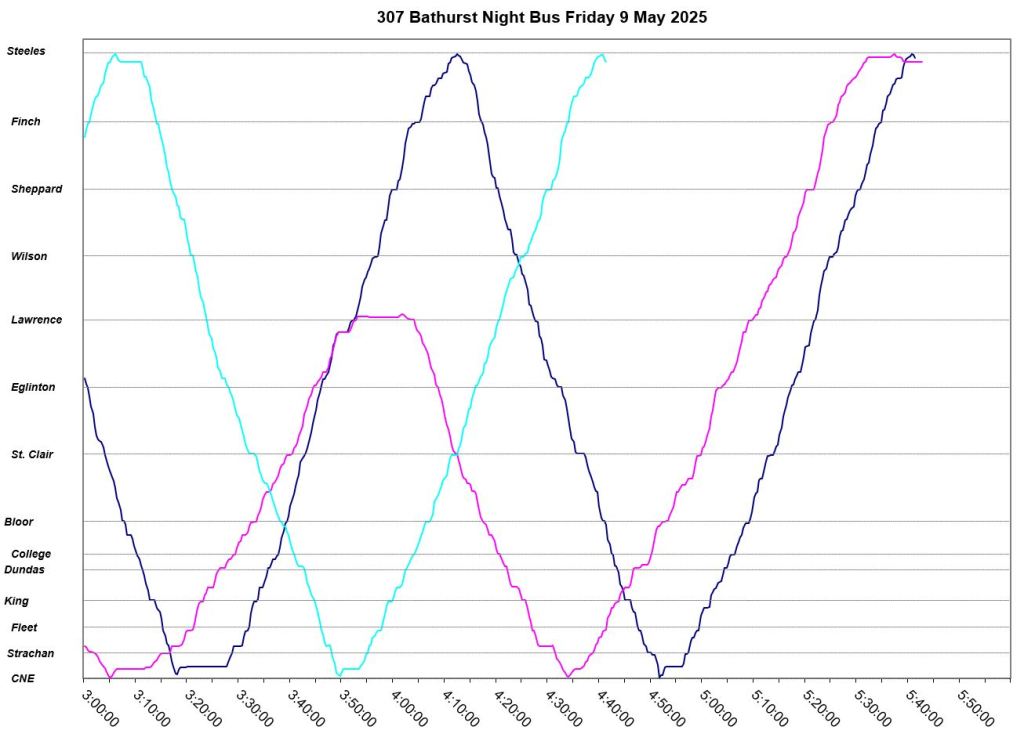
Friday, May 9, 2025
Although only three buses are scheduled on weekday 307 service, a fourth bus appears for a partial trip (yellow) short turning at Bathurst Station southbound. Another bus (pink) goes off schedule northbound at 3:00am leaving an hour-long gap to Steeles. It short turns at Lawrence northbound roughly into place southbound, but is still late leaving the southern terminus in a wide gap.
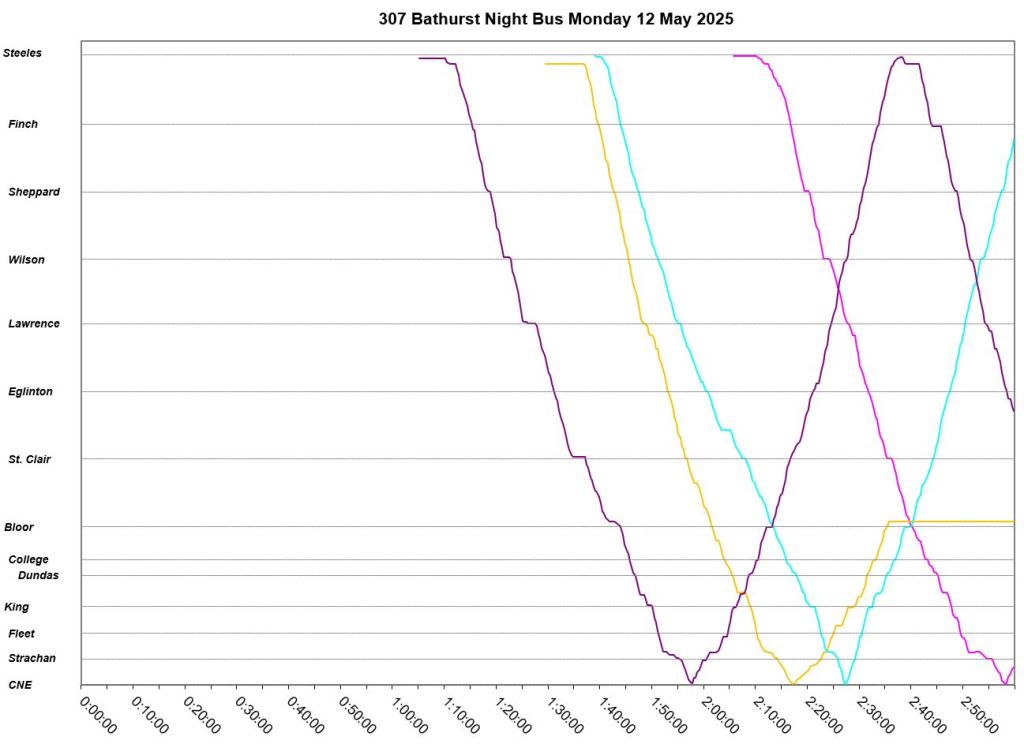
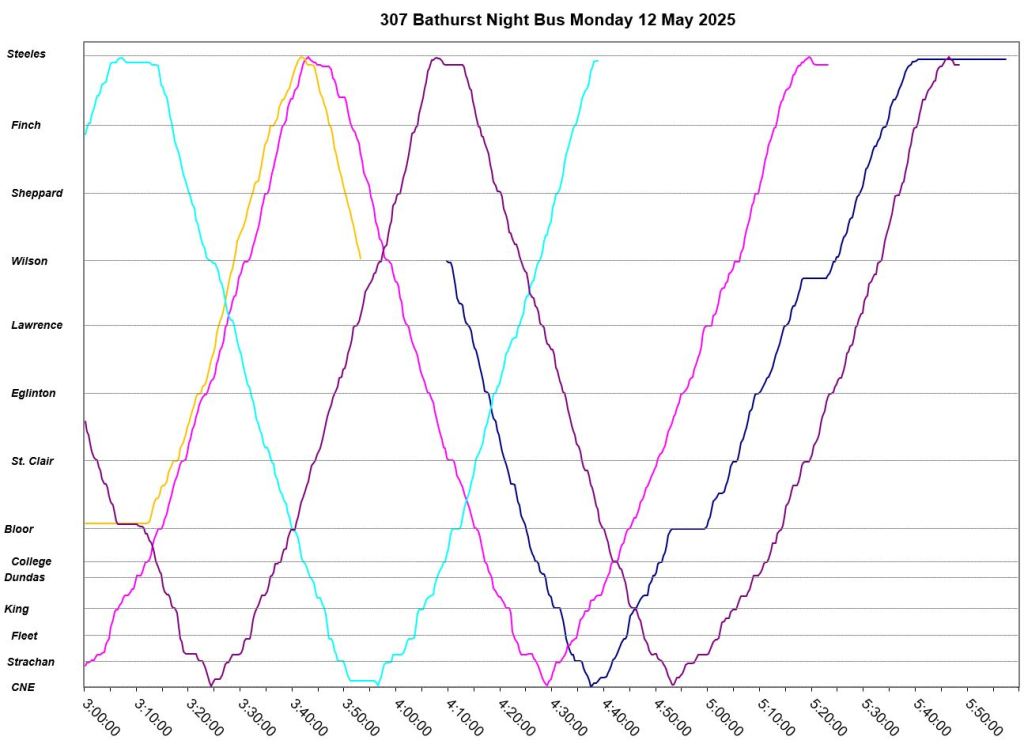
Monday, May 12, 2025
Again there appears to be an extra bus (yellow), and this is replaced by another (dark blue) at about 4:00 am. The extra bus runs as a pair to regular runs.
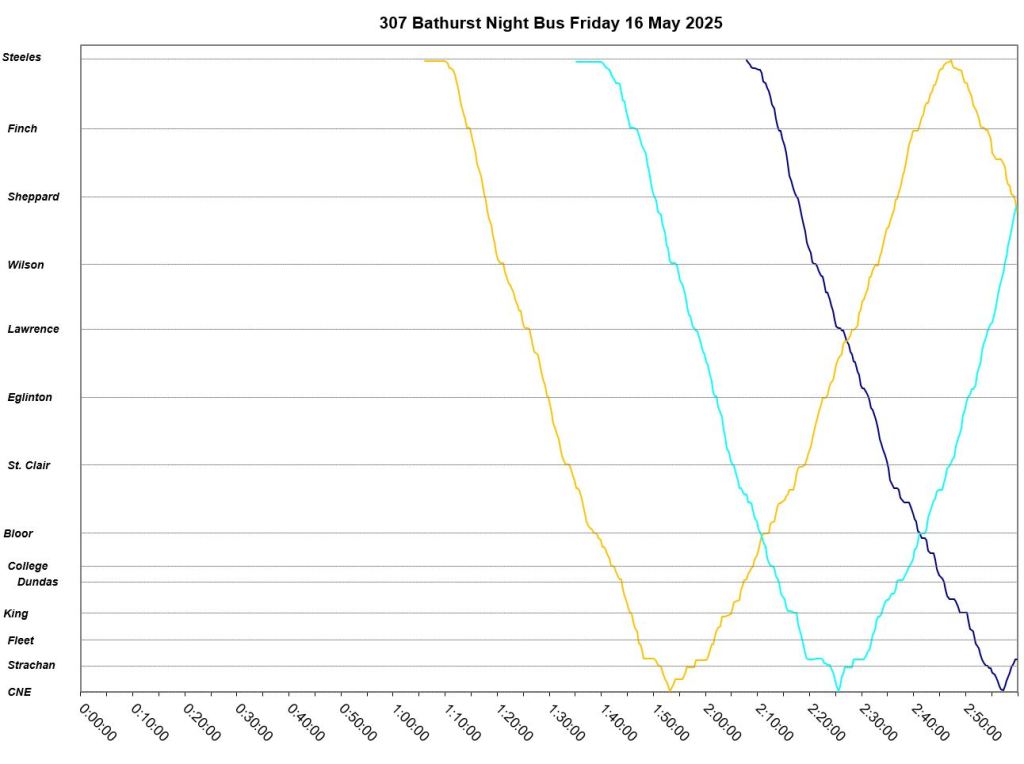
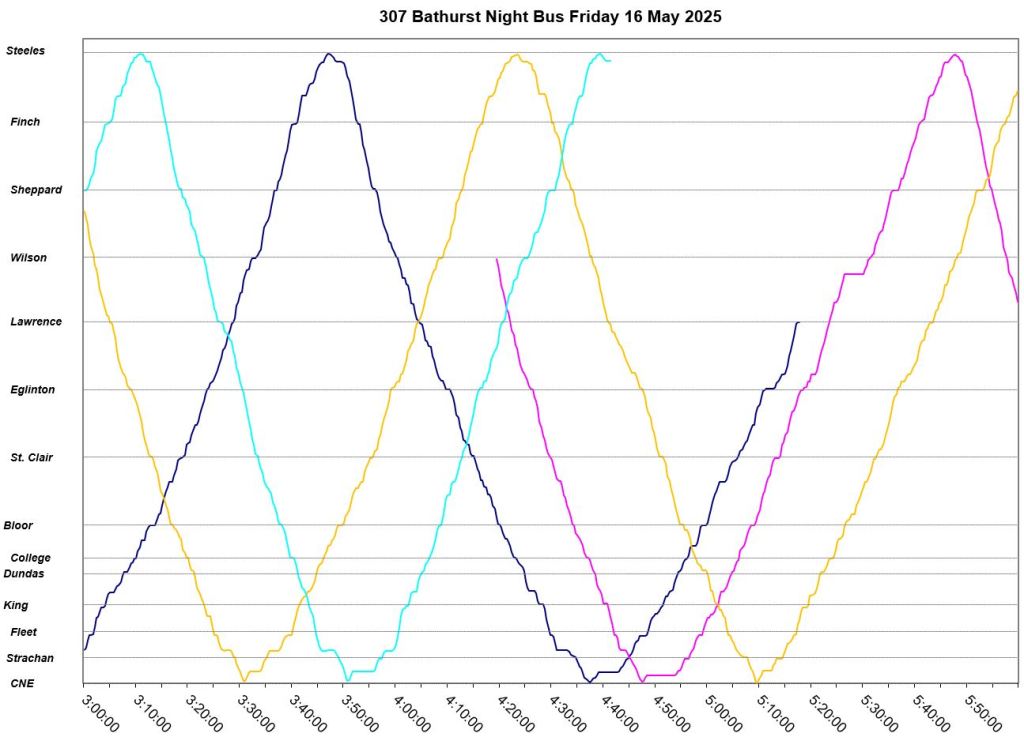
Friday, May 16, 2025
One of the three buses (dark blue) becomes gradually later with a gap opening up through the night. An extra (pink) appears at 4:20, but it follows the late bus rather than filling the gap in front of it.
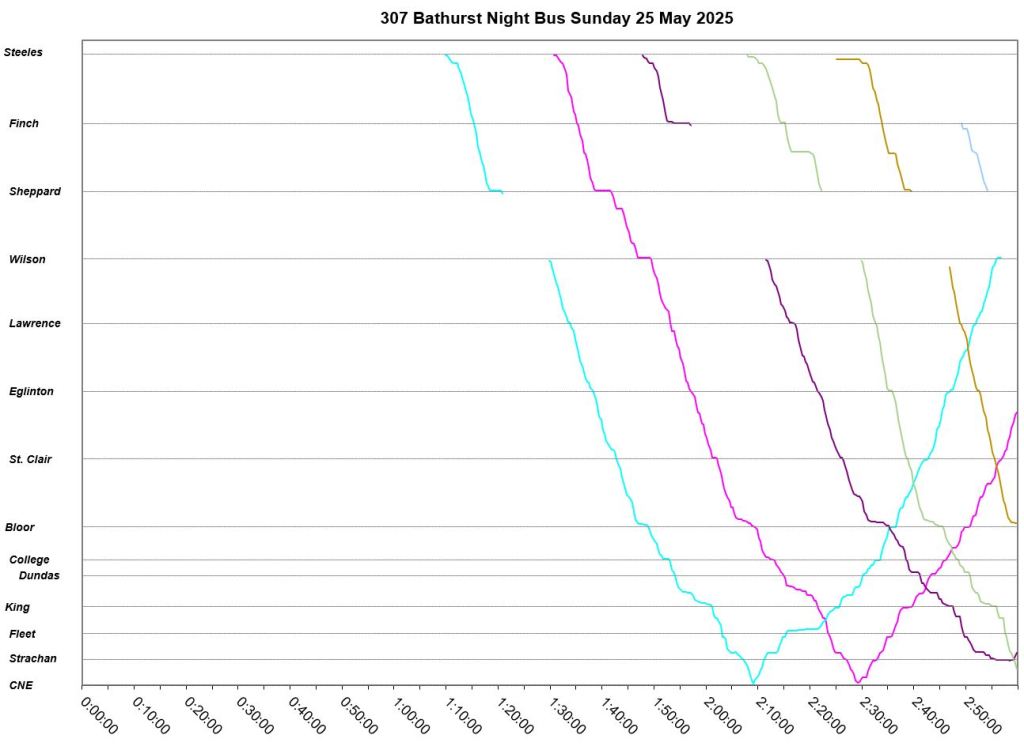
Sunday, May 25, 2025
The Saturday night (Sunday morning) service on 307 Bathurst runs every 20 minutes with five buses unlike the weekday and Sunday service of 30 minutes with three buses. Service diverted via Faywood because of unspecified “police activity” according to the eAlerts. Service was bunched and some buses short turned.
Monday, May 26, 2025
This is another example of an extra bus coming into service (brown, about 2:40am), but providing little assistance by running paired with another bus for most of the night rather than filling a service gap.
332 Eglinton West Night Bus Service Charts
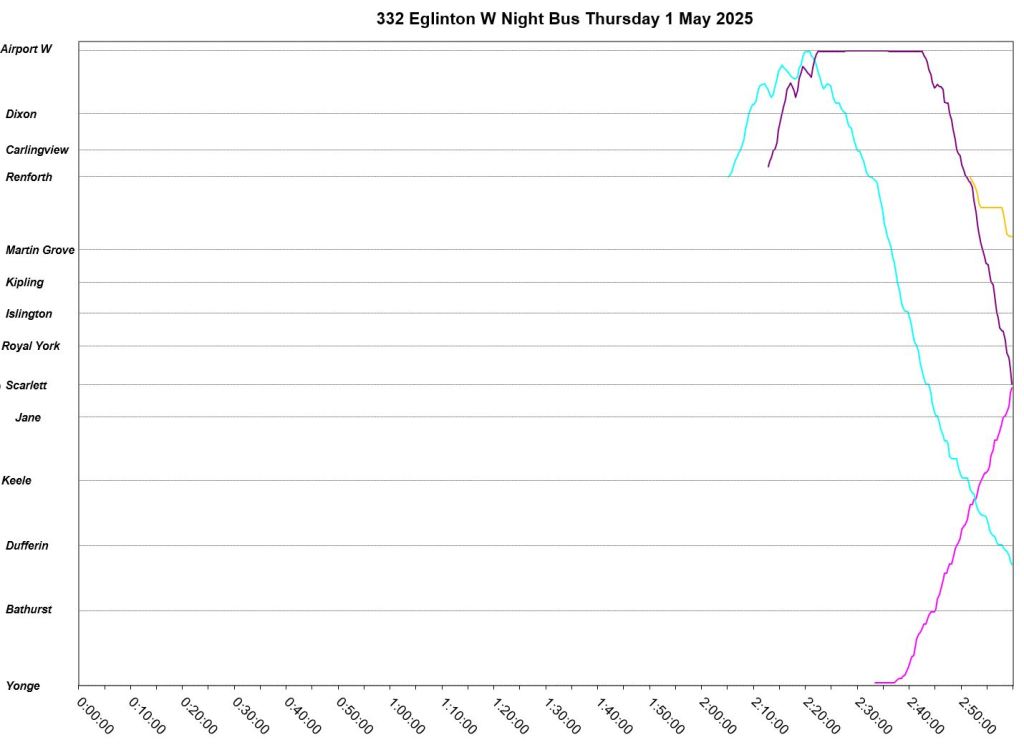
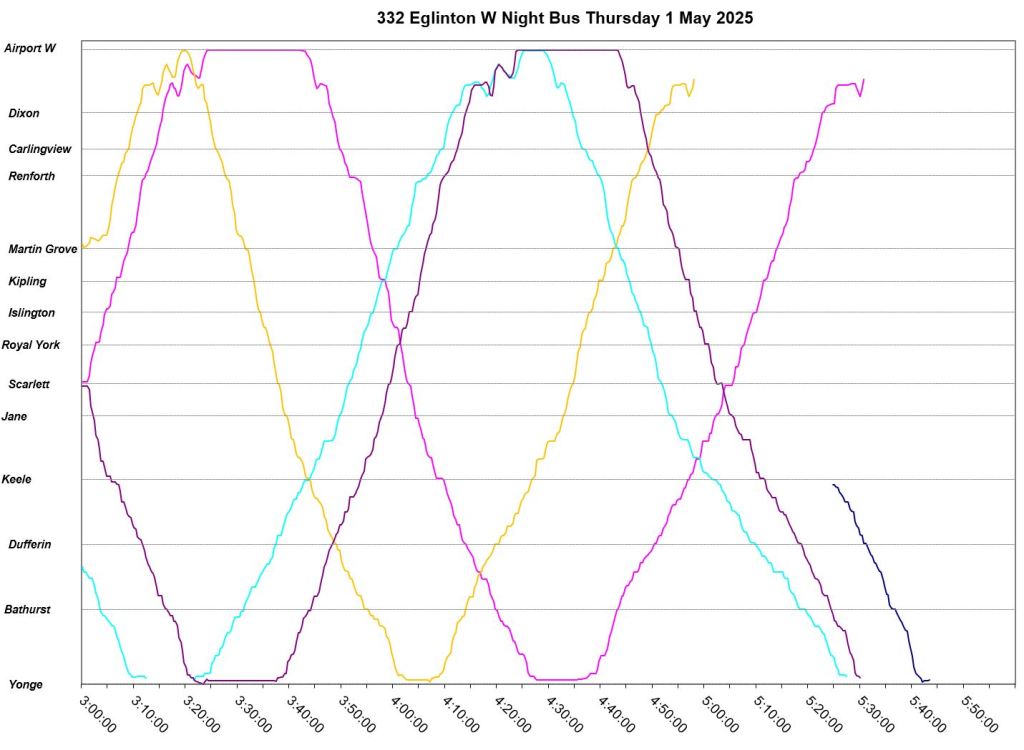
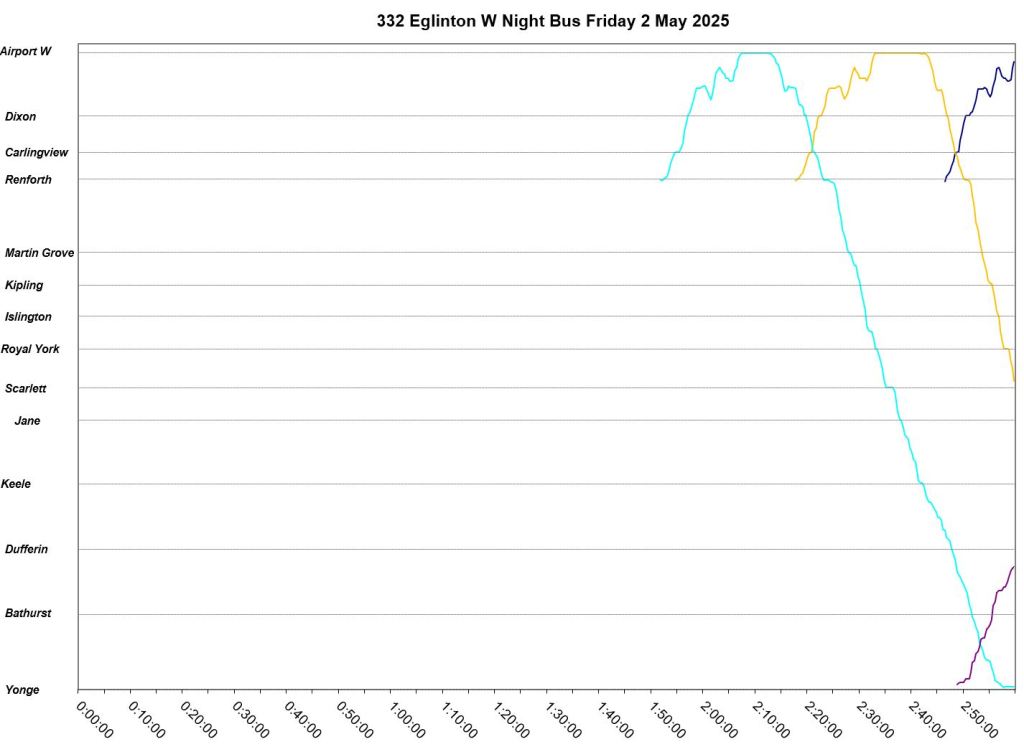
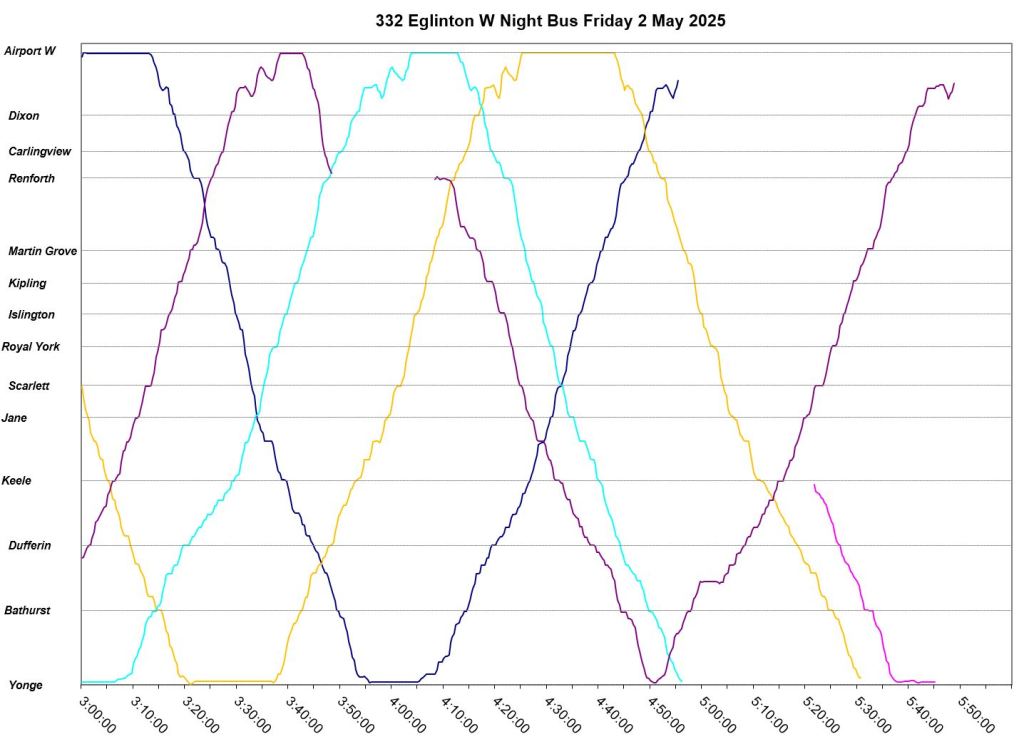
For the first two days of May, the service on 332 Eglinton West Night Bus was somewhat ragged.
On May 1, buses entered service as 332s unevenly, and their spacing remained poor, occasionally bunching to run as pairs.
On May 2, the service began properly, but one bus was out of service at Renforth for an extended period. This produced a gap and a short following headway.
No service alert was issued on either night explaining the problems.
Thursday, May 1, 2025
Friday, May 2, 2025
335 Jane Night Bus Service Charts
Monday, May 5, 2025
At about 2:10am, one bus (light blue below) goes out of service at Eglinton and is not replaced leaving a 40 minute gap.
Wednesday, May 14, 2025
From about 2:30am, a bus that should have left the northern terminus at 2:10, leaves together with its follower, and the two buses run as a pair through the night.
341 Keele Night Bus Service Charts
Wednesday, May 7, 2025
Two night buses go out of service northbound without day bus replacements creating a one-hour gap from 3:40 to 4:40am.
Monday, May 19, 2025
An example of how the night-to-day bus transition sometimes works, but not always. Note also the wide gap in southbound service at 4:30am caused by a long layover at York University.
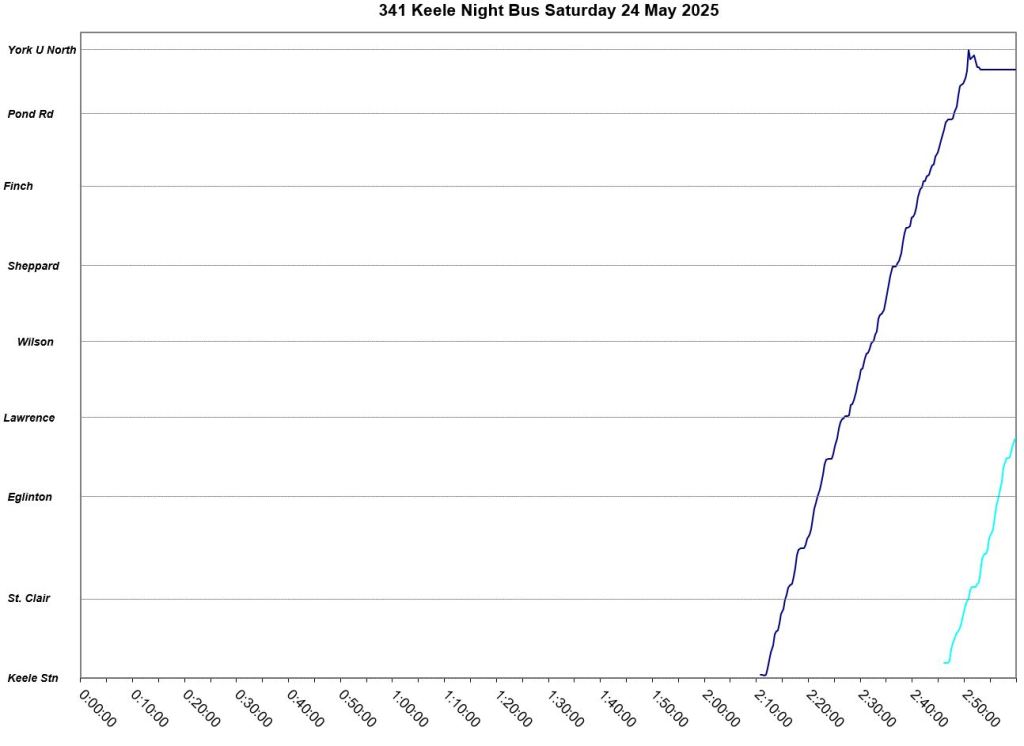
Saturday, May 24, 2025
Another example of the night-to-day transition that leaves a gap because one replacement bus (4am from Keele Station) is missing.
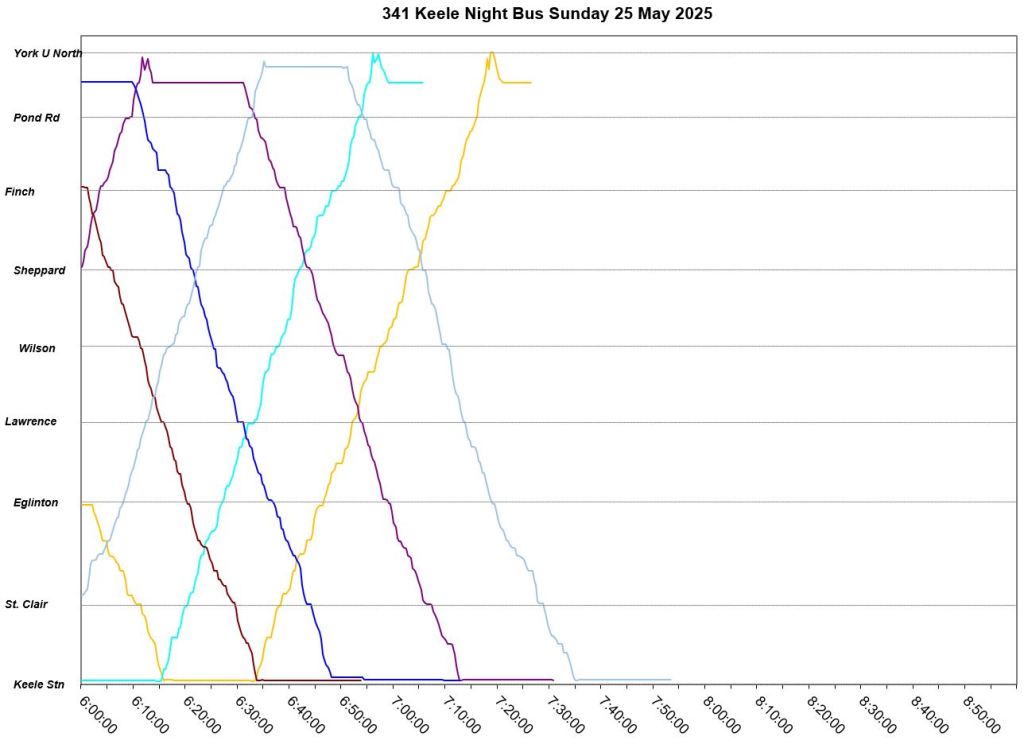
Sunday, May 25, 2025
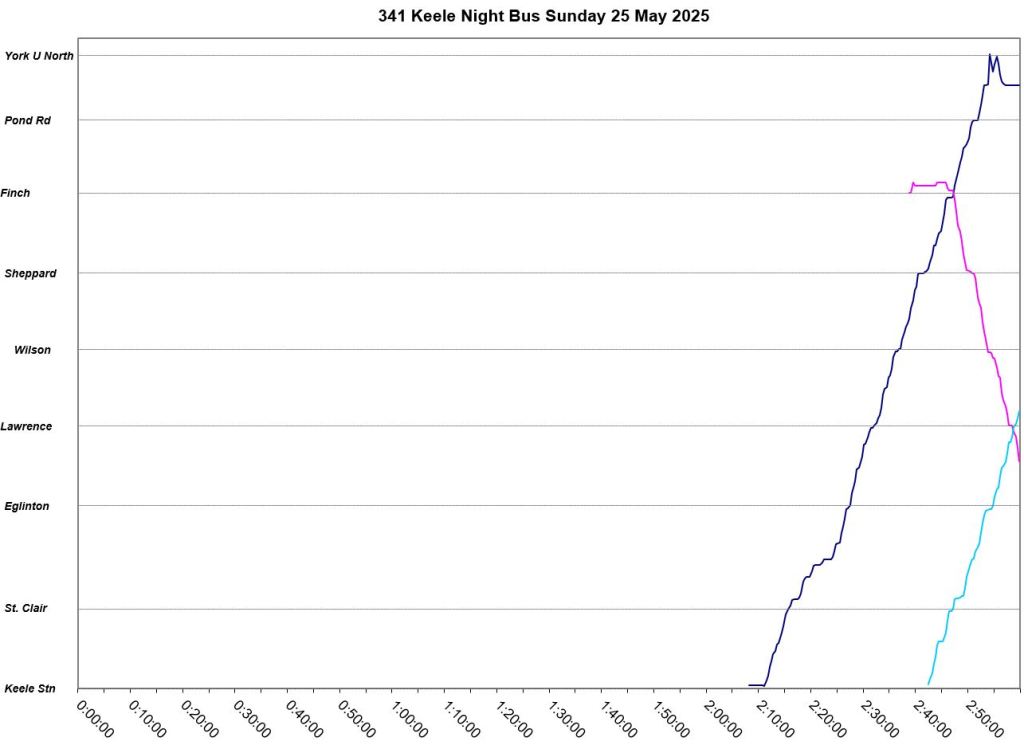
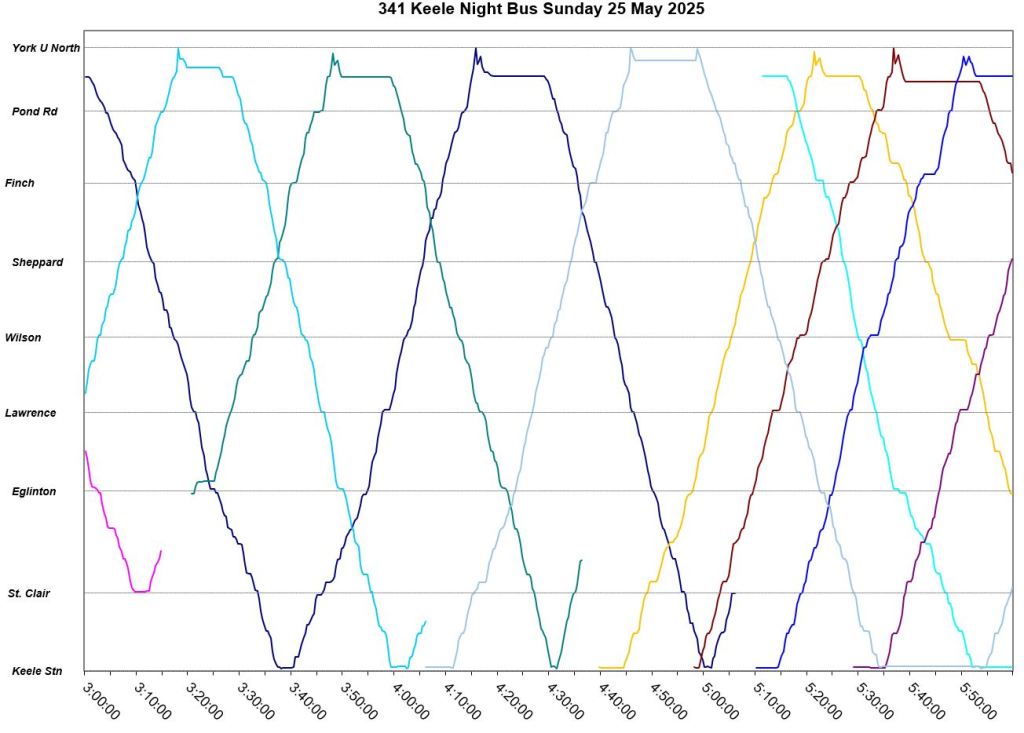
A short turn at St. Clair followed by a change to a new vehicle at Eglinton leaves a gap in service at Keele Station from 2:40 to 3:40am.
 Steve Munro
For reference, Wikipedia has a write up on Night service (public transport) around the world.
LikeLike
At night, some drivers are skipping trips or running the entire trips as NOT IN SERVICE and refusing to stop to pick up passengers. Such drivers need to be fired immediately. The TTC needs to have undercover auditors disguised as passengers at night with body worn cameras to collect evidence to justify the firings.
Steve: It would be useful if you would specify routes, times and locations so that this can be compared with vehicle tracking and loading data. Given your use of a pseudonym and fake email address, I am not going to treat this comment seriously.
LikeLike
Very detailed analysis as always Steve.
One thing that might be useful to add to your analysis on this particular set of routes would be the on-time performance relative to the schedule. Given how infrequent the Blue Night routes are, and the necessity of being able to make scheduled connections, riders are more likely to care about how close buses arrive to the scheduled time than the headways between buses.
Although I’m not a regular night bus user, one story that has been frequently told over many years is that the Blue Night buses frequently run early (not just +1 but often 5 to 10 minute ahead of schedule). One of the commonly held “excuses” for this practice is that inadequate terminal time in the schedules makes it impossible for drivers to have breaks at the ends, something you briefly alluded to at the beginning of the article. A review of OTP would be very informative in seeing how prevalent this practice is amongst routes, and whether it’s fairly common amongst all buses on a route (they all run equal amounts of earlyness), or if this is only practiced by certain operators, which causes the gapping and unreliable headways. Additionally, early running is something that should be easily caught and corrected by supervisors, so if this is seen to be prevalent, then it’s an indication of a lack of proper supervision or care (rather than lateness, which can be explained by multiple other factors).
LikeLike
It’s interesting to look at night network maps from the 1960s and see how they were deliberately scheduled to allow for timed transfers. They even showed the full schedule right on the map at every transfer point to reinforce it! e.g. you can see how all buses/streetcars were timed to show up at St. Clair and Bathurst at :28 and :58… or King and Bathurst, when westbound, southbound and northbound cars were all scheduled to arrive at :13 and :43.
Steve: That whole concept was lost with the night network expansion into the suburbs. Obviously you cannot have meets everywhere, but scheduled holds at major points would help to make the service predictable. However, TTC only cares about “on time performance” at terminals, and even that is lax. This has been a problem for a very long time.
LikeLiked by 1 person
I’ve had the opportunity to work alongside former TTC operators in a smaller urban setting and have found with several, a real tendency to push rules and limits almost from the outset in some cases. Younger ones with only a few years of TTC service generally have seemed good, however my sample size is limited.
I’ve heard the bragging of tailgating the bus ahead and never passing it, only to pass it at the subway station while it takes on a whole line of passengers, and disappearing down the road, among other stories.
I’ve seen similar selfish behaviors here and even general disregard for basic procedures. The difference here is that they are a lot easier to spot particularly when their attitude toward their job screws their coworkers over.
I don’t know the person who posted the above but from what I have seen and heard in my workplace I wouldn’t discount any of what was claimed.
In this business it is easier than you might think to get away with skipping trips and playing games, particularly after hours. All that GPS data means nothing when the management doesn’t have time to process it, an understanding of what it is saying, or the guts and dedication to confront issues head-on.
Considering the voluminous data that Steve has collected and the ways he has devised to process and present it, a person could easily assume that there is someone as smart and passionate as Steve in every transit agency. I’d counter that the exact opposite is true. Steve is a treasure in the efforts and mastery of these studies. I bet he has a better idea of what goes on along these lines than anyone getting paid.
If it was my business I’d toss every TTC resume showing five years plus experience in favour of a school bus driver showing a year. You need people you can trust to do what is asked, particularly in a position with minimal supervision, not the miserable dude that looks to exploit every opportunity he can at the expense of either the ridership or his coworkers.
Steve: Your description may be apt for some operators, but not for the majority. However, in any organization, some staff will get away with whatever is tolerated, if only by inaction.
LikeLike
Of course things can go the other way and be a management problem. Managers who take the general view that all employees are lazy liars tend not to listen to employee feedback.
You can be the most conscientious employee, and when you tell management “This thing you’re telling us to do, it really doesn’t work” they don’t want to hear it. They have designed a perfectly good process while sitting back in their swivel chair at the office, and if you’re not carrying it out, you must be a lazy worker.
After a while, when faced with this kind of managerial dictat, even the dedicated employee can say “you know what, screw it, I will follow their unworkable process and not worry that it doesn’t work”.
For example, if the rule is “do not pass the vehicle ahead” for transit operators, and they happen to catch up to the vehicle ahead, and there is no one in transit control asking them to short turn or to do anything about it, well fine, just follow along behind and take it easy. You are doing exactly as you have been instructed, and your feedback on this has fallen on deaf ears time and again. So why bother?
LikeLike