
The TTC Board met on February 24, 2025 with an agenda that seemed light going in, but the meeting itself ran well into the afternoon partly due to a long in camera discussion and partly to debates that expanded the scope of the items on the agenda.
Reports of interest:
- CEO’s Report
- KPI Report
- Supply of Battery-Electric Paratransit Buses and Green Bus Program Update
- Bloor-Yonge Capacity Improvements Project – Progressive Design-Build Development Phase
- Cost-Benefit Analysis of a Pilot for Free Wi-Fi Service on Bus and Streetcar Platforms
- Transit Priority Measures on Queens Quay East – Interim Bus Priority Lanes
- See my separate article on this item
- LRT Status Updates: Waterfront East and Eglinton East
- Improving the TTC’s Response to Major Snow Incidents
- An Urgent Need to Improve Bus and Streetcar Travel Time and Reliability
No Strategy for the TTC?
Notable by its absence was a report on establishment of a Strategic Planning Committee, an item approved by the Board on January 10 with an implementation plan due at the February 24 meeting. (See minutes at p. 3) Such a committee is vital so that consultation and planning can occur before and while the 2026 budget is in preparation, a process that gets underway in roughly June-July each year. If there is to be some brave new vision of what transit can become, there is no point in asking that it be included in an already final budget in December.
CEO’s Report
The CEO’s Report continues to dwindle in size and substantive comment. Key Performance Indicators, for all of their problems, have been hived off into a separate report that is not published as part of the agenda, and there is little discussion of the content.
The report touts plans for Community Bus Service when, in fact, the budget and Service Plan focused on limiting the scale of this operation. Expansion is only happening because of Board direction. Similarly, the report celebrates the 50th anniversary of Wheel-Trans noting that “participants were enthusiastic about the new door-to-door service” when it was established. In recent years, TTC has attempted to limit access to door-to-door service by diverting rides at least partly only the “conventional” system services.
Also, the report claims that “we are making huge investments to upgrade Toronto’s transit system and address the backlog of state-of-good repair work” without providing any indication of how much or how quickly that backlog will be addressed in 2025 and beyond. There is no recovery plan, let alone a target to aim at beyond a meaningless one adopted for slow zones.
We have established a baseline target of 12 slow zones in the system at any one time, but we know this number can and will fluctuate as we carry out more inspections. This spring, we will conduct another comprehensive audit of track geometry. That will undoubtedly result in more slow orders being put in place, and we apologize in advance for that. But with safety always at top of mind, we must stay on top of the state-of-good-repair even if it means temporary service impacts. [p. 9]
Riders might be forgiven for rolling their eyes at “temporary service impacts” when some slow zones are celebrating their one-year anniversary and others have lasted for months. (See my February 2025 update on this topic for details.) The issue is not simply counting the zones, but reviewing their physical size, the proportion of rider trips affected and longevity. The TTC is fond of evaluating service impacts by calculating a benefit or inconvenience to riders, but is content to evaluate slow zones by saying there is a target level of 12. This is self-serving nonsense.
Weekday demand for the first week of February 2025 (measured as boardings, not trips) at 2.6 million are up 2% over a year earlier. The subway saw very strong growth at 8% and streetcars at 1%, while bus demand dropped by 2%. There is no discussion of the factors that might be behind these changes.
A streetcar safety pilot with door-monitoring cameras on four cars will begin later in 2025, but at this point the work is only for data collection, not for issuing tickets. TTC promotes this as a safety issue for riders, although their concern might equally have been addressed to snow clearing at transit stops after the recent storms.
The report urges riders to follow @TTCNotices on X/Twitter, but does not mention that these are on BlueSky (@ttcalerts.bsky.social) only because someone set up a bot to echo the Twitter feed. Some notices appear on X under other accounts and these are not echoed. TTC likes to talk about communicating with riders, but is selective in the channels they use. As for their website, information there hides on several different pages as I have discussed here in the past. Whether the wayfinding project’s report in May 2025 will address shortcomings in communications remains to be seen.
KPI Report February 2025
As previously discussed here, several of the Key Performance Indicators do not give a valid state of the TTC. There has been informal discussion of replacing them, but nothing has happened so far.
The ridership and revenue charts (which I have not included here) only run to December 2024. There is no discussion of the change in growth patterns for the subway vs bus and streetcar modes cited in the main CEO’s report with data to early February.
An important issue for service planning is the question of just how many working vehicles the TTC owns, and what size of spare ratio is needed to ensure service operates. The number of vehicles in the fleet varies depending on which report one reads.
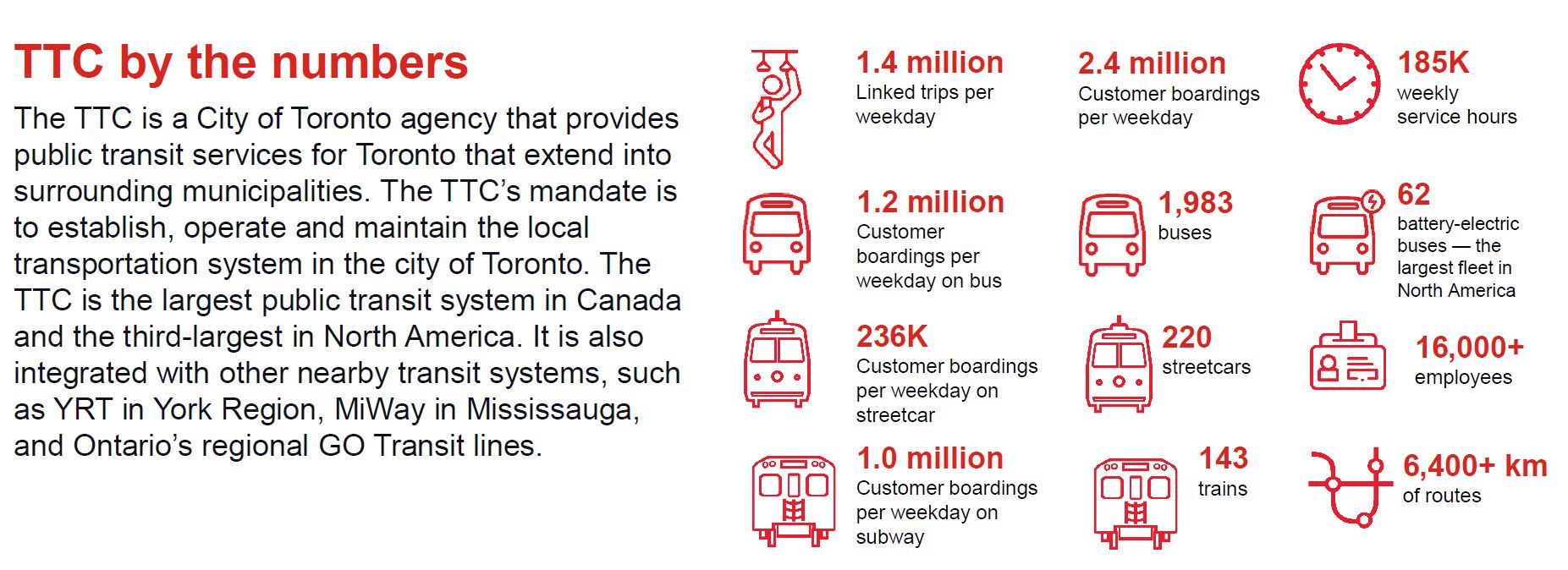
The chart below appears in both the KPI and CEO’s reports.
The following chart is in the Scheduled Service Summary for February 16, 2025.
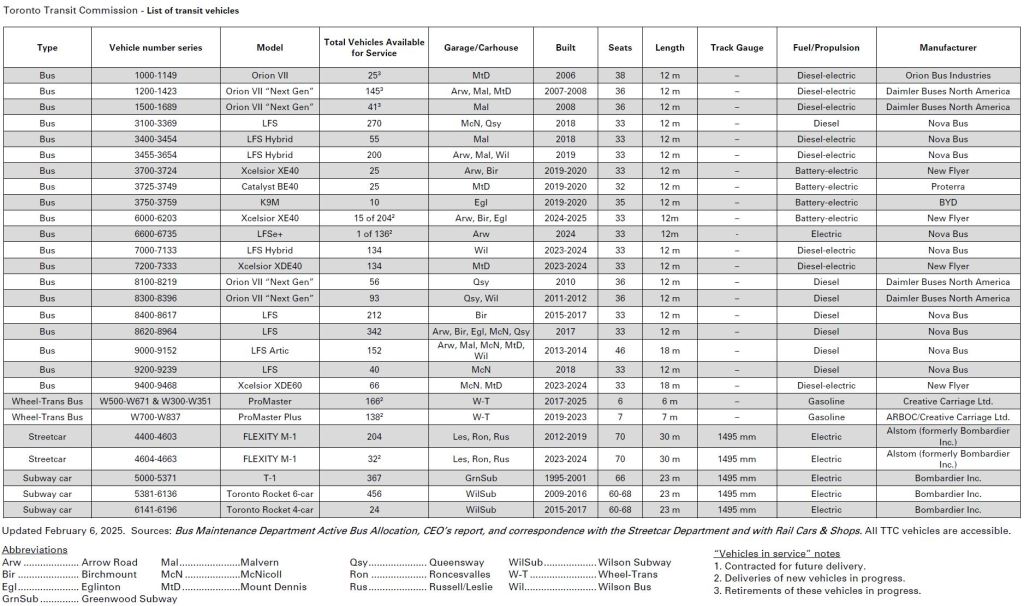
To save readers the trouble of adding them up, there are 2041 buses in the active fleet according to this chart, somewhat above the 1,983 in “TTC By The Numbers”. Exactly how many are really active among the dwindling numbers of old buses and the slowly growing pool of new ones is hard to measure.
In any event, by the time the remaining 211 buses marked for retirement are gone, and the 324 buses to be delivered are here, the fleet will be both larger and younger, although the reliability of the eBus fleet remains to be demonstrated.
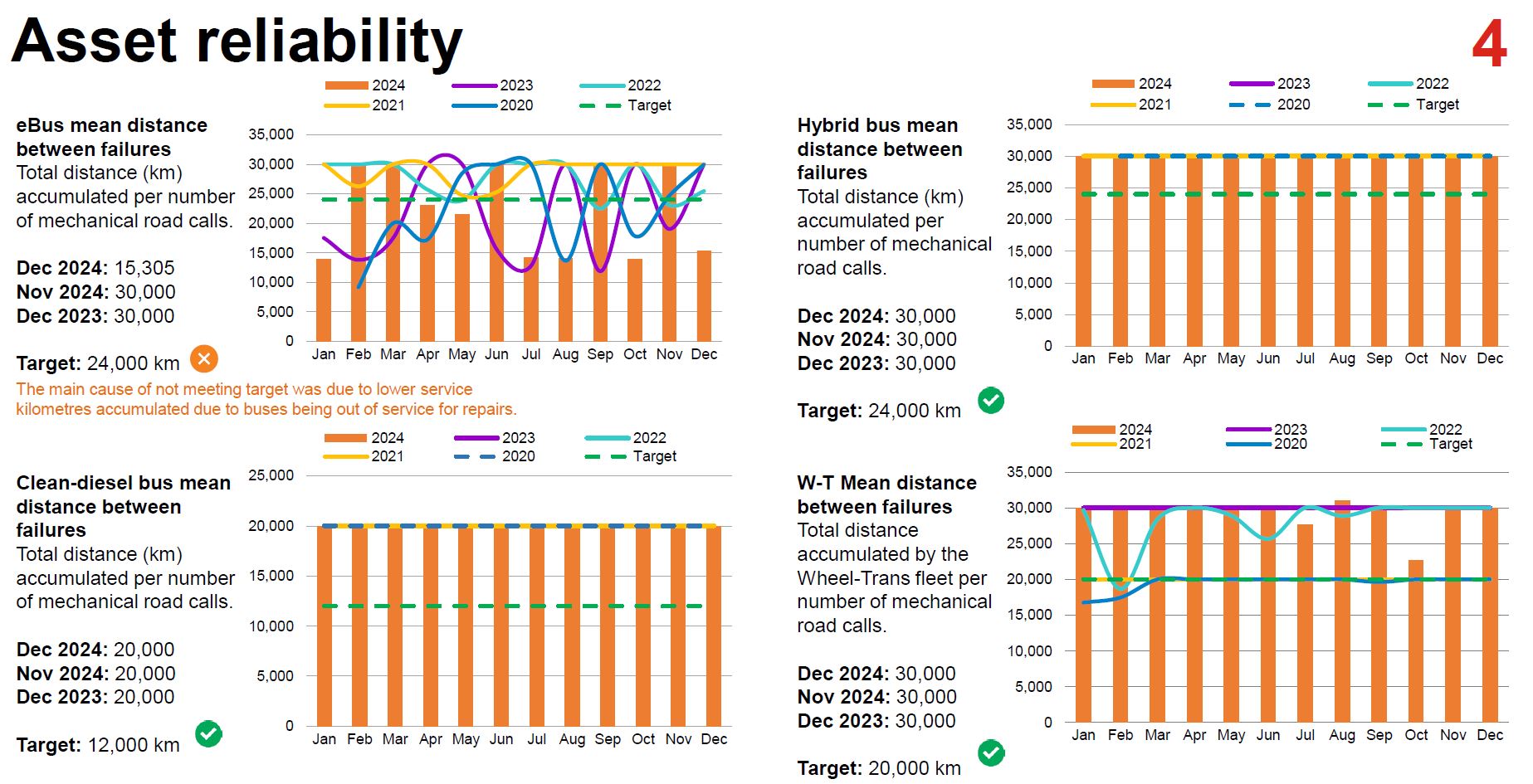
TTC reports the Mean Distance Between Failures (MDBF) values for its bus fleet, but in a way that hides information. The values for eBus, Hybrid and W-T fleets top out at 30,000 km. It is not possible that the fleets hit exactly this value month after month. The eBus stats show something more realistic, and yet even these are capped at 30,000. Diesels, for some reason, are capped at 20,000. This method of reporting makes it impossible to tell what the relative performance of each vehicle type really is.
A further problem is that buses that are not used much (or at all) contribute little or no mileage. A bus that never leaves the garage never breaks down, but it is also not available for service.
One issue for eBuses is the distance they can travel (or time in service) between recharging. This imposes an overhead for garage trips and limits the length of runs on which eBuses can be scheduled. This can be addressed in part with on route charging stations, but the TTC has not yet decided whether to adopt this technology.
For the rail modes, here is the corresponding presentation. Although we do see some variation, the subway charts appear to be capped at 700,000 km for TRs (Line 1) and at 400,000 km for T1s (Line 2).

Finally comes the question of whether service provision is limited by the number of available vehicles. This depends on how many the TTC attempts to field, and what constraints are placed on schedule design. It is clear that the TTC has a large surplus of streetcars with a fleet of 236 for a peak scheduled service of 145 cars. Allowing an industry standard of 20% for maintenance spares brings the requirement to to 174. The TTC could run considerably more streetcar service, but doesn’t (leaving aside that at any given time at least one route is affected by construction projects). The 2025 budget includes plans to add service in November on 512 St. Clair, 511 Bathurst and 505 Dundas in part to see how this affects ridership.
Peak bus service is 1,621 vehicles including 42 on streetcar routes and 69 as “Run as Directed” (RADs). The spare ratio, depending on which number is used as the total fleet size, lies between 20-25%. This should grow as new vehicles replace old, provided that the new ones are more reliable.
Sadly, the KPI report is silent on this issue.
Supply of Battery-Electric Paratransit Buses and Green Bus Program Update
This report deals only with the Wheel-Trans fleet and despite its title makes no mention of the conventional fleet.
At this point, the TTC will buy five paratransit buses from Damera Bus Sales Canada Corporation (one in 2025, four in 2026) at a unit cost of about $1.1-million. The total project cost is just over $8-million of which roughly $2.5-million is “Consultant fees, Engineering and Project Management Labour, other external costs, and contingency allowance”. [p. 2]
Although there were multiple bidders, several dropped out or were disqualified leaving only Damera with a qualified bid.
There is a separate project to build charging systems for Wheel-Trans totalling $1.3-million most of which has already been spent with the remainder to follow in 2025. This will be done under an existing contract with Ontario Power Generation.
The TTC will continue to acquire gasoline-powered WT buses until 2029, and plans, based on the result of the five-vehicle eBus pilot, to begin a bulk purchase of eBuses in 2028. This plan aims at the City’s target date of 2040 for electrification of the transit fleet. The current W-T fleet numbers 263.

Bloor-Yonge Station Capacity Improvement Project
The Board approved a $154.6-million agreement with Kenaidan Murphy Joint Venture (KMJV) for the detailed design phase of the project to expand Bloor-Yonge station with larger areas for passenger movement and a new, separate eastbound platform on the Line 2 Bloor-Danforth level. This is a huge project with an estimated cost of $1.514-billion to be shared by Toronto, Ontario and Canada. Toronto will be solely responsible for any overruns.
The project is to be handled as a “Progressive Design-Build” where the TTC and KMJV will work together on development of the design. A “go no-go” point is reached where either the design and cost are acceptable to the TTC (and by implication to the City) and construction proceeds, or where the project stops. This is summarized in the chart below:

The Board was concerned that there is a long period where the design is in progress, but there is no opportunity for them to review progress. The following motions were passed to add reporting stages to the development phase.
1 – Motion to Amend Item (Additional) moved by Councillor Jamaal Myers (Carried)
The TTC Board request the TTC CEO and the Progressive Design Build contractor to identify during the development phase, the costs for individual elements of the design, to allow the TTC to make recommendations to the Board, on which design elements may need to be omitted to keep the project within the current budget without impacting the project benefits.
2 – Motion to Amend Item (Additional) moved by Councillor Dianne Saxe (Carried)
TTC Board request that TTC staff give a presentation at the next TTC Board meeting that provides a detailed financial update for the Bloor-Yonge Capacity Improvements Project, including projected costs, actual costs, and variances for different elements of the project, including design, legal, and land acquisitions year-to-date.
This scheme has been pushed for years as essential to the subway’s ability to handle future growth. An unasked question here is what will happen if the cost of the project as designed is beyond a level the TTC can accept. What compromises will occur to stay within budget?
Although there was no explicit mention in the motions, the Board was concerned that demand and crowding projections are based on pre-covid conditions and commuting patterns including the then-foreseen rapid transit and commuter rail networks. Staff stated that these are being updated to reflect current conditions and forecasts. The only issue would be when the capacity is needed, not if.
Free Wi-Fi Service on Bus and Streetcar Platforms
The staff report on this topic triggered a much more extensive debate on WiFi access generally, despite an attempt to get this ruled out of order as being beyond the scope of the report. (Oddly enough, the same Commissioner had no qualms about turning status reports on the LRT projects into a discussion of the usefulness of Toronto’s Transit Expansion Office versus TTC staff.)
Responding to a previous Board request, “… Staff conducted a cost-benefit analysis of a pilot project to provide free public Wi-Fi service on bus and streetcar platforms.” For clarity, the report later refers to “TTC’s 47 off-street bus and streetcar platforms at subway and LRT stations (including 4 stations on Line 5)”. The estimated cost is $2.8-million in capital plus $3.3-million in annual operating cost. It is not clear whether this would involve completely new networking services, or if it would piggyback on the existing 5G connectivity. (It is fairly obvious that the major telcos like Rogers would prefer that the TTC not give away service.)
The report argues that there is a limited market for WiFi because:
[…] recent experience has clearly shown that TTC customers prefer to use faster and more readily available (i.e. no log in required) cellular services, which have also become more affordable over the past several years. This has been illustrated by the rapidly declining use of TTC free public Wi-Fi in subway stations once 5G service became available prior to the end of that service in December 2024, and the limited uptake of Wi-Fi when offered on select surface bus routes over the past several years.
During the debate this statement was challenged on a few points by members of the Board:
- The former WiFi service offered in the subway by BAI had spotty coverage and an onerous login process that made access difficult or impossible.
- The cost of Canadian data plans for phones is very high compared to other countries, and the takeup of smart phone data service is more of a challenge here to low income riders.
An important issue raised by deputations and some Board members is that if someone needs access to communications in an urgent situation, WiFi provides the ability to make contact either for support, or simply to let friends and family know what is happening during, say, a subway emergency. Internet access is no longer a nice-to-have but a must-have utility. This echoes the City’s desire to expand the reach of free WiFi.
The report also claims:
All bus and streetcar platforms or waiting areas at subway stations are equipped with real-time information screens displaying next vehicle arrivals and service disruptions.
This is flatly not true. At many locations the information display is at a central location well away from individual bus and streetcar stops where passengers would wait. Next vehicle displays are provided at some locations, but do not always work. The most primitive of these display no general information, only vehicle arrival predictions.
The report lists several other ways of acquiring assistance or reporting problems, some of which require Internet service or that a rider be located at a key point such as the intercom in a Designated Waiting Area. Station staff are no longer in a specific location (the collector’s booth).
Essentially, the report is a grab-bag of reasons not to provide WiFi service. Some of these are valid, especially in the context of alternate uses for the same funding. A sponsored service will inevitably run into the overhead and usability issues of any service with a login delay. A free service could draw users away from the paid Internet connections from the Telcos by reducing the incentive to buy a data plan.
An important point that needs clarification is just what the purpose of the service would be. For example, there is a big difference between information lookups (e.g. where is my bus), urgent messages (e.g. my bus is stuck in a snow drift), and more casual use (homework, email, social media, etc.)
The staff recommendations were replaced by Board amendment. The vote was 6-4 with a split between the Councillor members (6) and the so-called Citizen members (4) of the Board.
Recommendations to be deleted:
1. Forward this report to the City of Toronto for future consideration as part of their ConnectTO program
2. Direct staff to prioritize alternative strategies for improving customer information, safety, and accessibility, as detailed in the TTC Corporate Plan and 5-Year Service and Customer Experience Action Plan.
and, adopt instead the following:
1. Direct the Chief Information Officer, Toronto Transit Commission to partner with the Chief Technology Officer, City of Toronto to review opportunities, innovative solutions including partnership opportunities, and costs to deliver public Wi-Fi across TTC transit operations, including tunnels, in line with City Council directions to close the digital divide.
2. Direct the Chief Information Officer, Toronto Transit Commission in collaboration with the Chief Strategy and Customer Experience Officer to conduct a customer survey about the need for public Wi-Fi
3. Direct the Chief Information Officer, Toronto Transit Commission to report back on the status of this work to the Toronto Transit Commission Board of Directors in July 2025 with a final report in October 2025.
LRT Status Updates
Two reports were on the agenda “for information” passing along recent City updates on the Waterfront East and Eglinton East projects. Design work continues on both of them, but construction is hobbled both by lack of funding and by competing works in the same area (Gardiner Expressway and Ontario Line downtown, Scarborough subway to the east), not to mention open issues such as a carhouse location in Scarborough.
The next round of reports to Council will come in early 2026, but even if funding is obtained, construction of either line is years away, and we would not see actual service until the 2030s. This is a sad commentary on Toronto’s “transit first” objective in the waterfront.
The Board spent considerable time on the question of how the City’s Transit Expansion Office fits into overall transit planning including the TTC and Metrolinx. Some of the TTC engineering and planning functions were ceded to the City after the Spadina-Vaughan project often portrayed as botched by the TTC, and because at the time TTC management wanted to concentrate on operations, not construction.
Derek Toigo, who heads the TEO, attended the meeting online, and the Board’s discussion with him grew rather feisty. He argued that Council gave his office responsibility over these projects, although one might note that he was the author or the reports in question. When asked about experience with completing LRT projects, he offered some of his own previous work at Infrastructure Ontario, but unfortunately chose to cite the Ottawa projects among his portfolio. One issue among many there was the contract structure which came from IO. This was complicated by a project structure with fragmented responsibilities and political interference.
In all of the debate there was no mention of the fact that the TTC is already involved on the waterfront, and shares design responsibility with Waterfront Toronto (TTC is doing the Bay Street tunnel portion). TTC is also involved in design of the interface at Kennedy Station that will have to accommodate the subway extension and the new LRT connection.
Both LRT reports were “received” by the Board, but not without a sense that the Councillors on the Board should pursue the role of the Transit Expansion Office with a view to repatriating its function into the TTC.
Improving TTC Response to Major Snow Incidents
A motion without notice was brought by Commissioner Matlow, seconded by Chair Myers. The fundamental issue, as everyone in Toronto knows, is that the City’s snow clearing efforts have been woefully inadequate after recent storms. Large snowdrifts block access to transit vehicles, and many sidewalks are impassible. There is no sense that transit streets have any priority in spite of their designation as “snow routes”.
A much more aggressive approach to cleanups after major storms is needed. Note that part of this motion refers to snow clearing on the subway, something entirely within the TTC’s control.
The TTC Board requested that staff report to the Board in Q2 2025 on a proactive extreme weather plan to:
1. Improve the functioning of the system during extreme weather incidents, including major snowfalls, focusing on the above-grade portions on TTC’s Line 1 and 2.
2. Work in collaboration with the General Manager, Transportation Services, and consult with the Advisory Committee on Accessible Transit and Toronto Accessibility Advisory Committee, to develop service standards for snow clearing around TTC surface route stops to ensure TTC passengers can embark and disembark from vehicles safely and identify costs and necessary resource required for achieving these service standards. The developed service standards and information regarding the associated cost and resources required should be transmitted to City Council for consideration as part of the 2026 Budget process.
3. In collaboration with the General Manager, Transportation Services and Toronto Police Services, report back on the feasibility of increasing fines for vehicles that block TTC surface route operations and removing them quicker during extreme snow events.
An Urgent Need to Improve Bus and Streetcar Travel Time and Reliability
When one sits through countless TTC Board meetings, the level of indifference, or at times outright ignorance, in debates is disheartening. To my surprise, this meeting brought a motion saying “we really have to improve transit” from two Commissioners, Osborne and Jagdeo, who have not exactly set the world alight with transit advocacy.
The motion below takes a common TTC management viewpoint that most problems with service quality are external, that if only the City would give the TTC more priority, transit would improve and riders would flood back. This is valid up to a point, but ignores basic issues such as service reliability and capacity. We might make the buses run faster, but if they still arrive in twos and threes, much work will remain.
The Board approved this unanimously.
1. Affirm the position of the TTC Board that urgent prioritization of surface transit in the City of Toronto is crucial to improve travel times and reliability and to encourage transit use and help manage congestion; and that any changes to Toronto’s roadways contemplated by the City consider the impact on transit.
2. Request that City Council request the General Manager, Transportation Services, provide a report to the TTC Board on how transit travel times and reliability is prioritized in roadway design, decision-making, and operations and how we rethink the place that public transit occupies in this analysis.
3. Request that City Council request the Chief Planner and Executive Director, City Planning to report to the TTC Board how transit travel times and reliability are being prioritized in planning decisions and city-wide policy.
4. Request City Council in conjunction with the Toronto Parking Authority and the TTC evaluate the impact of dedicating scarce arterial road infrastructure to vehicles that are not moving, i.e. street parking. This analysis could include but not be limited to parking policy, parking alternatives, supply and pricing.
5. Request City Council to accelerate the implementation of RapidTO on priority corridors identified in the TTC’s 5-Year Service and Customer Experience Action Plan and provide resources to advance implementation of the Surface Transit Network Plan to provide a network of transit priority corridors to benefit transit riders across the entire city.
6. Forward this motion to the Toronto Region Board of Trade, Metrolinx, and the Ministry of Transportation, Ontario.
 Steve Munro
Hey Steve…so glad you do this because … I trust you to tell the truth! A diminishing of the lies ‘they’ tell us! 💋
LikeLike
Thanks Steve: Sounds like remarkably depressing meeting (except, maybe, the final motion proposed by the two civilian Board members.) The new interim CEO has now had enough time to have some influence, it is clear he is not going to be the answer to solving the TTC’s very obvious defects.
LikeLike
Something I’ve been trying to find out for the last few years, what is the % per month that the subway is not running to a failure in some sort equipment mechanical or electrical devices.
Steve: That would take some heavy delving into the delay logs which are available on the City’s Open Data site. The problem is not just that there is a delay at “X” due to a specific type of failure, but how long riders were affected and over what span of the line. It’s an obvious metric the TTC should develop subdividing their delays and effects among major groups of problem types.
LikeLike
The snow thing boils down to the numbers…and I didn’t hear anything about what they actually are…
There are 9000 bus stops, and 600 streetcar stops…to completely remove snow from all of them in one day, you need to do 7 stops/minute…if instead you are going to take a full week, it’s 1 stop/minute…
Assuming it takes 10 minutes to do a good job at a stop, and assuming another 10 minutes to get to the next stop…you need 20 teams, working around the clock in 8 hour shifts…(that’s 20 sets of gear, 60 people)…and it will take a week…
To do it in a day, you need 140 sets of gear, and 420 staff…
This doesn’t include any routes to or from stops, and it doesn’t include subway stations, or factor in that some number of stops are under bridges/tunnels or may be done by others etc…
What are the current numbers? Would be good for the board to know…what are the current rates each team works at? How are they scheduled? Is expensive gear being used around the clock?
I continue to suggest that the TTC drop courtesy shovels before major storms (first bus out would be filled with them, streetcars would have 1 person on the streetcar to do the drop since the driver can’t easily get out) and collect them afterwards…at 9600 branded shovels, it would be <100k$…and even with 100% loss each year would still be a rounding error on the snow budget…I have seen these shovels in action in Canmore, and most able bodied folks with some time will clear a path in between the crews arriving to do the major work of clearing the entire area…
Steve: A huge issue is that snow that might be annoying becomes impassible when windrows two feet tall are plowed across stops. This is a particular problem where there are curb bump-outs or bike lanes and a high drift is created right beside the streetcar track. Walking around the snow is not an option. Couple that with ineffective or missed clearance of sidewalks, and transit becomes inaccessible. Then stir in the farce of “snow zones” where streets were not cleared of snow to the curb so that parked cars would not block transit, and you have chaotic service even if you can get to a stop. A bad situation was made much worse, and compounded with patently false claims about work actually done.
LikeLike
No mention of the 150 MILLION DOLLARS lost every year for fare evasion and no action plan to fix. Again and again.
Steve: Two points. First there was provision in the budget to expand the force of Fare Inspectors. This is in progress. Too soon to see results. Second, that $150 million is the gross loss, not the net based on (a) the cost of enforcement and (b) the possible overstatement of the actual loss. It’s a number that gives financial hawks a claim that the TTC isn’t doing enough when their own numbers show that they will do well to recover 60% of the loss net of enforcement staffing. It’s this kind of overstatement of financial issues that fiscal hawks are noted for, and that they use to justify not spending more on transit, except on security.
LikeLike
I’m surprised the Turkish bus manufacturer wasn’t questioned at the Board meeting. There was so many bidders, yet they all dropped out. Would that not be a red flag? And with talks if Tariffs, you would think the deal would have been discussed.
Off the top of my head, there’s NFI with various companies that already provide buses that could provide EV bus. Vicinity and others that at least make small buses for that purpose.
I get the order is small, but it’s still significant.
As for the transit expansion department item, I would say it was more than feisty. It’s the type of energy we need for every item discussed at Board meeting. Loved Josh Matlow for that. Respectful questioning is what all members should be doing, especially with the core service in providing reliable transit. I would like to see Matlow as Chair. I’ll take passion any day.
LikeLike
William wrote:
Here is the info…you can mouse over the graph to find out what the code’s mean…note they only show the top 10 reasons…most of which are preventable by platform doors…you can filter the data and sometimes find other issues (brakes, speed control, etc.)…
More info.
Maybe someone could reach out to Ehsan to get the data updated to 2024.
Steve: There are some problems with how the TTC records the data because it does not fully describe the type and scope of problem. On the subway, the delay time is for the train that is held with no indication of how many more were in the queue behind it. Also they have so many different delay codes that some events the public might regard as being instances of a common problem are reported under separate categories. By contrast the surface routes have only a handful of delay codes. Things like “operational problem” are used for a variety of events some under the TTC’s control, others not.
The charts are interesting, but only as a starting point.
LikeLike
Steve said:
Agreed…I have sent an open data inquiry [to see] if we can get the following:
1. Whether the delay resulted in shuttle buses being dispatched
2. Whether the delay resulted in announcements to customers (either locally in the station, or on social media/app etc.)
3. Whether the delay resulted in a vehicle going out of service (ie. customers had to disembark)
4. Whether the delay resulted in service being modified (ie short turns) and for how long
5. Whether a station was taken out of service or bypassed during the delay
6. Number of vehicles impacted
7. Estimated number of customers impacted
8. Estimated cost to the system in lost fares
9. Estimated number of person hours impacted during the delay
LikeLike
Steve wrote:
This is both good news and not-so-good news. TTC are waiting until November to trial add service?
Steve: The TTC has a very bad habit of announcing an improvement as part of the budget, but scheduling implementation in September or later so that the actual effect on the budget is small. Press conferences and reports tout the changes, but riders wait forever to see change on the street. Management is still planning as if John Tory was mayor, and we get announcements for show. Mayor Chow and her allies are waking up to this, but not in time for the 2025 budget. For 2026, an election year, they will have to be much more forceful in promoting better transit.
I am also wondering why 506 Carlton is not included in the experiment. College/Carlton is more mid-way between Bloor/Danforth and Queen than Dundas, and 506 is a longer route. 506 Carlton is a key transit route. I see that this Saturday morning the headway on 506 is 12 minutes. But, my experience is that both 506 and 505 midday run on 20+ minute headways – unacceptable. I ride 512 weekly at all hours. Mostly, it is good but could use more cars in the morning rush.
Steve: I suspect it’s a budget thing. The three lines affected are relatively short, and between them will require 18 more cars in peak service. 506 Carlton alone would require 13. BTW the Saturday morning headway is supposed to be 10, not 12 minutes.
Now, my wife & I prefer to ride streetcars vs. buses and subways. Bus rides are not so comfortable, but buses rarely get stuck. It seems to me that the subway service is much worse than a few years ago, and if the train is stuck, it is difficult to exit and take another route. For example, this past Tuesday at 6pm the westbound train sat at Sherbourne station for 15 minutes due to supposed mechanical issues with a train at St. George. Finally, the train limped over to Yonge, where I decided to disembark and not take a chance.
LikeLike
The TTC is operating like the Toronto of the 1990s while the politicians want a Canada with double the population of the 1990s. Can’t win with the laissez-faire transit and the political dream of massive population growth.
Transit in densely populated cities like Tokyo and Shanghai rarely get these delay issues that the TTC gets.
LikeLike
Glad to see someone pulled their heads out of the sand. The poor snow clearing around TTC stops is not something new. I know I’ve been complaining about it for years on this blog. It’s a particular farce around streetcar stops serviced by 100 foot long vehicles with people either moving single file through the front or climbing over large piles of ice and snow to access the other doors.
This is probably the fourth or fifth time I’m saying this but I’m surprised nobody has filed a lawsuit against the TTC and the city over this. There are certainly individuals litigious enough to do it.
LikeLiked by 1 person
What is wrong with the TTC and the city. Common sense is just gone. I remember not very long ago that the TTC would announce the day before a storm that they were running storm trains over night, and applying Glycol to the 3rd rail to prevent freezing. What happened to doing that? Why was that not done this time? Did they just end service that night and head home.
Steve: The TTC did issue a press release on February 28 about this, but nothing equivalent earlier in the month.
Also posted today on FB a photo by Brian Huntley of the TTC’s catenary de-icing truck.
I don’t remember ever seeing the disruption to subway service we say over this storm. It never should have been like this, they knew this was coming. And as for the streetcars, if they are designated snow routes. Why are all tow companies not told to pickup any vehicle they find on a snow route. Why were there not tow trucks proactively patrolling the streetcar routes. The TTC has vehicles with push bars and bumpers designed to move disabled streetcars. Why not have these out there too. And push people who are blocking the tracks away. It felt like no one knew how to handle a snow storm, and the excuse was it was a big storm. Let’s not kid ourselves, it was not that big. And we should have been able to deal with it.
The fact that streetcars were being regularly stopped by morons in their cars should be enough to get people fired. I’m sure the tow companies would have gladly swooped in to take out those cars long before they caused a problem. i heard stories of cars sitting for hours before being moved. This was shameful.
LikeLiked by 1 person
What “wayfinding project’s report”‽
Steve: The interim report, for what it’s worth, is here. The final report is coming in May, supposedly.
LikeLike
I did’nt know where to post this so ill post it here. What did you think of the recent interview the interim CEO did with the star?
I was genuinely shocked that he is trying to either play down or normalize the slow zones on the subway. However, after reading what you’ve posted here, it seems to be the current TTC strategy.
Steve: I have already commented on this article on social media, and I was not impressed. The attitude seems to be that everything’s just fine, no problem here. It’s the same sort of gaslighting I expect from Metrolinx, and it has no place at the TTC.
Here is my post:
TTC’s Interim CEO Greg Percy talks to the Star about slow zones and crowding. See today’s Star “We wouldn’t have those crowds if we weren’t giving good service’: TTC’s CEO on jam-packed transit, fare evasion — and those persistent slow zones “.
His attitude is that the TTC must be doing something right because the system is crowded. Er .. ah .. no .. the system is crowded because there isn’t enough service, but riders have no alternative. It’s like saying a jammed 401 shows what great highways we have.
The TTC has unused buses, streetcars and subway trains because it plans for less subsidy than it would need to fully utilize the fleets. We are still digging out of the Tory-era legacy of underbudgeting.
As for subway slow zones, some have been in place for over a year, but the TTC has no announced end dates for them, and does not indicate which of the planned maintenance shutdowns will finally clear them. As of March 19, there are 9 of them.
The TTC lists five for the streetcar system, but one site is listed twice, one site is on non-revenue track, not part of the 511 as claimed, and three are listed as “winter” slow zones. Earth to TTC: it is no longer winter.
We do not need a CEO who papers over problems by saying that this situation is normal. Historically it was not, and the TTC can do better. A dose of honesty is badly needed.
LikeLike