
In the monthly CEO’s Report, one of the KPIs (Key Performance Indices) is a measure of the number of short-turned streetcars. This used to be reported as an absolute count, but is now expressed as a percentage of all trips.
Here is the most recent version:
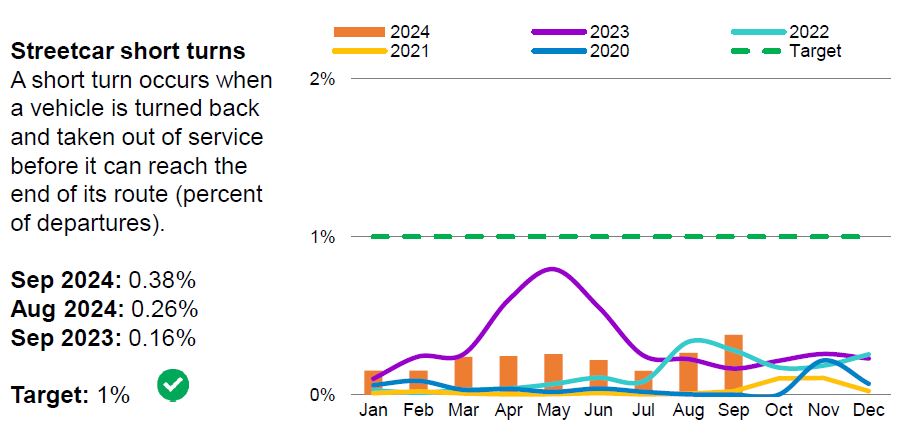
This chart is a fiction born of the Rick Leary era when, in theory, all short turns were banned and the stats were made to fit the objective. Like many KPIs, this suffers from a combination of system-wide consolidation across all routes and time periods, as well as under-reporting of what is really happening.
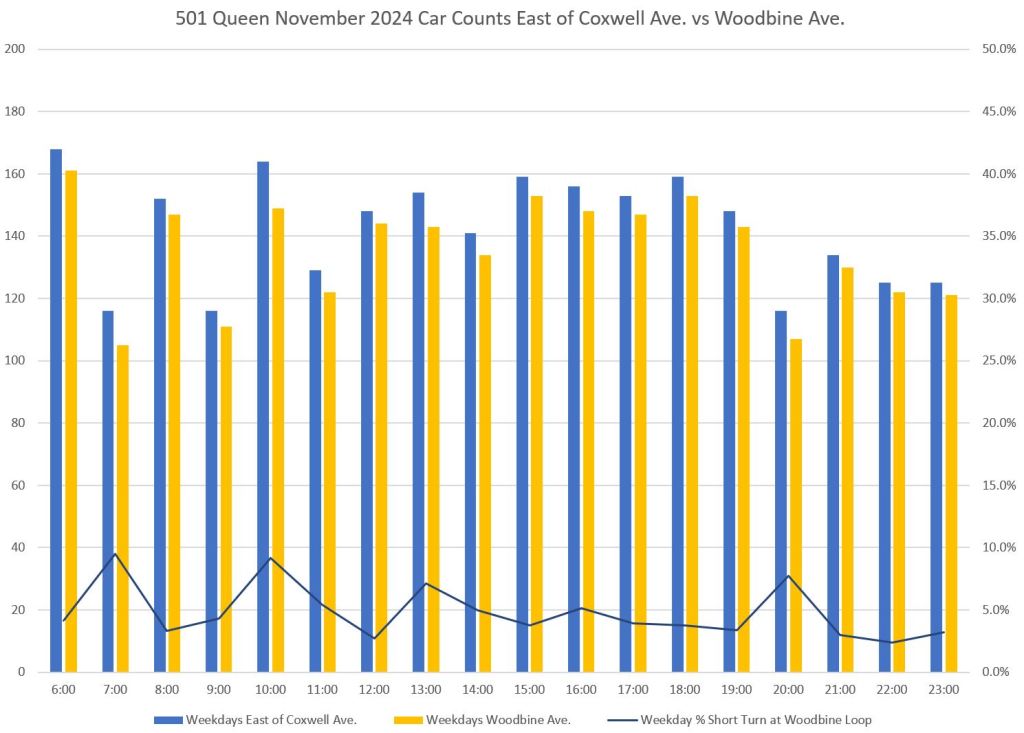
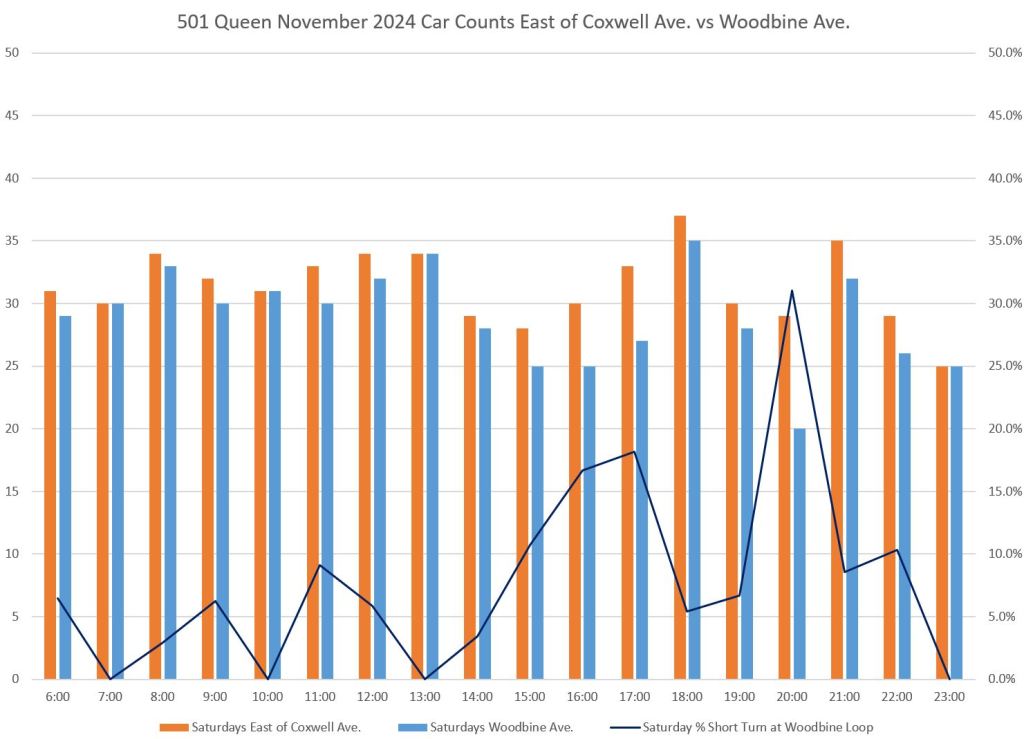
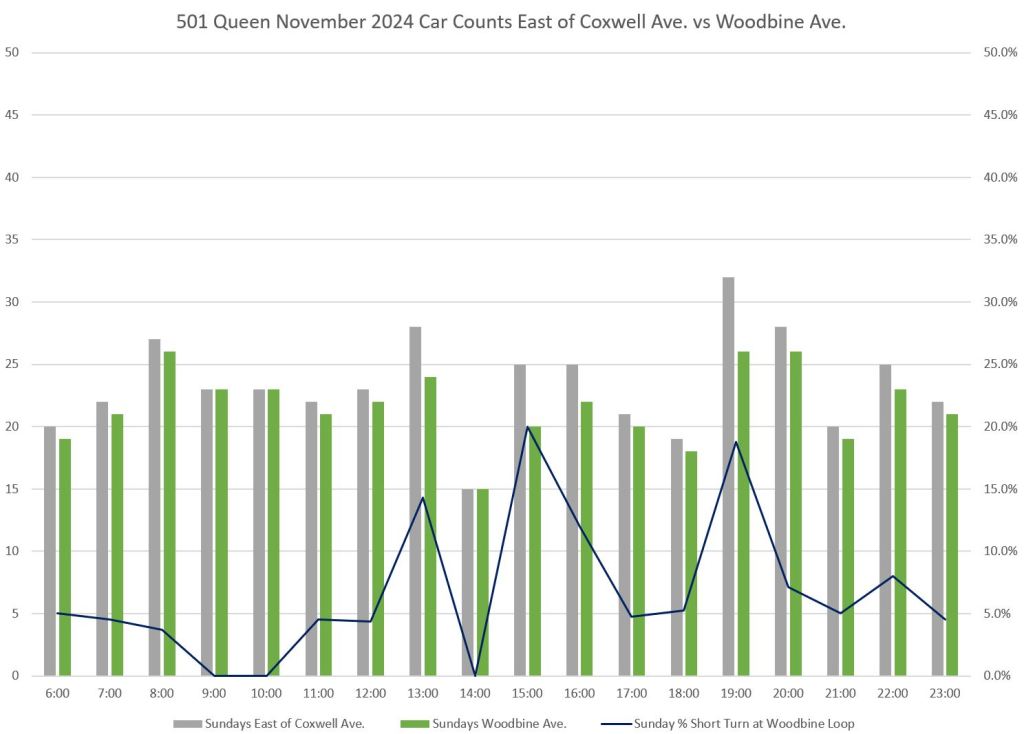
An easy way to get the true count is to look at tracking data and compare two points on either side of a short-turn location. For example, Woodbine Loop at Queen and Kingston Rd. is a favourite spot for 501 Queen and some 503 Kingston Road cars to turn back. Counting the number of vehicles crossing Coxwell (west of the loop) with the number at Woodbine Avenue (east of the loop) shows how many cars did not travel east of Kingston Road and, therefore, were short-turned.
The TTC claims that they better their 1% target for trips short turned, but it is clear that they rarely achieve this. In some cases, the value rises above 20% indicating that although much service does get to the terminal, there is a good chance that a rider will encounter a short turn. This is separate from frustrations caused by gaps and bunching.
Short turns happen for many reasons including traffic congestion, too-tight schedules, service blockages for collisions, medical problems, parades … it’s a long list. Riders really don’t care. The basic point is that service they expected to receive is not there, and usually with no advance warning.
The table below summarizes the statistics from the vehicle tracking records in November 2024 for the period from 6am to midnight. It is clear that even on an aggregated level, the proportion of short turns is much higher on these routes that the TTC KPIs indicate.
Updated Dec. 6/24 at 1:30pm: Short turn counts for 504 King eastbound, 507 Long Branch and 508 Lake Shore westbound trips added.
Note: The legends on the original charts in this post were misleading. They have been changed to better reflect what the columns and lines on the charts represent..
| Route | Location | Total Trips | Short Turns | % Short Turns |
|---|---|---|---|---|
| 501 Queen | Woodbine Loop EB | 3547 | 198 | 5.6% |
| Roncesvalles WB | 3537 | 247 | 7.0% | |
| 503 Kingston Rd | Woodbine Loop EB | 3252 | 136 | 4.2% |
| 504 King | Spadina WB | 6453 | 256 | 4.0% |
| Roncesvalles WB | 3275 | 364 | 11.1% | |
| Church EB | 6319 | 126 | 2.0% | |
| Parliament EB | 6198 | 204 | 3.3% | |
| Dundas EB | 2943 | 71 | 2.4% | |
| 505 Dundas | Parliament EB | 3040 | 212 | 7.0% |
| Lansdowne WB | 3062 | 397 | 13.0% | |
| 506 Carlton | Coxwell EB | 3031 | 293 | 9.7% |
| Lansdowne WB | 3256 | 572 | 17.6% | |
| 507 Long Branch | Kipling WB | 2074 | 88 | 3.0% |
| 508 Lake Shore | Kipling WB | 193 | 19 | 9.8% |
| 512 St. Clair (*) | Lansdowne WB | 2068 | 249 | 12.0% |
| Oakwood WB | 2113 | 122 | 5.8% |
(*) For 512 St. Clair, only data from November 14 onwards when streetcar service was restored are included.
Introduction
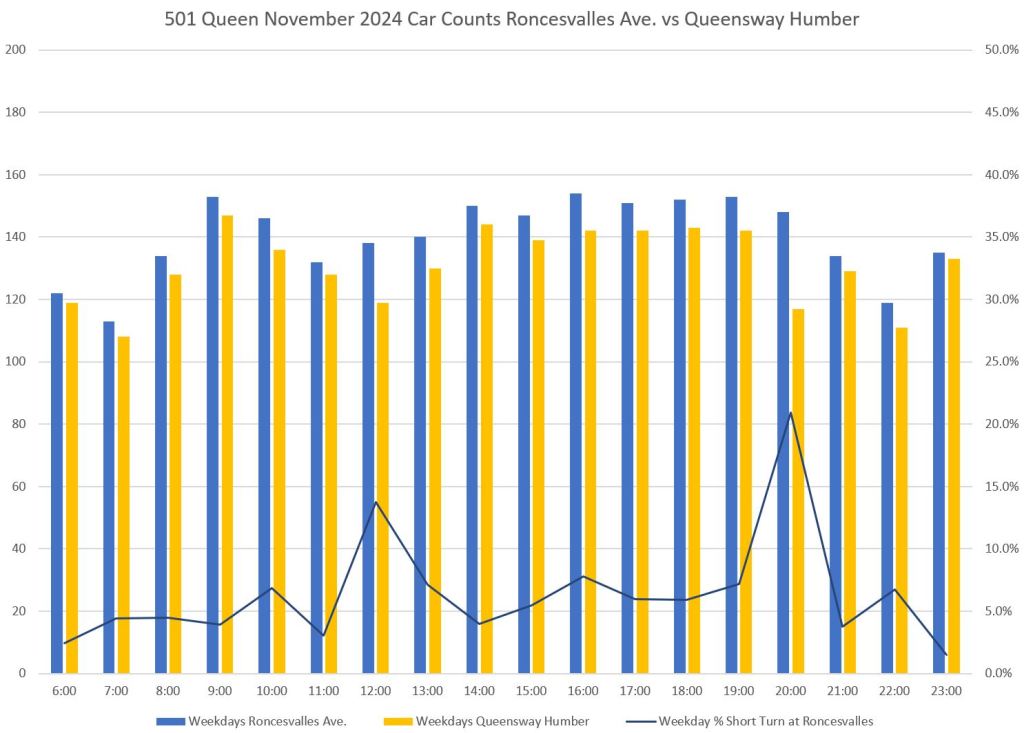
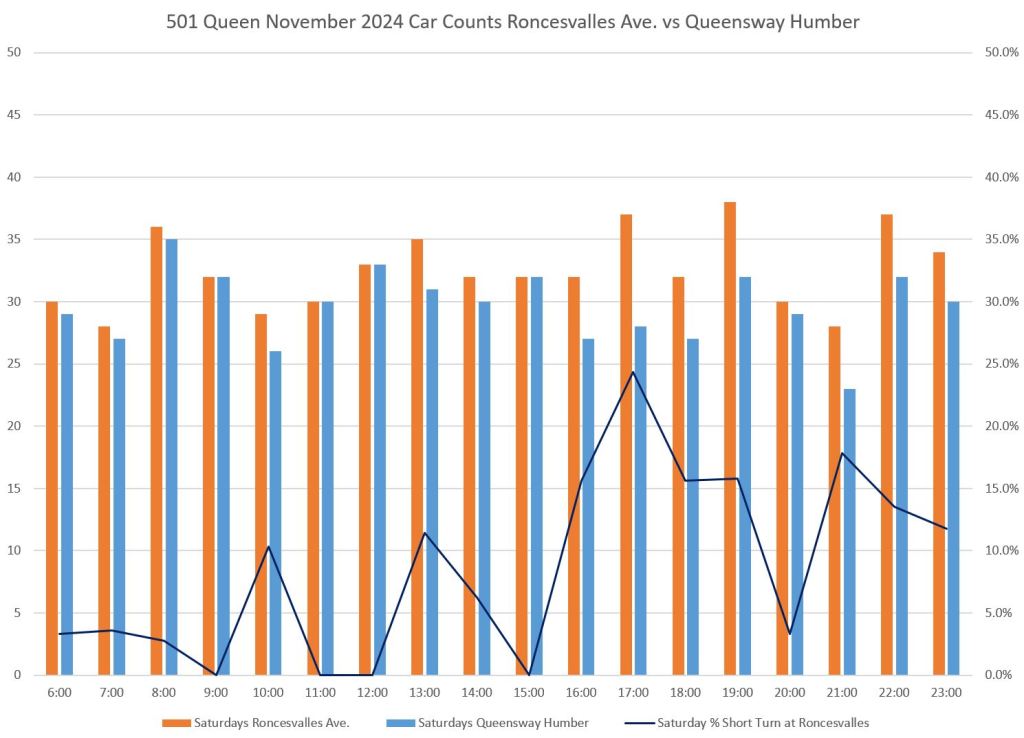
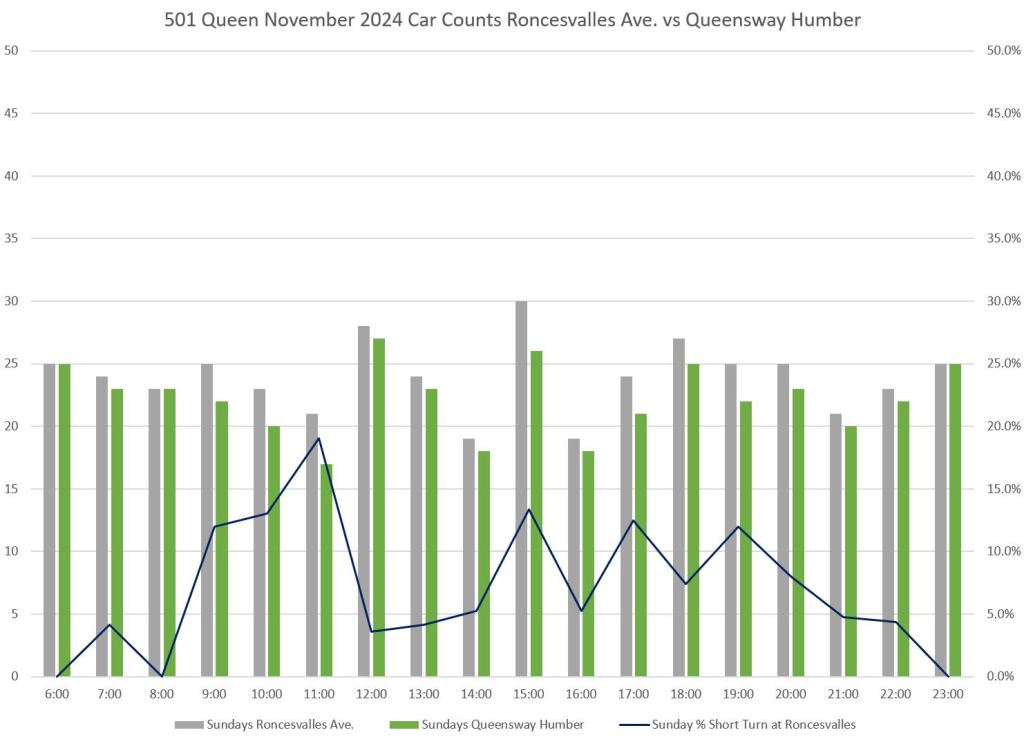
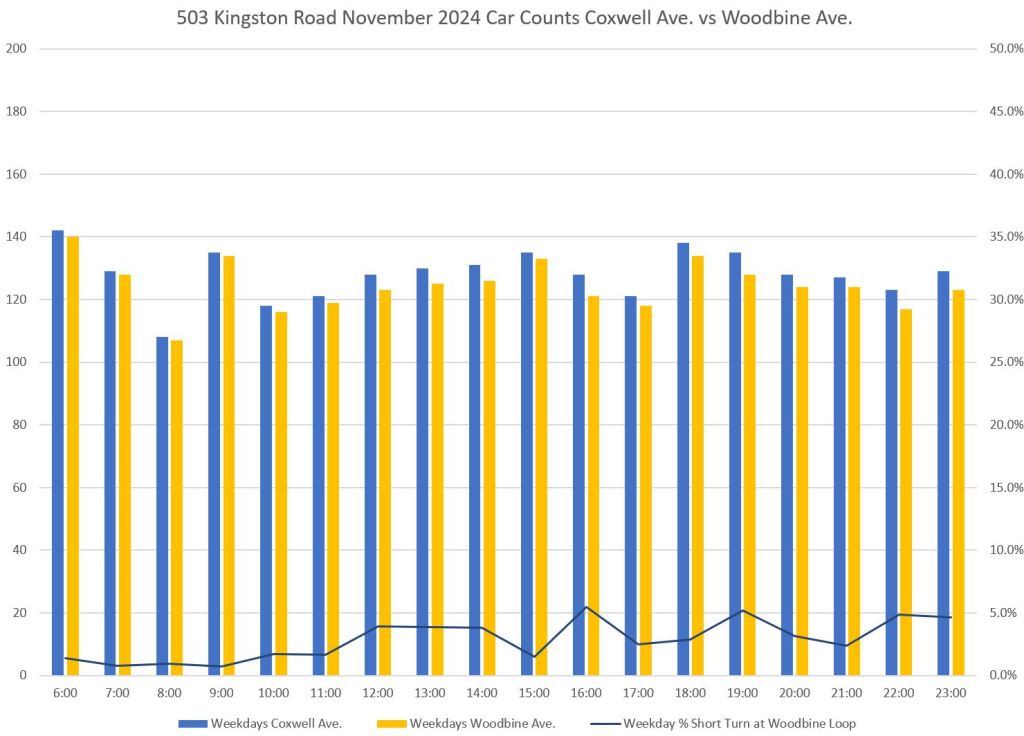
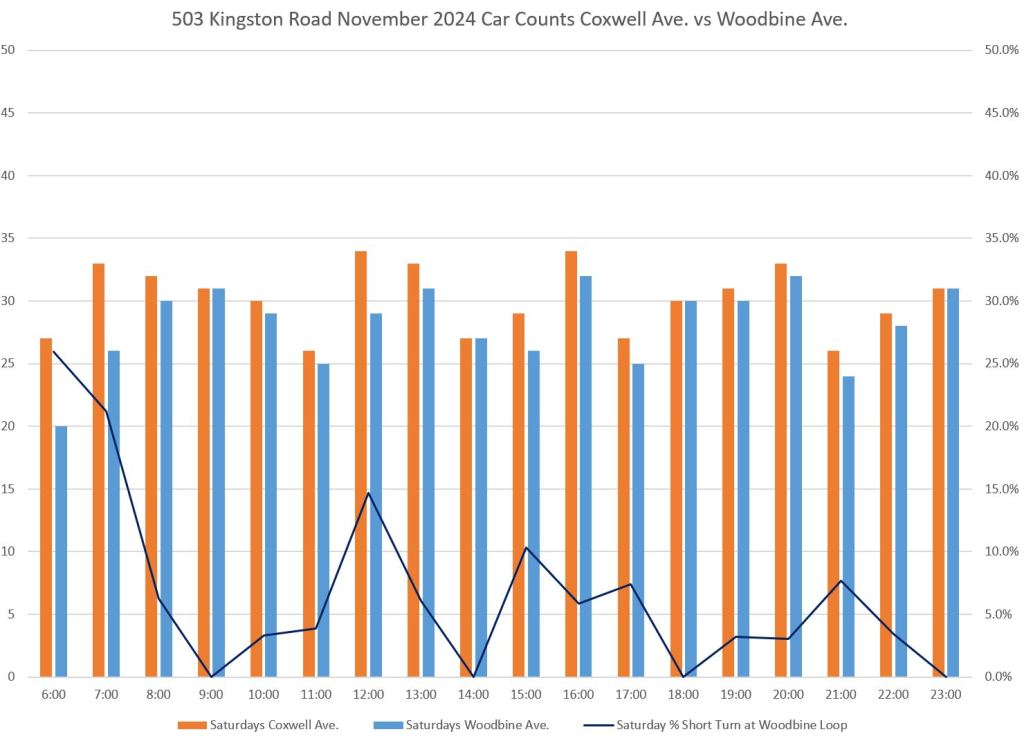
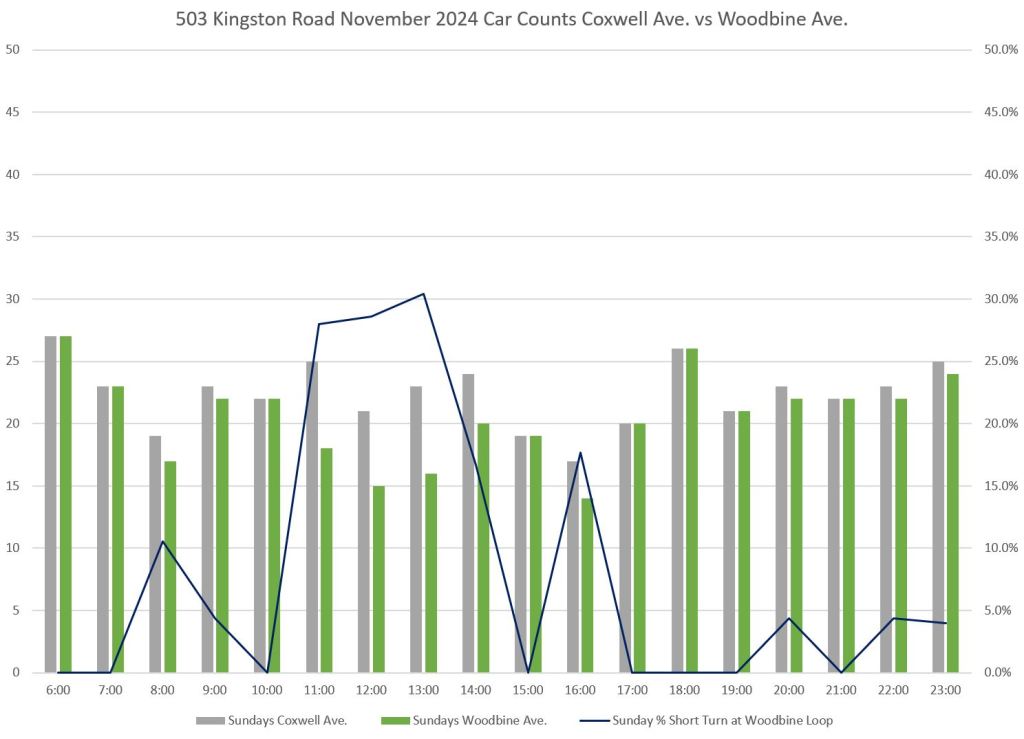
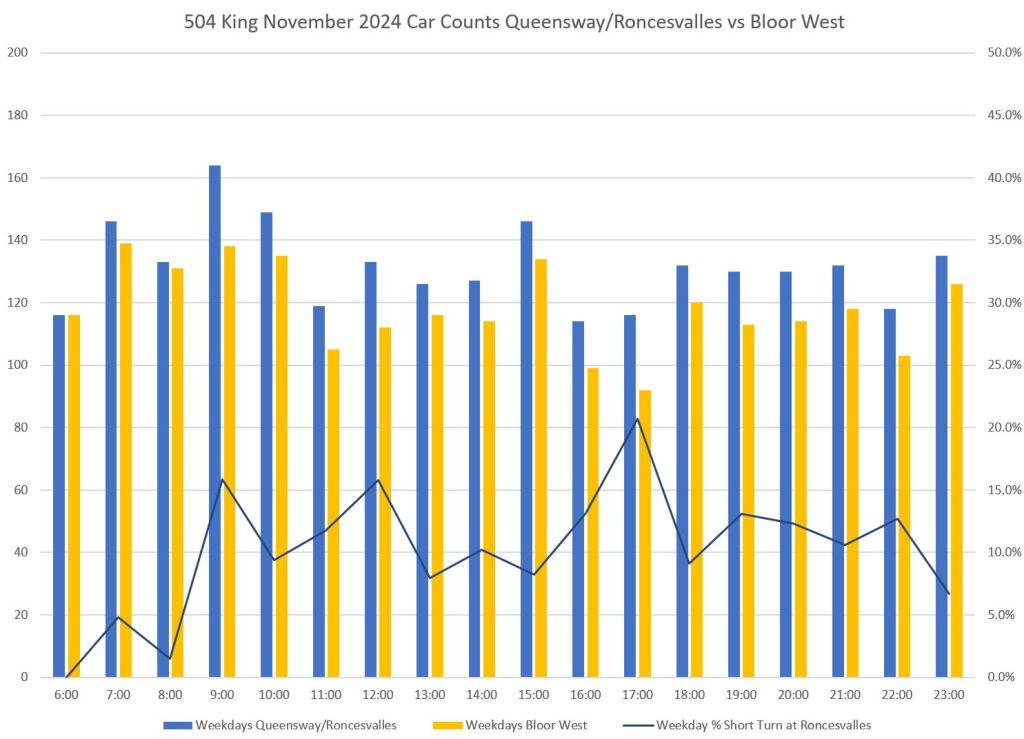
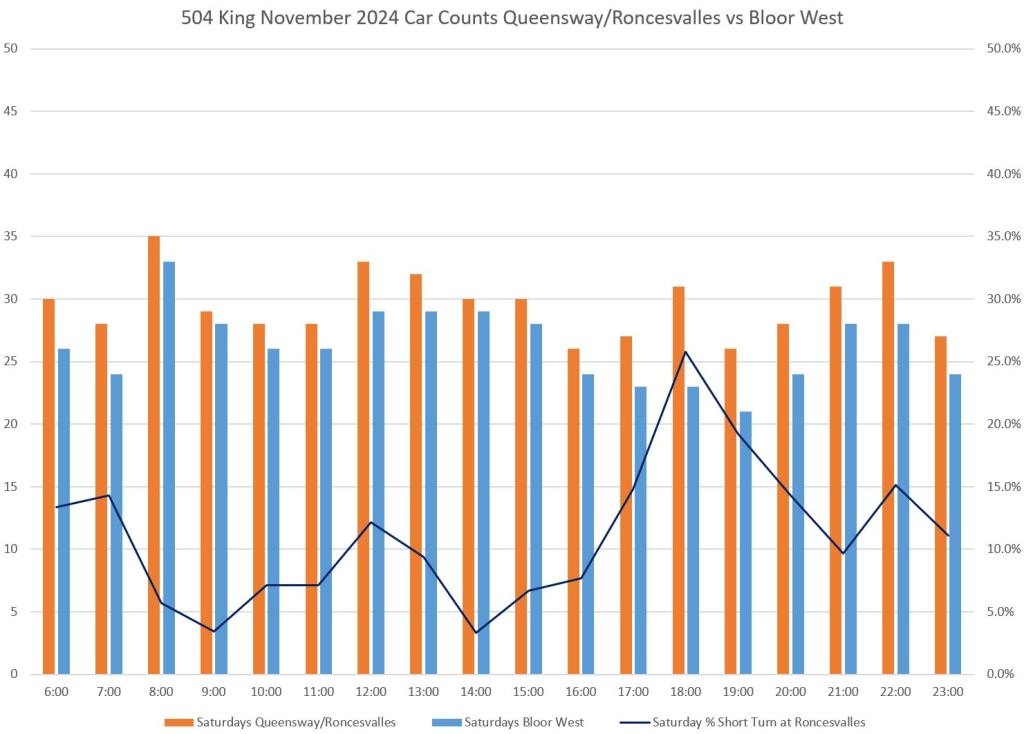
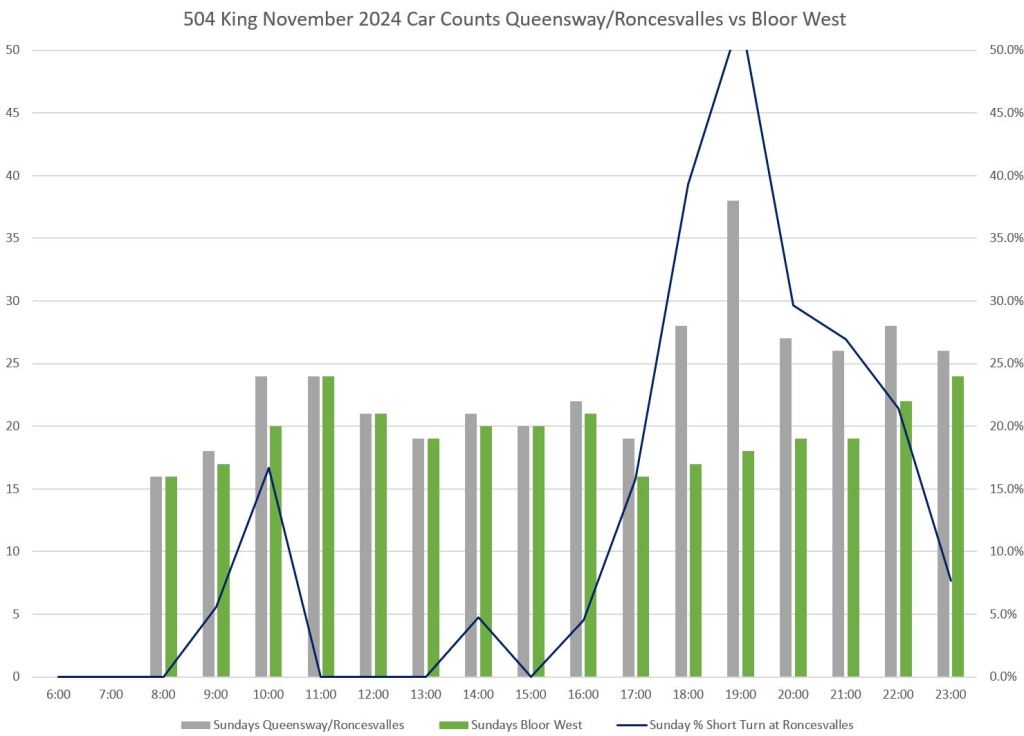
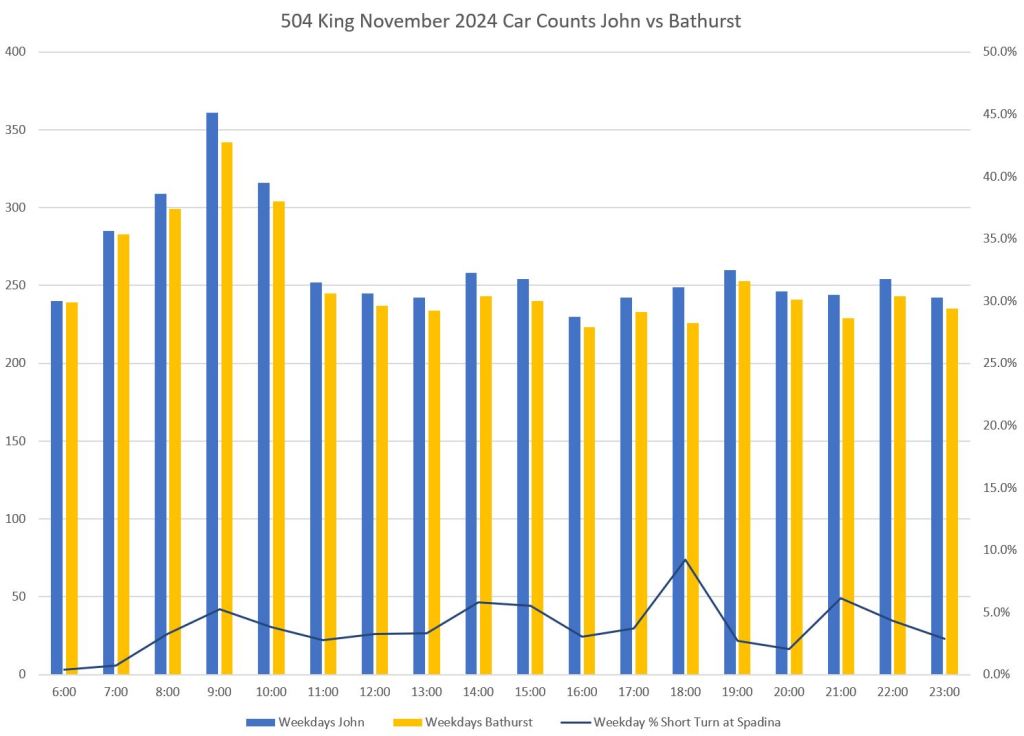
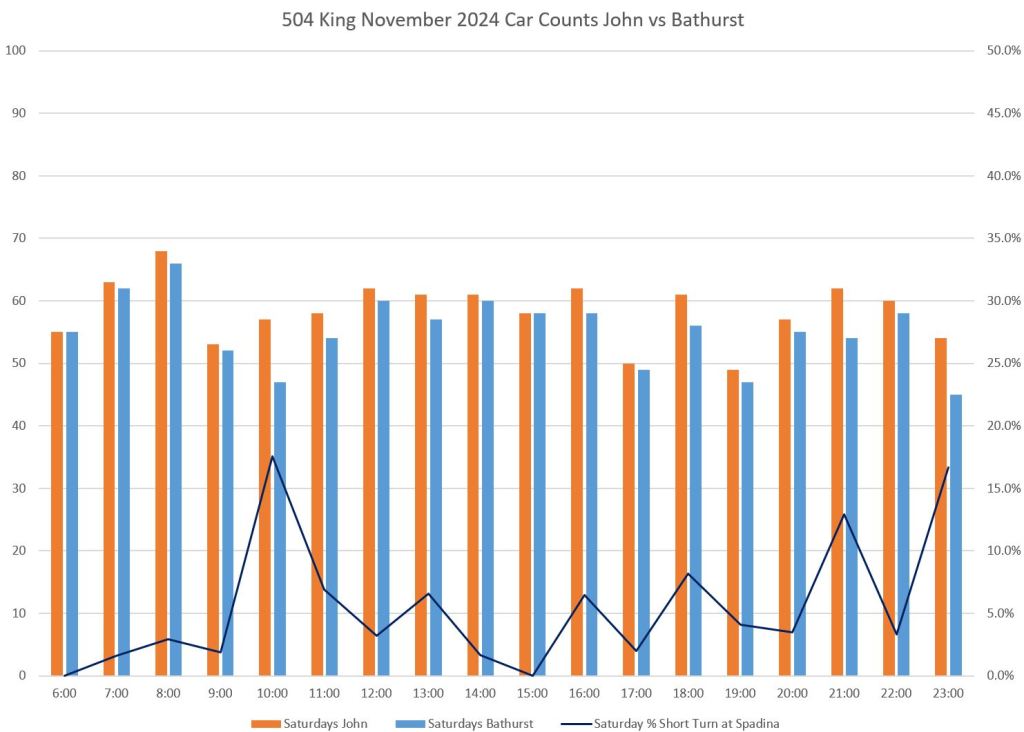
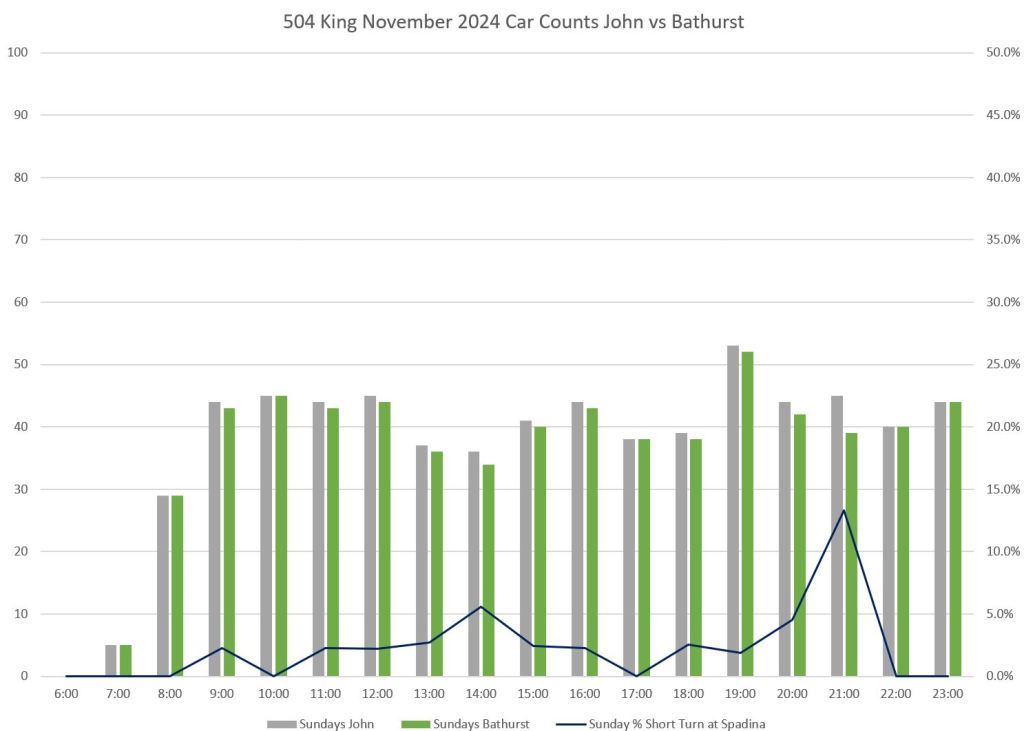
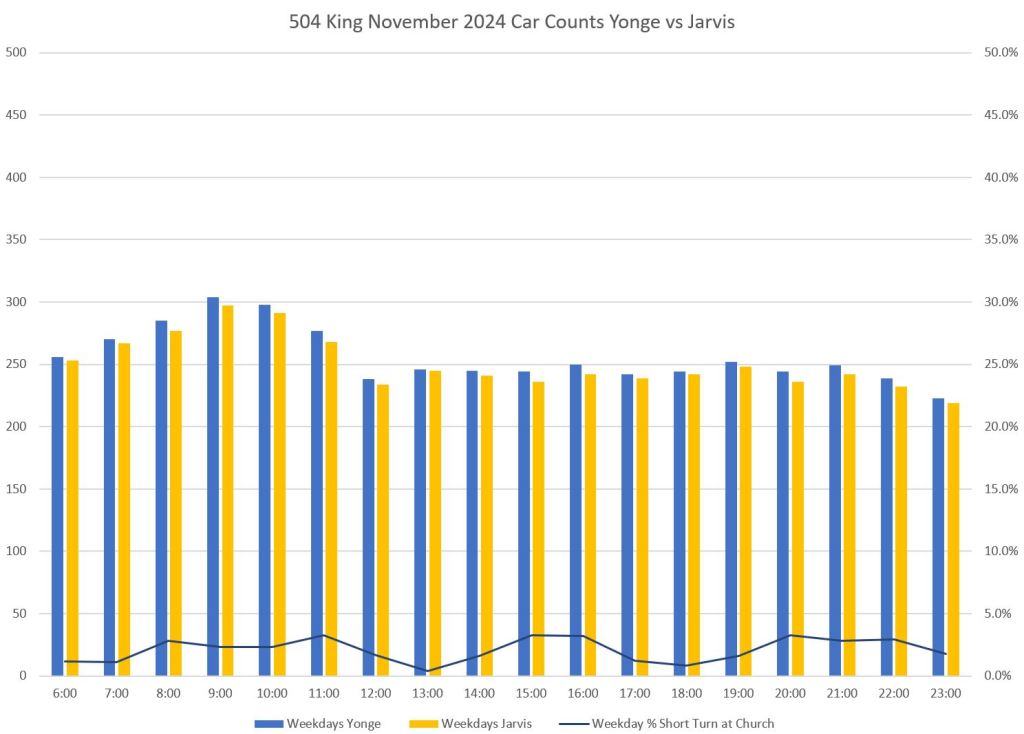
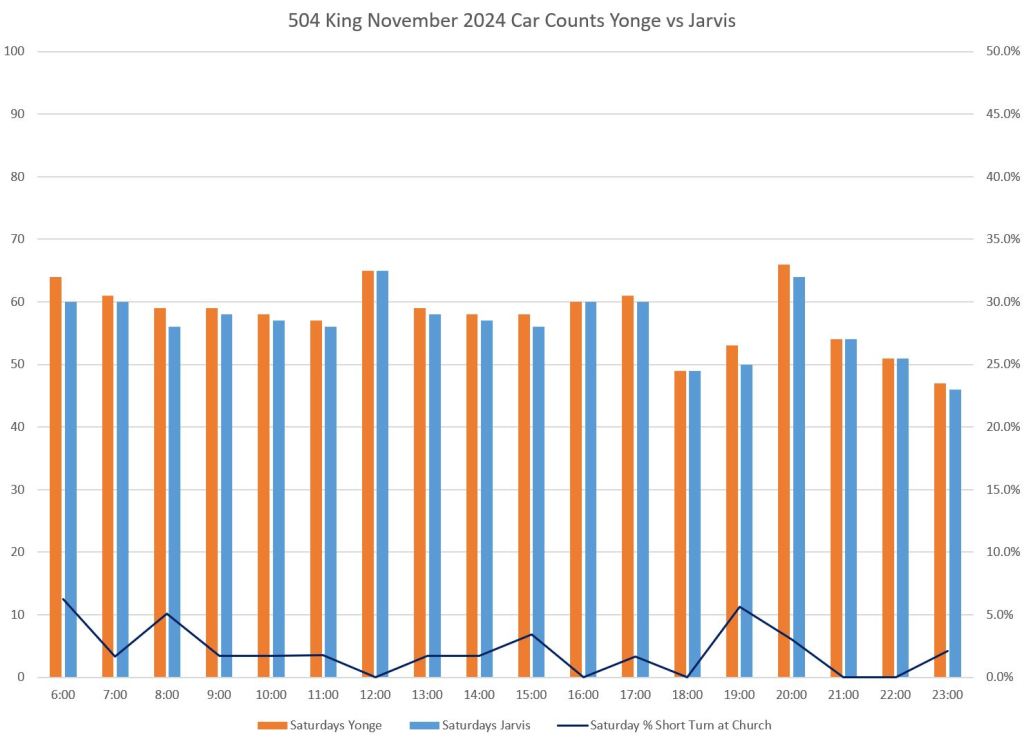
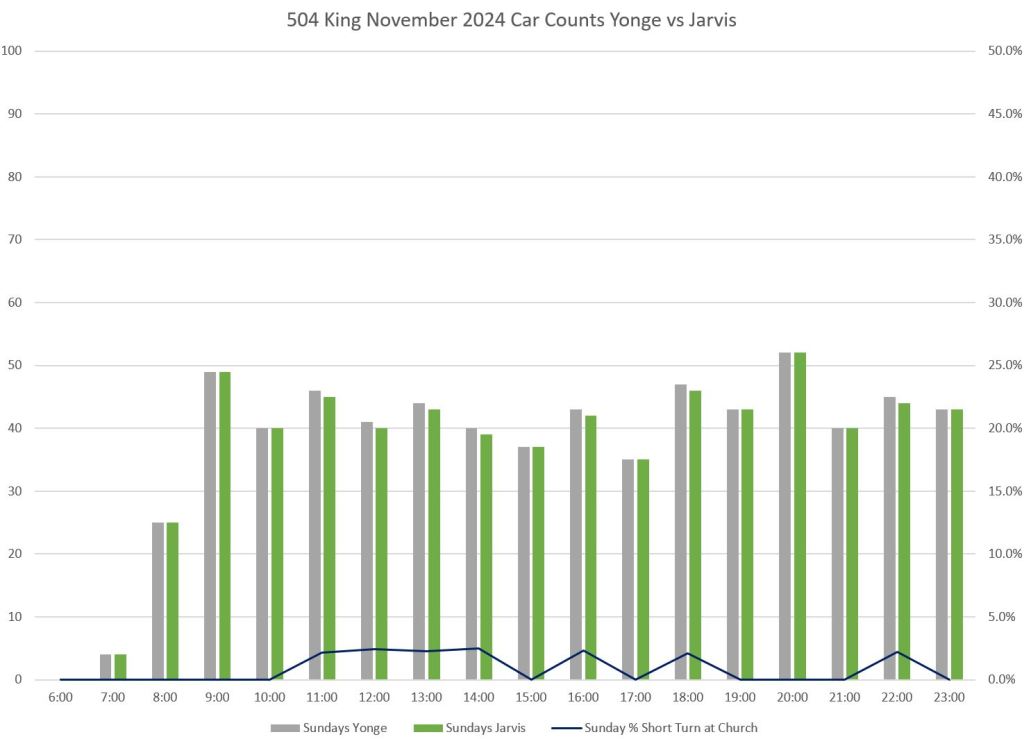
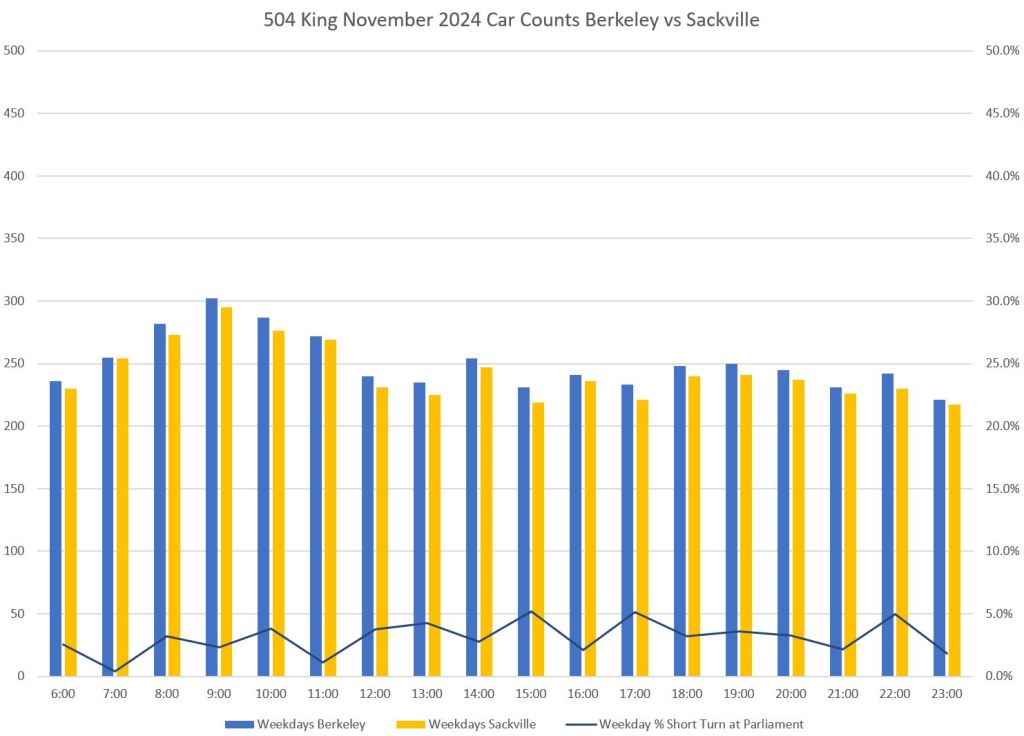
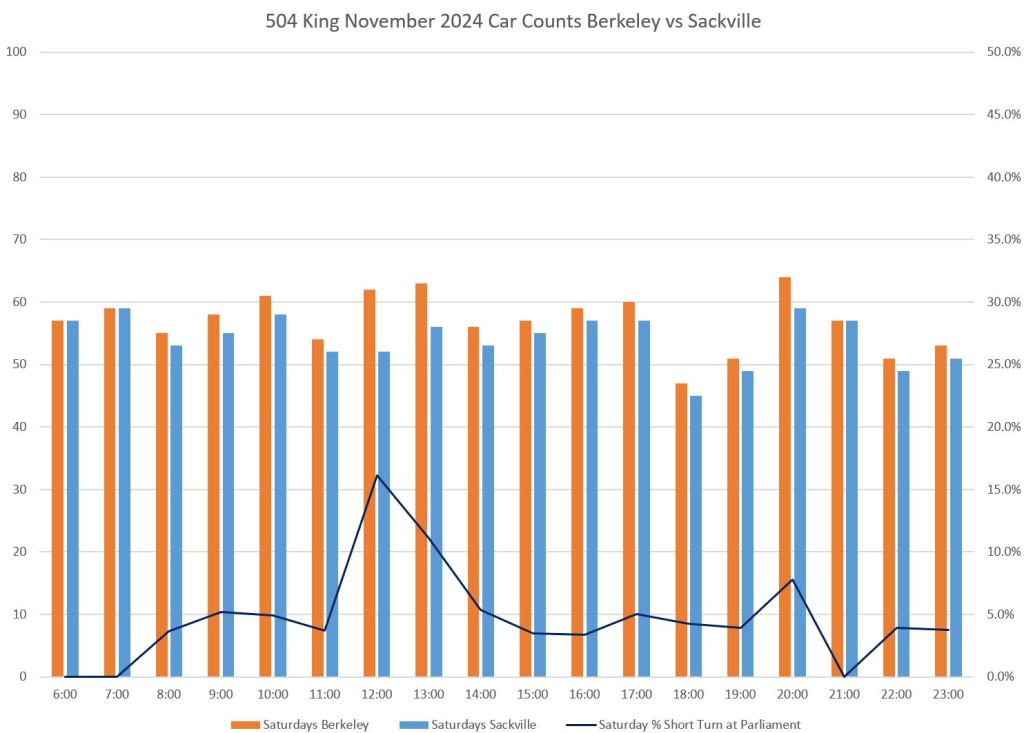
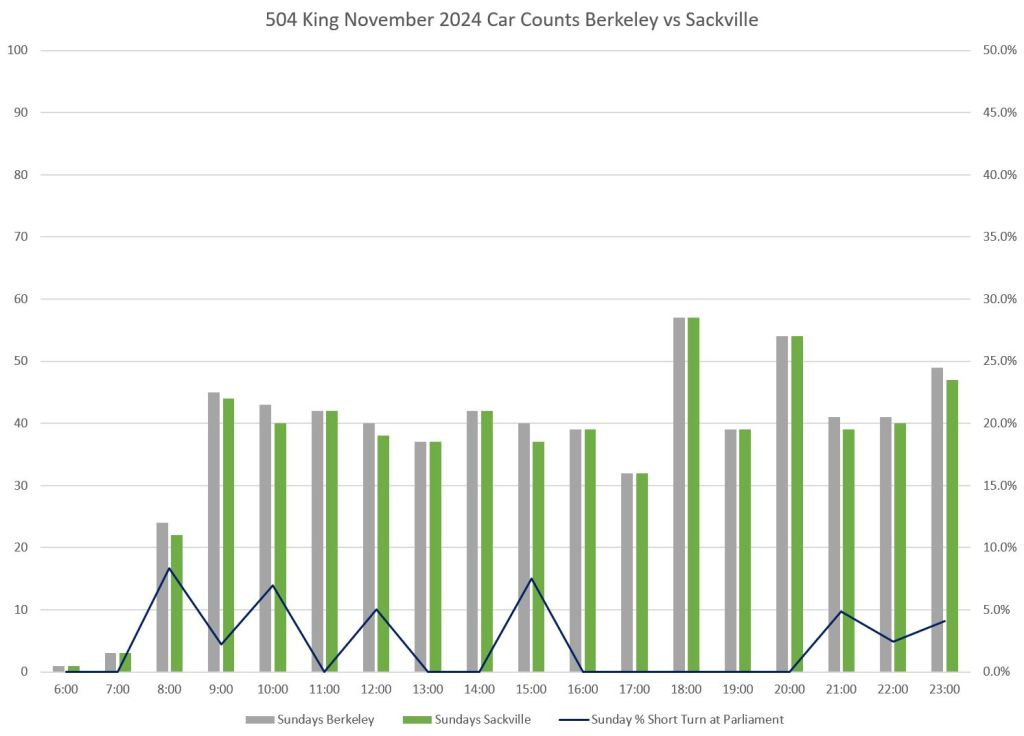
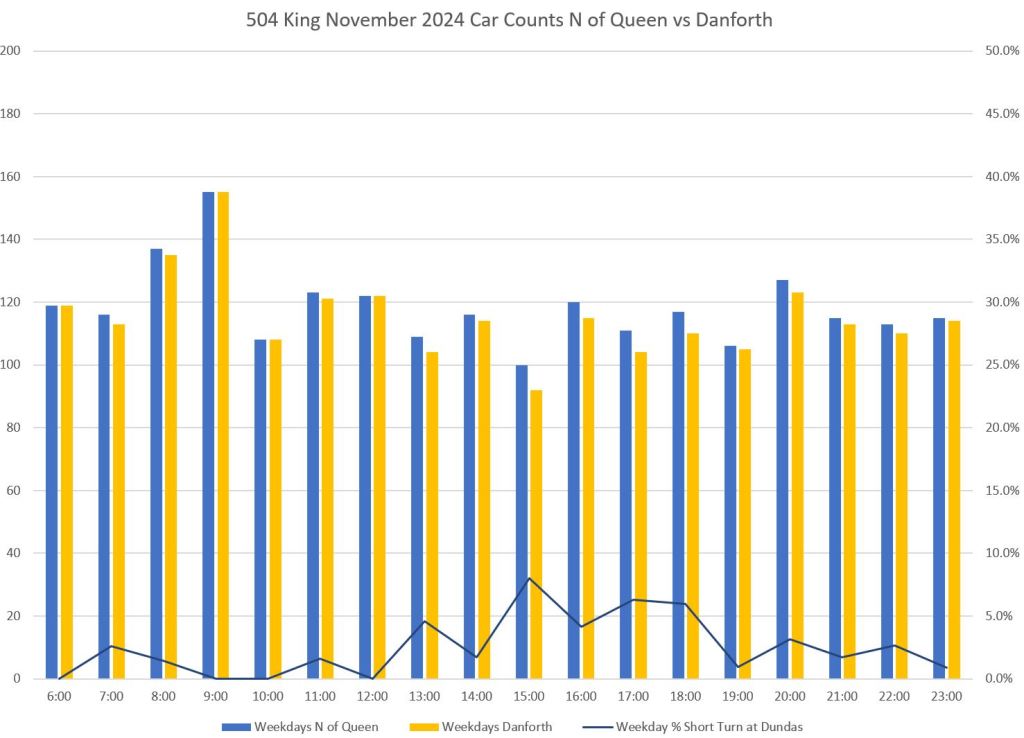
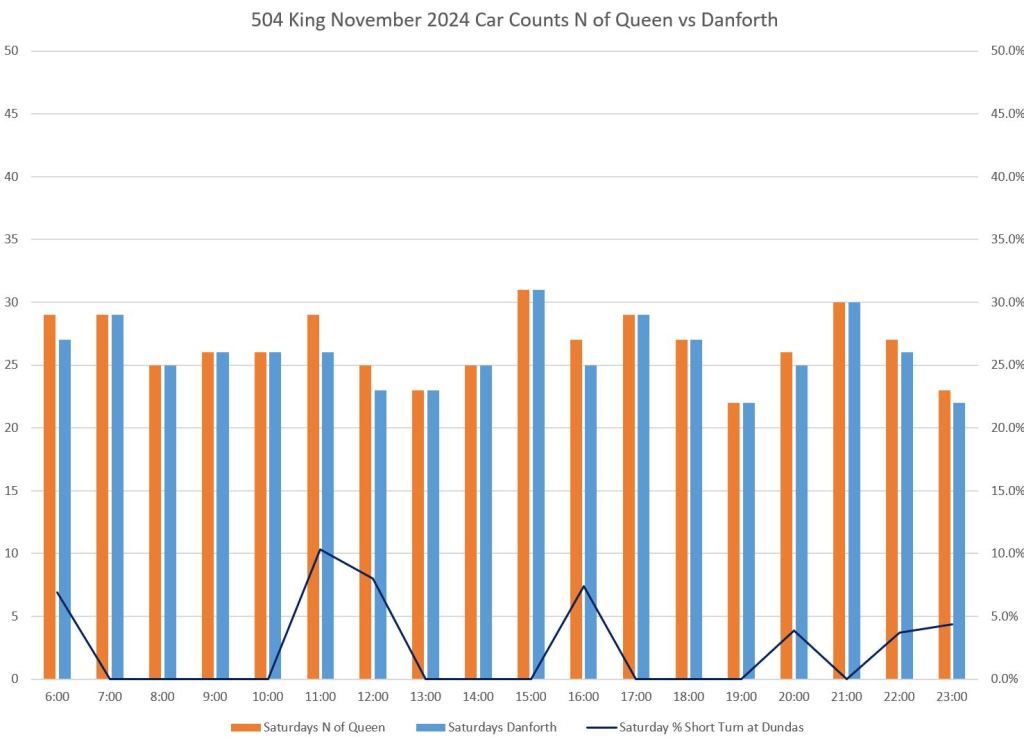
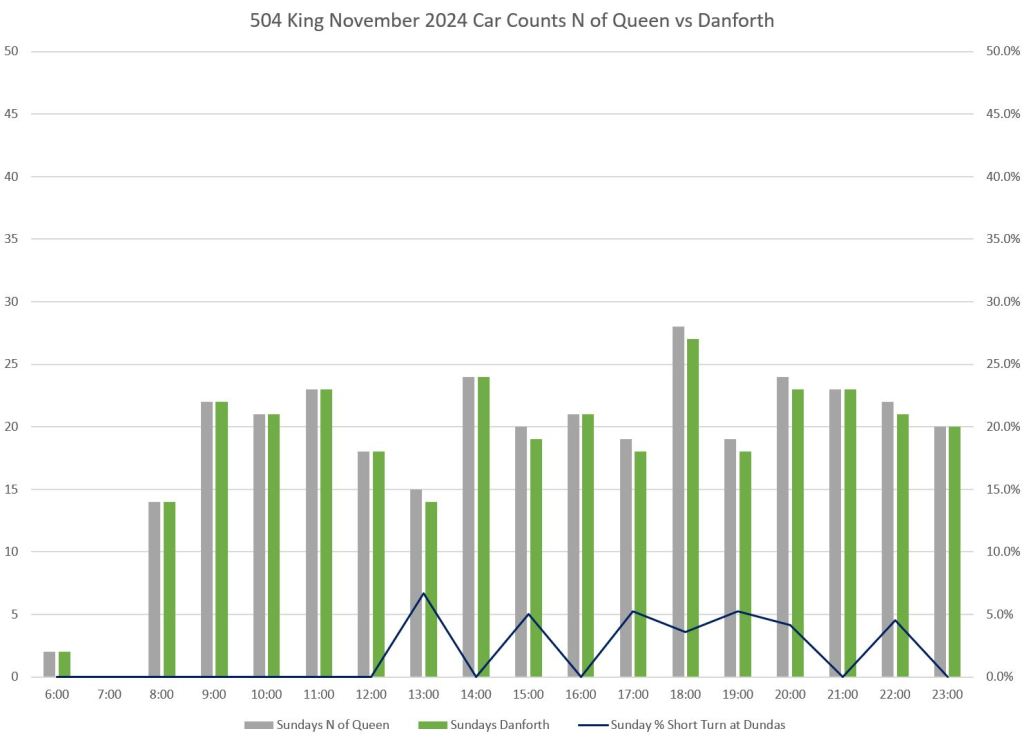
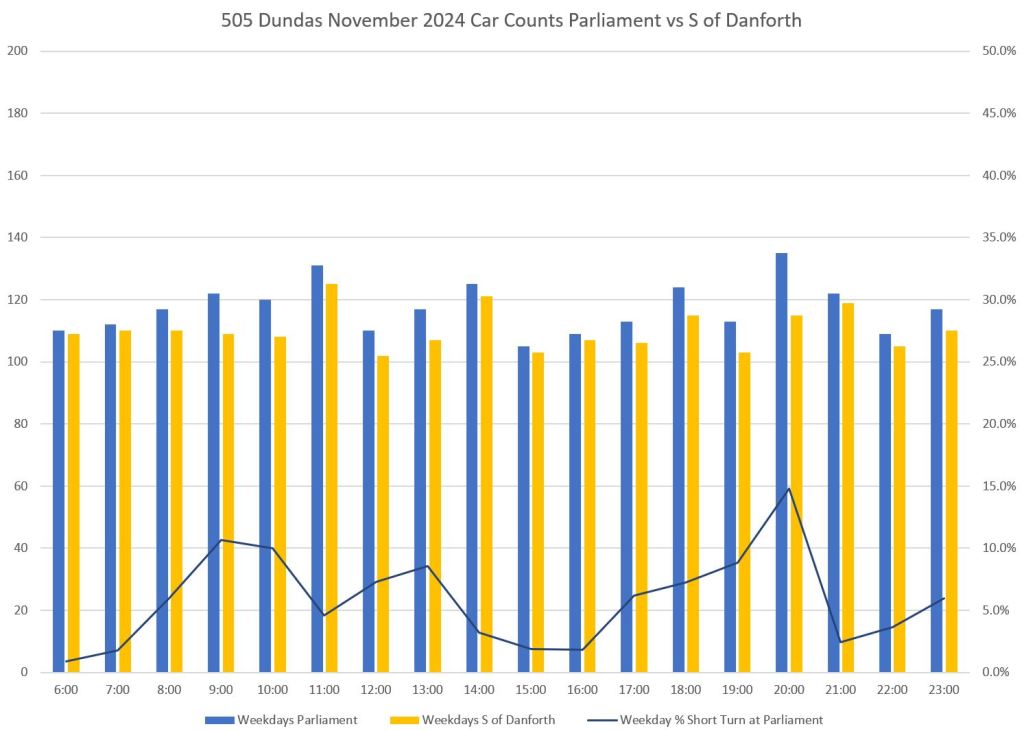
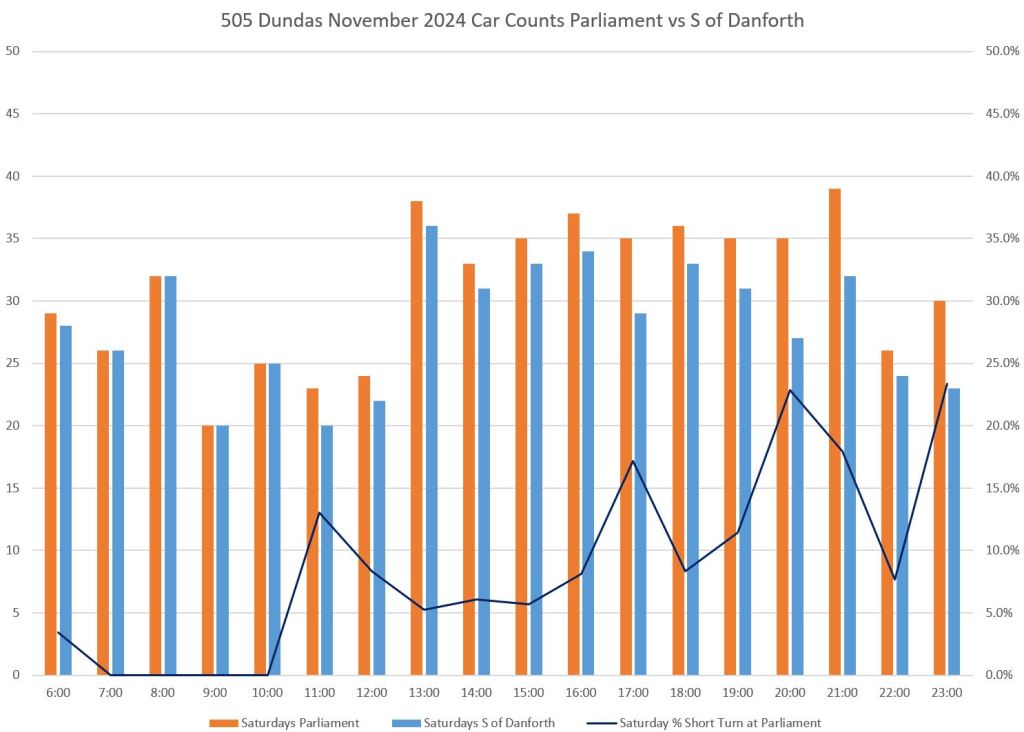
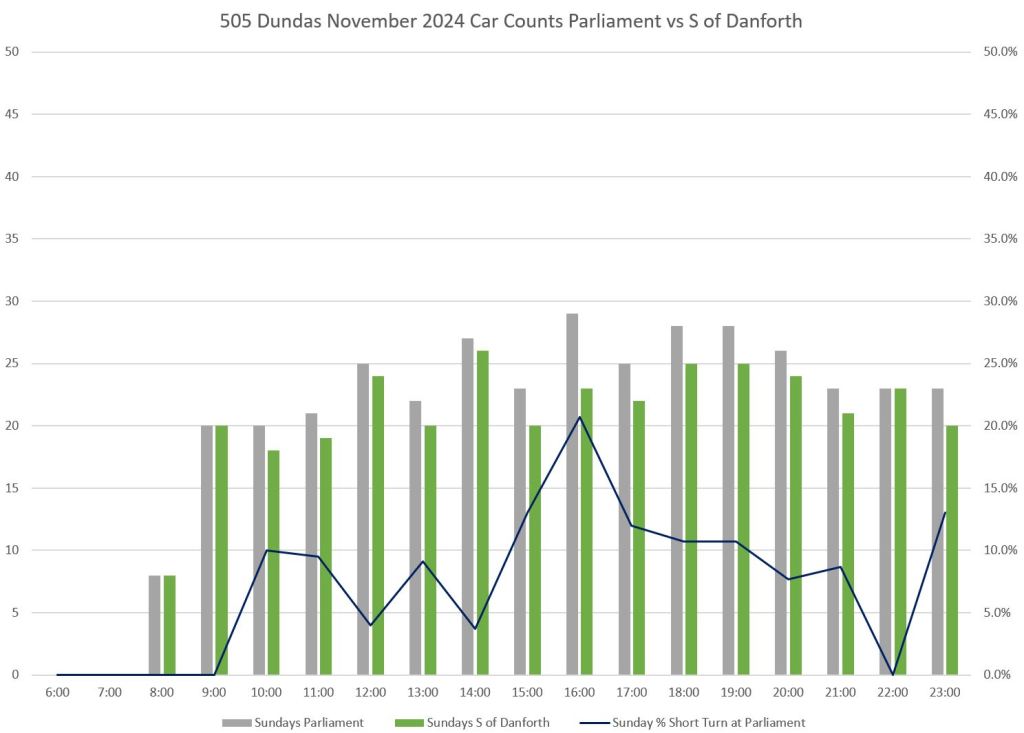
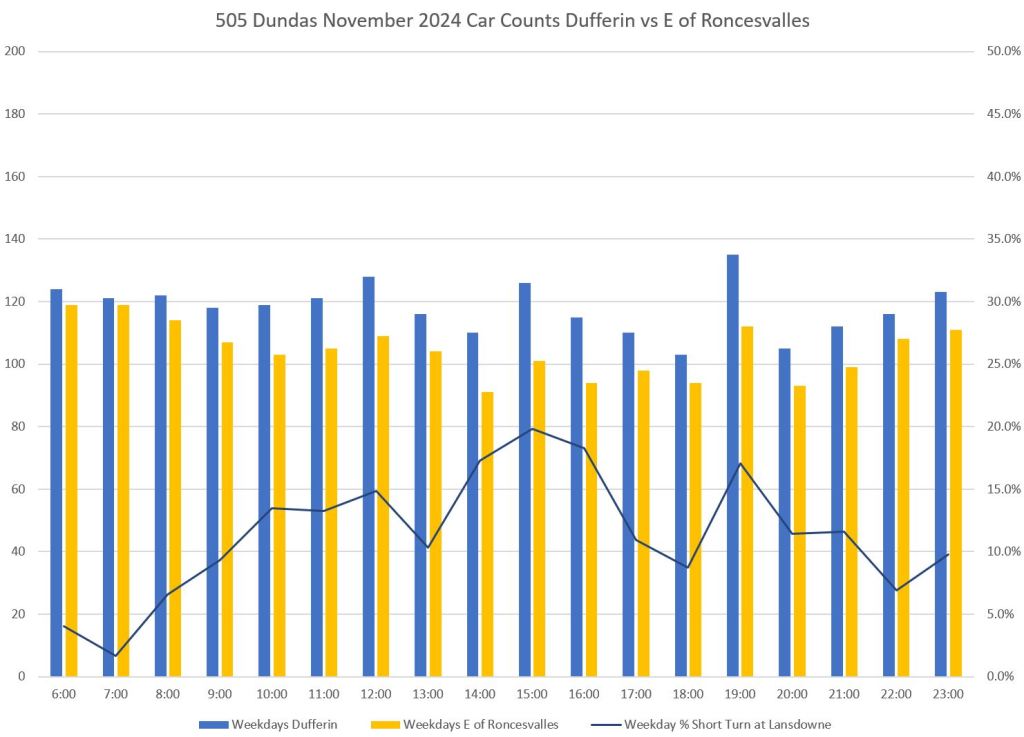
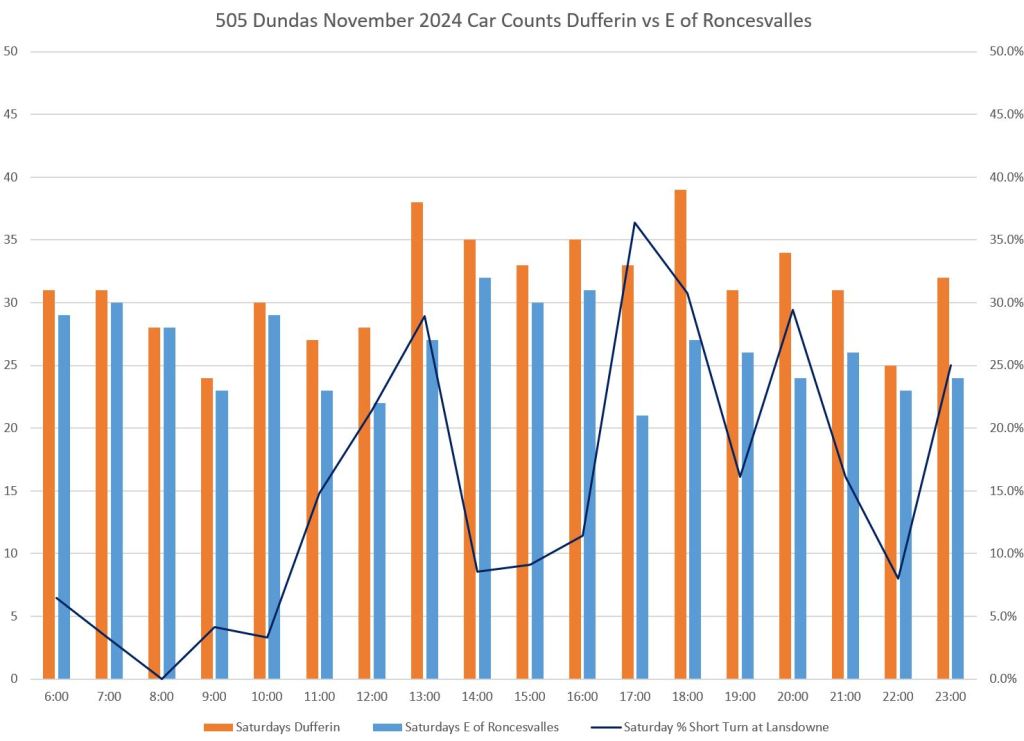
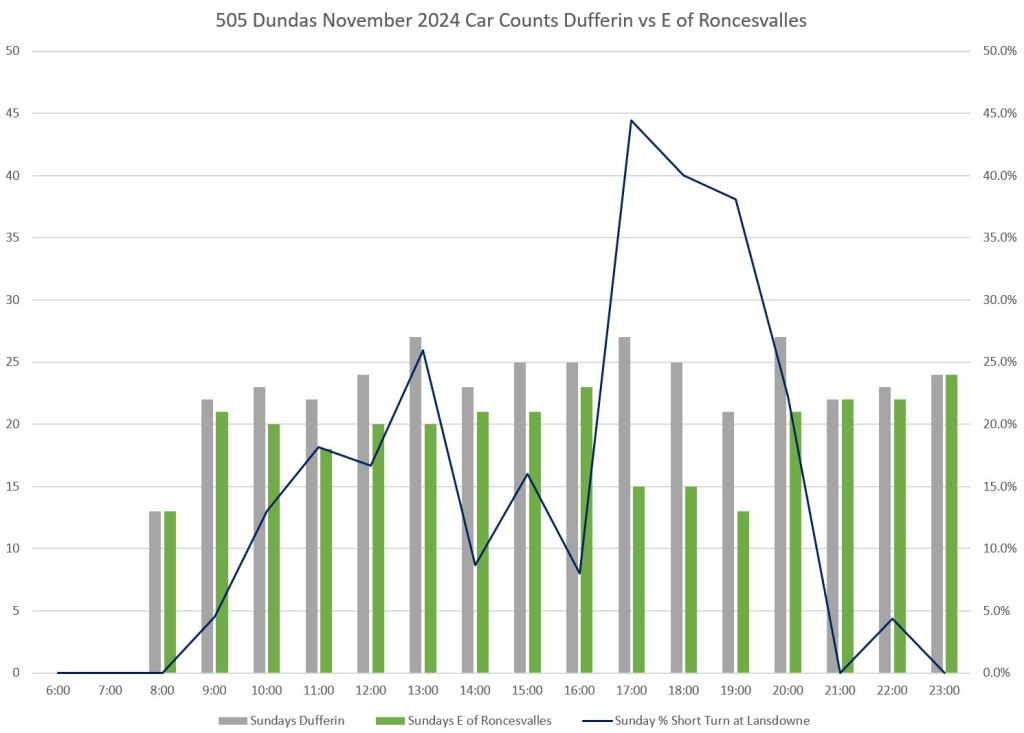
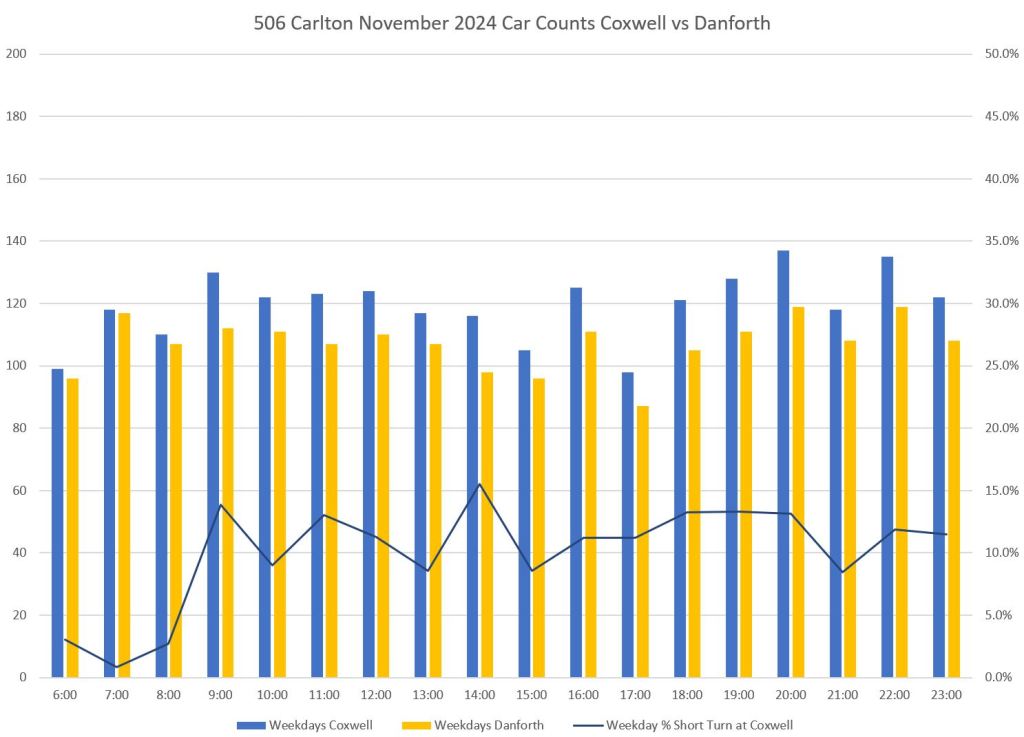
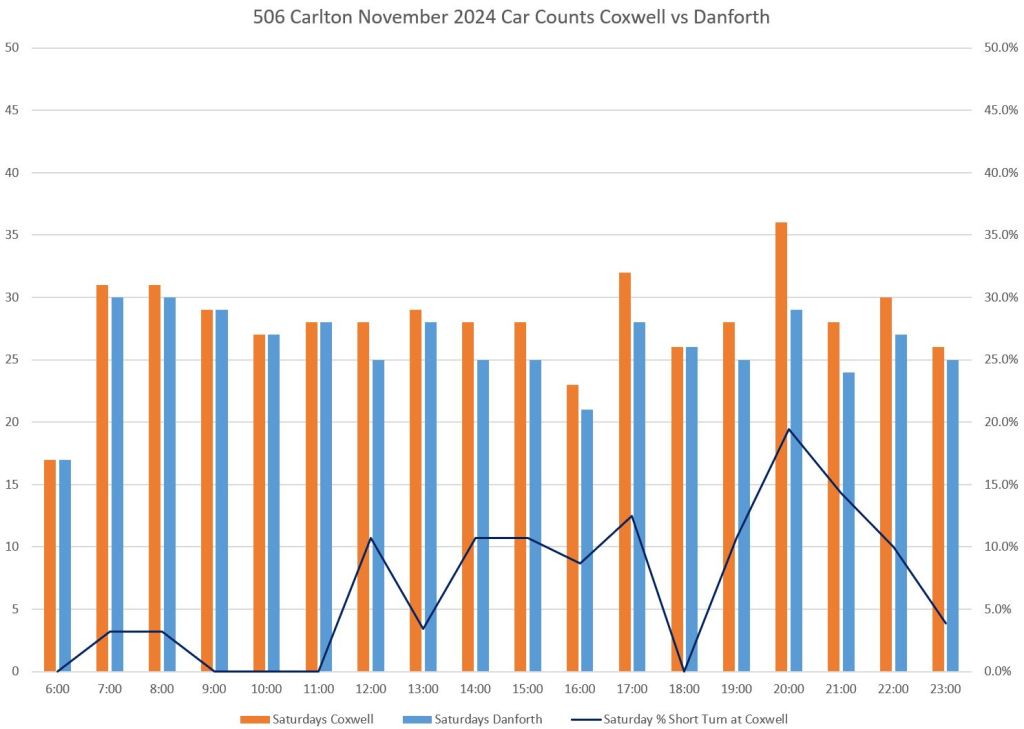
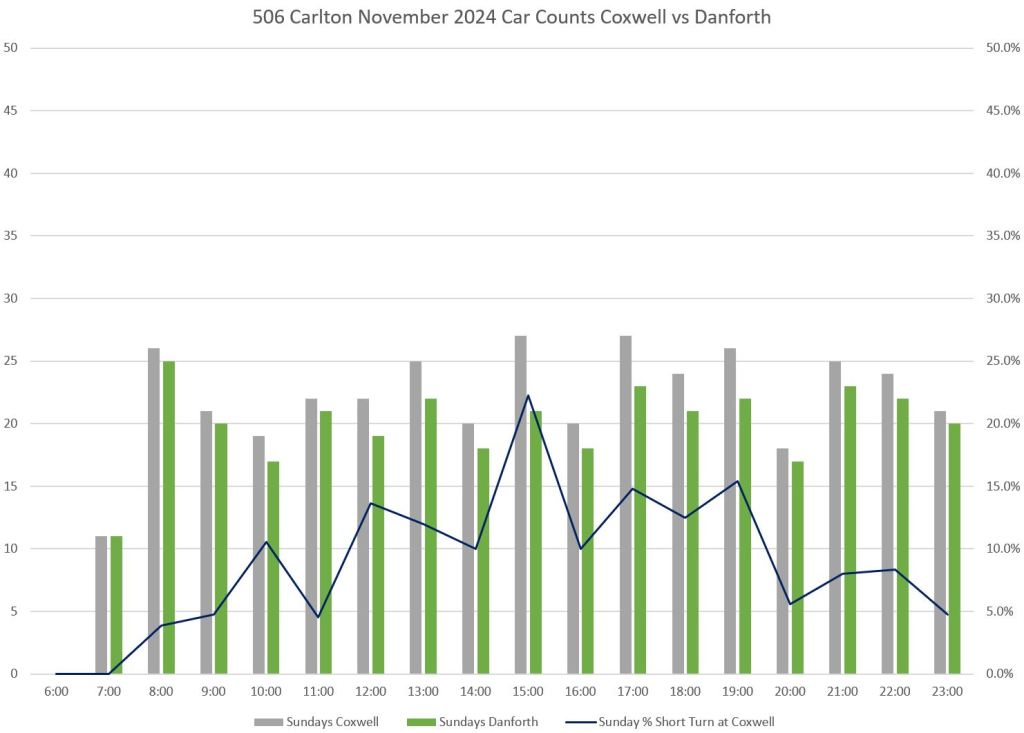
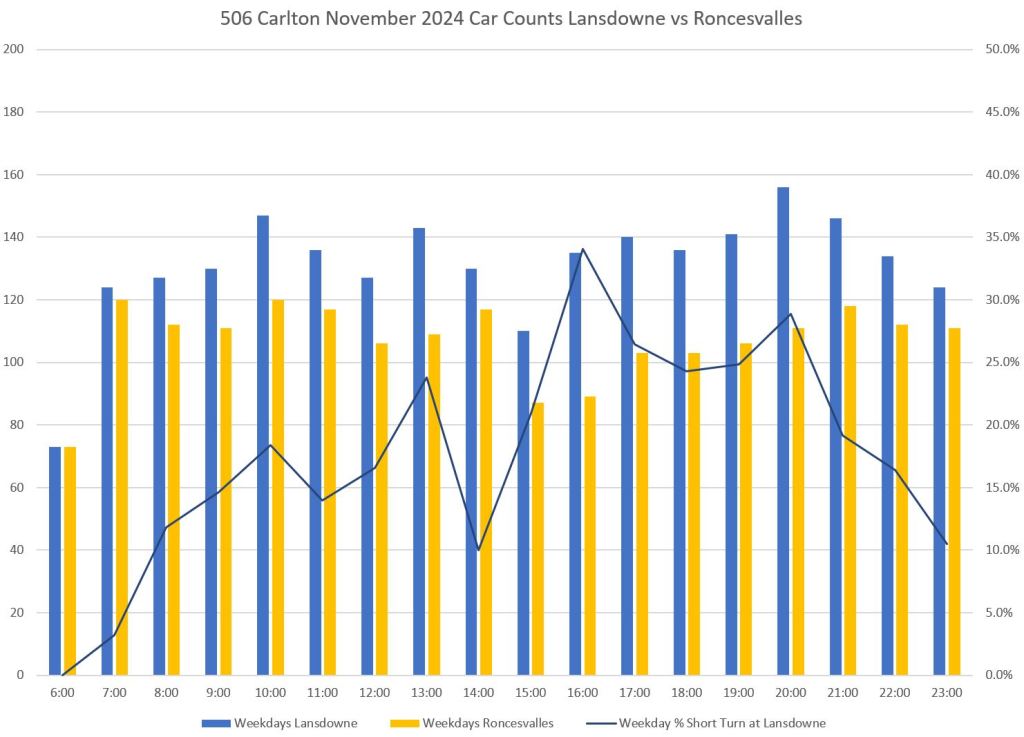
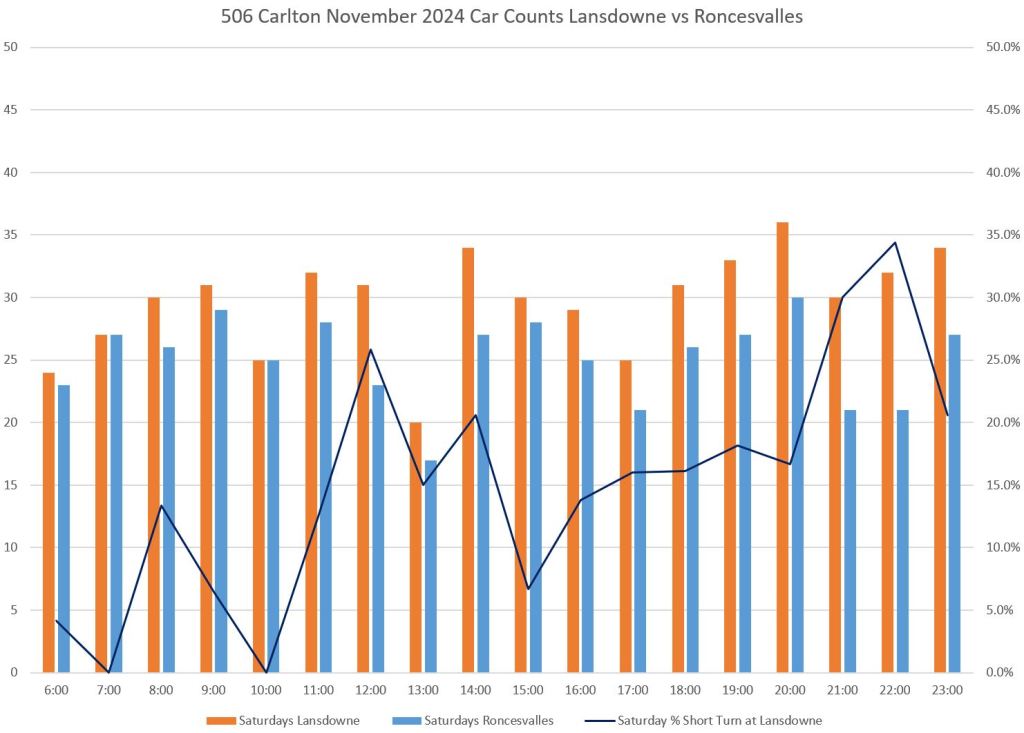
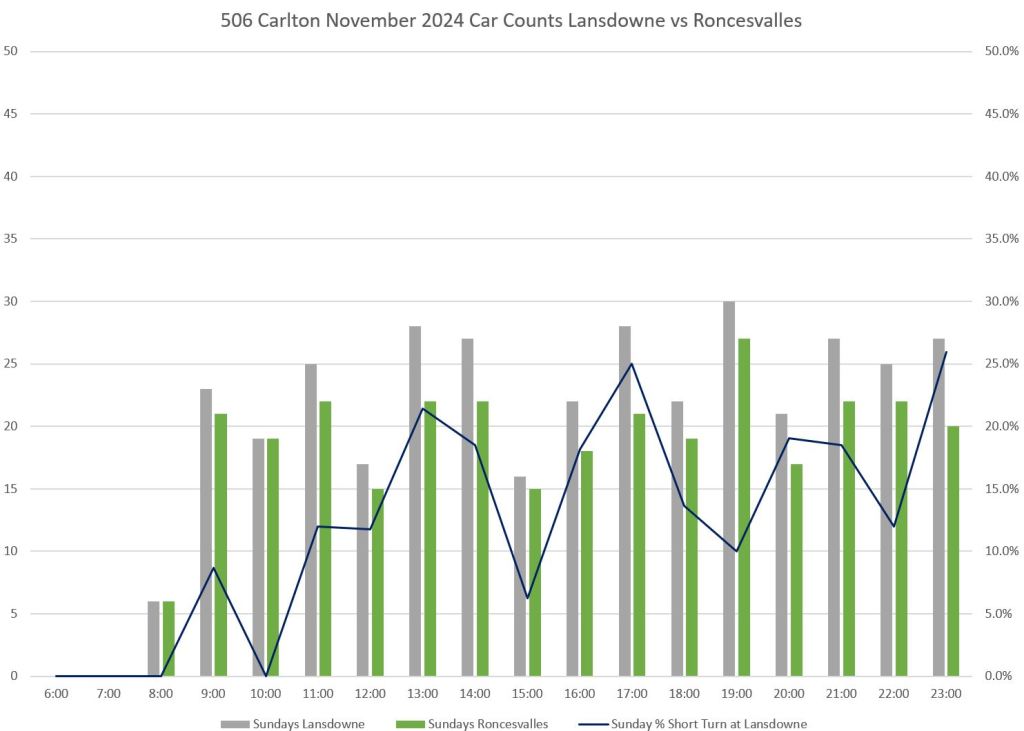
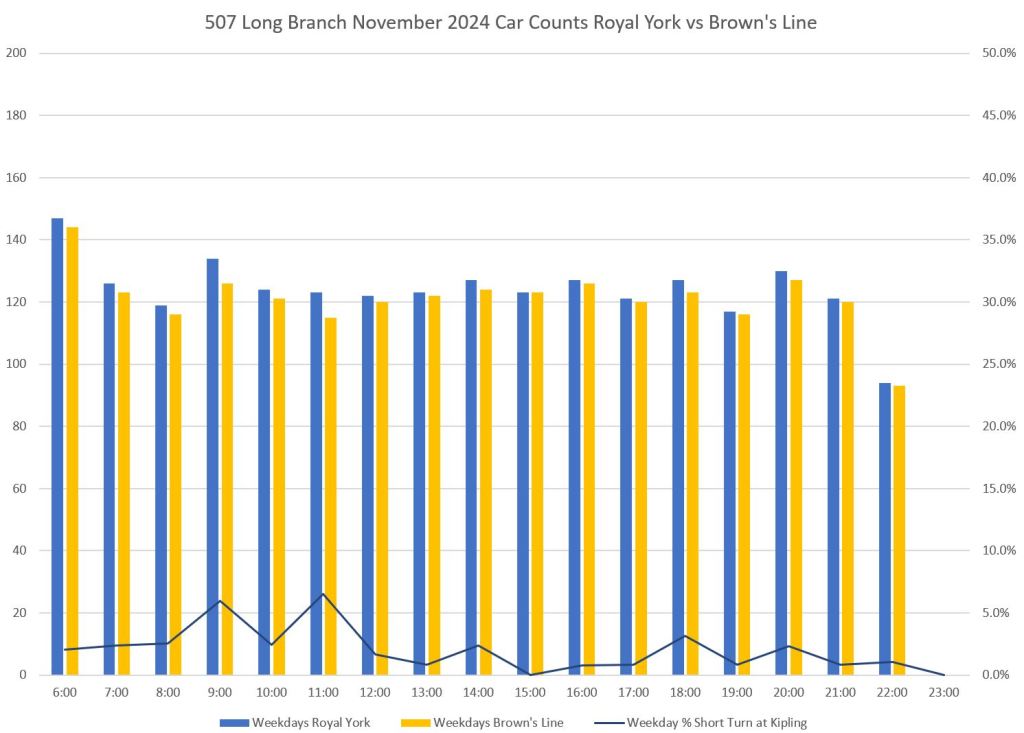
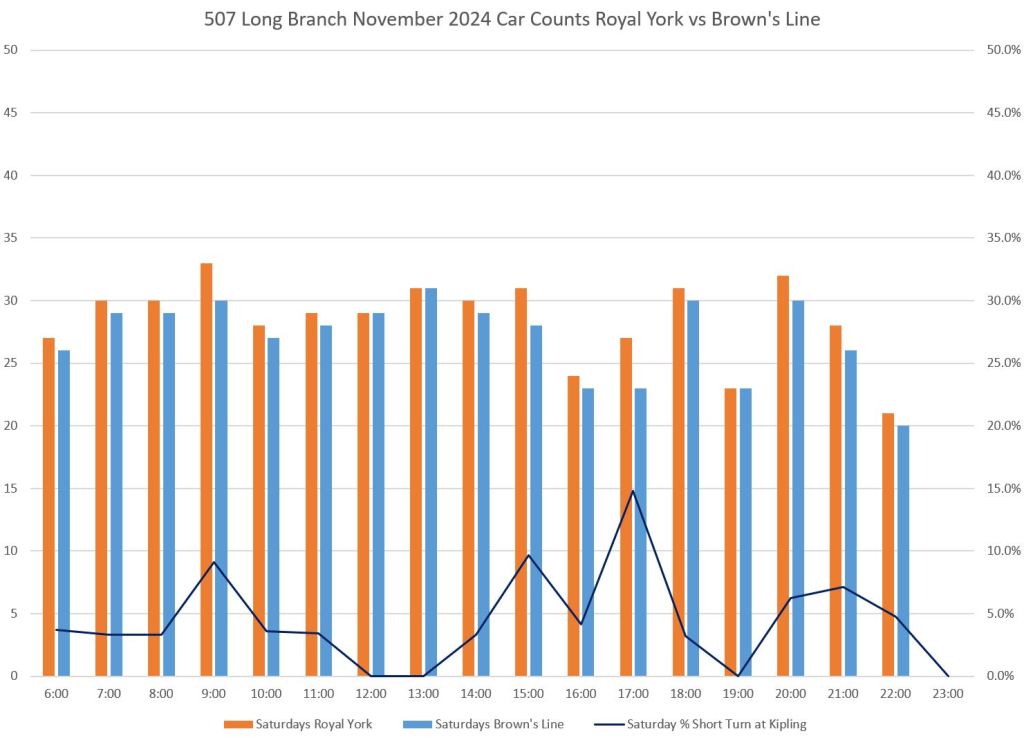
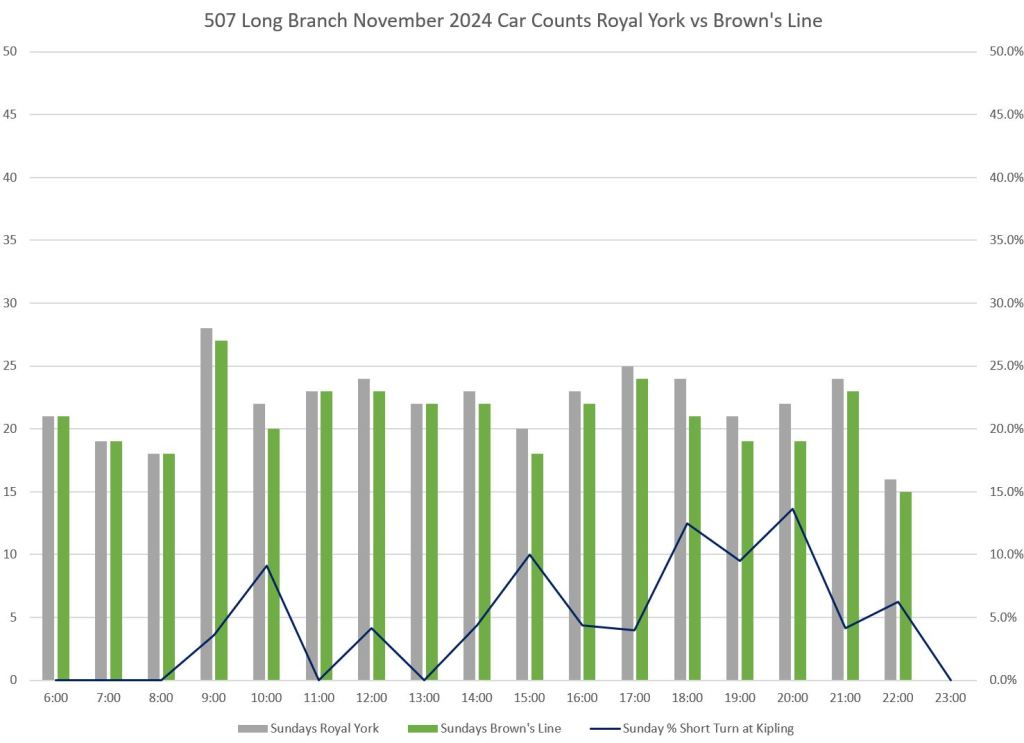
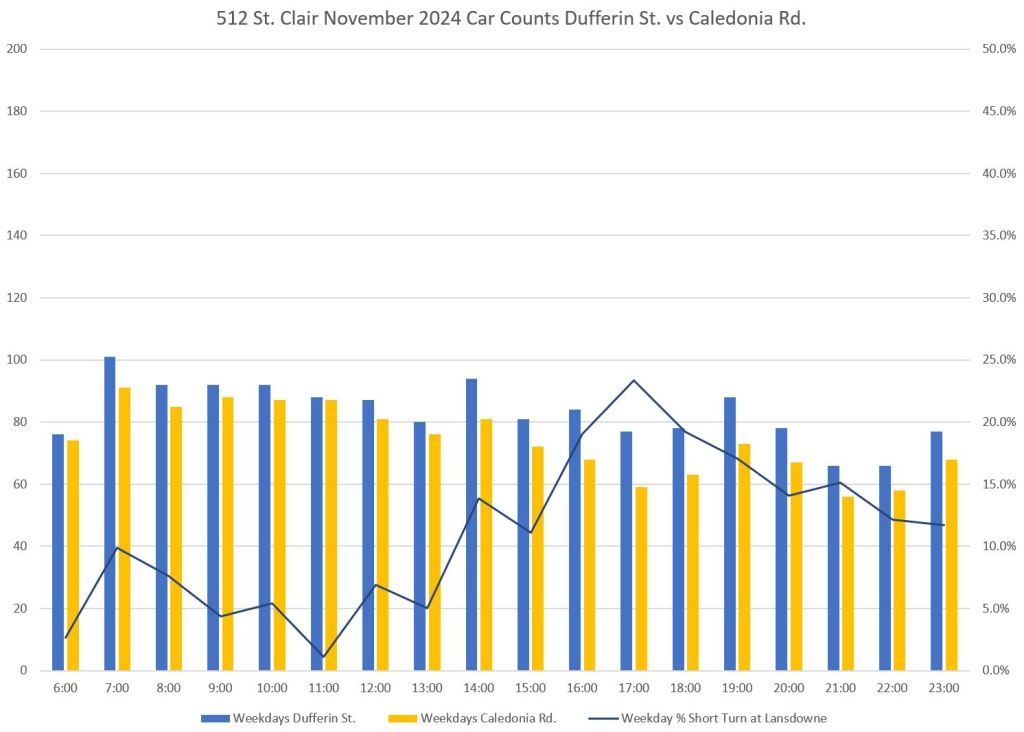
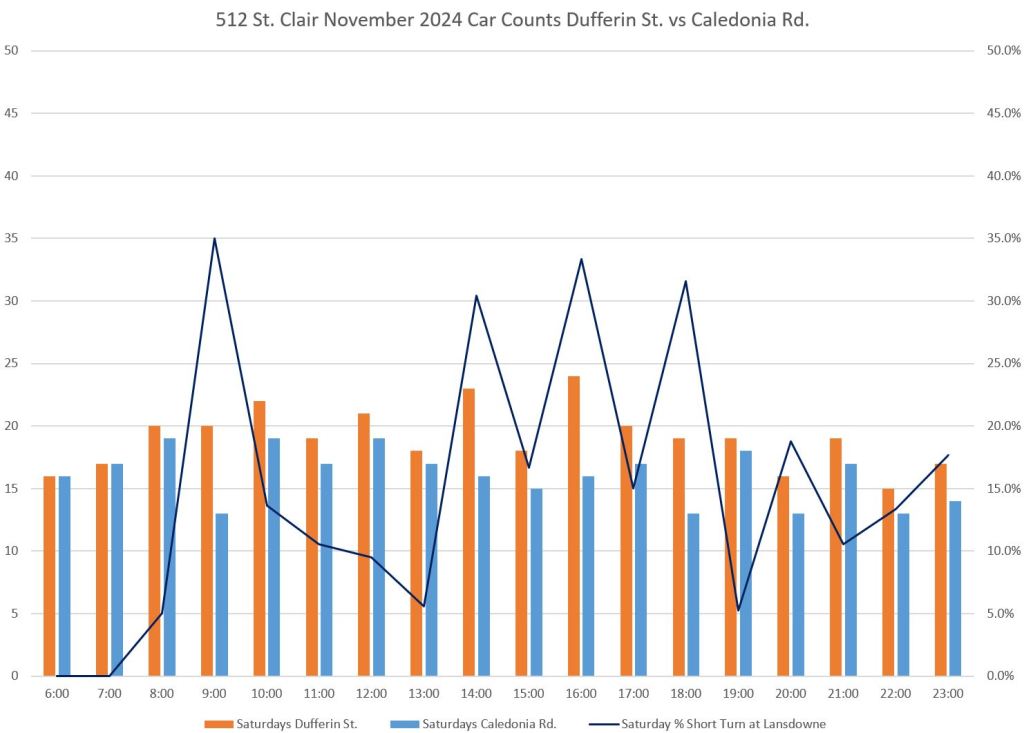
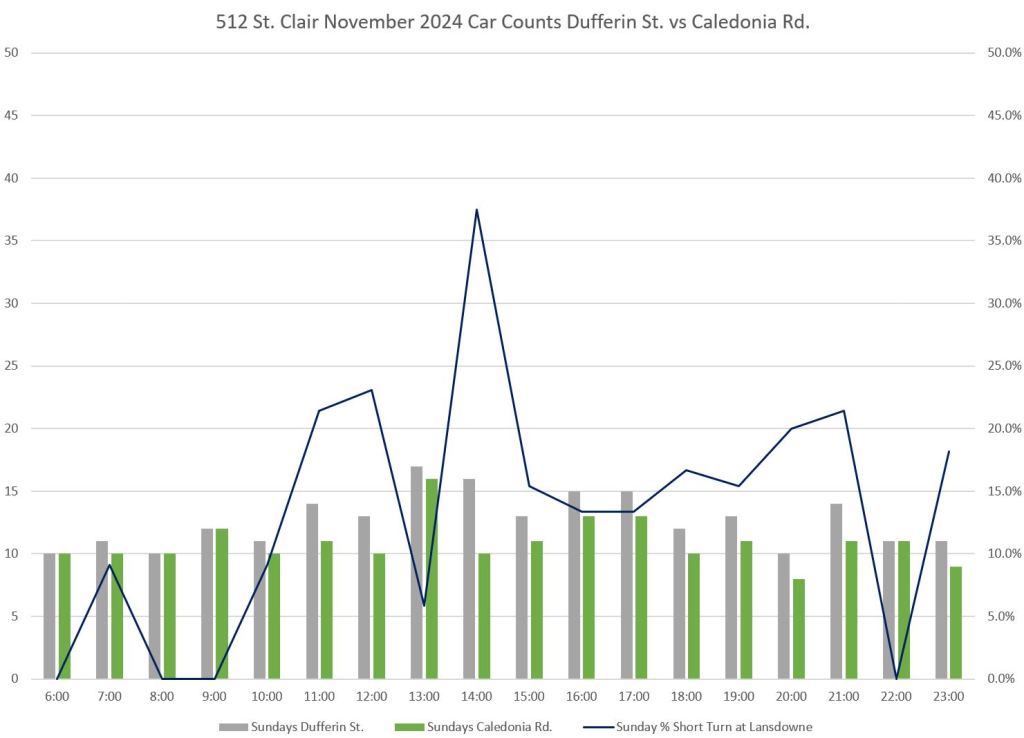
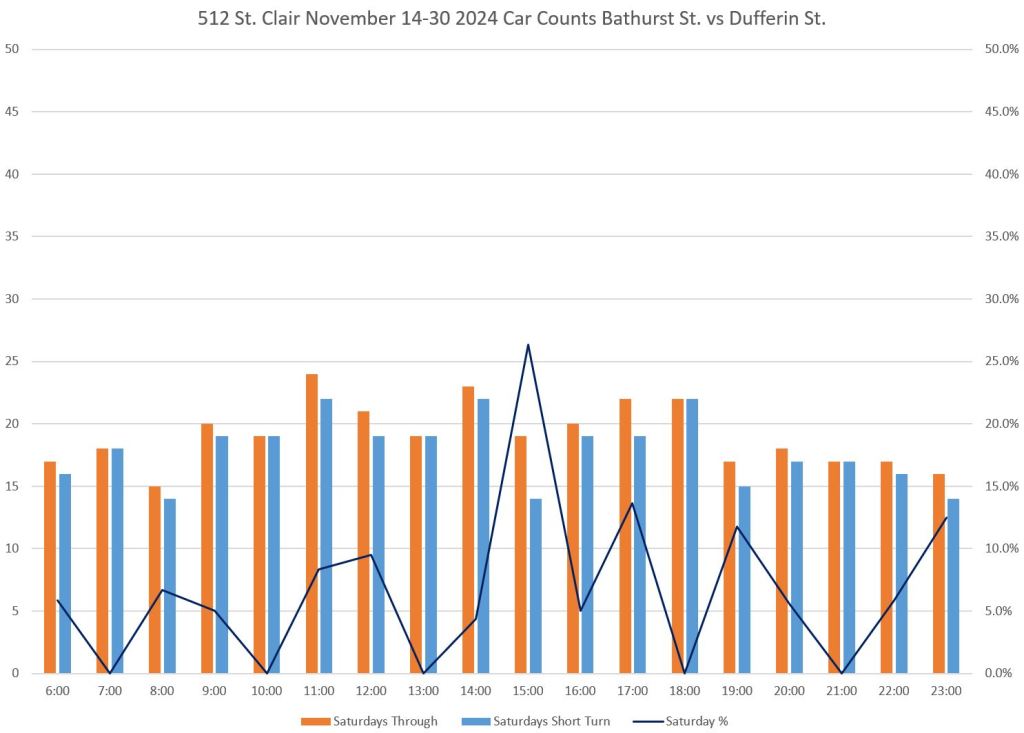
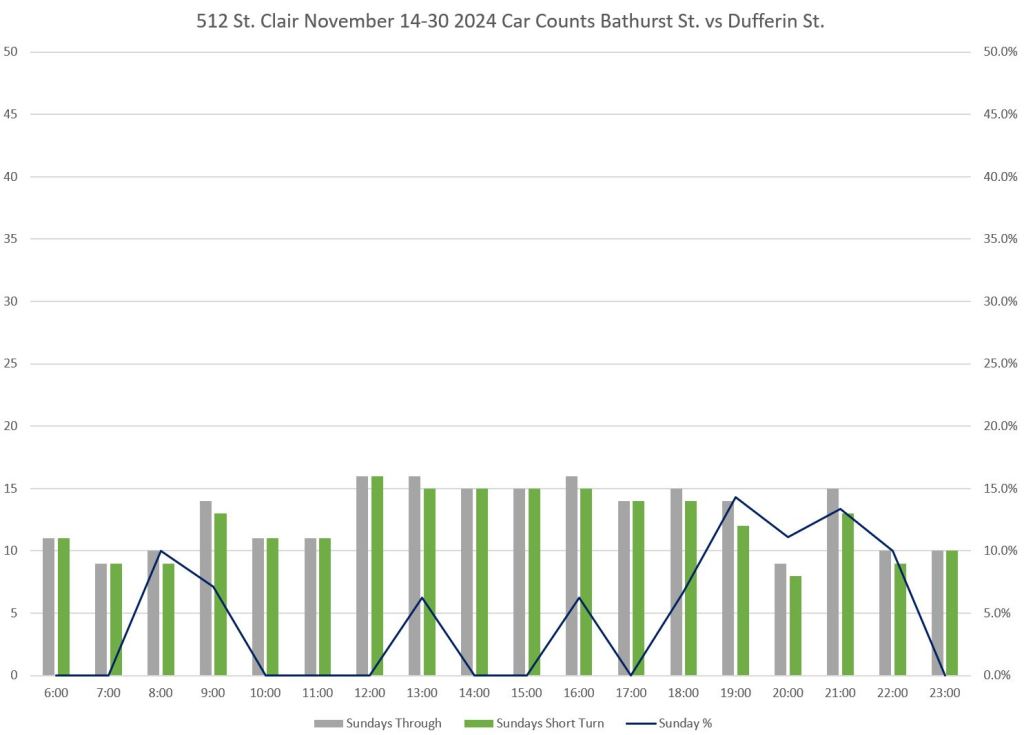
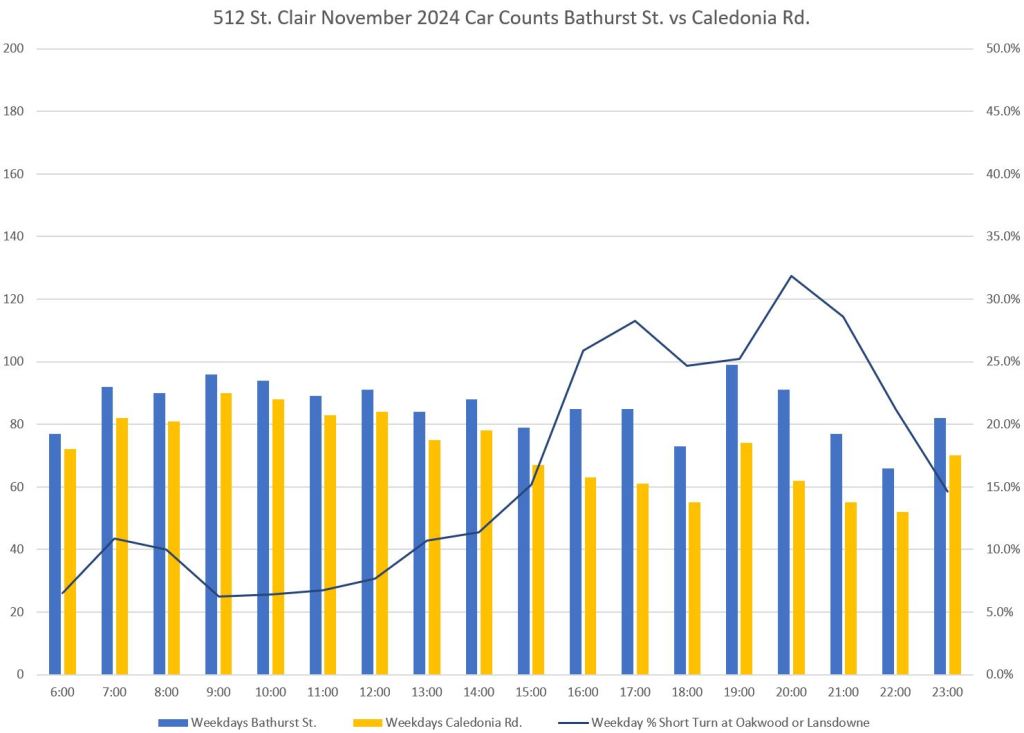
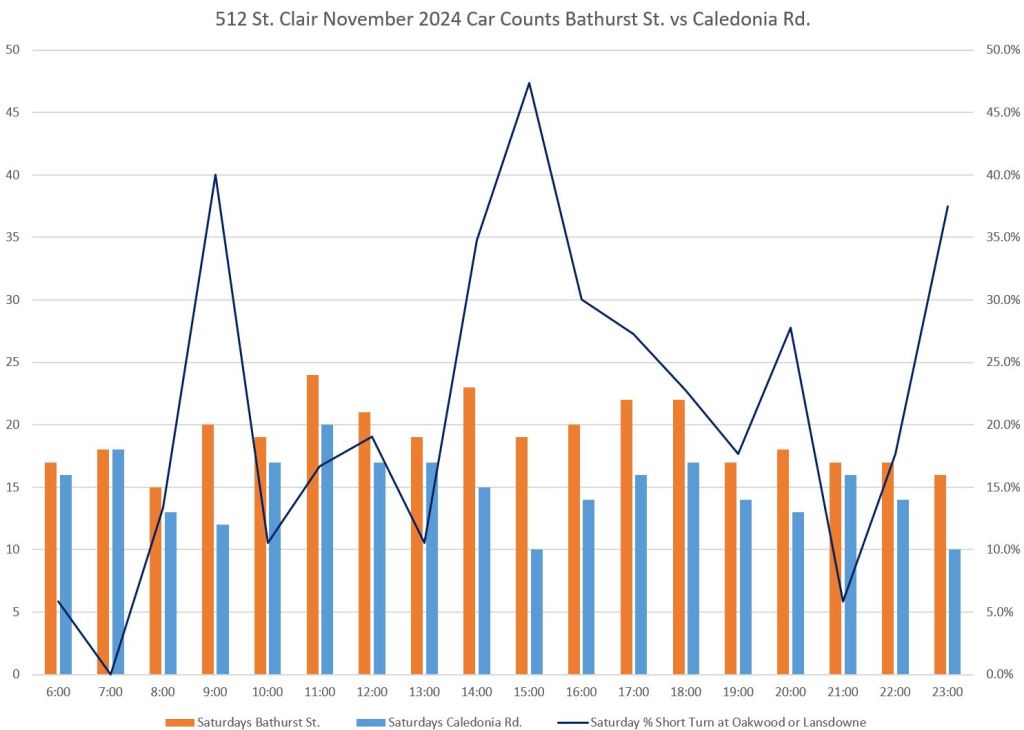
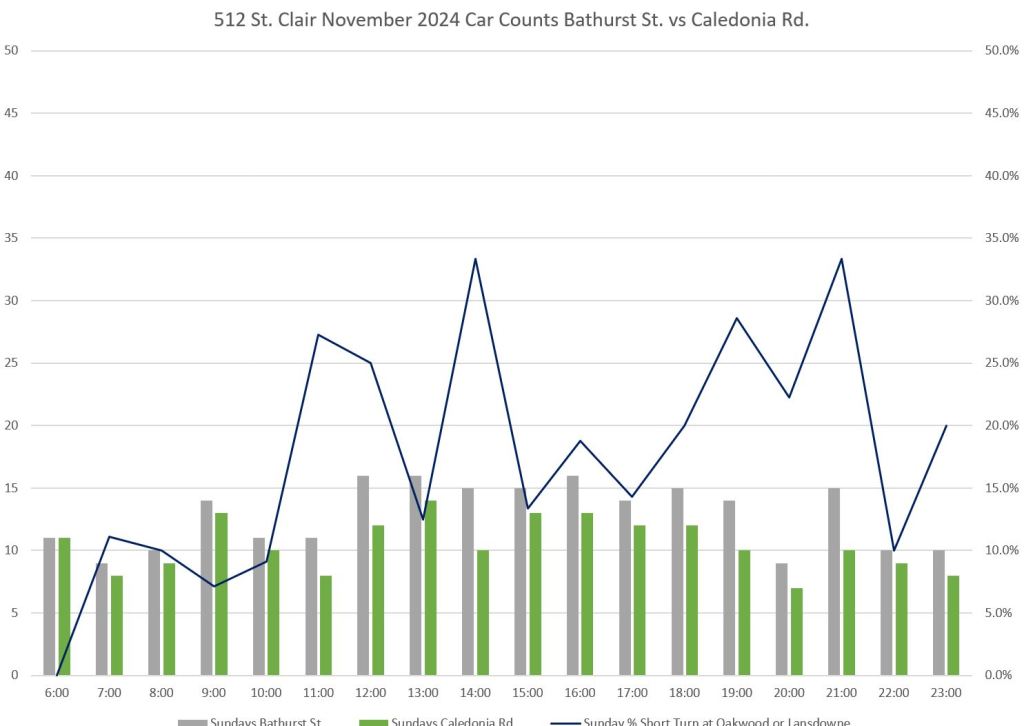
In these charts, the data are subdivided by type of day (weekdays, Saturdays and Sundays) and by hour. In each case the left bar of each pair shows the count of cars before the short turn, and the right bar shows the count of cars after. The line across the charts gives the percentage of trips short turned (note that the scale for these lines is on the right axis).
Note that in many cases the proportion of short turns on weekends is higher than on weekdays giving extra frustration to the portion of the TTC’s ridership that is most strongly recovering from the pandemic. Some of the higher weekend values are due to the fact that there are fewer Saturdays and Sundays than weekdays, and any major disruption on one day has a bigger effect than it would counted together with a month’s worth of weekdays.
In some cases the number of trips drops at odd times of the day such as Sunday afternoon. This indicates that some of the service did not even reach the “before” screenline for counting short-turns.
501 Queen
The drop in vehicle counts on Sundays in the early afternoon was caused by the Santa Claus Parade on the 24th. Between 1:40 and 3:00pm, no cars travelled east from Broadview, and there was a similar gap in service westbound from Spadina.
Woodbine Loop Eastbound
Roncesvalles/Sunnyside Westbound
These charts give the stats for westbound cars turning back at either Roncesvalles Carhouse or Sunnyside Loop just beyond the carhouse. The comparison count is between cars crossing Roncesvalles and cars arriving at Humber Loop.
503 Kingston Road
Woodbine Loop Eastbound
When a 503 car short turns at Woodbine Loop, this makes something of a joke of its route name considering that it travels only a few hundred feet on its namesake street. Short turns are a particular problem on weekends. The bulge on Sundays was caused by the Beaches Santa Claus Parade on the 17th which cut off all service east of Woodbine Loop.
504 King
Roncesvalles & Queen Westbound
The comparison count here is between cars crossing The Queensway northbound and those crossing Bloor Street just south of Dundas West Station.
The spike on Sunday evenings was caused by two events: on the 10th, buses served Roncesvalles and all streetcars turned back at The Queensway; on the 24th a collision blocked service from reaching Dundas West Station (this also affected 505 Dundas, see below).
Spadina Westbound
The comparison count here is between cars crossing John Street (east of Spadina) and those crossing Bathurst Street (west of Spadina).
Church Eastbound
Short turns eastbound at Church are rare and they account for only 2.0% of trips. However, these are most likely to be 504A Distillery cars as this is the last chance for an eastbound short turn. Assuming that the 504B Broadview Station cars inflate the total trip count, the percentage of Distillery trips is doubled.
Parliament Eastbound
504B Broadview Station cars short turn eastbound at Parliament returning to their route westbound via Dundas to Broadview. As with the Church short turns, the total trip counts are inflated by the 504A service which would not make this short turn. Therefore, the percentage for only Broadview Station trips is doubled from the values shown below.
Dundas & Broadview Eastbound
504B Broadview Station cars short turn via west on Dundas and south on Parliament. This is the reverse of the eastbound short turn at Parliament shown above. The trip count here includes only 504B Broadview Station cars.
505 Dundas
Parliament Eastbound
The comparison count here is between cars seen at Parliament Street eastbound (including short turns) and cars seen on Broadview south of Danforth.
Lansdowne Westbound
The comparison count here is between cars westbound at Dufferin (east of Lansdowne) and at Roncesvalles (west of Lansdowne).
There is an unusual spike on Sundays between 5pm and 9pm when there is a large number of short turns. Looking at the data for individual days, short turning at Lansdowne was quite common on November 3rd and 10th although there was no particular disruption of service. On the 17th, congestion downtown triggered the need for short turns, and on the 24th, a collision blocked service beyond Lansdowne for much of this period.
506 Carlton
Coxwell Eastbound
The comparison count here is between cars eastbound at Coxwell (including short turns) and cars seen on Main Street south of Danforth.
Lansdowne Westbound
The comparison count here is between cars westbound at Lansdowne (including short turns) and cars seen at Roncesvalles.
507 Long Branch
Kipling Westbound
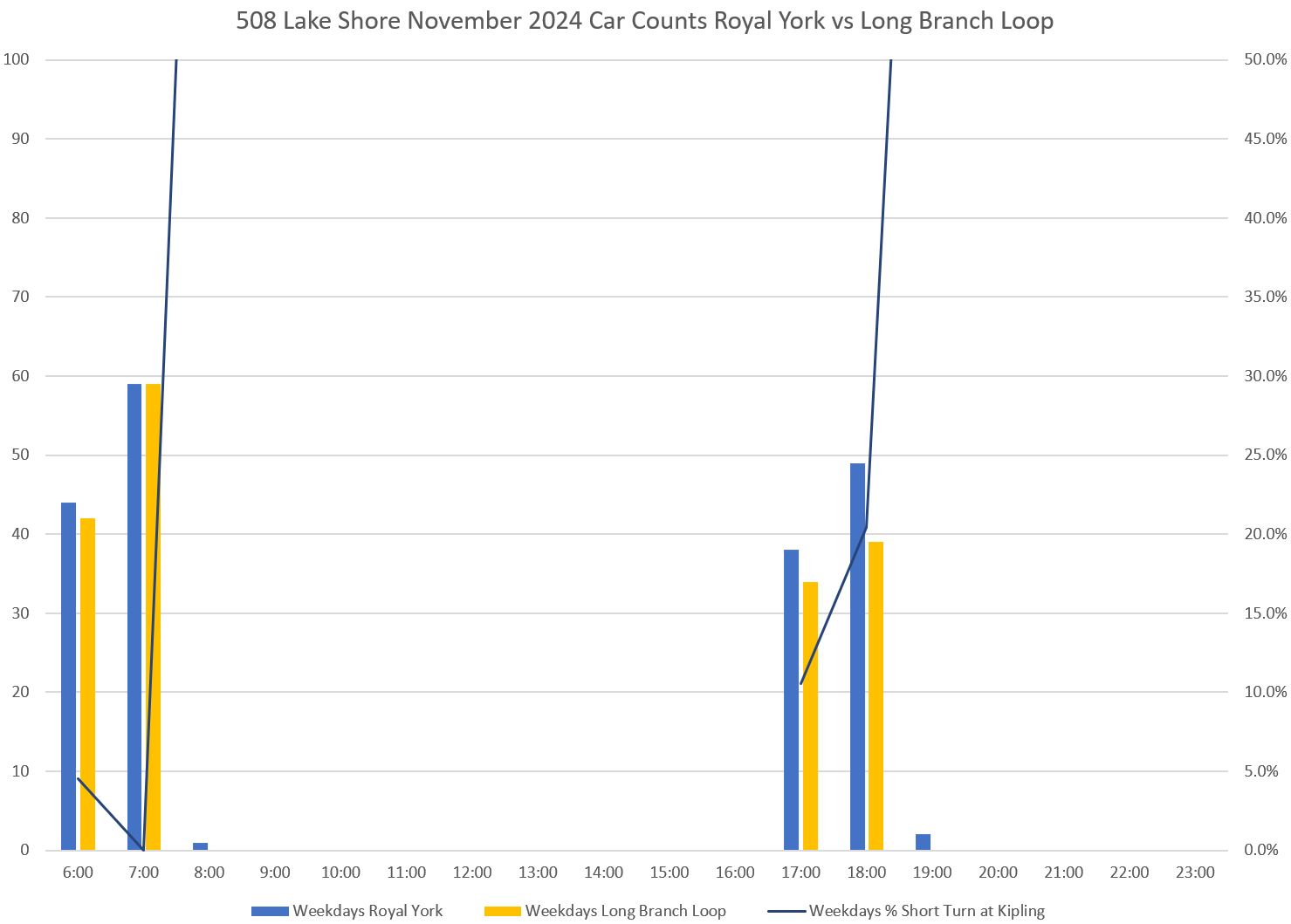
Some of the Long Branch service never actually reaches Long Branch Loop, but turns back at Kipling, particularly on weekends.
508 Lake Shore
Kipling Westbound
The Lake Shore car runs only in peak periods on weekdays. Some AM peak trips do not travel all the way to Long Branch Loop before making their inbound journey to downtown. Some PM peak trips do not make the full journey outbound.
512 St. Clair
512 St. Clair has two common short turns westbound: Oakwood Loop and Earlscourt Loop (at Lansdowne).
Note that only data from November 14 onward when streetcar service was restored here are included.
Lansdowne Westbound
The counts here compare cars seen westbound at Dufferin (east of Lansdowne) with cars at Caledonia (west of Lansdowne).
Oakwood Westbound
The counts here compare cars seen westbound at Bathurst (east of Oakwood) with cars at Dufferin (west of Oakwood).
Consolidated Short Turns Westbound
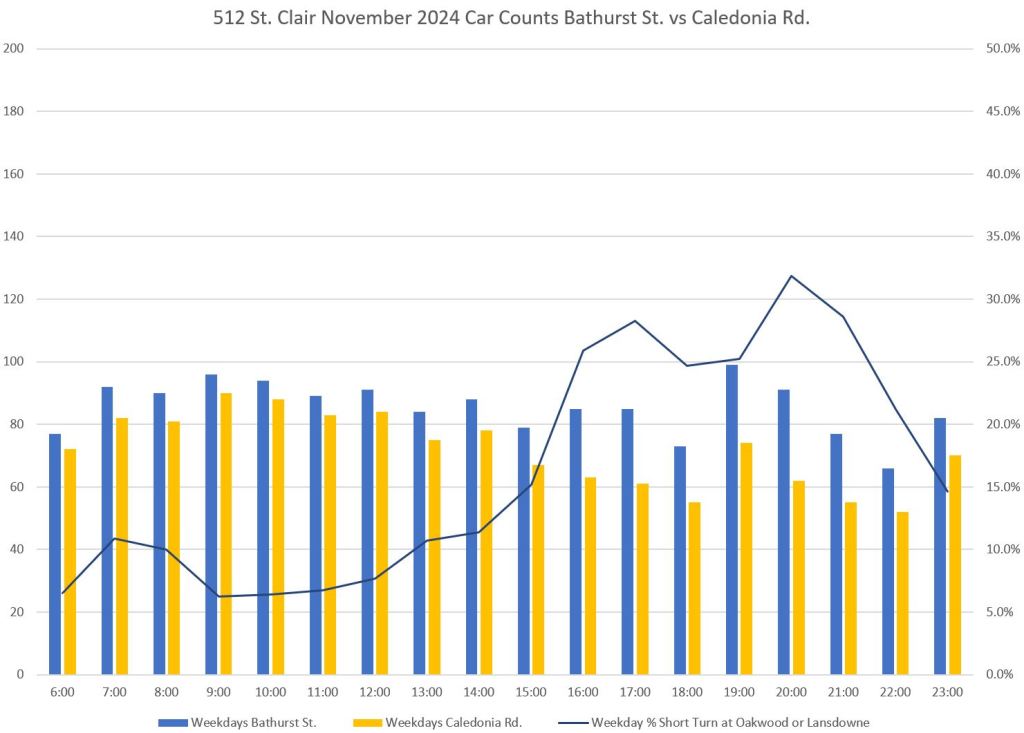
These counts compare cars leaving Bathurst westbound with those arriving at Caledonia. In other words, this shows how many cars were short-turned either at Oakwood or Earlscourt Loop. Short turn problems were particularly acute on Saturday afternoons when over 40% of the trips were short turned.
 Steve Munro
This isn’t the first time you’ve highlighted this large discrepancy in the short turn KPI. What is the TTCs explanation when presented with this data?
Steve: The TTC has never addressed the fact that their KPIs are not worth the (virtual) paper they are printed on. It is one of the “challenges” facing the new CEO – providing the Board with meaningful information about service quality.
LikeLiked by 2 people
Increase street car time from end to end. Less time given to operators. Ops have to follow rules and procedures. And control has to strictly monitor cars bunching. And question why ops are really early on time points. Situations out of control have people have to realize it. Street car ops have strict procedures to follow. Example schedule planning gives 10min from Broadview to Leslie bars. You cannot drive that in your car. I find all with the planning should be responsible. Why I have worked in planning teams in few countries. We just don’t talk stats. Our bosses fire people for not been productive.
Steve: There has been a lot of padding of streetcar schedules in recent years, sometimes to excess. In other cases, the schedules are too tight.
LikeLike
Yesterday I was at the Humber loop, and I saw a “508 Lake Shore” short-turning at the Lakeshore and Kipling loop instead of travelling the full distance to the Long Branch loop.
Steve: I have added charts for short turns at Kipling by 507 Long Branch and 508 Lake Shore cars.
LikeLike
As a passenger riding a streetcar, it’s unpleasant when my streetcar short-turns.
As a passenger waiting for a streetcar, it’s unpleasant when I have to wait a long time for an overcrowded vehicle because all the vehicles are stuck heading the wrong direction.
I don’t know what the right balance is, but it’s likely that trying to keep short turns to an absolute minimum isn’t it. But passengers can see being short-turned as the consequences of a decision, whereas they might not see a lack of route management as one. If the TTC changes their practice here, some passenger education may be necessary.
LikeLike
It’s not clear to me how streetcars running in to Roncesvalles can be disambiguated from Sunnyside or carhouse short-turns.
On a more amusing note, 507 Long Branch cars that usually turn back at Humber loop, show SHORT TURN to RONCESVALLES when running in. Surely that should be LONG TURN.
Steve: The run-in trips happen at the same, scheduled time every day, and so they could be factored out. Given that peak and off-peak services are not much different on most lines, the number of cars is not high.
LikeLike
On the streetcar network, in the 20th century, streetcars did not deadhead to the carbarns. If a DUNDAS (now 505) was heading to the Roncesvalles carbarn for the night, it would be able to pick up and discharge passengers along the way.
Living on Sunnyside Avenue, I would be able to stay on the DUNDAS streetcar as it turned on Howard Park and Roncesvalles on the way and drop me off at Galley Avenue.
Rare to see the buses do that, they deadhead with no pickups or discharges. I now live near the Mt. Dennis bus garage and the (Eglinton Maintenance and Storage Facility) Mt. Dennis carbarn. I’m assuming most light rail vehicles will pull into Mt. Dennis to discharge passengers before proceeding into the Eglinton Maintenance and Storage Facility. Maybe the buses that terminate at Mt. Dennis will do the same. But not the other buses, I’m guessing. They’ll just deadhead to garage.
Need a 000 bus that indicates its going to a garage, but still provide pickup and discharge for passengers.
Steve: The TTC has an on-again, off-again attitude to running garage trips in service. There are inklings that it might be changing to “on-again”, but I am not holding my breath. Especially on bus routes this saves time and money. On streetcar routes, it’s just an annoyance. Regular riders get used to the odd trips cars make and take advantage of them, if they are allowed to.
LikeLike
Perhaps some historical perspective on the history of short turns might be helpful for your newer readers. It seems like the TTC’s policy on short turns is an overreaction to when they had the opposite problem what, maybe 10 to 20 years ago?
Short turns are a legitimate tool, they just have to be done the right way (e.g. make sure another vehicle destined to the same place will arrive within xx minutes) and have to be used judiciously. There must be some way that TTC can codify a middle ground that gives supervisors permission to turn vehicles when needed to break up a bunch / fill a gap and defines the conditions under which that is acceptable, without giving supervisors carte blanche to the level that riders feel like they’re constantly being kicked off vehicles.
So many of your service diagrams show patterns where there’s a platoon of 2 or 3 vehicles parading back and forth across the city, followed by a gap that could easily have been filled by short turning one of the 3 vehicles.
Steve: For years there were complaints about the level of short turns on some routes. A general problem, but not universal, was that scheduled running times were too tight. There was also a problem with short turning pro-actively assuming they might be needed. With many complaints from members of the TTC Board, then-CEO Rick Leary instituted a “no short turns” policy and schedule changes began to stretch running times. A count of short turns tracked “success” in the CEO’s Report. However, right from the start the reported stats understated what was really happening.
On top of that, the bunching you mention was not addressed. In theory, the “on time departure” rules for terminals were supposed to fix this, but they are sufficiently lax that bunching and gaps from terminals falls within the target range. Moreover, gaps get wider and bunches close in as vehicles move along a route, and little or nothing is done to restore proper spacing.
All of this is compounded by a centralization of route management and reduction in the ratio of route supervisors to routes so that resources are stretched thin, and supervisors are not necessarily familiar with how their routes behave. Moreover, the pandemic-era service cuts, coupled with larger vehicles and longer headways on streetcar lines, result in greater disruption of service through bunching than was formerly the case. Fewer cars are available to juggle service, and a gap from a missing car is typically 20 minutes where a decade ago it would likely have been under 10.
The whole thing is very management-centric giving the impression that “something has been done” while riders know perfectly well that it has not. The TTC Board sits on its hands and does not want to get involved in technical operational issues, nor even hold their management to account.
LikeLike
If a rider sees three buses, will they be signed to their proper destinations. Don’t want to board a bus, then find out a half way through, that the bus you are on will be short-turned. Can they at the start of their run be told that this bus will be short-turned at this crossroad.
Many times on the transit apps, they indicate a bus will be going to the end of the line, but when you board, surprise!
Steve: The transit apps have no way of telling what the actual destination of a bus or streetcar is other than the one assigned in the schedule. There is no interface between vehicles and tracking systems to transmit the current setting of the destination sign.
Ops cannot be told at the beginning of their runs that they will short turn because conditions requiring this might not yet have developed. That said, the decision is often made at the last minute, moments before the short turn occurs, a practice that really frosts riders who boarded in good faith. Even worse when they are told that a through bus/car is right behind when in fact it is ten minutes away or more.
LikeLike
I always wanted to ask: Are route supervisors mostly in the field (standing at stations, turnbacks), or are more of them at the transit control centre? How many routes does one supervisor have to manage at the same time, lately?
Hiring more route supervisors seems like an obvious way to increase service quality and also save millions that would needlessly be spent on extra vehicles and operators who would just get bunched otherwise. Route supervisors need to feel a sense of personal responsibility for their routes, and need to constantly watch an app that shows the real-time location of all their vehicles.
Steve: This is a more complex question than it appears. The basic issue is that the TTC needs to have an underlying philosophy of how line management should work. If all a supervisor does is to stand in a station and tick off trains on the timetable as they pass, this is not “management”. Equally, one needs an overall view of the line to figure out the best strategy for whatever “today’s problem” might be.
There is a big problem that the ratio of supervisors to surface routes is too low, especially in off hours, and if a lot of routes have problems (e.g. storm days), there simply isn’t enough supervision to go around. But again I come back to the philosophy of what good line management looks like. If this doesn’t exist, or if it is as simplistic as “no short turns”, there is no basis for a supervisor to manage the line.
LikeLike