
Work on the Waterfront East LRT crept forward with the approval by Toronto’s Executive Committee of funding to continue design work, and of a tentative project plan. This must be endorsed by Council at its meeting of November 8-10, 2023.
For the previous update on this project, please see my April 2023 article.
Updated: Shortly after this article was published, the City of Toronto replied to questions I had posed about their report. The replies are integrated with the text of the article.
A combination of several factors push the completion date of this project, assuming that it receives full funding from provincial and/or federal sources, out into the 2030s. There is a danger that a so-called transit first community will actually see much of its redevelopment occur before adequate transit is in place to support it. Conversely, absent the transit service, some planned projects may simply sit as empty lots because they are not viable without it.
The current round of reports includes:
- Advancing Waterfront East Light Rail Transit (the main report)
- Preliminary Design Business Case
- Constructability Assessment Summary
The WELRT has been divided into three segments.
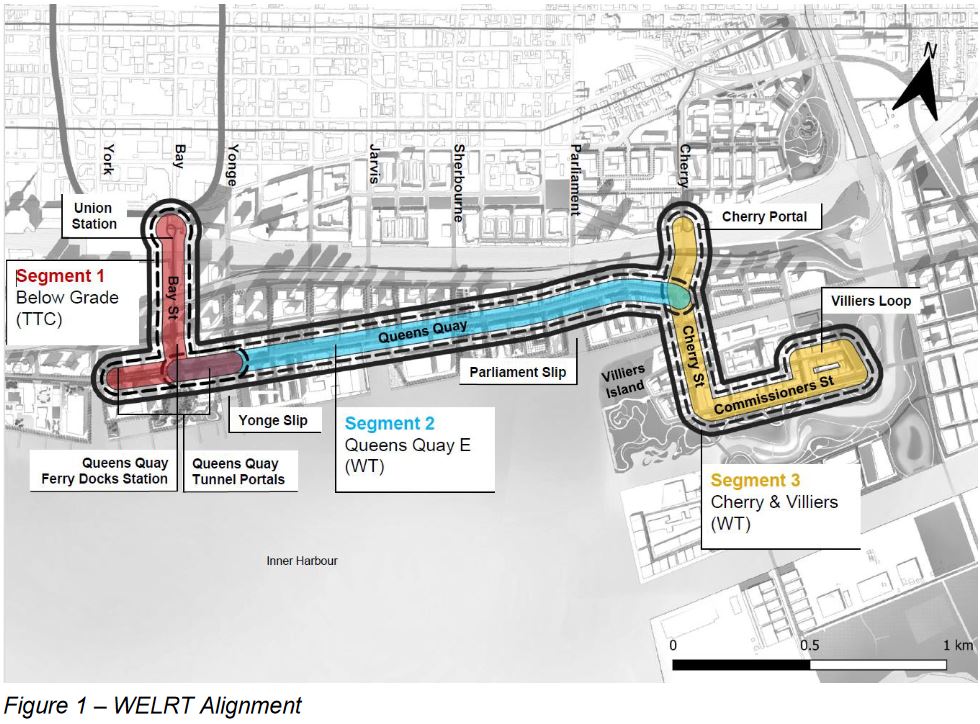
- Segment 1 (red) contains the Bay Street tunnel and the portals at Queens Quay where streetcars will surface. The existing west portal will be renovated and the new east portal added. Plans for decorative canopies have been dropped from the plan as a cost saving measure. This segment is under the TTC’s control for design and construction.
- Segment 2 (blue) consists of the surface running on Queens Quay East to a revised intersection at Cherry Street which is realigned to the west. This segment primarily involved the reconfiguration of Queens Quay East similar to what already exists on Queens Quay West. (For details please refer to previous articles.)
- Segment 3 (yellow) includes the southerly extension of trackage from Distillery Loop under the GO corridor, along a realigned Cherry Street, and east on Commissioners St to Villiers Loop (which is actually an around-the-block terminus, not an off street loop).
There are impediments to the work on segments 1 and 3 that dictate the timing of various works. The many delays in actually launching the WELRT project put other works in the same area in conflict that might otherwise be avoided notably the Ontario Line and the Gardiner/DVP realignment. The Bay Street tunnel has become more complex due to updated fire codes and the need to serve many more passengers than the Union Station Loop does today. Still outstanding is the redesign and expansion of Queens Quay Station and a link to the Island Ferry Docks which has been dropped from the project, as of the last update in April 2023.
The recommendations approved by Executive Committee are that:
- Council approve the alignment shown in the report.
- Council approve advancing design for the entire project, except segment 1 (underground), to 60%.
- Council approve
- completion of environmental approvals,
- undertaking of a traffic management plan to address interfacing the WELRT an other projects’ construction, and
- design and coordination of the scope for the WELRT at the Cherry Lake Shore realignment, the Inner Harbour Tunnel at Jarvis, and the Hydro One relocation project at Cherry Portal.
- Council authorize an increase to the Transit Expansion Division’s Capital plan of $63.6 million in 2024-2026.
- Council direct the Executive Director of the Transit Expansion Division to report back at some point, unspecified, in 2024 with an update.
The estimated cost of the full project is $2.57 billion over a ten-year period assuming that full funding comes in Q1 2024, and the design work proposed in this report starts immediately. Any delay is a notable concern in an era when construction material and labour costs are rising quickly. It is not clear whether the figure cited is in current 2023 dollars, or includes inflation to the point the money is actually spent. I await clarification on this from the City.
Updated: The City of Toronto advises that:
The City is using as-spent dollars with future escalation included to the anticipated year of the expenditure. The cost estimate relies upon timely funding to meet the implementation schedule which is used as the basis for these inflation numbers.
Email from City of Toronto Media Relations, Nov. 2/23
The reason that the underground segment is excluded from approved design in recommendation 2 above is that this segment is proposed to be executed with a design-build contract where the detailed design will be undertaken by a contractor who is familiar with work in an underground environment.
Updated: This also keeps the design cost off of the City’s expenses for the moment. The City of Toronto advises that:
As noted in the staff report, staff are not recommending advancing the design of Segment 1 to 60% due to the City’s current financial pressures.
Email from City of Toronto Media Relations, Nov. 2/23
The project is subdivided into three parts:
- Union Station Loop, $932 million.
- Remainder of project except Cherry North, $1.3 billion. Includes East and West portals on Queens Quay, Queens Quay Station, Yonge Slip infill, Queens Quay East track from Bay to Cherry, Cherry Street south, Commissioners Street and Villiers Loop.
- Cherry North connection to Distillery District, $337 million, to be completed as a separate future phase.
The scope of work planned at Queens Quay Station is unclear because at the last update, much of this work had been dropped (platform expansion, link to adjacent building, link to ferry docks). I have asked the City for clarification of this.
Updated: The City of Toronto advises that:
The current scope for Queens Quay Ferry Docks Station is related to the station access upgrades (upgrade of the west entrance to improve accessibility) and it is part of the Segment 1 scope.
Email from City of Toronto Media Relations, Nov. 2/23
For the benefit of latecomers to the Waterfront East project, I have included a history at the end of the article. The idea goes back at least to the 2003 Central Waterfront Plan, and has languished without strong political support ever since the Ford era when all focus shifted to subways.
The greatest challenge was and remains that waterfront transit is not “important enough” to many on Council and lacked key leadership from the Mayor’s office through the John Tory era. Under Mayor Chow, it will compete with many other projects for priority and funding both for transit and in the wider context of City projects.
Three decades after the Central Waterfront Plan and a 2011 target opening date, we might still not have good service to our “transit first” neighbourhood by 2032.
Continue reading Steve Munro