
At the TTC Board meeting on July 12, 2023, there was a brief discussion of the problem of short turns on streetcar lines. The information provided by management was, shall we say, less than a full accounting of what is actually going on.
This issue flared up many years ago particularly with short turns of service in The Beach among other areas, and in general a problem with erratic, gap-filled service on the outer ends of routes. TTC management committed to reducing or eliminating this problem, and to that end there was a “no short turns” policy that everybody seemed to know about at the operational level, but which was officially denied.
The stats did go down, but looking under the covers showed that not all was well:
- Short turns are a bona fide service management tactic for dealing with delays to restore even spacing of service. There is nothing wrong with a short turn of some cars in a parade because this will restore service sooner than if every car trundles to the terminal and they return in a pack.
- The official count of short turns fell to almost zero. However, this was due in part to selective reporting that was clear to (a) anyone actually riding the system and (b) anyone looking at vehicle tracking data.
Rick Leary got the equivalent of a gold star from the Board who frankly did not know any better, but occasionally wondered why claims of improved service did not align with complaints from constituents. The standard excuses for occasional upsets due to congestion and construction were regularly trotted out even though service could be erratic at times and locations when these were clearly impossible.
The charts below from the July 2023 CEO’s Report show the official count of short turns on the streetcar and bus network. An important factor in comparing the two is that the buses overall have many routes where congestion and construction do not affect most, if any, trips. The figures are not broken out by route to flag the “bad actors”. Moreover, the values are presented as a percentage of all trips so that time-of-day effects are hidden.
The “no short turns” policy implementation is quite clear in the data from Fall 2018 through Spring 2019. In reviewing actual short turn counts from tracking data, I have found that the values are consistently under-reported, and they do not represent actual conditions. For example, the proportion of service outbound on 501 Queen from downtown (as counted at Woodbine vs Greenwood) reaching Neville Park ranges from 100% to below 50% in January to June 2023.
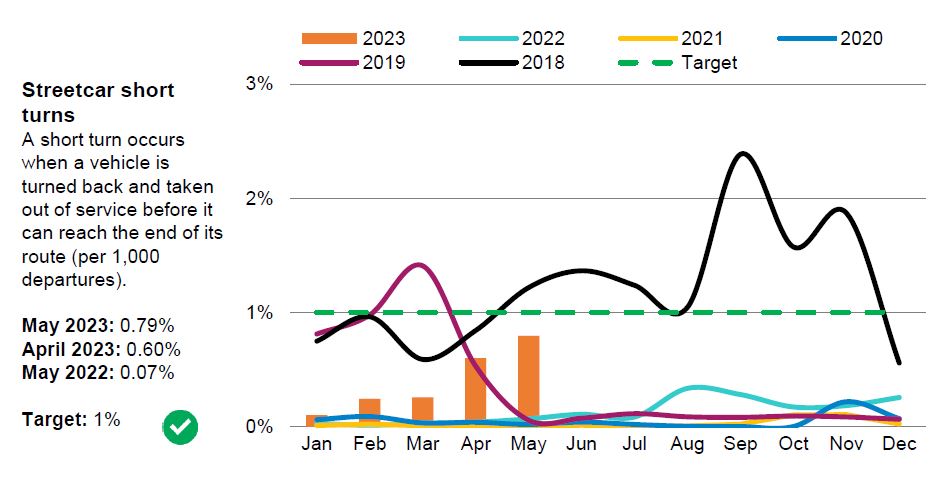
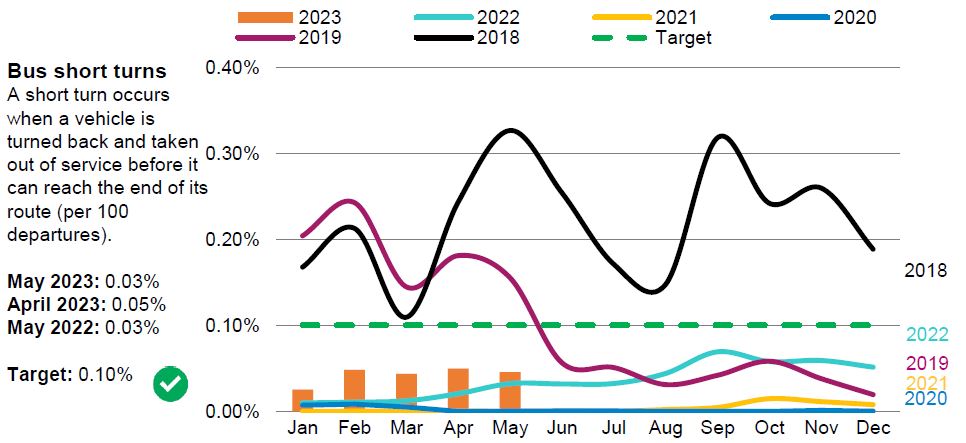
Updated July 15, 2023: In June 2023, the TTC changed its reporting of short turns from an absolute number to a percentage. The scale of these charts does not make sense because the streetcar chart claims it is per 1000 departures, but cites a percentage (per 100). For comparison, the May 2023 charts are below.
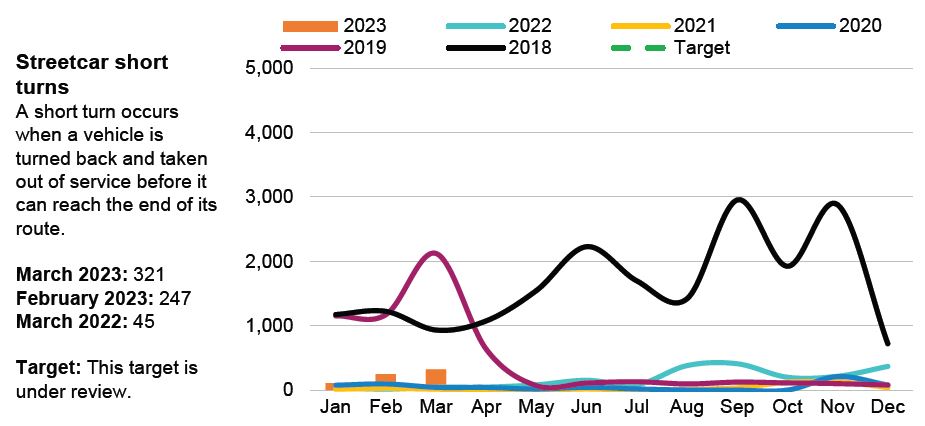
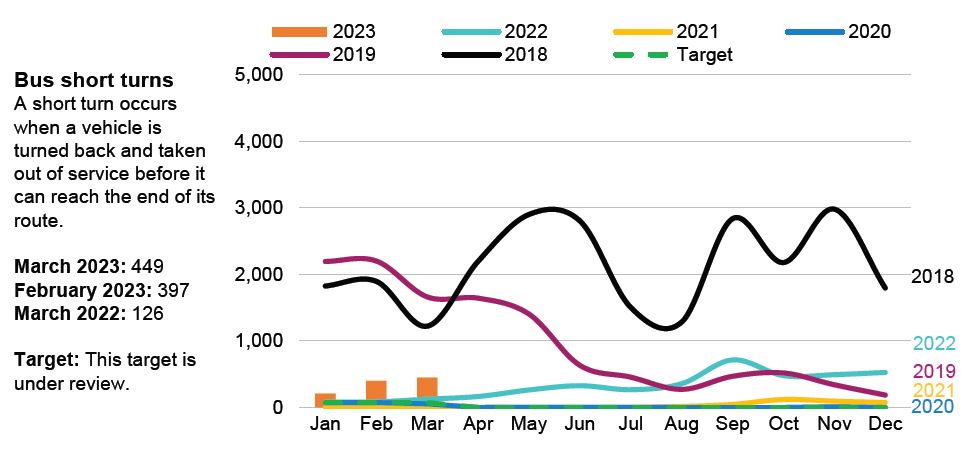
I have written many times on this site about service quality and there are many factors at play including:
- Unreasonably short or long scheduled travel times. This may sound like an odd pairing, but both can produce erratic service.
- Too short times lead to short turns to keep operators on time especially for crew changes.
- Too long times lead to extended layovers at terminals.
- Lack of headway discipline at terminals and along routes.
- Lack of headway management for vehicles re-entering service from a short turn to “split” a gap rather than simply running behind a through vehicle and carrying few passengers.
There are, of course, ad hoc situations where accidents, short-term construction or special events produce conditions that are not “standard”. These are normal and have to be managed to the degree possible. One side effect of the overall reduction in service on streetcar lines to a 10 minute level on many routes is that there is no spare capacity when delays occur, and wider headways make the effect on riders of any missing vehicle (either not in service or short-turned) greater.
This is not the first time the system encountered that problem, and tuning out surplus capacity has been a generic issue across the network any time budget “efficiency” takes precedence over service. The phrase “adjusting service to meet demand” goes back over four decades.
Service standards that allow for some empty space on vehicles are important because they guarantee some flexibility to absorb small problems without service collapsing. An analogy for motorists is that a highway totally jammed with cars does not move traffic at all well, and some empty space is necessary to ensure the road is usable. On transit, empty space is viewed as waste while on our roads no congestion is a holy grail.
The remainder of this article reviews the short-turning situation on most streetcar routes and the underlying causes.
501 Queen
Service on Queen now operates with three branches:
- 501 Neville to Roncesvalles streetcars diverting around Ontario Line construction via Broadview, Dundas and McCaul
- 501B Broadview to Bathurst buses diverting around Ontario Line construction via Church, Richmond/King and Bay
- 501L Dufferin to Long Branch buses
501 Queen East End
Short turns in the east end, primarily at Woodbine Loop, have become more common since the Ontario Line diversion stretched the ability of streetcars to achieve scheduled travel times. However, even before the May 7 diversion, there were problems.
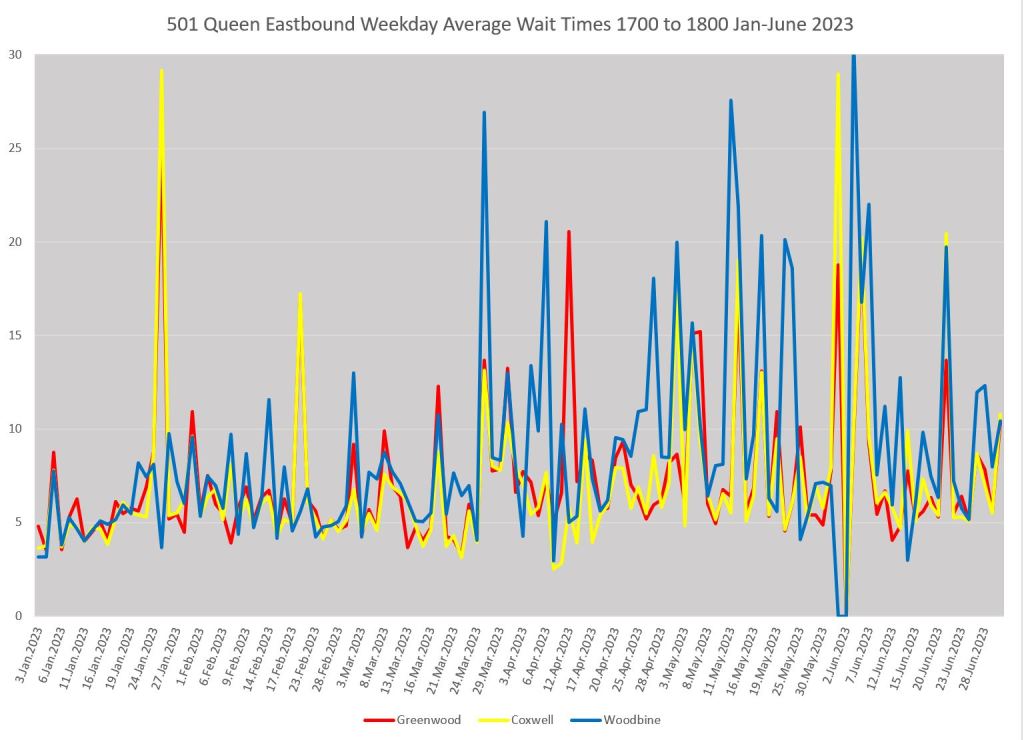
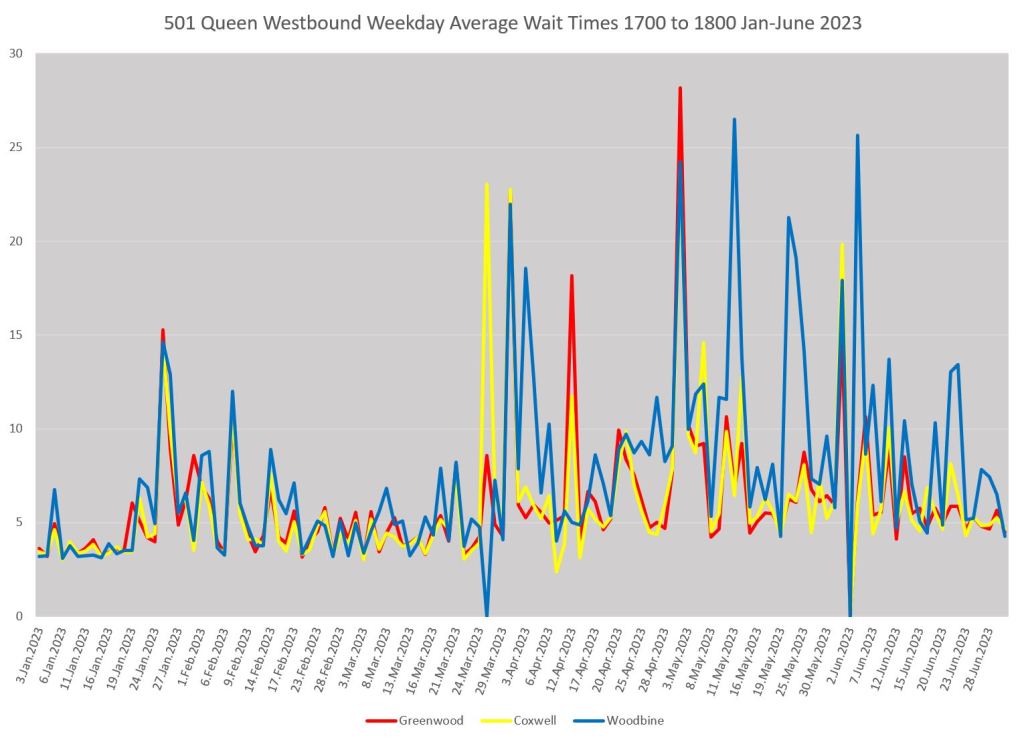
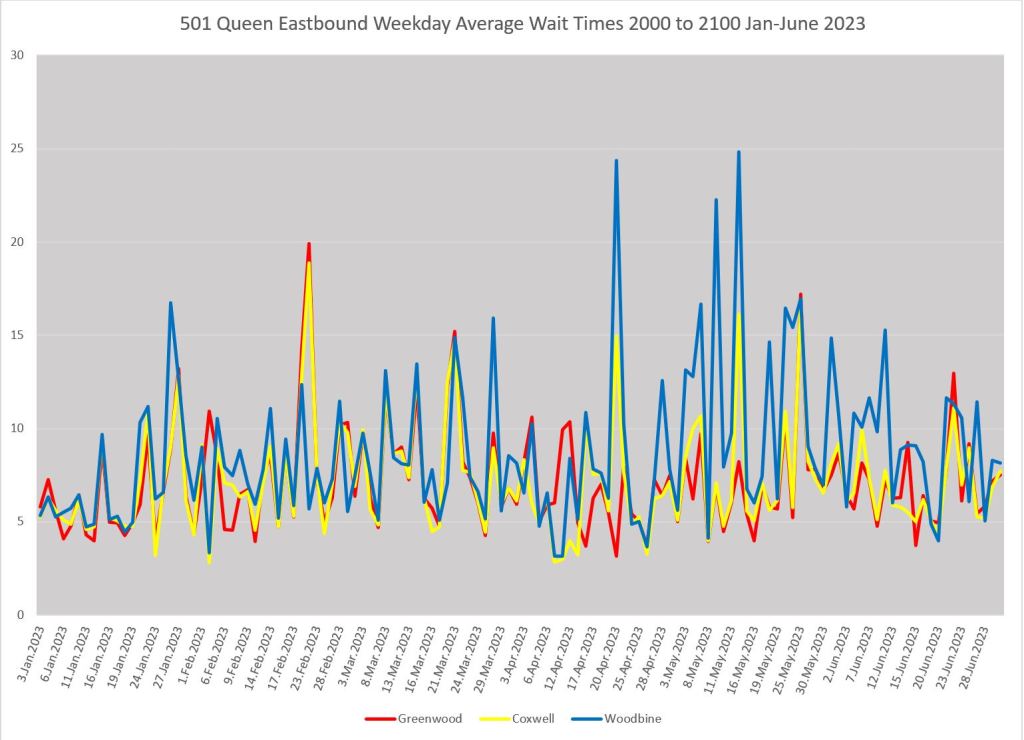
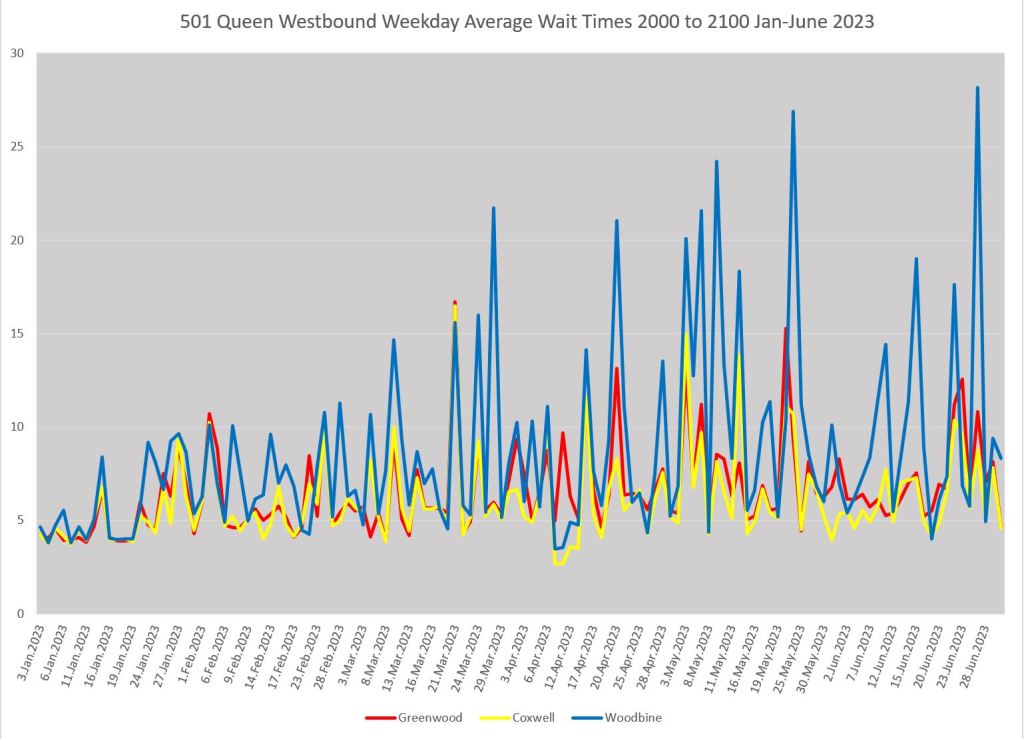
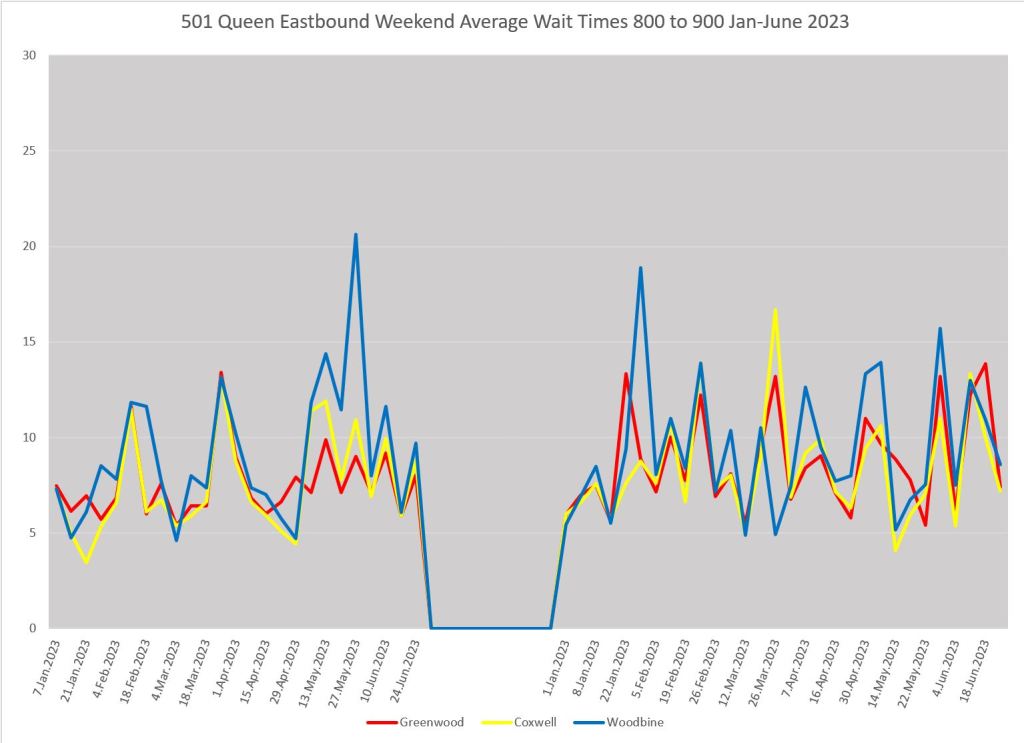
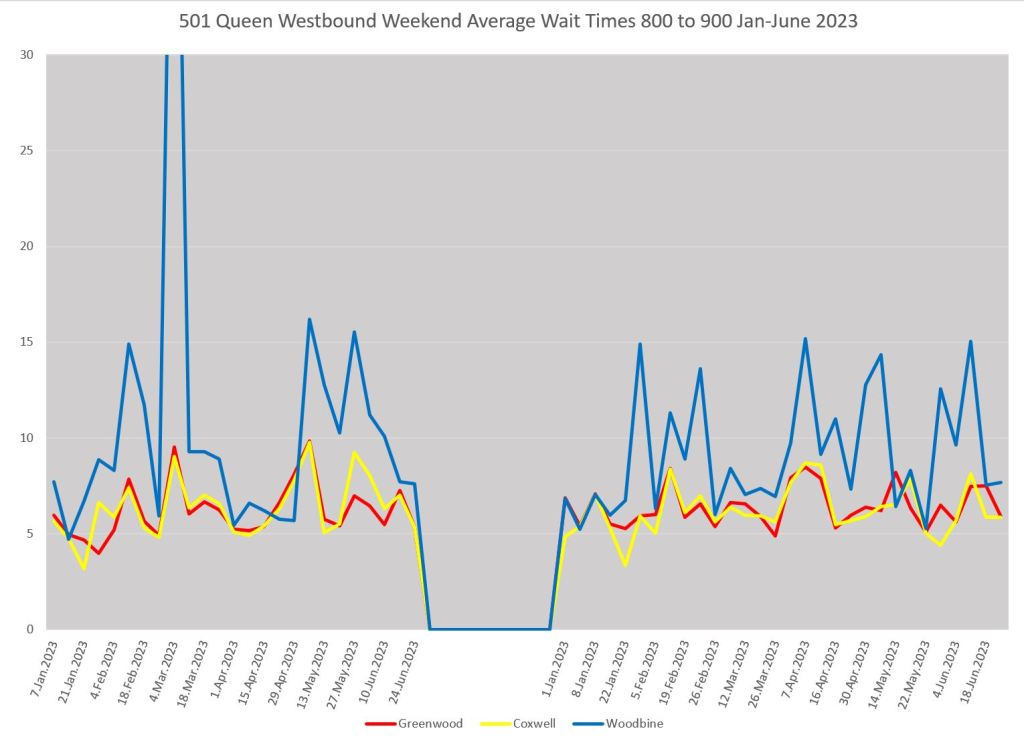
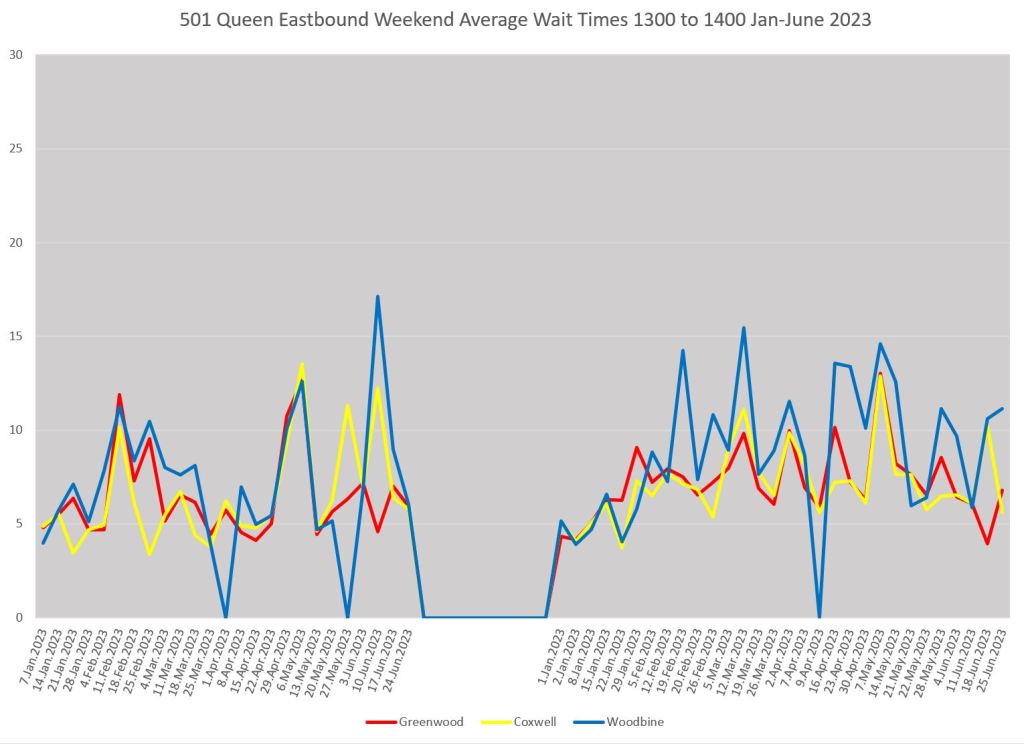
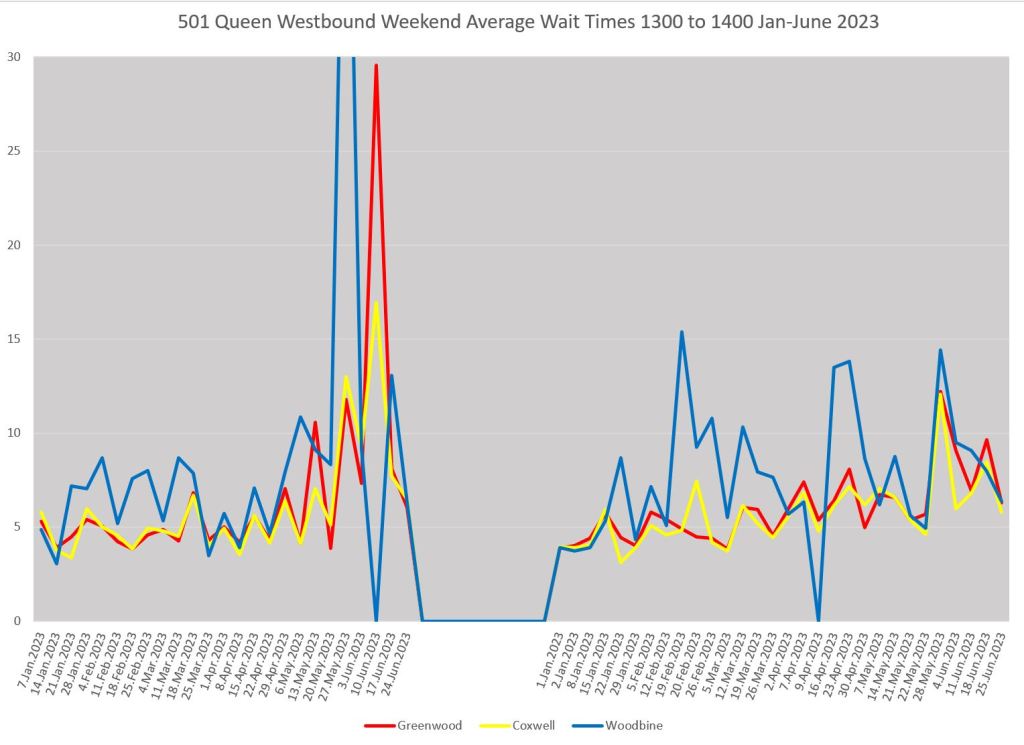
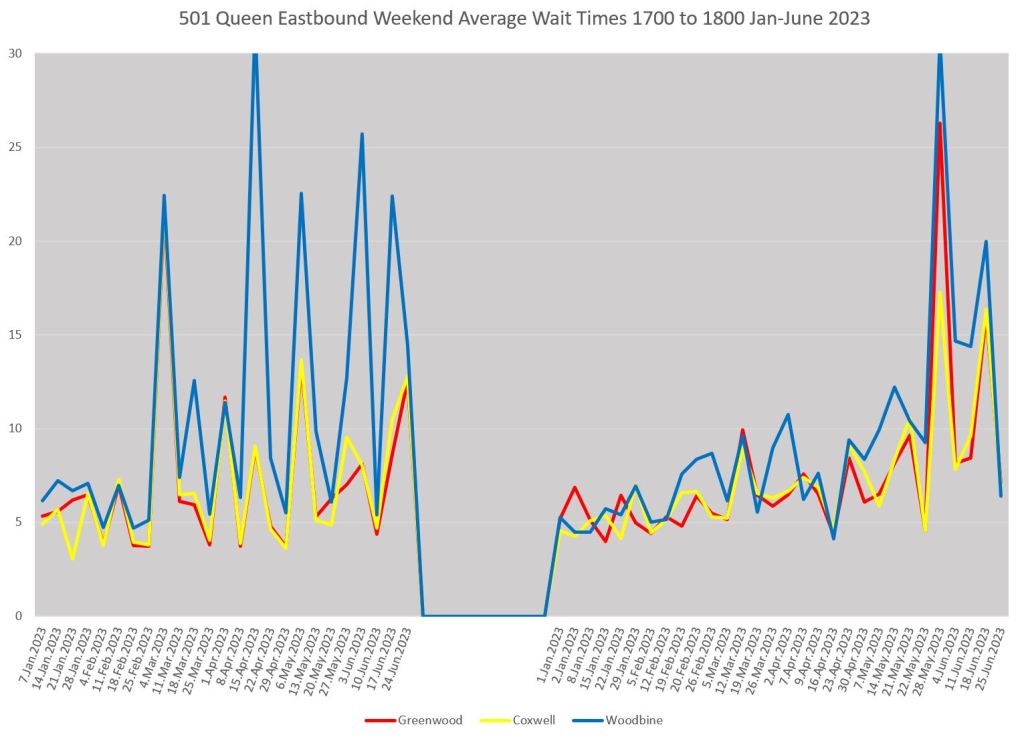
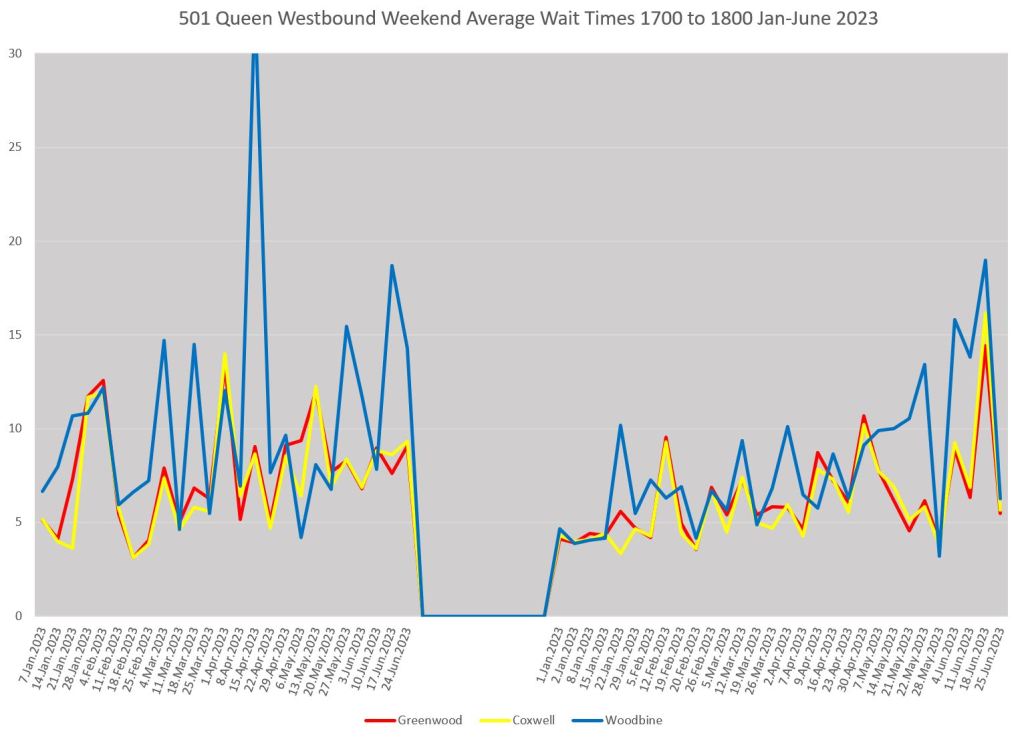
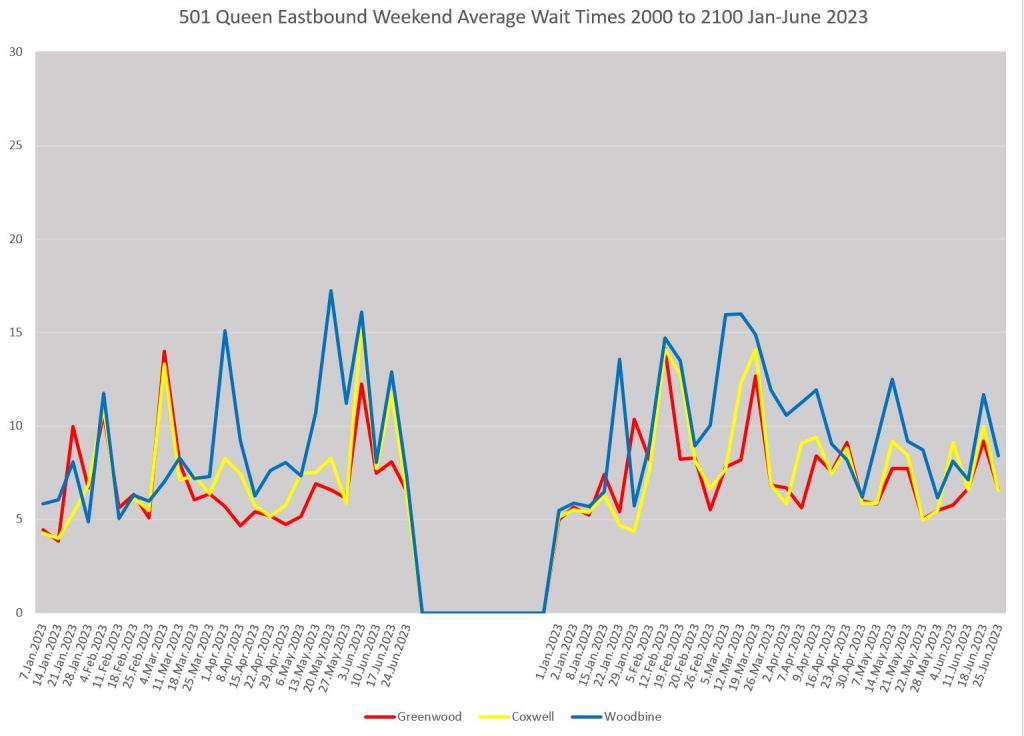
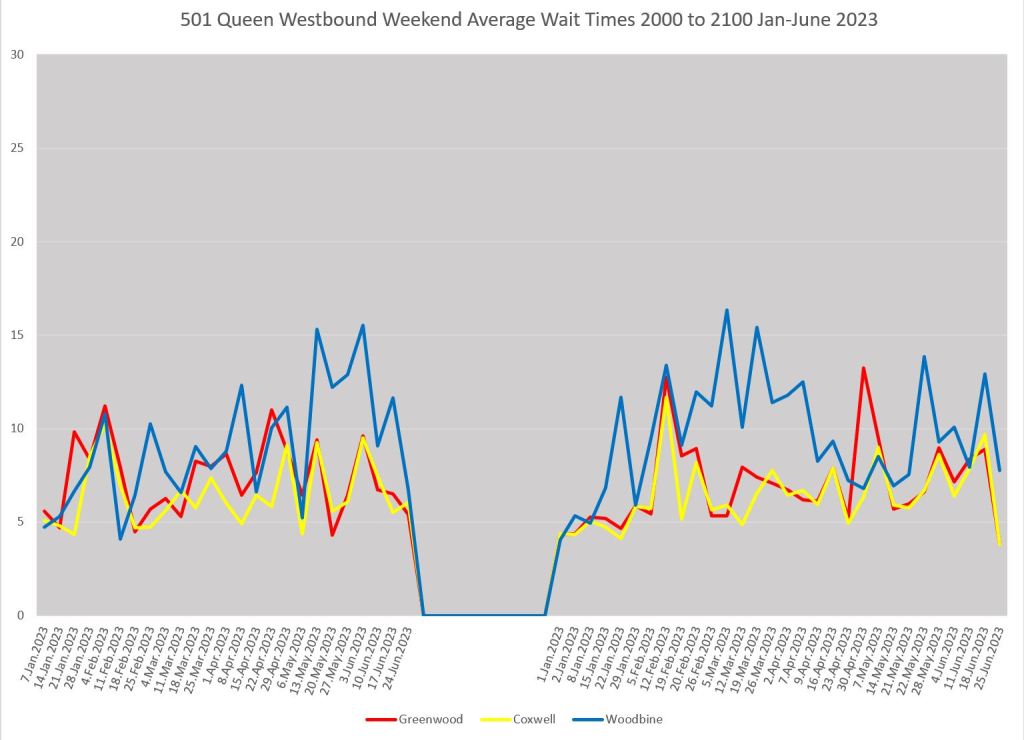
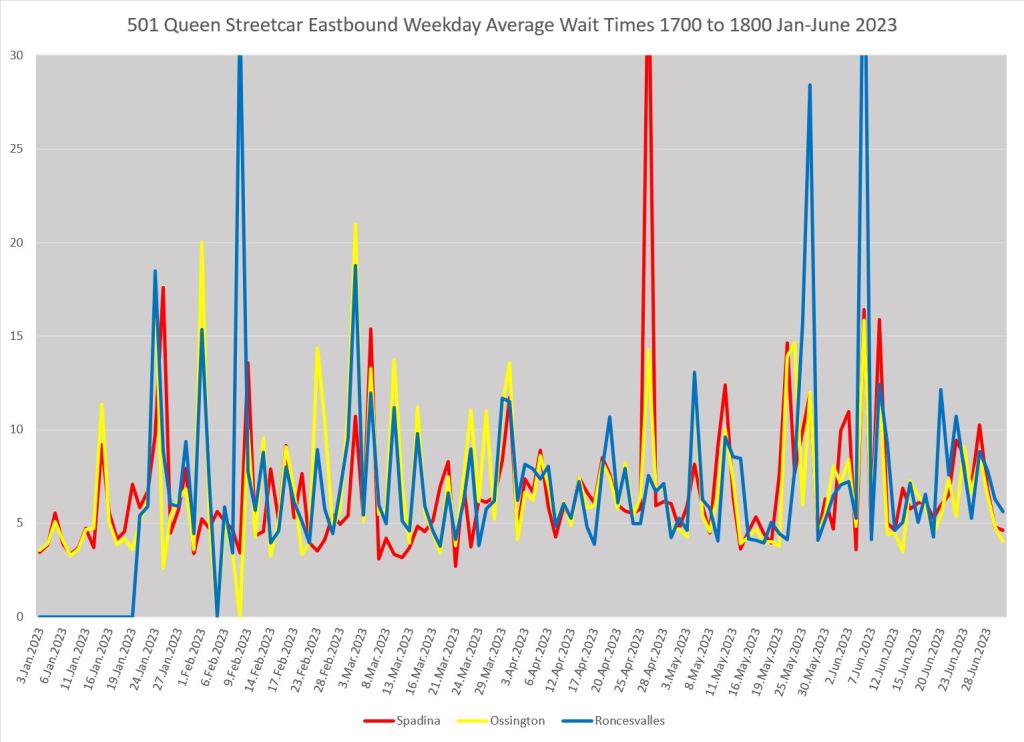
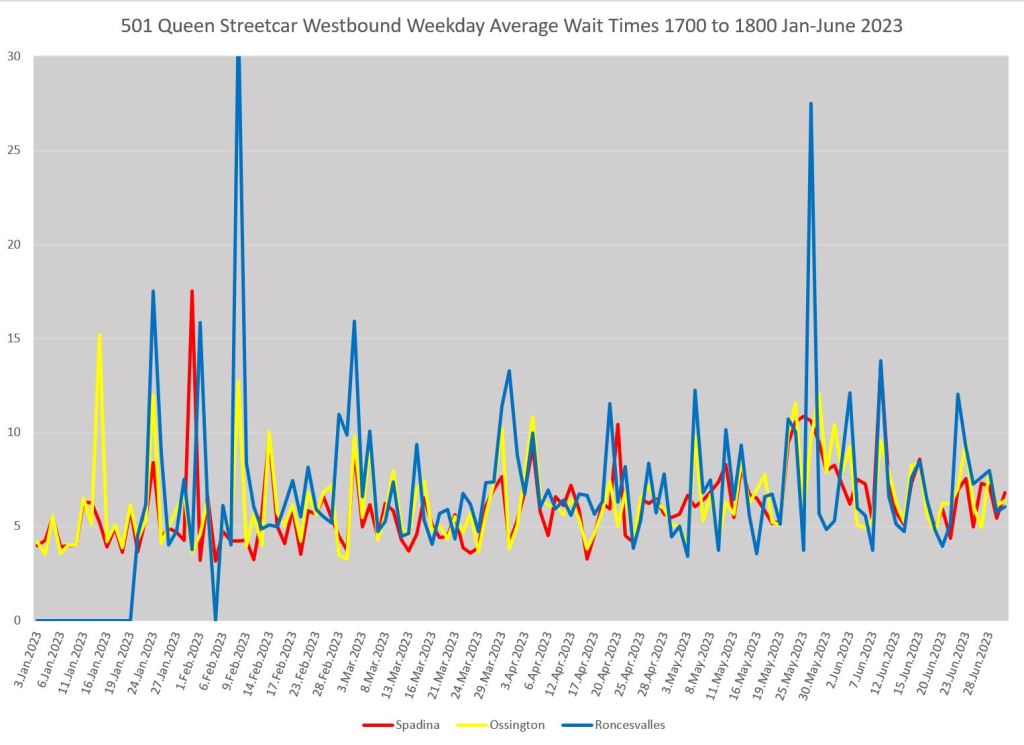
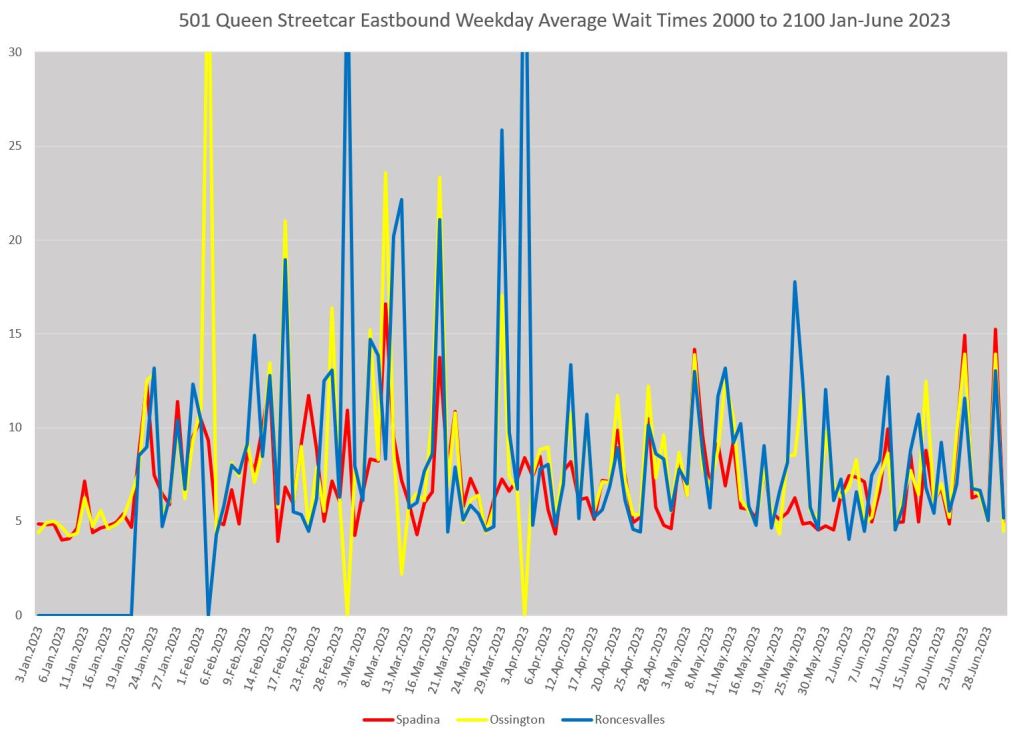
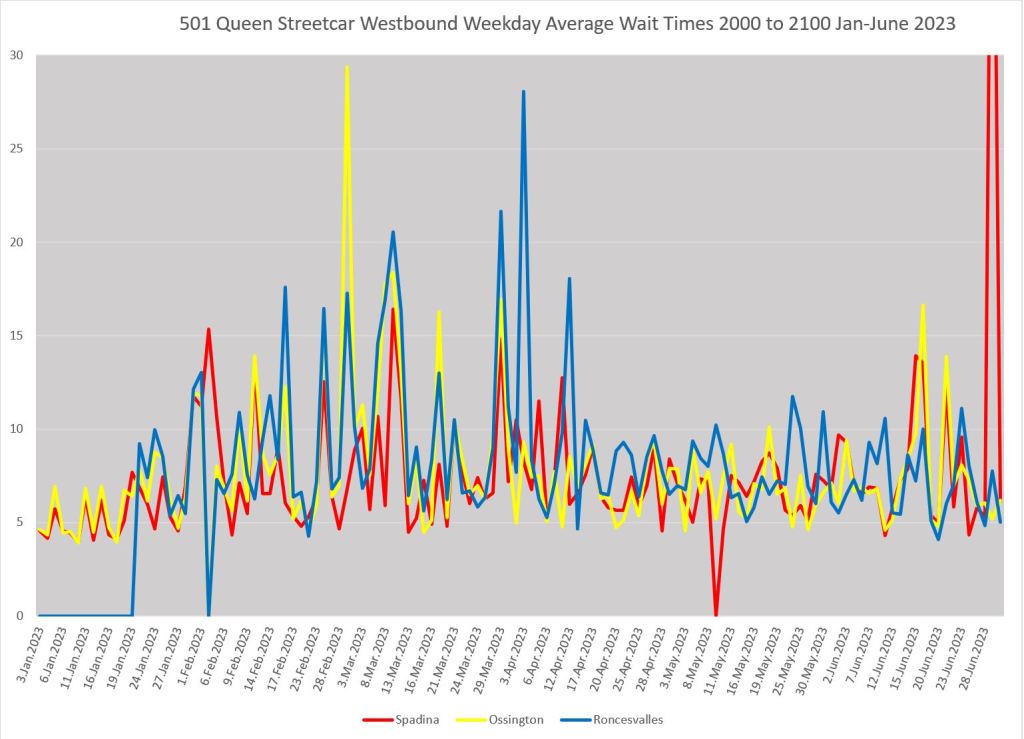
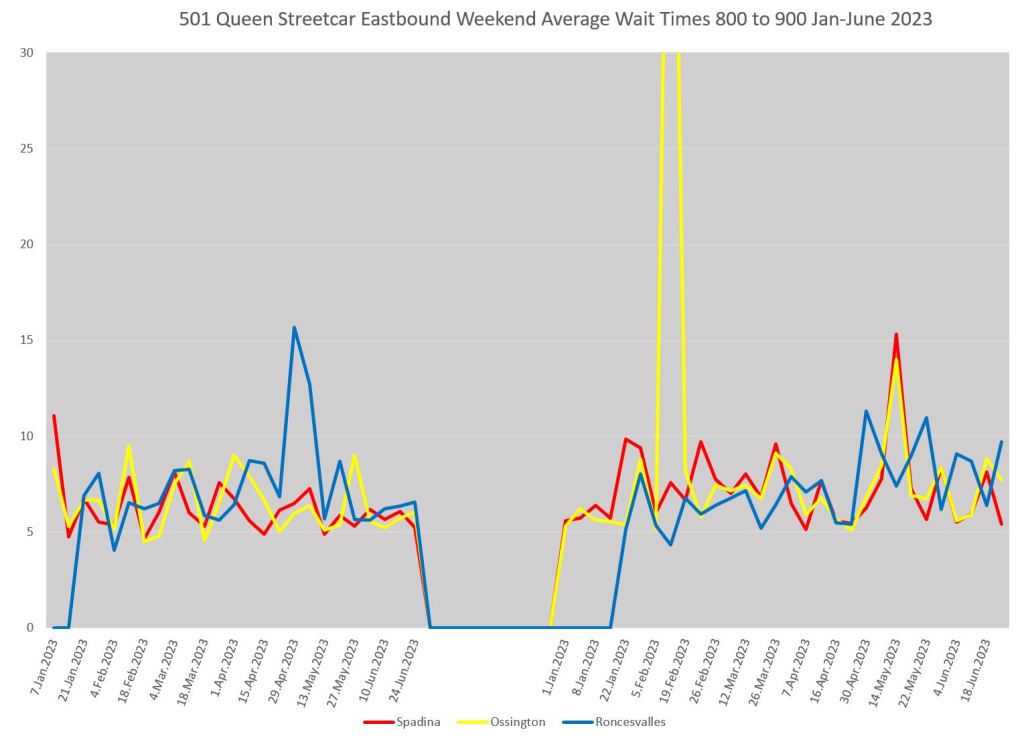
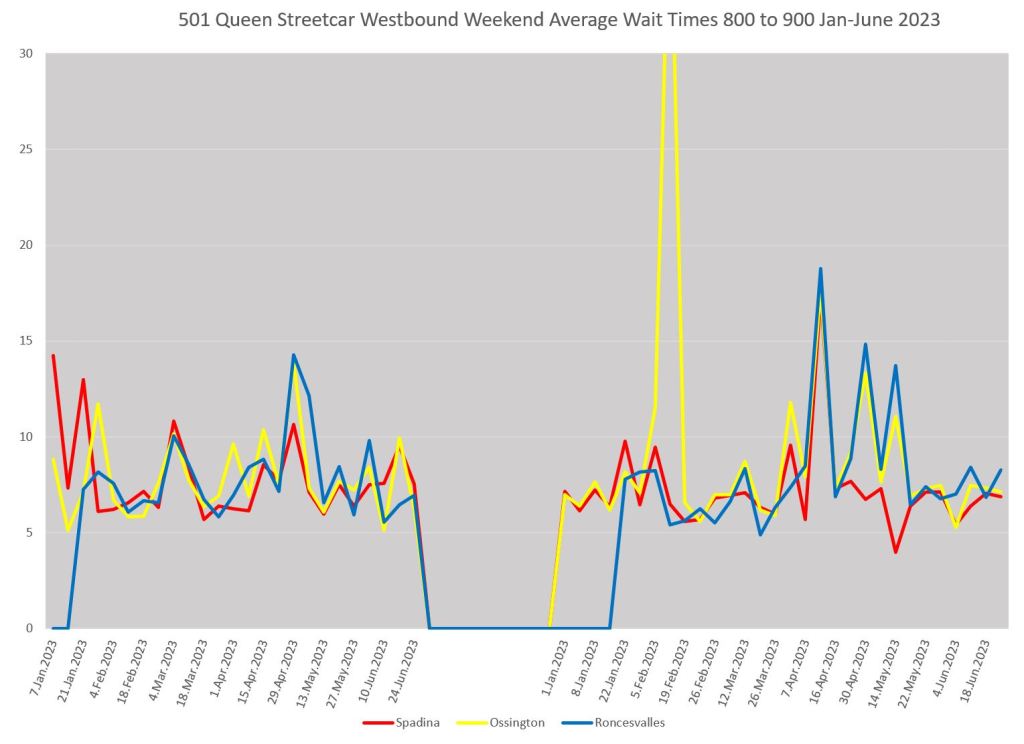
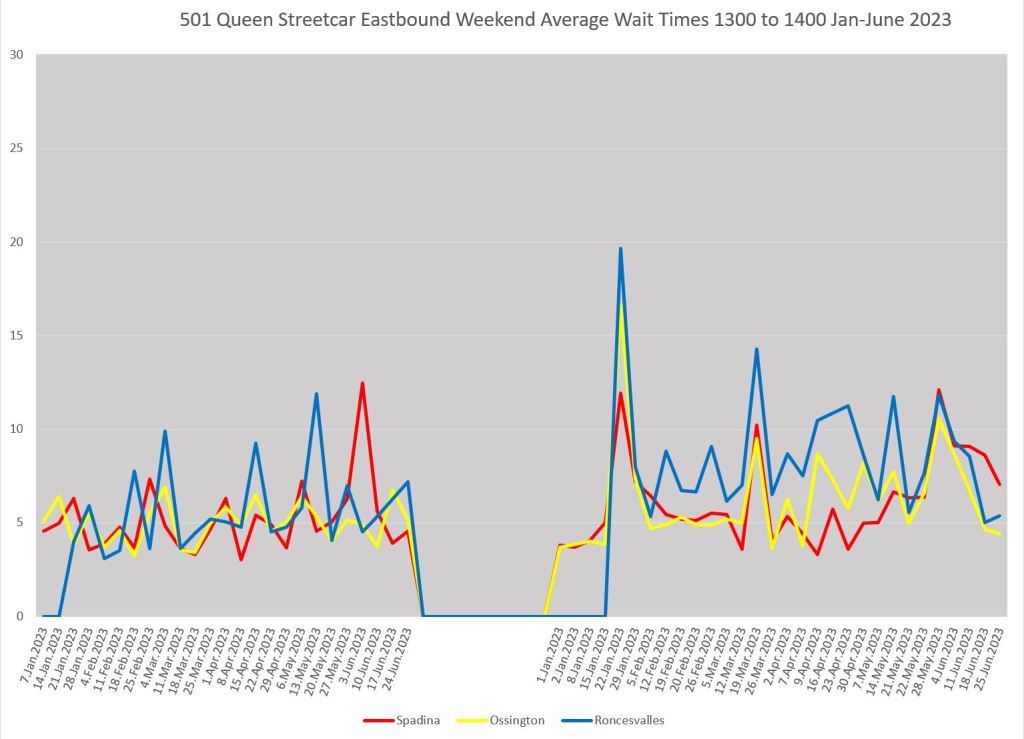
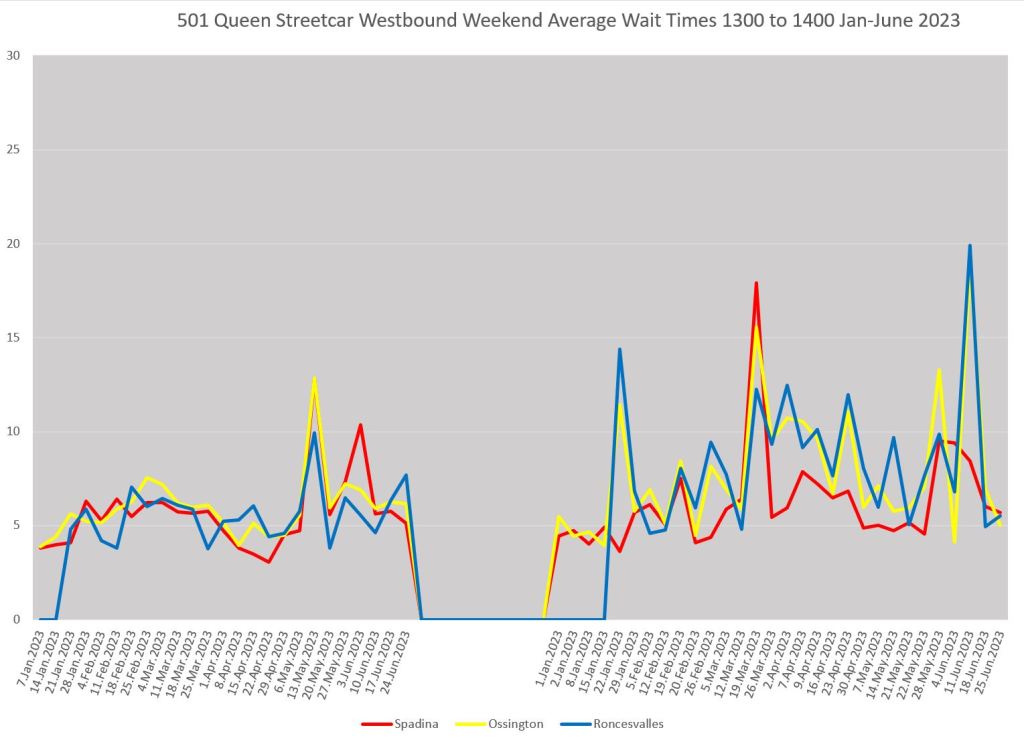
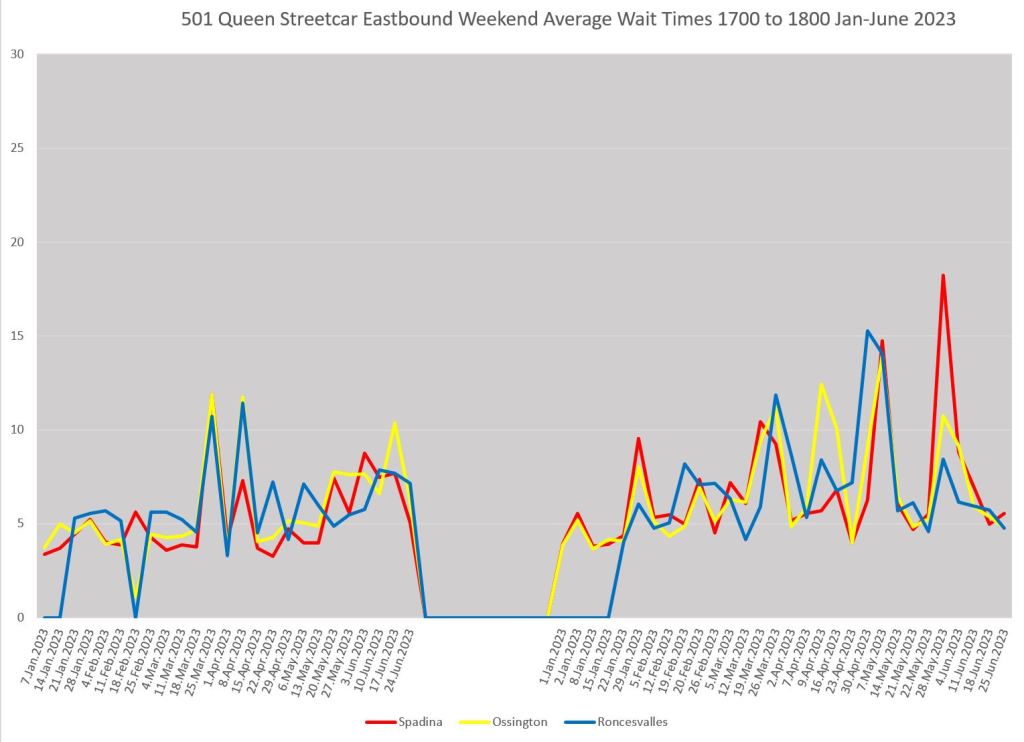
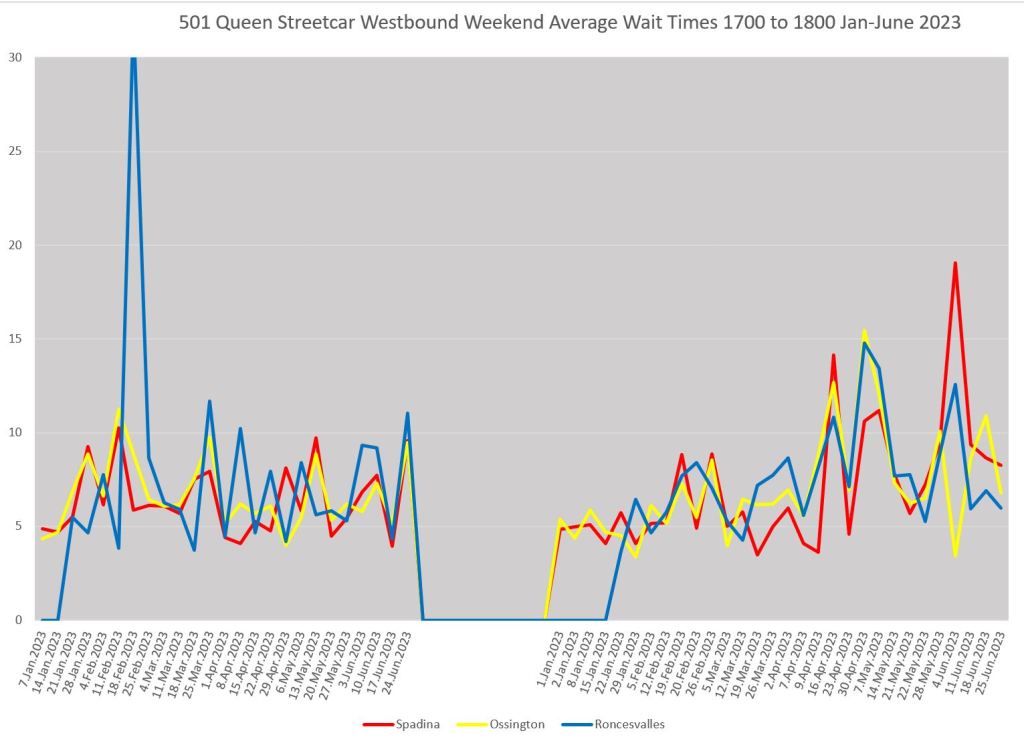
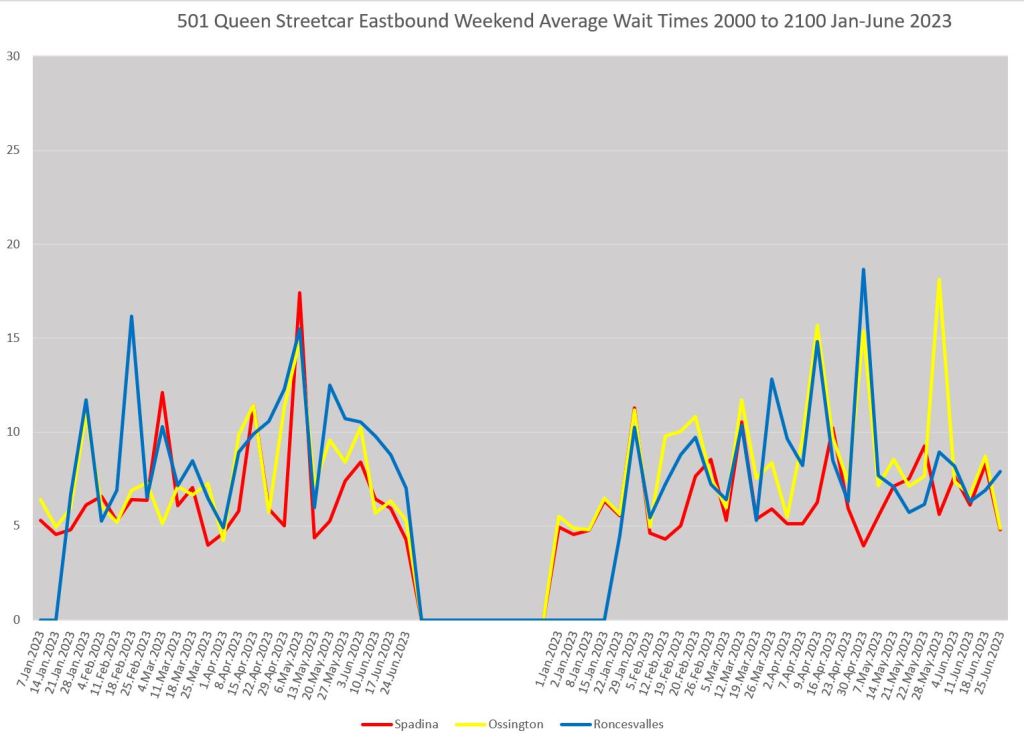
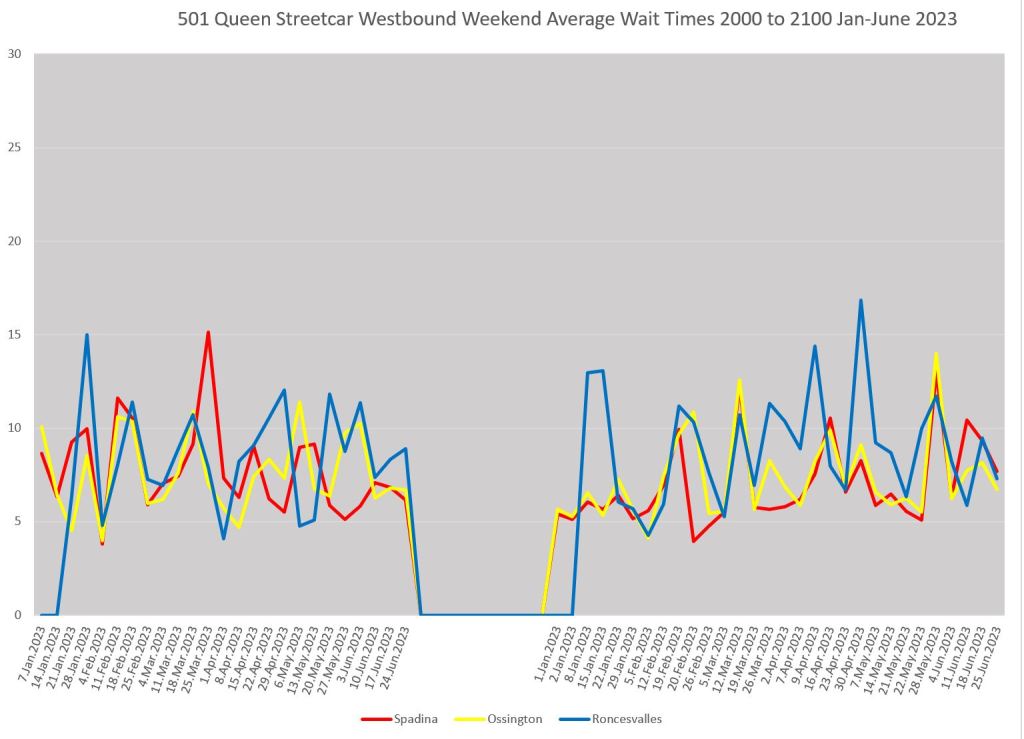
The charts below show average wait times (calculated on a weighted basis to reflect the larger impact of wide gaps on waiting riders) for three locations showing the effect of short turns at Woodbine Loop (between the Woodbine and Coxwell screenlines) and at Russell Carhouse (between screenline at Coxwell and Greenwood).
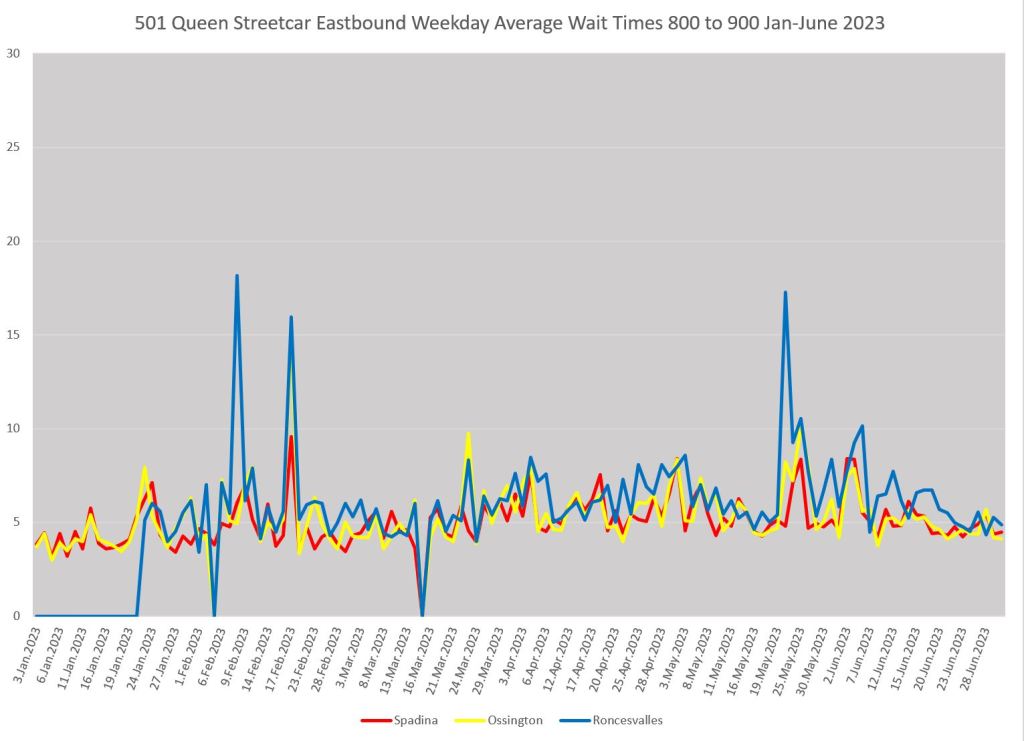
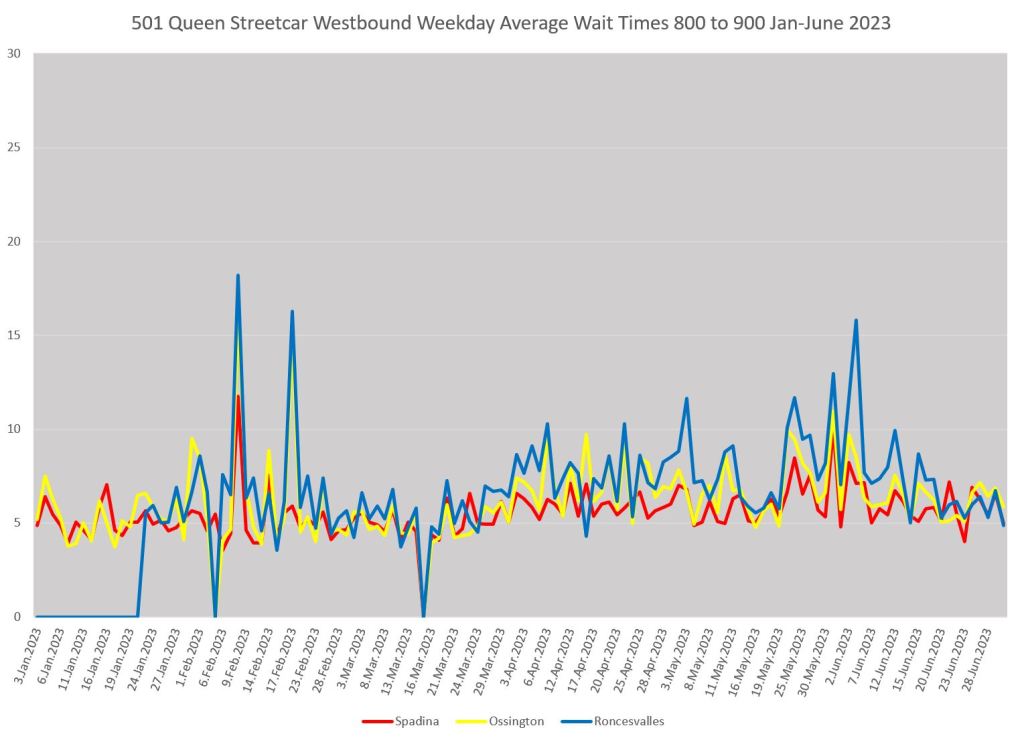
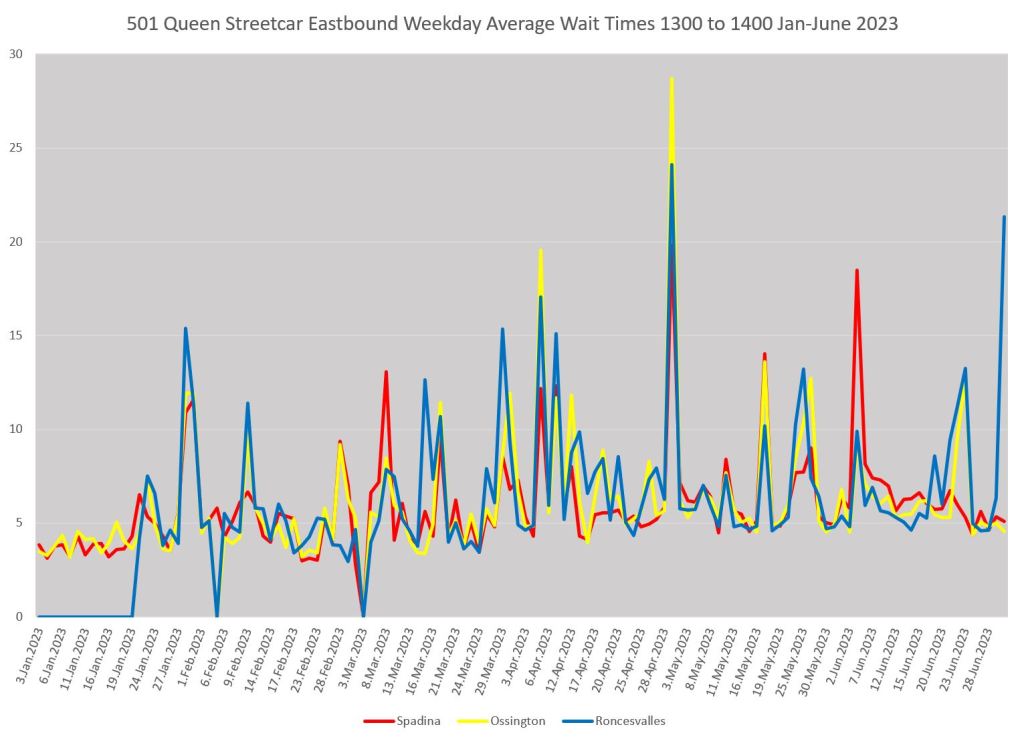
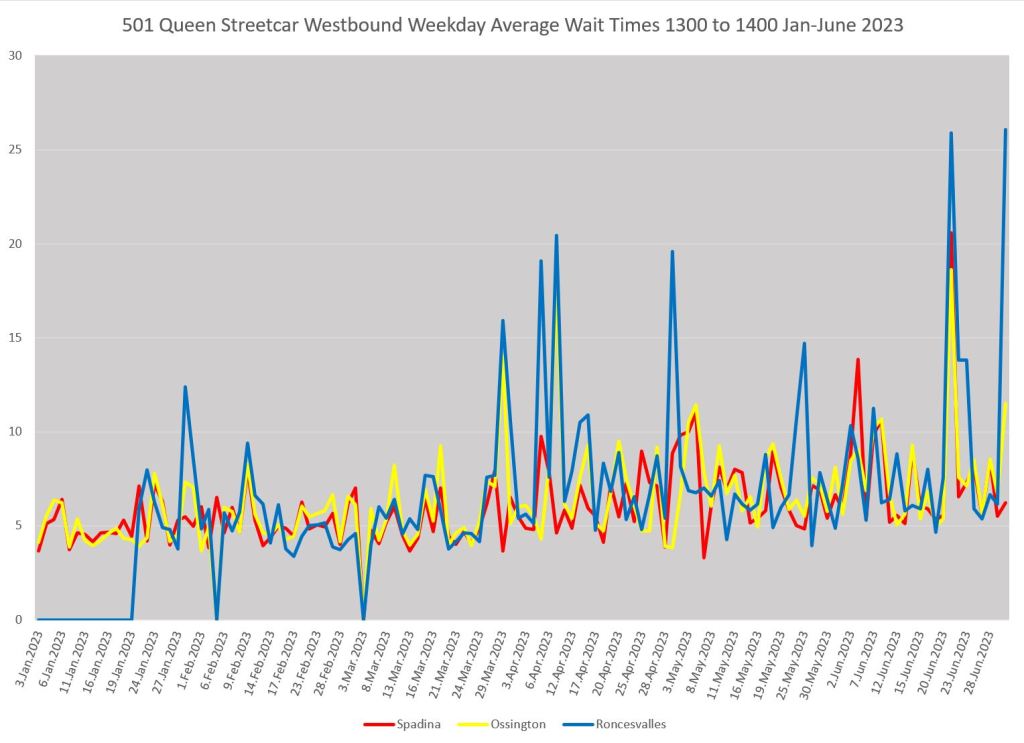
The blue lines show average wait times east of Woodbine Loop, and these values are quite often higher than wait times at Coxwell (yellow) or Greenwood (red) indicating that less service reached that point. Moreover, the blue line bounces around considerably from day to day showing how riders do not have even a service that is “reliably undependable”.
Eastbound data are on the left, westbound on the right, for sample periods through weekdays. As regular riders know, the situation deteriorates through the day with PM peak and evening service being particularly ragged.
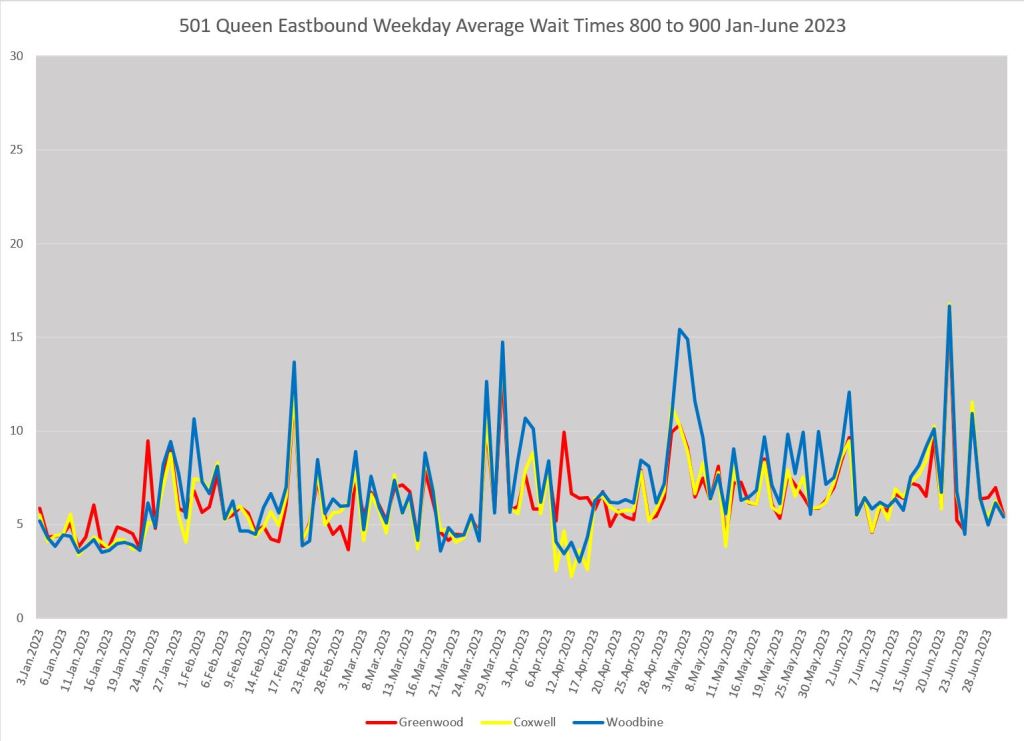
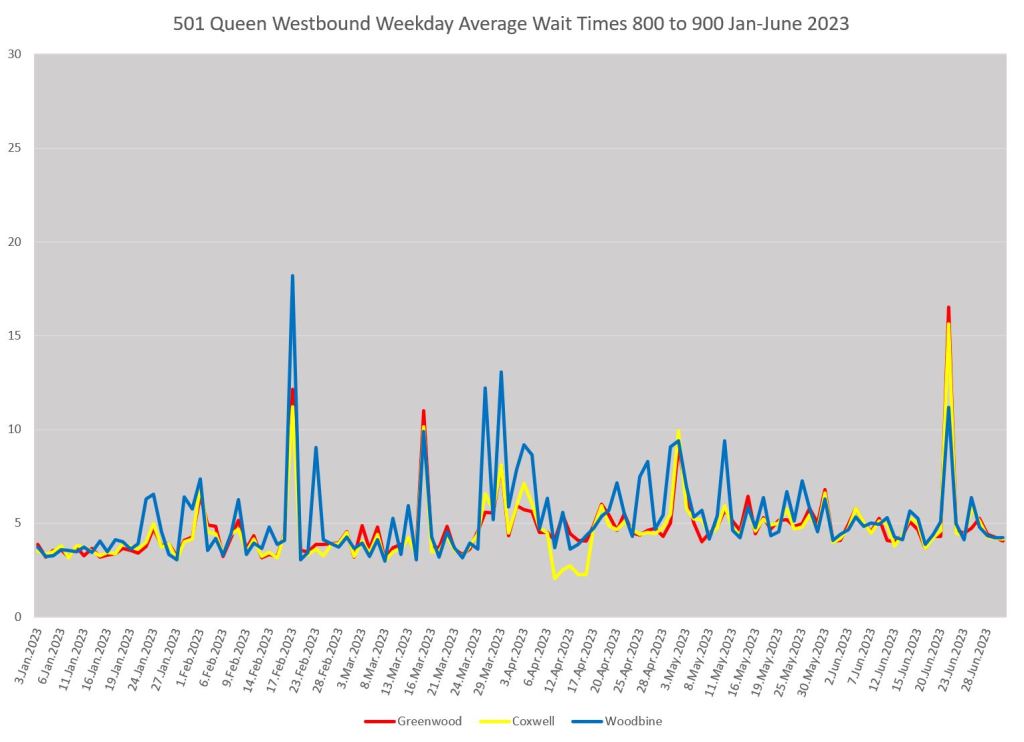
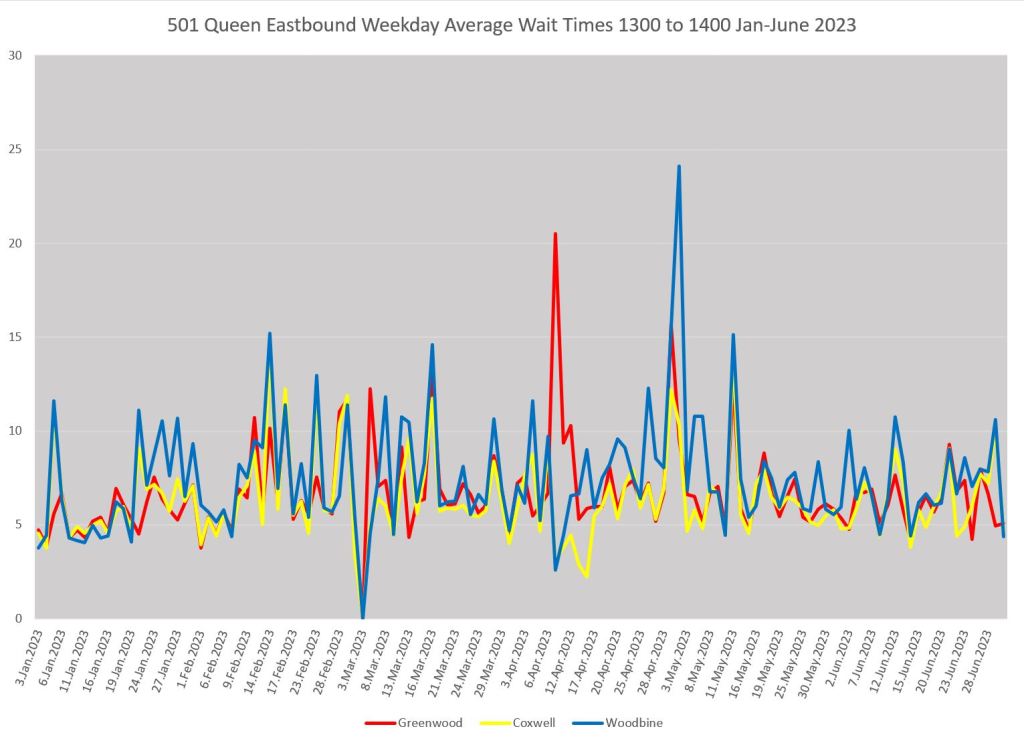
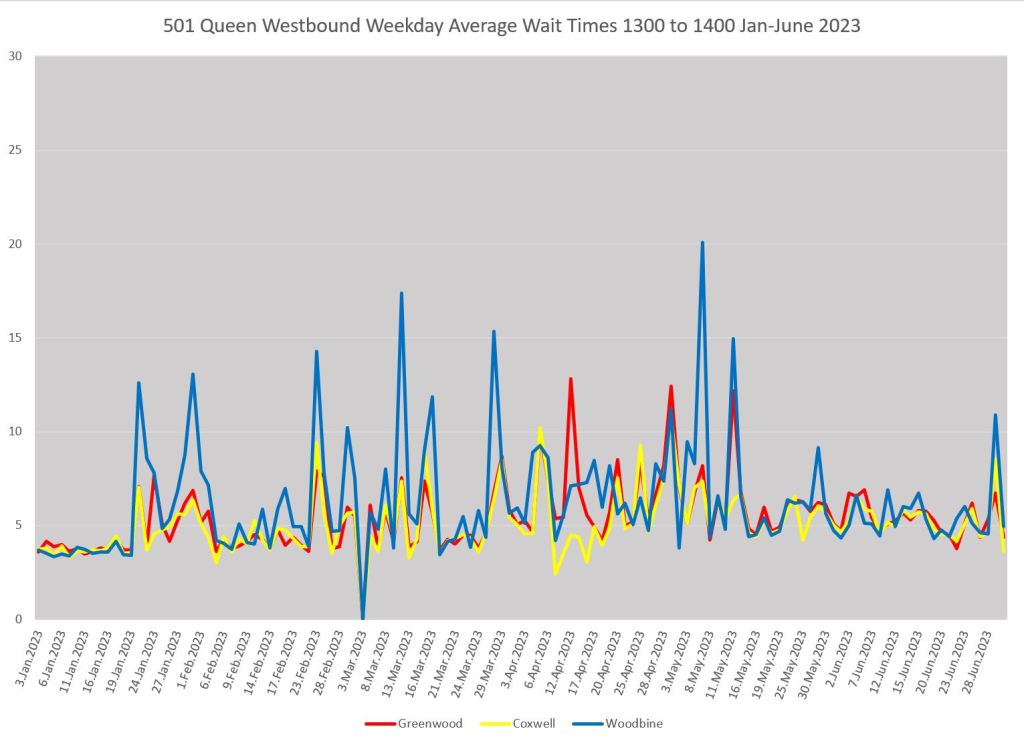
Here are the charts for weekend service. In each chart, Saturdays are grouped together on the left, and Sundays/Holidays are on the right.
501 Queen West End
Streetcar service on 501 Queen west to Roncesvalles was restored in mid-January. The charts below show the average wait time for a streetcar (bus data from the 501L Long Branch service are not included). The red line shows the average wait at Spadina before service leaves downtown. Further west, cars might turn at Bathurst (Wolseley Loop), or via Shaw/King/Dufferin. Generally speaking, average wait times rise the further west one is on the route, and the problem worsens in the afternoon and evening.
Weekend service:
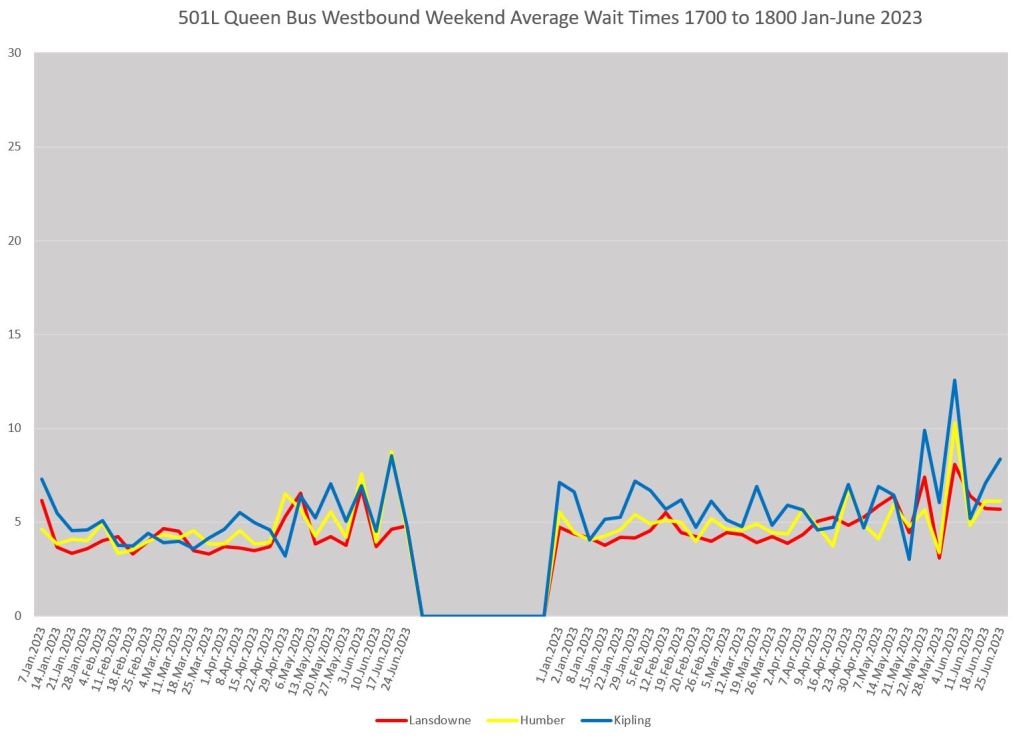
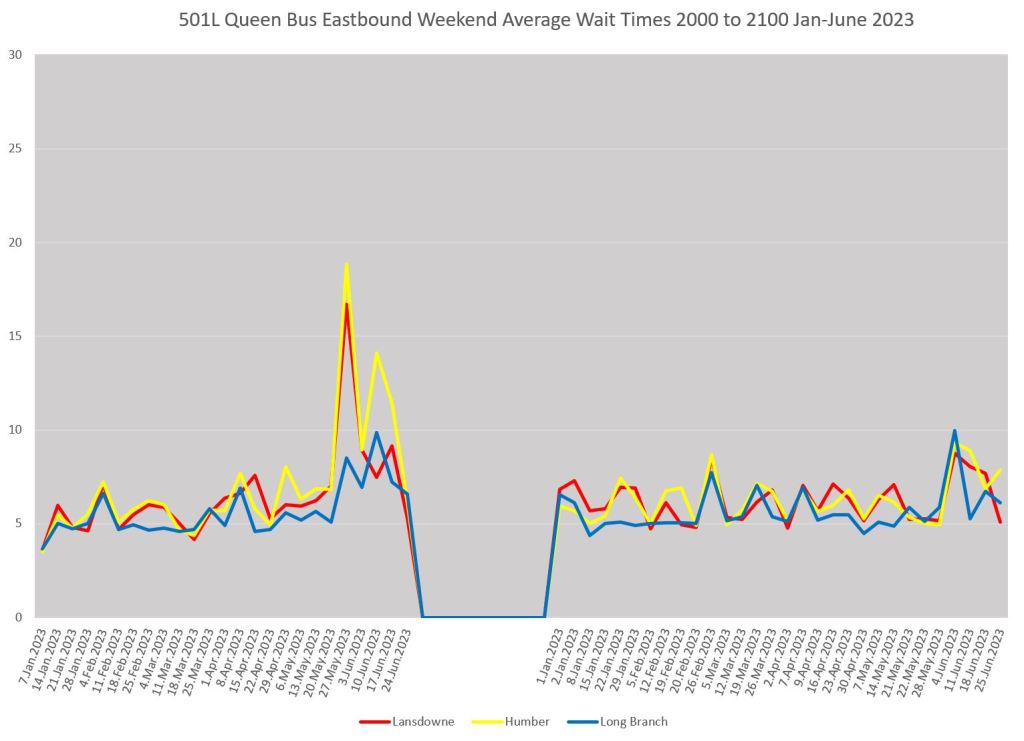
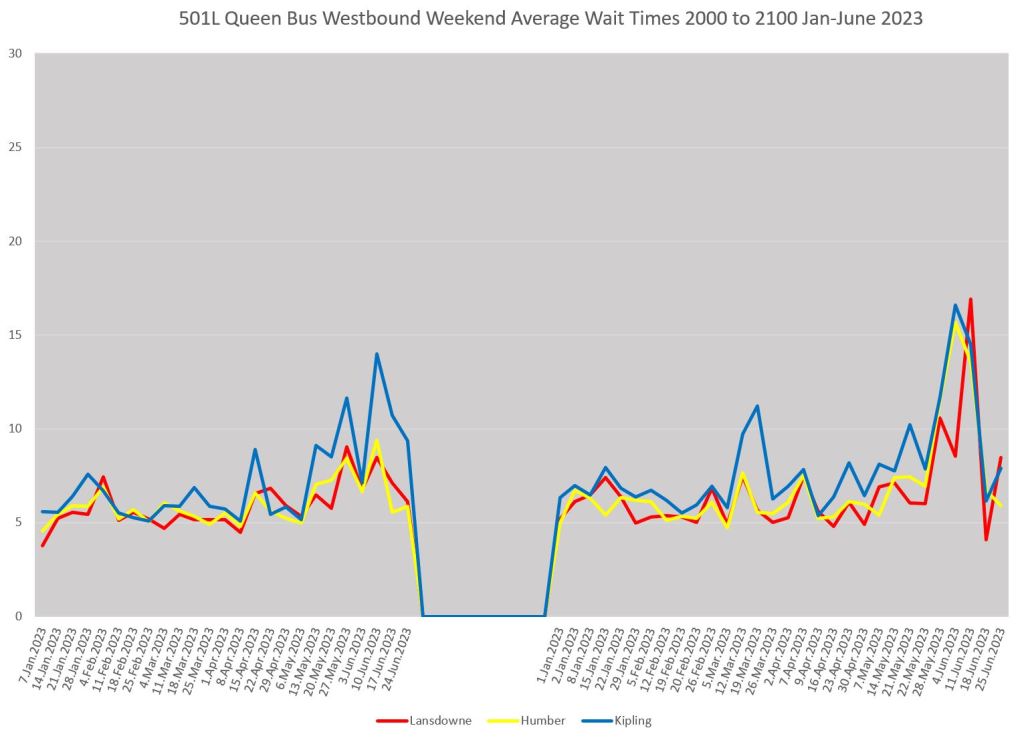
501L Long Branch
Service beyond Roncesvalles to Long Branch has been provided by the 501L bus.
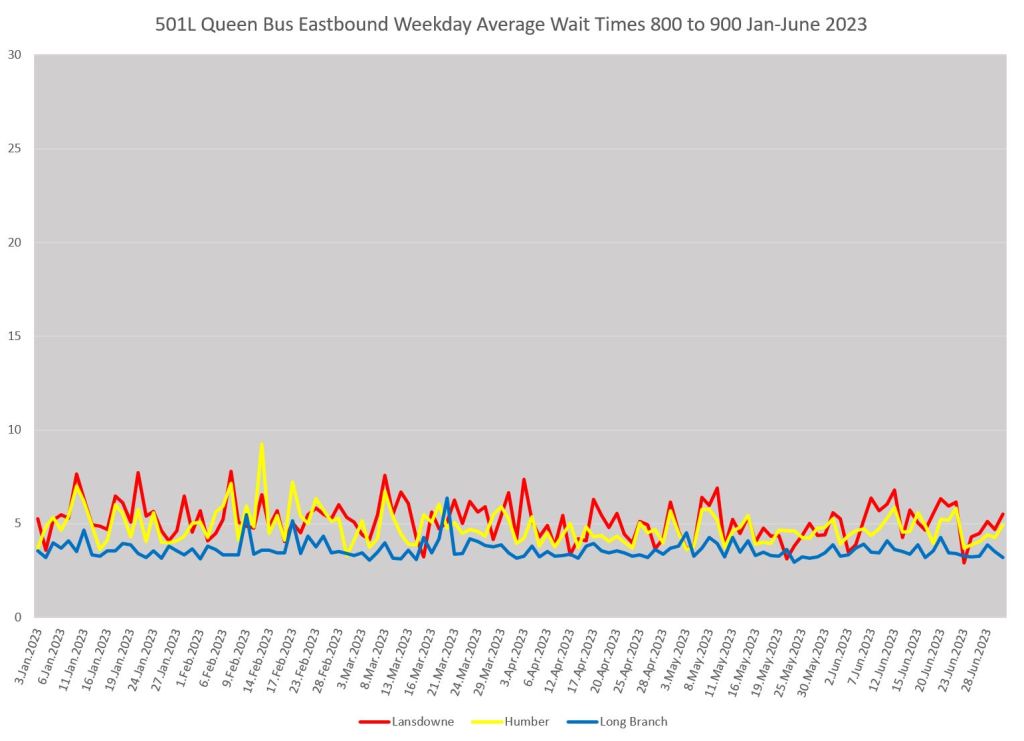
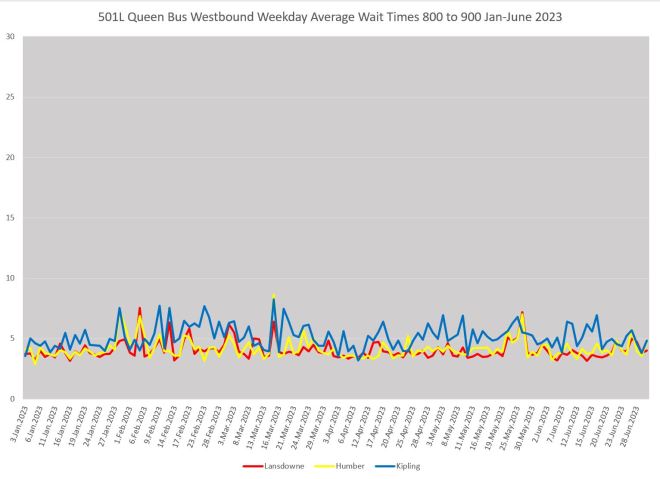
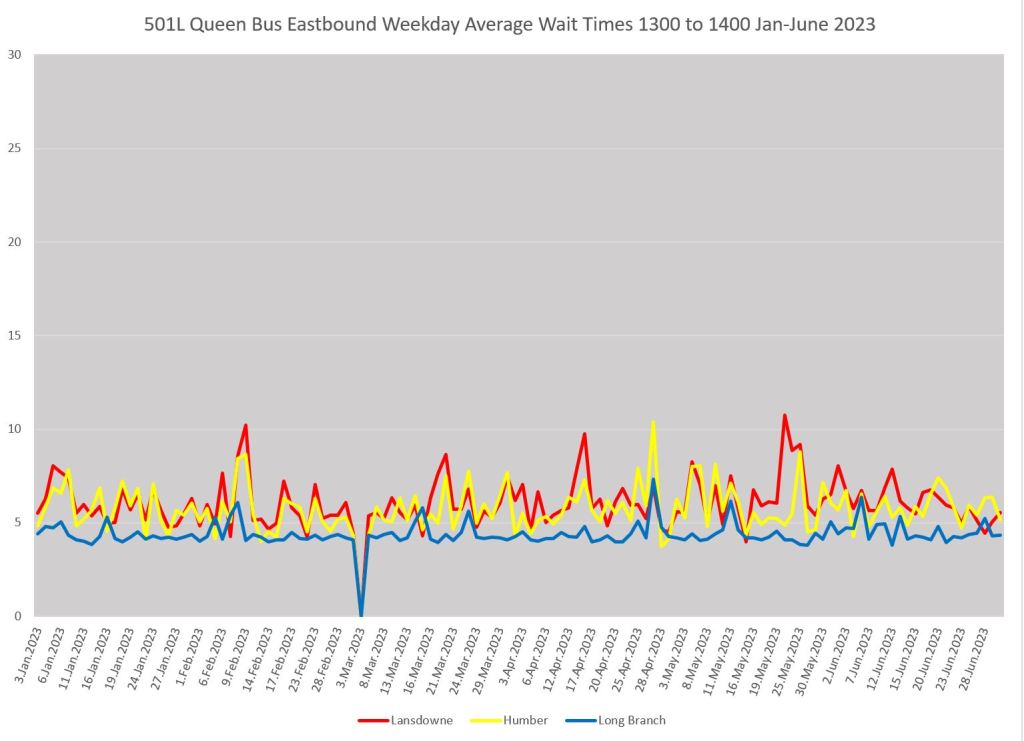
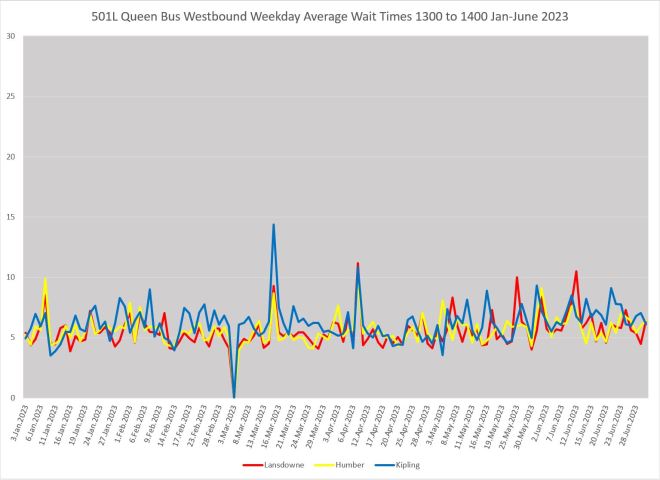
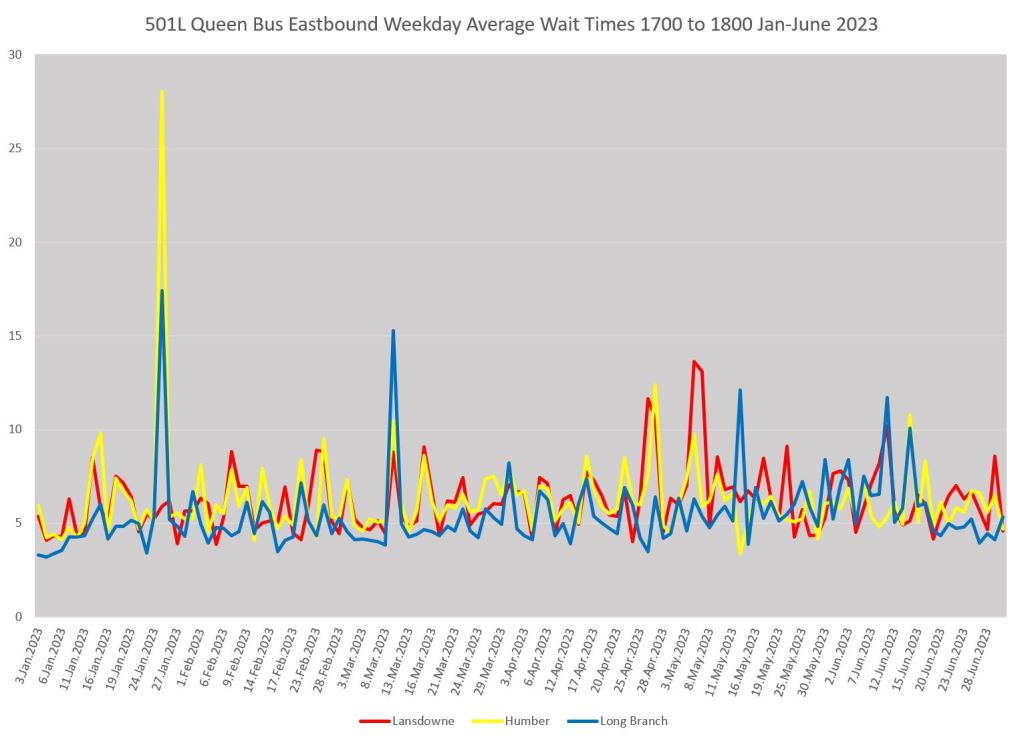
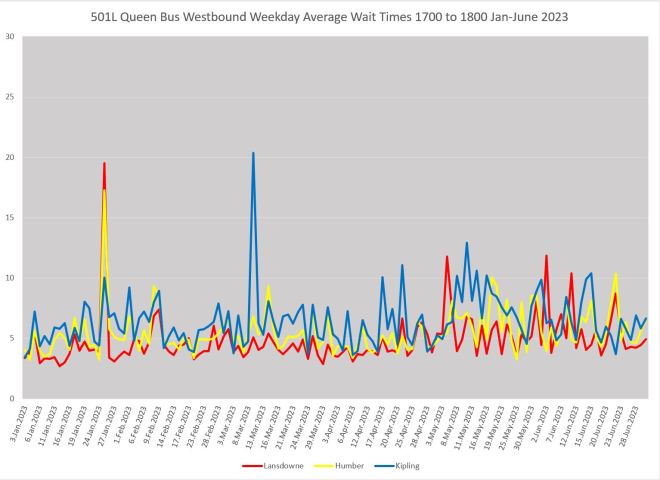
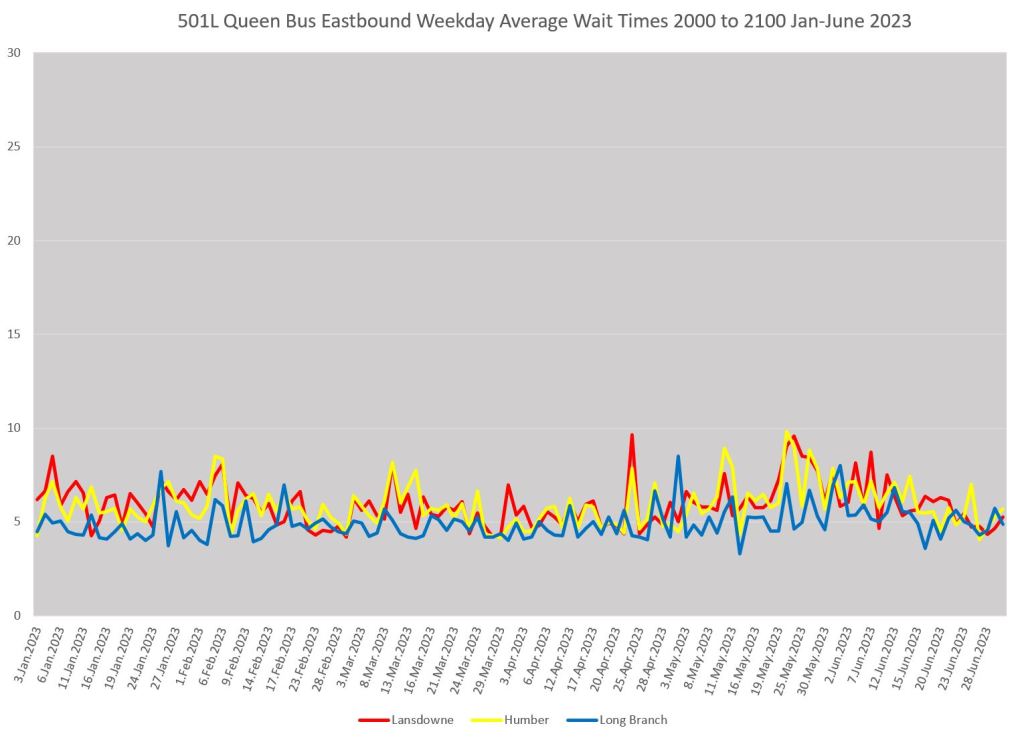
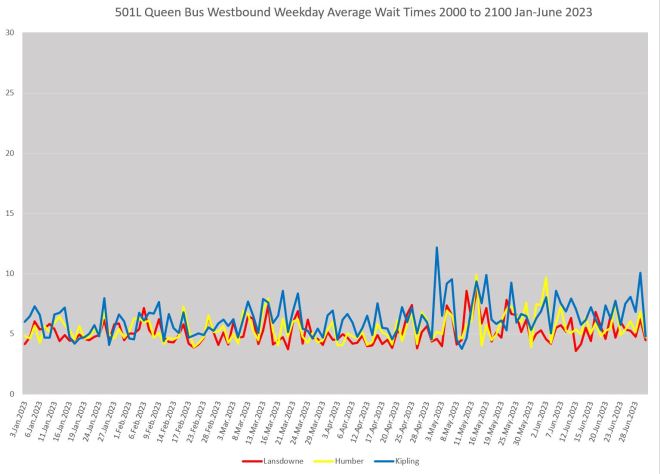
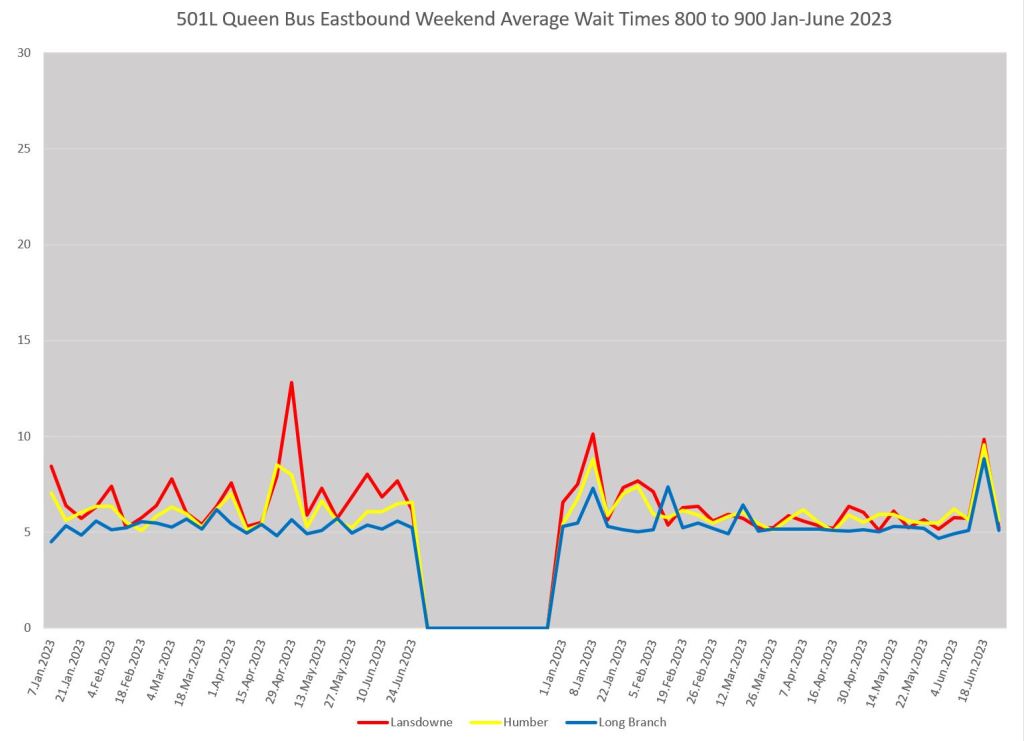
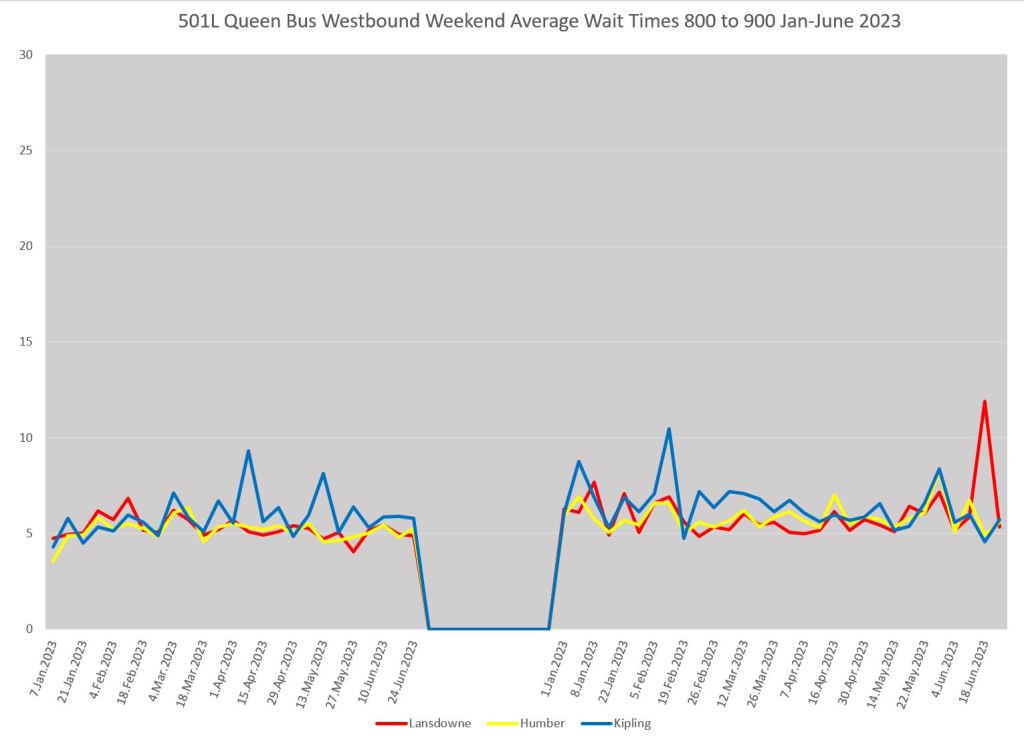
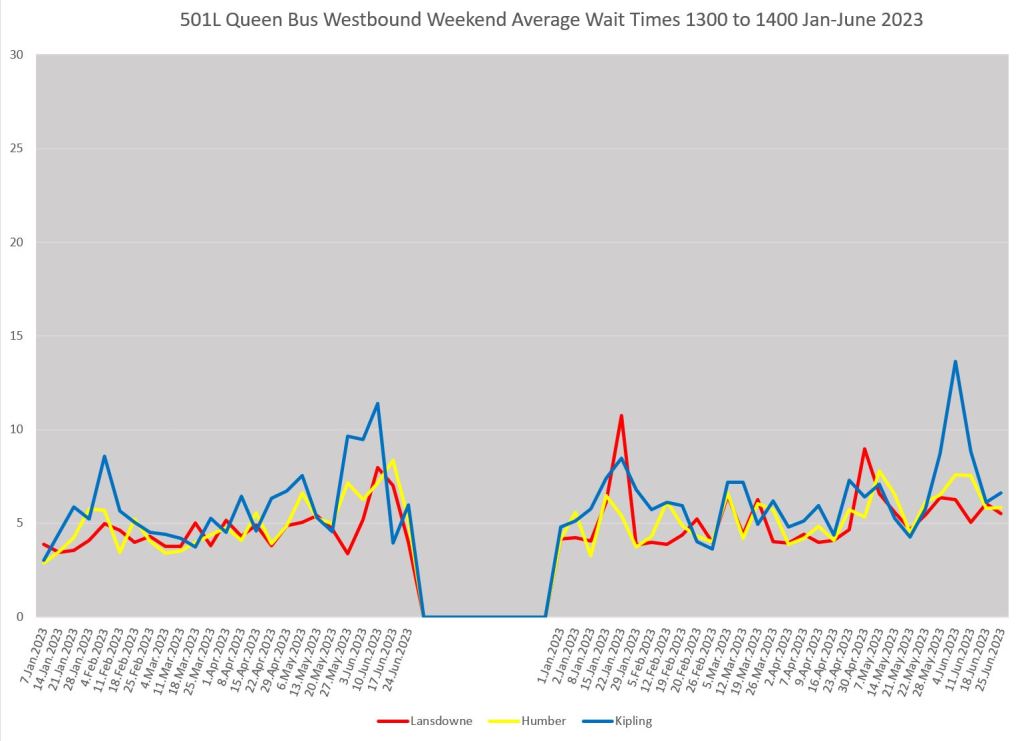
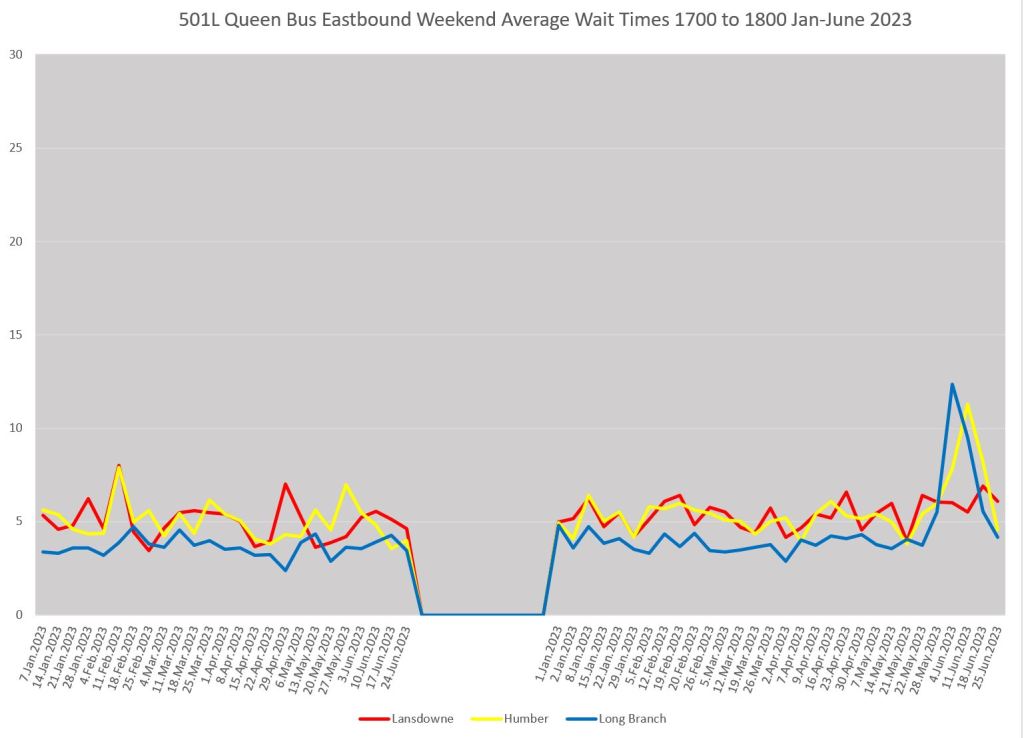
Although there are small differences in average wait times, the values tend to stay together as buses move west as seen by data at Dufferin, Humber and Kipling. Similarly, eastbound values at Long Branch, Humber and Landowne follow each other with few disruptions.
Evident in the data is the effect that the further one goes along a route, the more service tends to bunch. Although the average headway (the inverse of vehicles per hour) might be similar, the wait time, which is weighted by the length of individual gaps goes up. In the eastbound service, the wait time at Long Branch (blue) is lower than at points further east (yellow and red) because it is the least variable at the terminus. Similarly for westbound service, the wait times are generally lowest at Dufferin (red) and rise slightly further west.
There are a few exceptions where a spike in average wait times on the outer end of the line did reflect short turns. For example, on March 9 there is a spike in wait times caused by severe traffic congestion between Dufferin and Roncesvalles that triggered short turns west of Royal York, but this was a one-day effect. In early May, service on the 501L tended to bunch badly in the afternoon, compounded by congestion near Roncesvalles. This is reflected in long average wait times outbound at Kipling by which time bunching hits its maximum even though the actual disruption is further east.
Because the 501L buses have very generous recovery times scheduled at Long Branch, short turns are rare. The westbound gaps are not reflected in the eastbound service, at least to the same degree, as buses can leave Long Branch on a better spacing than they arrived.
Weekends:

504 King
King has been bedeviled by construction and diversions for a few years, and the west end of the line is now more or less back to normal. Short turns do occur at Roncesvalles westbound putting gaps into the Dundas West service, but the greater problem is headway irregularity on the line itself.
On July 30, the 504B Dufferin Gate service will be extended west to Roncesvalles for construction at Dufferin Loop.
It is not yet clear whether the TIFF diversions will occur this year given the state of Queen Street. The usual route taken eastbound by 504 cars (Spadina, Queen, Church) is not available.
At the east end of the route, all cars are currently looping at the Distillery due to construction on Broadview and this will continue until at least late November.
I plan a review of this route later in the year with a follow-up in 2024 once the route is back to normal, and construction on Adelaide Street is complete.
505 Dundas
The 505 Dundas car was scheduled to operate east via Queen to Bingham Loop, but was unable to achieve the scheduled running time. I explored this in detail in a recent article, and will not repeat that analysis here.
In brief, Dundas cars now only operate to Woodbine Loop rather than continuing to Bingham until 8pm while the 501/504 (aka 503) temporary buses provide service on Kingston Road.
While the streetcar service attempted to reach Bingham Loop, service on both ends of the line was poorer than normal as that article shows. The problem did not just affect service to Bingham but also to Dundas West Station. Short turns were common on both ends of the route.
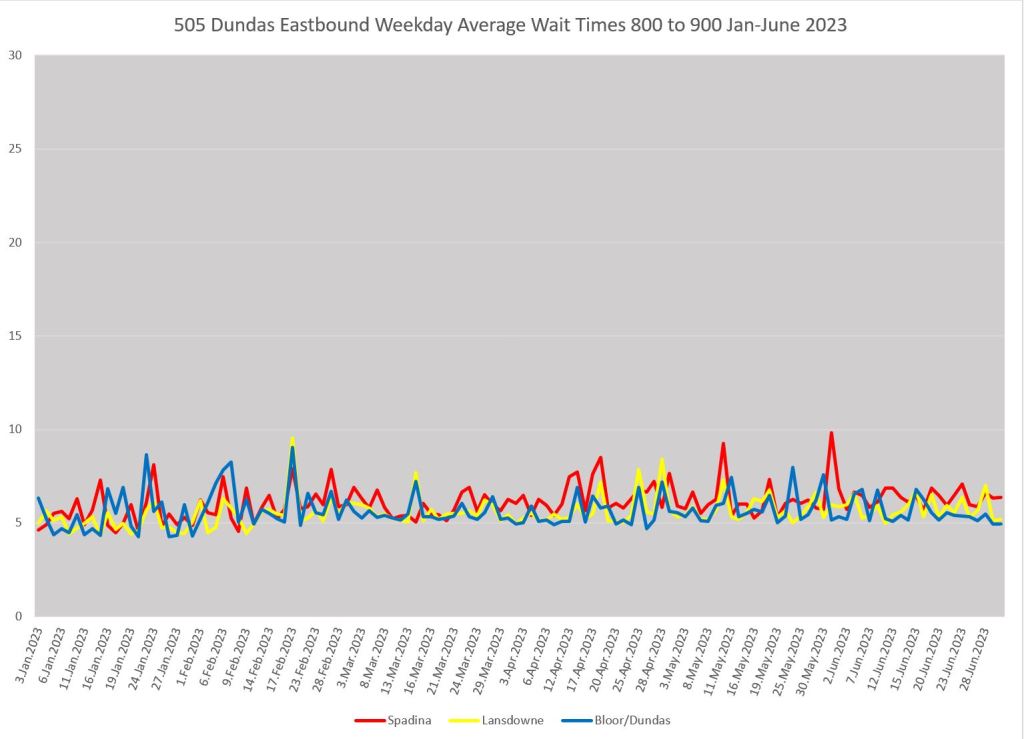
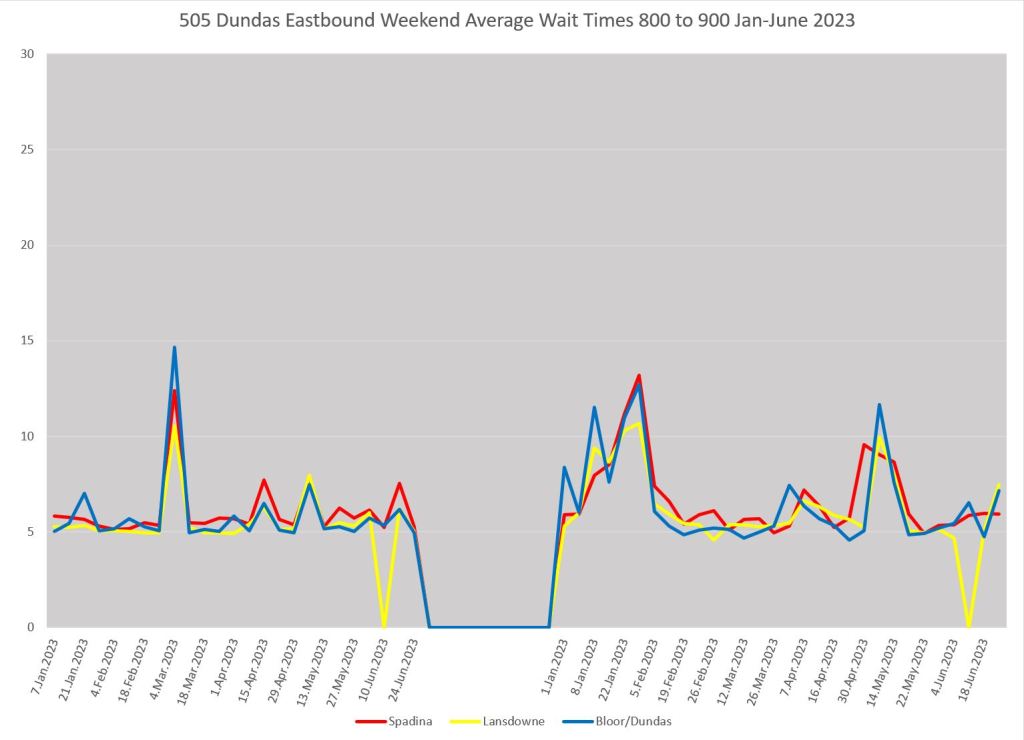
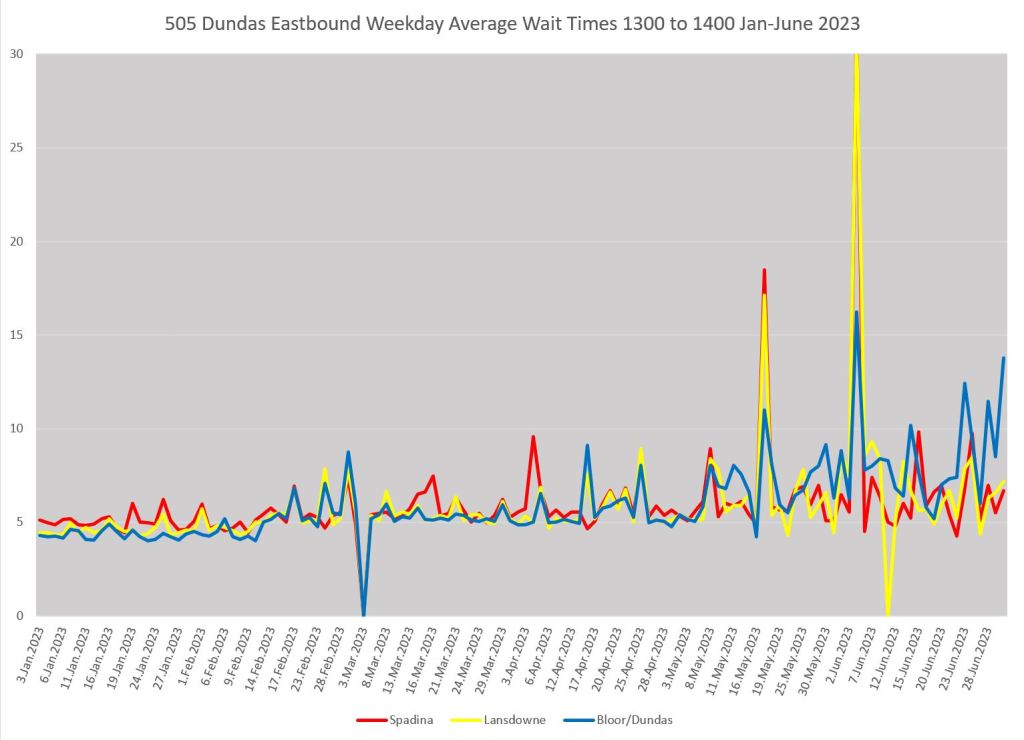
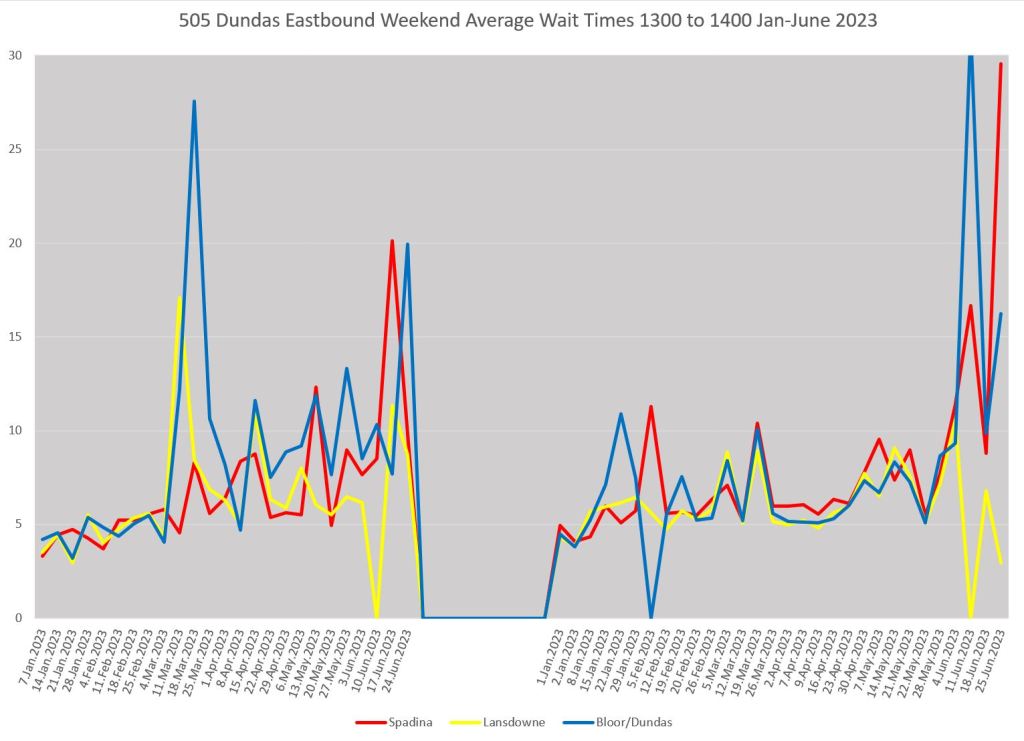
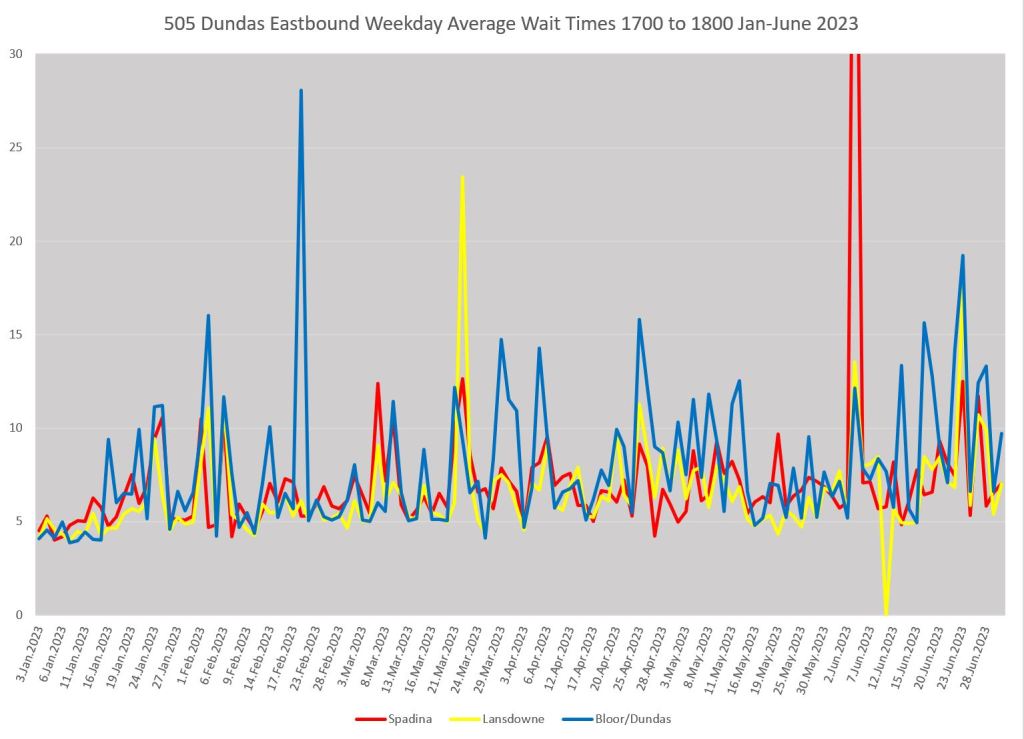
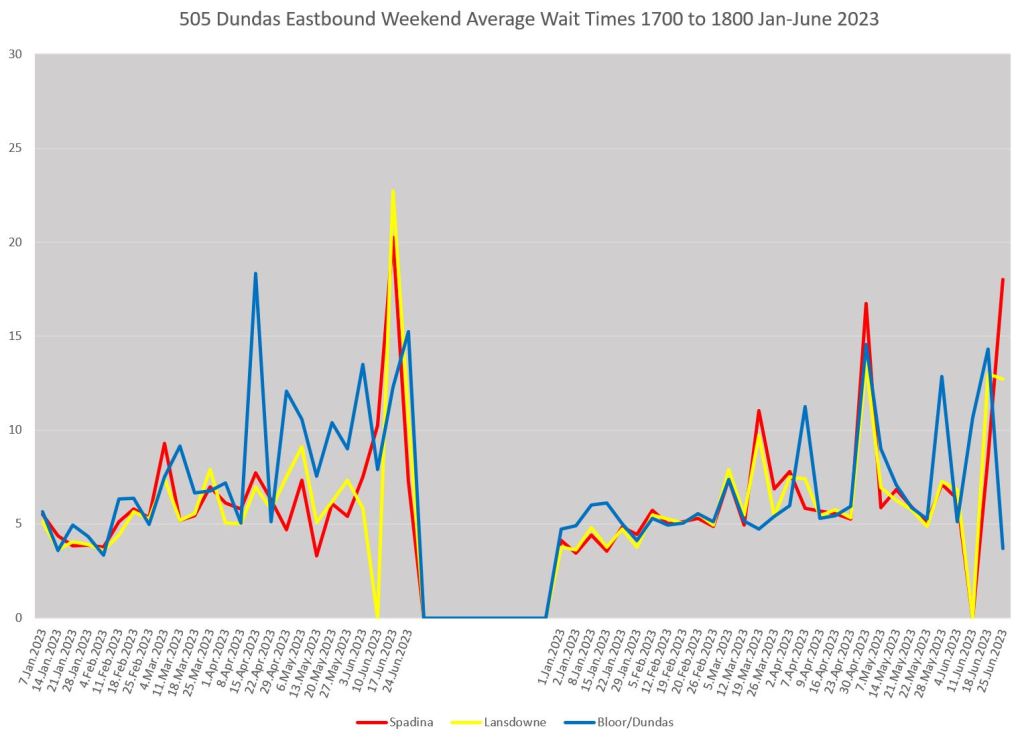
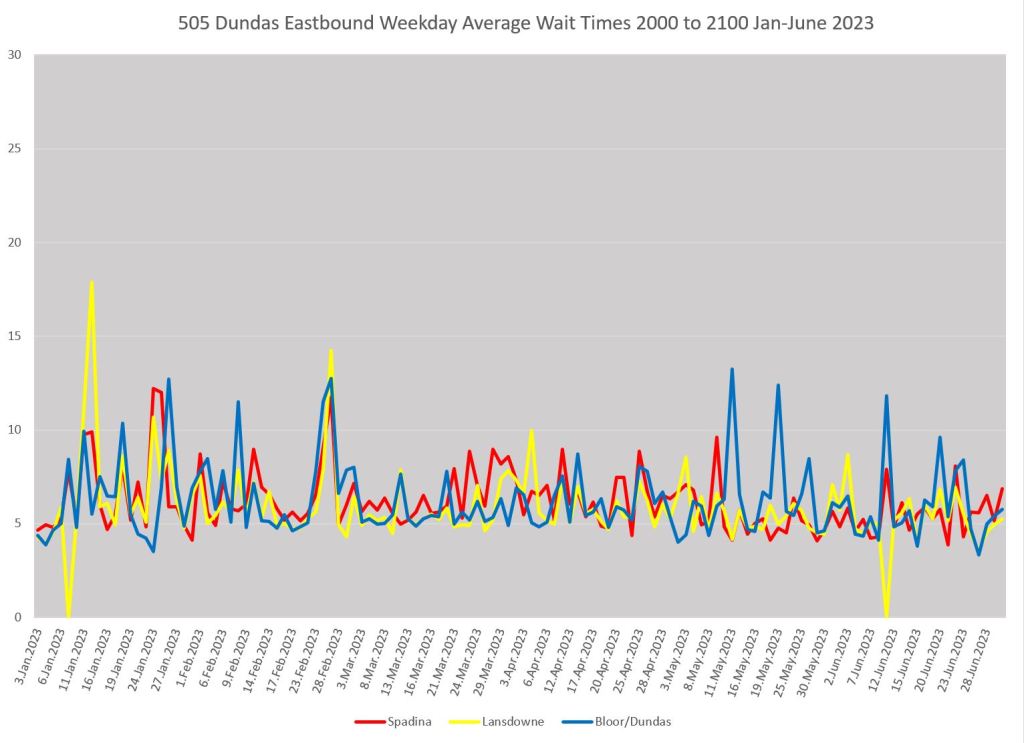
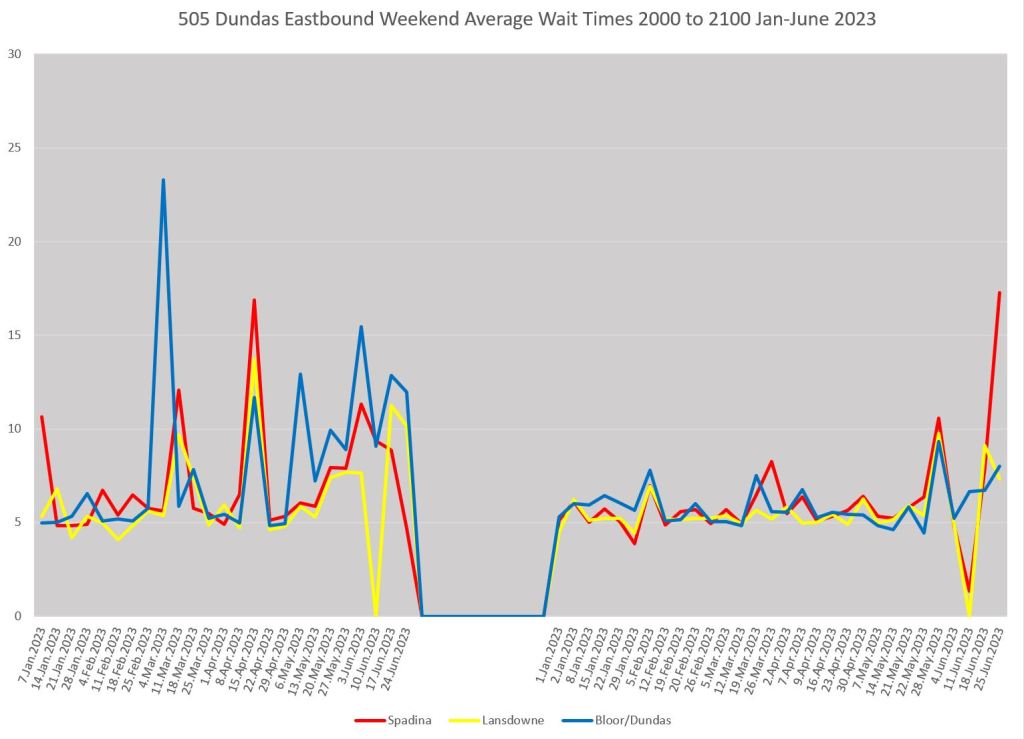
In the charts below, the average wait time at Dundas West (blue) is higher during some periods than at Lansdowne (yellow) due to short turns just west of Lansdowne via College Loop. The PM peak was a difficult time for 505 Dundas even before the Bingham extension as were some weekend periods notably on Saturdays. However, changes after May 7 are visible showing how service was affected on the far end of the route from the diversion.
The charts below are arranged with weekday data on the left, weekends on the right, for comparable time periods.
506 Carlton
The 506 Carlton car was scheduled to operate east to Woodbine Loop via Queen, but running times were inadequate as discussed in a recent article. Carlton cars now turn back from Broadview via Queen and Parliament to route.
They will be extended east to Woodbine Loop via Gerrard and Coxwell on July 17, but it is not yet clear whether the scheduled running time will actually support this. Short turns at Coxwell/Queen Loop or at Broadview might still be required.
509 Harbourfront and 510 Spadina
I have only resumed tracking the 509 and 510 services in June to see their behaviour during “high season”. What is immediately apparent in the data is that short turns at both Spadina and Fleet loops by 509 Harbourfront are not uncommon, and headway reliability is very poor. I will publish a separate study of these routes later in the summer when more data have accumulated.
512 St. Clair / 47 Lansdowne
Because of bridge construction west of Caledonia, the St. Clair car was cut back to Earlscourt Loop at Lansdowne, and the 47 Lansdowne bus St. Clair branch was extended to Gunns Loop. This arrangement proved quite unsatisfactory to riders because the buses could not stay on time and often ran in pairs or worse.
In response to this, and to a delay in the start of construction, the streetcars were extended again to Gunns Loop. However, with no change in their scheduled travel time, the result has been chaotic streetcar service and a lot of short-turning.
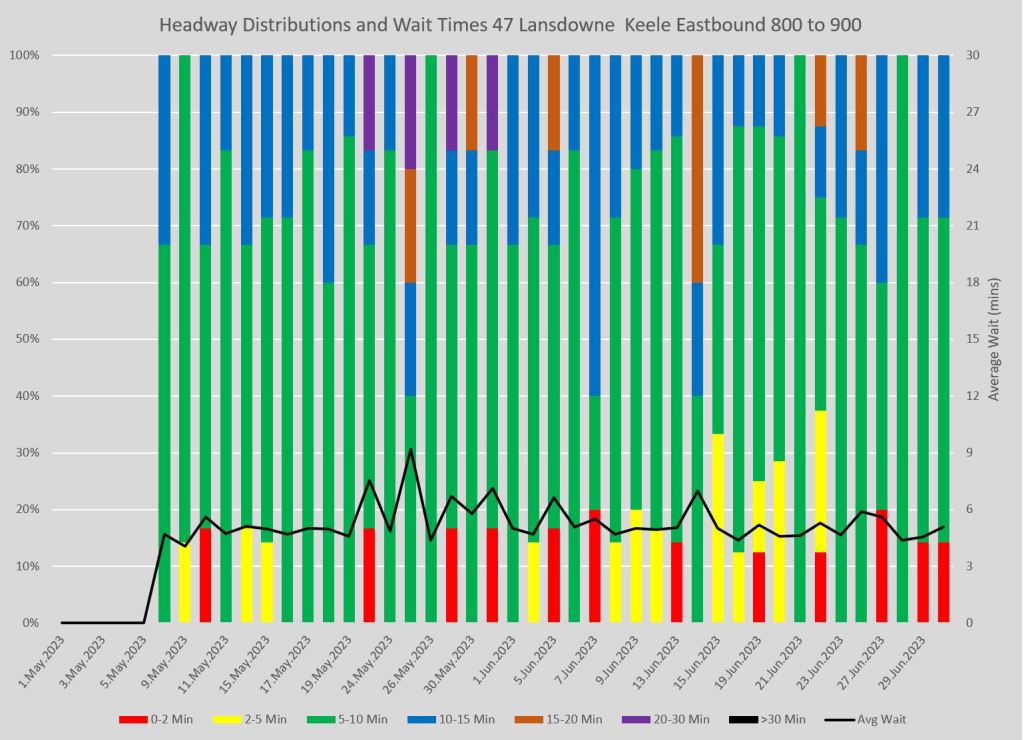
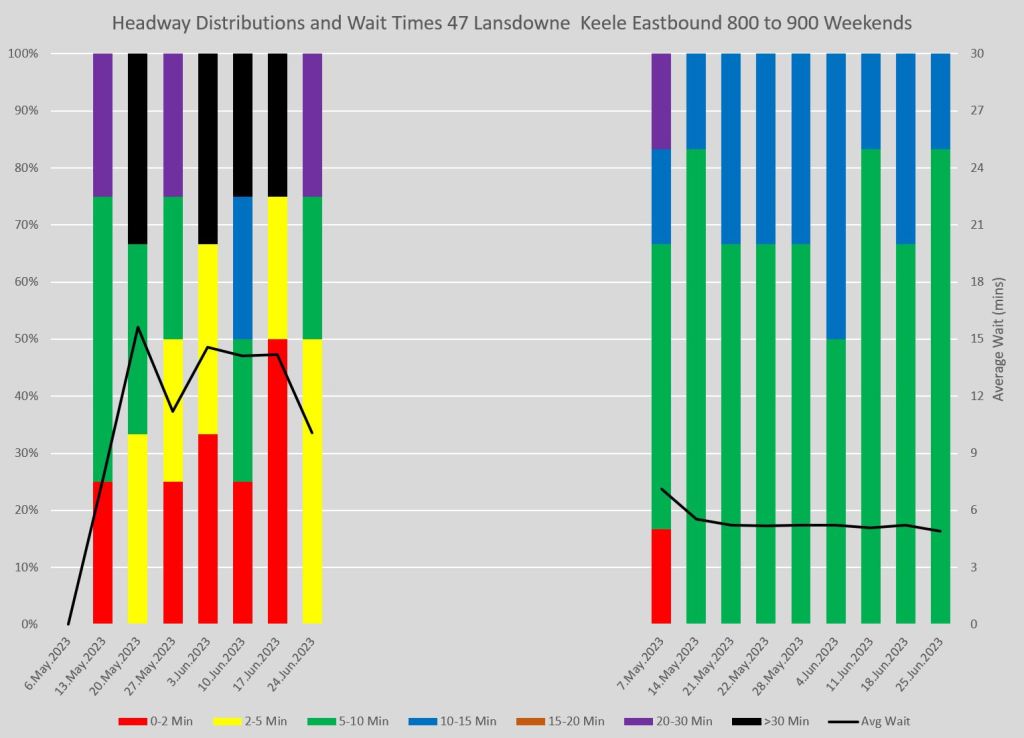
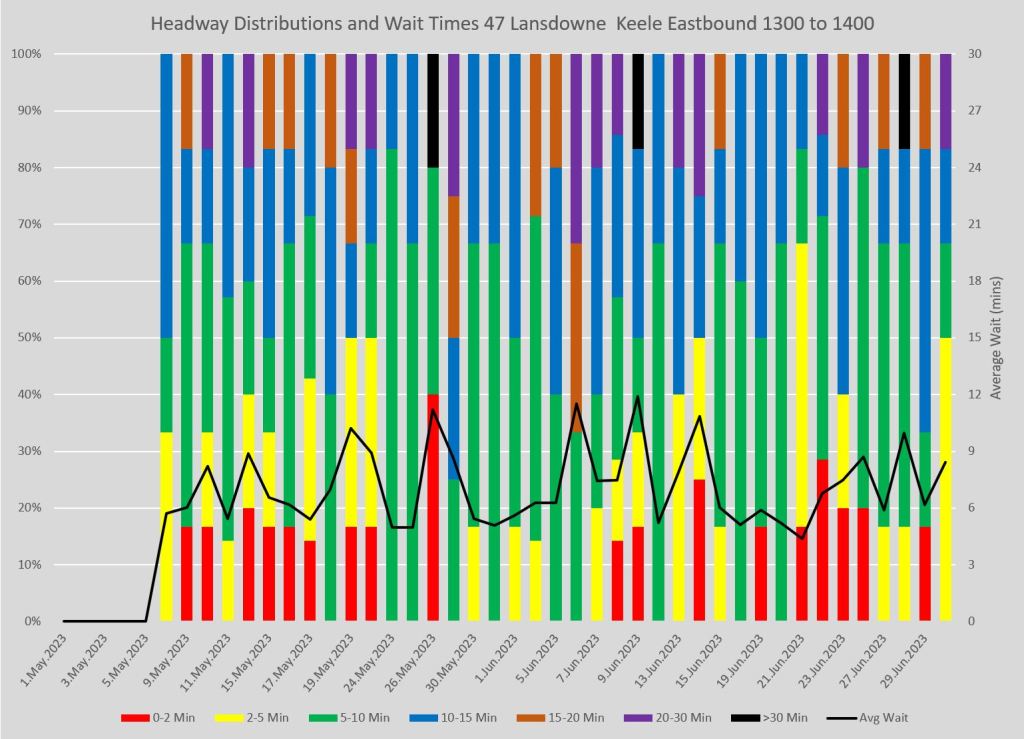
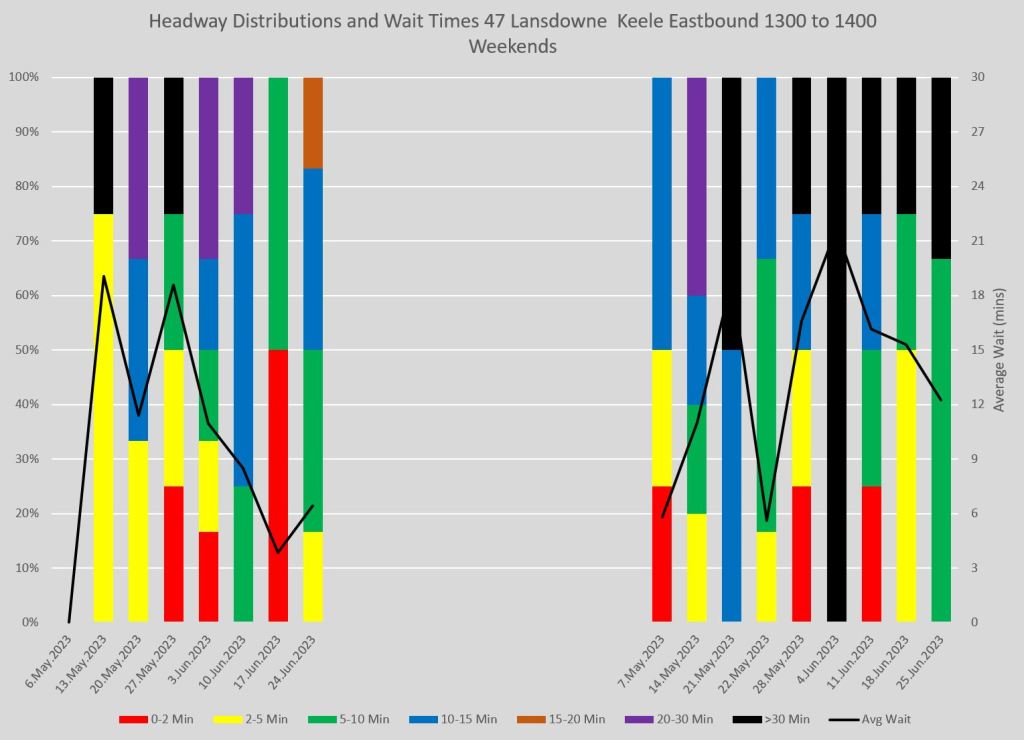
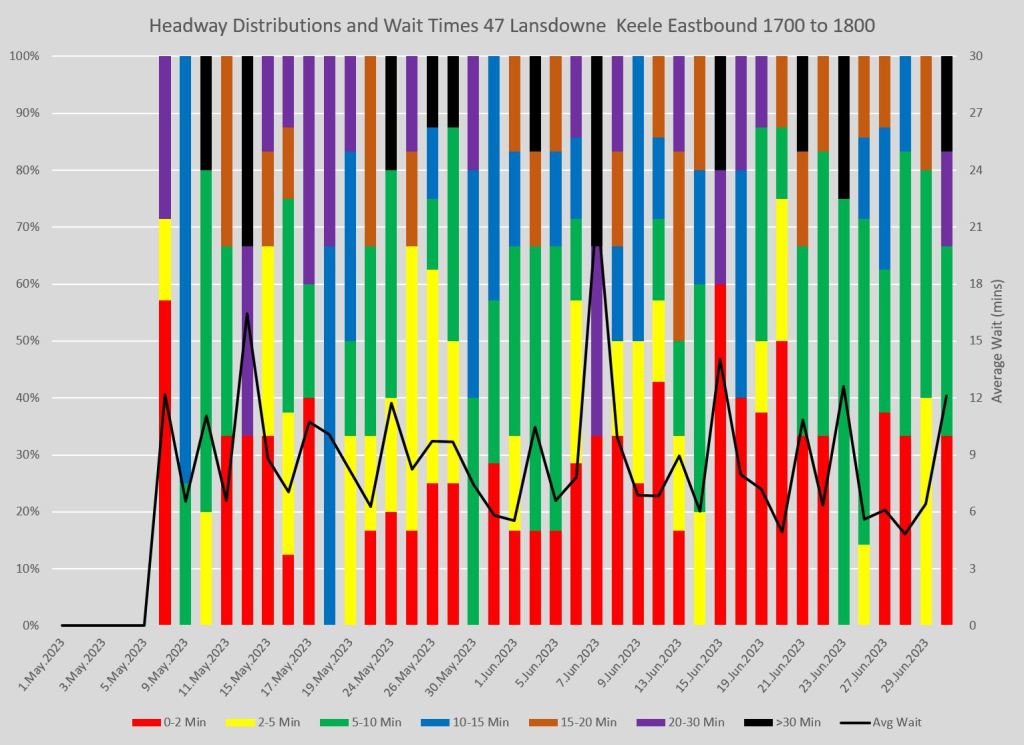
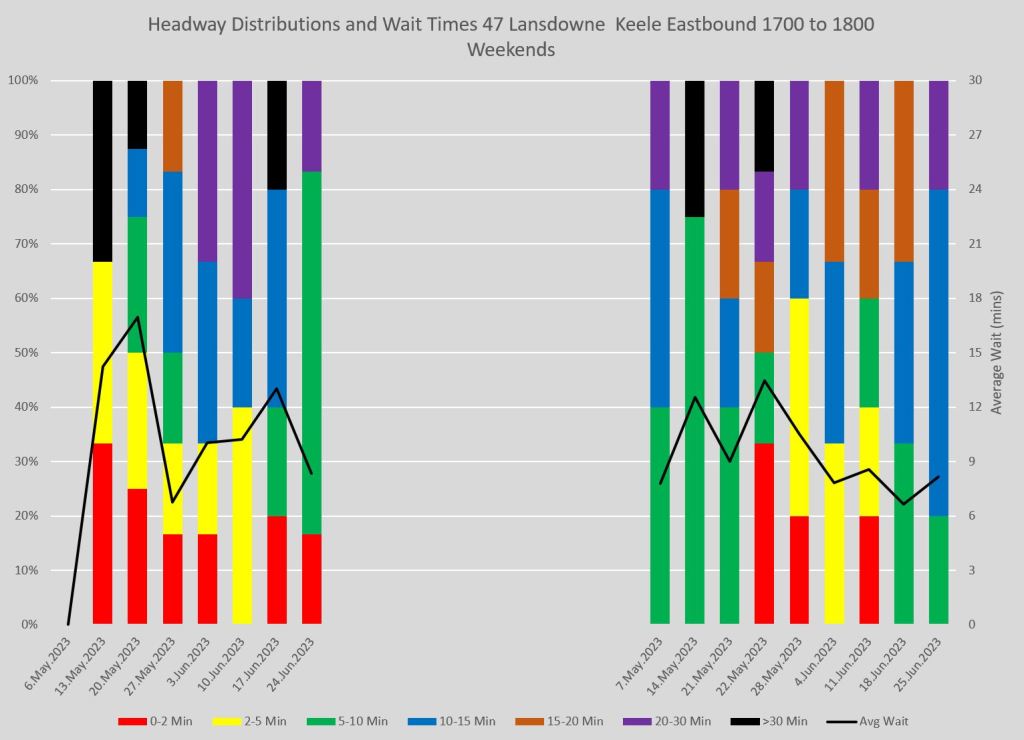
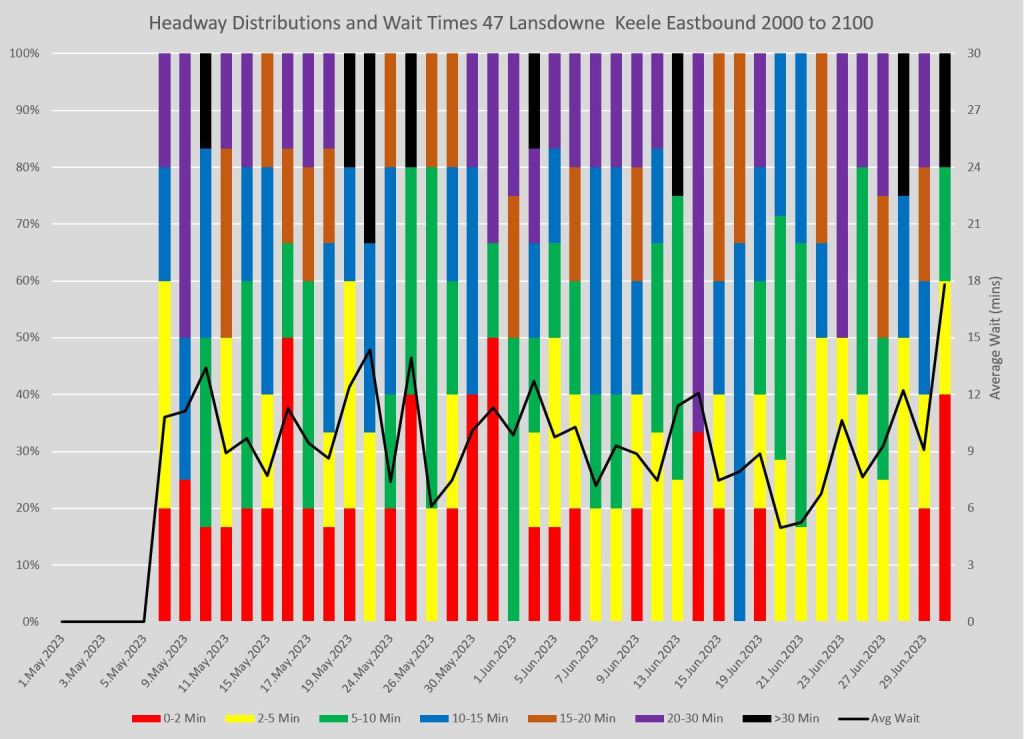
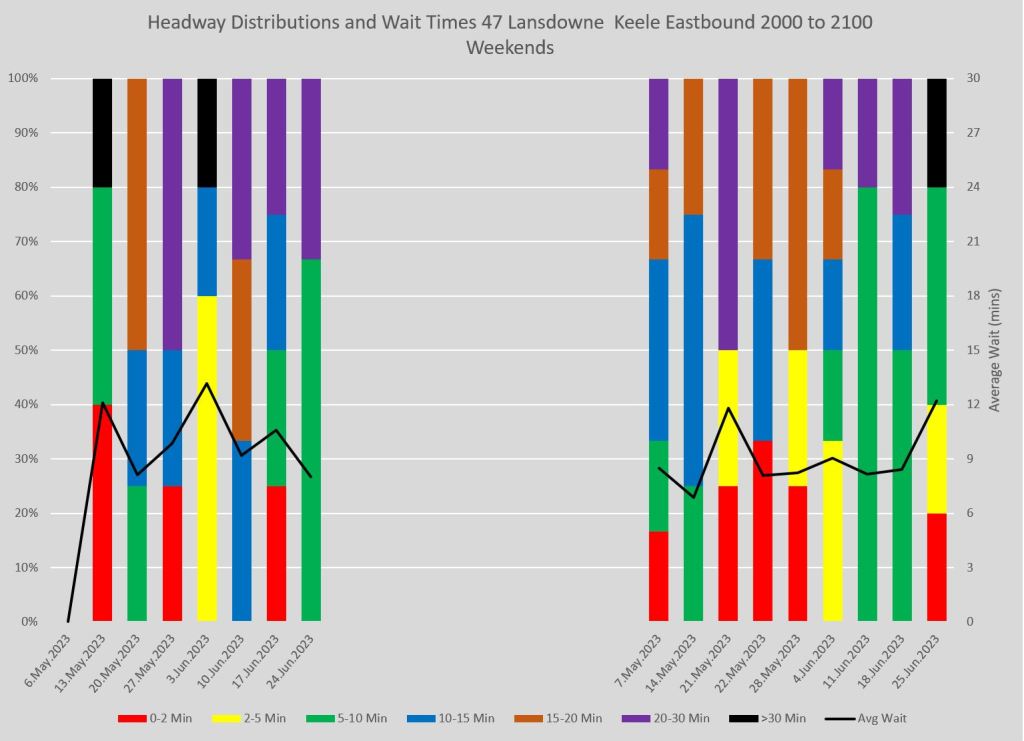
I will publish a review of the 512 and 47 services later this summer, but as a preview here are charts of the headways and average wait times eastbound at Keele on the 47 Lansdowne replacement bus. Note the prevalence of very short headways (red) and very long ones (purple and black).
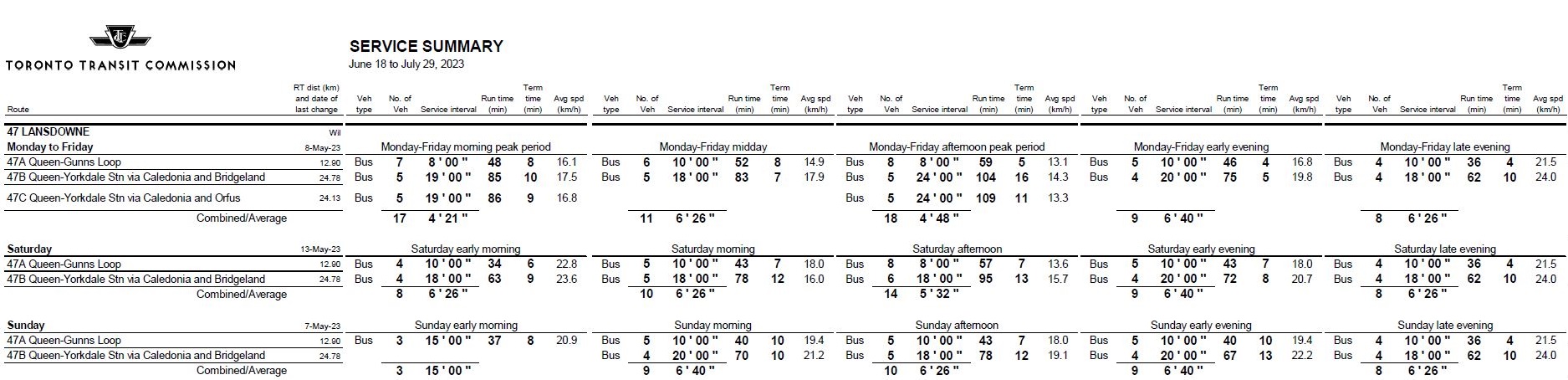
The scheduled service summary shows what riders should expect (the branch of interest is 47A to Gunns Loop). The service is, at worst, scheduled every 15′ on early Sunday mornings, otherwise every 10′ or better. This is a far cry from what actually operates. Bunching is extremely common as are gaps in excess of 20 minutes. The average wait (the black line in the charts) should be five minutes or less, but it is often much longer.
Although it is a very short route, only 6.45km one way, the service is rarely reliable.
Weekday data are on the left, weekend data on the right.
 Steve Munro
Thank you! The analyses are quite comprehensive (even though an old guy like me has trouble understanding them fully).
Steve: I’m an old guy too, and have wrestled for some time with a way to present the data.
LikeLiked by 2 people
Hi Steve,
Thanks a lot for your blog posts! I have a sort of unrelated question about streetcar lines with separate rights-of-way like 510 Spadina and 512 St. Clair. How are these lines optimized for traffic lights? And, is this similar to the at-grade section of the Eglinton Crosstown LRT?
Thanks!
Steve: The setup on Spadina is different from St. Clair. Because the Spadina service was very frequent when the cars were shorter (CLRVs), there is no traffic signal priority for through N-S movements because the assumption is that there would always be a car in one direction or the other, and “too much” priority would interfere with E-W traffic. There is a white bar turn signal for turns off of Spadina onto the cross streets, but no priority for turns onto Spadina. This is related to the width of the street and the fact that the detection point to set a switch for a left turn is inside the intersection rather than on the approach, and so the signals don’t “know” the car wants to turn until it enters the intersection. (There are other approaches to TSP that do not depend on the switch electronics, but that’s not how Toronto does things.)
St. Clair and some of the intersections on Queens Quay have green time extensions that depend on loop detectors in advance of an intersection. This will shorten the cross-street green, or lengthen the main E-W green for streetcars. On St. Clair this does not always work as desired and cars can wind up having to stop on both sides of an intersection because they are caught by a red on the approach, and then have to stop again at the farside stop. Both Queens Quay and St. Clair have white bar priority for some turns.
Eglinton was supposed to have more aggressive priority, but rumour has it that this will not be the case and m.uch will depend on the interaction of service spacing and signal cycle times, plus some green time extension. I have yet to see technical details, and of course with Metrolinx, everything is a state secret.
LikeLike
Yes, your (very) detailed analyses show, as always, that the TTC cannot (or does not) manage surface routes. If we are looking for gravy to show Mr Ford that the City is poorly run, I suspect we could can the whole of that department and would notice absolutely no difference!
LikeLike
After July 17, I wonder why the TTC doesn’t turn back all 506 streetcars at Coxwell/Queen Loop rather than at Woodbine Loop, if that would improve service reliability. Travelling along Queen Street for the short distance east does not seem very useful.
Steve: I suspect some cars will turn at Coxwell/Queen if they even get east of Broadview given schedule constraints. The main problem with that loop is that it can only hold one car at a time.
LikeLike
Do they still have checkers riding vehicles? If not, they should get some ASAP (reassign employees if necessary). Instruct them to record times and speed enroute and at terminals. Then , if necessary have Inspectors “boots on the ground” to keep Operators on the ball.
Steve: Checkers have been largely replaced by automatic passengers counters which are installed on all buses and, at last report, on about half of the streetcar fleet. Times and speeds can easily be obtained from vehicle tracking data as I have regularly shown in articles on this site.
LikeLiked by 1 person
Hmmm… I want to make sure that I do not misinterpret this. In particular that it is not considered a “problem” or an excuse for bad service when there is a local surge in demand due to things like a shift change at a factory, or the end of a hockey game, church service, concert or other regular event. These things are what transit is for. If the TTC starts regarding basic service as a “problem” then that attitude really is a problem.
In particular, local line management should be aware of all these sorts of regularly scheduled events on the line and provide service accordingly. Yes, I know, when it comes to TTC line management, “should be” and “actually is” can be two totally different things.
Steve: In decades past, the combination of frequent service and a slight excess of capacity hid problems from surge loads. In effect, minor disruptions could be absorbed, and even if a short turn was necessary, service was frequent enough that the gap was tolerable, even if annoying. Now cars are further apart and service is planned on the projected demand. This leaves little room for upsets even if the service were otherwise reliable, which it is not.
LikeLiked by 1 person
Or even the flexibility to absorb additional time needed to serve ramp users. I’ve been on trips where the ramp was needed for more than one person. This is potentially several minutes of time that has cascading effects down the line. If that car met with uncooperative signals then that 10 minute 505 headway on paper becomes 15 minutes very easily.
LikeLiked by 1 person
Years ago, Trains magazine had a column headed “The Potato Harvest should not come as a Surprise”.
LikeLike
Based on both my experience riding it and my data analysis, 509 Harbourfront has relatively little bunching. The only streetcar route that is better is 511 Bathurst.
Steve: Actual tracking stats from June 2023 show that departures from Exhibition are better behaved than from Union where cars often leave close together. Headways can range broadly and the standard deviation of the headway is often greater than 5 minutes. Bunching is more of a problem in the evening and on weekends, and headways over 15 minutes are not unusual.
Headways east of Fleet Loop tend to be better than west of the loop indicating that there are enough short turns to influence the stats. I will turn to Harbourfront and Spadina later this year when the summer’s data have accumulated.
LikeLiked by 1 person
Unfortunately, you riders complain about short turning vehicles and guess what, TTC will cater to the squeaky wheel that gets the grease.
Since TTC doesn’t want to short turn vehicles, this is how you get multiple vehicles travelling in packs and service in the other direction suffers.
Next time you complain about service, think about it folks. What are the unintended consequences.
Steve: That is exactly the point I am making. No short turns makes for worse service. However, it is easy to find examples where bunche of vehicles formed up and there was no attempt to space out the service over the course of multiple trips, ie including terminal departures. Some of the crappy service is bad (or missing in action) management coupled with some lazy operators who would rather follow their leader around without doing any work. It’s not one single cause like congestion, or construction, or weather, or plagues of locusts, or any other divine intervention for which the TTC can absolve itself of responsibility.
LikeLiked by 1 person
Also unclear given the state of labour relations in Hollywood.
LikeLike
Thanks for the analysis!
LikeLike
Thanks for the article Steve! It seemed to me that I only got to my final destination (Queen/Woodbine) about half the time. The problem is lack of information from the driver on why, and when you check your tracker app you see the next car isn’t for another 20-30 minutes. Luckily Kingston isn’t that far to Woodbine, but really feel sorry for those that live further east
I’ve never had a problem with short turns as at times they make a lot of sense: Standing at Queen/Kingston and watching up to 7 cars go eastbound all packed together. Why not short turn a couple of them? Would make us customers less upset!
I remember the experiment years ago on the 501 – I believe most cars going westbound would short turn at McCaul and eastbound at Church? (Can’t remember), and think a few cars would still do the the whole route. It seemed like a good idea, as most of us going westbound where only going as far as Yonge or University anyway. I never heard how the trial went and why they stopped it, maybe you had an article about it?
Steve: The western turnback point was via Shaw and Dufferin. A big complaint from operators was that these turnbacks had no washrooms, and really were impractical locations for cars to wait for the appropriate time for their return trip. The combined service in the overlap area was poor. Why not McCaul? The TTC claimed that there was a lot of traffic from the east side destined further west and they would be forced to transfer. There was a proposal some years back to build a new loop in the parking lot on Broadview just north of Queen, and there was a land swap involving the TTC, the TPA and others that actually put that lot in TTC hands. The loop has never been built, but it would be a logical eastern terminus for a Queen West route. From a cost point of view, a line with overlapped central sections would require more cars due to the duplication, unless service on the outer ends were cut to compensate. Now that it’s down to every 10 minutes, a further cut not be a good idea.
LikeLike
They can’t ever get their stories straight can they? If that was so true then why did they cut the 502 back from Bathurst decades ago and never once extended it past McCaul? And then cancelled the route entirely!
Steve: The Downtowner had severe problems getting to Bathurst Station where, despite its slow trip and relatively infrequent service, it was portrayed as a subway relief line (a political idea, not from staff). Most of the cars turned back at Wolseley. Then when the terminus was changed to Wolseley, most of them actually turned at McCaul. The official reason for the 502/503 consolidation was a shortage of streetcars. This was basically a BS excuse, especially now that they have so many spare vehicles thanks to service cuts and the impending arrival of more vehicles. That said, I’m not sure a 502 to McCaul would work well with the OL diversion.
LikeLike
From the comments above:
DavidC says, “Yes, your (very) detailed analyses show, as always, that the TTC cannot (or does not) manage surface routes.” and
Raymond in Etobicoke says, “Do they still have checkers riding vehicles? If not, they should get some ASAP (reassign employees if necessary). Instruct them to record times and speed enroute and at terminals. Then , if necessary have Inspectors “boots on the ground” to keep Operators on the ball.”
To echo these frustrations, I’ll quickly relate a “snapshot incident” – that I’m sure is similar to experiences of hundreds of TTC riders – that shows that TTC management doesn’t care what’s going on in the real world or how their customers are being served.
Saturday, May 6 (just before the new transit schedules were to come out) I found myself at College St. and Spadina Ave., waiting for a northbound 510 Spadina streetcar to take me to the subway at Bloor Street. All those waiting with me stood for 5 minutes with no streetcar anywhere in sight all the way down Spadina Ave., while 2 streetcars trundled by southbound after stopping at College St. Two guys near me then decided to head north on foot and left the streetcar island at a leisurely stroll, while 2 more streetcars stopped and then continued along southbound.
Over the next 15 minutes, 4 more streetcars came along southbound, stopping briefly at College St. while the crowd on the northbound island platform continued to grow in numbers. Suddenly, I see streetcar headlights at Dundas St., with the vehicle lumbering slowly northward until it stopped south of the College St. intersection – only to turn right and proceed eastward on College. No other streetcar headlights in view in the southern direction….
After 10 more minutes – and 2 *more* southbound 510 streetcars passing by, *finally* a northbound streetcar comes along and stops to let us in. Of course, we are jammed in like the proverbial sardines and cannot pick up any hopeful passengers at the last three stops farther along the route to the subway (Willcocks, Harbord and Sussex). And the 2 guys who went ambling off half an hour before? We passed by where they were walking on the sidewalk at Sussex Avenue, having made the 1 kilometre stroll calmly while the rest of us were twiddling our thumbs….
So, 10 southbound streetcars in half an hour…. I guess they kept to a “better-than-every-5-minutes” schedule for those heading farther downtown…. Not a good 10-to-almost-1 ratio for our one visible-but-rerouted northbound ride! Plus, given that the distance between Bloor and College is (per GoogleMaps) 1 kilometre, that means that a bunch must have been sitting in the inbound tunnel until they all gushed out like a transit dam had been opened.
Yes, one day, one snapshot – but one sorry excuse for “line management.” And something that, again, you, Steve, have shown *as the rule* in your graphs and analyses far too many times…
Steve: I have attached a snapshot of the line from May 6 from TransSee.ca. The chronology it shows is this:
This is a good example of what laissez-faire management brings to TTC service. It is particularly important to note that there is no chronic traffic congestion nor a lengthy blockage as one might expect froma collision or an onboard problem. There was one brief hold northbound at Dundas around 3 pm due to “police activity” according to the e-Alert, but this does not explain the size nor the persistence of the travelling gap.
LikeLiked by 1 person