
Metrolinx has published a set of documents containing the “Initial Business Case” for the GO Transit Regional Express Rail (GO/RER) network.
Updated Dec. 13, 2022: Due to a reorganization of Metrolinx’ site, the reports are no longer available there. However, I have archived copies of them. The Summary and Full Report links below are to my site. The Appendices are not yet available as I must break them into chunks small enough that WordPress will allow them to be uploaded.
- Summary
- Full Report
- Appendices A-J
- A: Corridor Specifications
- B: Corridor and System Schematics
- C: Model Assumptions and Results
- D: Record of Assumptions – Direct Demand Model
- E: Financial Performance of RER Systems
- F: Sensitivity Analysis
- G: Wider Economic Benefits
- H: Line Speed Analysis
- I: Environmental Assessment Program
- J: Fare Structure Issues and Solutions
- Appendix K: Station Access Analysis
[Note that except for the Summary, the documents are large PDFs.]
This article begins a review of these documents and of the various RER proposals examined in the Metrolinx studies.
Overview
Work on this review of GO/RER began in April 2014 following the announcement by Queen’s Park of its commitment to the RER concept. Unlike previous reports, this study looks in depth at all of the GO corridors, and reviews the technical issues associated with both increased service and electrification. This is not a final review, and much engineering work remains to be done, but there is a great deal more information now publicly available as the basis for discussions.
These documents were completed sometime in 2015 as is clear from references to future events that will occur later in the year, notably reports from the City of Toronto on SmartTrack. That scheme gets only passing mention, some of it the usual political cover story, because the specifics had yet to be decided. Exactly what the incremental effect of ST will be beyond the proposed GO/RER configuration is not yet known. Preliminary information in City reports implies that ST will amount to considerably less than was foreseen by the Tory election campaign, possibly as little as a few more stations and some sort of TTC/GO fare integration.
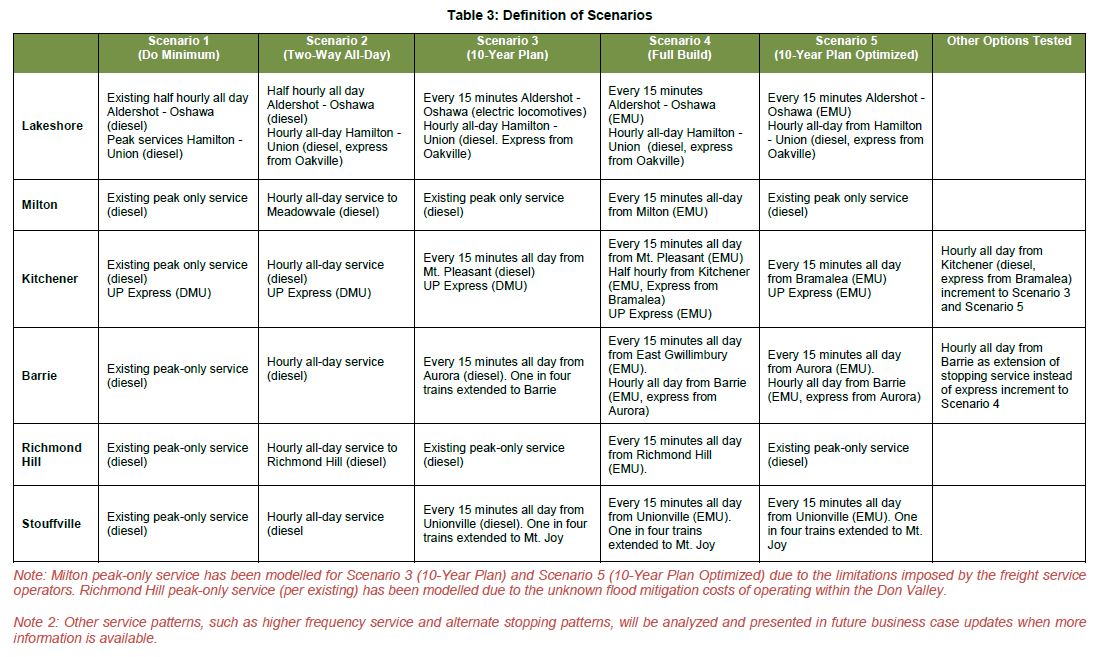
Five scenarios were reviewed to compare the effects, benefits, costs and technical issues associated with various possible future networks.
- The “Do Minimum” scenario provides only marginal peak period improvements to the existing system in response to projected demand growth, but with no electrification. This is effectively a “business as usual” model for the base case.
- The “Two-Way All-Day” scenario expands off peak service, but with diesel operation and no electrification. This is a minimal level of service expansion.
- The “10-Year Plan” would provide frequent service on the inner parts of some corridors, but with limited electrification.
- The “Full Build” extends beyond the 10-Year Plan to provide frequent service on the inner parts of all corridors, and with full electrification.
- The “10-Year Plan Optimized” extends the scope of electrification beyond that contemplated in scenario 3.
This progression implies a certain sequence of events during the study where a full build is impractical and the original 10-year plan was not aggressive enough with electrification, a key component of the announced government direction.
The estimated capital costs rise from $5 billion for scenario 1, through $10b, $12b and $19b for scenarios 2 to 4. The price tag for the latter is well above what Queen’s Park has available, and scenario 5 was developed with a projected cost of $13.5b. All but scenario 4 are said to be achievable by 2024. Given that it is now 2016, and this is a 10 year plan, that date probably requires some adjustment.
Scenario 5 is the 10-Year Plan Optimized, it represents significant progress towards implementing the service levels of Scenario 4. It goes beyond the investments and service included in Scenario 3 (10-Year Plan), with electrification also to Bramalea, Barrie, Stouffville and to Pearson Airport. This scenario and the resulting recommended RER program has been defined to maximize return on investment while mitigating risks. Depending on resolving various challenges, it can be delivered over 10 years for approximately $13.5 billion. It does not preclude, but rather prepares for, services to Milton and Kitchener to be eventually electrified and frequent all-day services introduced when agreement is reached on co-existence of GO and freight on these privately-owned corridors. [p. iv, Full Report]
Annual ridership is expected to go up by a factor of 2.5 over the coming 15 years, but operation costs will not rise at the same rate. The study postulates that an operating profit would be possible, eventually, but that will depend a lot on future fare policies, and on the evolution of trip patterns (length, direction, average fare). The ridership model foresees that “hundreds of thousands” of auto trips would be replaced by GO ridership each weekday comparing scenario 5 to scenario 1. The proportion of trips and its relationship to expected growth is not specified in the Executive Summary. (Possibly in the demand modelling later.)
The rate of demand increase on GO overall is projected at 2.3% which is lower than recent levels, but allows for some leveling off in a more mature service.
One big issue is the problem of getting riders physically to and from the GO trains. Either this will be done with substantially improved local transit services (an option that brings many issues associated with fare integration and cross-system subsidies), or with parking. The cost estimates include $750m for 15,000 new parking spaces, or $50k per space. At that scale, simply paving empty lots is not an option. The study notes the possibility that some of this cost “may not be necessary if service integration and fare integration with local transit services can be improved”. [p. v]
Those 15,000 spaces represent nowhere near the ratio of new parking spaces to existing facilities that the projected ridership growth would entail if everyone arrived by car. Parking charges are listed as a way of raising additional capital for the RER project, and of encouraging a shift to ride sharing and public transit feeder services.
It is amusing to read about the benefits of proven technology, something for which Ontario has not been noted in past endeavours.
Virtually all of the works are within existing rail corridors, so environmental and community impacts are limited mostly to noise and vibration. RER will use proven technology that is working around the world. [p. v]
Descriptions of RER cite similar operations in more than 50 city regions worldwide [page 6], and list a number of factors that simplify implementation [p. 4]. I cannot help thinking of how badly past studies have downplayed the benefits of LRT which bears a family resemblance, but at a local rather than a regional level.
The first electric railway opened in 1883 (the Volks Tourist Railway on the Brighton seafront in the U.K.). Ever since that time, electric traction has increasingly become the default source of power for the world’s more intensively used rail systems. [p. 14]
Finding this statement in a Metrolinx report is quite amusing considering some of the remarks made during community meetings on electrification before Metrolinx and GO “got religion” on the subject. The report skirts that debate by observing that GO is now at the threshold where electrification makes sense:
Until recently, diesel traction has been the appropriate mode of traction for the GO rail operation. However, the service enhancements envisaged in the near future will take GO rail beyond the threshold of service intensity appropriate for electrification. Continued use of diesel traction will become a source of financial and economic inefficiency. [p. 14]
Metrolinx intends to pursue discussions with the railways regarding the upgrades needed on their trackage, and also intends to review “modern, proven technology” with Transport Canada and the railways.
This is an “initial” analysis, and changes are likely depending on the evolution of expectations, changes in provincial funding, and who knows what political meddling that could arise.
A decade is a long time in politics, and the likelihood that the current governing parties or councillors will still be in place at that distant time is minuscule. Moreover, changes could come at any level part way through the project, and only a very strong, unshakeable commitment (i.e. very popular and difficult to derail) is likely to survive. This is not simply a case of showing up for a photo op or two with a gigantic prop cheque, but of supporting the plan for the long haul, including building a constituency that can survive beyond current governments. The arrival of a Ford-equivalent who simply wanted to start over with his own plan would be disastrous.
The Vision of Regional Express Rail
This section of the report begins by recounting the history of transit in the GTHA, of the formerly high transit mode share when more jobs were concentrated in central Toronto, of the rise and subsequent fall in subway construction, and of the growth of GO Transit for core-bound commuting trips.
At one point, there is even a claim that GO carries as many people into the core in the peak as the subway does, but this is hard to credit given that total one-way GO ridership is only about 90k. Possibly a restricted definition of the “core” has been used that omits a wide area served well by the subway, but less so by GO. In any event, growth of GO capacity will increase the commuting load it can bring to downtown Toronto.
Ridership into the core area has been growing by transit, at least during the peak period.
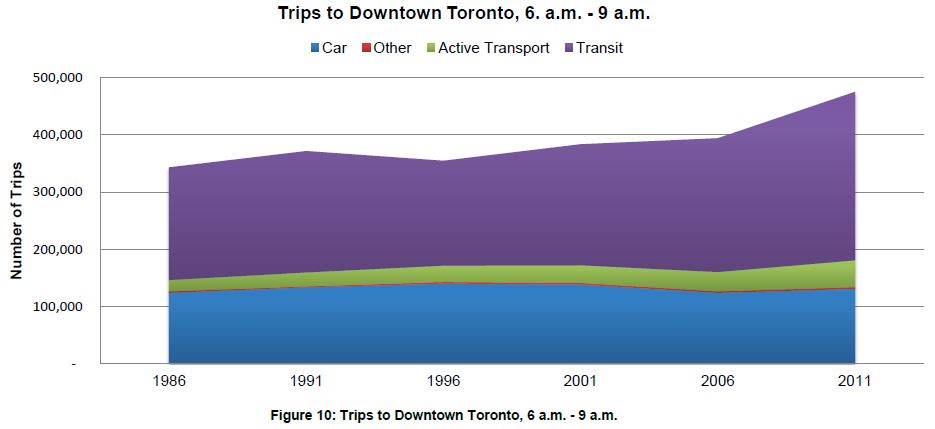
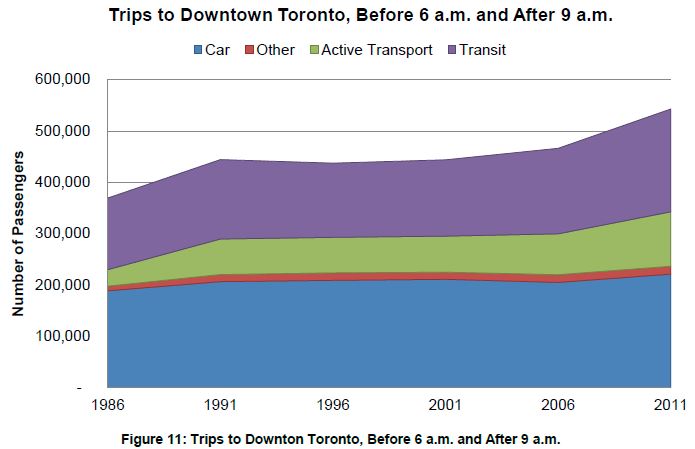
While “Active Transport” (walking, cycling) is a factor with all of the new housing downtown, it is small compared to overall figures during the peak. Their role is greater during the off-peak period, possibly reflecting a different pattern of trip origins more conducive to these modes. (Beware of differences in the vertical scales used in these charts.)
(The Transportation Tomorrow Survey updates these data every five years, but the 2016 numbers will not be available until 2017. The evolution of Active Transportation numbers will be interesting to see.)
Auto trips are growing outside the peak as anyone now dealing with off-peak congestion will know. GO, a peak-only service, has not seen much of the overall increase.
Between 2006 and 2011, average daily car trips to the downtown outside the morning peak period grew by 16,000, compared with less than 4,000 by GO Rail. Meanwhile, over 55,000 new trips were made by walking, cycling and TTC. [p. 10]
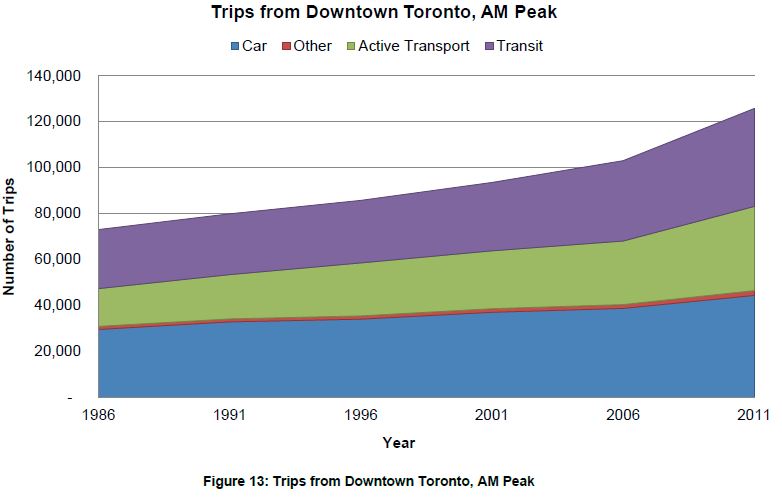
Trips from “downtown” are also growing strongly after a long period when the numbers were almost flat. Again, this will bear watching in the 2016 data when it is available. However, we must be careful about the definition of the “downtown” area which could very well exclude a good chunk of the central city such as the University of Toronto campus. It will be important to distinguish between “outward” trips that are simply among various locations in the old City of Toronto, and those to suburbs where GO/RER would make a difference.
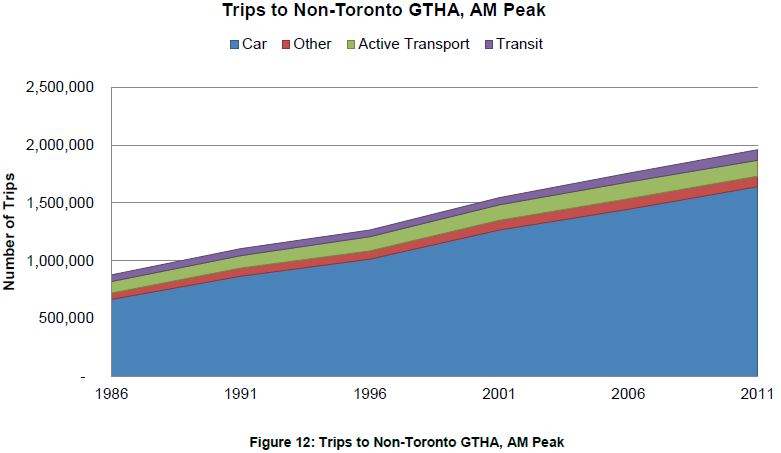
Finally, there is the question of commuting that is not focussed on the City of Toronto. The total trip count is very large, and it is almost entirely served by private autos with little sign of growth in other modes. This is a huge challenge for both the regional rail network, and for transit systems within the communities outside of Toronto.
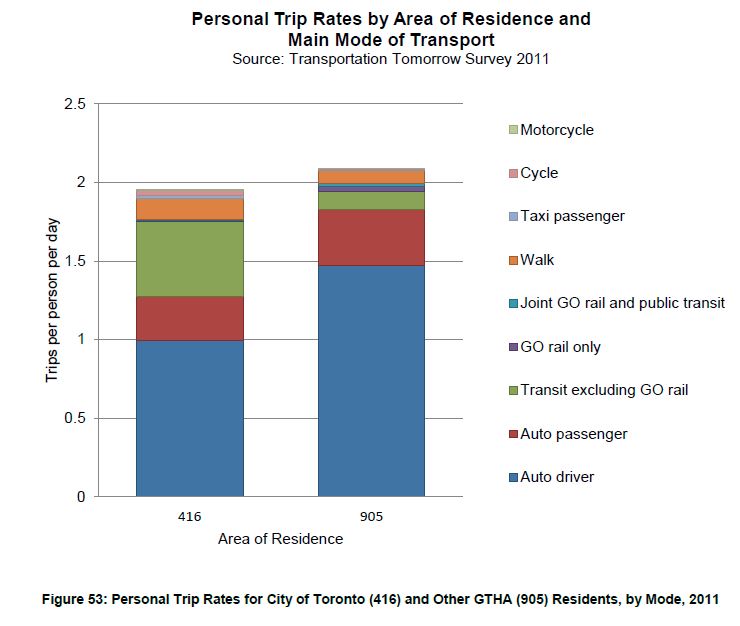
The challenge for transit in the overall travel market shows up in the proportion of trips by each mode taken within Toronto (the 416) and in the region beyond (the 905). GO rail services only have a tiny sliver of the travel market, lower even than walking. The problem here is that this is a chart of all trips from the most trivial journeys to the corner store to a long regional commute. A later chart looks only at trips over 10km, and this shows a different picture. All the same, transit has a lot of work to catch up with auto travel, and its credibility is hampered by decades in which transit simply was not an option for much travel throughout the city and region.
GO’s fleet plans include their current diesel-hauled trains with 10 or 12 bilevel cars, but also 4-car EMU sets running in 4, 8 or 12-car consists. The fleet required to operate the basic off-peak service would be EMUs, with electric locomotives hauling existing bilevels for peak service on routes that are electrified. [p. 20]
The comparative operating costs of different train consists are quite striking.
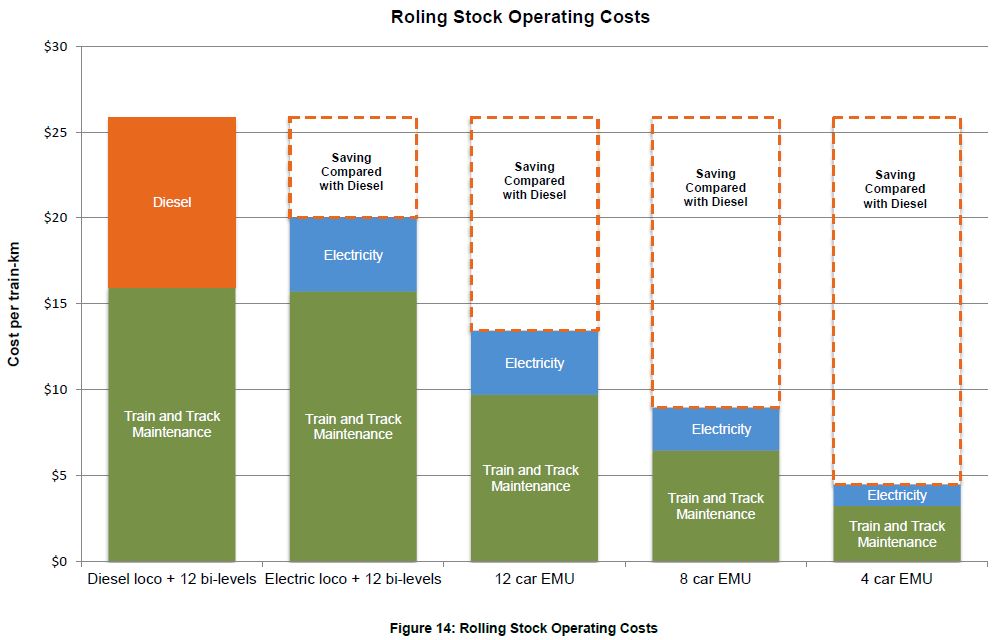
Although there will be additional costs once RER is operating, the report claims that additional revenue will more than offset this because fare revenue goes up more than operating costs, especially considering the savings available with EMU operations over the current diesel-hauled trains.
Many service options were tested, and the permutations are too extensive for an article here. I recommend that interested readers download the full reports for all of the details. As an overview, here is a table of the principal options studied (click to enlarge):
For the Lakeshore corridor, as an example, there is a much more detailed look at the options:
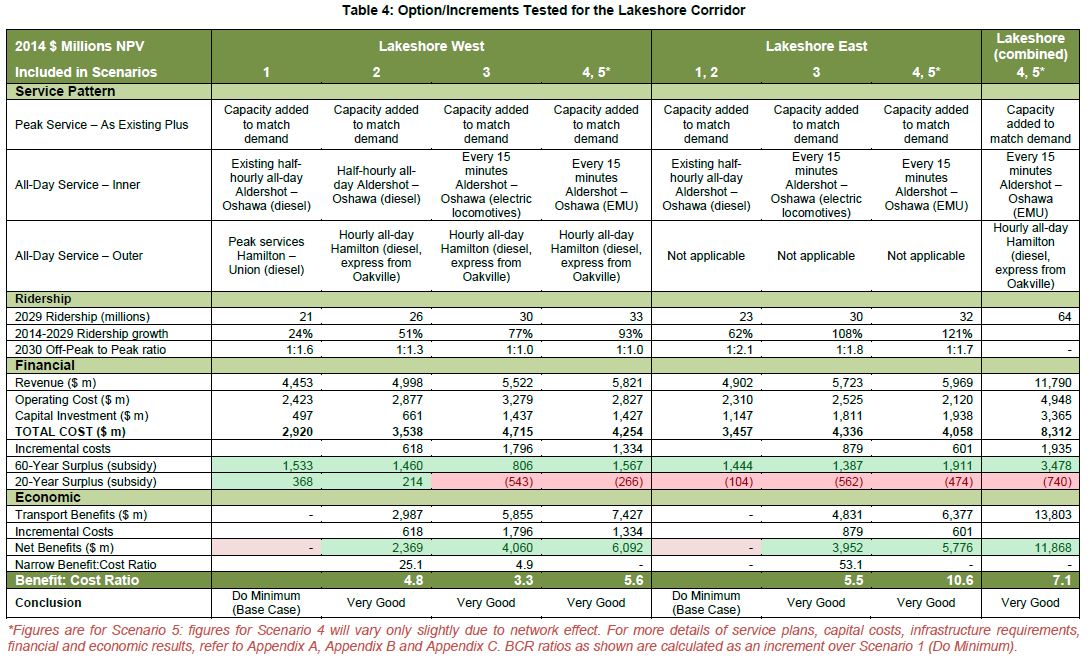
These figures show a very high return on investment assuming that one agrees with the methodology. Some points here are worth noting:
- Although the base 2014 ridership is not shown, it can be derived from the 2029 ridership and the percentage increases this represents. For Lakeshore West, the 2014 number is 17m, and for Lakeshore East it is about 14.5m. The scale of ridership increase has profound implications for the capacity that will be required to and from feeder stations.
- The revenues and operating costs are Net Present Value (NPV) figures over the life of the model, not one-year data. However, the ratios show that different service models produce different riding and revenue patterns. For example, for LSW scenario 5 has 33m riders/year by 2029, or 57% more than scenario 1. However, the revenues are only 31% higher suggesting that proportionately more riders in scenario 5 make shorter trips.
- The operating cost increment is small beyond the base case for LSW, and for LSE it is actually cheaper to operate the scenario 5 service than the base case.
- Capital investments are higher for scenarios with more service, but these are more than offset by the benefits imputed from shifting so many riders onto the RER network from autos.
Similar tables are included in the report for all of the other corridors and service options.
A common thread in all of the analyses is that the more aggressive service options tend to do best on the Business Case Analysis, probably because the additional ridership, revenue and benefits (trip diversion to transit) for well-used infrastructure more than offsets the capital investment required. Each of the lines reaches a point where better service produces proportionately more demand. If this is what might happen looking only to 2029, this has important implications for network growth in the decades beyond when RER really will operate as a “regional subway” rather than an occasional commuter train.
Growth to the full scenario 4 is constrained by the available provincial funding, and the tactic is to get as much value as possible for the $13.5b envelope Queen’s Park has announced.
The service plans for scenario 5 are summarized in the charts below.
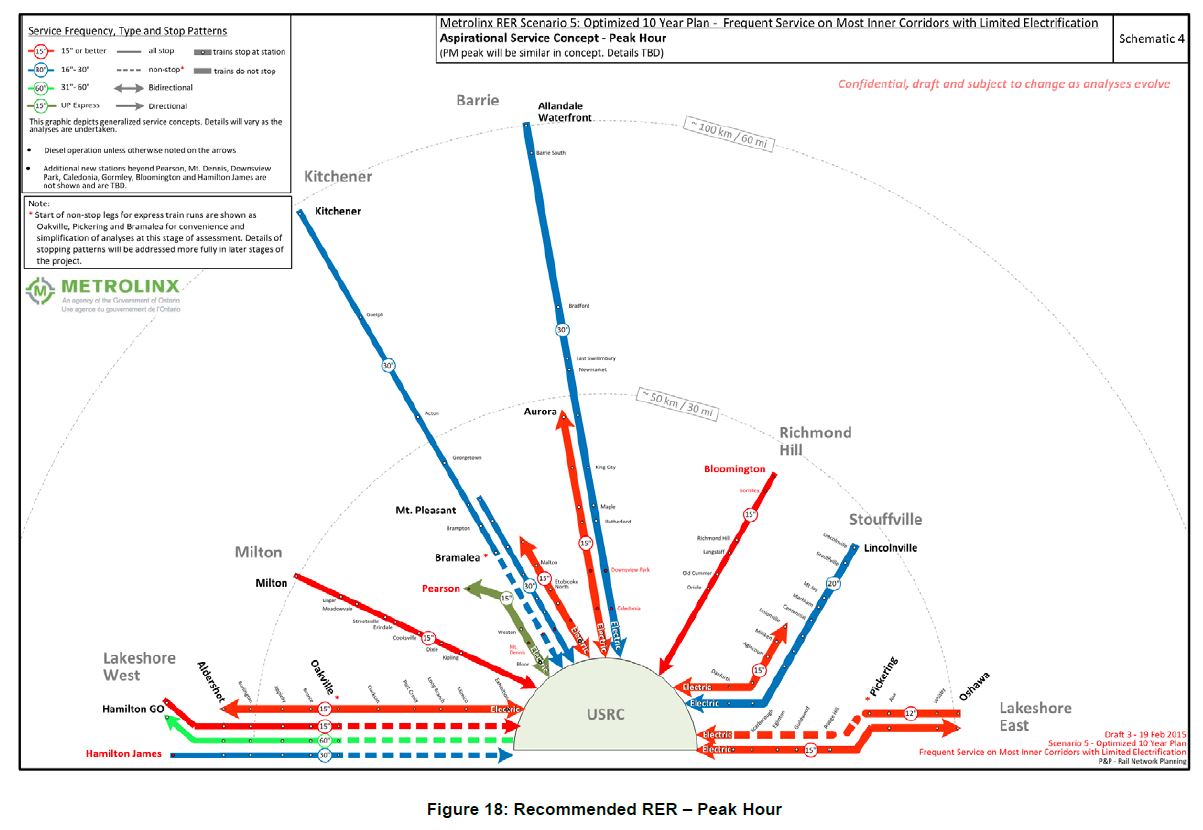
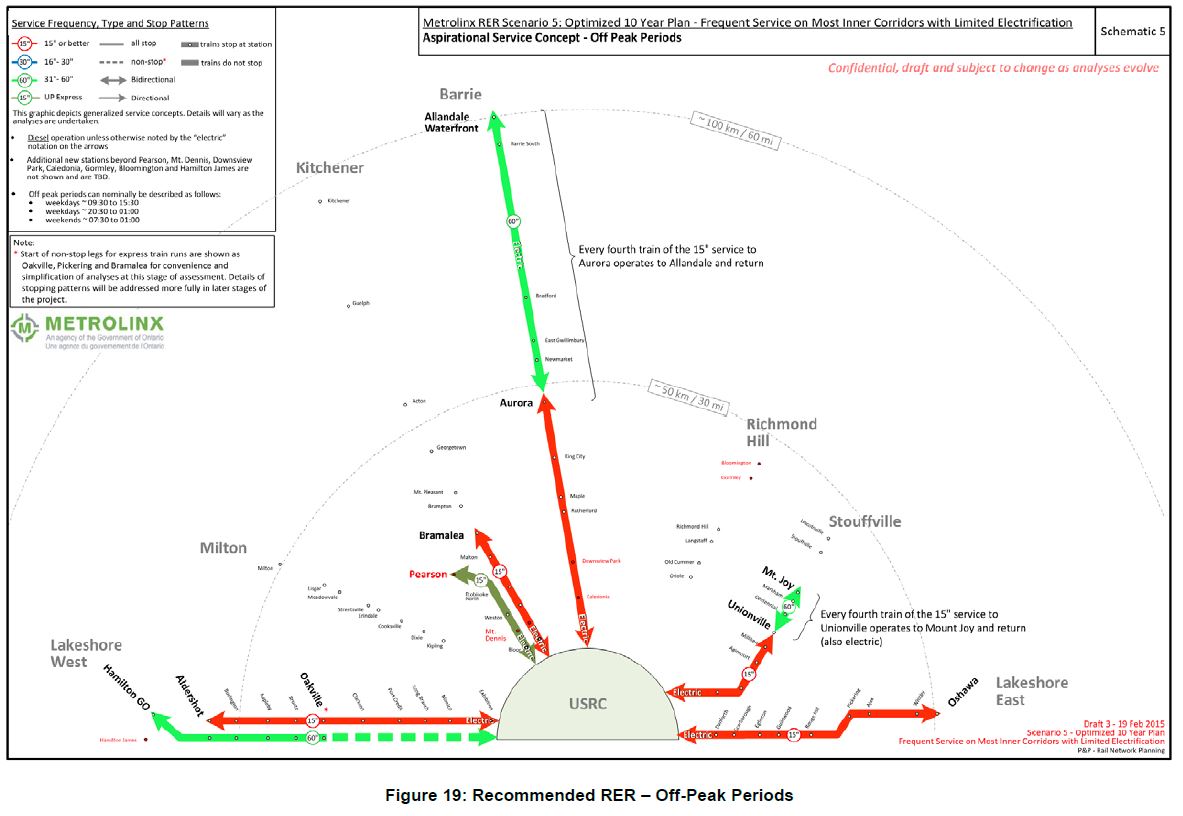
The colours indicate, generally, the level of service with red being 15′ or better through blue and green to the less frequent services. The Milton and Richmond Hill corridors remain with only peak period, peak direction service because of constraints on operation over CP and CN trackage, as well as the need to floodproof tracks in the Don Valley for the Richmond Hill service.
As a point of comparison, here is the “full build” scenario 4 service.
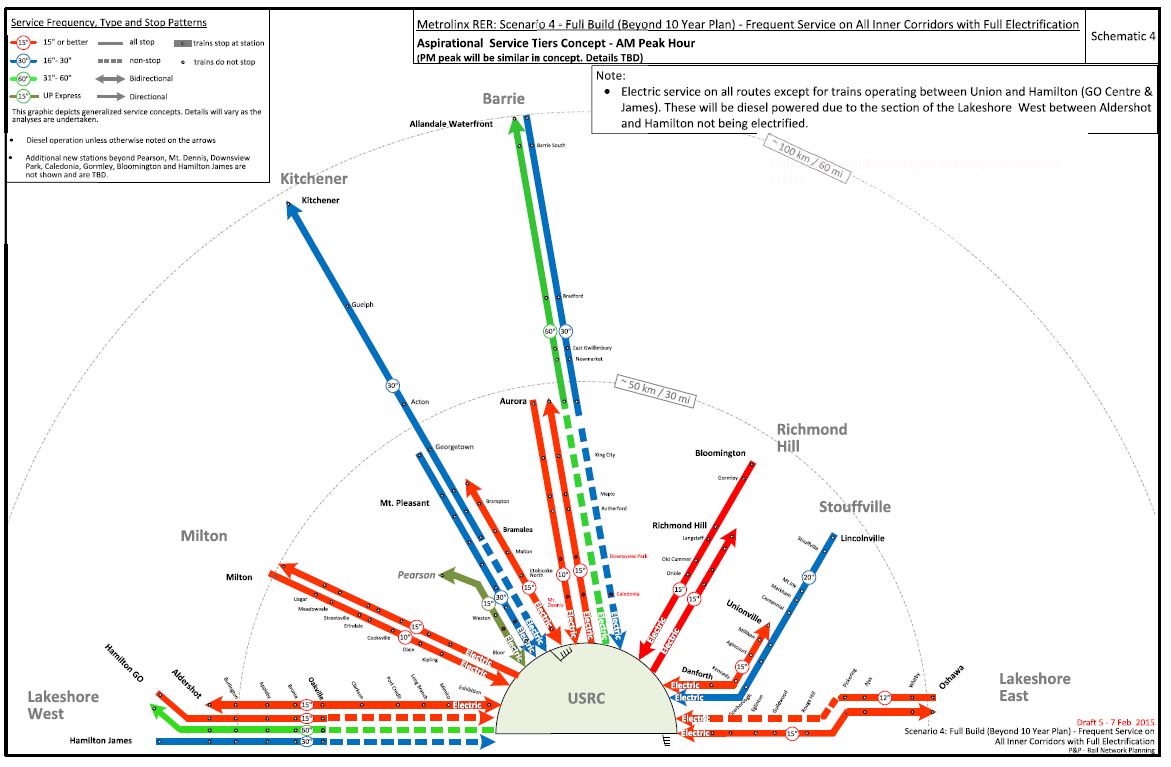
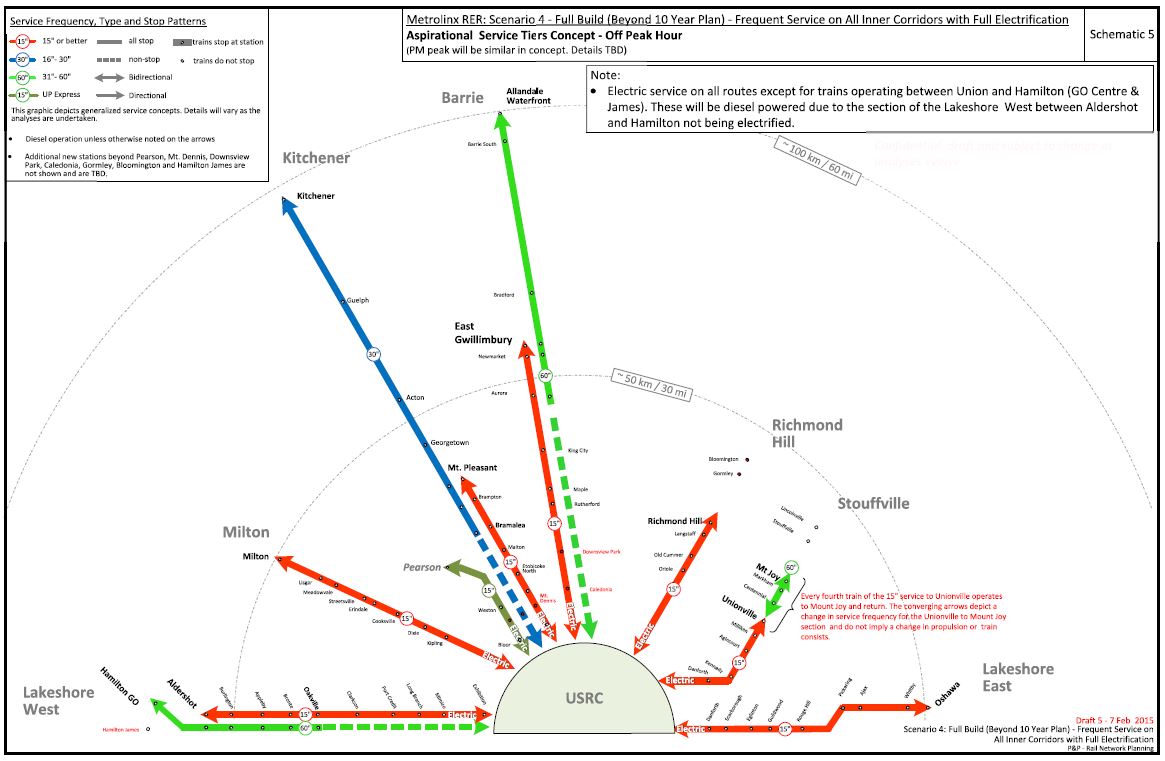
Whether any of us will ever see service at this level (let along just getting to scenario 4) is quite another matter. This will require a sustained commitment and funding, and it will not be paid for with fairy dust schemes such as “tax increment financing”. The Metrolinx report stays away from the “how to pay for it” problem and concentrates on the “what can we build” issue. The obvious variables in the financial picture are:
- Fare structure: should a higher or lower overall farebox cost recovery be attempted?
- Subsidies: is the provision of good transit considered a “social good” and the cost seen as a preferable alternative to continued expansion of road capacity?
- Parking: should GO parking lots charge for this service, and how much can this revenue source contribute to overall financing? The report estimates that parking could contribute $100m annually from 2020 onward, enough to finance $3.8b in capital spending.
Ridership projections for the corridors vary considerably with the largest gains, no surprise, coming in corridors that receive more service.
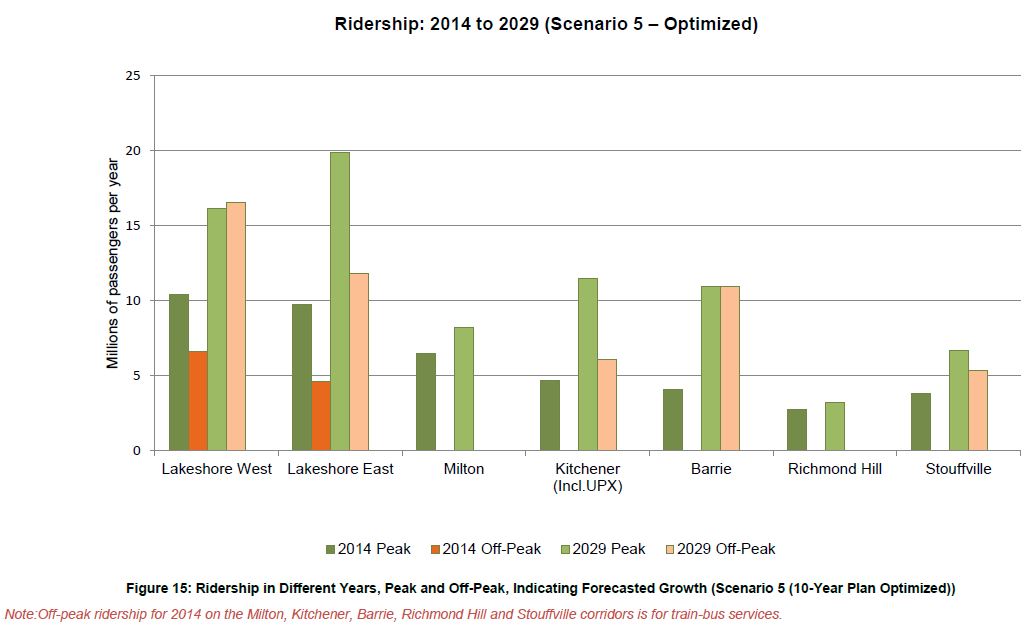
Projections for Lakeshore West, Barrie and Stouffville corridors are noteworthy because off-peak values are similar to peak (albeit they are spread over more service hours). This would put GO/RER in the same situation as TTC where off-peak ridership is an important part of overall demand, and many trips have nothing to do with conventional commuting patterns. As with other parts of the evolving regional travel patterns, this change cannot be achieved without substantial investment in local feeder/distributor services.
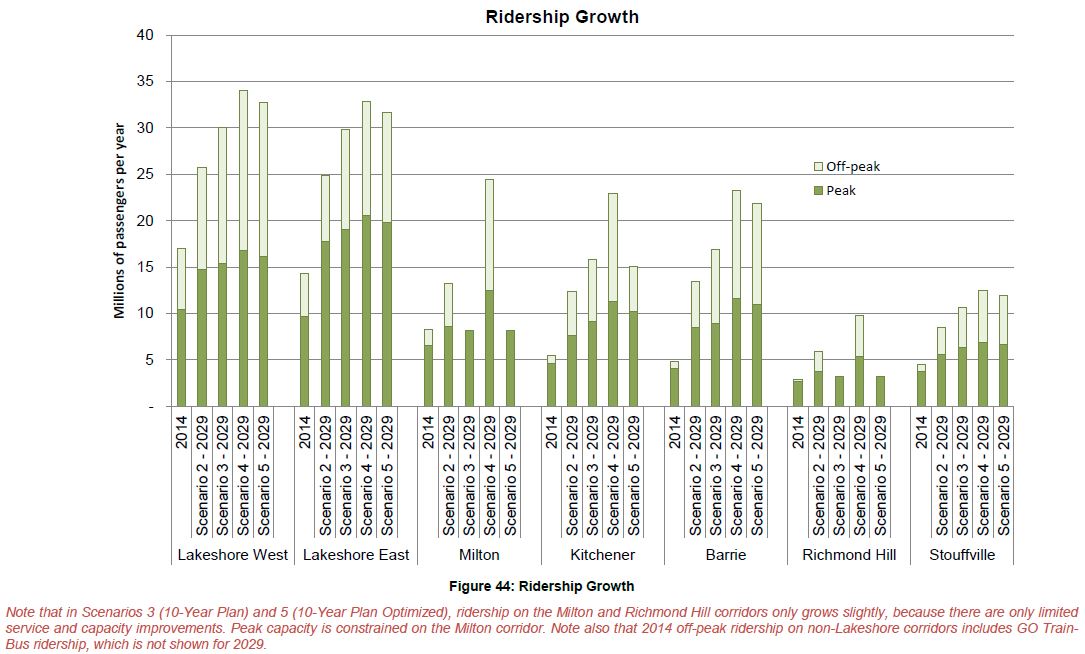
The projected growth for each scenario is shown in more detail in the following chart.
“Business Case” analysis is something of a black art, and much depends on assumptions used in the model such as the value of travel time, presumed changes in road congestion, reduction of pollution, and secondary effects such as reduced health care costs. For the five scenarios, the analysis produces the following result:
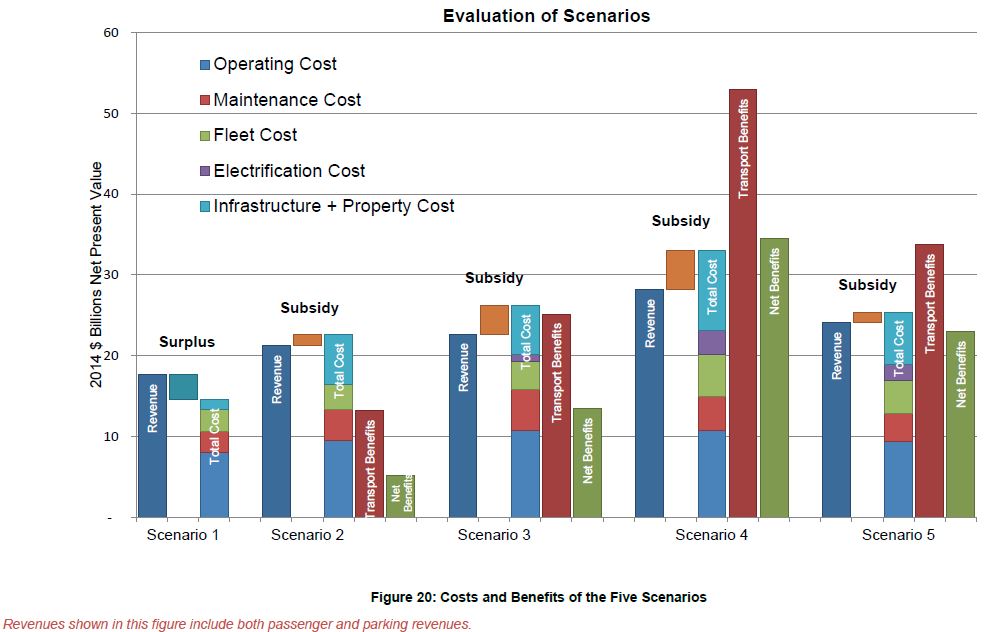
The business-as-usual scenario 1 produces a surplus, but only by virtue of minimal investment. There are no “transport benefits” because this scenario is the base against which others are measured. Other scenarios require varying degrees of subsidy, but the elimination of the Milton and Richmond Hill corridors reduces this quite markedly. However, the large decline in transport benefits between scenarios 4 and 5 shows how much network benefit goes untapped in the recommended scenario.
The electrification cost is a relatively small part of scenarios 3, 4 and 5, much smaller than the fleet, infrastructure and property costs. Although scenarios 4 and 5 provide considerably more service, their operating and maintenance costs do not skyrocket because of the substantial savings with an electrified (mainly EMU) operation.
Another way to look at the costs and benefits is to compare the base case with the four scenarios for improvement.
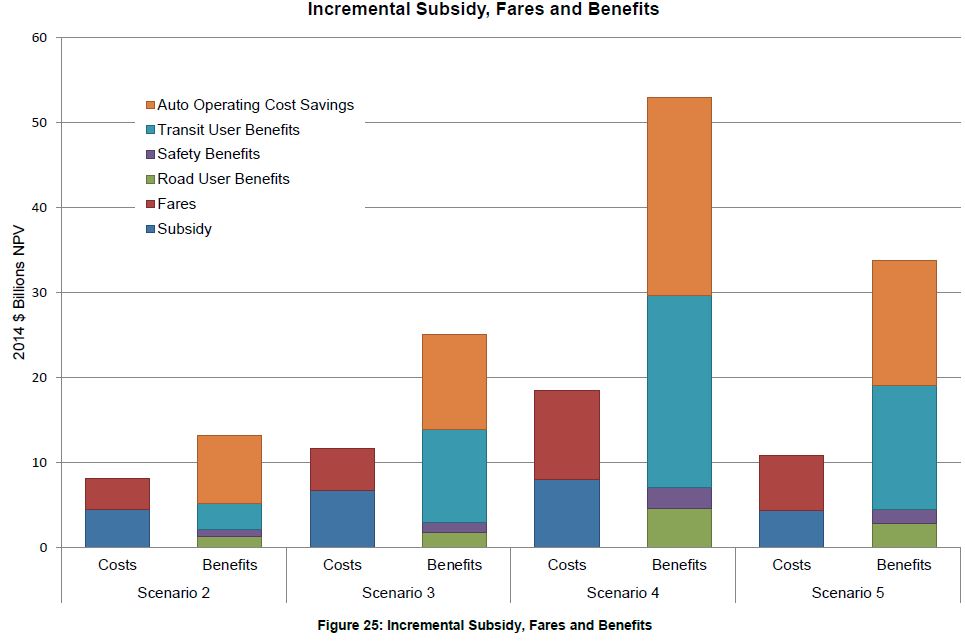
Again, the much more substantial benefits available with the full build scenario 4 are evident, but the cost is not at a level Queen’s Park wishes to undertake. “Transport benefits” are broken down here by type, and this shows an important distinction in the distribution of notional savings. By far the largest benefit accrues to to transit users whose trips become faster, and to former auto users who save on the cost of driving their cars. Benefits to road users in reduced congestion are comparatively small as are the “safety” benefits that flow from supposedly lower traffic volumes. These can easily be understood in the context that roads are full beyond capacity already, and the improvement of transit merely “buys” room for other drivers (and future growth) by shifting many trips onto transit. The idea that roads will ever be uncongested is a pipedream. In that sense, although GO/RER will make life much better for trips that fit well on the rail corridors, its benefit for off-corridor journeys (orbital rather than radial) will be considerably lower.
Journey times are projected to fall with the new network through a combination of frequent service (and thus shorter waits for a train) and improved speed with electrification. This will make transit more attractive for various trips, although the degree will vary from location to location. The report includes a chart of comparative travel times for multi-corridor journeys such as Richmond Hill to Hamilton where transit times will be substantially reduced. However, it is unclear whether the times used include access times at both ends of the journey, an area where autos have a distinct advantage for many trips. Transit’s ability to serve this type of trip will be constrained by the dispersal of origins and destinations across the region even if frequent trunk services were to fill in an east-west grid.
The uphill battle faced by GO/RER is illustrated below in a chart of mode share today and in 2029.
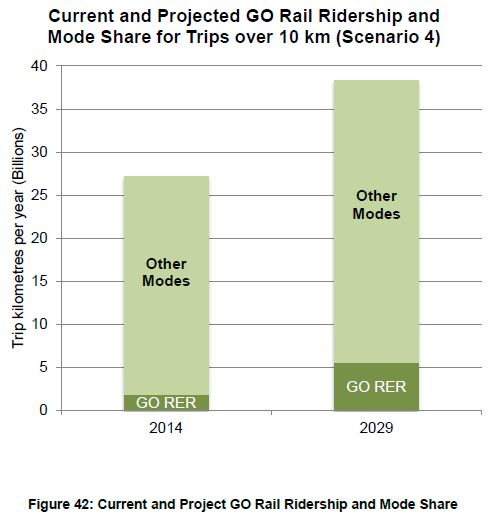
This chart would have been more useful if it included other transit modes and autos, but even as it is, this shows the relative scale of GO/RER growth versus transportation demand overall. Although GO/RER will roughly triple in the medium-to-long trip market, a rate much higher than overall trips, it will still be roughly one sixth of the total travel. The breakdown needs to be much better understood by market segment, and the importance of short trips must not be forgotten. The average TTC journey is under 10km, and so many TTC trips do not contribute to the “other modes” values above. Moreover, many of the “last mile” trips required for riders to access the GO system are short journeys on local transit systems.
On the financial side, the report presents a rosy picture of future profitability for the network. This is possible due to various factors including:
- GO’s existing fare-by-distance structure will generate more revenue as service capacity increases and infrastructure is better-utilized.
- Operating costs for the electrified network do not rise proportionally to the change in service level.
- The cost of capital debt service is not included as a charge against operations.
- Last mile services are borne by local municipal operations and is not counted as part of the GO/RER cost base.
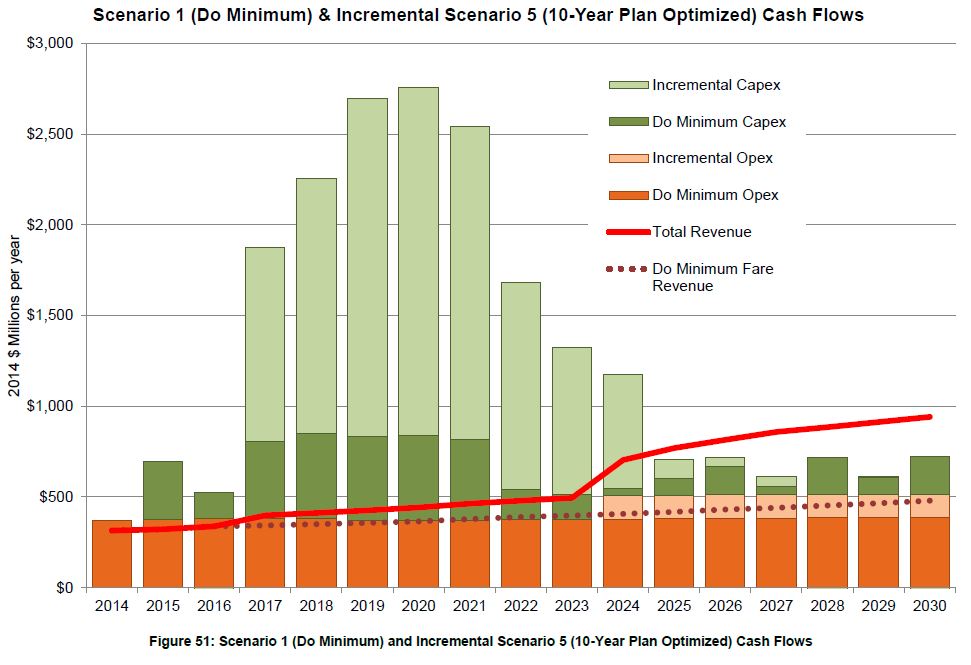
Whether this unexpected state, a transit service that actually shows a profit, is achievable will depend on many factors including political decisions about service, fares and subsidy levels, not to mention the basic task of simply building out the network to support the proposed level of service. As for local services, the report is somewhat evasive on additional local costs suggesting that all of these new GO/RER riders represent a market that might be tapped, and possibly even at no extra cost, by local systems. That really takes us into the realm of fantasy and shows the degree to which Metrolinx continues to avoid the delicate political question of subsidies to local systems. A further report on this issue is supposed to be in the works.
In future articles, I will turn to more details behind this study.
 Steve Munro
Why the question mark after nuclear? $30 billion of refurbishment and life extension projects are already in progress. It’s not going away, and will indeed continue to be the plurality of the mix in Ontario, with hydro second.
Wind only generates on windy days, but is used to offset use of natural gas. This isn’t some complex concept. The electricity generators have been managing inputs of renewables for a long time and they are proven contributors.
LikeLike
I did say “Modern EMU” trains. The older trains had one (under) powered coach and 2 trailers. It used old style DC traction motors which have much poorer tractive effort (accelerating force) than AC motors.
The reason for the extra time to travel from Oakville to Union is purely the Laws of Physics, which cannot be revoked. The maximum tractive effort that a locomotive can exert is about 25% of its weight when everything is optimal. Since this rarely happens it is about 20%. Newton’s Third Law states that acceleration is equal to mass divided by force (tractive effort). Since May of 1967 tractive effort has remained the same (but will increase with the newer MP54AC locomotives) while mass has greatly increased. The original low level coaches held 96 seated passengers in 10 car trains or about 1000 people. The new bi levels hold between 140 to 160 each so a loaded train has around 2000 passengers. I am doing a first order approximation so, please, don’t tell me it should be 1943 or some other number.
Because of the increased mass the acceleration is slower. Initial acceleration is limited to what people can tolerate and continues at that rate until it reaches the constant power point. This is the speed at which the tractive effort in pounds time the speed in ft/s divided by 550 equals the horsepower of the engine. Beyond this point, the constant power point, the tractive effort drops as speed increases because the product cannot exceed the hp. So as trains got bigger acceleration got lower and trip time increased.
The only ways to improve the time is to increase tractive effort and/or hp. Running 2 AC motored locomotives, one at either end, would more than double the tractive effort as you would have twice the weight on driving wheels and AC motors get an effective tractive effort of at least 32% vs 20% of weight. This would result in over 3 times the current tractive effort and better time keeping. Metrolinx does not want the upkeep on twice the number of locomotives but they are rebuilding some of the DC motored MP40s as AC motored MP54ACs which will put out 4600 hp of tractive effort.
The other way to improve speed is to run multiple units. Normally this is done with two powered cab coaches and 2 unpowered trailers in between. The power to mass ratio and the tractive effort to mass ratio are much higher which means the train can maintain its initial acceleration to a much higher speed before the constant power point is reached. With AC motors the slightly higher value of the constant power point from having all axles powered would yield only a marginal decrease in running times but would double the number of vehicles requiring the extra maintenance.
“The inability to shorten and lengthen GO trains was something built into them, it doesn’t have to be that way.”
I didn’t say that they cannot be lengthened or shortened, just that it is expensive and time consuming to do so. In the late 60s and early 70s GO used to do this. They usually did it at Mimico Station, though sometimes at Union, where they would have a short train parked. They pulled up across the platform from the short train, threw every one off the long train onto the short train. They only had 3 off peak trains so this was much easier to do.
All the connectors except the two power jumpers could be built into the couplers but they would still require manual connecting. As well as the four power wires in each cable there are also smaller signal wires to let the generator know that there is not an uncovered plug or cable. They are large enough to stick a finger in the female connectors and the male ends of the cable could easily be touched. When the cable is disconnected the main breaker opens shutting off all hotel power in the train.
EMUs get their hotel power from the overhead so there are no power jumpers between one 4 car set and the next. New EMUs would have better acceleration and braking rates than the current diesel hauled trains so would provide much better times on the trains that start and stop a lot. For trains with a lot of distance between stops locomotive hauled trains, either diesel or electric, are more cost effective.
If GO were to run 12 car trains with a locomotive at either either end and 2 cab cars as the 6th and 7 cars with couplers that automatically made the air brake, MU and communication connections while providing the necessary feed back for the brake test they could cut trains in half and re make them very quickly. They would not need the power cables as each half of the train would be powered by its own locomotive. They will soon have 65 or so of the old flat end cab cars which they will not need as cab cars. They could easily do this but they do not want the expense of running and maintaining the extra locomotives and cab cars required.
The Physics required to understand the acceleration calculations is taught in the Grade 11 Physics course, SPH 3U0. It does not require a university degree in engineering or Physics to comprehend. More people need to investigate the basic Physics of the system before making unfounded claims. I do have an engineering degree and taught Physics for 40 years.
LikeLike
Building too much too quickly basically means you won’t have time to learn and adjust as you go. Look at the track record, the UPX and Union Station upgrades were terrible and expensive. A society doesn’t go from not planning much public transit in decades to suddenly being expert at it. Good transit around the world grew slowly and towns and cities grew with it. It’s conflicting info when I hear to turn of one or two extra lights off at night to save energy but it seems ok to run half empty trains on electricity. Hydro has definitely gone up, and the question mark on nuclear is , what is the cost? Nobody knows the future costs of diesel or electric. Most original countries electrified because they had cheap electricity (hydro or coal) or poor access to diesel fuel or ran in tunnels alot. Montreal runs electric trains primarily because of the tunnel, so does New York City. This does not apply near Toronto. I still say focus on service first, it needs improvement.
Steve: I’m not sure I would agree that Union Station’s upgrade was “terrible and expensive”. What would you have done instead?
LikeLike
For one the train shed should not be a National Historic Site because it essentialy is a ball and chain for any suitable upgrades at such an important transit hub. It just becomes another reason not to string wires thru Union or altering the track layout to something simpler or better. The UPX should have been closer to the GO platforms for easier and faster transfers. But I really think they should have reduced the amount of tracks to 7 or 8 with wider platforms and wide stair cases for faster unloading and boarding. Remove the slow puzzle switches and replace them with 45mph hi-speed switches in a simpler layout. With wide safer platforms the track speed thru the station should be 45mph so trains can arrive and depart quickly (grand stand in and out), as if it was just a stop at Clarkson Station.
The layout could be inspired by stations in Holland and Sweden for example where they have cross-overs in the middle of the station so shorter VIA and UPX trains can get around each other on the same long platform. Simpler, faster, layout basically with wide platforms and stairways. Today getting off a GO train and working your way thru narrow places is terrible. Why run faster trains out on the line if you can’t get to or from the train at the train station very quick? Even access to the relatively new bus area is confusing to many people I’ve noticed.
Steve: I agree with many of your points especially about simplified routings and fewer, wider platforms. The big cost at Union, however, would remain to create the new double-height concourses and waiting areas.
LikeLike
The only way to improve service for many people is to make it faster and the only way to do that on the inner ends of LSE, LSW and Kitchener is to electrify the parts that the province owns and run EMUs, especially if more stations are going to be added. Once these trains are electrified the service from farther out can run express with diesel locomotives, speeding them up also until electrification can be added.
Building an electric train system with EMUs is not something new. It has been going on for many years and there really is not much to learn. While UPX is a disaster, it is not a traditional service but something that was originally supposed to be run “at no expense to the taxpayer” by a private, unnamed company. The federal government, who controls almost all mainline rail corridors told GO that they would have to accommodate this service so there was a real expense to the taxpayer. When the private company saw that they could not make money running it, the province and Metrolinx took over the project and continued to use the bad design of the private entity. UPX is a result of Metrolinx and the province letting their ego get in the road of good planning. Hopefully they will rely more on the rail planners in the GO rail division and the many competent consultants out there and not let their egos cloud their judgment
LikeLike
Robert,
I’m looking at this primarily from the point of view of a passenger and potential future passenger, and secondly as a tax payer and house owner. Most passengers consider on time as service. As for faster trains what really matters is a faster average speed for the whole trip. That means faster transfers, faster enter and exit, stations closer to where people need to go and faster ticket sales line ups.
Also there are other perhaps cheaper ways to increase the average speed of a train other then pure electric horse power. Of course there is smaller or lighter trains with the same locomotives, or just put two locomotives on like they do sometimes. Also in Europe late and hard braking is a technique to increase the average train speed even with under powered locomotives. Not all European trains are sexy high powered electric trains.
I do know that passengers are not going to be happy to one day hear that the train is delayed due to ice on the wires or wires down due to wind. My other concern right now about electric trains is that the electric car may be around the bend and add that will there really be enough electricity to go around? If electricity was plentiful and cheap for everyone I’d think MAYBE GO trains should be electric.
Steve: Electric cars will do most of their charging at night when there is lots of spare power in the grid. As for wiring and weather, there are may northern countries filled with electric trains. GO has at least as big a problem with snow fouling switches, and that’s got nothing to do with motive power.
LikeLike
Robert: Thank you for your detailed explanation of acceleration, tractive force and the use of EMUs.
About 100 years ago Sir Adam Beck developed a scheme he called “Radial Railways”. Part of his rational for doing so was to “consume” an over-supply of electricity that he had created through the use of hydro principally from Niagara Falls. Today there are 35,000 Megawatts of of generating capacity in Ontario. The current and forecast demand is in the neighbourhood of 22,000 to 25,000 MW. We have an oversupply of electricity in the province of Ontario. Is the proposal to electrify railways a throw-back to days of Beck and his over-supply situation?
Steve: No, but the numbers you cite certainly show that GO is not going to be responsible for any brown-outs.
A related issue is distribution capacity and the ability to serve new densely populated areas. That’s why Toronto Hydro has built a new station in the heart of downtown.
LikeLike
You want faster trips with faster average speeds and stations closer together. Those are conflicting requirements. More stations equals more time accelerating, decelerating and boarding. That increases trip time and decreases speed. EMUs can compensate for some of this but it can’t be done with locomotive hauled trains.
What transfers do most GO passengers make as they drive or get driven to the station and then walk to work? Fewer than half take transit at either end.
Why do you have line ups for tickets? Most people use Presto and it can be reloaded automatically. You seem to be inventing excuses not to electrify. Union station is a problem for entering and exiting.
I agree with you statements about the platforms at Union. Many of us have been advocating for fewer wider platforms and the elimination of those awful double slip switches but Metrolinx just spent many millions of dollars to completely rebuild the 8 sets of them. Leave all the tracks in up to the station so that trains have a place to sit if necessary for a couple of minutes to let other trains clear but eliminate platforms 3, 6 and 9 and tell VIA to make do with the rest. This would mean that every GO train would have a much wider platform to unload that could have much wider stairways but Metrolinx in its wisdom decided to rebuild the existing monster. The tracks and platforms are not the heritage part, it is that god awful train shed which could have been kept with fewer platform. If GO assigned all trains to a consistent set of platform the need for the slip switches could be reduce and a few high speed crossovers would have sufficed as you say. On this we are in full agreement.
If the wires are down due to ice and snow, which would probably be the main power lines rather than the overhead which is much sturdier then the trains would not be running because there would be no power for the signals and switches. This has happened before. Pantographs and catenary run in places with much worse winters than Southern Ontario.
This might be true if you live on the inner parts of the GO lines but many would like to have a seat and spend less than 2 hours commuting each way. That requires more and faster trains which basically means EMUs so that more trains can operate faster on the inner portions.
The problem with running these is getting TC to accept them. It will probably be allowed on track that Metrolinx owns and controls but not once they get onto CN and CP tracks. Putting on two locomotives would greatly improve acceleration rates but it is not liked as it increases maintenance and operating cost greatly.
It is one way to help but the amount of time spent slowing down is less than spent accelerating and hard braking increases maintenance cost and can bother passengers. Unfortunately GO has built so much slack into their schedules that trains often sit at stations long after they have loaded up so that they don’t depart early. If GO changed its schedules to reflect something close to actual travel times and put the slack at the end of the trip very few would complain if they were consistently arriving early.
Why are you so set against electrifying the lines? It will have an initial capital cost but will greatly reduce operating costs. It is similar to the decision to buy a high efficiency furnace for more money and save on fuel costs or buy a cheap furnace and pay more for heating. I believe the time has come to start electrifying.
LikeLike
To my mind there is one reason not to electrify, that is the capital can be used to greater effect elsewhere. So if there is lots of capacity left with diesel, and the stops are manageable, does it make more sense spending the money to reduce the portion of people driving, including to the station. Does it make sense to improve transit at the other end, or perhaps more to the point other stations, so the majority of GO passengers actually do ride transit at the other end. Not by reducing the number that walk to work, but by using transit elsewhere to make GO more relevant to trips that do not have as a destination the core. Lakeshore is a no brainer, but, well, other lines are not so clear to me. The early on the high capital cost might be better spent, on say LRT that serve a couple of the GO stations.
Electrify eventually, is the capital payoff there, very likely, but well, there are a whole bunch of things that are needed, and it is not clear, that 5 lines justify electrification, although 2 certainly do.
LikeLike
@ Malcolm;
There is not much sense in improving transit to GO Stations if the GO system Cannot handle the extra riders. Besides most stations are in locations that makes transit service difficult. There are some like those on the Lakeshore Lines and Kitchener that have decent transit service but many are in the wrong location. There are some town, like Georgetown, that will not have a public transit system because it encourages “those people” to move there.
I also think that Kitchener to Bramalea, to start, and eventually Mt. Pleasant need electrified service now.
LikeLike
I’m not completely against electric trains but I’m not against diesel trains either. But I have become more suspect of the ability of the railway institute being able to get this big project done right with no previous experience in electric trains. I think I’ve already given many of my reasons like tunnels, grades, supply costs as reasons to or not to electrify. I believe in service first and foremost, technology is secondary. Also if GO Transit does electrify I sure hope they choose the same system as Montreal did, because if ever VIA electrifies between Toronto and Montreal you want the systems to match. Electric trivia question just for fun; German and Swiss railways use the same unique voltage and frequency but are still NOT compatible for good reason, but why not ??
LikeLike
Unfortunately a change in technology is needed to get a major improvement in service. Faster service is going to be necessary and that requires a new technology and electric is probably the cheapest in the long run
All mainline electrification will be done at 25kV Ac and 60 Hertz. Exactly the same as Montreal.
Both use 15 kV 16 2/3 Hz AC but the Swizz use narrow Pantographs. If you could mount both types of Pans on a locomotive then you could probably operate on both.
LikeLike
Trains traveling over the couple off kilometers of track closest to Union Station slow down to bicycle speed. It has been a grave weakness of GO Trains, and will be a weakness of UPX, and that stupid SmartTrack — if it is ever built.
So, these high-speed switches, let me guess that where a yard switch that can be used at slow speed only takes a couple of dozen meters, the high speed switches require a much longer distance, so the vehicles traveling over it experience it as a gentle curve?
The SkyDome, CN Tower, and all those condos built on former rail-lands — are they built on rail-lands we should have continued to devote to rail, if we planned to have high-speed switches on the approach to Union Station?
LikeLike
@ Articdriver
The “high speed switches” used in Canada are good for 45 mph, limited speed. They are a number 20 switch; the distance from the point of the switch to the frog is 20 times the track gauge or about 86 feet. Once you get to a number 22 or higher switch the angle at the frog is too small for the wheels to negotiate and you need to use movable frog switches (also called movable diamond switches.)
All the switches on the Halton sub except two, the one at Aldershot Yard where the VIA train derailed at 56 mph and the one at Silver Junction where the line to Kitchener diverges from the Halton Sub at Georgetown are #20 switches good for 45 mph. Those two are either #6 or # 8 and are only good for 15 mph. See Wiki.
The double slip switches in USRC are, I believe #6s, only good for 15 mph or slow speed in the operating rules which is the speed that a single yellow signal allows you to pass at. Medium Speed, flashing yellow usually, is 30 mph and limited is 45 mph, flashing green but there is no common sense to railway signals in North America. As one British rail fan site puts it: “It ain’t red unless it’s all red.” Straight Green usually means track speed if it is alone over over red(s). Green over Yellow usually means something less. See rules 404 to 439 of the Canadian Railway Operating Rules.
So in a simple statement yes the USRC throats are maximum 15 mph, all railway speeds are still in mph and not km/h. If they had gotten rid of the double slip switches and rationalized the throats to Union they could have used switches good for at least 30 mph if not 45, but Metrolinx wants to run a railway service and not a useful transit service.
LikeLike
Right!!! Good one Robert. You can’t use one kind of pantograph. Too narrow (Swiss) and you will miss the outer extremities of the German wires. Dual pantographs are an issue. But the Swiss need narrow pantographs to fit tunnels. The German system is too large and efficient to compensate and altho some Swiss tunnels are being widened it’s not system wide. The point in case is do our leaders know what they are doing in every detail? Are they gonna stick us with an excuse for an oversight?? That is the history of our government arms. I can give another example where Denmark chose a “better” voltage and frequency than its neighbouring railways only to see diesel trains run thru just to avoid locomotive changes and delays to try to stay truck competitive and lost. Many passenger trains (DMU) still run the length of the electric main line just so they can reach unelectric main stations since 1985! Electrification can be done right, but will it be?
LikeLike
@ 383on the tree
I guess that we shall have to agree to disagree. If we were too afraid to try something new there would still be Witt trains on Yonge Street instead of a subway under it. Hopefully the Government through Metrolinx will build with proven technology and not try to invent something new like Presto or SRT. This is my last comment on this thread as be have thoroughly beat this deceased member of the equine family. Hopefully it is not a member of the ferro equine variety.
LikeLike
The problem with this Robert is that if they actually started to address this type of issue, it would increase the capacity of the USRC beyond the point where the platforms would be the prime issue, and then the fact that they were not willing to spend the money to rethink the platform layout etc, would be revealed.
LikeLike
Ah. Thanks very much for the detailed reply!
86 feet is much shorter than I imagined. Does that mean if the existing paths that spread the incoming three or four tracks out to a dozen platforms was rationalized, it could still be fit within the current footprint of the current existing tracks?
LikeLike
From Google maps the west end yard throat is about 650 m long and the length of the slip switches from south to north track is about 400 m. The length of high speed crossover from one track to the next appears to be 110 m. The length of the two crossovers that go from track A to B and then from B back to A is about 250 m. This means that it would be impossible to put in enough high speed crossovers to make it possible to join all the tracks. The length of a #6 crossover appears to be about 65 m to get from one track to the next.
In order to get from track A to B then from B to C you need a straight section of track between the two switches longer than the longest car. If you want to be able to get from any track to any track at Union you need the special sets of double slip switches. The question that should have been asked is if this is absolutely necessary. If they set up set routes that minimized the need to change tracks they could have reduced or eliminated the need for this complicated special work. They did not and this means that the trains from west of Bathurst to Union need to operate at about 10 to 15 mph. The problem is also complicated by the need to get from the two storage yards on the north west and south east side of the USCR to any track in the station.
Metrolinx rebuilt Union as a mainline passenger station instead of a modern rapid transit commuter rail station. Perhaps there are existing rules that forced them to do this.
LikeLike
Some obvious clarification:
The way SmartTrack was originally marketed by Tory as may have been stupid/deceptive in many points of view, but today SmartTrack is simply an EMU-ified GO train route.
But SmartTrack as it’s actually implemented — simply enhancements to RER — is actually relatively smart, as long as the Eglinton section is simply an Eglinton Crosstown West extension. Tory’s fine with this apparently, so let it slide — it’s headed into a properly smart SmartTrack now.
As of right now, Appendix A that Steve Munro linked to, assigns the less-performing electric locomotive driven BiLevels (but better performing than today’s diesels) to Lakeshore East/West, but gives the powerful EMUs to the Bramalea-MtJoy routing, while short-turning most trains at Unionville (3 out of 4). It says so in the PDFs. That’s the “SmartTrack” 15-minute routing, driven by identical trains as RER! But these exact same “SmartTrack” EMUs (just ordinary electric EMU GOtrains) are also going to Stoufville/MtJoy hourly via the common short-turn technique at Unionville, to achieve 15-minutes versus 60-minutes beyond. It’s actually rather clever how RER/SmartTrack is exactly the same thing now.
TL;DR: Today, there’s no difference between SmartTrack and RER on the Bramalea-Unionville route. Stop believing in the outdated SmartTrack marketing.
LikeLike
VIA wants to begin electrification construction before the end of this decade!
Globe and Mail VIA HFR
The $4bn plan includes $1bn for electrification!!!
Mr. Desjardins-Siciliano mentioned these pension funds as already-interested investors:
* Canada Pension Plan Investment Board
* Ontario Municipal Employees Retirement System
* Ontario Teachers’ Pension Plan
* Public Sector Pension Investment Board
* Caisse de dépôt et placement du Québec
Does it make sense? Of course it does, just look at the Canadian ownership of some of the European high speed rail lines:
* Eurostar is 30% owned by Caisse de dépôt et placement du Québec!
* And the UK HS1 concession was given to Borealis Infrastructure (part of Ontario Municipal Employees Retirement System) and Ontario Teacher Pension Plan.
Related note is VIA wants to begin construction on electrifying Toronto-Ottawa-Montreal. This could connect Metrolinx’s and AMT’s electric networks, and probably accelerate Bowmanville electrification (RER to Bowmanville) given the overlap.
VIA wants this shovel-ready by 2017 and running the initial trains by 2019. This is unrealistic, so I would say 2025 — the same time as GO RER.
Electrification is looking mighty interesting!
LikeLike
Umm…(knocks).
This is still the plan.
Presenting RER Business Plan (p165 of PDF, or p149 labelled)…
They’re going to do it, they delayed this until they’ve finished the Union shed & figured out how to run catenary through Union.
LikeLike
This is a very rational thought, but I would submit that the push for electrification is very irrational, or at least to combat irrationality. Look at Weston and the Clean Train Coalition. While even “dirty diesel” is better overall compared to private cars, there is huge resistance to increasing service without also “going green”.
Operationally, there isn’t much difference between diesel and electric due to the combination of dwell times and time at peak-velocity. The fancy dream of train coupling-decoupling could just as well be done with DMU as EMU (I see it as a dream mostly due to the need for additional drivers and infrastructure changes).
What’s needed is to separate the service level requirements (grade separations, double/extra tracks, etc.) from the fuel-type requirements (catenary, grounding/bonding, utility relocates). Overall, electrification is cheap, but it’s being used as a political lever to get all the enabling works in place.
While Lakeshore West and East have the most ridership, they are actually the lowest by riders per weekday trip. This is a combination of the others being capacity constrained and Lakeshore operating extended service. Looking at peak-hour riders-per-train, the order of justification would be:
Lakeshore West, Kitchener, Milton, Lakeshore East, Barrie, Stouffville, and Richmond Hill. Milton isn’t being electrified at this time due to CP and Richmond Hill needs extensive work. Richmond Hill was always on the bubble.
That’s the split between system needs and political realities. CN is willing to discuss segregated operations on an expanded corridor, but the enabling works and political machinations means that it won’t be done in “Phase 1”.
The experience rests with the consultants, not the Rail Authority. In this case, that would be Gannett Fleming with particular experience with New Jersey Transit. The cost for tunnels, grade separations, etc. are not related to electrification, but service level.
Both would use 25kV ac, 60Hz systems.
Exactly, but to be a bit more specific, a #12 switch (28mph) is 20’4″ from Point of Switch to Point of Frog, while a #20 switch (51mph) is 30’10.5″. On 14′ centres, that means a #12 switch is fouled for 64’1″, while a #20 switch is fouled for 105’2″.
There are 9 tracks to the west-end of the USRC before the double slip-switches (at Peter Street/Blue Jays Way). This expands to 16 tracks at Union Station. The North Ladder 2 track is capable of going from Track B (1) to Track 13. The South Ladder 2 track is capable of going from Track C1 (4) to Track 15. The North Ladder 1 track can go from Track D1 (6) to Track 1 and the South Ladder 1 track can go from Track D2 (7) to Track 2.
There is new work planned to improve operational efficiency of the southern tracks, which previously had been more or less dedicated to by-pass services. The RTC plan is to have more or less dedicated tracks and platforms for each corridor to minimize use of the switches, but first we need two-way service to avoid trains being parked in the Bathurst North Yard and to a lesser extent the Don Yard.
LikeLike
Lakeshore to me is a no brainer, east and west. However, the number of trains currently on Kitchener lines appears to me to be able to be hugely increased without electrification. Peak hour now is what 4 trains. So could we not double this and still have more room. I am merely making the argument, that we should start on Lakeshore, and re-task the equipment we free up. Track improvements first, to support many many more trains, and revisit the switches and platforms in the USRC and at Union, but well, keep the roll out targeted so each new dollar, has a real impact close to when it is expended. The province has not an extra dime allocated to transit, and the budget is tight every year. Yes, electrification will be required on Kitchener, but well, I think that is something more than a few years away. Service added here, will draw growth along this line, and will build the case. However, a lot of buses to the stations, would be required before the number of trains that could be run without electrification (I am assuming other track improvement will be done) would be full.
LikeLike
There are numerous parts in motion that impact the priorities. First off, there is a TPAP already completed for the electrification of the UPX corridor. Generally speaking, corridor expansion environmental assessment is premised on increased service with cleaner trains (Georgetown South/Weston subdivision was Tier 4 Diesel). There is a real feeling that unless there is substantial construction underway by June 2018 that RER and electrification can be axed without too much regret, so Kitchener gets the ball started with the first round of TPAPs doing Lakeshore West and the stub between the Pearson subdivision and Bramalea GO.
LikeLike
I am hoping they are able to come up with a unified 4-coach EMU used for both UPX and Bramalea-Unionville/MtJoy/Aurora RER. Many of the documents allude to 4-coach EMU trains that can automatically join up into 8-coach and 12-coach, which I’ve mentioned in an earlier post, too. UPX could theoretically run with 4-coaches with some manageable station modifications.
On the UrbanToronto forum, there’s been anecdotes from a well-known construction manager/photographer guy (drum118) that he’d been asked to investigate how the UPX station may be extended to 4 coaches.
Assuming platform heights are compatible, it might be a good way to further merge UPX/ST/RER into a unified-trainset service. The writing was already on the wall, I’ve already written about this in the past, but they’re apparently actually investigating trying to include UPX.
If it succeeds, it’s looking awfully a lot like Paris’ RER-B with its airport spur.
LikeLike
I did use the word “eventually.” Bramalea from a customer point of view is a stupid place to end the service. From the fact that CN owns the track west of there it makes sense. So electrify to Bramalea to start with but hopefully get the extra track(s) through Brampton to allow further electrification.
Can I ask where these numbers come from because everything I have read has greatly different values? A BNSF document I have read says that the distance from the point of the switch to the 1/2″ point of a #15 switch is 111′ 2 3/4″. I thought the simple version of a switch number was that the deviation from the straight line was 1 unit sideways for every switch number of units ahead for the switch number, or a # 20 turnout would be 20 time 4′ 8 1/2″ or about 86 feet. Your values seem less but other values that I see would tend to be more. I am totally confused.
@ Mark Rejhon;
This is still to my original point; if they were going to do this why did they waste $25 million rebuilding all the double slip switches if they were such a problem to running faster service. They might need to keep one set each way but two? They have wasted a lot of time and money rebuilding something that is a problem, and still the maximum speed in the west is only 30 mph, but it is better than 10 to 15.
They finally recognize that narrow platform and slow approaches in the USRC are a problem. It seems that they found this out after wasting a lot of money rebuilding an outmoded system.
The platform heights are not compatible and will never be without a lot of rebuilding.
LikeLike
I would agree, it is much more important that we get the tracks for highly frequent service to Brampton GO.
LikeLike
Can they actually add trains to Milton? Is this still not CP line, and they need to negotiate with CP for slots? Is the limit here actually going to be helped by anything that Metrolinx can actually do?
LikeLike
It is still explicitly mentioned as a possibility in Steve Munro’s links. Picture the scenario of 4-coach EMUs with automatic joiners.
Coming into Union in the pre-peak and joining up, and departing as a single 12-coach, all still with drivers in each 4-coach consists to later uncouple at the end of the route to return to Union. Drivers would not need to leave their consist (joined or not).
The reason is you want to preload Union before peak, so you can take advantage of accelerated train output from Union without incoming trains interfering.
LikeLike
It is often cheaper to keep the drivers in each 4-coach consist even when joined as they are just deadheading to their postpeak positions.
In the PDFs that Steve Munro linked, it explicitly says some routes will run 4-coach and 8-coach EMUs off peak. And you are “complete train” throughput limited, at something like 49 trains leaving Union per peak period (post-USRC-upgrade). What are you going to do with offpeak 4-coach and 8-coach EMUs as peak begins, and the corridor starts to get train-throughput limited? Every train leaving often means a train cannot come in. Might as well reduce congestion by joining coaches (pushbutton automatic joiners) even if you keep the train drivers in each to then unjoin again at the end of the route. Still cheaper that way than today’s split shifts (crazy, ain’t it).
LikeLike
True, but with possibly more than half of EMU stations not existing yet, and given the EMU route overlaps the potential HSR route, there is theoretical opportunity to standardize to a 48 inch platform on the Bramalea-Unionville route.
Also, HSR is high platform too — with the theoretical Pearson GO/HSR station (rebuilt Malton or new Woodbine RER station, either using UPX at Woodbine or a rail-based LINK II extension at Malton that connects it to all terminals). The ongoing HSR study includes a Pearson stop, which I assume requires rebuilding either Malton or adding an infill near Woodbine Racetrack. And then utilizing either UPX or extending LINK (if upgraded to a faster version) as the airport connector.
EMUs aren’t going on the Lakeshore route in the Option 5 scenario — see Appendix A linked. So less rebuilding. It would be a big mess though, with the need to incrementally modify the existing stations and only being able to open half of the coaches or so during a transition period, since you have to cannibalize the low platforms for the longer high platforms, at places like Bloor and Weston. But does not altogether seem to be completely ruled out (yet).
That said, we aren’t sure yet. It probably will not be compatible, I agree. But, not done deal yet.
LikeLike
Who says that the HSR trains are high platform? Some are high platform but the ones I rode in Europe, France and Italy, were not high platform, higher than are VIA ones but definitely not 48″ high platform.
LikeLike
It is interesting to visits GO’s web site, especially the page for the latest construction updates. According to their list of stations the only station for trains is the Hamilton GO centre on Hunter Street, the old THB station. They do say that there is construction at the West harbour Station.
The Bramalea Station is apparently having its North Platform rebuilt and extended to 12 cars long but there is no activity happening on. The south platform is being totally rebuilt with new shelters and a heated platform which is what is claims is happening to the north platform. The north platform will be finished by the summer of 2017 apparently though they have not even started work on it. Given the speedy construction on other projects I will believe this when I see it.
Burlington GO station has been under construction since 2012 according to the website. It will apparently be finished this summer. Clarkson’s parking garage started in 2012, was opened in 2014 and will be finished this summer. Metrolinx certainly likes to take its time with construction. It seems that whatever GO does takes a very long time.
LikeLike
HSR? Hamilton’s transit system retains the name it had when it consisted entirely of streetcars — the Hamilton Street Railway. But I figured you mean something else…
I’ve got it! High Speed Rail?
LikeLike
The biggest drawback to the 4/8/12 idea is staffing. The second drawback is the relative amounts of passenger space to conductor space, which basically is a 9% reduction in peak-capacity (assuming each coach position is one quarter of a car). Third, running 4-car trains to the airport is capacity overkill.
I’d just reduce UPX to every half an hour and leave it as-is.
Steve: There is also a question of train length constraint at Airport Station.
They are from the Metrolinx Design Requirements Manual and CN special trackwork drawings. GO allows switch speeds that [are] higher than other places.
The 1 to # rule is a great rule of thumb, but there are many real-world complications. The frog has a minimum width of 0.5″ and the point follows a spiral. Basically, it’s double PS to PF plus separation times tangent of angle of divergence.
To illuminate part of the thought process, not all the $25 million went into just the double-slip switches (an investment that can be recuperated later) and the other part was viewed as a temporary solution that maximizes train operations between then and ~2025-2030, when all-day service would remove the need for storing trains in the USRC.
It’s a black box of secrecy, but it’s actively known at 20 Bay that Metrolinx is actively negotiation with CP for the Galt subdivision (rumours range from outright purchase to parallel, but separate (like Weston/MacTier, Galt/Weston, or Kingston/GO), from dedicated tracks to enhanced timeslots).
There is a large disconnect between Metrolinx Planning Group and GO Operations Group. Just because a consultant put it in a conceptual report doesn’t mean it will survive to be a reality.
GO doesn’t actual like the 4′ platforms due to safety concerns of people falling and being ‘trapped’ at track-level.
The contractor at Bramalea is at risk of being terminated. On a positive note, Metrolinx now is tracking job quality company-wide and can blackball the consistent bad-performers (two spring to mind that if you say you have a problem on your project and name that company, others will automatically understand your position).
There are twin issues: scope creep and add-ons. The internal structure at Metrolinx previously had parking and stations as different divisions, so one would go in and build a parking structure, and then the other might go in and build a new station building (Burlington). So long as you have boots on the ground, it’s easier to get an extension of funds (or use a cash allowance) than to fight for a new project.
Steve: The mind boggles at the “organization” that is Metrolinx.
LikeLike
Well parallel tracks would certainly reduce that issue, however, even then the loading of the trains could be addressed by more trains, prior to electrification. I would think, that converting this to more frequent, all day service, would attract a substantial increase in ridership, and have a notable impact on development along its line. It would also justify greatly improved 2 way local transit at places like Streetsville and Meadowvale, and of course places like Cooksville benefiting from LRT.
LikeLike
The real problem with the CP line is crossing all traffic over from the north western side to the south side towards Union against a major freight line. I always thought that the TTC subway ducks under already, so extend that line further west. Or cut the TTC line off at Islington Station like it was at one time and run the GO main line thru the underpass and run faster longer distance single decker trains further out to Milton or beyond. Possibly a cheaper solution then the plans I’ve heard of. Single decker trains make cheaper fly-unders.
LikeLike
What exactly are you talking about? Do you want to get GO trains from the North Side of the Galt sub to the south side without actually running on CP tracks assuming that GO gets to build a parallel set of tracks? If so why not do it with a flyover in the old Lambton Yard? No GO train would be able to run through the TTC tunnel between Kipling and Islington because of the curves and limited vertical clearance even if you could cut it off from Islington Station. The height is too low for overhead or locomotives so were you planning on running third rail to Milton. The TTC uses 5% grades in a lot of areas and GO does not want anything over 2% on lines that are strictly for its use.
You have to explain what you are describing better.
LikeLike
LikeLike